



Abstract
Organizing vision (OV) theory, developed more than 25 years ago, posits a broad, diverse, and collective envisioning process at the heart of information technology innovation and diffusion. We revisit the theory and review more than 150 publications that have referenced the original paper, seeking to ascertain how the theory has been found useful in addressing innovation with information technology. We group and analyze these contributions according to how the promotion, reception, and enactment of organizing visions engage participants in bringing about change. In our review, we find that a varied group of some 46 technologies and their OVs have been studied. We consider how these contributions have also drawn from and spoken to related theories, topics, and literatures, finding that the influence of OV theory has largely been confined to the information systems field. Looking to the future, we address: (i) whether newer technologies in the changing digitized world are problematic for OV theory; (ii) how the overall engagement mechanism comprising promotion, reception, and enactment can be more deeply understood; and (iii) how OV theory can speak more effectively beyond traditional IS disciplinary bounds. Building especially on the more recent contributions, we propose a reimagining of the theory with which to guide its continued development and application.
Introduction
There is sometimes good reason for scholars to revisit their earlier work. In a recent article, the sociologists Woody Powell and Paul DiMaggio reflected on their landmark paper, “The Iron Cage Revisited,” published some 40 years ago (DiMaggio and Powell, 1983), offering thoughts on its origins, development, publication, reception, and vast influence (Powell and DiMaggio, 2023). Of the many thousand citations their paper has received, our own paper, “The Organizing Vision in Information Systems Innovation” (Swanson and Ramiller, 1997), provided one of them, as our theorizing, specific to our own field, Information Systems (IS), drew heavily from it. Now, much like these authors, more than 25 years later, we find it timely to revisit our earlier work.
In their 1983 paper, DiMaggio and Powell had addressed how, in the diffusion of innovations, organizations come to resemble each other through a process of institutional “isomorphism.” Now, in their revisit and assessment of diffusion research, they concede that their 1983 paper had evaded the question of what exactly was being diffused, namely practices. They conclude that even now: “The challenge for diffusion studies is to understand better the mechanisms of adoption and how newly adopted practices mesh with existing organizational practices, structures, and values” (Powell and DiMaggio, 2023: 14). Reflecting on this remark, we were inspired to revisit our own earlier paper (Swanson and Ramiller, 1997). It struck us that where new practices involve innovation with information technology (IT), our own work and that of many IS scholars has for decades focused in various ways on just such “meshing,” and that collectively we now know a good bit about it. Or do we?
Practices are the routine activities of individuals in organizations (Powell and DiMaggio, 2023: 12). While it might not be immediately apparent to those unfamiliar with organizing vision (OV) theory, the notion that it is the diffusion of practices that requires neo-institutional explanation resonates strongly with our own viewpoint, granting that we have focused on the change brought about by innovating specifically with IT, as distinct from innovating in other ways, with other technologies or with new management methods. (The term “neo-institutional” characterizes a wide range of research giving institutional explanation to organizational change, as with innovation. Powell and DiMaggio (1991) elaborate on the contrasts with earlier work on institutions (pp. 11–15). See also Scott (1995). Alvesson and Spicer (2019) offers a recent critique.)
Back when we undertook it, our work sought in particular to articulate a mechanism of adoption and diffusion of new IT in its characteristic organizational application. It addressed what might be characterized as a quintessential research question for the IS field: why and how do innovations with IT originate and diffuse among organizations? It posited that the envisioning of such innovations as worthy new technologies fundamentally drove the process of adoption and diffusion, and thus corresponding change in practices. The OV was theorized as the product of this envisioning.
Since its publication, our 1997 paper has received some 1100 citations (according to Google Scholar as of February 2024), a substantial if not large number. It is recognized as a significant niche contribution to the IS field more broadly, though a careful review of the theory’s subsequent development found that it was “still a teenager” some 20 years later (Kim and Miranda, 2018). In reflecting on this, we were at first merely curious. Now, more than 25 years later, how have other scholars found OV theory useful and worth citing in their own work, whether they have added to the theory or not? What new connections in the research literatures have been forged? What has been the collective contribution to date and what might the future hold? We address these questions in the present paper. We report our findings from our review of the OV literature and offer new insights into how OV theory has been usefully applied since it was first articulated. Further, we discern a “reimagining” of the OV as theorized to account for certain transformative changes in innovating with IT over the years, which have given rise to the new digitized world in which we all now work and live (Yoo et al., 2012). Perhaps somewhat surprisingly, the OV concept has proven to be adaptable in explaining aspects of this transformative change, beyond the bounds of its origins.
In what follows, we first present the background for our revisit of the Swanson and Ramiller (1997) paper. We recall its origins and then recap the OV theory itself, as presented at the time. We then review and summarize subsequent contributions to OV and related theories with references to the original paper. We follow with discussion of the various influences associated with this collective work, both on and from those contributions, across theories, topics, and literatures, and we suggest future research directions. We conclude with a brief reflection on the undertaking of the present paper and what we have learned from it.
Background
In revisiting the 1997 paper, we first speak briefly to its origins and development and then summarize the paper itself.
Origins
Our 1997 paper had its origins in Swanson’s developing interest in information systems innovation and his paper, “Information systems innovation among organizations” (Swanson, 1994), in which he ventured to theorize beyond his prior work. In that earlier work, the analysis had presumed that the organizations studied acted independently of each other, for example, in the IS maintenance of application software portfolios (Swanson and Beath, 1989). Such a presumption would be wrong-headed in the case of an innovation’s adoption and diffusion, where each successive adoption might be influenced by those that went before.
Ramiller began his doctoral studies at UCLA’s Anderson School in 1988 and worked with Swanson from the beginning. Both had developing interests in theory that might inform the diffusion of IT innovations. Institutional theory (Zucker, 1987) was especially appealing. Both were attracted in particular to DiMaggio and Powell (1983), which posited three isomorphic processes—coercive, mimetic, normative—leading paradoxically to organizational similarity under innovative change. All three of these processes would come to underpin our own account of how an IS innovation, in particular, might be embraced, or, alternatively, fail to gain traction in adoption.
Both of us had also delved into Weick’s work on sensemaking (Weick, 1995). Ramiller’s prior studies in cultural anthropology and philosophy (especially phenomenology) directed his own interest in this work. In the meantime, Swanson’s interest in sensemaking from talk had been provoked by a large local conference gathering to discuss what IBM had termed “information centers,” as the Next Big Thing (Fuller and Swanson, 1992). As Swanson recalls, likely in 1992 (not remembering exactly when), he had some preliminary ideas for a paper that he sketched and then invited Ramiller to lunch at the Faculty Center to propose a collaboration.
Development of the paper took a while, given other commitments, with a lot of thrashing around and rewriting. It was eventually submitted in October 1994 to Organization Science and to Gerry DeSanctis, who served as the OS editor for IS submissions. It underwent two revisions before its final acceptance in July 1996. In her letter to us, Gerry penned an added note: “This is a sure hit! Thanks for giving me the opportunity to serve as editor.” Such a warm endorsement is of course rare and we were understandably pleased to receive it.
Nevertheless, if the paper was indeed to be a hit, it was not apparent to us upon its publication. Except for one preview of our work in process (Ramiller and Swanson, 1993), we had not laid much groundwork for it in conference or other presentations. And we had placed it in a journal not subscribed to by most IS scholars. Citations to our work would be slow in coming.
Wang began his doctoral studies at the Anderson School in 1999, and also worked with Swanson from the beginning. He quickly became a collaborator in OV research with both Swanson and Ramiller. His paper, “What drives waves in information systems: The organizing vision perspective,” presented at ICIS in 2001, would be one of the first to bring the OV concept to broader attention (Wang, 2001). A paper presented at AMCIS by David Firth, also an Anderson doctoral student, was another in the same year (Firth, 2001).
Organizing vision theory
The Swanson and Ramiller (1997) paper begins by suggesting that, contrary to prevailing theory, institutional processes are engaged from the beginning of an IT innovation’s adoption and diffusion, in creating and employing an “organizing vision” that makes sense of the innovation as an organizational opportunity. Such sensemaking is necessary with IT, as it is in its application and use and through associated changes in practice that the technology comes truly and meaningfully to be acquired. Typically identified by a buzzword label, such as ERP (enterprise resource planning) or CRM (customer relationship management), an OV is defined as “a focal community idea for the application of information technology in organizations” (p. 460). Its role is discursive, as it seeks to advance the innovation. Its basic functions are those of interpretation, legitimation, and mobilization. The heart of the paper expounds on the institutional production of OVs by means of community discourse, as summarized in Figure 1, reproduced from the paper (the circled numbers indicating the sequence of discussion in the text). Institutional production of organizing visions.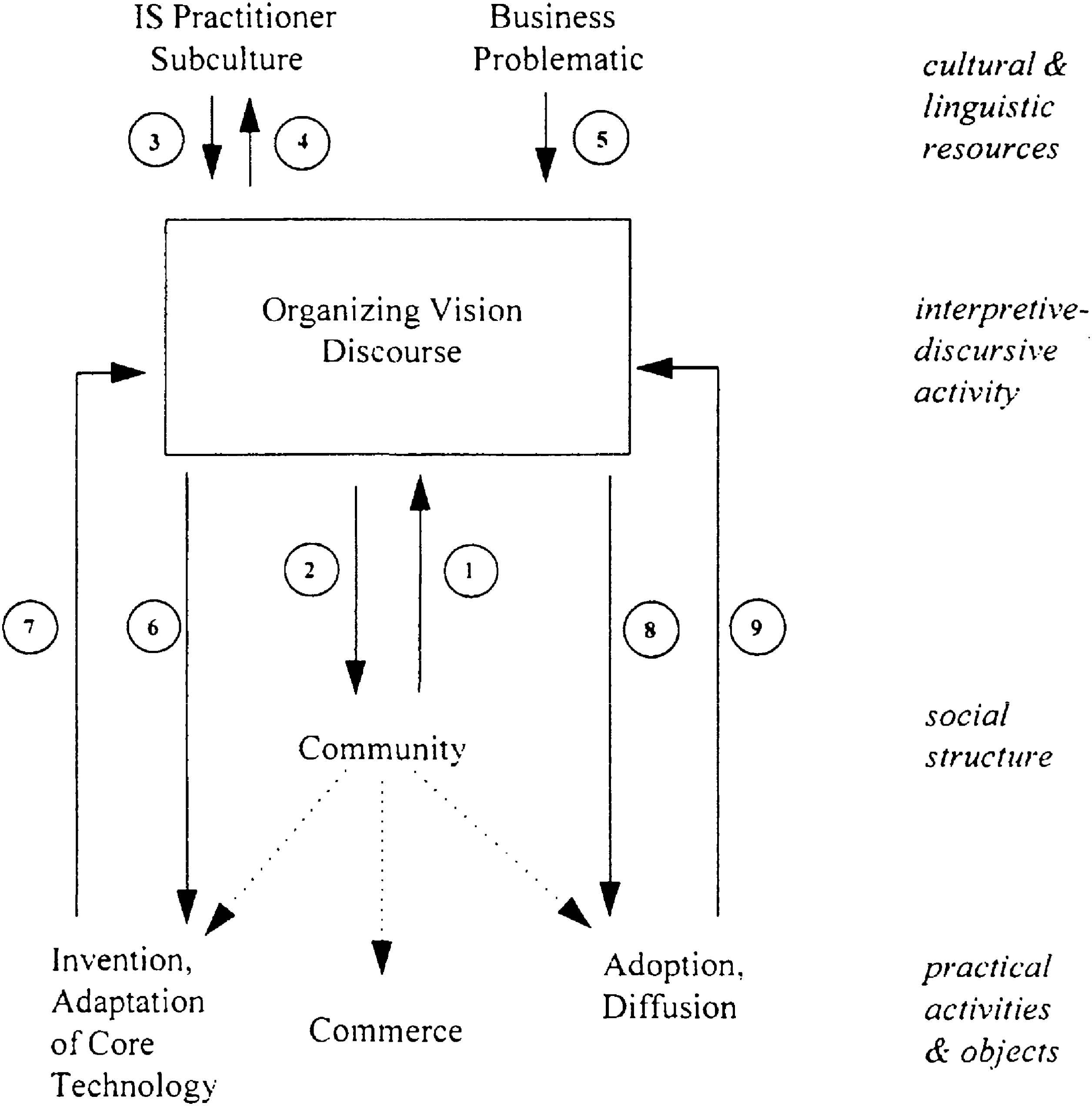
The paper then speaks to the “career dynamics” of OVs, invoking hot air balloon imagery to suggest that OVs, as products of discourse and rhetoric, vary over the course of their careers in their visibility, prominence, and influence. They rise, then eventually fall. In time: “Regardless of whether the final outcome is abandonment or institutionalization, the organizing vision’s ultimate fate is to be collectively ‘forgotten.’ That is, the organizing vision eventually loses salience and slips from view, while its constitutive discourse fades away” (p. 469). (Swanson recalls that he was particularly fond of this balloon imagery. The use of the term “career” in describing the dynamics was initiated by Ramiller. Swanson had suggested use of the term “organizing vision.”)
As “familiar examples” of OVs, the paper cites CASE (computer-assisted software engineering), client-server computing, business process re-engineering (BPR), and electronic commerce (p. 463), among others, reflecting the IS concerns of the time (the mid 1990s), some of which were more inward-looking than outward-looking. The broader socially transformative potential of information technologies in the years to come was at this time not yet very apparent.
As a theory, OV theory is one of explanation and prediction when classified according to Gregor’s (2006) types. As originally presented, it takes no particular epistemic stance beyond its embrace of discourse as a means of community sensemaking in a practice context (much mentioned in the paper’s discussion without embracing a particular practice theory). While it might be characterized as taking a realist perspective in its explicit recognition of materialities, it remains open to scholars who might wish to approach and engage it from varying positions, as we and others have since done (see, e.g., Orlikowski and Scott, 2015).
The paper wraps up with a discussion of theoretical implications and future directions. It issues a two-part call for future OV research: “…we believe first that process-oriented, historical studies of specific organizing visions will be needed, if we are to achieve more than the present rudimentary insight. These studies should differ substantially from conventional innovation studies, in particular, by focusing on the organizing vision’s evolving text and institutional presence, rather than on the adoption practices of individual organizations.” (p. 471) “From a theoretical standpoint, our core argument also clearly requires elaboration, consolidation, and validation. We must forge explicit ties to organizational and individual levels of analysis, in particular. From a practical perspective, we must learn how organizing visions both succeed and fail in supporting information systems innovation.” (p. 471)
Notably, in this call, there is no particular research methodology attached to it. Researchers are free to use whatever methods are suited to the questions they choose to ask.
How has the research community since responded? We next review what has actually been done by others and ourselves subsequent to this two-part call. We summarize selected OV research, 1997–2023.
Contributions
How have scholars made use of OV theory since the appearance of the Swanson and Ramiller (1997) paper? To address this question, we used Google Scholar to identify roughly 150 articles (including our own) that have made more than passing reference to the work among 1100 citing articles. As we did not review all the citing articles, our selections no doubt constitute an undercount of notable work, but we judged the chosen subset sufficient for our review and assessment purposes. We set aside a number of articles that merely acknowledged the 1997 paper in essentially unrelated ways.
Having settled on the subset of citing articles, we first examined their trajectory over the years 1997–2023, comparing this to that of the total. Results are shown in Figure 2. To our surprise, we found that substantive references to Swanson and Ramiller (1997) have recently been on the increase, even while total citations have peaked and leveled off. This plausibly indicates a cumulative learning effect, as researchers progressively have more substance to draw upon. It may also reflect the emergence of new technologies such as blockchain that have inspired researchers to examine the associated OVs, as we will see below in our analysis. Numbers of all citing articles and citing articles in selected subset, 1999–2023.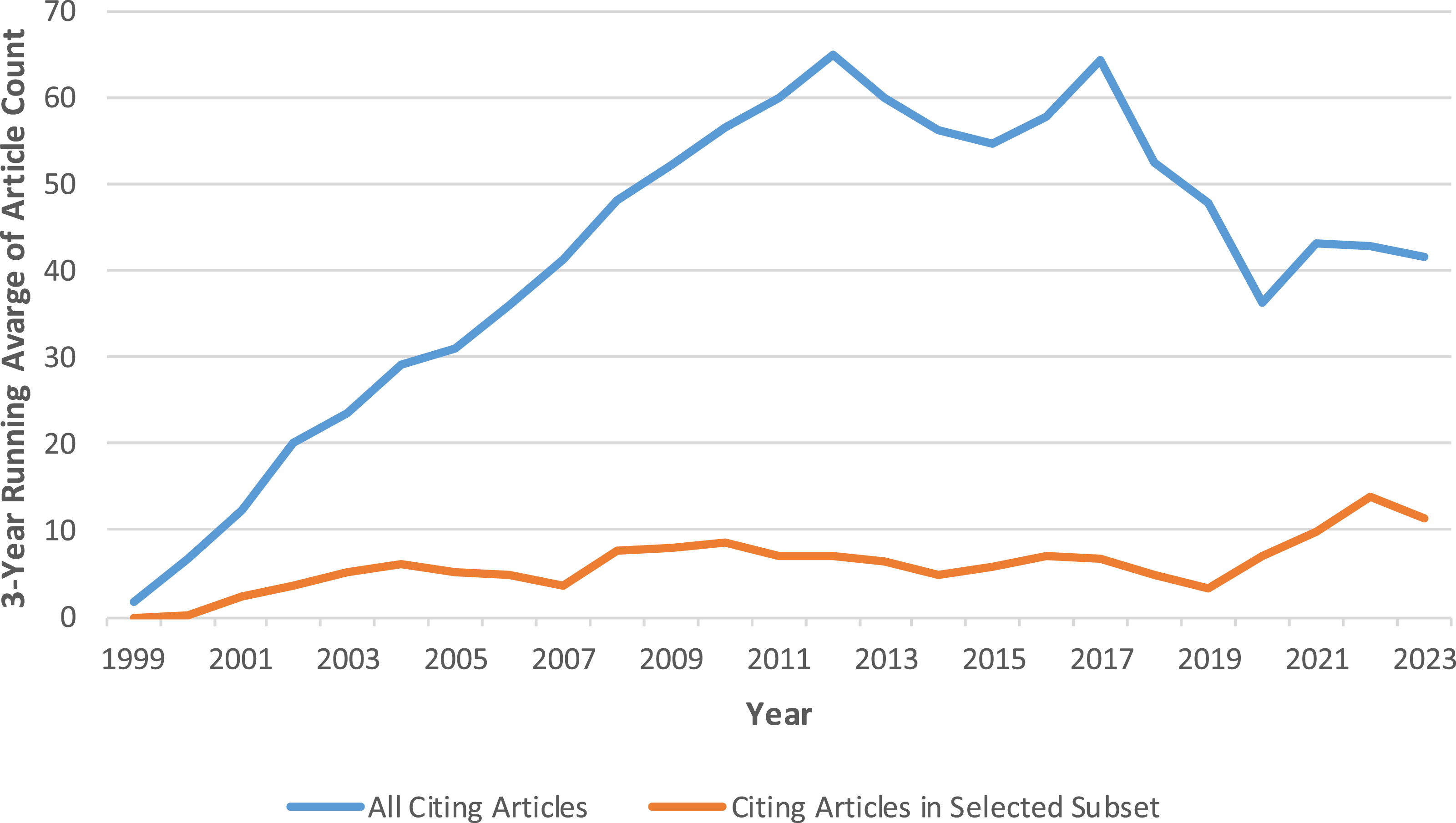
We then read and analyzed the selected articles in terms of their contributions as articulated by their authors (we took the claimed contributions at face value). We further noted and classified them according to their contributions to both OV and other related theories that the authors drew upon. (Most, though not all, of the selected articles are mentioned in our discussion and included as references in this paper. See below).
In assessing the contributions on the whole, we sought first to answer questions specific to OV theory: (i) What have been the domains of the theory’s application; (ii) What technologies have been studied; (iii) What has been learned about OV careers; (iv) What has been learned about individual and organizational engagement with OVs, in terms of OV promotion, reception, and enactment; (v) What has been learned about other aspects and implications of OV careers and engagement in innovating with IT?
We then sought further to assess the influence of OV theory more broadly in terms of how it has been referenced and leveraged to address questions specific to other related theories. We speak to this after first addressing the questions specific to OV theory.
Domains
In what nations, industries, professions, and other institutional contexts has OV theory been applied? From our analysis, we make four principal observations. First, the theoretical application has been global, with nations and regions represented from every continent (except Antarctica). Second, applications in and related to government are prominent, in addition to those specific to business and various industries. Third, healthcare is widely represented, with applications spanning the private and public sectors. Fourth, while a range of professions come into play, the IS profession itself is, perhaps unsurprisingly, prominent.
Beyond the sheer range of nations considered, several contributions take an international perspective. Carton et al. (2007) examine differences in OV promotion and reception between France and the U.S. Stratton and Bailey (2020) compare the reception and enactment of ICT4D in three South American countries. Avgerou (2001, 2003) includes discussion of OVs in arguing for taking national and international contexts and institutions into account in IS research.
Whereas our own early examinations of OVs were largely in a business context (Ramiller and Swanson, 2003; Wang, 2001; Wang and Swanson, 2007), more recent studies by others have focused as well on OVs in government contexts (see, e.g., Avgerou and Bonina, 2020; Bui and Lyytinen, 2022; Butler and Hackney, 2021; Currie, 2012; Hassan and Gil-Garcia, 2008; Meyer, 2019; Norström et al., 2022).
Healthcare is widely represented among the selected articles (see, e.g., Bernardi and Exworthy, 2020; Bunduchi et al., 2020; Currie and Finnegan, 2011; Davidson et al., 2015; Ellingsen and Monteiro, 2008; Essén and Conrick, 2008; Klecun-Dabrowska and Cornford, 2002; Klecun, 2016; Øvrelid et al., 2017; Palas and Bunduchi, 2021; Reardon and Davidson, 2007; Troshani and Wickramasinghe, 2016; Vedel et al., 2020; Wessel and Gersch, 2015; Yoo et al., 2020).
How professions involve themselves in innovating with IT is an important component of the innovation’s adoption and diffusion. The IS profession itself is often heavily engaged. Even when the OV, for example BPR (business process reengineering), is aimed at another functional unit, such as operations, the organization’s IS unit may do much of the work in its implementation. Further, some of the innovations, for example, agile system development, ASP (application service provision), and cloud computing, are aimed at the IS unit itself, in terms of functional responsibilities. Among the selected articles, the role of the IS professional is thus often featured (see Currie, 2004; Lawrence and Rodriguez, 2012; Shuraida and Titah, 2023).
Technologies
Technologies and organizing visions.
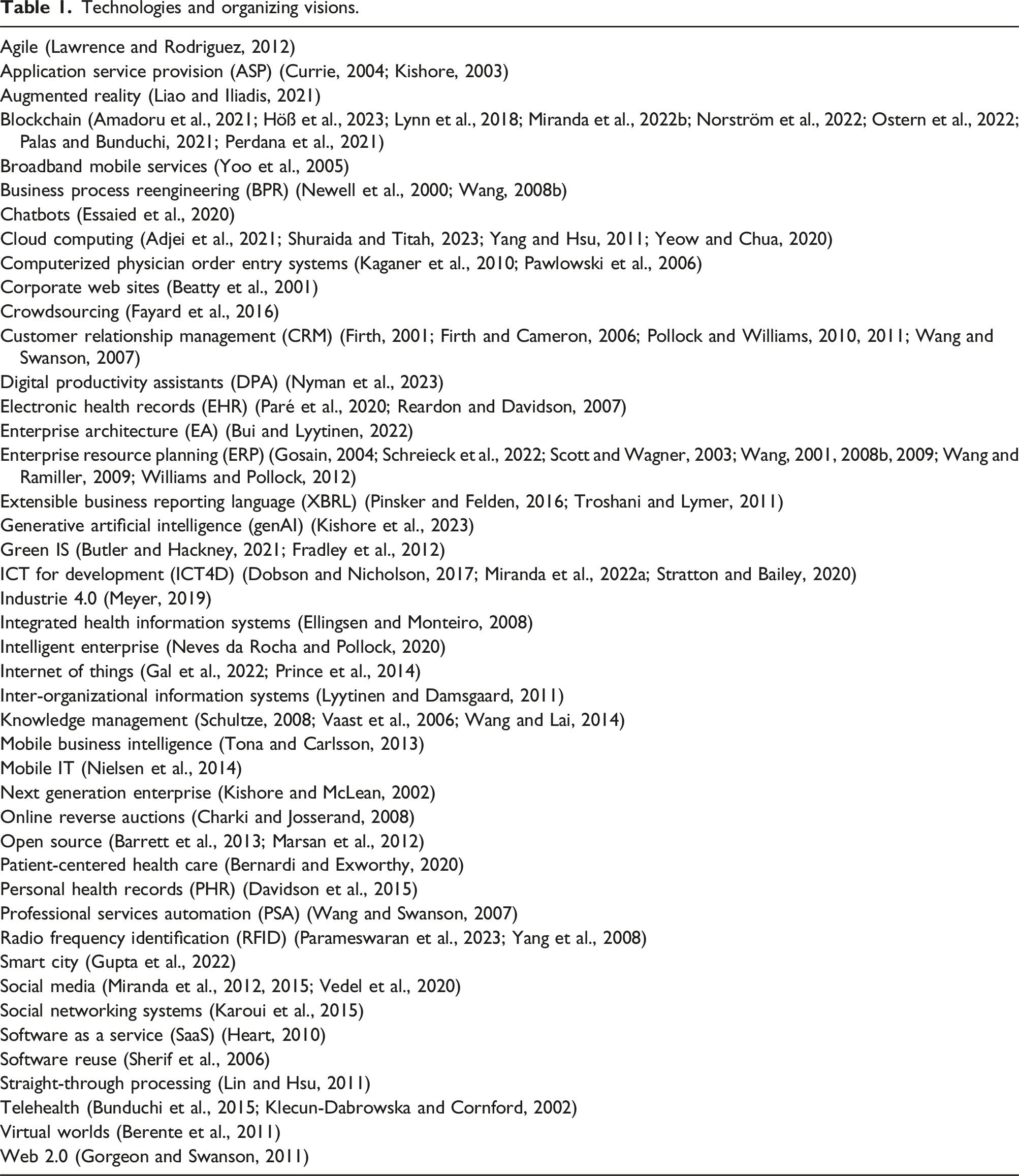
Technologies may also be more or less domain specific in their application. For instance, some are specific to healthcare or manufacturing or some other industry, while others, such as knowledge management, chatbots, or personal digital assistants, invite application across domains.
Technologies and their OVs may also be contrasted in terms of their generativity in subsequent applications (Bygstad, 2017). More generative technologies allow for wider ranges of application over time. Their visions, such as that for generative AI (genAI) (Kishore et al., 2023), may promise much, but in the early absence of application specificity, be received with much uncertainty in their interpretation. Those for less generative technologies, such as the one for ERP, which is highly application specific, may be received with greater certainty.
Technologies in their devices may be contrasted in terms of their IT materiality, as examined in a study by Gal et al. (2022). Some devices, such as a cell phone, are characterized by material elements such as shape and mass, whereas others, such as a phone app, are characterized more by their digitality, that is, symbolic instantiation (notwithstanding storage requirements). Only in their use, however, are both incorporated into OVs, such as that for a digital productivity assistant (Nyman et al., 2023). OVs require notions of use. Only in use are technologies realized as acquired routine capabilities (Swanson, 2019).
On the whole, what is most striking about the technologies studied in terms of their OVs is their sheer variety. OV theory seemingly has relevance to gaining adoption and diffusion insights into most IT applications that scholars choose to study. This relevance has endured for more than 25 years, notwithstanding vast changes in technologies. As new technologies emerge, they too become candidates for OV studies. A recent example is blockchain, which has attracted a small wave of studies, eight listed in Table 1.
Careers
Among the studies of OVs, several have addressed their careers, as well as the diffusion of the innovations themselves, in terms of their adoption, implementation, and assimilation. Our own work has been much concerned with this phenomenon (Gorgeon and Swanson, 2011; Swanson, 2004, 2011; Wang, 2001, 2009). But other scholars have made significant contributions.
Currie (2004) studies the rise and fall of the OV for application service provision (ASP) in considerable depth. Gal et al. (2022) examining the OV careers of 10 technologies based on the histories of their Wikipedia entries, find that the discourse patterns varied by levels of materiality, with elevated discourse more extended for the more nonmaterial technologies. Liao and Iliadis (2021) study the imagined futures of augmented reality (AR) over 10 years, drawing from attendance at AR conferences and a media archive, and observe substantial shifts in the OV discourse. Perdana et al. (2021) examine the OV career of distributed ledger technology from analysis of online English news articles, 2010–2018, and find that the technology, initially regarded as problematic, eventually came to be seen favorably.
Parameswaran et al. (2023) examining the early-stage diffusion of RFID in retailing from analysis of 20 years of discourse around Walmart’s push for it, find that between two codependent innovations necessary to RFID’s advancement, one adopter community (retailers) took the lead in bringing along the other (suppliers).
Studies of OV careers such as these thus help us understand the successes and failures in innovating with selected technologies. Together, they also contribute toward an ongoing collective history of innovating with IT, drawing from past endeavors potential insights for interpreting the present and likely future. Still other studies contribute further by focusing on particular aspects of the OV’s institutional production through the individual and organizational engagement that brings it about. We turn to this category of contribution next.
Engagement
Our visual sketch in the Swanson and Ramiller (1997) paper of the institutional production of OVs (Figure 1) sought to summarize the discourse mechanism by which individuals and organizations engage with them in their promotion and reception, in furthering a technology’s adoption and diffusion. For purposes of the present paper, we provide a simpler visual summary of the mechanism, featuring interlocked “gears” of promotion, reception, and enactment (e.g., adoption, implementation, and assimilation), as shown in Figure 3. We find from our review of contributions to OV theory that this simpler summary serves us well. We cover each gear in turn. Organizing vision engagement.
Promotion
How does a heterogeneous community of individuals and organizations come together in discourse to advance a new technology by means of an OV? Who are the important actors and what are the important vehicles for the discourse? Here we have had a good number of significant contributions to the theory.
Among the many actors are: entrepreneurs; market analysts; competing vendors; consultancies; gurus; conference organizers; journalists; publishers; advertisers; adopters; professional associations; government agencies; and researchers. The selected contributions speak to all of them and more.
Wang and Swanson (2007) describe the process of launching and promoting an OV for professional service automation (PSA), characterizing it as a form of institutional entrepreneurship involving an entrepreneur, market analyst, and conference organizer, among others. Seeking a supportive market analysis for an innovative product or service is one way to establish a new technology with its own OV.
The role of market analysts in the assessment and promotion of new IT has been intensively studied over many years by Neil Pollock and Robin Williams, with references to OV theory (Pollock et al., 2022; Pollock and Williams, 2010, 2011, 2015). The role played by Gartner, the leading analyst firm, has been a focus, in particular. Gartner assesses IT markets with two notable tools, a “Magic Quadrant” within which it positions competing vendors according to “completeness of vision” and “ability to execute,” and a “Hype Cycle” which tracks the progress of new IT in terms of the attention given to it (Fenn and Raskino, 2008). Both tools, as we understand them, speak to OVs, though without direct reference to them. Gartner markets its research by means of subscriptions to its reports and through widespread conferences, attended by hundreds of professionals, which serve to legitimate their work (Pollock and Williams, 2015).
Competing vendors also play an important role in the promotion of an OV, in particular when they rebrand and market their products and services to align with it (Pollock and Williams, 2011). Advertisers, serving competing vendors, then become major players as well, as do publishers and journalists who write for them. Wang and Swanson (2007) study promotion of the OV for customer relationship management (CRM) through 5 years of special advertising sections in Business Week, which served to maintain and extend CRM’s technological momentum. Such momentum can serve in part as its own resource in advancing the OV career. Kaganer et al. (2010) study the legitimation efforts of computerized physician order entry system vendors through an analysis of their press releases, 1998–2006, identifying a range of discursive strategies (see also Pawlowski et al., 2006).
Expositions and trade shows serve to bring vendors together where OVs can be promoted along with products. de Vaujany et al. (2013) conducted an intensive study of a single French trade show, in which OV discourse was found to be mostly informal among exhibitors and attendees, given an absence of organized presentations and panels.
Recognized technology gurus may also emerge to play important roles with their writings and conference presentations, often straddling research and practice. In the IT field, a notable guru is Thomas Davenport, who has written and spoken extensively on IT innovations including business process reengineering (BPR), enterprise resource planning (ERP), knowledge management, and AI (see, e.g., Davenport, 2018). Wang (2008b) describes the key roles played by Davenport and Michael Hammer in promoting BPR as an OV, a prominent example.
Early adopters of IT innovations also contribute substantially to promotion of OVs, in particular when individuals that have led the effort are recruited to speak to their accomplishments at conferences, meetings, and networking events. Individual leaders are also typically professionals who may encourage further adoption through their professional associations, where enthusiasm for the innovation may be either strong or weak. Bui and Lyytinen (2022), in a study of the push for enterprise architecture adoption among the 50 U.S. states, 2000–2012, by the National Association of State CIOs, find that NASCIO adapted its rhetoric of interpretation and persuasion over time to align with changing priorities.
Similarly, consultancies may become major players in OV promotion, once they have invested their expertise in the technology’s implementation and are now seeking new clients for their work (Swanson, 2010).
Governments and their agencies may also play roles in promoting a technology and OV seen as important in achieving a social end, as in healthcare (Currie and Finnegan, 2011; Klecun, 2016; Øvrelid et al., 2017), environmental protection (Fradley et al., 2012; Rajão and Hayes, 2009), or economic development (Avgerou and Bonina, 2020; Faik and Gwee, 2022; Stratton and Bailey, 2020). And researchers may play supporting roles, for instance, when their funded action research seeks to help organizations implement a new technology, or when they are participants in its design. At the national level, Meyer (2019) describes the roles played by industry associations, the German government, the Academy of Science and Engineering, and labor unions in promoting “Industrie 4.0” to infuse German manufacturing with ICT, highlighting the role that OVs may play in appealing to imagined social futures.
For all of these participants in the promotion of an OV, we note that new IT in the form of social media now provides new and compelling discourse vehicles, which may reshape participation itself (Amadoru et al., 2018). Amadoru et al. (2021) examine Twitter and its use over 7 years in the early promotion of blockchain, finding that Twitter allowed for wide and diverse participation across the three OV functions of interpretation, legitimation, and mobilization.
Miranda et al. (2022b) contribute new theory and research method to the study of blockchain’s promotion across seven “discursive fields,” including governments, news media, science, idea evangelists, corporations, projects, and social influencers. Through an examination of texts, these authors offer a new interpretation of achieving OV coherence, from mediated diversity in the OV’s framing across fields. Miranda et al. (2022a) use text mining of tweets in the study of discourse around ICT4D.
Taking all of this together, we can also discern what might be termed an IT innovation industry that provides institutional infrastructure supportive of promoting new IT and its OVs. Where the heterogeneous community comes together to promote a new OV, it will often be through this industry’s facilitation. We will have more to say about this below.
Reception
While an OV may be vigorously promoted, it also matters if and how it is received by those who would enact it through adoption and implementation, thus bringing about the innovation’s anticipated diffusion. Reception is therefore the linking gear in the OV engagement mechanism (Figure 3). While the attention of potential adopters may be sought in promotion, this attention, which must also be given, has much to attract it elsewhere. Reception should accordingly be understood as active, rather than passive. Reception entails sensemaking and Ramiller (2001) contributes from his dissertation an early interview-based study of how IS executives received several ITs at the time. He finds that certain imagery was used to address the risks and hazards faced in the construction of a successful response to prospective adoption.
Taking a different approach, Ramiller and Swanson (2003) contribute an early survey study of comparative OV reception by IS executives, identifying four dimensions (interpretability, plausibility, importance, discontinuity). Several studies that followed also used survey methods. Marsan et al. (2012) study open-source software reception among a large sample of Canadian IT specialists, analyzing OV dimensionality and also linking individual to organizational receptivity. Reardon and Davidson (2007) survey a sample of private physicians as to their reception of electronic medical records (EMR), also with analysis of OV dimensionality. More recently, Johnson et al. (2021) survey a large sample of marketing and analytics middle management professionals as to their reception of Big Data analytics (BDA), finding that BDA sensemaking has primarily been initiated and driven by top management.
Other studies of reception have relied on interviews and examinations of records. Berente et al. (2011) study the reception of virtual worlds by business professionals who immersed themselves in Second Life, through an analysis of the texts generated in its use, which furthered understanding of its organizational value. Nielsen et al. (2014) study the reception of mobile IT in Danish homecare over 10 years, 1998–2008, distinguishing between its theorization in the organizational field and its translation into practical solutions. Fayard et al. (2016) study the reception of crowdsourcing by two international consulting firms, finding that differences in their “epistemic stances” explained why one firm embraced it while the other did not. Ostern et al. (2022) examine blockchain sensemaking in organizations through interviews of executives and business professionals engaged in the development of prototypes.
Taking a normative approach, Jung et al. (2009) propose a methodology for study of social representations such as OVs, and demonstrate its use in examining early sensemaking about electronic health records (EHRs).
One insight from reception studies to date is that those individuals targeted in the reception are at once professionals and organizational employees, suggesting that they can be reached and influenced through either of two routes, one external, and the other internal. Both are likely to be in play where promotion engages with reception. Managers, in particular, may find themselves uniquely positioned. Bernardi and Exworthy (2020) examine the conflicting institutional logics faced by clinical managers in an English health care organization, in innovating with patient-centered health care, where “they are in a privileged position to facilitate IT innovation by spanning the boundaries among managerial and professional communities” (p. 567).
Of particular interest is the difference in reception between top management and IT management in the organization. Whereas top management is most likely to be reached and influenced by appeals to values specific to the organization as a whole, such as leadership in their respective industries, IT management is most likely to be reached and influenced by appeals to values specific to their function and profession, such as innovating with IT. Not surprisingly, then, it is IT management, more than top management, that attends to the reports of Gartner analysts, for instance, and grapples with the specifics and assessment of an OV.
Enactment
While it is one thing to promote an OV and another to receive it, it is quite another to enact it in the innovation’s adoption, implementation, and assimilation. Here, there has been much research over the years without particular consideration of the role of OVs in bringing it about (Lucas et al., 2007). In the present paper, we focus on research that has tied enactment to OVs. Our own research on mindfulness in innovating with IT (Swanson and Ramiller, 2004) elaborates on the process by which the organization chooses to act on its comprehension of an OV.
To enact an OV is to bring it to life locally, and we should note that this too involves discourse in its realization. Broadly, this begins with the rationale for adoption, continues with the decisions around purchased products and services, followed by discussions surrounding the method and progress of implementation, and lastly ongoing communications around use. Such enactment can transcend the local as other organizations’ adoptions become informed by public revelations of the earlier adopter’s experiences.
A number of studies address the intention to adopt the innovation, with references to OV theory (e.g., Heart, 2010; Pinsker and Felden, 2016). Fewer have explored the adoption decision making process itself. Shuraida and Titah (2023) examine adoption decision making in the case of software-as-a-service (SaaS), finding a cognitive bias for the status quo. Yeow and Chua (2020), in an interpretive case study, study a law firm’s sensemaking in selecting among alternative vendors in the adoption of a cloud computing service. Vedel et al. (2020), in a multiple-case study, describe how six non-profits dedicated to cancer prevention and management came to adopt and employ social media strategies in health promotion.
Failed adoption has also been studied, as has adoption falling short of OV expectations. In a case study illustrative of institutional misalignment, Bunduchi et al. (2015) explore the failed adoption of a telehealth solution that could not reconcile differences between a public sector hospital-based eye clinic and private sector optometry practices. Wessel and Gersch (2015) provide a case study of integrated medical care, where adoption fell short of OV expectations, interpreted as revealing problems with the OV’s performativity.
Lyytinen and Damsgaard (2011) address the adoption complexities of inter-organizational information systems, providing a configuration analysis framework that incorporates the role of an OV in bringing adopters together.
Of particular interest to OV theory is the feedback loop in which enactment through adoption and implementation by early adopters reinforces or undermines the OV and its continuing reception by those who might follow. Implementation problems, in particular, are well known to dull the enthusiasm for an innovation, when they become widely known. Consultancies play a key role in this feedback loop as they often specialize in guiding implementations from one firm to another (Swanson, 2010).
Another important role may be played by the IT champion within the organization who often leads the adoption and implementation effort (Tona et al., 2016). With success in this, such individuals may then leverage it in their careers and move on to become consultants or leaders in other organizations facing the same challenges. As professionals, they may also be active in promoting the OV in meetings and networking events.
Assimilation of the innovation subsequent to its implementation is the learning process by which the organization gradually (or in some cases quickly) builds new capabilities (Swanson, 2004). Where and when these new capabilities become apparent to others, the OV may increasingly be received as important and its promotion may further be adapted to reflect the promise of these capabilities.
Liang et al. (2007) address the assimilation of enterprise systems, finding that top management plays an important mediating role. Wang (2008a) contributes a follow-up study, drawing from both institutional and resource dependence theories, to find further longitudinal effects on adoption and use, including those stemming from pressures from the organization’s exchange partners.
Other aspects
What are the broader implications of the OV phenomenon in innovating with IT? What distinguishes OVs and how should we recognize and understand them? What is important about them and what is less so?
A first observation pertains to volatility and transition. Substantial shifts in the attention given to an IT innovation are characteristic, as new visions can emerge very quickly. Displacement in the attention given to an OV may or may not reflect a fall from fashion. The discursive tumult around IT innovation in general reflects the broader transformation of the world in which we live.
Still, fashion and hype are also characteristic. Wang’s research has addressed IT fashion and hype in particular (Wang, 2010; Wang and Ramiller, 2004). Klincewicz (2017) includes extensive discussion of OVs in his book on management fashion. Schinnen (2023) references OVs in discussing a study of IT fashion and its influence on organizational legitimacy and its effects on recommendations of security analysts. Logue and Grimes (2022), in a study of impact investing, reference the 1997 OV paper in discussing hype as a resource and attempts to use and manage it.
Broadly, OVs should be understood as a vehicle for learning in innovating with IT. Wang and Ramiller (2009), examining the public discourse on ERP over a 14-year period, find that OVs are consequential for an interplay between organizational and community learning, with early “know-what” and “know-why” learning driven by market analysts and vendors, but later “know-how” learning driven by organizational adopters.
OVs for innovating with IT also have implications for organizational strategy. Kindermann et al. (2022) present a framework based on “sensing, seizing, and reconfiguring” capabilities in the orchestration of a digital ecosystem, with reference to the role of OVs in communicating a value proposition to participants. In the same vein, Prince et al. (2014) in an interpretive case study explore the orchestration of innovation networks in developing a strategic initiative around the Internet of Things, where one hub actor’s dialogical strategies, including persuasive projection of an OV, are seen to bring the participants together. Schreieck et al. (2022) report on a multi-year grounded theory study of the institutional transformation of SAP’s ERP ecosystem, from a product platform ecosystem to an innovation platform ecosystem.
de Vaujany (2008) in an essay draws on OV theory in developing a practice-based view of strategic IS value. Wu and Chen (2014) from a survey study applying OV theory find that IT value in terms of firm performance indicators differs across stages of diffusion.
What seems clear is that with the rise of digital platforms and ecosystems bringing multiple organizations together in innovation, entailing cooperation as well as competition, the role of an OV in forging commitments and alliances is likely to be of increasing importance. Wang (2021) contributes a theory of digital innovation ecosystems in which the OV is developed and guides a “category” of innovative processes, products, services, or technologies within a hierarchy of ecological interactions, explaining how autonomous parties are brought together in the innovation.
Influences
Contributions referencing and contributing to OV theory subsequent to Swanson and Ramiller (1997) have drawn from and contributed to related theories, topics, and literatures as well. Here we address these ongoing lines of influence, together with their implications across disciplines with varying interests in innovating with IT.
The Swanson and Ramiller (1997) paper builds its OV theory by drawing most prominently from neo-institutionalism (DiMaggio and Powell, 1983; Scott, 1995), sensemaking (Weick, 1995), and innovation diffusion (Rogers and Williams, 1983), but also management fashion theory (Abrahamson, 1996). The central concept of discourse is taken from Porter (1992), given that organizational discourse theory was itself only in an emergent state at the time. Not surprisingly, a number of subsequent OV contributions that reference Swanson and Ramiller (1997), have interests in these same theories.
Gosain (2004), invoking neo-institutionalism, argues that ERP constitutes an “iron cage” in its adoption, implementation, and use. Ostern et al. (2022) use a sensemaking lens to examine organizational approaches to blockchain. Gal et al. (2022) draw from and contribute to discourse theory in showing how technologies themselves are shaped in discourse. Barrett et al. (2013) employ theory of rhetoric in examining IT diffusion in computerization movements.
How has OV theory been recognized and useful to those working primarily with other related theories? Here we can look to review articles for insights. Three such articles in the management and organizational literature reference Swanson and Ramiller (1997). Griffith’s (1999) review of technology as related to sensemaking was the first to recognize our paper. Dewett and Jones (2001) list and classify it in reviewing the role of IT in organizations. Li (2017) references it in discussing labeling and buzzwords in a semiotic theory of institutionalization. However, other more foundational reviews, for example, on institutional entrepreneurship (Hardy et al., 2008), organizational discourse (Phillips and Oswick, 2012), organizational innovation (Crossan and Apaydin, 2010), and organizational sensemaking (Maitlis and Christianson, 2014) make no reference to the Swanson and Ramiller (1997) paper. On the whole, the OV concept has largely failed to be taken up in the management and organization literature.
Turning to the IS literature, Kohli and Melville (2019) give OV theory considerable attention in their review and synthesis of research on digital innovation. In other assessments, Fichman (2004) gives extensive attention to OV theory in discussing “going beyond the dominant paradigm” in IT innovation research. Chiasson and Davidson (2005) reference the 1997 OV paper in arguing that industry should be better taken into account. Yoo (2010) references the paper tangentially in a call for research on experiential computing. Williams and Pollock (2012) cite it in their argument for “moving beyond the single site implementation study” in IS research. Mignerat and Rivard (2009) incorporate OV theory in their discussion of the institutional perspective in IS research. Fielt and Gregor (2016) make substantial references to OV theory in discussing “what’s new about digital innovation.” Bailey and Barley (2020) give mention to OV theory in speaking to how scholars should study intelligent technologies. Grover and Niederman (2021) cite the OV paper as an example of “blue ocean transformational studies” in their assessment of innovative IS research approaches. Clearly, the IS literature, in reviews and assessments over the years, has given considerable attention to OV theory.
Several references to OVs appear in publications in other fields, including marketing (Standing et al., 2017), accounting (Pinsker and Felden, 2016), and library science (Marsh et al., 2016). However, these articles are few and far between. On the whole, OV theory’s influence as a “native IS theory” (Kim and Miranda, 2018) has not extended much beyond the IS literature. There, however, while remaining a niche theory rather than a dominant paradigm, its influence continues to be felt among a community of scholars concerned with innovating with IT.
Futures
What does the future hold for OV theory, from our revisit of it here? Clearly, the reviewed articles that have cited the Swanson and Ramiller (1997) paper and the most recent work, in particular, show that the theory remains in active play among researchers. Still, much has changed since 1997, in both research and practice concerned with innovating with IT, much of this stemming from the innovations themselves, as reflected in the diverse technologies cataloged above. From our own perspective, we think it useful to address three questions from the present study: (1) Are more recent innovations with IT increasingly problematic for the application of OV theory as a means to understand them? (2) How can we more deeply understand the mechanism of individual and organizational engagement with OVs? (3) How can OV theory speak more effectively to innovating with IT not only within, but beyond traditional IS disciplinary bounds?
More recent innovations
With regard to our first question, whether more recent innovations are increasingly problematic for OV theory, we believe the answer is no, judging from the studies reviewed here. Rather, newer technologies such as social media (Vedel et al., 2020), blockchain (Höß et al., 2023), and genAI (Kishore et al., 2023) provide fresh opportunities for insightful OV studies. While new complexities in adoption and use present challenges, OV theorizing remains useful in explaining patterns of innovation and diffusion, not only organizationally, but individually and socially as well.
With their connectivity, embeddedness, and adaptability, digital technologies are now prevalent not just as organizational IT in the workplace but also as consumer IT in everyday activities (Yoo, 2010). While consumer information technologies such as e-readers, fitness trackers, and smartphones are individually adopted and used, consumer decisions are typically not made independently of each other (Sun et al., 2014). Rather, just as with organizational decisions, they are subject to individual, organizational, and social influence, often with bandwagon effects. Collective sense-making in experiential computing seems to be just as common as, if not more common than, in enterprise computing. OVs may play a role in this sense-making.
Further, even where adoption and use is first by individuals, as with social media, organizations are drawn into active participation too, in interactions with individuals, as can be observed from the organizations’ public Web pages and official accounts on various social media platforms. Organizations face their own adoption and use decisions. OVs are promulgated to guide them in this, as may be observed currently in the case of genAI, where universities (including our own) and others are scrambling to find ways to embrace it (Kishore et al., 2023).
The incorporation of chatbots more broadly into organizational and social life also potentially figures into the propagation of OVs and may offer new opportunities for studies. Unstudied thus far, to our knowledge, is how chatbots have been (or might be) deployed in OV discourse to extend the agencies of concerned stakeholders. Reportedly, the discourse community for blockchain innovations on Twitter consists of individuals, organizations, and social bots (Amadoru et al., 2019). As another example, Instagram is now developing a chatbot version of its leading influencers for their use in interacting more efficiently with their many followers (Maheshwari and Issac, 2024).
Recent developments in ecosystems linking multiple individuals and organizations on product and exchange platforms also present new OV research opportunities. Consider again the basic concept. While an OV as “a focal community idea for the application of IT in organizations” is specific to organizations, it arguably applies to organizations of all kinds (not only traditional hierarchies), and to ecosystems of organizations and individuals acting together as described by Wang (2021). What is interesting in such ecosystems is that participants may have very different takes on the OV and its implications. Reception is both distributed and differentiated. Enactment involves far more actors playing old and new roles (e.g., data brokers for big data and prompt optimizers for genAI) than in a hierarchical organization or a supply chain, as the layered modular architecture makes it possible, desirable, and even necessary to innovate with multiple players in platform ecosystems (Wang, 2021). Each individual or organization member of the ecosystem enacts an OV with reasoning grounded in its own specifics (Swanson and Ramiller, 2004). Given the diverse interests and conditions, the OV’s reception and enactment is likely more complex and challenging than in a traditional organization, with significant implications for both the OV’s career dynamics, and the capability and performance of the focal ecosystem.
In sum, we suggest that the OV concept originally applied to progressive singular adoption by traditional organizations can fruitfully be reimagined to apply to more complex forms of adoption and organization. We point to this in the title to this paper. From the contributions already made and reviewed above, this reimagination seems already underway.
Engagement mechanism
With regard to the second question, how we might more deeply understand the individual and organizational engagement mechanism, we believe an answer lies in studies that probe how the three gears—promotion, reception, and enactment—operate together in tandem over time.
In carrying out this probe, the linking gear of reception needs to be studied in more depth, in particular. How do organizations and their employees engage in reception as a means to adoption and how does this vary across technologies and domains? How does this reception also reciprocally drive promotion? Keeping in mind that reception is cognitively based and necessarily individual even when undertaken on the organization’s behalf, answering these questions likely calls for ethnographic studies, where targeted interviewing and examination of records can reveal how individual reception can build toward eventual organizational commitment.
Survey studies that examine the traditional “intention to adopt” variable as an outcome of reception may need to get more deeply into such intention, to distinguish organizational commitment from merely favorable inclination.
In the case of promotion, already well studied, we may need to take a wider view, beyond the single case. When we do so, we can discern what amounts to an IT innovation industry, as mentioned above, that drives OV discourse and is always on the lookout for the Next Big Thing. How should we understand this industry? Might its product or service provided be the OV’s promulgation? Are the providers then an infrastructure of promoters, and the consumers those with stakes in innovating with a particular IT? How does such an industry prosper? Where does the insatiable demand for OVs come from? Here we offer up these questions to seed a new line of thinking about promotion.
In the case of enactment as the third gear, how does it change OV reception both within and among organizations, beyond traditional enterprise innovations? Consider in particular those innovations that can be individually adopted before they are organizationally adopted, as with ChatGPT, adopted by students in a university, or researchers submitting manuscripts to a journal, or lawyers submitting briefs to a court of law. Here, where individual adopters come equipped with their own personal digital assistants, the innovation tables are turned on organizations, which face what might be termed “lagged reactive adoption” of an innovation already on the loose.
Such lagged reactive adoption is not new. The current situation with ChatGPT is reminiscent of the early adoption of spreadsheet computing, or minicomputer use before that, where the adoption tables were similarly turned within the enterprise. How in such circumstances is the OV and its reception affected, where enactment drives practice change from within, more than promotion does from without? Does the OV arise out of the practice and its reception, rather than from efforts to drive organizational change through reception, adoption, and implementation?
Beyond traditional IS bounds
Considering our third question, how OV theory can speak more effectively beyond traditional IS bounds, we think it useful to remind ourselves that innovating with IT is about changes in practices of all kinds, and our studies should focus on this. It is here that our thinking coincides with that of Powell and DiMaggio (2023) in their call for practice diffusion studies that help us “understand better the mechanisms of adoption and how newly adopted practices mesh with existing organizational practices, structures, and values.” Where innovating with IT is the concern, we believe that OV theory continues to have much to offer such practice diffusion studies. The OV’s envisioned outcome is always a change for the better in practices.
What is somewhat surprising is the failure of OV theory to gain a foothold in the management and organization literature, beyond the IS literature, given its obvious applicability to the study of practice change. A partial explanation may lie in the two academies, the Academy of Management and the Association for Information Systems, with their respective conferences and affiliated publications, and with relatively little purposeful interaction between them. In its absence, common interests in topics such as innovating with IT have been problematic to bridge, as has long been recognized (see, e.g., Orlikowski and Barley, 2001). Scholars have toiled mostly in their familiar terrains.
Still, one way to speak more effectively beyond traditional IS bounds is to forge a connection to a related literature that might open up new doors. Swanson (2024), in a work entitled “Technology entrepreneurship is more than one might think,” provides a recent illustration. Published in Information and Organization, it will have at least a niche IS audience. Whether it will come to broader attention in the management and organization literature remains to be seen, however. One can always be hopeful.
Perhaps the most obvious related literature with which to forge a better connection is that on organizational discourse (Phillips and Oswick, 2012). The question to ask here is how OV theory might inform this literature in its broad interest in “the role of discourse in the constitution of organizational life,” where “the nature of organizational discourse, how the texts which make them up are produced, and why some texts are more influential than others, are the sorts of general questions that are of interest to researchers who study organizational discourse.” (Phillips and Oswick, 2012: 437). Clearly, OV theory speaks directly to this in the context of innovating with IT, but why should organization and management researchers focused on organizational discourse find this more broadly interesting? Can a better link be forged here?
It might also be useful to forge connections beyond the management and organization literature, where the notions of vision and discourse have also been taken up in research with roots in the social sciences. An interesting example is in science and technology studies, where Jasanoff and Kim (2009, 2013) advance the concept of the “sociotechnical imaginary,” defined as “collectively imagined forms of social life and social order reflected in the design and fulfillment of nation-specific scientific and/or technological projects,” which “at once describe attainable futures and prescribe futures that states believe ought to be attained” (Jasanoff and Kim, 2009: 121). Originally applied to the comparative study of atomic energy development in the U.S. and Korea, the concept has now been applied to the comparative study of AI development in the U.S., China, Germany, and France (Bareis and Katzenbach, 2022). This suggests an OV research opportunity, positing that the genAI OV will be shaped and contested differently across countries according to the respective imaginaries. Several of the studies reviewed above seem to suggest as much.
Forging new connections to speak more effectively beyond traditional IS bounds can thus be about more than just extending the influence of OV theory. It can be about thinking more creatively about OV theory itself. It is in this sense that we refer to reimagining OV in the title to this paper. From the above discussion of sociotechnical imaginaries, one such creative route might entail thinking of an OV in terms of its futures orientation, where it might “at once describe an attainable future and prescribe a future that organizations believe ought to be attained.” After all, an OV, by its nature, is always a positioning toward a future, speaking both to an innovation’s plausibility and importance in adoption (Ramiller and Swanson, 2003), even while focused on present choices. And it always has a certain social dimension to its organizational rationale, even if not immediately apparent, as with the implications of ERP for quality of work life (Gosain, 2004). Now, with more recent IT innovations, and with AI in particular, this social dimension has emerged to assume a new importance and even a sense of urgency around prospects for the future (Bailey and Barley, 2020). How do we as innovation scholars position ourselves with respect to this newer development? One stance is to embrace new forms of futures research (Chiasson et al., 2018, provides a philosophical perspective. Schlagwein et al., 2024, call for research on digital futures). Might the examination of OVs have a role to play in such research? Even from more conventional stances, we believe that there are ample opportunities to be found in exploring the association of OVs with broader imaginaries through examination of their embeddedness in larger fabrics of discourse about the whys and wherefores of technology in relation to individuals, organizations, collectives, societal sectors, nations, humanity, and the planet.
Conclusion
As we said at the outset, there is sometimes good reason for scholars to revisit their earlier work. In the present case, motivated by Powell and DiMaggio (2023), we undertook to revisit OV theory we had advanced more than 25 years ago. In the many years since then, each of us had taken related but different paths in our own research, and had gradually lost close touch with the stream of OV-referencing research that followed and accumulated. We were now simply curious. With some 1100 citations to our 1997 paper, how had scholars found OV theory useful and worth referencing in their own work?
Overall, our revisiting project proved to be an eye-opener for us. From our review of more than 150 selected papers that cited the original paper, we found ourselves greatly impressed by the sheer variety of attention given to OV theory over the years. Here, we have provided something of a summary of these diverse contributions. As a historical review, the present paper is first of all a homage to this collective work (and we suggest in passing that other such reviews of earlier IS research might also be useful in bringing concepts to renewed attention through assessments of contributions over the years since they were first advanced.)
In organizing our review of contributions, we found it useful to do so by means of what we termed the mechanism of OV engagement featuring interlocked gears of promotion, reception, and enactment, as shown in Figure 3. In our discussion around this mechanism, contributing authors should be able to see how their work fits into this larger picture as we now see it. Our hope is that this brings some satisfaction to the authors as contributors to a scholarly community of common or at least intersecting interests. Perhaps too it might inspire further work and contributions.
Our revisiting of OV theory should also be of interest to scholars interested in innovating with IT more broadly, whether they are familiar with OV theory or not. As may be seen, because OV studies address specific technologies and their OVs, as these studies accumulate, they present a rich history of the evolution of these technologies taken together, and thus yield insights into how innovating with IT has arguably both changed and remained the same (see also Currie et al., 2024). With regard to sameness, the evidence is strong that envisioning as theorized, centered on the OV’s functions of interpretation, legitimation, and mobilization, remains a hallmark and driver of innovating with IT. What has perceptibly changed are the kinds of OVs themselves, and how their functions are carried out in an elaborating digitized world that they contribute to bringing about. Whereas earlier technologies were centered largely on organizational rationales for adoption, without much attention to social context, newer ones often bring this context more directly into the associated discourse, as we have discussed. Interpretation may now be more broad-based and challenging, as may be legitimation and mobilization. The employment of social media to meet these challenges may be seen as a natural response and highlights the emergence and embrace of new discourse vehicles.
Newer technologies are also interwoven with the rise of digital platforms and ecosystems that bring organizations together in innovating with IT, as seen in our review, and the role of an OV in this process and context needs to be more deeply explored. Where one organization dominates among networked others, for example, might it drive the innovation process with OVs tailored to its own strategic interest?
As social context merges with organizational rationale in new OVs, we also foresee more forceful engagement roles played by the professions and governments, as illustrated most starkly in the recent advancement of AI, with its implications for vast changes in practices. Here, promotion is rampant; reception varies widely, ranging from enthusiasm to skepticism to pronounced fear; while enactment takes many new forms deserving of exploratory study.
In sum, we found our own thinking about OV theory stretched and renewed by research contributions that addressed OVs associated with more recent technologies, compared to those that prevailed when we originated the theory. Looking to the future, we have offered some thoughts on this and, building from some of these contributions, we have suggested how the theory can continue to be relevant in its newer applications. We have spoken as well to how the OV engagement mechanism of promotion, reception, and enactment might be more deeply explored and to how OV research might be more fruitfully extended beyond traditional IS bounds.
Finally, our assessment suggests too that the reimagined OV might also be given a more expansive definition, reflective of our findings. We suggest this rewording: an organizing vision is a focal community idea for the application of IT in and across organizations and to society beyond. With this suggestion, we have added only a few words to the original definition, not to render it obsolete, but rather in recognition of the OV’s broader role as reflected in the eye-opening research reviewed here.
Having brought ourselves up to date on contributions and references to OV theory over 25 years, and having observed the theory’s continued relevance, we now look forward to seeing what scholars will do with it in the years to come. As innovating with IT is now not only a core subject of study by IS scholars, but by scholars more broadly, expanded research attention to the OVs that are a driver and hallmark of this ongoing change in our technologies and practices should continue to yield important organizational and social insights.
Footnotes
Acknowledgements
We wish to thank the reviewers of this manuscript for their supportive and helpful suggestions. We also thank Jiamei Sun for her editing help.
Declaration of conflicting interests
The author(s) declared no potential conflicts of interest with respect to the research, authorship, and/or publication of this article.
Funding
The author(s) received no financial support for the research, authorship, and/or publication of this article.
