




Abstract
We theorize mobile knowledge workers’ uses of digital and material resources in support of their working practices. We do so to advance current conceptualizations of both “information infrastructures” and “digital assemblages” as elements of contemporary knowledge work. We focus on mobile knowledge workers as they are (increasingly) self-employed (e.g., as freelancers, entrepreneurs, temporary workers, and contractors), competing for work, and collaborating with others: one likely future of work that we can study empirically. To pursue their work, mobile knowledge workers draw together collections of commodity digital technologies or digital assemblages (e.g., laptops, phones, public WiFi, cloud storage, and apps), relying on a reservoir of knowledge about new and emergent means to navigate this professional terrain. We find that digital assemblages are created and repurposed by workers in their infrastructuring practices and in response to mobility demands and technological environments. In their constitution, they are generative to both collaborative and organizational goals. Building from this, we theorize that digital assemblages, as individuated forms of information infrastructure, sustain stability and internal cohesion even as they allow for openness and generativity.
Introduction
Drawing on data from a study of mobile knowledge workers’ (MKW) uses of digital and material resources in support of their working practice, we advance current conceptualizations of both “information infrastructures” and “digital assemblages” as elements of contemporary knowledge work.
We advance the current conceptualization of digital assemblages and information infrastructures (Hanseth and Lyytinen, 2010; Monteiro et al, 2014; Sawyer et al, 2014). We also illuminate innovative ways in which ICTs are put into practice to support new work arrangements (Collings and Isichei, 2017).
We do so because current conceptualizations of information systems are ill-equipped to tackle the extra-organizational forms of ICTs which are emerging to address the new relationships among organizations, digital infrastructure (s), and work we see today (see also Baskerville, 2011; Leclercq-Vandelannoitte, 2015). Specifically, the framework advanced here reflects the broader “Mobility Turn” or “New Mobilities Paradigm” in social sciences (Cresswell, 2010; Sheller and Urry, 2006). We build on the Sørensen (2016: 63) observation that “the context for much of IS research is the organizational processes located within the physical boundaries of one organization.” This reflects a lack of attention to the organizing arrangement and work practices that form around the increasingly wide-spread uses of mobile ICT and work/worker mobility (Sørensen and Landau, 2015). To wit, “computing in the small has transformed highly distributed work contexts as well as everyday being across any context to loci of distributed connectedness” (Sørensen, 2016: 63). More broadly, this work is one response to calls by information systems scholars to attend the integration of ubiquitous ICT, distributed work context, and nomadic computing in IS theorizations (e.g., Lyytinen and Yoo, 2002; Sørensen, 2011; Yoo, 2010). As such, this work is a form of theory elaboration (see Fisher and Aguinis (2017) that reflects on Weick’s (1995) call for scholars of organizations to do more theorizing).
In exploring the role of digital assemblages, we focus on MKWs because these workers are (increasingly) self-employed (e.g., as freelancers, entrepreneurs, temporary workers, and contractors), compete for work, and collaborate with others. In doing this, they represent one view into how work is being restructured, with some recent surveys suggesting that such workers already account for almost 40% of the global workforce (Luk, 2015), and this percentage is expected to grow steadily over the next decade (IDC, 2016).
Because MKWs rely on a combination of their own devices and those provided by their current employers or clients, they assemble collections of material and digital resources that combine personal, public, and corporate elements into some sort of evolving and seamed arrangement (per Dourish and Bell, 2011; Mainwaring et al., 2005; Vertesi, 2014). These sociotechnical arrangements—what we refer to as digital assemblages—serve as an individualized information infrastructure (II) for MKWs. This infrastructure is more than any one system, affords many ways of being used, and evolves relative to the actors who support, enable, use, and guide its interconnected elements (Hanseth and Monteiro, 1997; Henfridsson and Bygstad, 2013; Jackson et al., 2007; Monteiro et al., 2014; Star and Bowker, 2002).
The focus and scholarly contribution of this paper lie at the intersection of digital assemblages and information infrastructures in the context of MKWs. We pursue two questions in addressing this empirical and theoretical space: 1. How do digital assemblages compare with and relate to information infrastructures in the context of MKWs? 2. What are important characteristics of digital assemblages that emerge from infrastructuring practices of MKWs?
The remainder of this paper provides an overview of the related literature on MKWs, digital assemblages and information infrastructures, details the study we conducted to interrogate the two questions above, and presents our empirical findings related to the digital assemblages enacted by the MKWs and the way these are reflective of their sociotechnical work context. We conclude with a discussion that focuses on generativity and stability, two key characteristics of successful digital assemblages, to larger questions of information infrastructure.
Literature review
Our argument is situated at the nexus of two streams of work: first, the research on the rise of mobility of work and nomadic knowledge work that takes place across different spaces and second, the scholarship on information infrastructures and digital assemblages. We consider the extant research in each of these discussions.
Mobile knowledge workers
This increasing presence of MKWs reflects the confluence of three labor market forces that, over the last five decades, have helped reshape the way that employers and workers conceive of work today (Colbert et al., 2016; Connelly and Gallagher, 2006; Katz and Krueger, 2016). The first labor market force is a broad shift from spatially and temporally located work contexts to arrangements that are flexible and mobile (Barley and Kunda, 2006; Evans et al., 2004; Johns and Gratton, 2013), arising from broad changes such as globalization of production and consumption (Arnold and Bongiovi, 2012).
The second labor market force is visible in the substantial evidence showing a deliberate move from stable employment patterns to a workplace based more on market principles (Department of Labor, 1999; Kalleberg, 2003). In contemporary labor markets, companies see workers as a resource to manage for specific needs; workers are expected to change jobs as employer needs demand, and both expect each to be less involved in each other on a relational basis. This makes work and employment more transactional (Kalleberg, 2009). Workers are increasingly aware that they must take charge of their own career paths and to develop distinctive skills, assemble the sets of professional networks and relations to help them sustain meaningful work (Briscoe et al., 2011; Kalleberg, 2009).
The third labor market force is visible in the rapid rise of and increased reliance on digital systems. This “computerization” of work via large-scale, interconnected, digital systems (Burris, 1998) has accelerated in each of the past five decades to where it is hard to conceive of knowledge work being done without them (Dutton, 2005; National Academies of Science, 2017; Wajcman, 2014).
The MKWs we focus on here represent the intersection of all three labor forces—de-located mobility, institutional independence, and technological reliance (Ciolfi and de Carvalho, 2014; Cousins and Robey, 2015; Hislop and Axtell, 2015). Distinct from traditions of office-based knowledge workers, who are often tied to both a location and an employer (or at least one employer at any one time), MKWs work beyond an office or space and often on their own. Across their day, MKWs move about, work with multiple clients, collaborate with other independent workers, all while relying on a suite of digital and material resources that they assemble to enable these efforts (e.g., de Carvalho et al, 2011; Hislop and Axtell, 2009; Kietzmann et al., 2013; Nelson et al., 2017; Sørensen, 2011). Estimates suggest that the population of mobile workers (of which MKW represent a portion) in the US will rise from 96.2 million in 2015 to 105.4 million by 2020 (The Week, 2015). Moreover, MKWs participate in knowledge-driven labor markets (what some call the “gig” economy or contract, not employment, based work (e.g., Barley et al., 2017; Spinuzzi, 2015)), which analysts predict will become increasingly common in the future (e.g., Harris and Krueger, 2015; Katz and Krueger, 2016).
Contemporary research on MKWs reveals some of the ways the dynamic realities of current institutional and technological arrangements challenge workers to navigate new social and organizational boundaries (Erickson et al., 2014; Hislop and Axtell, 2011; Sørensen, 2011). For instance, MKWs experience the conflation of personal and professional work and are often isolated from workplace social ties, and face multiple, and often restrictive, organizational policies by their clients or customers (e.g., Cousins and Robey, 2005; Jarrahi and Thomson, 2017; Johns and Gratton, 2013; Miguélez and Moreno, 2014; Spinuzzi, 2015).
Contemporary MKWs require substantial professional agility, as they often work as part of one or more small organizations or start-ups (e.g., Spinuzzi, 2015). Their work is often oriented around projects, rather than functions (Barley and Kunda, 2006; Schultze and Boland, 2000). This means working in teams organized by specialization, which in turn engenders a concomitant need for these uniquely skilled experts to also master the complexities of cross-organizational teamwork.
Expertise-driven employment like this is often location-independent (Ackerman et al., 2007; Costas, 2013; Czarniawska, 2014; Davis, 2002). This means these workers often travel beyond traditional organizational spaces (Chen and Nath, 2008; Czarniawska, 2014; Middleton, 2008; Sørensen, 2011; Spinuzzi, 2007)—if an organizational space exists at all for them. Indeed, it is more common for workers to be “nomadic” (Chen and Nath, 2008; Czarniawska, 2014), routinely traveling long distances, lacking a stable workplace or organization to which they are tied, and having the responsibility to manage and carry their resources as they move about (Nelson et al., 2017; Rossitto et al., 2014; Su and Mark, 2008). In this way, MKWs might be likened to professional satellites—individuals who define their work not by their presence in a traditional work-related location but by their need to orbit around clients and/or co-workers while integrating inputs and producing outputs as they circumnavigate (Büscher, 2013; D’Mello and Sahay, 2007; Lilischkis, 2003; Lyytinen and Yoo, 2002).
As noted, digital technologies are both the mediator as well as the medium of the new forms of knowledge work we see today (de Carvalho et al., 2011; Lyytinen and Yoo, 2002; Nelson et al., 2017; Yuan et al., 2010). So, the rise of pervasive, and often nearly ubiquitous, ICT infrastructures have enabled MKWs to expand the places and spaces in which they conduct their work (Hislop and Axtell, 2015; Yoo, 2010). Workers rely on access to these digital networks and online services and resources to do their work (Cousins and Robey, 2015; Forsgren and Byström, 2017; Jarrahi and Sawyer, 2013; Johns and Gratton, 2013; Miguélez and Moreno, 2014). Some of these digital and material systems are controlled by an employer or customer (e.g., specific information systems and resources that a company sees as a strategic or operational asset). Some resources are semi-public (e.g., WiFi networks and various internet-accessible repositories and platforms). And, some are personal (e.g., personal devices like phones and tablets, contact lists, previous work products, independent research, and educational materials).
Unlike most office workers, MKWs must rely on themselves, and perhaps a few trusted others, to support the digital and material proto-infrastructures that they assemble and use (Su and Mark, 2008). And, they are their own helpdesk: there is no support staff beyond themselves. More broadly, the combination of relying on multiple digital resources and working independent of particular organizational resources or particular resources of specific locations means MKWs are themselves responsible for continuously managing and reconfiguring the multiple, heterogeneous digital and material sociotechnical systems that define their work (Erickson and Jarrahi, 2016; Perry, 2007).
Digital assemblages and information infrastructures
A digital assemblage can be defined as a collection of digital and physical resources that a worker draws together to help him or her pursue a specific goal or set of goals (Sawyer et al., 2014). The research theorizing concepts similar to the concept of digital assemblages has been sparse and embryonic at best. Researchers from different research traditions and communities such as information systems or human-computer-interaction (HCI)/computer supported cooperative work (CSCW) have directed attention to different facets of these sociotechnical arrangements. For example, HCI/CSCW research has emphasized an ecological perspective on how multiple tools and technologies shape users’ computing environments by building on the work of Gibson (1977). This research often adopts an activity-centric perspective, meaning it theorizes artifact, device or communitive ecologies by focusing on how certain activities of the user are supported by various devices and applications, and how the interactions among technologies may unfold and facilitate or complicate ecologies (e.g., Bødker and Klokmose, 2012; Coughlan et al., 2012; Jung et al., 2008). Information system research has put forward the concepts such as “individual information systems” (e.g., Baskerville, 2011; Hwang et al., 2018) or “the technology portfolio” (Carroll and Reich, 2017) to single emerging arrangements that diverge from typical adoption of enterprise information systems in organizational contexts. Independent of their research background, what is common among these conceptualizations is a focus on (1) diversity of tools and technologies being integrated in work practices, (2) the marginalization of organizational systems, (3) the centrality of individuals and their preferences in shaping these arrangements, and (4) the emergent and bottom-up nature of digital assemblages.
The construct of a digital assemblage only makes sense, however, in its relation to an information infrastructure (II). From this previous work, one can conclude digital assemblages are a form of individualized information infrastructures that stretch across organizations; but the relationship between the two concepts remains to be explored empirically and theoretically. As a result, one of the objectives of this work is to provide a better delineation of the relationship.
Broadly speaking, an information infrastructure is an evolving ecosystem of interconnected systems and modules that stretches across space and time, and is open to many types of users with various objectives (Monteiro et al., 2012). An II includes technological elements along with the routines, shared norms, and social practices that undergird generating, sharing, and other distributed knowledge practices (Edwards et al., 2009; Star and Ruhleder, 1996). Unlike common conceptualizations of information systems (IS), an II cannot be described through a distinct set of functions, nor does it have distinct boundaries (Tilson et al., 2010): IIs are generative. Whereas most IS are closely tied to the working processes they are meant to support (Hanseth et al., 1996), an II is open, providing openings for expanding both the numbers and types of users (Hanseth and Lundberg, 2001; Pipek and Wulf, 2009). While IS are deliberately engineered in support of end-to-end processes, IIs support a dynamic portfolio of systems, each with a multiplicity of purposes and agendas: they are heterogeneous. What sustains these heterogeneous and open infrastructures is an installed base comprised existing systems evolving along a dynamic but uncertain technological path (Garud and Karnøe, 2003).
One fundamental tension of an II is the conflict between stability and the localized uses, generative structures, and adaptability that otherwise define it (Hanseth et al., 1996; Star and Ruhleder, 1996). Star and Bowker (2002: 241) describe these forces as follows: “A good information infrastructure is one that is stable enough to allow information to be able to persist in time. However, it should also be modifiable at the individual level in terms of ‘tailorability’ (allowing a user to modify it for their own purposes: see Nardi, 1993), and at the social level in terms of being able to respond to emergent social needs.”
More specifically, as reviewed below, II shares three dimensions: (1) an “installed base” or groups of users (Ciborra and Hanseth, 1998), (2) standards that provide for interoperability (Star and Bowker, 2002), and (3) generativity that allows for local adaptation (Henfridsson and Bygstad, 2013). The first two dimensions ensure an II’s longevity and stability; the third dimension allows for innovation and new uses (Hanseth et al., 1996).
Installed base
At their core, IIs are open systems that evolve through repeated uses. Their growth is shaped by the cumulative uses, akin to something like Hughes’ concept of technological momentum, that reflects a culmination of these uses—the pressure of an installed base. For this reason, strategies for growing infrastructures can be understood as a tension between the desires of designers to develop services and the distributed power of the installed base to use these services in ways that make sense to their local needs (Hanseth et al., 1996). The installed base is the “existing infrastructure,” which shapes the future development of the II (Hanseth and Braa, 1998). As IIs adapt and change through uses, they “wrestle with the inertia of the installed base [...] and are fixed in modular increments, not all at once or globally” (Star, 1999: 382).
While installed bases are not fully reducible to the intention and influence of the designers or support personnel, they can partly represent it (Ciborra and Hanseth, 1998). The installed base enacts and reflects the politics, standards, ontologies, temporal rhythms, and interactional possibilities of the II (Vertesi, 2014). More importantly, the stability of an II is accomplished through the decentralized actions of the installed base. These actions embody the diversity of social and technological components and their connections, and persist across time and space (Star, 1999; Star and Ruhleder, 1996; Tilson et al., 2010).
Standardization
Standards ensure the continuity of an II by allowing interoperability, constraining the negative effects of heterogeneity through expectations of compatibility (the standards) that are enforced by the responses of the installed base to use (Braa et al., 2007; Edwards et al., 2013). As noted, the normalcy and invisibility of infrastructure is achieved through the interconnections among multiple sub-systems (Star, 1999), so in this way standards serve as a foundation for interoperability (Hanseth and Monteiro, 1997; Hanseth et al., 1996; Ribes and Lee, 2010). Standards connect heterogeneous systems and enable the power, scope, and quality of the kernel or installed base to take shape (Jackson et al., 2007).
Standards take a number of forms: organizational rules such as data conventions, specifics of application programming interfaces (APIs) (Baker et al., 2005; Bietz et al., 2010), social norms such as higher-level access for more accomplished uses, and uses of specific technological arrangements like gateway technologies (and the concept of middleware that these represent) (Egyedi, 2001; Sanner et al., 2014). Once in use, modifying a standard proves increasingly difficult. As a standard diffuses, it creates lock-ins and self-reinforcing effects called “technological momentum” (Hughes, 1993). Hanseth and Monteiro (1997) liken a standard’s presence to the concept of “irreversibility” (Callon, 1990), when the alliances and arrangements settle in around a non-human player. Hence, much like the role of the installed base, a standard helps to maintain the continuity, stability, and functioning of an II.
Generativity and openness
Generativity and openness are defining characteristics of an II, given its heterogeneity enabled by standardization (see Hanseth and Lyytinen, 2010; Henfridsson and Bygstad, 2013). These characteristics enable an II to interact and adapt to changed environments, integrate and internalize elements from their environment (Jackson et al., 2007), and span multiple locales (Monteiro et al., 2012). As such, IIs can be described as “never fully complete … they have many uses yet to be conceived of” (Zittrain, 2008: 43). For example, Hanseth and Lyytinen (2010) argue that the Internet is arguably one of the most generative IIs of all time because it effectively integrates and accommodates heterogeneous communities, regulators, and other social actors perpetually.
In contrast to contemporary infrastructures like highways and sewer systems, and different than current conceptualizations of information systems, an II’s generativity is showcased in its ability to allow new outcomes without additional inputs from the originators or designers (Tilson et al., 2010). This quality underscores an II’s “overall capacity to produce unprompted change driven by large, varied, and uncoordinated audiences” (Zittrain, 2006: 1974).
Key to this interaction with IIs are “infrastructuring practices” sociotechnical actions helping users appropriate and reshape the macro structures for local uses (Pipek and Wulf, 2009; Star and Bowker, 2002). Seen this way, new uses or adaptations are “innovations” extensions of current uses that go beyond current uses, the designers’ intent and possibly the maintainers’ expectations (Ciborra and Hanseth, 1998).
Together, installed base, standardization, and generativity have helped organize the scholarly literature written about IIs. There is also a strand of scholarship that claims the constituting aspects of an II to be the interactions between the social and technological elements (Henfridsson and Bygstad, 2013; Star and Ruhleder, 1996; Vaast and Walsham, 2009). We argue this maps to the installed base component of an II. Another strand of scholarship conceptualizes an II as a thing that foregrounds a broader sociotechnical order, manifest by the momentum of standards (Braa et al., 2007; Hanseth and Monteiro, 1997). Finally, the last strand conceptualizes II as an activity, often called “infrastructuring” per Karasti et al. (2006) and Pipek and Wulf (2009). This last perspective is anchored on an II’s generativity, foregrounding the continuous practices of developing, using, and further cultivating infrastructures.
Infrastructuring beyond the organizational container
Much of the II research to date has focused analytic attention to understanding large, complex, and—of late—organizationally centered IIs (e.g., Hanseth et al., 2001; Hanseth and Monteiro, 1997; Hepsø et al., 2009; Pollock and Williams, 2010; Silsand and Ellingsen, 2014). One of the most commonly studied organizational IIs are those for healthcare (e.g., Aanestad and Jensen, 2011; Constantinides and Barrett, 2014; Grisot et al., 2014; Langhoff et al., 2016; Sanner et al., 2014). Over the past 15 years, science-oriented IIs, typically known as cyberinfrastructures (CI) have also become a focus of study (e.g., Bietz et al., 2010; Edwards et al., 2013; Ribes and Polk, 2015). And, there is now a fast-growing body of II research focusing on broader forms of II such as the Internet (e.g., Hanseth and Lyytinen, 2010; Sandvig, 2013). Acknowledgments of complexity aside, this set of infrastructure research can be characterized by its focus on the Hughesian concept of large technical systems (LTS) (e.g., Edwards et al., 2009; Hughes, 1993) in more stable and traditional organizational contexts (Sørensen, 2016)—in other words, the accomplishment of a large scale, interconnected system of systems that spans both space and time.
The infrastructures that MKWs construct and use, by contrast, can best be characterized as assemblages of multiple, nested, and commodified technologies (Sawyer et al., 2014; Sawyer and Winter, 2011). Some call these arrangements “work infrastructures” or “work-oriented infrastructures” (Hanseth and Lundberg, 2001; Pipek and Wulf, 2009). More generally speaking, these can be seen as “… the entirety of devices, tools, technologies, standards, conventions, and protocols on which the individual worker or the collective rely to carry out the tasks and achieve the goals assigned to them” (Pipek and Wulf, 2009: 455). Studies of these arrangements typically focus on how individuals construct and customize their personal collections (Carroll, 2008; Carroll and Reich, 2017). And, there is some attention to theorizing the relationships individuals have with these assembled systems (Monteiro et al., 2012). In this spirit, Monteiro et al. (2014) recently called for research on the ways “peripatetic knowledge workers” cobble together off-the-shelf technologies to ensure access to information resources away from organizational nuclei and to address their dynamic work practices (Middleton et al., 2014).
Focusing on MKWs’ effort to leverage IIs highlights these arrangements exist beyond what Winter and colleagues (2014) describe as the “organizational container.” They observe that much of the research on information systems, and worker’s uses of information, focuses on the “... organizationally-created infrastructures are presumed to provide the context for work, constraining and enabling organizationally-designed work practices.” (Winter et al., 2014: 251). This assumption does not reflect the reality of the MKW’s work life, which exists across organizations, institutions, contexts, and tools. As such, MKWs, in assembling their own IIs, interact with multiple organization’s digital arrangements and with third party vendors who have no relationship with any of the organizations. 1
Research study
Building from what we know about MKWs, IIs and digital assemblages, the research approach developed here focuses on addressing the two research questions: (1) How do digital assemblages compare with and relate to information infrastructures in the context of MKWs? And what are important characteristics of digital assemblages that emerge from infrastructuring practices of MKWs? To do this, we draw from interview data, complemented with trace data acquired through digital diary studies and app-based data collection. While our approach is exploratory, we are grounded by what is currently known and use concepts of MKWs, digital assemblages, and II to structure data collection.
Identifying participants
We began identifying possible participants using a broad understanding of “knowledge worker” or “information professional” (Alvesson, 2004; Schultze and Boland, 2000). We specifically focused on those whose work involved knowledge intensive activities, and whose work could occur anywhere, given they had their ICT access. So, we did not interview workers who worked in location-fixed settings. And, we chose to not include workers, even if they were mobile for part of their work, from manufacturing or agricultural settings (acknowledging these contexts are knowledge intensive).
In the spirit of exploration and discovery, we looked for individuals who had temporal and/or spatial independence, were goal- and/or project-oriented, were client-facing, collaborative, and digitally reliant (e.g., Ciolfi and de Carvalho, 2014; Cousins and Robey, 2005; Erickson et al., 2014). We sought out individuals who were mobile on a frequent, if not routine, basis as part of their work (i.e., physical mobility was a core component of their working practice, not something that occurred rarely) and were reliant on some set of digital resources to pursue their work.
Distribution of participants.
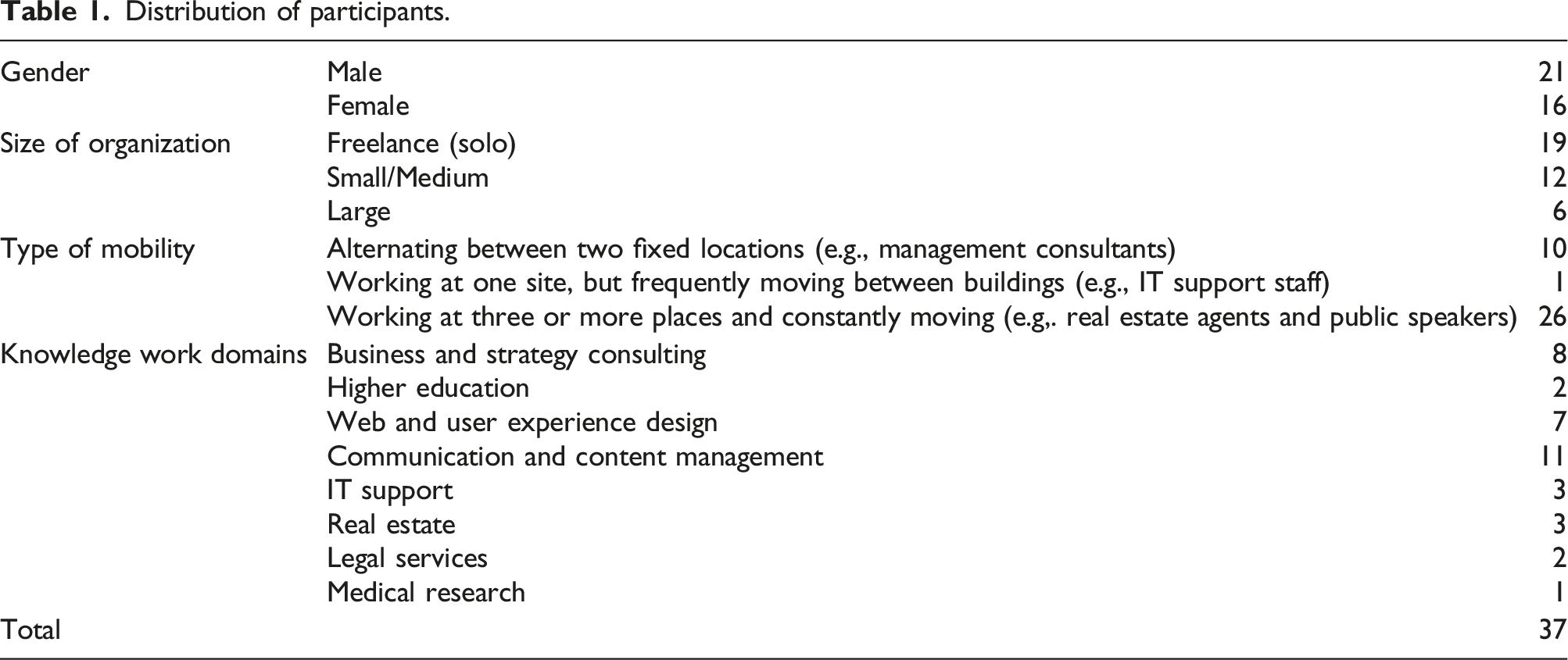
Data collection
Data collection 2 began with exploratory interviews using an interview protocol developed over the course of several pre-tests. This protocol focused on (1) interviewees’ professional background, working situation, work tasks, and work arrangements; (2) the nature and structure of mobility (e.g., spatially and temporally) and work spaces; and (3) the ways that different technologies and infrastructures play a role in their work. Interviews were conducted as semi-structured conversation both online and in-person lasting on average 60 min. These were audio recorded with permission and transcribed verbatim.
The second stage of data collection came in two parts: a diary study and trace data collection. The diary study involved 13 of the 37 participants. The diary study allowed for in situ data collection about the participant’s daily work habits, technology arrangements and uses, and provided further insight into participants’ practices in naturalistic settings over a longer period of time (Grinter and Eldridge, 2001; Jokela et al., 2015). Since the work day of an MKW involves frequently shifting social and spatial environments (Ciolfi and de Carvalho, 2014), it makes direct researcher observation difficult. So the diary approach allowed participants to complete entries from any location and on any device without requiring a participant observer to be present.
Diary entries were structured as a questionnaire about work activities and ICT uses and the protocol included taking pictures as possible. These questions were designed based on findings from the initial interviews with the participants and guided by the prior relevant work (which was primarily ethnographic, e.g., Czarniawska, 2014; Su and Mark, 2008). The questionnaire was a mix of multiple-choice and open-ended questions enquiring about what work had been occupying our participants’ time and what technologies they had been using, and took, on average, 10 min to complete. As part of the diary questionnaire, participants were asked to upload pictures of their work environment, power sources, and digital devices. A link to the questionnaire (hosted on Qualtrics) was emailed to participants twice a day for 7–10 days. Participants were asked to complete both diary entries per day during the duration of the study and to submit them through online survey software from a computer or mobile device. Participants used either their smartphones or laptops to submit responses; they were compensated US$3 per entry, given by gift card after the completion of the diary collection (e.g., two entries per day for 7 days = US$42 gift card).
Trace data, or data created as a byproduct of people’s activities (Geiger and Ribes, 2011), were collected from 13 participants (also selected from the original set of 37 interviewees). This was done using a purpose-built mobile application, TraceMobile, an application that we had designed specifically to capture mobile workers’ infrastructural and mobility practices. TraceMobile runs on both Android and iOS platforms and records a user’s location information, type of Internet connection (WiFi vs. Cellular networks), IP addresses (assigned by the internet service provider), battery usage, accelerometer (to identify the speed and type of mobility: walking vs. driving), and application activities (only for Android users). To use TraceMobile, participants downloaded and installed the app on their personal devices; the app then ran in the background on each individual’s device for a limited period. The average for our 13 participants was 21 days. As a participation incentive, each TraceMobile user in our study was provided with US$50 gift card.
In using the application, the participants’ privacy and security was protected. All the communication and data sharing between the application and server was encrypted using the SSL technology. The application did not collect real-time tracking as location data were sent every 5 min. The users logged on to the app using an anonymous ID and password assigned by the research team. Therefore, the application and server did not have access to the participants’ identifying data (e.g., name and email address). Each piece of data (i.e., field note, photograph, interview, or data collected from subject’s smartphones) was identified by a unique tracking number, the date of collection, the location or means of collection, size, and content. Identifying metadata about each participant were kept separate from the data sources.
Finally, we conducted a second set of interviews with those participants who had participated either in the diary study, the TraceMobile experiment, or both. These interviews were focused and individualized, driven by empirical insights gleaned to date. For example, data from the TraceMobile application provided a useful daily mobility map with specific information on uses of local infrastructures, battery usage, and other data such as use of various applications (for Android users); these maps were used in the second interview, enabling participants to further discuss patterns of mobility and technology use.
Data analysis
Data analysis involved two major steps and was inductive, following principles of grounded theory building (Strauss and Corbin, 1990). The first step involved interpreting interview transcripts in the NVivo research software using open coding (Glaser, 1978). This resulted in the identification of a set of common themes across the complete data set, revolving around assemblages of technologies and specific practices to assemble and integrate these technologies in daily work of mobile workers.
We refined these themes across several iterations of discussion and returning to the data. These themes were iteratively refined after the analysis of the diary study data and the trace data, which allowed for the development of new, targeted questions for the second round of interviews.
This iterative process of data analysis led us to adding, changing, and combining codes that were considered conceptually similar (Miles and Huberman, 1994). These themes helped us identify relevant statements in the interviews and enabled us to compare them through meaning condensation. As is typical in exploratory and constructivist studies (e.g., Cousins and Robey, 2005), the first author was primarily involved in coding, and the other authors engaged in successive rounds of transcript reading, memo writing, and extended conversation to become familiar with the collected data and to collaboratively “sensemake” to produce the findings we report here.
Both the TraceMobile and Qualtrics applications provided data outputs in the form of MS Excel spreadsheets, encompassing records of diary entries and trace data related to each participant. We examined these for finding common patterns, interesting exceptions, or any other points that can complement or demarcate the interview data. As noted, we also used this analysis as probes in the second interview with the participants. It is, therefore, noteworthy that the diary study or trace data collection were not employed as standalone data collection strategies; interviews served as the primary means of data, and our approach toward diary study and trace data was an interposed one in that they were proceeded and succeeded by interviews with the same participants. Trace data and diary entries provided opportunities to augment interview data by bringing a more situated perspective. As a result, we did not use the trace data to necessarily give a voice to technology as done in previous research (e.g., Østerlund et al., 2019; Ribes et al., 2013). This can be considered a limitation of our analysis and presentation of research findings.
Finally, it is important to note that participants technological practices and the configuration of their digital assemblages could vary due to personal preferences or unique work contexts. For example, the data that emerged from the diary study could exhibit idiosyncratic elements in self-reflections by each participant. We kept a balance in our data analysis approach by focusing on common themes across three data sources from different individual participants; these themes emerged in the iterative data analysis process, revealing the infrastructuring practices and the digital assemblages dimensions that appeared to be fundamental to the MKW context.
Findings
The digital assemblages created and used by MKWs comprise a diverse set of ubiquitous, and often commodified, digital technologies and services. These are assembled purposefully and in pursuit of specific goals, reflecting known needs. As noted, our participants have different professional expertise and interests, but share a common set of issues due to the similarity of work arrangements (e.g., constant needs to interact with clients and collaborators) and share many of the same challenges (e.g., location independence and distant collaboration). As such, we find the mobile workers in our study shared a common set of sociotechnical assembling practices that transcend their particular professions and work. As noted, in comparison with more traditional knowledge workers, MKWs are more responsible for the ICT elements of their work and have to constantly learn about and assemble various applications and infrastructures to support their core work practices. We find, as have others, that MKWs spend substantial time organizing and coordinating work (with clients, collaborators, and other stakeholders) as location-independent work in many cases translates into organizational independence (Sørensen, 2011). These efforts are further magnified by the need of many of these workers to (1) find their next project (in many cases they are companies of one, gig-workers) or at least manage organizational complexity and (2) be productive on the move (working across multiple organizational, geographic, technological, and temporal boundaries) (see Spinuzzi, 2012). In what follows, we describe the two sociotechnical infrastructuring strategies (“ensuring digital stability” and “mobilizing work”) that seem to distinguish MKW from traditional work settings and enable these workers to overcome the complexity and unpredictability of their work milieu.
Ensuring digital stability
The choices MKW make to bring particular digital resources together are framed by the needs to accommodate spatial mobility. As described below, this includes harnessing local infrastructures, maximizing resource access and availability, monitoring usage of digital resources, ensuring security of data transfer, and creating a cohesive digital assemblage that operates across various systems.
Harnessing local infrastructures
For mobile workers, two infrastructures are fundamental: electricity and the internet. As MKWs move about to conduct their work, they make sure these two are close “at hand.” The profundity of electricity deserves surfacing, as participant 24 explains: “if you’re a mobile worker I mean you’re not just talking about you need access to the internet, but you also got to think about your power supply. That’s actually if you frequent coffee shops you’ll start noticing where the plugs are…. If you get there early you’re more likely to get a power supply seat.” Accessing this form of infrastructure is not always easy, however, as participant 9 shares: “finding a table near a plug is hard. I carry [power splitter] in my bag in because I’m in an airport or in a Starbucks and all the plugs are filled, I can split, I can split the plug and make 3 outlets.” Indeed, many of the study participants carry extra batteries (for phone and laptops) so that they can work in airport lounges, during flights, and in busy coffee shops where finding a plug is sometimes impossible.
Equally important is access to the internet. Participants 19, 22, and 30 describe how they do extensive online research before visiting a new city or locale (using websites such as Yelp or workfrom.co) to identify ideal public places (e.g., coffee shops) with reliable WiFi. Participant 22 uses a mobile application, WiFi Analyzer, to display the available networks in his neighborhood and assess their relative signal strength. They note: “if I needed to upload a big file and I didn’t have internet access right now, I’d park in the parking lot out front here and just run my upload […] I have antennas to be able to extend the range.” Participant 15, a real estate agent, argues similarly: “You figure out which place that I can pull up in the parking lot, jump on the WiFi, versus places where I might have to go in.” Participant 13, a web developer, leverages inflight WiFi without having to pay for it. They were able to develop applications while their computer can communicate with the client company’s development server without the need to pay for internet access.
Maximizing resource availability
Common to all 37 MKWs we spoke with is the need to ensure constant access to information across space and time in different locales. This takes the form of a diversity of digital information sources, “apps,” and digital systems that help workers create, access, manipulate, and share information. To ensure as much location-independent as possible, participants develop workflows that can be conducted primarily through mobile and portable devices. This includes tactics such as creating digital content or converting non-digital content. For example, most participants convert all required documents/information into digital formats and in doing so, take advantage of a wide variety of physical and virtual storage systems to make information accessible wherever work takes place. These include external hard drives, and in some cases personal servers. Participant 10 uses an Evernote Smart Moleskin Notebook, which “bridges the gap between paper and digital information” and makes it easy to search and retrieve notes across devices. Participant 24 describes a fully digital workflow, enabled by smartphones: “I was at a networking event and needed to get a retainer agreement out to a client. I just typed it on MS Word on my phone, saved it as a PDF, e-mailed it over, and signed up the client.” Participant 9 sees digital signature made possible by a mobile application (Sign Easy) as central to their mobile work: “That app I use a ton on my phone. When I’m out, and someone sends me a contract, I can sign the contract and get it back to them right from my phone rather than having to print and scan it.”
Cloud-based repository services play a crucial role in assemblages: these enable workers to access and manage information resources on the go. Almost all the participants use at least two popular cloud services such as Dropbox, Google Drive, and Microsoft OneDrive. Some relied on lesser-known services such as Backblaze (Participants 20 and 34), SpiderOak (Participant 33), and CrashPlan (Participants 5 and 22). Participant 20, a world-traveler, notes the importance of cloud computing: “We try to keep everything on the cloud especially because it’s easy access and no matter what time zone anyone is on or whatever they have access to the information they need.”
Monitoring usage
Most MKWs are cognizant of their data usage when drawing on the cellular network. In particular, when using a hotspot, participants are more careful using programs that automatically synchronize data in the background. As such, they take pains to monitor their usage. For example, they pause automatic syncing Dropbox, Google Drive, and email client programs so that big files do not consume their cellular data. Participants also showcase a pragmatic understanding about which of their professional activities can be achieved while moving. Emphasizing her mindfulness of the limits of her data plan, Participant 33 describes why she is predominantly using audio conferencing outside of her home office: “I have an idea, I think, <that> one hour of audio call only takes about 25 megabytes of data, so that’s not bad at all. I assume a video call is a lot more than that.”
Ensuring security
Most MKWs working with sensitive material strive to protect this by leveraging their assemblages. Participants 10, 11, and 24 avoid using public WiFi due to specific concerns over the security of data being transferred. From the TraceMobile data, we can see Participant 32 uses WiFi in public places only if it is offered by Time Warner WiFi-Passpoint. He explains the reason: “Time Warner Cable Warner hotspots actually have internet protection so that you can’t come in on somebody’s phone at those locations.” Similarly, Participant 25 deals with security and privacy data by using an enterprise VPN connection on any public WiFi network.
Sometimes security is a matter of using additional technology. For example, diary postings by Participants 22 and 26 make it clear they use specific devices to secure their Internet connections in places like coffee shops. Participant 22 leverages a device (see Figure 1) that secures an Internet connection to share files with co-located colleagues: “If I’m wanting to work on a project and share files I don’t necessarily have to share it on the public network I can share it on the private network there and I can even have that thing connect to the public network and then share that connection through the private network, so I would be able to tunnel through it to get to the internet but nobody would be able to on the public network connect and get into the hard drive where I’m sharing files.” Wireless travel router, securing internet connection, and file sharing (photo from the diary study).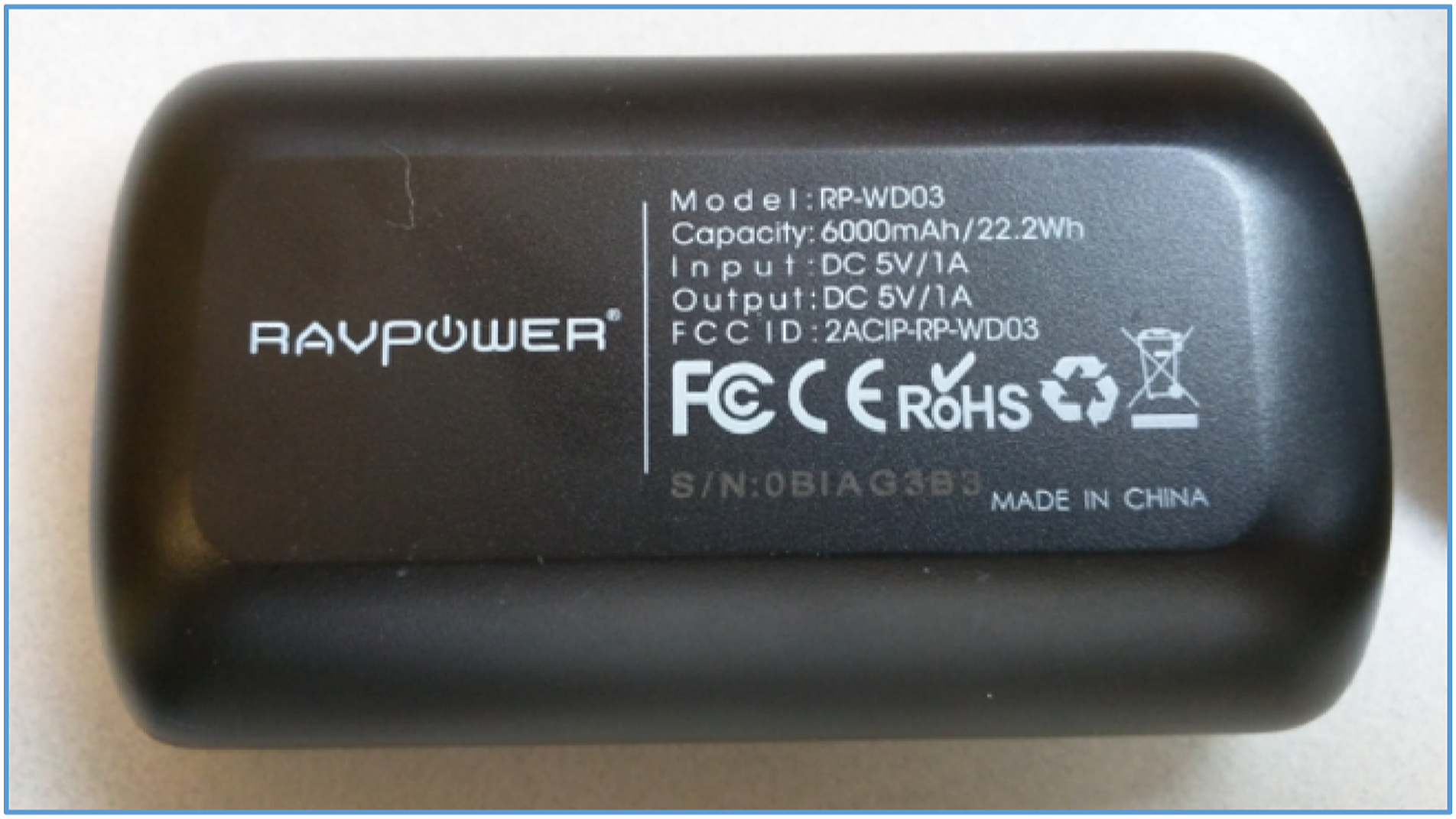
Finally, several participants turn to cellular data if they have concerns over the security and privacy of the available WiFi network. Data from both TraceMobile and follow-up interviews makes clear that creating hotspots using the cellular data is a common practice. Participant 26 explains: “…when the WiFi connection somewhere is unreliable and I’m having connectivity issues then it becomes easier to use a wireless hotspot like tethered to my phone; you don’t have to talk to the coffee shop owner or barista to reset the modem. Sometimes it’s easier just to hop on your phone and connect that way. The other reason is security: When you’re on like an open network WiFi and you just want to be extra cautious just knowing that it’s really easy for people who know what they’re doing so to sniff out a network and kind of get a sense for different data and transitions that are happening.”
Overcoming technological interoperability challenges
Assembling a diverse set of software and digital platforms contributes to MKWs’ flexibility. Even though this assemblage of various software and platforms enable MKWs location-independence, it also creates interoperability challenges. Participants reported having to grapple with limited interconnectivity among information resources, apps, and systems. This means MKWs must devise infrastructuring strategies to weave together the collection of consumer technologies and digital platforms into a cohesive, functioning digital assemblage. One way participants achieved this weaving is to manually connect two platforms or use a “gateway technology.” A manual connection operates like a bridge that spans the gap between two platforms. For example, participant 6 is constantly challenged by his host firm’s system preference for Microsoft. To adhere to his personal preference for Google calendar, he initially requested to import his Google calendar details into Outlook; this request was rejected by his organization’s IT department. As a workaround, he manually synchronizes the two calendar systems separately: “Whenever anyone invites me to a meeting via Outlook, I have to manually synchronize that with Gmail” (Participant 6). Similarly, Participant 10 receives new legal cases from clients through an organizationally sanctioned document management service called NetDocuments. In order to use his preferred cloud-based document management system (Box.com), he downloads and manually uploads each case separately.
Gateway technologies provide a means for digitally spanning a gap between different systems (Jackson et al., 2007). Participant 10, a partner at a law firm, uses a gateway technology called Clio to overcome a disconnect in the calendaring system he must use for work: “If we have a deadline, it gets entered into Clio, which then gets pushed to the Google Calendar, then gets pushed to mobile devices or computers. So, <the appointment> shows up on my calendar on my iPhone or iPad—all nicely integrated. People have multiple calendars, so I’ve got my law firm calendar, my [the 2nd firm’s name] calendar; I’ve got a family calendar, and those are Google oriented, so they all tie together nicely, and I can access those from any device.” Not only does Clio assist with mobility, it has the ancillary benefit of integrating other components of other information resources into alignment with one another. Participant 24, another attorney, described the bridging role of the Slack application: “So it’s kind of a chat room and we can actually have multiple channels on it and so we can connect various other systems to it like Dropbox or a payment process and so we get notifications through it as well that would go through the whole thing and that allows us to kind of have an asynchronous chat. So, I can put a message up and I don’t have to worry about it, at some point they will see it.” Other gateways, like IFTTT (If This Then That), Zapier, and Basecamp, help create digital connections among competing applications and ecosystems so that participants can coordinate their work across multiple platforms.
Mobilizing work across boundaries
In addition to technological challenges of mobility, MKWs have to also arrange their work across different spaces, times, projects, and clients. In order to be productive workers, MKWs have to actively navigate and accommodate various spatial, temporal, project-centric, and organizational boundaries.
Creating productivity spaces
All 37 of the participants relied on some form of a “mobile office” through which they could be productive across the different places that their work took them. The effort to work while on the move creates an unpredictable working context, so workers need to bring assemblages, infrastructures, and strategies together in ways that provides these workers with a sufficient base to engage in information management, calendaring, time/task management, communication and collaboration. These contrived arrangements are “definitely not physical” (Participant 19), remain “undefined [and] everywhere” (e.g., Participants 7, 8, and 9), and are sometimes simply thought of as “the Internet” (e.g., Participants 3, 11, 20, and 30).
16 participants were able to find ways to be productive without Internet connectivity—what several referred to as “offline mode.” Participant 21 uses this time to think: “I am an actual knowledge worker; I actually work with ideas, so it’s developing ideas, writing, creating presentations. I can do a lot of creation without internet access.” Others turn the offline mode into an opportunity to focus and to accomplish work without the distraction of social media and emails. Participant 27 notes: “I find that’s the best place to get work done is when there is no internet on the plane because then you’re not tempted to go surf the internet and get distracted. If you’re writing an outline for a television show; you have nothing to do but focus on writing that outline.” Participant 5 accomplishes work while sitting in the passenger seat on long trips. As a web developer, he runs a Web server on his laptop, which allows him to develop and run programs without needing Internet access.
To create a mobile office, backpacks play a key role by bringing people’s collected sets of (digital and non-digital) tools together and make them available at hand. Five respondents spent extensive time talking about their backpacks and the criteria and needs, many more spoke of how they packed, organized, and managed these kits. In Figure 2, we showcase the assembled assemblages of Participants 25 and 31. All the necessary resources and objects carried in a backpack.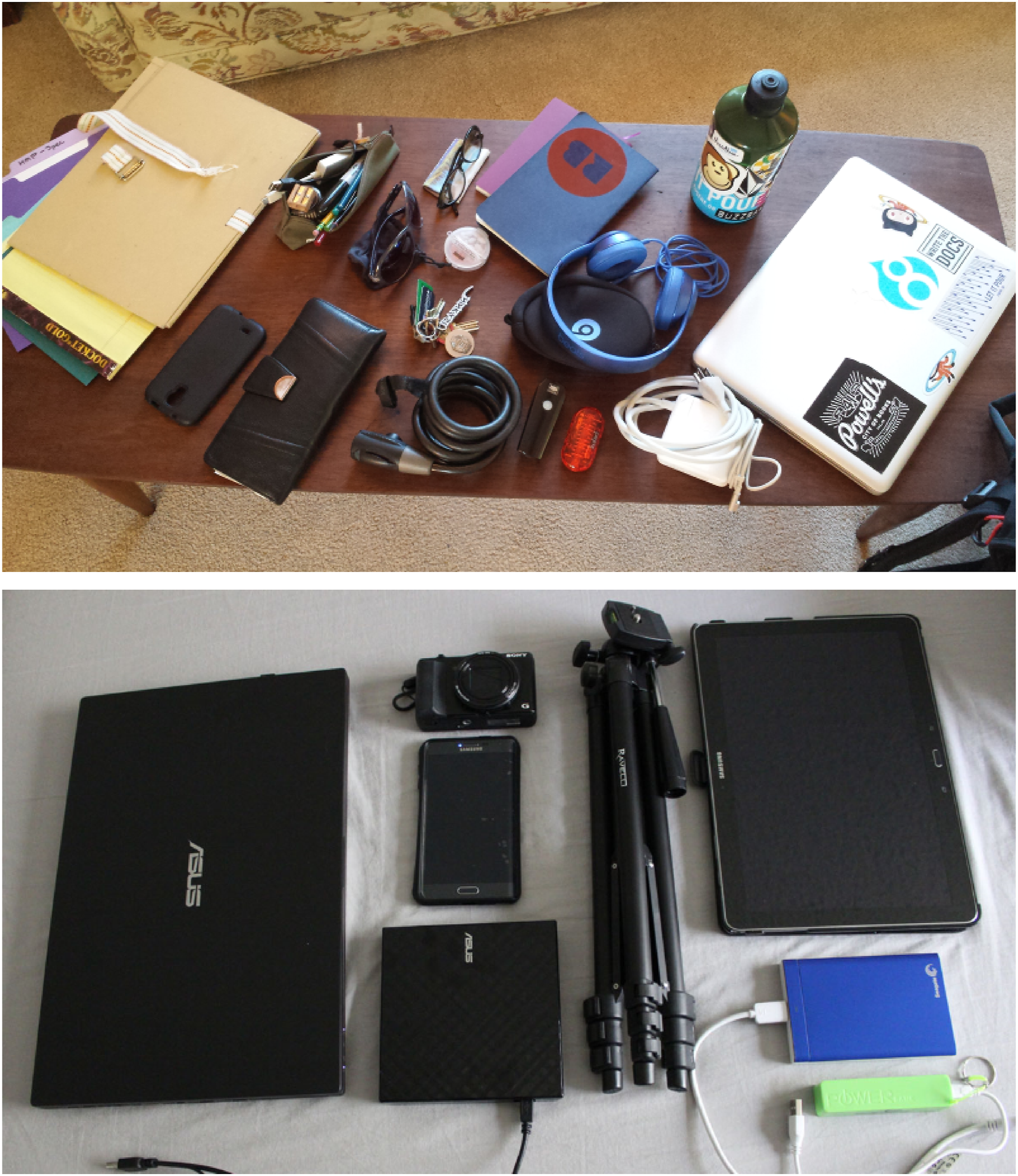
Customizing collaborations
Each participant developed practices for using certain cloud services. Often these practices were specific to each client, partner, and collaboration (something that is common to MKW’s work lives, and freelancers more broadly, that more traditional knowledge workers do not have to consider). The diversity of cloud services participants’ uses reflects clients’ needs more than the worker’s personal preferences. Many of the participants routinely engage in multiple projects, which impose different requirements. As such, to adopt to the needs of clients or collaborators, several participants used multiple cloud services for information sharing (e.g., Dropbox, Google Drive, OneDrive, Spider Oak, or Box.com). For example, Participant 25 finds Google Drive’s interface and information organization impractical, but still uses it because of client preferences. Likewise, Participant 18 uses a communication tool suggested by their clients, going “…where the people are…,” even as observe some of these are “…terrible software platforms.”
Accommodating the needs of collaboration, while intentionally constructed, is another reason the digital assemblages used by MKWs in our study seem like random collections. For example, the diary notes and app survey conducted using the TraceMobile app revealed that Participant 22 frequently used multiple (mobile) applications such as Google Calendar, Calendly, Meetup, Appear.in, Asana, and Any.do to strike a balance between their personal needs and collaborative efforts, sacrificing simplicity to be more client-friendly.
Overcoming organizational restrictions
As mentioned, different organization’s policies both enable and constrain MKWs as they do their work. Participants 11 and 12 could only log onto corporate resources via certain IPs pre-specified by the corporate IT infrastructure. This restricted their mobility and access to information resources from other locations. Participant 25 describes how one of her client organizations imposed its enterprise mobility policy on her phone when she began working with them: “I had to install this really, really invasive security framework before they would let me install any of the apps and access any of the service for my phone. So, like I’m sure they know every text I send and like I mean I don’t imagine anyone cares but I felt totally like naked and unconnected, not being able to check my e-mail (email account provided by the client) from that client on my phone.”
To overcome restrictive policies like these, participants engage in workaround practices, as mentioned. For example, several participants reported they carry two laptops because one enables them to access to enterprise resources (the “company machine”) and the other one provides them with flexibility (the personal machine). Participant 4 emails files from one laptop to the other, because the use of flash drives and cloud services is restricted on their corporate laptop. Their personal laptop becomes the site to install and runs various software (e.g., Photoshop) that directly facilitates their work. Participants also use personal cloud services to work around challenges. For example, disgruntled with the speed and practicality of VPN connections, Participant 13 requests that his teammates share enterprise documents on Dropbox rather than the shared drive that can be only accessed by a VPN connection.
Discussion
The two infrastructuring strategies adopted by MKWs make clear that these workers’ daily practices revolve around the need to constantly navigate and negotiate both technological resources and local infrastructures, while working to meet collaborator and client demands across multiple projects. In doing so, MKWs sort out what is possible across different locations to pursue their work-related goals: riffing and juggling a multi-attribute, multi-goal puzzle. These practices and the digital resources they use, both depend on and support workers’ spatial mobility: a dynamic relationship among local environmental constraints and opportunities, the infrastructural resources needed and available, and the multiple outcomes or goals being pursued.
Here, we generalize from the specifics of our study to highlight central social and technological dimensions of MKWs and their infrastructuring practices. These two dimensions together reflect the premise that digital assemblages are, themselves, sociotechnical systems and are constituted of both social practices and technological elements. 1. Technological context: The diverse use of consumer technologies and the reliance on ubiquitous technological infrastructures (e.g., local WiFi and cellular networks) characterizes MKW as an interplay between work tasks and technological environments. Environments defined by organizational affiliation alone reflect both a different set of knowledge practices on the part of workers—one primarily defined by the expertise of the IT department and as such, a different era of knowledge work (Sawyer et al., 2014). 2. Social context: Personal digital assemblages are concomitantly reflective of both persistent and emergent work arrangements. These work arrangements embody spatial mobility of work, are often project-centric, and exist trans-organizationally. That is, they are often independent of a single or core organizational set of arrangements (Kakihara and Sørensen, 2001).
Building from this empirical understanding, we now look more closely at (1) how this conceptualization of a digital assemblage compares with current conceptualizations of II in the IS research (the second research question) and (2) how digital assemblages are enacted in relation to II and via infrastructuring practices.
Comparing digital assemblages and information infrastructures
Comparison between digital assemblages and II.
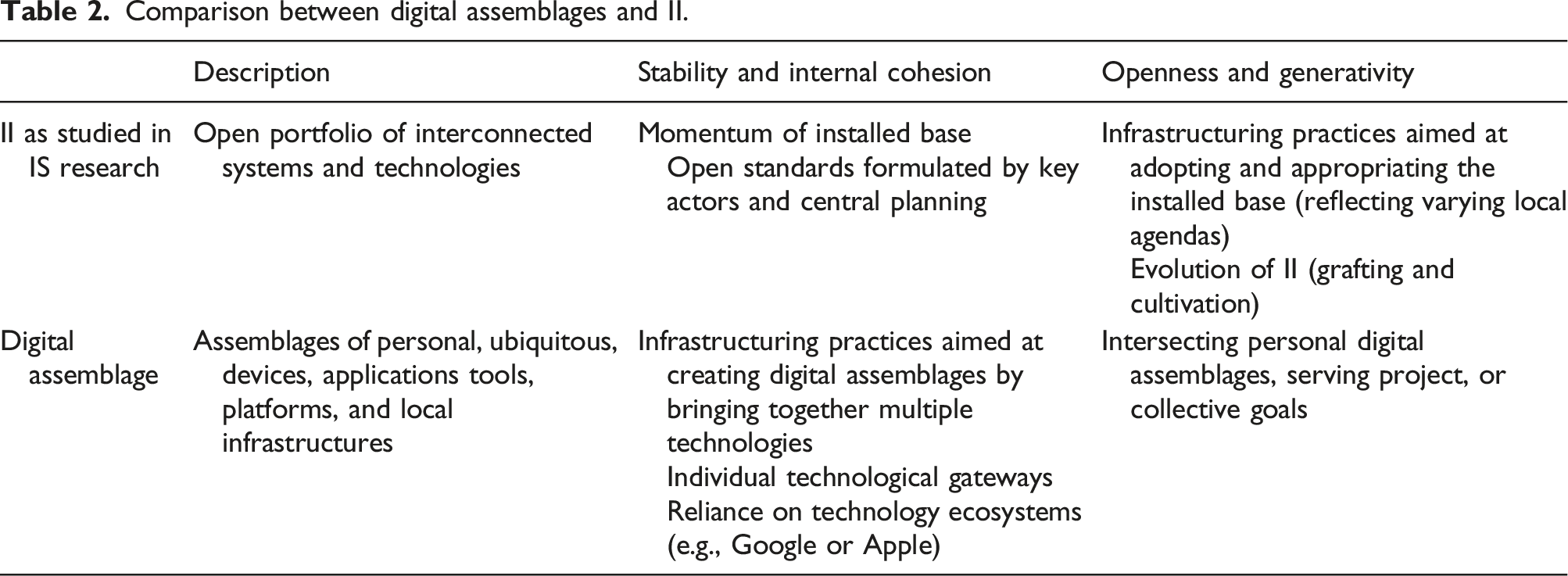
Stability and cohesion
As noted earlier, IIs are sustained through (1) the power of the “installed base” and (2) a set of standards (e.g., norms and rules of uses and access) that allow for information to move across systems and boundaries (per Ciborra and Hanseth, 1998; Hanseth and Monteiro, 1997). Stability in digital assemblages, by contrast, is primarily achieved through workers engaging in dynamic and adaptive infrastructuring practices, piecing together an ever-evolving collection of digital platforms, consumer and organizational applications, and multiple devices to meet their needs—a form of infrastructural competence (Sawyer et al., 2018).
The standards embodied in consumer-based platforms such as Google or Microsoft, shaped by market-based forces, makes it easier for workers to fashion de facto standards that allow for sufficient information sharing among platform components, however these embedded conventions can also plague cross-platform sharing requiring extra infrastructuring work. As Participant 18 states: “Everyone tries to lock you in, and at a certain point you have to decide which lock in you find useful. For me it’s the Google eco system that is the most useful lock in because I use g-mail, I use Google Docs, I use Google Talk, and I use spreadsheets, Google calendar.” That is, the individualization and consumerization of ICT-centric tools (Baskerville, 2011) reinforces commercial boundaries thereby imposing lock-in mechanisms which, in turn, force workers to perpetually work around constraints and weave together assemblages into functioning whole. The core difference in the stability of assemblages versus II is the role of the individual worker’s abilities to maintain a cohesive, functioning arrangement across multiple situations.
Openness and generativity
The generativity of IIs is credited to the digital natures of their core functionality (Ribes and Polk, 2015; Tilson et al., 2010). An installed base forms around this kernel: together this sociotechnical arrangement provides the possibility for infrastructural adaptations (Sanner et al., 2014). These adaptations are shaped in part by consumer-facing standards (e.g., it would be hard to imagine II developments that did not support access to Google’s suite of applications, or Microsoft Office), so growth is rarely random or without due cause.
Digital assemblages—with no pre-defined set of functions—owe their openness to workers’ adaptability in the face of various collaborative and organizational needs. Workers find ways to assemble components into a usable resource for individual and collaborative work, often at the expense of their own preferences.
We further note that even in their individual enactments, digital assemblages exist and must operate in socially and organizationally intelligible ways. In this way, any one individual’s personal digital assemblage is also a generative resource on which collaboration with other individuals and organizations are built and supported. For example, Participant 1 and her collaborators developed a convention for creating, naming, modifying, and saving documents on Dropbox. This agreed-upon convention enabled them to ensure they work on the last draft of a document, and the document is not worked upon by another collaborator: “[it is] like living in the cloud but with an explicit plan so that we’re all not in there working on different versions or downloading it to different things ... and with a handoff process.”
These emergent patterns of use bring workers together and create interconnections and overlaps. In turn, these serve as gateways to shared access to digital resources—to enable access from multiple devices, to allow collaborators to connect and participate, and to reduce the chances of a single point of failure (Sawyer et al, 2014). This resilience is a defining characteristic of digital assemblages and what distinguishes them from isolated uses of technology (i.e., the presence of an artifact). This also extends beyond individuals as many of the organizations who employed mobile workers in our sample have begun to allow personal devices to be seen as corporate resources through policies of bring your own device (BYOD) or bring your own cloud (BYOC). For example, Participant 35 notes that each of her co-workers employs a Dropbox subscription (some use the Plus version); as an independent individual cloud services get connected, they serve as the corporate repository (rather than having a server or drawing upon the enterprise version of Dropbox).
The relationship between digital assemblages and information infrastructure
Digital assemblages emerge from infrastructuring practices that both build from and reconfigure existing IIs; therefore, they both rely on and extend from the IIs. In describing the process through which digital assemblages are enacted, and the links between digital assemblages and II emerges, we draw on Orlikwoski’s structurational view of technology-in-practice (see Figure 3). Orlikowski’s (2000) technology-in-practice concept is informed by premises of structuration theory (Giddens, 1984), and aims to capture the duality of social practices and social structures. Social structures include an emergent technology-in-practice, which is constructed through people’s recurrent interactions with a technology, and the effect of already existing social structures (e.g., other technologies-in-practices as legacy information systems). As such, digital assemblages can be understood as representing information infrastructure-in-practice— a social structure that is shaped by and embedded into a worker’s practices as a set of ready-to-hand rules and resources. From this perspective, the feature space, standards, and openness of IIs serve as an invitation for workers to generate a set of digital resources (their own assemblage) to leverage the IIs. Existing IIs are important in so far as their elements get integrated into functioning digital assemblages via infrastructuring practices. Adaptation of technology-in-practice lens (Orlikowski, 2000) to explain the enactment of digital assemblages as II-in-practice.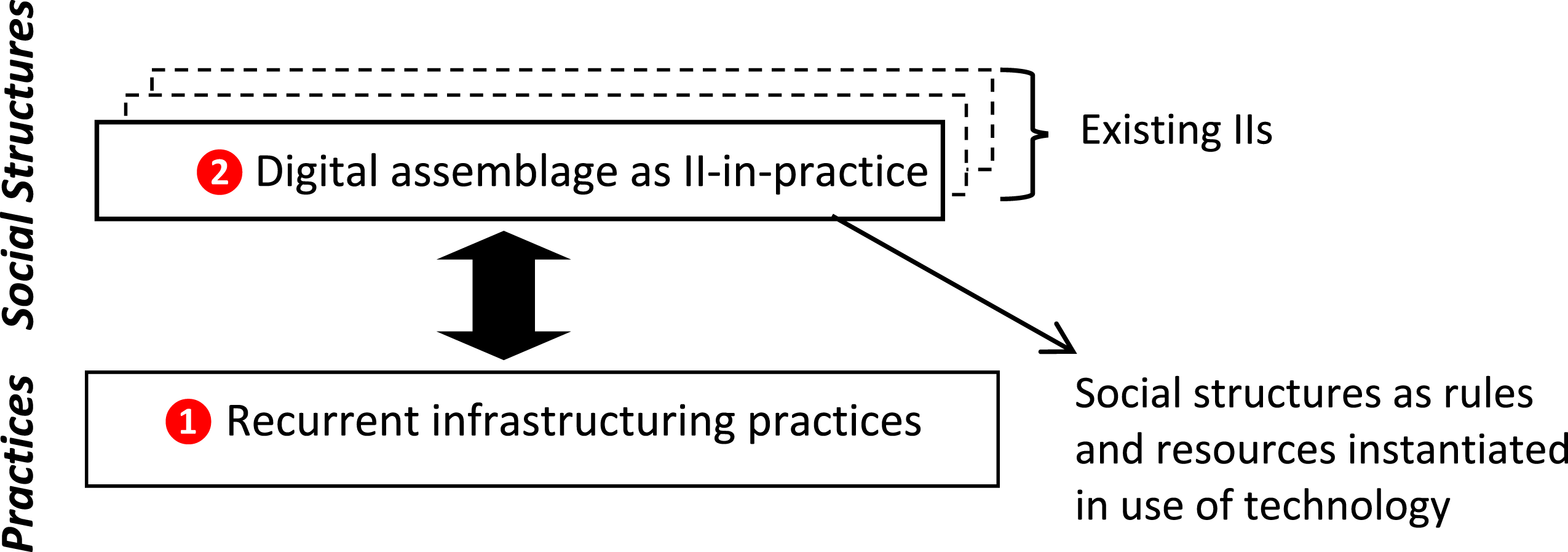
Characteristics of digital assemblages in the context of MKWs
We conceptualize digital assemblages as sociotechnical structures presenting recurring patterns of individual choices of digital artifacts, uses, and purposes that emerge from infrastructuring practices, noted earlier. As outlined in Figure 3, through recurrent infrastructuring, MKWs draw on a panoply of available IIs, and enact a digital assemblage (II-in-practice as a set of rules and resources). In turn, digital assemblages, like other social structures, define future interactions with IIs and shape infrastructuring practices. We focus on different aspects of the technology-in-practice lens (Figure 3) to highlight the key characteristics of digital assemblages. 1- Infrastructuring practices
An MKW’s recurrent infrastructuring practices (i.e., enhancing digital stability and mobilizing work across boundaries), use various IIs and brings them together into a functioning digital assemblage. For this reason, the process through which digital assemblages are enacted is use-centered and bottom-up.
Use and user-centered: the components of a digital assemblage are brought together in purposeful ways and are used to achieve goals and resolve problems—often in ways that do not align with expected functionality. An assemblage is directional and usable. There is a high degree of worker customization and individualization when it comes to coupling work practices and digital assemblages. It may be that through weak ties to one or multiple organizations, MKWs often have a great deal of freedom to craft the means by which they conduct their work. This freedom to assemble necessitates that workers source their own alterative tools and engage in sometimes-complex workaround practices. In doing this, it requires them to develop currency regarding which combinations of tools and practices work best for certain intended ends. MKWs develop this understanding and workarounds through trial and error, and they measure new devices, platforms, and other digital resources relative to their operational usefulness.
Bottom-up and emergent: digital assemblages exhibit common patterns of emergence that mirrors bottom-up investments made by individuals rather than centralized actors such as organizations. As such, we can say that digital assemblages are a type of “inverse infrastructure”: a set of emergent sociotechnical arrangements that are use-driven and self-organized (Egyedi et al., 2009). Partly spawned by the consumerization and individuation of digital technologies and services, we see digital assemblages as reflecting the increasing independence of work from organizations and physical locations. In their bespoke variation, digital assemblages invert top-down arrangements that organizations seek to impose (Egyedi and Mehos, 2012). 2- Digital assemblage as a set of resources and rules
Like Orlikowski (2000), we theorize technology-in-practice as a set of social structures that embody both rules and resources that structure future interactions with technology (p. 406). In what follows, we describe some of the resources and rules provided by digital assemblages that shape recurrent practices of MKWs.
Resource-based characteristics of digital assemblages
Digital assemblages serve as facilities and resources, which help the accomplishment of MKWs work practice due to their structural similarities, functional equivalence, and local adaptability. These characteristics correspond to the generative aspect of digital assemblages in the context of MKWs.
Structural similarity: refers to the presence of common, and distinct, patterns that characterize the ways in which MKWs bring together digital resources. These patterns help define and give shape and form to the digital assemblage, even as each worker’s particular set of arrangements are tuned to their interests. The common patterns are the basis of the structural similarity and facilitate connection of digital assemblages enacted by various workers (opening up the possibility of generative collaboration). Common patterns emerge from similarity of challenges and opportunities MKWs face in their mobile work practices.
Functional equivalence: is reflected in an assemblage’s ability to provide similar support and allow similar outcomes to meet various coordination and information management needs using multiple technologies (redundancies). MKWs digital assemblages demonstrate functional equivalence despite the fact that they may use different technological ecosystems (Apple, Google, Microsoft products, etc.). Therefore, although these assemblages are shaped by worker’s individual preferences and dynamic work conditions, they exhibit structural similarity even among their diversity. These similar functional affordances also contribute to the stability of digital assemblages.
Local adoptability: performing work across different places (or on the move), and away from traditional organizational nuclei requires a set of activities, involving such practices as information management, calendaring, time/task management, and satisfying communication and collaboration needs across different places and times that bring together an ensemble of tools and technologies into a functioning digital assemblage. We observed that MKWs are able to maintain local awareness across several spaces and to leverage their digital resources to support high levels of spatial mobility. Digital assemblages therefore reflect an understanding of local resources and infrastructures and the ability to fashion them into a functional mobile office.
Rules-based characteristics of digital assemblages
Digital assemblages also embody rules-related characteristics that correspond to the stability of these structures.
Standardization/commodification: digital assemblages are assembled from what exists. Standardization allows the different pieces of an assemblage to work together; the pricing benefits of commodities make such activities affordable. This also means the elements can inter-operate and be swapped in and out as needs change, functionalities evolve, and uses differ. Digital assemblages of MKWs often rely on de facto standards offered by brand ecologies such as Android, Apple, and Microsoft, which facilitate the interoperability among various platforms and devices within the same ecology.
Devolved governance: a digital assemblage relies on constituent parts that are developed separately, by multiple developers, in accordance with myriad plans and principles of the maker or developer—and not the worker. As such, policies, features, and inconsistencies are resolved at the use level, often in reaction to changes and often not according to the timelines or timescales the worker seeks. For this reason, MKWs may often need to go to great lengths to iron out inconsistencies and configure a digital assemblage through infrastructuring practices.
Conclusions: IIs and digital assemblages
While most researchers of information technology and work consider organizations as “containers” encapsulating both the work that is done and the information technology used to do it (Baskerville, 2011; Sawyer and Winter, 2011; Sørensen, 2016; Winter et al., 2014), mobile work and the related use of personal and ubiquitous technologies extend beyond these containers. These forms of independent work are not cleanly encapsulated within a single organizational boundary, and their underlying sociotechnical dynamics are not effectively explained using current theorizations of enterprise information systems (Yusuf et al., 2004) or global II (Hanseth and Lyytinen, 2010).
This work contributes to the research on II by furthering the concept of digital assemblages in the context of MKW. Due to the similarity of work arrangements (e.g., constant needs to interact with clients and collaborators) and similarity of challenges (e.g., location independence and distant collaboration), the mobile workers in our study share a common set of sociotechnical infrastructuring practices that transcend any particular profession and or workstyle. This “infrastructural competence” is tied to ongoing infrastructuring work, which creates a functioning and effective digital assemblages based on oft conflicting sociotechnical systems (or device ecologies) (Sawyer et al., 2018).
It appears that an MKW’s success is due in some part to the sociotechnical acumen that shapes these worker’s understandings of the availability, uses, and potentialities of various digital resources (Erickson et al., 2014; Jarrahi and Thomson, 2017), as they must intelligently span organizational, temporal, and spatial boundaries to accomplish their work (Cousins and Robey, 2005). Mobility demands MKWs to constantly confront and account for the complex sociotechnical environments in which their work occurs (Sawyer et al., 2018). As Vertesi (2014) observes in the context of “multi-infrastructural work practice,” such an ability expresses not only one’s “artfulness” and skill but also a degree of local knowledge and membership (p. 270–271).
Findings reported here help make clear that digital assemblages are enacted and sustained by MKWs to manage and effectively execute their work. These digital assemblages, in turn, arise as a direct result of local and bottom-up infrastructuring practices that bring together a large diversity of ubiquitous tools, devices, and technological platforms. These are contrived in purposeful ways, are used to achieve goals, and address opportunities and challenges associated with dynamism of the mobile work context. As a result, they may not align with expected functionality.
Supplemental Material
sj-pdf-1-jin-10.1177_02683962211050943 – Supplemental Material for Digital assemblages, information infrastructures, and mobile knowledge work
Supplemental Material, sj-pdf-1-jin-10.1177_02683962211050943 for Digital assemblages, information infrastructures, and mobile knowledge work by Mohammad Hossein Jarrahi, Steve Sawyer and Ingrid Erickson in Journal of Information Technology
Footnotes
Declaration of conflicting interests
The author(s) declared no potential conflicts of interest with respect to the research, authorship, and/or publication of this article.
Funding
The author(s) disclosed receipt of the following financial support for the research, authorship, and/or publication of this article: This work is supported in part by grants #ACI 1346550 and #IIS 1665386 from The United State's National Science Foundation. Any opinions, findings, conclusions and recommendations expressed here are those of the authors and do not necessarily reflect the views of the NSF.

Supplemental Material
Supplemental material for this article is available online.
Notes
References
Supplementary Material
Please find the following supplemental material available below.
For Open Access articles published under a Creative Commons License, all supplemental material carries the same license as the article it is associated with.
For non-Open Access articles published, all supplemental material carries a non-exclusive license, and permission requests for re-use of supplemental material or any part of supplemental material shall be sent directly to the copyright owner as specified in the copyright notice associated with the article.
