




Abstract
Business processes, simply defined by Davenport as ‘structures for action’, organize the creation of value in a company. In addition to being carried out visibly, processes also have an inner dimension which remains hidden in the existing mechanistic metaphor of process management models. Aesthetic business processes draw from systems theory and Gestalt theory in order to uncover this inner dimension. The aim of this phenomenological investigation presented here is to describe the super-summative nature of business processes, in other words, to understand them holistically as a Gestalt. Mechanical Engineering students at a university of applied sciences analyzed business processes at different companies to discover patterns which they then visualized with the process participants at those companies. They used Christopher Alexander’s pattern language as a paradigm to make implicit knowledge buried in those business processes explicit. Using this technique, aesthetic business processes were identified as patterns. The format of the patterns served as a tool for collective thinking and as a form of expression for the Gestalt of aesthetic business processes in their visualization. A pattern language as an overview of the many ways to combine business process patterns has yet to be reconstructed based on this investigation. The shared visualizations highlighted the nature of the business processes and made it possible to see, in a metaphorical way, their significant interactions.
Keywords
Introduction
Throughout the history of the information systems (IS) field, the concept of the ‘business process’ has always been viewed as an engineering phenomenon. Davenport and Short’s (1990) combination of the process view of business with innovation to key processes is dubbed the ‘New Industrial Engineering’ or ‘reengineering work through information technology’. Hammer and Champy’s (1993) ‘Reengineering the Corporation’ followed the same metaphor—that the corporation is a machine that could be reengineered to extract more value, flexibility, service quality and other goals. Hammer (1990) went as far as obliterating the business process itself since he viewed automating and rationalizing the business process only increases its efficiency but leaves it tied to existing business rules that are unsuited for the new demands of business. Such strategies in business process reengineering (BPR) resulted in high failure rates that are reported in the popular press and in research studies (Clemons et al., 1995; Davenport, 1995; Stoddard and Jarvenpaa, 1995). Corporations and their business processes are complex systems, built from a long history of routines that are embedded in the organization, making clean slate transformations impractical and cost prohibitive (Davenport and Stoddard, 1994). The fad of clean slate BPR transformations, an evolution of the Total Quality Management (TQM) and continuous improvement, ended (Deakins and Makgill, 1997) but its principles continue to be implemented in various forms including knowledge management, SERVQUAL, balanced scorecard and business process management (BPM). These approaches and tools including BPM take the form of a more practical, iterative and incremental perspective to fine-tuning business processes.
BPM began to emerge as a discourse around 1996 (Armistead, 1996) as BPR effectively died. In 1997, the Busi-ness Process Reengineering and Management Journal renamed itself the Business Process Management Journal, officially taking BPR out of the picture. The discourse of BPM itself persisted because processes will always be there but its nature did not change significantly from that of BPR. The same machine metaphor and the legacy of TQM and continuous improvement remained in BPM despite calls to critically assess its nature. As early as 1999, researchers bemoaned the limitations of BPR methodologies (Valiris and Glykas, 1999), and exorted for a more holistic approach. The lack of focus on the human aspect also inspired more holistic approaches in change management. Organizational change can be classified into four types, as processual, structural, cultural, and political changes (Cao et al., 2001). One of the reasons why BPR as a field effectively died was because it lacked any theoretical underpinnings and was largely based on anecdotal reports and industry hype (Deakins and Makgill, 1997). BPM became the opportunity to correct the omissions of BPR. It became a way of laying disciplinary structures such as standard languages (e.g. BPMN) that could carry BPM, and introduce models that describe different ways of organizing processes and increase the number of empirical research that are theoretically guided (Aalst, 2013; Recker and Mendling, 2016).
This article fills the gap in theorizing business processes and introduces a more holistic Gestalt view of business processes. By focusing on the products of theorizing (Hassan et al., 2022) and how they enable us to unpack complex socio-technical phenomena discursively (Hassan et al., 2019), this article introduces a novel view of business process as a community of practice that can think artistically about what they are doing, use their imagination as they experience their work and evaluate their performance based on aesthetic patterns of business processes. This approach differs from the rational and logical machine metaphor and brings into the business process discourse a phenomenological aspect that accesses the experiences given to the senses of the people involved in the business process. This article describes in a more holistic manner the role of people in the business process, the major omission that brought the demise of BPR. The article proceeds as follows organized by the products of theorizing. It begins by describing the difference in the way the system metaphor is used to characterize the business process and how this metaphor enhances the relevance of business processes. Next, a framework for this more holistic business process is described with the help of concepts, theories, paradigms and models including von Bertalanffy’s General Systems Theory, Gestalt theory, Christopher Alexander’s pattern language, a sociological paradigm that offers solutions to specific practices, the artefactual paradigm of visual thinking and new concepts such as ‘aesthetic business process’. Finally, the article concludes with an empirical study conducted in a project involving mechanical engineering students of the University of Applied Sciences Emden/Leer describing and visualizing business process patterns as solutions for a business context.
Replacing the machine metaphor of business processes
The Corona pandemic uncovered many issues related to how we work that were not highlighted otherwise. The sudden necessity of working remotely from home highlighted the need for new forms of work, which can be summarized under the term New Work (Bergmann, 1977; Foelsing and Schmitz, 2021). The Coronavirus pandemic has put digitalization at the center of corporate strategies in many areas of the economy so as to exploit productivity potential and to network in globalized markets (BMWi, 2021). Indeed, the months of the Coronavirus pandemic have also shown: ‘We need the encounter, the whole picture, which a video conference is barely able to offer. As practical as coordination, presentations and actual exchanges are in the digital tile, it is difficult to develop creativity or build relationships in front of the screen’, says the brandeins editor (Fischer, 2021: 3). And when working across functions within a business process, these problems are exacerbated.
Limitations of the mechanistic metaphor
Digitalization presents a challenge for ‘thinking together’ in business processes. Digital technologies support effective and efficient processes in the entrepreneurial context, but challenge reflective processes of ‘thinking together’ in landscapes of practice (Pyrko et al., 2017, 2019). Processes describe a temporally and spatially structured set of activities that transform inputs into outputs, in summary: ‘a structure for action’ (Davenport, 1993: 5; Gaitanides, 1998: 371). Thus, a process is a form of organizational structure. Business processes begin and end with the customer, link cross-functional activities and network companies. In contrast to organizational theory as a possible approach to process management, business engineering takes particular account of information and communication technologies in order to determine tasks that need to be managed in a division of labor (Österle, 1995; Malone et al., 1999; Schmelzer and Sesselmann, 2020). This is where the machine metaphor for the business process fails. It assumes that business processes can only be designed in rational and technical terms, so neglects human and organizational issues. Second, the mechanistic view of business processes assumes that the process itself is static and once redesigned will stay that way. Ignoring the dynamic behaviors that change over time limits the mechanistic view of business processes (Melão and Pidd, 2000). The success of a business process in a complex environment depends not only on process strategy, process governance, methods and IT, but also on process culture and people (Rosemann and vom Brocke, 2010). The faster an organization learns, the faster it can respond to changes and mobilize reserves (s. the ‘Knowledge-Chain-Model’ according to Holsapple and Jones, 2011; Lehner, 2021). This requires new forms of collaboration in business processes (Van Looy, 2021). To think together in business processes as communities of practice (Wenger et al., 2002), it is necessary to also find a ‘timeless form of conversation’ in the digital space (Oguz et al., 2010). Such limitations of the mechanistic metaphor can be addressed by viewing business processes as complex dynamic systems. Understanding business processes as complex, multi-dimensional, open and dynamic systems opens up new perspectives which will be described in the next section.
Visual thinking as a paradigm to express invisible knowledge
To communicate the aesthetic business process to others, visualization offers a way to describe the various forms of experiences into a holistic experience through the interplay of feeling, thinking and seeing (Zeller, 2016; Reichenbach, 1958). In organizational research, Strati (2000), Taylor (2013) and Ratiu (2017) suggest the potential for an aesthetic understanding of the field, so analogously, a similar possibility exists for digital space. However, these aesthetic values remain underrepresented in the field of IS (Hassan et al., 2018; Tractinsky, 2004). One of the reasons could be that aesthetics as a specific form of sensual knowledge can barely be experienced in everyday organizational life. In addition, the uniqueness of the aesthetic experience can hardly be grasped by the general character of terms (Bubner, 1989). If this experience can be visualized, the intangible values could become measurable and assessable in the context of performance management and gain importance for a more mindful process management (Normann, 2001). Finally, knowledge can be linked to value attitudes and competences for coping with complex challenges develop in companies.
Gestalt as a metaphor for a business processes
Analogous to Böhme’s ‘aesthetic work’, aesthetic business processes encompass a spectrum of activities ‘that aim to give things and people, cities and landscapes an appearance, to make them shine, to give them an atmosphere or to create an atmosphere in ensembles’ (Böhme, 2016: 25). With atmosphere as that which is primarily given to the senses, a New Aesthetic as a theory of sensual cognition can be introduced (Böhme, 2013). Tufte (1990: 92) posits that such a ‘span of incredible fineness of distinction’ in visualization is possible using a spectrum of colors, so in capturing the activities as subprocesses relevant for aesthetic business processes, a spectrum analogous to the rainbow spectrum in Tufte’s sense is to be reconstructed to give color to the atmosphere of business processes. The focus of the visualizations is on the integration of the process elements in a ‘whole’, so that the business process can be perceived as a Gestalt. Principles of cybernetics explain the relationships in the business process as well as its integration into the environment. The phenomenological approach proves to be valuable because it clarifies that the technical resources of business processes are less to be understood as a tool, but rather as a prerequisite for creating value in business processes. Meaningfulness also arises ‘with an awareness of the significance of work in its historical and future context’ (Bailey and Madden, 2017: 15).
A framework for understanding the aesthetic qualities of business processes
The aim of process modeling is, in particular, to make their structure and sequence transparent. As the previous discussion showed, the structure and sequence of the business process’s colorful spectrum can be made transparent by visualizing it so it can be adequately understood and successfully modeled. The examination of standardized process landscapes and their further development is currently undertaken using formal modeling languages and notations which fails to capture the artistic ‘irritations’ within organizations (Fenkart, 2014). To aestheticize business processes with visualizations, a framework (see Figure 1) will be developed in this section in order to better grasp the aesthetic qualities of business processes. The framework aims to describe the essential elements and relationships of a business process as a Gestalt, to distinguish them from existing process models and to demonstrate the benefits of aesthetization. Based on this framework, not only can the phenomena be adequately observed, the interdisciplinary dialogue that takes place as part of the collective thinking in digital and virtual spaces within the business process can be examined with the help of visualization. All the processes relevant to the reconstruction of aesthetic business processes are presented, as well as the aspects of systems theory and Gestalt theory that are significant for the framework. To perceive the atmosphere of aesthetic business processes, the framework is theoretically constituted using several worldviews (Weltanschauung) (Hassan and Willcocks, 2021), in particular the system metaphor, general systems theory and Gestalt theory. Application of processes and products of IS Theorizing along with derived principles to reconstruct aesthetic business processes (framework).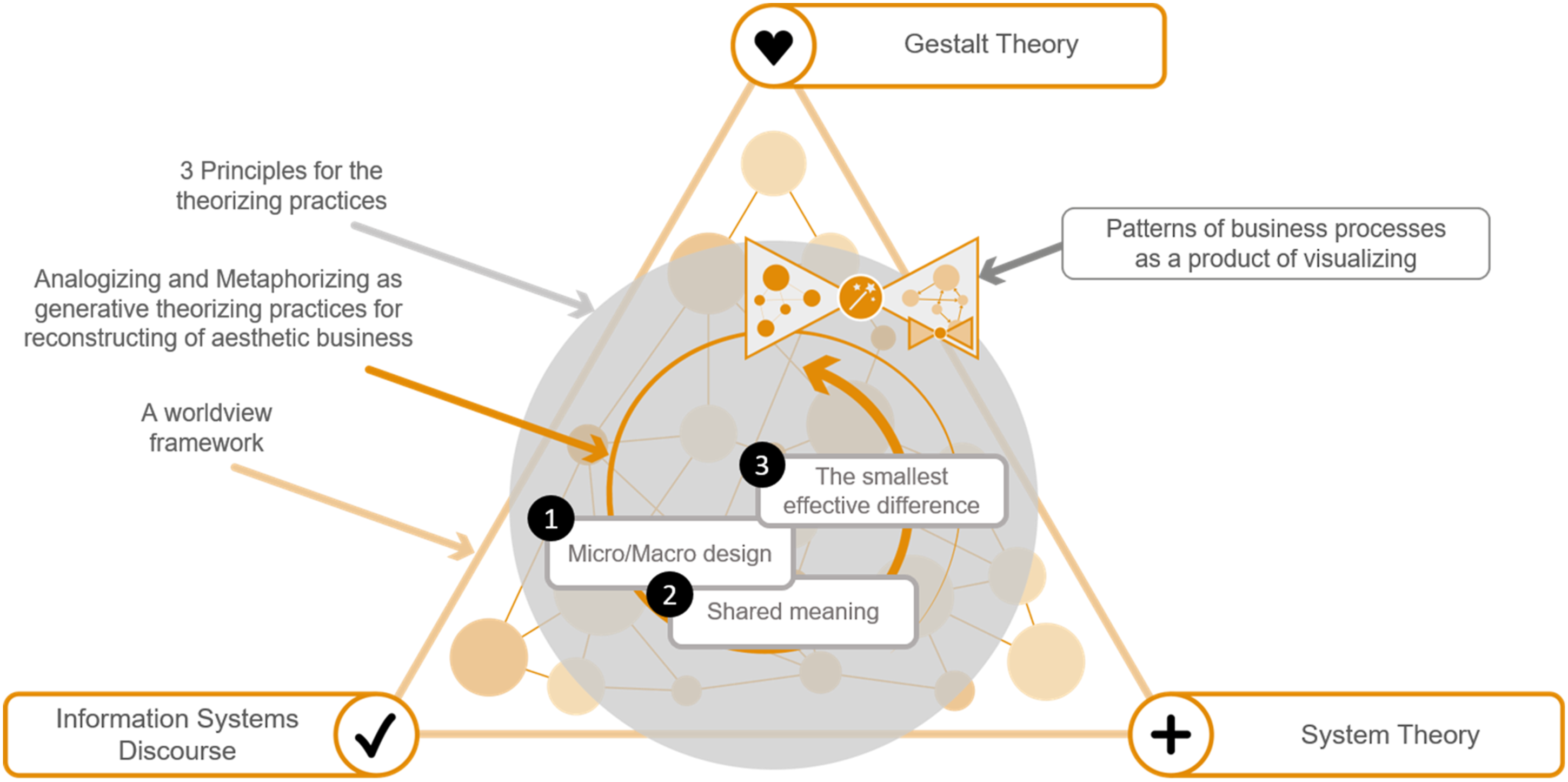
The system metaphor
Using the system metaphor to reframe business processes changes nearly everything that we know about them. About the only aspect about the business process that remain unchanged is that a system consists of interconnected parts, of which existing business process literature subscribes to. Beyond that the system metaphor changes everything else. Morgan (1986) labels the system metaphor as the organistic metaphor – that organizations are organisms, specifically sociotechnical organisms. This first difference incorporates the social nature – the people factor – of business processes into the framework that are intertwined with tasks, structure and technology (Melão and Pidd, 2000). The system metaphor assumes that the system exist within an environment in which the system is constantly adapting to in order to survive (Atkinson and Checkland, 1988). Consequently, the systems are always changing its state, constantly in flux and transformation, even evolving, not like the machine metaphor that assumes stability. Another difference is the holism absent in the machine metaphor, which is described in detailed by the General Systems Theory component of the framework.
General systems theory
General systems theory examines the emergence of systems and recognizes self-preservation and further development as the purpose of every open system. With General System Theory, Von Bertalanffy (1968) provides a counterdraft to the analytically deductive methods of classical physics that underpins the machine metaphor. According to von Bertalanffy, the isolated observation of individual phenomena has no cognitive value; after all, they never occur in isolation in reality. What is needed, therefore, is an understanding of the connection between the respective phenomena. Von Bertalanffy explains systems as holistic, organized and complex structures that are ‘more than the sum of its parts’.
Gestalt theory
Gestalt theory mirrors General Systems Theory in its holism. As Ehrenfels (1890, 1978) explains in ‘On Gestalt Qualities’: ‘Every solid body has some kind of Gestalt. But anyone who compares the shape of a clod of earth or a heap of stones with the shape of, say, a swallow, will readily admit that the swallow or the tulip have realized the peculiar genus Gestalt to a greater extent than the clod of earth or the heap of stones’. With this, Ehrenfels points out that higher forms are those ‘in which the product of the unity of the whole and the diversity of the parts is a greater one’. On the one hand, a Gestalt is described by internal structural laws; on the other hand, it is characterized by the whole and an essence. Finally, the whole is perceived as being ‘different from the sum of its parts’. Gestalt principles support the perception of a Gestalt, which are mainly used for visual representations so as to increase their clarity, unambiguity and comprehensibility (Hartung, 2014). In Gestalt psychology, perceiving a Gestalt is considered an essential prerequisite for effective object identification and grouping, figure-ground differentiation and the completion of missing and obscuring image information (Wirtz, 2016; Goldstein, 2013). Taking the example of comparing the clod of earth with the swallow, the clod of earth may contain the same minerals as can be found in a swallow, but clearly we recognize that the swallow is not a clod of earth, even if it essentially contains the same ingredients, the whole and its essence are completely different.
Together, Gestalt theory and systems theory are suitable for a holistic understanding of business process management, whereby systems theory is particularly complementary with regard to the reflection of complex interrelationships in dynamic environments. Due to the more practical orientation of the framework, a comparative and deliberative discussion is avoided. Various rules determine the relationships of the elements to each other and to the system as a whole. Von Bertalanffy expanded the concept of the system, which he introduced in General Systems Theory, with the concept of strategies (De Zeeuw, 2021). He thus recommended adding experiences, such as emotions and preferences, as observations (Rosenblueth et al., 1943), and ordering these experiences through the concept of strategies. These combination of experiences as a Gestalt forms the basis for the proposed concept of the ‘aesthetic business process’.
The aesthetic business process concept
Witkin (2009a) describes the adjective ‘aesthetic’ in describing business processes not as pure pleasure or stimulating the senses but in the sense of Dewey (1934) and Gadamer (1988, 1990) as a ‘mode of understanding, knowledge and as intelligence’, more precisely as an ‘intelligence of feeling’, and in terms of ‘presence’ of a subject. The aim of aesthetic business processes is to integrate the various forms of human experience of those involved in the process into a holistic experience. At the center of the concept is the ability to generate new imaginative structures and mental images from experiences in a variety of ways (Schlaeger and Tenorth, 2020). Isaacs (1999) describes this ability as combining three languages in ‘Dialogue as the Art of Thinking Together’ to ignite ‘the fire of conversation’: the pursuit of objective understanding, the subjective experience of beauty, coordinated and fair actions. Besides the systems metaphor, another metaphor that describes the aesthetic business process is Böhme’s (2016) use of the term ‘aesthetic work’ to describe the aesthetic economy consisting of human activities ‘that aim to give things and people, cities and landscapes an appearance, to give them a charisma, to provide them with an atmosphere’ (p. 26). Applying his atmosphere metaphor, we refer to aesthetic business processes as accessing what is primarily given to the senses in two different ways: (1) through the experiences that people have in business processes, such as bodily senses, whether pleasant, unpleasant, or neutral and (2) the creation of this atmosphere as a result of the elements and conditions present in business processes. The opposite of aesthetic business processes would be the mechanistic business processes in which people do one thing and think about many other things in multitasking mode. To model these mechanistic business processes, the BPM literature applies texts, tables, diagrams as well as formal modeling languages and notations such as BPMN (Melão and Pidd, 2000). The concept of aesthetic business processes places the focus squarely on the people and further incorporates culture, organizational and political factors. Aesthetic business processes would thus require liberation from the limitations of formal modeling languages and notations and apply the less abstract visual language (Wehlan and Whitla, 2020) and processes of shared experience that is made possible using the paradigm of visual thinking.
Artefactual paradigm of visual thinking
Artefactual (and conceptual) paradigm as a product of theorizing (Hassan et al., 2018) offers concepts and instruments for problem solving. Just like how the instrument used for X-ray crystallography became the artefactual paradigm for the discovery of the double helix shape of DNA, visual thinking or visualization can become the artefactual paradigm for understanding and portraying the aesthetic qualities of business processes. Visual representation has a number of advantages when it comes to associating different things to each other, for bridging spatial distance through similarity of form, color, etc. Art in general familiarizes us with the ambivalence of meaning: What does Michelangelo intend when he refers to the correspondence between man and the barren tree in the ‘Creation of Eve’ in the Sistine Chapel Ceiling? Therefore, the aesthetization of business processes can also succeed if visualizations trigger semantic processes and evoke meanings.
To really appreciate the power of visual thinking, a form of visual literacy is required (Debes 1970). Visual literacy refers to a group of competences that enable a person to distinguish and interpret visible actions, objects and symbols and to communicate with others what they have understood. This is achieved by involving different sensory perceptions. More specifically, visual literacy can be defined as a continuum consisting of processes of visual thinking, visual communication and visual learning (Seels, 1994). As a mental process, visual thinking focuses more on the internal component of competence, while visual communication focuses on the external component and interaction with others (Avgerinou and Pettersson, 2011). In visual learning, both the processes of visual thinking and visual communicating play a role. In principle, a distinction can be made between process- and result-focused approaches to a definition of visual literacy. The structural model of visualization competence by Wafi and Wirtz distinguishes between receptive and productive components, which in turn are divided into different facets (Wafi and Wirtz, 2016): Recognizing the representation, understanding the representation, linking multiple representations and generating representations. Visual competences and visual thinking are considered to be essential for creativity and problem-solving processes. As a method, visualization is suited for research-based learning, for example, which requires the use of the ‘whole’ person (Zeller, 2016; Reichenbach, 1958) and enables the experience of a ‘wholeness’ such that what has value and makes sense becomes sensually and emotionally clear to learners.
Sociological paradigm of the pattern language
While the artefactual paradigm of visual thinking offers concepts and tools for problem solving, the product of solving the problem are ‘patterns’ of aesthetic business processes which represents a sociological paradigm. These patterns are like the formalized accomplishment of the practice of aestheticizing business processes that can be used by others as the bases for future work. Just like how Franklin’s sociological paradigm of the ‘conservation of charges’ (Kuhn, 1970) bounded early researchers of electricity into a distinguishable scientific community, the patterns of aesthetic business processes offer the opportunity to build a new community of creative and imaginative business process modelers. The notion of patterns of aesthetic business processes is drawn from Alexander’s (1979) work in theorizing about architecture. In ‘The Timeless Way of Building’, Alexander searches for a way to design timeless architecture and discovers the concept of patterns. Every place, he noted, gets its character from patterns that are repeated and integrated into the space in a particular way. He collected 253 patterns (Alexander et al., 1977) that can be combined in a pattern language that manifests living architecture: ‘The specific patterns out of which a building or a town is made may be alive or dead. To the extent they are alive, they let our inner forces loose and set us free; but when they are dead they keep us locked in inner conflict’ (Alexander, 1979: 101). Patterns are characterized by a liveliness that manifests itself in three different forms: • Patterns are generic: A pattern documents a proven solution to a problem in a specific context. Strictly speaking, they are not so much actual structures in the world, but rather explicit and tacit knowledge (Kohls, 2013). Patterns abstract and require our participation: patterns are given as much life as is breathed into them in perception, documentation and application. Finally, patterns provide a framework for analysis that extracts good practice as a solution from a context. A pattern only becomes a good solution if it fits into a context. By illuminating a good practice from unfamiliar perspectives, a pattern can surprise us with a new meaning (Van Den Berk and Kohls, 2018; Baumgartner and Grundschober, 2017; Bauer and Baumgartner, 2012). • Patterns contain a real invariant: Although patterns contain recurring elements, these must not be understood as templates. Rather, patterns seek to capture the core of proven solutions that need to be found. Alexander hopes ‘that many of the people who read, and use this language, will try to improve these patterns - will put their energy to work, in this task of finding more true, more profound invariants’ (Alexander et al., 1977: xv). Patterns as well as pattern languages therefore evolve and remain alive. • Patterns are generative: Patterns require holistic processes because they exist only insofar as they are supported by others. Analogous to natural languages, a pattern language networks patterns and allows them to be combined together in unlimited ways. The freedom gained in the pattern language allows both individual and collective experiences to be incorporated. In the process, a dead work can emerge despite adherence to rules, or a living work that contradicts all rules (Alexander, 1979).
The individual aspects in the spectrum of business processes cannot be considered in isolation from each other. Therefore, as a method the pattern approach should help (a) to perceive business processes vividly in their entire form, (b) to consciously perceive them in a lively process of visualization and (c) to design business processes lively in a pattern language. Isaacs (1999), who uses the pattern approach for his ‘Dialogue as an Art of Thinking Together’, understands a living dialogue less as theory. Rather, dialogue ends up as a quality of existence, as different as reading the menu is from eating the meal from that menu.
Generation of a Framework for Studying Aesthetic Phenomena in Business Processes
Now that all the components of the framework are described, we can pull them together and see how they interconnect into a framework that represents the map of the phenomenon of interest that includes the ‘system of concepts, assumptions, expectations, beliefs, and theories that support and inform’ (Maxwell, 2013: p. 39) us concerning the phenomenon. This framework is depicted in Figure 1 framed by Gestalt Theory, Systems Theory and the information systems discourse. The analogizing and metaphorizing theorizing practices are shown as iterative theorizing practices following Rivard’s (2021) spiral model of theory building. It is in discourse that creative thinking processes are inspired, which are crucial for the production of visualizations (Seels, 1994) and this discursive practice needs to take place within both science and art in order to properly understand the dynamics of human experience. As neuroscientist Kandel (2012: 501) notes, ‘Art is best understood as a distillation of pure experience. It therefore provides an excellent and desirable complement to, and enrichment of, the science of mind’. By metaphorizing and analogizing (Hassan et al., 2019), we can extend the restrictive process standardization for business process management practiced in the IS field (Schumm et al., 2010; Tregear, 2015; Rosemann and De Bruin, 2005) and make it possible to describe and take into account the different views of the business process. For example, Cockburn (2001) showed by metaphorizing, how the goals of use cases can be refined as business processes across three levels: sea level corresponding to user goals, a kite for goals above sea level, and a fish for goals below sea level.
Tufte (1990) begins his book ‘Envisioning Information’ with: ‘The world is complex, dynamic, multidimensional; the paper is static, flat. How are we to represent the rich visual world of experience and measurement on mere flatland’. Tufte shows different principles to find an answer to this question. Inspired by his principles, especially the principle of ‘Micro/Macro Readings’, we introduce the following three principles for visualizing in Figure 1: (1) Micro/Macro design, (2) Shared meaning, and (3) The smallest effective difference.
‘Micro/Macro design’ as principle 1
Using the example of the ‘Isometric Map of Midtown Manhattan’, Tufte (1990: 37) explains his rather unusual design strategy ‘to clarify, add detail’: ‘This fine texture of exquisite detail leads to personal micro-readings, individual stories about the data: stores visited, hotels stayed at, walks taken, office windows at a floor worked on - all in the extended context of an entire building, street, and neighborhood’. The visualization of Midtown Manhattan combines both the micro and macro reading elements in one image and as a result the reader is able appreciate all those levels – stores visited and walks taken as well as the city’s formidable panorama of structures and buildings. This micro/macro design portrays its visual and emotional strength in the case of the Vietnam Veterans Memorial in Washington D.C. Looking from the end of the black granite wall, the reader is impressed by the length of the shimmering structure almost disappearing in the horizon with the entire collection of 58,000 names of dead soldiers. But as the reader approaches the wall, and the shape resolves into individual names, the reader is able to touch the etched, textured names arranged by its time of death, and is able to focus on the tragedy of that information at the micro level, as it was reflected earlier, at the macro level in its immensity. Micro/macro designs are able to show complexity in their emotional states.
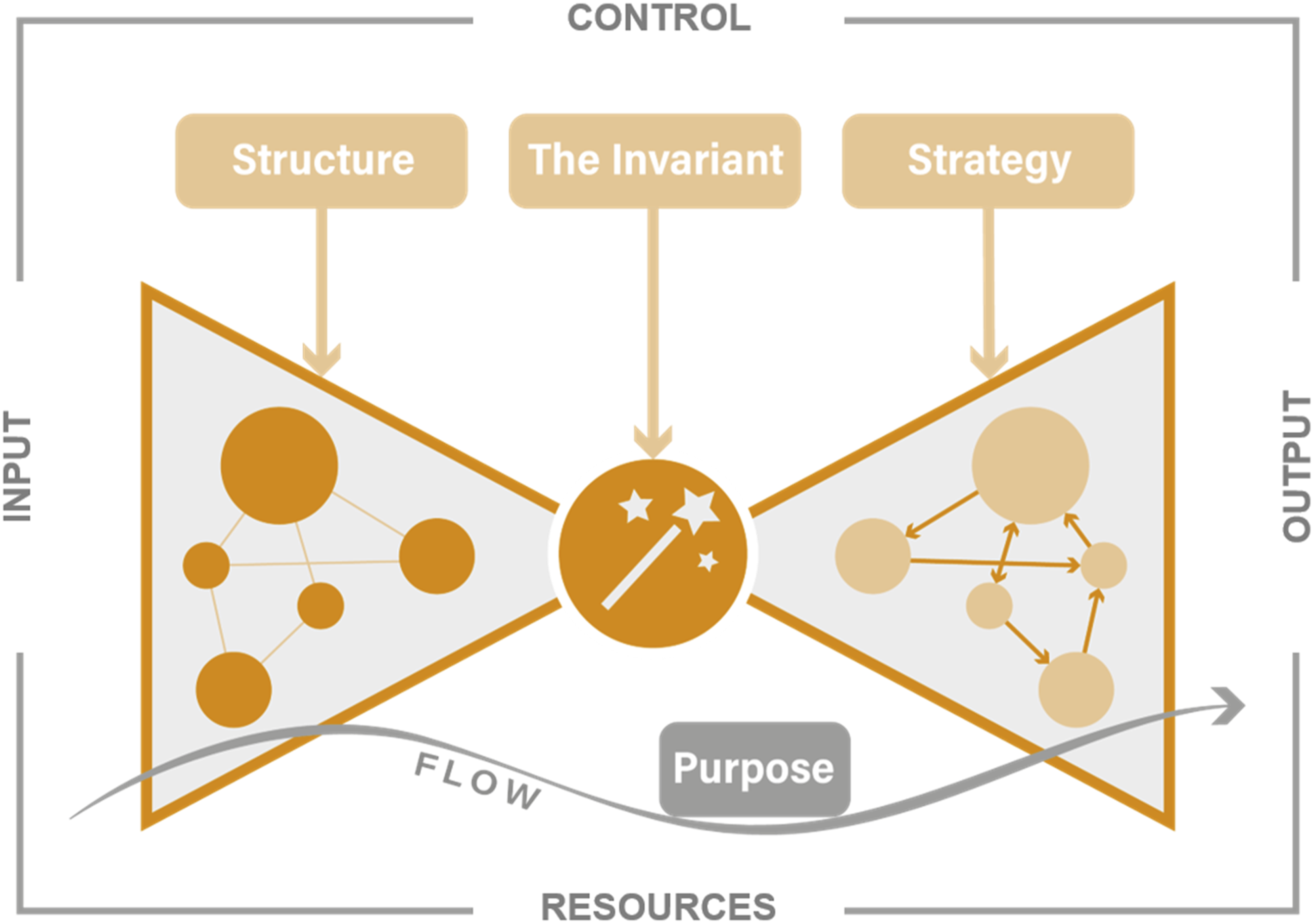
Similarly the business process can be read at the micro/macro level. Business processes can be identified and delimited by means of an ‘anatomy’. Bititci (2016) distinguishes between the following elements: (a) information, materials and customer requirements are transformed into outputs as inputs in a process; (b) business processes require control over the alignment with expectations, requirements, goals as well as certain framework conditions under which a business process runs; (c) value creation in the process requires various resources, such as personnel, machines, consumables, energy, information technologies; (d) finally, business processes consist of subprocesses that essentially determine the workflow and contain various details (see Figure 2). In this context, an organizational design with a macro design and micro design shows how the strategy is operationalized and internalized (Suter et al., 2019). Due to its uniqueness, a specific business design forms the basis for a company’s competitiveness. While the macro design depicts the business processes company-wide from the perspective of a market, the micro design focuses on the optimization of selected subprocesses. The way in which a process is broken down and conceptualized depends on the complexity of the process and what it is trying to achieve in a particular context. Bititci (2016: 67) points out: ‘I would advise against breaking a process into subprocesses and analyzing and attempting to measure and manage the performance of a subprocess (activity or task) in isolation. This will only result in a sub-optimization of the process and will undermine the overall process performance’. Principle 1 should finally make it possible to achieve the effect described by Tufte ‘details cumulates into large coherent structures’ when visualizing a business process with all its subprocesses. Two different ways of visualizing to study aesthetic phenomena in and of business processes on which the framework is based.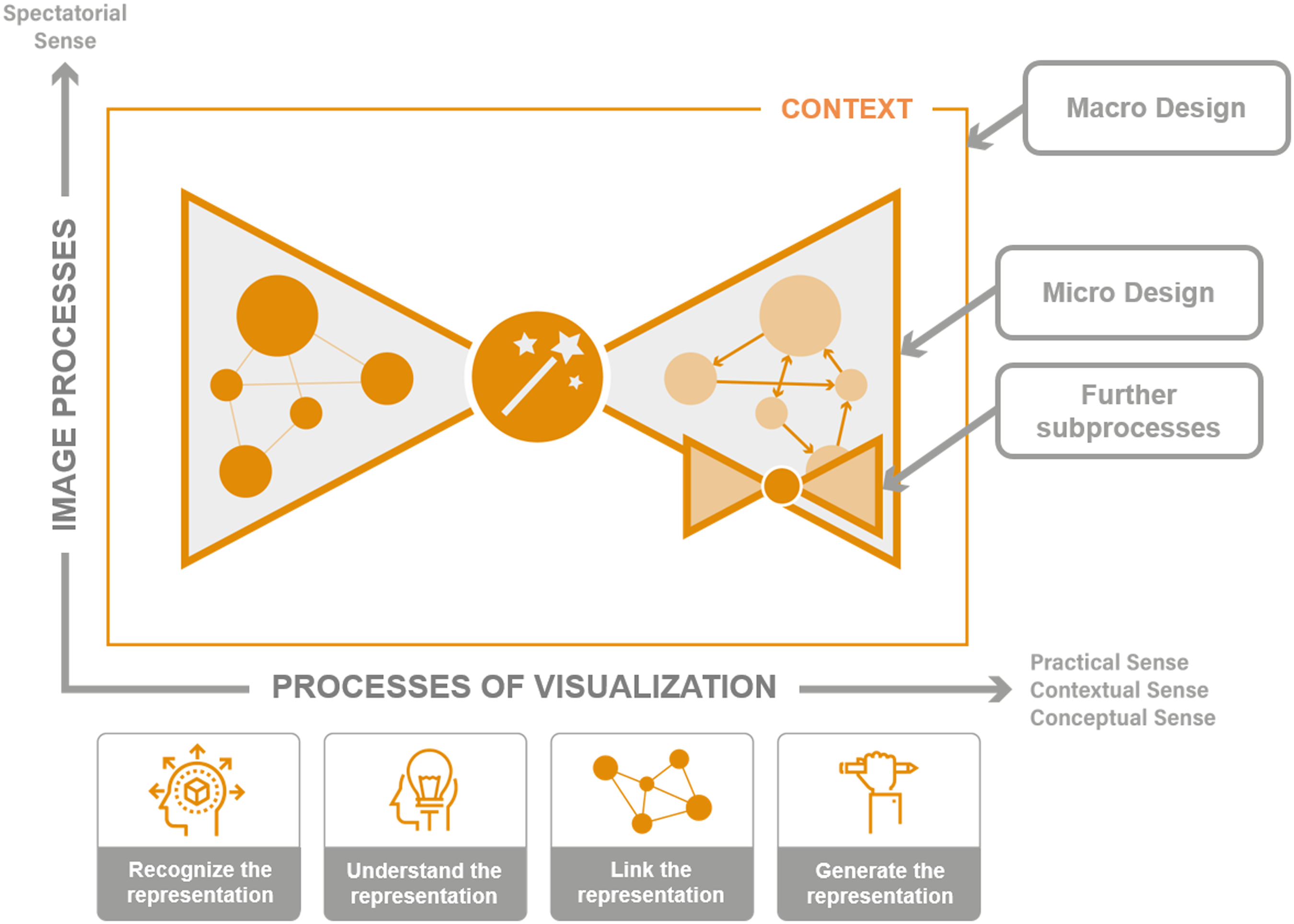
‘Shared meaning’ as principle 2
In visualizing business processes, we look for a ‘shared meaning’ in the more cognitive sense of ‘I get it/I see what it means’, or in an emphatic sense, ‘I care/This means a lot to me’ (Whelan and Whitla, 2020; Morris, 1964). • Sensemaking in business processes: Just like how Weick et al. (1995, 2005) described sensemaking as making situations and circumstances explicitly understandable through language, especially narratives, aesthetic business processes is a form of ‘shared meaning’. In relation to everyday organizational life, Sandberg and Tsoukas (2020) developed a typology for sensemaking that distinguishes different forms of sensemaking depending on the organizational context: immanent, involved-deliberate, detached-deliberate, and representational sensemaking. Essential for sensemaking is the linkage to social processes. The spectatorial sense emerges when the action is removed from the previous context and reconstructed in a ‘secondary practice world’. For example, representational sensemaking describes situations for ‘members of inquiry committees or academics who are representing, reflecting on, thinking about, and explaining the accomplishment of organizational activities’ (Sandberg and Tsoukas, 2020: 8). Immanent, involved-deliberate, and detached-deliberate sensemaking actually form more of a continuum that can be found in the processes of an organization. The senses that emerge through these forms of sensemaking enable a company to design collective action. While contextual and conceptual senses lead to new concepts as a result of involved-deliberate and detached-deliberate sensemaking, immanent sensemaking gives them a practical sense when they are internalized as new or changed routines. We have allocated the above-mentioned senses to the two ways of visualizing business processes in Figure 2. • The spectatorial sense of the image process: Imagery or image processes is one dimension of the processes where the image, supported by the metaphor is generated. The image risks highlighting only one aspect of the business process. For example, the metaphor ‘the man is a lion’ draws attention to the lion-like aspect of that man, and that the man can also be ‘a devil, a saint, a bore, or a loner’ is thus relegated to the background. A comprehensive interpretation requires the insight that all these different aspects can be present at the same time in complementary or even paradoxical ways (Kendall and Kendall, 1993; Morgan, 1986). As illustrated in Figure 2, a ‘specterial sense’ (Sandberg and Tsoukas, 2020: 23) emerges when actions in a business process are removed from their current context and reconstructed in a ‘secondary world of practice’. • The practical sense, the contextual sense, the conceptual sense of the process of visualization: As Oskar Bätschmann (2009: 82) notes: ‘The image is work, a product of work’. So at the same time, the process of visualizing as the other dimension also includes recognizing what is being represented, understanding its different layers, linking the multiple representations to make sense and only then will the representations be generated providing sense. While the image process can result in a spectatorial sense, the process of visualization itself is what leads to a practical sense, contextual sense, and conceptual sense.
‘The smallest effective difference’ as principle 3
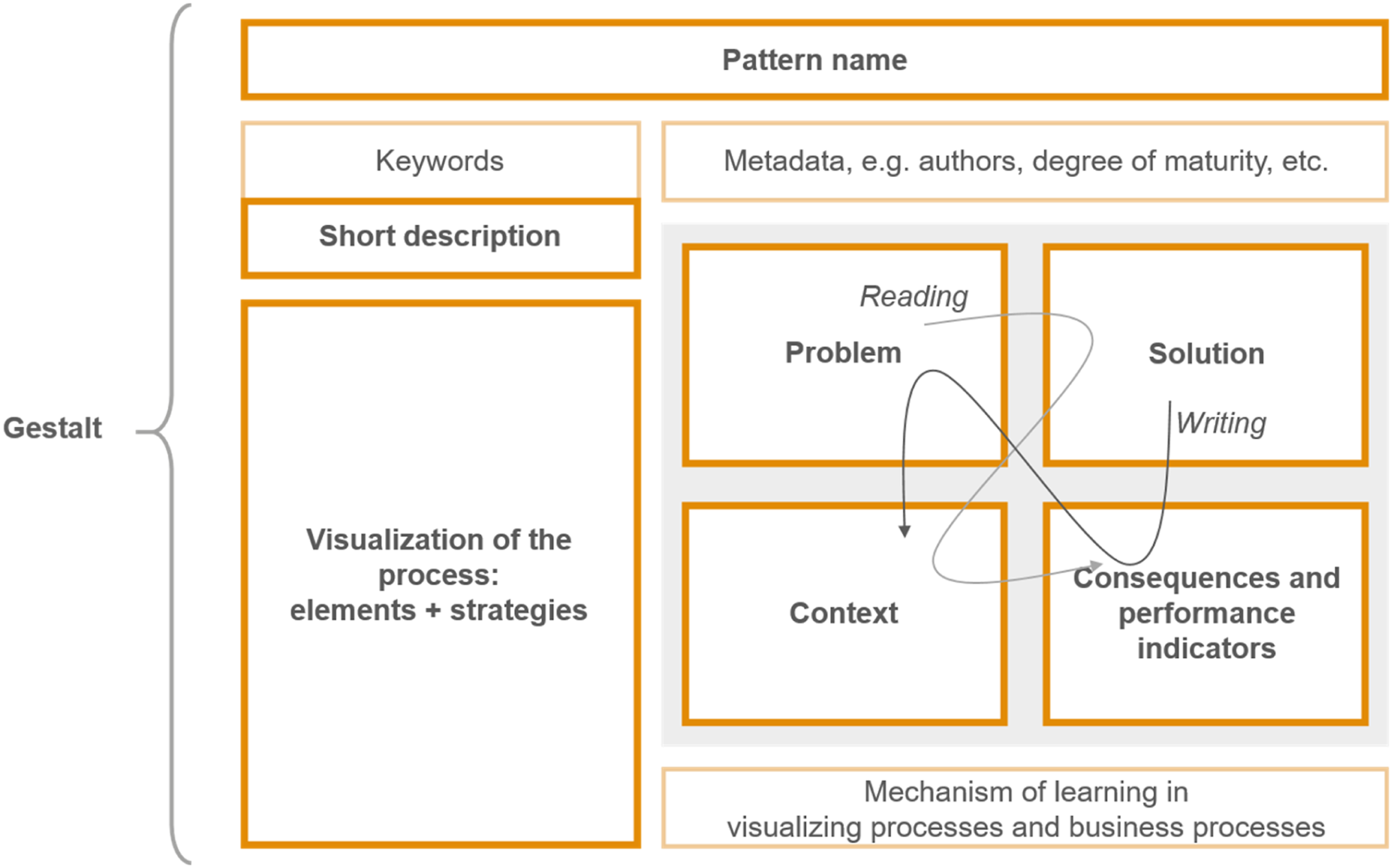
The third principle is again, drawn from Tufte’s (1997: 73) ‘the smallest effective difference’. The actual principle is ‘Make all distinctions as subtle as possible, but still clear and effective’. For example, in visualization, both quantitative and qualitative values can be represented by many shades and hues of color. When visualizing the depths of the ocean, dark blue represents deeper trenches in the ocean, whereas, as the shared of blue gets lighter and changes to light brown, the color indicates sea level and the darker the brown color indicates higher elevations above sea level. This small change in shading or color provides tremendous possibilities for indicating variation in meaning, which is also indicated using numbers (depth or elevation in meters) in the same map legend. The change in shade or color is subtle, but the variation in value is made clear effectively. Tufte wants to point out the importance of the contrast between figure and ground: ‘when everything (background, structure, content) is emphasized, nothing is emphasized’. We take ‘The smallest effective difference’ into account when we model the Gestalt in the following: • A model for visualizing the Gestalt of business processes (see Figure 3): Based on Tufte’s design strategy ‘the smallest effective difference’, Figure 3 brings the ‘just notable differences’ of aesthetic business processes, derived from systems theory and Gestalt theory, into a loose context. Input, output, control and resources describe the contours of the Gestalt and give space to the image that characterizes the flow and purpose of a business process. Bititci (2016: 65) emphasizes the relevance of flow and purpose by comparing the processes of an upmarket restaurant with those of a fast-food restaurant: ‘Customers book a table for the evening, arrive around 8 pm and may stay until midnight. It is about ambience, relaxation and immersion in the experience. Here the flow rate is completely different from that in the fast-food restaurant. It is much slower, as this is what the customer expects’. Various rules determine the relationships of the elements to each other and to the system as a whole. Von Bertalanffy expanded the concept of the system, which he introduced in General Systems Theory, with the concept of strategies (De Zeeuw, 2021). Strategies refer to the choices people make as part of the system. With this extension, von Bertalanffy expanded the General Systems Theory into the social sciences, including as part of its components everything that could be considered a strategy such as plans, models, stories, proposals, blueprints, designs, schemes and so on, and therefore can be observed. He thus recommended adding experiences, such as emotions and preferences, as observations (Rosenblueth et al., 1943), and ordering these experiences through the concept of strategies. One of the most important results of cybernetics, which according to von Bertalanffy is a part of General Systems Theory, is that all viable systems have an invariant structure. Viability means that systems which have the corresponding structure adapt to changing environments, that they absorb and utilize experiences, that is, learn, and that they can maintain their identity and develop. In particular, it is the specific context of the components and not the components themselves that are invariant (Malik, 2016). • Patterns to capture the invariant: The invariant of business processes is to be understood in the sense of Alexander, whose pattern approach is used as a method for visualizing aesthetic business processes. Aesthetic business processes, like successful buildings and processes of growth, have at their core a fundamental, unchanging characteristic which is responsible for their success. Alexander emphasizes that not all ways of timeless building need be identical: ‘Although this way has taken on a thousand different forms at different times, in different places, still, there is an unavoidable, invariant core to all of them’. Both the fast-food restaurant and the upmarket restaurant can be successful in their own unique way because their business process is adapted to the context and thus true to its essence. Regardless of the flow, there is an invariant, the patterns, that describe both the fast-food restaurant and the upmarket restaurant. For example, for both, service is expected, and food is served after an order is made, and the production patterns involving cooks and servers are similar. These invariants affect the strategies and the ultimately impact the goals of going to the restaurant. Focusing on each type of restaurant a study of their aesthetic business processes will yield very different patterns, and in each type of restaurant, invariants that accomplish the goals of each restaurant type. • Visualization of the elements and atmosphere of business processes: We have already referred to patterns as a product of the framework and to the pattern language as an artefactual paradigm for studying the aesthetics in business processes. The format of a pattern helps us to capture the essence in order to abstract and thus visualize it. A model of how aesthetic patterns can be described, based on Iba (2016) who proposed extensions to Alexander’s et al. (1977) pattern language, is shown in Figure 4. The description allows patterns not merely for architecture, but patterns for human behaviors including for learning, presentation, collaboration, business and social innovation. The pattern name is displayed at the top along with any metadata. The pattern name gives the pattern a short memorable name. The metadata will enable patterns to be searched. An example of a pattern name for learning (a human behavior) is ‘Jump In’, described as ‘A pattern of learning where the learner dives into the field or joins a project or class to observe and learn from the members’. The Context is the condition for applying this pattern. For example, ‘The community of learners related to the subject or interests exists’. The Problem describes a difficulty that the learner experiences, such as ‘The learner may have doubts whether the community is suitable since it’s difficult to know the actual state of the community from the outside’. The Solution describes ways to overcome the Problem, which could be ‘Dive into the community, engage in the activities with every effort possible and reflect on your experiences’, which are then described in the Consequences and Performance Indicators of the pattern. All four components: the Problem, Context, Solution and Consequences and Performance Indicators form the mechanism of learning in visualizing the business process, which is then illustrated with a visualization (Iba and Sakamoto, 2011). While Iba illustrates his patterns, Alexander uses a photograph for each of his patterns presented in ‘A Pattern Language’ to express the culture we can experience in patterns. A business process can be understood as a system and as a Gestalt. We decided for the Gestalt in order to pay special attention to the ‘beingness’ (Wesenhaftigkeit) of aesthetic business processes. In order to be able to recognize this ‘beingness’, it is necessary to have aesthetic experiences in business processes. A pattern description combined with a visualization should make it possible to get closer to the Gestalt of a business process. After all, models of systems and Gestalten always remain abstractions and therefore only show partial aspects. Visualization is not only about being understood as a ‘sign’ or ‘symbol’ for business processes, but rather wants an atmosphere of business processes to be experienced. ‘What is important now is to recover our senses. We must learn to see more, to hear more, to feel more’ demands Sontag (Sontag, 2009: 10). This should also be the primary task of the visualization of aesthetic business processes in Figure 4. A model for visualizing the Gestalt of business processes. Pattern structure for the visualization of the Gestalt of a business process.
Application of visualizing aesthetic business processes in the VisualBP experiment
The above framework for aesthetic business processes were applied in an empirical study conducted at the University of Applied Sciences Emden/Leer. Students of Mechanical Engineering & Design worked with subject matter experts (SMEs) from companies in different sectors to visualize patterns.
Experiment in the field
Specifically, the students looked at subprocesses in the value creation architecture of the following companies: (a) Bünting SCM/Logistik GmbH & Co. KG, a service provider in logistics that controls the flow of goods of the trading group ‘Bünting Unternehmensgruppe’, (b) Ostfriesische Beschäftigungs-und Wohnstätten GmbH, which enables people in different fields, who have high assistance needs to participate in working life, for example, in the production of automotive supply parts or consumer good, (c) IDpartners, a design agency that offers industrial design in mechanical engineering. The business processes of the three companies, differed significantly in terms of process strategy, process governance, process culture, process employees, process methods and process IT, such that it is possible to generalize the patterns across different context. The steps of the experiment conducted in the VisualBP project are generally shown in the structural analysis of Figure 14, with the digitization of the patterns concretized in Figure 7.
In the VisualBP project, two software services supported the visual learning of students in the context of the university and the companies. First, the web-based Pattern-Pool-Tool Visual-BP, inspired by the Open Pattern Tool for Higher Education Research and Practice (Van Den Berk and Schultes, 2019) enabled the students to collaboratively reconstruct and document business processes based on a pre-defined pattern structure.
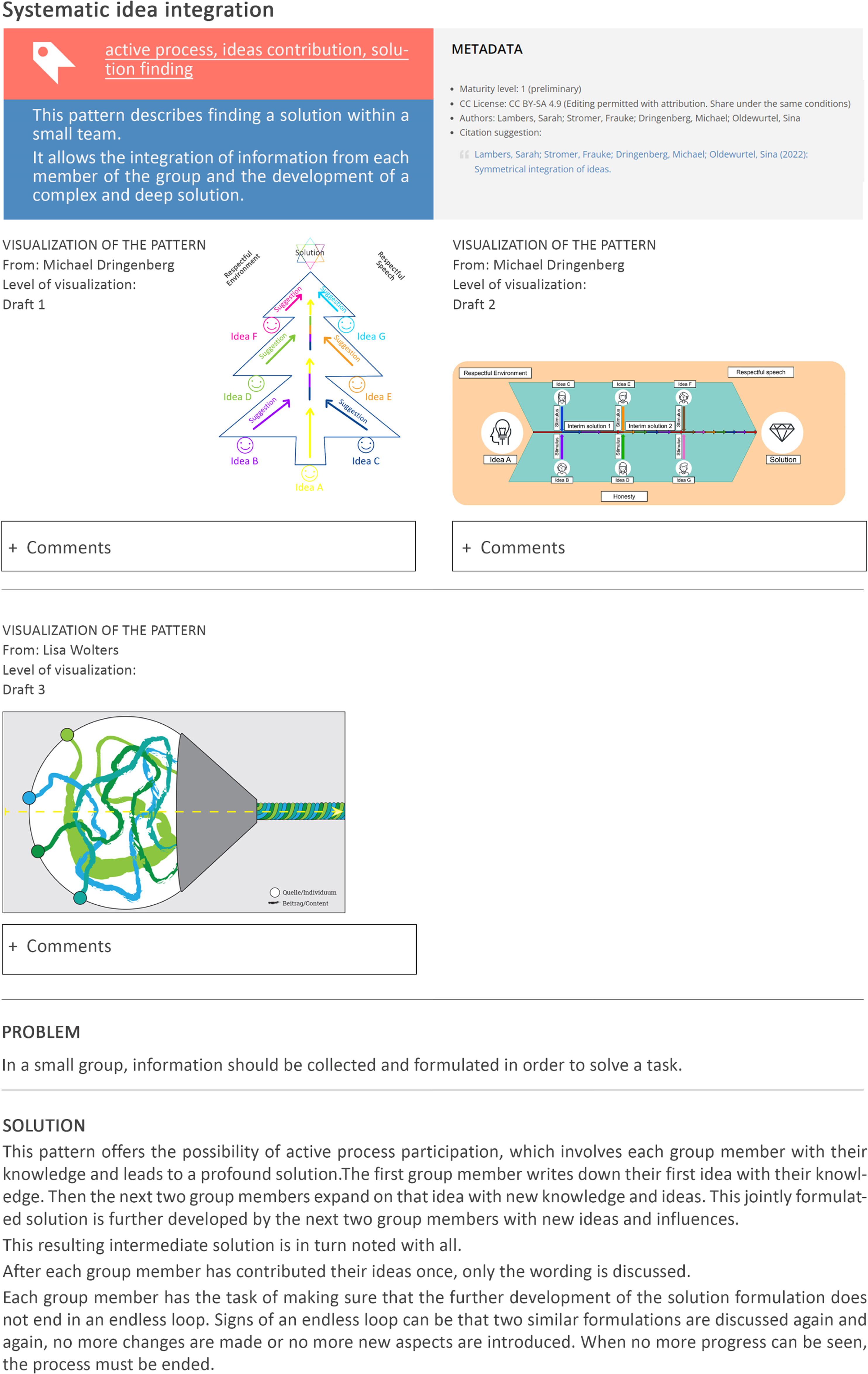
The start page of the Pattern-Pool-Tool shows the current collection of patterns, each of which is presented via its central visualization and keywords (see Figure 5). After selection, each pattern can be studied in more detail in the following format: Pattern Name, Short Description, Metadata, Perspectives, Problem, Solution, Context, Consequences. The Pattern Name provides a short, memorable name that accurately describes the pattern. The Short Description introduces the pattern and the Metadata inform about the maturity level, the authors and suggest a citation. The Problem, Solution, Context, and Consequences texts (see Figure 4) provide more information about the pattern. The Pattern-Pool-Tool also contributed to the aesthetic value of the process visualizations, as it was possible for these to be shown in different media formats and interlinked. In particular, visualizations of different perspectives (see Figure 6) can support the textual description. In Figure 6, a pattern discovered and documented by students, the ‘Symmetric Idea Integration’ pattern, is visualized with three different drafts to make it easier to imagine the liveliness of a pattern and to find a suitable illustration. In the Pattern-Pool-Tool, the process visualizations were not only stored, but rather commented on and reflected upon. Secondly, graphical symbols were developed and provided for the process visualizations, which extend the notation of formal modeling languages. Visual-BP is still in a design state, which helps mainly students in education. The learning processes in the VisualBP project (see Figure 4) aimed to gaining experience for further development of both the Pattern-Pool-Tool and the symbol list in use for aesthetic business processes. In the long run, the Pattern-Pool-Tool Visual-BP aims to help make business processes accessible as patterns beyond the universities and to disseminate them. The start page of the Pattern-Pool-Tool, presenting the current collection of patterns via their respective central visualization. The pattern “Symmetric Idea Integration” shows as an example how patterns can be described in the pattern-pool tool and visualized with different perspectives. The textual description, which focuses on Problem and Solution, takes the form of a patlet. A patlet briefly summarizes Problem and Solution.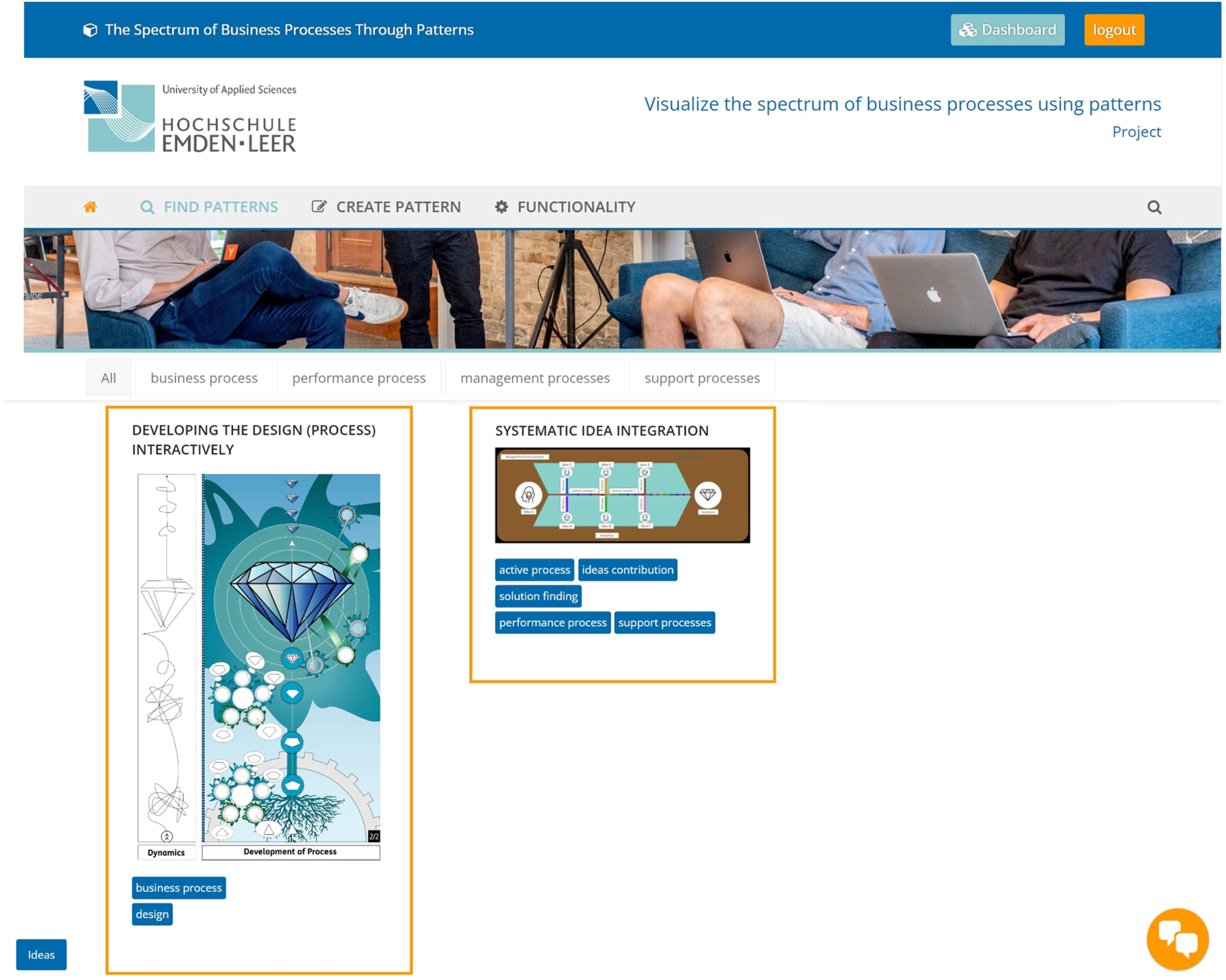
Method for studying the aesthetic qualities of business processes
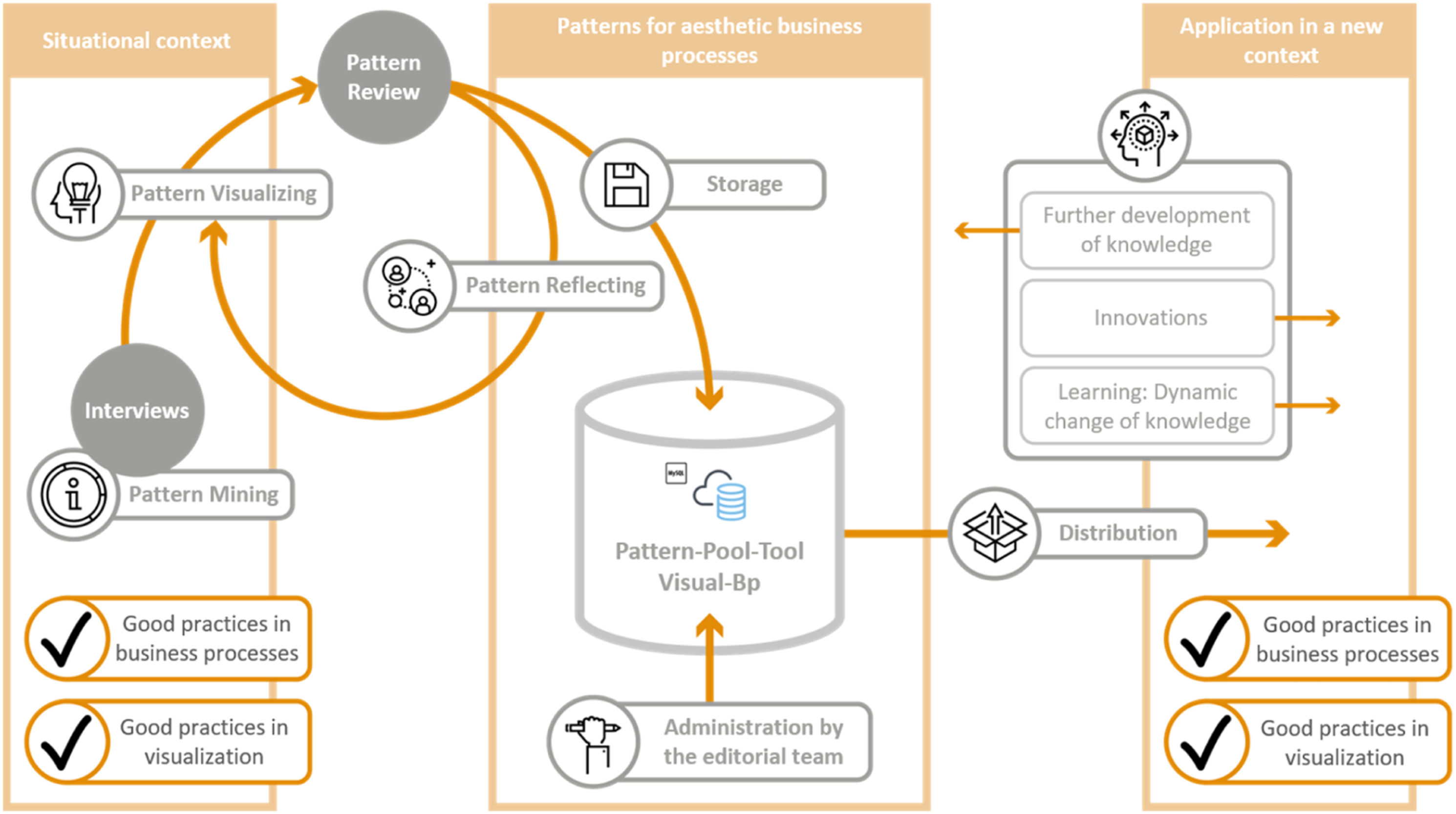
The VisualBP project searched for good practices in business processes, which were then visualized as a pattern within the format of Figure 4. The framework developed in the previous sections guided the analysis of the observations in terms of sensemaking in visualizing and reception of a visualization. Figure 7 shows how the patterns were described and visualized together in the VisualBP project. The visualization of the business process patterns was oriented towards the following three phases of the life cycle of creating patterns: • Pattern mining: The first phase in creating patterns is to search or mine for them. Pattern mining involves extracting valuable ‘seeds’ of patterns from good practices (Sasabe et al., 2016). It also involves identifying the rules, methods, tips, and customs used for the business process and then find connections among these, so the prospective patterns form a meaningful whole to be understood. Patterns can be found in different ways. In the VisualBP project, students conducted problem-centered interviews with at least three process participants of a micro process using a collaborative pattern mining approach. The students were able to use a guideline that provided various questions. Specifically, these were questions (a) about the role and task of the process participants, (b) about the analysis of typical situations in which problems occur and (c) about the analysis and solution of problems in the relevant business processes. After the interviews, the students reflected on the answers given by the interviewees and good practices were identified and written as patterns. The students explore the interviewees’ experiences, observations, episodes, and documented past work related to the subject at hand. • Pattern writing: By explicitly describing and naming each business process pattern, students were able to share, structure, and document knowledge. Through this exploration, they look for and identify hidden knowledge used for the target. This knowledge may include associated rules, methods, tips, or customs. The students then find critical connections among these related items so that prospective pattern begins to form a meaningful whole. The format of the pattern should help to harmonize the different ideas of the students and the people involved in the process and to facilitate the communication between the different actors. Like definitions, pattern descriptions can be more or less adequate. It was crucial that a consensus on the meaning was established by explicating the experiences. • Pattern application: The fact that the visualized business process patterns come close to those of reality was initially considered a hypothetical assumption. The visualization made the business process patterns explicit and thus empirically accessible. With the help of the Pattern-Pool-Tool, it wasn’t only possible for the visualizations to be documented, it was also possible for them to be further developed on a collaborative basis. On the one hand, the business process patterns were supported with further application examples, and on the other hand, they were changed if they did not correspond to the ideas that were considered correct. For example, for their visualizations, the students adapted the patterns of visual learning that had been documented in a preliminary stage of the VisualBP project (Blattmeier, 2020, 2021) in a co-evolution. The students' visualizing constantly followed Dan Roam’s four-stage process of visual thinking (Roam, 2008). The process of visualizing business processes together with the help of the interactive web tool Visual-BP.
A concrete example of the steps taken in the experiment is described using the specific case of IDpartners, a design agency that offers industrial design in mechanical engineering. Visualizing the Gestalt of business processes in the format of a pattern (text + visualization) makes it possible to perceive a more than just what’s ‘different from the sum of its parts’. It provides the possibility of appreciating the ‘atmosphere’ and ‘existence’ of the aesthetic business process. We would like to use the framework of chapter 3 in particular as a ‘tool’ with which the aesthetics of business processes can be studied. According to Reckwitz and Rosa (2021: 45), the practice of a theory-as-tool ‘always has the character of an experiment, in which concepts and theoretical relations are tried out and refined in dialogue with the objects’. Thus, structural analysis is further presented as a possible concept for visualizing business processes and related to the competences of visual literacy (see Figure 14). The structural analysis wants to let the Gestalt of a business process develop step-by-step down to all details in a clarifying process from a basic conception taken up at the beginning. In the visualization, the different human forms of experience can be integrated, so that the Gestalt of a business process can also be recognized during the visualization. Finally, the value of aesthetic business processes in terms of ‘shared meaning’ will be demonstrated, as far as the phenomenological investigation would allow. For a detailed evaluation, however, it needs categories analogous to art, which remain to be defined based on this project.
Experiencing the Gestalt of a business process
As section 4.2 wants to make clear, the patterns in the case study of IDpartners were not invented. Patterns exist in the world and are waiting to be discovered and documented. In the VisualBP project, we set ourselves the task of finding a visualization that makes business processes explicit and lively as hidden patterns. In the following, the micro process ‘Developing the design (process) interactively’ and the macro process ‘From corporate identity to design’ are visualized as a Gestalt. Micro process and macro process allow each one to have its own focus in the visualization and description. Thus, the macro process forms the basis for various micro processes. The connection between micro/macro process corresponds to the ‘Micro/Macro design’ as principle 1 of the framework (see Figure 1). With regard to ‘the process of creating life’ Alexander points out that living structures emerge in the interaction of two types of processes, which are arranged in a hierarchy: ‘There are individual processes of design or construction each one a locally complete type of creative process’ and ‘There is an accretive process which forms the larger structure, piece by piece’ (Alexander, 2002b: 204). Thus, the process participants have the chance to ‘carefully fit their work into the whole around them’. With regard to the documentation in the Pattern-Pool-Tool, the selected micro process ‘Developing the design (process) interactively’ was documented as an ‘individual process’ via its visualization in two parts and the visualization of the macro process (see Figure 8). The macro process ‘From corporate identity o design’ is a larger pattern that can be related to other micro processes. Visualization of the micro process “Developing design (process) interactively” in the pattern-pool tool with relation to the macro process ‘From corporate identity to design’.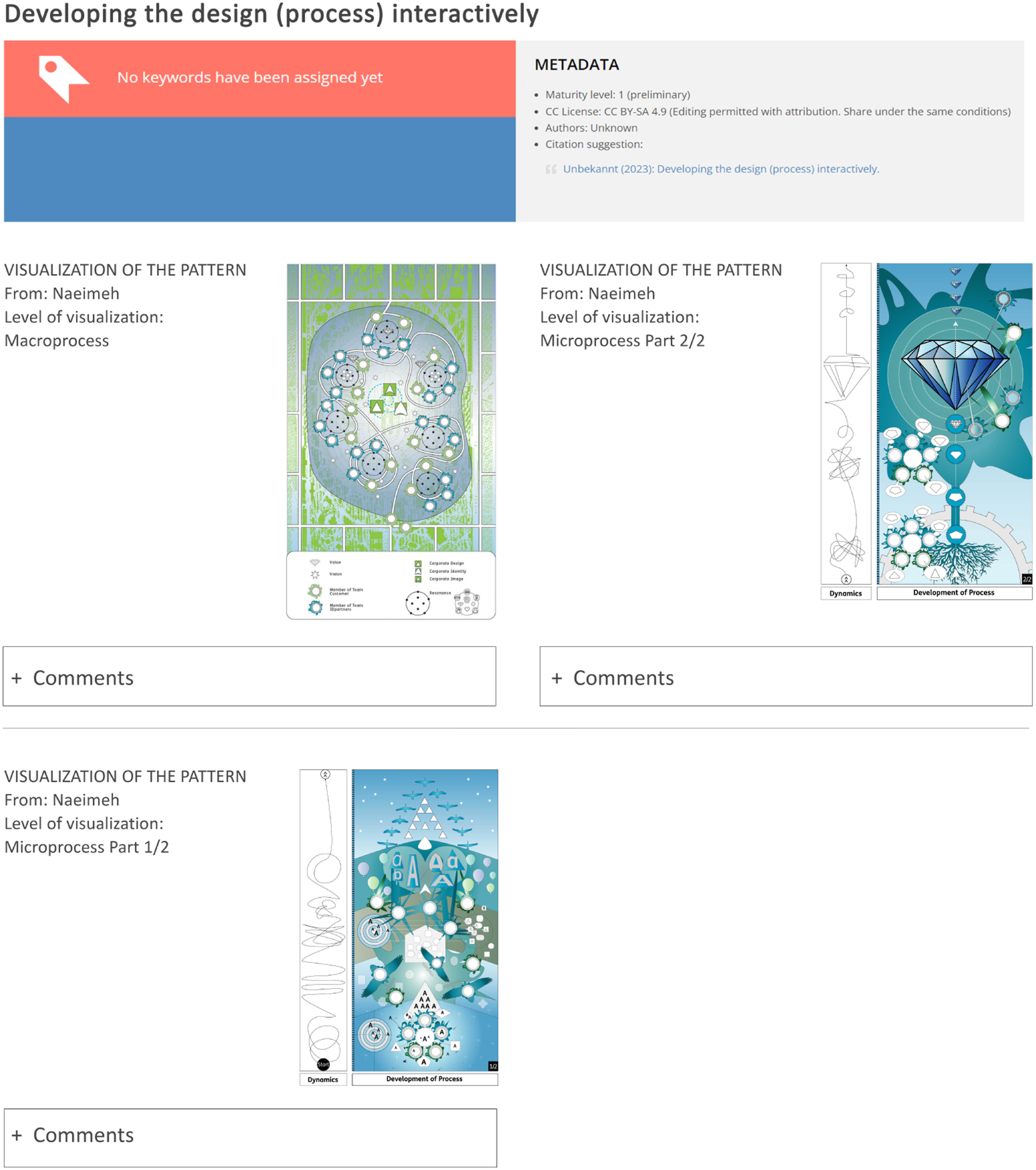
Gestalt of the micro process ‘Developing the design (process) interactively’ (Micro Design)
Building on the macro design outlined in the framework (see Figure 1), the VisualBP project visualized the patterns identified in interviews as subprocesses of business processes in the micro design. Detached from the macro design, the micro design showed the individual process steps and defined the resources required for them on a qualitative and quantitative basis. The micro design aims to answer the question of ‘how’ and therefore describe the workflow. Workflows control the execution of business processes through the communication and information technologies that are used for this purpose. • Context, problem, solution: ‘Corporate design can solve this problem’, explained Jacques Stevens, head of IDpartners. Although there are many methods available for creative processes, in technical industrial design it is often very difficult to understand the design and its development in a theoretical and structured way. Designers and engineers solve problems differently due to their training, and the cooperation in the design process tends to be intuitive. In corporate design, IDpartners develops the design iteratively together with the customer. In their description of the solution, the students emphasized the importance of the customer’s input:
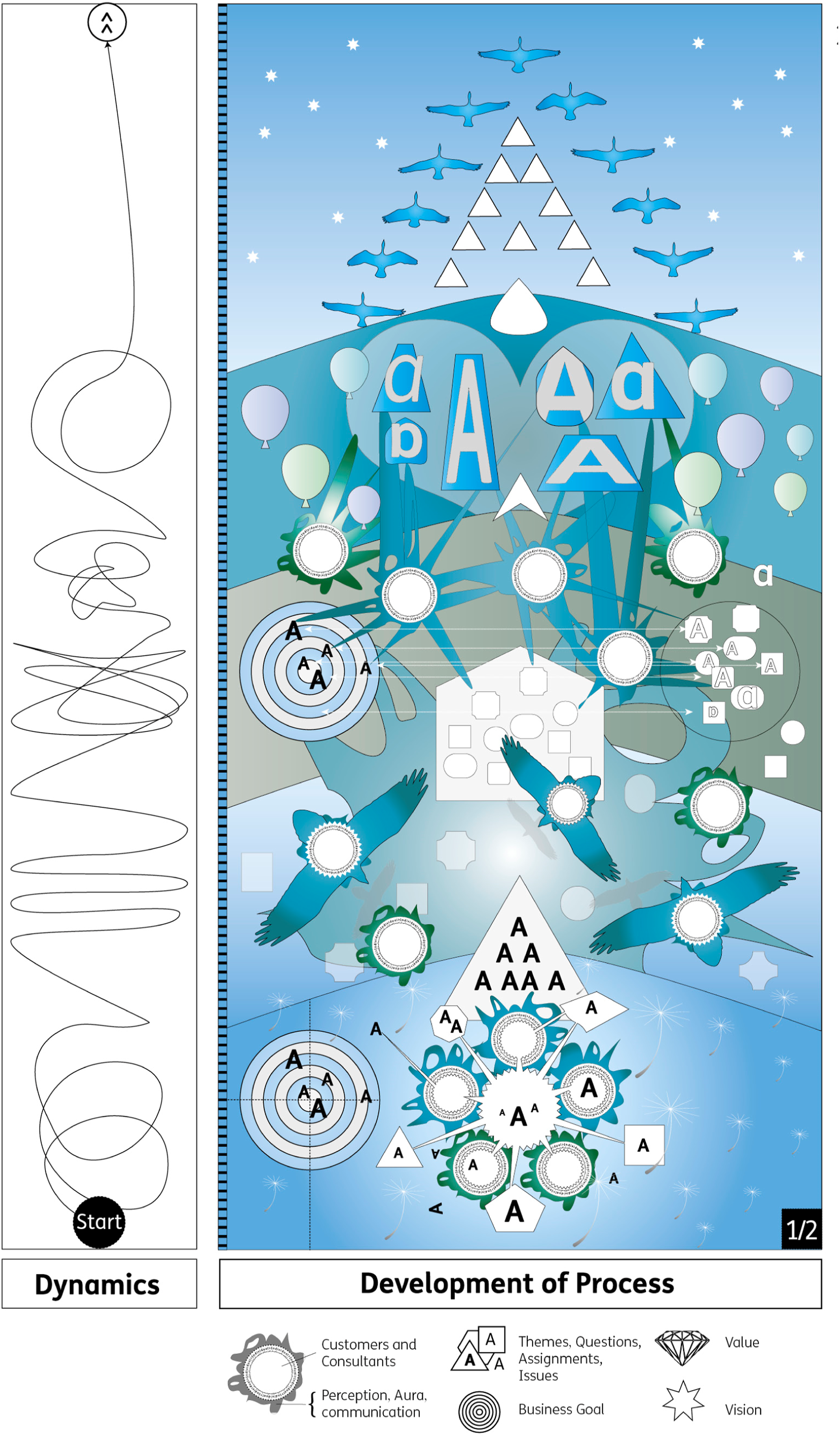
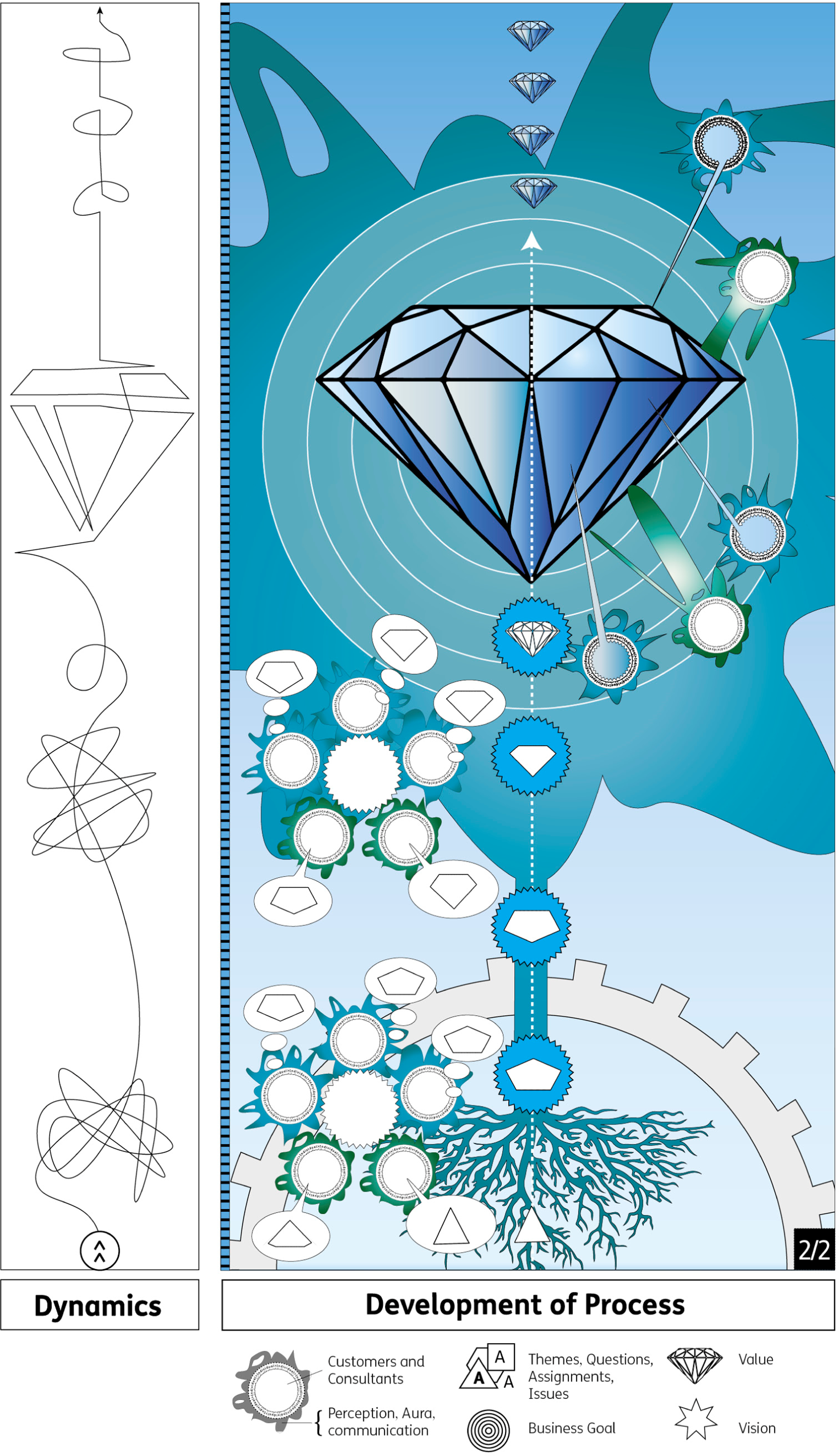
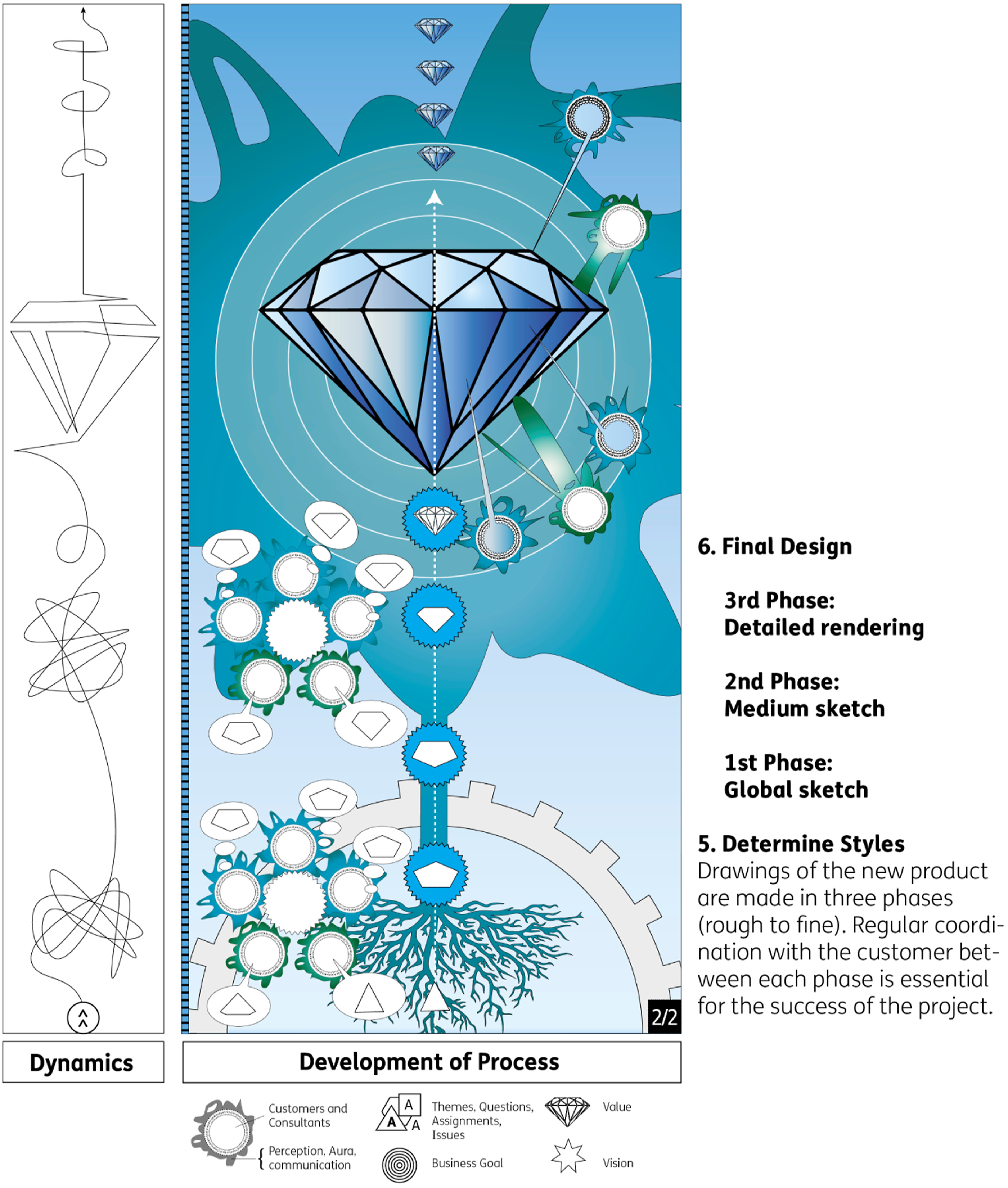
The development starts with rough sketches, which are revised and further developed after feedback and reflection rounds in the company and with the customer. Then they move on to the next phase and more detailed sketches are made. These are then discussed and revised in feedback sessions. This process is repeated until a satisfactory final result is developed. In each round of reflection, a changed environment has to be addressed and new aspects in the design process have to be considered. • Visualization of the micro process: The process visualizations in micro design (see Figures 9 and 10) aims to make the analytical and synthetic phases in the design process visible and therefore create a common starting point. The visualization indicates the steps in the micro process, which are carried out in a smooth sequence by a team consisting of people from IDpartners and the customer. The first step is to formulate a mission for the company and its design mandate. The customer’s current and future product portfolio is described and then evaluated in an image assessment. This is followed by the development of a mood board for the new product design, so that styles and corresponding style elements can be defined. Finally, the product design is developed. Visualization is all about involving the various disciplines in the process by giving them the opportunity to follow the thinking and actions. This is to make it clear that design is not only the responsibility of design development, but also of the customer and other stakeholders. The representation of the process aims to support the participation of people in the process by using icons to allow for the integration of experiences, ideas and perceptions. The abstracted process ‘Developing the design (process) interactively’ reveals the principles of design thinking, which, however, are used in a specific context. Design Thinking is known as a method for creating new solutions for customers in a structured and iterative way (Mootee, 2013; Schallmo and Lang, 2017). Against this background, the chosen name ‘Developing the design (process) interactively’ indicates that the essence of the micro process can be applied not only to the development of a design, but also to the business process itself. • Value of the visualized micro process: The central concern of the visualization is the resonance that can be experienced in the atmosphere in the IDpartners micro process. In general, resonance is known to us as an acoustic phenomenon when the vibration of one body excites the natural frequency of another. Here, a basic dimension of resonance becomes clear, which is that it is a relational one between bodies or systems (Rosa, 2016). The central concern of the visualization is the resonance that can be experienced in the atmosphere in the ID partner microprocess. Resonance is generally known to us as an acoustic phenomenon when the vibration of one body excites the natural frequency of another. Here, a fundamental dimension of resonance becomes clear, namely, that it is a relational one between bodies or systems (Rosa, 2016). First, visualization refers to the microprocess and wants to be further something that conveys spirit, mood, feelings. On the left side in Figures 9 and 10, we see the dynamics of the process in each phase, and on the right side we see the unfolding of the process in which each step follows the previous step. As can be seen on the left side of Figure 9, in the beginning the process moves in more rounded courses in finding the mission and then moves into a higher frequency oscillation looking for inspiration for the mood board. In Figure 10, the visualization of the micro process of Figure 9 continues. With the shift to a bird’s eye view, team members expand their vision to identify possibilities in their individual associations. Like a formation of seabirds, they focus on their goal (the product design) and steer towards it in a collaborative process. Like a plant in nature, the product design needs light (ideas) and nourishment (data, information, knowledge). The diamond symbolizes in different stages and forms the increase in value when the product design is developed, tested, adapted step-by-step. IDpartners especially appreciates to systematically integrate a heterogeneous team, consisting of engineers and designers, IDpartner employees and customers, into a creative business process. Resonance here refers to moments when something ‘happens’ to the team members together. They learn together because they are in a mode of open and opening presence. With resonance, visualization seeks to emphasize the kind of dialogue for team learning that builds on reflection and exploration. Crucial to this is that each view opens up an individual perspective on a larger reality. Visualization of the micro process ‘Developing the design (process) interactively’ for the aesthetic perception of its Gestalt (Part 1). Visualization of the micro process ‘Developing the design (process) interactively’ for the aesthetic perception of its Gestalt (Part 2).
Gestalt of the macro process ‘From corporate identity to design’ (Macro Design)
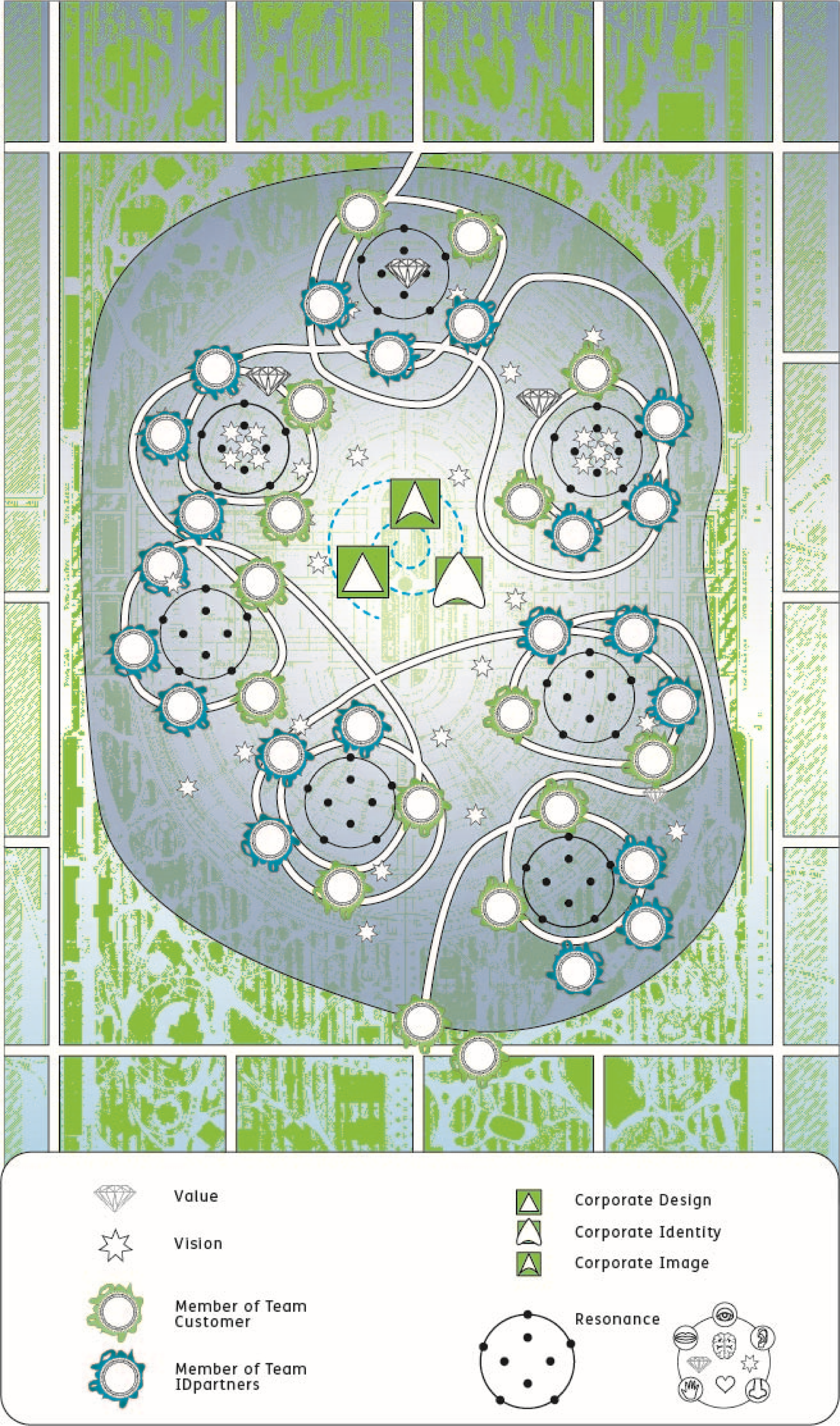
The macro design format is intended to visualize the context for the design of business processes. The focus is on the business process as the core process of a company, which is initiated by a customer need and produces a result of value for the customer. In the macro design, the implementation of the strategy in the company can be seen, as well as the roles and responsibilities involved in the business process. It isn’t only the internal interfaces, but also the interfaces of the company with external business partners that emerge from the macro design. • Context, problem, solution: IDpartners' business process concretizes the strategy of giving customers' technical products a special value through corporate design. The corporate identity of a company can be unmistakably recognized in the corporate design. This enables products to differentiate themselves, to enter the consciousness of potential customers and to motivate them to buy. Digitalization has expanded the possibilities of corporate design. At the same time, a company’s performance in a digital world is increasingly scrutinized, compared and questioned, and the importance of a strong corporate design is growing. IDpartners develops the corporate design according to the systematics ‘corporate image - corporate identity - corporate design’. Finally, IDpartners not only aims to make the procedure transparent, but also the effect of the corporate design on the corporate identity and the corporate image, especially for customers of medium-sized businesses and for potential customers. • Visualization of the macro process (Figure 11): The visualization was inspired by the park of the Paris World’s Fair of 1867. The first use of a park as well as the invention of the national pavilions as the most conspicuous medial component marked the exhibition. The character of the exhibition pushed the question of the representativeness of the objects into the background. In the park, visitors could eat and be entertained; walking through it must have been a surprising and stimulating experience (Barth, 2009). Following the principle of micro/macro design, the visualization shows the context and the macro process ‘From corporate identity to design’ itself, which ‘illuminates’ the micro processes of IDpartners, one of them being the micro process ‘Developing the design (process) interactively’, in all its different phases. Each microprocess of IDpartners follows different stages and suggests itself as a trail as the team collectively works out the value of a product design depending on the conditions. The macro process refers to how a corporate design results from the corporate image (external image) and the corporate identity. The condition for a successful corporate design is that the customer’s company is aware of its identity. In order to arouse attention, sympathy and trust, clear and unmistakable signs must be set by the customer. The visualization in Figure 11 also aims to express IDpartners' always structured, yet creative, interdisciplinary approach: Each of the stations emphasizes that the product design is developed together with the customer, whose representatives work with IDpartners employees in each station. • Value of the visualized macro process: The World’s Fair and its park are used as a metaphor to provide a new perspective on the daily organizational life at IDpartners. In particular, the visualization is meant to refer to IDpartners' strategy to inspire in a complex world as an innovative, multifaceted and inclusive team by developing product designs together with customers. The World’s Fair wanted to represent a large number of different places, and to this purpose constructed a microcosm, which was realized with the park. By viewing IDparters' macro design actions through the lens of the World’s Fair metaphor, individuals are given the opportunity to open up their individual perspectives, discover their own vision of the product design to be developed for the customer, and unite them in a shared vision. Senge compares this process to a roller blind in which many small holes are poked (Senge, 1990). Each hole opens up a unique perspective. The symbol of the star in the visualization takes on a special meaning: the star refers to an individual and ultimately shared vision. The star appears for the first time in the second station in the macro process and multiplies until a corporate design is developed for the customer based on their corporate identity and corporate image. Visualization of the IDpartners’ macro process for understanding its Gestalt.
The visualizations are not meant to be explained, but to be experienced. In experiencing, a range of sensations can arise. Through language, processes can be described rather ‘dryly’, whereas when looking at a visualization, especially works of art, we can be elated, comforted, amazed, enlightened, educated, depressed, and much more. To enhance the understanding of this article, Figures 12 and 13 inform about the phases of the micro process ‘Developing the design (process) interactively’ directly in connection with its visualizations. Marking the phases of the microprocess ‘Development of the design (process) interactively’ to promote understanding of the visualization in Figure 9 (Part 1). Marking the phases of the microprocess ‘Development of the design (process) interactively’ to promote understanding of the visualization in Figure 10 (Part 1).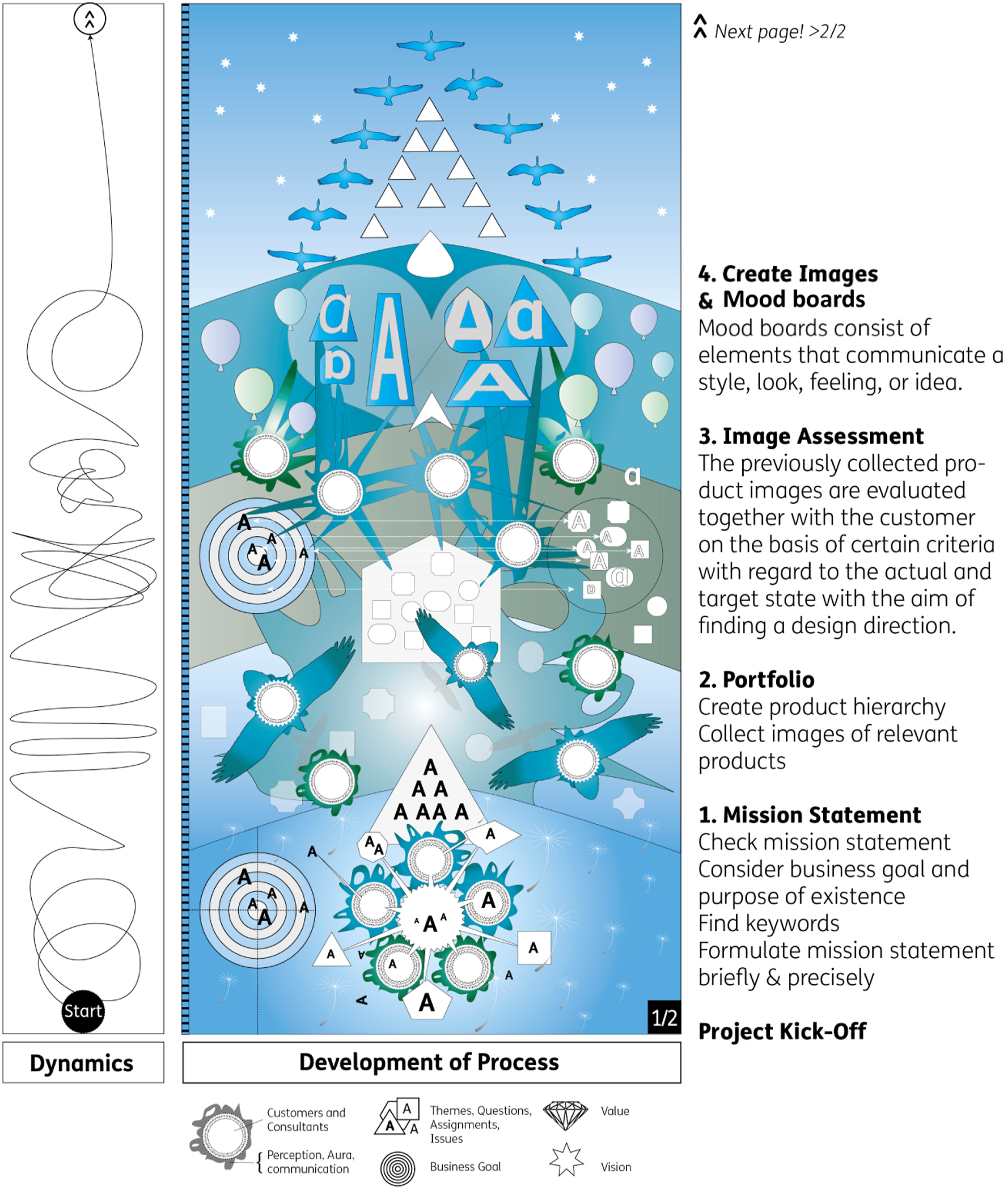
Structural analysis of aesthetic business processes
With the ‘Developing the design (process) interactively’, which is understood as a pattern, IDpartners showed the students how it can be possible to develop the style of an industrial design together in an iterative process. In three stages, the composition of the form and its design elements are developed in the corporate design. To find the style of the form of an aesthetic business process in a team in an analogous way, the process of visual thinking with its four steps, Looking, Seeing, Imagining, and Showing, was elaborated into a concept for the structural analysis of aesthetic business processes (see Figure 14). The processes, forms and patterns compiled in this concept are based on the students' experiences in the three analyzed business processes. To arrive at a form for an aesthetic business process, it is first necessary to perceive the spectrum of a business process. Therefore, the concept integrates different principles in the four stages that can be used as instruments for an aesthetic conception in teams: (LOOKING) Looking together in business processes means taking into account the perspectives in the web of relationships between those involved in the process and yet maintaining one’s own perspective. An initial sense of the big picture must be developed. (SEEING) Seeing at business processes requires appreciating the spectrum of a business process and becoming aware of the impossibility of understanding it completely. To endure and not intensify the tensions that arise, it helps to focus on the essence of a business process. (IMAGINING) In imagining, thoughts and feelings related to the business process are presented in such a way that it becomes possible for others to perceive and understand them. In this way, alternatives can be identified and creative energy can be released. (SHOWING) To show the meaning of a business process, it is important to listen to the voice of a group. This is a narrative style, which is different from the style of the rational and analytical mind. The voice of a group is a function of the story developing within it. The sense evoked in visualizing based on research-based learning was not so much a practical sense as a conceptual sense, as the students reflected on outcomes and methods and practiced taking different perspectives: The four units of the production systems module helped us as a group to gain new insights from a methodological and content perspective. First of all, the pattern approach was a new way of approaching topics for the majority of the group. In particular, to understand processes and to visualize them, the pattern approach offers a very good entry into the topic. In addition, the methodology of the pattern approach helps to promote the creativity of the group. In our group, for example, creativity arose through the possibility of visualizing patterns via y-ed. The lecture is less oriented towards a conventional lecture, rather the methodology of research-based learning is applied. We found this kind of learning difficult at first, as there can be different results, especially when solving tasks. And not knowing what is “right or wrong” is a challenge for the interpretation of results. Accordingly, we learned that different perspectives (especially between the groups) can also lead to different results, through a different interpretation of the given task. At this point we learned that there can be more justified results. Concept for the structural analysis of aesthetic business processes so that they can be experienced together.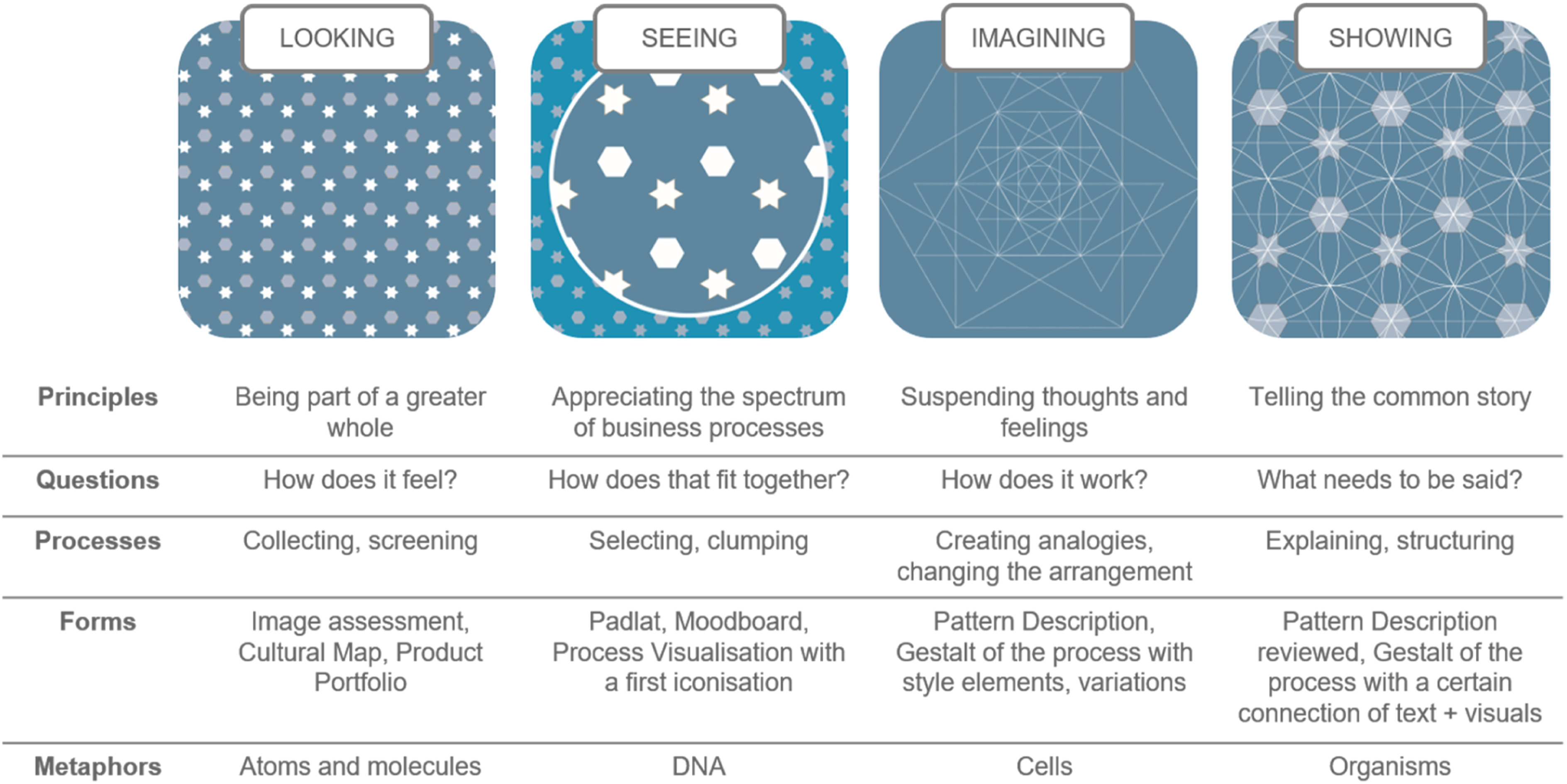
In summary, the concept of structural analysis aims to support the visualization of aesthetic business processes, which develops the Gestalt of an aesthetic business process from the structure and strategy of a business process on a step-by-step basis. It is crucial that teams decide on a selection of the offered processes, forms and patterns and bundle them into a basic attitude that they want to adopt when visualizing.
Conclusions and implications on collective thinking in business processes
German philosopher Böhme (2021) recently expanded the spectrum of aesthetic predicates in the article ‘What does ecology have to do with aesthetics?’: ‘It is no longer just about beauty, sublimity and the picturesque, but about the abundance of affective amusements that one experiences in nature and art’. He explains a new aesthetics of nature as a respect for nature in its autonomy. Analogously, aesthetic business processes with their spectrum can be valued through visualization, as the phenomenological investigation presented in this paper shows. In this context, visualization takes on two meanings: First, as a representation, visualization captures the conceptual content of a business process while enabling us to think together in a digital age. Based on systems and Gestalt theory as well as the pattern approach, a concept for visualizing the Gestalt of a business process and its structural analysis was developed. To date, little attention has been paid to the findings of Gestalt theory and systems theory in business process management. Yet both meta-theories provide valuable insights into what business processes are at their core, what objective truths apply in them, but also how business processes can be described as a whole and their essence. Meaningfulness was rarely experienced only in the moment, but rather emerged from an appreciative and reflective act when business processes were perceived together in a larger temporal setting. Thus, the concept for the aesthetics of business processes is less suitable for extending the methods of process modeling in process management, but rather for organizational learning (Basten and Haamann, 2018) in a (post)covid world. Due to its conceptual nature, companies often have difficulties in implementing the theories of organizational learning (Senge, 1990; Blackler and McDonald, 2000). Due to the practical elements in particular, the concept for visualizing aesthetic business processes can create the basis for collaborative thinking. In the following, the results of the study are related to the questions raised at the beginning regarding the meaning of aesthetic business processes, their potential for thinking together in companies and an applicable concept for this:
Visualization of culture as a ‘non-hereditary memory of the community’
What is valuable, what gives meaning to aesthetic business processes, was therefore revealed (a) in the visualized form and (b) in the process of visualizing. The visualizations combined the description of a business process as a pattern in Christopher Alexander’s format and the Gestalt of the business process as a micro design and a macro design. The perception of the Gestalt of an aesthetic business process resulted when the elements of the business process were integrated into a unity and perceived as a meaningful ‘wholeness’. As a product and instrument of human cognition, visualization opened up a new approach to business processes. Thus, the structural analysis for the development of the Gestalt also dealt with the visible and invisible elements of the culture of a business process according to Spender (1996). Those involved in the process were challenged to think and experience more and in different ways than they were used to. Aesthetic business processes therefore surprise us with a new sense, in which they illuminate structure and strategy from an unfamiliar perspective. In particular, the visualizations made it possible to interconnect individual realities into a shared reality. The Pattern-Pool-Tool Visual-BP, as a medium remote from the body, stored the visualizations and therefore the culture in business processes as a ‘non-hereditary memory of the community’ (Lotman and Uspenskij, 1984). Different types of sensemaking have been observed, but should be analyzed in more detail by experts in management theory.
Aesthetic business processes for learning collectively
Developing the Gestalt of an aesthetic business process within the structural analysis required the use of different forms of representation. Specifically, visualizations made perception available for the communication. Visualizing aesthetic business processes is therefore suitable as a model for learning that leads to knowledge transformation through learner interaction. The function of visualization is to make three contributions to collective learning: first, it can convey meanings that escape description. People, as Polanyi (1966) reminds us, know more than they can explain. Secondly, visualizing enabled individuals to use and develop their mental faculty in their own unique ways. Thirdly, the learners at the university and in the companies were able to gain experiences with an aesthetic quality that are considered memorable and characterized by an intrinsic value. Thus, in collaborative visualization, explicit knowledge is combined with one’s own knowledge, and new knowledge is created that can be applied in practice, laying the foundation for innovation (Sauter and Scholz, 2015; Nonaka and Takeuchi, 1995). The IS field has the capabilities and skills to structure data, information and personal knowledge in order to support business processes in knowledge management. Therefore, the IS field is particularly suited to develop a concept for visualizing aesthetic business processes. In this way, it may be possible to integrate Business-BPM, which has been rather underrepresented up to now (Jeston and Nelis, 2006; Schmelzer and Sesselmann, 2020; Schmiedel et al., 2015), more strongly in addition to IT-BPM in organizational practice as well as in research and teaching. Business-BPM looks at business processes from a business and customer-oriented perspective. The human being is in the focus as a central actor. IT-BPM deals with business processes from a technical and system-oriented perspective. So far, the business processes have been visualized by students. Further studies should therefore also involve companies in the process of visualization in order to align the applicability of the concept for thinking together with the organizational context. It is also necessary to investigate sensemaking in terms of a practical sense, contextual sense and conceptual sense through the visualization of business processes by the process participants themselves.
Reconstructing a pattern language for aesthetic business processes
Visualizing aesthetic business processes led to a teaching-learning culture in which both the students at the university and companies learned through research. In this respect, learners independently discovered, reflected on and presented different experiential knowledge. The draft of a pattern language that was already present at the beginning of the study developed further when the students applied patterns of visual learning in the structural analysis and supplemented the pattern language stored in the Pattern-Pool-Tool with patterns of good practices in business processes. When integrating the business process patterns, it became clear that they are driven by three values: The pursuit of objective understanding, the subjective experience of beauty, and coordinated and fair actions. William Isaacs also used these elements of the ancient Greeks for his dialogue theory, which he based on Christopher Alexander’s pattern approach (Isaacs, 1999). A pattern language for aesthetic business processes supports dialogue across all levels of the company as well as a common understanding of realities and challenges. According to Christopher Alexander, patterns not only enable living solutions, but are alive: ‘you see then that the patterns are very much alive and evolving. In fact, if you like, each pattern may be looked upon as a hypothesis like one of the hypotheses of science’ (Alexander et al., 1977: xv). In this context, it is important to further develop the exvisualizations of aesthetic business processes documented in the Pattern Pool tool in order to (a) disseminate their gestalt and (b) gain new insights for the structural analysis of aesthetic business processes. Over time, Alexander has studied various systems of nature, art, and architecture for their liveness. He has identified fifteen properties that are always found in living things (Alexander, 2002a) and that allow us to understand the physical and geometric character of living systems. Based on the patterns reconstructed in this investigation, the next step is to elaborate on the liveliness for aesthetic business processes in analogy to Alexander’s fifteen properties, in order to find principles for the design of business processes. Finally, the aim is to derive sequences and the structure of a pattern language for aesthetic business processes. A sequence is the path through a pattern language. If patterns are used in a certain order for the design of business processes, the users of the pattern language follow a sequence.
The paper started with the impact of the Coronavirus pandemic. The visualizations of aesthetic business processes are often oriented to the practices regarding the creation and interpretation of artworks. In the times of the Coronavirus pandemic, various exhibitions, such as that of the ‘Walking Artists’ in Frankfurt, February 2022, showed that art went in search of physical, existence experiences. A reality desensualized in pandemy seems to have intensified the desire for the unfiltered. In this respect, aesthetic business processes also search for spaces as the carriers of memories. With regard to the entrepreneurial context, aesthetic business processes, analogous to a metaphor, aims to visualize the fundamental, common characteristic of good solutions in communities of practice and also to make it possible to experience it in digital spaces of a (post)covid world. The common reflection of the visualized business processes supports sensemaking, especially in agile companies, when the individuals organized in them create the specific and distinctive sense of their company themselves and in the network with external reference groups.
Footnotes
Acknowledgements
I would like to thank Leslie Willcocks for his always reliable support during the review process. I am especially grateful to Nik Rushdi Hassan, who thoroughly decomposed the first two versions of the paper and then grounded the paper itself as well as the concept of “aesthetic business processes” on a philosophical fundament. I would also like to thank IDpartners and the students who worked on the project, especially the students Lisa Artemiev, Michael Dringenberg, Sarah Lambers, Naeimeh Ramezanpoor, Frauke Stroemer, Sina Oldewurtel, and finally graphic designer Lisa Wolters.
Declaration of conflicting interests
The author(s) declared no potential conflicts of interest with respect to the research, authorship, and/or publication of this article.
Funding
The author(s) disclosed receipt of the following financial support for the research, authorship, and/or publication of this article: The project was co-financed by the European Regional Development Fund (ERDF) within the framework of the INTERREG program Germany-Netherlands.
