



Abstract
Despite all our theorizing efforts and the importance that we and our major information systems (IS) journals ascribe to theory development, making theoretical contributions to our field remains challenging. Recognizing that we cannot develop better theories without improving how we theorize, our field is now engaged in an in-depth discussion of the theorizing process. This manuscript contributes to this discussion by exposing why and how leveraging paradigms when theorizing can foster theoretical contributions within our field. Its premise is that we need to stop working within the confines of a limited set of well-entrenched paradigms and move beyond what is known as true and correct to come up with improvements that significantly alter the way we come to rationalize, explain, and master our world. Anchored on this premise, this manuscript begins by discussing the origin, role, and features of paradigms as well as explaining that they are of three different but interrelated forms (i.e., metaphysical, sociological, and artefactual). The manuscript then adds to this understanding of paradigms by detailing the unique relationships that tie paradigms of each form to theory and explaining why taking advantage of these unique bonds when theorizing may help us make theoretical contributions. Lastly, to foster theoretical contributions within our field, this manuscript proposes a set of guidelines to help us leverage paradigms of the different forms when theorizing.
Keywords
Introduction
“Theories are nets cast to catch what we call “the world”: to rationalize, to explain and to master it” (Popper, 1959: 37). They act as lenses through which certain things are magnified while others are filtered out to guide the process of making sense of “complicated and often contradictory real-world phenomena” (Truex et al., 2006: 800). Theories describe and explain what is unexplained but experienced, so that we may use them to act in more informed and effective ways (Lynham, 2002). As such, they represent an important goal for any academic field and developing theories is a key part of what is expected from academic researchers (Gregor, 2014).
In the field of information systems (IS), great importance is given to theory development as we (IS researchers) are repeatedly reminded of the importance of making a theoretical contribution. We argue that developing theories is essential in shaping the core of the discipline (Benbasat and Weber, 1996; Weber, 2003) or key to ensure the survival and advancement of the discipline (Grover, 2013; Markus and Saunders, 2007). Major journals of our field also articulate the need for significant theoretical contributions in the manuscripts they receive and consider it as one if not the most important criterion for acceptance (e.g., Agarwal, 2012; Benbasat, 2001; Grover et al., 2008; Lee, 1999; Weber, 2003; Markus and Saunders, 2007). Yet, despite all our theorizing efforts and the importance that we and our major journals ascribe to theory development, making a theoretical contribution continues to be highly challenging to researchers in the IS field (Weber, 2012; Hassan et al., 2019a; Hassan et al., 2019b). As a result, insufficient theoretical contribution remains the most common reason for rejecting submissions in the prestigious journals of our field (Ågerfalk, 2014; Straub, 2009; Venkatesh, 2006).
Fortunately, after having long been a neglected feature of IS research (Gregor, 2006; Weber, 2012), theory development is now being discussed more thoroughly within the IS literature. Recognizing that “theory cannot be improved until we improve the theorizing process” (Weick, 1989: 516), we are now moving away from the sterile debate over the nature and importance of theory for the field and towards an in-depth discussion of the theorizing process or the act of developing theory (Hassan et al., 2019a; Lee, 2020; Rivard, 2020). For instance, Burton-Jones et al. (2015) have examined key IS theoretical perspectives (e.g., variance, process, or systemic approach), while Hassan et al. (2019a) have described the process of theorizing as a discursive practice. More recently, Rivard (2020) has proposed a highly iterative spiral model that portrays theory development as a craft while Hassan et al. (2022) have identified useful products in theorizing.
This manuscript contributes to this discussion through the lens of “paradigms.” Paradigms refer to the diverse entities (e.g., assumptions, symbolic constructs, research instruments) that form the foundation of the theorizing process and that simultaneously enable and constrain our theorizing efforts. They are of three forms, namely, metaphysical, sociological, and artefactual and together define for researchers what is to be observed, what questions are to be asked and probed for answers, what conjectures and predictions can be made, what research procedure(s) and tool(s) are to be used, where to look for evidence, what can be considered as constitutive of evidence and how results are to be interpreted (Kuhn, 1962; Popper, 1959; Ratcliffe, 1983). As such, paradigms of the different forms influence the way we judge and evaluate real-world phenomena (i.e., how we theorize) and, in turn, condition the theories we develop (i.e., how we explain and rationalize our world). In doing so, they also determine what can be considered a theoretical contribution since the outputs of our theorizing efforts (e.g., theories) will be deemed novel (i.e., provide original insights) and/or useful and thus make theoretical contributions (perhaps after some time has elapsed) to the extent they refine or change the paradigms we use to make sense of real-world phenomena (Kuhn, 1962).
Unfortunately, despite the importance of refining and changing paradigms for the advancement of our field, we tend to work within the confines of a limited set of well-entrenched paradigms instead of moving beyond what is known as true and correct to make impactful theoretical contributions. Moreover, as the prevailing understanding of paradigms within our field consists of conflating the term with ontological, epistemological, and methodological standpoints (i.e., metaphysical paradigms), and to describe and explain their influence in the context of theory testing rather than theory development, the IS literature offers little guidance on how paradigms influence our theorizing efforts and condition the theories we develop or why and how we may refine and change the paradigms of different forms that anchor our theorizing efforts.
The goal of this manuscript is to help us move beyond this limited understanding of paradigms and enhance the theoretical contribution of our research by leveraging paradigms during theory development. Its basic thrust is that one of the ways to make a theoretical contribution is to shift the paradigms that shape the way we see and explain the world. Anchored on this premise, this manuscript begins by discussing the origin, role, and features of paradigms as well as explaining that they are of three different but interrelated forms (i.e., metaphysical, sociological, and artefactual). The manuscript then adds to this understanding of paradigms by detailing the unique relationships that tie paradigms of each form to theory and explaining why taking advantage of these unique bonds when theorizing may help us make a theoretical contribution. This part of the manuscript thus provides key groundings that justify our suggestion to consider paradigms for theory development and not only for theory testing. Lastly, anchored on this theoretical background, this manuscript proposes a set of guidelines to help us leverage paradigms of the different forms when theorizing so we may make theoretical contributions to our field.
A brief history of the paradigm concept and where we stand today
The term paradigm has a long history in science dating back to ancient Greek. Plato used the term in Timaeus, his dialogue that provides an explanation of the creation of the universe, to describe the model or the pattern that Demiurge—the god responsible for the creation and maintenance of the physical universe—used to create the cosmos (Zeyl, 2014). A few decades later, Aristotle, in Rhetorics, his treatise on the art of persuasion, stated that an example (“paradeigma”) was a rhetoric counterpart of dialectic induction (Rapp, 2010). Aristotle also went on to say that “when two statements are of the same order, but one is more familiar (knowable) than the other, the former is an example (“paradeigma”)” (Göktürk, 2005: 3).
Nevertheless, it is Thomas Kuhn, the physicist, historian, and philosopher of science, that made the term paradigm prominent in today’s modern scientific discourse. In his book The Structure of Scientific Revolution, Kuhn (1962) showed that scientific inquiry is inherently anchored on various entities such as symbols, models, exemplars, rules, guidelines, heuristics, values, and/or beliefs that directly influence the way we conduct research. Hence, similar to what Plato and Aristotle did more than 22 centuries before, Kuhn (1962) showed that the reasoning, actions, and, ultimately, the everyday work of scientists is based on certain paradigms.
At the time, this key contribution to the philosophy of science marked a break with the positivist belief that science was a value-free process of confirmation and repudiation that made scientific findings objective. In addition, this contribution injected a sociological perspective into the logic of science (Hassan, 2014). That is, it reminded scientists that what can be considered a true and valid scientific finding is in essence a collective construction based on agreed upon paradigms. In doing so, Kuhn (1962) also challenged the long-standing linear notion of scientific progress by showing that transformative ideas are not the result of day-to-day incremental research based on prevailing paradigms (i.e., normal science) but rather the product of paradigm shifts where there is a fundamental change in the basic concepts and experimental practices of a scientific field or discipline.
However, despite showing the importance of paradigms for scientific inquiry and progress, Kuhn (1962) did not clearly define the term paradigm in the first version of his book. In fact, he ascribed more than twenty different meanings to the term in his original work (Masterman, 1970). This unspecified use of the term paradigm rapidly gave rise to several criticisms from researchers in various disciplines who argued that the term was too vague and meant different things to different people (Hassan, 2013). Amongst these, we note Masterman (1970), a friendly critic, who, in addition to acknowledging the usefulness of the paradigm concept, attempted to elucidate the nebulous nature of the term by showing that Kuhn (1962) used the term paradigm to identify three interrelated sources of influence: (1) unquestioned philosophical presuppositions that operate throughout an entire discipline, which she labeled “metaphysical paradigms”; (2) notions or entities that the different scientific communities within a discipline, respectively, commit to, which she labeled “sociological paradigms”; and (3) concrete accomplishments of a scientific community that serve as tools or apparatus for problem solving, which she labeled “artefact or construct paradigms.”
Endorsing Masterman’s (1970) work and acknowledging other insightful criticisms over the confusion surrounding the term paradigm, Kuhn (1970) later proposed to replace the term paradigm by the terms “disciplinary matrix”; “disciplinary” to emphasize that paradigms are the common possession of the practitioners of a scientific discipline and “matrix” to emphasize that paradigms are ordered elements of various sorts, each requiring further specification (Kuhn, 1970). Hence, Kuhn’s (1970) disciplinary matrix encompasses the constellation of all the shared commitments of a scientific group that he described as paradigms, parts of paradigms, or paradigmatic in his original work. Since then, other authors from various disciplines have attempted to clarify the meaning of the term paradigm (e.g., Burrell and Morgan, 1979; Eckberg and Hill, 1979; Guba and Lincoln, 1994; Morgan, 1980).
What can be distilled from these more recent works is a consensus in the social sciences that, just as pointed out by Masterman (1970), there are three different forms of paradigms that each operate at a different level of generality: metaphysical, sociological, and artefactual paradigms. Metaphysical paradigms refer to the philosophical aspect of the paradigm concept and denote the unquestioned philosophical assumptions (e.g., ontological, epistemological, methodological, or axiological assumptions) that span multiple communities within one or more disciplines. Taken in this sense, paradigms include what Kuhn (1962) described in his original work as sets of beliefs, myths, successful metaphysical speculations, standards, new ways of seeing, organizing principles governing perception itself, maps, and things which determine a large area of reality (Hassan and Mingers, 2018; Masterman, 1970). Understanding that these descriptions of the paradigm concept referred to metaphysical notions or entities rather than scientific ones, Masterman (1970) pointed out that paradigms of this form do not relate directly to a concrete subject matter or topic of research but rather to general presuppositions about reality and our understanding of it. Paradigms of this form are thus the most abstract and those that operate at the broadest level of generality. They are also the most personal form of paradigms, in the sense that they are accepted on faith because it is impossible to truly confirm or disconfirm these kinds of assumptions.
Sociological paradigms refer to the practical aspect of the paradigm concept and denote the multifaceted cognitive anchors that researchers within their respective scientific community recognize as their basis for future work. Taken in this sense, paradigms refer to notions or entities that are close to real-world phenomena and intimately related to a topic or area of research. They include what Kuhn (1962) described in his original work as universally recognized scientific achievements, concrete scientific achievements, set of political institutions and accepted judicial decisions (Hassan and Mingers, 2018; Masterman, 1970). Paradigms of this form are thus more concrete and more specific than their metaphysical counterpart which also makes them more practical. As such, paradigms of this form act as cognitive anchors for the actual practices of a community of researchers and may also represent bases for specialization within a discipline.
Artefactual paradigms refer to the concrete aspect of the paradigm concept and denote the instruments, tools, and/or apparatuses that researchers use to solve problems. Taken in this sense, artefactual paradigms include what Kuhn (1962) described in his original work as actual textbooks or classic works, supplying tools, or instrumentations (Hassan and Mingers, 2018; Masterman, 1970). They represent the physical objects that are acknowledged as valid research tools or instruments by the research community and those that researchers are encouraged to use in their daily work. As such, artefactual paradigms are even more specific and more concrete than sociological paradigms and thus operate at the lowest level of generality.
It is also consensually acknowledged that metaphysical, sociological, and artefactual paradigms do not operate in a vacuum or independently; they are in fact “embedded one within the other” (Eckberg and Hill, 1979: 927). In other words, the paradigms of more abstract and general form: 1. Act as an encapsulating unit or framework within which the paradigms of the more specific and concrete forms develop; 2. Have a directive power over paradigms that are more specific and concrete such that the development of the paradigms of the more concrete and specific forms can be seen as an articulation of those that are more abstract and general; 3. Orient the paradigms of the more concrete and specific forms toward a purpose, which the latter would not seek if left alone.
Accordingly, metaphysical paradigms direct sociological paradigms which in turn direct artefactual paradigms. Artefactual paradigms are thus embedded in, directed by, and carry the attributes of sociological paradigms that, in turn, are embedded in, directed by, and carry the attributes of metaphysical paradigms (see Figure 1).
To illustrate the embeddedness that exists between the paradigms of different forms, we refer to Galileo’s endorsement of Copernicus’s theory of a heliocentric universe which led the Catholic church to declare his book Dialogues as heresy and to have Galileo prosecuted and given a life sentence of house arrest by the inquisition. The influence of paradigms on theory.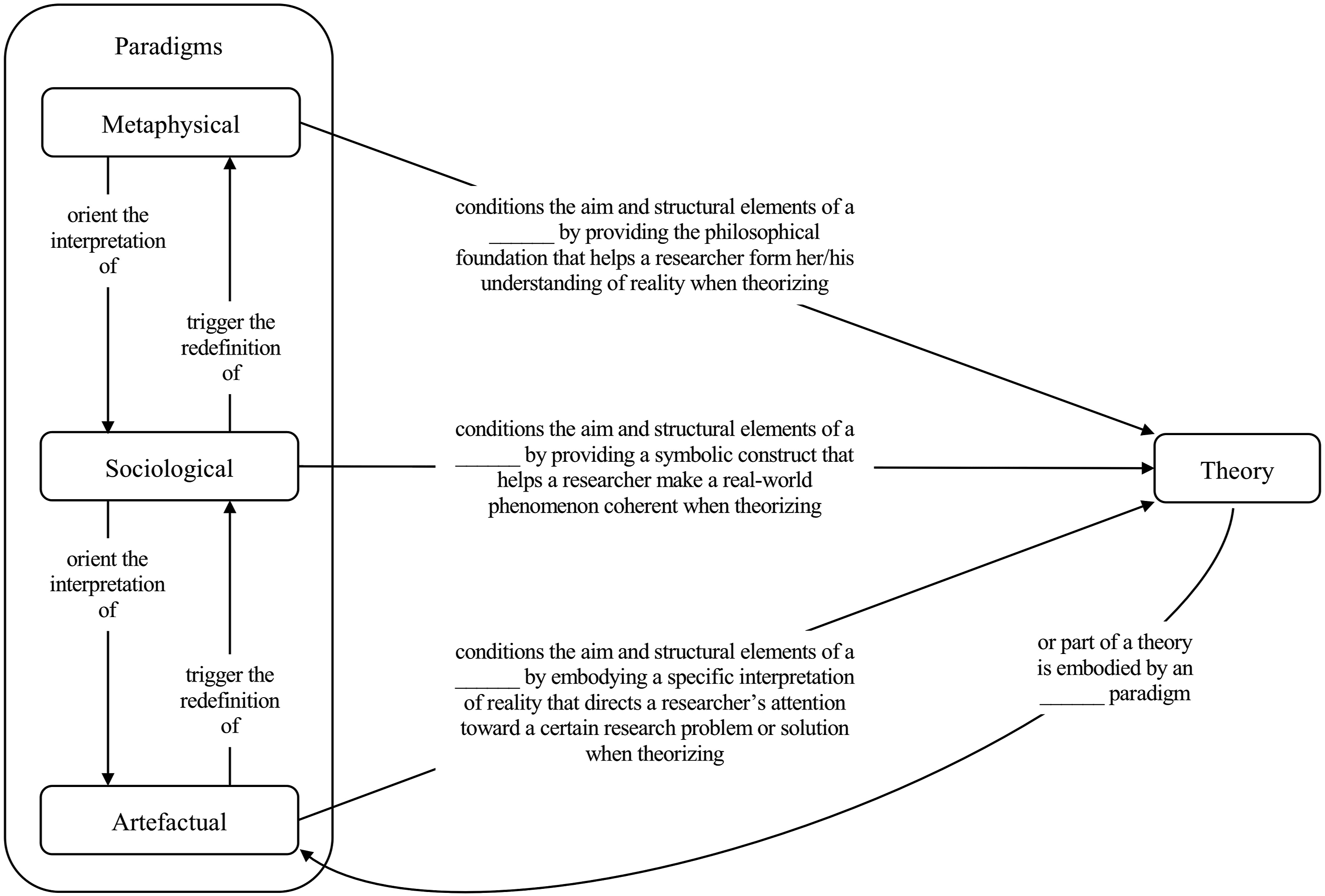
The influence of paradigms on theories of the universe.

It is this embeddedness of paradigms that eventually led to Galileo’s demise. By questioning geocentric theories, Galileo was not only questioning the earth’s position in the universe; he was also questioning the intricate set of embedded paradigms that led to the development of this understanding of our world. Arguing in favor of heliocentric theories was thus more than a rejection of an earth-centered universe. It was also a rejection of the various forms of paradigms that anchor geocentric theories and, most importantly, the metaphysical standpoint within which geocentrism and the Ptolemaic system are embedded. As such, Galileo wasn’t prosecuted and convicted by the inquisition because he supported a theory that place the sun at the center of the universe. He was prosecuted and convicted because he endorsed a set of embedded paradigms that favored science over religion, something the Catholic church was not ready to accept.
The embeddedness of paradigms also implies that the need to redefine and challenge the paradigms of the more abstract and general forms can be triggered by the failure of the paradigms of the more concrete and specific forms (see Figure 1). In other words, the failure of metaphysical paradigms can be detected when the sociological paradigms they orient and harbor fail to explain real-world phenomena, whereas the failure of sociological paradigms can be detected when the artifactual paradigms they orient and harbor fail to solve real-world problems as expected.
To illustrate this point, we refer, one more time, to Copernicus’s and Galileo’s pioneering works. During his research, Copernicus realized that the Ptolemaic system and Anaximander’s models (two key artefactual paradigms of that era) could not properly predict and explain the movements of the planets. It is the anomalies he observed when using these key puzzle-solving tools that led him to question the pertinence of geocentrism, the key sociological paradigm that oriented their construction. Based on this key insight, he proposed the first heliocentric theory of the universe. In doing so, he also questioned the religious beliefs that led to the development of geocentrism and related artefacts; beliefs that can hardly be questioned directly. Metaphysical paradigms are, after all, the most personal form of beliefs and accepted on faith. Years later, Galileo made similar observations. Equipped with a more recent innovation (i.e., a telescope), he observed that planets did not follow the paths that geocentric theories predicted. These observations led him to support Copernicus’s heliocentric theory and to question the artefactual, sociological, and metaphysical paradigms that embody or led to the development of geocentric theories. He thus also indirectly and in a more debatable manner revealed the limits of higher beliefs.
Within the field of IS, Banville and Landry’s (1989) text about the evolution of management information systems as a scientific field was amongst the first to discuss the notion of paradigm. Unfortunately, by assuming that paradigms can only be of the metaphysical form and that Kuhn’s paradigmatic view of scientific progress would inherently lead to the dominance of a single paradigm or to the prevalence of a single grand unifying theory, Banville and Landry (1989) argued that the IS field should not adopt Kuhn’s view. Up until today, these two misconceptions tied to Kuhn’s notion of paradigms have not ceased to resonate in our field even though the success of Kuhn’s (1962) paradigms has been demonstrated in the case of many other established disciplines (see Hassan, 2014).
Hence, since the publication of Banville and Landry’s (1989) work, IS research on paradigms has been mainly limited to paradigms of the metaphysical form. For instance, anchored on Burrell and Morgan’s (1979) framework, Hirschheim and Klein (1989) proposed four IS worldviews (i.e., functionalism, radical structuralism, neohumanism, and social relativism) to show the absence of a unifying (metaphysical) paradigm amongst members of the IS field. Other IS studies, some of which anchored on Burrell and Morgan’s (1979) work, have demonstrated that functionalist and positivist studies have historically dominated IS research (Chen and Hirschheim, 2004; Goles and Hirschheim, 2000; Orlikowski and Baroudi, 1991). Nonetheless, interpretivist (Lee, 1991), critical realist (Mingers et al., 2013), and critical research (Myers and Klein, 2011) worldviews have also been proposed and embraced by segments of the IS field. As a whole, the discussion surrounding metaphysical paradigms within the IS field has evolved, over the years, into a slow but general acknowledgment that the presence of multiple metaphysical paradigms in our research adds value to the IS field (Hassan, 2013).
Yet, realizing that undue focus on metaphysical paradigms places limits on the advancement of our field, some IS researchers have recently reemphasized the critical importance of the three forms of paradigms (i.e., metaphysical, sociological, and artefactual) to develop theories (Hassan, 2013; 2014; Hassan and Mingers, 2018; Hassan et al., 2019a). In doing so, these researchers noted that theory development within the IS field has been significantly influenced by various sociological paradigms that were borrowed from the management discipline: the decision-making paradigm, the information processing paradigm, and the strategic management paradigm (Hassan, 2013; Hassan and Mingers, 2018). They also showed that several IS artefactual paradigms do exist within our field. Amongst these we note the highly regarded texts of Davis and Olson (1985), Davis (1989), Delone and McLean (1992), and Rogers (1962) (Hassan, 2013; Hassan and Mingers 2018; Moody et al., 2010). However, much work is still needed if we are to develop an understanding of sociological and artefactual paradigms that is as elaborate as the one we have developed on metaphysical paradigms.
The reasons for and the value of leveraging paradigms when theorizing
Theorizing is the act of making sense of our reality. It consists of a mental exercise where we identify and then solve a research problem by generating and retaining valuable conjectures (Shepherd and Suddaby, 2017; Weick, 1989). It is during this complex, messy, and iterative effort that we harness our creativity and the serendipity of discoveries to develop new explanations of a real-world phenomenon and related context(s). As they represent the foundation upon which we build our understanding of reality, paradigms of the different forms simultaneously enable and constrain this mental exercise as well as condition the output of our theorizing efforts; the theory we develop. This is in part why the term theory means different things for each of us. Indeed, the various understandings of the aim (i.e., describing, explaining, and/or predicting a real-world phenomenon (Gregor, 2006)) and structural elements of a theory (i.e., means of representation, constructs, statements of relationship, scope, and possibly additional components such as causal explanations, testable propositions, or prescriptive statements (Gregor, 2006)), or “what a theory is for” and “what a theory is,” are caused by the different paradigms that inform our theorizing efforts.
And it is because of this connection between paradigms, theorizing and theory that making a theoretical contribution can be linked to the paradigms of different forms that both enable and constrain our theorizing effort. Making a theoretical contribution implies that we provide new knowledge and that we advance our understanding of a studied phenomenon. To do so, we need to see the world in a different light and to bring change to the way we theorize. This is in part why we should leverage paradigms when theorizing. It ensures that we conduct this mental exercise in a different way so we may reach a different conclusion. Furthermore, because they represent the established and accepted ways of thinking about our world, leveraging paradigms when theorizing ensures that the theories we develop will have significant impacts within our field by altering the very foundations upon which its members build their understanding of real-world phenomena.
The next three subsections present a detailed explanation of this connection between paradigms, theorizing, and theory. Specifically, each subsection details the unique relationship that ties paradigms of a specific form to theory and explains the reasons for and value of taking advantage of this unique relationship to make a theoretical contribution.
Metaphysical paradigms
Metaphysical paradigms provide the philosophical foundation that shape a researcher’s conception of the universe and his or her place in it. They are “something far wider than, and ideologically prior to, theory” (Masterman, 1970: 67) and thus provide a substructure or a scaffolding that helps researchers form their understanding of our reality. Note, however, that metaphysical paradigms are not all encompassing and only provide a partial understanding of our reality. For instance, years of IS research on (metaphysical) paradigms have highlighted the limits and, ultimately, the complementarity that exists amongst the main IS metaphysical standpoints: positivist, interpretivist, critical realist, etc. (Chen and Hirschheim, 2004; Goles and Hirschheim, 2000; Orlikowski and Baroudi, 1991). Metaphysical paradigms thus inevitably influence the way we theorize by directing our attention towards certain facets of reality to the detriment of others. In other words, they both enable and constrain our theorizing efforts and, in turn, condition the theories we develop.
Being aware of the metaphysical paradigms that informed the development of our theories is thus of perennial importance when we theorize. It allows us to understand the facets of reality that our theories explain and the ones they don’t as well as to see their limits and biases. By leveraging metaphysical paradigms, we can therefore direct our attention towards these unexplored and unexplained areas of reality and, in turn, contribute to our field by developing new knowledge. We may also knowingly let complementary philosophical assumptions guide our theorizing efforts, which will enable us to see the world through different lenses and, ultimately, to develop new ideas and novel theories. Leveraging metaphysical paradigms thus ensures that we see the world differently so that the theoretical elements we develop refine or challenge existing ways of explaining the world: it ensures that our theorizing efforts make a theoretical contribution to IS research.
To illustrate this relationship that exists between metaphysical paradigms and theory as well as the value of taking advantage of this unique bound to make a theoretical contribution (i.e., to leverage metaphysical paradigms when theorizing), we refer to the theory of Media Richness (MRT) and to the work of Daft et al. (1987) and Lee (1994). Initially, in accordance with their positivist assumptions, Daft et al. (1987) conceived media richness as being an intrinsic property of the media they studied. Anchored on this understanding, these authors developed a law-like hierarchy that ranks the influence of different media on human behavior and posits that the richest communication medium is face-to-face meetings followed by telephone, e-mail, and finally memos and letters. Put differently, Daft et al.’s (1987) positivist assumptions constrained their view of this specific phenomenon and had them focusing on the intrinsic properties of media to explain media richness. Lee (1994) purposefully pointed to this bias in his criticisms of MRT when he argued that the theory only afforded a partial understanding of our reality. To support his claim, he presented several real-life examples where the theory failed to explain the richness of media. To overcome these theoretical shortcomings, Lee (1994) adopted a different metaphysical lens (i.e., interpretivist assumptions) to theorize this phenomenon. In doing so, he was able to see media richness differently and to suggest significant changes to MRT. Specifically, he was able to see and theorize that richness is not an intrinsic property of media but rather an emergent property that is socially constructed by users. In other words, Lee’s (1994) interpretivist assumptions directed his focus on the yet unexplored interactions between media and users. Only then, was he able to make a significant theoretical contribution to our field by not only showing the bias of the then prevailing positivist understating of media richness, but also by proposing a novel theory that explains other facets of this phenomenon.
Sociological paradigms
Sociological paradigms provide a symbolic interpretation of reality that helps researchers develop their understanding of real-world phenomena. For instance, researchers often draw upon symbolic constructs such as root metaphors (Cornelissen, 2006) and/or core analogies (Ketokivi et al., 2017) to make the world coherent and build their descriptions, explanations, predictions, and/or prescriptions when theorizing (see Figure 1). In the IS field, the assumption that attitude and intention lead to behavior (i.e., the attitude paradigm borrowed from psychology) is a good example of the nature and influence of such paradigms since this way of conceiving how behaviors are formed underlies and conditions many of the theories we use (e.g., theory of reasoned action, theory of perceived behavioral control) as well as several models we have developed (e.g., technology acceptance model, unified model of technology acceptance, task-technology fit model). While of practical use because they allow us to identify relevant phenomena and related context(s) or to make sense of them, sociological paradigms also constrain our theorizing efforts by directing our attention away from certain phenomena or biasing how we see them. For instance, researchers that follow the attitude paradigm to frame their understating of IS behaviors implicitly chose to focus on specific aspects of our psychic (i.e., our attitudes and intentions) to the detriment of other artefactual, individual, organizational, and societal factors that also influence how such behaviors are formed. Hence, sociological paradigms both enable and constrain our theorizing efforts and, in turn, condition the theories we develop.
Accordingly, when we theorize, it is important to be cognizant of the sociological paradigms that underpin our theories. It allows us to understand that past choices of symbolic construct have unquestionably directed past theorizing efforts toward certain phenomena or toward certain ways of seeing them. Equipped with this better understanding of our theories’ limits and biases, we may therefore leverage sociological paradigms to direct our theorizing efforts towards those areas of reality that remain unstudied and unresolved. This change in focus, in turn, allows us to develop new knowledge and, ultimately to contribute to our field. By leveraging sociological paradigms, we may also purposely let complementary symbolic constructs guide our theorizing efforts, so we may see the world through different lenses and, in turn, develop new ideas. In doing so, our sociological paradigms will be refined or challenged which will lead us to refine or challenge key elements of exiting theories or to develop new ones. Leveraging sociological paradigms thus ensures that we see the world differently so we may develop theoretical elements that refine or challenge existing ways of explaining the world; it ensures that our theorizing efforts make a theoretical contribution to IS research.
To illustrate this unique relationship that exists between sociological paradigms and theory as well as the value of taking advantage of this bound to make a theoretical contribution (i.e., to leverage sociological paradigms when theorizing), we refer to the concept of strategic information systems (SIS) and to the work of Mason (1991). Recognizing that most theories explaining SIS-related phenomena were, up until that point, anchored on a “war metaphor,” Mason (1991) argued that it was time to consider other symbolic representations to form our understanding of SIS. To make his point, the author first showed that SIS theories often had a military theme, which was made apparent by the labeling of IS as competitive weapons, categorizing opportunities for IS as offensive or defensive, or describing competing firms as targets. Then, by revealing that theories anchored on the war metaphor could not explain a vast array of SIS-related phenomena, he demonstrated that seeing SIS through this lens undermined our theorizing efforts and, ultimately, our understanding of SIS-related phenomena. For instance, in his criticism, Mason (1991) pointed to the fact that the war metaphor entices us to see competition as a zero-sum game and thus that SIS theories anchored on this symbolic construct could not properly explain the strategic role of IS in cooperative settings or in environments characterized by blurred organizational boundaries where organizations both compete and cooperate with each other. Lastly, and most importantly, conscious of the various theoretical limits and biases induced by the war metaphor, Mason (1991) proposed several alternative metaphors (e.g., the organization as an evolving organism, the organization as an expression of market forces, organizations as city-states, or organizations as sports teams) that we may use to see SIS-related phenomena differently and, in turn, develop new explanations for these phenomena. Leveraging a key sociological paradigm thus allowed Mason (1991) to make a key theoretical contribution to IS research by not only showing the limits of SIS theories, but also by proposing new symbolic constructs that we may use to inform our theorizing efforts and, in turn, develop complementary explanations of SIS-related phenomena.
Artefactual paradigms
As artefactual paradigms embody the knowledge developed within a scientific community, paradigms of this form do not precede theory like metaphysical and sociological paradigms do, but rather follow it. They make a theory or parts of a theory concrete by operationalizing its aim and structural element(s) in a way that allows us to use a theory or some of its parts to solve real-world problems. Artefactual paradigms thus embody a very specific understanding of reality: the one portrayed by the theories that led to their construction. While essential to allow us to test and refine our theories, this specific embodiment of reality also means that these puzzle-solving tools may direct our attention towards certain research problems or solutions while at the same time insulating or distracting us from others. As Maslow (1966) famously said: “I suppose it is tempting, if the only tool you have is a hammer, to treat everything as if it were a nail” (p. 15). Consequently, even though they conceptually follow theory, in practice, artefactual paradigms may also precede it. As such, artefactual paradigms not only enable and constrain our theorizing efforts but also condition the theories we develop (see Figure 1).
Confounding relative advantage with perceived usefulness.
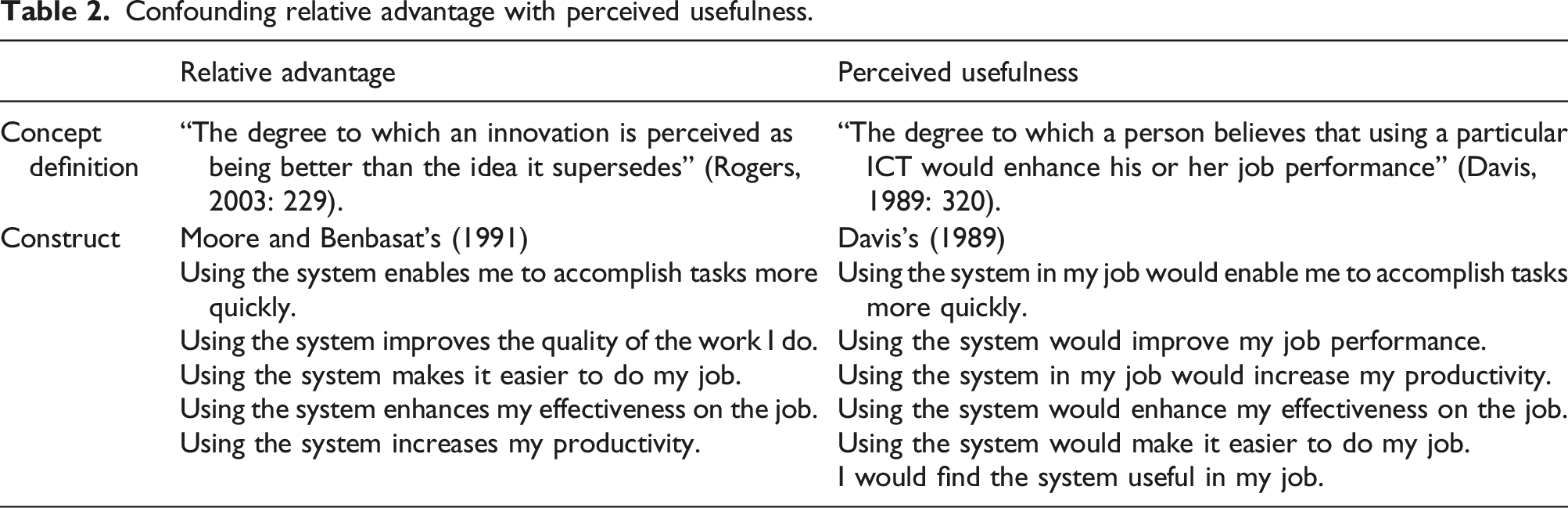
This example shows how well accepted tools and apparatus can explicitly and/or implicitly influence our theorizing efforts and condition the aim and structural elements of the theories we develop. In this case, the very meaning of a theory’s key concept was changed. It is thus important to be careful when we use artefactual paradigms and even more so when we use them in a theorizing context that is different from the one that led to their creation. More importantly, we need to be aware of their limits and biases since these limitations are the reflections of our theories’ limits and biases. By being mindful of these shortcomings, we may therefore grasp opportunities to improve existing theories or even propose new ones. Leveraging artefactual paradigms thus ensures the theoretical elements we develop refine or challenge existing ways of explaining the world; it ensures that our theorizing efforts make a theoretical contribution to IS research.
To highlight the value of taking advantage of the bidirectional relationship that exists between artefactual paradigms and theory to make a theoretical contribution (i.e., to leverage artefactual paradigms when theorizing), we refer to the work of Sharma et al. (2009) who demonstrated that one of the main methods we use to collect data within IS research undermines the validity of our findings and, indirectly, of our theories. Specifically, the authors noted that, up until that point, the vast majority of IS studies had used a mono-method approach to collect data (i.e., using a single method to assess all constructs of a single study), which is susceptible to common method variance (CMV) bias. As a result, the authors argued that the variance explained in the models we developed could be the fruit of CMV and not of theoretically grounded correlations/causation between independent and dependent variables. To prove their point, Sharma et al. (2009) investigated for the effect of CMV on the observed correlations between perceived usefulness (PU) and usage (U) in the TAM literature. They drew two conclusions from their findings. First, that CMV is a powerful predictor of the observed PU-U correlations when U is measured on behavioral and perceptual scales and that the theorized PU-U correlations may not be as valid as we thought. Second, that “support for TAM is subject to a major potential validity threat from CMV, because a significant PU-U correlation is a necessary but not sufficient condition for behavioral intention to mediate the relation between PU and U (Sharma et al., 2009: 487).” With these findings, the authors made a key theoretical contribution to our field by showing that our use of the mono-method approach to collect data introduced a key theoretical bias within our understanding of technology acceptance. By leveraging a key artefactual paradigm, Sharma et al. (2009) were thus able to make a key theoretical contribution to IS research by not only showing the limits of technology acceptance theories, but also by warning us of a key flaw in one of our main data collection methods. In addition, their findings reiterate that the theories we develop reflect the tools and apparatus we use to solve real-world problems and that we need to be aware of the limits of artefactual paradigms when we theorize.
Guidelines for leveraging paradigms when theorizing
Guidelines for leveraging paradigms when theorizing.
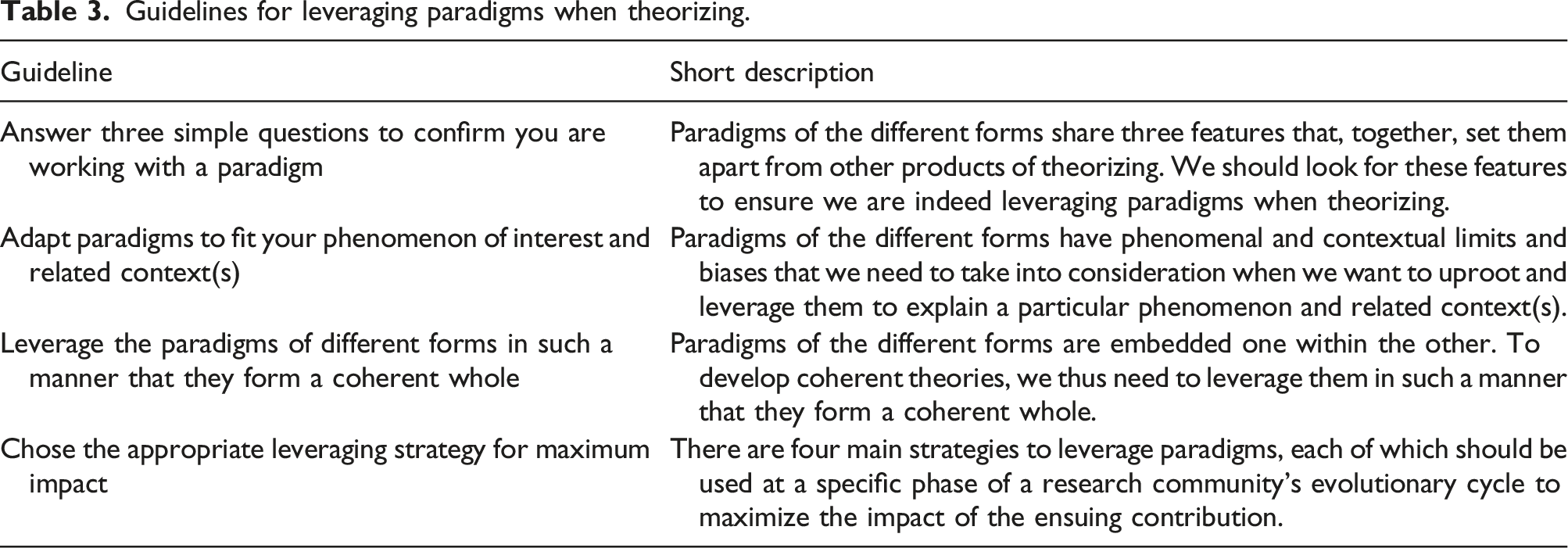
Guideline #1: Answer three simple questions to confirm you are working with a paradigm
To leverage paradigms when theorizing, we need, first and foremost, to identify the paradigms of different forms that simultaneously enable and constrain our theorizing efforts. As paradigms are often confused with other products of theorizing (e.g., theories, theoretical elements, analogies, myths, metaphors, laws), the identification of paradigms continues to be a challenge for us. To alleviate this issue, we must understand the three features that, together, set paradigms, whatever their form (i.e., metaphysical, sociological, artefactual), apart from other products of theorizing.
First, paradigms are charged with meaning and orient the way we see our reality. For example, positivist and interpretivist assumptions enticed Daft et al. (1987) and Lee (1994) to understand the phenomenon of media richness differently, while the attitude paradigm from psychology directed Davis’s (1989) focus on attitudes and intentions to the detriment of other factors that may also help explain technology acceptance. Similarly, Sharma et al. (2009) demonstrated that our use of a specific data collection tool (i.e., the mono-method approach) biased our understanding of technology acceptance. Still, it is important to acknowledge that other products of theorizing also carry meaning (e.g., theories, constructs, relationship statements, analogies, metaphors, laws, framework). As will be explained next, some of these products of theorizing are not paradigms (e.g., theories and theoretical elements) while others (e.g., analogies and metaphors) may become paradigms if and when they possess the two features explained next.
A second key feature of paradigms is that they precede and/or follow theory. Indeed, by shaping a researcher’s conception of the universe and his or her place in it, metaphysical paradigms are “something far wider than, and ideologically prior to, theory” (Masterman, 1970: 67). Likewise, sociological paradigms, by providing a symbolic interpretation of reality that helps researchers make the world coherent and develop an understanding of real-world phenomena, are different than and come before theory (Masterman, 1970). Lastly, because they make a theory or parts of a theory concrete, artefactual paradigms conceptually follow and may even precede theory in practice. Paradigms are thus different than theories and theoretical elements (e.g., means of representation, constructs, statements of relationship, scope, and other theoretical components such as causal explanations, testable propositions, or prescriptive statements). It is in fact this difference as well as the unique relationship that the paradigms of each form have with theory and theoretical elements that make leveraging metaphysical, sociological, and artefactual paradigms possible.
The third and most important feature of paradigms is that they are the subject of consensus or agreement by all or the vast majority of members of a scientific community. They represent a community’s “standards” or shared commitments (Kuhn, 1962; Masterman, 1970). For example, to improve our understanding of SIS-related phenomena, Mason (1991) leveraged the then widely accepted sociological paradigm of the “war metaphor” to propose several other metaphors that have yet to be widely accepted and thus cannot be conceived as paradigms. Paradigms are thus different from other products of theorizing since they represent a specific subset of assumptions, symbolic constructs, and tools; the ones we universally commit to and are encouraged to use in our daily work to solve research problems.
Considering the three complementary features just described, we must ask ourselves the following three simple questions while theorizing to make sure we are working with a paradigm: 1. Does the assumption, symbolic construct, or tool I have identified simultaneously enable and constrain the way I see a phenomenon of interest and related context(s)? 2. Does the assumption, symbolic construct, or tool I have identified precedes or follows theory? 3. Is the assumption, symbolic construct, or tool I have identified widely accepted within my research community?
Answering “yes” to each of these three questions confirms we are working with a paradigm and alleviates several sources of confusion that may appear while theorizing. For example, a theory or some of its elements can be the subject of consensus by the vast majority or all members of a scientific community (positive answer to question #3). That is why certain theories are labeled “paradigmatic” by some. However, a theory cannot precede or follow itself (negative answer to question 2) and thus cannot be conceived as a paradigm. Likewise, although several metaphors, analogies, or myths bring meaning to explain a specific phenomenon (positive answer to question #1) and precede theory (positive answer to question 2), they will not be considered paradigms unless they are also the subject of consensus (positive answer to question 3).
Guideline #2: Adapt paradigms to fit your phenomenon of interest and related context(s)
In addition to making sure we are working with paradigms, we must also consider the phenomena and related context(s) in which paradigms are rooted if we are to leverage them properly. Indeed, even though the paradigms of different forms operate at different levels of generality (i.e., artefactual paradigms are closer to reality than sociological paradigms which, in turn, are closer to reality than metaphysical paradigm), each paradigm is rooted in one or more phenomena and related contexts it helps explain. More precisely, the concrete nature of artefactual paradigms ensures that a paradigm of this form is linked to a specific phenomenon and related context(s). For example, Davis’s (1989) perceived usefulness items were tailored to the study of IT acceptance in the context of electronic mail and text editing. In turn, the practical nature of sociological paradigms ensures that a paradigm of this form is linked to one or a small set of phenomena and related context(s). For example, the attitude paradigm from psychology has been used to explain a limited set of IS phenomena (e.g., IT acceptance and IT continuance). Lastly, the philosophical nature of metaphysical paradigms ensures that a paradigm of this form is linked to a broad but still defined set of phenomena and related context(s). For instance, positivist assumptions have been useful to explain a wide array of phenomena and context(s) studied in the natural sciences but have been judged unsatisfactory for several phenomena and context(s) studied in the social sciences.
Metaphysical, sociological, and artefactual paradigms thus have phenomenal and contextual limits and biases that we need to take into consideration when we want to uproot and leverage a paradigm to explain a particular phenomenon and related context(s). This holds true for all paradigms that are uprooted whether they are from the IS field or borrowed from foreign disciplines. For instance, in his attempt to adapt TAM-based tenets to the study of hedonic systems, Van der Heijden (2004) showed that adapting Davis’s (1989) perceived usefulness items to fit this new context would be an anathema and revealed an important boundary condition related to TAM’s set of beliefs and related puzzle-solving tool. In turn, many critics demonstrated that the SERVQUAL instrument (i.e., a key artefactual paradigm from marketing), despite its intended generic predispositions, still needs to be adapted to consider the idiosyncrasies of the research context in which quality is assessed. For instance, studies in the banking (Carman, 1990; Brown et al., 1993) and retail sectors (Dabholkar et al., 1996) have demonstrated that utilizing a single measure of service quality across industries is not feasible. Similarly, findings from IS studies show that the original SERVQUAL instrument needs to be adapted to the context in which we want to measure information systems service quality (Kettinger and Lee; 1997; Pitt et al., 1995; Van Dyke et al. 1997).
When leveraging a paradigm to explain a particular phenomenon and related context(s), we should thus focus on its explicative merits rather than its origin. In addition, as each combination of phenomenon and context is unique, this guideline does not aim to reveal an exhaustive list of possible adaptations. Instead, it aims to emphasize the necessity that we explain and justify how the paradigms we use and adapt help us understand a particular combination of phenomenon and context(s) of interest. There are three reasons for this. First, by clearly explaining and justifying the logic behind our use and adaptation of a paradigm, we can draw legitimacy from the paradigm we leverage. Second, by specifying what is different and how we are able to take these differences into account, we can make our theoretical contributions standout. Third, by clearly establishing how our work builds on past contributions, we ensure that our theorizing efforts contribute to a cumulative tradition within the IS field and across reference disciplines.
To highlight the importance of explaining and justifying the adaptions we make to a paradigm we leverage, we refer to the work of DeSanctis and Poole (1994) and how they rationalize the development of Adaptive structuration theory (AST). To begin, and to position their work in the broader context of IS research, the authors detail the evolution of two competing schools of thoughts that explain the effects of IT on users differently: the decision-making and the institutional schools. After highlighting the key conflicts or disagreements between these two perspectives, the authors introduce a third school of thoughts (i.e., the socio-technical perspective) that synthesizes and reconciles the assumptions of the two previously mentioned schools of thoughts. In doing so, DeSanctis and Poole (1994) identify the notion of structuration which is a key symbolic construct of the socio-technical schools of thoughts and at the root of Gidden’s (1979) structuration theory that aims to explain the relationship between individuals and society. It is at this point that the authors inform the reader about their intention to extend previous structuration models and to draw from this notion of structuration (a key sociological paradigm within the socio-technical schools of thoughts) to develop their own theory of IT appropriation: adaptive structuration theory.
DeSanctis and Poole (1994) then propose and explain a set of seven conjectures or theoretical propositions that make sense of variations in IT induced organizational change. In doing so, the authors are careful to explain why and how they adapt the notion of structuration to their phenomenon of interest and to the context of group decision support systems (GDSS). For instance, they explain how technologies and GDSS incorporate certain social structures and how users that interact with these systems instantiate these structures in action. They also explain that the “structural features” and “spirit” of GDSS can be seen as instantiations of Gidden’s (1979) notions of signification, domination, and legitimation which provide theoretical grounds that help explain the multiple patterns of GDSS appropriation. As a result, the authors can use the symbolic construct of structuration and related notions (i.e., signification, domination, and legitimation) to legitimize their conjectures while also highlighting their unique contribution to structuration and socio-technical research. In addition, by providing a sound rationalization for the adaptation of this sociological paradigm and the development of AST, DeSanctis and Poole’s (1994) eased the work of other researchers who followed in their footsteps and adapted the notion of structuration for their own purpose.
Guideline #3: Leverage the paradigms of different forms in such a manner that they form a coherent whole
In addition to being rooted in the phenomena and context(s) they help explain, the paradigms of different forms are embedded one within the other. As mentioned previously, artefactual paradigms are embedded in, directed by, and carry the attributes of sociological paradigms which, in turn, are embedded in, directed by, and carry the attributes of metaphysical paradigms (see Figure 1). As such, the paradigms of different forms do not operate in a vacuum. They are in fact inextricably linked to one another and form, together, a coherent whole.
Unfortunately, evidence from the IS literature suggests that we often disregard the embeddedness that exists between the paradigms of different forms and thus that we tend to leverage paradigms in a piecemeal fashion. This is apparent in Venkatesh et al.’s (2003) theorizing efforts to develop the Unified theory of acceptance and usage of technology (UTAUT) model. First, like Moore and Benbasat (1991), Venakatesh et al. (2003) disregarded the relationship that ties Davis’s (1989) perceived usefulness items (artefactual paradigm) to the attitude paradigm from psychology (sociological paradigm) and used these items to create two constructs they labeled relative advantage, and extrinsic motivation, which, based on past theorizing efforts, should not carry the attributes of the attitude paradigm but rather the attributes of two other sociological paradigms, namely, the diffusion paradigm from sociology and the motivation paradigm from psychology, respectively. By disregarding the embeddedness that exists between sociological and artefactual paradigms, Venkatesh et al. (2003) changed the meaning of the relative advantage and extrinsic motivation constructs. Furthermore, to create UTAUT’s new construct of performance expectancy, the authors combined items from artifactual paradigms (some from Davis’s (1989) perceived usefulness construct and others from Compeau and Higgins’s (1995) outcome expectations construct) that are embedded in different sociological paradigms (i.e., the attitude paradigm from psychology and the socio-cognitive paradigm from psychology). As a result, UTAUT’s new construct of performance expectancy loses rather than gains meaning as more than one rationale can be given—the user values the behavior of adopting the technology (the attitude paradigm from psychology) or the user values the potential outcomes that may occur once the technology is adopted (the socio-cognitive paradigm from psychology)—to explain a high score on this construct. As Venkatesh et al. (2003) also used this piecemeal approach for other elements of the UTAUT model (e.g., the operationalization of the effort expectancy and social influence constructs), it becomes difficult to interpret the results from applying the UTAUT model, which undermines the theoretical contribution of their interesting attempt to combine different paradigms together.
Leveraging paradigms is thus more than a mix and match scheme where one can manipulate individual paradigms at will. Instead, it is a holistic approach where one must maintain the coherence amongst the paradigms of different forms she or he leverages. As such, when we leverage a paradigm, we must (1) consider the attributes that the paradigm carries, (2) adapt the paradigm in question to make sense of our phenomenon and context(s) of interest, and (3) make the necessary adjustments to the paradigms of other forms that either direct or carry the attributes of that specific paradigm so that the set of embedded paradigms forms a coherent whole. Consequently, if we want to make a change to a key metaphor that acts as a sociological paradigm (the attitude paradigm from psychology), we must first consider the attributes it carries, then make the desired changes so that the key metaphor enlightens our understanding of a phenomenon and context(s) of interest, and, lastly, make the adjustments to the metaphysical paradigm that directs the key metaphor and, when applicable, to the artefactual paradigm that carries its attributes so that the set of embedded paradigms forms a coherent whole. By following this holistic approach to leveraging paradigms and conceiving a theory as a well-articulated representation of the coherent influence of a particular set of embedded metaphysical, sociological, and artefactual paradigms, we will not only maintain the coherence amongst the set of embedded paradigms we leverage but also the coherence of the theories we develop.
Guideline #4: Chose the appropriate leveraging strategy for maximum impact
As demonstrated by Kuhn (1962), research communities as well as disciplines evolve over time through several cycles of “prescience,” “normal science,” and “scientific revolutions” during which paradigms emerge, are refined and extended through scientific inquiries, or challenged and replaced by paradigm shifts. Our understanding of the paradigms of different forms that shape the way we see and explain our world thus evolves over time and the impact of the theoretical contributions we make by leveraging paradigms is tied to this evolutionary cycle. For instance, we cannot bring change to a paradigm that does not exist and formulating an umpteenth extension to an already established paradigm is unlikely to be perceived as a noteworthy theoretical contribution. Hence, to have a significant impact and increase our chances of being published, we need to adopt a leveraging strategy that fits our research community’s level of maturity.
Evidence from the IS literature suggests that there are four fruitful strategies we can use to leverage paradigms and that each of these strategies should be used, for maximum impact, at a specific phase of a research community’s evolutionary cycle. The first strategy, Revealing an implicit set of embedded paradigms is most impactful when used in the “prescience” phase. Indeed, by making explicit one or more implicit set of embedded paradigms, this strategy can rally isolated researchers to a common understanding of reality that begets a collaboration that would have been difficult to imagine a priori and that moves this novel community to the normal science phase of scientific research. The key theoretical contribution from theorizing efforts anchored on this strategy rests on the description of the set of embedded paradigms under study as well as why and how it can move IS research forward.
An example of using this strategy can be found in the work of Walsham (1995) who articulated the key tenets of the interpretivist standpoint, a metaphysical paradigm that was nascent within IS research at the time but had yet to be explained and crystallized. Recognizing that several research communities within the IS field had rallied around this key metaphysical paradigm, the author discussed the defining features of these communities to show that they indeed shared common interpretivist assumptions. To do so, Walsham (1995) revealed the directing influence this philosophical standpoint had on the symbolic construct and main tools these research communities use to investigate phenomena and context(s) of interest. For instance, he described how a group of IS researchers, concerned with the design of information systems, came to conceive design as a hermeneutic process (a key symbolic construct) and base their empirical work on interviews and interpretive descriptions of system design (a key method and tool). As result, Walsham (1995) made a key theoretical contribution to our field by not only articulating the main characteristics of the interpretivist standpoint, but also by revealing symbolic constructs and tools embedded in this metaphysical paradigm. Similarly, Orlikowski and Iaconno (2001) described the then prevailing five views of the IT artifact within IS research and showed that the main sets of embedded paradigms we used during that period to study the IT artifact undermined our research efforts.
For maximum impact, the next two strategies, Improving our understanding of an existing set of embedded paradigms and Contrasting existing sets of embedded paradigms, should be used in the normal science phase of a scientific community’s evolutionary cycle. Indeed, working out the strength and weaknesses of existing paradigms is at the heart of conducting normal science research. The second strategy, Improving our understanding of an existing set of embedded paradigms, entails that we extend or limit the boundaries of an existing set of embedded paradigms. The key theoretical contribution from theorizing efforts anchored on this strategy rests on identifying the different phenomena and context(s) an existing set of embedded paradigms may help explain.
This way of leveraging paradigms is certainly the most common and numerous examples could be brought forward to illustrate its value. For our purpose, we refer to work of Gefen and Straub (1997) who used the TAM model to investigate gender differences in the perception and use of e-mail. In doing so, these authors made a theoretical contribution to IS research by explaining how males and females may use a technology differently and by showing that the attitude paradigm from psychology (i.e., a sociological paradigm) and its related metaphysical (i.e., positivist assumptions) and artefactual paradigms (e.g., Davis’s (1989) perceived usefulness construct) can be adapted to provide relevant theoretical groundings in the investigation of gender-based phenomena.
The third strategy, Contrasting existing sets of embedded paradigms, entails that we compare sets of embedded paradigms in a way that enlightens our understanding of an IS phenomenon and related context(s). The key contribution from theorizing efforts anchored on this strategy rests on alleviating the confusion surrounding existing sets of embedded paradigms and better articulating the explanatory power of each set of embedded paradigms. An example of using this strategy can be found in the work of Taylor and Todd (1995) who compared the explanatory merits of two different sets of embedded paradigms: one centered on the attitude paradigm from psychology and another linked to the diffusion paradigm from sociology. Specifically, the authors made a theoretical contribution to our field by reconciling findings from both streams of research and improving our understanding of the IT usage phenomenon. Similarly, Iivari et al. (1998) compared and articulated the merits of five different sets of embedded paradigms or approaches that are espoused by researchers concerned with the development of information systems, namely, the interactionist, speech act-based, soft systems methodology, trade unionist, and professional work practice approaches. In doing so, these authors made a significant theoretical contribution to our field by highlighting the value of and complementarities between these approaches as well as clearing the confusion surrounding these various understanding of information system development.
The fourth strategy, Challenging an existing set of embedded paradigms, is most impactful when anomalies found through normal science research accumulate to a point where a paradigm shift is seen as a way forward by members of a scientific community. Indeed, by challenging an existing set of embedded paradigms and proposing a valuable alternative, this strategy can offer a sound new path to a group of researchers who have realized that incremental improvements to their current of ways of conducting research won’t solve the shortcomings they have identified. The key contribution from theorizing efforts anchored on this strategy rests on exposing the limits of an existing set of embedded paradigms and proposing an alternate way of seeing and judging reality.
A good example of using this strategy can be found in the work of Lamb and Kling (2003) and their assessment of our understanding of the IT user. Specifically, the authors challenged the common conception within IS research that the IT user should be seen as an atomic individual with well-articulated preferences and the ability to exercise discretion in Information and Communication Technology (ICT) use. To do so, they first showed that studies that conceptualize IT users in this way often fail to properly predict IT usage. Then, the authors explained why we need to change our view of the IT user and proposed to reconceptualize the IT user as a social rather than an individual actor. In doing so, Lamb and Kling (2003) made a significant theoretical contribution to our field by not only highlighting the limits of one of our key sociological paradigms (i.e., IT user as an individual actor), but also by proposing an alternate symbolic construct (i.e., IT user as a social actor) to guide our research efforts.
Conclusion
As paradigms constitute the foundations upon which our theorizing efforts are anchored and represent the established and accepted ways of thinking about our world, bringing change to the paradigms of different forms that permeate our field ensures that we conduct the mental exercise of theorizing in such a way that new and significant knowledge can be developed. Shifting the paradigms that shape the way we see and explain phenomena of interest is thus a sound approach to make a theoretical contribution and move IS research forward. Consequently, the fundamental message of this manuscript is that we need to think more purposefully about the paradigms that inform our theorizing efforts to come up with improvements that significantly alter the way we come to rationalize, explain, and master our world. That is, we need to stop working within the confines of a limited set of well-entrenched paradigms and move beyond what is known as true and correct to find opportunities for new contributions.
To do so, this manuscript offers four guidelines to help us leverage paradigms during theory development. The first guideline reminds us that paradigms of the different forms share the following three features that, together, set them apart from other products of theorizing: (1) paradigms carry meaning, (2) precede or follow theory, and (3) are the subject of consensus amongst members of a research community. By asking ourselves three simple questions anchored on these defining features, we may then stop confusing paradigms with other products of theorizing and better identify the paradigms of different forms that influence our theorizing efforts as well as those that permeate IS research.
The second guideline informs us that because they have phenomenal and contextual limits, we need to adapt paradigms if we are to uproot and leverage them to explain a particular phenomenon and related context(s). As each research setting is unique, this guideline emphasizes the importance of explaining how the paradigms we use and how we adapt them help us understand a particular combination of phenomenon and context(s) of interest. Only then, will we be able to draw legitimacy from the paradigms we leverage, make our theoretical contributions standout, and contribute to a cumulative tradition within the IS field and across reference disciplines.
The third guideline explains that, to develop coherent theories, we must ensure that coherence exists between the paradigms of different forms we leverage. We thus need to stop leveraging paradigms of different forms in a piecemeal fashion and start leveraging them in such a manner that they form a coherent whole.
The fourth guideline details four strategies to leverage paradigms and in which phase of a community’s evolutionary cycle each strategy will have a maximum impact. Selecting a leveraging strategy that fits our research community’s level of maturity is thus important to maximize the impact of our theoretical contributions and improve our chances of being published.
Still, leveraging paradigms requires caution. Because they represent the main criteria by which we judge and evaluate theorizing outputs within a scientific community, paradigms induce a cognitive bias that discourages us from moving beyond what is known as true and correct. Indeed, conjectures that are confirmed by existing paradigms are more likely to be judged plausible (e.g., reasonable, believable, credible) and be retained, whereas conjectures that are disconfirmed by existing paradigms are more likely to be judged implausible (e.g., unreasonable, unbelievable, incredible) and be discarded. Accordingly, paradigms undermine the retention of conjectures that are “out of the box” and essential to create avant-garde, creative, and interesting theorizing outputs. As such, when theorizing, we need to make an extra effort to avoid being trapped in this self-reinforcing cycle of cognition. An effort that, as shown in the various examples given throughout this manuscript, we have been able to make in the past, and should be able to make in the future to overcome this barrier and leverage paradigms in a constructive and productive manner during theory development.
To conclude, we (the authors) are conscious that leveraging paradigms is one of many avenues to enhance the theoretical contribution of IS research. Still, we hope that our suggested approach will foster the creation of new and useful knowledge as well as facilitate its accumulation within the IS field and across reference discipline. Identifying the key sociological and artefactual paradigms espoused by members of our field and explaining how they relate to the theories we use could be a great first step in this direction.
Footnotes
Declaration of conflicting interests
The author(s) declared no potential conflicts of interest with respect to the research, authorship, and/or publication of this article.
Funding
The author(s) disclosed receipt of the following financial support for the research, authorship, and/or publication of this article: This work was supported by the Fonds de Recherche du Québec-Société et Culture (150703).
