




Abstract
The Metaverse has become a buzz-phrase among tech businesses. Facebook’s rebranding to Meta is symptomatic of this. Many firms and other actors are trying to shape visions of the Metaverse, leading to confusion about the term’s meaning. We use social construction of technology (SCOT) theory to disentangle the conflicting notions proposing that what the Metaverse is and will become relies on the collective sensemaking processes. We point out similarities and differences between various concepts presented in the public media and link them to individual actors’ monetary, political, or social motives. We describe the tensions that occur because of the conflicting interests. As the Metaverse is an emerging phenomenon, opportunities exist to reorient it toward humanist values rather than singular interests. However, the complexity of the social processes that shape the Metaverse requires a considerate approach rather than premature conclusions about the Metaverse’s characteristics. The analysis presents the Metaverse as a new, continually evolving sociotechnical phenomenon, and calls for research that explores it as a dynamic, moving target.
Keywords
Introduction
Many futurist scenarios claim that humanity will soon “live” in the Metaverse. 1 Yet it remains unclear what it will become and who will shape it. Currently, the concept serves as a projection surface for various incompatible visions of big tech, investors, early adopters, and other actors. Science and society require a systematic understanding of the forces that shape such development so as to engage with it and the future it will bring.
The Metaverse attracted much public attention in 2021 and 2022. It became a buzz-phrase, 2 shifting the focus of companies, investors, and users. Metaverse tokens experienced significant growth, and investments in Metaverse-related technologies skyrocketed. The rebranding of Facebook to Meta and the largest takeover transaction in the history of Microsoft, who acquired a virtual reality (VR) company for USD 68.7 billion, are further symptoms. Suddenly, what was previously considered a literary or gaming fantasy acquired the status of a global phenomenon with implications for society and the economy. Many organizations are exploring potentials of the Metaverse based on information from the media. Without solid knowledge of the public discourse and forces that shape it, IS researchers will fail to offer effective guidance to companies or policymakers.
The need to specify the meaning of the Metaverse and identify potential trajectories for its development has been widely acknowledged (Kshetri, 2022; Nickerson et al., 2022; Schöbel et al., 2023). Several publications have holistically explored the Metaverse based on research published between 2000 and 2021 (Dincelli and Yayla, 2022; Kim, 2021; Lee et al., 2021; Park and Kim, 2022; Peukert et al., 2022). Others focus on aspects, opportunities, and risks relevant for a specific domain (Inceoglu and Ciloglugil, 2022; Kim, 2021; Peukert et al., 2022). Some conclude that a stringent definition is not possible (Peukert et al., 2022; Xu et al., 2022). Others identify aspects for which a consensus exists in the literature (Dincelli and Yayla, 2022) or among practitioners (Schöbel et al., 2023). Researchers disagree on whether the Metaverse is something novel (Kim, 2021; Lee et al., 2021) or merely old wine in new bottles (Park and Kim, 2022; Peukert et al., 2022). Yet the studies share the assumption that the Metaverse is a phenomenon that should be specified in analytical terms, that is, by identifying its properties or elements. We propose an alternative view, acknowledging social dynamics that relate to emerging technological phenomena.
We lever the public discourse to understand what is behind the Metaverse and its popularity. We describe how the popular media portrays the Metaverse, to explicate notions and attributes of this phenomenon as postulated by various interest groups. Such visions shape the public’s perceptions and receptions of the Metaverse and affect its development during this—emerging—phase. Compared to scientific or technical literature, the popular media are vital for the reception of the Metaverse. They were shown to impact on the collective sensemaking and adoption of technologies, which—in turn—result in new economic drivers that impact on the technology’s development (Bijker, 1995). Thus, analyzing media provides a basis for considering potential futures of the Metaverse.
Using the lens of social construction of technology (SCOT) theory to analyze 273 news stories, we show that interpretative flexibility remains very high. We identify the social actors who try to shape the Metaverse’s meaning according to their objectives. We provide an overview over the meanings and conflicting visions of the Metaverse and its futures. The results show that the Metaverse is subject to political and economic tensions (rather than being a fixed technological phenomenon). This has implications for scientists and practitioners: rather than assuming a static research object, they need to embrace the Metaverse as a moving target—with all its dynamic, adaptive characteristics, and socioeconomic interdependencies. Researchers should embrace this complexity to develop an independent stance on the Metaverse and to influence its development. This overview over the public discourse provides a starting point for a holistic yet sovereign view of the Metaverse.
We interrogate the assumptions behind the previous studies and offer a novel perspective based on social constructivism. It reveals how dynamic the emergence of the Metaverse is and how unsure these processes’ outcomes can be. Thanks to this study, practitioners building or investing in the Metaverse can get a better understanding of the market and social forces relevant for their success. Social scientists obtain in vivo insights into forming of the Metaverse, providing a basis for future studies. IS researchers can gain insights into the ongoing public debate, as this study sensitizes them to the underlying social, economic, and political processes shaping the Metaverse, and provides guidance on how to deal with this development. Policymakers get an independent and balanced view on stakeholders’ individual interests and relevant warnings.
Background
Etymology
The etymology of metaverse signals that the concept it denotes is hard to grasp. The word’s root, verse, is short for universe, from the Latin universus, which translates as all together, all in one, whole, entire. Universum denotes all things, everyone, the whole world. In modern English, universe refers to the sum of everything that exists in the cosmos, including space and time, that is, physical reality as a whole. It may refer to all conceivable instances of a thing (e.g., a universe of possibilities).
The prefix “meta” (among, with, after) comes from Greek. Its most prominent use is in the word metaphysics (meta ta physika)—after the things of nature. Metaphysics is the science of what comes after, beyond, or above the physical world. With time, metaphysics’ focus shifted to studying the nature of reality, including the relationships between mind and matter, substance and attribute, or potentiality and actuality. Yet metaphysics’ exact scope is subject to debate. Through back-formation from metaphysics, meta attained new meanings such as transcending and pertaining to a level above, but also distinct from but about other things of the same type or self-referential.
In sum, metaverse can carry several related and overlapping meanings. (1) It can be something that transcends physical reality described in terms of time and space. (2) It can denote a universe distinct from the physical universe but referring to it by summarizing, condensing, or depicting its various aspects. (3) It can refer to one or more potential possible alternatives to the existing universe. These definitions highlight various possible relationships between physical reality and the Metaverse, and put them at the core of the term’s meaning.
The fact that meaning(s) of the Metaverse are hard to grasp create risks of misunderstandings, misconceptions, and contrary perspectives. Various actors may be tempted to put their stamp on the term’s meaning, claiming it for their own developments. We argue that the ultimate definition of the Metaverse will emerge through public discourse. To assure that this meaning will acknowledge the needs of society and not any individual actor, we need to understand which aspects and visions are associated with this term and which actors seek to shape the Metaverse.
Past developments
Metaverse was mentioned in 1992 in Neal Stephenson’s dystopian science fiction novel Snow Crash, which depicts an infinitely immersive, embodied, and persistent experience accessible through dedicated hardware. Stephenson’s metaverse is used to subjugate the individuals who enter it. However, some researchers claim that the Metaverse’s origins are older. They refer to flight simulators from the 1920s (Mystakidis, 2022), immersive, multisensory theaters from the 1950s (Momtaz, 2022), videogames from the 1970s (Lee et al., 2021), or Jaron Lanier’s experiments with VR (Mystakidis, 2022; Walsh and Pawlowski, 2002). These technologies create a sense of an alternative reality for the user. However, users could not interact with the virtual objects—the interaction was detached from the physical world, and the content was predefined by developers. The early virtual worlds (VWs) existed only when used; they were hosted on a single computer such that switching it off ended a metaverse’s existence. Owing to these technical limitations, these visions did not develop beyond scientific or commercial labs.
The rapid uptake of massively multiplayer online games (MMOGs) such as World of Warcraft and Second Life in the late 2000s characterizes the second wave of the Metaverse, which was facilitated by the technological progress regarding 3-D graphics for private computers and the increasing speed and accessibility of the Internet. The server-based architecture of MMOGs made VWs constantly accessible. Their popularity yielded platform-specific virtual economies that revolved around purchasing and selling the provided content or status points for avatars, that is, users’ virtual representations (Mennecke et al., 2008; Nazir and Lui, 2016). MMOGs were designed for desktop computers, such that user experiences were mediated by peripheral devices, monitors, mouses, and trackpads. Also, the VWs in MMOGs were independent, without the possibility to transfer goods or avatars. Nonetheless, they attracted much interest from research.
The IS community has focused on why and how individuals use VWs, positioning it as a sociomaterial and sociotechnical phenomenon (Davis et al., 2009; Orlikowski, 2010; Schultze, 2011; Schultze and Orlikowski, 2010). Users were shown to rely on virtual material and bodily performances, movements, or postures, to establish their own or interpret others’ identities (Riedl et al., 2014; Schultze, 2011, 2014). While meetings in VWs were productive (Venkatesh and Windeler, 2012), the use of VWs for work was not sustainable (Chandra et al., 2012). Following the early hype around MMOGs, their use in organizations has diminished (Berente et al., 2011; Srivastava and Chandra, 2018). MMOGs remained attractive to users who invested much time to establish and improve their avatar-embodied virtual identities (Goel et al., 2011; Junglas et al., 2013; Mäntymäki and Riemer, 2014; Nevo et al., 2012; Zhou et al., 2012, 2015). This heralded the end of the second wave of the Metaverse.
Current developments
The current—third—wave of the Metaverse relates to various technological and economic trends. Since late 2000s, technical progress has accelerated, and new technologies have revolutionized businesses and leisure. The most radical innovations relate to mobile computing, AI, and decentralization. Simultaneously, new consumer hardware became available, including VR/AR devices. These technologies found application in metaverses. Cryptocurrency communities employed nonfungible tokens (NFTs) to represent and trade virtual property, while Facebook, Inc. rebranded to Meta Platforms, Inc. and announced new hardware for the Metaverse. Featuring attributes such as formally acknowledged and platform-independent ownership, authorship, responsibility, and agency, the current Metaverse wave is laying the foundations for a socioeconomic system directly intertwined with the global economy. Yet it remains unclear how these developments correlate with the actors’ particular interests and their rhetoric about the Metaverse.
The topic has attracted attention from researchers. We identified three major perspectives on the Metaverse: a technical, a use-oriented, and a structural view. The technical discourse attends to technologies relevant for the Metaverse such as the blockchain (Augustin et al., 2023; Lacity, 2022), VR/AR (Dincelli and Yayla, 2022; Knop et al., 2022; Zhao et al., 2022), or a combination thereof (Chen et al., 2022; French et al., 2020; Nevelsteen, 2018; Seidel et al., 2022). These studies take an architectural perspective and see the Metaverse as a platform that bundles technological abilities. Comparing it to earlier developments, they mention decentralized or cloud-based infrastructures, tokens and cryptocurrency, or novel immersive experiences; but they assess the relevances of these technological developments differently. They discuss potentials and risks connected to, among others, standardization, modularization, or data privacy, focusing on the Metaverse’s implementation (Dincelli and Yayla, 2022; Seidel et al., 2022).
The use-oriented discourse explores the Metaverse from the perspective of an individual user or an application field. Some articles empirically analyzed metaverses’ users (Augenstein and Morschheuser, 2022; Cheng et al., 2023; Lee et al., 2022; Lee and Kim, 2022; Reis, 2022; Siyaev and Jo, 2021), while others explored social implications of the Metaverse (Bao et al., 2022; Smith and Molka-Danielsen, 2023). Other articles discuss the Metaverse’s relevance for specific disciplines such as education (Inceoglu and Ciloglugil, 2022; Tlili et al., 2022) or advertising (Kim, 2021). The current use-oriented research is mostly exploratory, suggesting relevant perspectives (e.g., ethics and affordances) or illustrating practical challenges.
The structural discourse treats the Metaverse as a phenomenon of interest, and focuses on offering conceptualizations of the Metaverse (Lee et al., 2021; Peukert et al., 2022; Schöbel et al., 2023). It proposes frameworks to classify it (Abu-Salih, 2022; Chen et al., 2022; Kshetri, 2022; Ning et al., 2021; Park and Kim, 2022). These papers—mostly framed as literature reviews, research agendas, or research opinions—seek to introduce the phenomenon to the scientific community.
The literature derives its definitions of the Metaverse from past research (Lee et al., 2021; Park and Kim, 2022) or a combination of it, visions from science fiction, and unsystematically selected accounts from social media (Inceoglu and Ciloglugil, 2022; Momtaz, 2022; Peukert et al., 2022). The most comprehensive review of definitions of the Metaverse—by Park and Kim (2022)—consider 54 definitions developed between 2000 and 2022. In their analysis, the Metaverse is primarily defined as a place, a space, or a world—highlighting its physical dimension. Park and Kim define the Metaverse as “a three-dimensional virtual world where avatars engage in political, economic, social, and cultural activities” (Park and Kim, 2022, p. 4211). However, some publications they considered proposed a different framing, such as a system (Kemp and Livingstone, 2006), a network (Dionisio et al., 2013; Wright et al., 2008), a medium (Prisco, 2009), or a simulation (Guo et al., 2011; Nevelsteen, 2018). Momtaz (2022) defined the Metaverse as an entrepreneurial vision that embraces a network of interconnected worlds. Mystakidis (2022) sees it as a perpetual and persistent multi-user environment that is unfolding around VR and AR. Finally, others conclude that no precise definition is possible (e.g., Xu et al., 2022). The literature also disagrees about which elements the Metaverse is made of, or what attributes it has (Inceoglu and Ciloglugil, 2022; Lee et al., 2021; Park and Kim, 2022). Overall, researchers are far from a consensus. Also, the extent to which their definitions cover the visions emerging in the public discourse is unclear. Without this link, researchers may implicitly and unintentionally favor some actors’ visions over others. Also, they risk creating an ivory tower discourse that is unrelated to societal sensemaking processes.
Depending on their favored definition, researchers diverge on whether the Metaverse embraces a new phenomenon with a potential for a “big bang” (Inceoglu and Ciloglugil, 2022; Lee et al., 2021; Mystakidis, 2022), or whether it has been in the background and is making a comeback (Kim, 2021; Park and Kim, 2022; Peukert et al., 2022). Some point to research into VR, AR, avatars, or telepresence, concluding that the Metaverse is a mix of these (Kim, 2021; Peukert et al., 2022). Those who claim the novelty emphasize the unprecedented interest from business, new perceptions of remote work settings owing to the Covid-19 pandemic, new economic possibilities provided by NFTs, or the unprecedented immersive experience (Lee et al., 2021; Mystakidis, 2022). The extent to which past studies are applicable to the Metaverse and whether the current research will remain relevant in the future remain open questions.
We claim that the challenges of the current scientific discourse result from positivist assumptions about the nature of technology. Most papers presuppose that the Metaverse can be objectively defined in terms of its nature or constituents, and that there is (or should be) a single, valid definition. This assumption is problematic, because it sees a technology as static and unlikely to change, whereas the meanings attached to technologies were shown to emerge and shift over time (Bijker, 1995; Bijker et al., 2012; McLuhan et al., 1967). The intensity of the ongoing public discourse about the Metaverse and the number of parallel definitions indicate that the meaning has not yet stabilized. Thus, it is risky to draw conclusions about the Metaverse’s novelty or to predict its impacts. While positivist assumptions about technology may help achieve clarity in research about stable technologies, objects of an ongoing discourse require a more careful approach.
We offer an alternative perspective. Following SCOT, we claim that technologies are subject to social construction. SCOT is a theory about social factors and forces’ impacts on technological development, technological change, and meanings associated with a technology (Bijker et al., 2012). In other words, what a technology is depends on the meanings attached to it through sensemaking processes in society. This perspective positions the social developments as superordinate or at least as important as the technical developments in the process of forming a technology. SCOT claims that technological phenomena are open to radically different interpretations. Different groups perceive one technology differently based on social, cultural, economic, and political influences. With time, a meaning becomes dominant and stable, completing social construction processes.
We claim that what the Metaverse is and will become relies on the collective sensemaking processes’ outcomes. Researchers need to be cautious when making classifications or predictions concerning the Metaverse without addressing the ongoing social discourse. We capture the current state of the public discourse on the Metaverse, providing an overview over what meanings emerge and how various interests are reflected in these provisional meanings. Researchers can use these insights to contemplate their definition of the Metaverse and can reflect on whether using it may implicitly support one of the interest groups. The resulting transparency will help them to establish their own, independent voice.
Method
We characterize the public discourse on the Metaverse based on the relevant coverage in the popular media according to SCOT while following Richardson’s (2007) approach to analyzing media reports. We will now specify the lens and will address the process of selecting and analyzing the media stories.
Lens: Social construction of technology
The current controversies around the Metaverse and the increasing interest indicate that it is undergoing a collective sensemaking process (Weick, 2000). Sensemaking is a continuous, partially conscious production of plausible stories about what is happening to inform own actions (Weick, 1999). It happens through attributing meaning to objects, situations, or phenomena based on external cues. SCOT attends to social processes surrounding the collective sensemaking of technology (Bijker, 1995).
SCOT proposes a model for explaining what a technology has become. The model has two temporal phases: interpretative flexibility and closure and stabilization (Pinch and Bijker, 1984). Phase one is characterized by (1) the emergence of relevant social groups (RSGs), that is, groups of stakeholders who represent various interests that affect a technology, (2) problems and conflicts owing to various interests, and (3) design flexibility, that is, accepting the existing design as a single option among many possibilities that will evolve in the discourse. Over time, the interpretative and design flexibility collapse through stabilization and closure mechanisms.
SCOT requires studying social processes to understand reasons behind the acceptance or rejection of a technology. In other words, researchers must study the criteria related to what people consider “the best” and which stakeholders participate in specifying these criteria. Users, developers, bystanders, or organizations define the development trajectory by constructing interpretations and designs of a technology and processes that yield them (Klein and Kleinman, 2002). Accordingly, SCOT perceives the society–technology relationship as shaped by different agents (Bijker, 1995), challenging the story about “heroic inventors and engineers [who] stole great ideas about technology from the gods and gave them to the mortals” (Bijker et al., 2012, p. xvii).
The term relevant social groups (RSGs) acknowledges many interests shaping the construction and development of technologies (Bijker, 1995). Each RSG experiences particular problems or desires and has different expectations of a technology. This leads to conflict or negotiation between the RSGs. Confusion concerning the definition, expected abilities, promises, and risks of a technology are symptoms of conflicts between groups. All groups—including critics, observers, and skeptics—participate in constructing a technology (Bijker, 1995; Bijker et al., 2012; Pinch and Bijker, 1984). Revisiting SCOT, Humphreys (2005) proposed meta-categories of RSGs: producers, advocates, users, and bystanders. Members of these categories are not homogenous, and can differ in their perceptions of a technology based on their particular interests (Humphreys, 2005). Still, they help segregate various opinions.
Data selection
To understand how different actors depict the Metaverse, we selected multiple sources. We identified the most influential newspapers and magazines published in English, considering circulation data 3 to estimate the importance of outlets from (1) the UK, (2) the U.S., and (3) elsewhere. We identified four newspapers and three weekly news magazines with the highest circulation numbers for each location. 4 (1) For the UK, we selected The Daily Telegraph, The Guardian, The Times, Financial Times, Private Eye, The Economist, and The Week; (2) for the U.S., The New York Times, The Washington Post, The Wall Street Journal, USA Today, TIME Magazine, The New Yorker, and Bloomberg Businessweek; and (3) for the rest of the world, The Times of India, The Jakarta Post, The Rio Times, China Daily, India Today, Outlook Magazine, and Forbes India Magazine. These outlets cover a broad sociopolitical spectrum (left to right, liberal to conservative, business-friendly to business-critical) as well as various cultural and geographical regions.
We used Factiva 5 and Business Source Premier 6 to search and select relevant stories. 7 We queried stories published until June 30, 2022, with the keyword “metaverse” in the title or leading paragraph. The search yielded 700 items. We manually identified 343 duplicates or near-duplicates (>95% of the texts were identical), leading to a pre-selection of 357 unique stories. Further, we excluded items that met one of the following criteria: uses “metaverse” only to explain the origin of the name Meta Platforms, Inc., without explaining or discussing its meaning (28 items), only includes a reference to another story on the Metaverse (17 items), mentions it only as an example of recent technological development (17 items), only as a monetary asset type (14 items), only as a literary construct (e.g., in a review of a novel) (6 items), or as a reference to Radio Metaverse (2 items). The final set contained 273 unique news stories published between 1995 and June 30, 2022.
Data analysis
The analysis involved a multistep process. We identified SCOT as the theoretical basis and operationalized it for our analysis by operationalizing a range of constructs to identify in the data. We considered the authors of the statements referenced in the media to identify the RSGs. To address the design flexibility of the Metaverse, we collected various notions, definitions, and examples that explain the term. To identify conflicts and problems, we collected promises and challenges associated with the Metaverse and compared the proposed definitions, considering which RSG propagated a specific definition or claimed a promise or challenge. To understand where the current interest regarding the Metaverse comes from, we identified events and trends driving the current discourse.
To acknowledge the social dynamics, we considered specific and generic stakeholders mentioned in the stories and the interests attributed to them. We used four meta-categories to classify the stakeholders by their relationship to the Metaverse: producers, users, advocates, and bystanders. Mostly, the interests are explicitly mentioned in or can be extracted from stakeholders’ representatives’ statements (e.g., from Mark Zuckerberg’s presentation). The news stories sometimes deliver additional explanations or interpretations, which we used to sharpen and substantiate our analysis. We particularly considered the explanations or interpretations supported by an analysis of factual data (e.g., enhanced a firm’s investments in a specific technology type).
Supplement Appendix C presents the applied codes. A single coder coded the whole data set. To guarantee the validity and reproducibility of the results, another coder coded a subset of 70 randomly selected news stories (±25% of all stories) following O’Connor and Joffe (2020). The raw interrater agreement between the coders was 78.3% while Cohen’s Kappa was 0.76, that is, above the well-acknowledged threshold of 0.7 (Boudreau et al., 2001). Supplement Appendix D provides an overview over further measures used to assure the analysis’ trustworthiness and rigor (Merriam and Grenier, 2019).
The coding process yielded over 1500 excerpts. They were grouped using the abovementioned concepts and, if necessary, assigned additional comments, for instance, indicating whether an excerpt represents an opinion from the news story’s author or from an RSG member. We made sense of the extracted passages in a multistep procedure.
First, we sought to understand why the Metaverse was able to re-emerge as a hyped topic at all. As noted, similar concepts and applications—including VWs and MMOGs—have been around for years, with limited popularity in society. The overview over what trends produced the current interest yielded a basis for considering Metaverse’s meaning.
Second, we considered definitions of the Metaverse. Four perspectives, 12 classes associated with them, and multiple distinct themes emerged as an adequate classification to describe the notion and to explicate the conflicts between the RSGs. While themes in some classes represent contradictory or incompatible concepts, other themes complement one another. Yet even if some themes are compatible, various stakeholders prioritize or stress them differently. We used the identified perspectives, classes, and themes to structure the Definitions of the Metaverse in Findgings.
Third, we analyzed the statements of or referring to the interests of various actors. We identified 10 major RSGs within the coded categories. In section on Relevant Social Groups, we describe the reasons for the varying interpretations of the Metaverse while attending to the identified interests of RSGs. Common, most often-mentioned motives and definitions within a group were treated as typical for this group.
The researchers regularly consulted each other during the analysis to arrive at a shared interpretation of the data. Both researchers composed the findings by selecting representative passages for each relevant concept and integrating additional information. Overall, the process aligned with approaches proposed in other SCOT studies (Fast et al., 2019; Jackson et al., 2002; Van Baalen et al., 2016).
Findings
The analysis revealed various insights concerning the third Metaverse wave. It points to new catalyzers that fueled the discourse about the Metaverse (Catalyzers of the Metaverse). It identifies various meanings, indicating a high interpretative flexibility (Definitions of the Metaverse). Also, it links those meanings with RSGs' individual or commercial interests (Relevant Social Groups).
Catalyzers of the Metaverse
The analysis indicates that multiple developments drive the Metaverse’s popularity. The construction of the Metaverse occurs in a broader social, technological, organizational, political, and cultural context (see Figure 1). Accordingly, the growing interest is a response to a changing environment. Catalyzers for the emergence of the current (third) wave of the Metaverse
8
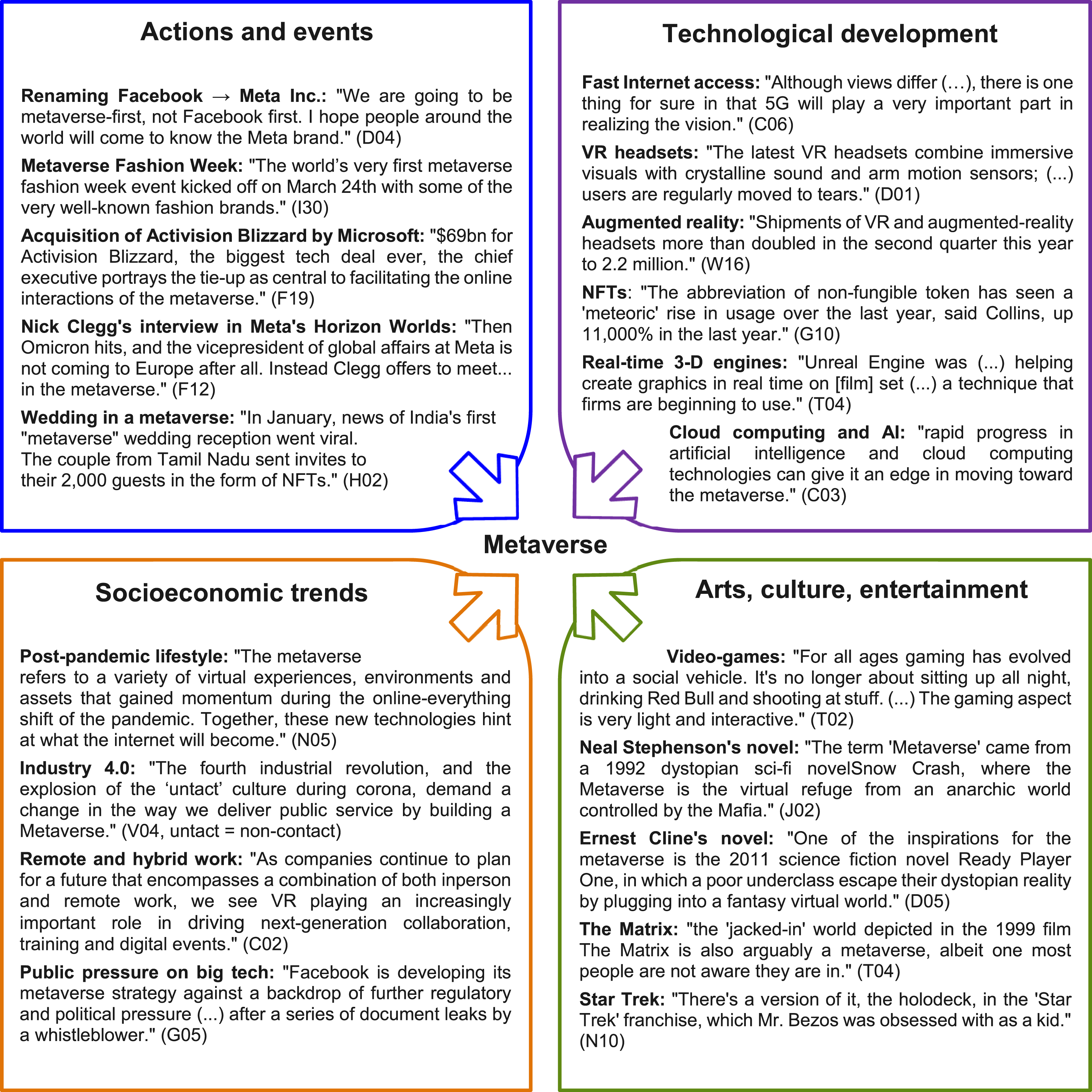
First, specific actions by various actors fuel the discourse. The actors create and distribute visions that attract positive and negative reactions (we address the RSGs’ interests in section on Relevant Social Groups below). The most commented-on action was Facebook’s rebranding in October 2021, followed by Microsoft’s acquiring Activision Blizzard, Nick Clegg’s interview in a metaverse, and Metaverse Fashion Week. Such actions catalyze the use of the Metaverse as a target vision for the development of adequate devices or the flow of money to Metaverse-related businesses.
Second, the data refer to technological progress as a driver of the Metaverse. Diffusion and acceptance of cloud computing, VR goggles, or cryptocurrencies inspire thinking about future possibilities. Without technological progress, the proposed visions would seem impossible—empty rhetoric. The proliferation of new technologies makes various stakeholders receptive to the Metaverse. Many stories discuss whether a technology (e.g., VR or AI) is relevant and ready for the Metaverse. They consider the Metaverse a standalone goal.
Third, culture, arts, and entertainment also feed the discourse. Although most of the typically mentioned sources (Snow Crash, The Matrix, Star Trek) have been around for decades, they now become references for many stakeholders to propagate their vision of the Metaverse and for journalists to explain or criticize it. Also, newspapers refer to videogames and the environments in them as an additional inspiration for the discourse. Through references to popular culture, a shared mental model can be established and presented as (un)desirable. Overall, artistic visions of the Metaverse provide a static reference point in the very dynamic discourse.
Fourth, newspapers identify socioeconomic trends as sources of inspiration. Most refer to the Covid-19 pandemic or a shift in economic priorities as a reason for a broader acceptance of hybrid work and socializing. Awareness of and interest in nonphysical interaction modes motivate society to explore various technical options and modalities to provide enjoyable experiences. Increasing legal and economic pressures on various market actors is another relevant sociopolitical development: the affected RSGs choose to escape the risks by positioning themselves in an emerging discourse. Overall, the discourse is intensifying owing to major sociopolitical shifts.
The analysis shows that controversy concerning the Metaverse and the corresponding debate were set in motion by social, technological, economic, cultural, and political dynamics. Some developments (e.g., industrial progress or technical improvements) have continued for years. Others (e.g., Covid-19 or the rapid uptake of cryptocurrencies) could not have been predicted.
Definitions of the Metaverse
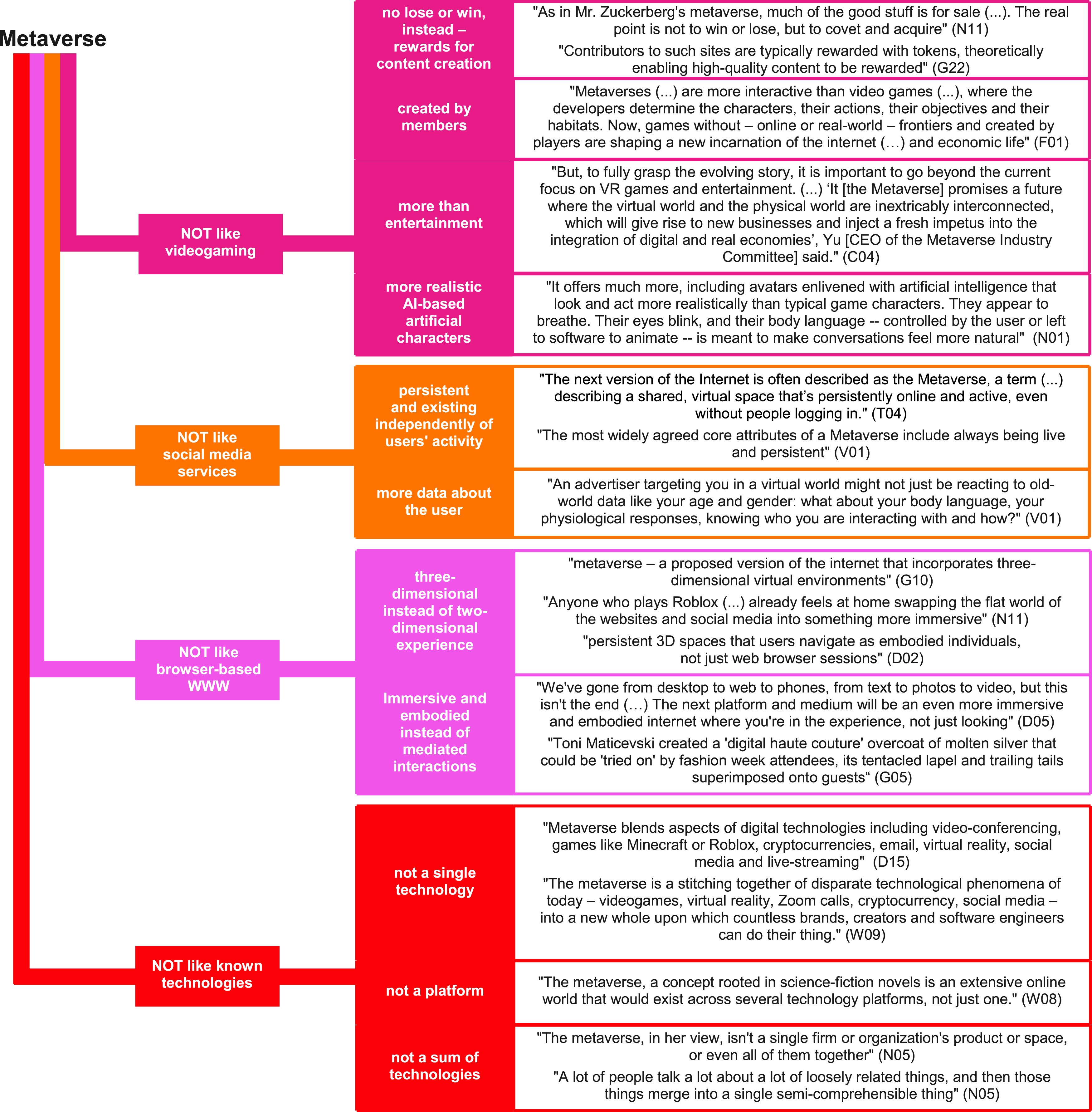
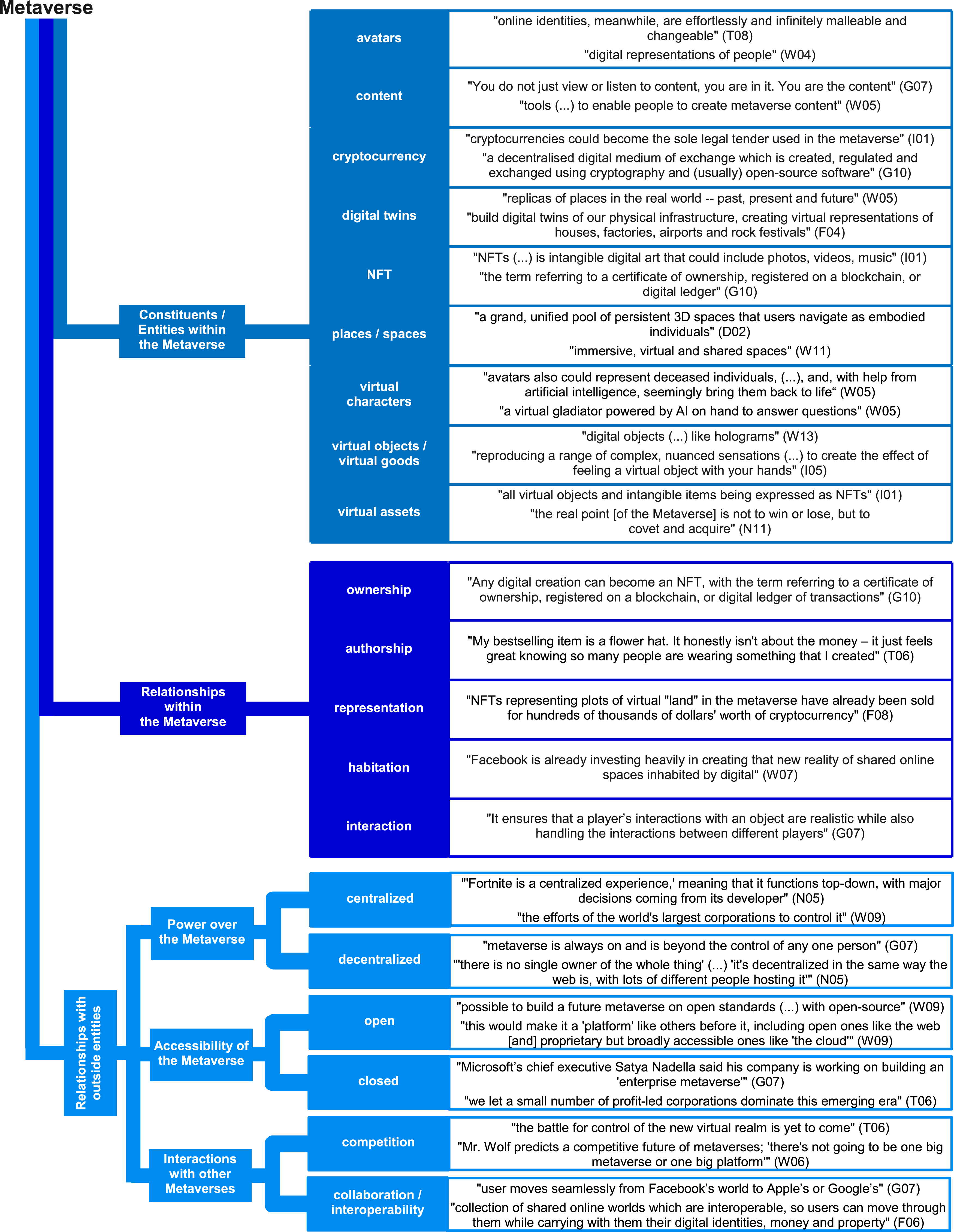
The analysis revealed that definitions of the Metaverse have not yet stabilized. Many mutually exclusive metaphors, explanations, and claims exist in parallel. For instance, it is unclear whether a metaverse is already existing, currently emerging, or only possible in the future (Figure 2). New technologies, use cases, and elements are being attached, inflating the concept’s scope. For instance, the list of building blocks of the Metaverse is continually being extended, creating new interaction possibilities (Figures 4 and 5). We use Figures 2–5 to indicate which meanings are incompatible (individual leaves in the tree structure; see ontological category in Figure 2) or additive (nested tables; see constituents in Figure 4). This points to the potentials for disagreements and concurrence. We identified 12 classes that cover various aspects of definitions of the Metaverse, which we grouped into four sections. Ontological meanings attributed to the Metaverse, grouped into three classes (the meanings in all classes are considered mutually incompatible, e.g., existing here and now cannot be combined with to emerge in the future) Differential meanings of the Metaverse, in four classes (the meanings within the classes are mutually compatible, i.e., they can co-exist within a single definition) Structural meanings of the Metaverse in three classes and three subclasses (incompatible meanings are represented as individual leaves, compatible as rows in a table) Meanings based on the capabilities of the Metaverse in two classes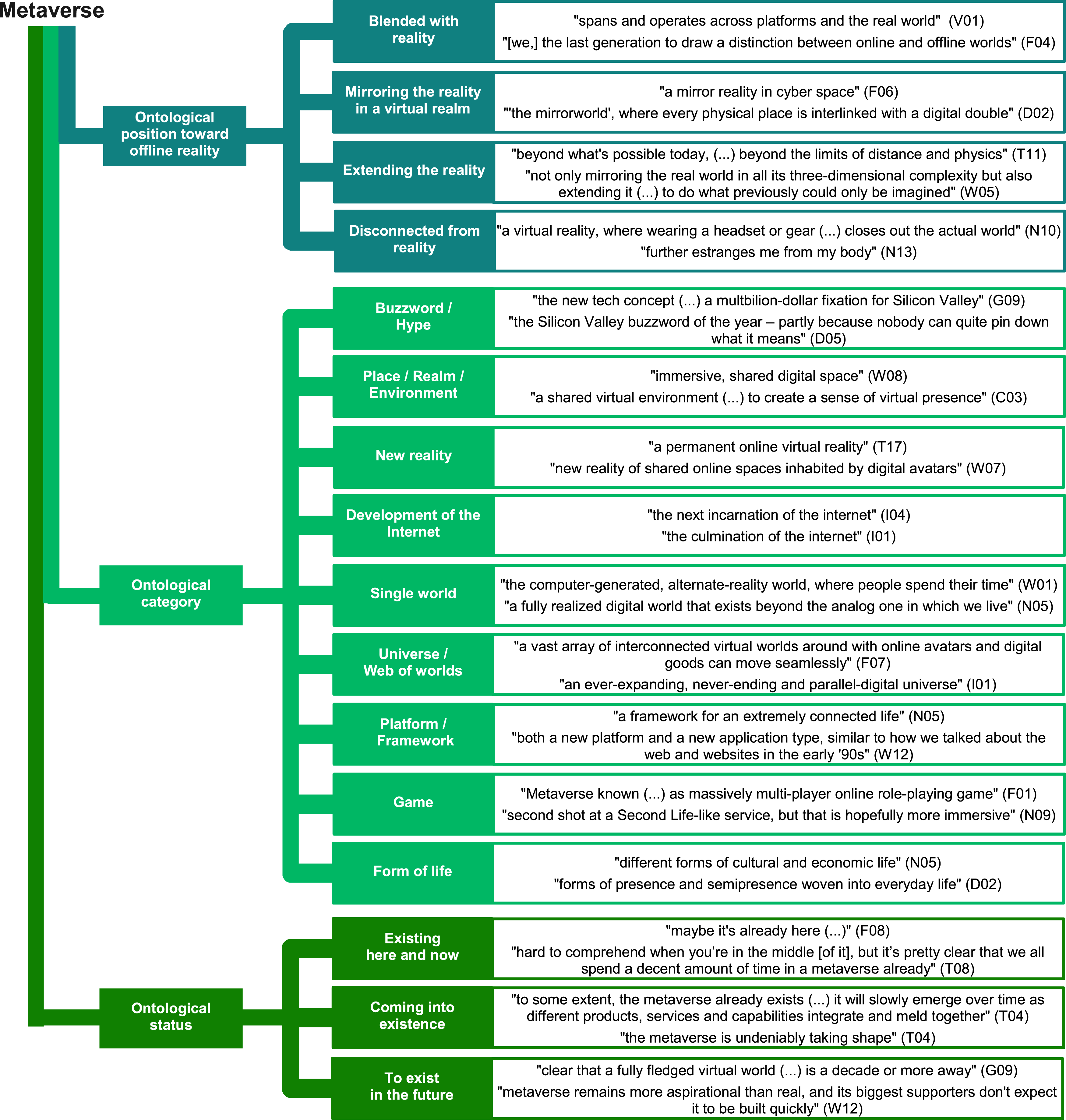
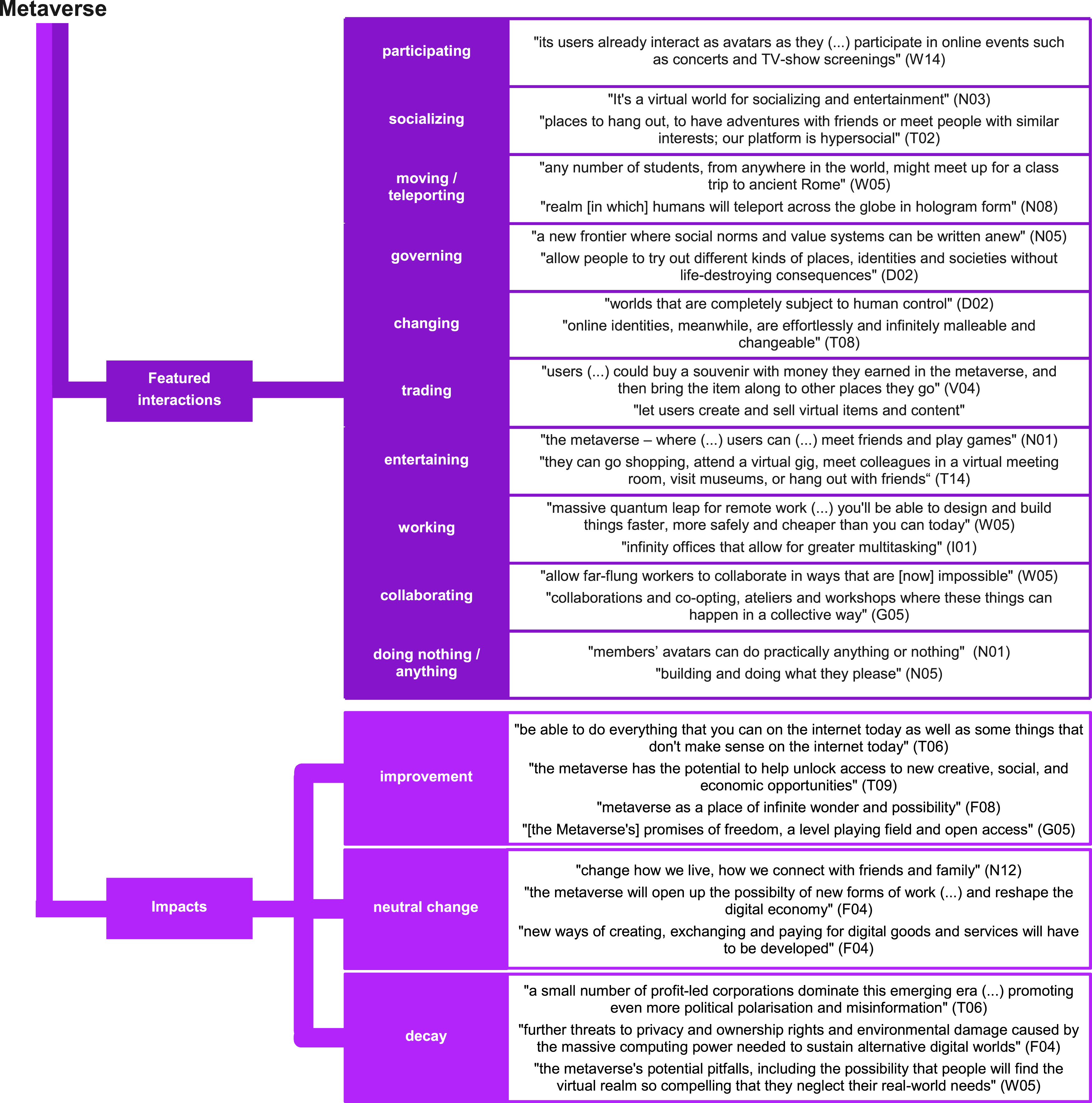
Ontological perspective
Ontology deals with how entities exist and how they interrelate.
9
The analyzed stories deal with the ontological category (What kind of thing is the Metaverse?), the ontological status (Does the Metaverse exist at all?), and the ontological relationship with the offline world (How does the Metaverse exist?). The extracted opinions contradict one another. Sometimes, even one person use
Differential perspective
There are disagreements on what the Metaverse is, and shared models of what it is not, that is, how it differs from other phenomena, including videogaming, social media, the Internet, or any single technology (Figure 3). The comparisons to other phenomena are used to highlight singular aspects that distinguish the phenomenon Metaverse. Although these differences are mutually compatible, that is, the Metaverse may be unlike videogaming for various congruent reasons, they are not equally important for all stakeholders: some contrast the Metaverse to the Internet, while others contrast it to games. Further, some of the identified contrasts directly contradict the ontological categories (e.g., “the Metaverse is not like videogaming” vs. “the Metaverse is a game”).
Structural perspective
Public discourse addresses the Metaverse’s structure: its constituents, relationships between them, and relationships with entities outside the Metaverse (Figure 4). The internal structure embraces (1) the elements that exist in or make up the Metaverse and (2) the relationships between these constituents within the Metaverse. While these elements and relationships are mostly compatible, the RSGs differed concerning which elements or relationships are central. There are also incompatibilities concerning the relationships with external entities or between metaverses.
Capabilities perspective
Listing what is possible within the Metaverse is a frequent approach to capture its meaning (Figure 5). Many statements follow this pattern: “A Metaverse (…) is a virtual world in which people will be able to shop, work, and socialize” (T11), reflecting promises and wishes for what the Metaverse should enable. Generally, there is no disagreement in this regard, such that the various abilities are mutually compatible. Yet we identified conflicting expectations of how the Metaverse will impact on society, the economy, or individuals. For some, the Metaverse is thought to spark innovation and positive changes, leading to more social justice. Others fear that it could amplify the known issues caused by social media. Nonetheless, there is agreement that the Metaverse will strongly impact on all aspects of the world.
Relevant social groups
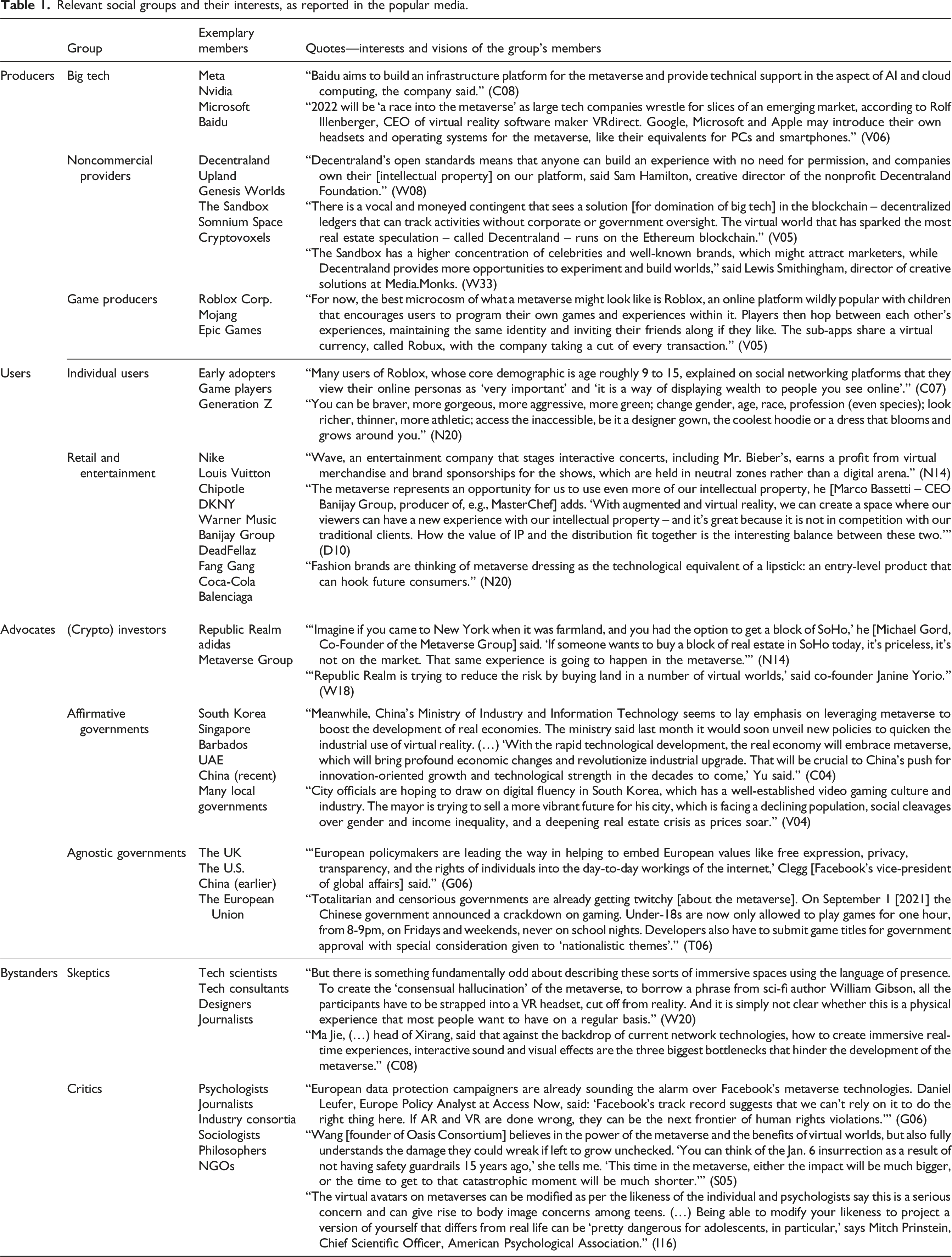
Relevant social groups and their interests, as reported in the popular media.
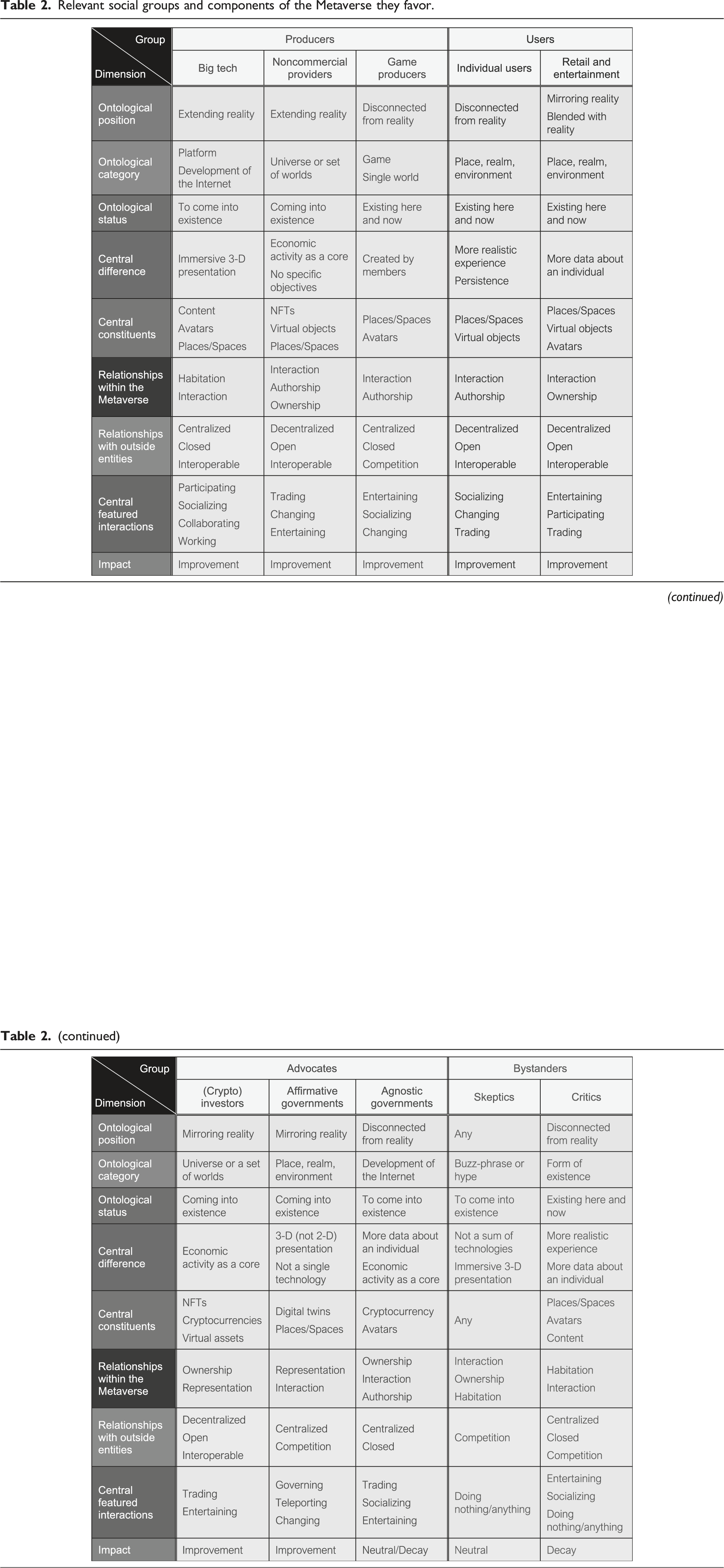
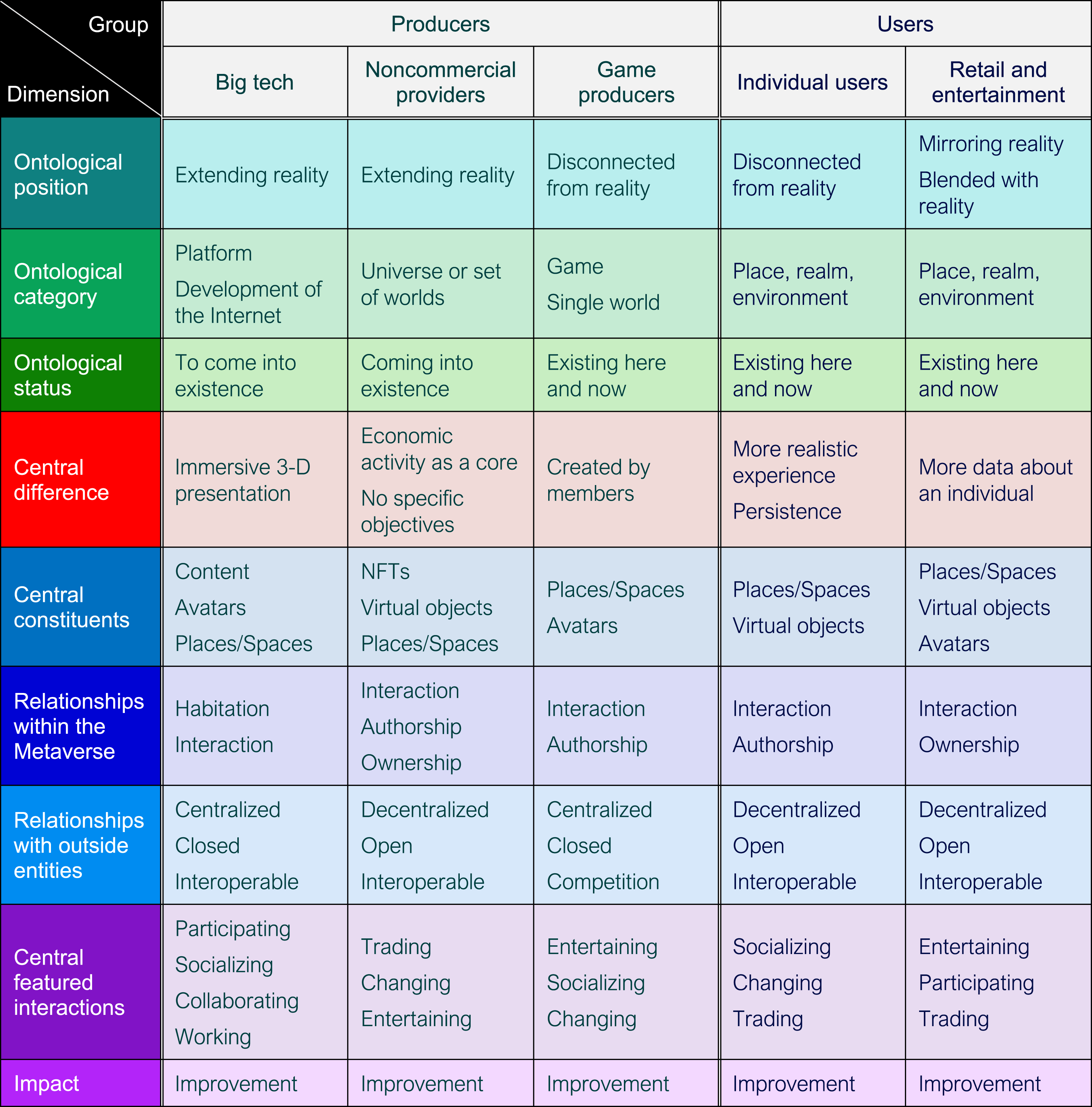
Relevant social groups and components of the Metaverse they favor.
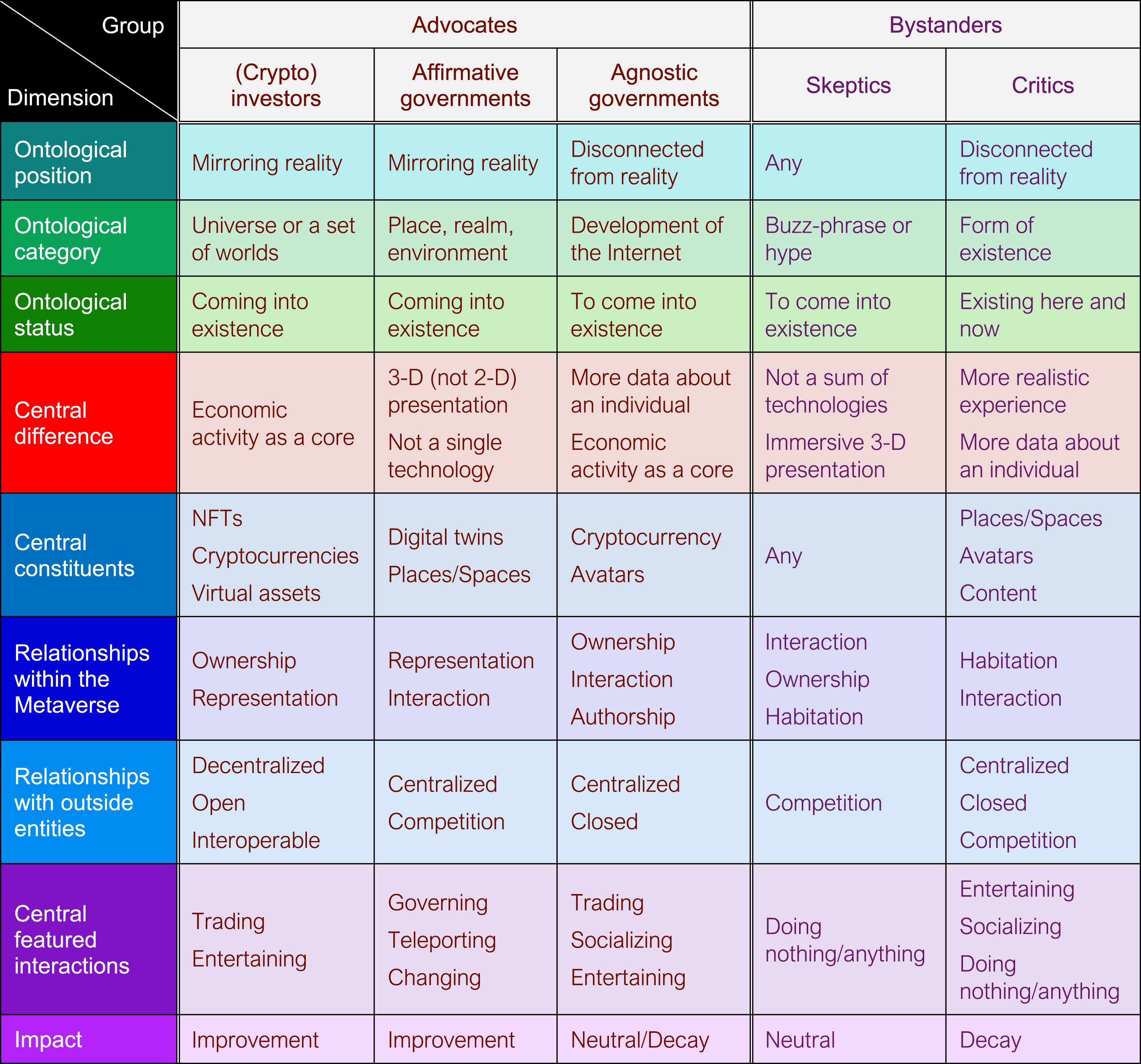
Producers
According to the data, big tech companies such as Meta, Microsoft, Baidu, Nvidia, or Alibaba are enthusiasts of the Metaverse. Meta’s Zuckerberg is widely cited for the unbounded possibilities offered by the Metaverse, and Microsoft’s Satya Nadella for the enterprise metaverse. Big tech firms are driven by the need to expand and establish new fields that promise to flourish in the future. They also have an interest in levering their assets and market position. Accordingly, Microsoft stresses its expertise in supporting collaborative work, Meta in managing identities and connecting people, and Baidu in linking content across the Internet. They self-position as providers of a software and hardware platform to enable the Metaverse. Since necessary technologies (e.g., VR goggles or embodied interaction devices) are in development, also in their labs, they claim that the fully fledged Metaverse will emerge in the future, self-presenting as trendsetters. Further, their visions develop around the notions of co-habiting and interacting with other avatars and content in a virtual space. While they acknowledge that the Metaverse cannot be created by a single company and foresee the existence of parallel interoperable spaces or worlds, they push toward proprietary standards and centrally distributed technologies.
Big tech firms’ visions are mostly contrasted with those of noncommercial providers, including communities, foundations, or decentralized autonomous organizations. Decentraland Foundation’s Decentraland, Game Credits’ Genesis Worlds, Yuga Labs’ Otherside, or Animoca Brands Corp’s The Sandbox are examples of noncommercial metaverses. They propose an open, interoperable, and decentralized Metaverse controlled by its users—a universe of possibilities with potentials to change society. The rise of these platforms relates to the uptake of NFTs as ownership certificates. Since the platforms depend on content created by the users, their providers strengthen the importance of ownership and authorship so as to attract potential contributors. Since their funding relies on external investors and sales of tokens, they attract public attention by inviting people to entertainment events or shows in the Metaverse. They self-position as enablers of a revolution in progress.
A group that claims that the Metaverse exists here and now (and has been for years) are videogame producers such as Roblox Corporation, Mojang (known for Minecraft), and Epic Games (Fortnite). They highlight the overlap between their platforms and the visions offered by big tech or noncommercial providers, indicating that they already offer platforms for space and content creation, and for free social interaction in 3-D environments. Yet the platforms are centralized and controlled by the providers, who compete for users’ attention, money, and effort. The providers, not the creators, own the content and the avatars. Game producers’ main revenue stream is the sale of game extensions and perks to users, as they want to keep as many users as possible on their platform. This implies detaching a user from other metaverses and offering a refuge from reality. While some games support VR hardware to deliver an immersive experience, most rely on non-immersive 3-D environments accessible through computer screens. Since some games already have millions of users, many newspapers identify game producers as strong yet underrated stakeholders in the Metaverse discourse.
Users
The Metaverse is currently used primarily by two groups: individual users as well as retail and entertainment firms. The newspapers report on individuals who regularly enter metaverses: advanced users who actively contribute to metaverses by creating or selling content and those who use metaverses for socializing or spending time with people they share interests with. However, they are united by the desire to create an alternative self, avatar, to express their personality or status—either by how it looks, behaves, or what it contributes. They wish to enter an alternative place without physical distance in which they can explore a virtual version of themselves. For individual users, the Metaverse exists here and now, and they experience it as more realistic than previous online interaction types. Members of underrepresented communities hope that the Metaverse will become a sphere with more equality and better opportunities, because it carries no “cultural baggage.” Overall, current individual users focus on how they self-present and how they can improve their status.
Notable retail and entertainment real-world brands such as Chipotle, Dolce & Gabbana, Nike, Verizon Communications, Warner Music, and Andrew Lloyd-Webber are exploring the Metaverse’s potentials. Yet some new brands such as DeadFellaz or Fang Gang target only the virtual realm. A major event that attracted media attention was Decentraland’s Metaverse Fashion Week in March 2022. Here, designer brands presented their offerings—users could buy digital and physical cloth items. According to the organizers, they could invite virtually everyone to their shows, which is impossible in the physical realm. Yet metaverses are used for concerts, shows, or sales events, and feature virtual branches of retail companies, including banks, food chains, or fashion chains. Industry sees the Metaverse as a marketing platform to attract young customers. But the companies also admit that the Metaverse generates revenue streams on its own: the sales of virtual goods such as clothes are improving, and the demand is increasing because users want to individualize their avatars. The industry does not want to miss this opportunity and expresses strong ambitions regarding the Metaverse. They transfer assumptions about business and economy from the physical world or even see it as blended with physical reality. They seek intense interaction with their clients and see ownership rights as a prerequisite for an economy that fits their purposes. They favor an open, decentralized, and—most importantly—interoperable Metaverse, such that the value of the goods or experiences they sell is not limited to a single platform. The visions of individuals and retail and entertainment firms overlap.
Advocates
The news stories present investors and governments as advocates. (Crypto) investors shape the Metaverse through their economic power. They buy cryptocurrencies and tokens in various metaverses, putting money into their expansion. While some organizations focus on investing in virtual real estate (e.g., Republic Realm, the Metaverse Group), physical-world companies (e.g., adidas, PwC) have also acquired “land” in various metaverses. Investors expect major returns from their investments: they compare the Metaverse to the Manhattan of 200 years ago, assuming the economy in the Metaverse to mirror the real world. They define economic activity as the differentia specifica of the Metaverse over past technologies, and highlight the importance of ownership rights. Because they want their ownership rights to be valid independent of a metaverse or a specific provider, they favor an interoperable, open, and decentralized Metaverse with multiple worlds. They invest in various metaverses to diversify their investments. There is a strong dependency between investors and noncommercial providers; the former provide liquidity, while the latter need to attract user groups to enliven their metaverses and make them attractive for further investment.
Governments and public agencies engage with the Metaverse by establishing regulatory frameworks for the industry’s development. Because Facebook’s rebranding coincided with Facebook hearings in the U.S. Congress, initial reactions from many governmental agencies were agnostic or critical. The media suggested that the name-change may have been a trick to move the focus away from the company’s regulatory and financial problems. Many governments’ critical stand toward cryptocurrencies amplified this position. The newspapers report on heavy lobbying from Metaverse producers and critical NGOs who tried to impact the regulatory work on the Metaverse. Yet most governments remained silent on the Metaverse as a specific development, focusing instead on the more general issues of data security, privacy, and economy. Governments that explicitly addressed the Metaverse feared the destabilization of the markets through speculation, the creation of independent social structures beyond the state’s control, and the amplification of social media’s negative impacts. Also, questions emerged concerning crime and policing in metaverses when cases of sexual assault or child pornography were reported. Agnostic governments referred to the Metaverse as an emerging realm disconnected from reality, in which centralized power remains with wealthy speculators and tech giants who want to increase their revenues by collecting even more user data.
In parallel, many local governments started experimenting with the Metaverse on their own, for instance, by exploring digital twins to mirror their infrastructure or even whole cities. The most prominent examples are Seoul, Shanghai, and Singapore who, besides exploring the Metaverse’s practical potentials, created supportive environments for Metaverse businesses to flourish. With time, many countries’ governments acknowledged that supporting the Metaverse can pay off in the future. Two examples are China and South Korea.
China’s attitude toward the Metaverse changed drastically in November 2021. China Daily, which is considered all but independent from China’s government, originally called for alertness against the Metaverse craze. It called for policy to safeguard China against loss of control over the economy and society, and claimed that the Metaverse, if at all, will emerge far in the future. Simultaneously, China’s government issued a ban on computer gaming after a rapid uptake in VR games. Yet its tone changed: since late 2021, articles embrace the Metaverse as a potential benefit to Chinese industry. In parallel, Western outlets cite a statement by a research unit affiliated with the Chinese Ministry of State Security that called for China to secure technological hegemony over the Metaverse. Following this development, Chinese companies established a Metaverse Industry Committee, directors of the largest Chinese museums signed a manifesto to position China’s cultural heritage in the Metaverse, and major actors such as Baidu launched their metaverses. China’s focus went from criticism of the Metaverse as a hypercapitalist danger to the economy and young people, to a perspective driven by potential industrial benefits as well as competition between firms and nations.
South Korea’s government also supports the Metaverse ecosystem in its country, with billions of dollars in investments and an adequate regulatory framework. It launched a Metaverse Policy Review Committee and the Metaverse Industry Promotion Act to ongoingly support its Metaverse industry. Yet Korea’s rhetoric is more balanced and nuanced than China’s. In parallel to investing in Metaverse businesses, Korea’s government, in collaboration with major industry actors, prepared the Metaverse Ethical Principles to prevent potential risks.
Affirmative governments propose a centralized, controllable Metaverse, allowing for state interventions. They present the Metaverse as a virtual, 3-D realm for new experiences, work, and leisure activities, mirroring the real world. Many assume that this may attract virtual and real tourists and may provide a platform for their own citizens who want to improve their qualifications or contact public authorities.
There has been little to no coverage of Western governments’ actions. In Europe and the U.S., the Metaverse’s development remains in the hands of producers and investors. This will likely change: U.S. and UK newspapers are demanding that their governments actively engage with the Metaverse’s opportunities and risks. First, publicly funded projects are emerging, and local governments are beginning to explore the Metaverse’s potentials. This resembles earlier developments in Asia.
Bystanders
Two major bystander groups featured in the newspapers are skeptics and critics. Skeptics doubt whether the producers’ and advocates’ visions are possible, claiming that the Metaverse will materialize only far in the future. They are mostly technology scientists, economists, or consultants, as well as journalists who have had first experiences in the Metaverse. They focus on challenges that may prohibit the emergence of the Metaverse or its broader uptake, such as affordability issues and diffusion of the technology, or the lack of a clear usage case. Many skeptics imply that the current (third) wave will end in a similar way to the earlier Metaverse waves. They suggest that investors or companies such as Meta blend various barely related technologies into a new underspecified buzz-phrase to detract the public’s attention away from their problems. Although it is hard to identify any specific interest behind this skepticism, skeptics are presented as independent experts and their accounts stand in contrast to the enthusiastic comments from producers.
Critics warn of the Metaverse’s negative impacts on individuals and society. They are mostly psychologists, lawyers, sociologists, or philosophers, as well as journalists who have observed regular Metaverse users or have tried it themselves. Also, NGOs concerned with data security and privacy criticize current developments (e.g., Access Now), while standards development consortia seek to downplay potential downsides of the Metaverse (e.g., Oasis Consortium). There are three major lines of criticism. First, critics address social and psychological implications of detachment from physical reality. Metaverse users may become unable to engage in physical interactions and may become addicted to their virtual selves, causing conflicts and disorders. Second, the Metaverse may amplify criminal and antisocial tendencies, including harassment, assaults, hate speech, manipulation, and disinformation, making them more intermediate and therefore more harmful. Third, critics fear that users will lose control of their own behavioral data, which may be exploited by producers (especially big tech) or retailers. Critics see their role as raising concerns and warning society, although some may have a political agenda, such as NGOs lobbying for policy adaptations.
Most critics assume that the Internet and existing social media already represent an early phase of the Metaverse. They identify big tech and investors as power-holders in a centralized, dystopian, and closed Metaverse that detaches people from one another and from reality. Critics argue that the Metaverse is a form of existence for societies that began to emerge years ago and is already in place. Producers lure people into the Metaverse by offering entertainment and socializing possibilities as well as-yet-unknown freedoms.
Discussion
Tensions and overlaps
The results show that the Metaverse is subject to very high interpretative flexibility. Various contradictory or incompatible visions are proposed by the RSGs. The discrepancy starts with the question whether the Metaverse exists at all and ends with the question of what elements it is built of. These differences exist also within the RSG meta-categories. Different producers make radically different claims about the Metaverse, constructing it around their individual strengths and competitive advantages. Advocates also differ depending on what they seek to achieve. Investors seek large revenues and diversified investments in barely regulated environments, while governments seek control mechanisms to retain their power or to secure their citizens’ rights. Competitions for market shares and technological leadership feed the conflicts. Each party seeks to lay the foundations for the Metaverse along its own interests.
However, there are also synergies within meta-categories. Individual users as well as retail and entertainment firms follow complementary visions of the Metaverse. While users want to establish an alternative reality for a better version of themselves, retail and entertainment firms (including established and virtual-only brands) provide them with virtual objects to feed their alter ego. While users seek new experiences, the firms provide them with new entertainment types. Thus, basic supply-and-demand structures bring some actors together.
Further synergies emerge between the (crypto) investors and noncommercial Metaverse providers. The providers see the Metaverse as a universe of possibilities in which new societal and economic forms emerge. Yet they depend on external funding. Investors like the freedoms combined with the ownership and scarcity mechanisms in noncommercial metaverses guaranteed by blockchain technologies. Both groups see themselves as pursuing a groundbreaking innovation.
Big tech corporations and affirmative governments propagate another vision. Governments want a Metaverse under control of a single entity, while big tech wants to keep the control. These firms are also an attractive investor in the local economy as opposed to collectives behind the noncommercial platforms. Corporations have also a strong interest in influencing policymaking, such that they willingly join various committees established to propagate self-regulation or advise public agencies. This may contribute to the synergetic perspective on the Metaverse. Simultaneously, agnostic governments and critics also seem to form an alliance, although the connections are not as explicit.
The bilateral dependencies between RSGs form a complex ecosystem. To implement visions of the Metaverse, money and technology are needed. For (crypto) investors, a metaverse needs to attract users if it is to be a promising investment. Users often enter a metaverse if it offers them the experiences they seek, including the content provided by retail and entertainment firms. Further, a fully fledged multimodal experience is only possible with novel technologies, including powerful hardware—so far provided by big tech—and powerful 3-D virtualization engines—a specialty of game producers, who want to monetize the trend and secure their future influence. Governments provide a regulatory framework and an investment environment that may inspire or undermine development. The media are also stakeholders: by proliferating positive or negative opinions, they create a general tone in the public debate. The best example in the collected data was the drastic change of attitude toward the Metaverse in China Daily. We expect that this multilateral tug of war will eventually lead to stabilization and closure in the social construction of the Metaverse.
Our analysis shows that the social construction processes are far more complex than one may assume. They go beyond the appropriation of a technology where users—through their collective and individual practices, sensemaking, and attitudes—attach meaning to the technology. The global-level dynamics are more complex. Organizations have explicit and implicit goals, and adapt to external and internal pressures; further, there are unstable and whimsical money flows, unexpected events, hype cycles, and governmental agendas.
In this context, various actors try to make sense of what is happening, what their own position is, and what actions they should take (Weick, 1999, 2000). This sensemaking may be implicit. For instance, (crypto) investors implicitly assume that the real estate economy in the Metaverse resembles a real-world real estate market (e.g., the comparison to the Manhattan of 200 years ago). Also, retail and entertainment firms mimic what they know from their real-world business. Yet their sensemaking may also be explicit. Big tech firms declare that they search for “the next big thing” and explain their actions (e.g., various Metaverse investments) through this lens.
Sensemaking is rarely fully rational and planned. It involves establishing provisional meanings, acting based on them, and then iteratively adjusting them (Weick, 1999, 2000; Weick and Sutcliffe, 2015). Yet, often, only some of the available information is considered (Weick and Sutcliffe, 2015), as exemplified by various governments’ inconsistent reactions. Based on the sensemaking accounts, one may propose that harsh regulations, inspired by a critical understanding of the Metaverse as a capitalist development with potential addiction risks, led to confused reactions from the local industry, which turned the original mistrust into its opposite. Similarly, users’ sensemaking is characterized by exploration of the opportunities and iterative adjustments of the meanings. For instance, individual users who originally enter the Metaverse for socializing or gaming may become content creators, and may start treating the Metaverse as a marketplace in which they buy, sell, or transfer NFTs associated with virtual goods. Such meanings emerge over time under consideration of selected cues.
In sum, two forces contribute to the confusions, overlaps, and disagreements concerning the Metaverse’s meaning. First, the RSGs pursue their individual interests, which are driven by economic goals, antagonism toward other actors, or the interplay of fear and curiosity. The interests yield an interwoven system of interdependencies and incongruences in which various actors explore the limits of their own influence, undermining the development of a specific definition. A single definition would imply that some groups have won. Second, this ongoing tension and uncertainty leaves space for exploration, the emergence of new business and investment models, ongoing sensemaking, and trial and error. Mixing definitions and proposing various metaphors at the same time, some actors (un)consciously imply that they may have no interest in stabilizing the meaning, such that they can keep exploring. This attitude further increases the interpretative and design flexibility.
The social discourse and actions of the RSGs will form the Metaverse, which may become an open, decentralized, and interoperable platform or an ecosystem of ecosystems as favored by noncommercial providers, crypto investors, or the retail and entertainment industry. If the depictions created by big tech or game producers will dominate, the Metaverse may emerge around closed, centralized platforms offering a VR-supported social experience. However, owing to the high flexibility, further options are possible: the Metaverse as a state-controlled virtual replica of the world, as a development stage of social media, or as an overlay augmenting physical reality. In January 2023, the skeptics led the discussion. Given the negative sentiments around Meta’s or Microsoft’s investments and the underwhelming reception from individual users, the construction of the Metaverse is far from being done.
Implications for research
The Metaverse is subject to high interpretative flexibility and will likely remain in this phase for the foreseeable future. It is a controversial phenomenon, with many actors advancing their interests and visions. This calls for a careful handling of the term the Metaverse, its meanings, and the phenomenon it references. Scientists should be aware that to engage with this topic is to enter a power play. Proposing simplistic definitions or parroting the visions of a specific party (e.g., Mark Zuckerberg) may impact on the public discourse and the development of the Metaverse.
Research critique
The scientific literature offers three perspectives on the Metaverse: technical, use-oriented, and structural. The results indicate that technological developments are key drivers of the Metaverse. Yet framing it as a technology (Augustin et al., 2023; Dincelli and Yayla, 2022; Knop et al., 2022; Lacity, 2022; Zhao et al., 2022) or a combination of technologies (Inceoglu and Ciloglugil, 2022; Kim, 2021; Peukert et al., 2022) is risky. Distributed ledger technology may afford decentralization, openness, interoperability, or a token-based economy, and may differentiate the Metaverse from Web 2.0. However, it does not guarantee that metaverses will have any of these attributes. Users or investors may ignore the affordances of distributed ledger architecture, turning it into a technological peculiarity without impact on the Metaverse’s meaning. Distributed ledger technology may turn the Metaverse into an ecosystem of ecosystems, but it may also become irrelevant during the social construction. Defining the Metaverse from the perspective of AR/VR-based interfaces or even the combination of technologies is also risky. In the current phase, the social forces rather than technological developments specify what the Metaverse is.
The use-oriented perspective bears further risks. The interests, motives, and behaviors of individual users shape the developments (Augenstein and Morschheuser, 2022; Cheng et al., 2023; Lee et al., 2022; Lee and Kim, 2022; Reis, 2022; Siyaev and Jo, 2021), but the goals of corporate users, producers, and advocates are equally important. The hype around the Metaverse emerged partially due to investors speculating with Metaverse-related assets rather than considering the business models behind the assets. Some individual users also focus on monetary wins rather than immersive social experience claimed to be the Metaverse’s core. Domain-specific studies (Inceoglu and Ciloglugil, 2022; Kim, 2021; Tlili et al., 2022) implicitly align with producers’ rhetoric, such as Microsoft promoting the Metaverse for enterprise or Meta’s focus on education. Researchers need to acknowledge the context and the various motives driving the Metaverse’s development. Despite some RSGs’ romantic visions, we argue that users are not the only constructors of the Metaverse.
The structural perspective sorts and categorizes the Metaverse, yielding frameworks, taxonomies, and typologies (Abu-Salih, 2022; Chen et al., 2022; Kshetri, 2022; Lee et al., 2022; Ning et al., 2021; Park and Kim, 2022; Peukert et al., 2022; Schöbel et al., 2023). They offer an entry point and help scope the research. Yet they may be short-lived, owing to the high interpretative flexibility. Researchers using such frameworks should check their applicability and timeliness. Some framings and definitions strive for high backward-compatibility, which makes them very selective. For instance, they implicitly and likely unintentionally ally with the commercial producers, positioning VR experience at the core and downplaying the roles of interoperability and decentralization (Park and Kim, 2022). Some offer broad frameworks that are potentially applicable to many phenomena beyond the Metaverse (Schöbel et al., 2023). We speculate that this results from the dynamic depiction of the Metaverse and the drive to encapsulate its various interpretations. The RSG-specific visions of the Metaverse presented in Table 2 are an alternative to such tendencies.
Yet the research requires definitions of a phenomenon in order to specify its objectives. We are sympathetic to those who conclude it is not possible to provide a precise definition (Xu et al., 2022). We claim that this difficulty results from the complexity of the Metaverse and its context. The technologies and actors enter complex interactions with one another, yielding unprecedented outputs. Complexity is crucial here: while a complicated system is defined by its individual parts, a complex system can be specified only in terms of the interplays between the parts (Weick and Sutcliffe, 2015). It creates emerging, short-lived structures, randomness, and nonlinear developments (Weick, 1999; Weick and Sutcliffe, 2015). The Metaverse is a complex system, and its construction occurs in a complex environment composed of contradictory interests, interdependencies, and mutual mistrust. Thus, it requires much sensemaking. More provocatively: if physical reality is hard to define and scope, why should this be easy for the Metaverse, a virtual reality?
The scientific community needs to engage in the sensemaking and attend to controversies. The contrast between a system, a technology, or a platform is key for determining adequate governance structures and effective interventions. The question whether the Metaverse extends, mirrors, blends with, or separates from reality affects legal and regulatory issues. Traditionally, physical proximity plays a role for prosecution of sexual offenses. The reported cases of sexual assault in the Metaverse present lawyers with new challenges, because a definition of proximity is missing. Finally, the analogy between the universe and the Metaverse is inconsistent. Understanding the interaction between the Metaverse, parallel metaverses, VWs, and universes is key for creating a coherent mental model of the Metaverse. Overall, we speculate that core capabilities, constituents, and relationships within the Metaverse will be selected through the aforementioned social processes based on their practical usefulness. We call for the community to build on the presented insights and work toward conceptual clarity in parallel to the ongoing social construction progress.
Research guidance
Critique of the literature raises the question: What should researchers who want to explore the Metaverse’s impacts do? Precision is key. We appreciate Peukert et al.’s (2022) warning to researchers who may be tempted to surf the hype. As noted, the Metaverse is characterized through the complex interplays between its components and with the environment, leading to second-order phenomena and societal shifts. This has two implications. If researchers focus on a single component or scenario (e.g., collaboration in virtual offices), they should specify the capabilities, constituents, and technologies relevant for their research object, rather than claiming Metaversal scope or relevance. If researchers address novel interactions between technologies or components (e.g., using NFTs to represent virtual goods that have pragmatic value only in a VR), then using the label the Metaverse may be appropriate to some extent.
But using the label the Metaverse requires caution. First, researchers should explicate how components and structures implemented in their selected metaverse (e.g., governance and economic structures) affect their research object. As in any complex system, interplays between elements may have uncontrollable effects and may cause undesired measurement mistakes, reducing the research’s internal validity. Second, researchers should consider that metaverses differ concerning their static and emerging characteristics. The static characteristics embrace among others the technology stack used, the governance form, the economic form, abilities, functionalities, and explicit objectives. The emerging characteristics are much harder to identify and may require information about the user base, the community’s manners and implicit etiquette, ongoing economic processes, dependencies in the real world (owner, regulations, sources of investment), etc. This is relevant for assessing external validity. We encourage Metaverse research and see these suggestions as opportunities to conduct more demanding but also more interesting research.
Further, rather than providing a single, potentially biased definition, we suggest taking a step back and explaining the term and its potential meanings while referring to its etymology (see Section 2.1). It can be a departure point to zoom in on the specific research object. While the etymological explanation has limitations regarding precision, concreteness, and ambiguity, it is well suited to establish a basis independent of the current hype and the RSGs’ particular interests.
Despite the challenges concerning framing and definition, researchers can use the Metaverse’s attributes to their advantage. The interoperability and openness of some platforms accommodates the transfer and evaluation of developed apps or objects across metaverses—a benefit for design researchers. Also, the availability of more granular and richer data than for instance social media allows for studying social and economic in more detail—an advantage for behaviorists. The Metaverse allows one to test virtually any social or economic intervention with minimal risk of injuries and independent of physical limitations, yielding a virtual social research lab. With the Metaverse, researchers can gain access to numerous such labs in the future. Accordingly, they should take a proactive role and should propagate a notion of the Metaverse that offers the best conditions for their research.
The current development phase also holds potential for relevant observations. Metaverses require regulations and codes of conduct, opening doors to behavioral studies of how those regulations and codes emerge in various conditions. Currently, new metaverses emerge as countermodels to other metaverses. After stabilization and closure, one or two dominant models will likely develop, and evolution will replace the rapid exploration. The current variety may not be repeated in the future. Further, the power play we observe is prototypical of high-paced times of innovation. At once, most major big tech firms are trying to carve out pieces of the same cake, while previously they mostly focused on distinct areas (Meta—social media; Microsoft—workplace support; Apple—consumer electronics; and so on). The dynamics may become particularly interesting to study innovation processes in a nutshell.
Implications for information systems
Some research topics for IS studies of the Metaverse.
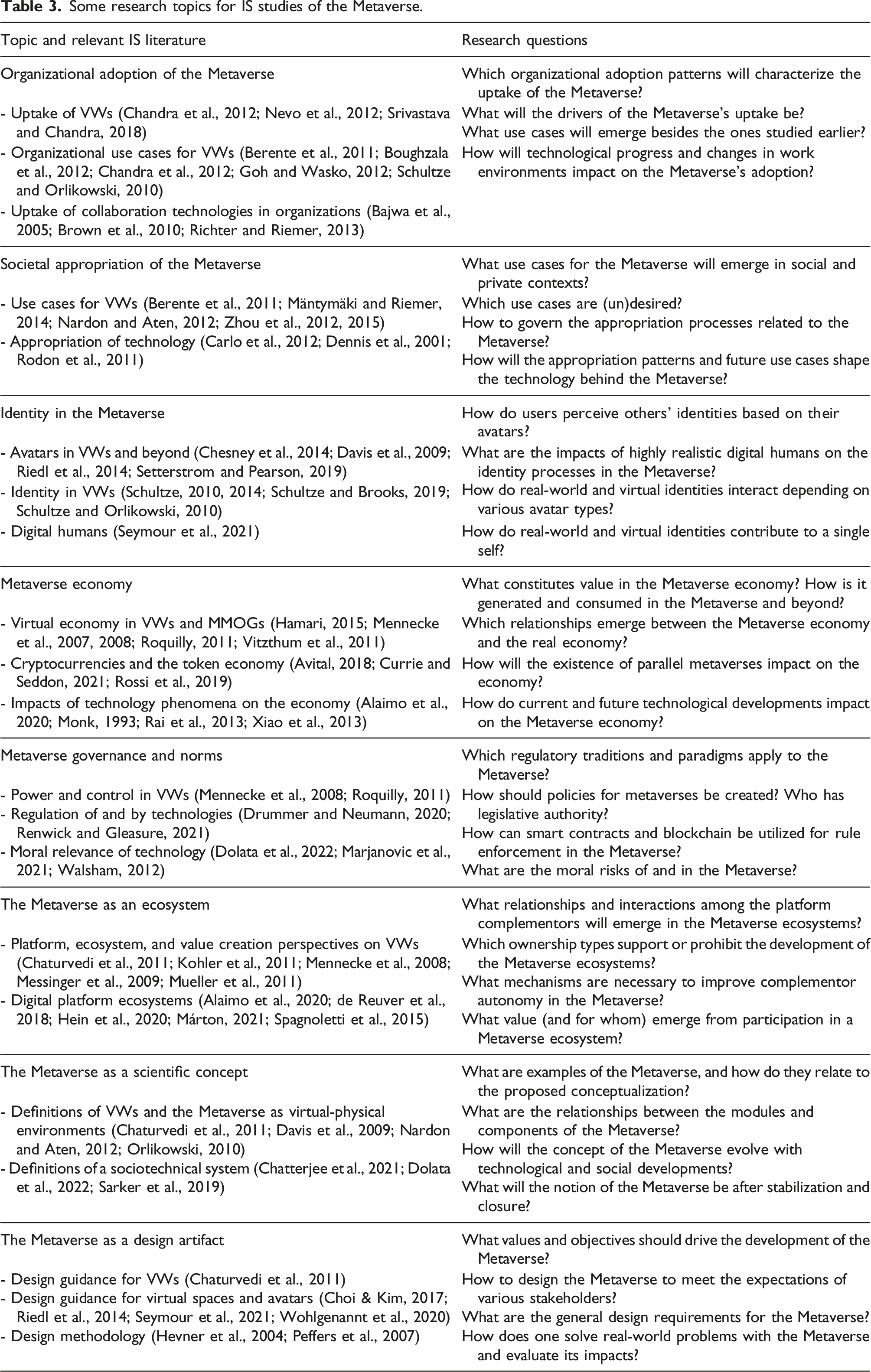
Overall, the Metaverse requires further research. Society needs insights about specific design decisions’ impacts on users, society, and the economy. Governments need reliable guidance if they are to issue adequate regulations. Companies need assistance in assessing the current developments’ relevance for their business. Metaverse producers need support to take decisions that rely on empirical evidence rather than their particular interests. While the meaning of the Metaverse may remain blurry, we need to explore the options according to the abovementioned guidance. 11
Conclusion
This study has limitations. First, the Metaverse discourse is still immature. Analyzing an emerging discourse bears risks of biases, as niche opinions do not reach top-tier outlets. Second, we selected only English-language outlets to facilitate a consistent linguistic analysis (e.g., regarding used metaphors). Considering the coverage of the Metaverse in other languages will complement our findings. Third, the public discourse is not limited to the selected outlets. Studying technical or professional magazines, industry consortia, and other media will augment the picture we presented. Finally, the world is changing rapidly, and recent—often disturbing—trends in international politics and the economy, including mass layoffs in big tech, have not yet been covered in the selected data. 12
We have analyzed the public discourse to understand what meanings of the Metaverse are presented to the broader public, finding that the Metaverse is subject to interpretative flexibility—many meanings exist in parallel. As various actors shape the meaning of the Metaverse according to their interests, this affects how it is presented and what components or technologies are connected to it. The Metaverse is emerging as a complex sociotechnical phenomenon without a predictable development trajectory. This yields opportunities for researchers, who can observe the emergence of a technology in vivo, and businesses, which can test innovative business models. A warning to potential investors, users, and researchers: the intense discourse about the Metaverse is not equivalent with its success. 13
This study has made several contributions. It provided a cumulated, comprehensive summary of the social discourse on the Metaverse and has evaluated multiple meanings used in this discourse. It identified social groups engaged in the discourse and links their interests to the meanings they propagate. We discussed social processes involved in the social construction and suggested how researchers and practitioners can deal with the Metaverse as a dynamic and underspecified object. 14
This research is of interest to various stakeholders. SCOT researchers gain insights into sensemaking of the Metaverse, offering a basis for follow-up studies. IS researchers benefit from the positioning of the phenomenon in past IS research. We have offered guidance on how to accommodate the Metaverse’s complex and dynamic nature. Designers have received a summary of aspects that need explicit attention in new metaverses. Further, decision-makers can use this independent description of forces that drive the Metaverse’s construction. We have provided a picture of what the Metaverse is and could become, according to RSGs. 15
Supplemental Material
Supplemental Material - What is the Metaverse and who seeks to define it? Mapping the site of social construction
Supplemental Material for What is the Metaverse and who seeks to define it? Mapping the site of social construction site by Mateusz Dolata and Gerhard Schwabe in Journal of Information Technology
Footnotes
Acknowledgements
We express our best gratitude to Dr. Christiane Schwabe for her support during data analysis and interpretation.
Declaration of conflicting interests
The author(s) declared no potential conflicts of interest with respect to the research, authorship, and/or publication of this article.
Funding
The author(s) received no financial support for the research, authorship, and/or publication of this article.

Supplemental Material
Supplemental material for this article is available online.
Notes
Author biographies
References
Supplementary Material
Please find the following supplemental material available below.
For Open Access articles published under a Creative Commons License, all supplemental material carries the same license as the article it is associated with.
For non-Open Access articles published, all supplemental material carries a non-exclusive license, and permission requests for re-use of supplemental material or any part of supplemental material shall be sent directly to the copyright owner as specified in the copyright notice associated with the article.
