




Abstract
Focusing on inter-organizational information sharing in criminal justice, it is found that, while poor project management leads to unsuccessful inter-organizational information sharing, a recipe for success is more demanding as it requires both compatible technologies and good project management implemented either by means of a top-down approach of strategic alignment or an emergent approach of bottom-up alignment. Though unplanned, the latter approach may lead to mistakes that are more correctable than the large mistakes stemming from top-down, deliberate planning. The study is an analysis of context-mechanism-outcome configurations of inter-organizational information sharing activities within criminal justice systems and demonstrates the causal asymmetry between positive and negative cases. Theoretical, methodological, and practical implications are discussed by highlighting the causal role of different types of governance structure in a crisp set configurational fashion.
Introduction
Information sharing is the bedrock for smart governance (Gil-Garcia and Sayogo, 2016) and for effective public safety networks (PSNs; Fedorowicz et al., 2018). The literature has recently defined PSNs as “inter-agency collaborations focused on developing and using information systems in support of information sharing and function-al interoperability among public safety organizations engaged in law enforcement, criminal justice, and emergency response” (Fedorowicz et al., 2014: 302). Inter-organizational information sharing has also been defined as “cross-boundary information sharing that takes place among multiple organizations as opposed to among multiple units within the same organization” (Gil-Garcia and Sayogo, 2016: 573). Drawing on the IS success literature (DeLone and McLean, 1992, 2003), Gil-Garcia and Sayogo (2016) have argued that inter-organizational information sharing is an interdependent variable that captures both determinants of information sharing, as well as underpinning processes (or mechanisms) linking the determinants (i.e. independent variables) to the outcome of interest (e.g. efficiency savings, satisfied users).
Despite the growing amount of research investigating the determinants of efficient inter-organizational information sharing (Gil-Garcia and Sayogo, 2016) and PSNs effectiveness (Fedorowicz et al., 2018), it is not yet clear whether centralized information technology (IT) governance plays a pivotal role in determining successful inter-organizational information sharing within PSNs. In other words, it needs to be understood whether governance structures such as Legislative Oversight Committees, Steering Committees, and Executive Boards are essential for successful inter-organizational information sharing within PSNs. For example, Gil-Garcia and Sayogo (2016) argue that compatibility of technical infrastructure and formally assigned project managers are “the two most important predictors explaining the success of inter-organizational information sharing initiatives” (p. 572) and that “the governance structure was found not to be a statistically significant predictor” (p. 579). On the contrary, Fedorowicz et al. (2018) have shown that “stakeholder and technical governance are key contributors to PSN effectiveness, while organizational and financial governance are not” (p. 327).
The fact that technical governance can be a key contributor to effective inter-organizational information sharing for one stream of literature (Fedorowicz et al., 2018) and a non-statistically significant predictor for another stream (Gil-Garcia and Sayogo, 2016) raises the issue of validity. Are these findings truly inconsistent? Or can they be reconciled somehow? Building on the fledgling literature on governance of information-sharing initiatives within the public sector (e.g. Fedorowicz et al., 2018; Sawyer et al., 2013), we highlight an emergent approach of IT governance that challenges the traditional view of top-down governance. Compared with the traditional view emphasizing top-down control and a centralized IT governance structure, the emergent approach revolves around a more flexible IT governance strategy featuring the absence of a pre-existing plan. Far from being unsuccessful, the emergent approach enables the bottom-up alignment between the technical (i.e. technological infrastructures, platforms, and standards) and the social aspects (i.e. governance structures, and project management approaches) through the emergence of “transient” organizational structures and the ongoing reassembling and recombining of data standards (Lanzara, 1999; Lupo and Velicogna, 2018). Accordingly, both approaches can lead to successful inter-organizational information sharing depending on whether centralized IT governance is present (i.e. deliberate plan based on top-down alignment) or absent (i.e. emergent plan based on bottom-up alignment). By problematizing the fundamental tenet that IT governance should be approached in a top-down fashion, in this article, we ask the following questions: (1) What is the role of IT governance in generating successful inter-organizational information sharing? (2) What is the associated mechanism for generating a positive outcome (or the lack thereof)? (3) In what way do IT governance, project management, and technological compatibility combine to achieve efficient and effective inter-organizational information sharing? 1
Criminal justice systems provide the ideal settings for addressing these questions because they are an archetype of PSNs. They are complex socio-technical systems aiming for criminal law enforcement by means of cross-boundary information sharing. As such, criminal justice systems are socio-technical systems that encompass both social and technical aspects. Indeed, criminal justice systems may be regarded as microcosms of strategic, operational, and technological issues because criminal justice organizations work together in complex and interdependent networks. Furthermore, recent findings show that inter-organizational information sharing initiatives within criminal justice may be started either by the participating agencies in a bottom-up fashion or result from top-down government mandates (Fedorowicz et al., 2018). While some scholars have made the case that criminal justice systems reflect a bottom-up and middle-out set of technological and organizational arrangements (Williams and Fedorowicz, 2012), recent findings point to the importance of building a common vision and a shared purpose across criminal justice organizations in a top-down fashion (Fedorowicz et al., 2018). Even when an overarching governance structure is established, it may be difficult to agree high-level data governance principles because of the potentially conflicting interests at stake (Benfeldt et al., 2020; Constantinides and Barrett, 2015; Eaton et al., 2018 Markus et al., 2006). This issue, in turn, makes a compelling case for analyzing both centralized and decentralized IT governance structures as viable structures for pursuing successful inter-organizational information sharing.
In this article, we assess inter-organizational information sharing initiatives within criminal justice systems from the perspective of IS success (DeLone and McLean, 1992, 2003). We draw on this well-established theoretical perspective because successful inter-organizational information sharing improves efficiency by reducing redundancy in terms of multiple data collection efforts and data entries while facilitating collaboration and coordination across multiple organizations (Gil-Garcia and Sayogo, 2016). Using a sequential research design comprising a single longitudinal case of IS success (i.e. England) followed by a cross-case analysis based on qualitative comparative analysis (QCA) techniques, we deploy Pawson and Tilley’s (1997) context–mechanism–outcome (CMO) approach to investigate both temporal and causal influences underpinning successful inter-organizational information-sharing initiatives within criminal justice. By doing so, we distill the holistic effects of socio-technical factors working in conjunction with each other rather than separately (Berg-Schlosser et al., 2009; George and Bennett, 2005; Henfridsson and Bygstad, 2013).
Despite the small number of cases under investigation, our findings reveal the causal asymmetry between positive/successful cases (i.e. Austria, Estonia, and Finland) and negative/unsuccessful cases (i.e. Denmark, Italy, and Portugal) because the causes leading to the presence of the outcome of interest are very different from those leading to its absence (Fiss, 2011). While the lack of successful inter-organizational information sharing revolves around poor project management, successful inter-organizational information sharing is much more taxing because it requires good project management coupled with compatible technologies that enable the criminal justice system organizations to communicate between and among each other securely. Furthermore, the successful configurations are underpinned by an alignment mechanism acting in context (Pawson and Tilley, 1997). While top-down alignment presupposes a centralized governance structure with a deliberate (or intended) plan, it turns out that successful inter-organizational information sharing may also be triggered by an emergent strategy of bottom-up alignment. Though unplanned, this process of bottom-up alignment may lead to mistakes that are more tolerable and correctable than the large, costly mistakes stemming from top-down, deliberate planning. Not only does this bottom-up approach shift the focus to alignment as a dynamic, multi-faceted, and non-deterministic process (Chan and Reich, 2007; Coltman et al., 2015; Jenkin and Chan, 2010; Karpovsky and Galliers, 2015; Luftman et al., 2017; Vessey and Ward, 2013). It also fits with flexible standardization strategies (Hanseth and Bygstad, 2015) revolving around an agile software development process and an emergent project organization (i.e. a decentralized or localized governance structure).
The remainder of the article is organized as follows. The “Theoretical background” section highlights the role of IT in e-Government in general and criminal justice systems in particular. The “Methodology: the sequential research design” section introduces our methodological approach which interweaves a longitudinal case study followed by a cross-case analysis using QCA techniques. The “Analysis” section analyzes the empirical data by performing a within-case analysis followed by a cross-case analysis of criminal justice systems. The “Discussion” section discusses the findings deriving from this work. The “Conclusion” section brings the article to a close with a summary of key findings, their theoretical, methodological, and practical implications, as well as the limitations of this study.
Theoretical background
As information-sharing initiatives, PSNs are often linked to e-Government programs. e-Government is “the use of IT to enable and improve the efficiency with which government services are provided to citizens, employees, businesses and agencies” (Bélanger and Carter, 2012: 364). Information sharing lies at the core of e-Government because it enables seamless coordination between and among multiple government organizations (Pardo et al., 2012). More than being a technical achievement, information-sharing initiatives encompass disparate social dimensions ranging from strategic issues to operational matters (Pardo et al., 2012). Yet, scholars studying information-sharing projects deployed within e-Government initiatives have systematically neglected the social side (Olphert and Damodaran, 2007; Sorrentino and Virili, 2003). Adopting a standard (technical) mind-set, social issues have been repeatedly overshadowed by more pressing techno-rational matters that tend to regard information-sharing initiatives as a straightforward means to an end in a context where incentives to change are unproblematic (Kling and Lamb, 1999).
Spurred by Kling and Lamb’s (1999) call for redressing this imbalance, e-Government scholars have recast social issues at the center of their theorizing. For example, Gil-Garcia et al. (2005) have highlighted issues of information sharing and coordination. More in detail, Gil-Garcia et al. (2005) have identified the factors that influenced the success of selected criminal justice integration initiatives, thus discovering different approaches to inter-organizational information integration based on meeting a specific need or building systemic capacity. Each initiative, in turn, was underpinned by a comprehensive, selective, or incremental approach depending on whether it targeted many different organizations (and levels of government) or a few, in a comprehensive or more incremental fashion. Similarly, Gil-Garcia et al. (2007) have used data from six public sector information-sharing projects to reveal how managerial and cultural impediments limit perceptions of expected benefits and argued that models of IT success should incorporate both impediments and experience-based components as determinants of expected benefits. Pardo et al. (2008) on their part have interviewed participants in four state and local government criminal justice initiatives to identify the determinants of governance structures for cross-boundary information sharing. They subsequently developed six propositions drawn from the analysis of the cases that highlight the critical role that knowledge of information needs, knowledge of the environment, diversity of participating organizations and their goals, knowledge of participating organizations, enabling legislation, and executive involvement play in the formation of governance structures for cross-boundary, information-sharing initiatives.
Furthermore, Pardo et al. (2012) have devised a model of multi-dimensional capabilities for information sharing within e-Government that includes both social (e.g. strategic, governance, and operational capabilities) and technological dimensions (e.g. business architectures, security standards, and technology compatibility). By the same token, Sawyer et al. (2013) have developed a framework that embodies the strategic, operational, and technological dimensions that play a central role in understanding the function of ITs in digital government and identified two core configurations of successful IT-enabled information sharing revolving around data management issues (Courts) and integration and interoperability issues (Police). Finally, and related to Sawyer et al.’s (2013) findings, Fedorowicz et al. (2018) have stressed the importance of network-level governance competencies to manage stakeholders and information infrastructures in the context of PSNs.
Overall, these articles reiterate the need to account for broader social issues in the study of information-sharing initiatives that go beyond data management, integration, and interoperability. Information-sharing initiatives are complex phenomena with both social and technical aspects (Gil-Garcia et al., 2009, 2010). They encompass several interrelated, but distinct elements of government information sharing and integration ranging from social (e.g. centralized governance structures, project management, project implementation) to technical aspects (e.g. integrated data, interoperable technical infrastructures). Yet, none of these studies unpacks the mechanisms by which the social and the technical aspects become tightly coupled (Meyer et al., 1993). The relationship between the social and the technical is a complex and dynamic one. In-depth, longitudinal case studies are required to understand the complex interplay between social and technical aspects because they enable the analysis of mechanisms acting in context (Pawson and Tilley, 1997). Following in the footsteps of Pawson and Tilley’s (1997) CMO approach, Figure 1 depicts our model of generative causation where “causal outcomes follow from mechanisms acting in contexts” (p. 58).
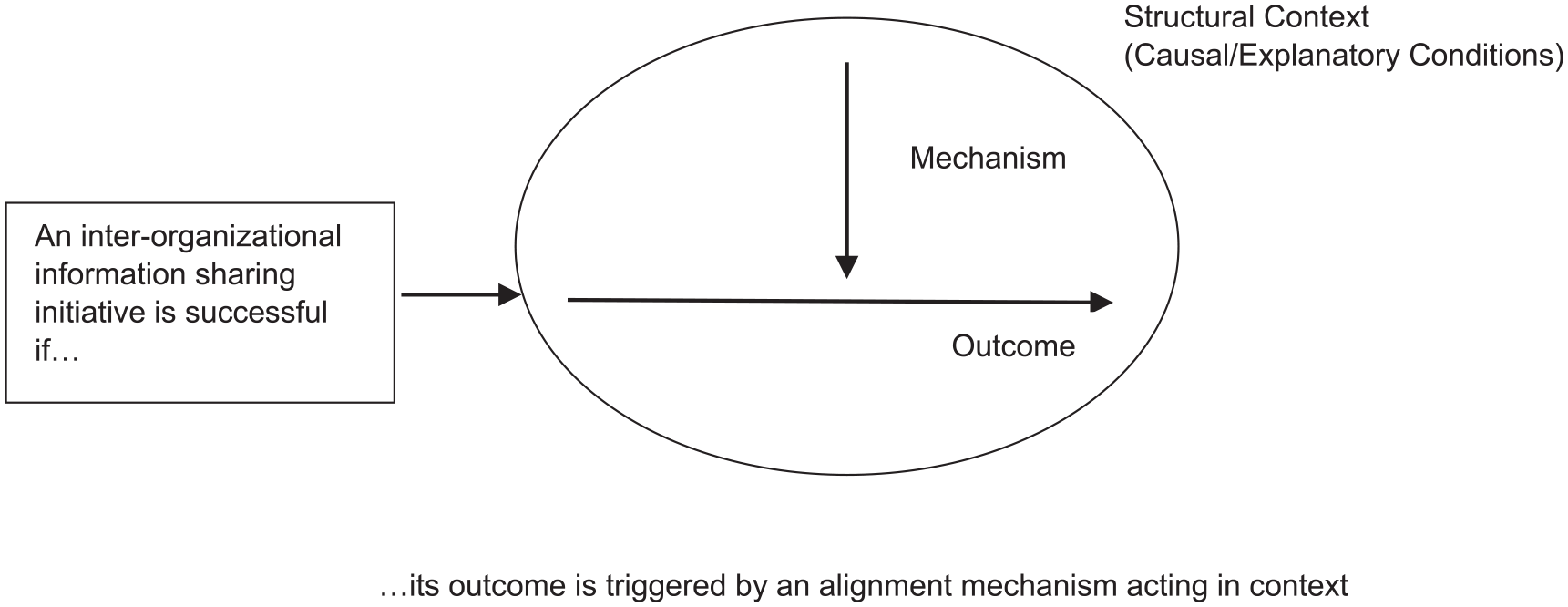
The model of generative causation.
Rather than black-boxing causal mechanisms, in-depth longitudinal case studies enable the discovery of underlying processes (or mechanisms) that link explanatory conditions with the outcome of interest (Chan and Reich, 2007). In what follows, we deploy a within-case analysis followed by a cross-case analysis of digitization of criminal justice systems to explore the CMO configurations leading to successful inter-organizational information sharing. Far from being universal regularities, these CMO configurations point to demi-regularities, that is, partial regularities that indicate the activation of a mechanism “over a definite region of time-space” (Lawson, 1998: 149).
Methodology: the sequential research design
To shed light on the temporal and causal influences underpinning our outcome of interest (i.e. efficient and effective inter-organizational information sharing), qualitative data were collected by means of multiple data collection methods. We first explored the alignment mechanism in its complex and natural setting to generate a meaningful understanding of the process of bottom-up and top-down alignment. In this first stage, data sources were aptly triangulated by means of both primary data (i.e. interviews and focus groups) and secondary data (e.g. documents, reports). Both primary and secondary data were analyzed through an iterative dialogue between the CMO approach and the empirical evidence to discover the causal conditions at play and the mechanisms linking these causal or explanatory conditions (i.e. the structural context) with the outcome of interest. Subsequently, we used QCA techniques for our cross-case analysis. By bridging deductive and inductive theorizing, the QCA approach is an ideal way of extrapolating differences across modest samples of relatively similar cases (Ragin, 1987; Rihoux and Lobe, 2009), thus contributing to the development of middle-range theories that provide “contingent generalizations about combinations or configurations of variables that constitute theoretical types” (George and Bennett, 2005: 233).
As mentioned above, one country provided the empirical basis for this study: England. This country was investigated using semi-structured interviews, mini-focus groups, and secondary data as part of a multi-method, exploratory approach (Bélanger, 2012). 2 Our interviewees were carefully selected through a stratified, but purposeful strategy (Miles et al., 2018). In particular, we interviewed both IT directors/managers and project/program managers, among others, to glean both strategic and operational perspectives at once. While IT directors/managers gave us a glimpse into high-level IT strategies, project/program managers gave us insights into more operational issues concerning the implementation of specific plans and projects. Mini-focus groups instead were primarily aimed at understanding the critical success factors (CSF) underpinning the efficient and effective exchange of information across criminal justice organizations. Only three-to-five practitioners with a high-level of expertise in the digitization of criminal case files were recruited in these mini-focus groups for a total of six focus groups. By conducting multiple focus groups, we ensured comparisons across focus groups (Bélanger, 2012). Furthermore, England was purposefully chosen based on the existing literature on the use of electronic tools in the public sector (Fabri, 2007; Reiling, 2009, 2012), as well as insights from knowledgeable informants. The principal reason for choosing England was that it scored very high in terms of its e-Government development index (EGDI). The EGDI “is a composite measure of three important dimensions of e-Government, namely: provision of online services, telecommunication connectivity, and human capacity” (United Nations, 2014: 13). The EGDI is normally used to “give a performance rating of national Governments relative to one another” (United Nations, 2014). Since England scored very high in terms of its EGDI and since it was a front-runner regarding the automation of its inter-organizational information-sharing processes within its criminal justice system, we purposefully selected England as an ideal type of digitization of criminal case files in general and electronic capturing and preparation of case files in particular.
The within-case analysis of this country (i.e. England) revealed a re-alignment mechanism switching the alignment process from bottom-up alignment to top-down alignment. It also revealed that the alignment process (or mechanism) is the mirror image of the IS strategizing process. While bottom-up alignment reflected an emergent e-Government strategizing process, top-down alignment mirrored a deliberate process of e-Government strategizing. Subsequently, we deployed QCA techniques to discover similarities and differences across instances of both successful and unsuccessful digitization of criminal case files. 3 We outline this sequential research design below.
Longitudinal case study: the English system of criminal justice
The case study approach is a research strategy which focuses on understanding specific processes (or mechanisms) in context (Eisenhardt, 1989; Yin, 2014). Case studies can involve either single or multiple cases, as well as combine several levels of analysis. Cases can be chosen to replicate previous studies, extend emergent theory, or provide examples of polar types to fill theoretical vacuums. Even though the cases can be chosen randomly, random selection is neither necessary nor preferable. Given the limited number of cases that can thoroughly be studied, it makes sense to focus on purposefully chosen cases in which the process of interest is “transparently observable” (Pettigrew, 1990: 275). Whereas the goal of random sampling is to develop statistical generalizations from the sample being analyzed, the case study approach aims at developing analytic generalizations, that is, generalizations where investigators are “striving to generalize a particular set of results to some broader theory” (Yin, 2014: 43).
The case study approach is widely used in IS research (Walsham, 1995). IS researchers have used case study designs to study IS phenomena in context to address “How” and “Why” questions (Yin, 2014). More recently, Avgerou (2013) has advocated the development of explanatory theory of social mechanisms based on case study research and narrative methods, while Wynn and Williams (2012) have proposed a set of methodological principles for conducting and evaluating critical realism-based explanatory case study research within the IS field. In this article, we use a single, longitudinal study drawing on the insights from Pawson and Tilley’s (1997) CMO approach. Not only does this approach favor closeness to the empirical material, but also allows for the identification of mechanisms capable of explaining the e-Government strategizing process.
The cross-case analysis based on QCA techniques
The cross-case analysis entailed the purposeful selection of six cases with common background features, but “with sufficient variation on the outcome” (Marx and Dusa, 2011: 106). Our theoretical sample required rich-enough evidence to identify cases that paralleled each other enough to ensure comparison (e.g. European Union (EU) countries with high EGDI, EU countries with large investments in the integration of criminal justice systems), and yet these cases achieved maximum heterogeneity considering that they were instances of both positive and negative outcomes. All in all, we included only six cases drawn from book chapters and reports. This theoretical sample was subsequently coded using the explanatory conditions emerging from conducting multiple mini-focus groups. 4 Following in the footsteps of Henfridsson and Bygstad (2013), we used Pawson and Tilley’s (1997) CMO framework as our overarching coding scheme. While Henfridsson and Bygstad’s (2013) study focuses on technical architecture and organizational control as two key contextual conditions (p. 920; italics in original), our study identified three causal (or explanatory) conditions of successful inter-organizational information sharing. These three conditions emerged through an in-depth dialogue between practitioners’ insights and analysis of relevant e-Government literature (e.g. Bélanger and Carter, 2012; Fedorowicz et al., 2018; Gil-Garcia et al., 2005; Kubicek et al., 2011; Pardo et al., 2012; Sawyer et al., 2013). More specifically, drawing on practitioners’ insights gleaned from mini-focus groups and the idea that the digitization of paper files is a complex socio-technical process that encompasses strategic (e.g. deliberate planning), operational (e.g. project management and implementation), and technological dimensions (e.g. compatible systems; Gil-Garcia and Sayogo, 2016; Sawyer et al., 2013), we identified three core determinants of successful inter-organizational information sharing: (1) Compatibility. This contextual condition explains whether the criminal justice system organizations are able to communicate between and among each other securely. It refers to IT systems that must be standardized, consistent, and interconnected. (2) Project management. This contextual condition explains whether IT projects are on schedule and within budget (Wirick, 2009). It also captures the process of planning for and organizing projects (e.g. assigning project managers or project champions to specific initiatives, developing project structures aimed at managing relations with third-party vendors). (3) Deliberate planning. This contextual condition explains whether the criminal justice system organizations have developed a top-down approach to inter-organizational information sharing. It is about setting up a grand vision and specifying a prescriptive, target-driven strategy that captures the underlying wants and needs toward inter-organizational information sharing with their associated governance structures (Fedorowicz et al., 2018). Subsequently, based on existing literature on the management of IT projects in large organizational networks (Carugati et al., 2016), we regarded efficiency savings (e.g. reduced duplicate data entry and handling, improved throughput time of criminal cases) and satisfied users as the key features (or characteristics) of successful inter-organizational information sharing because they warranted smooth cross-boundary collaboration in the execution of interdependent activities.
Given our interest in the causal conditions leading to successful inter-organizational information sharing within criminal justice, we deployed QCA techniques because these techniques enable the integration of three interrelated streams of literature spanning across IT standardization (or compatibility), project management, and strategic management of inter-organizational networks (or IT governance). QCA allows for the analysis of complementarities between and among these three streams of literature within an overarching framework that taps into the qualitative insights obtained from multiple case studies (George and Bennett, 2005; Ragin, 1987; Vergne and Depeyre, 2016). QCA is the most formalized set-theoretic method (Schneider and Wagemann, 2012). It consists of several variants, but, following in the footsteps of previous IS publications (Henfridsson and Bygstad, 2013; Rivard and Lapointe, 2012), in this article, we use the crisp set QCA (csQCA) approach which operates on conventional sets “where cases can either be members or non-members in the set” (Schneider and Wagemann, 2012: 13).
csQCA encompasses both a multi-case, comparative research approach and a set of techniques aimed at unraveling causal complexity (Berg-Schlosser et al., 2009; Schneider and Wagemann, 2012). As a context-oriented research approach, csQCA reduces cases into constellations of causal attributes (or features) and seeks explanations in terms of independent (or causal) variables causing changes in the dependent (or outcome) variable. csQCA’s context-sensitive logic is both deductive and inductive. It is deductive because causal relations are informed by prior theory (i.e. the CMO approach underpinned by the broader literature on digitization of criminal justice systems). It is inductive because coding revolves around the substantive knowledge of the empirical cases at hand (Ibid). As a research approach, csQCA entails the search for similarities across common outcomes and differences across positive and negative outcomes on the assumption that cross-case commonalities are irrelevant when moving from positive to negative outcomes (George and Bennett, 2005; Ragin, 1987; Vergne and Depeyre, 2016). Hence, this approach mirrors Yin’s (2014) replication logic (Iannacci at al., 2020). The search for similarities helps one predict similar results (i.e. literal replication). The search for differences helps one predict contrasting results in terms of successful versus not-successful outcomes, but for anticipatable reasons (i.e. theoretical replication).
The csQCA techniques are based upon a specific template for undertaking data analysis. This template requires the following steps (Rihoux and De Meur, 2009).
Step 1: Calibrating data. The first step entails transforming rich contextual detail into set membership. Given the lack of fine-grained breakpoints, we coded each causal variable and the outcome of interest as being either present (coded as 1) or absent (coded as 0). We used the “consensus approach” (Henfridsson and Bygstad, 2013: 921) to score the cases in a binary (present/absent) fashion. We met several times to discuss the “crisp-set” coding (or calibration) of our cases. In case of disagreement, we went back to the original sources and discussed any discrepancies until 100% agreement was reached.
Step 2: Building a dichotomous truth table. This table lists all logically possible configurations of causal conditions with their associated outcomes (see Table 1). “Examining all logically possible combinations of causal conditions makes it possible to construct experiment design-like contrasts (where only one causal condition at a time is allowed to vary) and thus offers a thorough analysis of the effects of relevant causal conditions” (Ragin, 2008: 125). 5
Step 3: Minimizing the truth table. We used the fuzzy set QCA (fsQCA) software program (Ragin and Davey, 2016) to derive three solutions ranging from the most complex to the most parsimonious solution with an intermediate solution striking a balance between the two extremes. As such, the intermediate solution is the “preferred solution” because it is “often the most interpretable” solution (Ragin, 2008: 175). We report this solution below and outline the minimization process underpinning QCA in the Supplemental Appendix; 6
Step 4: Interpretation of findings. Finally, we returned to the cases to interpret our findings and make sense of the recipes leading to successful inter-organizational information sharing (or the lack thereof). Far from being a one-off process, we cycled back-and-forth between theory and case-based knowledge in an ongoing fashion to develop preliminary explanations of our findings that we then used as a basis for further typological theorizing from multiple case studies (George and Bennett, 2005). This back-and-forth cycling (Rihoux and Lobe, 2009) allowed us to identify two distinct types of efficient and effective PSNs characterized by a top-down (i.e. Estonia and Finland) and bottom-up (i.e. Austria) mechanism of IT alignment, respectively. Alongside these two types of successful PSNs, we also discovered two unsuccessful types of top-down (i.e. Italy and Portugal) and bottom-up misalignment (i.e. Denmark).
Truth table. a
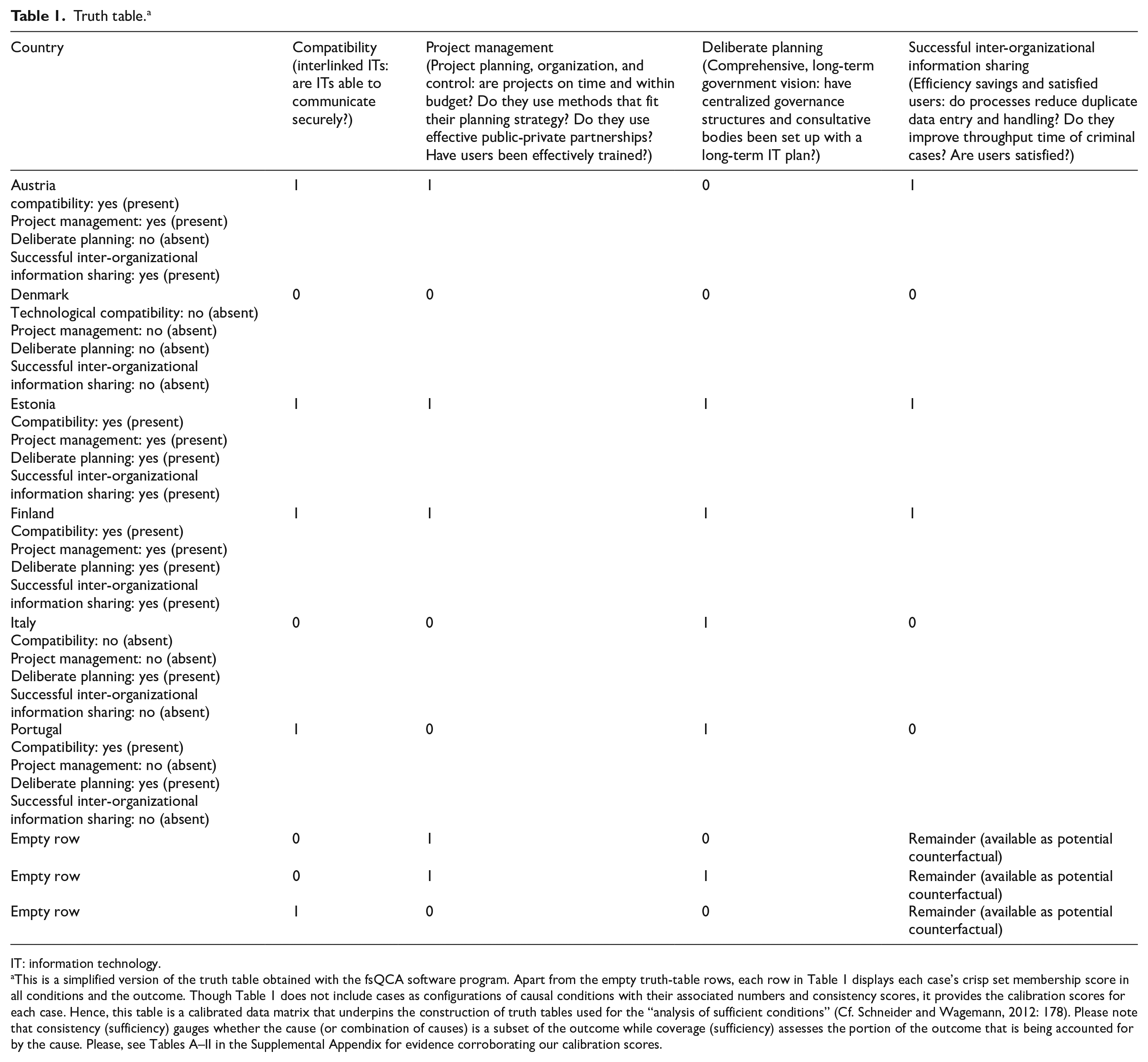
IT: information technology.
This is a simplified version of the truth table obtained with the fsQCA software program. Apart from the empty truth-table rows, each row in Table 1 displays each case’s crisp set membership score in all conditions and the outcome. Though Table 1 does not include cases as configurations of causal conditions with their associated numbers and consistency scores, it provides the calibration scores for each case. Hence, this table is a calibrated data matrix that underpins the construction of truth tables used for the “analysis of sufficient conditions” (Cf. Schneider and Wagemann, 2012: 178). Please note that consistency (sufficiency) gauges whether the cause (or combination of causes) is a subset of the outcome while coverage (sufficiency) assesses the portion of the outcome that is being accounted for by the cause. Please, see Tables A–II in the Supplemental Appendix for evidence corroborating our calibration scores.
Analysis
Our sequential research design calls for a within-case analysis of the English system of criminal justice followed by a cross-case analysis (Eisenhardt, 1989). While the within-case analysis aims at explaining the mechanisms that account for the e-Government strategizing process in the English system of criminal justice, the cross-case analysis aims at identifying patterns across a larger number of cases. We now proceed with the within-case analysis of the English system of criminal justice followed by a cross-case analysis revolving around csQCA techniques.
Within-case analysis: digitizing criminal case files in England
The Criminal Justice System in England includes the Police, the Courts, the Crown Prosecution Service (CPS) and the Prisons and Probation Service. The Police encompass 43 relatively independent forces while the CPS is divided in 13 areas which are headed by a Chief Crown Prosecutor. While the Police are responsible for investigating new cases, the CPS advises the Police in their investigation, reviews cases that are submitted by the Police, determines the charges in all but minor cases, prepares and presents Court cases, and provides information and assistance to witnesses and victims. The Courts themselves are divided into Magistrates Courts and Crown Courts, the former virtually starting all criminal cases, the latter dealing with the most serious offenses.
While the criminal case file is the collection of evidence concerning a criminal case against a defendant (De Blok et al., 2014), the digital case file is “a case file in digital format complying with a requirement for standard information content” (HMCPSI-HMIC, 2016: 11). The digitization of criminal case files started in a truly haphazard way in England. The CPS took the lead through its Transformation Through Technology (T3) program before 2010. Yet, this program did not produce the expected benefits primarily because both Police and Courts were wedded to the paper file rather than the digital case file. As remarked by the CPS Chief Information Officer: The CPS is doing it (i.e., using the digital case file), and we are saving a lot of money. If the Police and the Courts would do this as well, we could save a lot more money through the whole criminal justice system. (Chief Information Officer, CPS)
Hence, the CPS took the initiative to render (or transform) the paper forms coming from the Police into portable document format (PDF) files that could be sent by secure email to the Courts. Again, an informant maintained, The CPS worked with the Police to capture case information as structured data and subsequently developed a capability to “render” these structured data into a readable format so that it could be sent to other parties. (Director of Digital Business Program, CPS)
Another informant reiterated this point: The digital case file is about taking structured data from the outset and firing them through a national standard format. Regardless of how the Police put (the data) in, they should come out in a standard format for Prosecutors, Defense Practitioners, and Judges (if the case goes to Court). (Crown Prosecutor, CPS)
This technological capability, in turn, has triggered a new vision of “digital end-to-end criminal justice system” (HMCPSI-HMIC, 2016: 3) because it has enabled the rendering of structured data inputs into standardized forms to be sent to the Courts without impinging on their ownership of data (Iannacci at al., 2019). Hence, the standardized PDF forms acted as “boundary objects” traveling across disparate domains (or jurisdictions) and meeting localized needs (Star and Griesemer, 1989).
As this new end-to-end vision emerged (Swanson and Ramiller, 1997), the Courts, the CPS, and the Police agreed to launch the Criminal Justice System Efficiency Program with the aim of modernizing the criminal justice system by “reducing or removing the movement of paper, and people, around the system” (HMCPSI-HMIC, 2016: 3). Again, an informant clarified this program as follows: We’ve got a specific program of work to look just at integration work where this has currently been tackled transactional service by transactional service. This data work will be governed by a group on which the whole justice system is represented. As before, this will help to tackle siloed working and will mean that every part of the justice system is given equal voice in taking forward new standards and ways of working. (Program Manager, Criminal Justice System Efficiency Program)
Accordingly, the parties decided to create the National Criminal Justice Board, that is, a new cross-organizational governance structure that includes the Heads of the CPS, the National Police Chiefs Council, and Her Majesty’s Courts and Tribunals Service (De Blok et al., 2014). Far from being the outcome of a deliberate e-Government strategy, the National Criminal Justice Board emerged in a bottom-up fashion. While the T3 program was the outcome of a CPS initiative, it contributed to the creation of a “transient” IT governance structure (i.e. the T3 governance structure) which paved the way for the emergence of a higher level governance structure (i.e. the National Criminal Justice Board) where all participating organizations with “a substantive collective action problem were represented adequately” (Cf. Constantinides and Barrett, 2015: 53). In other words, the National Criminal Justice Board epitomizes a separate administrative entity which was “set up specifically to govern the network and its activities” (Provan and Kenis, 2008: 236). Figure 2 depicts this process of bottom-up e-Government strategizing.
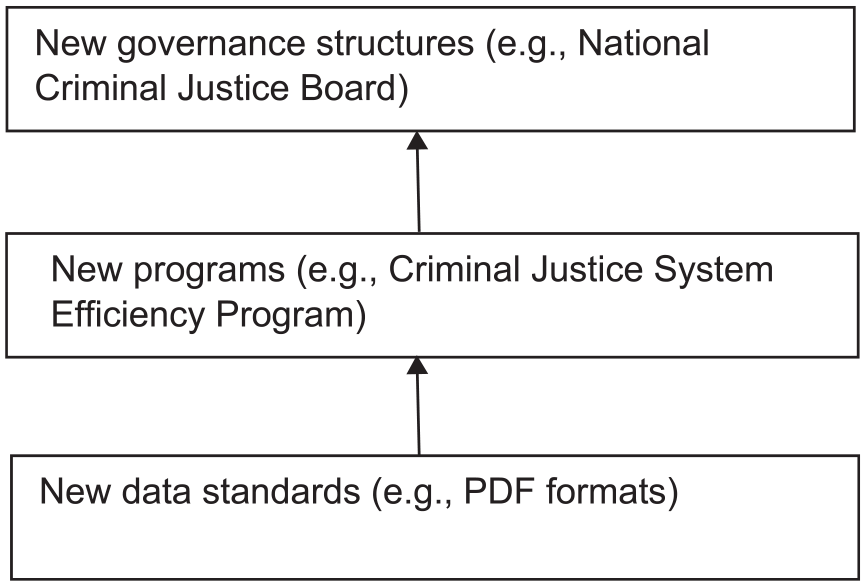
Digitization of criminal case files as an emergent strategy.
As the National Criminal Justice Board emerged, the Courts, the CPS, and the Police decided to switch from PDF files to streamlined digital case files to bypass email exchanges and retrieve the whole information package from a shared repository (aka the Common Platform). This, in turn, entailed a switch from PDF formats to JSON (JavaScript Object Notation) standards. Again, a Business Consultant remarked, The streamlined digital case file initiative chose JSON for data formatting purposes. The streamlined digital case file is essentially a structured information package that is transferred across the criminal justice system and automatically retrieved by the CPS or Court. (Business Consultant, Focus Group)
Again, the HMCPSI-HMIC (2016) report reiterates this point: The Criminal Justice System Efficiency Program aims to deliver better joined-up working between partners with access to a single source of data [sic] Following the transfer of data into the Common Platform [the shared digital repository] at the start of the process, the program aims to move away from the transfer of data between CPS and Her Majesty’s Courts and Tribunals Service (HMCTS) systems by making them available in one place, enabling those who need access to do so according to their need. (p. 14) Using the central digital repository provided by the Criminal Justice System Common Platform should ensure that material is only submitted once and viewed as appropriate by all criminal justice partners. This system will also have provision to allow the editing of sensitive documents. (p. 37)
As the governance structure aligned with the new possibilities enabled by the rendering functionalities of the CPS, it triggered the re-alignment of data standards from PDF formats to JSON standards. Figure 3 depicts this re-alignment mechanism.
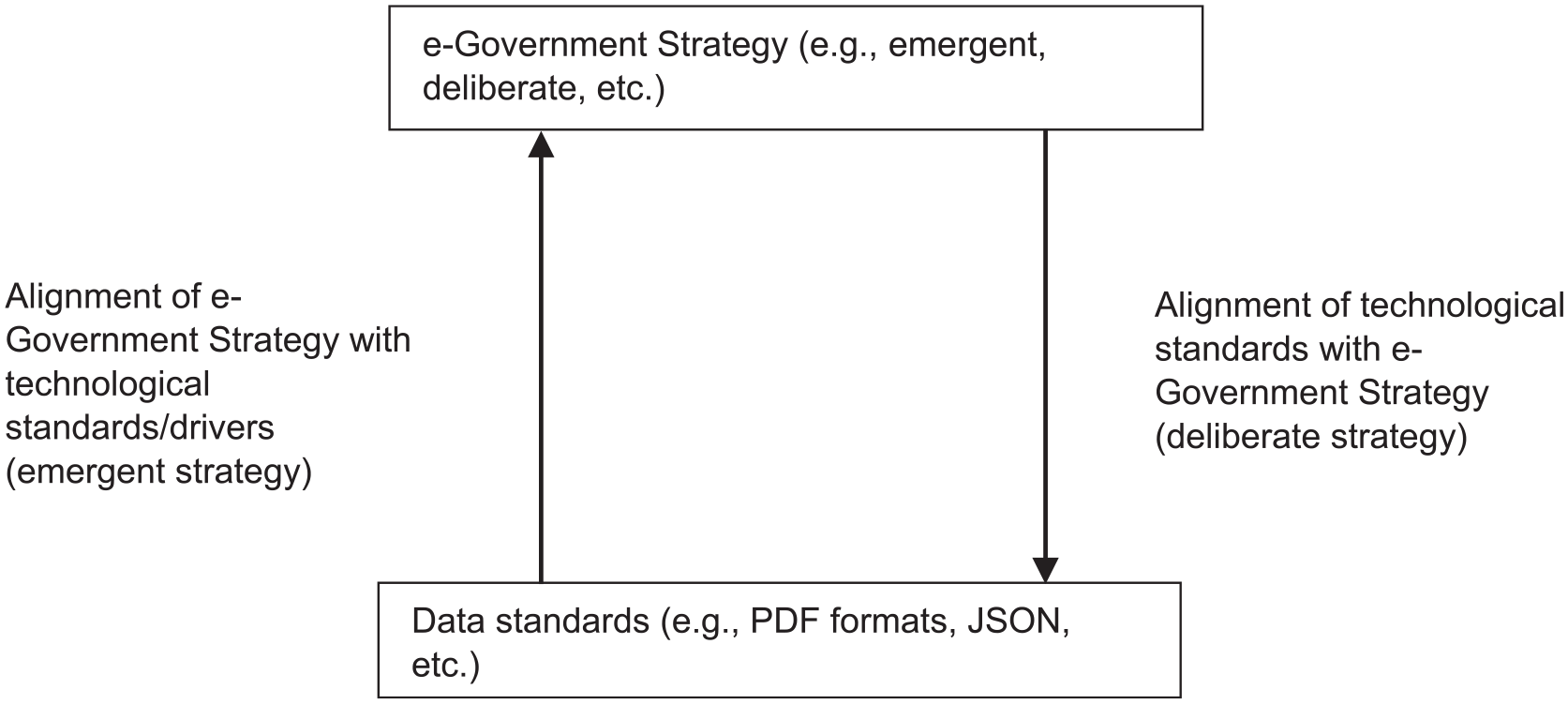
The re-alignment mechanism.
Ultimately, the analysis of the case reveals that the IS strategizing process (Marabelli and Galliers, 2017) is the mirror image of the alignment mechanism. When the e-Government strategy aligns with technological standards, the IS strategizing process becomes more emergent. However, when data standards align with the e-Government strategy, the IS strategizing process becomes more deliberate and prescriptive as standards are being set out by the National Criminal Justice Board. Nevertheless, the within-case analysis is silent about the contextual conditions that combine with IS strategy to lead to successful inter-organizational information sharing. While the within-case analysis illuminates the (IS) strategizing process and the (re-)alignment mechanism leading to successful digitization of criminal case files, we need to switch to csQCA techniques to understand which configurations of causal conditions influence the occurrence of this mechanism and allow it to unfold “over a definite region of time-space” (Lawson, 1998: 149).
csQCA cross-case analysis
The within-case analysis of the English system of criminal justice reveals that e-Government strategizing is a proxy for the alignment mechanism. However, the dialogue between practitioners’ insights and analysis of relevant literature on the digitization of criminal justice systems suggests that there are other contextual conditions leading to efficient and effective inter-organizational information sharing above and beyond e-Government strategizing. Taking stock of our case study findings, we now aim to see in what way e-Government strategizing combines with technological compatibility and project management to lead to successful inter-organizational information sharing (or the lack thereof).
To accomplish this task, we first code each contextual variable and the outcome of interest (i.e. successful inter-organizational information sharing) as being either present (1) or absent (0). Table 2 transforms the contextual details associated with each case into a set-membership score where 1 indicates presence and 0 absence.
This truth table was subsequently minimized by searching for similarities across common outcomes and differences across positive and negative outcomes. This, in turn, enabled us to arrive at asymmetric findings where the absence of good project management leads to unsuccessful inter-organizational information sharing, but both good project management and compatible technology lead to the presence of successful inter-organizational information sharing in the context of deliberate or emergent planning. Table 2 displays the intermediate solution for positive (i.e. successful) cases.
The intermediate solution for successful cases (black circles indicate the presence of a condition.
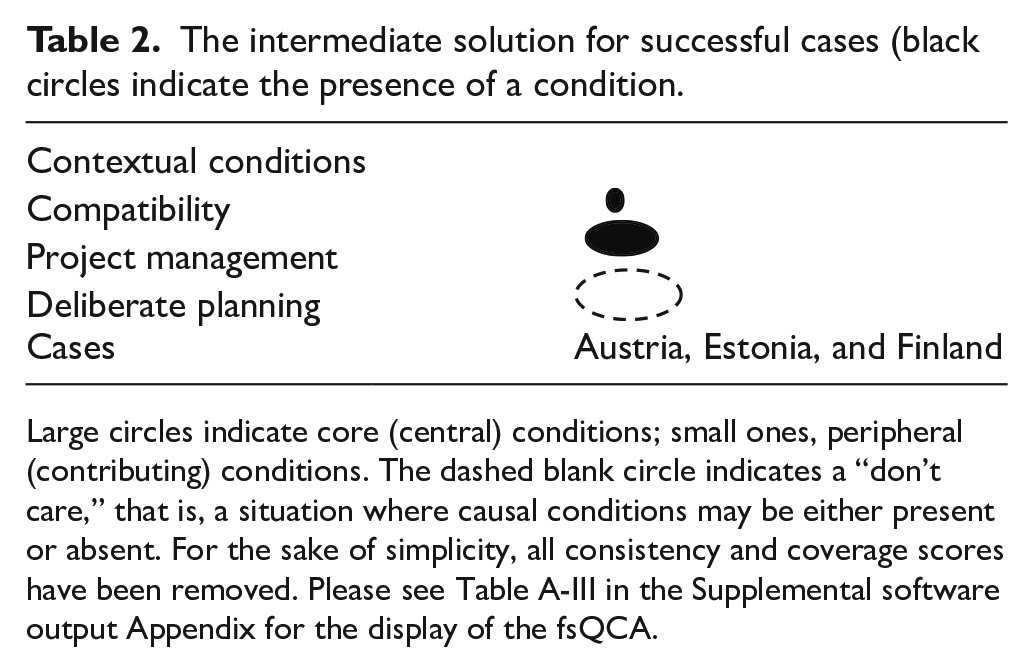
Large circles indicate core (central) conditions; small ones, peripheral (contributing) conditions. The dashed blank circle indicates a “don’t care,” that is, a situation where causal conditions may be either present or absent. For the sake of simplicity, all consistency and coverage scores have been removed. Please see Table A-III in the Supplemental software output Appendix for the display of the fsQCA.
Whereas Table 3 displays the intermediate solution for negative (i.e. unsuccessful) cases.
The intermediate solution for unsuccessful cases (circles with “x” indicate the absence of a condition. Large circles indicate core (central) conditions).
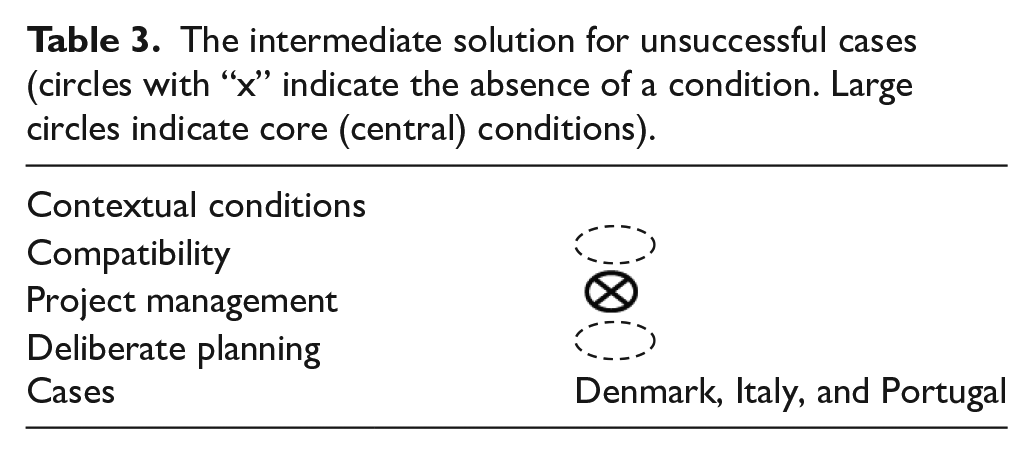
Dashed blank circles indicate “don’t cares”, that is, situations where causal conditions may be either present or absent. For the sake of simplicity, all consistency and coverage scores have been removed. Please see Table A-III in the Supplemental software output Appendix for the display of the fsQCA.
Finally, Table 4 summarizes our findings regarding both positive and negative cases.
Summary of key findings from cross-case analysis.
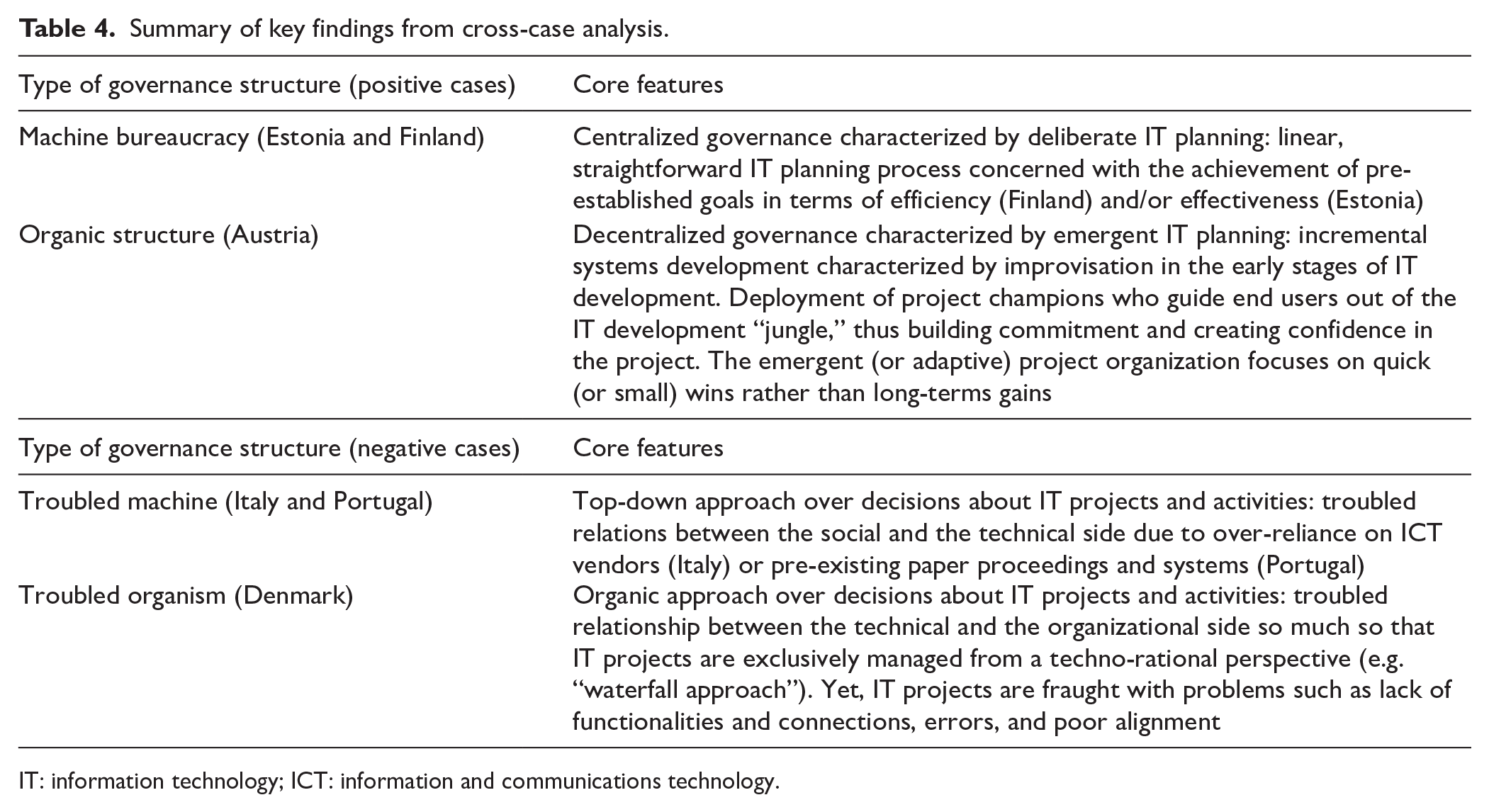
IT: information technology; ICT: information and communications technology.
In the following section, we return to the cases to interpret the configurations of contextual (or explanatory) conditions allowing for the actualization of the alignment mechanism in a top-down and bottom-up fashion. We also dissect the misalignment mechanism within those configurations of unsuccessful inter-organizational information sharing.
Discussion
Above we have asked about the way the causes leading to successful inter-organizational information sharing combine and the role of IT governance with its associated alignment mechanism. Based on an in-depth dialogue between practitioners’ insights and analysis of relevant literature, we have distilled three important ingredients for successful inter-organizational information sharing, namely, compatibility, project management, and deliberate planning. The comparative analysis of the six countries under investigation, in turn, generates several eye-opening insights regarding the causal recipes leading to successful or unsuccessful inter-organizational information sharing. More specifically, successful inter-organizational information sharing is much more demanding than its opposite scenario characterized by inefficient and ineffective information sharing. While the lack of good project management is bound to create setbacks by default (see Denmark, Italy, and Portugal), good project management is only one single ingredient in a more complex recipe for successful inter-organizational information sharing. A successful inter-organizational information-sharing initiative goes well beyond good project management and entails compatible technologies that enable secure information exchanges whether by means of a deliberate planning strategy (see Estonia and Finland in Figure 4) or an emergent strategy (see Austria in Figure 4).
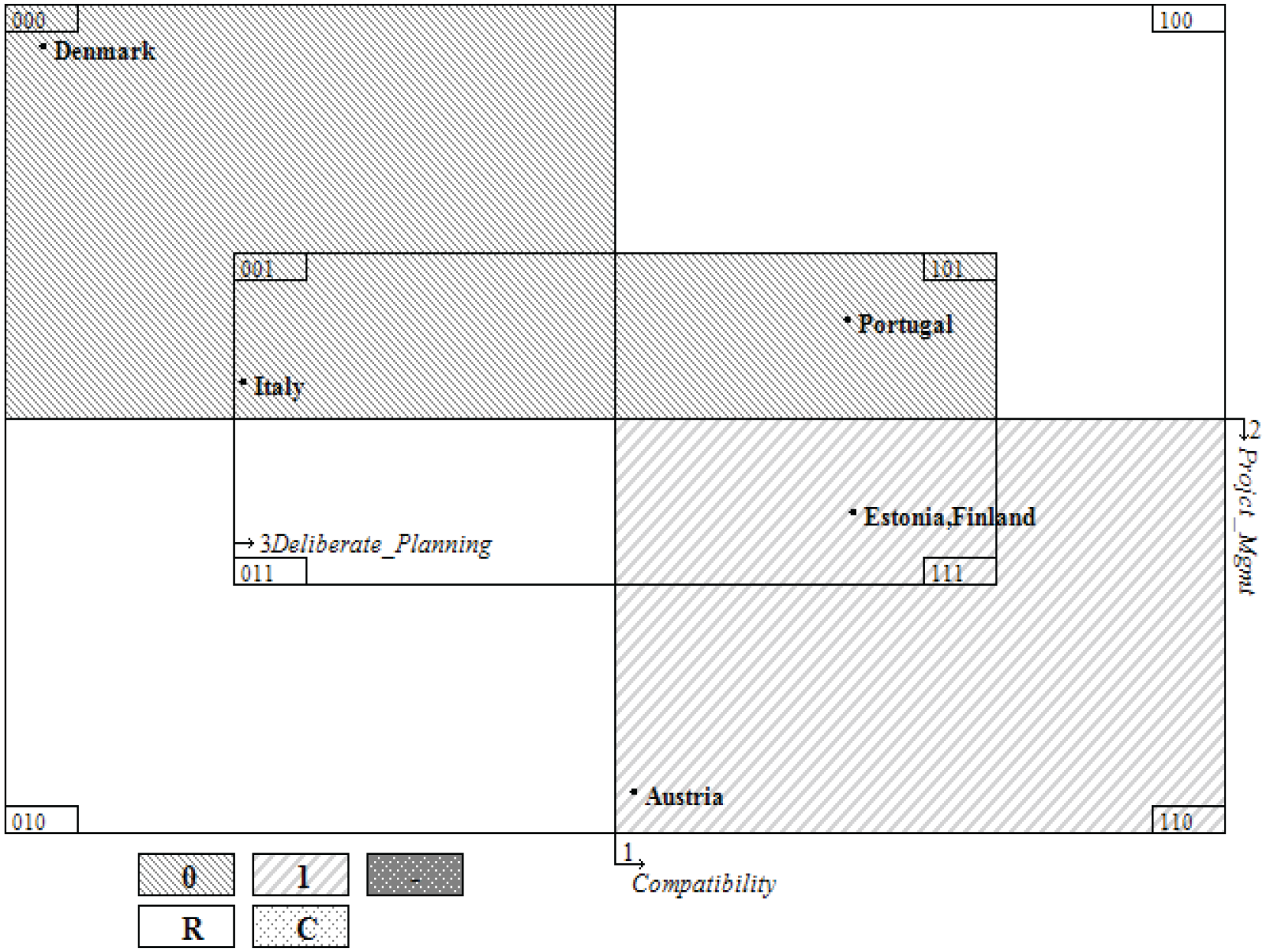
Visualization of successful (light-shaded) cases and unsuccessful (dark-shaded) cases with the Tosmana software program which is specifically linked with the csQCA analysis (Cf. Rubinson, 2019: 21; footnote 8).
The recipe for successful inter-organizational information sharing from Table 2 reveals that TECHNOLOGICAL COMPATIBILITY AND PROJECT MANAGEMENT lead to SUCCESSFUL INTER-ORGANIZATIONAL INFORMATION SHARING.
More importantly, Table 2 also reveals that there are situations where deliberate planning may be either present or absent (see the dashed blank circle indicating a “don’t care”). Put differently, a prescriptive, target-driven approach is but one way to achieve successful inter-organizational information sharing. Though a deliberate approach for digitizing criminal justice can yield positive benefits (see Estonia and Finland in Figure 4), this approach is not needed if the country under investigation aims for small or quick wins (see Austria in Figure 4). The Austrian case is telling in this respect: Experience from both the successful and the less successful countries teaches us that it is sensible to start with sub-projects where quick wins can be obtained relatively easily in the form of cost savings, or quicker or better processes. There are various options for this: starting with a process for which very little has been defined as yet (e.g. the unknown perpetrators in Austria) or digitizing the processes where efficiency gains can be made quickly and with little effort (e.g. guilty pleas in England). (De Blok et al., 2014: 35/149) Another commonality between both cases [i.e., Legal Information System/LIS and Electronic Legal Communication/ELC both deployed within Austria to share secure information] is that they are grass-root projects originating from within the administration, only later being endorsed by Government. Since the main users in both cases, at least of the first versions, were staff from within [the] administration, the projects can be labelled as user innovations [sic] The technology development process was initiated more than 30 years ago in the case of the LIS and more than 15 years ago in the case of ELC, while the necessary environments for both electronic government initiatives were created on the way. (Koch and Bernroider, 2009: 169; 170–171)
Indeed, our primary data confirm this finding because in the England case the grand vision of a collaborative platform fostering end-of-end criminal justice was a point of arrival rather than departure. As reported by an informant in England, It would have been nice to have all criminal justice parties signed up on a shared digital vision earlier in time. However, it would probably not have been possible then to have everyone agree and see the need for such an agreement. The parties needed to go through the process of overcoming the barriers of individual projects before being ready to jointly agree what to achieve. (Senior Project Manager, Criminal Justice System Efficiency Program)
Hence, even in the absence of a shared vision, criminal justice system organizations can cooperate seamlessly provided that good project management and compatible technologies are in place. Though extant e-Government literature has emphasized the role of prior deliberate planning time and again (Gil-Garcia et al., 2005; Pardo et al., 2012), it turns out that emergent approaches may be suitable strategies in the context of small or quick wins. Such approaches foster agile software development processes and localized governance structures (e.g. emergent project organizations) that can respond more flexibly to changing environmental contingencies.
There is more to this statement than meets the eye. Extant e-Government literature has produced mixed findings regarding the role of governance structures. For example, some scholars have argued that compatibility of technical infrastructure and formally assigned project managers are “the two most important predictors explaining the success of inter-organizational information sharing initiatives” (Gil-Garcia and Sayogo, 2016: 572), while other scholars have claimed that “one of the key reasons for these [public sector] failures is the lack of adequate IT project management and governance” (Dawson et al., 2016: 301) because, in the absence of effective structures of governance, continuity of public sector technology projects can end up shielding many poorly functioning projects (Sandeep and Ravishankar, 2014). Yet other scholars have advocated locating technological governance “as high up the authority chain as possible” (Fedorowicz et al., 2018: 341).
One way to reconcile these mixed findings is to acknowledge that centralized governance structures are strongly dependent on deliberate planning strategies of e-Government. In other words, if the digitization initiative revolves around a long-term vision of e-Government (as per Estonia and Finland), then it is likely that a centralized governance structure will be established from the very outset. However, if the e-Government strategy is about achieving quick or small wins “in the form of cost savings or quicker or better processes” (De Blok et al., 2014: 35) then there is no need for a centralized governance structure from the very beginning. Put differently, in this context, one needs to ensure the presence of compatible IT systems combined with formally assigned project champions because the formally assigned project champions will do the hard work “to sustain the collaboration regardless of the governance structure of the information sharing initiatives” (Gil-Garcia and Sayogo, 2016: 579). Again, the Austrian case is telling in this regard: The Public Prosecution Service was closely involved in the development of iTOP [a project regarding IT optimization of Public Prosecution and Courts based on automatic case allocation and the electronic handling of unknown perpetrators]. The system requirements were determined by a project group, which included one of the highest prosecutors in the country. This ensured the involvement of the end user, as well as the creation of commitment from the end users . . . One of the highest Prosecutors was personally committed as a project leader, this was important for building commitment and creating confidence in the project. (De Blok et al., 2014: 108/112)
Not only was the iTOP project characterized by an emergent project organization led by one of the “highest Prosecutors” in Austria. It also instantiated a localized governance structure where both Public Prosecutors and Courts engaged in a dynamic and adaptive governance process. This localized governance structure, in turn, paved the way for the emergence of a wider e-Justice vision in Austria aimed at “avoiding island solutions” (Seepma et al., 2020: 9). Figure 5 shows the CMO approach within successful inter-organizational information-sharing initiatives.
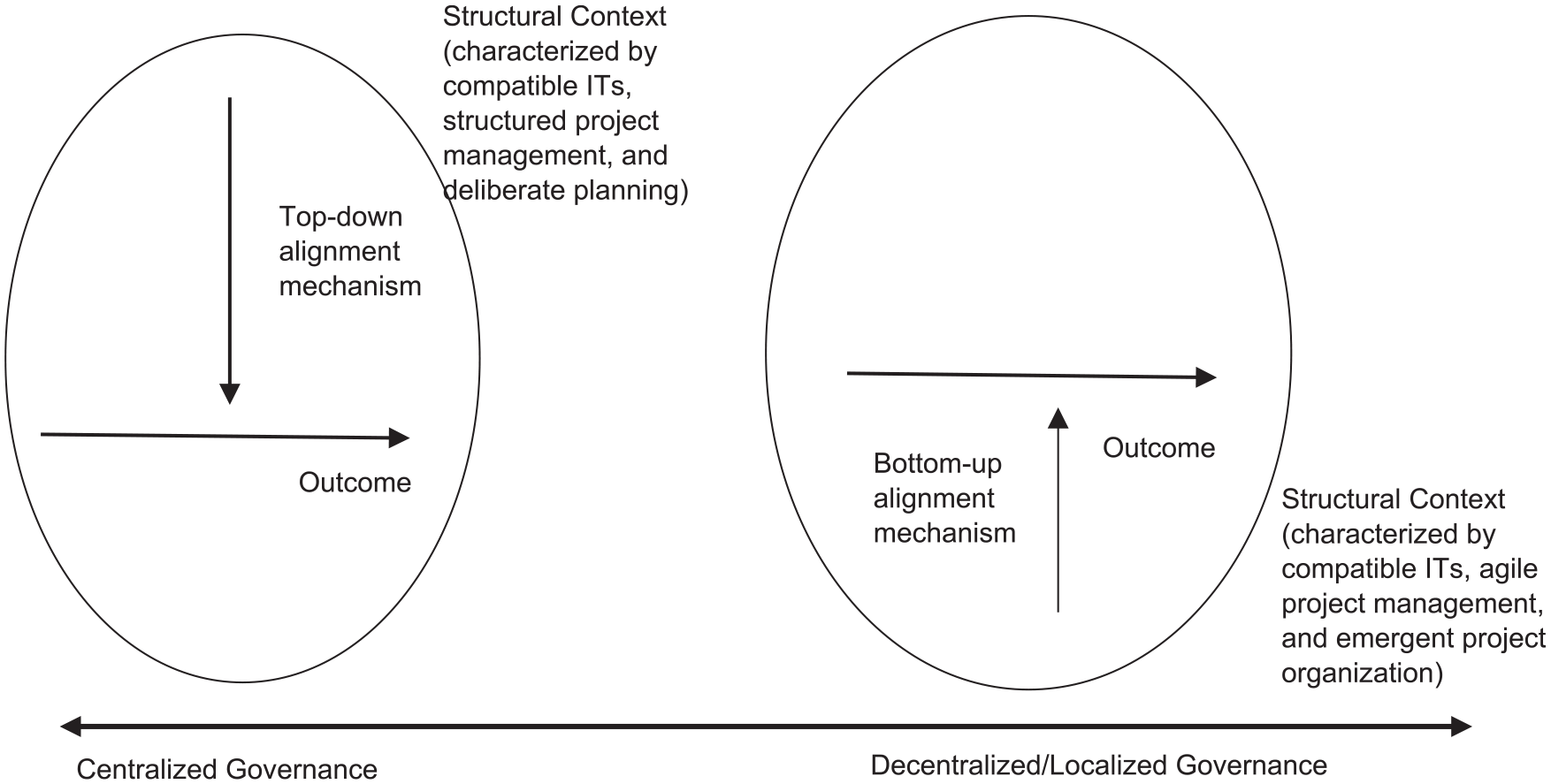
The CMO approach within successful inter-organizational information-sharing initiatives.
Whereas Estonia and Finland feature a top-down mechanism of socio-technical alignment, efforts spent on planning and restructuring business processes may be unwarranted within decentralized governance structures. Indeed, in the Austria context, there was no need for restructuring business processes considering the self-contained nature of the project organization: The e-Government strategy and the evolving vision of e-Justice (in Austria) do not yet seem to have led to changes in the work processes between chain partners . . . In the current digitization initiatives, it has been decided to digitize the current work processes without fully analyzing and changing all existing work processes. (De Blok et al., 2014: 107)
Hence, in the Austria context, coordination processes do not depend on planning and foresight. Rather, they depend on localized standardization (i.e. having compatible interfaces, as well as data in a compatible format) considering that the alignment mechanism is actualized in a bottom-up fashion to avoid restructuring processes, practices, and procedures: When the Police have the criminal file complete, it is sent electronically to the Public Prosecution Service (PPS) in 85% of the cases (in Austria). The Police are not obliged to use ELC, which is why the criminal file is not sent via this system in all cases. In addition, the Police have the option to send structured data (i.e., extracted from the IT system) or scanned documents that have been transferred to PDF via ELC . . . In order to connect EliAs (i.e., the Electronically-Integrated Assistant system) to the other systems in the criminal justice chain, such as ELC and PAD (the system with which the Police work internally), all these systems have been expanded with a specific link that allowed the systems to communicate with each other and documents could be read from one system to the other. (De Blok et al., 2014: 105, 106)
Once again, this finding sheds a new light on existing IT governance research (e.g. Benfeldt et al., 2020; Buchwald et al., 2014 Constantinides and Barrett, 2015; Eaton et al., 2018; Fedorowicz et al., 2018; Sawyer et al., 2013) because it emphasizes the role of technology as a governance structure that goes above and beyond other regulative forces enshrined within social structures. Far from being a passive object, technology plays an active role in coordinating a distributed ensemble of criminal justice organizations. This finding also highlights the role of data standards as “transient artifacts” (Lanzara, 1999: 347) that are constantly shifting in an endless process of localized experimentation (e.g. sending structured data rather than scanned documents, expanding the interoperability between and among systems with specific links). These “transient artifacts” help resolve the tension between stability and flexibility because they may occasionally coalesce into larger technological structures that become progressively more stable (Lanzara, 1999; Lupo and Velicogna, 2018). Conversely, the common cause for negative cases can be captured with a single ingredient, namely, the lack of good project management: THE LACK OF GOOD PROJECT MANAGEMENT leads to UNSUCCESSFUL INTER-ORGANIZATIONAL INFORMA-TION SHARING.
Once again, Figure 6 depicts this situation.
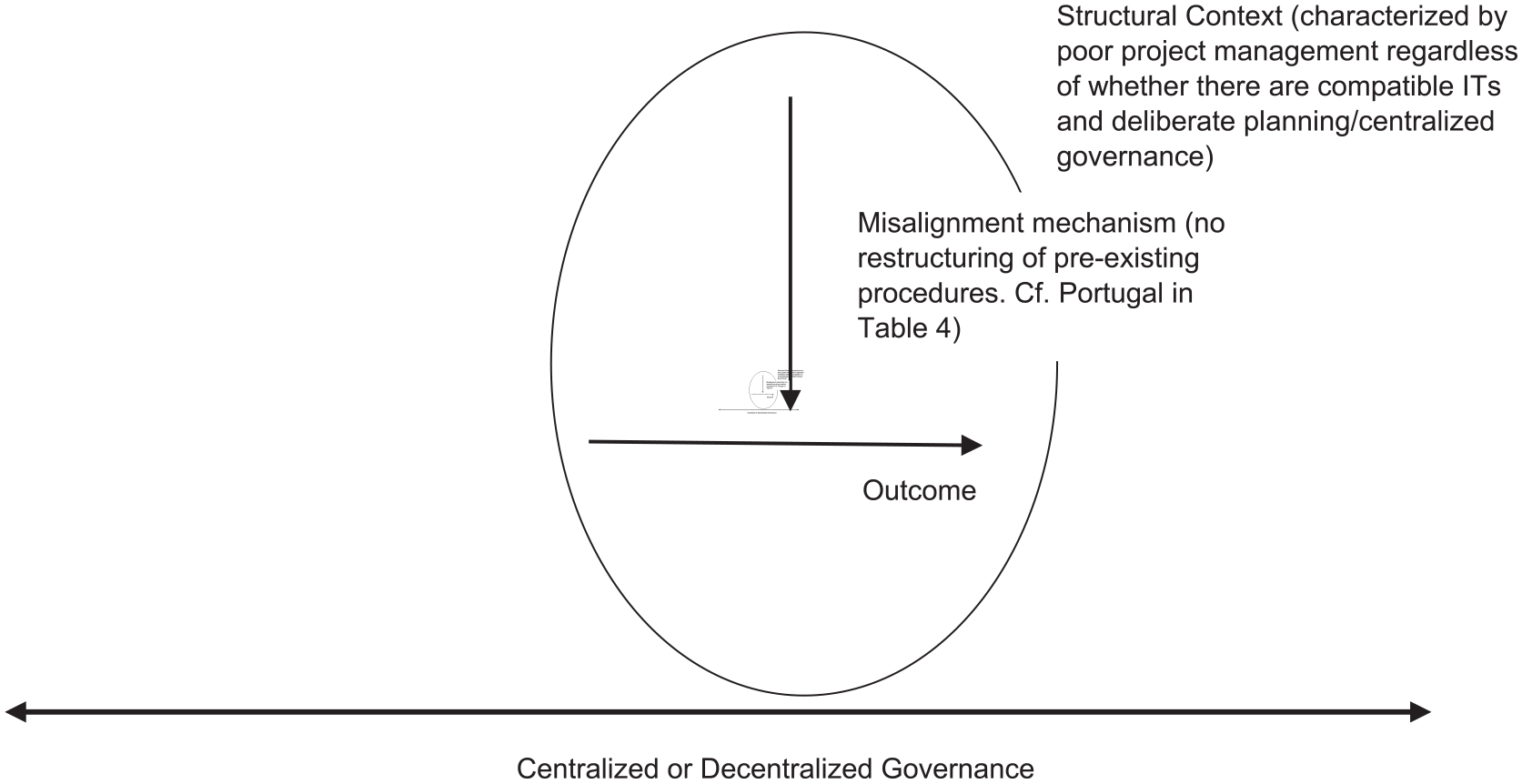
The CMO approach within unsuccessful inter-organizational information-sharing initiatives.
Hence, project management is a wicked problem that is both socially and cognitively challenging (Rittel and Webber, 1984). Even in the presence of a deliberate plan and compatible technologies, criminal justice organizations may achieve poor inter-organizational information sharing if, for example, there is no user participation, outsourcing is poorly managed or, alternatively, suitable software development methods are not deployed. The following quotes are telling in this respect: The lack of participation of Judges and Public Prosecutors (in Portugal) led to the rejection of the system designed by the Ministry of Justice to digitize proceedings (i.e., Citus), at least initially. (Fernando et al., 2014: 156) Outsourcing of ICT projects (in Italy) has created major problems in terms of interconnectivity among different systems. ICT projects are stuck in feasibility studies or an “ever-lasting piloting stage.” (Fabri, 2009: 131)
Likewise, the Danish report clearly calls for more agile software development methods: Both the projects POLSAG (i.e., the national document management system for both the Police and the Judiciary) and Datafølgesedlen (i.e., the electronic correspondence system for organizations within the criminal justice chain) have been initiated and managed by the criminal justice chain partners themselves. The approach taken towards designing, testing, and implementation was according to the so-called “waterfall approach,” i.e. a sequential design process involving the design, development, testing, implementation and realization phase. (De Blok et al., 2014: 221) Lack of attention to or failure to properly develop technical aspects of systems leads to negative experiences of users. This applies to Datafølgesedlen where lack of functionalities and connections to existing systems, and experienced lack of security, ensures that the system is used for only a quarter of all possible digitally exchangeable information. Also, in the test phase of POLSAG it appeared that many errors in the system, and the inability to correct them without encountering new problems, caused dissatisfaction among users. The technical functionalities were also not properly aligned with the functionalities required in daily activities. (De Blok et al., 2014: 84)
To avoid falling in the same trap, the criminal justice system organizations in Denmark have decided to deploy a more agile approach to IT development: In their current strategy, the organizations changed their approach towards step-by-step [iterative] improvement of their systems and take all decisions carefully and with sound arguments. (De Blok et al., 2014: 221)
Agile software development engages both developers and users in a collaborative dialogue aimed at developing user requirements in an iterative fashion. Hence, changes in user requirements are identified early on and they are embedded into software products as smoothly as possible (Wirick, 2009). This, in turn, fosters a more agile project organization that fits the decentralized governance structure.
Conclusion
Driven by conflicting findings concerning the role of centralized governance structure in its contribution toward successful inter-organizational information-sharing initiatives, we have discovered the causal asymmetry between positive and negative recipes. We have also shown that, within the recipes for successful inter-organizational information sharing, a deliberate planning strategy may be either present or absent (see Austria, Estonia, and Finland in Figure 4). This finding, in turn, makes a valuable contribution to the PSN literature in general and the e-Government alignment literature in particular (Davison et al., 2005; Rusu and Jonathan, 2017). For example, a recent literature review of IT alignment in public sector organizations has concluded that “the study of different IT alignment approaches challenging the traditional top-down strategy planning . . . might bring a new insight concerning IT alignment in public (sector) organizations” (Rusu and Jonathan, 2017: 52). Since emergent approaches to e-Government strategizing may be regarded as a proxy for bottom-up alignment, our study challenges the traditional view of top-down alignment based on a deliberate planning strategy. Indeed, our study shows that deliberate planning is but one way to achieve successful inter-organizational information sharing. The Austria and, to a degree, the England cases show that more emergent approaches to e-Government strategizing are suitable to contexts where the country under investigation aims for small or quick wins. The focus on project implementation (i.e. “the ways”) makes this strategy “better suited to today’s environment of rapid and unpredictable change related to either ends or means” (Peppard and Ward, 2004: 186). Furthermore, the process/mechanism of bottom-up alignment may lead to mistakes that are more tolerable and correctable than the large, costly mistakes stemming from top-down alignment, thus fostering a culture of continuous change and trial-and-error learning that is better geared toward coping with ambiguity rather than avoiding it (Ravishankar, 2013). Likewise, extant IT governance literature focuses on “polycentric governance” to promote the development of information infrastructures (or “information commons”) in a bottom-up fashion (Constantinides and Barrett, 2015; Mindel et al., 2018). Nevertheless, this literature is silent about the role of technology as a governance structure. Far from being passive objects, technological standards play a pivotal role in the integration of a distributed ensemble of criminal justice system organizations. Hence, the journey toward more centralized governance structures entails a socio-technical effort aimed at ensuring flexible standardization strategies in response to the need for interoperability across domains (Hanseth and Bygstad, 2015). Such flexible standardization strategies require the localized involvement of a small number of stakeholders who keep assembling and recombining data standards through small-scale, practical experiments (Lanzara, 1999; Parmiggiani and Grisot, 2020).
Our methodological contribution sheds a new light on the conceptualization of causality because it shifts the focus away from the successionist view of causality and toward the generative view of causality (Pawson and Tilley, 1997). Compared with the successionist view which is after constant conjunctions between cause and effect, the generative view shifts the focus toward demi-regularities, that is, partial regularities that indicate the activation of a mechanism “over a definite region of time-space” (Lawson, 1998: 149). This can be exemplified by reference to the successful cases of Austria, Estonia, and Finland. The top-down alignment mechanism was activated only within the spatio-temporal boundaries corresponding to the Estonia and Finland cases. Likewise, the bottom-up alignment mechanism was activated only within the spatio-temporal boundaries corresponding to the Austria case. While the alignment mechanism is about the process of fitting together the social and the technical dimensions, the context is about the combination of crucial causal conditions that jointly and synergistically produce the outcome of interest (El Sawy et al., 2010). Put differently, the alignment mechanism explains the “how” of causation whereas the complex combination of causal conditions (i.e. the context) explains the “why” of causation (Pattyn et al., 2020; Wynn and Williams, 2020). Hence, the generative view points to a relationship between causal mechanisms and their effects which is not fixed but contingent, that is, dependent upon a specific combination of causal conditions (or context). 7 What is more, our methodological contribution sheds a new light on the minimization process that is at the heart of QCA (Cooper and Glaesser, 2011, 2016; Schneider and Wagemann, 2016). QCA is fast becoming a popular approach in the IS field (e.g. Dawson et al., 2016; El Sawy et al., 2010; Fedorowicz et al., 2018; Henfridsson and Bygstad, 2013; Rivard and Lapointe, 2012; Sawyer et al., 2013). Popularized by Ragin (1987), QCA has first been used for comparative analysis of medium-sized samples of cases, but more recently, it has been used for the analysis of large samples as well (e.g. Fiss, 2011). Informed by a sophisticated extension of Mill’s methods (Berg-Schlosser et al., 2009; George and Bennett, 2005; Ragin, 1987), QCA uses the counterfactual approach to causation (Ragin, 2008). According to this approach, one needs to minimize the complex configurations obtained from truth-table analysis by means of “easy” or “difficult” counterfactuals, that is, counterfactuals that are theoretically plausible or not (Ragin, 2008). The incorporation of “easy” counterfactuals produces an intermediate solution which is longer and more complex than the parsimonious solution obtained with the “inclusion of both easy and difficult counterfactuals, without any evaluation of their plausibility” (Ragin, 2008: 163). Though the intermediate solution is the preferred solution (Ragin, 2008: 175), it is worth stressing that the intermediate solution may collapse two configurations that are different at the level of mechanisms and structures (Cooper and Glaesser, 2011). For example, in this study, COMPATIBILITY AND PROJECT MANAGEMENT collapses two distinct configurations where DELIBERATE PLANNING may be either present (see Estonia and Finland in Figure 4) or absent (see Austria in Figure 4). Not only do these configurations capture two distinct approaches to e-Government strategizing (i.e. deliberate vs emergent approaches or, put differently, centralized vs decentralized governance structures). They also point to separate mechanisms of e-Government alignment revolving around top-down (i.e. Estonia and Finland) versus bottom-up alignment (i.e. Austria). Hence, we urge IS scholars to use the QCA approach (and its easy-to-use fsQCA software program) with care. This approach may minimize away causal conditions (and indirectly configurations of causal conditions) that are markedly different at the level of mechanisms and structures. 8
Our study also contributes to practice. The causal asymmetry between positive and negative cases reminds practitioners that failure is much easier to attain than success. The Portugal case is telling in this respect. Despite being ranked as a country with high EGDI (United Nations, 2014: 17), the Portuguese government mismanaged its IT projects because the Citus applications were designed to carry out a digital version of existing formal procedures on paper, thus relying almost solely on the automation of some tasks (Fernando et al., 2014: 157) rather than restructuring pre-existing procedures. Furthermore, such applications were designed by and for Court Clerks and Registrars, thus making them less suitable to the Judges’ and Public Prosecutors’ needs (Fernando et al., 2014). Likewise, in the Denmark case, inter-organizational information sharing was pursued as if this was simply an IT project. The poor selection of private suppliers coupled with the lack of an overarching governance structure and below-par compatibility between and among IT systems spelt out the failure of its information-sharing endeavors (De Blok et al., 2014). Similarly, in Italy, the over-dependence on information and communications technology (ICT) vendors for technical design, assistance, implementation policy and monitoring created lock-in effects that undermined a more effective management of these projects (Fabri, 2009).
Yet, good project management is not a silver bullet for successful inter-organizational information sharing. A recipe for success goes further and entails in our context compatible technologies that enable secure information exchanges whether by means of a bottom-up approach to e-Government strategizing (see Austria in Figure 4) or a deliberate approach in a top-down fashion (see Estonia and Finland in Figure 4). Using the troubled machine and the troubled organism metaphors (Jenkin and Chan, 2010), it turns out that not only can the troubled relations between the social and the technical side challenge pre-existing plans. They can also create a heightened degree of strategic ambiguity that undermines project management grounded in techno-rational perspectives (Ravishankar, 2013). Conversely, the focus on “clear and explicit strategic plans, precise implementation models and objective measures of success based on the initial goals” (Ravishankar, 2013: 328) is not the only way to achieve efficient and effective inter-organizational information sharing. There are other paths to successful inter-organizational information sharing revolving around bottom-up alignment, agile software development and emergent project organization (i.e. decentralized governance).
Clearly, this work is not without limitations. Three issues are worth highlighting. First, our findings do not support statistical generalizations (Berg-Schlosser et al., 2009; Yin, 2014). Given the relatively small sample size, one should not generalize our recipes for successful inter-organizational information sharing beyond those cases that share a relevant number of characteristics with the cases under investigation (i.e. EU countries that have a high level of EGDI and have already invested conspicuous resources in the electronic integration of their criminal justice systems). Second, our underpinning assumption was that efficiency savings (e.g. reduced duplicate data entry and handling, improved throughput time of criminal cases) and satisfied users may be conceived of as our outcome of interest because they warrant seamless information sharing in the execution of interdependent activities. Nevertheless, this assumption may be too simplistic because it sets aside other important, and potentially conflicting, goals (e.g. information privacy, security). Hence, future research could study the contradictory nature of different goals related to information sharing in criminal justice as streamlining inter-organizational information sharing may translate into heightened risks in terms of privacy and security of sensitive information. Third, though we have studied both positive and negative cases, our reliance on csQCA techniques for cross-case analysis may be regarded as overly reductionist because of the assignment of numbers to qualitative data. Conversely, the over-reliance on interviews as the most important data collection strategy in the England case is liable to response bias, poor recall, and inaccurate articulation of past events (Yin, 2014). Notwithstanding these limitations, this article is a genuine attempt to apply a socio-technical lens to the study of inter-organizational information-sharing activities within criminal justice systems. Further research is required to understand the causal outcomes following from mechanisms acting in context (Pawson and Tilley, 1997).
Supplemental Material
sj-doc-1-jin-10.1177_02683962211013826 – Supplemental material for Investigating the determinants of inter-organizational information sharing within criminal justice: A context-mechanism-outcome approach
Supplemental material, sj-doc-1-jin-10.1177_02683962211013826 for Investigating the determinants of inter-organizational information sharing within criminal justice: A context-mechanism-outcome approach by Federico Iannacci, Boyka Simeonova and Peter Kawalek in Journal of Information Technology
Footnotes
Acknowledgements
Many thanks to Carolien de Blok, Peer Fiss, Lasse Gerrits, Panos Panagiotopoulos, Roel Rutten, Aline Seepma, Gialuigi Viscusi for reviewing early drafts of this paper. Special thanks go to the JIT Reviewers and Editors for their constructive comments throughout the reviewing process.
Declaration of conflicting interests
The author(s) declared no potential conflicts of interest with respect to the research, authorship, and/or publication of this article.
Funding
The author(s) received no financial support for the research, authorship, and/or publication of this article.

Supplemental material
Supplemental material for this article is available online.