




Abstract
Governance of the Internet is a matter of global importance and concern. The multi-stakeholder (MS) and multilateral (ML) forms have been presented as two competing and plausible models of Internet governance. Drawing on actor–network theory (ANT) and building on an interpretive case study of rich archival data, this paper examines how the focal actor’s (i.e. the U.S. government’s) beliefs influence the choice of Internet governance form. It further explores the strategies of the focal actor to translate the interests of the ML network’s supporters, with a view to enrolling them in the MS governance network. The analysis shows how the focal actor has established the MS governance form through the Internet Corporation for Assigned Names and Numbers (ICANN) as an Obligatory Passage Point to keep the Internet successfully operational. The analysis also illuminates the combination of structural and collaborative strategies employed to allay the growing dissatisfaction with the MS governance form. The paper suggests that whilst the protocols and technical standards of the Internet are increasingly relegated to the background, the social and political network that Internet artefacts draw together in a meta-form has grown in prominence. It also argues that there may be a hierarchy of beliefs, which influence how actors enact their translation strategies. Finally, the paper discusses parallels between the MS/ML forms of Internet governance and IT governance in organizational contexts.
Introduction
Debates on how the Internet should be governed are pervasive. The arguments especially focus on the extent of participation of its varied stakeholders in trans-national decision-making and governance. Stakeholders of the Internet comprise of firms, governments and the general public typically represented by civil society organizations. With their diverse historical and cultural backgrounds, different stakeholders have varied and mutually conflicting expectations from the Internet (Kalogiros et al., 2011). For many years, stakeholders at the periphery of Internet governance discussions have been concerned about the excessive influence exerted by the technologically dominant parties in decision-making.
Lately, this long-drawn-out debate has been exacerbated owing to several events which have caused upheaval in international circles. Some noteworthy examples include the contentious allocation of ‘.amazon’ (Sepulveda, 2017) and ‘.xxx’ (ICANN, 2007) global top-level domains (gTLDs), and the U.S. National Security Agency’s (NSA) surveillance activities (Birnbaum, 2013). Each of these and similar other decisions, since the Internet’s inception, have led Internet stakeholders across the world to deliberate on the legitimate form of governing trans-national issues of the Internet. Two prominent governance structures are discussed in this context: multi-stakeholder (MS) and multilateral (ML). The MS governance form implies an inclusive, bottom-up decision-making process where all stakeholder groups of the Internet participate. ML, on the other hand, argues for an inter-governmental form of governance. An important example of the former is the Internet Corporation for Assigned Names and Numbers (ICANN) and a key example of the latter is the International Telecommunication Union (ITU). The two forms are largely differentiated based on the extent of stakeholders’ (especially governments’) participation in Internet governance.
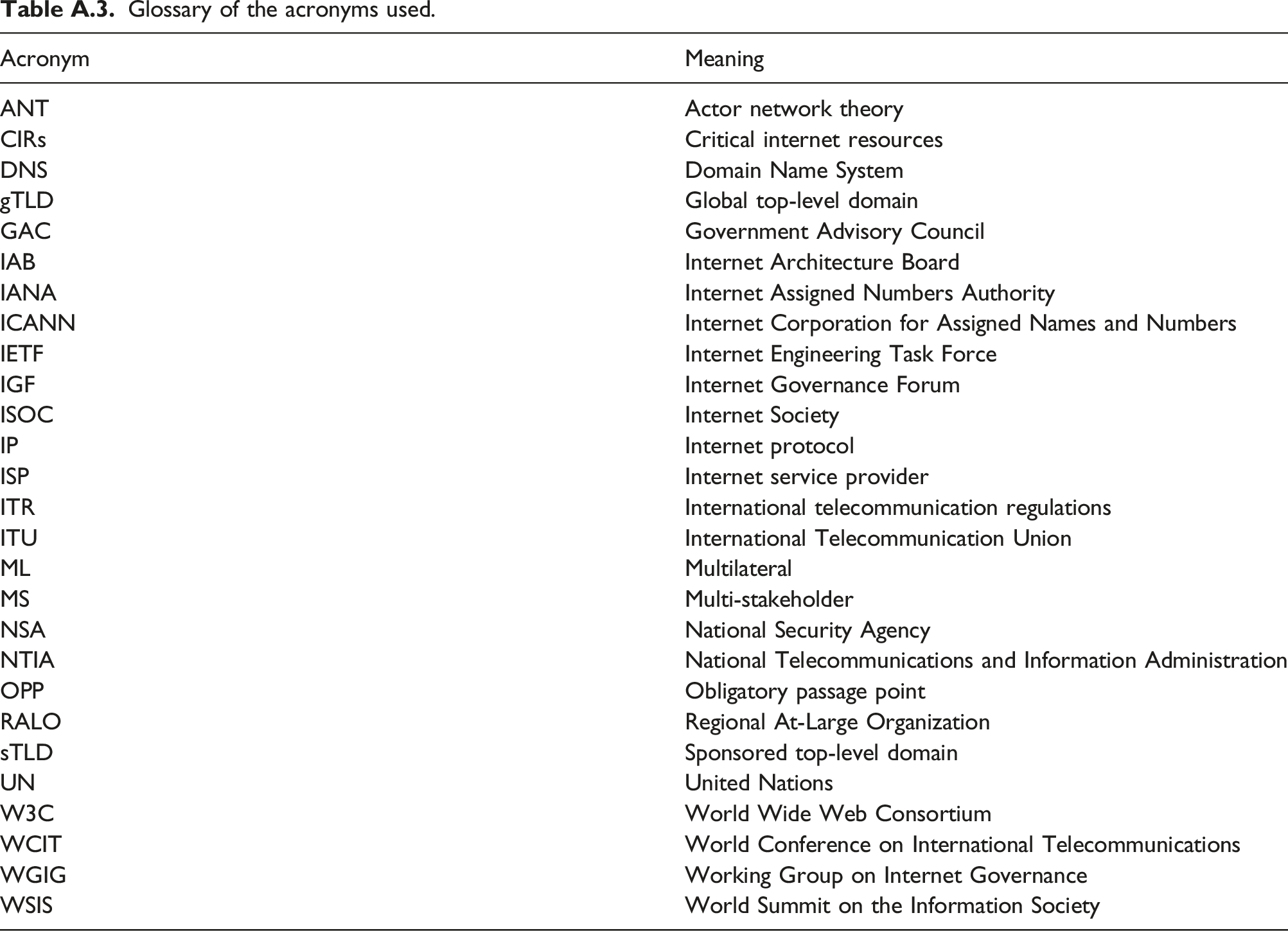
ICANN is an Internet governance organization that handles a wide range of functions (Table A3 in the Appendix is a glossary of the main acronyms used in this paper). It centrally manages the allocation of domain names and numbers - the critical resources required for the Internet to run. It also manages the root zone file and expansion of the global Top-Level Domains (gTLDs). ICANN is often portrayed as a multi-stakeholder form. However, key Internet governance incidents over the years have challenged its legitimacy and its MS form. Several stakeholders feel that the ‘supposedly’ multi-stakeholder form, which oversees most decisions, does not give them any real opportunities to take part in decision-making (Taylor, 2016). These stakeholders support an enhanced role for governments in the Internet’s governance, that is, the ML form, fearing that the governance decisions taken through the MS form may not adequately consider their interests, values and belief systems. At the same time, the more influential stakeholders have employed numerous strategies for sustaining the pre-eminence of ICANN as the most appropriate form for governing. This study focuses on the history of this debate and examines the ongoing consensus-building process towards establishing ICANN as a legitimate form of Internet governance.
For a substantial period since its inception, development of the Internet has occurred under the leadership of the U.S. government. The U.S. government still plays a dominant role in its technical development, as well as in creating substantive policies around it. Therefore, this paper considers the U.S. government as the ‘focal actor’ in the ML versus MS governance form debate. The paper builds on a study of archival data and focuses on the history of this debate. It examines the ongoing consensus-building process towards settling on an acceptable governance form by its global stakeholders. In particular, the study addresses two questions: (1) How do the focal actor’s beliefs influence its choice (preference) of MS governance form? and (2) What strategies does the focal actor employ to translate the interests of the competing ML governance network towards its preferred form?
Theoretically, the study draws on actor-network theory (ANT) as an appropriate sensitizing lens to better explicate the internet governance debates. ANT offers insights into how network builders achieve their goals through associations and alliances of faithful actors, including both human and non-human ones. It provides explicit insights into the dynamics of the actions of actors with heterogeneous interests and beliefs (Andrade and Urquhart, 2010). It therefore has a particular bearing on Internet governance, since the Internet as a platform allows recurrent entry and participation of a heterogeneous group of stakeholders.
The primary contribution of the study is to show the inscription of the focal actor’s Communicated Beliefs on the Internet’s development and governance. Tracing the translation process of the MS governance network, the study shows how the focal actor establishes the MS governance form through ICANN as an Obligatory Passage Point to keep the Internet successfully operational. Further examination of the translation process reveals a combination of structural and collaborative strategies which the focal actor employs to allay the concerns of the competing ML network and to enrol them to the MS governance network. The study also highlights a hierarchy of focal actor’s beliefs that steer the translation strategy.
The paper is structured as follows: Firstly, the literature review outlines the theoretical foundations of the study. Specific concepts of ANT are reviewed and synthesized. The Methodology section discusses the approach used by the study, identifies the sources of data and discusses the approach to data coding and analysis. This is followed by an analysis of governance debates using archival data and the ANT concepts of inscription, translation and enrolment. The paper concludes with research and policy implications.
Internet governance
Internet governance is defined as ‘decisions on design and development of technologies which are required to keep the Internet operational and the implementation of substantive policies around them’ (DeNardis, 2014). For ease of understanding this expansive domain, researchers as well as practitioners in the field have proposed various taxonomies for the concerns involved (Kurbalija, 2014; DeNardis and Raymond, 2013). One of them offered by DeNardis and Raymond (2013) segregates Internet governance into six functional areas: (1) control of Critical Internet Resources (CIRs), (2) setting Internet standards, (3) access and interconnection coordination, (4) cybersecurity governance, (5) information intermediation and (6) architecture-based intellectual property rights enforcement. Although each of these functional areas may have different types of administration structure optimal for their operational stability (DeNardis and Raymond, 2013), this study focuses on the control of CIRs, which to a large extent is governed by ICANN.
Stakeholders of the Internet include firms, governments, technical communities and end-users. Given the Internet’s global scale and all-pervasive presence, the stakeholders are diverse in their beliefs, capabilities, interests and goals. Such diversity leads to frequent governance tussles. These tussles are intensifying on the expectation of more significant impacts that the Internet will have across social, economic and political domains in the future (Ford et al., 2009). Therefore, the initial assumptions of cooperative behaviour within and between the stakeholder groups are not valid anymore (Kalogiros et al., 2011). This has led to numerous trust and security concerns like distributed denial-of-service attacks, cyber terrorism, espionage, viruses, identity theft, and data interception and modification. The concerns are prevalent and severe, which, unless taken care of, will turn the Internet into a dark infrastructure. In this context, CAIS’ Bright Internet Initiative (Lee, 2015) calls for the investigation of technologies, national policies and international agreements towards devising new business models.
Although most of the Internet governance tasks are seemingly technical, they have significant public policy implications. For example, the expansion of top-level domains (.xxx, .wine, .amazon and .gay) raises multiple public interest issues related to intellectual property rights, free speech and stakeholder interest disputes between territorial states versus global corporations (DeNardis and Raymond, 2013). Such issues have led to the debate on the legitimate form of Internet governance.
Internet governance form
Stakeholders of the Internet represent different historical and cultural contexts and hence have different expectations from the Internet. At the same time, the open architecture of the Internet also allows for the continuous entry of new actors with diverse values and perspectives (Clark et al., 2005), leading to tussles within and among stakeholder groups. In the governance of any information infrastructure, when the diversity of stakeholders or stakeholder groups leads to contradictions, the focus invariably is on the management of stakeholder relationships (Flak et al., 2008).
Tussles in governing the Internet may occur at design time, redesign time, configuration time or run-time. However, they predominantly occur at run-time since tussles on the Internet continue in large part while the system is in use (Clark et al., 2005). These conflicts may be either economic or social or a mix of both, in which case, the tussle could arise when following economic objectives by a set of stakeholders that may undermine the social interests of others and vice-versa (Kalogiros et al., 2011).
One of the most controversial issues of Internet governance, at the trans-national level, is the control of a narrow but essential set of resources and decision-making rights. These include oversight and management of the Internet’s root zone file, allocation of gTLDs, IP address and autonomous system number distribution, operating internet root servers and resolving Domain Name System (DNS) queries (DeNardis, 2014). DNS translates domain names into IP addresses through a hierarchical process and root zone file is at the top of this distributed hierarchical database. Root zone file definitively tracks the lists of names and IP addresses of all authoritative servers for the top-level domains (DeNardis and Raymond, 2013). ICANN has historically handled this file and any addition, deletion or modification to the root zone file. ICANN also authorizes the allocation of other CIRs, which are critical for the functioning of the Internet. Some of the concerns raised around the management of these CIRs are the decision-making procedure for authorizing the publication of modifications in the root zone file and the transparency of this process (ITU, 2005) as well as the expansion of gTLDs (Uddin, 2013). Contestations from many countries of the world on varied issues over ICANN’s functioning and decisions have led to considerable debate on whether oversight of ML form over ICANN is more suited compared to the MS form.
Multilateralism (ML) is defined as ‘an institutional form which coordinates relations among three or more states on the basis of “generalized” principles of conduct-that is, principles which specify appropriate conduct for a class of actions, without regard to the particularistic interests of the parties or the strategic exigencies that may exist in any specific occurrence’ (Ruggie, 1992). Multi-stakeholderism, on the other hand, is a somewhat newer form of global governance. It refers to the ‘processes that aim to bring together all major stakeholders in a new form of communication, decision-finding (and possibly decision-making) on a particular issue’ (Hemmati and Hohnen, 2002).
In the Internet context, the ML form requires the creation of an inter-governmental body such as the ITU or the UN (United Nations) to perform required trans-national functions or to have an inter-governmental oversight on the tasks performed by the ICANN, which is ‘supposedly’ in the MS form. The primary argument in favour of ML governance is an equal representation of all countries towards Internet governance concerns. Given the transcendence of shared global issues across national borders and sovereign states (e.g. the impact of Internet governance issues on civil liberties), this representation is seen as very important. The most striking critique of the ML form is the state’s capture of Internet access and usage, especially in countries with authoritarian regimes (Nye, 2014).
Explicating differences in ML and MS form in the Internet governance context.
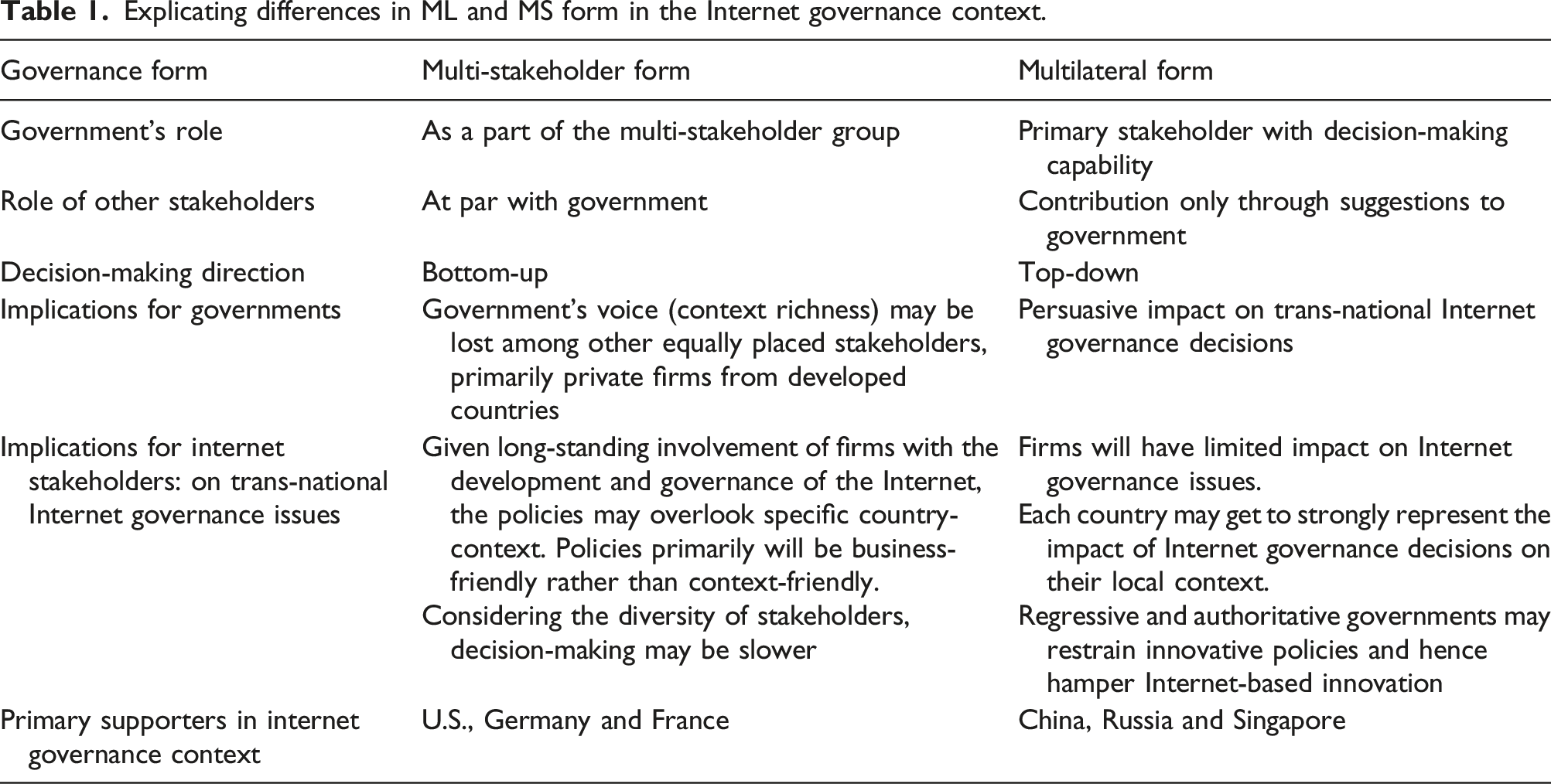
Many of the policy issues of the Internet are often intimately and inextricably related to technical and operational decisions (Mueller et al., 2007). Thus, stakeholders who possess capabilities required to create and control infrastructures attain power, which they exploit to advance their own interests and world views (Nye, 2014). A dominant actor’s keen understanding of the importance and impact of each of the issues (and the corresponding non-understanding of the technically weak stakeholders) creates an apparent mismatch of the capability to influence the design (Singh, 2015). Thus, in trying to resolve Internet governance tussles through an MS form, asymmetric technical capabilities can lead to asymmetric participation and the exercise of asymmetric power (Nye, 2014). This is a major concern for stakeholders without such power, who remain unsure of whether their interests are adequately taken care of.
Actor–network Theory
Pioneered by Callon and Latour (1981), ANT provides an effective approach towards understanding the formation of networks of aligned interests. ANT argues that an action is basically an association between agents, rather than being a characteristic of an actant. The theory outlines how actors enrol other actors to form alliances and use non-human actors (artefacts) to strengthen these alliances (Mähring, Holmström, Keil and Montealegre, 2004). By following the actors’ actions throughout the different stages of establishing the network, ANT aids us in better interpreting events and explaining outcomes (Andrade and Urquhart, 2010).
Following Walsham’s (1997) call to explore the use of ANT in IS research, it has become a leading theory in the interpretive paradigm in the IS domain. There have been similar calls to use the theory for strong critical empirical analysis (Doolin and Lowe, 2002). ANT helps in understanding how ideas, values and intentions of social actors become ‘inscribed’ in technology (Akrich, 1992) and how this inscription renders intentions immutable over time. The theory has been used to explicate the development and diffusion of technologies, infrastructure standards and IT-enabled organizational change (Rodon et al., 2008; Elbanna, 2008). The theory also helps better understand the dynamics of technology adoption (Hannemyr, 2003) such as the use of e-commerce among older people (Lepa and Tatnall, 2006).
ANT is frequently used to demonstrate conflict between actors with divergent views and beliefs and the prohibiting impact that inscription of beliefs of one actor in the network may have on the stability of the actor–network (Walsham and Sahay, 1999). The theory also reveals the tension between stabilizing the network of actors and stabilizing the technical design (Heeks and Stanforth, 2007). Raising the importance of using the past to understand and reveal current assumptions and biases, ANT enables the conduct of historical research by going back to moments in time when the outcome was merely one option among many. It allows the discovery, tracing and recreation of past actions that combined to produce the present (Bonner, 2013). In this paper, we use ANT as a sensitizing lens to understand the conflicts between the competing actor–networks (ML vs. MS) in the Internet governance context.
Among the different concepts developed under ANT, inscription of beliefs and translation mechanisms are two important ideas. The process of inscription is critical to building actor–networks as most artifacts within a social system embody inscriptions of some interests (Mahring et al., 2004). Translation process also relates to the creation of actor–networks and refers to ‘the methods by which an actor enrolls others’ (Callon, 1986). By tracking the history of translations, ANT helps explicate the disparate goals of actants and the efforts employed towards strengthening the ICANN-network, which is considered more ‘legitimate’ by a group of actors. It also reveals the stakeholders’ interaction, in particular, the resistance and the compromises made during the translation process. Table A1 in Appendix lists the key ANT concepts used in this study.
In short, the ANT lens helps develop insights into the evolution and persistence of the long-standing debate over the most legitimate form of Internet governance. In particular, it illuminates the use of a creative set of strategies that convince stakeholders of the focal actors’ preferred positions.
Methodology
To achieve our research goal, we conducted a case study within the interpretive tradition of IS studies using archival data. We focussed on ICANN, the most prominent among Internet governance organizations. The paper follows an interpretivist epistemology, which assumes that neither technology nor human actions exert direct causal impact on consequences (Walsham, 1995, 2006). Rather, it sees consequences as ‘the interplay of competing infrastructures, conflicting objectives, the preferences of different social groups, and chance’ (Markus and Robey, 1988). Since actor–network studies are predominantly interpretive or critical (Walsham and Sahay, 1999), this lens enabled us to answer questions about how alliances are formed, broken and re-formed in the domain of Internet governance in favour or against a particular form of governance.
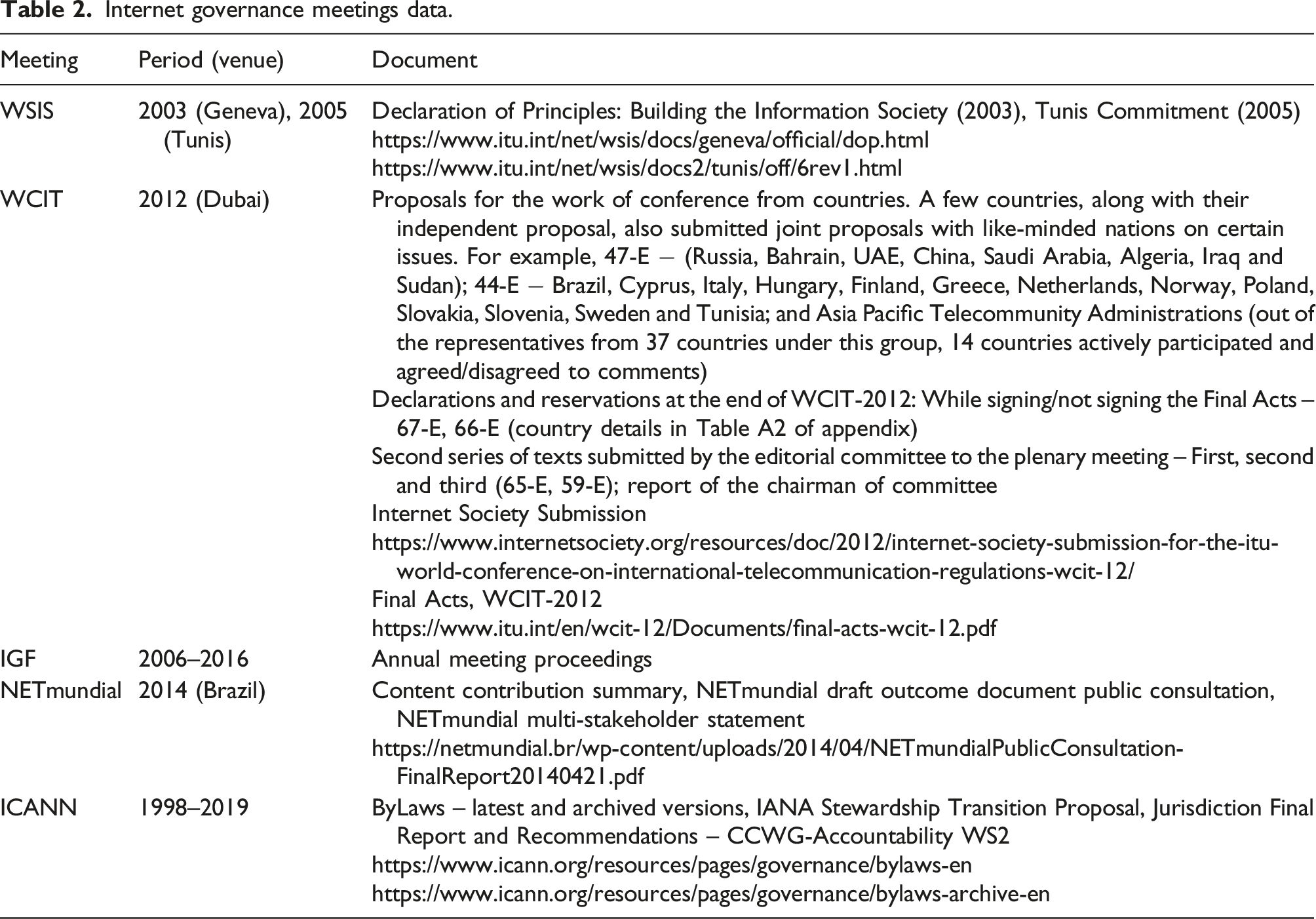
Data sources
Internet governance meetings data.
Other data sources.
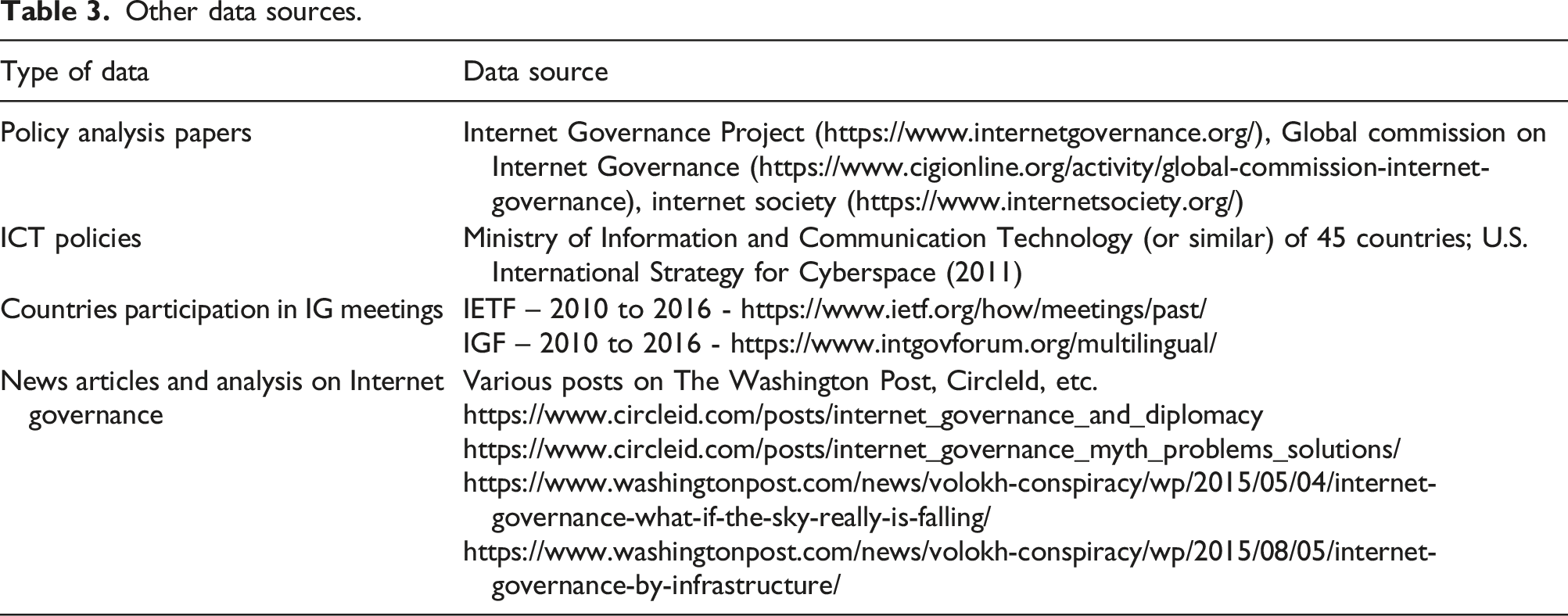
Since the U.S. government is the focal actor in the study, we collected documents related to the Internet released by them. We also collected the participation data of countries in IETF and IGF meetings between the years 2012 and 2016, when the debate of ML versus MS governance form had reached its peak.
Data analysis
Archives are ‘documents made or received and accumulated by a person or organisation in the course of the conduct of affairs and preserved because of their continuing value’’(Ellis, 1993). This data type is particularly suited to generating developmental explanations, that is, explaining and examining processes of change and evolution of network structure and processes (Welch, 2000). It is also used regularly in Information Systems research (Deng and Chi, 2012). Archival data also facilitates access to aspects of organizations and events of earlier time which may not be accessible otherwise (Ventresca and Mohr, 2017; Cunliffe et al., 2018).
Considering the long history of Internet governance and ICANN inception, we first went through various policy articles which discussed Internet governance issues with a specific focus on governance form. This initial sifting through the policy articles helped us trace the prominent lines of discussion on the form of Internet governance as well as the landmark events driving these discussions.
In the second step of analysis, data sources related to specific meetings were analysed chronologically. Policy documents of different countries along with their submissions in various meetings facilitated understanding the influences made and changed view of the stakeholders over time. Proceedings and Final Declarations of the meetings expressed the agreements and disagreements of the stakeholders involved and the adjustments made to achieve consensus. The study of ICANN bylaws assisted in comprehending chronological change in its belief and structure.
The use of ANT as a sensitizing lens in the process of examining the archives helped arrange the findings under well-established theoretical concepts. The data analysis presented in the findings section is thus, based on deductive coding performed on the data available, keeping ANT concepts in mind. One of the authors took the lead in coding the data from the source documents. This initial coding was discussed regularly with other co-authors, who also read the documents, leading to further modifications and reasonable adjustments. The process of reading and coding the data was done manually and took over 1 year to converge. The codes finally led to the development of themes. For example, from the available data excerpts, we developed themes for the ‘beliefs’ inscribed. From various bylaws of ICANN and the U.S. government’s strategy documents and various other releases, we deciphered the different moments of translation, again using the concepts defined by ANT. Whenever we found it difficult to categorize the codes into specific stages of translation, we went back to reading the seminal papers which use ANT as a lens for analysis with a focus on IT artefacts. This back-and-forth process of coding helped in better understanding the application of ANT and led us to carefully and logically separate the different stages of translation.
A brief narrative of the Internet governance form debate
Case study: historical context of ICANN
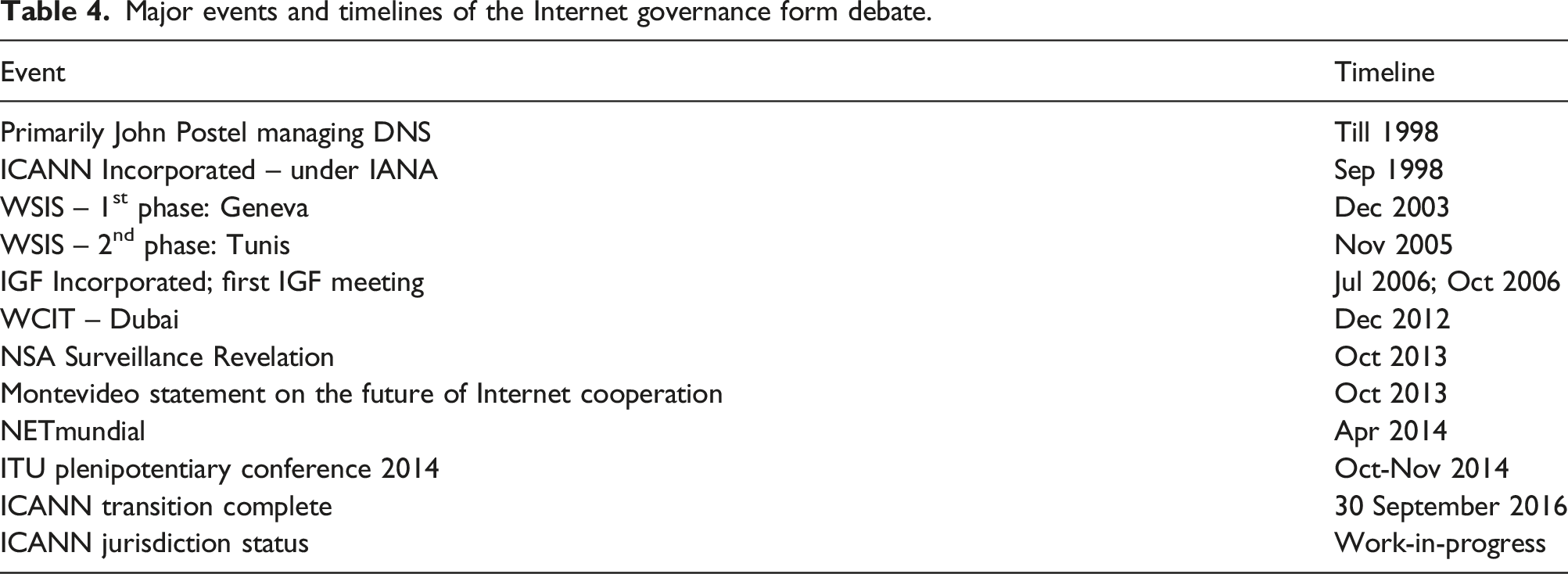
Although Internet governance has been intensely contested in recent years, the history of this debate can be traced back to 1998. Introduction of the World Wide Web in 1994 and subsequent proliferation of domain names started the debate on how this naming system should be governed. A private firm Network Solutions Inc. held an initial contract for a 5-year period, with control subsequently passing to the International Ad-Hoc Committee in 1996.
ICANN was established in 1998 as a private, not-for-profit corporation, governed by California law under the U.S. Department of Commerce (DoC). Its primary function included allocation and management of CIRs which comprised IP addresses, domain names and autonomous system numbers. Since these resources had to be unique for the Internet to remain operational, they required centralized control. The ICANN also managed the ‘root’ file of top-level domain names. Initially, the U.S. Department of Commerce’s stewardship role was intended to be until 30 September 2000. The status quo continued for much longer until a few Internet-related events caused dissent among nations on the governance form, mandating changes.
After the burst of the dotcom bubble and the terrorist attacks of September 2001, the broader political and economic environment for Internet governance changed radically. Guaranteeing security and stability of the Internet became a priority. ICANN turned from a project on ‘cyberdemocracy’ into an instrument for ‘cybersecurity’ (Kleinwächter, 2004). The weightage given to the representation of the Internet users and government also changed dramatically. The first echoes of Internet governance form debate were heard in the first WSIS meeting in 2002. The debate gradually moved from the periphery during the initial phase of WSIS to the main agenda.
In 2012, ITU convened the World Conference on International Telecommunications (WCIT), as a formal meeting of the national governments to revise the International Telecommunications Regulations (ITRs). The tussle around broadening the scope of the ITRs to include the Internet erupted into a massive controversy, signalling a new Cold War over Internet governance (Glen, 2014). The signatories and non-signatories of WCIT-2012 were assumed to be on the opposite sides of the ML/MS debate. Table A2 (Appendix) provides the list of countries on either side of the debate.
Major events and timelines of the Internet governance form debate.
Interpretation of findings using an ANT perspective
The Internet governance context deals with two competing networks, first, the ICANN-governance network, which represents the multi-stakeholder (MS) form of governance (i.e. the organic evolution of Internet development under the U.S government) and second, the ITU-like governance network, which represents inter-governmental or multilateral (ML) form of governance.
In an actor–network, different actors may be involved in different processes of translation. Therefore, picking a focal actor brings in considerable clarity in examining the creation and stability of any actor–network (Sidorova and Sarker, 2000). Given the dominance of the U.S. government in Internet’s development and governance from its inception, this study considers U.S. government as the focal actor (or the initiator) of the ICANN-governance (or alternatively MS governance) network.
Inscription
Most artefacts in a social system embody inscriptions of some interests (Mähring et al., 2004). These inscriptions have a role in achieving socio-technical stability (Latour, 1987). When actors differ in the power they hold in the network, the beliefs of dominant actors are embodied in the form of the technological artefact that fundamentally shapes the evolution trajectory of the technology (Faraj et al., 2004).
We identify three prominent beliefs of the focal actor (U.S. government) that are inscribed in the Internet, both in its technological implementation and policies around it. The three beliefs are: freedom, dominance of the market, and openness and inclusive development. Supporting evidence for each of these beliefs is presented below.
Belief in freedom
The U.S. government propagates its core belief of freedom in the development and governance of the Internet as a platform. While making its first ever policy on managing Internet names and numbers, the focal actor declared: “The Internet succeeds in great measure because it is a decentralized system that encourages innovation and maximizes individual freedom” (Daley, 1998).
The focal actor’s continued insistence on freedom is visible in its International Strategy for Cyberspace, released in 2011. The strategy outlines belief in freedom of expression, free trade and free flow of information: “…, the United States will continue to combat them (forces trying to restrict freedom of expression) in a manner consistent with our core values—treating these issues specifically, and not as referenda on the Internet’s value to society” (The White House, 2011, P. 5, emphasis by authors).
Supporting free flow of information and against nation-level data-filtering, the strategy declares: “The United States is committed to international initiatives and standards that enhance cybersecurity while safeguarding
Belief in markets and private sector
Since various Internet governance functions, especially management of CIRs require coordination, the focal actor expects better performance by private organizations compared to government control. This is a market-based approach, where the interests of world-wide coordination are entrusted in market mechanisms of price, exchange and equilibrium. The NTIA declared: “Certain management functions require coordination. In these cases, responsible,
Even after a few years of ICANN managing the Internet DNS, the NTIA reiterates its belief in market-based approaches and the private sector: “ICANN is the appropriate technical manager of the Internet DNS…. the United States will
Belief in openness and inclusive development
At the inception of ICANN, the U.S. government declared its commitment to governance being open to all stakeholders and to strive towards a broad and inclusive participation process: “.. the corporation activities would need to be open to all persons who are directly affected by the entity, with no undue financial barriers to participation or unreasonable restrictions on participation … The Board Members should be elected from membership or other associations open to all … that ensure broad representation and participation in the process” (Daley, 1998).
The 2011 International Strategy for Cyberspace again reiterates the focal actor’s belief in involving as many stakeholders of the Internet as possible, both in building the Internet together as well as enjoying its benefits. Highlighting how the inscription of the principle of openness in the Internet design has led to its exemplary growth, the strategy claims: “The openness of digital systems explains their explosive growth, rapid development, and enduring importance…To continue to serve the needs of an ever-growing wired population, manufacturers of hardware and operating systems must continue to
Thus, by virtue of the Internet technology developed mainly in the U.S. ecosystem, we find that it is inscribed with long-held values and beliefs of the country and its government. Reiteration of these beliefs from time to time also indicates the commitment of the U.S. government towards these values for its further development. Since the beliefs are abstracted from the policy and strategy documents formally released by the U.S. government, we refer to them as Communicated Beliefs of the focal actor.
The sociology of translation
When competing ideas are subjected to ‘trials of strength’, competition in actor–networks becomes highly visible (Bonner, 2013). As detailed earlier in the historical context of ICANN, the ML governance form has remained in competition with the MS governance form. The demand for ML governance form started taking shape during the first WSIS meeting at Geneva in 2002, with many notable events in recent years creating a sense of urgency. These events are significant, since they repeatedly evoke the debate between ML and MS governance form, leading the focal actor to devise and implement strategies to translate the interests of the actors of the ML network into its own (MS). We describe the three most prominent events before discussing specific enrolment strategies of the focal actor.
‘.xxx’ allocation
The proposal and eventual allocation of ‘.xxx’ gTLD (for adult-entertainment content) to ICM (a domain name registry operator) is one such event. The primary argument against this step was the legitimization of pornographic sites, and it spurred ideological debates among countries. The step challenged norms of some societies which were unprepared for such openness. National governments of countries like Australia, U.K., Canada, Sweden, Brazil and others raised serious concerns and sought reconsideration of the decision. After various rounds of discussions and reviews, the .xxx domain was finally formally approved for its inclusion in the root (Collazo, 2011).
NSA surveillance program
The NSA, in collaboration with top Internet companies and some governments, harvested huge swathes of online traffic to spy on individuals, including foreign delegates. Snowden’s revelations in June 2013 revealed that the NSA had subverted encryption standards and open-source software, and withheld information about security holes in commercial products to be able to exploit them before companies could fix them (Nye, 2014). This event is considered as an inflection point for the future of the Internet and led to the evaporation of global trust in the U.S. and U.K.’s leadership on Internet freedom. For many countries, Snowden’s revelations laid bare the rift between the stated values of the US and UK and their behaviour. This mass surveillance programme of the NSA generated a trust deficit in Internet governance mechanisms.
‘.amazon’ allocation
During ICANN’s offer of expanding gTLDs, ‘.amazon’ was allocated to Amazon Inc, a US-based, multinational corporation. However, a group of South American countries opposed the move, stating that: “the name Amazon, in any language, is part of the cultural heritage and identity of the Amazon countries, and that its use as a first level domain name, unless otherwise agreed by the Amazon countries, shall be reserved for the promotion of the interests and rights of the Amazon peoples and their inclusion in the information society.”(ICANN, 2019a).
The debate has been going on since 2012, and after various rounds of discussions, on 15 May 2019, the board again approved the request of allocation of ‘.amazon’ to Amazon Inc. Again, on 25 June 2019, the Colombian government lodged a request for its reconsideration. The presidents of Bolivia, Colombia, Ecuador and Peru also subsequently protested, citing exemptions to highly restricted ‘.brands’ from some of the new gTLD registry agreement’s provisions. The issue is now under discussion (ICANN, 2019b). Events like these invited sharp responses from countries on the existing systems of Internet governance and how a government, being a legitimate ‘caretaker’ of its citizens, should have a say in these decisions. For example, the government of Pakistan – supported by a few other governments – made a statement at the Human Rights Council in September 2013, expressly linking the revelations about surveillance programmes to the need for a new international governance framework (Shears, 2014).
During WCIT-2012, a proposal submitted by the most vocal initiators and delegates of some countries directly challenged the existing Internet governance framework and called for greater control in the hands of governments over Internet routing and content and domain names. Article A.2 notes: “Member States shall have equal rights to manage the Internet. . .” Article 3A.3 asserts: “Member states shall have the sovereign right to establish and implement public policy, including international policy, on matters of Internet governance …” (Robertson, 2012).
Events like these led the focal actor to make efforts towards converting the interests of the actors of the competing network towards the MS form of governance. The complete process of translation, according to ANT, goes through the moments of problematization, interessement, enrolment and mobilization. It is, however, not mandatory that all moments occur or get detected. The sequence among the moments, too, is not fixed and the hence the process of translation remains fluid (Elbanna, 2008). We now illustrate the process of translation of interests by the focal actor.
Problematization
In the language of ANT problematization covers the initiator’s work to define the interests and roles of other actants; the defined interests are consistent with those of the initiator (Callon, 1986). It refers to the network builder’s effort to divert the attention of actors from their goal towards the network builder’s aims, and to convince them that they cannot achieve their displaced goal without helping the network builder pursue his or hers (Elbanna, 2008). In the process, the initiator creates an obligatory passage point which all actors need to go through to achieve their goals and interests.
We find that the focal actor, that is, the U.S. government, frequently emphasizes the exemplary growth of the Internet and its positive impact on societies. It also stresses the need for centralized authority to continue this unparalleled growth. To achieve all that the Internet has to offer, it portrays MS governance (e.g. ICANN) as the obligatory passage point. Pointing to the exemplary performance of the Internet leading to enriched societies, its continuity is professed as the ultimate goal for all the stakeholders: “Our goal is to preserve the global Internet, which is a force for innovation, economic growth, and the free flow of information” (US Department of Commerce, 2011). “… For these technologies to continue to empower individuals, enrich societies, and foster the research, development, and innovation essential to building modern economies, it must retain the openness and interoperability that have characterized its explosive growth.” (The White House, 2011, P. 3).
To achieve growth and maintain generativity of the Internet platform, the U.S. government underlines the need for centralized authority. Arguing for the need of significant coordination to make sure that the Internet meets the changing needs of the Internet users, the focal actor portrays multi-stakeholder form (bottom-up) of governance as the Obligatory Passage Point (OPP):
“The private process [required for coordination]
The focal actor contends that only multi-stakeholder governance form can ensure innovation, freedom of expression and enable economic growth from the Internet, that is, an obligatory path to continue achieving what the Internet has to offer: “[Architecture of the Internet] fuels the freedom of expression and association that enables social and political growth and the functioning of democratic societies worldwide. The United States stands firm in our conviction that when the international community meets to discuss the range of Internet governance issues, these
NTIA reiterated its commitment towards the MS form (specifically, for ICANN) even when the U.S. government’s interests did not align with the outcomes of the ICANN form of governance. For example, during the allocation of the .xxx domain, they announced: “While the Obama Administration does not support ICANN’s decision, we respect the multi-stakeholder Internet governance process… Our goal is to preserve the global Internet… dedicated to improving the responsiveness of ICANN to all stakeholders, including governments worldwide” (U.S. Department of Commerce, 2011).
Enrolment
Enrolment concerns the negotiation of roles between actors in the actor network (Callon, 1986). The process of enrolment involves group negotiations and acceptance from other actors of the interests defined by a focal actor through bargaining and making concessions (Madon et al., 2004). It is a continuing process of persuasion, and control is a key process for creating and maintaining the actor–networks (Allen, 2004). Thus, enrolment is basically a set of strategies that a focal actor attempts to define and interrelate the various roles that allows other actors to enrol (Gunawong and Gao, 2010). Successful networks of aligned interests are created through the enrolment of a sufficient body of allies, and the translation of their interests so that they are willing to participate in particular ways of thinking and acting, which maintains the network (Walsham, 1997).
The focal actor’s strategies were employed to convince the actors of the competing network to accept ICANN (and the MS form) as the ‘legitimate’ from of Internet governance to manage trans-national issues. The ICANN leadership initiated reforms in the wake of recurrent debates that questioned ICANN’s legitimacy as the key body for Internet governance. The reforms were designed to bolster the organization’s flagging authority. The focal actor followed a two-pronged approach: (1) Structural transformation of ICANN and (2) lowering the participation constraints for actors. Although the formation of ICANN was a part of privatization of the domain name system, its initial practice and founding documents gave the U.S. government power to essentially veto all its decisions (Weinberg, 2011). Over a period, structural transformation of ICANN led to a more prominent role for governments in the ICANN board and a change in ICANN’s oversight from the U.S. government to a truly multi-stakeholder community.
Structural transformation of ICANN: enhanced role of Government Advisory Council
At ICANN’s incorporation, its relationship with national governments, through the Government Advisory Council (GAC), was solely that of an advisory body: “The GAC
For the first time in 2002, the CEO of ICANN raised the issue of national governments being the most legitimate representatives of its populations and hence deserving of a much bigger role in resolving trans-national issues of the Internet. It led to the first private-public structure of the ICANN by involving GAC in its board, which constituted a third of the board members. The bylaws of ICANN declared: “in those cases where the policy action affects public policy concerns, to request the opinion of the [GAC] and take duly into account any advice timely presented by the [GAC] on its own initiative or at the Board’s request” (ICANN, 2002).
Later, in 2016, with regards to ICANN Board obligations with respect to GAC advice, the control of GAC on the workings and decisions of ICANN was enhanced: “Any Governmental Advisory Committee advice approved by a full Governmental Advisory Committee consensus, understood to mean the practice of adopting decisions by general agreement in the absence of any formal objection, may only be rejected by a vote of 60% of the Board …” (ICANN, 2016).
Thus, the role of national governments in ICANN moved from being a purely advisory role to their advice being taken seriously, and then progressing to where their advice was rejected only when at least 60% of the ICANN board objected.
Structural transformation of ICANN: change in ICANN’s oversight structure
Change in the oversight of ICANN is another major structural transformation, which can be interpreted as a strategic step taken by the focal actor to convert the interests of the competing network into its own. The NSA surveillance scandal of 2013 put the U.S. government under international pressure leading to the announcement by the NTIA of its intention to transfer the role of ICANN’s oversight to the ‘truly’ global multi-stakeholder community. This announcement was made with a caveat that it would not accept any proposal of transferring the role of NTIA to any inter-governmental form. After the transition on 1 Oct 2016, ICANN declared:
“This community validated the multi-stakeholder model of Internet governance. It has shown that a governance model defined by the inclusion of all voices, including business, academics, technical experts, civil society, governments and many others is the best way to assure that the Internet of tomorrow remains as free, open and accessible as the Internet of today.”
Along with distrusting the structure of ICANN, the competing network of ML governance form also question the constraints that various Internet stakeholders face towards participation in Internet governance. The constraints can be in the form of awareness, ability, opportunity or resources to participate (Maciel and De Souza, 2011). Therefore, to augment the enrolment of actors of the competing network to the MS governance network, the focal actor also designed strategies focussing on lowering participation constraints. Two different mechanisms were employed to implement this.
Lowering the participation constraints: creating new forms of participation
In the first phase of WSIS in 2003, the Declaration of Principles argued for increased role of governments: “The international management of the Internet should be multilateral, transparent and democratic, with the full involvement of governments, the private sector, civil society and international organizations … taking into account multilingualism” (WSIS, 2003).
To implement this demand, the Working Group on Internet Governance (WGIG) was created in the first phase of WSIS, which would: “ensures a mechanism for the full and active participation of governments, the private sector and civil society from both developing and developed countries, involving relevant intergovernmental and international organizations and forums, to investigate and make proposals for action, as appropriate, on the governance of Internet” (UN, 2004).
The outcome of the two phases of the WSIS meetings and WGIG was the creation of a new forum for multi-stakeholder policy dialogue, the Internet Governance Forum (IGF), which was set-up to:
Although the two WSIS meetings could not achieve acceptance of the multilateral form by the ICANN-network, they had a significant role to play in changing the definition of diverse stakeholders taking part in Internet governance (Weinberg, 2011). The creation of IGF, although still assumed to be in the multi-stakeholder form, included governments along with business and civil society (Weinberg, 2011).
Lowering the participation constraints: capacity building at local and regional levels
Another definitive step taken by the ICANN-governance network was to lower participation constraints for all stakeholders by initiating capacity-building measures. ICANN approved the formation of local and regional ‘at-large’ groups around the world in June 2003. A corresponding At-Large Advisory Committee was created for the purpose of coordinating these groups. Local groups were also authorized/encouraged to form Regional At-Large Organizations for better coordination in each geographical region. The U.S government declared their role as: “[p]rovide the necessary knowledge, training, and other resources to countries seeking to build technical and cybersecurity capacity…. Develop relationships with policymakers to enhance technical capacity building, providing regular and ongoing contact with experts and their United States Government counterparts” (The White House, 2011, P. 23).
Enrolment Strategies of the ICANN-governance network.

Mobilization
Mobilization activities keep actors aligned and acting in concert with the interests of the initiators (Mähring et al., 2004). Some actors, enrolled in the focal network, speak on behalf of a bigger cause to mobilize the action of an entire network (Callon, 1986). Historically, the government of Brazil, remained aligned to ML governance. Their alignment to the ML governance network was strengthened after the Snowden revelations of privacy violations of Brazilian government functionaries by the U.S. The speech of Brazil’s President to the U.N. on 24 September 2013 included repeated reference to the ML form of governance (Trinkunas and Wallace, 2015).
To restrict the damage caused by NSA revelations, all the major Internet organizations (ICANN, IETF, IAB, W3C, the Internet Society and all five regional Internet address registries) unanimously released a statement calling for ‘accelerating the globalization of ICANN and IANA functions, towards an environment in which all stakeholders, including all governments, participate on an equal footing’ (Ramey, 2013). After several meetings with the CEO of ICANN, Fadi Chehade of Brazil organized the NETmundial meeting in April 2014. In the meeting, Brazil professed its support for the MS (ICANN) governance for the Internet, clearly indicating its change in stance (Trinkunas and Wallace, 2015). In the meeting it called upon the support of all countries to the MS governance form and helped the focal actor mobilize other actors towards joining this form. In his analysis, Mueller (2013), highlighting the mobilizing role of Brazil, notes: “Brazil’s state is now allied with the spokespersons for all of the organically evolved Internet institutions, the representatives of the very “multi-stakeholder model” the US purports to defend.”
Timeline of focal actor’s strategies
In line with the evidence of strategies employed by the focal actor, we present the findings of our study through a timeline (Figure 1), which indicates major events which strengthened the ML-MS controversy and measures taken by the ICANN-network towards addressing those controversies. The timeline also indicates that not all steps taken by the focal actor were direct consequences of any prominent event in the history of Internet governance. The figure also highlights time periods denoting the inscription of beliefs on the Internet and different phases (problematization, enrolment and mobilization) of the formation of the ICANN actor–network. Formation and stabilization of the ICANN actor–network.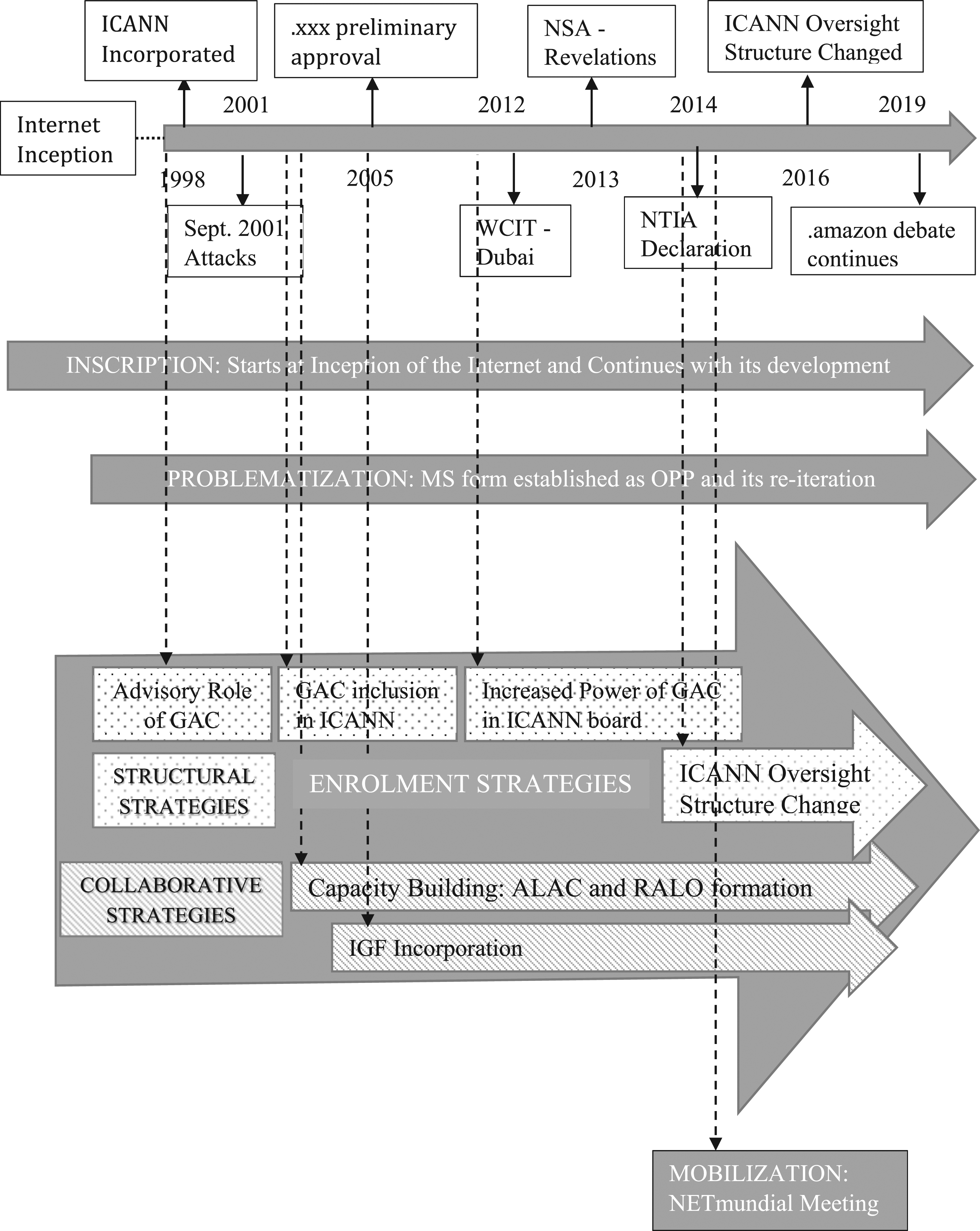
Discussion
Internet governance is a problem of global significance. The diversity of the Internet’s stakeholders in terms of their belief systems as well as their capability to ascertain the inclusion of those beliefs in the Internet governance decisions motivates the examination of its governance structure. This study undertakes an analysis of this long-drawn-out debate on the MS versus ML form of Internet governance structure. Employing actor–network theory as the sensitizing lens, the above analysis illustrates how inscription of certain beliefs in a technology impacts the choice of its governance structure. The study goes further to demonstrate the strategies focal actors employ to enrol all stakeholders of the Internet to its chosen governance structure. Thus, through this study, we are charting the inscription and the translation work taken up by the focal actor over an extended period. We find evidence of three beliefs of the focal actor (U.S. government) inscribed in the Internet’s development. They are belief in freedom, belief in markets and private-sector and belief in openness and inclusive development. Since we have abstracted these beliefs from policy and strategy documents formally released by the U.S. government, we refer to them as their Communicated Beliefs. With these beliefs in place, the focal actor has established multi-stakeholder form of governance through ICANN as the Obligatory Passage Point to ensure the Internet’s successful operations.
When a few Internet-based events raised concerns against the MS governance form, a competing network arguing for an enhanced role of governments arose, pitching for governance through an ML form. The focal actor of the MS governance form then employed a combination of structural and collaborative strategies to allay the concerns of the competing network and to enrol them fully in the MS governance network. The structural strategies included transforming the ICANN Board’s structure by incorporating a larger role for governments through enhanced power of GAC (Government Advisory Council) and the transformation of ICANN’s oversight from the U.S. government to a global multi-stakeholder community. The collaborative strategies, on the other hand, included the creation of newer forms of participation like the IGF and capacity-building measures at local and regional levels. The application of ANT in the field of Internet governance, thus, demonstrates that it may not be enough on the part of the focal actor to merely articulate their beliefs and state how those should be ingrained in the development and governance of the artefact. For an information infrastructure of the Internet’s scale, complexity and diversity, it needs to be followed by substantive steps to persuade the competing network into translating their interest to the focal network.
Our study identifies gaps between the focal actor’s communicated beliefs and actual strategies. We find that while some strategies are in line with their beliefs and interests, others contradict them. For instance, whilst the creation of new forms of participation through the IGF or the regional ALACs aligns with the focal actor’s belief in openness and inclusive development, the introduction of GAC and subsequent enhancement of its power is contrary to their belief in individual freedom. The U.S. government is a strong proponent of minimal intervention of governments in Internet governance (Stifel, 2017). However, it appears to go against its own beliefs, to a certain extent, to gain support of the proponents of the competing ML governance network. Reflecting on the timeline of the implementation of these strategies by the focal actor, we observe that the strategies which align with their beliefs were taken up voluntarily without any trigger. On the other hand, the ones which go against their beliefs and interests occur only as a response to events which distinctly questioned the focal actor’s dominance in Internet governance decisions. For example, steps were taken to change the oversight structure of ICANN (from being U.S. government-led to a more multi-stakeholder form) only after Snowden’s revelations about NSA's surveillance activities. Similarly, increased attention to the government’s role in the ICANN board came after considerable controversy triggered by the allocation of the ‘.xxx’ domain.
Theoretical implications
Through the research, we explain how focal actors, in the face of complex global issues, exercise a series of creative strategies in order to convince others of their position. The study shows that such a phenomenon can be explained well by examining it through the lens of ANT and in the process, derives several implications for theory. We would argue that the Internet, as a technological artifact, does not remain an important actor in the debate. The Internet is a set of technologies that has created a network of networks and plays a vital role in connecting people and devices across the world. However, in this debate on its governance form, we find that the protocols and technical standards that the Internet is built on and is often considered synonymous with, are relegated to the background. Instead, what becomes more prominent is the social and political network that this artefact has now drawn together in a meta-form. The competing actor–networks of ML versus MS governance forms take the centre-stage in this debate. Hence, we depart from Orlikowski and Iacono’s (2001) call for focussing on the nature of the IT artifact, which is the underlying technical network, and illuminate the meta-network that drives its form and sustenance. Though their ensemble view would explain the formation of the technical network and its protocols, we focus on the administration and control of it, post its formation.
Our study further suggests that there may be a hierarchy of beliefs, which plays an important role in devising how the translation strategy is enacted. In other words, we observe that actors do not assign the same level of importance to all their beliefs around Internet governance. While it is acceptable to many actors to compromise on their beliefs in markets and inclusive development, the strongly differentiated belief in freedom becomes the most contentious. For example, although frequently argued against (Kumar, 2012), the sizeable presence of private firms, primarily originating in the developed countries, has never resulted in massive controversies. However, events which touched upon freedom led to an enormous outcry among nations. For example, when Snowden exposed NSA’s surveillance activities, governments across the world raised serious concerns. While a few announced their preference for a multilateral form of governance on issues of national security, others bilaterally started working on technology bypassing the Internet routed though the U.S. (Birnbaum, 2013; Scola, 2014). Freedom as a concept is open to multiple interpretations and has a high potential to cause gridlock in the governance network. Thus, any discussion of a governance issue which hinges on the belief of freedom causes significant contention among its stakeholders. Similarly, the allocation of the ‘.xxx’ domain attracted a lot of dialogue on individual freedom as against societal values and has become one of the most controversial Internet governance discussions to date (TitanAdmin, 2015). Thus, as an implication for ANT, we would argue that actors may have a hierarchy among the beliefs that they hold dear. Moreover, some of those beliefs may include intangible ideas with widely different possible interpretations and a broad spectrum of values attached to them. In such cases, translation activities aimed at better enrolment of actors are steered in line with deeply embedded values.
Another implication of our study relates to the design of the Bright ICT initiative (Lee, 2015), which addresses concerns of security, spam, cybercrime, denial-of-service attacks, fraud, hacking, viruses and theft. Since its publication, this vision statement has attracted considerable attention and has led to several research papers (Lee, 2016; Lee et al., 2018, 2020). The initiative proposed certain principles that could be included in the design of the Internet, where the principles originated from existing ideas of security and responsibility sharing employed in other domains such as the environment, e-waste management, etc. In later work (Lee et al., 2018), the principles were extended to include further aspects of global collaboration and privacy protection. To achieve some of the proposed Bright ICT (BICT) initiatives, global organizations like Bright Internet Global Organisation (BIGO) (Lee et al., 2018) and governance forums like Bright Internet Global Governance (BIGG) (Shin et al., 2018) are proposed. Given little collaboration between the bodies such as the ITU, the ICANN and the IGF, BIGO is envisaged to oversee the development of the various proposed protocols, whereas BIGG is envisioned to design peace principles to control and prevent state initiated cyber-attacks. BIGG relies on the analogies of peace treaties such as the UN Charter, Geneva Convention, Hague Convention and others. These proposals by BICT do not address the principles of freedom, market-led technology advancement and openness and inclusivity. Their success, however, largely depends on the problematization framed by the focal actor and the subsequent mobilization of the other actors along these ideas. Through the findings of the current study, we argue that these proposed governance bodies will also have to necessarily engage with the existing ML versus MS debate and the role of the focal actor. As there are many actors – corporations that develop and build technology, international agencies that design protocols and state actors that enable the ground-level implementation of routers and servers that will carry the BICT design – any collaboration proposal must include the interests and priorities of all. Further, creation of such global coordination and governance forums will require reducing participation constraints, by creating capacity at the local level. This will involve education and training of many stakeholders, drawn from actor groups, regarding technology, protocols and security.
Global platform firms, such as Google, Facebook and Amazon, dominate the Internet. Their increasing clout in world affairs and in determining the very nature of business and politics (Fukuyama, 2020) has led to a call for breaking them up and for stronger regulations. Curbing the power of such platforms is a subject of intense research with implications for both theory and practice. Can the inherent network effects of such platforms be curbed, and to what extent? Once split, can such firms be prevented from rapidly gaining their dominance (as it happened when AT&T was broken down). The governance of the Internet has a strong role to play in how network externalities are affected and enable large, near-global monopolies to emerge. The focal actor’s belief in markets and the mechanisms of price, equilibrium and exchange, and their core belief in freedom of expression are likely to influence this aspect of regulating platform firms and their growing monopoly. A key implication of our study is that that such powerful platform-owning firms could be a prominent part of the focal actor’s network of developers of the Internet and perceived as core constituents of the MS form of governance. Their exclusion and marginalization are likely to be a considerable challenge, almost impossible in practice. Their business models and infrastructure investments are likely to define the future of the Internet. Hence, we conclude that further critical analysis of the Internet governance structure is necessary.
The United Nations has declared the Internet as a catalyst for the enjoyment of human rights (Psaila, 2011). Access to the Internet for essential services has convinced governments that it has to be treated at par with the right to life, to vote and to education, among other fundamental rights. However, several governments have also seen the possibility of controlling this right, by the mechanism of the ‘kill switch’, which refers to the centralized control of the Internet and the ability to shut it down. Internet shutdowns are now common across the world, with many governments and regimes resorting to it at frequent intervals, for various reasons – to control public unrest, to prevent spread of rumours, to prevent cheating during public examinations, to control riots, to suppress dissent and so on. Over the last decade, the number of Internet shutdowns across the world has grown, and scholars and journalists have raised the issue of having global regulation to prevent use of the kill switch (AccessNow, 2019). Further research will need to analyse the phenomena from the perspective of the communicated beliefs of the focal actor, especially those of freedom of expression and of the freedom of markets. These beliefs underlie the pull to MS governance, whereas the kill switch directly undermines these beliefs.
Conclusions
Governance of the Internet (in ML or MS form) inevitably involves all its stakeholders (governments, private firms and end-users), albeit with different levels of primacy attached to each of these groups (Kumar, 2012). The debate is less about the specific form, MS or ML. Rather, what seems central in this debate is the ability of one group (network) to convince the other of their beliefs and in the process, establish agreement on some mutually acceptable intermediate form. The reason for this may be the mutual non-exclusivity of the two forms as well as the constantly evolving form of multi-stakeholderism. ICANN itself has gone through a significant evolution since its inception Thus, although the debate is more about the preference for a specific form, the forms themselves are constantly evolving. The actors of the two competing networks themselves do not appear to show rigid attachment to particular beliefs. For example, the U.S. government, which despite its stated commitment to freedom and openness, was found to indulge in activities conflicting with those beliefs during the NSA scandal. We also find countries like India changing stance on their preferred governance from ML to MS and then to MS in all domains other than national security issues where it has a preference for the ML form (Murthy, 2014; Wadwa, 2015).
IS research has taken significant interest in the governance of IT artifacts (Tallon et al., 2013). Through this study, we have enhanced understanding of governance of the most complex, vibrant and ubiquitous information infrastructure of our times. Considering the prevalence of the Internet and its significance for businesses, governments and society, Internet research is a growing area of study. As Dutton (2015) noted, ‘Although technological innovation had been the central narrative about Internet’s development from its inception to about the last decade, the dominant narrative of the next decade is more likely to focus on its governance policy and regulation’, and our study is a contribution towards understanding Internet governance better. Further, given the potential impact that governance of a platform has on the evolutionary dynamics of ecosystems (Tiwana et al., 2010), our study helps in raising awareness of the Internet’s history and contributes to the future of its development.
Our study encourages policymakers to have a strong and deep understanding of the debates around the governance of the Internet. In the current geo-political scenario, with many governments of the world tending to move away from globalization (Saval, 2017; Sullivan, 2019), development of the Internet, as a global information infrastructure, may be impacted. As governance of any information system significantly impacts its further development, international technical developers, as well as policymakers, need to be conversant with the intermingling of technical and policy issues of the Internet to be able to make informed decisions.
While we focus on the governance of the Internet in this study, learnings from this research may be extended to the organizational context as well. Though the heterogeneity of stakeholders is much higher in the Internet context as compared to the organizational context, concerns with the IT governance form remains an often discussed and extensively researched topic in the IS domain. In both organizational and inter-organizational contexts, governance forms that differ in the locus of control, like centralized, decentralized and federal (or hybrid) mode are discussed (Sambamurthy and Zmud, 1999; Xiao, Xie, and Hu, 2013). Most studies discuss the contingency factors which influence the mode of IT governance (Sambamurthy & Zmud, 1999; Bygstad & Hanseth., 2016) and the impact of each of these governance forms (Weill & Ross, 2004) on firm performance.
The ML and MS forms of governance referred to in this study resonate in different types of organizations. The ML form suggests a more top-down approach and indicates the involvement of the C-suite executives in IS governance. MS form, on the other hand, points to the involvement of all stakeholders and hence resembles more a bottom-up form of governance. Analysing the governance of information infrastructures in organizations, Bygstad et al. (2016) take a contingent approach to argue how the stability of elements of an infrastructure may benefit differently from top-down versus bottom-up approaches of IS governance. Constantinides and Barrett (2015) explain how a polycentric approach to governance might be further developed to promote the ongoing cultivation of information infrastructures from the bottom-up.
Unlike most of the research mentioned above, our study does not offer normative conclusions as to the forms of governance most suited for various contexts. It, instead, focuses on the inevitability of conflicts in the governance of IS and highlights a set of strategies that may be implemented by focal actors within organizations, to allay the concerns of other stakeholders. We suggest a systematic review of the strong and weak beliefs held by various actors involved, leading to the formulation of appropriate collaborative and structural translation strategies, as explicated in our current study. This understanding of beliefs and subsequent strategy implementation may help break the impasse/deadlock in IS governance within organizations. For example, consider IT outsourcing firms that regularly deal with clients having strong and divergent beliefs about particular ways in which the IS governance should take place in specific business units. The outsourcing firm, on the other hand, may have a central IT department supporting the overall IT functions of the organization. Such an arrangement may lead to significant friction within the organization. In such a scenario, to resolve the conflicts between the IT team for each business unit and the central IT department, a combination of collaborative and structural strategies may be planned by the focal actor in each case to ensure breaking the impasse. The strategy may include overhauling the structure of the current governance form to include a more balanced structure, focused on giving representation to all the stakeholders. An example of a collaborative strategy would be to build new forms of participation from the bottom-up.
Finally, we acknowledge the obvious limitation of our study stemming from the use of archival data. As Faraj et al. (2004) note, to better understand a technology’s development and its historical governance, we should ideally be immersed in it at the time of its development, which helps in getting first-hand accounts from developers. However, since it was not feasible to get first-hand accounts of Internet developers, our study has looked at extensive historical documentation, including governance meetings and ICANN bylaws covering the period from 1998 to 2016, that is, until the recent transition plan of the structure materialized.
Footnotes
Declaration of conflicting interests
The author(s) declared no potential conflicts of interest with respect to the research, authorship, and/or publication of this article.
Funding
The author(s) received no financial support for the research, authorship, and/or publication of this article.

Appendix
Glossary of the acronyms used.
| Acronym | Meaning |
|---|---|
| ANT | Actor network theory |
| CIRs | Critical internet resources |
| DNS | Domain Name System |
| gTLD | Global top-level domain |
| GAC | Government Advisory Council |
| IAB | Internet Architecture Board |
| IANA | Internet Assigned Numbers Authority |
| ICANN | Internet Corporation for Assigned Names and Numbers |
| IETF | Internet Engineering Task Force |
| IGF | Internet Governance Forum |
| ISOC | Internet Society |
| IP | Internet protocol |
| ISP | Internet service provider |
| ITR | International telecommunication regulations |
| ITU | International Telecommunication Union |
| ML | Multilateral |
| MS | Multi-stakeholder |
| NSA | National Security Agency |
| NTIA | National Telecommunications and Information Administration |
| OPP | Obligatory passage point |
| RALO | Regional At-Large Organization |
| sTLD | Sponsored top-level domain |
| UN | United Nations |
| W3C | World Wide Web Consortium |
| WCIT | World Conference on International Telecommunications |
| WGIG | Working Group on Internet Governance |
| WSIS | World Summit on the Information Society |
