



Abstract
We test whether structural priming is syntactically constrained in first language (L1) and second language (L2) speakers. In a written production task, 68 L1 English speakers and 144 L2 English learners described transfer-of-possession events shown in pictures by using double-object (DO) datives (‘The artist sells the sailor the knife’) or prepositional-object (PO) datives (‘The artist sells the knife to the sailor’). The preceding prime sentences were either DO or PO datives, syntactically related locatives (‘The boy carries the cake to the soldier’) or syntactically unrelated infinitivals (‘The monk brings the cake to share’). Additionally, verbs between prime and target sentences either overlapped or were different. L1 speakers showed structural priming of datives from datives and locatives, yet not from infinitivals. Higher-proficiency L2 learners showed priming only within datives; yet, lower-proficiency learners demonstrated dative priming from datives, locatives and infinitivals. Lexical overlap in verbs contributed to priming within datives, yet not from infinitivals to datives. The results show that structural priming in L1 speakers and in higher-proficiency L2 learners does not cross syntactic boundaries. In L2 development, lexical surface overlap (‘to’) between infinitivals and datives occasions across-structure priming. We discuss implications of such form-based across-structure priming in L2 development for learning and language change.
I Introduction
In language use, speakers and hearers cooperate by aligning to each other in how they communicate. Such cooperation extends to structural aspects of language in that hearers tend to adopt and reuse the syntactic structure of utterances they encounter in what is known as structural priming (Bock, 1986). For instance, speakers are more likely to use a dative verb like ‘give’ with a prepositional-object (PO) structure (‘the cake to the boy’) than a double-object (DO) structure (‘the boy the cake’) if they have heard a PO structure before. Because priming effects occur even when verbs and nouns are different between prime and target sentences, priming involves abstract linguistic structure to some degree. Studying structural priming can therefore inform our understanding of how grammar is processed and represented in the mind (e.g. Branigan and Pickering, 2017). At the same time, studying structural priming may also inform our understanding of language acquisition, because the processing mechanisms that govern alignment to the input in language use have been argued to scale up to be learning mechanisms in language development (e.g. Dell and Chang, 2014). By using language, learners align to the ambient input and thus acquire the grammar of a language.
In this article, we probe the scope of structural priming in late second language (L2) learners with two aims in mind: First, to identify the mechanisms of priming in L2 development; and, second, to identify the potential and limits of structural priming as a learning mechanism for L2 grammar. Specifically, we are interested in how structural priming may lead to grammatical generalizations in language learners. A recent study on structural priming from questions to relative clauses suggests that structural priming holds across syntactically related structures in an L2 (Hopp et al., 2026). Although different in surface realization, object wh-questions (‘Which camel does the horse kick?’) and object relative clauses (‘. . . the animal that the horse kicks’) share the same syntactic structure according to formal linguistic theory (e.g. Chomsky, 1977). In a structural priming study, groups of low-to-intermediate adolescent German learners of English listened to relative clause target sentences after having been exposed to prime sentences with relative clauses or questions, respectively. The prime sentences lexically disambiguated the structures to a subject-initial or object-initial question or relative clause. For the target sentences that did not provide any cues to their structure other than the word order, the group that was primed with the same structure, relative clauses, and the group that was primed with the related structure, questions, showed comparable magnitudes of cumulative and long-term abstract structural priming. Specifically, both groups improved in their comprehension accuracy of the non-canonical object relative clauses. Hence, structural priming may boost generalizations from earlier-acquired questions to more difficult relative clauses thanks to their underlyingly shared structure. In this way, structural priming can speed up the acquisition of the L2 grammar. In the present study, we not only examine generalizations via L2 structural priming across syntactically related structures in an L2, as did Hopp et al. (2026), but we also investigate whether structural priming extends across syntactically unrelated structures in an L2.
We study structural priming among L2 learners of English in comparison to native (L1) speakers of English in an extended replication of Bock and Loebell (1990: Exp. 1 and 3). Bock and Loebell (1990) tested priming within datives and priming to datives from other surface-identical structures, namely locatives and infinitival clauses. 1 Locative verbs such as ‘carry’ as in ‘Susan carried a book to Stella’ share a ditransitive complementation structure (V [NP] [PP]) as well as lexical overlap in the preposition ‘to’ with PO datives (‘Susan brought a book to Stella’), even though they express different thematic roles, namely, locative goals versus recipients. In contrast, infinitival clauses as in ‘Susan brought a book to study’ also have surface and lexical overlap with datives (‘to’), but do not share their syntactic structure. Instead of being verbal complements of ditransitive verbs, infinitival clauses are noun-level or clause-level adjuncts. In Bock and Loebell’s structural priming task from comprehension to production, English native speakers produced more PO dative structures (‘The man read the story to the child’) after PO dative prime structures as well as after locative prime structures with locative verbs, despite differences in thematic roles (see also Messenger et al., 2012). However, infinitival clause primes did not lead to more PO datives, despite surface lexical overlap. Among L1 speakers, then, the scope of structural priming seems to be demarcated by the sharing of content-free syntactic structure. 2 Hence, structural priming in L1 users would be equivalent to syntactic priming. 3
II The role of lexical overlap and the mechanisms of structural priming
Although structural priming holds even across sentences that do not share any lexical items and thus operates at abstract levels of representation, lexical overlap between prime and target sentences in open-class words reliably increases the magnitude of structural priming (for review, Mahowald et al., 2016). In particular verb repetition magnifies structural priming in what has been termed the ‘lexical boost’ effect. Lexical boost effects from repeated verbs to repeated structures suggest that lexical and structural information interact in structural priming. Lexicalist approaches to priming model this interaction as the result of spreading activation from verbs to the syntactic structure they project via their argument structure (e.g. Pickering and Branigan, 1998). For instance, when listeners encounter a verb used in a particular structure, the structure and its link to the verb retain residual activation, which in turn spreads to other verbs over time, accounting for abstract priming across different verbs. However, when activation spreads back from the structure to the same verb it originated from, it is stronger, which creates the lexical boost. Critically, lexical boost effects in priming are limited to the repetition of the head constituent, typically the verb (e.g. ‘bring’), between prime and target sentences. In contrast, repetition of other open-class lexical elements from the prime sentence, such as nouns (e.g. ‘book’), does not consistently boost priming because they do not connect to structural nodes (e.g. Carminati et al., 2019; Huang et al., 2023; but see Scheepers et al., 2017). Hence, the lexical boost effect of open-class words like verbs in priming depends on its interaction with syntactic structure.
In addition, some studies report that structural priming is also sensitive to lexical overlap in closed-class function words. For instance, priming from intransitive clauses with locative prepositional phrases (‘The nymphs were bathing by the waterfall’) to passives (‘The nymphs were soaked by the waterfall’) depends on lexical overlap within the prepositional phrase and disappears when a different preposition is used (‘under the waterfall’; Ziegler et al., 2019). However, lexical overlap is not a prerequisite for structural priming. For instance, despite differences in closed-class lexical items, benefactives, also referred to as for-datives (‘The man baked the cake for the girl’), prime to-datives to comparable degrees as other to-datives (Bock, 1989). Accordingly, lexical overlap in closed-class items does not constitute a prerequisite for structural priming from prime to target sentences that share the same syntactic structure. Importantly, lexical overlap does not affect priming across different structures among L1 speakers. For instance, English speakers produce more overt ‘that’ complementizers in complement clauses only after complementizer ‘that’ prime sentences (Ferreira, 2003; see also Momma, 2021), yet not after prime sentences with demonstrative ‘that’ noun phrases (‘that farm’). Likewise, as reviewed above, infinitival clauses with the particle ‘to’ do not boost the use of to-datives (Bock and Loebell, 1990: Exp. 3). Hence, lexical overlap effects of closed-class words seem to be limited to occur within the same syntactic structure.
In general, effects of lexical overlap are less long-lived than abstract structural priming and decay more quickly over time (e.g. Hartsuiker et al., 2008). Ferreira and Bock (2006) therefore proposed that lexical overlap effects reflect the encoding of the form of the prime sentence in episodic memory. Consistent with this proposal, priming effects are stronger when participants were asked to focus on the wording and meaning of the sentences, which prompts the encoding of lexical form and meaning in explicit memory (Bock et al., 1992). This suggests that explicit memory generally contributes to priming, because language users may recall the specific experience with the prime sentence, including all representational aspects of this experience (for discussion, Pickering and Ferreira, 2008).
In sum, despite the syntactic nature of structural priming, lexical overlap affects priming magnitudes within the same structure in native speakers. On the one hand, overlap in lexical heads of syntactic structures may boost structural priming effects as per spreading activation from heads to the structure to which they connect. On the other hand, lexical overlap in other constituents may promote structural priming due to the involvement of explicit memory of the prime sentence’s form. 4 Lexical overlap effects in structural priming can thus simultaneously cast light on the mechanisms of structural priming and the grammatical representations implicated in it.
Against this backdrop, we study priming within and across different structures in L1 English speakers and L1 German learners of L2 English at different L2 proficiency levels. This way, we can (a) identify potential differences between L1 and L2 structural priming, including its scope and its underlying mechanisms, as well as (b) characterize different stages in L2 development.
III Structural priming and effects of lexical overlap in L2 development
In the course of L2 acquisition, structural priming at lower levels of L2 proficiency has been found to be weaker and more dependent on lexical overlap between prime and target sentences (e.g. Bernolet et al., 2013; van Lieburg et al., 2023; for a review of L2 structural priming, Jackson, 2018). Moreover, structural priming seems to be more construction-specific at low L2 proficiency. For instance, L2 German learners produce more adverbial-initial temporal phrases (e.g. ‘In the morning the man watched TV’) after prime sentences with fronted temporal phrases, yet structural priming does not extend to syntactically identical sentences with fronted locative phrases (e.g. ‘In the garden the man watched TV’; Jackson and Ruf, 2017). Even priming with fronted locatives only held in an immediate priming task, but did not extend to longer-term priming in a posttest production task (see also Jackson and Hopp, 2020). These findings suggest that structural priming is initially less abstract and less long-lived in L2 development. At higher proficiency, L2 learners come to show abstract structural priming along with cumulative (e.g. Kaan and Chun, 2018) and long-term priming (e.g. Hwang and Shin, 2019).
The developmental model of structural priming in bilinguals by Hartsuiker and Bernolet (2017) maps different stages in L2 acquisition to the use of different priming mechanisms within a lexicalist model of priming. Across five developmental stages, structural priming among L2 learners is argued to proceed from initial verbatim copies of the input (Stage 1) via lexically-specific L2 representations (Stages 2 and 3) to abstract syntactic L2 representations that are then linked to their L1 counterparts (Stages 4 and 5). Once L2 learners develop L2 knowledge, they begin to form item-specific representations of L2 sentences (e.g. ‘give to the man’), which are stored in explicit memory. In consequence, structural priming is limited to sentences with lexical overlap, whose word order is then copied from prime to target. Subsequently, structural priming across different verbs emerges, suggesting that abstract shared representations guide L2 structural priming; yet, L2 learners still show strong lexical overlap effects, indicating that they continue to rely on explicit memory processes in language production. In more advanced stages of L2 development, learners then form fully abstract representations in the L2, which they subsequently link to abstract L1 representations (see also Bernolet and Hartsuiker, 2018). In the context of this model, we investigate priming within and to dative structures. In order to explore the mechanisms of structural priming in L2 development, our focus will be on effects of lexical overlap between different prime and target structures.
IV The study
In the present study, we vary the degree of lexical overlap between prime and target sentences in priming within datives and priming to datives. Table 1 summarizes the design of the study, which we explain from left to right in the following.
Design of current study: From prime structures to target structures: The role of lexical overlap.
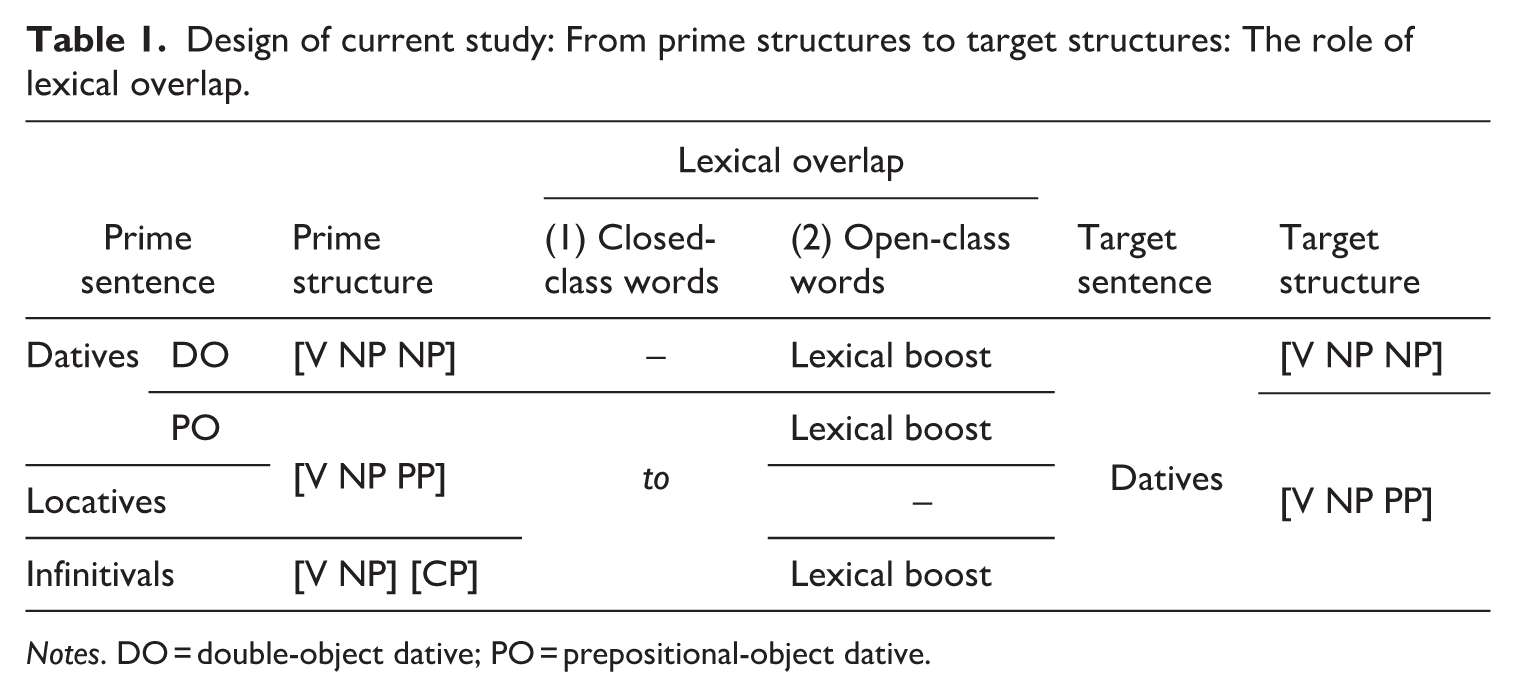
Notes. DO = double-object dative; PO = prepositional-object dative.
As for priming within datives, we test for priming from DO datives and PO datives to dative target sentences in order to assess to what extent the structure of DO datives ([V NP NP]) or PO datives ([V NP PP]) carries over from prime to target sentences. In addition, we examine priming to dative target sentences from locatives ([V NP PP]), on the one hand, and adjunctive structures in infinitivals, on the other. Infinitival to-clauses like ‘The man brings the apple to eat’ are either noun-level adjuncts to direct objects of transitive verbs (V [NP [CP]]) or clause-level adjuncts ([CP[IP [V [NP]]] [CP]]). 5 Next to effects of prime structure, we test effects of lexical overlap. We examine effects of lexical overlap between prime and target sentences in two ways: In a first step, we test whether lexical overlap in closed-class function words (‘to’) between to-locatives, to-infinitivals and to-datives occasions structural priming to datives in the presence of shared syntactic structure (locatives) or its absence (infinitivals). This way, we can assess whether syntax constrains structural priming. In a second step, we test for additive lexical boost effects of the verb to assess whether within and across-structure priming is susceptible to lexical overlap in the verb. 6 We use lexical boosts as an index as to whether structures are related in representation through common lexical heads in structural priming. If lexical boosts hold between infinitivals and datives in some groups, then infinitivals and datives share some structural representation. We pose the following research questions:
Research question 1: Does shared syntactic structure constrain structural priming in L1 and L2 speakers?
For L1 speakers, we expect to replicate and extend the findings by Bock and Loebell (1990) in that structural priming should hold within datives and to datives from the syntactically similar locatives, yet not from the syntactically different infinitivals despite surface word order overlap and lexical overlap in closed-class words (‘to’). Further lexical verb overlap between prime and target sentences (‘The man brings the apple to eat’→‘The man brings the cake to the girl’) should not lead to a lexical boost effect in priming from infinitivals to datives in native speakers, because the verbs do not head the same structure.
For L2 speakers, we predict the native pattern if syntax constrains structural priming. However, if L2 priming is more susceptible to lexical form overlap, then priming could hold from and to datives, including from the syntactically dissimilar infinitivals. Such priming may be driven by overlap in closed-class words (‘to’) and, correspondingly, in surface word order, which would suggest that explicit memory of the prime sentence’s form carries over to the target sentence, even when prime and target sentence differ in their syntactic structure. In addition, lexical overlap between the verbs in infinitivals and datives may further boost priming. Over and above indicating that priming involves explicit memory, such additive lexical boosts could suggest that L2 speakers connect infinitival and prepositional object complements to some kind of common structural representation.
Research question 2: What is the role of proficiency in structural priming among L2 learners?
As per the developmental model of bilingual structural priming (Hartsuiker and Bernolet, 2017), we predict that lower-proficiency L2 learners may be more susceptible to lexical form overlap in structural priming, because they rely on explicit memory to greater degrees than higher-proficiency L2 learners (Coumel et al., 2024). In consequence, they should be more susceptible to priming from other structures to datives than higher-proficiency learners. We further explore whether lexical boost effects of the verb change across L2 proficiency.
V Participants
We recruited 80 native speakers of English and 80 native speakers of German who were L2 learners of English via Prolific. Since the L2 learners on Prolific uniformly had very high proficiency scores, we additionally recruited 70 native speakers of German with a wider range of proficiency from the student population at a German university. Of the participants from Prolific, 12 were excluded because their L1 was not actually English or they were bilingual with English and German from birth. Two were excluded due to incomplete responses. Of the university participants, 10 were excluded because their L1 was not German or they were bilingual with English and German from birth, and one participant was excluded due to incomplete responses. For the remaining 68 L1 English and 144 L2 English participants, Table 2 lists their background characteristics. As an objective measure of their English proficiency, the participants completed the LexTALE task, an untimed, standardized 60-item vocabulary size task that has high correlations with standardized proficiency measures (Lemhöfer and Broersma, 2012). In addition, they completed the LEAP-Q questionnaire (Marian et al., 2007) that included self-ratings of their proficiency in speaking and understanding English.
Participant characteristics by group: Means (standard deviations in parentheses).
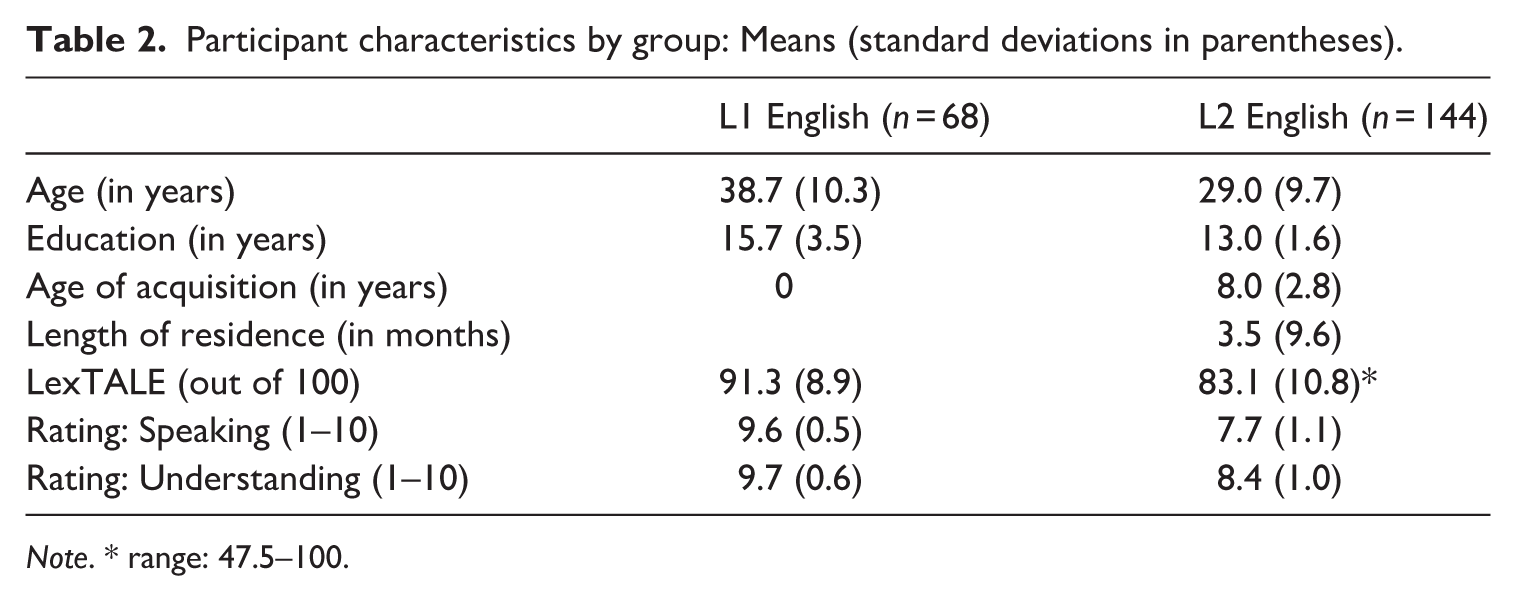
Note. * range: 47.5–100.
VI Materials and methods
We constructed prime-target sentence pairs for four alternating dative verbs (bring, mail, sell, send), four locative verbs (carry, move, push, shove) and four intransitive verbs (drown, laugh, walk, yawn). All ditransitive verbs expressed transfer-of-possession events and required a theme and a recipient argument. These verbs were used in sentences with 16 animate referents as agentive subjects and recipients (artist, boxer, clown, cowboy, dancer, doctor, farmer, monk, pirate, policeman, professor, sailor, soldier, swimmer, thief, waitress) and 16 inanimate referents as themes (apple, banana, ball, book, cake, carrot, computer, guitar, hat, key, knife, letter, postcard, present, purse, spoon).
For each verb in the target sentence, we created sets of prime sentences. Example (1) illustrates the design for the set of prime sentences that occurred with the target sentence ‘The artist sells the knife to the sailor’ in (2). Half of the sets had lexical overlap between prime and target verbs, and half did not (as in (1)). 7 The nouns never overlapped in prime and target sentences (for all materials, see Table S1 in supplemental material).
The prime sentences were matched to displays of black-and-white drawings of intransitive events (for 1a) or transfer of possession events (for 1b-e), adapted from previous studies (Ivanova et al., 2012). For the transfer events, the pictures showed the agent referent and the recipient alternatingly on the left or the right, and the theme object in the middle of the display (see Figure 1, left panel). For the infinitival prime sentences, the recipient was removed from the pictures, which were otherwise identical to the pictures for (1b-d). The prime sentences were spoken by a female native speaker of American English at a moderate pace with neutral intonation. In the experiment, the participants listened to the prime sentences once. After the audio track of the prime sentence had ended, the screen changed to show the display and participants made a yes/no verification response as to whether the picture provided an accurate depiction of the event expressed in the sentence. For half of the prime sentences, the pictures matched the event described; for the other half, one character was different or the event was reversed (as in Figure 1, left panel).
For the target sentences, participants saw pictures with different referents and objects. The bare form of the target verb was printed in capital letters below the sentence (see Figure 1, right panel). The displays for the target sentences varied the order of the referents, with half of the displays having the recipient on the left, and half on the right (as in Figure 1).
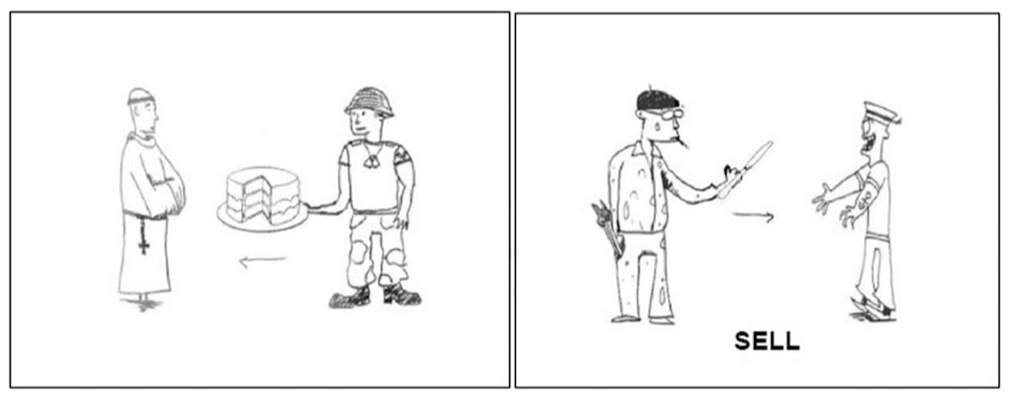
Display for verification of prime sentence ‘The monk brings the soldier the cake’ (left), and display for target sentence (right).
Each target verb was used eight times, four times with the same prime verb in the lexical overlap conditions, and once with each different prime verb. This resulted in 32 experimental prime-target sentence pairs. Each condition had four items, one with each verb. In addition, 40 prime-target pairs were used as fillers. Sixteen presented prime sentences with intransitive verbs or passive prime sentences with monotransitive verbs (hit, kiss, pull, reprimand, scold, touch) and monotransitive verbs in the target sentences (chase, follow, punch, pursue, push, shoot), and 24 further sentences had intransitive verbs in both prime and target sentences. As in the experimental sentences, half of the verification pictures in the fillers corresponded to the event expressed in the prime sentences. All sentences were spread across four lists, with the order of presentation being pseudorandomized in blocks that ensured that experimental items and conditions did not follow each other. Each participant received one list, so that one participant encountered every prime-target sentence pair, but did so in only one prime-target combination in (1 and 2).
VII Procedure
All participants took part in the study via a web browser. The study was set up in Qualtrics, and participants were directed to the study from Prolific or logged directly onto the site in Qualtrics. The software’s selection criteria ensured that participants used desktop computers with keyboards and had audio equipment. Before taking the main experiment, the participants completed the LexTALE proficiency task and the LEAP-Q language background questionnaire. For the main experiment, they received instructions that explained that they would listen to sentences, then judge whether a picture presented afterwards corresponded to the event expressed in the sentence. Subsequently, they would see a picture with a verb printed underneath and were to use this verb to describe the event shown in the display by typing into a textbox presented below the display. They were told that there was no time constraint and that they should use all referents and objects depicted in the display in their descriptions. All instructions and descriptions were in English. Two practice prime-target pairs with written explanations and model target sentences followed. The two practice items used an intransitive and a monotransitive verb, respectively. Additionally, the participants received an explanation that they would occasionally see memory probes, i.e. pictures of events, and had to click buttons to indicate whether they had seen the picture before. The memory probes served the purpose of distracting participants from the nature of the task. The participants then took the main experiment. Each prime sentence was presented auditorily. One second after the end of the audio, the screen changed to display the verification display, and participants made the yes-no response by selecting the corresponding radio buttons. Then, the target display was presented, with the verb printed below it and a text box for the participants to type the sentence. Participants submitted their response by hitting the Enter key or by pressing a ‘Next’ button. Afterwards, the presentation of the next trial would start. Following the experiment, participants were asked to indicate if they had encountered any technical difficulties, and they were redirected to Prolific for reimbursement. The full session took around 50 minutes on average. All participants gave informed consent before participating, the study followed the Helsinki Declaration of 1975, as revised in 2008, and had ethics approval by the German Society for Linguistics (DGfS laboratory vote 2023–04).
VIII Results
The participants’ responses were downloaded from Qualtrics as .csv files and submitted to a customized Python script which used the TreeTagger software for English (Schmid, 1994) to provide Parts of Speech tags and a preliminary classification of the sentences into DO datives, PO datives or OTHER structures. A description was scored as a DO (dative) structure if the sentence had an NP-V-NP-NP order. A PO (dative) structure was assigned if the sentence had an NP-V-NP-P-NP order. Sentences with verbs different from the ones printed below the pictures, with transitive or other uses of the verb were classified as ‘other’, along with incomplete or missing sentences. The script output was exported and manually cross-checked for accuracy by the first author. The data were imported into R (version 4.3.1), and all analyses were done using mixed-effects logistic regression models, using the glmer function in the lme4 (version 1.1-30) and lmerTest (version 3.1-30) packages. All models were run for the dependent variable of PO-structures produced out of all PO or DO-structures produced. They had the maximal random-effects structure permitted by the design, and we used the ‘order’ command in the package buildmer (version 2.8), combined with the bobyqa optimizer, to identify the maximal model that converged.
In total, there were 6,748 responses, comprising 158 ‘other’ responses. The remaining responses consisted of 1,575 DO structures (23.9%) and 5,012 PO structures (76.1%). Figure 2 presents a breakdown of the PO structures by condition and group. ‘Other’ responses were excluded. For full results, including ‘other’ responses, see Table S1 in supplemental material; for all data and scripts, see https://osf.io/f9qr3. Specifically, Figure 2 plots the proportion of PO responses in the baseline (intransitive) condition and then shows the difference in PO responses in the other conditions relative to the baseline to illustrate the priming effects.
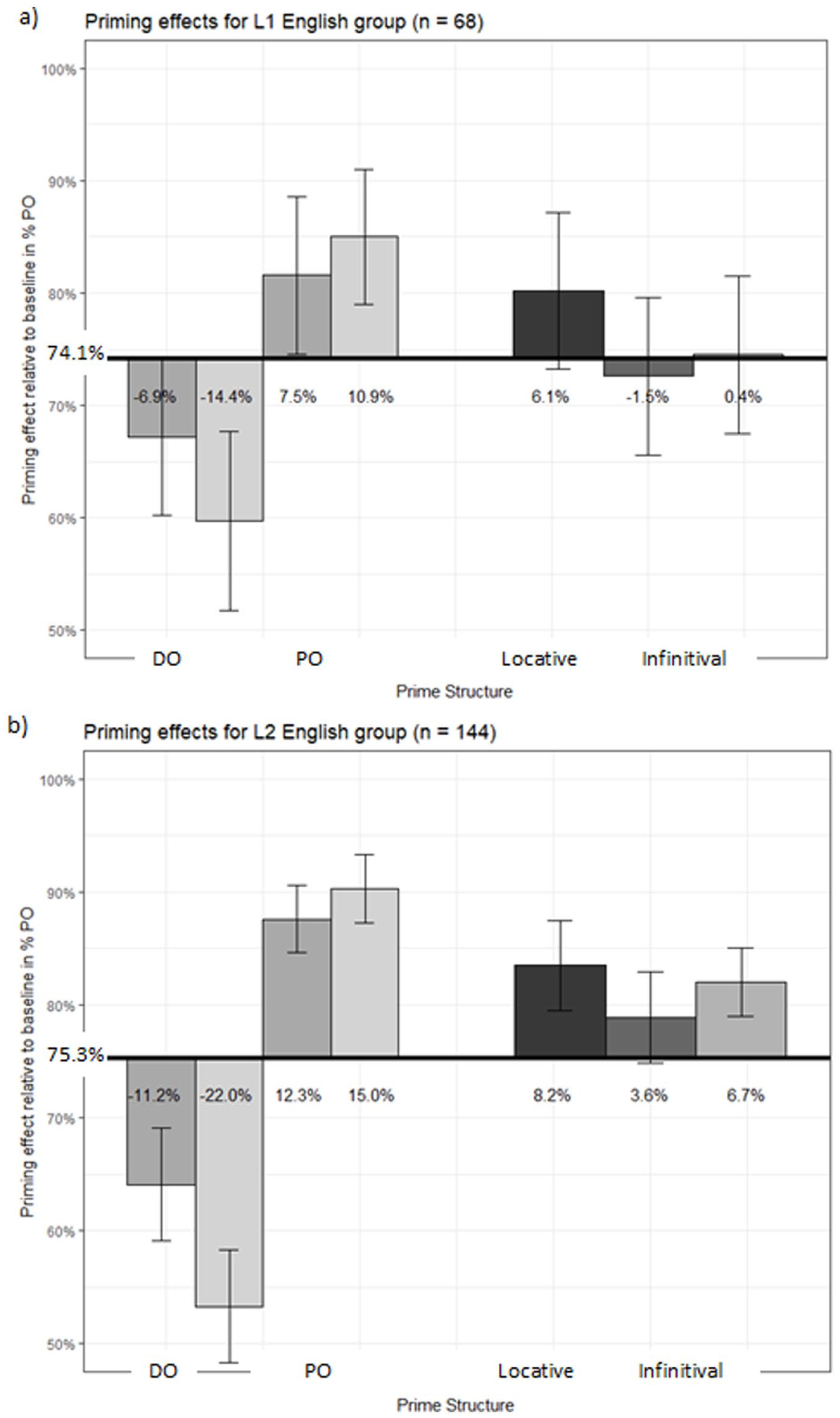
First language (L1) and second language (L2) English groups: Priming effects by group and condition in proportion of prepositional-object (PO) structures produced relative to intransitive baseline (horizontal line). (a) Priming effects for L1 English group (n = 68). (b) Priming effects for L2 English group (n = 144).
Even in the intransitive condition, both groups gave a majority of PO responses, which may be partially due to the overall low number of DO structures in the experiment. Compared to the intransitive baseline, both groups showed priming within datives, namely DO priming, with fewer PO responses, and PO priming, with higher PO responses. Lexical overlap only boosted DO priming, partially because PO responses were already very high, which left less room for additional lexical boosts. Both groups also showed priming to datives from locatives, with PO responses after locative primes at levels close to after PO primes. For infinitival primes, each group showed only small increases in PO responses, and even the L2 English group had lower levels of PO responses compared to PO or locative primes, even under lexical overlap.
To address research question 1, we ran a model containing Language as a fixed between-subject effect (contrast coded), Prime (treatment coded, with Intransitive as the reference level) and Overlap (treatment coded, with no overlap as the reference level) as within-subject fixed effects. This model returned simple effects of PO primes (ß = 0.66; SE = 0.30; z = 2.22, p = .026) and locative primes (ß = 0.75; SE = 0.29; z = 2.55, p = .011), while neither the effect of DO primes (ß = −0.29; SE = 0.28; z = −1.02, p = .307) nor the effect of INF primes (ß = 0.07; SE = 0.28; z = 0.24, p = .812) was significant. These findings suggest that there is abstract priming for PO datives and locatives across groups, yet not for DO datives and infinitivals. As for lexical overlap, only the interaction of DO primes and lexical overlap was significant (ß = −0.88; SE = 0.33; z = −2.65, p = .008), which shows that both groups produced more DO datives relative to the intransitive baseline under lexical overlap. No other effects or interactions reached significance, including any involving the between-subject factor language (for full model outputs, see Table S2 in supplemental material). By-group models confirmed the omnibus analysis in that each group showed PO and DO priming (at least under lexical overlap) as well as locative priming, yet no priming from infinitivals (see Tables S3a and S3b in supplemental material).
To address research question 2, we assessed effects of proficiency in the L1 German group. Figure 3 plots the proportion of PO responses by prime structure according to the LexTALE score. As for priming within datives, that is higher or lower production of POs compared to the baseline intransitives, shown in black, both DO and PO priming held across the proficiency range, with DO priming effects being larger at lower proficiency and PO priming effects being larger at higher proficiency. These differences partly stemmed from an overall strong tendency towards PO responses at lower proficiency, which limited the room for additional priming towards PO. At lower proficiency, DO priming was greatly enhanced by lexical overlap, while lexical overlap boosted PO priming at higher proficiency. For PO priming at lowest proficiency, the strong overall PO preference again limited potential lexical overlap effects.
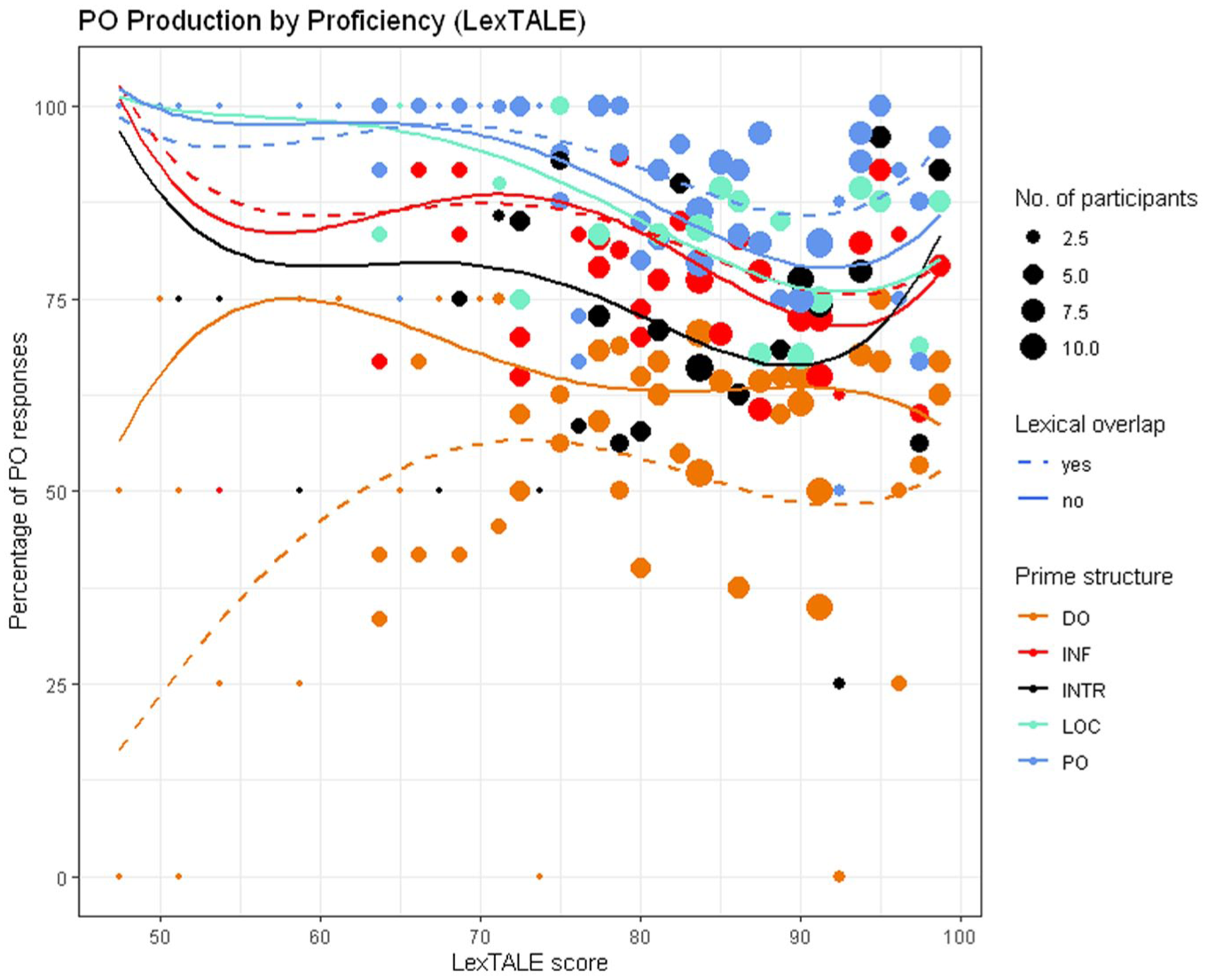
Second language (L2) English group: Proportion of prepositional-object (PO) dative responses by prime structure according to the LexTALE score (n = 144).
As for priming to datives, locatives showed more PO responses than the baseline across the proficiency range, except for the high end, where locatives converged with the baseline. For infinitival primes, PO responses were also comparable to the baseline at high proficiency, but were higher than the baseline as proficiency drops. Again, the overall trend towards PO responses at the lowest proficiency attenuated this PO priming effect for infinitivals. Unlike for dative primes, lexical overlap between verbs in the infinitival primes did not enhance PO responses in any proficiency range.
Descriptively, Figure 3 suggests that priming patterns changed depending on L2 proficiency. At the low end of proficiency, learners seemed to resort to an overall PO preference. At the same time, they showed large lexical boost effects for DO priming. In the mid-proficiency range, learners showed DO priming for DO datives, PO priming for PO datives and locatives as well as infinitivals. At the high end, learners showed dative priming only, yet no PO priming to datives following locatives or infinitivals.
Due to the non-linear effects of proficiency across different structures and the uneven spread of participants across the proficiency range, we opted to group the participants into proficiency groups for further analysis. Such a grouping also preserves sufficient statistical power in testing for structural priming and moderating effects of lexical overlap (Mahowald et al., 2016). Since proficiency is a multifaceted construct, we followed recent proposals to capture proficiency across more than one dimension, while safeguarding against multicollinearity of predictors (He et al., 2025). Using the procedure and script in He et al. (2025), we ran a principal component analysis (PCA) on the objective proficiency measure, the LexTALE score, the subjective proficiency measure, namely the average of the self-ratings for speaking and understanding English, and an exposure measure, the length of residence in English-speaking countries (Table 1). Run in the stats package in R, the PCA on these three variables returned two principal components, with LexTALE scores and self-rating predominantly loading on the first component (PC1), and length of residence loading most on the second component (PC2; Table S4 in supplemental material). We then used the scores of the two principal components as proficiency measures in a non-hierarchical cluster analysis to identify proficiency groups by means of the kmeans function from the stats package. This function iteratively assigns participants to clusters and minimizes the differences within each cluster. Its output suggested that three clusters present the optimal cluster size. These clusters are visualized in Figure 4 relative to the two principal components, namely, PC 1 on the x-axis and PC2 on the y-axis. In Figure 4, the numbers of the participants correspond to their rank according to their LexTALE scores (from lowest to highest). As can be seen, by adding more proficiency measures, participants are grouped in terms of commonalities on various dimensions, rather than just along one proficiency measure, such as the LexTALE.
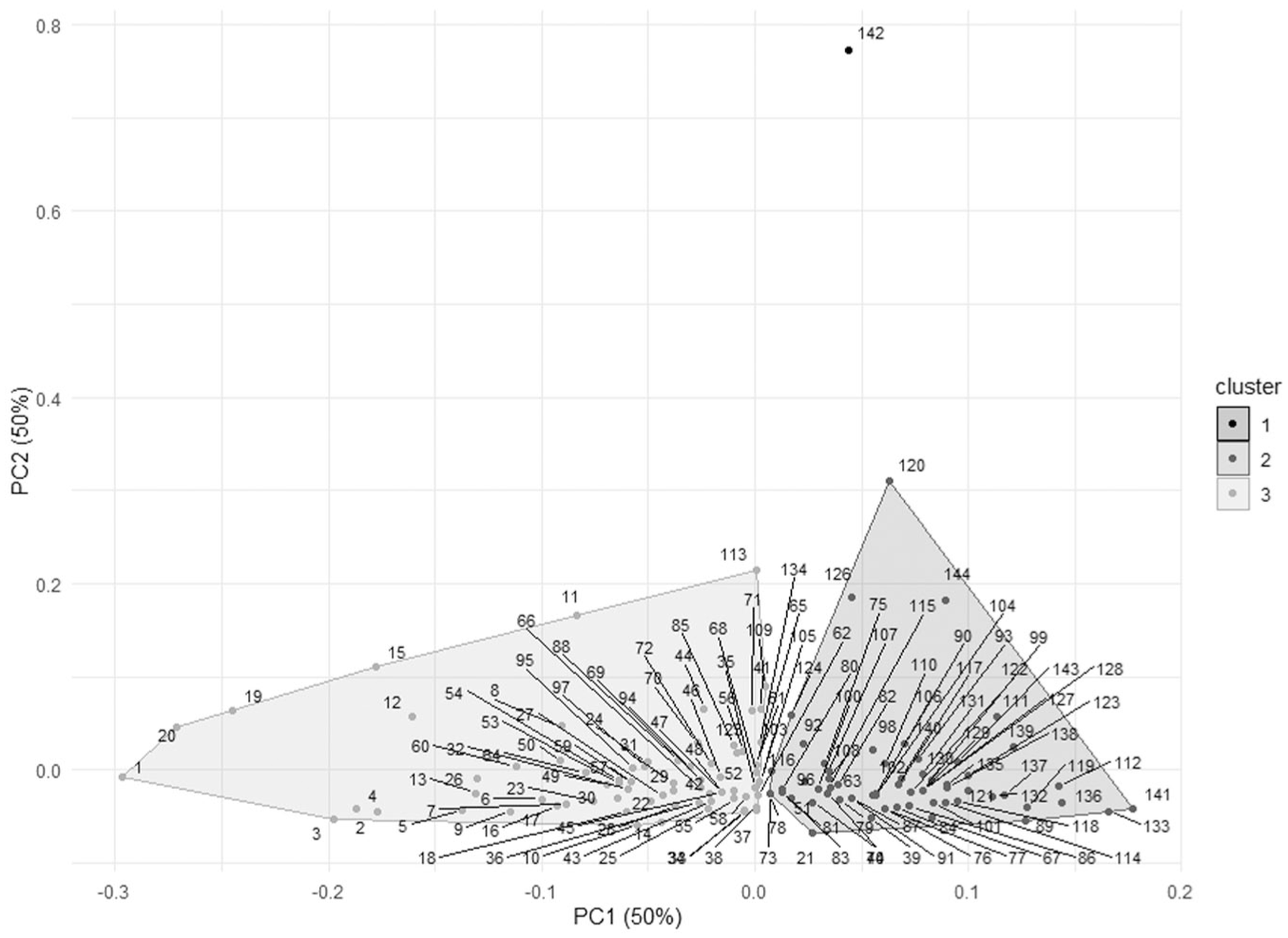
Result of cluster analysis for second language (L2) English participants (n = 144).
Figure 4 illustrates that the clusters mainly differ along the first component. Cluster 1 consists of only one participant, namely a learner with a very long length of residence in English-speaking countries (8 years). We decided to group this participant with Cluster 2 due to their location with regard to the first component. As a result, we obtained two proficiency clusters, the lower-proficiency cluster (n = 76, Cluster 3) and the higher-proficiency cluster (n = 68, Cluster 2).
We ran subsequent groupwise analyses of the priming data on these two clusters with Prime (treatment coded, with Intransitive as the reference level) and Overlap (treatment coded, with no overlap as the reference level) as within-subject fixed effects and all random factors permitted by the design. 8 Figure 5 shows the priming effects by prime structure and cluster (for raw data, see Table S1 in supplemental material). Learners in the lower-proficiency cluster showed priming within datives for DO and PO primes. They also demonstrated priming to datives from both locatives and infinitivals. In contrast, learners in the higher-proficiency cluster only showed priming within datives after both DO and PO primes, yet no priming to datives from locative or infinitival primes. Across both groups, lexical boost effects held only for DO datives. The models in Table 3 support these descriptive observations.
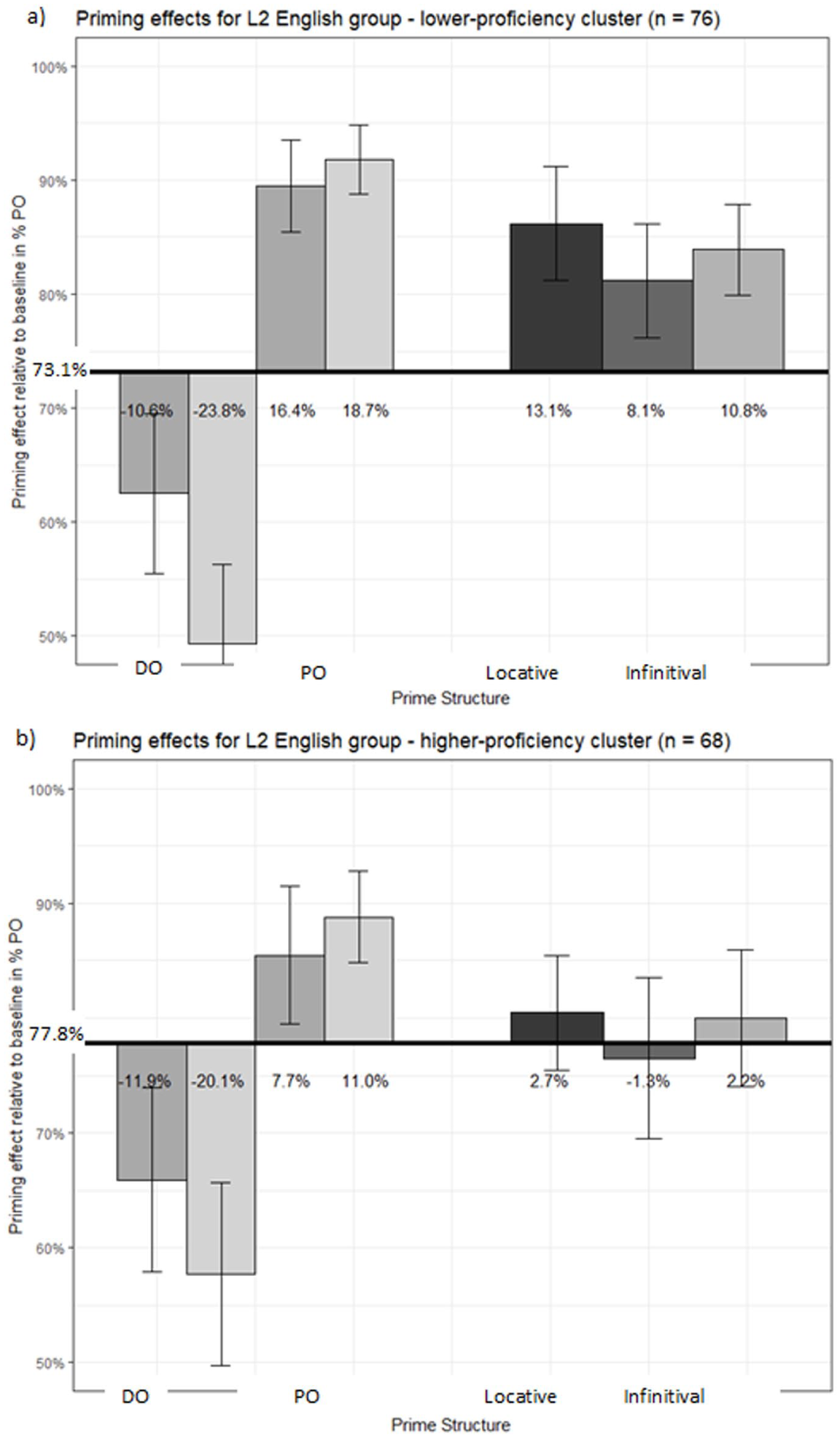
Proficiency clusters: Priming effects by group and condition in proportion of prepositional-object (PO) structures produced relative to intransitive baseline (horizontal line). (a) Priming effects for second language (L2) English group: Lower-proficiency cluster (n = 76). (b) Priming effects for L2 English group: Higher-proficiency cluster (n = 68).
Model outputs by proficiency cluster (Significant effects in bold print).
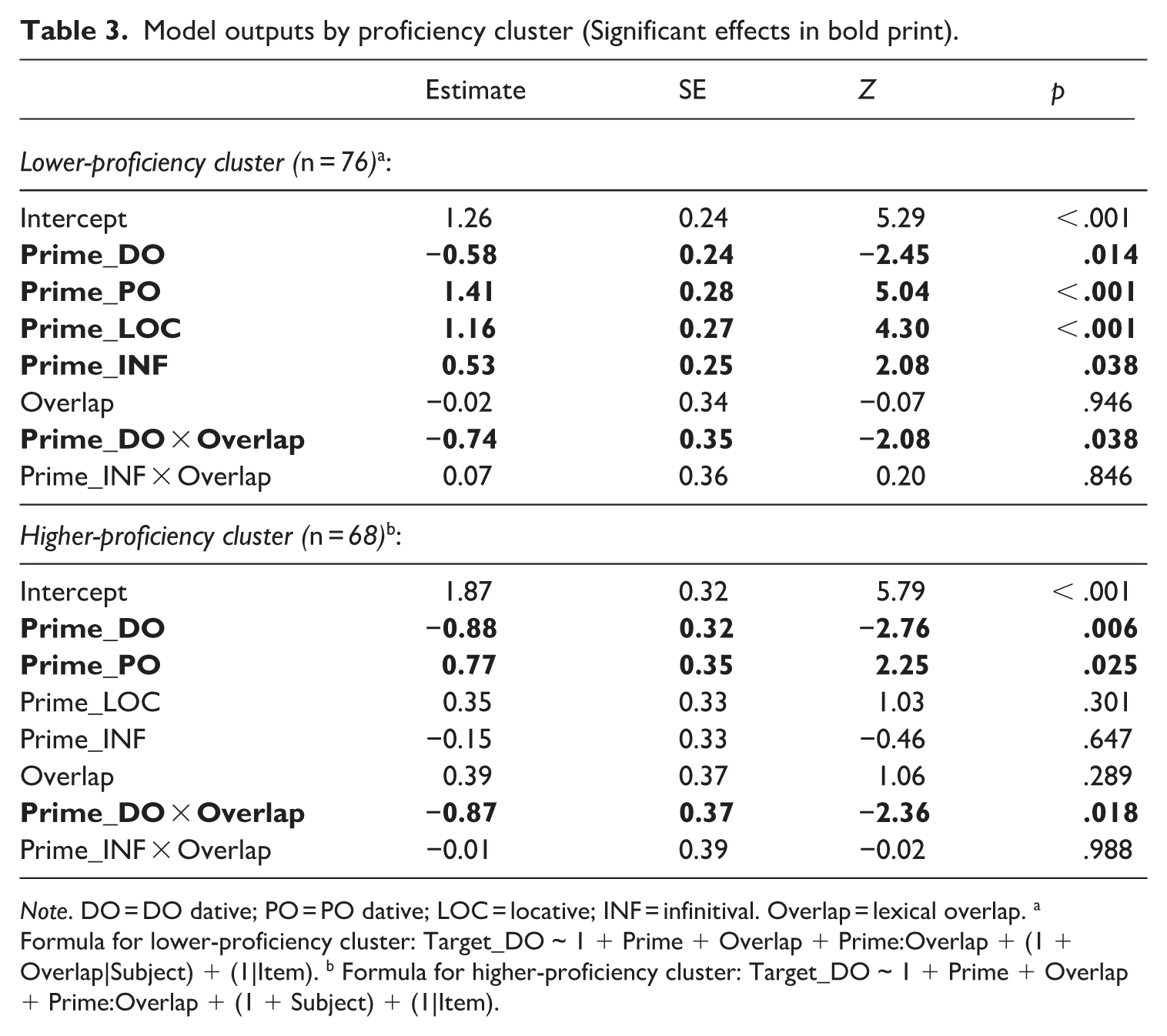
Note. DO = DO dative; PO = PO dative; LOC = locative; INF = infinitival. Overlap = lexical overlap. a Formula for lower-proficiency cluster: Target_DO ~ 1 + Prime + Overlap + Prime:Overlap + (1 + Overlap|Subject) + (1|Item). b Formula for higher-proficiency cluster: Target_DO ~ 1 + Prime + Overlap + Prime:Overlap + (1 + Subject) + (1|Item).
In sum, the experiment showed that the priming patterns of the L1 English and the L2 English groups did not differ from each other at the group level. However, when we took into account proficiency differences among the L2 learners, the priming patterns varied between lower-proficiency and higher-proficiency learners. The lower-proficiency L2 learners showed full priming within and to datives. In contrast, the higher-proficiency L2 learners had priming only within datives, yet they exhibited no priming from either locatives or infinitivals to datives.
IX Discussion
This study explored syntactic constraints on structural priming in L1 and L2 speakers of English. Building on the logic in Bock and Loebell (1990), we tested whether and under which conditions priming within English datives extends to priming to datives from superficially similar, but underlyingly syntactically different structures.
Using an improved and extended design as well as current statistical analyses, the present study replicated the original results in Bock and Loebell (1990) for L1 English speakers. Locative structures occasioned PO dative priming, while infinitival clause structures did not. Like PO datives, locative verbs also take a prepositional complement with the preposition ‘to’ that follows the direct object. In consequence, PO priming could also reflect shared lexical or phrasal content, rather than underlying structural similarities. However, there was no PO-dative priming from infinitivals that also share lexical content with PO datives. Crucially, lexical verb overlap did not have any effect on priming from infinitivals to datives, even though it did enhance priming within datives. The absence of priming from infinitivals to datives indicates that structural priming does not cross syntactic structures even under considerable lexical and surface overlap. These results confirm that structural priming is syntactic priming.
For non-native speakers, the group-level analysis returned a comparable priming pattern. Yet, when proficiency differences were factored in, L2 speakers demonstrated different priming patterns. For the higher-proficiency cluster, priming held only within datives, and neither locative nor infinitivals primed to datives. In this respect, priming was fully syntactically constrained in that it was limited to datives and did not extend to the syntactically comparable locatives. One potential reason for the narrower priming pattern in the higher-proficiency L2 speakers might be cross-linguistic influence from their L1, German. On the assumptions of the developmental model of priming that advanced L2 learners fully share abstract structures across languages (Hartsuiker and Bernolet, 2017), L1 German learners may disfavour priming from locatives to datives. In German, as in English, locatives are obligatorily formed using prepositional complements and thus overlap with the PO-dative. German datives, however, have a strong preference for the double-object structure, with the PO structure being marked and limited to some verbs (Kholodova and Allen, 2023). The strong DO bias of German datives may restrict PO-dative priming from structures that cannot appear in the DO structure that is prototypical for datives in German. In other words, because datives are almost always DOs and locatives are always POs in German, German speakers may separate datives and locatives to a larger extent. Such an account is in line with findings that L2 biases in verb complementation are affected by L1 structural preferences in high-proficiency L2 learners (e.g. Şafak and Hopp, 2023; Van Dijk and Hopp, 2025). Future studies could test L2 speakers of other L1s in order to test whether locative-to-dative priming holds at high proficiency among these speakers. In any case, higher-proficiency L2 learners did not demonstrate any structural priming across syntactically different structures.
For the lower-proficiency cluster, priming held within datives as well as to datives from both locatives and infinitivals. Within the L2, priming from locatives to datives was comparable in magnitude to priming within datives. In contrast, priming from infinitivals to datives was also significant, though somewhat smaller in magnitude than priming from locatives. Hence, structural priming occurred across two syntactically different structures in English for learners in the lower-proficiency cluster. This could be due to two reasons. First, such structural priming could indicate that L2 learners treat infinitivals and datives as structurally similar in representation. Second, priming could be occasioned by shared lexical and word order overlap in spite of structural differences. We discuss both options in turn.
Structural similarity between infinitival complement clauses and prepositional objects could be modelled within lexicalist residual activation models of structural priming. Here, structural priming follows from the activation of lexical heads, namely a verb like ‘bring’, whose activation then spreads to associated combinatorial nodes for the DO structure, (V → [NP NP]), or the PO structure (V→[NP PP]; see Pickering and Branigan, 1998: Figure 1). In these models, structural priming from locatives to PO-datives follows from locative and dative verbs connecting to the same [NP PP] node, while priming from infinitivals to PO-datives should not occur, because the infinitivals would not be connected to the [NP PP] node. However, the cross-structure priming found in the lower-proficiency cluster could indicate that the combinatorial nodes are not fully abstract but instead contain lexical content in intermediate stages of L2 learning. In other words, instead of linking verbs to a categorially abstract [NP PP] node, learners may initially connect them to a categorially underspecified but lexically indexed [NP to] node. Accordingly, priming from infinitivals to datives would occur thanks to them sharing a lexically indexed combinatorial node. In representation, these nodes would correspond to intermediate-level generalizations of constructions that combine abstract categorial features and lexically-specific content, as proposed, for instance, in construction grammar or related approaches (e.g. Croft, 2001; Goldberg, 1995).
However, the priming patterns observed in the present study do not provide support for such an analysis. Critically, priming from infinitivals to datives was not enhanced by lexical overlap in the verb as per the lexical boost. Lexicalist models capture lexical boost effects in that residual activation spreads from a verb to a combinatorial node and back to the same verb. The resulting activation is higher than if activation spreads across different verbs. In the lower-proficiency learners, the proportion of PO structures produced following infinitival primes was not close to ceiling, so that – unlike for the PO datives – there would have been room for additive lexical boost effects. Indeed, for DO priming, the lower-proficiency cluster demonstrated considerable lexical boosts. The absence of lexical boost effects in priming from infinitivals to datives thus speaks against an explanation according to which learners rely on a common lexically-indexed structure between infinitivals and datives. Specifically, the L2 learners in the lower-proficiency cluster do not appear to analyse the two structures as being headed by the same verb. In other words, they treat the two structures as syntactically different.
In consequence, the cause of priming from infinitivals to datives appears to be the result of lexical overlap in the word ‘to’ between infinitivals and datives. 9 At first sight, these findings seem comparable to results from L1 speakers reported in Bock and Loebell (1990: Exp. 2) that intransitive primes with locative prepositional by-phrases (‘The nymphs were bathing by the waterfall’) primed passive target sentences as much as passive primes with agentive prepositional by-phrases. Ziegler et al. (2019) demonstrated that intransitive primes with other locative prepositions (‘under’) did not prime passives, suggesting that the priming effect from intransitives to passives is due to lexical form overlap in the preposition. However, in these studies, lexical overlap held within the same syntactic structure, namely prepositional phrases. In the current study, lexical form overlap in ‘to’ occasioned structural priming, even though the word form ‘to’ belongs to different word classes in different syntactic contexts, namely, a particle in the verb phrase in an infinitival adjunct clause, on the one hand, and a preposition followed by a noun in a prepositional phrase in a dative complement, on the other. Structural priming from infinitivals to datives in the lower-proficiency L2 cluster thus seems to be narrowly due to local and surface lexical overlap between shared word forms in the absence of any sharing of syntactic structure in which these word forms are embedded.
Such low-level form-based effects in structural priming indicate that participants may recall specific formal aspects of the prime sentence from their memory which then facilitates reproducing these aspects in the target sentences (Ferreira and Bock, 2006; Pickering and Ferreira, 2008). Specifically, learners seem to recall ‘to’ as a lexical cue for postverbal structure and thus map the word order of a verb followed by a direct object and an infinitival complement clause to the surface-identical PO to-dative structure ([V N to X]). An explicit memory account also accommodates the finding that additional lexical verb overlap did not further boost the magnitude of priming. A verb form like bring in and of itself does not uniquely index the structure or order of its complements. It thus does not increase the retrieval of the sequence [V N to X] from explicit memory of the prime sentence. Taken together, the pattern of lexical overlap effects in the lower-proficiency cluster suggests that explicit memory of the prime sentence informs structural priming in L2 development to a degree that surface overlap can cause priming to cross syntactic structures, even when L2 learners do not appear to connect these two structures in representation. Hence, although not fully syntactically constrained, structural priming seems to operate over distinct syntactic structures in representation across L2 development.
We can relate the development of priming across proficiency in Figure 3 to the different stages within the developmental model of structural priming (Bernolet and Hartsuiker, 2018). At the lowest proficiency levels in this study, learners adopt a default preference for datives in the L2, namely the PO-structure (e.g. Jäschke and Plag, 2016; Mazurkewich, 1984; see also van Lieburg et al., 2023, for passives), and they demonstrate large lexical boost effects in DO priming. Bernolet and Hartsuiker characterize these learners as forming item-specific representations of L2 syntactic structures, which are stored in explicit memory and then copied from prime to target sentences (Stages 2 and 3; Bernolet and Hartsuiker, 2018: 209). In the mid-proficiency range, abstract priming emerges, suggesting that syntactic representations guide structural priming; yet, L2 learners continue to rely on explicit memory processes in language production that increase lexical overlap effects in priming (Stage 4). This reliance then seems to give rise to the pattern of across-structure priming from infinitivals to datives observed for the lower-proficiency cluster in the present study. As shown by learners in the higher-proficiency cluster, L2 learners then develop abstract structural priming in L2 development that is fully constrained by shared syntax across L1 and L2 (Stage 5).
Our developmental finding that structural priming spreads across different syntactic structures resonates with evidence in L2 sentence processing that adult L2 learners rely less on syntactic detail in sentence comprehension. Instead, they prioritize non-grammatical information in what has been termed shallow processing (e.g. Clahsen and Felser, 2006). As in structural priming, L2 learners at higher-proficiency levels come to integrate syntactic structure in sentence processing (for review, Hopp, 2022). These commonalities suggest that shallow processing, including across-structure priming, characterizes language processing up to intermediate stages of L2 learning, but does not reflect generally shallow grammatical representations in L2 learning.
At the same time, shallow across-structure priming via form-based overlap can lead to different generalizations for grammatical learning. On the one hand, learners can make syntactically supported generalizations, namely, when form and structure overlap. In this study, learners can successfully map the form of locative complements to the PO dative structure via structural priming, similar to how structural priming can allow L2 learners to generalize from questions to relative clauses (Hopp et al., 2026). On the other hand, learners can make erroneous generalizations, namely, when surface form and syntactic structure do not overlap. Such syntactically unsupported generalizations can impede learning of the L2 grammar or set it off on the wrong track. With English ditransitive verbs, the generalization from lexical overlap in ‘to’ from infinitival complement clauses to PO-datives, though grammatically unsupported, does not lead to non-target grammatical structures. However, with transitive verbs, the same generalization would lead to erroneous structures (‘She cycled to the boy’→* ‘She kicked to the boy’). Future studies should systematically delineate the scope of form-based across-structure priming in the early stages of L2 development to assess whether form-based generalizations via priming can explain learners’ errors in production. In addition, form-based overlap could lead to erroneous generalizations in cross-linguistic structural priming and thus occasion persistent effects of L1 transfer (e.g. Hopp and Grüter, 2023). Form-based generalizations may particularly prevail in the context of syntactic optionality and ambiguity where the L2 input does not reign in or rule out a form-based or L1-based generalization (e.g. Grüter and Hopp, 2021). Finally, it is key to investigate whether structural priming across different syntactic structures via form-based or lexical overlap is limited to L2 learning or whether it characterizes language learning in general.
In this regard, form-based structural priming also has implications for our understanding of historical language change. In the history of English, the PO dative emerged in English during the early Middle English period (Mitchell, 1985). While some accounts relate its emergence to language-internal factors, such as the loss of case distinctions that would grammatically distinguish direct and indirect objects by the end of the fourteenth century (e.g. McFadden, 2002), other accounts recruit psycholinguistic factors to explain its rise. For instance, based on corpus evidence, Kodner (2019) argues that the PO dative may have spread because child learners misanalysed prepositional datives as goal-datives and thus generalized their uses. Trips and Stein (2019) argue that language contact with Old French, which exclusively has PO datives, may have accelerated the emergence of the PO dative in English, especially within translations of texts created by bilingual French–English speakers (see also Elter, 2020). The present findings provide experimental support for psychohistorical accounts of language change in that learners, in our case low-to-mid proficiency L2 learners, can in principle spread a particular structure based on misanalyses of the input. More specifically, Middle English witnessed a concomitant rise in the to-dative and the to-infinitive in verb complementation in the fourteenth and fifteenth centuries (e.g. Los, 2005). Although these concurrent changes seem unrelated at first, the present study suggests a possible psychohistorical link by demonstrating that to-infinitives occasion structural priming of to-datives among language learners. The present findings by no means provide evidence of an actual facilitative cross-structure effect in the history of English; yet, they constitute proof of concept that across-structure priming based on lexical form overlap can change language production in language learners. Such modified output in language production then cycles back as input to other speakers and may thus further prime and accelerate the spread of innovations in a speech community.
In conclusion, the study finds form-based across-structure priming among L2 learners. Under lexical overlap, structural priming can cross syntactic structures in L2 development, even when learners do not entertain common grammatical representations for them. Such across-structure priming reflects learners’ reliance on explicit memory next to abstract structural priming in L2 development. By comprising structural and general mechanisms, structural priming in language use can thus spur both grammatical generalizations and grammatical innovations in individual and historical language development.
Supplemental Material
sj-docx-1-slr-10.1177_02676583261417943 – Supplemental material for Syntactic constraints on structural priming in L2 development: Effects of lexical overlap within and across structures
Supplemental material, sj-docx-1-slr-10.1177_02676583261417943 for Syntactic constraints on structural priming in L2 development: Effects of lexical overlap within and across structures by Holger Hopp, Duygu F. Şafak and Chantal van Dijk in Second Language Research
Footnotes
Credit author statement
Holger Hopp: conceptualization; methodology; investigation; formal analysis; writing – original draft preparation; writing – review and editing; funding acquisition; project administration. Duygu F. Şafak: writing – review and editing. Chantal van Dijk: writing – review and editing.
Declaration of conflicting interests
The authors declared no potential conflicts of interest with respect to the research, authorship, and/or publication of this article.
Funding
The authors disclosed receipt of the following financial support for the research, authorship, and/or publication of this article: This work was funded by the German Research Foundation (DFG) with grant 437487447, awarded to Holger Hopp, and was conducted within the Research Unit ‘Structuring the Input in Language Processing, Acquisition and Change’ (supported by the Deutsche Forschungsgemeinschaft with grant FOR 5157).
Ethical approval and informed consent statements
The study had ethics approval by the German Society for Linguistics (DGfS laboratory vote 2023–04). All participants gave informed consent before participating, and the study followed the Helsinki Declaration of 1975, as revised in 2008.

Supplemental material
Supplemental material for this article is available online.