




Abstract
Although German is described as adhering to a V2 constraint, restricting preverbal elements to one, corpus data reveal that V3 constructions systematically occur in everyday German, challenging the rigidity of the V2 rule. This discrepancy raises questions about the validity of V2 as a strict syntactic constraint, with significant implications for L3 acquisition. While L3 learners often produce V3 structures, these have been largely dismissed as errors rather than analysed for their potential functions. To date, little research has explored the functions that V3 might fulfil in L3 speakers’ language use. This article argues that both L1 speakers and L3 learners employ V3 structures for similar discourse-pragmatic and information-structural purposes, warranting a reconsideration of V3’s role in German. We present findings from a self-paced reading study with German learners at different proficiency levels, examining how V3 differs from V2 in sentence processing. The study identifies factors influencing processing strategies, particularly verb position and preverbal constituents. Our results suggest that V3 structures arise from information-structural and discourse-functional features of German, positioning these constructions as legitimate elements of the language. This work challenges the traditional V2 paradigm, advocating for a more nuanced understanding of German syntax and learner variation.
I Introduction
German declarative clauses are usually considered subject to the V2 constraint, which restricts the number of preverbal elements to exactly one. This element can be of almost any syntactic category (e.g. adverbial, subject, or object). Sentences with two constituents preceding the finite verb are often considered ungrammatical since they violate the alleged strict V2 rule and lead to a V3 structure.
(1) * Gestern Johann hat getanzt. yesterday Johann has danced ‘Yesterday Johann danced.’ (Roberts and Roussou, 2002: 137)
While examples as in (1) represent constructed examples with acceptability judgments being based on introspection, corpus data of actual language use reveals that these V3 patterns systematically occur in everyday German: (2) Auf einmal der Hund hat sich mies erschrocken. suddenly the dog has RFL badly scare ‘Suddenly, the dog was really terrified.’ (DEmo56FD_isD)
1
Many studies suggest that V3 sentences like in (2) fulfil a specific discourse-pragmatic and information-structural function (e.g. Bunk, 2020; Schalowski, 2017; Wiese and Rehbein, 2016). However, while V3 has been observed to occur frequently in the production of L3 2 learners, L3 acquisition research has not yet considered it as a structure that emerges due to such functions. Rather, it is categorized as a faulty word order variant to be overcome to obtain a target V2 rule. These perspectives from L1 usage 3 and L3 research lead to the following question: Is the rigid V2 rule, as the ultimate goal in acquiring German syntax, only a myth? We approach this question from the perspective of sentence processing and argue that V2 is not as strict as the literature suggests. Further, we argue that V3 fulfils functions, similar in both L1 and L3 German that might help learners acquire the functional properties of the preverbal area in German.
So far, the literature lacks studies devoted to the processing of V3 sentences in L3 German. This is surprising, given the large body of literature focusing on the processing of other word order variants such as object-topicalized V2 sentences (e.g. Hopp, 2010; Jackson, 2008; Kempe and MacWhinney, 1998; Schlesewsky et al., 2000) or scrambling phenomena (e.g. Dröge et al., 2019). Although V3 sentences are a systematic (structural) property of learner languages, little is known about their function in L3 German.
The present study aims to contribute to closing this research gap. It investigates whether V3 differs from V2 in processing and which factors influence processing strategies in V3 most: verb position or preverbal and/or sentence-initial constituents. We argue that the occurrence of V3 in both L1 usage and L3 acquisition can be best explained by considering functional features and information structure in the prefield; more specifically, we assume that German allows the (systematic) realization of both themes and frame-setting elements in the prefield, resulting in V3 sentences such as in (2). At the same time, the simultaneous usage of frame-setters and objects seems to be restricted since it rarely occurs in L1 usage or acquisition. Consequently, we assume that V3 in adverbial–subject–verbfin realizations are a common pattern among L3 speakers resulting from information structural, functional and discourse structural features rooted in the German language that is processed accordingly as integral parts of German grammar.
We will first sketch out the major characteristics of V2 and V3 sentences in German and highlight empirical findings on the usage of V3 in German. We show that German allows several surface V3 structures, which might contribute to the occurrence of V3 in learners. We then turn to the role of V3 sentences in L3 acquisition and L1 and L3 processing. The second part of the article comprises the outline and major results of our self-paced reading experiment with L3 learners, followed by a discussion and concluding remarks.
1 V2 and (surface) V3 in German declaratives
V2 is a well-studied feature of German(ic) syntax, where in canonical declaratives, the verb appears in the second position and the preverbal area (the so-called ‘prefield’; Drach, 1937) is occupied by exactly one constituent. Generative approaches have extensively discussed the syntactic structure of V2 languages, advocating the existence or lack of particular functional projections for different V2 sentence types. However, most accounts assume that German has an underlying verb last order; that is, SOVfin with a V2 feature (for an overview of the grammatical evidence, see Müller, in preparation).
In V2 sentences, the prefield is most frequently occupied by subjects (= SVfin), followed by adverbials (= AVfin) and objects (= OVfin; e.g. Bohnacker and Rosén, 2008). From a functional perspective, several studies highlight that the prefield either hosts thematic and rhematic constituents (Eroms, 2000: 355) and functions as the prototypical topic position (Frey, 2004) or is preserved for frame-setting elements (Speyer, 2010). Since, according to the V2 constraint, the number of constituents is restricted to one in the prefield, information-structural properties (Demske and Wiese, 2016) compete with each other for the initial position (topics and frame-setters).
However, numerous constructions seem to violate the V2 property. In this context, we distinguish between constructions with surface V3 on the one hand and actual V3 on the other. Surface V3 phenomena are, for example, left-dislocation (3a) or hanging topic (3b) constructions as well as sentences in which discourse markers (3c) or adverbials trigger (3d) V3 on the surface (Schalowski, 2017): (3) a. [Der Hund], [der] hat auf diesen Ball reagiert the dog it has to this ball reacted ‘The dog, it reacted to the ball.’ RUEG corpus (DEbi02FG_isD) b. Und [die Frau], [der Hund] ist an ihrer Hand and the woman the dog is on her hand ‘And the dog is on the hand of the woman’ RUEG corpus (DEmo11MD_isD) c. [Also] [gerade] ist hier was voll krasses passiert. DM just. now is here something really badass happened ‘Something really badass just happened here’ RUEG corpus (DEbi10MR_iwD) d. [Ehrlich gesagt,] [ich] halte es für eine Zumutung. honestly speaking I hold it for an impertinence ‘Honestly, I think it’s an impertinence’ (DeWaC corpus; Schalowski, 2017: 63)
In such sentences, the left peripheral elements are often analysed as part of a field preceding the prefield, that is, these cases do not constitute prefield phenomena but rather ‘pre-prefield’ phenomena. Just like the prefield, the pre-prefield relates to many functional properties. It hosts meta-communicative elements that fulfil purely structural functions (e.g. connectors), interactive, discourse-related units, and theme marking/theme highlighting expressions (Hoberg, 1997: 1580).
Although the patterns appear to have V3 on the surface, they are usually analysed as special instances or acceptable deviations from V2 due to their special functions. Consequently, they are considered grammatical and acceptable. Based on extensive qualitative and quantitative research on such phenomena, the deviating verb position in declaratives has been established to be systematic and functionally motivated, thus not violating V2.
The picture looks rather different for actual V3 patterns exhibiting an adverbial > subject > finite verb linearization (= ASVfin), as exemplified in (1). To date, ASVfin patterns have been predominantly described for Kiezdeutsch (Wiese, 2006), an urban contact dialect spoken in highly multilingual urban areas and major cities such as Berlin. Similarly, the pattern occurs in other urban contact dialects in northwestern Europe, for example, in Sweden (Fraurud, 2003; Kotsinas, 1992, 1998), Denmark (Quist, 2000), Norway (Opsahl, 2009), and the Netherlands (Appel, 1999; Meelen et al., 2020; Nortier, 2001; for a comparative analysis, see also Freywald et al., 2015). In addition, we find ASVfin patterns in Germanic contact varieties across the globe, for example, in American Norwegian (Alexiadou and Lohndal, 2018), American Danish (Kühl and Heegård Petersen, 2018), Heritage Icelandic in the US (Arnbjörnsdóttir et al., 2018), heritage German in Namibia (Wiese and Müller, 2018) and the US (Tracy and Lattey, 2010), and heritage Low-German (Rocker, 2022). There is also extensive work in V3 from a diachronic perspective. V3 has been attested for earlier stages of modern German, such as Old High German (Axel-Tober, 2007), Early New High German (Speyer, 2008), Middle Low German (Petrova, 2012) and V2 variation has been discussed extensively in the literature on English, for example, Old English (Van Kemenade, 1987), and Middle English (Bech, 2001; Westergaard, 2009). V3 has also been analysed for West Flemish (Haegeman and Greco, 2018), Norwegian dialects (Westergaard, 2009) and with specific adverbials, such as kanske (‘maybe’) in Swedish (Bohnacker, 2006). Considering the large number of varieties that exhibit V3, claiming that this structure results from incomplete acquisition or lapses in production seems too simplistic. Moreover, studies on V3 in these different varieties have interesting similarities regarding structure and function, especially regarding the role of pronouns and information structure (for a summary, see Bunk, 2020; however, arguing for a different status of V3 in heritage Norwegian in the USA, see Westergaard et al., 2021).
In present day German, V3 seems restricted to specific communicative contexts. ASVfin patterns predominantly occur in informal communicative contexts in both the German of monolinguals and the German of multilingual speakers (Bunk, 2020; Schalowski, 2017; Wiese et al., 2022), where they appear in spoken and less frequently in written discourse (Wiese et al., 2022). The structure is low in frequency, with 0.65% of all declarative clauses (126 out of 19,324 sentences) being V3 sentences in multilingual speakers in the Kiezdeutschkorpus (see Wiese and Müller, 2018) and even less in monolingual speakers (see Wiese and Rehbein, 2015; Wiese et al., 2022).
Despite their rare occurrence, V3 sentences exhibit similar grammatical and functional properties. We, therefore, argue that actual V3 sentences, as in (1), are systematic structures of German that follow specific and systematic linguistic features on several levels (Bunk, 2020; Schalowski, 2017; Sluckin, 2021 for an extensive overview; Wiese and Rehbein, 2016): the initial constituent is always an adverbial, preferably with temporal or locational semantics, while the second constituent is usually the subject. Objects hardly ever occur in the second position (= AOVfin) (Sluckin, 2021), which, according to Bunk (2020), is because second position constituents in V3 host continuing (= subjects) rather than contrastive topics (= objects). The rare occurrence of AOVfin patterns, as opposed to the systematic occurrence of ASVfin patterns in L1 usage, undermines the hypothesis that actual V3 sentences are not merely violations of a strict V2 rule (if this were the case, we would expect to find an equal distribution of both ASVfin and AOVfin patterns) but the result of information-structural properties. In ASVfin patterns, the sentence-initial adverbial is a frame-setter or discourse linker (Schalowski, 2017). Breitbarth (2022) reports prosodic boundaries between the first two constituents, while Bunk and Rocker (in preparation) report the absence of boundaries in many V3 sentences, correlating with the adverbial function. These functional properties of the preverbal area in V3 sentences mirror the function of the prefield in V2 sentences rather than the prefield of surface V3, which is the major difference between surface V3 and actual V3 from a functional perspective.
As already indicated, V3 might be motivated by a specific information-structural makeup (Wiese and Rehbein, 2016) and the preference of the prefield to host topical and frame-setting elements. While in V2 sentences, these two pieces of information need to be represented separately from one another (i.e. as AVfinS or as SVfinA), V3 allows for the simultaneous realization of both elements, and thus of two fundamental pieces of information at the beginning of the clause, without violating ‘the general V2 layout of the sentence bracket and topological fields’ (Wiese and Müller, 2018: 215). 4
In sum, V3 seems to be rooted in German grammar as a word order option that is particularly open, but not restricted, to the grammar of multilingual speakers. Further, no evidence indicates that V3 results from correcting a speech error (see Bunk, 2020), and V3 has been an option in Germanic languages for several centuries. Consequently, it is highly unlikely that V3 is merely a lapse in production.
So far, we have seen that although German is traditionally assumed to have a V2 property in declaratives (comprising SVfin, AVfin, and OVfin sentences), there are numerous examples of surface V3 patterns and systematic usage of actual V3 patterns (comprising ASVfin and, much more rarely, AOVfin sentences). Both integrate into the general layout of German syntax, fulfilling functional properties of the preverbal area while keeping the sentence bracket intact. In informal language, in particular, speakers use these patterns to convey specific meanings. There thus seems to be a competition between the functional possibilities of V3 sentences and the formal V2 property in German. This competition can be particularly well observed in L3 German learners and it might be enhanced whenever learners interact with L1 speakers outside the classroom and are confronted with linguistic variation in the input. 5 In the following, we take a closer look at the acquisition of the V2 property in L3 German and the role of V3 sentences in learner languages.
2 V2 and V3 in L3 German: Acquisition
Numerous accounts assume that the acquisition of verb position patterns (V2, V1, V-End) proceeds in successive developmental stages in L3 German, with SVX being the first pattern, followed by the emergence of the verb bracket, then the acquisition of the subject–verb inversion (V2-INV), and finally the verb-end position in subordinated clauses (Clahsen et al., 1983; Clahsen, 1988; Czinglar, 2014; Ellis, 1989; Grießhaber, 2006; Haberzettl, 2005; Jansen, 2008; Klein and Perdue, 1992; Schwartz and Sprouse, 1994; Vainikka and Young-Scholten, 1994). This gradual acquisition trajectory seems to be robust against factors like L1 (Clahsen et al., 1983; Haberzettl, 2005; Schwartz and Sprouse, 1994), age of acquisition (e.g. Czinglar, 2014), or degree of instruction (e.g. Clahsen et al., 1983 for ‘natural’ or uninstructed second language acquisition; Ellis, 1989 for instructed second language acquisition ) and is characterized by the existence of intermediate stages. Here, ASVfin sentences are among the most persistent non-canonical structures in the acquisition process and are consequently classified as independent acquisition stages in several studies (e.g. Clahsen et al., 1983; Dimroth et al., 2003).
The fact that ASVfin sentences are among the earliest systematic word order patterns in L3 German (Clahsen et al., 1983; Pienemann, 1998: 98–107) is a robust empirical finding explained differently depending on the theoretical preassumptions. While generative approaches assume that the acquisition task consists of raising the finite verb to the V2 position (e.g. Haberzettl, 2005), V3 is understood as the result of processability constraints during language acquisition within the framework of the Processability Theory (PT; Pienemann, 1998). PT assumes that language acquisition stages result from a (universal and incremental) processability hierarchy. Here, V3 sentences constitute stage III, which means exchanging information within instead of between phrases. Adverb fronting here fulfils pragmatic functions as, for example, a temporal or local alignment between sentences. Only when learners can exchange information between phrases (stage V in PT), fronted objects trigger V2-INV, which is assumed to be obligatory within PT (Pienemann, 1998: 103).
More functionally oriented approaches assume that word order patterns in learner languages generally follow information-structural principles. Dimroth et al. (2003), Dimroth (2004), Dimroth and Narasimhan (2012), Klein and Carroll (1992), and Klein and Perdue (1992), among others, assume that learners form topic-link-predicate structures (Dimroth et al., 2003) in the course of the so-called ‘Conceptual Ordering Stage’, in which the topic functions as an anchor point and thereby links the content of a statement to previous discourse elements. Only in the ‘Finite Linking Stage’ do learners link semantic and morphological finiteness with the help of the finite verb; the development of this stage is accompanied by a gradual development of a V2 rule (Dimroth et al., 2003: 84–88). This stage model is embedded in the basic assumption that given topics or givenness in general (Dimroth and Narasimhan, 2012; Klein and Perdue, 1992) are realized earlier in the sentence than focus (see also Bohnacker and Rosén, 2008; Carroll et al., 2000). In the Basic Variety postulated by Klein and Perdue (1992), this topic-focus structure principle, which gives rise to ASVfin sentences, provides the basis for the emergence of word order patterns. V3 sentences in learner languages contain sentence-initial adverbials that, for example, indicate the topic time and temporally embed an utterance (which corresponds to assumptions within PT; see above). They are thus part of the topic (Dimroth et al., 2003: 83) and are successively displaced by the emergence of a V2 rule. In this sense, V3 sentences would be an information-structural phenomenon that competes with a word order principle as a V2 rule.
The hypothesis that V3 sentences are discourse-immanently motivated is supported by a close look at the occurrence of V3 sentences in learner languages. Numerous studies on the acquisition of verb position variance point towards a – at least temporary – co-existence of target-like V2-INV and V3 sentences (e.g. Czinglar, 2014: 154; Klein and Carroll, 1992: 166, 184; Schlauch, 2022). According to Dimroth (2004), this co-existence of target and deviant structures mirrors the competition between information-structurally motivated principles of sentence structure and more rule-guided principles of the target language. This interpretation is strengthened when looking at different topicalization strategies in learner languages: Czinglar (2014: 151) points out, for example, that object-topicalized V2 sentences of the type OVfin occur quite early, but never as V3 sentences in the form of OSVfin or the like. From this, we can assume that it is not the fronting of (non-subject) constituents that triggers V3 but the function of the topicalized constituent. In OVfin sentences, the topic-first principle (e.g. Dimroth, 2004) is abandoned in favour of a pragmatically motivated focus, whereas in V3 sentences such as in (1) above, it is not. Thus, there are at least indications that V3 sentences in learner languages (also) seem to fulfil discourse functions in the sense that they stand for an aligned realization of frame-setters and topics in the prefield. Moreover, learner languages also seem to show a lack of AOVfin patterns. The systematic occurrence of ASVfin patterns and the non-occurrence of AOVfin patterns underpin the assumption that actual V3 sentences are systematic instances reflecting information-structural properties (see above).
Despite the partly very different explanatory approaches (‘rather formal’ vs. ‘rather functional’), all models of word order acquisition in German analyse V3 sentences exclusively against the background of a strict V2 rule and an obligatory V2 inversion whenever adverbials are fronted. This might be one of the reasons why V3 sentences are often associated with typical (erroneous) learner structures. This view, however, contradicts findings from L1 usage and studies looking at the processing of V3 sentences in German, as the following section will show.
3 V3 processing in L1 and L3 German
V3 has not only been analysed in detail in several corpus studies for L1 German (Bunk, 2020; Schalowski, 2017; Wiese, 2006; Wiese and Müller, 2018) but also with two acceptability judgment studies (Bunk, 2020; Burmester et al., 2016). From the perspective of language processing, Bunk (2020) discusses findings from a reading time study investigating the processing of V2 and V3 sentences. The study compares subject-initial and non-subject-initial V2 clauses (i.e. SVfin vs. AVfin vs. OVfin), V3 (ASVfin), and unattested V3 (AOVfin). 6 Three results from the study are particularly relevant to the topic of this article:
Overall, AOVfin sentences were read significantly slower than all the other sentences. ASVfin sentences did not differ from V2 sentences, indicating that verb placement (i.e. V2 vs. V3) did not substantially impact the overall processing but the preverbal constituents did.
The verb in ASVfin was read significantly faster than in AOVfin but significantly slower than in SVfin and AVfin. There was no difference in the reading times on the verb in ASVfin and OVfin.
Subjects in ASVfin were read significantly slower than objects in AOVfin, indicating processes of accessing V3 structures or constructions.
Based on these and several other findings, including an acceptability task indicating that ASVfin is judged to be more acceptable than AOVfin, Bunk (2020) concludes that ASVfin is processed as an integral part of German grammar in which ASVfin linearizations are structurally represented, while AOVfin linearizations are not. It is thus not the position of the verb alone that influences reading times, but predominantly the preverbal elements occurring in the prefield.
In L3 research, studies dealing with non-canonical word order patterns primarily focus on nominal constituents in the prefield in V2 sentences rather than investigating the processing of verbs in different positions. Numerous studies on OVfin sentences in German show that sentences with fronted objects (i.e. OVfin) are processed slower than canonical SVfin sentences, which can be explained by their rare occurrence (Bader and Häussler, 2010; Schlesewsky et al., 2000), a low cue validity of case markers in German (Kempe and MacWhinney, 1998), and a relatively strong N1 bias (first-noun bias) in both L1 speakers (e.g. MacWhinney et al., 1984; Schlesewsky et al., 2000) and L3 learners (e.g. Jackson, 2007). This N1 bias levels off in learners with higher proficiency (e.g. Jackson, 2008) and in learners with L1s that allow for word order variation more extensively than German (e.g. Slavic language; see Hopp, 2010).
Although the studies sketched out for L3 German do not focus on the processing of verb placement but look into word order variants concerning preverbal nominal constituents only, we see some parallels to the results of L1 processing studies on V3 in German. In both contexts, participants seem to struggle with OVfin and AOVfin contexts, while SVfin and ASVfin contexts have lower processing costs. We might conclude from this that the preverbal objects (both in first position in V2 sentences (i.e. OVfin) and in second position in V3 sentences (i.e. AOVfin) trigger higher reading times and seem to come along with a higher processing cost. From L1 studies, we might further conclude that it is not (only) the position of the verb but largely the position of non-topical nominal constituents (i.e. objects) that highly impacts processing strategies.
The present study builds upon these observations and investigates whether the verb position is a relevant factor when processing V2 and V3 sentences or whether it is rather preverbal and/or sentence-initial constituents that impact processing outcomes. Against this background, our study is a first attempt at exploring functional aspects of V3 structures in L3 learners of German.
II Present study
In the present study, we investigate whether there are processing differences between V2 and V3 sentences with varying preverbal and sentence-initial constituents (i.e. subjects, objects, or adverbials). This study aims to explore the discrepancy between production-based and processing-based studies sketched out above: Although numerous studies show that actual V3 sentences (i.e. ASVfin) systematically occur in L1 German and are among the most persistent structures in learner languages in L3 German, there is a lack of evidence on the processing of V3 sentences. Based on a processing account, we aim to contribute to answering the question of what function V3 sentences fulfil in L3 acquisition and whether they might be classified as independent variants following information-structural properties rather than solely defective structures or leaps to be overcome and displaced by a formal V2 rule. In pursuit of this goal, the study addresses the broader question of what role linguistic variation in general and word order variation in particular plays in L3 acquisition and processing.
Based on our observations, our study builds upon the following assumptions:
V3 sentences come with higher processing costs since they might compete with a general V2 rule L3 learners are constantly confronted with (both in terms of formal instruction and the input). We thus assume generally higher reading times in V3 sentences than in V2 sentences since participants might have difficulties building up a grammatical structure and assigning meaning to this structure.
Apart from the verb position (i.e. V2 vs. V3), preverbal elements strongly impact processing. More specifically, based on the large body of studies dealing with the processing of non-canonical sentences with preverbal objects, we hypothesize that it is not only the position of the verb that impacts reading times but also the preverbal element. Preverbal objects should generally lead to higher reading times than preverbal subjects or adverbials. Unattested V3 sentences of the type AOVfin should, given the assumption in hypothesis 1, thus lead to particularly high reading times. Concerning hypothesis 1, we thus assume generally higher reading times in V3 conditions and particularly high reading times in AOVfin conditions, unattested in German.
We assume an effect of language proficiency concerning both hypotheses 1 and 2: Despite the assumption that, across conditions, advanced learners should generally show faster reading times than intermediate learners since they are more familiar with processing German, we assume that advanced learners should have replaced the conceptual ordering stage by the finite linking stage (Dimroth et al., 2003) and are thus ‘irritated’ by V3 sentences in general and AOVfin sentences in particular. Expected effects formulated in hypotheses 1 and 2 should thus be more pronounced in advanced learners than in intermediate learners. We expect a greater difference between V2 and V3 sentences and particularly high reading times in AOVfin sentences in advanced learners.
1 Methods
To compare our data to L1 German, the study was designed based on Bunk (2020). We conducted a self-paced reading (SPR) experiment on a laptop using the software LINGER (version 2.88, developed by Doug Rohde). The experiment applied the moving-window technique (Just et al., 1982). By pressing the space bar, participants revealed one word at a time while the previous word disappeared. Reading time measurements started with each press of the space bar. Each word was presented separately except for the combination determiner + noun, which was presented as one unit.
We tested different V2 and V3 structures. The stimuli differed in the syntactic category of the preverbal constituents and were designed based on earlier studies on the grammatical features of V3, that is, the initial adverbials had temporal and locational semantics, while the subject was a pronoun. 7 Table 1 provides an overview of the stimuli.
Item structure in the self-paced reading study.
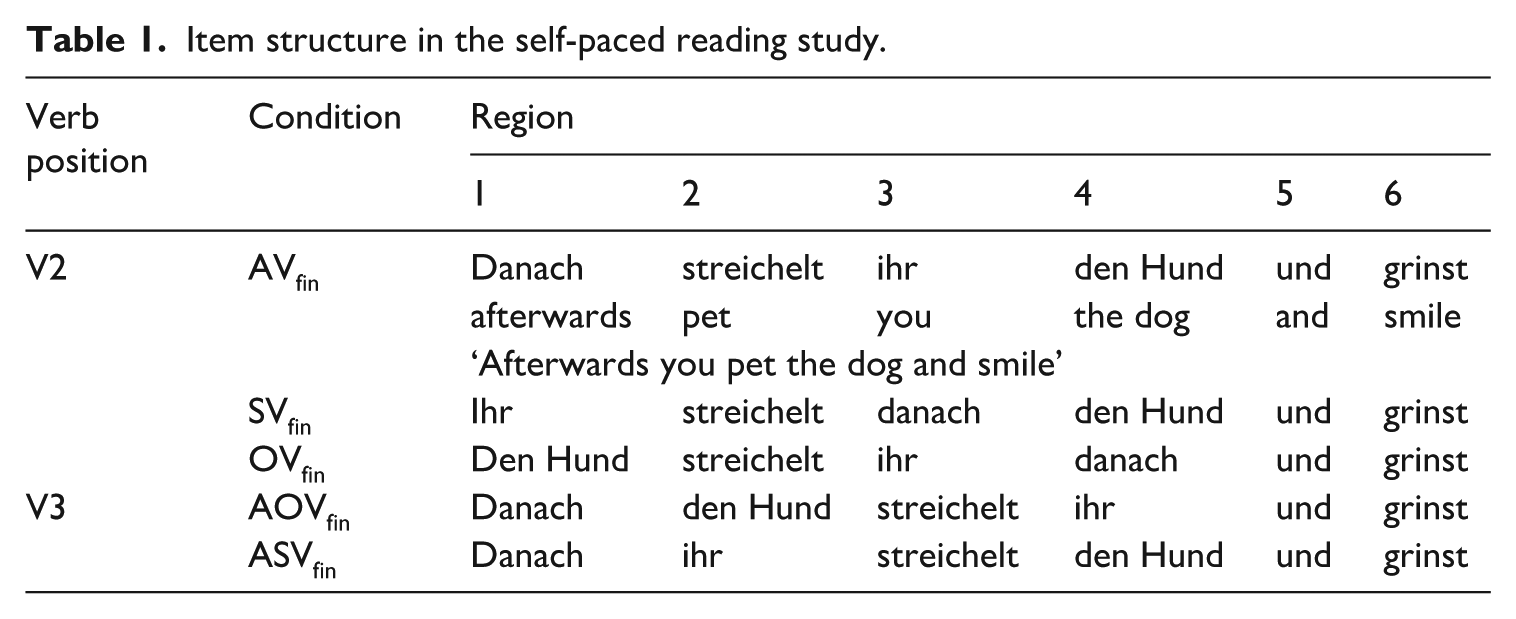
The lexical items chosen in the test items were matched with frequency lists of words for intermediate learners 8 only to include lexical items that can be expected to have been mastered by the participants. 9 We tested a total of 30 items. These items were distributed over five lists, using a Latin square design, with twice as many fillers as test items. Fifty percent of the fillers consisted of structures with agreement mismatches and word orders that differed from the target language (e.g. determiners following their head noun). Fifty percent of the fillers were grammatical structures.
Since V3 clauses exhibit a particular information structure in L1 German, namely frame-setter > topic > comment orders, we provided context sentences that motivated a frame-setting reading for the adverbial and a topic reading for the subject. An example is given in (4): (4) Context: Du siehst mit deiner Freundin einen süßen Hund und eine ernste Katze im Garten des Nachbarn. (‘You and your friend see a cute dog and a serious cat in your neighbor’s garden.’) Item: Nachher ihr streichelt den Hund und grinst. afterwards you pet the dog and smile ‘Afterwards you pet the dog and smile.’
2 Participants
Forty-six participants (34 female, 11 male, 1 diverse 10 ) took part in the experiment (mean age = 24 years; SD = 4). All participants attended a language course at the University of Potsdam at the time of testing. Twenty of them were attending an intermediate course and 26 an advanced course. Since the course assignment was based on a standardized placement test consisting of a cloze test, a reading and writing assignment, and an oral interview, no additional proficiency tests were administered for the experiment. Most participants (n = 35) learned English as their first foreign language; German was their first foreign language for only 8 subjects. For n = 24, German is the second foreign language; for n = 11, it is the third; and for n = 3, even the fourth. The participants had 14 different first languages, with 16 participants speaking a Slavic language as an L1 (Polish: n = 6, Russian: n = 8, Ukrainian: n = 1, Czech: n = 1), and 20 a Romance language (French: n = 5, Italian: n = 8, Portuguese: n = 2, Spanish: n = 5). The remaining participants’ L1s are Turkish (n = 3), Azerbaijani (n = 2), Farsi (n = 2), Hindi (n = 1), Greek (n = 1) and Finnish (n = 1). Eleven of the 46 participants stated that they had two or more first languages and are thus bilingual in a narrow sense. The average duration of acquisition of German is 48.5 months (min. = 6 months, max. = 96 months; SD = 33.25). We will turn to the potential influence of the other L1s in the discussion.
According to Wisniewski (2020), there is a high degree of variance among intermediate learners when it comes to mastering V2-INV, even though the majority seem to have acquired the pattern. To make sure that the participants have acquired V2-INV, they completed a written sentence completion test in addition to the SPR experiment, in which they had to form sentences using a given sentence-initial constituent (subject, adverbial, object) with the help of given words. V3 sentences with a sentence-initial adverbial were produced almost exclusively by intermediate learners and less so by advanced learners, but in only 11% of all cases. The proportion of ASVfin sentences was only 1% in advanced learners. Although the difference is significant (χ2(1) = 19.0809; p < .001), it can be explained by the fact that advanced learners, in principle, hardly ever produce V3 sentences. Given that intermediate learners also perform nearly at ceiling, the results of the sentence production test show that both groups master V2-INV in German, at least in a written test.
It is important to consider the previous acquisition context of the participants: On the one hand, L3 acquisition is highly controlled and most likely strongly norm-oriented, especially when it comes to acquiring the V2 property in German. An analysis of the textbooks used in the language courses (Netzwerk B1.1 and Mittelpunkt Neu B1/B2) showed that both textbooks used the topological field model to depict verb position in German. Both textbooks contrast V2 sentences (both with and without subject–verb inversion) with verb final clauses by highlighting the position of the verb within the examples, with a special emphasis on the second position of the verb in different contexts. Against this background, it should be kept in mind that our subjects’ awareness of verb position norms is quite high because it can be assumed that violations of the V2 principle are corrected both orally and in writing. The strong norm orientation to the V2 principle also reinforces the usage of formal verb position principles, which may displace information-structural verb position variants. On the other hand, all participants were in Germany for a longer period (at least 1 semester) for study purposes during the test. This means that some of them attended German-language seminars or lectures and most likely had contact with German-speaking peers (within and outside the university). Against this background, it would be implausible to assume that the input in German takes place exclusively under laboratory-like teaching conditions. Participants are likely confronted with different varieties of German in their everyday lives. Due to their proximity to Berlin, it is reasonable to assume that participants have contact with multilingual varieties, especially outside the German language classroom. This should be kept in mind when interpreting the results.
3 Procedure
The participants were first presented with detailed instructions before the pretest phase started. The pretest consisted of five test items and aimed at familiarizing the participants with the procedure and the material. After the participants completed the pretest phase, they started the experimental phase.
In both the pretest and the test phase, 25% of the items were followed by a question about the sentence’s content. All participants were asked to answer this question by pressing the green (‘yes’) or the red (‘no’) key on the keyboard. The answers were automatically evaluated, and the participants got immediate feedback on their answers (‘Correct’ or ‘Wrong’). Questions were not asked after each sentence to keep the duration of the experiment below 40 minutes to ensure that the participants stayed focused throughout the experiment. One session included eight breaks and lasted about 35 minutes.
4 Hypotheses and testing procedure
We aimed to test the following hypotheses:
Hypothesis 1: There is a main effect of verb position, that is, reading times of V3 sentences are higher than those of V2 sentences (V2 > V3), as well as an interaction between verb position and proficiency: we expect higher reading times in advanced learners in V3 conditions.
Hypothesis 2: There is a main effect of the preverbal element. That is, across conditions, reading times of preverbal subjects are expected to be lowest (i.e. SVfinO, ASVfin), while preverbal objects (i.e. OVfinS, AOVfin) are expected to be highest. Due to its canonicity, we expect comparable reading times for preverbal adverbials (i.e. AVfinS) concerning preverbal subjects. We also expect an interaction between preverbal element and proficiency: we expect higher reading times for preverbal objects in intermediate but not in advanced learners but no differences for preverbal subjects or adverbials.
Hypothesis 3: There is an interaction between verb position and preverbal element. In particular, we expect a gradual decrease in reading times based on such an interaction: V3 sentences with preverbal objects (i.e. AOVfin) lead to highest reading times, followed by lower reading times in V3 sentences with preverbal subjects (ASVfin). Non-canonical OVfinS sentences are expected to lead to lower reading times than ASVfin sentences but should still be higher than reading times in canonical V2 sentences with preverbal subjects or adverbials (i.e. SVfin and AVfinS). The expected graduality of reading times can be summed up as follows: AOVfinS > ASVfinO > OVfinS > SVfinO/AVfinS.
Hypothesis 4: Based on hypothesis 3, we expect an interaction between verb position, preverbal element, and proficiency level. Advanced learners should show particularly high reading times in V3 conditions with preverbal objects (i.e. AOVfin), while differences between AOVfin and all other conditions should be smaller in intermediate learners.
5 Data preparation
Only response times from the first to the fourth position were entered into the analyses since any differences at the fifth and sixth position (i.e. the spill-over area) cannot be solely attributed to syntactic differences. Following the standard procedure (Jegerski, 2014; Whelan, 2008), response times faster than 200 ms were excluded from analysis. Since raw reading times can be heavily influenced by varying word length, we used residuals to fit our regression models. In a sensitivity analysis, we identified potential outliers and removed them from the analysis to ensure that our results were not skewed by exceptionally long response times.
III Results
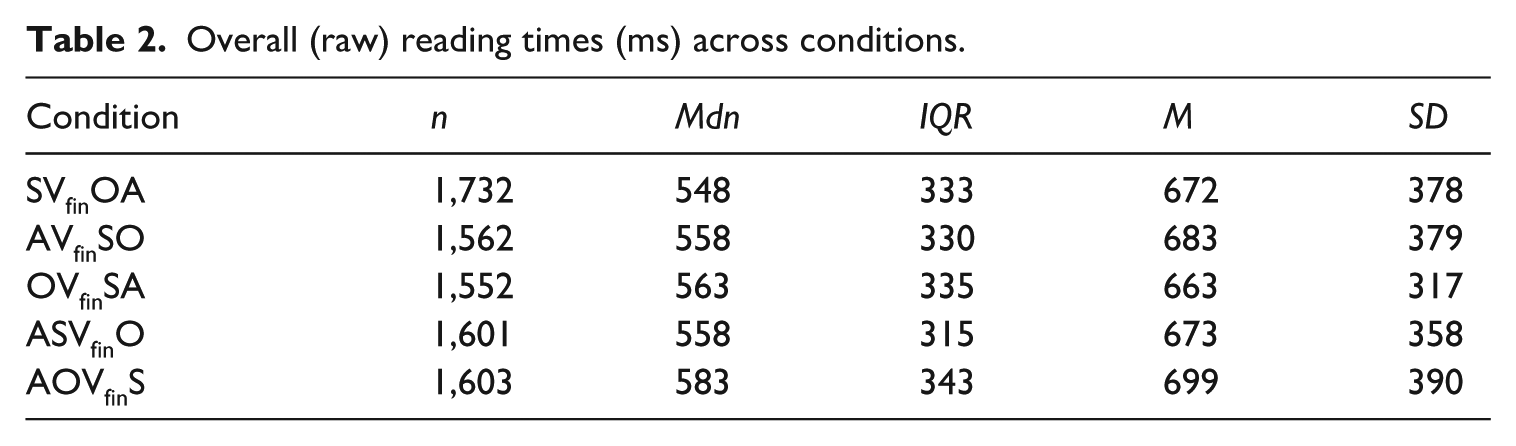
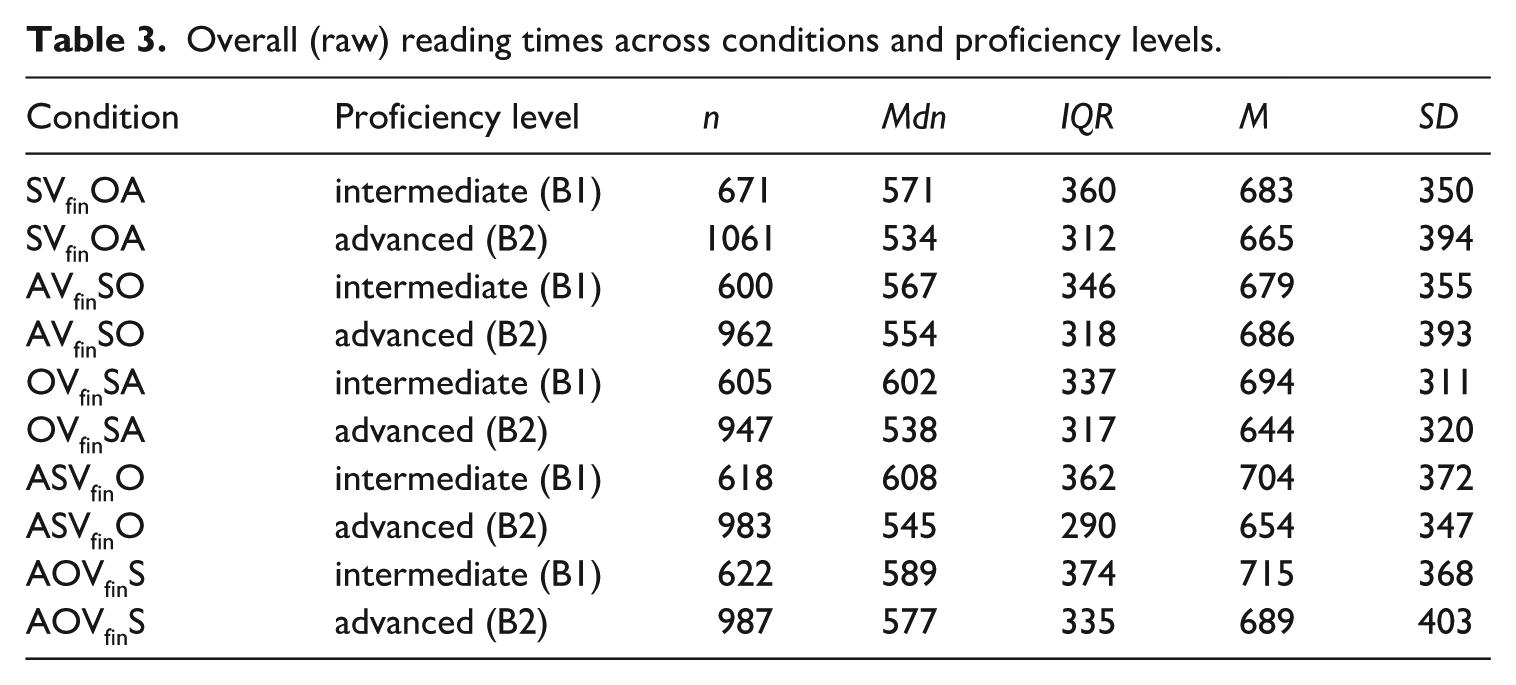
We first present a general overview of the reading times across the tested conditions (see Table 2) in ms. We used residuals for the statistical analyses and corresponding illustrations. As Table 2 shows, we see differences between the individual conditions being tested. Overall, mean reading times are highest in the AOVfinS condition and lowest in the SVfinO condition. The second highest median can be found in the OVfinS condition, while the AVfinS and ASVfin condition medians are identical. Based on the raw reading times, we do not see a tendency towards V3 conditions being processed slower than V2 conditions. Rather, there seems to be a greater tendency towards an effect of preverbal elements across conditions. Regarding probable differences resulting from proficiency levels, we see a difference between intermediate and advanced learners in that, across conditions, intermediate learners (see Table 3) show higher mean reading times than advanced learners. To test the hypotheses and observations based on the descriptive overview, we fitted a series of linear mixed-effects models (Bates et al., 2015) with the residuals as the dependent variable and random intercepts of participants and items. In all, we fitted four models.
Overall (raw) reading times (ms) across conditions.
Overall (raw) reading times across conditions and proficiency levels.
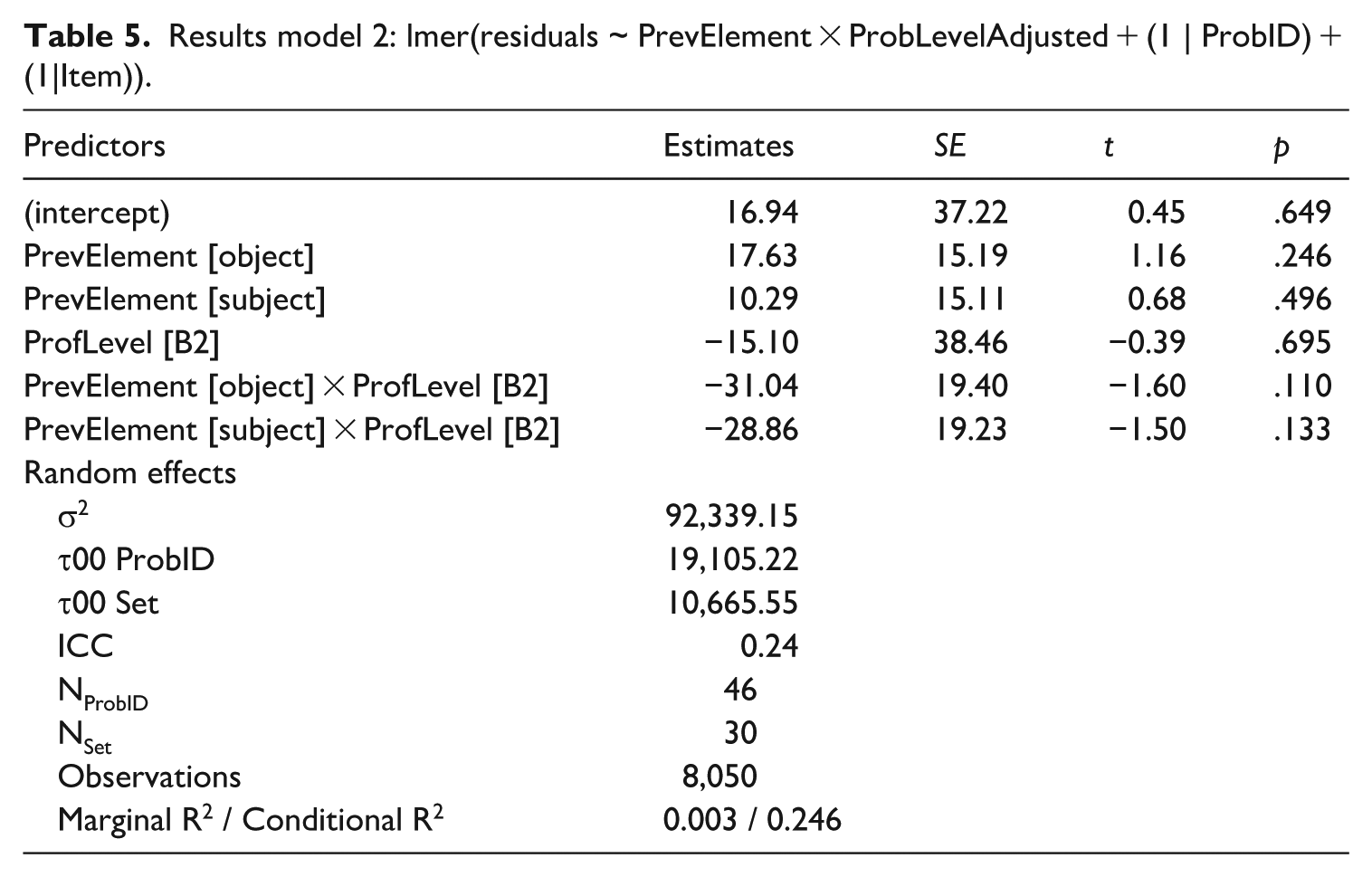
Model 1 tested for hypothesis 1 and contained a fixed effect for verb position and proficiency level and random effects for participants and items. 11 Model 2 tested for hypothesis 2 and contained, based on the observation that non-canonical OV sentences lead to higher reading times (especially in L3 learners), fixed effects for preverbal element and proficiency level and random effects for participants and items. Since models 1 and 2 look at verb position and preverbal element with respective interactions with proficiency levels independently, model 3 tested for hypothesis 3 and contained fixed effects for preverbal element and verb position and random effects for participants and items. Finally, to test for hypothesis 4, we extended model 3 by including proficiency level as a further fixed factor to obtain potential interactions with verb position and preverbal element. This final step is represented in Model 4. All analyses were done using R (2008) Version 4.4.1. Linear mixed-effect modelling was carried out using the package lme4 (Bates et al., 2015).
We first present the overall results for each model with plots illustrating the results:
Model 1 revealed a significant effect of verb placement. Sentences with the verb in the third position were read slower than sentences with the verb in the second position. Figure 1 visualizes generally higher reading times in V3 conditions, with specifically high (but not significantly higher) reading times in intermediate learners.
Model 2 revealed no significant effect. Neither the preverbal element nor an interaction of the preverbal element and proficiency significantly impacted the reading times. Figure 2 shows gradually decreasing reading times from preverbal adverbials (i.e. AVfinS condition) to preverbal objects (i.e. OVfinS and AOVfin conditions) to preverbal subjects (i.e. SVfinO and ASVfin conditions) for advanced learners. For intermediate learners, we see almost identical reading times for preverbal adverbials and subjects (i.e. SVfinO, ASVfin and AVfinS conditions) and higher reading times for preverbal objects (i.e. OVfinS and AOVfinS conditions). However, as mentioned before, none of them are significant.
Model 3 revealed a significant interaction between verbs appearing in the third position and the type of preverbal element. As shown in Figure 3, the highest reading times were observed for AOVfin conditions, suggesting that the relationship between verb position and reading times is influenced by the type of preverbal element. The significant positive interaction indicates that reading times are particularly high when verbs appear in the third position and the preverbal element is an object.
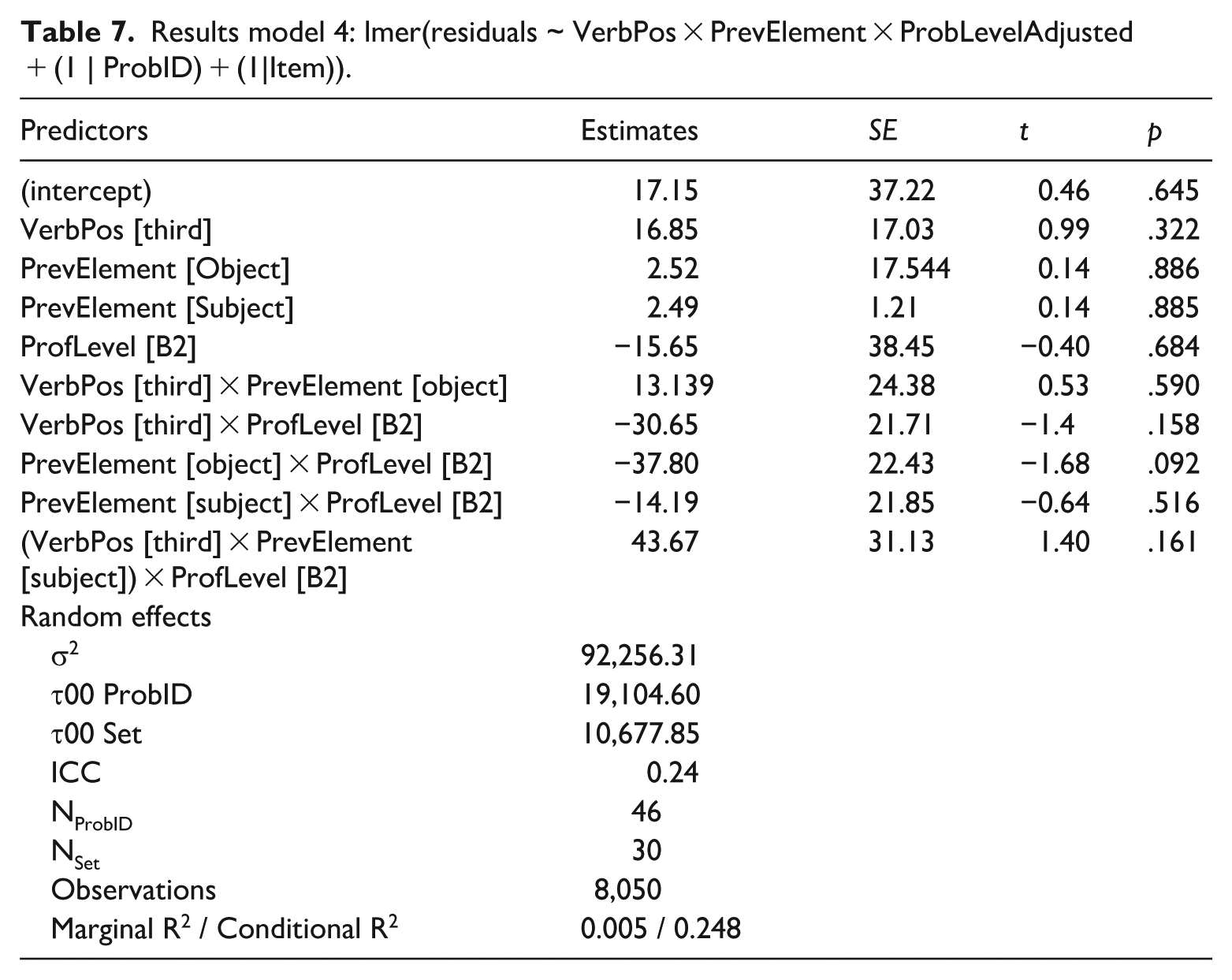
Model 4 did not reveal any significant results. There was no effect of the preverbal element, proficiency level, or an interaction between verb position and the other variables. When it comes to proficiency levels, we can observe at least a slight, but not significant tendency towards generally higher reading times for all V3 conditions in intermediate learners while advanced learners show particularly high reading times in AOfinV conditions only (see Figure 4). Regarding V3 sentences, we even see very low reading times for ASVfin conditions (reading times are here comparable to SVfinO and OVfinS conditions). Considering an SPR study by Kaan et al. (2018), one might argue that our findings might be explained by adaptation effects. We thus conducted an analysis of reaction times to examine potential adaptation effects. The results indicate a slight adaptation effect in the AOVfinS condition, with reaction times decreasing over the course of the experiment, suggesting that participants gradually adapted to this structure. However, in the ASVfinO, AVSfinO and SVfinOA conditions, we observed the opposite pattern: reaction times increased as the experiment progressed. Proficiency levels do not have a significant influence on these results. Thus, while there is some evidence of adaptation, the observed effects suggest increased cognitive load over time – both in canonical (i.e. SVfinO, AVfinS) as well as non-canonical conditions (i.e. ASVfinO). Therefore, the suggestion that the observed results are due to adaptation, as described by Kaan et al. (2018), does not explain the tendencies we find in our data.
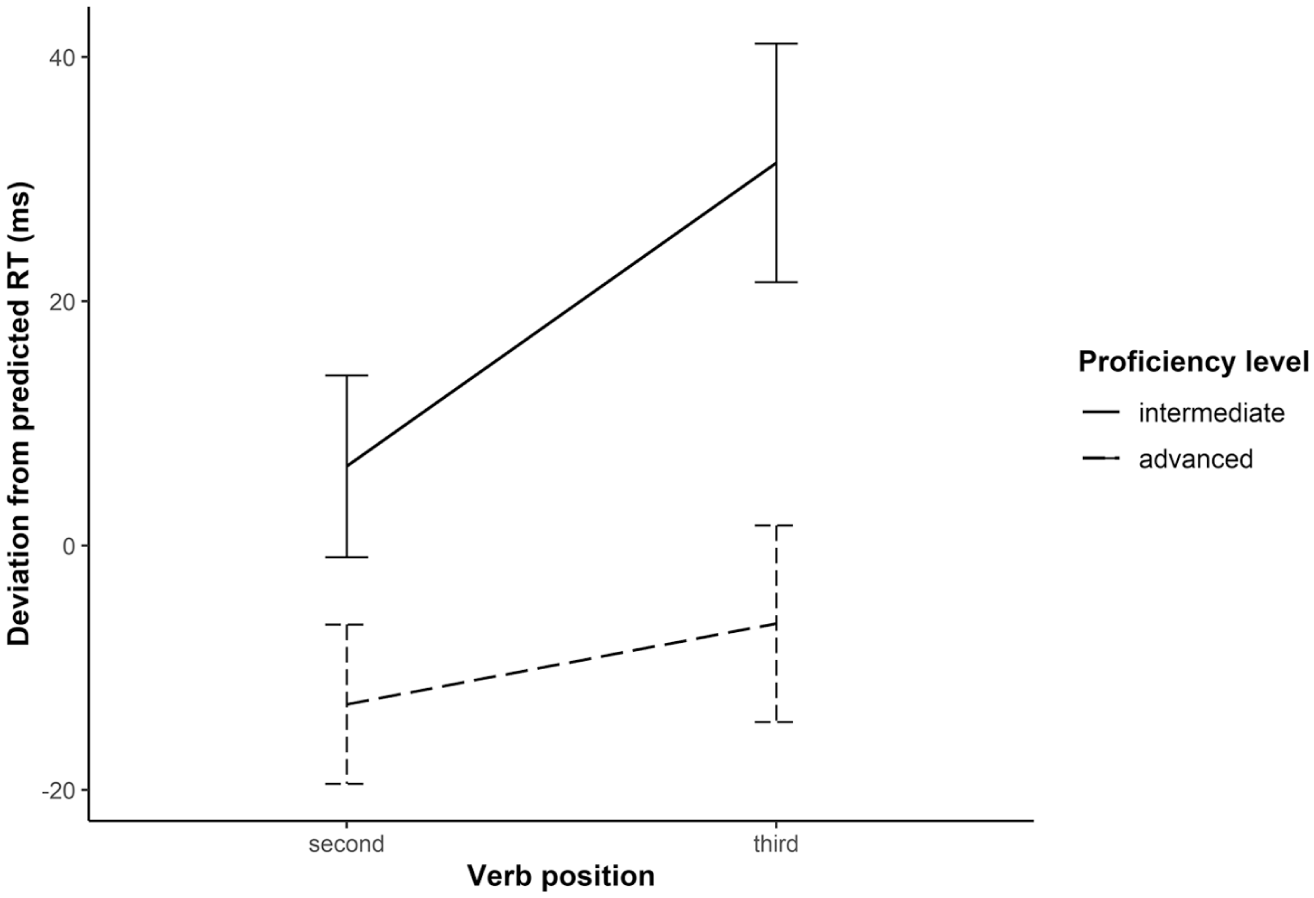
Mean residuals by verb position and proficiency level.
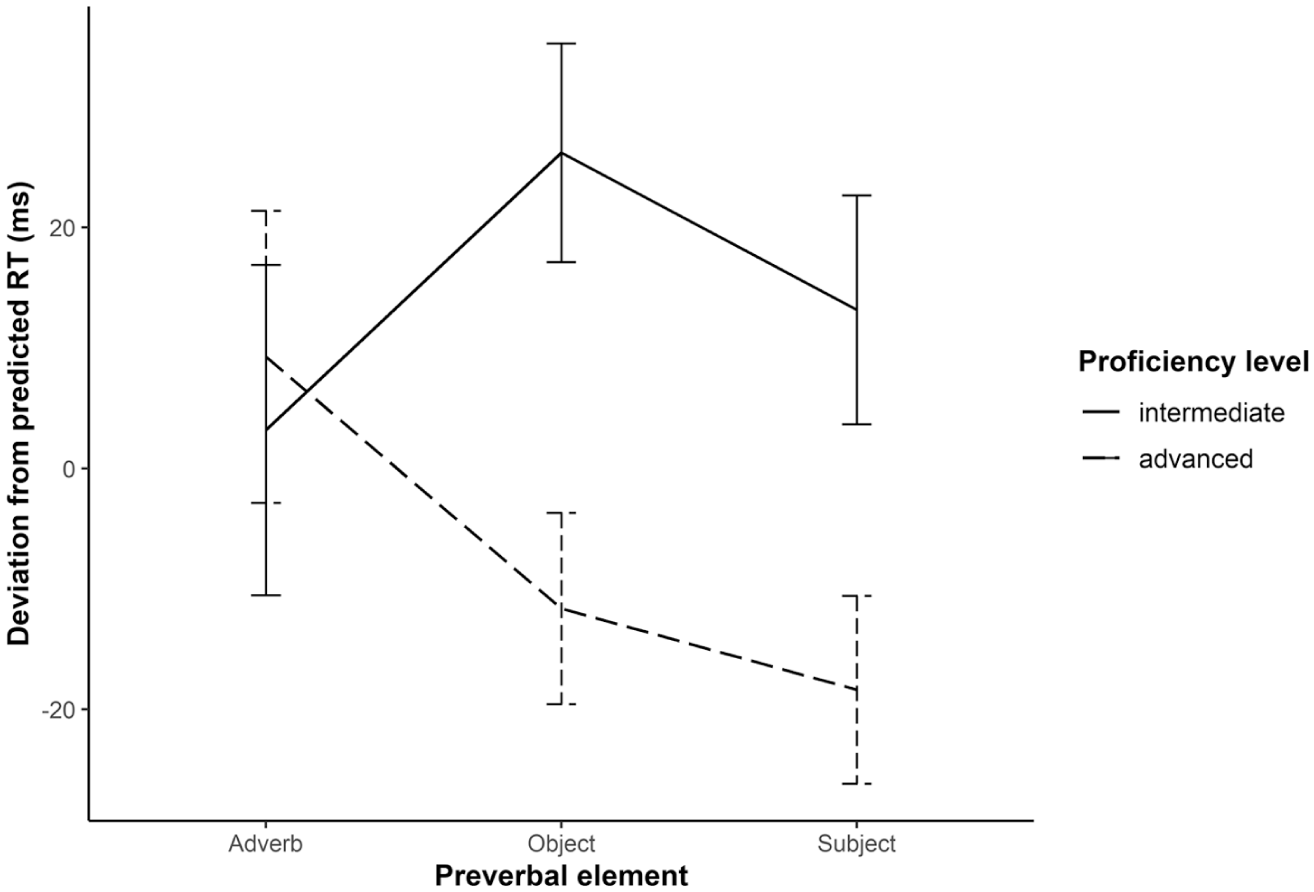
Mean residuals by preverbal element and proficiency level.
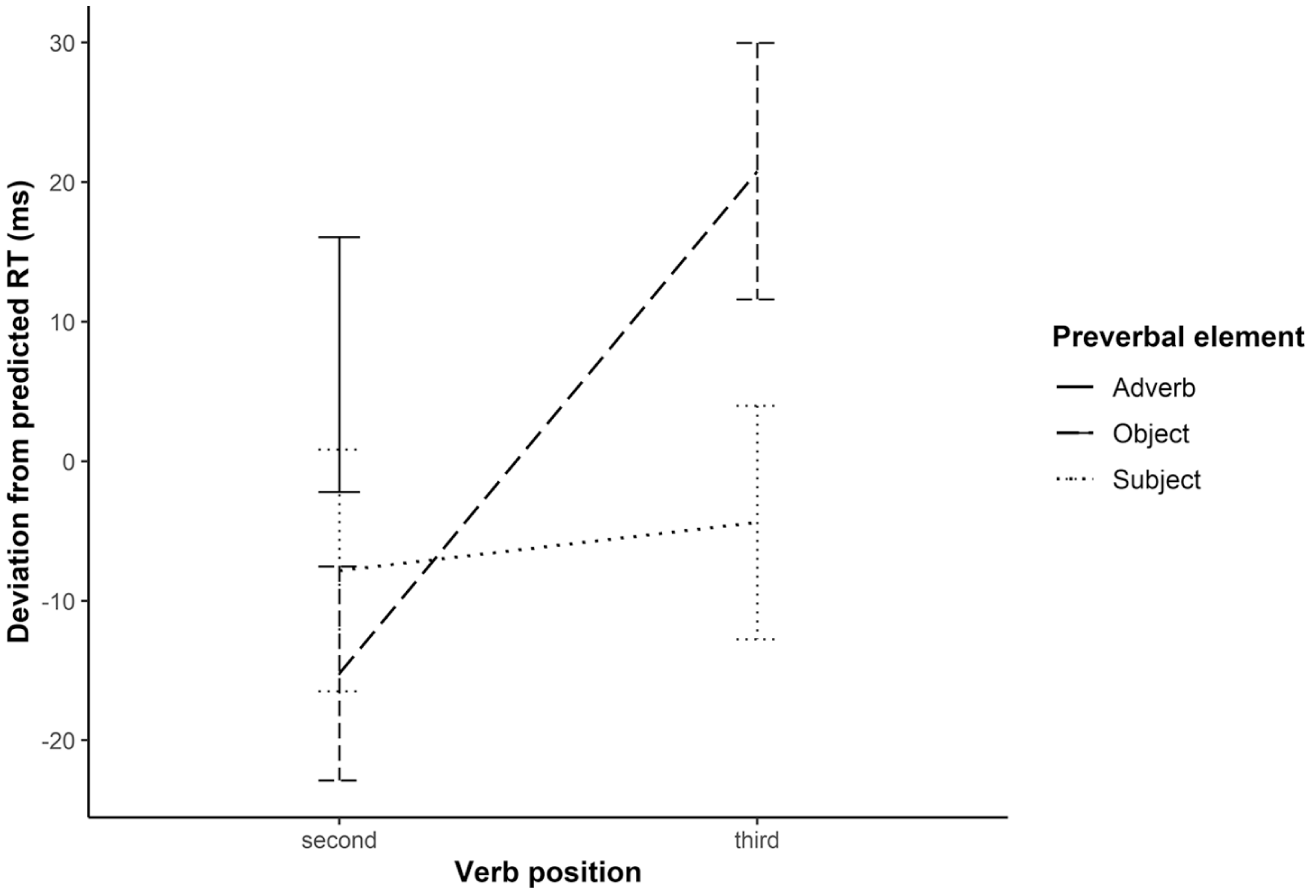
Mean residuals by verb position and preverbal element.
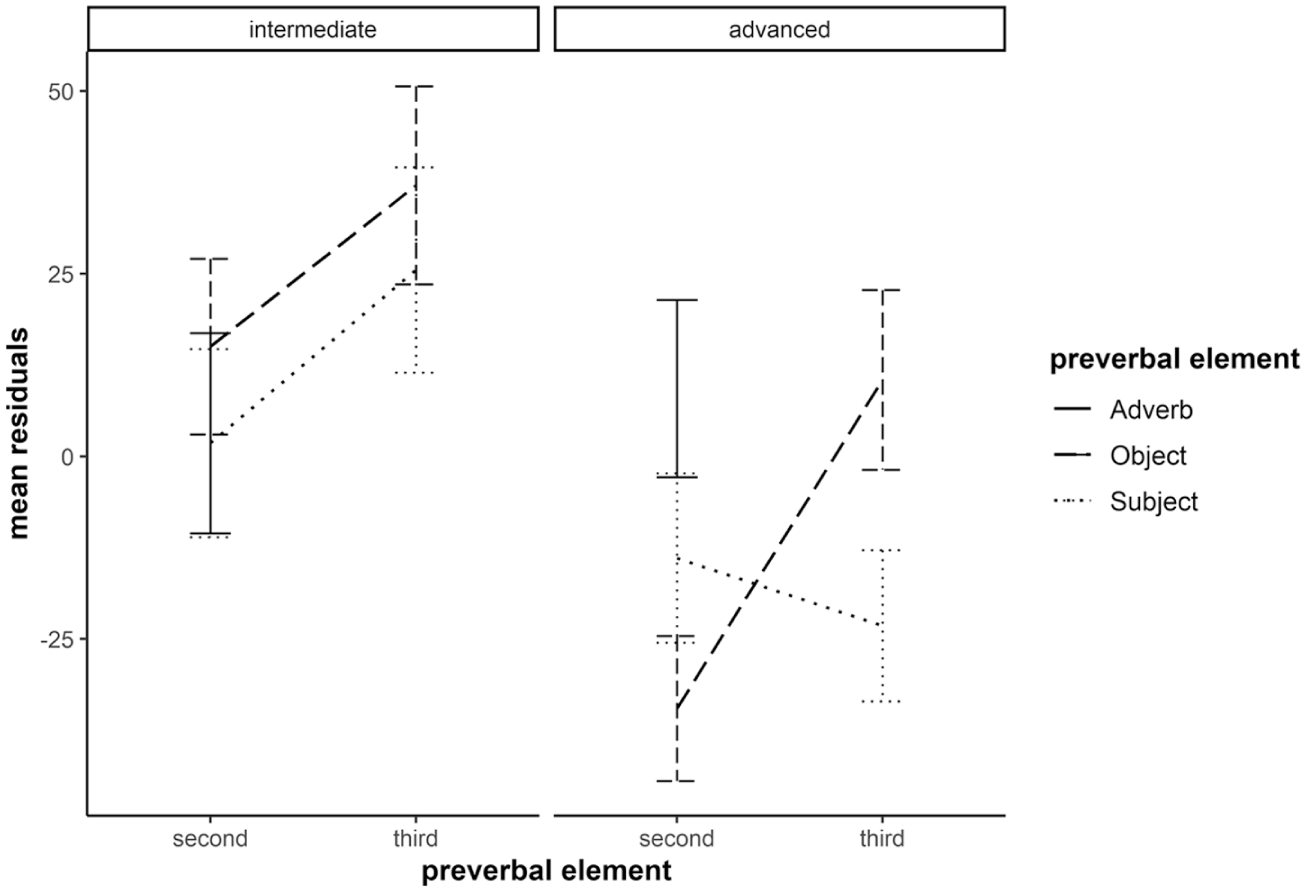
Mean residuals by verb position, preverbal element, and proficiency level.
In sum, Tables 4 to 7 indicate a main effect for verb position, but none for preverbal element. However, there is a strong interaction of both variables. No main effects or interactions were found for proficiency levels.
Results model 1: lmer(residuals ~ VerbPos × ProbLevelAdjusted + (1 | ProbID) + (1|Item)).
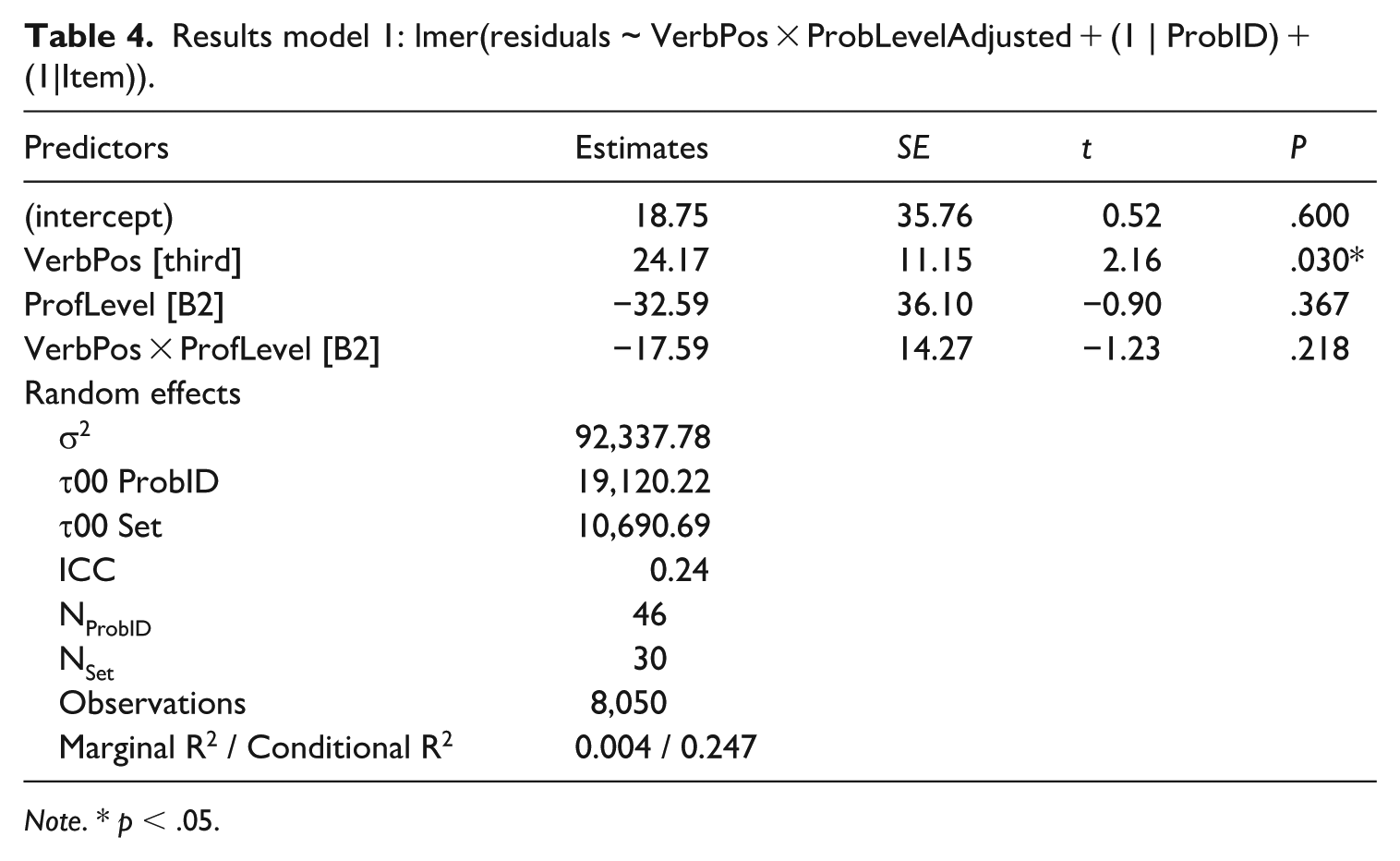
Note. * p < .05.
Results model 2: lmer(residuals ~ PrevElement × ProbLevelAdjusted + (1 | ProbID) + (1|Item)).
Results model 3: lmer(residuals ~ VerbPos × PrevElement + (1 | ProbID) + (1|Item)).
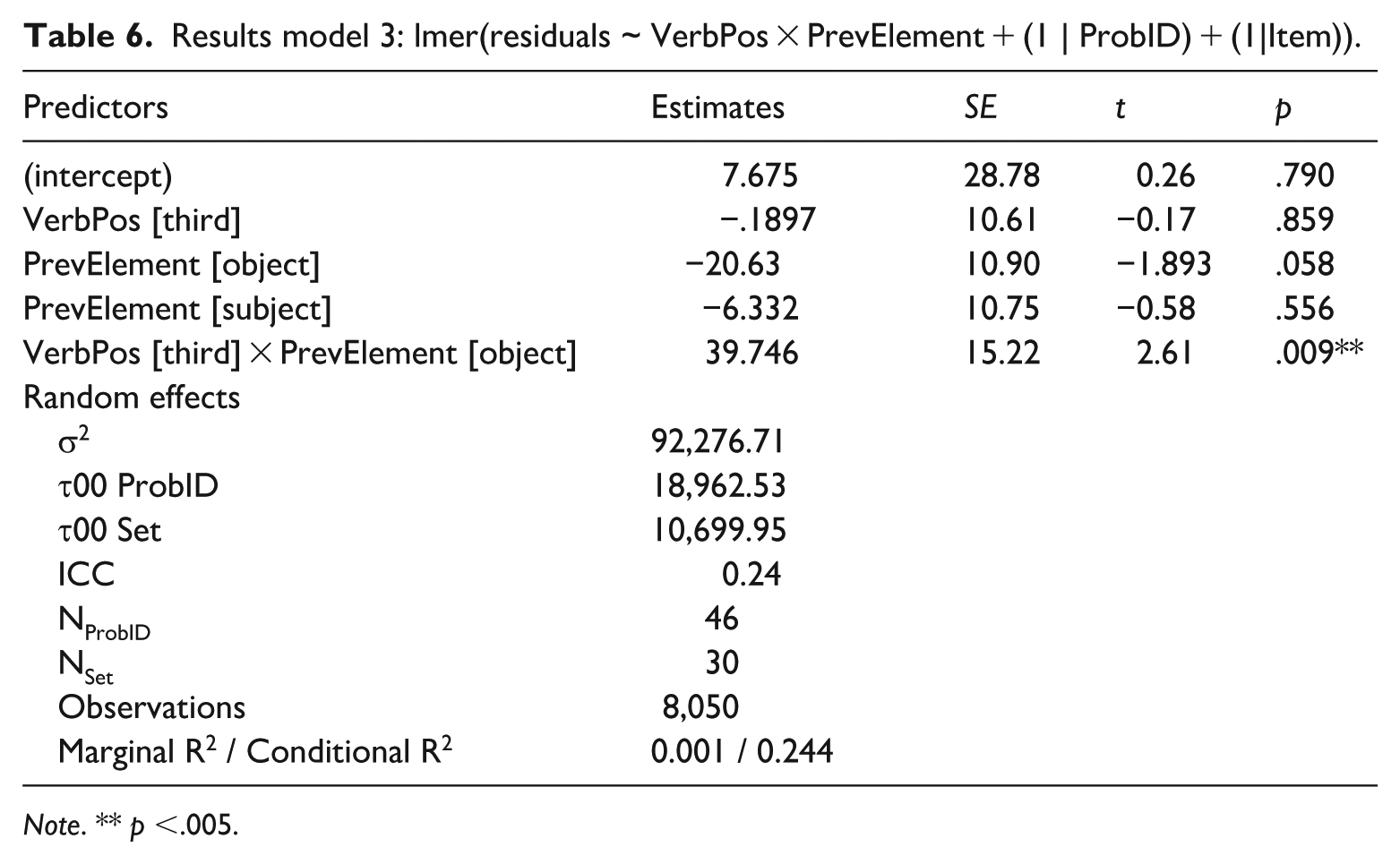
Note. ** p <.005.
Results model 4: lmer(residuals ~ VerbPos × PrevElement × ProbLevelAdjusted + (1 | ProbID) + (1|Item)).
In a final step, we compared models 1 to 4 in order to test which model accounts best for the variability. Table 8 presents the results of the chi-square test we conducted. As Table 8 shows, model 4 accounts best for the variability. However, model 3 provided the best model fit as indicated by low AIC and BIC values. Based on these analyses, we chose model 3 as the preferred model due to its balance between statistical significance, interpretability, and parsimony. Unlike model 4, model 3 includes significant predictors and interaction terms that provide meaningful insights into the data structure while maintaining a simpler and more interpretable framework. This aligns with the principle of parsimony, particularly given that the overall variance explained by the models is limited.
Results of model comparison.
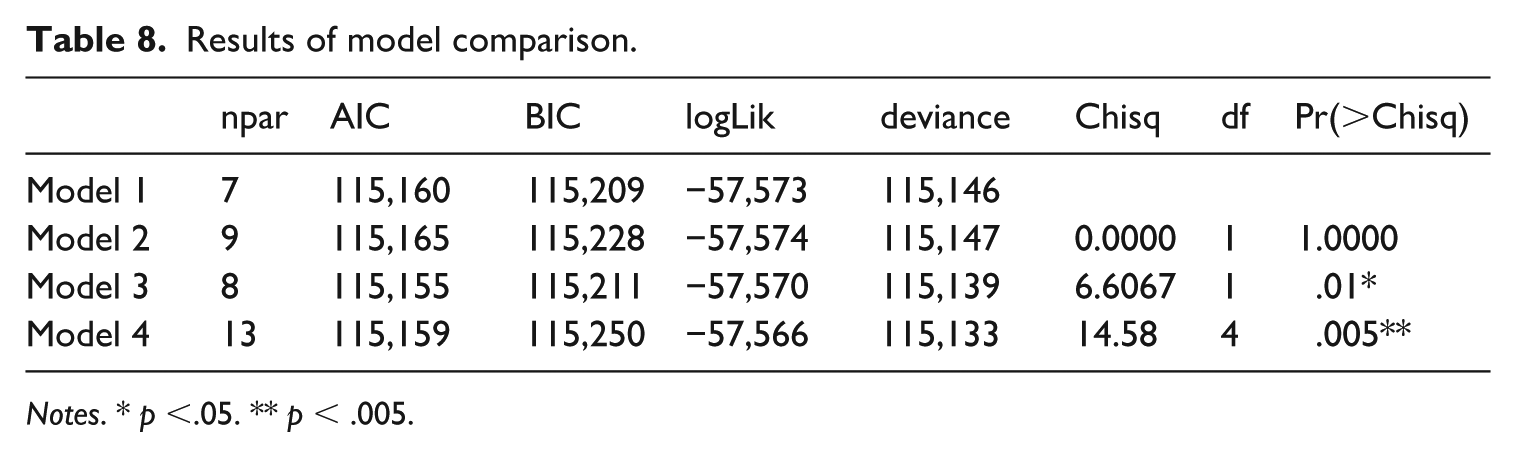
Notes. * p <.05. ** p < .005.
Since our model takes into account both random and fixed effects, we can assume that other individual differences beyond proficiency levels also play an important role. An important variable that allows for a higher variance explanation is the L1 of the participants. We therefore fitted a further model in which, based on numerous findings on the crucial role of L1 transfer effects in sentence processing, we tested whether taking L1 into account improves the variation resolution in our data. Due to the unequal distribution of 14 different L1s among participants, we grouped them into larger language types – Slavic (n = 16), Romance (n = 20), Turcic (n = 5), and others (n = 6) – to assess whether adding L1 as a factor could improve model performance. The results of model 5 are summarized in Figure 5.
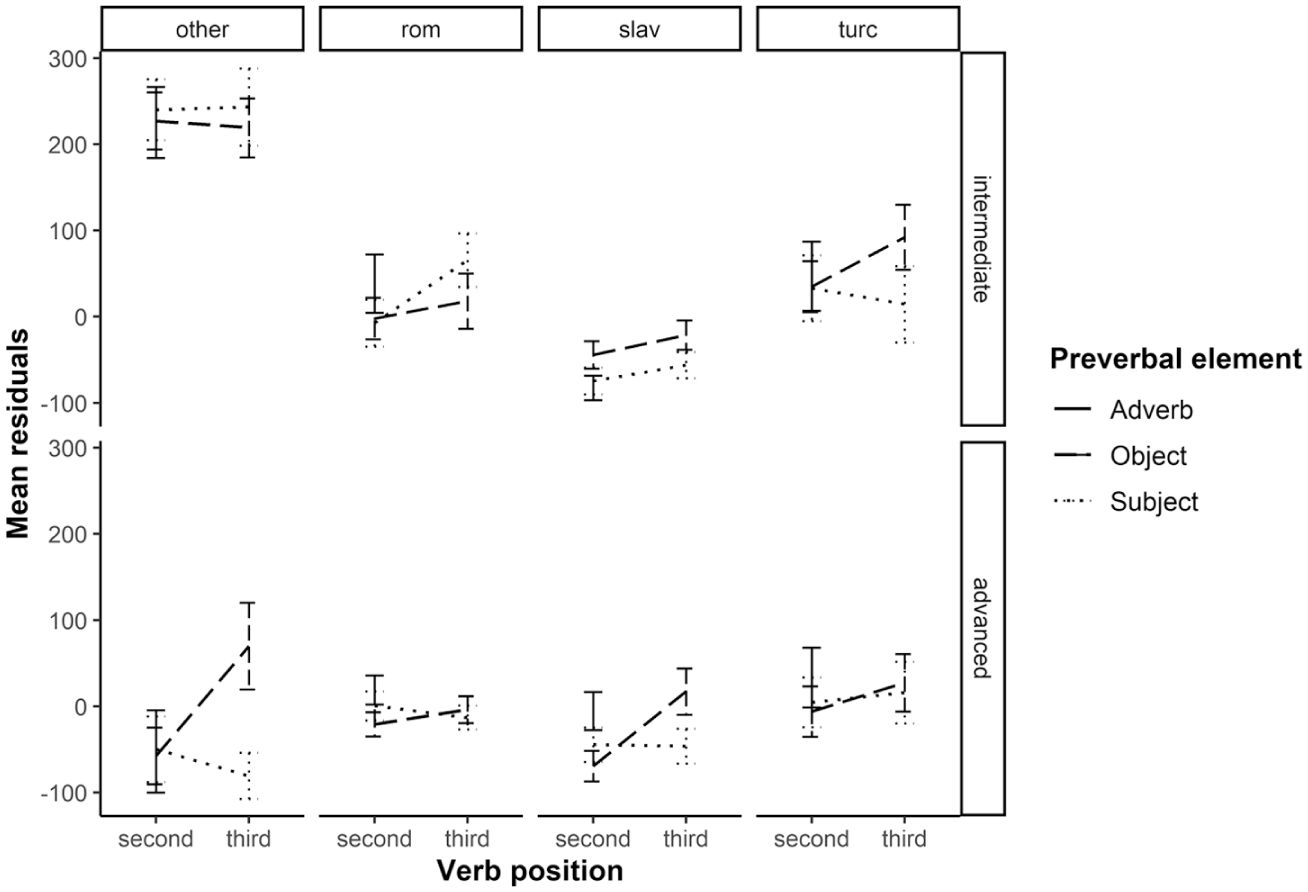
Mean residuals by verb position, preverbal element, and first language (L1) type.
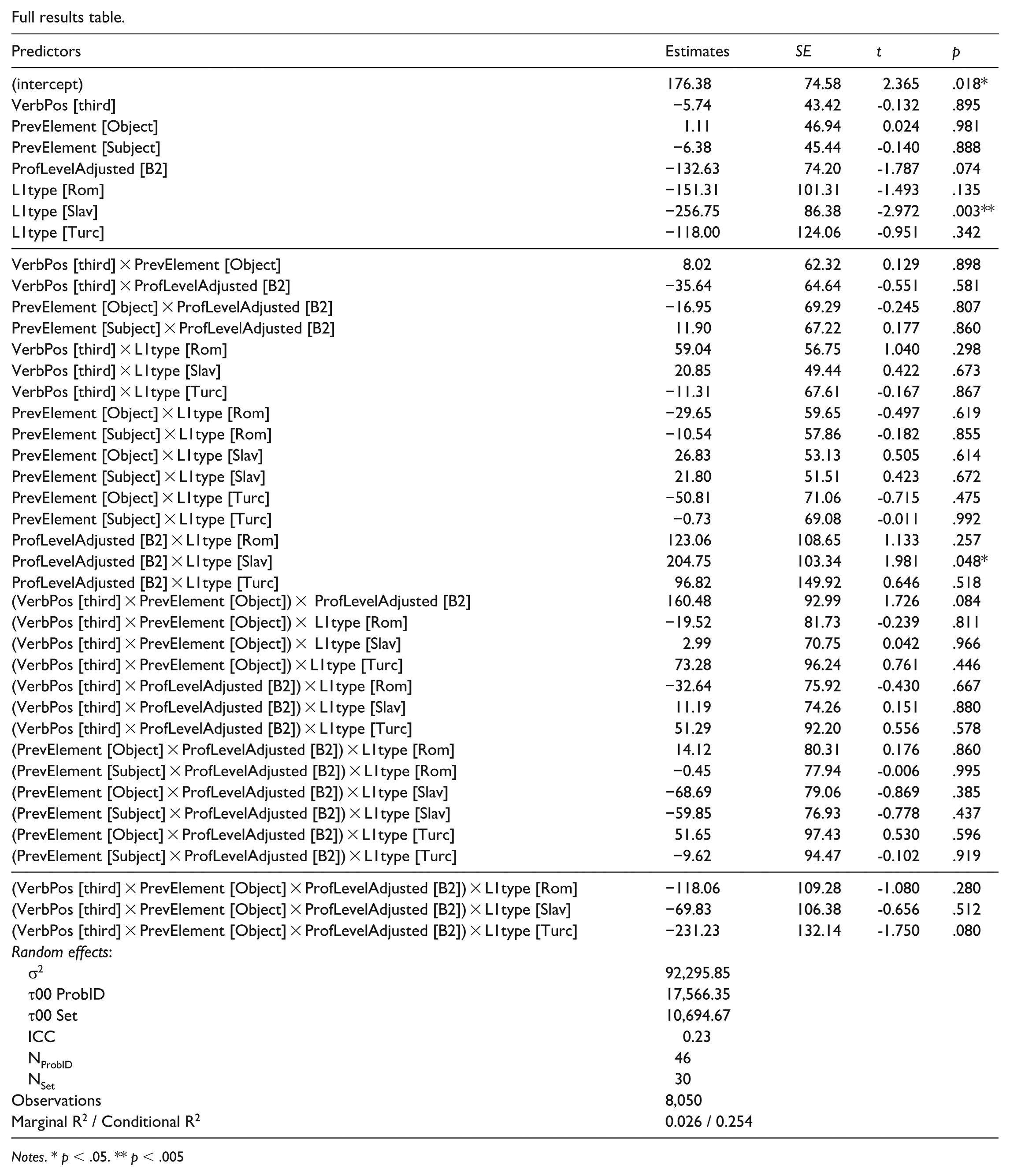
As Figure 5 shows, we see a main effect for participants with a Slavic L1 (p = .003) as well as an interaction effect for L1 type (Slavic) and advanced proficiency level (p = .048). No effects can been found for the other L1 types in our data. When looking into detail at the results, we can observe generally lower reading times across conditions in participants with a Slavic L1. At the same time, mean reading times significantly increase in AOVfinS conditions in advanced learners. 12
To assess whether the inclusion of L1 type improved model fit (in comparison to model 3, see above), a likelihood ratio test was conducted. The comparison showed that the more complex model 5, which included all four-way interactions, did not result in a significantly better fit than the reduced model 3 (χ²(35) = 37.37, p = .361). Although we find an L1 effect for Slavic speakers, the overall increase in explanatory power did not justify the added complexity. Still, the full model allows for important descriptive insights regarding the role of individual factors on sentence processing in multilingual speakers (see Section IV).
To sum up, our hypotheses can only partly be verified. Concerning hypotheses 1 and 2, we only find an effect of verb position but none for preverbal element or proficiency levels. Intermediate and advanced learners show comparable tendencies, although we could observe generally (slightly) higher reading times in intermediate learners. Hypothesis 3 could be verified: we find an interaction effect for preverbal element and verb position. Concerning hypothesis 4, we do not find any significant main effects or interactions. Model 3 provided the best fit for the data, and thus, we consider the interaction of preverbal element and verb placement as explaining the data best. At the same time, we see that none of the variables included in the models provide a satisfactory explanation of variation in our data. Although adding L1 type as a possible explanatory factor to our analyses did not improve the overall model fit, it provided meaning insights on the role of individual factors in multilingual sentence processing. These insights pose a limitation to our explorative study.
IV Discussion
Although we identified significant differences in reading speeds between the V2 and V3 conditions, our analysis suggests that these differences are not due to verb position alone but mainly due to the interaction between verb position and preverbal element. Regardless of proficiency levels, participants show the highest reading times in AOVfin conditions. Despite their low frequency in German and attested non-canonicity, ASVfin sentences lead to tendentially (but not significantly) higher reading times in intermediate learners only (and are very close to mean reading times in OVfin conditions). For advanced learners, however, we observe that mean reading times for ASVfin conditions are comparable to SVfinO conditions and lower than in (canonical) AVfinS and OVfinS conditions.
These findings align with processing results from L1 speakers of German (Bunk, 2020) and studies dealing with the processing of non-canonical structures in L3 learners of German. Most importantly, our study highlights new insights into the interaction of verb position and preverbal elements, the processing of non-canonical structures in L3 German and the role of individual factors such as language proficiency and L1 background in L3 processing. Based on our results, we will discuss (1) the empirical and theoretical implications of our main findings as well as (2) the role of (a) language proficiency and (b) potential other variables.
Although this body of studies is limited to processing differences between SVfin and OVfin sentences, numerous studies show that L3 learners of German (as well as L1 speakers) exhibit a relatively strong N1 bias, depending on proficiency level, L1, and age of acquisition. Both fronted (i.e. OVfin) and preverbal objects (i.e. AOVfin) lead to higher processing costs (e.g. Clahsen and Featherston, 1999), which can be attributed to different factors such as frequency of occurrence in the input, cue validity of case markers, or syntactic movement. In our study, however, we cannot see a general effect of the preverbal element alone. First, we do not find significant differences in reading times between preverbal subjects and preverbal objects (see model 2). Second, model 3 points towards the assumption that there seems to be an interaction between the non-canonicity of nominal constituents and verb positions, which tend to occur more pronounced in advanced learners. We thus cannot say that a potential N1 bias generally determines differences in reading times across conditions. Instead, preverbal objects and verb third might have an accumulative effect, which disappears for preverbal subjects and verb third (see model 3).
The observed tendency that preverbal elements seem to influence sentence processing together with verb position supports the hypothesis that V3 sentences in L3 German – despite their comparatively low occurrence in German – serve a predominantly information-structural and discourse-pragmatic function. Because nominal and adverbial constituents take over central functions such as naming semantic roles, topic, focus, and frame-setting, formal criteria such as verb position recede into the background. In sentence processing, L1 speakers and L3 learners seem also to be focused on semantic relations and information-structural configurations between non-verbal elements than on verb placement alone. Against this background, V3 sentences fulfil the function of realizing frame-setters and topics in advance, thus ensuring an information-structural makeup that simultaneously places two particularly important pieces of information in the preverbal area, both in L1 and L3 German.
The interpretation that V3 sentences predominantly fulfil such functions is supported by the fact that we did not find significant differences between intermediate and advanced speakers in our study. At the same time, we see a tendency towards the fact the intermediate learner show generally higher reading times in V3 conditions (with especially high reading times in AOVfin sentences) while advanced learners show particularly high reading times in AOVfin sentences only. Although missing effects might here be due to sample size, we can at least hypothesize that despite the circumstance that all of our participants have mastered V2-INV (i.e. AVfin sentences) and should thus have acquired the finite linking stage (Dimroth et al., 2003) or stage V according to the PT-framework (Pienemann, 1998, 2007), only intermediate learners are generally irritated by the violation of the V2 rule. Advanced learners, on the contrary, show a surprisingly higher acceptance of non-canonical ASVfin sentences (but not of AOVfin sentences). This might be due to a generally greater acceptance of linguistic variability in more advanced learners. Further support for this hypothesis comes from a corpus study on intermediate and advanced learners of German, presented in Hauenstein (2022). In her analysis, the number of V3 did not decline gradually with proficiency levels but stabilized at 2.48% for advanced , 1.64% for proficient, and 2.00% for near native speakers, where the percentages represent the numbers of V3 sentences against all declarative clauses in the corpora. Importantly, most sentences were produced with initial framesetters and discourse linkers. At the same time, we need a greater sample size to verify this observation and a closer look at learners with lower proficiency levels to shed more light on the development and acquisition of a functionally motivated V3 in L3 learners.
A further limitation to our study can be found with respect of potential L1 transfer on sentence processing. We find such effects especially in subjects with a Slavic L1. Compared to subjects with a Romance or Turcic L1, we find generally lower mean reading times in all conditions in Slavic-speaking subjects, but significantly higher processing times in AOVfinS sentences in subjects at the advanced level. Considering that Slavic languages generally allow for greater word order flexibility than Romance and Turcic languages, these findings seem consistent: Slavic-speaking subjects generally seem to have fewer problems with word order and verb position variance. With a higher language level, however, they are apparently more sensitive to conditions that violate discourse-pragmatic principles or are not attested in the target language (here: German). In other words, speakers with an L1 that allows for flexible word and verb order seem to have fewer challenges with processing non-canonical sentences, but are then more sensitive to violations of discourse-pragmatically unmotivated variance.
Based on our interpretation of the results and the fact that our models only explain a small part of the variance, we need to consider potential further variables and factors predicting and explaining variance in the data. One such factor might be a closer and more systematic look at L1 transfer. Although we do not find clear evidence for transfer effects in our data, we still have indications that varying L1 backgrounds lead to varying processing strategies. Based on the explorative nature of our article, further research should zoom in on specific L1 transfer effects. Also, the individual degree of exposure to informal and multilingual varieties of German, where non-canonical structures like V3 sentences are more frequent, might be a crucial explanatory factor. This exposure likely occurs outside the classroom, fostering greater tolerance for variation (that we tendentially find in more advanced learners). Additionally, the influence of English (where V3 sentences are common), as a widely spoken foreign language among participants, might contribute. Further research with richer metadata on learners’ linguistic exposure and interactional contexts is needed to understand better these dynamics and their impact on processing non-canonical structures.
V Conclusions and theoretical implications for future research
The overall aim of our article was to contribute to the question of what function the variable usage of V2 and V3 in declaratives with sentence-initial adverbials has in L3 German. Based on corpus linguistic findings and processing studies, we assumed that V3 sentences fulfil information structural and discourse-pragmatic functions that also play a role in learner varieties of German. The results on L1 German point towards a systematic use of V3 sentences. Explanatory accounts assume that V3 sentences allow for the concurrent realization of both frame-setters and topics in the prefield, which contradicts a strict V2 rule stating that the prefield may only host one non-verbal constituent. In V3 sentences, thus, frame-setters and topics no longer compete for the prefield and can be realized together as related elements with high information structural or discourse structuring value.
The assumption that discourse-pragmatics and information structure rather than exclusively formal linguistic principles can be responsible for the systematic emergence of V3 sentences in L3 German has been marginally discussed in the literature on learner varieties of German. Rather, common explanations assume that V3 sentences result because learners have not yet fully acquired the principles of subject–verb congruence and morphological finiteness and cannot exchange information across phrases (Pienemann, 1998, 2007). Therefore, formal and processing constraints are among the most common explanations for the systematic occurrence of V3 sentences in L3 German. More functionally oriented approaches that link word order variance to a competition between discourse-pragmatics, information structure, and form-oriented strategies (i.e. the usage of the V2 rule in German) are less common (Dimroth et al., 2003). Our study builds upon the latter approach.
We conducted a self-paced reading experiment with 46 L3 learners of German at the intermediate and advanced level. We found that sentences with verbs in the third position were read slower than sentences with verbs in the second position, as well as an interaction of preverbal element and verb position. Both factors, verb placement and proposed objects, give rise to particularly slow reading times in AOVfin conditions. We did not find significant differences between intermediate and advanced learners, but tendencies point towards the hypothesis that more advanced learners might generally be more tolerant regarding linguistic variation (regarding non-canonicity). Our data indicates that it is not the position of the verb alone but the interdependence between verb position and the order of non-verbal constituents that enhances processing cost. Against this background, ASVfin sentences are not per se difficult to process, while AOVfin sentences are, aligning with research on V3 processing in L1 speakers (Bunk, 2020). This (cautious) interpretation aligns with the assumption that ASVfin sentences follow information-structural properties and are rooted in German syntax. We find evidence for this in corpus data, processing studies, and grammaticality judgment tests. The circumstance that ASVfin sentences are comparatively rare and are often perceived as faulty (learner) utterances can be explained by a competition between the rather rigid V2 property in German on the one hand and information-structural properties on the other. Given this competition, it is necessary to call the rigid V2 rule in German into question, in particular from a functionally motivated approach. Rather, V3 sentences provide a systematic way of producing declarative clauses, exploiting the functional dynamics of the preverbal area in German, and this option also seems to be available in L3 acquisition.
Accordingly, we assume that in L3 acquisition, V3 sentences are not merely in-between steps on the way to acquiring V2-INV but can be understood as the result of information-structural or discourse-pragmatic principles in the construction of sentences. ASVfin sentences might show that learners apply knowledge concerning the functional properties of the preverbal area that they deduce from lessons in the classroom, but more importantly, through interaction with L1 speakers, who continuously make systematic use of (surface) V3 sentences. While corresponding approaches share the assumption that such principles are replaced by formal principles (= replacement of V3 from usage), we assume a co-existence of V3 and V2 sentences, in which different language internal (grammatical) or language external (social setting, linguistic registers, language ideologies and norms) factors interact. Evidence for the co-existence of V2 and V3 comes from corpus-based learner language analyses (e.g. Czinglar, 2014; Hauenstein, 2022) and the present study. However, the questions about whether classroom settings vs. L1 and L3 interaction and register awareness are determining factors for the usage and processing of V3 need further investigation.
Another factor we could not yet consider is whether different L1s influence how V3 is used in German as an L3. Bohnacker (2006) shows for learners with L1 Swedish that the occurrence of V3 sentences significantly depends on whether the learners learned English as a foreign language before acquiring German. Speakers of L1s typologically related to German seem to be ‘safer’ from V3, although the data do not yet allow generalizations of these findings given the small number of speakers (e.g. two in Bohnacker, 2006). Looking into the effects of the L1 might, therefore, be highly revealing for the question of how and by which speakers V3 is used and how varying L1s or, in fact, all prior knowledge of any foreign languages influence V3 processing.
Turning back to the question raised at the beginning of the article of whether the V2 rule is only a myth, our study indicates that it is neither necessary nor helpful to consider V3 in opposition to V2 as a structure that needs to be overcome to achieve full and correct syntactic acquisition. Rather, V3 should be perceived as the result of systematic syntactic variation that allows varying verbal placement under specific circumstances and might even be necessary to acquire the functional aspects of the preverbal area in German. What should be kept in mind, though, are the effects on language ideologies towards deviations from the standard, that is, standard language ideologies (Lippi-Green, 1997), based on which speakers devaluate deviations of standard norms in both L1 speakers and L3 language learners. While learners might experience disadvantages when not adhering to these norms, teachers should be aware of linguistic variation and their functions to avoid evaluating learners based on beliefs rather than research-based knowledge. Raising awareness for varying linguistic forms for functional reasons is thus beneficial to L1 speakers of German with their own non-standard varieties and foreign language learners.
Footnotes
Appendix A
Full results table.
| Predictors | Estimates | SE | t | p |
|---|---|---|---|---|
| (intercept) | 176.38 | 74.58 | 2.365 | .018* |
| VerbPos [third] | −5.74 | 43.42 | -0.132 | .895 |
| PrevElement [Object] | 1.11 | 46.94 | 0.024 | .981 |
| PrevElement [Subject] | −6.38 | 45.44 | -0.140 | .888 |
| ProfLevelAdjusted [B2] | −132.63 | 74.20 | -1.787 | .074 |
| L1type [Rom] | −151.31 | 101.31 | -1.493 | .135 |
| L1type [Slav] | −256.75 | 86.38 | -2.972 | .003** |
| L1type [Turc] | −118.00 | 124.06 | -0.951 | .342 |
| VerbPos [third] × PrevElement [Object] | 8.02 | 62.32 | 0.129 | .898 |
| VerbPos [third] × ProfLevelAdjusted [B2] | −35.64 | 64.64 | -0.551 | .581 |
| PrevElement [Object] × ProfLevelAdjusted [B2] | −16.95 | 69.29 | -0.245 | .807 |
| PrevElement [Subject] × ProfLevelAdjusted [B2] | 11.90 | 67.22 | 0.177 | .860 |
| VerbPos [third] × L1type [Rom] | 59.04 | 56.75 | 1.040 | .298 |
| VerbPos [third] × L1type [Slav] | 20.85 | 49.44 | 0.422 | .673 |
| VerbPos [third] × L1type [Turc] | −11.31 | 67.61 | -0.167 | .867 |
| PrevElement [Object] × L1type [Rom] | −29.65 | 59.65 | -0.497 | .619 |
| PrevElement [Subject] × L1type [Rom] | −10.54 | 57.86 | -0.182 | .855 |
| PrevElement [Object] × L1type [Slav] | 26.83 | 53.13 | 0.505 | .614 |
| PrevElement [Subject] × L1type [Slav] | 21.80 | 51.51 | 0.423 | .672 |
| PrevElement [Object] × L1type [Turc] | −50.81 | 71.06 | -0.715 | .475 |
| PrevElement [Subject] × L1type [Turc] | −0.73 | 69.08 | -0.011 | .992 |
| ProfLevelAdjusted [B2] × L1type [Rom] | 123.06 | 108.65 | 1.133 | .257 |
| ProfLevelAdjusted [B2] × L1type [Slav] | 204.75 | 103.34 | 1.981 | .048* |
| ProfLevelAdjusted [B2] × L1type [Turc] | 96.82 | 149.92 | 0.646 | .518 |
| (VerbPos [third] × PrevElement [Object]) × ProfLevelAdjusted [B2] |
160.48 | 92.99 | 1.726 | .084 |
| (VerbPos [third] × PrevElement [Object]) × L1type [Rom] |
−19.52 | 81.73 | -0.239 | .811 |
| (VerbPos [third] × PrevElement [Object]) × L1type [Slav] |
2.99 | 70.75 | 0.042 | .966 |
| (VerbPos [third] × PrevElement [Object]) × L1type [Turc] | 73.28 | 96.24 | 0.761 | .446 |
| (VerbPos [third] × ProfLevelAdjusted [B2]) × L1type [Rom] | −32.64 | 75.92 | -0.430 | .667 |
| (VerbPos [third] × ProfLevelAdjusted [B2]) × L1type [Slav] | 11.19 | 74.26 | 0.151 | .880 |
| (VerbPos [third] × ProfLevelAdjusted [B2]) × L1type [Turc] | 51.29 | 92.20 | 0.556 | .578 |
| (PrevElement [Object] × ProfLevelAdjusted [B2]) × L1type [Rom] | 14.12 | 80.31 | 0.176 | .860 |
| (PrevElement [Subject] × ProfLevelAdjusted [B2]) × L1type [Rom] | −0.45 | 77.94 | -0.006 | .995 |
| (PrevElement [Object] × ProfLevelAdjusted [B2]) × L1type [Slav] | −68.69 | 79.06 | -0.869 | .385 |
| (PrevElement [Subject] × ProfLevelAdjusted [B2]) × L1type [Slav] | −59.85 | 76.93 | -0.778 | .437 |
| (PrevElement [Object] × ProfLevelAdjusted [B2]) × L1type [Turc] | 51.65 | 97.43 | 0.530 | .596 |
| (PrevElement [Subject] × ProfLevelAdjusted [B2]) × L1type [Turc] | −9.62 | 94.47 | -0.102 | .919 |
| (VerbPos [third] × PrevElement [Object] × ProfLevelAdjusted [B2]) × L1type [Rom] | −118.06 | 109.28 | -1.080 | .280 |
| (VerbPos [third] × PrevElement [Object] × ProfLevelAdjusted [B2]) × L1type [Slav] | −69.83 | 106.38 | -0.656 | .512 |
| (VerbPos [third] × PrevElement [Object] × ProfLevelAdjusted [B2]) × L1type [Turc] | −231.23 | 132.14 | -1.750 | .080 |
| Random effects: | ||||
| σ2 | 92,295.85 | |||
| τ00 ProbID | 17,566.35 | |||
| τ00 Set | 10,694.67 | |||
| ICC | 0.23 | |||
| NProbID | 46 | |||
| NSet | 30 | |||
| Observations | 8,050 | |||
| Marginal R2 / Conditional R2 | 0.026 / 0.254 | |||
Notes. * p < .05. ** p < .005
Acknowledgements
We would like to thank the anonymous reviewers and the editors of this journal for their valuable feedback and support.
Data Availability Statement
The data supporting this study is not publicly available as participant consent for data sharing was not obtained at the time of data collection. Researchers seeking further details about the study are encouraged to contact the corresponding author.
Declaration of conflicting interests
The authors declared no potential conflicts of interest with respect to the research, authorship, and/or publication of this article.
Funding
The authors disclosed receipt of the following financial support for the research, authorship, and/or publication of this article: The author(s) received financial support from the Deutschen Forschungsgemeinschaft (DFG, German Research Foundation) for the research, authorship, and/or publication of this article. Projects: Research Unit ‘Emerging Grammars in Language Contact Situations’ (FOR 2537, Project P8/313607803), CRC 1412 ‘Register: Language Users’ Knowledge of Situational Variation’ (Project C07/416591334).
