




Abstract
This article discusses inflected infinitives in adult first language (L1) Brazilian speakers whose second language (L2) is Spanish. We focus on adjunct clauses headed with para in cases involving same and different subjects in the matrix and the embedded clause. These languages differ in that Brazilian Portuguese, but not Spanish, allows for inflected infinitives, and we provide evidence that these bilinguals are using innovative forms, i.e. inflected infinitives in their L2. We examine our findings under a lens of L1 transfer, L1 pre-emption, and the difficulty posed by the subset–superset relationship between the L1 and the L2. Additionally, we propose that Brazilian Portuguese-speaking L2 learners of Spanish at an initial stage of L2 acquisition encounter challenges abandoning L1 strategies and apply the tense projection’s features in the inflected infinitives of their L1 into the verb forms of their L2. We further propose that those L2 learners with greater vocabulary knowledge succeed in abandoning the L1 strategies that are unavailable in the L2, in contrast to those with a more limited vocabulary knowledge.
I Introduction
This article discusses inflected infinitives in second language acquisition (SLA) by focusing on first language (L1) Brazilian speakers whose second language (L2) is Spanish. We focus on adjunct clauses that are headed with para in cases involving control, specifically, same and different subjects in the matrix and para clause. While Brazilian Portuguese and Spanish are rather similar in several respects, including the presence of para-headed adjunct clauses, they differ in that Brazilian Portuguese allows for inflected infinitives, whereas Spanish does not. In addition, in the cases discussed, only Brazilian Portuguese allows for infinitival clauses with overt subjects (that are different from the subject in the main clause). Thus, the strategies in Spanish for adjunct clauses headed with para are a subset of the L1 superset (i.e. the Brazilian Portuguese strategies). We show that these bilinguals are making use of inflected infinitives in their L2, i.e. they produce innovative forms in the L2, which are only present in the L1, and we explain that difficulties in L1 pre-emption (Iverson and Rothman, 2015; Trahey and White, 1993) may result in prolonged L1 transfer (see, amongst others, Ellis, 2006; Gass and Selinker, 1992; Schwartz and Sprouse, 1994; Schwartz, 1998). That is, having to restrict parts of their L1 grammar that are irrelevant in the L2, as opposed to having to learn a new strategy, results in different degrees of variability and convergence on the L2 system.
We propose that low-proficiency Brazilian Portuguese-speaking L2 learners of Spanish transfer the L1 strategies into the grammar of the L2, while more advanced learners show less influence from the L1. In the specific case of these speakers, problems restricting the strategies available in the L1 grammar can be evidenced by the transfer of the tense projection’s features in the inflected infinitives into the verb morphology of the verb forms in the syntactic strategies available in their L2. We further propose that those L2 learners with deeper vocabulary knowledge have successfully abandoned inflected infinitives in the L2, while those with a more limited vocabulary knowledge are still in the process.
The article is organized as follows. In Section II, we introduce the phenomena under discussion and address the theoretical background as to how the phenomena are analysed. In Section III, we present our research questions and hypotheses. Sections IV and V present the methods and results of our study. Section VI discusses our findings by focusing on how tense features are reset in the L2 in connection to syntax and morphology, as well as on what the role of lexical proficiency is. Section VII is the conclusion. In the appendices in supplemental material we attach the materials for the tasks that were used.
II Theoretical background
1 Distribution
Brazilian Portuguese has inflected infinitives, which may occur in argument and adjunct positions (see, for example, Ambar, 1998, 2000; Ambar and Jiménez-Fernández, 2017; Barbosa and Raposo, 2013; Barbosa et al., 2018; Duarte et al., 2016; Gonçalves et al., 2014; Martins, 2001, 2006; Maurer, 1968; Mensching, 2000; Modesto, 2011, 2016; Pires, 2006; Raposo, 1987a, 1987b, 1989). The latter is the construction that is examined in this article. Relevant examples appear below, where the subjects are in the third person and contrast in number (singular vs. plural): our focus is on para-headed adjunct clauses, as indicated. As (1) shows, the subject of the adjunct clause is null; these are instances of obligatory subject control. With the null subject, the agreement in number is optional; when agreement occurs, this is an inflected infinitive, as in (1b). The subject of the infinitive can also be overt, as exemplified in (2): there are different subjects in the matrix and adjunct clauses here. Number agreement in these cases is obligatory, as in (2b), i.e. the verb cannot be uninflected in this case. In a nutshell, the infinitive optionally agrees with null subjects, whereas it must agree with overt subjects.
(1) a. Martín e João dormem muito [para ter boa saúde]. Martín and João sleep a lot for have good health b. Martín e João dormem muito [para ter Martín and João sleep a lot for have good health ‘Martín and João sleep a lot to be healthy.’ (2) a. Margarita conserta os computadores [para seu cliente terminar o trabalho]. Margarita repairs the computers for her client finish the job ‘Margarita repairs the computers, so that her client finishes the job.’ b. Margarita conserta os computadores [para seus clientes terminar Margarita repairs the computers for her clients finish the job ‘Margarita repairs the computers, so that her clients finish the job.’
Brazilian Portuguese has an additional strategy for cases with different subjects. Such a strategy appears in (3), where there is a finite adjunct clause (also headed by para). The verb in the adjunct clause is in the subjunctive here; this is a finite verb.
(3) Maurício treina os animais de estimação [para que seus cachorros protej Maurício trains the animals of pet for that his dogs protect his house ‘Maurício trains the pets, so that his dogs protect his house.’
In contrast to Brazilian Portuguese, not all the aforementioned strategies are attested in Spanish. Specifically, Spanish allows for adjunct clauses where the subject is null and is controlled by the matrix subject, as in (4) – this is like the strategy in (1) in Brazilian Portuguese. In Spanish, however, the infinitive cannot be inflected – there are no inflected infinitives in this language, i.e. cases such as (1b) are ungrammatical in Spanish. The strategy in (2) is not attested, i.e. cases with an overt subject that is different from the matrix subject plus an infinitive are not possible in this language. Thus, the attempt in (5) is ungrammatical. For cases with different subjects, Spanish makes use of finite adjunct clauses, which is similar to (3); the verb is in the subjunctive, as in Brazilian Portuguese, i.e. it is a finite verb. Such a strategy appears in (6).
(4) Martín y Juan duermen mucho [para estar sanos]. Martín and Juan sleep a lot for be healthy ‘Martín and Juan sleep a lot to be healthy.’ (5) *Margarita repara las computadoras [para su cliente terminar el trabajo]. Margarita repairs the computers for her client finish the job ‘Margarita repairs the computers, so that her client finishes the job.’ (6) Mauricio entrena a las mascotas [para que sus perros protej Maurício trains the pets for that his dogs protect his house ‘Maurício trains the pets, so that his dogs protect his house.’
2 Analysis
The discussion as to how to analyse adjunct clauses as the ones indicated has concentrated, in general, on two aspects, namely, how the subject of such clauses is licensed and what the ϕ-features of the verbs (the T heads here) are. The latter is key in the current discussion, where the main difference concerns the presence of inflected infinitives (and the absence thereof) in the production of L2 Spanish, which, crucially, is a language that lacks the relevant verb forms; see (5) above. We sketch a general analysis of the strategies under consideration. The discussion to follow, however, is in no way exhaustive and does not attempt to provide a comprehensive analysis of the strategies. We refer the reader to the references cited for detailed discussion.
As a starting point, we discuss the strategy with finite verbs, i.e. Brazilian Portuguese (3) and Spanish (6). For concreteness, we adopt the approach in Pesetsky and Torrego (2007) with regard to ϕ-features (see also Bošković, 2011). In this approach, ϕ-features can be interpretable and valued, or uninterpretable and unvalued. Valued features can provide a value to unvalued features; unvalued features must be valued. In the cases under discussion, the subject in the adjunct clause would have interpretable and valued person and number features, but an uninterpretable and unvalued case feature. The finite verb in T can value the case feature, but is unvalued for person and number features. Agreement takes place so that the subject values the unvalued features in T and vice versa. For illustration, consider the schematic representations in (7). Example (7a) represents the case prior to agreement; (7b) shows the case once agreement has taken place. This is how agreement would proceed in (3) and (6), where the subject is nominative and the verb is finite (third person and plural number are used for illustration).
(7) a. subject[iPerson: 3, iNumber: PL, uCase:__] T-finite[uPerson:__, uNumber:__, iCase: NOM] b. subject[iPerson: 3, iNumber: PL, uCase: NOM] T-finite[uPerson: 3, uNumber: PL, iCase: NOM]
As for the adjunct clauses with infinitive verbs, there is a key contrast in that these may be inflected in Brazilian Portuguese (1)–(2), but not in Spanish (4). We will start with the discussion of the cases in (1a) and (4), where there is subject control and an uninflected infinitive. The literature in Brazilian Portuguese (see, for example, Modesto, 2011, 2016; Nunes, 2014, 2018) has discussed these cases extensively. A key aspect of the discussion concerns the nature of the subject in the adjunct clause, where the debate oscillates between a standard approach to control (i.e. with a silent pronoun such as PRO) (Modesto, 2011, 2016) and an application of the movement theory of control (Nunes, 2014, 2018). With regard to case, PRO may be analysed as getting null case from T (Chomsky and Lasnik, 1993); under the movement theory of control, the subject is merged into the structure in the adjunct clause but gets case in the matrix clause. 1 What is actually key for current purposes is that the T projection for infinitives lacks number features. No agreement for number takes place between the subject and T.
As noted, Brazilian Portuguese has instances of inflected infinitives as well, as overtly found in the examples in (1b) and (2b). Following Kato et al. (2023), we assume that inflected infinitives have a T with an unvalued number feature whose exponent is -m (the -e that is found in the examples is a thematic vowel). Importantly, this means that such a feature needs valuation. In the cases in (1b) and (2b), there are elements that can provide a value in this regard, namely, the null subject (1b) and the overt one (2b). This is schematically represented in (8): in (8a), the number feature in T is unvalued; it has been valued in (8b); only the relevant features are represented; plural is used for illustration.
(8) a. subject[iNumber: PL] T-infinitive[uNumber:__] b. subject[iNumber: PL] T-infinitive[uNumber: PL]
Importantly, these examples differ with regard to the subject: in (1b), it is null, whereas it is overt in (2b). The example in (1b) is similar to what was discussed above. As for (2b), we assume, following Kato et al. (2023), that the element heading the adjunct clause, i.e. para, is an oblique case licenser, so that it can provide a value to the unvalued case feature of the overt subject. The agreement process is schematically shown in (9): the case feature of the subject is valued with oblique case, and the number feature of the infinitive is valued for number (plural in this case).
(9) a. para[iCase: OBL] subject[iNumber: PL, uCase:__] T-infinitive[uNumber:__] b. para[iCase: OBL] subject[iNumber: PL, uCase: OBL] T-infinitive[uNumber: PL]
As for (2a), with an overt subject but no explicit marking for inflection in the infinitive, for theoretical simplicity, we assume the same analysis as the one for (2b), i.e. (2a) and (2b) display the same strategy; the only difference lies in that there is no overt morpheme for the inflected infinitive with singular number; see the contrast in (2b). The agreement process is then as the one in (9) with a singular number feature (instead of a plural one). Thus, the cases in (2) display a strategy where para heads the adjunct clause (and licenses oblique case) and such clauses have an inflected infinitive (e.g. para selects for inflected infinitives). In contrast, Spanish lacks such a strategy; (5) is thus ungrammatical.
To sum up, the key difference between Brazilian Portuguese and Spanish lies in that the former has inflected infinitives, which head Ts with an unvalued number feature. These languages are similar in that they both display strategies with uninflected infinitives (the T in such cases does not have number features) and with finite verbs in the subjunctive (the T in such cases also has unvalued number, in addition to person features).
III Research questions
In this article, we follow Iverson and Rothman’s (2015) proposal, which states that while we can assume initial L1 transfer for learners, L1 transfer alone cannot fully account for the great degree of variability in L2 development. As Iverson and Rothman (2015) state, initial L1 transfer might eventually result in new L2 acquisition given access to at least some aspects of UG, but it is also possible that L2 syntactic acquisition might still show effects of the L1 syntax. In the initial L1 transfer state, abstract properties of the L1 grammar in the relevant domain (the T features here) are fully transferred and constitute the initial state of adult L2 acquisition (Schwartz, 1998). However, in order to account for non-convergence and variability during L2 development, we turn to the notion of ‘L1 pre-emption’ proposed by Trahey and White (1993). L1 pre-emption specifically requires learners to restrict parts of their L1 grammar that are irrelevant in the L2 in order to fully converge on the target grammar (Trahey and White, 1993).
L1 pre-emption difficulties may arise due to learnability factors, which can determine the pace at which the L2 grammar is integrated. For instance, a major learnability obstacle is posed by the subset–superset relationship between the L1 and the L2 (White, 1991). From this perspective, restructuring a given L1 property becomes more challenging when the L1 grammar constitutes a superset to the L2 subset because the L1 grammar appears to be able to parse the L2 input that is available to the learners (Inagaki, 2001; Judy and Rothman, 2010; Rothman, 2008). This means that the strategies available in the L1 are a superset of the subset of L2 strategies and, thus, parsing failures are not easily recognizable. Parsing failures are necessary to trigger a target-like grammatical restructuring; if they cannot be noticed, there is not enough negative evidence to start restructuring (Rothman, 2008). According to Montrul and Yoon (2009), in such a case, learners have to infer the impossibility or unavailability of a particular property (e.g. a feature or feature bundle) by simply noticing its absence in the input.
The present study is an interesting case to examine how the subset–superset relationship between the two grammars under investigation (see Section II) interact with L1 transfer and pre-emption. The strategies in Spanish for adjunct clauses headed with para are a subset of the Brazilian Portuguese strategies as specified for the relevant features. Specifically, both Brazilian Portuguese and Spanish present similar strategies to create para-headed adjunct clauses with either the same or different subjects as in the main clause, with the exception of inflected infinitives, which are only available in Brazilian Portuguese. Given that the L1 transferred grammar does include all the L2 strategies (i.e. null subjects and subjunctive), learners might not have evidence that some restructuring (i.e. abandoning the inflected infinitive strategy) is needed. The parallelisms in this domain are one instantiation of the evident similarities of this language pair, which further presents a high number of cognates and similar functional morphology. These considerations motivate the following research questions:
• Research question 1: What knowledge do Brazilian Portuguese-speaking L2 learners of Spanish possess of para-headed adjunct clauses in their second language?
Hypothesis 1: We hypothesize that Brazilian Portuguese-speaking L2 learners of Spanish transfer the strategies available in their L1 into their L2. L1 pre-emption difficulties may arise from having to do restructuring from a superset grammar to a subset grammar in the relevant domain, which requires the unlearning of L1 properties that do not exist in the L2 (Iverson and Rothman, 2015; Judy and Rothman, 2010; Rothman, 2008). Specifically, they may find difficulties restructuring T in the inflected infinitives in their L1 into the verb morphology of other syntactic strategies: either uninflected infinitives (which lack number features) if the main and the adjunct clauses share the same subject, or finite verbs, particularly verbs in the subjunctive (which do have number features). Eventually, and given that Spanish and Portuguese present similar functional morphology, these L2 Spanish speakers should converge on the target grammar and abandon the L1 strategies that do not exist in the L2. However, the pace at which convergence on the L2 system occurs might present variability because the transferred L1 grammar enables parsing of all the L2 strategies, which means that learners have insufficient negative evidence for the ungrammatical realizations (Rothman, 2008). This might lead to prolonged L1 influence.
• Research question 2: Is their knowledge of para-headed adjunct clauses modulated by their L2 productive vocabulary knowledge?
Hypothesis 2: Following previous studies documenting a correlation with overall proficiency and productive vocabulary knowledge (e.g. Bedore et al., 2012; Gollan et al., 2012; Sheng et al., 2014; Treffers-Daller and Korybski, 2015), we hypothesize that the participants’ knowledge of para-headed adjunct clauses in Spanish is modulated by their productive vocabulary knowledge, as measured by the Prueba Léxica de Español y Portugués / Prova Léxica de Espanhol e Português (PLEP) (Jimenez et al., 2024; López and Jimenez, 2022; see below). We hypothesize that those L2 learners with deeper productive vocabulary knowledge have successfully restructured the T in the inflected infinitives in their L1 into the L2, whereas those participants with a more limited productive vocabulary knowledge show more transfer from the L1, suggesting that they are still in the process of restructuring. As for the production of morphological competence, which is considered particularly challenging in SLA, we predict that productive vocabulary knowledge will indicate which participants have acquired the functional morphology under examination vs. those who may transfer strategies or produce innovative functional morphology.
IV Methods
1 Participants
A total of 97 subjects participated in the study: 74 L1-Brazilian-Portuguese–L2-Spanish speakers (54 female and 20 male; mean age = 33.84 years, SD = 9.87) and 23 native Spanish speakers from Mexico. The L2 Spanish speakers were all born and raised in Brazil and were living in this country when data collection occurred. The participants were native speakers of Portuguese who had learned Spanish in Brazil after puberty through formal education. They speak varieties of Portuguese from all the regions in Brazil, being the Southeast and Northeast regions the most represented, followed by the South, Central-West, and North. All the participants were university students or had at least a bachelor’s degree at the time of data collection. The participants reported having been exposed to Spanish at school and/or at work for an average of 223 weeks (or over 4 years) (SD = 145.79; range in weeks = 150–750; range in years = 3–14.42), including secondary and post-secondary education. Some of them had not received exposure to Spanish in a Spanish-speaking country (n = 22) whereas most of them had either studied, worked or visited at least one Spanish-speaking country (n = 52), including Argentina (n = 28), Spain (n = 26), Uruguay (n = 19), Chile (n = 18), Peru (n = 8), Bolivia (n = 7), Mexico (n = 6), Paraguay (n = 6), Colombia (n = 5), Dominican Republic (n = 2), Cuba (n = 1) and Ecuador (n = 1). The participants who reported visiting Bolivia, Ecuador, Paraguay and Peru also reported visiting other Spanish-speaking countries, indicating that they had been exposed to several varieties of native Spanish outside the classroom. The help of the Consejería de Educación en Brasil, which is the institution that represents the Spanish Ministry of Education and Professional Training in Brazil, was crucial for prompt and successful data collection. This institution shared the recruitment flier on their website, and people who were interested contacted the researchers.
The comparison group, composed of 23 native Spanish speakers from East-Central and Northeastern Mexico (13 female and 10 male; mean age = 42.87 years, SD = 14.59), served as the native baseline for this study. They were all born and raised in Mexico and were living there when data collection occurred. They were contacted using a recruitment post on social media and the snowball approach. Twenty native speakers had received college degrees while three had high school diplomas. A variety of occupations are represented in this group: eight subjects were teachers, yet the group also included engineers, psychologists, and hotel managers, among others.
2 Data collection instruments and procedures
Prior to beginning the study, participants read and signed a consent form, which informed them of the length of the study, the procedures and confidentiality of their data, as well as the compensation for their time: a $50 BRL gift card for a store in Brazil or a $200 MXN gift card for a store in Mexico, which is equivalent to a $10 USD gift card. All the gift cards were electronic codes that were distributed to the participants via email upon completion of the study.
The first part of the study involved a Zoom meeting with one of the researchers to sign the consent form and complete the first task: a lexical knowledge test, which was used as a proxy for general language proficiency. The PLEP is a picture naming task designed by the research team to specifically assess Spanish–Brazilian Portuguese bilinguals. This task resembles the Multilingual Naming Test (MINT) (Gollan et al., 2012) in that participants are presented with a series of black-and-white images showing objects that they need to name. Participants can receive semantic and phonemic cues, and receive one point for each correctly named object with or without having received cues, while no points are awarded for incorrect or missing names. Vocabulary knowledge can be a reliable predictor for overall language performance (i.e. in speaking, writing, listening, and reading), and it is known that grammatical development depends, to a large extent, on vocabulary knowledge (Bates and Goodman, 1997). For example, recent studies have used lexical range, sophistication, and richness in oral production tasks to determine language dominance in bilingual populations (Daller et al., 2003; Gollan et al., 2012; Pienemann et al., 2011; Treffers-Daller and Korybski, 2015). Specifically, previous studies have established a correlation with overall proficiency and productive vocabulary knowledge (e.g. Bedore et al., 2012; Gollan et al., 2012; Sheng et al., 2014; Treffers-Daller and Korybski, 2015). Appendix A in supplemental material includes a copy of the PLEP as well as instructions and expected responses.
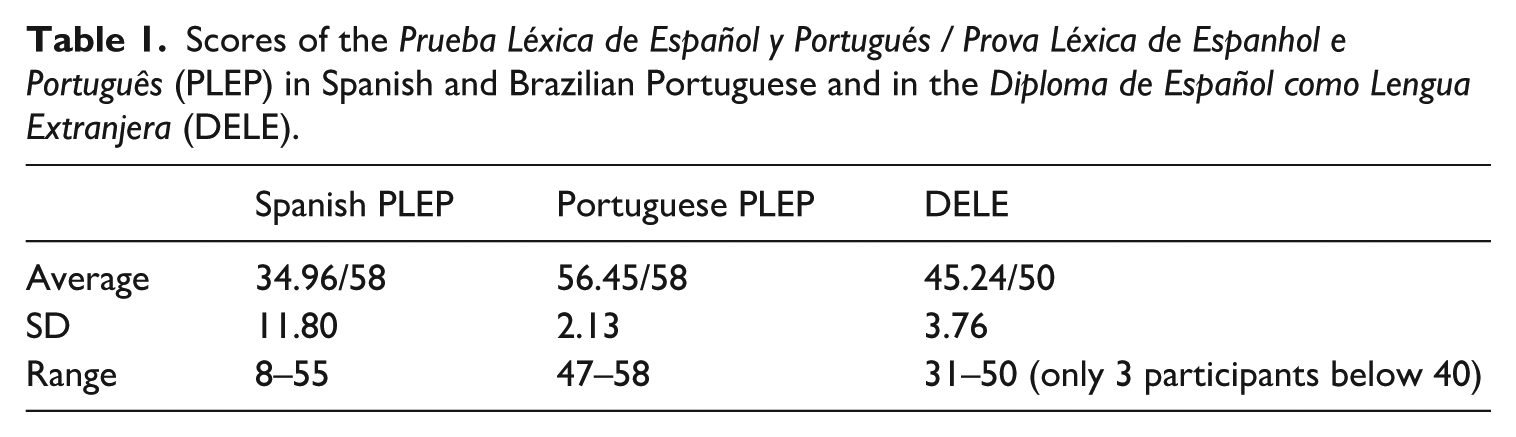
This task was administered in both languages (first in Spanish and then in Brazilian Portuguese) and contains 58 items that are not cognates in the language pair and are organized based on lexical frequency. That is, the lexical frequency of the items in each language was matched (as much as possible) using the frequency data provided in Corpus del Español (Davies, 2016a) and Corpus do Português (Davies, 2016b). The Spanish native speaker group performed at ceiling (range = 56–58/58; M = 57.78; SD = 0.60). The L2 learners’ scores, on the other hand, differed in each of their languages, as expected. Their scores are reported in Table 1, which shows that the participants’ lexical knowledge in Brazilian Portuguese is stronger and less variable than in Spanish, the L2.
Scores of the Prueba Léxica de Español y Portugués / Prova Léxica de Espanhol e Português (PLEP) in Spanish and Brazilian Portuguese and in the Diploma de Español como Lengua Extranjera (DELE).
After completing the PLEP on Zoom, the participants were given a Qualtrics link and their participant code so they could complete the second part of the study. The Qualtrics link contained a Diploma de Español como Lengua Extranjera (DELE) test, which is a quick 50-item multiple-choice proficiency instrument adapted from the MLA Foreign Language Test and a cloze test from the DELE focusing on morphosyntactic, syntactic and lexical knowledge (Cuza et al., 2013; Duffield and White, 1999; Montrul and Slabakova, 2003). Specifically, the participants were asked to complete the version provided in Cuza et al. (2013), as well as two experimental tasks: a written Elicited Production Task (EPT) and an Acceptability Judgment Task (AJT), which the L2 learners completed in Spanish first, and then in Brazilian Portuguese, whereas the Spanish native speaker group only completed them in Spanish.
We expected to find a ceiling effect and a lack of variability in the DELE scores because of its low predictive power for the population under investigation given the syntactic and lexical similarities in this language pair. Our findings confirmed this prediction, and we follow previous research that acknowledges the significant relationship between L2 (productive) vocabulary knowledge and all four macro language skills – reading, listening (Cheng and Matthews, 2018), speaking (Koizumi and In’nami, 2013), and writing (Oh et al., 2015) – to suggest that the PLEP can be an appropriate measure to assess overall proficiency in Spanish and Brazilian Portuguese. We decided to include only cognates in the verbs and direct objects featured in the test items of the tasks in this study. We did this in order to prevent confounding effects and to allow all participants to be able to complete the tasks despite their varied proficiency levels. However, we acknowledge that further research could explore the role of cognates in the acquisition of this phenomenon. In the present study, we use PLEP scores as a proxy measure for overall proficiency; therefore, hereinafter, when we mention proficiency, we are referring to results on a productive vocabulary knowledge test.
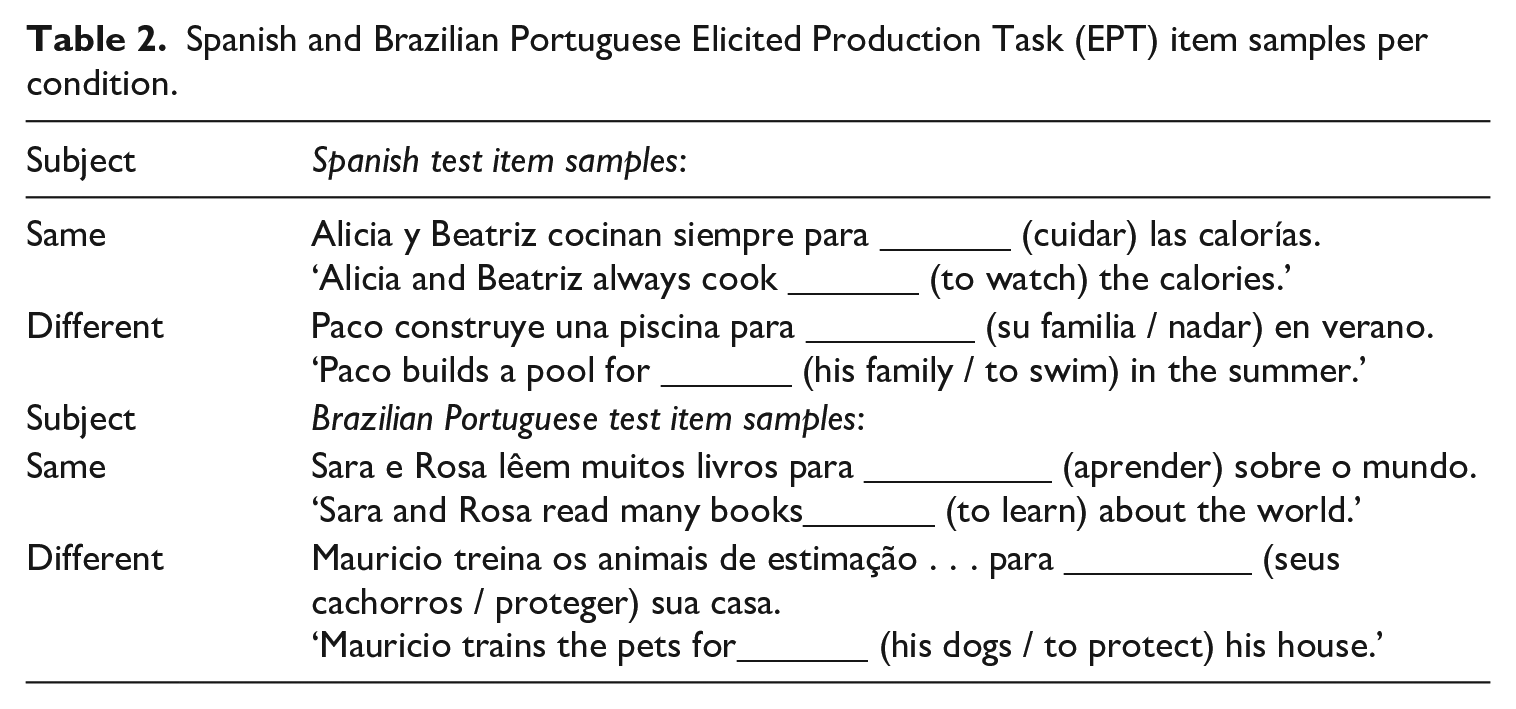
The EPT was used to examine the participants’ grammatical knowledge of verb morphology in subordinate clauses with either the same as or different subject than the subject in the main clause. This EPT required the participants to fill in the blanks with the appropriate verb conjugation. The desired verbs for the subordinate clauses were given in parentheses. The condition subject had two levels (same and different) based on whether the main and subordinate clauses had the same subject or not. This task had 32 experimental items (64 distractors per language), distributed in two conditions (k = 8, 16 per language). Table 2 provides sample items per condition in both languages, and Appendix B in supplemental material includes a list of all EPT test items in both languages.
Spanish and Brazilian Portuguese Elicited Production Task (EPT) item samples per condition.
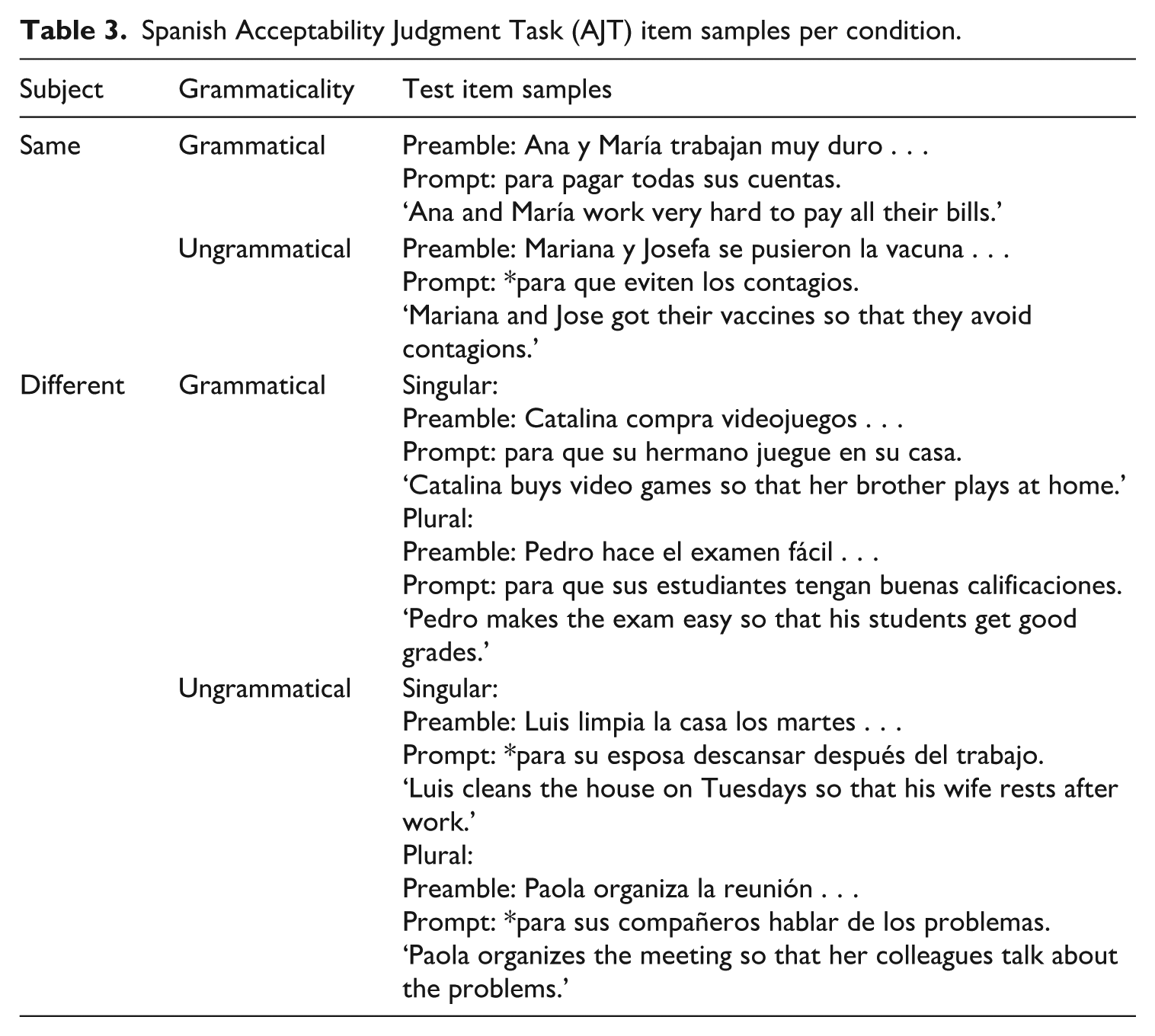
The AJT examined the participants’ receptive knowledge of subordinate clauses with grammatical and ungrammatical sentences. The AJT comprised 32 experimental items (64 distractors per language) distributed in four conditions (k = 4; 16 in each language). The participants were presented with sentences featuring subordinate clauses with a subject either different or not from the subject in the main clause. Both grammatical and ungrammatical versions of those sentences were also presented to the participants in the Spanish AJT. As an anonymous reviewer points out, the test items labeled as ungrammatical in the same subject condition can be considered grammatical if interpreted as if the subject of the infinitive is different from the subject of the main clause in the preamble. We acknowledge this limitation yet maintain these items’ label as ungrammatical for ease of presentation.
Participants were asked to rate each of them using a Likert scale from 1 to 5 (1 – muy extraño ‘very odd’, 2 – extraño ‘odd’, 3 – ni bien ni mal ‘neither good nor bad’, 4 – bien ‘good’, 5 – muy bien ‘very good’). Every time a participant rated an item 1 or 2, they were also asked to explain why, in order to confirm that they had rejected the item due to the phenomenon under examination. The items were counterbalanced and pseudorandomized. Table 3 shows the distribution of items according to conditions in Spanish, and Appendix B in supplemental material includes a list of all AJT test items in both languages.
Spanish Acceptability Judgment Task (AJT) item samples per condition.
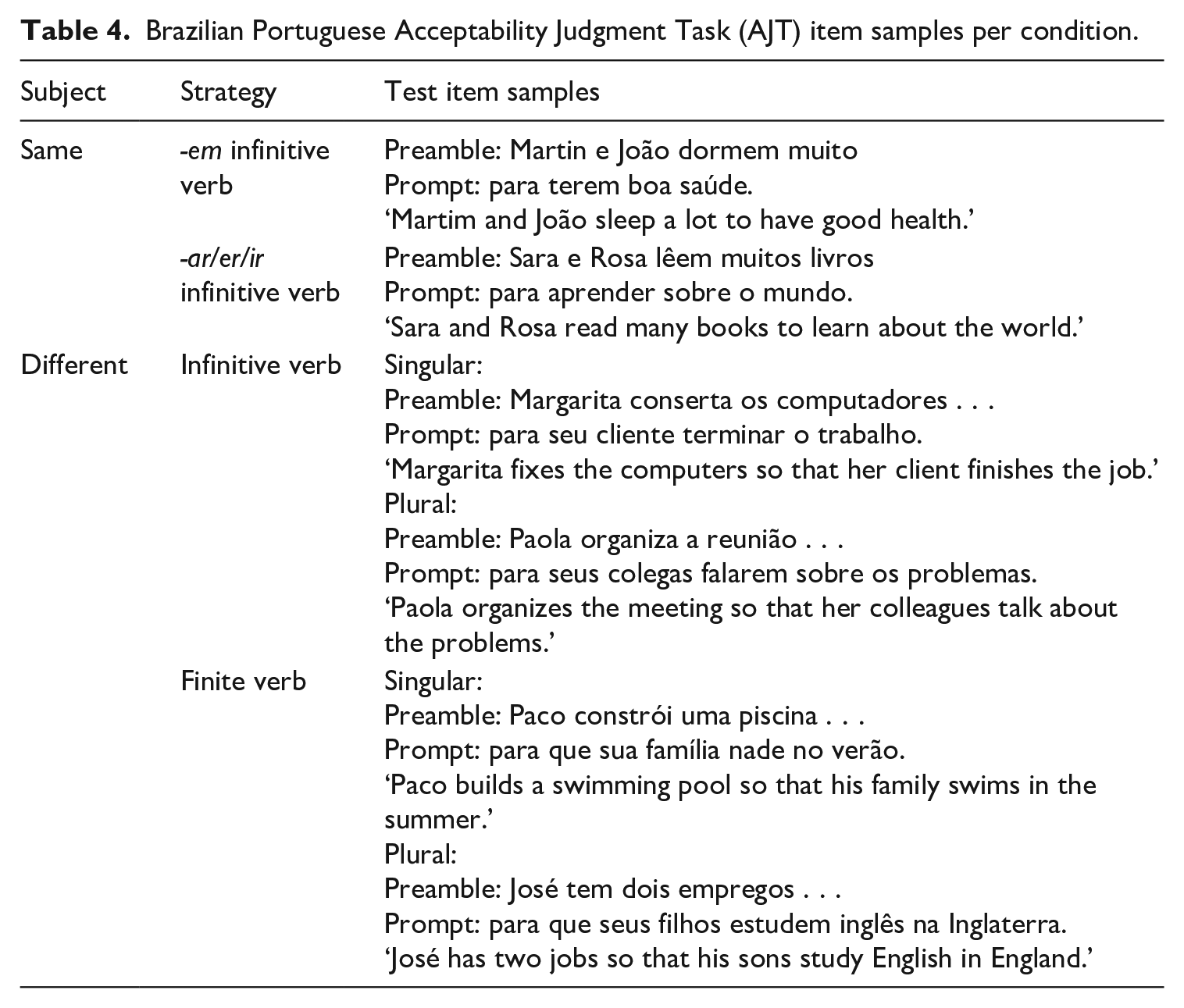
As for the labels in the Brazilian Portuguese AJT, we are more cautious, since both options in the phenomenon under investigation are grammatical in this language. That is, in the Brazilian Portuguese AJT, both the verbs ending in -ar/-er/-ir (which are generally referred to as uninflected infinitives) and verbs ending in -em (where the number inflection is expressed) are grammatical. Table 4 shows item samples for the Brazilian Portuguese AJT per condition.
Brazilian Portuguese Acceptability Judgment Task (AJT) item samples per condition.
3 Data analysis
For the present study, only Spanish language data were analysed with the use of inferential statistics, which we performed with the use of R (R Core Team, 2021). Descriptive statistics from the Brazilian Portuguese data are presented below. The main purpose of Brazilian Portuguese data is to serve as an L1 baseline for the L2 learners’ acquisition of the distribution of finite and nonfinite verbs in adjunct subordinate clauses headed with para.
The data from the EPT were analysed by using five generalized linear mixed models (GLMM) with the glmer function from the lme4 package (Bates et al., 2015). Four of these GLMMs examined the participants’ responses in four subsets of the EPT data, which were divided attending to condition (same vs. different subject) given that the different subject condition includes a contrast in the subordinate subject number (singular vs. plural) as independent variable while the same subject condition does not. Furthermore, the resulting data subsets were analysed from two different perspectives: by examining between-group differences between the native and the L2 speakers and by exploring within-group effects among the L2 speakers, specifically PLEP score effects. The fifth GLMM explored the factors predicting the production of innovative forms, particularly -em infinitive verbs in the L2 learners’ Spanish. All GLMMs included random intercepts for participants and test items.
In these GLMMs, the participants’ responses were the dependent variable. These responses were dummy coded: expected responses were coded as ‘1’ whereas unexpected responses were coded as ‘0’. In the same subject condition, -ar/-er-/ir infinitive verbs were the expected response whereas subjunctive verbs, either singular or plural, were the expected response in the different subject condition, depending on the number of the subordinate subject. Overall, the participants’ responses included -ar/-er-/ir infinitive verbs, -en/-em infinitive verbs (these are the inflected infinitives), singular subjunctive verbs, and plural subjunctive verbs. Other responses were discarded. The independent variables included two nominal categorical variables and one continuous variable: group (native vs. L2, in which native served as the reference), subordinate subject number (singular vs. plural, in which singular served as the reference), and Spanish PLEP scores. Categorical variables were sum coded, and Spanish PLEP scores were standardized before any analysis.
The four GLMMs used with the EPT data presented the following fixed effects structures. The first GLMM (GLMM1) analysing the same subject condition EPT data only included group as a dependent variable whereas the second GLMM (GLMM2), which focused on L2 data only, included Spanish PLEP scores as its only independent variable. The third and fourth GLMM examined the different subject condition of the EPT data. The third GLMM (GLMM3) included group and subordinate subject number as independent variables as well as an interaction between them (group × subordinate subject number). Finally, the fourth GLMM (GLMM4), which analysed L2 data only, presented Spanish PLEP scores and subordinate subject number as independent variables as well as an interaction between them (Spanish PLEP scores × subordinate subject number). Finally, the fifth GLMM (GLMM5), exploring innovative forms in the L2 learners’ production, included condition (same vs. different subordinate subject, in which same subject served as the reference), Spanish PLEP scores and subordinate subject number as independent variables. Appendices C and D in supplemental material include the code used to perform the GLMM described above and their outputs, respectively.
The data from the AJT were analysed by using four ordinal regressions performed with the clmm function from the ordinal package (Christensen, 2022). These four ordinal regressions follow structures similar to the ones featured by the first four GLMMs: the AJT data were divided in two according to conditions (same vs. different subject) as the different subject condition includes both singular and plural subordinate subjects. Additionally, the resulting subsets were analysed by examining either between-group differences or within-group effects. All ordinal regressions included random intercepts for participant and item.
In all ordinal regressions, the participants’ ratings were the dependent variable, which ranged from 1 to 5. A total of 22 responses were discarded from the Spanish AJT data as they were rejections due to reasons unrelated to the purpose of this study. The independent variables in the ordinal regressions are consistent with the ones in the GLMM examining the EPT data, with the addition of grammaticality (grammatical vs. ungrammatical, in which grammatical served as the reference; for discussion regarding this label, see Section IV.2).
The first ordinal regression (OR1) focused on the same subject condition data and included grammaticality (grammatical vs. ungrammatical) and group (native vs. L2) as well as an interaction between those variables (grammaticality × group). The second ordinal regression (OR2), which analyses the same subject condition from the AJT data from L2 learners only, included grammaticality and Spanish PLEP scores as well as an interaction between those variables (grammaticality × Spanish PLEP scores). The third ordinal regression (OR3) examines the between-group effects in the different subject condition and includes grammaticality, group, and subordinate subject number as well as three two-way interactions (grammaticality × group, grammaticality × subordinate subject number, and group × subordinate subject number) and one three-way interaction (grammaticality × group × subordinate subject number). Finally, the fourth ordinal regression (OR4), which analysed within-group effects in the different subject condition among the L2 speakers, includes grammaticality, Spanish PLEP scores, and subordinate subject number in combination with two two-way interactions (grammaticality × Spanish PLEP scores, and grammaticality × subordinate subject number). As in the EPT, categorical variables were sum coded, and Spanish PLEP scores were standardized before any analysis. Finally, significance of main effects and all possible interactions were assessed using hierarchical partitioning of the variance via nested model comparisons, and predicted probabilities were calculated for all GLMMs and ordinal models with the emmeans function from the emmeans package (Lenth, 2021).
V Results
1 Brazilian Portuguese results
The participants’ responses to the EPT in Brazilian Portuguese were coded and classified into five strategies. These strategies included -ar/-er-/ir infinitives (e.g. Mariana e Josefina se vacinaram para
Distribution of responses across strategies and conditions in Brazilian Portuguese.
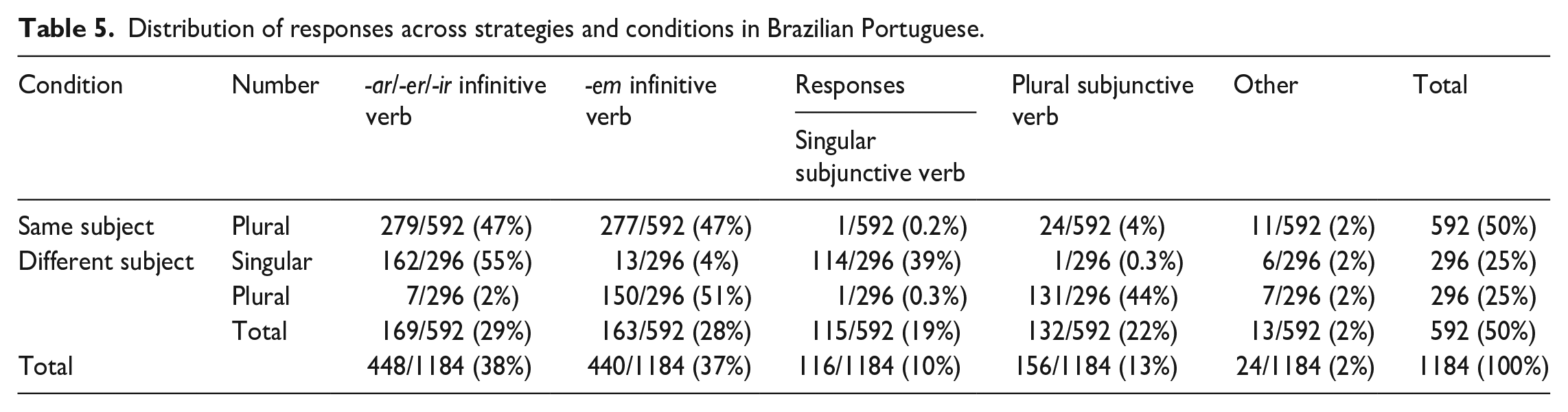
The L2 learners produced a similar number of instances of -ar/-er/-ir infinitive verbs and of -em infinitive verbs in the condition exploring embedded clauses with the same subject as the main clause, all of which were plural. With regard to the condition exploring the distribution of nonfinite and finite verb forms in embedded clauses with different subjects than the main clause, the L2 learners produced more instances of nonfinite verb forms. In the case of singular subjects in the subordinate clause, L2 learners produced -ar/-er/-ir infinitive verbs 55% of the time, followed by singular subjunctive verb forms, which were produced 39% of the time. Finally, when the subjects in the subordinate clauses were plural, L2 learners produced -em infinitive verbs 51% of the time while plural subjunctive verbs were produced 44% of the time. These results indicate that -ar/-er/-ir infinitive verbs and -em infinitive verbs co-exist in embedded clauses headed with para when the subordinate subject is plural and the same as in the main clause. On the other hand, when the subject in the subordinate clause differs from the one in the main clause, -ar/-er/-ir infinitive verbs and of -em infinitive verbs are distributed according to the number of the subordinate subject, as is the case for singular and plural subjunctive verb forms.
The L2 learners’ Brazilian Portuguese AJT data show their L1’s acceptability of the distribution of finite and nonfinite verbs in the contexts under examination. These data allow us to establish an L1 baseline to compare with their L2 Spanish results. Table 6 in Appendix E in supplemental material shows the Brazilian Portuguese-speaking L2 Spanish speakers’ acceptability data of their L1. Table 6 shows that this group of Brazilian Portuguese-speaking L2 Spanish speakers accept both finite and nonfinite forms in the contexts under examination. In the same subject context, participants accept both -ar/-er/-ir infinitives and -em infinitives. Nevertheless, -em infinitives might be favored in this context (97 + 152 acceptances for -em infinitives vs. 91 + 146 acceptances for -ar/-er/-ir infinitives in addition to 12 + 31 rejections for -em infinitives vs. 6 + 18 rejections for -ar/-er/-ir infinitives) as a result of formal education; see Modesto (2016) and references therein.
Distribution of the second language (L2) learners’ responses across strategies and conditions in Spanish.
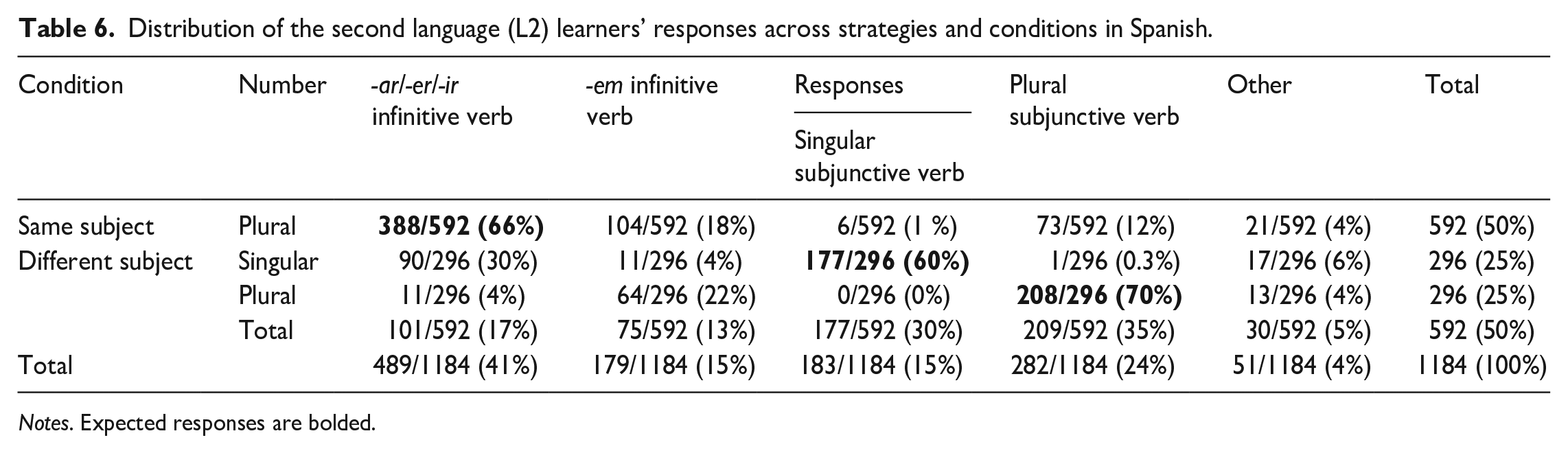
Notes. Expected responses are bolded.
2 Spanish language results
The participants’ responses to the Spanish EPT were coded and classified in five strategies: -ar/-er/-ir infinitive verbs (e.g. Ana y María trabajan muy duro para
Instances of participants producing innovative verb morphology in the Elicited Production Task (EPT).
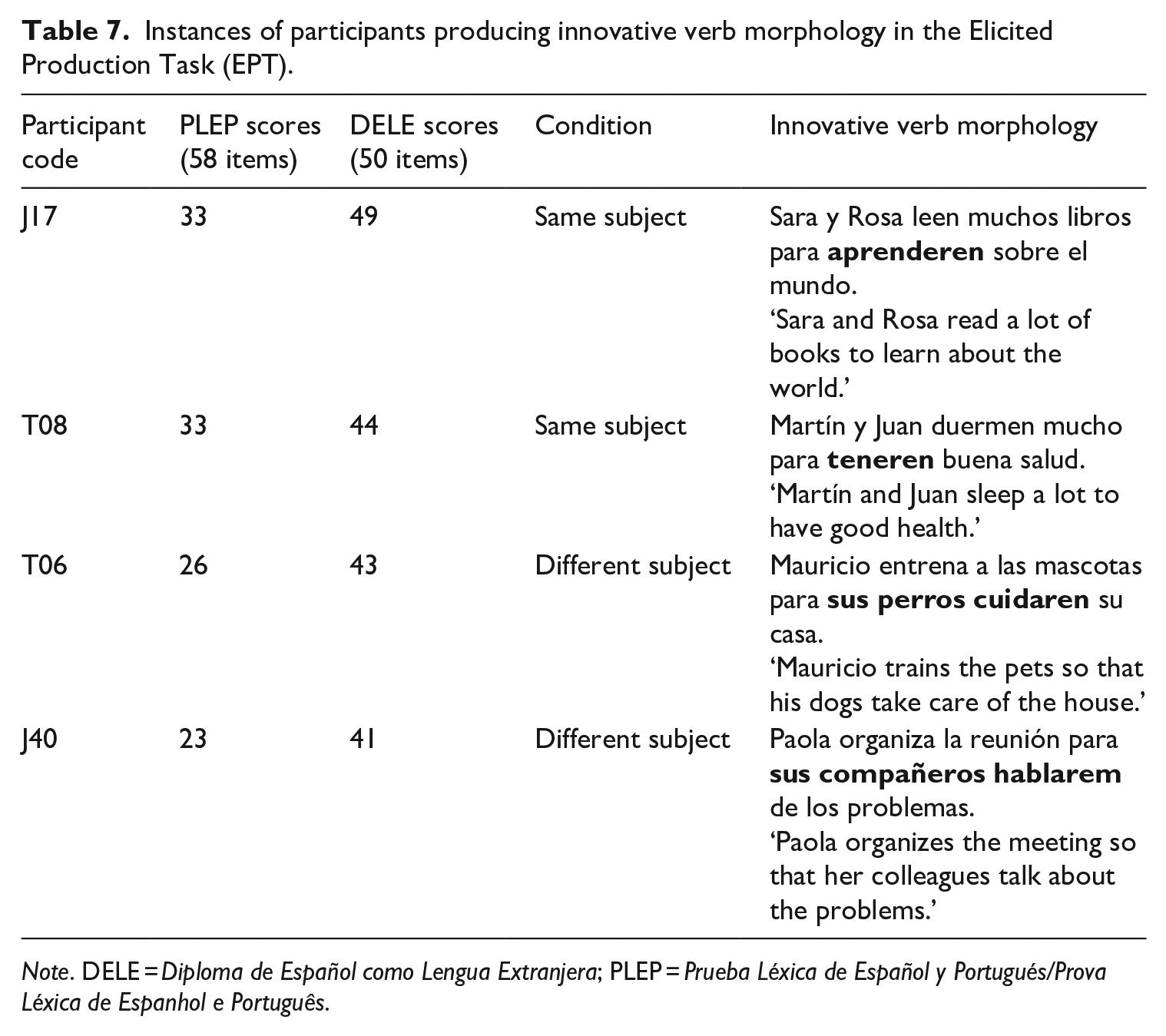
Note. DELE = Diploma de Español como Lengua Extranjera; PLEP = Prueba Léxica de Español y Portugués/Prova Léxica de Espanhol e Português.
As Table 7 shows, there was an abundance of -ar/-er/-ir infinitives in the same subject condition, while the use of finite verbs was preferred under the different subject condition. Additionally, innovative verb morphology was produced, particularly instances of -en/-em infinitive verbs. The examples in Table 8 show responses that illustrate such innovative answers in the EPT and are representative of a variety of speakers. These examples are accompanied by the Spanish PLEP and the DELE scores so that the reader can also see their overall performance in the proficiency tests.
Distribution of the native speakers’ responses across strategies and conditions in Spanish.
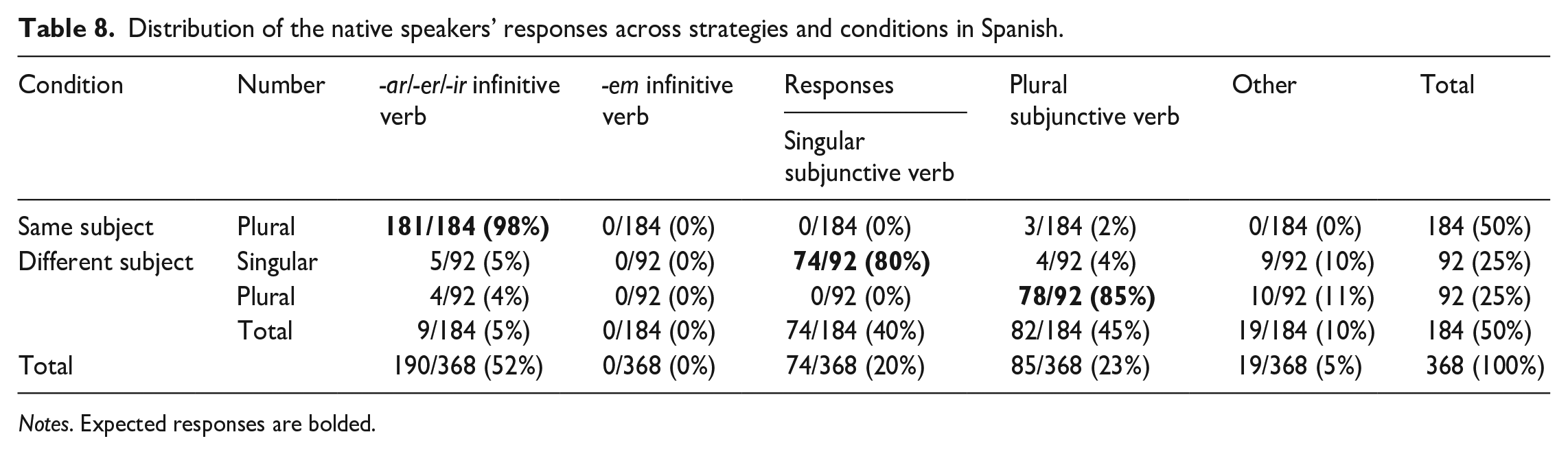
Notes. Expected responses are bolded.
The native speakers’ responses show a clear pattern: -ar/-er/-ir infinitives are the preferred verb form in embedded clauses in the same subject condition while subjunctive verbs are the more frequent response in the different subject condition. These subjunctive verbs present either a singular or a plural form depending on the number of the subject in the subordinate clause. As expected, native speakers did not produce any instance of -em/-en infinitive verb forms.
GLMM1, which examines between-group effects in the same subject condition, confirms the trends observed in the descriptive statistics: the two groups differ with regard to the accuracy of their responses (β = −4.91; SE = 0.96; z = −5.10; p < .01*). Indeed, the predicted probability of the L2 speakers producing target-like responses in this condition is 0.76 vs. 0.997 for the native speakers.
GLMM3, which focuses on between-group effects in the different subject condition, presents a similar picture as the results described above: the native speakers produce more accurate responses than the L2 speakers (β = −1.61; SE = 0.67; z = −2.42; p = .02*). This is also confirmed by predicted probabilities: the predicted probability of native speakers using target-like forms is 0.93 (for singular subordinate subjects) and 0.95 (for plural subordinate subjects) vs. 0.67 (for singular subordinate subjects) and 0.83 (for plural subordinate subjects) for the L2 speakers.
GLMM2 and GLMM4 analyse within-group effects in order to establish whether the L2 learners’ PLEP scores can predict their production and comprehension of the phenomenon under examination. The results indicate that the diverging patterns presented by the L2 speakers dissipate as their Spanish PLEP scores increase. In the different subject condition, which is analysed by GLMM4, we find that the L2 speakers produce more accurate responses as their Spanish PLEP scores increase (β = 1.08; SE = 0.31; z = 3.52; p < .01*). Within the different subject condition, the predicted probabilities of the L2 speakers in the lower end of the Spanish PLEP score range producing target-like responses are 0.15 (for singular subordinate subjects) and 0.43 (for plural subordinate subjects), respectively. Figure 1 illustrates this effect.
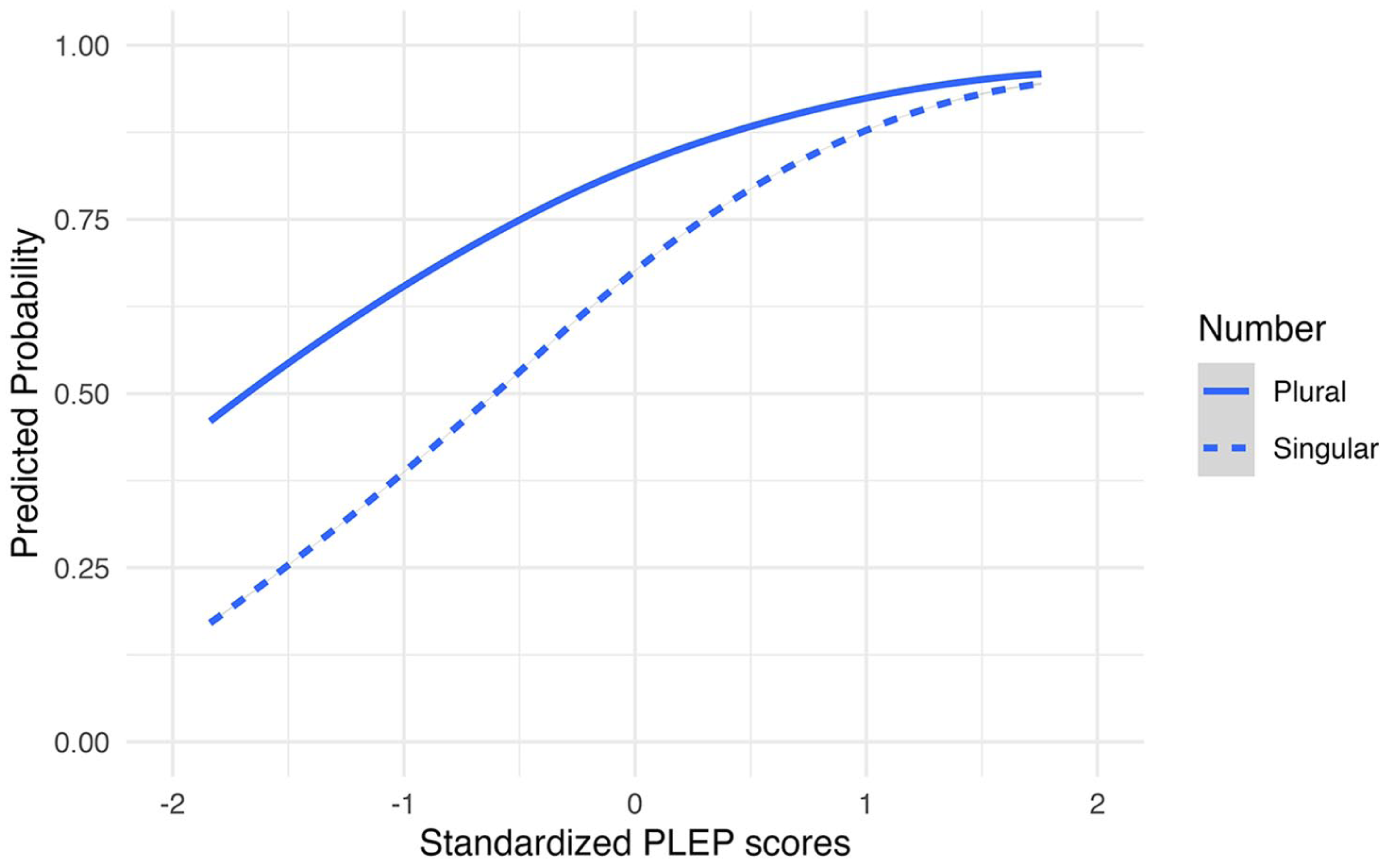
Predicted probabilities of production of target-like responses in the different subject condition as a function of Prueba Léxica de Español y Portugués/Prova Léxica de Espanhol e Português (PLEP) scores and subject number among the second language (L2) learners.
On the other hand, L2 speakers in the higher end of the Spanish PLEP score range present predicted probabilities of producing target-like responses of 0.96 (for singular subordinate subjects) and 0.97 (for plural subordinate subjects). Nevertheless, in the same subject condition, which is explored by GLMM2, we do not find an effect of the Spanish PLEP scores. We argue that this lack of productive vocabulary knowledge effect on their EPT responses is due to the similarity of the available strategies in this context in both Brazilian Portuguese and Spanish: both -ar/-er/-ir infinitives and -em infinitives are grammatical in Brazilian Portuguese in this particular context.
GLMM5, which explores the production of innovative forms (i.e. -em infinitive verbs) among the L2 speakers, yielded that these innovative forms (e.g. Paola organiza la reunión para
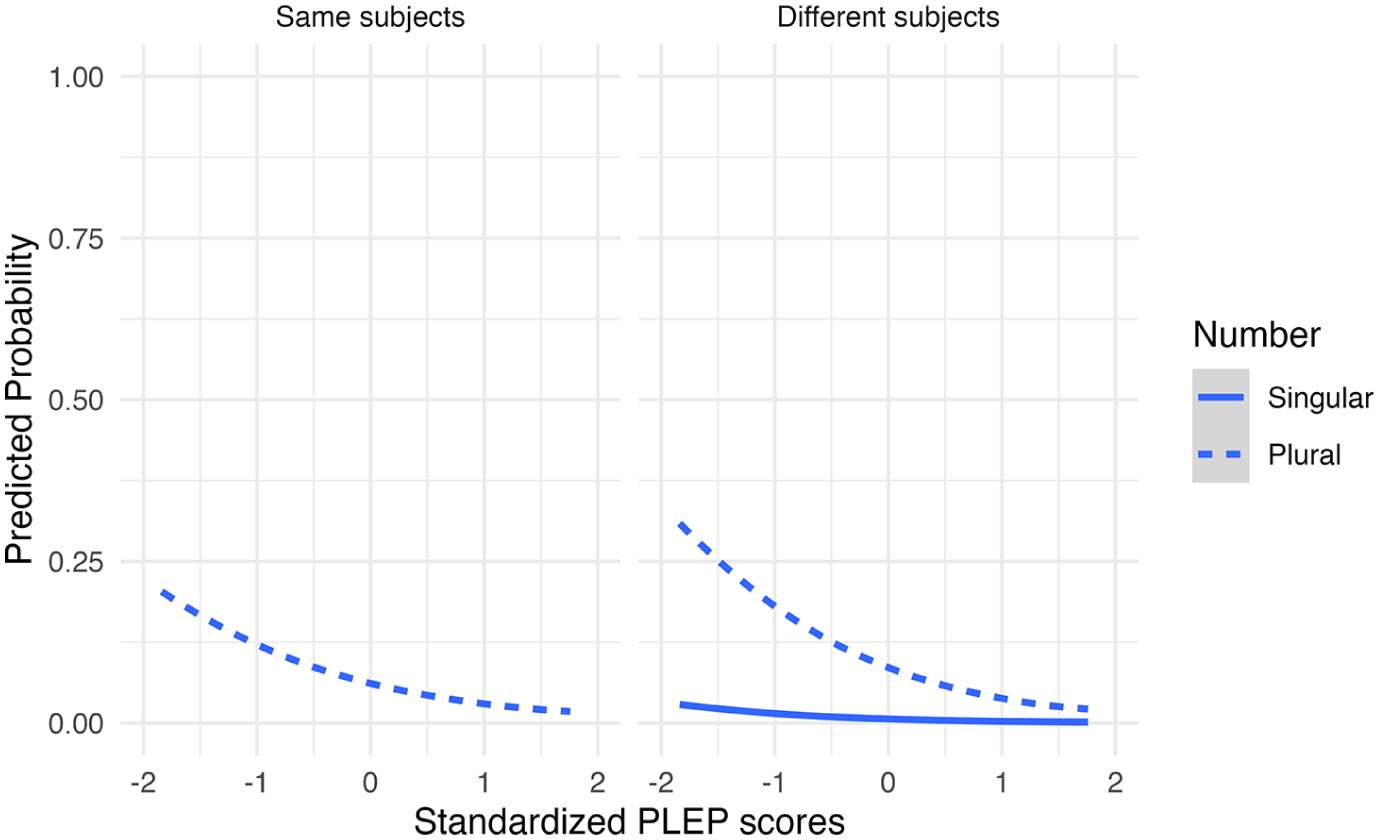
Predicted probabilities of production of innovative responses (i.e. -em infinitive verbs) as a function of Prueba Léxica de Español y Portugués/Prova Léxica de Espanhol e Português (PLEP) scores, condition and subject number among the second language (L2) learners.
Please note that the same subject condition only features plural subjects. Overall, these results show that Spanish PLEP scores can predict the abandonment of strategies invalid in Spanish, specifically inflected infinitives, in favor of those strategies used by native speakers, particularly subjunctive verb forms in subordinate clauses. For the outputs of all the models, see Appendix D in supplemental material.
The Spanish AJT data also present a contrast between the two groups under examination: the native speakers’ judgments are consistent with our expectations while the L2 learners’ feature more variability. The native speakers overwhelmingly accept grammatical test items and reject ungrammatical ones (for discussion regarding the labels, see Section IV.2). Table 10 in Appendix E in supplemental material shows the counts of every acceptability judgment made by the native speakers across grammaticality, condition, and subordinate subject number.
The L2 learners, on the other hand, accepted most test items. While they accepted grammatical test items more than ungrammatical ones, some ungrammatical conditions were frequently accepted: 236/296 (102 + 134) ungrammatical test items belonging to the same subject condition were accepted (e.g. Mariana y Josefa se pusieron la vacuna para que eviten los contagios). Only 5/92 (1 + 4) instances of these test items were accepted by the native speakers.
In the different subject condition, there seems to be a difference between singular and plural subordinate subjects. Ungrammatical test items presenting singular subordinate subjects (e.g. Luis limpia la casa los martes para su esposa descansar después del trabajo) receive more acceptance judgments than ungrammatical test items with plural subordinate subjects (e.g. Paola organiza la reunión para sus compañeros hablar de los problemas). Specifically, 102/148 (51 + 51) test items were accepted in the former condition vs. 49/148 (28 + 21) in the latter. This may be a sign of L1 transfer as -ar/-er/-ir infinitives are grammatical with third-person singular subjects in para-headed adjunct clauses in Brazilian Portuguese while -em infinitives are preferred for third-person plural subjects in this context. Table 11 in Appendix E in supplemental material shows the numbers of the acceptability judgments made by the L2 speakers across grammaticality, condition, and subordinate subject number.
The first ordinal regression (OR1), which examines between-group differences in the same different subject condition of the AJT data, found grammaticality effects (β = −1.88; SE = 0.27; z = −6.95; p < .01*) and interactions between grammaticality and group (β = 3.04; SE = 0.36; z = 8.53; p < .01*), indicating that ungrammatical test items received lower ratings and that the native Spanish speaker group gave lower ratings to ungrammatical test items than the L2 learners. The predicted probabilities indicate that grammatical test items are accepted by both groups. For the native speakers, the predicted probability of rating grammatical test items as 4 or 5 is of 0.20 and 0.76, respectively, while the L2 speakers’ predicted probability of rating those as 4 or 5 is 0.58 and 0.33. On the other hand, the groups present differences in their judgments of ungrammatical test items: the predicted probability of native speakers rating ungrammatical items as 1 or 2 is 0.13 and 0.30 whereas it is 0.02 and 0.06 for the L2 speakers.
The third ordinal regression (OR3) analysed between-group differences in the different subject condition of the AJT data and found grammaticality effects (β = −4.22; SE = 0.37; z = −11.46; p < .01*) and group effects (β = 1.23; SE = 0.35; z = 3.56; p < .01*) as well as two interactions: a two-way interaction between grammaticality and group (β = 3.36; SE = 0.37; z = 9.13; p < .01*) and a three-way interaction between grammaticality, group and subordinate subject number (β = −2.39; SE = 0.70; z = −3.43; p < .01*). These results are consistent with those provided by the first ordinal regression above. Additionally, the three-way interaction suggests that ungrammatical test items presenting singular subordinate subjects (e.g. *Luis limpia la casa los martes para
The second (OR2) and the fourth ordinal regressions (OR4) explored within-group effects among the L2 learners, with a focus on whether Spanish PLEP scores can predict the L2 learners’ receptive grammatical knowledge of the phenomenon under examination. OR2, which examined the same-subject condition, found an interaction between grammaticality and Spanish PLEP scores (β = −0.72; SE = 0.13; z = −5.64; p < .01*). This interaction suggests that the L2 speakers with higher Spanish PLEP scores rate ungrammatical test items lower than the L2 speakers with lower Spanish PLEP scores. The predicted probabilities of L2 speakers in the lower end of the Spanish PLEP score range (−2 in the standardized values of the Spanish PLEP scores) rating ungrammatical test items in the same subject condition as 1 or 2 is <0.01 and 0.01, respectively. On the other hand, for the L2 speakers in the higher end of the Spanish PLEP scores (2 in the standardized values of the Spanish PLEP scores), those values are 0.05 and 0.16, respectively. Despite grammaticality effects, L2 speakers accept ungrammatical items even if they present high Spanish PLEP scores. Figure 3 shows the predicted probabilities for the participants’ AJT responses (1 through 5) in the same subject condition as a function of PLEP scores and across grammaticality.
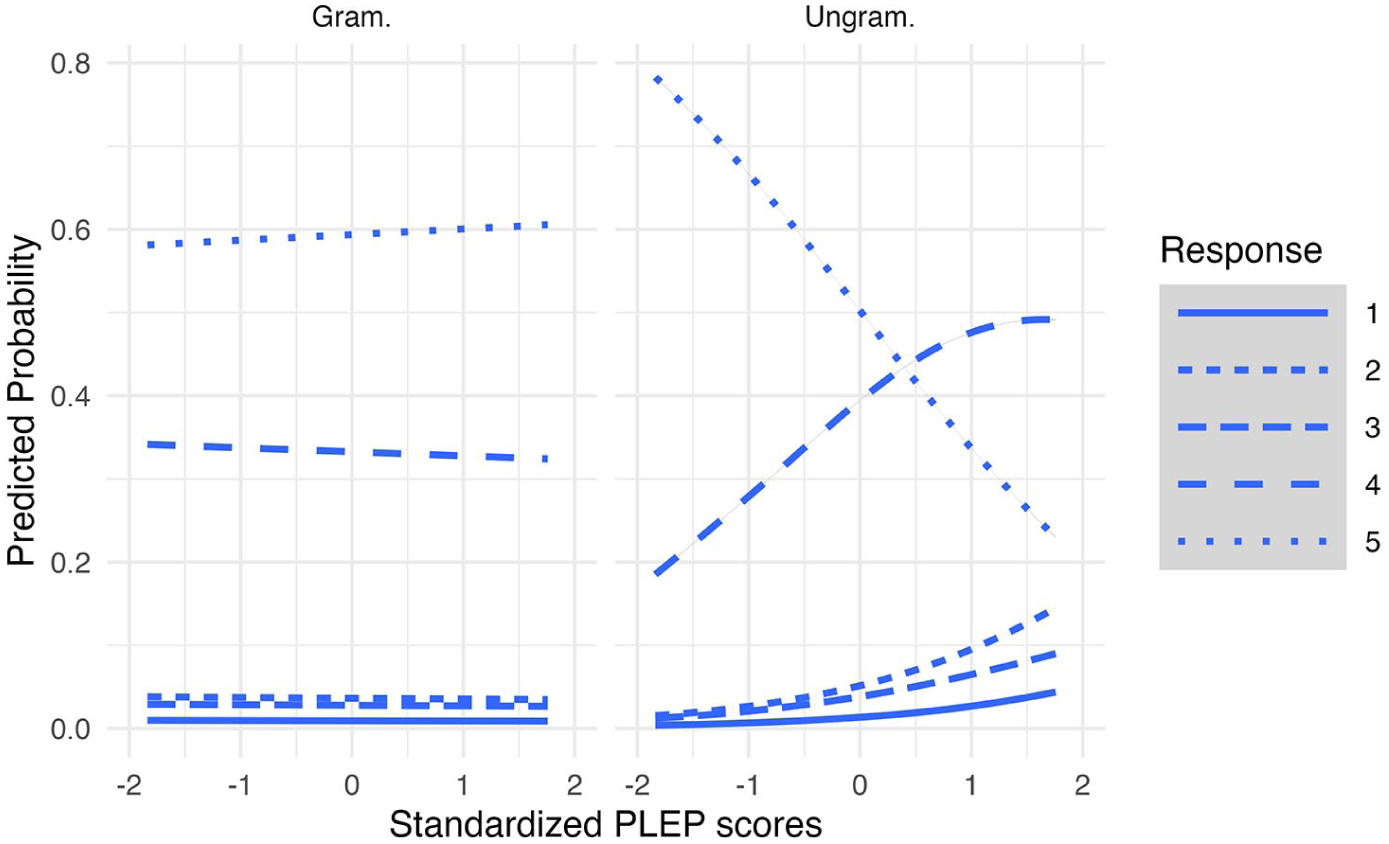
Predicted probabilities for the participants’ Acceptability Judgment Task (AJT) responses (1 through 5) in the same subject condition as a function of Prueba Léxica de Español y Portugués/Prova Léxica de Espanhol e Português (PLEP) scores and across grammaticality.
The fourth ordinal regression (OR4) examined within-group effects among the L2 learners in the different subject condition. This regression found grammaticality effects (β = −2.54; SE = 0.35; z = −7.28; p < .01*) and subordinate subject number effects (β = −0.18; SE = 0.48; z = −0.36; p = .03*) as well as two two-way interactions: between grammaticality and Spanish PLEP scores (β = −0.42; SE = 0.12; z = −3.42; p < .01*) and between grammaticality and subordinate subject number (β = 1.88; SE = 0.68; z = 2.75; p = .01*). The findings of this fourth ordinal regression are consistent with the results provided by the regressions above: ungrammatical items receive more rejections, particularly from L2 speakers with higher Spanish PLEP scores. This can be observed in the predicted probabilities of the ratings of ungrammatical test items; for instance, belonging to the different subject condition with plural subordinate subjects. The predicted probabilities of L2 speakers in the lower end of the Spanish PLEP score range (−2 in the standardized values of the Spanish PLEP scores) rating ungrammatical test items in this particular context as 1 or 2 is 0.08 and 0.28, respectively. On the other hand, the predicted probabilities of the L2 speakers with high Spanish PLEP scores (2 in the standardized values of the Spanish PLEP scores) rating these test items as 1 or 2 is 0.23 and 0.44, respectively. Figure 4 below illustrates the predicted probabilities for the participants’ AJT responses (1 through 5) in the different subject condition as a function of PLEP scores and across grammaticality and subject number conditions.
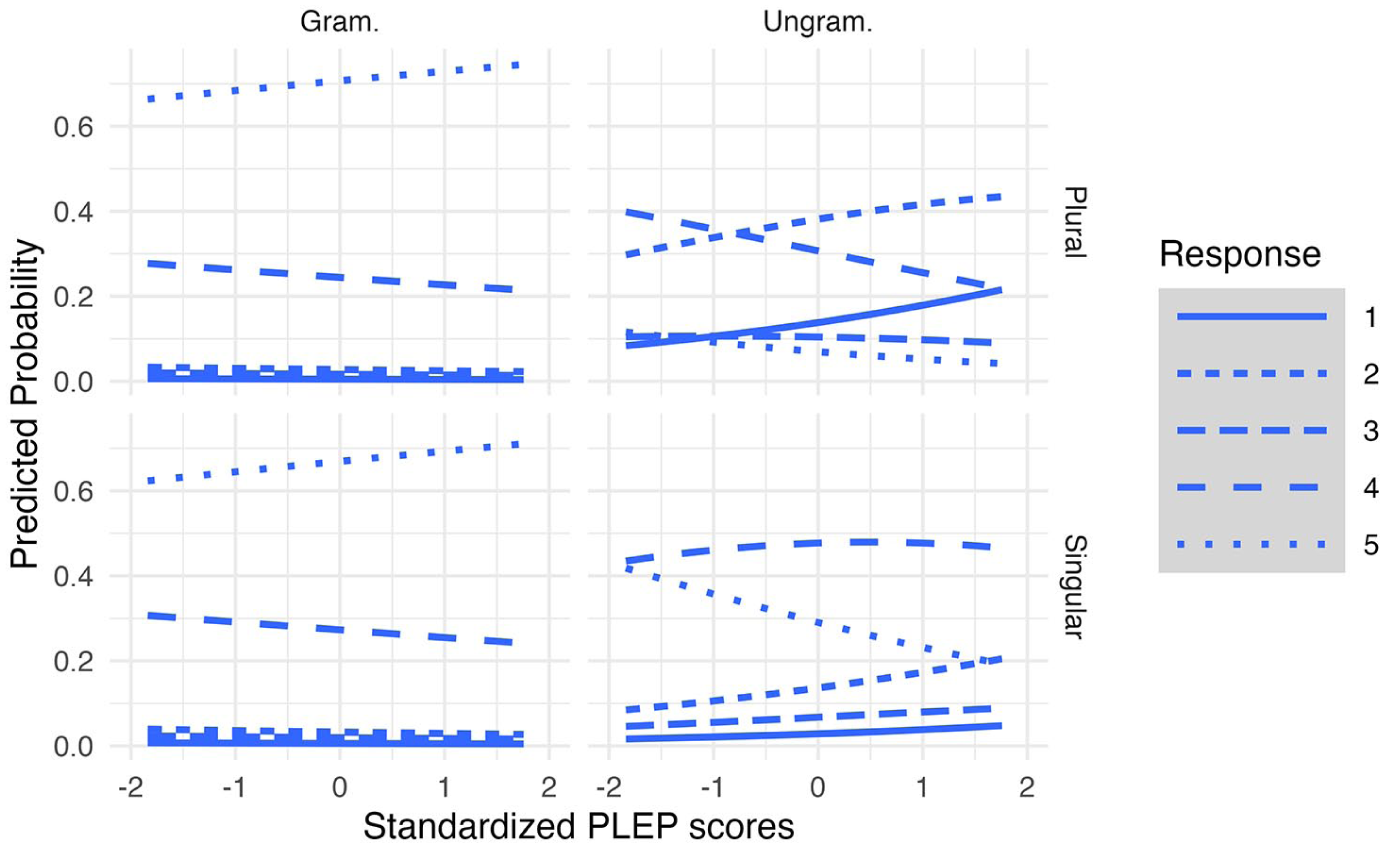
Predicted probabilities for the participants’ Acceptability Judgment Task (AJT) responses (1 through 5) in the different subject condition as a function of PLEP scores and across grammaticality and subject number conditions.
Furthermore, the interaction between grammaticality and subordinate subject number suggests that AJT test items in the different subject condition with singular subordinate subjects receive higher ratings than those with plural subordinate subjects, as the third ordinal regression (OR3) above found. We argue that this is the result of -ar/-er/-ir infinitives being a grammatical option in Brazilian Portuguese in the context under examination (e.g. *Paola organiza la reunión para
To sum up, the results from the Spanish EPT revealed that the L2 learners abandon their production of inflected infinitives in their L2: their use of -em infinitives decreases and their use of target-like strategies increase in tandem with their vocabulary knowledge. In other words, the L2 learners with higher PLEP scores present a more native-like distribution of verbs form in para-headed adjunct clauses than the L2 learners with lower PLEP scores. Furthermore, the Spanish AJT results signaled that productive vocabulary knowledge predicts lower ratings to ungrammatical test items among the L2 learners. Nevertheless, despite grammaticality effects and interactions, these lower ratings do not always represent rejections in our 5-point Likert, as shown in Figure 4 above as well as in the distribution of responses in Table 11 in Appendix E in supplemental material and in the predicted probabilities in Appendix D in supplemental material. This is arguably the consequence of participants avoiding giving low ratings (1 and 2) as our Qualtrics survey forced survey takers to provide an explanation for their low ratings.
VI Discussion
The goal of this article was to examine the acquisition of the available syntactic strategies to express para-headed adjunct clauses in Spanish among Brazilian Portuguese-speaking L2 learners of Spanish. Specifically, we looked at the production and the receptive grammatical knowledge of this type of adjunct clause in two conditions: (1) those in which the main clause and the subordinate clause share the same subject (e.g. Ana y María trabajan muy duro para pagar todas sus cuentas ‘Ana and María work very hard to pay all their bills’) and (2) those in which the subject of the main clause is different from that of the subordinate clause (e.g. Catalina compra videojuegos para que su hermano juegue en su casa ‘Catalina buys video games so that her brother plays at home’).
The two languages spoken by the learners present differences in these strategies. On the one hand, in Spanish, the expected strategy when the main and the adjunct clauses share the same subject is uninflected infinitives, which do not have number features. In contrast, verbs in the subjunctive (which do have number features) are the expected strategy when the subject of the main clause is different from the subject in the adjunct clause. On the other hand, Brazilian Portuguese presents inflected infinitives as an available strategy in addition to the aforementioned strategies in Spanish. In other words, both languages allow for infinitives in para-headed clauses in which the subject is the same as in the main clause and is expressed in null form yet, in this context, Brazilian Portuguese infinitives may present subject–verb agreement while infinitives in Spanish cannot. Additionally, both Spanish and Brazilian Portuguese can feature a finite (subjunctive) verb when the subjects in the main and in the subordinate clauses are different. However, Spanish does not allow infinitives in the aforementioned condition while Brazilian Portuguese does. The contrast discussed above is rooted in the presence of inflected infinitives in Brazilian Portuguese, which are not available in Spanish.
Research question 1 inquired about the knowledge of the available syntactic strategies in the L2 Spanish of Brazilian Portuguese-speaking learners, while research question 2 focused on the effect of proficiency on the acquisition of these strategies. Proficiency was measured with a productive vocabulary test. The findings confirm the hypothesis for research question 1. Specifically, our findings support Iverson and Rothman’s (2015) view in the sense that L2 learners experience an initial L1 transfer, yet said transfer cannot fully account for the variability found in L2 development. Particularly, this group of L2 learners must restrict the strategies available in their L1 in order to match the grammar of the L2. Indeed, access to UG allows learners to acquire the L2 despite showing signs of L1 transfer. Additionally, our findings are consistent with our hypothesis in that the variability in the L2 acquisition process can result from L1 pre-emption difficulties (Trahey and White, 1993). That is, Brazilian Portuguese-speaking L2 learners of Spanish need to restrict parts of their L1 grammar that are not available in their L2 despite both languages presenting similar functional morphology overall. The L1 pre-emption difficulty arises due to the subset–superset relationship between their L1 and L2 regarding the phenomenon under examination: the syntactic strategies available in Spanish, their L2, are a subset of the strategies available in Brazilian Portuguese, their L1. Therefore, the L2 learners need to restrict their L1 grammar and abandon the strategies that do not exist in the L2 grammar (Inagaki, 2001; Judy and Rothman, 2010; Rothman, 2008). Given this subset–superset relationship, parsing failures are not easy to detect, which hinders target-like grammar restructuring. Because of this, the L2 learners do not receive enough negative evidence in their input to trigger a target-like restructuring of their L2 grammar (Rothman, 2008). More specifically, at the initial L1 transfer stage, we expected to see difficulties in restructuring the T in the inflected infinitives in their L1 into the verb morphology of other syntactic strategies: either uninflected infinitives (which do not have number features) if the main and the adjunct clauses share the same subject, or finite verbs, particularly verbs in the subjunctive (which do have number features). Our results confirm that L2 learners on the lower end of proficiency, as per the PLEP, show variability in the strategies that they used while higher-proficient L2 learners seem to have abandoned the strategies that are unavailable in the L2.
A closer look at the results shows that the L2 learners mostly produced -ar/-er/-ir infinitive verbs in the condition where the subject in main and in the subordinate clauses is the same, while finite verbs are the most produced verb form in the different subject condition. However, non-target-like strategies were also employed. In the same subject condition, over a sixth of responses included an innovative strategy functioning as an inflected infinitive as a result of transfer from their L1. This innovative strategy presents verb forms in -en or -em (e.g. *para sus perros cuidaren de su casa), mimicking the functional morphology of inflected infinitives in the third person plural in their L1. A similar picture emerges in the different subject condition. that is, finite verbs are the most common response yet the L2 learners produce infinitives as well. As this condition included both singular and plural subjects in the subordinate clauses, the participants produced both -ar/-er/-ir infinitive verbs and -en/-em infinitive verbs, mostly distributed along with singular and plural subjects, respectively. Their production in their L1 presents an even distribution of -ar/-er/-ir infinitive verbs and -em infinitive verbs in the same subject condition, which only examined plural subjects, and a preference for infinitives (-ar/-er/-ir infinitive verbs for singular subjects and -em infinitive verbs for plural ones) over finite verbs in the different subject condition. These production data indicate that, while the L2 learners do not display difficulties with strategies that both languages have in common, they are still in the process of restructuring the T in inflected infinitives in their L1 into the available strategies in their L2. As shown in their L1 production data, inflected infinitives represent a widespread response across conditions.
Overall, our findings support Iverson and Rothman’s (2015) claim that even though L1 transfer does not necessarily block L2 acquisition, it is not always the case that the L1 grammar is completely excluded from the L2 interlanguage. In our study, we found evidence of a strong reliance on the L1 grammar among low-proficient learners, while higher-proficient L2 learners seem to have adopted the strategies appropriate to the L2. Our results align with studies such as Montrul and Louro (2006), who examined the morphosyntactic and discourse-pragmatic properties of the Null Subject Parameter across L2 English (L1 Spanish) learners with different levels of L2 proficiency. Their findings point to a full transfer (characterized by a high degree of both morphosyntactic and pragmatic inaccuracy) at the earliest stages of development and full restructuring (showing target-like morphosyntax and almost native-like pragmatics) at later stages. The findings from Montrul and Louro (2006) are also similar to the ones in the present study because Spanish (the L1) is a superset of English (the L2) with respect to the Null Subject Parameter, showing that, while there is grammar restructuring eventually, going from a superset to a subset can be problematic, especially at the L2 initial state.
Regarding the acceptability data, the L2 learners were sensitive to grammaticality only in the different subject condition, in which they were presented with grammatical uses of finite verbs (e.g. José tiene dos trabajos para que sus hijos estudien inglés en Inglaterra) vs. ungrammatical uses of infinitives (e.g. *José tiene dos trabajos para sus hijos estudiar inglés en Inglaterra). This sensitivity to grammaticality may be the result of initial L1 transfer, as the use of the infinitive in Spanish (please be reminded that infinitives do not present any functional morphology in Spanish) can be perceived as an instance of lack of agreement in an inflected infinitive of the participants’ L1. This view is supported by the relatively high predicted probabilities to rate these items as unacceptable among the participants in the lower end of the PLEP score range (for all statistical results, see Figure 4 and Appendix D in supplemental material), particularly when comparing those predicted probabilities with the overall high acceptance of items in the other ungrammatical conditions among the participants with low PLEP scores.
The L2 learners gave similar ratings to the two types of items tested in the same subject condition: target-like uses of infinitive verbs (e.g. César y José se bañan a diario para mantener buena higiene) and non-target-like finite verbs (e.g. Mauricio y Magdalena viajan todos los años para que conozcan lugares interesantes). This response pattern may be due to the latter type of test items, which can be interpreted as if the subjects in the main and the subordinate clauses are different. Overall, these results indicate that, while they show sensitivity to grammaticality in their receptive grammatical knowledge, these learners are still in the process of restructuring the T in the inflected infinitives in their L1 into the verb forms of the strategies available in their L2 (as shown in their production data). Verb morphology appears to be particularly challenging for these L2 learners, a finding consistent with previous literature. However, the task does not involve acquiring new functional morphology but restricting inflected infinitives in their L2.
For research question 2, we hypothesized that the L2 learners’ knowledge of these phenomena is modulated by their proficiency, which we tapped into with a proxy measuring their productive vocabulary knowledge (e.g. Bedore et al., 2012; Gollan et al., 2012; Sheng et al., 2014; Treffers-Daller and Korybski, 2015). Particularly, we hypothesized that those L2 learners with deeper vocabulary knowledge have converged on the target grammar, while those with a more limited vocabulary knowledge are still in the process.
Our results confirm our second hypothesis. The models examining the effect of lexical proficiency on the participants’ productive knowledge found that, as their productive vocabulary knowledge increases, they produce fewer cases of innovative verb morphology, namely -en/-em infinitive verbs, vs. the expected strategy, which are -ar/-er/-ir infinitives. In the different subject condition, particularly with plural subjects, they produce more plural subjunctives, which is the expected strategy, as their PLEP scores increase, vs. unexpected strategies. Regarding their acceptability data, the regressions found interactions between grammaticality and PLEP scores in both conditions, which indicates that the L2 learners with deeper vocabulary knowledge rate non-target-like items lower than their low-proficiency counterparts. Grammaticality effects were not found in the same subject condition, yet the interaction between grammaticality and PLEP scores suggest that the L2 learners with deep vocabulary knowledge do not accept the use of finite verbs in the same subject condition (e.g. Mauricio y Magdalena viajan todos los años para que conozcan lugares interesantes). Additionally, the interaction between grammaticality and subordinate subject number in the regression examining the ratings to items belonging to the different subject condition indicates that ungrammatical test items presenting singular subordinate subjects (e.g. *Luis limpia la casa los martes para
Collectively, these findings illustrate the acquisition process that the L2 learners undergo, taking into consideration L1 pre-emption difficulties that help explain the variability in the L2 development. The acquisition of these L2 learners requires restricting syntactic strategies available in their L1 to fewer strategies in their L2, which involves functional morphology (i.e. inflected infinitives) existing in their L1 but not in their L2. Since the low-proficient L2 learners produce ungrammatical infinitives (i.e. inflected infinitives) in their L2 Spanish (sometimes even with innovative functional morphology derived from L1 transfer), we suggest that the production of those low-proficient L2 learners evidence a not fully complete grammar restructuring. Specifically, Brazilian Portuguese-speaking L2 learners of Spanish seem to start their acquisition process of the phenomenon under examination by using their L1 knowledge: they use non-target-like infinitives in their L2, reflecting their production patterns in their L1 in which they favor inflected infinitives. After that initial stage, the L2 learners do not seem to acquire syntax followed by morphology, since their acquisition task is different in nature: as their productive vocabulary knowledge increases, they restrict the use of inflected infinitives, which do not exist in Spanish, along with their innovative morphology. That is, the L2 learners successfully restructure T into the verb forms in the syntactic strategies available in Spanish.
The high number of cognates and the similar functional morphology in these two languages is arguably the reason for this acquisition process. The L2 learners with deep vocabulary knowledge in their L2 have integrated target-like syntactic and morphological information in their L2 lexicon while those with more limited lexical knowledge were still in the process. For consistency, all the verbs tested in the experimental tasks were cognates in the two languages (for a list of the test items in the EPTs and AJTs, see Appendix B in supplemental material). Overall, we argue that cognates and similar functional morphology in the two languages involved in this process facilitate non-target-like L1 transfer in the L2.
Lastly, the crucial role of lexical knowledge, which is significantly determined by the exposure to target language input (Chang and Hu, 2018), was also attested in the study. We determined that the productive vocabulary test focusing on non-cognate words (i.e. the PLEP), can be used as a proxy to measure overall L2 proficiency. We highlight the importance of using instruments that are appropriate for the language pair. Using a grammar test, such as the adapted DELE, was ineffective for measuring grammatical and lexical knowledge in our study, although tests like this one have been successfully used with Spanish L2 learners with different L1 backgrounds. The syntactic and morphological proximity between this language pair led to misleading scores. That is, the learners could guess the correct answer by using their L1 knowledge since the test does not control for cognates or grammar that is almost identical in both languages. The DELE results were at ceiling: 71 out of 74 participants scored over 40/50, which is, in most studies, considered advanced. Such lack of variability in their responses limits the DELE’s predictive power for this population. All in all, these findings suggest that the PLEP and not the DELE may be more appropriate to assess overall proficiency in this language pair. Therefore, by taking advantage of the relationship between lexis and grammar and the critical role that vocabulary knowledge plays in L2 learning (Qian and Lin, 2020), we propose an alternative way to assess a language pair that does not benefit from traditional assessment measures.
VII Conclusions
The present study has provided evidence supporting Iverson and Rothman’s (2015) view on the role of initial L1 transfer, showing that learners with lower L2 proficiency rely on L1 transfer while higher-proficiency learners adopt target-like syntactic strategies and verb morphology. The use of innovative syntax and morphology could have also been facilitated by the lexical similarity in this language pair. This study has also shown supporting evidence for using productive vocabulary measures as a proxy for overall proficiency. The implementation of a productive vocabulary knowledge test examining non-cognate words in this language pair proved to be a predicting factor in the participants’ responses.
The present work is not without limitations, and future research could help us better understand inflected infinitives in SLA. Particularly, we acknowledge that the use of infinitive verb forms in parentheses (see Table 2) to guide participants on what verb needed to be used in each test item might have had priming effects on their verb morphology production. Additionally, the production tasks were administered online, in written form. Additionally, while we found grammaticality effects, we acknowledge that forcing participants to provide an explanation for rejecting test items in the AJT may have discouraged them from rating items as 1 – muy extraño or 2 – extraño, which may have impacted our AJT data. However, this choice allowed us to confirm that rejections were related to the scope of the study. Furthermore, the use of brief preambles might have led to a lack of clarity and alternative interpretations, as pointed out by an anonymous reviewer. Specifically, test items in the same subject condition were labeled as ungrammatical (e.g. Mauricio y Magdalena viajan todos los años para
Future directions include collecting data from Spanish-speaking L2 learners of Brazilian Portuguese with the goal of examining directionality effects (see Judy and Rothman, 2010; Rothman, 2008) in this language pair. Additionally, doing so would also help assess whether the PLEP can predict the acquisition of Brazilian Portuguese grammar among Spanish speakers. Further validating this tool would provide additional evidence on the correlation (not causation) between lexical knowledge and L2 proficiency.
Supplemental Material
sj-docx-1-slr-10.1177_02676583241297543 – Supplemental material for Inflected infinitives in SLA: A study of L1-Brazilian Portuguese–L2-Spanish speakers
Supplemental material, sj-docx-1-slr-10.1177_02676583241297543 for Inflected infinitives in SLA: A study of L1-Brazilian Portuguese–L2-Spanish speakers by Julio César López Otero, Abril Jimenez and Gabriel Martínez Vera in Second Language Research
Supplemental Material
sj-docx-4-slr-10.1177_02676583241297543 – Supplemental material for Inflected infinitives in SLA: A study of L1-Brazilian Portuguese–L2-Spanish speakers
Supplemental material, sj-docx-4-slr-10.1177_02676583241297543 for Inflected infinitives in SLA: A study of L1-Brazilian Portuguese–L2-Spanish speakers by Julio César López Otero, Abril Jimenez and Gabriel Martínez Vera in Second Language Research
Supplemental Material
sj-docx-5-slr-10.1177_02676583241297543 – Supplemental material for Inflected infinitives in SLA: A study of L1-Brazilian Portuguese–L2-Spanish speakers
Supplemental material, sj-docx-5-slr-10.1177_02676583241297543 for Inflected infinitives in SLA: A study of L1-Brazilian Portuguese–L2-Spanish speakers by Julio César López Otero, Abril Jimenez and Gabriel Martínez Vera in Second Language Research
Supplemental Material
sj-docx-6-slr-10.1177_02676583241297543 – Supplemental material for Inflected infinitives in SLA: A study of L1-Brazilian Portuguese–L2-Spanish speakers
Supplemental material, sj-docx-6-slr-10.1177_02676583241297543 for Inflected infinitives in SLA: A study of L1-Brazilian Portuguese–L2-Spanish speakers by Julio César López Otero, Abril Jimenez and Gabriel Martínez Vera in Second Language Research
Supplemental Material
sj-pdf-2-slr-10.1177_02676583241297543 – Supplemental material for Inflected infinitives in SLA: A study of L1-Brazilian Portuguese–L2-Spanish speakers
Supplemental material, sj-pdf-2-slr-10.1177_02676583241297543 for Inflected infinitives in SLA: A study of L1-Brazilian Portuguese–L2-Spanish speakers by Julio César López Otero, Abril Jimenez and Gabriel Martínez Vera in Second Language Research
Supplemental Material
sj-xlsx-3-slr-10.1177_02676583241297543 – Supplemental material for Inflected infinitives in SLA: A study of L1-Brazilian Portuguese–L2-Spanish speakers
Supplemental material, sj-xlsx-3-slr-10.1177_02676583241297543 for Inflected infinitives in SLA: A study of L1-Brazilian Portuguese–L2-Spanish speakers by Julio César López Otero, Abril Jimenez and Gabriel Martínez Vera in Second Language Research
Footnotes
Declaration of conflicting interests
The authors declared no potential conflicts of interest with respect to the research, authorship, and/or publication of this article.
Funding
The authors received no financial support for the research, authorship, and/or publication of this article.

Notes
References
Supplementary Material
Please find the following supplemental material available below.
For Open Access articles published under a Creative Commons License, all supplemental material carries the same license as the article it is associated with.
For non-Open Access articles published, all supplemental material carries a non-exclusive license, and permission requests for re-use of supplemental material or any part of supplemental material shall be sent directly to the copyright owner as specified in the copyright notice associated with the article.
