




Abstract
Embedded questions (EQs) are islands for filler–gap dependency formation in English, but not in Norwegian. Kush and Dahl (2022) found that first language (L1) Norwegian participants often accepted filler–gap dependencies into EQs in second language (L2) English, and proposed that this reflected persistent transfer from Norwegian of the functional structure that licenses such filler–gap dependencies. However, their results do not conclusively establish that the judgment patterns were specific to transfer from L1 Norwegian and not a general L2 effect. To address this issue, we conducted elicited production tasks comparing how L1 Norwegian and L1 Swedish speakers complete dependencies into declarative complement clauses and EQs both in their native languages and L2 English. Despite its similarity to Norwegian, Swedish prohibits the filler–gap dependency into EQs that Norwegian allows. We expected participants to complete dependencies that they considered grammatical with gaps and to avoid gaps where they considered them ungrammatical. Our results clearly indicate transfer: L1 Norwegian participants overwhelmingly used gaps when completing dependencies into EQs in both L1 and L2, whereas Swedish participants almost never used gaps in either language. We interpret our results as support for models that allow transfer of functional heads and their associated features from L1 to L2, and suggest that such transfer persists when the L2 input does not provide relevant evidence for restructuring.
Keywords
I Introduction
In this article we consider how aspects of an individual’s first language (L1) grammar influence the filler–gap dependencies they produce in their second language (L2). We investigate a particular case, originally discussed in Kush and Dahl (2022), illustrated below. Norwegian and English are alike in that both languages allow long-distance filler–gap dependencies into embedded declarative clauses (1). The languages differ in that Norwegian also permits filler–gap dependencies into embedded questions (henceforth EQs) like (2b), but English does not (2a). That is, finite EQs are islands in English (Chomsky, 1977), but not in Norwegian (Maling and Zaenen, 1982a). The divergence points to underlying differences in the grammars of the two languages.
(1) a. That was the signali that the sailors knew [ __i meant danger.] b. Det var signal-eti som sjømenn-ene visste [ (at) __i betydde fare.] It was signal- ‘That was the signal that the sailors knew meant danger.’ (2) a. * That was the signali that the sailors knew [what __i meant.] b. Det var signal-eti som sjømenn-ene visste [ hva __i betydde.] It was signal- ‘That was the signal that the sailors knew what meant.’
Kush and Dahl (2022) argued that Norwegians transfer EQ-island insensitivity from their L1 grammar to their L2 English grammar. In two acceptability judgment studies, L1 Norwegian speakers rated sentences like those in (1) and (2) in English and Norwegian. The participants judged (1b) and (2b) to be equally acceptable, confirming that EQs are not islands in Norwegian. The same participants rated English sentences differently: They gave high ratings to dependencies into embedded declaratives like (1a), but rated dependencies into EQs (2a) as significantly less acceptable on average.
Kush and Dahl contended that the lower average ratings of (2a) obscured clear effects of transfer. Closer examination of participant judgments revealed that while L1 English control participants uniformly rejected sentences like (2a), nearly all L1 Norwegian participants rated such sentences as acceptable on at least one trial and most accepted the sentences more frequently. Thirty out of 59 participants in Experiment 2 rated at least half of the dependencies into EQs they saw on par with grammatical sentences like (1a) and eight participants consistently accepted the sentences. Similar response variability was not observed in ratings of other island violations where transfer was not at issue: Participants nearly always rejected dependencies into nominal subject phrases, which are islands in both Norwegian and English. Thus, participants were significantly more likely to accept ungrammatical English dependencies whose Norwegian counterparts were grammatical than those that were not.
Kush and Dahl’s results are consistent with persistent transfer, but the results do not conclusively establish that transfer was responsible for the effects. Inconsistent judgments of a sentence type only provide indirect evidence that participants’ L2 grammars generate the structures. Moreover, we cannot rule out the possibility that inconsistent judgments of sentences like (2a) are a more general ‘L2 effect’, independent of transfer, because Kush and Dahl did not compare L1 Norwegians’ judgments to judgments of speakers of an L1 where sentences like (2a) are unacceptable.
The primary goal of this article is to look for more direct evidence of transfer through an elicited production task in which we measure L1 Norwegian participants’ willingness to produce filler–gap dependencies into English EQs. Alongside L1 Norwegian participants, we test a group of L1 Swedish participants on the same task. Norwegian and Swedish are closely related languages, but the Swedish equivalents of (2a/b) are, crucially, unacceptable. As shown in (3), Swedish does not allow a subject gap immediately following a wh-phrase in the left periphery of an embedded question.
(3) * Det var den signal-eni som sjömännen visste [ vad __i betydde]. It was the signal-
We reasoned that if it is transfer that causes L1 Norwegian speakers to accept English island violations like (2a), then L1 Norwegian participants should potentially produce such filler–gap dependencies, but L1 Swedish participants should not. To preview our results, this is exactly what we find, implicating transfer of the features that license dependencies like (2b) from Norwegian to English.
A subsidiary goal of the article is to bring more data to bear on whether L1 Norwegian speakers can restructure their L2 English grammar after the aforementioned transfer to avoid dependencies like (2a). Prominent models of restructuring (Schwartz and Sprouse, 1996; White, 2003) predict that restructuring would be particularly difficult in these cases because the L2 input does not contain clear evidence that filler–gap dependencies into EQs are disallowed in English. In apparent contradiction to this prediction, Kush and Dahl (2022) suggested that a portion of their participants showed signs of having restructured. Their basis for this claim was that a subset of participants were more likely to reject dependencies into English EQs than Norwegian EQs. Once again, the conclusion should be handled with caution: we do not know whether participants rejected dependencies into EQs because they were ruled out by a restructured L2 grammar or simply because participants found the dependencies harder to process in L2 than in L1 (e.g. Juffs, 2005; Juffs and Harrington, 1995). Results from the present study do not provide strong evidence of restructuring. If restructuring occurs, it appears to be much rarer than Kush and Dahl (2022) suggested. We elaborate on why restructuring appears to be so uncommon in Section VII.
The remainder of the article is structured as follows. In Section II we discuss the relevant grammatical differences between English, Norwegian and Swedish to identify the feature(s) that could be transferred and discuss prior work on transfer and islands. Section III briefly discusses issues surrounding restructuring. Our experiments are presented in Section IV, V and VI. In Section VII we discuss our results and their implications.
II Grammatical differences and relevant features
English sentences like (4a) are ruled out for two reasons. First, there is an island violation caused by associating a filler with a gap inside a finite embedded question. The unacceptability associated with island violations generalizes across gaps in various positions and question types: (4) a. * That’s the book that John asked [who had written __ ]. b. * I saw the guy that you wondered [when Ali gave some money to __ ].
The second source of unacceptability is that (2a) contains a subject gap immediately adjacent to a word in the complementizer phrase (CP) of the clause. Generally speaking, English appears to disallow subject gaps directly after a word or phrase in CP (Chomsky and Lasnik, 1977; Perlmutter, 1971; Pesetsky, 1982; Sobin, 1987). The canonical examples that illustrate this prohibition are that-trace sentences like (5), where a subject gap is adjacent to the complementizer that.
(5) That was the signal that the sailors knew (*that) __ meant danger.
Various authors have argued that the constraint that rules out that-trace sentences should be generalized to block any configuration where a subject gap is immediately next to other words or phrases in CP, such as in (2a), where the lexical material in CP is not the complementizer but rather a wh-phrase in the specifier of CP (see, for example, Lohndal, 2009; McDaniel et al., 2015; Morgan, 2022). The umbrella term ‘Complementizer-trace’ (henceforth Comp-t) configuration is used to pick out any structure with the relevant properties, and a Comp-t effect refers to when such a configuration causes unacceptability.
English speakers sometimes attempt to link a filler to a position that is ruled out by the grammar. When they do, they often opt to use a resumptive pronoun instead of a gap (McKee and McDaniel, 2001). This behavior follows a general cross-linguistic trend to use resumption as a way to ‘repair’ ungrammatical filler–gap dependencies or to ease the processing of particularly taxing dependencies (Asudeh, 2012; Chacón, 2019; Chao and Sells, 1983; Ferreira and Swets, 2005; Kroch, 1981; Morgan and Wagers, 2018).
Resumptives can be used in place of a gap inside EQs (6a). They are also occasionally observed in sentences where a that-trace configuration would have resulted (6b).
(6) a. *? That was the signali that the sailors knew [what b. *? That was the signali that the sailors said [that
Despite their use in production, resumptive pronouns are generally judged to be unacceptable in English by formal studies (Alexopoulou and Keller, 2007; Heestand et al., 2011).
As seen in (2b) and (7), both Norwegian and Swedish allow filler–gap dependencies into EQs (Engdahl, 1982; Maling and Zaenen, 1982).
(7) a. Norwegian Hvilke bøker spurte Jon [ hvem som __ hadde skrevet __ ]? Which books asked Jon who C had written ‘Which books did Jon ask who had written?’ b. Swedish Vilka böcker frågade Jan [ vem som __ skrev __ ]? Which books asked Jon who C wrote ‘Which books did Jon ask who had written?’ (Maling and Zaenen, 1982a: 232)
The languages differ, however, with respect to Comp-t effects. Norwegian allows gaps immediately after a complementizer (8a), 1 but Swedish does not, as seen in (8b). 2
(8) a. Norwegian Hvem tror du (at) __ har gjort det? Who believe you that has done it/that ‘Who do you believe (that) has done it?’ (adapted from Vangsnes, 2019: example 5) b. Swedish Vem tror du (* att) _ har gjort det? Who believe you that has done it/that ‘Who do you believe (that) has done it?’
Swedish speakers use resumptive pronouns to neutralize Comp-t effects (Engdahl, 1985) and, like English speakers, would also use a resumptive if extracting a subject from an EQ. 3
(9) a. Subject Resumptive after Comp ‘att’ (Swedish) Vem tror du att _ Who believe you that he did it/that ‘Who do you believe that b. Subject Resumptive in EQ (Swedish) Det var den signal-eni som sjömännen visste [ vad It was the signal- ‘That was the signal that the sailors didn’t know what
Though resumptives can be used in Norwegian, they are rarely used inside EQs. That is, while sentences like (2b) are well attested in casual speech and edited prose (Kush et al., 2021), sentences like (10) are not. Hammarstrand (2022) found that L1 Norwegian speakers rate sentences like (10) with a resumptive as unacceptable, preferring corresponding versions with gaps instead.
(10) * Det er signal-et som sjømen-nene visste [ hva It are signal- ~ ‘That is the signal that the sailors knew what it meant.’
The fact that Norwegians prefer gaps to resumptives in these configurations further supports the conclusion that filler–gap dependencies into EQs are grammatical in Norwegian.
The discussion above establishes that the grammars of English and Norwegian diverge with respect to whether they treat EQs as islands and whether they display Comp-t effects. It also establishes that the grammars of Norwegian and Swedish diverge with respect to Comp-t effects. However, we do not know for certain what grammatical features underlie the divergences, since there is still disagreement in the formal literature on how to analyse (i) crosslinguistic variation in island-insensitivity and (ii) Comp-t effects (see, for example, Douglas, 2017; Kandybowicz, 2006; Sobin, 2009; Richards, 2016). For the sake of concreteness, we adopt a relatively general syntactic characterization of the effects that links the divergences to parametric differences in the CP domains of the three languages. We point out, though, that our general conclusions about whether transfer and restructuring have occurred are independent of the particular analyses we adopt here.
We first consider why EQs are islands in English, but not in Norwegian or Swedish. Many generative syntactic analyses posit that moving a filler out of an embedded clause requires successive-cyclic movement through the specifier of a phrase in the CP-domain of the embedded clause (e.g. Chomsky, 1977, 2001). In EQs, the wh-phrase (e.g. what in 2a) occupies the relevant specifier. If a language has only one specifier that fillers can move through, then the wh-phrase will block successive cyclic movement of any other filler out of the EQ. English is assumed to have only one specifier, so EQs are islands. In contrast, Kush and Dahl (2022) adopted a proposal that Norwegian, and other Mainland Scandinavian languages including Swedish, can have multiple specifiers in the CP-domain, which allows for successive-cyclic movement of other fillers through the edge of an EQ (Lindahl, 2017; Vikner et al., 2017). In the absence of a better proposal, we also assume this analysis and tie the ability to generate multiple specifiers to a feature of a functional head in the CP-domain.
Turning to the features responsible for Comp-t effects, we adopt the general idea that cross-linguistic differences are tied to variation in features on heads in the CP-domain (e.g. Douglas, 2017; Lohndal, 2009). We adopt the proposal in Lohndal (2009) that cross-linguistic differences stem from variation in (i) which head in the CP-domain the overt complementizer lexicalizes, and (ii) formal features on the lowest head in the CP-domain (Fin0 in Lohndal, 2009). According to Lohndal (2009), languages that exhibit Comp-t effects have a valued Tense-feature ([+T]) on Fin0 that triggers Case-checking on the local subject, which in turn ‘freezes’ the subject in place. In languages without Comp-t effects, Fin0’s T-feature is deactivated ([T]), which entails that the subject is not frozen and can be moved further. To explain the cross-linguistic differences, we must assume that in Norwegian Fin0’s T-feature is always deactivated ([T]), thereby allowing a subject extraction of a subject regardless of whether the complementizer is present or not. In English and Swedish, however, we assume that the T-feature on Fin0 is valued ([+T]) under two conditions: (i) when Fin0 is lexicalized by that/att, to explain that-trace effects and (ii) when a wh-phrase is in the left edge of the phrase, as it is in EQs. This analysis parallels that of Engdahl (1985), where it was assumed that the differences between Norwegian and Swedish with respect to Comp-t effects stemmed from the fact that in Norwegian at and C[+wh] bear a feature that allows the heads to properly govern a trace in subject position, but their Swedish counterparts lack such a feature.
Thus, we assume L1 Norwegian grammars allow dependencies like (2b) because they have (i) a functional head in the C domain with a feature that allows for multiple specifiers and (ii) the CP-level features that make Comp-t configurations possible. L1 Swedish grammars allow multiple specifiers in the CP domain, but lack the CP-level features that license Comp-t. If features of the L1 CP domain transfer to L2, then we predict that the composition of learners’ L2 English CP domains should differ depending on their L1. Is such transfer expected?
It is well established in L2 acquisition research that properties of the L1 transfer to the emerging L2 grammar. An important debate in early work on transfer was whether the entire grammatical system of the L1 transfers and constitutes the initial state of L2 acquisition (e.g. Schwartz and Sprouse, 1996), or whether only certain parts of grammar transfer. For example some theories proposed that only lexical items and their associated features transfer, but functional heads like C do not (Bhatt and Hancin-Bhatt, 2002; Vainikka and Young-Scholten, 1996). While there is still not consensus about whether transfer is best described as the wholesale copying of the entire L1 grammar at the initial stages (Schwartz and Sprouse, 2021) or as parsing-based transfer on a property-by-property basis (Westergaard, 2021) it is clear that transfer is not limited to lexical categories. Under current models, such as the Feature Reassembly Hypothesis (Lardiere, 2009, 2017), learners transfer their L1 analyses of functional heads like C, replete with their language-specific set of formal features, to L2. Subsequently, L1 formal features can drive non-nativelike behavior in the L2. For example, studies show that L1 German and Norwegian speakers transfer V2 word order patterns to L2 English (Bohnacker, 2006; Rankin, 2012; Westergaard, 2003). As V2 order is traditionally analysed as being driven by features of C in these languages (den Besten, 1983), it stands to reason that those features are transferred to L2. Further suggestive evidence for transfer of CP-level features more directly relevant to our study comes from Martohardjono’s (1993) results on that-trace effects in L2 English. As part of a larger study Martohardjono found that native Italian-speaking participants (whose L1 allows Comp-t configurations) accepted English sentences with that-trace violations nearly 50% of the time. If the acceptability of Comp-t violations is determined by CP-level features, then the results suggest those features can transfer.
Given the reasoning above, we expect transfer from L1 Norwegians to result in an L2 English grammar that has both features necessary to license subject gaps inside EQs. As discussed in the next section, the lack of positive evidence for restructuring in the L2 input should result in the effects of initial transfer persisting even at advanced L2 proficiency. In contrast, we expect that transfer from L1 Swedish should not result in an L2 English grammar that permits the gaps because one half of the necessary recipe for such dependencies – the feature that permits Comp-t configurations – is not present.
III Restructuring
If Norwegians transfer CP features from their L1 grammar to L2 English, their initial L2 grammar should allow the dependencies in (2a). A natural question is whether it is possible for them to restructure their L2 grammar and expunge the transferred features from their L2 English complementizer system. That is, can they subsequently ‘learn’ that English EQs are islands?
It is generally assumed that restructuring of the L2 grammar must proceed based on positive evidence of conflict between a sentence (string) in the L2 input and what the current state of the L2 grammar can generate (White, 2003). In many cases, positive evidence of conflict is abundant. Take the case of V2 word order from L1 Norwegian to L2 English as an example. Transfer of V2 word order would incorrectly predict that inflected verbs should (i) precede negation and adverbs in subject-initial main clauses, and (ii) precede the subject in non-subject-initial clauses. However, relatively common English sentences like (11) and (12) conflict with those predictions. Thus, learners receive clear and consistent evidence that English is not a V2 language: (11) The sailors (V2: * The sailors know (12) After disembarking, (V2: * After disembarking,
Unlike with V2, there are few, if any, obvious candidates for English sentences that conflict with the generative capacity of the L1 Norwegian grammar and thereby signal that EQs are islands. English filler–gap dependencies form a subset of the dependencies that are permitted by Norwegian grammar, so it is unlikely that any grammatical filler–gap sentences in English could be the source of conflict. Moreover, the mere absence of filler–gap dependencies into English EQs is not direct positive evidence of their islandhood. Similarly, since English and Norwegian are both languages that allow complementizers to be dropped, the absence of that-trace configurations in the L2 input should not be direct evidence of a difference between the two languages. 4 Given the absence of direct positive evidence of conflict, it should be difficult, if not impossible, for L1 Norwegians to recover from negative transfer of CP-level features to L2 English. As such, we should expect the transferred features to become fossilized and their effects to be observable even among highly proficient L2 users (Franceschina, 2005; Hawkins et al., 1993; Judy and Rothman, 2010; Lardiere, 2007; Schwartz and Sprouse, 1996).
Contrary to these predictions, Kush and Dahl (2022) claimed to find evidence that at least some L1 Norwegians are able to restructure their L2 English grammar after transfer, which in turn suggested that assumptions about what types of evidence could trigger restructuring might need to be revised. Kush and Dahl (2022) speculated that the English input potentially contained ‘quasi-direct’ evidence for the islandhood of English EQs. It was suggested that while the set of grammatical utterances does not provide direct evidence of islandhood, the distribution of resumptive pronouns in English speech errors might. Consider (13).
(13) *? Those were the signs that I couldn’t figure out what they meant.
If an L1 Norwegian speaker of L2 English heard (13), they could use the sentence as evidence that English EQs are islands if they recognized (i) that the Norwegian system could have generated (13) without a resumptive, and (ii) that the resumptive signals that the gap would have been ungrammatical in English. The chain of reasoning above relies on the same basic logic of conflict and comparison between an observed L2 form and a ‘near neighbour’ L1 counterpart that is built into traditional models of restructuring, but requires inference over sentences beyond those that are strictly considered ‘grammatical’. Whether such a revision of standard models is motivated, however, depends on the strength of the evidence that restructuring actually occurs. We return to this issue in Section VII.
IV Elicited production experiments
We ran two elicited production experiments designed to determine whether L1 English, L1 Norwegian, and L1 Swedish speakers would produce subject gaps inside English EQs. We also tested whether the Norwegian and Swedish participants would produce similar gaps in their L1. Before turning to the individual experiments, we describe design and methodological details that were shared between the studies.
1 Materials
Twelve test items were created following a 2 × 2 design that crossed the factors Sentence Type and Response Language. Each test item contained a base sentence and a prompt. Base sentences consisted of a main clause and an embedded clause that was the complement of the main verb. Sentence Type manipulated the type of the embedded clause in the base sentence. In the No Island condition the embedded clause was a declarative complement clause. In the Wh-Island condition the embedded clause was an embedded question. Response Language manipulated whether participants completed sentences in English or participants’ L1 (Norwegian or Swedish).
Prompts were incomplete sentence fragments that corresponded to the start of a cleft of the form That is/was the X that . . . The NP head of the cleft (X) corresponded to a noun in the base sentence the prompt was paired with. In test conditions the head noun corresponded to the subject of the embedded clause. Fragment prompts always included the highest subject NP from the base sentence (e.g. sailors in 13) after the complementizer that/som to minimize the possibility that participants would omit the matrix clause in their completions.
Examples are given below: (14) a. No Island – English Base: The sailors didn’t know that the signal meant danger. Prompt: That was the signal that the sailors . . . b. No Island – Norwegian Base: Sjømennene visste ikke at signalet betydde fare. Prompt: Det var signalet som sjømennene . . . c. No Island – Swedish Base: Sjömännen visste inte att signalen innebar fara. Prompt: Det var den signalen som sjömännen . . . d. Wh-Island – English Base: The sailors didn’t know what the signal meant. Prompt: That was the signal that the sailors . . . e. Wh-Island – Norwegian Base: Sjømennene visste ikke hva signalet betydde. Prompt: Det var signalet som sjømennene . . . f. Wh-Island – Swedish Base: Sjömännen visste inte vad signalen innebar. Prompt: Det var den signalen som sjömännen . . .
Twelve sets were created according to the template illustrated above.
In addition to the test items above we also included two different control conditions. The first control condition included filler items with mono-clausal base sentences. In such 1-Clause sentences the clefted head noun corresponded to the object in the base sentence. Ten different 1-Clause items were created in matched English–Norwegian–Swedish triples, just like test items.
(15) a. 1-Clause – English Base: The artist sold the painting. Prompt: That is the painting that the artist . . . b. 1-Clause – Norwegian Base: Kunstneren solgte maleriet. Prompt: Det var maleriet som kunstneren . . . c. 1-Clause – Swedish Base: Konstnären sålde tavlan. Prompt: Det var den tavlan som konstnären . . .
The second control condition tested whether participants would complete a filler–gap dependency into NP subjects. In these eight Subject Island items the embedded subject noun of the base sentence (office in 15) was modified by a prepositional phrase (in the factory). The head of the cleft in the prompt sentence corresponded to the complement of the preposition in the base sentence (e.g. factory).
(16) a. Subject Island – English Base: The designer said that the office in the factory was very ugly. Prompt: That was the factory that the designer . . . b. Subject Island – Norwegian Base: Designeren sa at kontoret i fabrikken var veldig stygt. Prompt: Det var fabrikken som designeren . . . c. Subject Island – Swedish Base: Designern sa att kontoret i fabriken var väldigt fult. Prompt: Det var den fabriken som designern . . .
Completing the prompt with a gap in the base position of the clefted NP would result in the sentences in (17), which have been shown to be unacceptable in English (e.g. Sprouse et al., 2012) and Norwegian (17b) (Kush et al., 2018, 2019; Kush and Dahl, 2022; Kobzeva et al., 2022) and are judged similarly in Swedish (17c).
(17) a. * That was the factory that the designer said the office in __ was very ugly. b. * Det var fabrikken som designeren sa at kontoret i __ var veldig stygt. c. * Det var den fabriken som designern sa att kontoret i __ var väldigt fult.
If Norwegian and Swedish participants are profligate with gaps in L2 English irrespective of where the gaps are licensed in their L1, they should insert a gap inside the subject when completing (16) in English, producing an ungrammatical sentence like (17a). If they insert gaps only where they would be acceptable in their L1, they should avoid gaps in English Subject Island sentences.
2 Procedure
The experiment was run on Ibex Farm (created by Alex Drummond). Test items were presented one at a time, with the base sentence and prompt both appearing above a text-entry field. Participants read instructions in their native language (either English, Norwegian, or Swedish). They were told that their task was to ‘rephrase’ the base sentence by completing the fragment prompt in a way that conveyed all of the meaning of the base sentence. Participants were encouraged to prioritize making their responses sound like everyday ‘conversational’ English/Norwegian/Swedish instead of formal language. Participants were also told that if the prompt sentence could not be completed grammatically, they could refuse to complete the sentence by typing ‘XXX’ in the text field. Given the option of rejecting a dependency, we reasoned that participant completions with gaps or resumptives more transparently reflected what they considered acceptable. Test items were distributed according to a Latin square design such that participants never saw the same item twice in any language.
3 Coding
Completions that preserved the bi-clausal structure and the full meaning of their corresponding base sentences were coded as either gap or resumptive depending on what participants used in the base position of the clefted subject NP. Responses were labeled ungrammatical if they (i) were incomplete, or (ii) clearly violated grammatical rules unrelated to our question of interest. We did not penalize otherwise-well-formed responses that contained subject–verb agreement errors, since such errors are common among proficient L2 speakers whose L1 is a Mainland Scandinavian language and are irrelevant to our study. Responses were recorded as NA if the full structure of the base sentence was not reproduced in the response (e.g. if the response omitted the matrix clause from the base sentence). Responses were labeled as reformulations if they preserved the meaning of the base sentence, but changed the structure of the utterance to avoid constructing a filler–gap dependency into an island. An example of a reformulation from a Wh-Island item is below: (18) Base: The sailors didn’t know what the signal meant. Prompt: That was the signal that the sailors . . . Response with Reformulation: . . . couldn’t remember the meaning of. Sentences where participants typed ‘XXX’ were labeled as rejections.
V Experiment 1: L1 native English control group
1 Participants
Twenty-two Native English-speaking participants (age = 22–63 years, median = 36) were recruited from Prolific Academic (prolific.co) and paid the equivalent of £8 per hour. Participants varied in the highest level of education attained: secondary school (14 participants), bachelor’s degree (6), postgraduate degree (4).
2 Procedure
Participants only completed sentences in English. All 12 test items were split across two lists according to a Latin Square design such that each participant completed six sentences each in the No Island and Wh-Island conditions. All 10 1-Clause fillers and eight Subject Island items were randomly intermixed among test items. Two practice trials preceded the experimental trials. Thus, each participant completed 32 sentences in total.
3 Results
Results are presented in Figure 1. Native English speakers used a gap on 235/240 trials in the 1-Clause condition. In the No Island condition they used a gap more often than not (117/143 trials), though they occasionally used a resumptive (9/143 trials). Participants rejected No Island sentences on 14 trials.
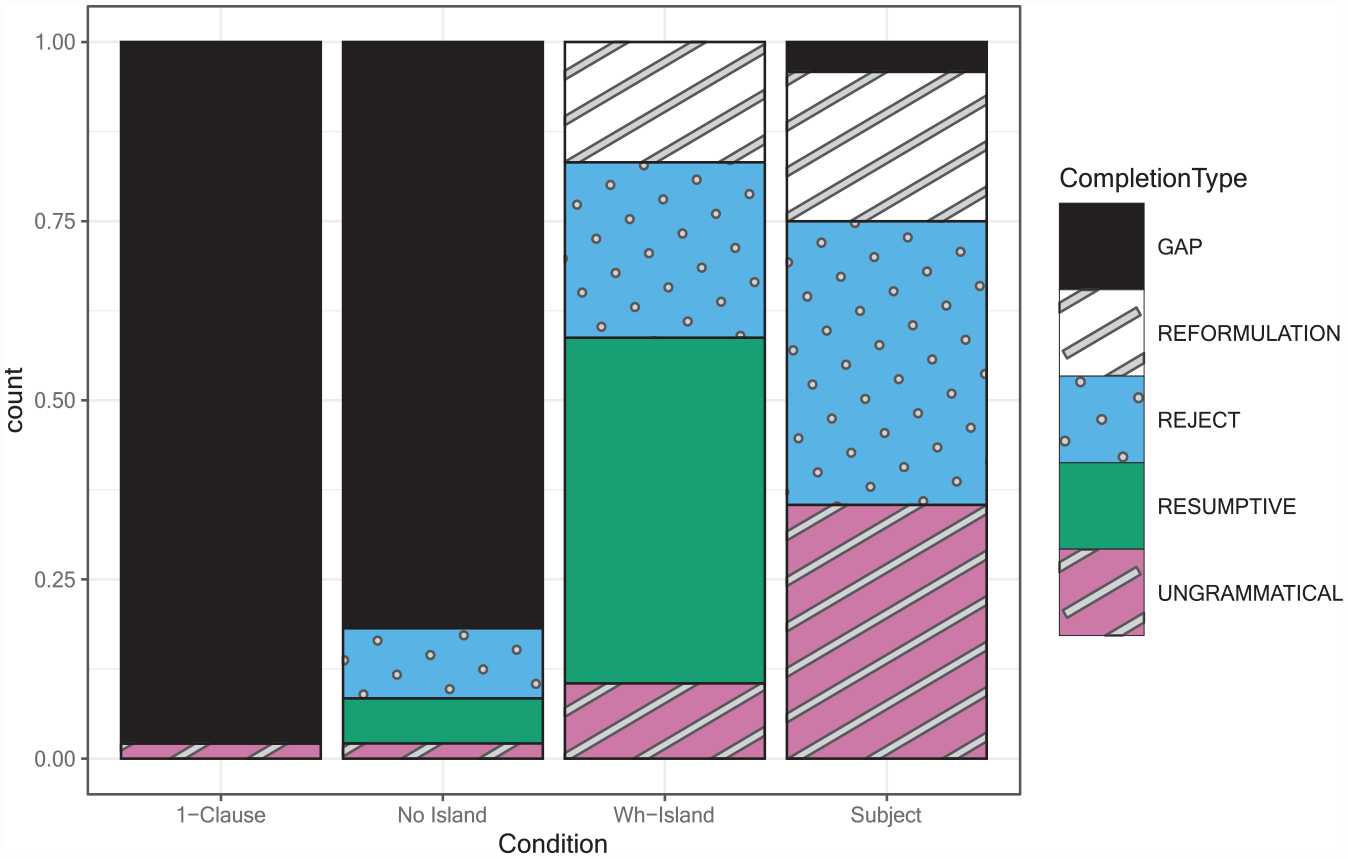
Native English-speaking participant responses in Experiment 1.
Participants never used a gap in the Wh-Island condition, preferring a resumptive pronoun (69/143 trials), reformulation (24 trials) or rejection (35 trials). Ungrammatical completions that either lacked a gap or did not recapitulate the structure of the prompt sentence were more common in this condition (15 trials). 5
In the Subject Island condition gaps were rarely used (6/144 trials). The most common response was to reject (57 trials). Participants reformulated on 30 trials, for example as below: (19) Base: The designer said that the office in the factory was very ugly. Prompt: That was the factory that the designer said ___ had an ugly office.
Participants provided ungrammatical completions on 51 trials. Interestingly, 44 of these trials followed the same abstract pattern: participants repeated the structure of the base sentence but omitted the prepositional phrase that originally hosted the gap, as in (20).
(20) * That was the factory that the designer said the office was ugly.
We speculate that in such sentences the head of the relative clause functions as an implicit restrictor on the subject NP in the embedded clause creating a meaning where the embedded clause is essentially interpreted as ‘the office in that factory was ugly’. We do not pursue an analysis of these constructions, but note (anecdotally) that similar sentences are attested in casual speech.
The results confirm that native English-speaking participants strongly disfavor gaps in Wh-Island configurations and in Subject Island configurations.
VI Experiment 2: L1 Norwegian vs. L1 Swedish
1 Norwegian participants
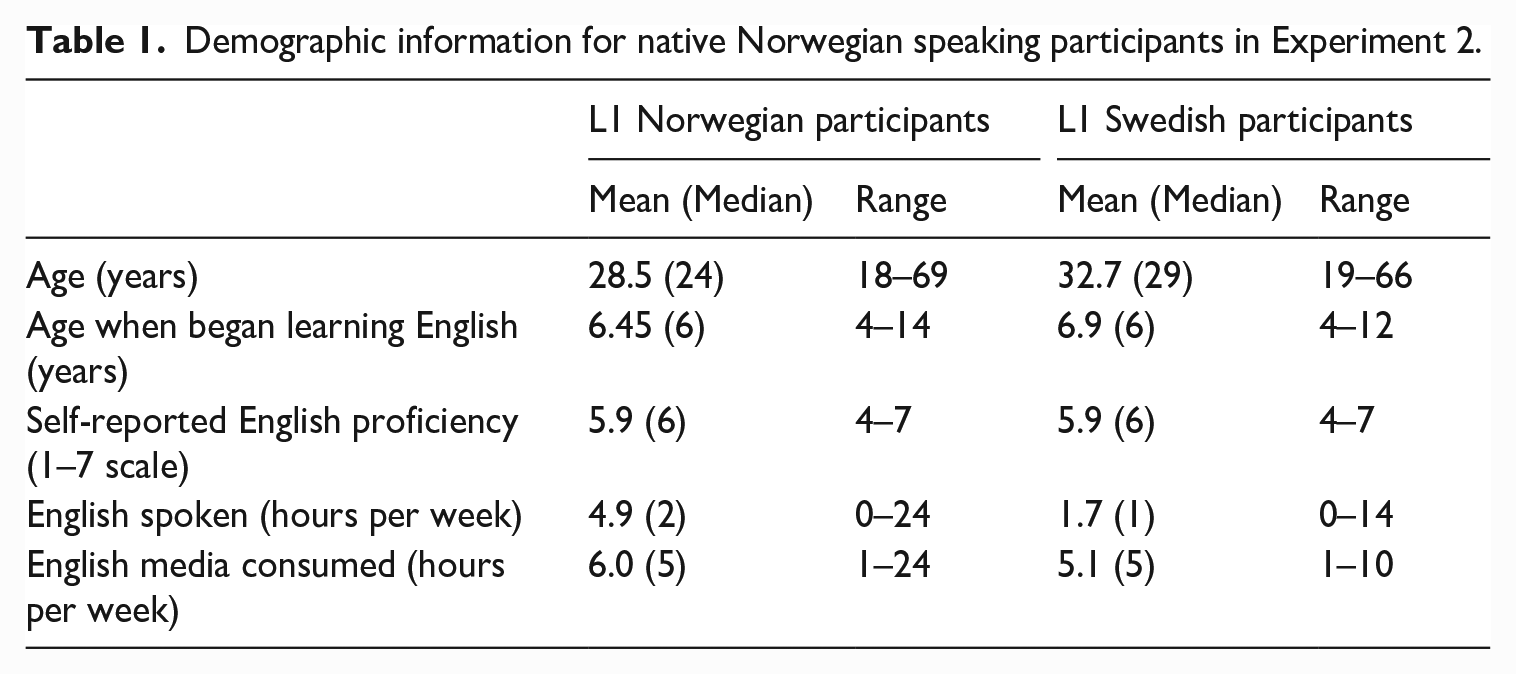
Fifty-seven participants were recruited from two sources: Prolific Academic (32 participants) and the student body at the Norwegian University of Science and Technology, NTNU (25 participants). Participants from Prolific had a varied educational background: secondary school (12), two-year Associate’s equivalent (1), bachelor’s degree (13), master’s degree (6). Students from NTNU were all currently enrolled in a bachelor’s program. All participants had learned English in school from a young age, and would also have been exposed to English outside of the educational system, and can be assumed to be proficient L2 English speakers. Participants from Prolific were paid the equivalent of £8 per hour. NTNU students participated voluntarily. Two participants were excluded for being non-native speakers of Norwegian. Another participant was excluded for having learned English in early childhood. Demographic information about the 54 participants whose data was used in analysis can be found in Table 1.
Demographic information for native Norwegian speaking participants in Experiment 2.
2 Swedish participants
Thirty-two participants were recruited via Prolific Academic and paid the equivalent of £9 per hour. The Swedish participants had a roughly similar demographic profile to the Norwegian participants as seen in Table 1, though the Swedish participants spoke English slightly less on average than Norwegian participants. Their educational backgrounds were varied: secondary school (15), two-year Associate’s equivalent (1), bachelor’s degree (9), master’s degree (5), MD/PhD (2).
3 Procedure
For each language group, 12 test items, eight Subject Island items and 10 1-Clause filler sentences were split across four lists. Items were distributed following a Latin Square design such that each list contained three No Island items, three Wh-Island items, four Subject Island and five 1-Clause items in each language. In total, participants completed 15 sentences in their L1 (either Norwegian or Swedish) and 15 sentences in English. We chose to limit the number of test and control items that each participant saw to minimize (i) participant fatigue and (ii) the likelihood that participants would identify our constructions of interest. Participants completed sentences first in English and then in their L1. Presentation order of individual test items was randomized within language blocks.
4 Analysis
We analysed use of gaps in the No Island and Wh-Island sentences using a logistic mixed effects model fit using the lme4 (Bates et al. 2015) and lmerTest packages (Kuznetsova et al., 2017) in R (R Core Team, 2021). We coded trials where participants produced gaps as ‘0’. Trials where participants avoided a gap by using a resumptive pronoun, reformulating, or rejecting the sentence were coded as ‘1’. The model had fixed effects of Participant L1 (coding: L1 Norwegian = −0.5, L1 Swedish = 0.5), Response Language (coding: L2 English = 0.5, L1 Norwegian/Swedish = −0.5), Sentence Type (coding: No Island = −0.5, Wh-Island = 0.5) and their interactions. The model included random intercepts for participants and items. In addition, the model included by-item random slopes for all fixed effects and their interactions and by-participant random slopes for Response Language, Condition and their interaction. We describe participants’ responses in the Subject Island condition, but we did not statistically compare No Island and Wh-Island completions to Subject Island completions.
5 Results
Results are visually presented in Figure 2. Both L1 Norwegian and L1 Swedish participant groups completed 1-Clause control prompts with gaps in English and in their L1. Similarly, use of gaps predominated in the No Island conditions. L1 Norwegian participants rarely used resumptive pronouns in either language (5 trials in English, 1 trial in Norwegian). L1 Swedish participants used resumptive pronouns more frequently (22/96 trials in Swedish and 6/96 trials in English). Consistent with the generalization that resumptives are used to avoid that-trace configurations, the resumptive was only used in Swedish No Island trials when it was preceded by an overt complementizer att.
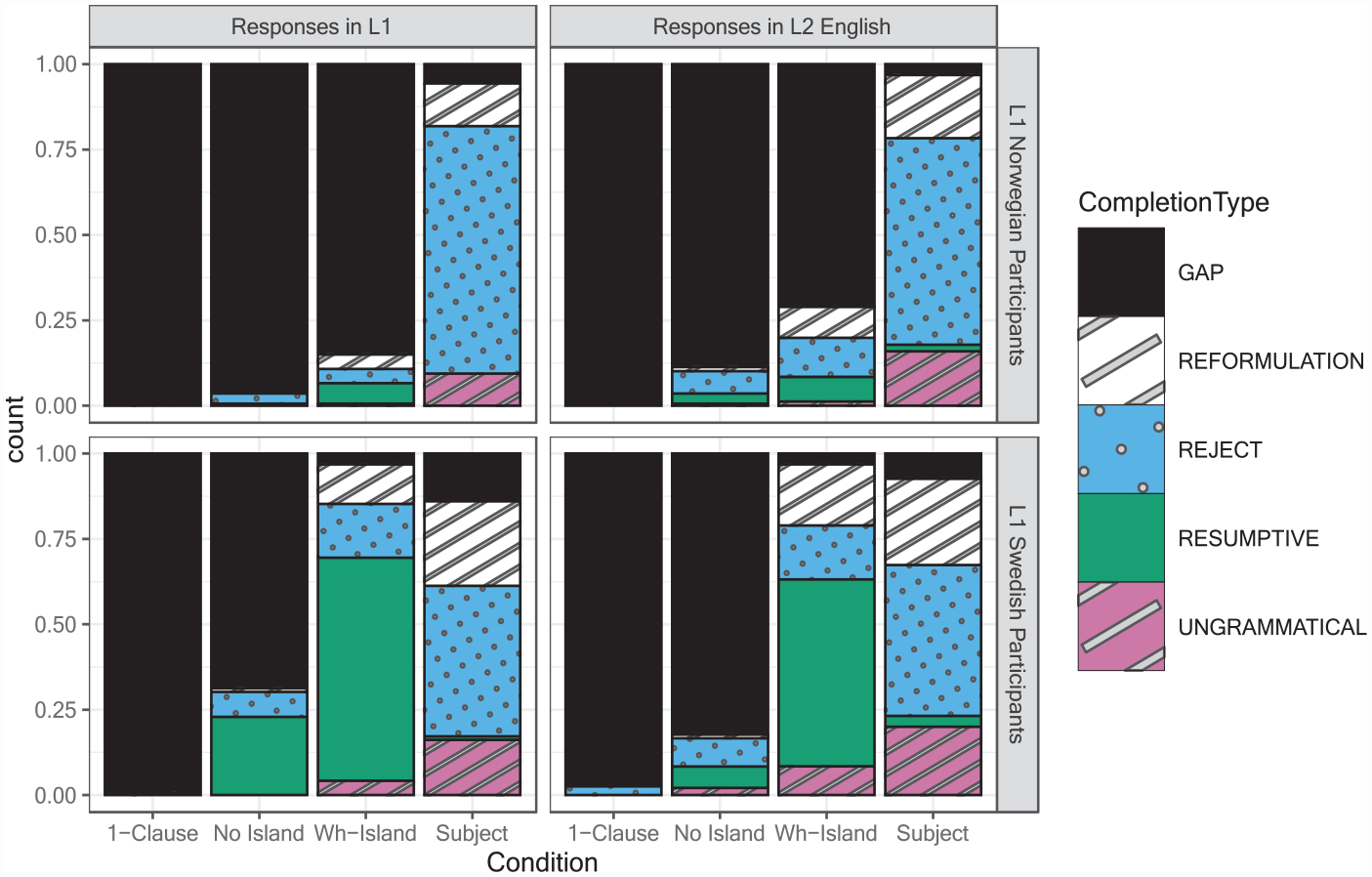
Participant responses in Experiment 2 arranged by Response Language (columns) and Participant L1 (rows).
L1 Norwegian participants preferred to use gaps to complete Wh-Island sentences in both languages. L1 Swedish participants, in contrast, almost never used gaps to complete Wh-Island sentences in either English or Swedish.
Statistical analysis confirmed that gap use differed significantly between the two groups. Most important for our purposes, there was a significant Participant L1 × Sentence Type interaction (p < .001), confirming that the differences in gap use between No Island and Wh-Island sentences varied by participant group. Resolving this interaction revealed a robust effect of Sentence Type for L1 Swedish participants (β = −9.53, z = −4.81), and a significant effect of Sentence Type for L1 Norwegian participants (β = −2.53, z = −2.04). A significant Participant L1 × Response Language interaction (p < .05) indicated that Norwegian participants were significantly more likely to use gaps in English than Swedish participants. A full summary of statistical results is in Table 2.
Summary of statistical effects for comparison of responses of L1 Norwegian and L1 Swedish participants.
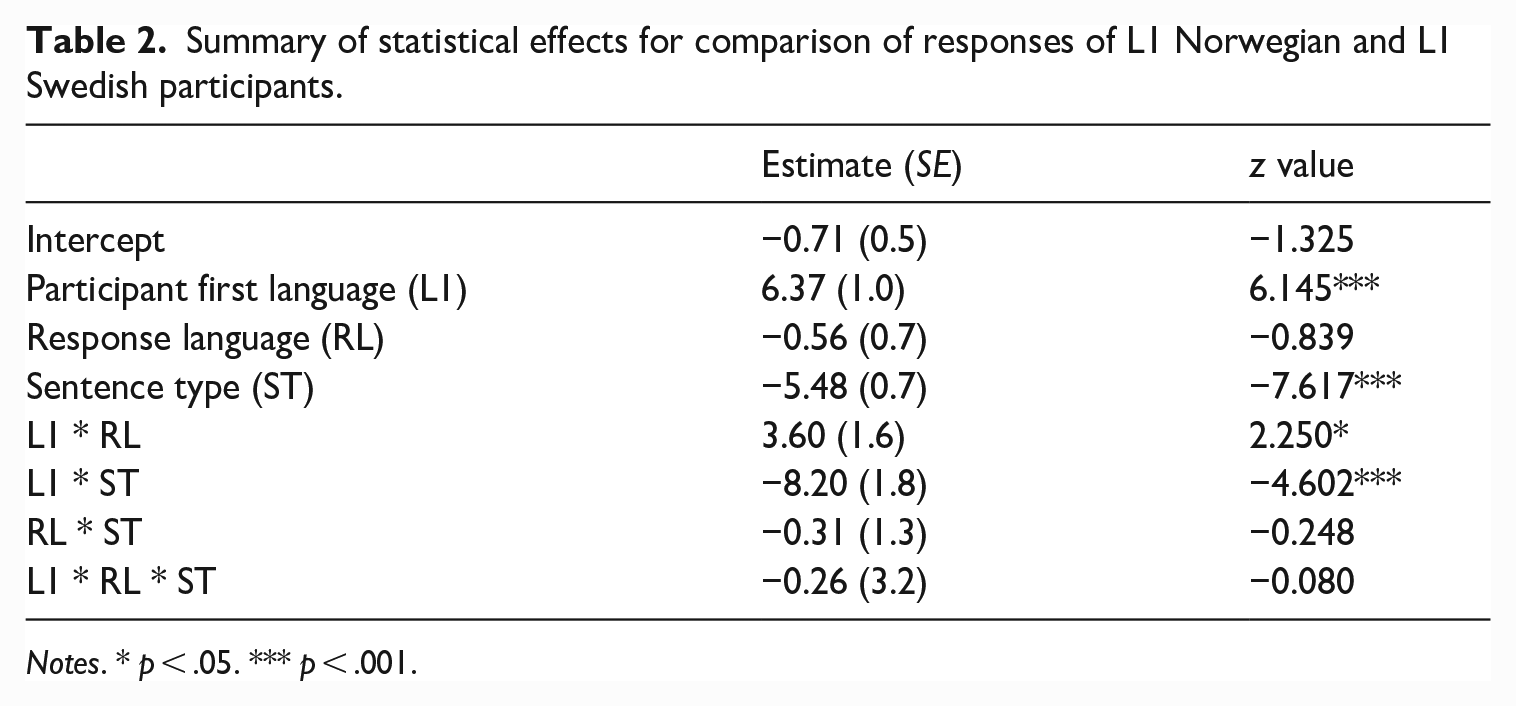
Notes. * p < .05. *** p < .001.
Descriptively, L1 Swedish participants avoided gaps in Wh-Island sentences in various ways. On most trials the participants used resumptives (52/95 trials in English and 62/95 trials in Swedish). Swedish participants also reformulated to avoid gaps (17 trials in English and 11 in Swedish). Rejections were also more common than gaps (15 trials in both languages). In total, there were 6 completions with gaps (3 in English, 3 in Swedish). All 6 were produced by the same participant, consistent with the observation that there is some regional/dialectal variation in Comp-t effects in Swedish (Bentzen, 2014).
On trials where they did not use gaps to complete Wh-Island sentence, L1 Norwegian participants occasionally used resumptives (11 trials in Norwegian, 14 in English). Their rejection rate was numerically higher in English (12 trials) than in Norwegian (5 trials), as was the rate of reformulation (17 vs. 8 trials).
Completions in the Subject Island item condition were largely similar between groups and response languages. Participants primarily rejected completions, and reformulations were the second most common completion type. Ungrammatical completions were the next most common response. Just as we observed with the English control group, many of the ungrammatical trials could be categorized as cases of implicit restriction, as in (21). L1 Norwegian participants seemed to use the implicit restriction strategy (23/31 ungrammatical trials in Norwegian and 35/47 trials in English) more often than L1 Swedish participants (9/19 ungrammatical trials in English and 2/15 trials in Swedish).
(21) Base: The technician believed that files from the computer could be saved. Prompt: That was the computer that the technician . . . Response: . . . believed the files could be saved.
In the aggregate, Norwegian participants seem largely unaware that gaps inside embedded questions are unacceptable in English. Following up on Kush and Dahl (2022), we checked whether some participants were more likely to avoid unlicensed gaps. We identified three different response patterns relating to how likely participants were to produce unlicensed gaps in English EQs. Twenty-nine participants produced illicit gaps in English EQs on all trials. Four participants used gaps in Norwegian EQs but avoided gaps in English EQs. All other response patterns were lumped together under the label Indeterminate. 6 The distribution of participants across categories is presented in Table 3.
Native Norwegian-speaking participants in Experiment 2 categorized by response pattern.
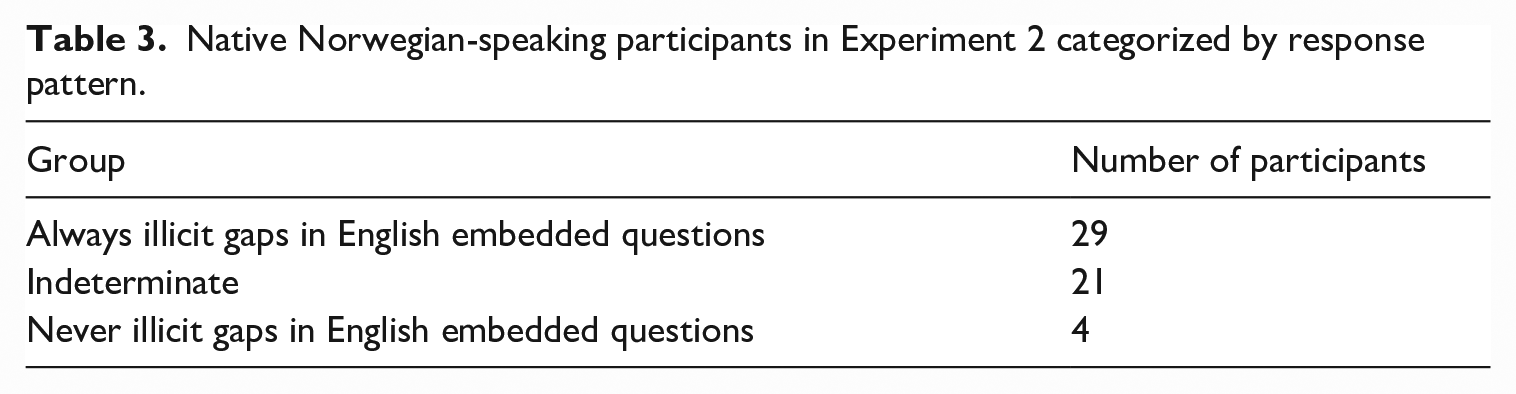
Thus, more than half of the L1 Norwegian participants appear not to distinguish between Norwegian and English with respect to the gaps in question. Only a small fraction of L1 Norwegian participants appear to distinguish between Norwegian and English with respect to gaps in EQs. As for the second-largest group of participants, the indeterminate responders, we cannot draw firm conclusions about the extent to which they distinguish between the two languages based on the low number of observations per condition per participant.
VII General discussion
We were interested in whether L1 speakers of Norwegian transfer the features that license filler–gap dependencies into embedded questions (EQs) from their L1 to L2 English, and whether this transfer is still evident in proficient Norwegian L2 speakers of English. In an elicited production task L1 Norwegian participants completed dependencies into declarative complement clauses and EQs in L1 Norwegian and L2 English. We expected that participants would complete dependencies they considered grammatical with gaps and would avoid gaps where they considered them ungrammatical. L1 Norwegian participants overwhelmingly used gaps to complete dependencies into embedded declaratives and EQs in both Norwegian and English. L1 English control participants did not use gaps when asked to complete dependencies into the same English EQs, instead preferring to use resumptive pronouns or to reformulate the sentence to avoid an island violation. We also tested a group of L1 Swedish participants on the same task. Swedish is typologically similar to Norwegian, but Swedish grammar prohibits subject gaps in the specific EQs we tested. L1 Swedish participants did not produce gaps inside English EQs, preferring instead to use resumptive pronouns at the same rate they did in L1 Swedish. Taken together, the data indicate that participants only accepted subject gaps in L2 English EQs if such gaps were licensed in their L1. The stark difference between the use of gaps by L1 Norwegian participants on the one hand and the other two groups on the other strongly implicates L1–L2 transfer of the features that license filler–gap dependencies into EQs from Norwegian to English. The fact that L1 Swedish participants behaved differently from L1 Norwegian participants argues against the possibility that gap use inside EQs is a general ‘L2 learner effect’.
We argued that two grammatical features were responsible for the ability to establish filler–gap dependencies into the EQs we tested: (i) a feature that allows for multiple CP-specifiers and (ii) a feature that permits Comp-t configurations, which, following Lohndal (2009), we assumed to be an unvalued tense feature on Fin0. L1 Norwegian learners appear to transfer both of these features to their L2 English grammars. In Section II we argued that Swedish grammars possess the feature for multiple specifiers, but they do not permit gaps in the EQs we tested because Fin0 bears a valued [+T]-feature in (standard) Swedish. As a result, Swedish uses resumptive pronouns in such configurations. The fact that L1 Swedish participants used resumptives in English as they would have in Swedish is consistent with transfer of the valued [+T] feature to Fin0 in L2 English. Our results cannot establish whether there was concomitant transfer of the feature for multiple specifiers (and hence EQ-island insensitivity) from L1 Swedish to L2 English.
Although we have operationalized sensitivity to Comp-t in terms of a [+T] feature on Fin0 and adopted the assumption that insensitivity to EQ-islands reflects the ability to generate multiple specifiers of CP, we wish to underscore that our conclusion regarding transfer is independent of the particular formal analysis we have adopted. As stated above, there is a lack of consensus on how to analyse island insensitivity and Comp-t effects in the formal syntax literature, so conclusions about the exact features that are being transferred will vary as a function of one’s preferred analysis. However, though there is disagreement as to which formal features are responsible for licensing and exactly which heads bear the features, many analysts agree that these differences are linked to (parametric) variation in CP-level syntax. Insofar as these features are CP-level features, our results are consistent with models that allow for transfer of functional heads and their associated feature matrices from L1 to L2 (e.g. Schwartz and Sprouse, 1996; Lardiere, 2009; Westergaard, 2021).
Importantly, our evidence suggests that effects of transfer persist in participants who have been exposed to English for many years. This in turn indicates that the initial transfer of the features that license dependencies into EQs is not easily overcome, arguably due to the lack of direct positive evidence that English disallows subject gaps in EQs.
Our results support the basic conclusion in Kush and Dahl (2022) that transfer occurs. However, our results are less easily reconciled with Kush and Dahl’s secondary contention that many L1 Norwegian speakers undergo some degree of restructuring. As discussed above, their claim was based on the fact that many L1 Norwegian participants were more likely to judge dependencies into English EQs as unacceptable than into Norwegian EQs in an untimed 7-point acceptability rating task.
Taken at face value, the results of our production experiment do not provide strong support for (inter-individual variation in) restructuring. Over half of L1 Norwegian participants showed no sign of having restructured: they consistently produced gaps inside English EQs. The consistent use of gaps in English EQs constitutes an example of fossilized transfer (Franceschina, 2005; Hawkins et al., 1993; Judy and Rothman, 2010; Lardiere, 2007; Schwartz and Sprouse, 1996). A second group of participants avoided gaps in English EQs on at least some trials. In principle, inconsistency is compatible with what Kush and Dahl (2022) called ‘partial restructuring’. However, the small number of observations per condition made it difficult to establish whether participants were more likely to avoid gaps in English than in Norwegian. Finally, a small number of participants (~7%) systematically avoided gaps in English EQs, despite producing them in Norwegian EQs. This behavior is arguably consistent with having fully restructured, but the evidence is not conclusive. 7
Kush and Dahl (2022) speculated that observing resumptives in English EQs could prompt restructuring. The general idea was that use of the resumptive in (13), repeated below as (22), implied that the gap was not a grammatical alternative in English, contrary to what is possible in L1 Norwegian. Hearing such a sentence, in turn, could serve as the necessary conflict between the L1 and L2 grammars that L1 Norwegian needed to reanalyse their analysis.
(22) *? Those were the signs that I couldn’t figure out what they meant.
If our participants’ frequent use of gaps is taken as evidence that restructuring is rare, then it would appear that L1 Norwegians do not consistently use resumptives as evidence that English EQs are islands. There are a number of reasons why resumptives might not be effective cues for guaranteeing restructuring. First, the analysis assumes that the distribution of resumptives in the English input is significantly different from the distribution in Norwegian. Our production results show that Norwegians occasionally produce resumptives inside EQs in their L1, so any reasoning about cross-linguistic differences cannot be made on the basis of binary or categorical classifications. Learners would instead have to compare differences in the base rates of resumption between languages, which would require observing enough sentences with resumptives in English to detect a significant difference from Norwegian. The English input simply might not contain enough examples. The second challenge associated with using resumptives as a trigger for restructuring is that while resumptives may identify constituents that are islands, they do not identify the grammatical features responsible for making those constituents islands (e.g. extra specifiers in CP). As such, it may be difficult to infer what transferred features should be restructured, even if learners could identify cross-linguistic conflict.
While it is possible that the different results in the present study compared to those of Kush and Dahl (2022) indicate that most speakers do not restructure, they could also reflect differences driven by the modality of testing. In the previous study, participants could make nuanced judgments about the structures in question, whereas participants in the present study were forced into more categorical behavior. Their willingness to use gaps in English EQs does not necessarily entail that they find such gaps acceptable. It simply entails that they found the gap the best option of those that they had at hand, given the constraints of the experiment. To investigate how participants’ productions and judgments align, future studies should test the same participants on both tasks.
Relatedly, the fact that the L1 Norwegian participants used gaps in English EQs does not tell us that they would produce such structures in natural speech in L2 English. It simply tells us that their L2 English grammar permits such gaps to a degree that the grammars of L1 Swedish speakers and L1 English speakers do not. Different production tasks such as translation could be employed in future research to investigate whether L1 Norwegians consider gaps a natural option in L2 English.
Finally, L1 Norwegian participants very rarely used resumptives in L2 English. Our results do not allow us to conclude whether this is because they are not aware that resumptives are an option in these contexts in English, or whether they simply prefer gaps when choosing between two competing continuations. This question could be addressed in future research through judgment tasks of sentences containing gaps and resumptives, respectively.
VIII Conclusions
We found that L1 Norwegian speakers produce filler–gap dependencies into English EQs when the corresponding dependencies are acceptable in Norwegian. L1 Swedish speakers do not. We conclude that L1 Norwegian participants produce the dependencies because they have transferred the grammatical features that determine that (i) embedded questions are not islands in their L1 and (ii) Comp-trace configurations are acceptable in L2 English. Swedish speakers do not produce the dependencies in English because the corresponding sentences are blocked by the grammar of Swedish due to a Comp-t violation. If the features controlling EQ-island insensitivity reside in the CP domain, our results provide support for models that permit transfer of functional heads and their features from L1 to L2. Moreover, given the lack of evidence in the input of the difference between Norwegian and English, the effects of initial transfer appears to persist at proficient L2 English levels.
Footnotes
Acknowledgements
We wish to thank audience members at HSP 2022, members of the ØyeLab/Eyelands lab and AcqVA at NTNU, and three anonymous reviewers for helpful suggestions and feedback on this project.
Declaration of Conflicting Interests
The authors declared no potential conflicts of interest with respect to the research, authorship, and/or publication of this article.
Funding
The authors disclosed receipt of the following financial support for the research, authorship, and/or publication of this article: Dave Kush was supported in part by funding from the Social Sciences and Humanities Research Council of Canada.
