




Abstract
American Norwegian (AmNo), a moribund heritage variety of Norwegian spoken predominantly in the Upper Midwest of the US, licenses wh-infinitives (i.e. indirect questions), which are structures that are not acceptable in either standard Norwegian Bokmål or Norwegian dialects. Adopting a spanning-account of syntax (Blix, 2021; Julien, 2021; Svenonius, 2016), we propose that wh-elements in AmNo can encode covert modality (similar to what is found in English indirect questions). We discuss these results and their impact on our understanding of the nature of syntactic change and the interaction of spanning in combination with Aʹ-movement in heritage language syntax.
I Introduction
The syntax of heritage languages continues to be the focus of intense research with the general consensus being that where ‘core’ elements remain largely unaffected through the lifespan of individuals, ‘peripheral’ interface phenomena can, and do, occasionally show signs of attrition and restructuring (Lohndal, 2021; Montrul, 2016; Polinsky, 2018). The majority of these studies have focused on the phonological realization of morphosyntactic categories, i.e. exponence, and word order variation. One domain that has received considerably less attention in this literature involves Aʹ-movement phenomena; i.e. instances of filler-gap dependencies such as wh-movement. Seminal studies by Cuza (2013, 2015); Cuza and Frank (2011); Cuza, Miller, and Ortiz (2016) and Hopp, Putnam, and Vosburg (2019) suggest that these structures of heritage language syntax can – at least to some degree – be affected. One particular domain that necessitates deeper inquiry involves whether or not heritage languages can adopt Aʹ-movement behavior that is not found in any related baseline; for related discussion, see also Polinsky (2018: section 6.4). We base this assertion not only on the relatively low number of studies that focus exclusively on these related phenomena, but also on the fact that multiple grammatical and extra-grammatical factors can shape the acceptability of structures resulting from Aʹ-movement; for an extensive overview, see Chaves and Putnam (2020).
In this article we investigate the structure of a particular subtype of Aʹ-dependencies in American Norwegian (AmNo), namely wh-infinitives (also known as indirect questions). 1 AmNo is the language of Norwegian immigrants spoken predominantly in the American Upper Midwest since the 1860s. Because of the different dialectal backgrounds of the speakers, the language contains a mixture of features from multiple varieties of Norwegian, with a predominant influence from Southeastern Norwegian dialects (particularly from Gudbrandsdalen) (Hjelde, 2015; Johannessen and Laake, 2012). 2 Today AmNo is moribund.
English and Norwegian exist in complementary distribution with regard to the licensing of wh-infinitives. Whereas English licenses these structures (1a), they are not possible in homeland Norwegian (1b); where they must be expressed with a finite complement clause (1c); see also Faarlund (2019: section 8.2.2) for an overview of interrogative clauses in Mainland Scandinavian. Homeland Norwegian is illustrated with the written standard Bokmål (BM).
(1) a. I don’t know [what to do.] [English]
b. * Jeg veit ikke [hva å gjøre.]
I know not what INF do
‘I don’t know what to do.’ [Norwegian Bokmål (BM)]
c. Jeg veit ikke hva jeg skal/kan/må gjøre.
I know not what I shall/can/must do
‘I don’t know what I should do.’
In this study we show that AmNo seems to have largely adopted the English-like strategy of licensing wh-infinitives; see the examples in (2).
(2) a. i læRde i skuR’n håsst å snakke enngelst
I learnt in school.DEF how INF speak English
‘I learnt how to speak English in school.’ (Hatton-01gm)
b. menn e leRde aller åss’n å læsa nåssjt
but I learnt never how INF read Norwegian
‘But I never learnt how to read Norwegian.’ (CoonValley-08gm)
The data above in (2), extracted from the open access Corpus of American Nordic Speech (CANS), housed at the University of Oslo (Johannessen, 2015),3,4 evince that wh-infinitives appear to be acceptable in AmNo.
The remainder of this article attempts to answer a how- and a what-question respectively:
Can we model how this syntactic change took place (since these structures are not possible in homeland varieties of Norwegian)?, and
What does this say about the status of Aʹ-dependencies in AmNo specifically and heritage syntax more generally?
Turning our attention to the how-question first, which will be the principle focus of this article, requires a more refined understanding of both the syntax and semantics of wh-infinitives. Indirect questions, in particular those exhibiting a wh-item, license ‘covert modality’, which can be understood as modality that is present but not directly associated with the structure we are interpreting (Bhatt, 1999; Groenendijk and Stokhof, 1982; Portner, 1997). To explicate this point, consider example (1a), repeated here as (3), which is understood to entail covert modality.
(3) I don’t know [what to do.]
( ≈ I don’t know what I should do.)
From a syntactic perspective, the left-periphery of clauses, i.e. the CP-layer (Rizzi, 1997), represents a highly vulnerable domain for attrition and syntactic change due to its interface with information structure and propositional semantics (Platzack, 2001). With data from CANS serving as the empirical foundation, we develop an analysis that utilizes both syntactic (Sabel, 2020) and semantic information (covert modality) to account for this apparent syntactic change that has taken place in AmNo. Adopting a non-lexicalist, spanning approach to syntax (Baunaz and Lander, 2018; Putnam, 2019, 2020; Starke, 2009; Svenonius, 2016), we propose that wh-elements in English and AmNo can encode, i.e. lexicalize, covert modality. Our analysis also touches on the what-question we introduced above. The adaptation of wh-infinitives in AmNo requires the introduction of a covert element (modality) into the heritage grammar, which is incorporated into the wh-item itself, forming a complex syntactic element, or a span. This analysis avoids the postulation of a silent, or empty, head, which is generally dispreferred in heritage language syntax (Laleko and Polinsky, 2017).
The structure of this article is as follows: In Section II we outline the syntactic and semantic properties of indirect questions that exhibit wh-infinitives, with a focus on the role of covert modality. Although they are not the principle empirical focus of this article, here we mention a related structure as well; namely, ‘infinitival relatives’, that also license covert modality. We introduce the AmNo data in Section III, demonstrating the English-like pattern that has emerged in these Aʹ-constructions. We introduce our spanning analysis of covert modality in these structures in Section IV, and discuss the impact these findings have for (further) research on Aʹ-dependencies in AmNo, and for heritage language syntax more generally, in Section V.
II The syntax and semantics of wh-infinitives
In this section we outline the core properties of wh-infinitives, with an empirical focus on English, Norwegian Bokmål, and AmNo respectively. The (in)ability of languages to license wh-infinitives, and as we will see, infinitival relatives, is tied to other syntactic properties of the CP-layer and the syntax–semantics interface pertaining to the licensing and realization of (covert) modality. Here we introduce the basic theoretical assumptions and machinery that are immediately relevant for our analysis of wh-infinitives in AmNo.
As laid out in the introduction, English and (homeland) Norwegian starkly contrast with one another regarding their ability to license wh-infinitives. Compare the examples from English (4) and their translational equivalents in (5) below (illustrated with the Norwegian written standard Bokmål (BM)):
(4) a. I know [what to say]. [English]
b. I know [who to ask].
c. I know [where to find you].
d. I know [which car to take].
Although English licenses wh-infinitives – as shown immediately above in (4) – these structures are ungrammatical in homeland Norwegian:
(5) a. * Jeg vet [hva å si].
I know what INF say
‘I know what to say.’ [BM]
b. * Jeg vet [hvem å spørre].
I know who INF ask
‘I know who to ask.’
c. * Jeg vet [hvor å finne deg].
I know where INF find you
‘I know where to find you.’
d. * Jeg vet [hvilken bil å ta].
I know which car INF take
‘I know which car to take.’
In homeland Norwegian, the modal semantics entailed in indirect questions is lexicalized on a modal verb. In addition to the modal verb, the overt subject appears, as in (6a) and (6b); compared to (5a) and (5b):
(6) a. Jeg vet [hva jeg må si].
I know what I must say
‘I know what I must say.’ [BM]
b. Jeg vet [hvem jeg kan spørre].
I know who I can ask
‘I know who I can ask.’
Sabel (2020) establishes an important connection between languages that lack both wh-infinitives and infinitival relatives; in languages where both are impossible, the left periphery of the infinitive cannot be occupied by a phonetically realized element in its highest projection. As expected, English and Norwegian also contrast with respect to the (in)ability to license infinitival relatives. In Norwegian (as well as in English), relatives can be licensed when the verb is finite and the modal is overtly expressed, like (7d) and (8d). For infinitival relatives it is a bit more complicated in Norwegian when compared with English. Although a detailed treatment of infinitival relatives warrants an independent study, in the remainder of this article we mention them in connection with wh-infinitives when it concerns the licensing of covert modality. Norwegian (in general) shows a contrast in its ability to license subject vs. object infinitival relatives. Subject infinitival relatives are ungrammatical (7b), while non-subject infinitival relatives are acceptable (8b) (more details below). 5 English examples from Bhatt (1999) compared to Norwegian Bokmål follow here:
(7) a. The man to fix the sink is here. [English]
b. * [Mannen å fikse vasken] er her.
man.DEF INF fix sink.DEF is here [BM]
c. * [Mannen til å fikse vasken] er her.
man.DEF PREP INF fix sink.DEF is here
d. [Mannen som skal fikse vasken] er her.
man.DEF REL shall.MOD fix sink.DEF is here
‘The man who shall fix the sink is here.’
(8) a. Jane found [a book to draw cartoons in] for Sara. [English]
b. Jane fant [en bok å tegne tegneserier i] til Sara.
Jane found a book INF draw cartoons in to Sara [BM]
c. Jane fant [en bok til å tegne tegneserier i] til Sara.
Jane found a book PREP INF draw cartoons in to Sara
d. Jane fant [en bok (som) man kan tegne tegneserier i] til Sara.
Jane found a book (REL) one can.mod draw cartoons in to Sara
‘Jane found a book (that) one can draw cartoons in for Sara.’
Non-subject infinitival relatives similar to (8) are quite common in Norwegian (OBJ, ADV, extraction from PP), especially with extracted indefinite nominal phrases; see Faarlund et al., 1997: 1062–63:
(9) Eg leitar etter [ei bok å lese].
I search after a book INF read
‘I’m looking for a book to read.’ [Norwegian Nynorsk (NN)]
(10) De hadde ikke [noe å snakke om].
they had not anything INF talk about
‘They didn’t have anything to talk about.’ [BM]
(11) Han lengta etter [nokon å gi roser (til)].
he longed after someone INF give roses (to)
‘He was longing for someone to give roses to.’ [NN]
(12) Han prøver å finne [et passende land å tilbringe alderdommen i].
he tries to find a suitable country INF spend old-days.DEF in
‘He’s trying to find a suitable country where he can spend his old-days.’ [BM]
We briefly revisit these structures in Section III.3 due to their connection with our treatment of wh-infinitives concerning the licensing of covert modality in AmNo.
Returning to wh-infinitives, although wh-items cannot appear in the left periphery of non-finite clauses in homeland Norwegian, non-finite clauses are selected in this language, and prepositions such as for ‘for’, med ‘with’ and til ‘to’ can appear in the left periphery:
(13) Terje bestemte seg [for å selge vogna.]
Terje decided REFL for INF sell wagon.DEF
‘Terje decided to sell the wagon.’ [BM]
(14) Mari sleit alltid [med å stå opp om morgenen.]
Mari struggled always with INF get up in morning.DEF
‘Mari always had a hard time getting up in the morning.’
(15) Barna fikk lov [til å spise godteri.]
children.DEF got permission to INF eat candy
‘The children were allowed to eat candy.’
Based on the assumption that Aʹ-movement involves binding with an Op(erator) as well as movement of the wh-item to Spec,CP (in languages that license overt wh-movement) by a feature (let’s call it [+wh]), the underlying structure of both wh-infinitives and infinitival relatives are structurally very similar ((16); from Bhatt (1999: 14)).
(16) a. Hafdis knows [
b. The people [
These empirical facts make a solid case for the theoretical proposal that the differences between languages like English and Norwegian cannot be reduced to idiosyncratic lexical difference and are syntactic in nature. In addition to these syntactic differences, we have to address the semantic issue of modality. Both wh-infinitives and infinitival relatives license covert modality (Bhatt, 1999; Geisler, 1995; Groenendijk and Stokhof, 1982; Kjellmer, 1975; Pesetsky and Torrego, 2001; Portner, 1997). Bhatt (1999: 15) proposes that the source of modality in these constructions is located in the wh-item itself. 6
(17) C[+wh,+inf] is interpreted as the modal ◊D,→
The modality in wh-infinitives is somewhat variable; in some cases it can be paraphrased with an existential modal (e.g. could), in other environments a paraphrase with a universal modal (e.g. should) is appropriate. Deontic and bouletic readings are possible in a limited set of environments, whereas epistemic readings are not possible. Since the particular flavors of modality do not bear on our treatment of wh-infinitives in AmNo, we do not discuss them further in this article.
In an attempt to parameterize the underlying differences of combinatorial possibilities of languages and their ability to license wh-complements ([± wh]) and (non -)finite-complements, Sabel (2020) proposes the Wh-infinitive Generalization (WHIG):
(18) The Wh-infinitive Generalization (Sabel, 2020: 146):
If a language has wh-movement to Spec,CP in infinitives, then this language has the option of filling the C-system of this (type of) infinitive with an overt complementizer.
The WHIG proposal delivers the following feature typology of possible languages and their relation to these parameters.
(19) a. [+Op-in-SpecCPinf, +Compinf]
b. [− Op-in-SpecCPinf, − Compinf]
c. [+Op-in-SpecCPinf, −Compinf]
d. [ −Op-in-SpecCPinf, +Compinf]
The first type (19a) represents languages such as English that do not require overt infinitive complementizers, while languages with the feature specification in (19b) have this requirement (such as Norwegian). 7 We return to Sabel’s (2020) WHIG proposal in Section IV.2, where we operationalize this proposal along the lines of our spanning analysis. Next we turn to the AmNo data, which functions as the empirical base of this study.
III American Norwegian (AmNo)
AmNo is a moribund heritage language spoken in the Upper Midwest of the US, predominantly in Minnesota and Wisconsin. AmNo emerged from the language of speakers who immigrated to this region around the 1860s, and is a conglomeration of various dialects. The empirical data analysed for this study were extracted from the Corpus of American Nordic Speech (CANS) (Johannessen, 2015). CANS (version 3.1) includes spontaneous speech of 268 informants with Norwegian (246) and Swedish (22) heritage, in total 774,625 tokens. The main base of the corpus consists of recordings made in 2010–16 (170 speakers), but it also includes recordings made by Arnstein Hjelde in 1987–92 (5 speakers) and has recently been extended with several tapes from Einar Haugen’s recordings from 1942 and 1935–36 (84 speakers) and Seip and Selmer’s recordings from 1931 (4 speakers). We based our analyses on the Norwegian heritage recordings from 2010–16 – including a total of 614,613 tokens from 152 speakers (57 females and 95 males).
The moribund status of AmNo alongside the fact that the empirical data for this study originate solely from CANS present certain challenges. Most notably, the sheer number of occurrences of constructions such as wh-infinitives will be low. In our search for the string [word beginning with hv- in Bokmål] + [1-3 words] + [non-finite verb form], followed by (control) searches for specific wh-items (hva ‘what’, hvem ‘who’, hvor ‘where’, hvorfor ‘why’, hvordan ‘how’, åssen ‘how’, hvilke(n) ‘which’, når ‘when’ and om ‘whether, if’), we found 22 clear examples of English-like wh-infinitives, produced by 21 speakers (all born in and around the 1930s, 2nd–4th generation of immigrants). 8 (Additionally, we found two examples in the 1942 recordings, informants born in 1883 and 1902.) 9 These 21 speakers represent approximately 14% of the population in the part of the corpus from 2010 to 2016 (n = 152). 9 Twenty-two examples uttered by 21 different AmNo speakers may not appear to be a significant number of tokens from a corpus this size, but we content that this amount – and the fact that different speakers produce them – is non-negligible. As recently suggested by D’Alessandro, Natvig, and Putnam (2021), the low frequency of an occurrence of a particular feature or construction in a moribund heritage grammar does not diminish its importance or relevance in a thorough analysis of the grammar under investigation (see also Kupisch and Polinsky, 2022). The robust nature of the contrast between the production of wh-infinitives in AmNo, and the non-acceptability of these in homeland Norwegian, supports the relevance of this investigation.
We searched through the (modern) Norwegian part of the Nordic Dialect Corpus (NDC, approximately 2 million tokens) and the ‘LIA – Corpus of older Norwegian dialect recordings’ (LIA, approximately 3.5 million tokens) to investigate whether or not wh-infinitives can be found in spoken homeland Norwegian. 10 Our search efforts turned up only one single example in (20) exhibiting a wh-infinitive.
(20) de var innj somm drev å så lærd opp høssdænn å sættj opp svannsjer
it was one who did and so taught up how INF set up tractor-forks
‘There was one who was teaching how to set up tractor-forks.’ [LIA: aamot-0103]
The overwhelming lack of evidence of wh-infinitives beyond this single example affirm the rarity of this construction in spoken homeland Norwegian.
In this regard, research on moribund heritage varieties that relies primarily (if not exclusively) on previously collected corpus data shares certain affinities with work in historical syntax and linguistic reconstruction (Walkden, 2014). In this context, linguists extract data (previously from only (hand-)written sources, but now also from digital corpora) and advance proposals about mental representations and instances of language change based on said data. In our analysis, we primarily compare AmNo examples with standard written Norwegian – and additionally with spoken Norwegian found in corpora such as LIA and NDC, since these, especially the LIA, serve as reasonably good approximations of a ‘baseline’ for AmNo. 11 Again, this caveat notwithstanding, the contrast between AmNo and the data from these aforementioned sources evinces that some change has taken place in the AmNo grammar to allow the production of wh-infinitives.
Before taking a closer look at AmNo wh-infinitives, we find it relevant to mention that infinitive markers in AmNo can occasionally vary. Although the standard Norwegian å is the most common form attested in the CANS corpus, there are a substantial number of tokens in which the infinitival marker is realized as te, as in (21).
(21) remm læRde uss
they learnt us INF speak Norwegian
‘They taught us
As noted by Putnam and Søfteland (2021), this should not be misconstrued as cross-linguistic influence from English due to the fact that they are common in certain dialects of Norwegian, as in example (22). 12
(22) me lærde no
we learnt now INF read a morning-verse
‘We learnt
1 AmNo wh-infinitives
Here we provide a detailed overview of the examples of AmNo wh-infinitives found in CANS. As previously noted, all of these structures resemble an English pattern for indirect questions that is ungrammatical in homeland Norwegian, such as (23a) and (23b), (both with te as the infinitive marker): 13
(23) a. e veit ikke
I know not how INF speak so good Norwegian
‘I don’t know how to speak Norwegian very well.’ (Harmony-01gk)
(Bokmål: Jeg veit ikke åssen jeg skal snakke så godt norsk.)
b. e veit tje
I know not what INF talk about
‘I don’t know what to talk about.’ (Sunburg-02gk)
(Bokmål: Jeg veit ikke hva vi skal/kan prate om.)
These are representative examples of indirect questions licensing an adverbial and an object (of a particle verb) wh-item respectively. The Bokmål translations of the examples in (23) demonstrate that these Aʹ-dependencies cannot be licensed in non-finite clauses in homeland Norwegian. Admittedly, it is difficult to establish a one-to-one translation of these utterances found in AmNo to corresponding homeland Norwegian structures, however these glosses represent as close approximations as possible.
Many of the wh-infinitives co-occur with te (or ti) infinitive markers (around 50 %), and many occur with (different dialectal variants of) the wh-word ‘what’ (e.g. va, hå, kå). Examples (24), (25) and (26) occur with veit ‘know’ as the finite verb in the matrix clause – visste (preterite), veit (present) – and the wh-item as an object (for the non-finite verbs ‘do’ (jørra, jæra) and ‘believe’ (tru)): 14
(24) menn ho visste
but she knew what INF do
‘But she knew what to do.’ (Saskatoon-01gk)
(Bokmål: Men hun visste hva hun måtte/kunne gjøre.)
(25) e visst ikk
I knew not what INF think about this here
‘I didn’t know what to think about this.’ (SpringGrove-07gm)
(Bokmål: Jeg visste ikke hva jeg skulle tru om dette her.)
(26) ja veit issje
yes know not what INF do with it
‘Yes, (I) don’t know what to do about it.’ (Sunburg-10gm)
(Bokmål: Ja, (jeg) veit ikke hva jeg skal gjøre med det.)
Example (27) shares similar properties with those above, however in this example we find the regular colloquial construction ha greie på ‘find out’ in the matrix clause:
(27) måtte ha greie på
must have knowledge on what INF do with it
‘. . . had to find out what to do about it.’ (Ulen-03gm)
(Bokmål: . . . måtte ha greie på hva man skulle/kunne gjøre med det.)
Example (28) reveals that the wh-infinitive in AmNo can also be part of a relative clause expressed in the passive voice:
(28) me mådde jæra
we must do what we were told INF do
‘We had to do what we were told to do.’ (Starbuck-01gk)
(Bokmål: Vi måtte gjøre det (som) vi ble fortalt at vi skulle gjøre.)
Approximately half of the wh-infinitives occur with the common infinitival marker å, appearing here (again) with factive matrix predicates such as vite ‘know’, now with adverbial wh-items hvor /henn/ ‘where’ in (29) and hvordan /køss/ ‘how’ in (30):
(29) ja vesst itte
yes knew not where INF be
‘Yes, (I) didn’t know where to be.’ (Westby-07gk)
(Bokmål: Ja, (jeg) visste ikke hvor jeg skulle være.)
(30) e veit issje
I know not how INF learn you it
‘I don’t know how to teach you that.’ (Sunburg-05gk)
(Bokmål: Jeg veit ikke hvordan jeg skal/kan lære deg det.)
In our corpus search we also found four examples with the infinitive marker å following the matrix verb lære ‘teach’ (all occurring in the simple past tense (preterite), all with a wh-item meaning ‘how’) – see (31) and (32) – and one equivalent with the matrix verb glømme ‘forget’ (33):
(31) og hann tå- læRte hann
and he tau- taught him how INF work on that uh structural steel
‘And he taught him how to work on that, uh, structural steel.’ (Chicago-01gk)
(Bokmål: Og han lærte han åssen han skulle arbeide med/på ‘structural steel’.)
(32) såmm lært
who learnt how INF speak Tromsø-dialect
‘. . . who learnt how to speak Tromsø-dialect.’ (Minneapolis-01uk)
(Bokmål-i: . . . som lærte hvordan man kan snakke Tromsø-dialekt.)
(Bokmål-ii: . . . som lærte å snakke Tromsø-dialekt.)
(33) så da glemmer du
so then forget you how INF do it
‘So then you forget how to do it.’ (Harmony-01gk)
(Bokmål: Så da glemmer du åssen du kan/skal gjøre det.)
Another alternative infinitive marker in spoken Norwegian, å sså – derived from the adverb også ‘also’ or the combination /å/+/så/ ‘and so’ – appears in the CANS corpus; see example (34) with an adverbial wh-item hvordan /vorrdan/ ‘how’:
(34) å visste
and knew how INF transfer
‘. . . and knew how to transfer.’ (Spokane-03gk)
(Bokmål: . . . og visste hvordan man skulle/kunne overføre.)
Finally, we find wh-infinitives that exhibit a combination of the particle te and the infinitive marker å (see Putnam and Søfteland, 2021), again occurring with factive matrix predicates:
(35) vet issji
know not what PRT INF talk about
‘(I) don’t know what to talk about.’ (Saskatoon-07gk)
(Bokmål: (Jeg) vet ikke hva jeg/vi skal/kan snakke om.)
(36) hann veit ikkje
he know not what for one PRT INF put first
‘He doesn’t know which one to put first.’ (Sunburg-01gm)
(Bokmål: Han veit ikke hva for en han skal/bør sette først.)
2 AmNo finite indirect questions
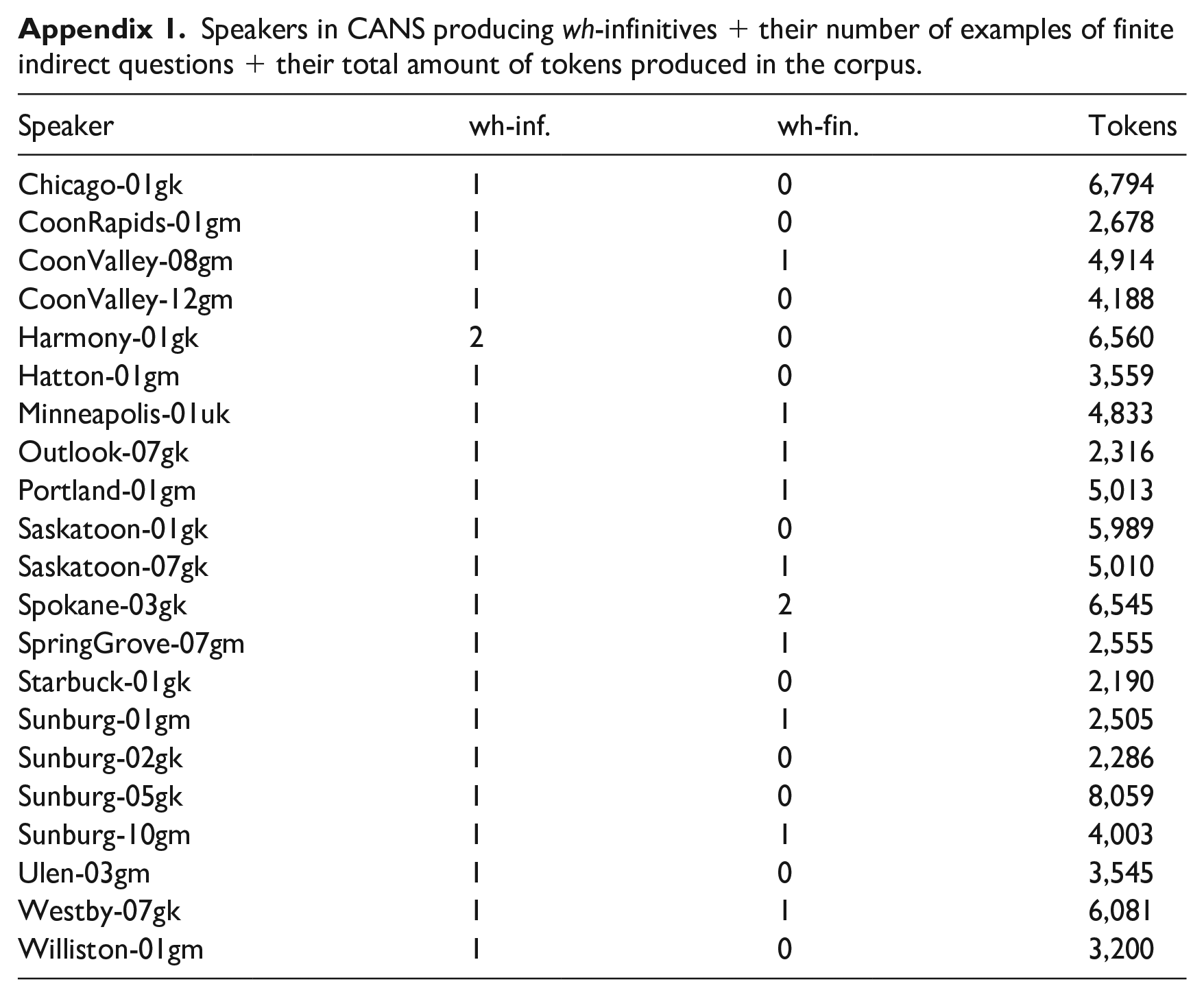
In the CANS corpus (2010-2016 recordings) we also searched for finite indirect questions with wh-items, i.e. the corresponding construction with modal verb and subject; see (6a) and (6b). We have found 45 examples of forms with an overt modal verb, produced by 39 different speakers. 15 Among the 21 speakers who produce wh-infinitives, there are 10 who also produce corresponding finite constructions (see Appendix 1). Again, whereas both options are licit in English, only one is grammatical in homeland Norwegian. One of the AmNo speakers producing both, is Outlook-07gk:
(37) je veit itte håssen je ska si de
I know not how I shall say it
‘I don’t know how I should say it.’ [Outlook-07gk]
(38) je veit ikke håss å si de
I know not how INF say it
‘I don’t know how to say it.’ [Outlook-07gk]
In summary, AmNo appears to display the same sort of optionality as found in spoken English, i.e. the production of both wh-infinitives and finite subordinate clauses with wh-items in the presence of overt modal verbs.
3 AmNo infinitival relatives
Before providing our theoretical treatment of wh-infinitives in AmNo, we offer brief remarks here on infinitival relatives. We do so since both structures require covert modality, but we wish to point out that any detailed account of infinitival relatives in AmNo would require an individual study. Whereas both English and homeland Norwegian license object infinitival relatives, subject infinitival relatives are not acceptable in the latter. The AmNo examples found in (39)–(40) are representative and highly frequent constructions with non-subject infinitival relatives that would be found in homeland Norwegian as well:
(39) mannge mil å gå
many miles INF go
‘. . . many miles to go.’ (Webster-02gm)
(40) vi e go te ha nåen tinng te jøre
we are good INF have some things INF do
‘We are good at finding things to do.’ (Saskatoon-14gk)
(41) å så hadde vi kkje så mykkje penng å levva åv
and so had we not so much money INF live of
‘And so we didn’t have much money to live by.’ (Sunburg-04gk)
Although we did not locate any (English-like) subject infinitival relatives in our corpus search, examples (42) and (43) are perhaps worth noting. They are not acceptable in written Bokmål (with infinitive marker å), but they occur in some dialects (with infinitive marker te). 16 These examples also illustrate the point mentioned in Section II; namely, that Norwegian could add either (i) the preposition/particle til or (ii) a relative particle som to make structures like this grammatical:
(42) de va inngen inni huse
it was no-one inside house.DEF INF fix food
‘There was no one inside the house
(Bokmål-i: Det var ingen inni huset
(Bokmål-ii: Det var ingen inni huset
(43) hann far hann byggde hann hadde føRRK
he father he built he had people INF build house.DEF
‘(My) father hired people
(Bokmål-i: Han far, han hadde folk
(Bokmål-ii: Han far, han hadde folk
It does not appear that infinitival relatives have been affected in the way that indirect questions have in AmNo.
4 Section summary
We have evidence that 21 different speakers from the CANS recordings in 2010–16 – approximately 14% of the speakers from these field trips whose natural speech has been transcribed – produce wh-infinitives (n = 22). Based on this fact, we can see that wh-infinitives have become a viable option in AmNo. We now turn to how this change may have taken place, and why its development is generally interesting for future work on heritage language syntax.
IV Analysis
The AmNo data in the previous section establish the following:
Whereas English licenses wh-infinitives and both subject and object infinitival relatives, homeland Norwegian does not.
AmNo has adopted the English properties of wh-infinitives (regarding covert modality), and can license this option as well as overt modality.
In this section we explicate what this state of affairs contributes to our broader understanding of language change in heritage language grammars. In the AmNo data examined here, we are dealing with a probable instance of permanent change in the grammar (i.e. at the level of mental representations) rather than temporary effects of cross-linguistic influence. We capture these effects in a version of generative grammar that adopts a One Feature-One Head-architecture (OFOH) (Kayne, 2005; Putnam, 2020), where each functional head in the syntax is headed by a singleton functional feature. One of the key desideratum of our proposal, which is consistent with the literature reviewed in Section II that classifies the semantics of these structures as instances of covert modality, is that modality can be encoded in wh-items in AmNo (and English) in wh-infinitives via a process known as spanning (Svenonius, 2016); see Section IV.1. There is an additional consequence to the lexicalization of (covert) modality in the wh-items in AmNo which enables this heritage grammar to license wh-infinitives: The lack of an overt modal – which also licenses tense (T) – eliminates the need for the (co-)occurrence of an overt complementizer in C (Chomsky, 2000, 2001, 2008; Sabel, 2020), a point we return to in Section IV.2.
1 Spanning: The basics
The OFOH-architecture eschews the need for bundles of features in syntactic representations. To illustrate this point, consider the organization of features as an unordered bundle in (44a) vs. their representation as an ordered sequence in (44b); from Dékány, 2009, 51):
(44) a. Unordered bundle (i.e. symmetrical relation)
[X, Y, Z]
b. Ordered sequence (i.e. asymmetrical relation)
[XP X [YP Y [ZP Z]]]
Individual functional heads serve as indices for semantic interpretation and the identification of morphophonological exponents. This latter operation is commonly referred to as Spell-Out, according to which individual functional heads can be combined into larger units that are semantically well-formed (and, hence, interpretable) and can be assigned appropriate exponents, or, more appropriately, these larger units can be lexicalized. Following Svenonius (2016), we refer to a contiguous string of functional heads that are semantically well-formed and can be lexicalized as a span 17 :
(45) SPAN: A span is a contiguous sequence of heads in a head-complement relation (Svenonius, 2016)
A consequence of the OFOH-architecture is that the combinations of functional heads (i.e. features) into larger syntactic objects can span over multiple terminal nodes. This situation can be illustrated with the following data; from Baunaz and Lander (2018: 16–17):
(46) a. karhu-lle
bear-ALL
‘onto the bear’
b. karhu-i-lle
bear-PL-ALL
‘onto the bears’ [Finnish]
(47) puell-
girl-ACC.FEM.PL
‘girls.ACC’ [Latin]
Finnish (46) and Latin (47) represent the canonical distinction between agglutinating and fusion languages respectively. As an agglutinating language, Finnish realizes its individual syntactic–semantic features with individual exponents; -i is the plural morph while -lle marks allative case. In contrast, in Latin, case, gender, and number are realized as one (complex) exponent, -
(48) 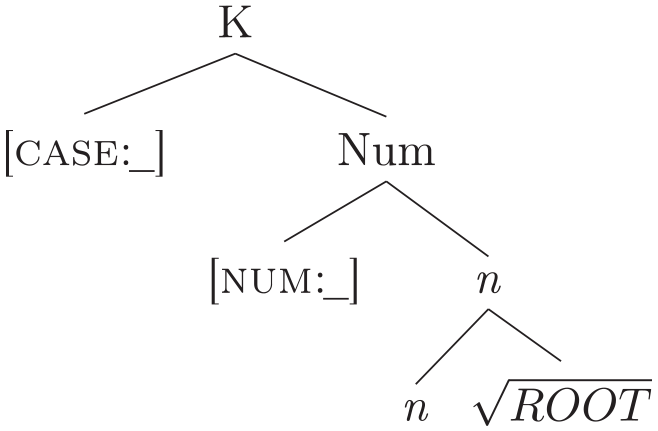
Although a one-to-one mapping is possible between functional heads and the case and number features in Finnish, in Latin the span encapsulates both case and number, resulting in a portmanteau exponent. 18
(49) [Case:ACC, Gen:FEM, NUM:PL] ↔ /-
The spanning-operation will play a central role in our analysis of the apparent change that has taken place in AmNo. As we illustrate below, spanning allows wh-items to ‘absorb’ modality, which further participate in an Aʹ-movement operation to Spec,CP.
2 Lexicalizing covert modality (via spans)
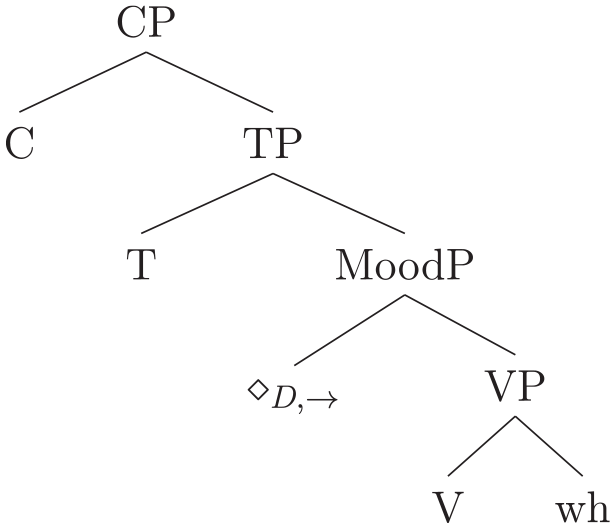
We provide a sketch of a spanning analysis of covert modality and how this further impacts this instance of Aʹ-movement in the AmNo grammar. This approach to the divergent development of heritage grammars across generations is consistent with recent theoretical proposals that eschew reliance on parameters in favor of the combinatorial properties of features (Lightfoot, 2020; Putnam, 2019; Putnam, Perez-Cortes, and Sánchez, 2019). Let’s start our analysis by adopting Bhatt’s (1999) proposal that in both wh-infinitives as well as infinitival relatives, the functional head C is interpreted as expressing modality; see (17), repeated below for the reader as (50). 19
(50) C[+wh,+inf] is interpreted as the modal ⋄D,→
Schematically we can represent these features in a tree structure such as (51). 20
(51) 
Recall that homeland Norwegian requires that modality be spelled-out, or lexicalized, as a modal verb; example (6a) is repeated below as (52) for the sake of the reader.
(52) Jeg vet [hva jeg må si].
I know what I must say
‘I know what I have to say.’ [Norwegian Bokmål]
In this context, the wh-item that undergoes Aʹ-movement does not entail modality, it represents a simple instance of Aʹ-movement, as illustrated in (53). To be explicit, the instance of Aʹ-movement represented in (53) (wh → Spec,CP) does not entail (covert) modality. Rather, the head of MoodP remains in situ.
(53) 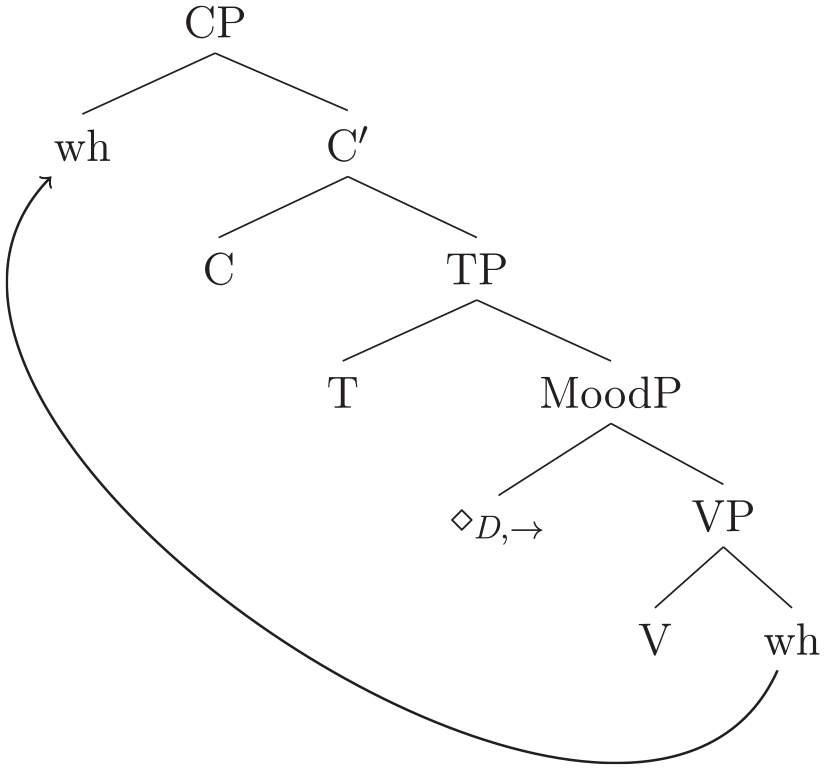
The Vocabulary Items in (54) illustrate the realization of the wh-item that has undergone Aʹ-movement, hva ‘what’, and the modal verb, må ‘must’, as separate, individual exponents. The Vocabulary Item in (54a) represents the Aʹ-chain of (wh → Spec,CP), which again does not lexicalize (covert) modality into this chain. This forces the head of MoodP to be realized as a unique exponent – a singleton span – as represented in (54b). Instances of covert modality do not require the formation of a complex span involving the wh-item and (covert) modality.
(54) a. C[+wh] ↔ /hva/
b. [⋄D,→] ↔ /må/
We now turn to English and AmNo, which unlike homeland Norwegian can license wh-infinitives, and as a result of this fact, covert modality. These instances of Aʹ-movement include wh-items that constitute more complex spans that entail (covert) modality. We illustrate this point by taking a closer look at (26), repeated below as (55).
(55) ja veit issje hå å jæra mæ re
yes know not what INF do with it
‘Yes, (I) don’t know what to do about it.’ (Sunburg-10gm)
Covert modality lexicalized in the wh-item requires the modal entailment to be ‘absorbed’, or lexicalized, in the span that represents the wh-item. We capture this state of affairs in (56). Admittedly, this derivation is markedly more complex than the previous one proposed for overt modality. The wh-item forms a complex span (via a sequence of roll-up movements to capture/license modality) that includes the functional heads ⋄ D, →, T, and C, on its way to Spec,CP. Therefore, in addition to typical Aʹ-movement, we also observe the creation of a span that incorporates modality in the wh-item.
(56) 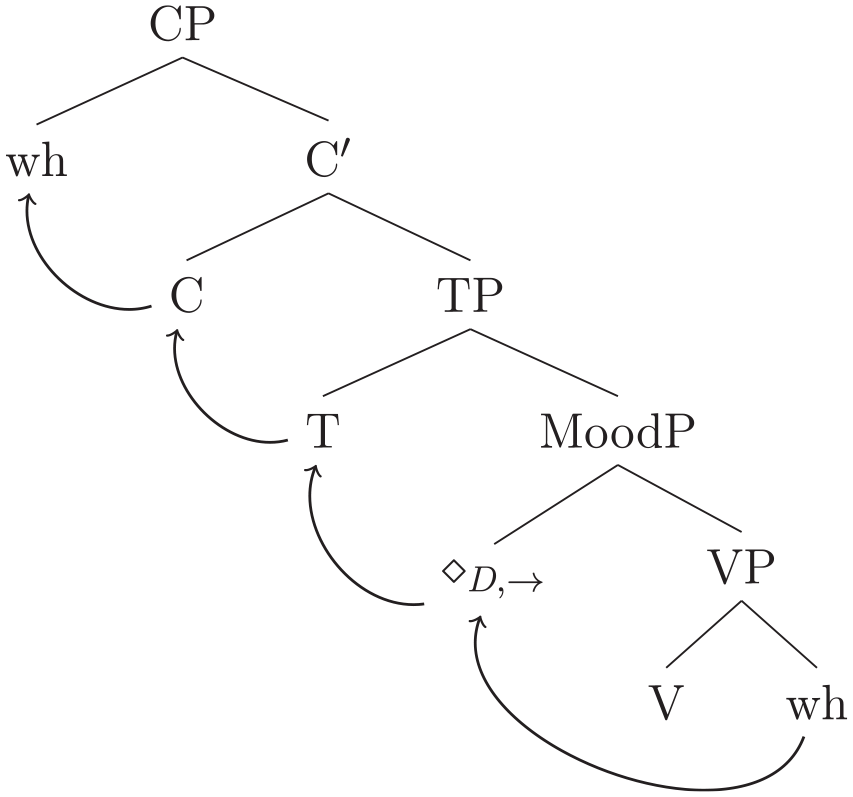
The result of this complex chain is a wh-item that lexicalizes modality and does not require the realization of an independent modal verb, resulting in a complex syntactic object. The Vocabulary Item for this span is stated in (57). An important point worth mentioning here is that the formation of a complex syntactic object via spanning can still take place in further operations, such as Aʹ-movement. For example, Gallego (2016) proposes that such (complex) elements are ‘frozen’, i.e. cannot be further decomposed, once lexicalized (i.e. pronounced). Although we do not discuss the consequences of his proposal in detail here, it suffices to say that our analysis supports these claims.
(57) 〈C,T,⋄D,→ 〉 ↔ /hå/
The ability to lexicalize covert modality in wh-items in wh-infinitive structures as complex spans in AmNo forces the clause it appears in to be non-finite. The lack of an overt modal/auxiliary verb results in the additional ‘failure’ of Tense being overtly realized. To explicate this point, we need to recognize that modal verbs also inflect for tense. As such, the span of functional heads that realize overt modal verbs involves both MoodP and TP:
(58) [Tense:,⋄D,→] ↔ /(tensed) modal verb/
The absence of an overt modal/auxiliary, due to it being ‘absorbed’ into a larger span (57), results in the clause being non-finite. 21
Although one could conceivably argue that the presence of (some types of) infinitival relatives in AmNo (and homeland Norwegian) in combination with constant exposure to English aided in a facilitative change, the nature of the structure that has been assimilated into the AmNo is somewhat unique in the literature on heritage language syntax to date. The morphosyntax and semantic properties of modality have a profound effect on the nature of the clause that contains them. 22 Whereas other generative analyses may refer to the change that has taken place as an instance of feature transmission (Aboh,2015), we capture these effects through spans. In our approach, AmNo has assimilated to the spanning properties of English with respect to adopting the ability to license covert modality in wh-items in wh-infinitives via complex spans. The proposal that wh-items can lexicalize covert modality and undergo Aʹ-movement supports a version of representation economy (Scontras, Polinsky, and Fuchs, 2018) that avoids ‘silent elements’ (Laleko and Polinsky, 2017). At the same time, the occurrence of complex spans such as these are not as simplex as one-to-one feature-exponent mappings, which also seem to be preferred in heritage language (morpho)syntax (Lohndal and Putnam, 2021). The existence of spans such as these in heritage language syntax certainly raise interesting questions concerning how best to understand exactly what ‘representational economy’ and complexity in these systems mean. As recently proposed by Lohndal and Putnam (to appear), the tendency to minimize morphosyntactic complexity in agglutinating heritage languages (e.g. Hungarian and Turkish) via ‘expanded structures’ such as span could be viewed as a benefit since it reducing the number of mappings between spans and exponents. Taken together, these findings lend further support to the view that even moribund heritage grammars continue to develop complex grammatical nuances (Bousquette and Putnam, 2020).
V Conclusions
The lexicalization of covert modality in wh-items via spans that include the functional heads of T, C, and ⋄ D,→ in AmNo has led to the licensing of wh-infinitives in this heritage language grammar. These structures are ungrammatical in homeland Norwegian, thus supporting the hypothesis that they are likely nuanced innovations due to extended exposure to English and a lack of use of the heritage language (Putnam and Sánchez, 2013). Critically, AmNo has adopted the English-like strategy of lexicalizing modality within wh-items under certain contexts (i.e. in non-finite clauses), while also allowing for the expression of overt modality (thus nullifying the infinitival context). In the conclusion of this article, we return to the how- and what-questions that we posed in the introduction (repeated here for the sake of the reader):
Can we model how this syntactic change took place (since these structures are not possible in homeland Norwegian)?, and
What does this say about the status of Aʹ-dependencies in AmNo specifically and heritage syntax more generally?
Regarding the how-question, we made the case in the previous section that in an OFOH-architecture, the size of spans (i.e. syntactic objects) can vary considerably. The key difference between languages that license wh-infinitives – such as English and AmNo – vs. those that do not – such as (homeland) Norwegian – can be reduced to whether or not modality can be lexicalized in the spans that represent wh-items which then further participate in Aʹ-movement operations. The realization of these complex spans that encode modality on the wh-item leads to a snowball effect of depriving Tense of an environment to be realized, followed in turn by the lack of a need for an overt complementizer, resulting in a non-finite clause.
As for the what-question, these data challenge certain received notions concerning the nature of heritage language syntax. First, the lexicalization of covert modality in the wh-items in AmNo wh-infinitives represents an instance of the absorption of covert, or ‘silent’ elements in spans. The strategy of generating complex spans avoids postulating ‘empty heads’ in syntactic structure, which are dispreferred in heritage language syntax (Laleko and Polinsky, 2017). Adopting a view of syntactic structure that interprets syntactic objects as spans, or any system that adopts a late-insertion approach, can avoid unwanted ‘silent elements’, albeit it at the expense of creating more complex syntactic objects. According to this line of reasoning, the size and (feature) content of syntactic objects (i.e. spans) would be ‘bigger’ in certain situations where the trade off might result in an ease of communication or parsing (Lohndal and Putnam, to appear). 23 Second, these findings further confirm that non-finite clauses (Putnam and Søfteland, 2021), the (morpho)syntactic expression of modality (Putnam et al., 2019), and Aʹ-dependencies more generally (Cuza, 2013, 2015; Cuza and Frank, 2010, 2011; Cuza et al., 2016; Hopp et al., 2019; Montrul, Foote, and Perpiñan, 2008) in heritage language grammars can be affected over their course of development. Both of these aforementioned elements of syntax involve syntax–semantic interface congruence, which provides further support to the long-held assumption that whereas the core elements of syntax remain consistent and unscathed, those involving any sort of interface mapping (e.g. in the case involving both the syntax–semantics and syntax–morphology interfaces) may be subject to alterations of both feature- and pattern-level shifts (Aboh, 2015), conceptualized here as spans.
Footnotes
Appendix
Speakers in CANS producing wh-infinitives + their number of examples of finite indirect questions + their total amount of tokens produced in the corpus.
| Speaker | wh-inf. | wh-fin. | Tokens |
|---|---|---|---|
| Chicago-01gk | 1 | 0 | 6,794 |
| CoonRapids-01gm | 1 | 0 | 2,678 |
| CoonValley-08gm | 1 | 1 | 4,914 |
| CoonValley-12gm | 1 | 0 | 4,188 |
| Harmony-01gk | 2 | 0 | 6,560 |
| Hatton-01gm | 1 | 0 | 3,559 |
| Minneapolis-01uk | 1 | 1 | 4,833 |
| Outlook-07gk | 1 | 1 | 2,316 |
| Portland-01gm | 1 | 1 | 5,013 |
| Saskatoon-01gk | 1 | 0 | 5,989 |
| Saskatoon-07gk | 1 | 1 | 5,010 |
| Spokane-03gk | 1 | 2 | 6,545 |
| SpringGrove-07gm | 1 | 1 | 2,555 |
| Starbuck-01gk | 1 | 0 | 2,190 |
| Sunburg-01gm | 1 | 1 | 2,505 |
| Sunburg-02gk | 1 | 0 | 2,286 |
| Sunburg-05gk | 1 | 0 | 8,059 |
| Sunburg-10gm | 1 | 1 | 4,003 |
| Ulen-03gm | 1 | 0 | 3,545 |
| Westby-07gk | 1 | 1 | 6,081 |
| Williston-01gm | 1 | 0 | 3,200 |
Acknowledgements
We would like to thank three anonymous reviewers for Second Language Research whose interesting and probing questions forced us to revisit aspects of our analysis and ultimately strengthened this article. Special thanks are also due to Ellen Brandner, Kari Kinn, Terje Lohndal, and Silvia Perpiñan for comments and suggestions on earlier versions of this article. All remaining errors are our own.
Declaration of Conflicting Interests
The author(s) declared no potential conflicts of interest with respect to the research, authorship, and/or publication of this article.
Funding
The author(s) received no financial support for the research, authorship, and/or publication of this article.
