




Abstract
This study investigates feature acquisition and feature reassembly associated with Clitic Left Dislocation (CLLD). The article compares the acquisition of CLLD in second language (L2) Italian to L2 Romanian to examine effects of first language (L1) transfer, construction frequency and the type of interface involved (external vs. internal interface) within the same syntactic construction. The results from an acceptability judgment task and a written elicitation task show that while English near-native speakers of Italian/Romanian acquired the L2 constraints on CLLD, which is [+anaphor] for Italian and [+specific] for Romanian, data from both Romanian L2 learners of Italian and Italian L2 learners of Romanian showed persistent L1 transfer effects. Target-like acquisition for these groups requires both grammatical expansion and retraction; Romanian CLLD requires the addition of an L1-unavailable [+specific] feature and the loss of a [+anaphor] feature, while Italian CLLD requires the addition of an L1-unavailable [+anaphor] and the loss of a [+specific] feature. The reported findings extend evidence in favour of the Feature Reassembly Hypothesis to the syntax–discourse interface, as reassembly of interpretational features associated with CLLD proved more difficult than feature acquisition. While learners at the near-native levels were able to broaden the contexts that allow a clitic in the L2 (grammatical expansion), L1 preemption difficulties were attested as well. This was the case regardless of the frequency of the relevant construction in the input and the type of L2 feature that needed to be added/removed.
Keywords
I Introduction
This article examines the acquisition of constraints on Clitic Left Dislocation (CLLD) in Italian and Romanian, a phenomenon that requires the integration of discourse information onto the syntax. Most research on the acquisition of phenomena at the discourse–syntax interface has been conducted in light of the Interface Hypothesis (IH; Sorace, 2011; Sorace and Filiaci, 2006) and has been argued to be an area of the grammar that is particularly prone to non-native optionality compared to phenomena at the internal interfaces, including the syntax–semantics interface (Sorace and Filiaci, 2006; Sorace and Serratrice, 2009; Tsimpli and Sorace, 2006) due to increased processing costs for second language learners (L2ers) in the integration of discourse information into the syntax. Despite the attested observation that phenomena at the syntax–discourse interface are often acquired late, evidence for a generalized interface-related deficit is not reported; there is an increasing body of research showing successful L2 acquisition of discourse properties that are not instantiated in the learner’s first language (L1) (e.g. Donaldson, 2011; Hopp, 2009; Ivanov, 2012; Iverson et al., 2008; Leal et al., 2017; Rothman, 2009; Slabakova Kempchinsky and Rothman, 2012; Smeets, 2019), as well as positive transfer of L1 properties for speakers whose L1 and L2 behave alike (Hopp, 2009; Kraš, 2008; Smeets, 2019).
To gain further insights into the specific conditions that facilitate or hinder L2 acquisition of discourse properties, it is important to investigate the combination of factors contributing to the relative ease or difficulty of L2 acquisition. The current study weighs into this debate by focusing on the role of the L1, the type of L2 feature involved (semantic or discourse) and construction frequency effects (see also Hopp et al., 2020; Slabakova, 2015), considering a situation where the L1 and L2 allow the same syntactic construction but do so in different discourse contexts.
Specifically, the study examines the differences between Italian and Romanian Clitic Left Dislocation (CLLD), a construction where the direct object is moved leftwards to the beginning of the sentence and a clitic pronoun is inserted in preverbal position, as shown in example (1a) for Italian and (1b) for Romanian.
(1) Who prepared the fish and who the soup? a. [Il pesce]i the fish cl.m.3sg have prepared I ti and Cristiano has made the soup b. [Peştele]i Fish-the cl.m.3sg- have prepared I ti and Cristi has made soup ‘I made the fish and Cristian made the soup.’
Although the construction exists in both Romanian and Italian, speakers of each language use the construction differently depending on the discourse and semantic properties of the dislocate; ‘the fish’ in examples (1a) and (1b). Hence, we present a situation where learners can parse the L2 input using their L1 syntax but where the interpretative properties may not coincide. In fact, in Italian only discourse topics can be involved in CLLD. In Romanian, on the other hand, discourse status is not at issue; instead, clitic use is constrained by specificity (for more details, see Section II.1).
This study builds on earlier findings on L2 Italian reported in Smeets (2022) showing persistent L1 transfer effects for Romanian but not for English native speakers. Applying insights from the Feature Reassembly Hypothesis (FRH), we examine whether the need for feature reassembly leads to persistent non-convergence compared to learners who do not bring knowledge of L1 features into the L2 acquisition process. Comparing the L2 acquisition of Italian to L2 Romanian CLLD by reversing the L1 and L2, we gain further insights into the factors that may hinder overcoming L1 transfer, such as the contribution of construction frequency (the amount of input L2ers are exposed to for a given construction) and the role of external (discourse) vs. internal (semantic) interfaces. Foreshadowing the results, we find learnability issues specific to certain language pairings, regardless of whether discourse or semantic properties are involved and regardless of construction frequency. The need for feature reassembly and L1 preemption together can explain the different outcomes between the L1–L2 pairings involved.
II Properties of CLLD in Italian and Romanian
Two types of object fronted constructions are relevant in this study: Topic Fronting and Focus Fronting, as illustrated in (2) and (3) respectively.
(2) Topic Fronting Q: What did you do with the couch and with the table? A: [The couch]i I put ti in the living room, but the table broke during transportation. (3) Focus Fronting Q: You put the table in the living room, right? A: [THE COUCH]i I put ti in the living room, not the table.
Although both constructions involve A-bar movement of an object into the left-periphery (following López, 2009) and both constructions are associated with a contrastive interpretation of the dislocate (in both sentences ‘the couch’ is contrasted with ‘the table’ mentioned in the previous sentence), the two constructions are used in different contexts.
Following López, the discourse property ‘discourse anaphoricity’ differentiates between Topic and Focus Fronting. In (2), the object is an example of a discourse anaphor, as the dislocate ‘the couch’ has an antecedent in the immediate discourse (a local antecedent; see Villalba, 2000), and the answer elaborates on the previous sentence by contributing new information about what happened to the couch. In (3), the dislocate ‘the couch’ does not have an antecedent (it is not mentioned in the immediate discourse). 1
Italian, Romanian and English, the languages relevant to this study, all allow Topic Fronting and Focus fronting. Crucially, however, the languages differ as to whether they insert a clitic that agrees with the left dislocated object and the exact discourse contexts in which a clitic is used. While English does not use a clitic or a pronoun in either construction (Note: The couch I put (*it) in the living room), CLLD is used in both Italian and Romanian.
1 Interpretative properties
Romanian and Italian differ in the features associated with CLLD. As summarized in Table 1, Italian restricts CLLD to constructions where the fronted object is a discourse anaphor. In Romanian, clitics are used when the fronted object has a specific referent.
Distribution of resumptive clitics in Italian and Romanian.
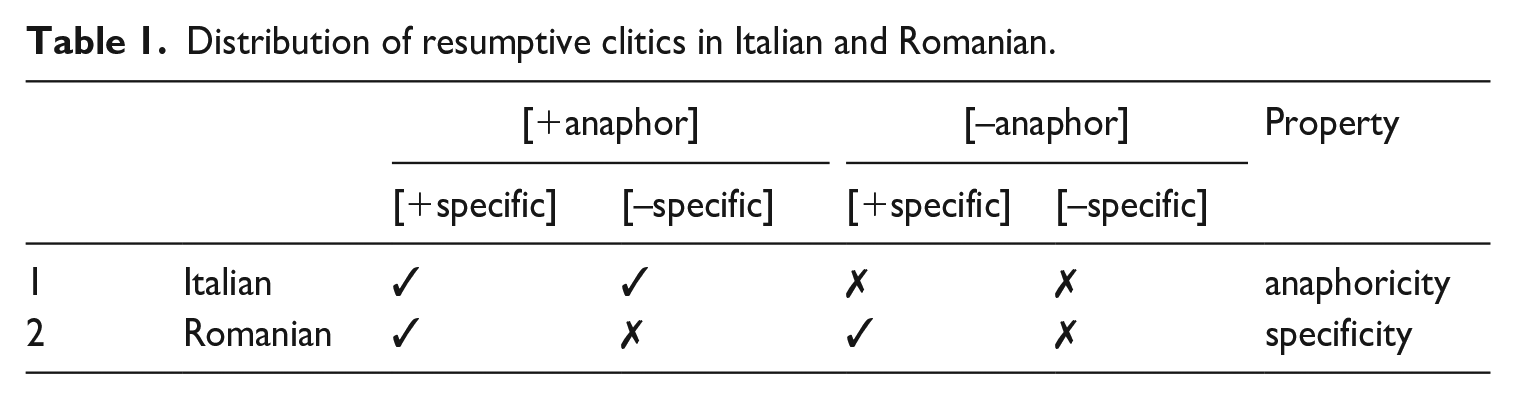
To illustrate the differences between Italian and Romanian regarding the role of anaphoricity and specificity, we can manipulate the [±anaphor] and [±specific] status of the object in four different scenarios (for further evidence from Catalan that specificity/referentiality and anaphoricity are orthogonal features, see also López, 2009).
In (4a) for Italian and (4b) for Romanian, CLLD is used in a context where the construction is felicitous in both languages, as il divano / canapeaua (‘the couch’) is both specific and discourse anaphoric.
(4) [+specific, +anaphor] Q: What did you do with the couch and the table? a. [Il divano]i *( The couch cl.acc.m.sg have put in living room but the table refl is broken during the transportation ‘The couch I put in the living room, but the table broke during transportation.’ b. [Canapeaua]i am pus-*( Couch.def have put-cl.acc.m.sg in living room but table.def refl-is broken in time transportation ‘The couch I put in the living room, but the table broke during transportation.’
Changing the context slightly such that the dislocate has no antecedent in the immediate discourse, clitic use becomes illicit in Italian; see (5a). In Romanian, the clitic is obligatory – see (5b) – suggesting that discourse anaphoricity is irrelevant for Romanian.
(5) [+specific, –anaphor] Q: You put the table in the living room, right? a. Il DIVANO (* The couch cl.m.3sg have.1sg put in living room not the table Il tavolo si è rotto durante il trasporto. the table refl is broken during the transportation ‘The couch I put in the living room, not the table. The table broke during the transportation.’ b. CANAPEAUA am pus-*( couch-the have.1sg put-cl.f.3sg in living room not table-the Masa s-a rupt în timpul transportului. table-the REFL-has broken in time transportation ‘The couch I put in the living room, not the table. The table broke during the transportation.’
In Romanian, clitics can only be used with specific/referential nouns (see also Avram and Coene, 1999; Cornilescu and Dobrovie-Sorin, 2008). The couch in (4) and (5) is specific, as the speaker has one specific couch in mind. However, if we look at clitic use in a scenario where the dislocate is non-specific, as is the case for a red skirt in (6) and (7), the clitic makes the sentence ungrammatical in Romanian. Specificity does not affect the use of clitics in Italian; in (6a), where the dislocate is [–specific, +anaphor], a clitic is obligatory.
(6) [–specific, +anaphor] Q: Did you find a red skirt and a pair of boots? a. Una gonna rossa *( a skirt red cl.f.3sg search.1sg already since two months but have.1sg found a pair of boots black b. O fustă roşie (* a skirt red cl.f.3sg search already for two months but have.1sg found a pair of boots black ‘I’ve been looking for a red skirt for two months, but I did find a pair of black boots.’
In the context in (7) neither Italian nor Romanian uses a clitic. A clitic is not allowed in Italian because the fronted object is [–anaphor] and it is not allowed in Romanian because the dislocate is [–specific].
(7) [–specific, –anaphor] Q: Weren’t you looking for a red sweater? I saw some nice ones at H&M. a. Una GONNA rossa (* A skirt red cl.f.3sg look-for.1sg, not a sweater red b. O FUSTĂ roşie o caut, nu o cămaşă roşie. A SKIRT red cl.f.3sg seek-for.1sg not a shirt red ‘I am looking for a red skirt, not a red sweater.’
To summarize, Romanian has a specificity requirement on the use of CLLD; left dislocated object DPs are doubled by a clitic when there is a particular entity to which the object is referentially anchored. Italian has an anaphoricity requirement on the use of CLLD, where the dislocate is obligatorily linked to a discourse antecedent.
2 Assignment of the features [±anaphor] and [±specific]
This section briefly discusses how the features [±anaphor] and [±specific] can be assigned to the syntax (for more details, see López, 2009). According to López, the discourse feature [±anaphor] is assigned by an external pragmatic module of computation to the syntactic derivation at specific phase edges, the areas where the pragmatic module can access the syntax (following Chomsky, 2000). As illustrated for the sentence in (4a) in Figure 1 (left), a dislocated object moves from its VP internal base position to the specifier of vP, where it shares agreement features with a clitic adjoined to the v head. The pragmatic feature [+a(naphor)] is assigned to the object in Spec vP and is subsequently shared through agreement with the clitic in the phrasal head position, as shown in Figure 1 (right). When there is no clitic available, the dislocated object is assigned [–anaphor]. Because Romanian CLLD does not depend on anaphoricity or any specific discourse property, I assume that [±anaphor] is not assigned to clitics in Romanian.
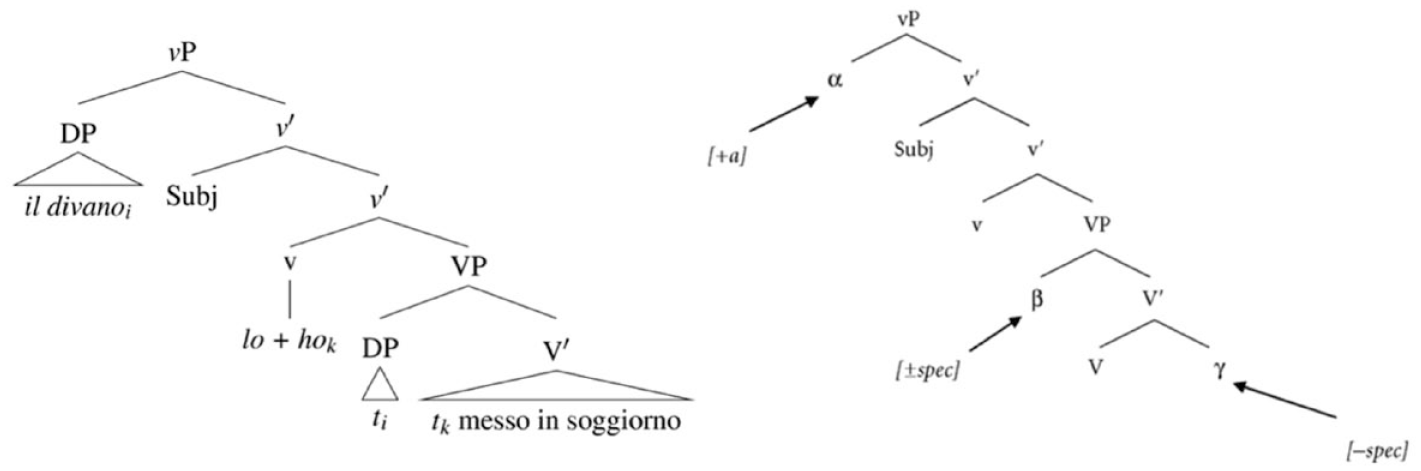
Assignment of [+a] for example (4a) (left) and the different locations for [+a] and [+spec] (right).
The feature [±specific] is not assigned by the pragmatic module at Spec,v. López assumes that specificity also involves movement ‘to Spec,V or some vP-internal functional category’ (López, 2009:172) where they can be bound or anchored by sentential operators. As shown in Figure 1 (right), [+spec(ific)] is assigned in Spec,VP where the clitic can share the feature with the agreeing DP. Both Spec,v and Spec,V are thus relevant for interpretation. From an acquisition perspective, these syntactic differences, if correct, may not be easily observable from the input since both interpretative properties are assigned in the verbal domain. Instead, surface similarities between Romanian and Italian are likely to be most salient for learners. Within the question of acquirability, it should furthermore be mentioned that while the Italian [±anaphor] feature is only relevant for CLLD, the [+specific] constraint on Romanian clitics also holds for clitic doubling, which is obligatory with differential object marking (DOM) marking in Romanian (Dobrovie-Sorin, 1990). We will return to this in the discussion.
III Acquisition of CLLD and L1 transfer of discourse properties
In this section we present a selective overview of recent research that is most relevant to the goals of our study, focusing on the acquisition of specificity and anaphoricity constraints associated with clitic constructions and on earlier studies on L1 transfer of discourse properties.
1 Acquiring specificity and anaphoricity
The L2 acquisition of constraints on CLLD has mainly been studied for Spanish and, to our knowledge, not yet for L2 Italian and L2 Romanian. 2 Our predictions are therefore based on findings in L2 Spanish. Like Italian, Spanish CLLD is a topicalization strategy, but unlike Italian, and like Romanian, clitics with object fronting are only used with specific noun phrases (e.g. Arregi, 2003). Spanish CLLD is thus constrained by both [+anaphor] and [+specific].
Valenzuela (2005) focused on the specificity restriction on CLLD by English L2 learners of Spanish. Participants rated orally presented sentences with either specific or generic left dislocated objects, varying the presence or absence of a clitic. Near-native Spanish speakers rated sentences with a clitic significantly higher than sentences without a clitic when the object was specific, like the native speakers. However, L2ers also over-accepted clitics with generic objects and therefore failed to acquire the Spanish specificity requirement. Valenzuela (2005) reported similar findings for a sentence selection task and a sentence completion task. Additional research on the acquisition of the specificity constraint has mainly focused on DOM marking in L2 Spanish, reporting persistent difficulty for native speakers of non-DOM languages like English (Bowles and Montrul, 2009; Farley and McCollam, 2004; Guijarro-Fuentes, 2011, 2012; Guijarro-Fuentes and Marinis, 2007), but not for native speakers of Romanian (Montrul, 2019) or Turkish (Montrul and Gürel, 2015) where the L1 also instantiates a specificity constraint on DOM.
Slabakova et al. (2012) investigated, among other aspects, the anaphoricity constraint on Spanish CLLD. Participants provided acceptability judgments of sentences with Topic or Focus Fronting, similar to the examples in (4) and (5), where the clitic was either present or absent. Near-native speakers correctly accepted the clitic in the topic condition and rejected it in the focus condition. Hence, English learners of L2 Spanish can acquire the discourse appropriateness of CLLD. Similar results are reported in Leal et al. (2017) and Sequeros-Valle et al. (2020) for offline tasks, although differences between L1 and L2 speakers arise in tasks with increased processing pressure (Sequeros-Valle et al., 2020). Successful acquisition of discourse constraints on CLLD is also reported for L2 Bulgarian (Ivanov, 2012; Slabakova and Ivanov, 2011). Leal et al. (2017) furthermore showed that, using a self-paced reading task, with increased proficiency English L2 learners of Spanish process CLLD constructions like native speakers. In contexts with fronted topics, L2ers correctly expected a clitic in the preverbal position.
To summarize, previous research suggests that the acquisition of the specificity constraint on clitics is difficult when this constraint is not instantiated in the L1. Acquisition of the anaphoricity constraint, however, is shown to be less problematic for L2 acquisition.
2 L1 transfer at the syntax–discourse interface
Relatively fewer studies investigated L1 transfer of discourse properties associated with non-canonical word orders. One such study is Bohnacker and Rosen (2008) who examined the clause-initial position (prefield) in L2 German declaratives by native speakers of Swedish. The two languages show frequency differences in the type of constituents that are placed in the prefield as determined by the informational value of those constituents. For example, subject or topic-initial clauses are more frequent in Swedish than in German, while the German prefield is more often filled with constituents that are in focus. Swedish L2 learners of German were shown to apply Swedish strategies on their L2. In another study, Hopp (2009) examined the acquisition of discourse constraints on object over subject scrambling in German and reports convergence with the target language (TL) for speakers whose L1 realizes features related to discourse driven word order optionality in the same way as the TL (i.e. Russian L2 learners of German) as well as for speakers whose L1 does not instantiate object scrambling (i.e. English L2 learners of German). Interestingly, target language divergence was found for Dutch learners of German, but not for native Russian or English speakers. Hopp speculates, but did not further test, that this may be due to L1 transfer: both Dutch and German allow object scrambling, but Dutch does not allow it in the discourse context used in the experiment. L1 transfer was also found in Slabakova and García Mayo (2015), who tested native Spanish L2 learners of English on their use of pronouns, comparing three constructions that exist in both languages: Focus Fronting as illustrated in (3), Topic Fronting as illustrated in (2) and Left Dislocation (LD) as illustrated in (8). 3
(8) (Source: Slabakova and García Mayo, 2015: example 3b)
Acceptability judgments show that while Spanish speakers learning English correctly preferred a pronoun in English LD constructions and rated a pronoun with Focus Fronting as unnatural, they also showed a significant preference for pronoun-sentences with Topic Fronting, unlike the English native speakers. The authors interpret these findings as L1 transfer of clitics from Spanish CLLD onto English Topic Fronting, two constructions argued to be functionally alike (Ward and Birner, 2005).
The findings discussed in this section suggest that acquiring discourse constraints on CLLD in an L2 is possible, and that it may be less challenging than acquiring the semantic constraint of specificity. However, L1 transfer may hinder successful acquisition. The next section discusses input considerations in situations where learners need to overcome L1 transfer.
IV The input factor and L1 transfer for L2 acquisition
Language learners create form–meaning mappings to parse the incoming input. One of the several crucial differences between L1 and L2 acquisition is that the default hypothesis with which L2 learners parse their grammar is their L1 (Yang and Montrul, 2016). When an L2er attests a different form in the TL input, this form is supposed to preempt or override the incorrect form created by the learner, following the Uniqueness Principle (Wexler and Culicover, 1980). Additionally, different grammatical options are associated with different probabilities, and these probabilities change over time when the learner receives more input and proficiency increases (Yang, 2002). A certain frequency threshold needs to be met before a productive rule can be formulated. A possibility to consider is that the threshold may be different for learners who must switch from an L1 system to an L2 system as opposed to acquiring the L2 system without conflicting features that are transferred from their L1. Crucially, more input may be needed to unlearn L1 mappings based on the absence of such mappings in the L2 input. Additionally, target acquisition of L2 properties does not imply that transferred L1 options are necessarily replaced, resulting in L1 preemption effects (as shown first for L2 syntax by Trahey and White, 1993). Gabriele (2005) claimed that preemption for L2 interpretation (semantics/discourse) shows up as optionality for L1/L2 meaning mappings. In this section we discuss the role of construction frequency and the need for L1 preemption in various recent studies on related phenomena and link the findings to acquiring constraints on CLLD.
Recently, Hopp et al. (2020) investigated the impact of frequency on discourse driven fronting tendencies in a bidirectional study of German and English speakers. In both languages, canonical word orders place the subject in initial position, but fronting of temporal phrases, locative phrases and objects are possible too. Importantly, the frequency distributions of non-canonical orders differ between the two languages. The study reports that the judgments from L2 English and L2 German speakers were equivalent to those of native speakers for locative and temporal phrases. However, both L2 English and L2 German speakers overgeneralized how natural sentences with fronted-objects sounded in the L2, rating them as natural as their L1 counterparts in both English and German. The authors attribute the non-native effects with object fronting to low frequency of this construction in the input in comparison to temporal and locative fronting, which are more frequent. Slabakova (2015) also considers frequency to play a role in explaining the previously discussed results from Slabakova and García Mayo (2015). Recall that English L2 learners of Spanish successfully acquire discourse constraints associated with CLLD while Spanish L2 learners of English show persistent transfer from Spanish CLLD on English Topic Fronting. Slabakova (2015) shows that, based on a corpus analysis by Brunetti et al. (2011), CLLD in Spanish is ±1,000 times more frequent than Topicalization in English. The author suggests that English Topicalization may not be sufficiently frequent in English to alter L1-transferred properties.
Slabakova and García Mayo (2017) entertain a different possibility to explain the findings in Slabakova and García Mayo (2015). It is commonly understood that the grammar of learners is informed or altered based on exposure to the language (positive evidence). The authors suggest that for unlearning an L1 syntactic option (i.e. retreating from the use of a clitic/pronoun in English topicalization), positive L2 input may not be sufficient to force a change in the interlanguage grammar. Retreating from CLLD may require negative evidence, the overt correction of a learner’s production (White, 1989), which is not reliably available in the input. In fact, Leal and Slabakova (2019) showed that CLLD is typically not taught in the L2 Spanish classroom and that language instructors typically do not have metalinguistic knowledge of the construction. In sum, relatively low frequency of the relevant construction in the input as well as the need to unlearn competing L1 options can contribute to lack of L2 convergence.
How do construction frequency and effects of L1 preemption apply to the learners in the current study? Lardiere’s (2008) Feature Reassembly Hypothesis (FRH) allows us to make predictions about L1 transfer and L2 learning of interpretative properties of CLLD. According to the FRH, which follows the Full Transfer Full Access model (Schwartz and Sprouse, 1996), L2 learners transfer L1 formal linguistic features (represented within words and morphemes) to the L2. When the initial one-to-one mapping of features is unsuccessful, as is the case for the Romanian–Italian combination, L2 learners will have to reorganize the grammatical system, i.e. reassemble the features involved. Acquiring new features that do not exist in the L1 – as is the case for our English learners of Italian/Romanian – is predicted to be easier than feature reassembly. For reassembly, the L2 acquisition process occurs in two stages. In the mapping stage L2 learners apply their L1 feature specifications onto the L2 grammar, which is [+anaphor] for Italian learners of Romanian and [+specific] for Romanian learners of Italian. At the reassembly stage, L2 learners reconfigure their feature organization. Italian learners of Romanian must remove the [+anaphor] feature and add the [+specific] feature to their L2 Romanian grammar, while Romanians learning Italian must remove the [+specific] feature and acquire the [+anaphor] feature. Note that the acquisition of one feature does not imply the loss of another feature. In other words, grammatical expansion and retraction are two separate parts of the acquisition process. In principle, the FRH predicts ultimate attainment to be possible, but other factors such as the lack of sufficient input and inability of L1 preemption can affect L2 ultimate attainment.
With respect to construction frequency, Brunetti et al. (2011) investigated the relative frequency of various object initial constructions, including Topic Fronting and Focus Fronting for Catalan, Italian, Spanish and German. The authors report that 1.35% of all Italian and Spanish finite clauses were instances of CLLD. This percentage was 1.4% for Catalan and may suggest that frequency of CLLD in Romance languages is comparable. Focus fronting was shown to be around half as frequent as CLLD. Due to the lack of other studies investigating frequency of object fronting in Romanian, we may cautiously assume that the proportion of CLLD and Focus Fronting in Romanian is similar to the other two languages. While both Topic and Focus Fronting are relatively infrequent, we know from earlier studies that English L2 learners of Spanish acquire the discourse appropriateness of clitics. For the Italian–Romanian learners, the learning task also involves the loss of an incorrect form from the learner’s grammar, for which more input may be needed. Our Italian–Romanian groups bring into the L2 acquisition process a parse that can handle the L2 data, at least most of the time. 4 Romanian learners of Italian and Italian learners of Romanian then may not receive sufficient counter evidence to trigger reconfiguration. Since Focus Fronting is even less frequent than Topic Fronting, unlearning the use of clitics with Focus Fronting for the Italian learners of Romanian may be even more problematic than unlearning clitics with non-specific topics, as required for target L2 Italian. Note furthermore that negative evidence is not reliably available. As for Spanish, CLLD does not seem to be taught in the L2 Italian classroom (Dr. Sandra Parmegiani, Dr. Samia Tawwab, p.c.).
In sum, both frequency effects (Topic Fronting being more frequent than Focus Fronting) as well as the need for unlearning L1 configurations in the absence of negative evidence can contribute to persistent L1 transfer effects. The bidirectional design presented in this study, where Romanian learners of Italian need to unlearn clitics with object fronting of specific foci and Italian learners of Romanian need to unlearn clitic with object fronting of non-specific topics, allows us to tease these factors apart.
V Current study
1 Research questions
The properties of Italian and Romanian in this bidirectional study allow us to answer prominent questions in the field of SLA through systematic investigation of L1 transfer at the syntax–discourse interface in light of the Feature Reassembly Hypothesis as well as examine the relative contribution of construction frequency and the need for unlearning in the absence of direct negative evidence. The present study aims to answer the following research questions:
Research question 1: Is feature reassembly more difficult than acquiring a feature not instantiated in the L1?
Research question 2: Are L2 semantic constraints easier to acquire than L2 discourse constraints?
Research question 3: How do construction frequency and the need for unlearning L1 options affect L2 acquisition?
2 Participants
A total of 112 participants completed the experimental tasks, either in Italian or in Romanian (see participant details and background information in Table 2). Participants were found through word of mouth and through Facebook pages targeting English/Romanian native speakers living in Italy and English/Italian native speakers living in Romania. None of the participants spoke another language with CLLD (e.g. Spanish, Greek or Bulgarian). The L2 Romanian groups have fewer participants as we were not able to find more participants after two years of active recruitment. In interpreting the results, the L2 Romanian data is used to support the conclusions we draw from the L2 Italian data.
Background information and c-test score, showing mean (range).
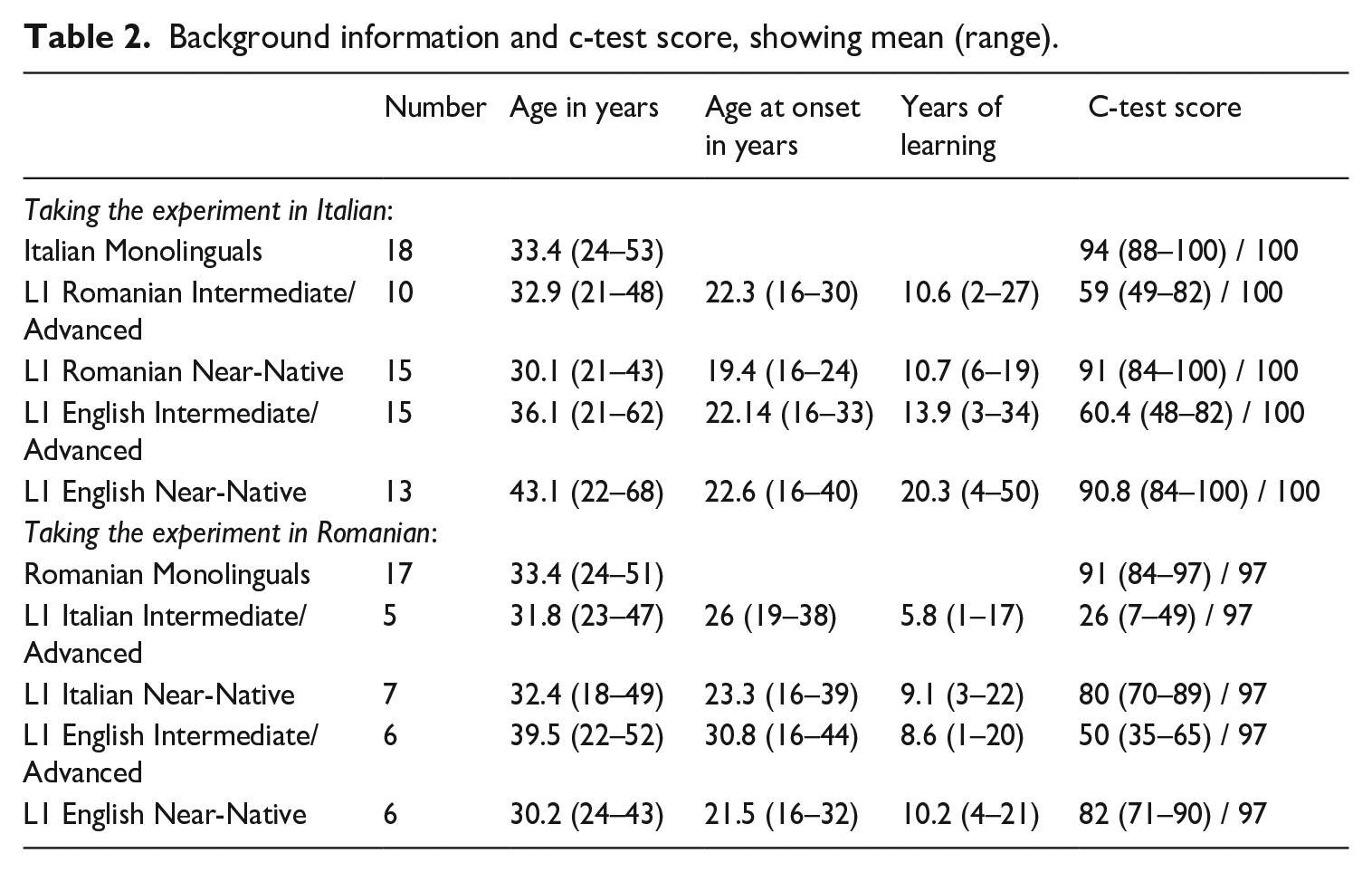
In addition to an acceptability judgment task (AJT) and a written elicitation task (WET), participants completed a background questionnaire, c-test and proficiency test. The proficiency test was adapted from an Italian placement test devised by Oxford University, which focused on a variety of grammatical phenomena such as the use of prepositions, conjugation, articles, clitics and agreement marking on adjectives. These items doubled as fillers for the WET and therefore each target sentence was gapped and all items were preceded by a short context sentence and a question (for more details see Section V.3.c). The Romanian version was adapted from the Italian version by a Romanian native speaker and linguist. Given the complexity of CLLD, proficiency criteria reported on the Oxford University webpage were used to remove the results from beginner and lower intermediate learners (i.e. score of < 20 = beginner/lower intermediate). Only participants with a proficiency score of 20 or higher are included in Table 2 and the analyses. The Italian c-test was developed by Voorhout (2010), the Romanian c-test was an adapted cloze test developed by Charlotte Gooskens and Vincent J. van Heuven. Since the FRH predicts there to be an L1 transfer and a reassembly stage, c-test results were used to divide learners into two proficiency levels: Intermediate/Advanced and Near-Native. Participants in the Near-Native group scored (near-)perfect on the proficiency task and similar to native speakers on the c-test.
3 Experimental tasks
a Acceptability judgment task: Methods
Participants judged the acceptability of sentences with left dislocated word orders on a 6-point rating scale where 1 indicated highly unacceptable and 6 highly acceptable. Experimental trials were like the examples in (4) to (7) in which the contexts, questions and answers were presented in Italian or Romanian. The target items differed by three factors: Discourse and Clitic, which are within item factors, and Specificity, which is a between item factor. The factor Discourse had two levels: in the Topic context, as in (4) and (6), the left dislocated object was discourse anaphoric and in the Focus context, as in (5) and (7), the fronted object was not discourse anaphoric. For Specificity, the fronted object was either specific, as in (4) and (5), or non-specific, as in (6) and (7).
The experiment was presented as follows: the context automatically appeared after which participants clicked ‘next’, followed by the question-and-answer pair. Stimuli were presented both in written and auditory form to ensure that participants processed the sentences with the intended intonation.
b Acceptability judgment task: Results
Since we are interested in the effects of discourse function and specificity on the use of CLLD within each participant group, the results were plotted for each language separately to examine systematic patterns within the (interlanguage) grammars themselves (following Bley-Vroman, 1983). All felicity ratings were analysed using cumulative link mixed effects models (Christensen, 2014). The models include fixed effects for the categorical predictors Clitic, Specificity, Discourse and their interactions and random effects for Participant and Item. Each contrast was centred using sum coding. Random-effect slopes were based on a maximal model that allowed convergence, following Barr et al. (2013). For the monolinguals and the L2 Italian groups, all random slopes were included. The models for the L2 Romanian groups only include random intercepts and no random slopes, as models with random slopes did not converge.
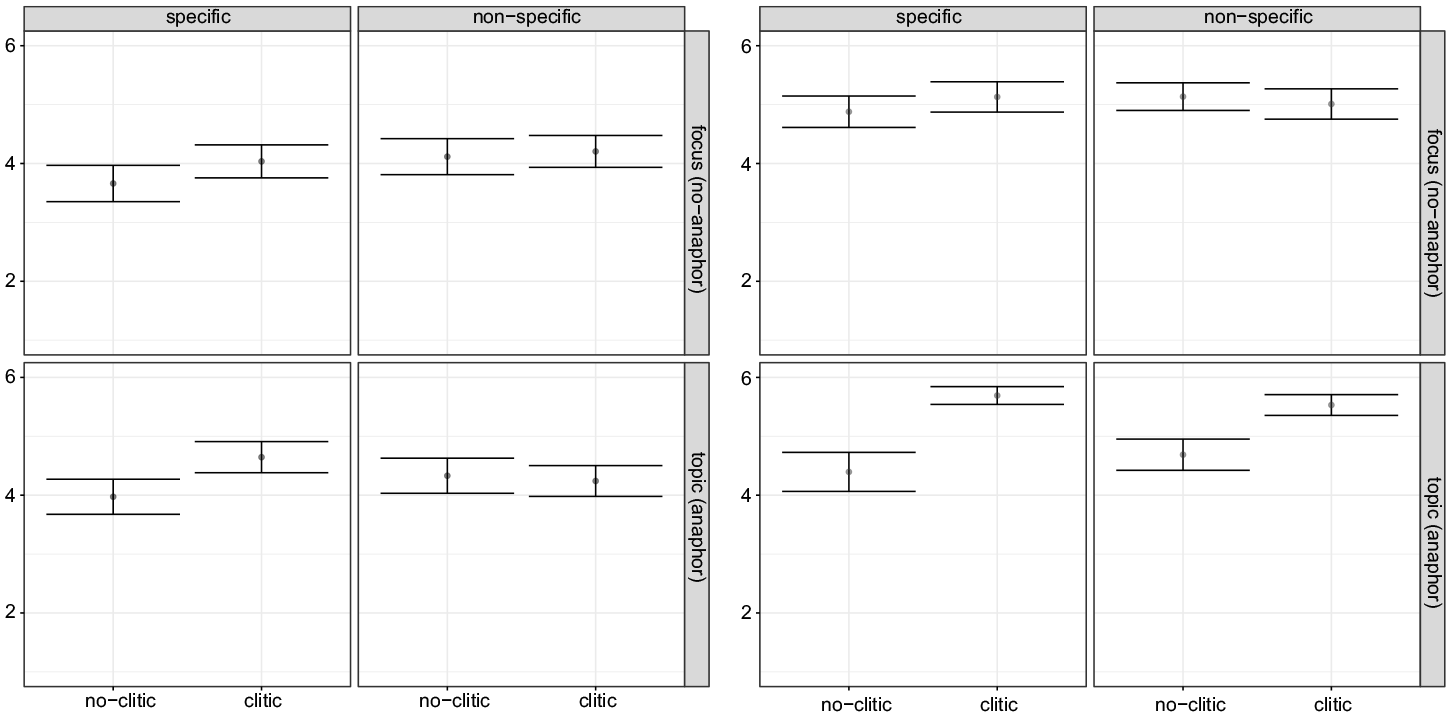
Figure 2 shows the results from the Italian and Romanian monolinguals, and Table 3 the outcomes of the cumulative link mixed effect models. Each line in the table starts with the label of the predictor in bold (e.g. Clitic). All predictors are categorical and the label in bold is followed by the two levels that were contrasted (e.g.
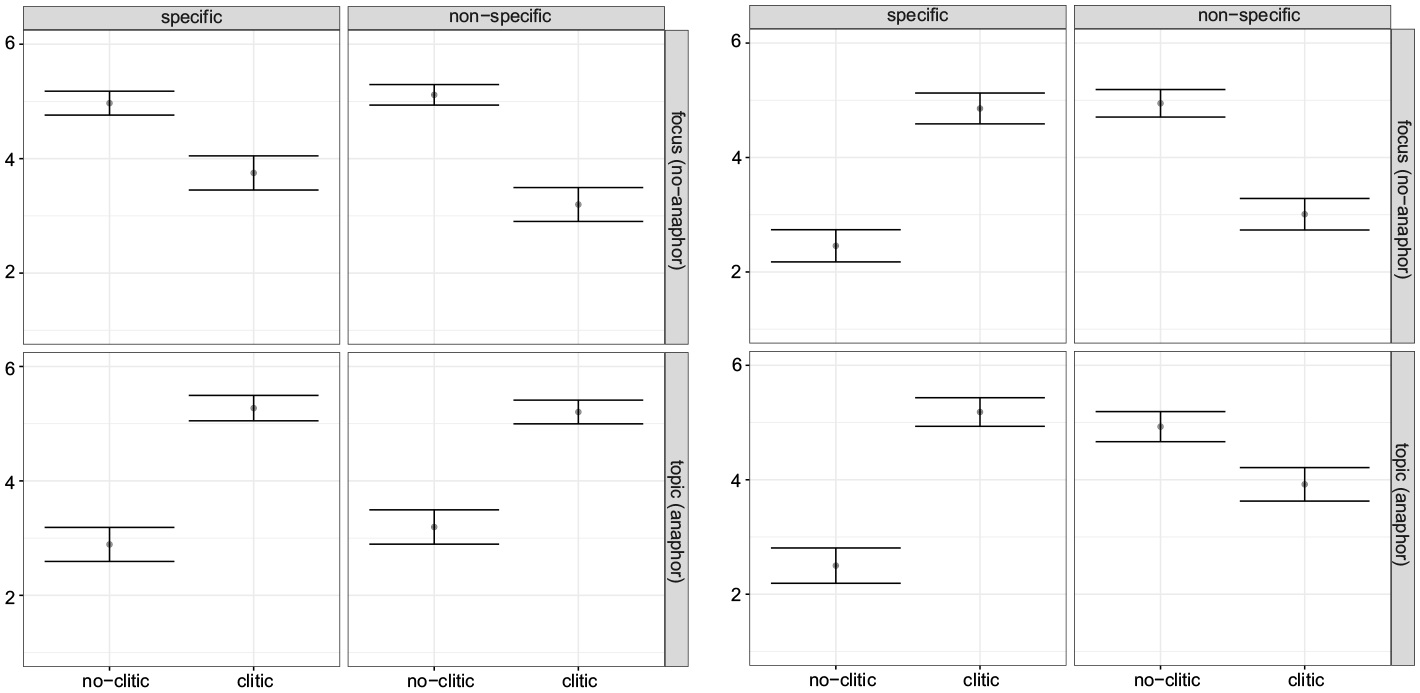
Acceptability judgments from Italian Monolinguals (left) and Romanian Monolinguals (right) with means and error bars showing 95% confidence intervals.
Acceptability judgments from Italian and Romanian Monolinguals and their comparison: Estimate for each predictor with SE in parentheses.
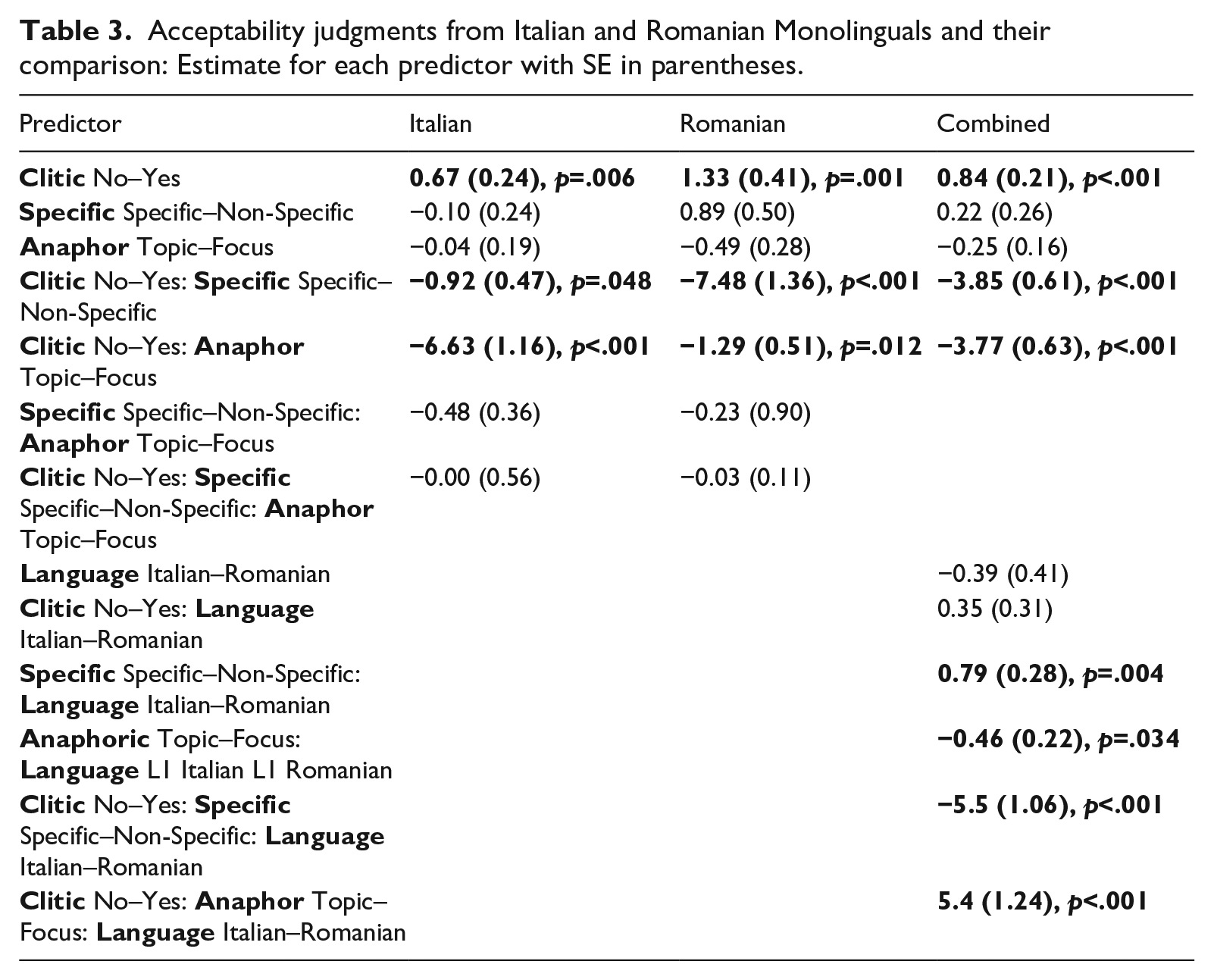
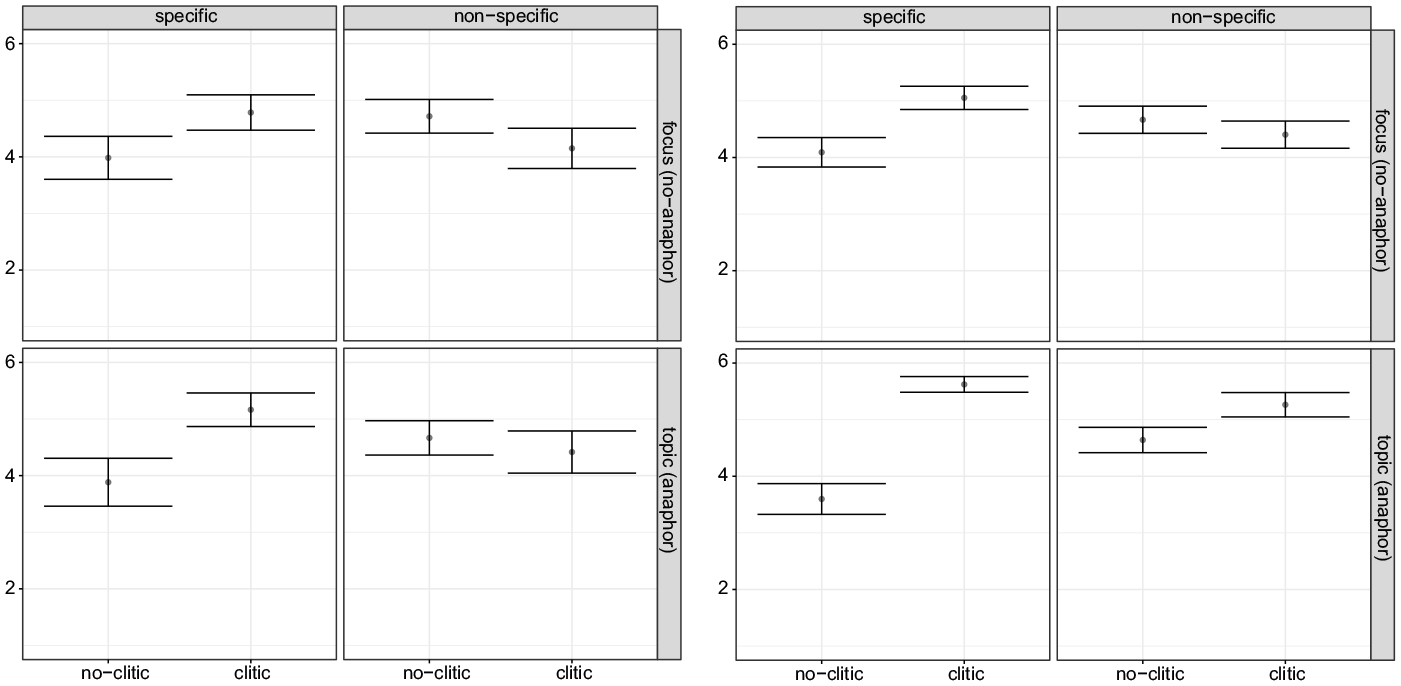
Figure 3 shows the results of the AJT by English L2 speakers of Italian, divided into two groups based on proficiency level, and Table 4 the results of the cumulative link mixed effect models. The model for the Intermediate/Advanced group shows no significant effects. Estimates for the Near-Native group show a significant interaction between Clitic and Anaphoricity, suggesting that near-native speakers, like native speakers and unlike the Intermediate/Advanced group, prefer clitic sentences when the fronted object is a Topic ([+anaphor]).
Acceptability judgments from L1 English Intermediate and Advanced Learners of Italian (left) and L1 English Near-Native speakers of Italian (right) with means and error bars showing 95% confidence intervals.
Acceptability judgments from the L1 English L2 Italian group, comparing proficiency levels: Estimate for each predictor with SE in parentheses.
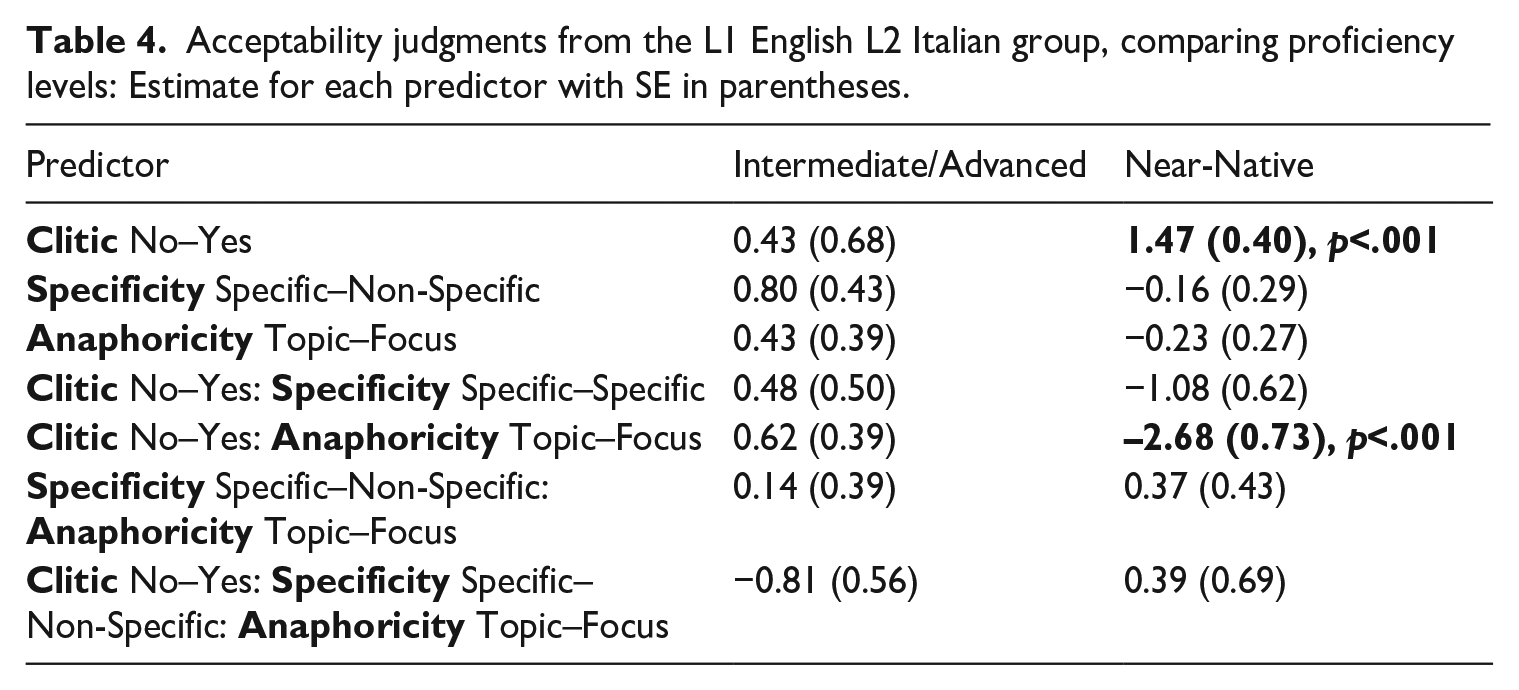
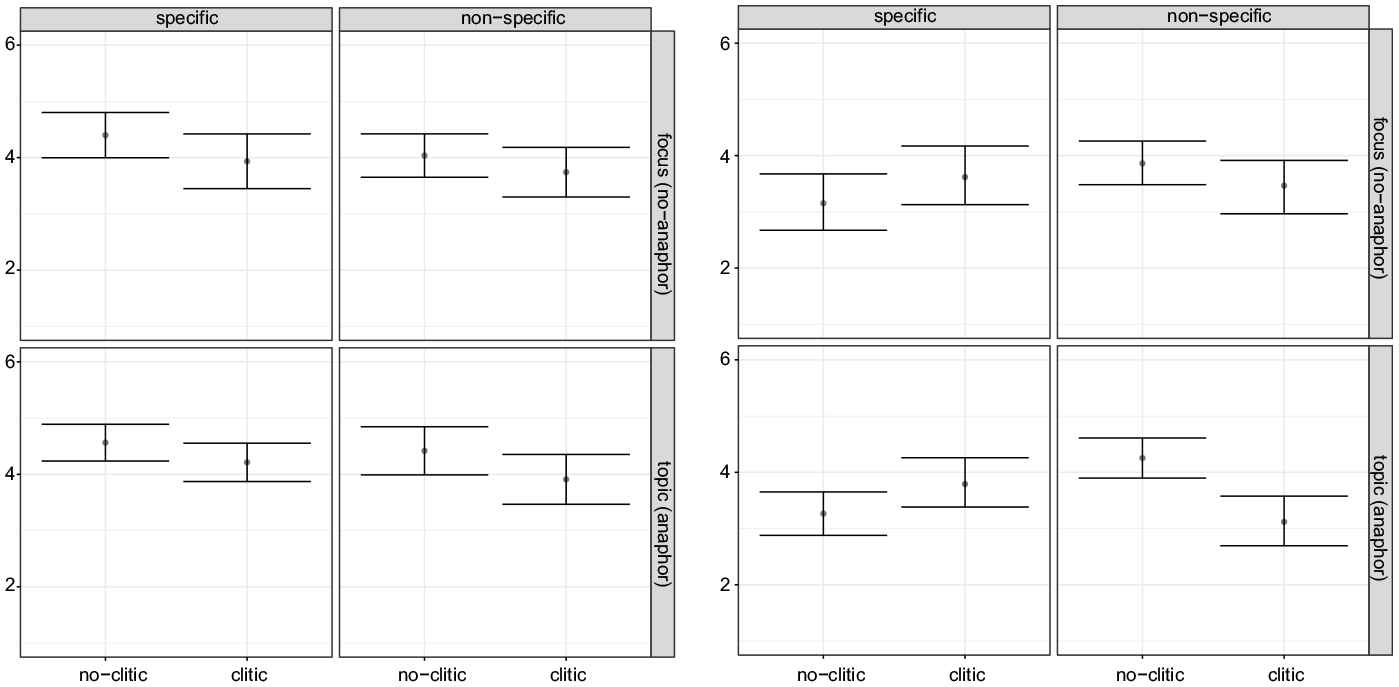
Figure 4 and Table 5 show the results of the AJT by Romanian L2 speakers of Italian. For the Intermediate/Advanced group there is a significant interaction between Clitic and Specificity and no other significant interactions, suggesting that clitic sentences are preferred over no-clitic sentences when the fronted object is specific, regardless of anaphoricity and like the Romanian monolinguals. For the near-native speakers there is a significant interaction between Clitic and Anaphoricity and between Clitic and Specificity. As Figure 3 shows, clitic sentences are preferred when the fronted object is specific, but also when the fronted object is a non-specific topic. This suggest that Romanian near-native speakers of Italian prefer clitics in contexts where they are used in the L1 (with [+specific, –anaphoric] objects) but they also acquired that clitics in Italian are used with [–specific, +anaphoric] objects.
Acceptability judgements from L1 Romanian Intermediate and Advanced Learners of Italian (left) and L1 Romanian Near-Native speakers of Italian (right).
Acceptability judgments from the L1 Romanian L2 Italian group, comparing proficiency levels: Estimate for each predictor with SE in parentheses.
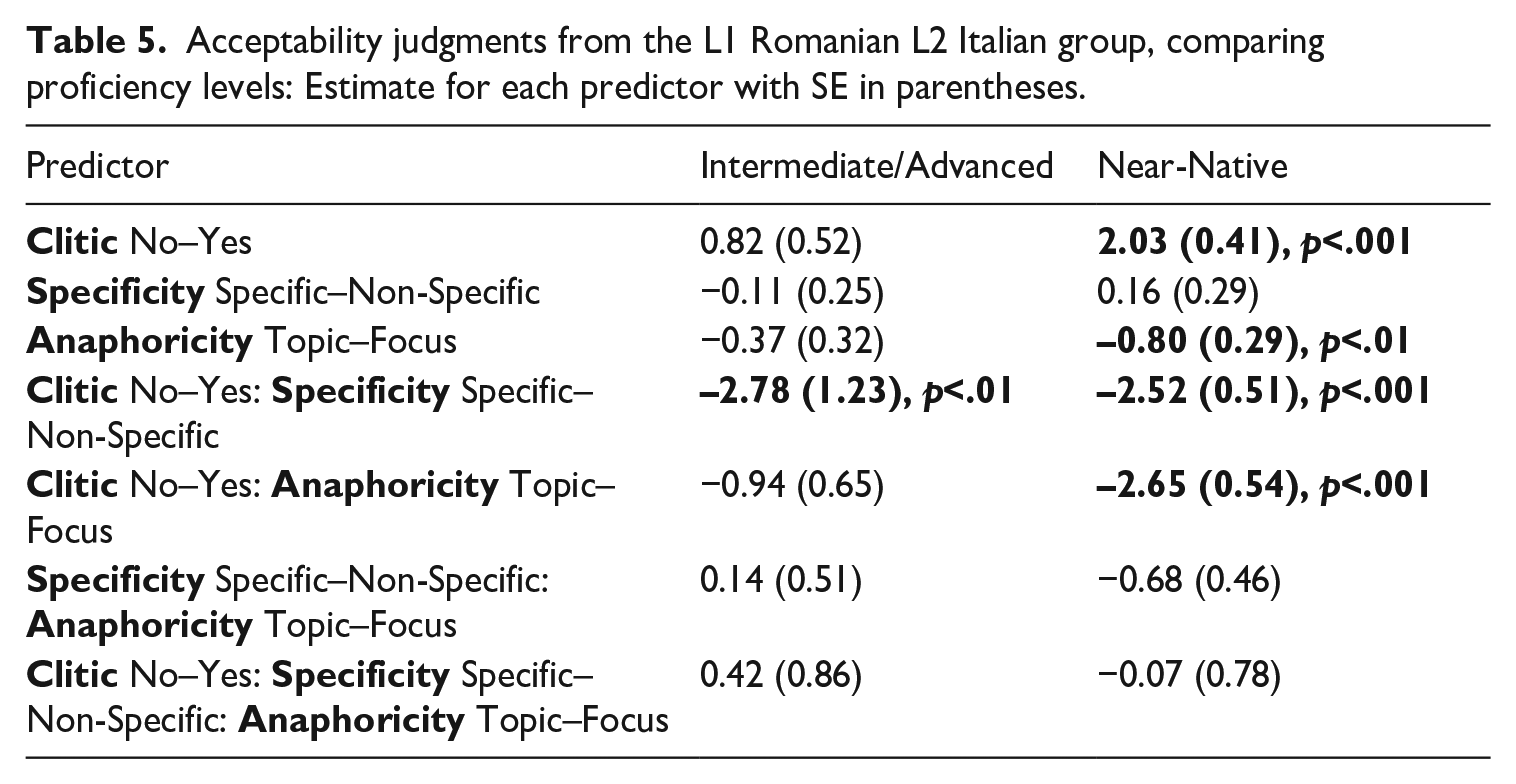
Figure 5 and Table 6 show the results of the AJT by English L2 speakers of Romanian. The significant effect of ‘clitic’ for the Intermediate/Advanced group suggests that learners at this stage prefer sentences without a clitic, as in their L1. The model for the near-native speakers shows a target-like interaction between clitic and specificity, as clitic-sentences were rated higher when the fronted object was specific and no-clitic-sentences were rated higher when the fronted object was non-specific. This suggests that English learners of Romanian at the near-native level have acquired the Romanian specificity constraint.
Acceptability judgements from English L2 learners of Romanian.
Acceptability judgments from the L1 English L2 Romanian group, comparing proficiency levels: Estimate for each predictor with SE in parentheses.
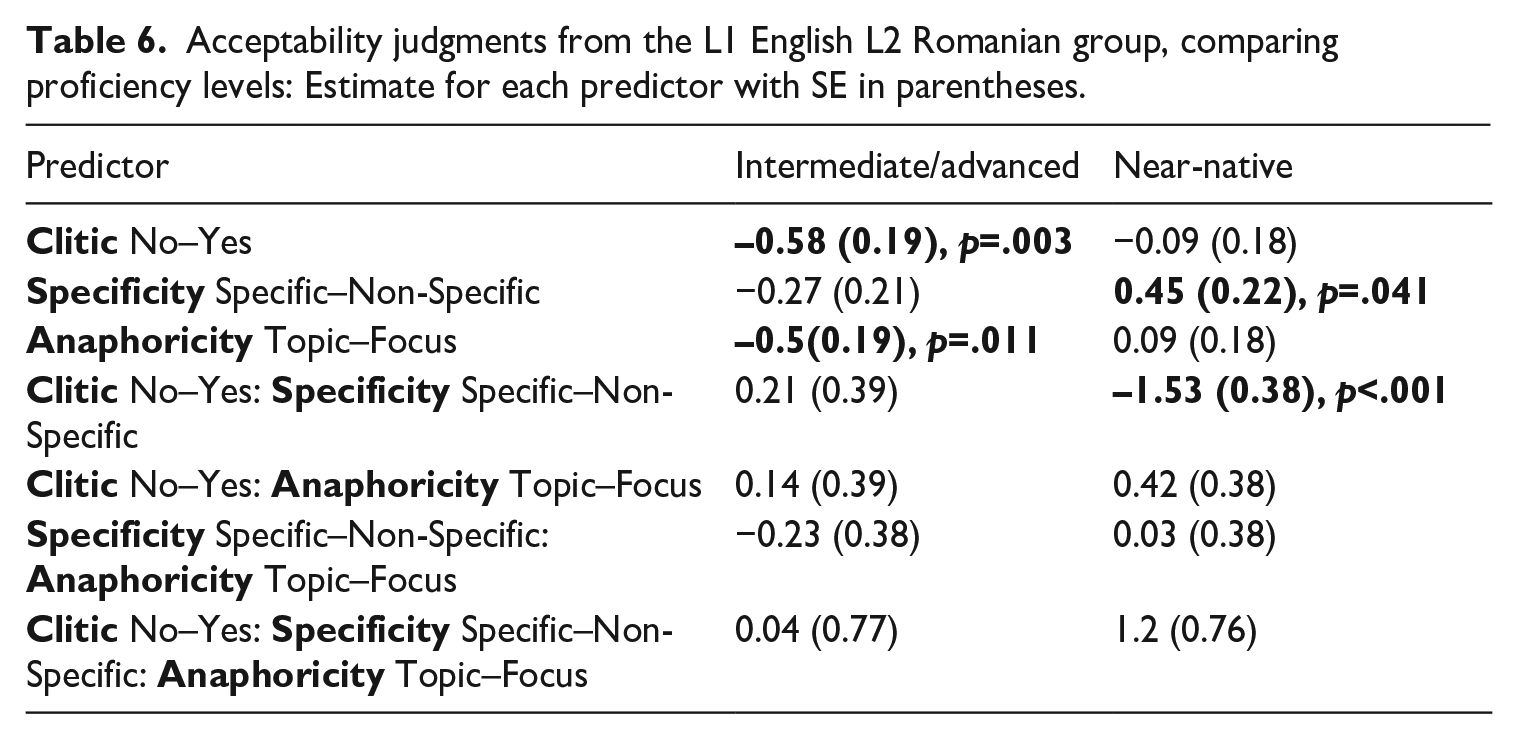
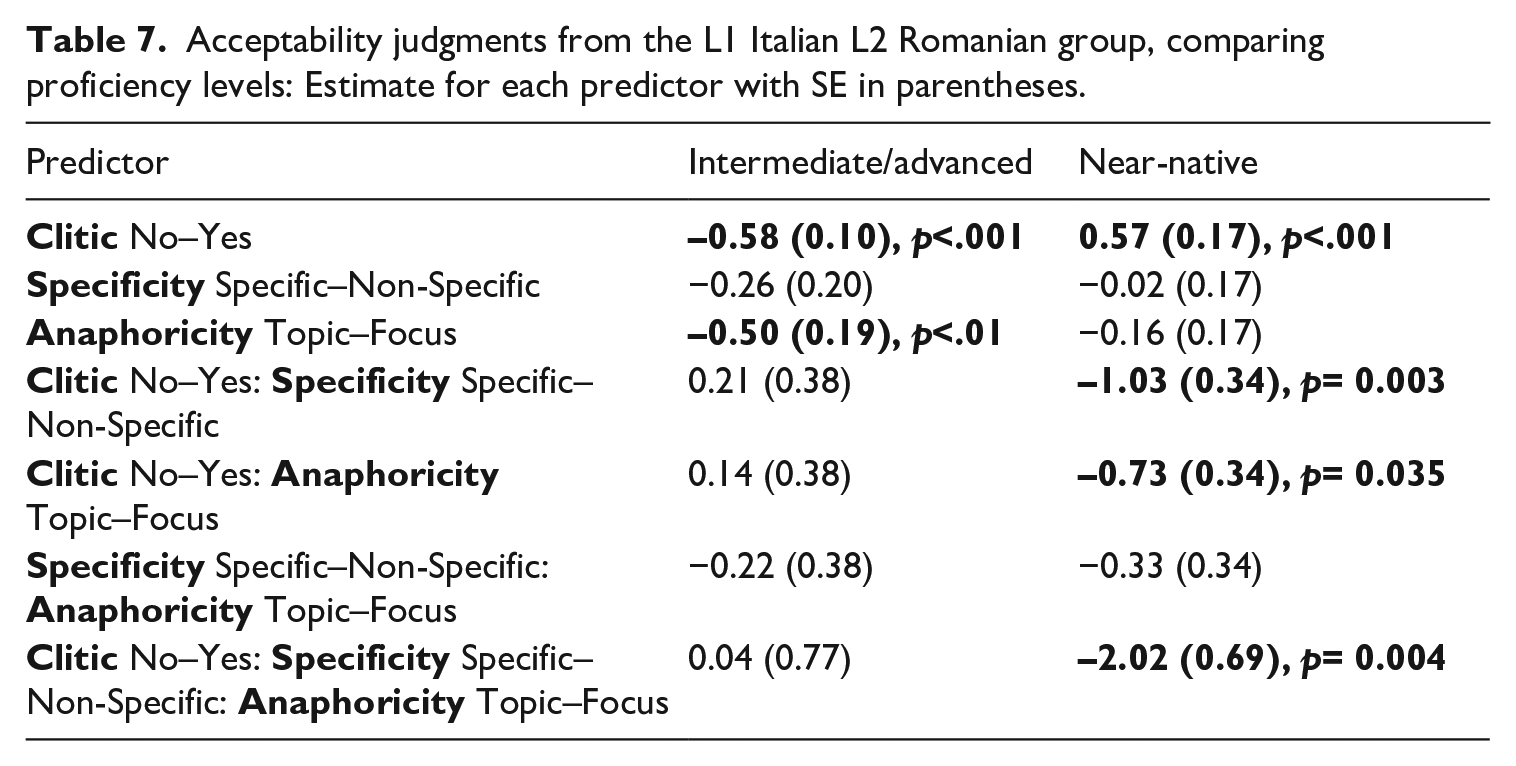
Figure 6 and Table 7 show the results of the AJT by Italian L2 learners of Romanian. Speakers in the Intermediate/Advanced group did not show a clear preference for clitic or no-clitic sentences in any of the contexts. Table 7 suggests that, overall, these speakers preferred no-clitic sentences over clitic sentences and Topic Fronting over Focus Fronting. There is no clear indication of L1 transfer. The results from the Italian near-native speakers of Romanian are more interesting: similar to Romanian near-native speakers of Italian, we see both an effect of specificity and discourse. Italian near-native speakers of Romanian rate clitic sentences higher than no-clitic sentences when the fronted object is specific, but they also continue to prefer clitics with non-specific topics.
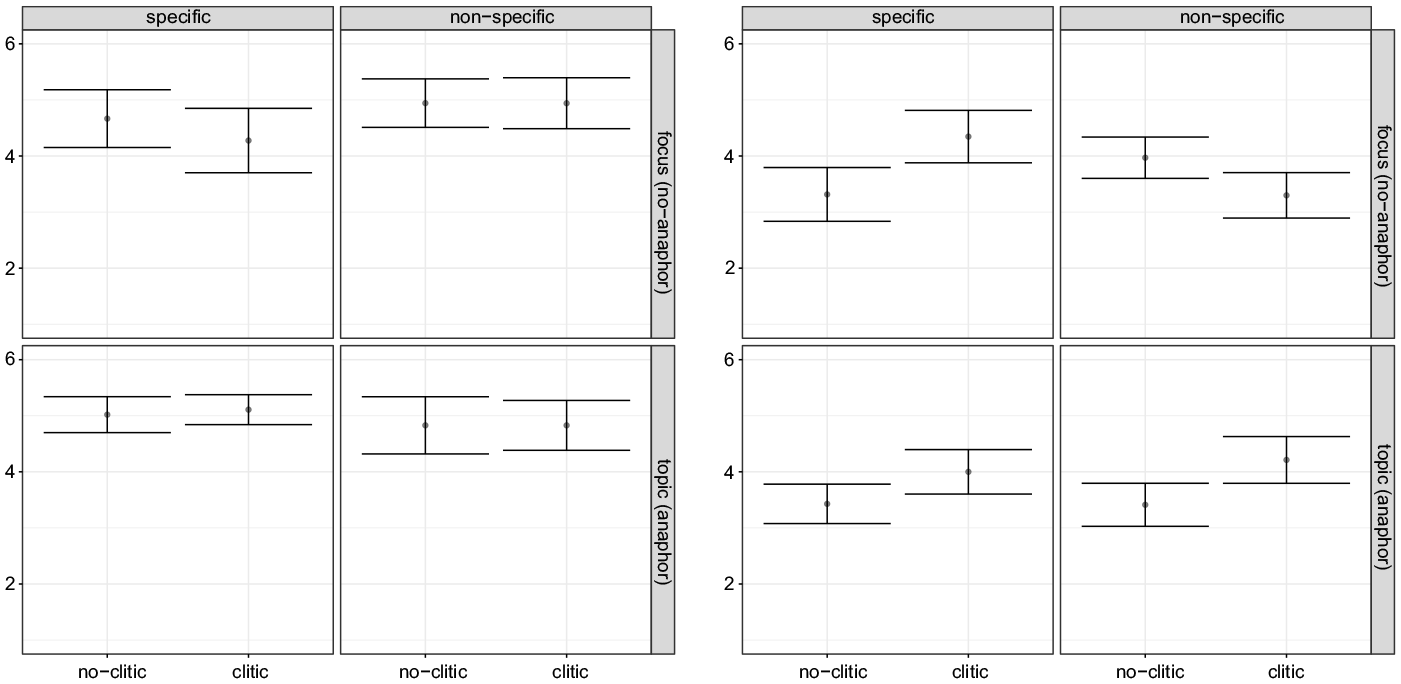
Acceptability judgements from L1 Italian Intermediate and Advanced Learners of Romanian.
Acceptability judgments from the L1 Italian L2 Romanian group, comparing proficiency levels: Estimate for each predictor with SE in parentheses.
c Written Elicitation task: Methods and procedures
Participants were asked to complete sentences that were partially left blank and were asked to complete the sentence using a part of a word or alternately one, two or three words. The parts left blank aimed at eliciting a verb alone or a clitic and a verb. The WET consisted of 20 target items, five of each in the four possible conditions as illustrated in (9)–(12), varying the factors [±specific] and [±anaphor]. The experimental items were interspersed with filler items that doubled as the proficiency task. Each item started with a short context followed by a question–answer pair, all presented in either Italian or Romanian.
(9) [+specific, +anaphor] Livio is looking for someone who can take his granny’s cat and dog as she can’t take care of them anymore. Livio asks Silvia: Q: Would you maybe want to adopt the cat or the dog? A: Il gatto
A: Pisica o voi adopta/ as adopta-o/ o pot adopta cu drag, dar nu avem loc pentru un câine. The cat
(10) [+specific, –anaphor] Anna and Beatrice are talking about Lea and Gianni who recently got married. Anna says to Beatrice: Q: They have visited the Virgin Islands if I remember correctly. A: Le MALDIVE
A: Insulele MALDIVE le-au vizitat în luna de miere, nu Insulele Virgine The Maledives
(11) [–specific, +anaphor] Alessandra is in the library but she isn’t sure what she wants to read and she goes to the librarian to ask for recommendations. The librarian says: Q: Would you like to read a book about airplanes or one about cars? A: Un libro sugli aeroplani
A: O carte despre avioane as citi cu plăcere, dar maşinile nu mă interesează. A book about airplanes (CL) will/would.1sg read with pleasure, but I am not interested in cars. (12) [–specific, –anaphor] Elena will go shopping this weekend because she has a date. Her friend tries to be helpful and says: Q: Weren’t you looking for a black shirt? I saw some cute ones at Zara. A: Un VESTITO nero cerco , non una maglietta nera. A: O ROCHIE neagră caut , nu o cămaşă neagră. A black dress (CL) search.1sg , not a black shirt.
d Written Elicitation task: Results
All answers were manually coded by a native speaker of Italian or Romanian and acceptable responses with a clitic were assigned the value ‘1’ and those without a clitic the value ‘0’. A small proportion of responses was excluded when the answers did not provide a context to illustrate knowledge of clitic use (Table 8 shows the number and percentage of excluded items). Excluded answers typically contained words of affirmation (e.g. si, magari, forse, volentieri) or included verbal elements that turned the sentence initial object in a dative experiencer subject, such as the use of the verb piacere/place ‘like’, or verbs in the passive voice. Very few responses with a clitic contained a gender or number agreement error (see Table 8), and no clitics were placed after the verb, suggesting command of morphosyntactic properties of clitics. Since we are interested in the acquisition of discourse and semantic constraints on clitic use, the few responses with number/gender agreement errors were included in the analysis.
Number (with percentage in parentheses) of answers that were excluded as they were not able to show knowledge of clitic use and number and percentage of gender/number agreement errors.
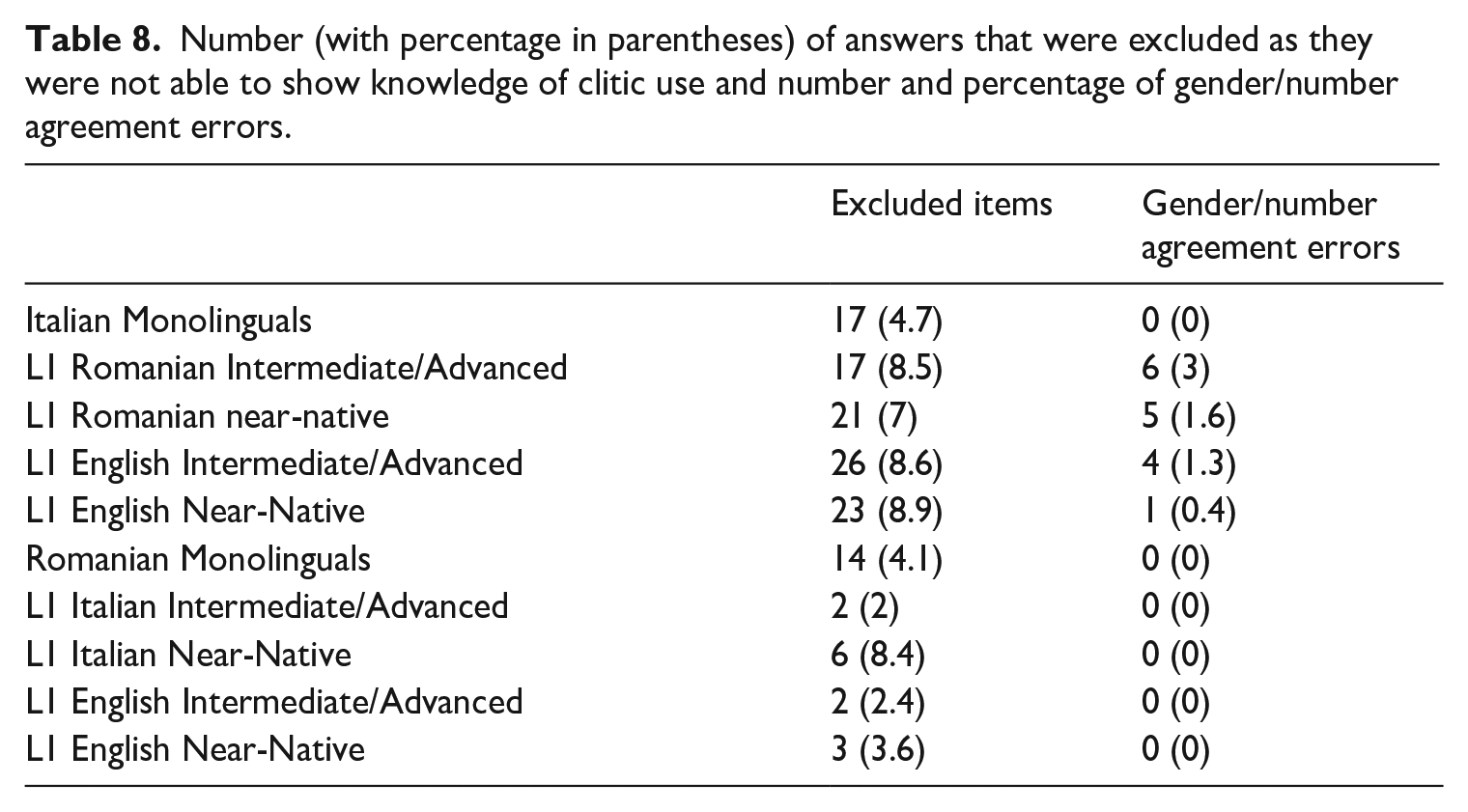
Figure 7 shows the proportion of clitics used by Italian monolinguals and Romanian monolinguals, and Table 9 shows the results of binary logistic regression models. The third model includes the data from the two groups together to further examine whether the two languages are significantly different. All models include fixed effects for the categorical predictors Specificity, Anaphoricity, and their interactions. Random effects for Participant and Item were included where possible, aiming for a maximal model that allowed convergence (Barr et al., 2013).
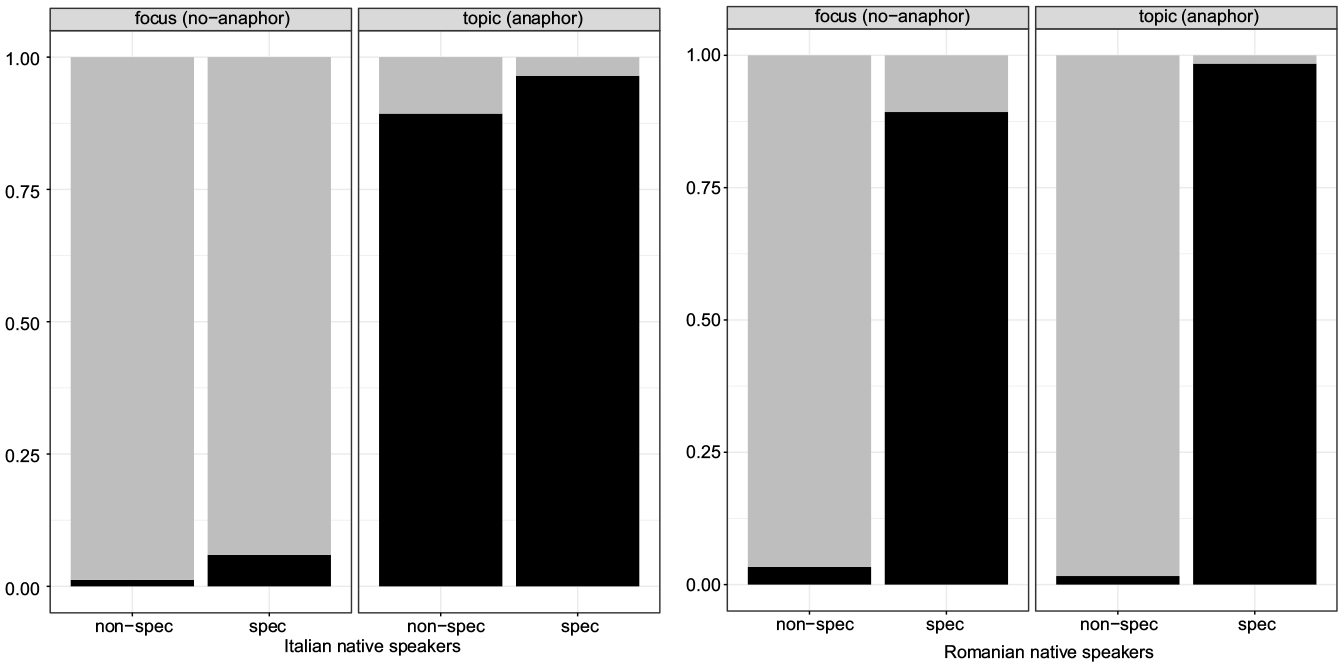
Proportion of clitics used by Italian and Romanian Monolinguals.
Written elicitation task (WET) results from Italian monolinguals, Romanian monolinguals and their comparison, predicting how the factors Anaphoricity and Specificity affected the use of clitics in Italian and in Romanian: Estimate for each predictor with SE in parentheses.
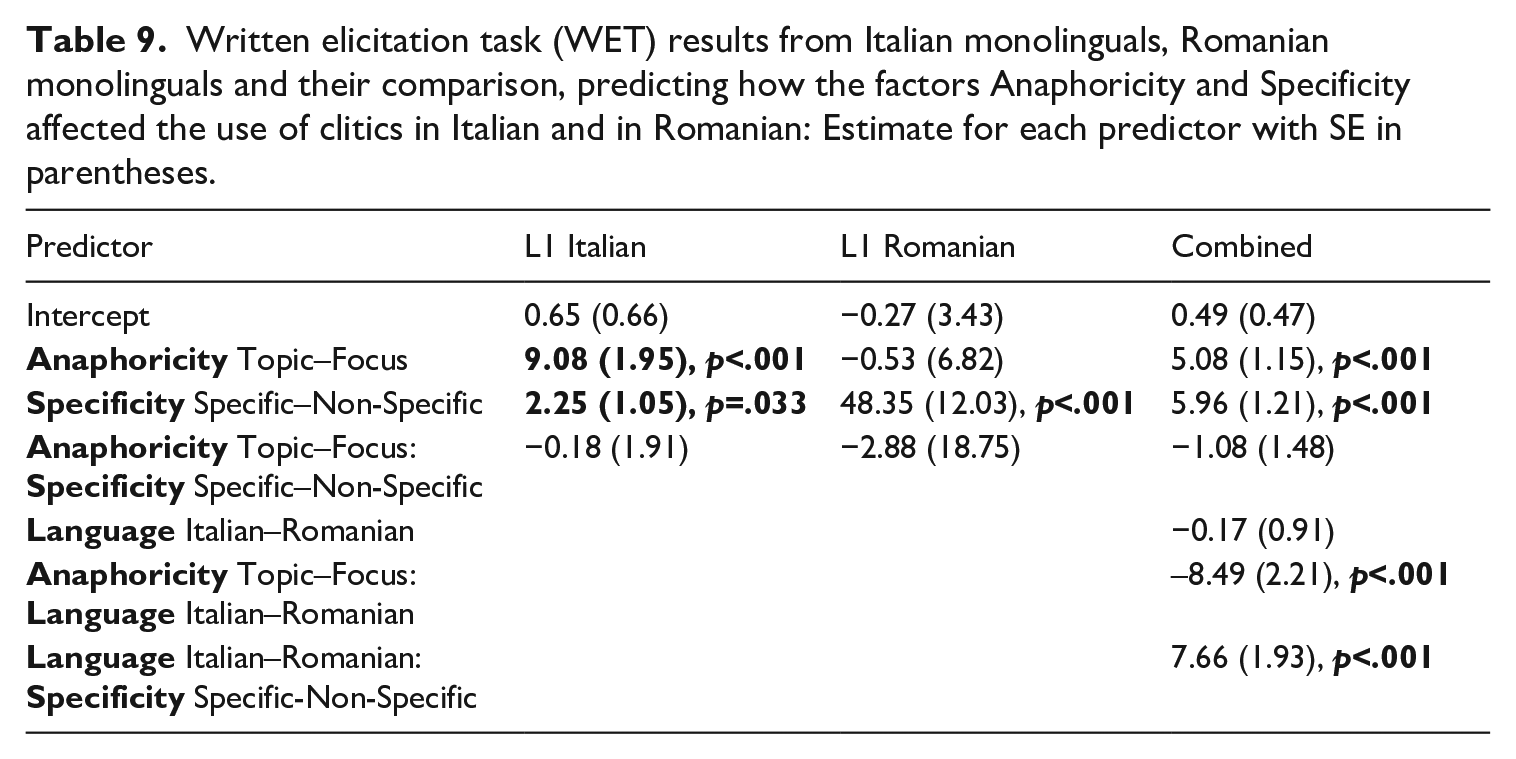
In line with what can be observed in Figure 7, the model shows a significant effect of Anaphoricity for the L1 Italian group and a significant effect of Specificity for the L1 Romanian group. 5 The significant interactions shown in the last two lines of the third model confirm that the two languages are significantly different.
Figure 8 and Table 10 show the results from English L2 learners of Italian for each proficiency level. There is a significant effect of specificity for the Intermediate/Advanced group as clitics are used more when the fronted object is specific than when it is non-specific. The near-native speakers show an effect of Anaphoricity, choosing a clitic significantly more often when the fronted object is a Topic than when it is a Focus, suggesting they acquired the Italian anaphoricity constraint.
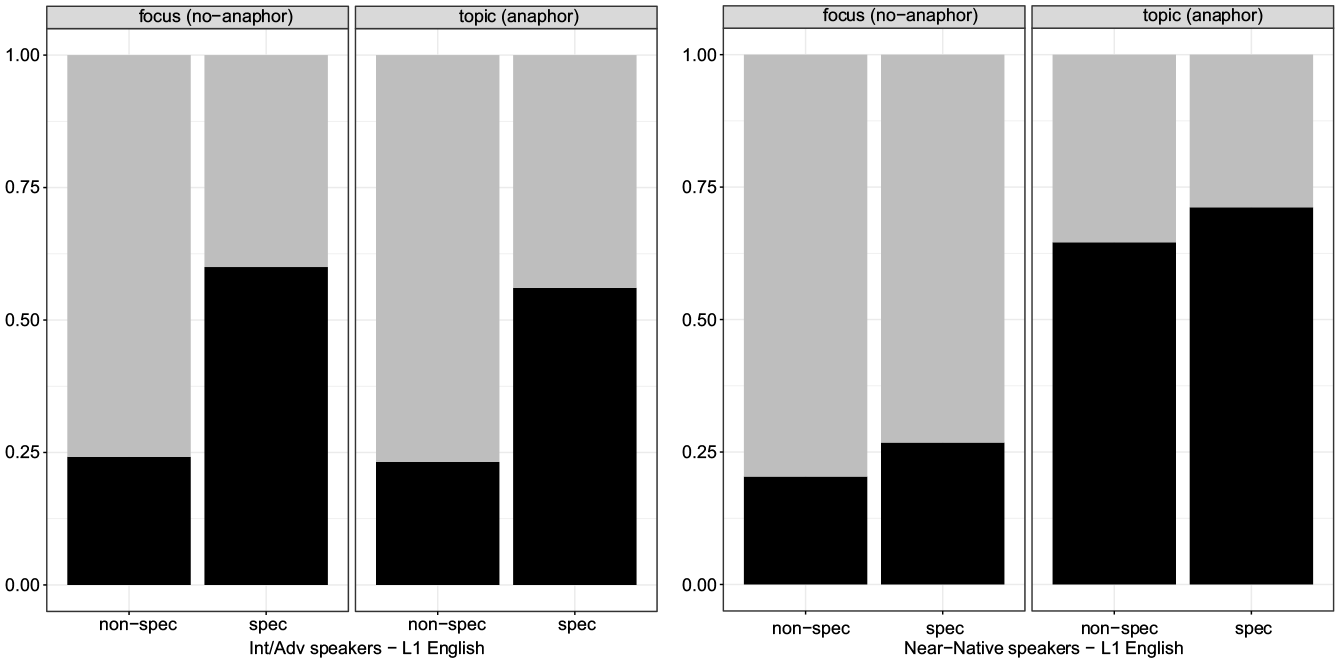
Proportion of clitics used by L1 English L2 Italian speakers.
Written elicitation task (WET) results from L1 English L2 Italian speakers, divided by proficiency level: Effects of specificity and discourse on use of clitic: Estimate for each predictor with SE in parentheses.
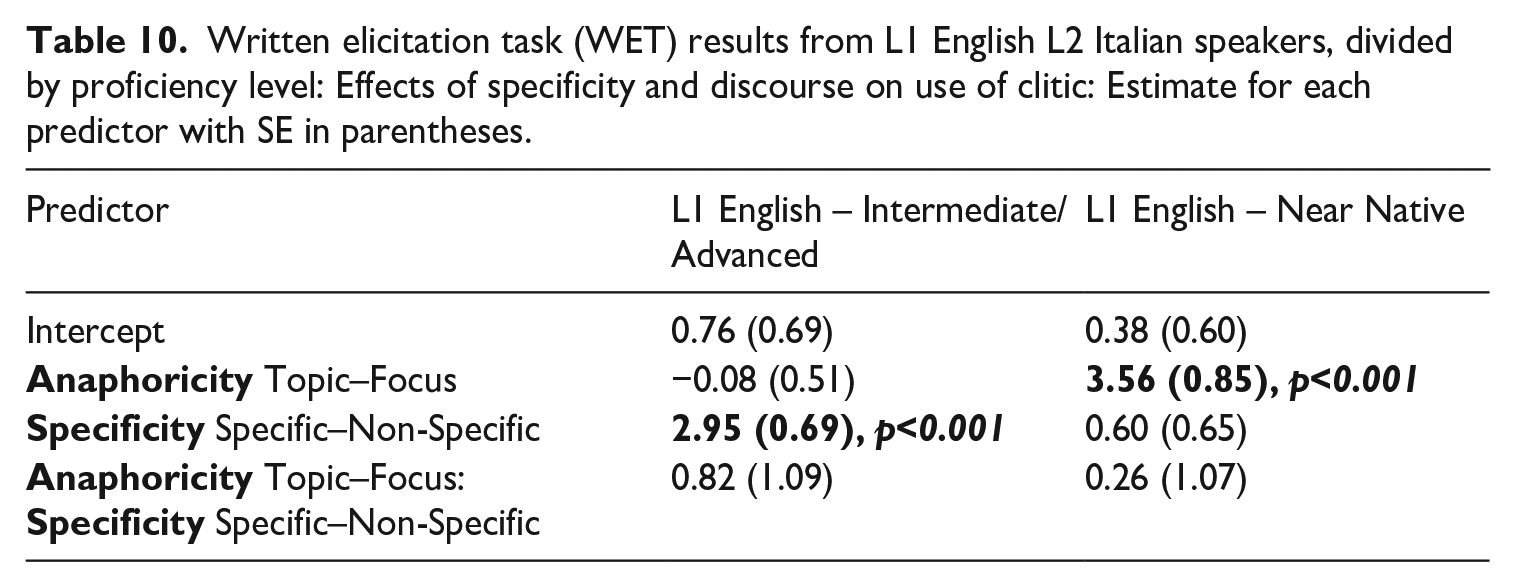
Figure 9 and Table 11 show the results from Romanian L2 learners of Italian. The model outcomes for the Intermediate/Advanced group show that specificity, but not anaphoricity, has a significant effect on the use of clitics (similar to the Romanian monolinguals). For the near-native speakers, both specificity and anaphoricity have an effect: clitics are used more when the fronted object is a topic, but they also use clitics when the object is a specific focus.
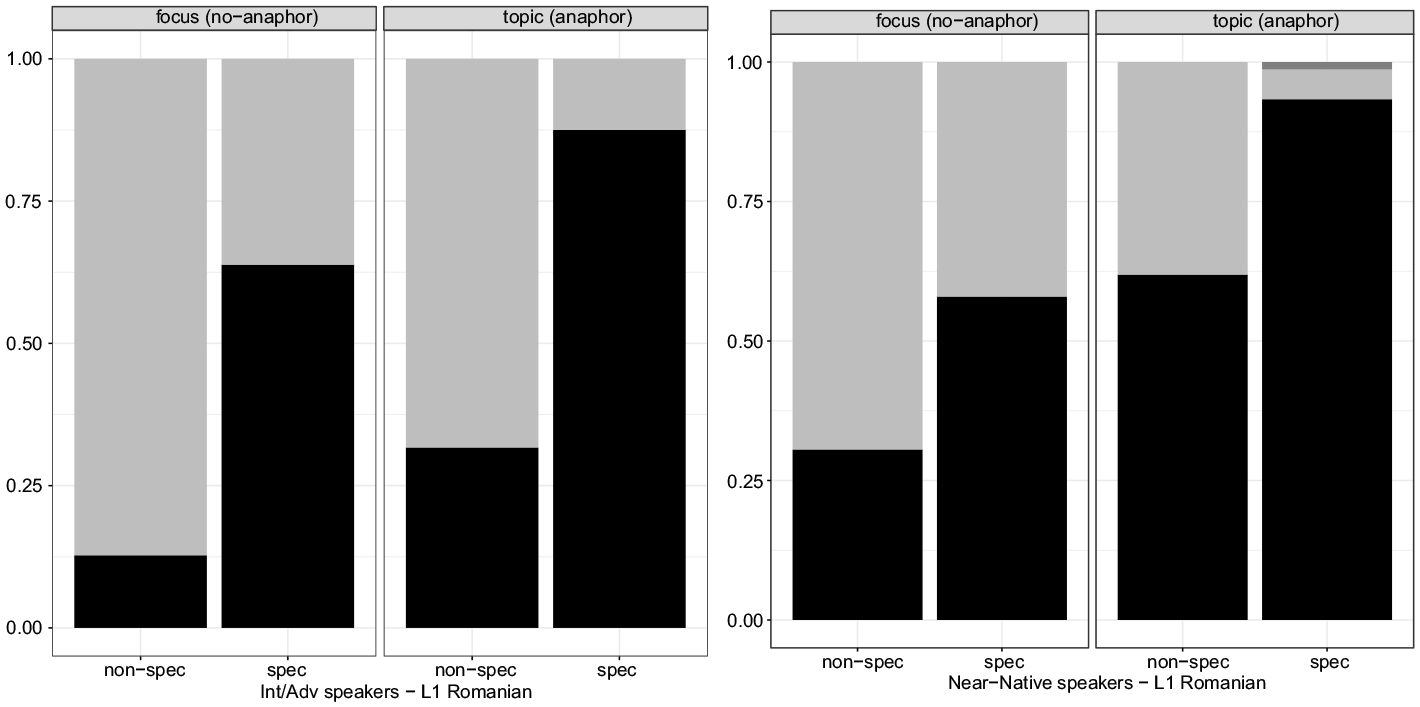
Proportion of clitics used by L1 Romanian L2 Italian speakers.
Written elicitation task (WET) results from L1 Romanian L2 Italian speakers, divided by proficiency level: Effects of specificity and discourse on use of clitic: Estimate for each predictor with SE in parentheses.
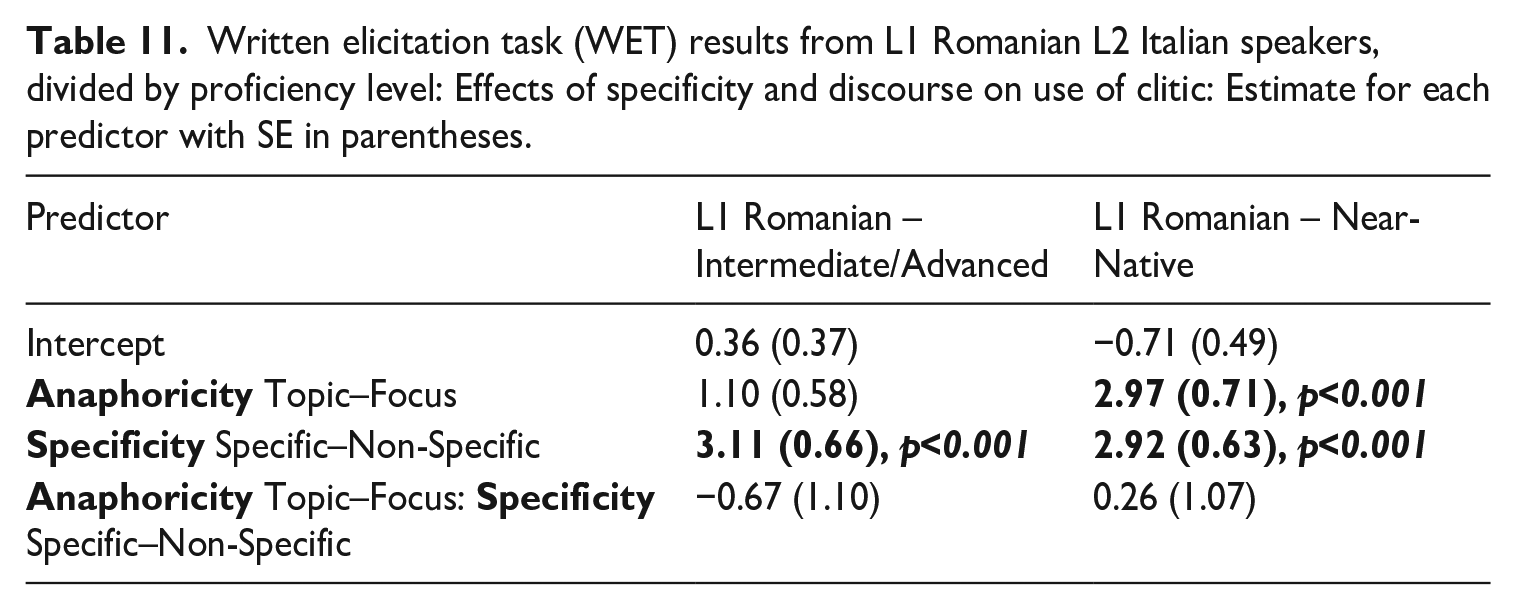
Figure 10 and Table 12 show the results from the English L2 learners of Romanian. For both proficiency levels, there is a significant effect of specificity, clitics being used significantly more when the fronted object is specific than when it is non-specific. This effect is even stronger for the near-native speakers.
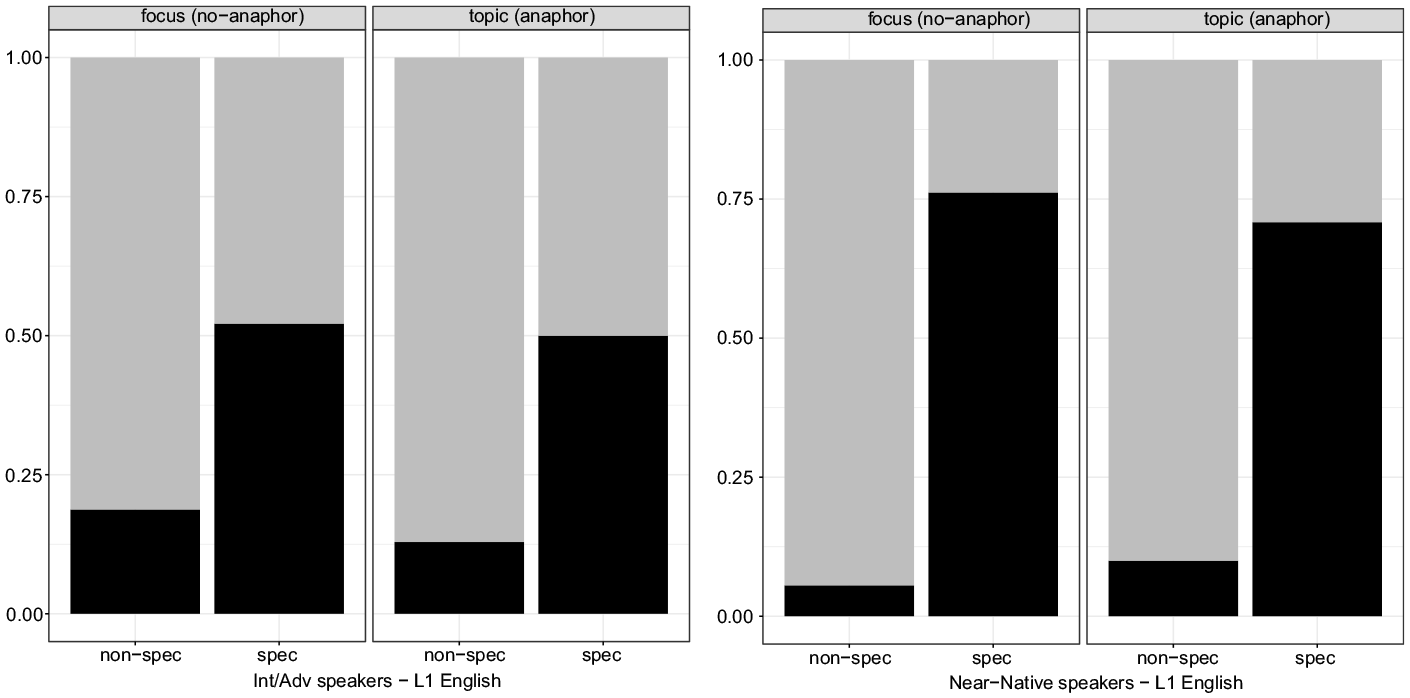
Proportion of clitics used by L1 English L2 Romanian speakers.
Written elicitation task (WET) results from L1 English L2 Romanian speakers, divided by proficiency level: Effects of specificity and discourse on use of clitic: Estimate for each predictor with SE in parentheses.
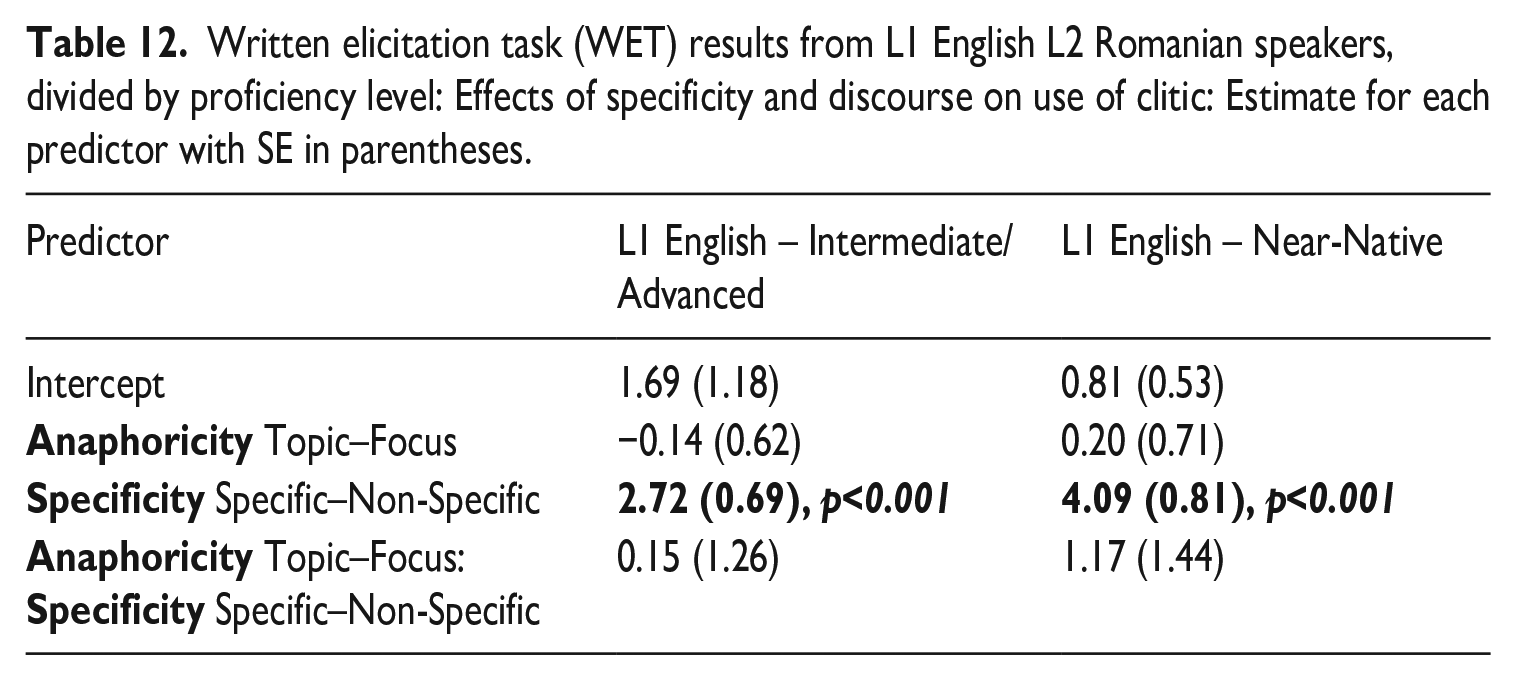
Figure 11 and Table 13 show the results from Romanian L2 learners of Italian, showing a significant interaction for the Intermediate/Advanced group. It should be mentioned, however, that 3 out of 5 participants in this group did not use a clitic in any of the experimental trials. The differences in clitic use by condition shown in Figure 11 therefore represent only 2 participants. A more likely interpretation of these data is that learners at this level have not yet acquired the use of clitics in Romanian, in line with the results for the AJT where these same participants accepted both clitic and no-clitic sentences in all conditions.
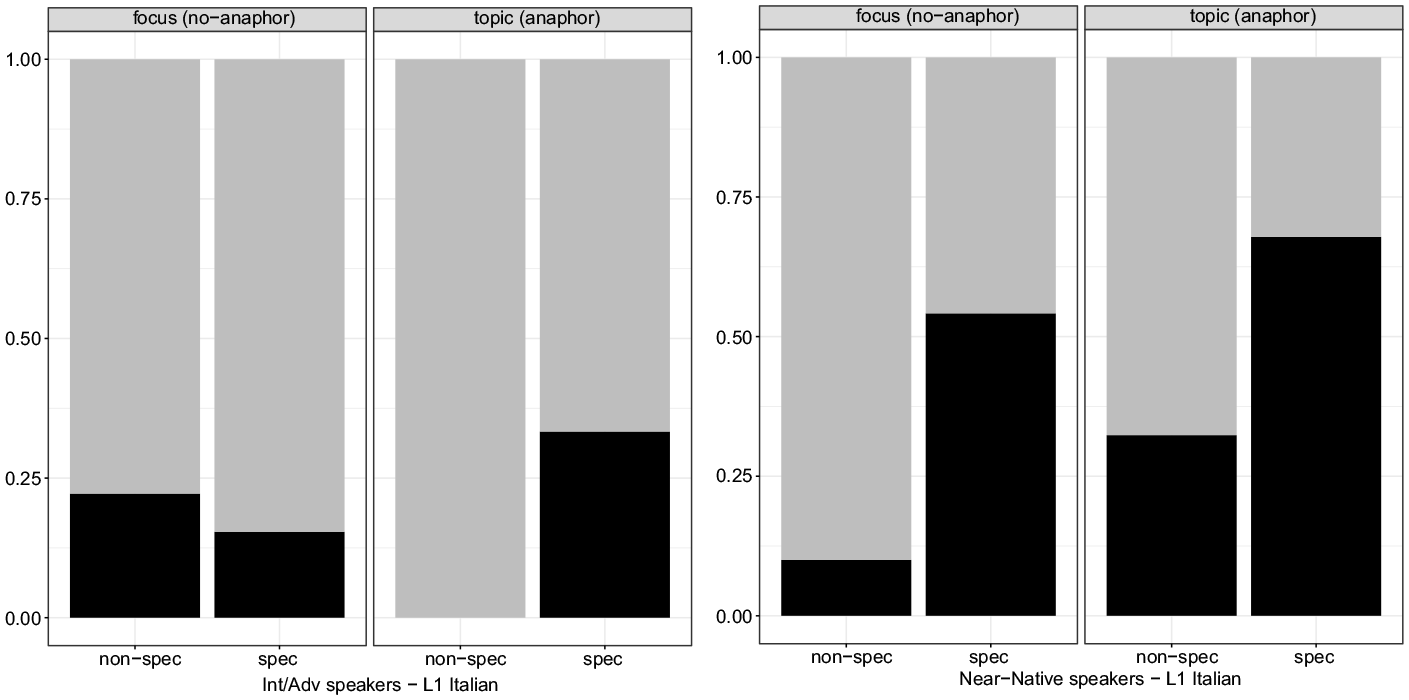
Proportion of clitics used by L1 Italian L2 Romanian speakers.
Written elicitation task (WET) results from L1 Italian L2 Romanian speakers, divided by proficiency level: Effects of specificity and discourse on use of clitic: Estimate for each predictor with SE in parentheses.
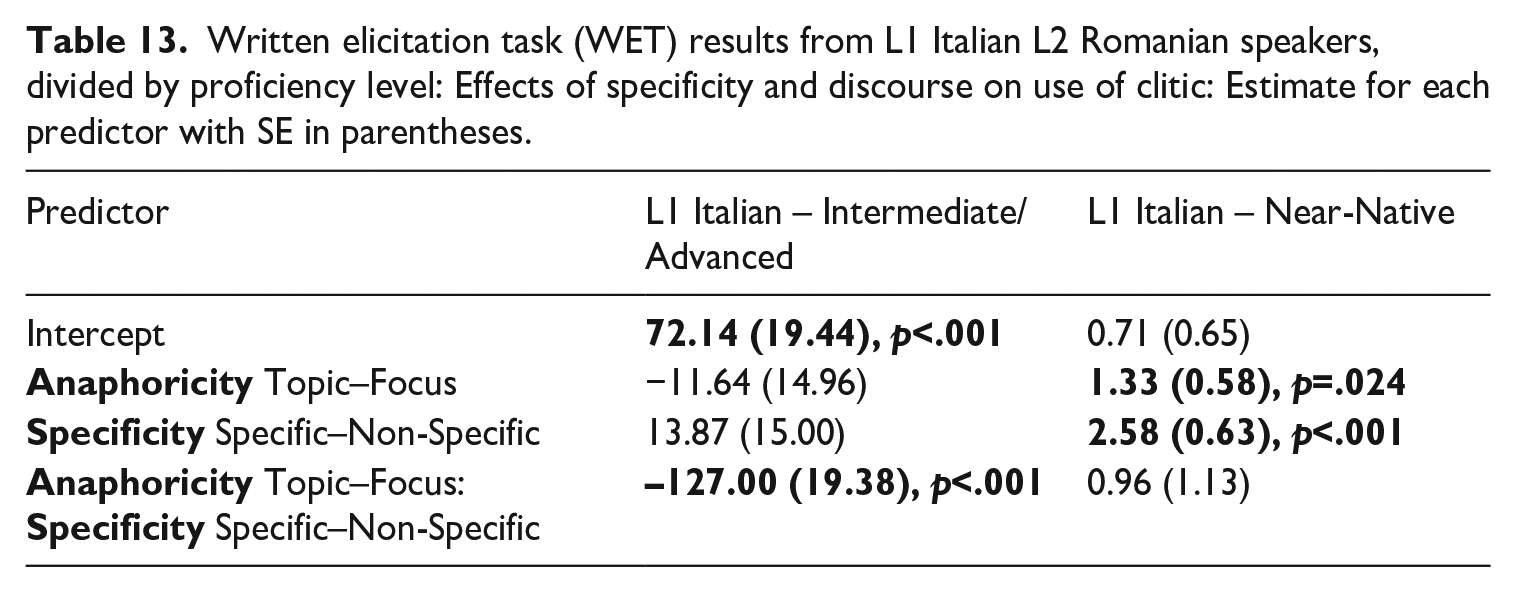
For the near-native speakers, both specificity and anaphoricity has an effect: clitics are used more when the fronted object is specific, whether with Topic or Focus Fronting, and used significantly more when the object is a non-specific topic.
e Summary of results
Combining the results from the AJT and the WET we can draw the following generalizations: native English L2 learners of Romanian/Italian at the Intermediate/Advanced stages have not yet acquired the Italian anaphoricity and the Romanian specificity constraint. Note that in the WET, English L2 learners of Romanian used significantly more clitics with specific than with non-specific objects, but English L2 learners of Italian did this as well and this effect was not attested for the AJT. L2 speakers at the near-native stages, on the other hand, have acquired the specificity constraint in Romanian and the anaphoricity constraint in Italian, as indicated by the results from both tasks (except for clitic and no-clitic sentences with Focus Fronting, which were rated as equally acceptable in the AJT by English near-native speakers of Italian). For the Romanian–Italian groups at the Intermediate/Advanced levels, results from the L1 Romanian L2 Italian participants indicate L1 transfer. Results from L1 Italian L2 Romanian speakers do not show clear L1 transfer or target L2 acquisition, although there is insufficient data to draw any conclusions. At the near-native levels, the results yielded both an effect of specificity and anaphoricity. This was the case for both L2 groups and in both tasks. The next section interprets these findings with reference to SLA theories and the research questions.
VI Discussion
The different features associated with CLLD in Italian and Romanian allowed us to extend the FRH to a new domain and to examine the role of construction frequency and the type of L2 grammatical domain involved (discourse or semantic).
Research question 1 asked whether reassembling features is more difficult than acquiring constraints on CLLD without prior L1 knowledge of this syntactic construction by comparing English learners of Italian/Romanian to those with Italian/Romanian as L1. At the near-native levels, the L1 English groups successfully acquired the anaphoricity/specificity requirement of CLLD in Italian/Romanian (in line with studies on L2 Spanish discussed in Section III.1). This finding supports full access approaches, who argue that L2ers have access to universal features not used in their L1 grammars. Native speakers of Romanian/Italian, however, showed L1 transfer, even at the near-native levels. The combined findings support the FRH as feature reconfiguration was found to be more problematic than feature acquisition.
To answer research question 2, we compared the acquisition of a discourse feature (anaphoricity in L2 Italian) to a semantic feature (specificity in L2 Romanian), using the same syntactic construction. According to the IH, differences between native and non-native speakers are predicted to show in higher degrees of optionality and indeterminacy for discourse dependent syntactic word orders. As discussed in Section III.1, however, earlier research showed difficulties with the acquisition of the [+specific] constraint on clitic use, both for CLLD and for DOM marking. L2 learners were indeed less categorical in their acceptability judgments compared to native speakers as they accepted non-felicitous sentences at a higher rate than native speakers and did not always use clitics in contexts required by native speakers. Importantly, however, this was the case regardless of whether the L2 property was a discourse or a semantic feature and is typical for non-native speakers. Note furthermore that although specificity is a semantic feature, the correct interpretation of indefinite NPs requires integration of that NP into the discourse context. In fact, the indefinite NPs used in the study are not inherently non-specific (e.g. ‘a hairdresser’ in I am looking for a hairdresser can either refer to a specific person or not). This is relevant for an account that attributes performance differences between learners and native speakers to increased processing loads associated with integrating sentence external information.
Research question 3 focused on construction frequency. The low frequency of Focus Fronting can potentially explain why English near-native speakers of Italian did not show a clear preference for clitic over no-clitic sentences with Focus Fronting in the AJT. Note, however, that the same effect was not attested in the WET. These results furthermore differ from those reported for the English near-native speakers of Spanish in Slabakova et al. (2012), which did show higher ratings of no-clitic sentences over clitic-sentences with Focus Fronting using an almost identical design. The only difference between our task and the one in Slabakova et al. (2012) is that in the latter study, participants were asked to rate a sentence with a clitic and one without a clitic at the same time, making the presence versus absence of the clitic more salient, facilitating the experimental task.
We furthermore considered the possibility that L2 learners need more input to preempt options transferred from the L1 (i.e. only relevant for the Italian–Romanian bilinguals). Since the grammars of both groups show persistent L1 transfer despite Focus Fronting being less frequent than Topic Fronting, we conclude that construction frequency either has no effect or learners encounter both constructions insufficiently to overcome L1 transfer.
To explain the results from the Italian–Romanian groups, we consider both feature reassembly and L1 preemption to play a role (see also Iverson and Rothman, 2015). Our L2ers successfully expanded their grammars; in both learning directions participants allowed CLLD in a context where the construction is used in the L2 but not in the L1. Grammatical retraction, which is characterized by the need to acquire a feature not applied to the same construction in the L1, was more problematic. Specifically, the results show that the L1 Romanian group acquired that Italian CLLD is used with non-specific topics, thus removing the [+specific] constraint, and the L1 Italian group acquired that Romanian CLLD is used with specific foci, removing the [+anaphor] constraint. However, both groups failed to unlearn clitics in contexts where they are used in the L1; the Romanian learners of Italian continued to use clitics with specific foci, and Italian learners of Romanian used clitics with non-specific topics.
Our findings differ from those reported by Hopp (2009), as discussed in Section III.2, where Dutch learners of German did not allow the non-canonical VOS (object scrambled) order in a context where it is not used in Dutch. Dutch object over subject scrambling is more restricted than in German as Dutch only allows it when the object is a contrastive topic and the subject in focus, while in German the object can also be a non-contrastive topic. Hence, the Dutch learner of German failed to drop a [+contrast] feature. Results from the current study did show successful grammatical expansion, as learners dropped a restriction transferred from the L1.
Grammatical restriction, where the L2ers task is to unlearn L1 options or interpretations, may generally be more difficult. Persistent effects of L1 transfer in addition to successfully acquiring new L2 properties is common in L2 acquisition. Cuza et al. (2013a), for example, examined interpretational restrictions of bare plural preverbal objects in English L2 learners of Spanish, where target performance also involved both the addition and removal of an L1 feature. Unlike in English, bare plurals in Spanish do not allow a [+generic] interpretation. The interlanguage grammars showed traces of L1 influence as learners did not consistently reject [+generic] interpretations of bare plurals, although they were above change level. Relatedly, Iverson and Rothman (2015), providing an overview of studies using different L1s acquiring the semantic [–definite] constraint on Spanish object drop, showed that while English learners of Spanish in Bruhn de Garavito and Guijarro-Fuentes (2001) acquired this semantic restriction, Chinese learners of Spanish in Cuza et al. (2013b) did not. While English does not allow object drop, Chinese does allow it, but the Chinese grammar is less constrained, allowing null objects also with [+definite] objects. Chinese learners of Spanish then showed difficulty unlearning object drop with [+definite] objects. Interestingly, however, native Brazilian Portuguese speakers learning Spanish in Rothman and Iverson (2011), whose L1 like Chinese allows object drop without the definiteness constraint, did acquire the L2 property.
To conclude, our findings are consistent with the idea that both L1 and L2 options are competing in the interlanguage grammar, and that complete semantic/discourse (interpretational) preemption is difficult. Given the low frequency of object fronted word orders in the input to provide positive evidence for learners to alter the L1 grammar, we may have a situation where positive evidence alone does not serve to preempt feature reconfiguration.
VII Conclusions
This study examined the L2 acquisition of interpretational properties of CLLD in Romanian and Italian. The results yield evidence in favour of the Feature Reassembly Hypothesis, as learners initially transferred L1 features onto the L2 and subsequently reassembled them into L2 configurations, although not completely target like. In fact, the results suggest that L1 transfer persists when TL convergence involves unlearning the use of clitics in contexts where they are used in the L1 but not in the L2. In fact, L1 preemption was found in addition to acquiring new L2 contexts in which clitics were used. These results were attested for both L2 Italian and L2 Romanian, regardless of whether a discourse or semantic feature was involved and despite differences in frequency of the relevant construction in the input that could help learners alter L1 configurations. Therefore, for certain L1–L2 pairings, only negative evidence may help the L2er overcome L1 preemption effects. Explanations related to L1 transfer were strengthened by the fact that near-native speakers with English as an L1 did show complete L2 acquisition of both the anaphoricity and the specificity constraint.
Future work aims at extending this design to other language pairings, such as Italian–Spanish bilinguals and Romanian–Spanish bilinguals, since these pairings differ by only one feature, Spanish CLLD being constrained both by specificity and anaphoricity. Furthermore, future work can include a larger variety of structures, like clitic doubling for Romanian, to examine whether knowledge of the [+specific] constraint is transferred across constructions.
Footnotes
Acknowledgements
I thank the reviewers and the editors for their great help in making this article much clearer. I also thank Anda Neagu for help with participant testing and Lydia White and Lisa Travis for comments on earlier versions of this project.
Declaration of Conflicting Interests
The author declared no potential conflicts of interest with respect to the research, authorship, and/or publication of this article.
Funding
The authors disclosed receipt of the following financial support for the research, authorship, and/or publication of this article: The Social Sciences and Humanities Research Council (P2021-3842).
