




Abstract
Although previous research has observed a facilitative influence of the first language (L1) on the acquisition and processing of gender agreement in a second language (L2), particularly in language pairs with similar gender agreement marking, the question of whether knowledge of two languages with gender can confer an additional advantage for L3/Ln (third or additional language) learners has not yet been addressed. The present study aimed to fill this research gap by examining the processing of gender agreement in intermediate and advanced L3/Ln Swedish among two groups of Polish native speakers: 30 L2 English / L3 Swedish learners, and 30 L2 English / L3 German / L4 Swedish learners. Participants were tested by means of a speeded grammaticality judgment task, in which they judged the correctness of indefinite noun phrases that either agreed or did not agree in gender. They also completed an untimed gender assignment task to control for their lexical knowledge of gender. Accuracy and response time data were submitted to Generalized Linear Models. The analysis shows that L4 Swedish learners process noun phrases faster than L3 Swedish learners, but only at the intermediate proficiency level; however, the groups do not differ in their judgment accuracy. This advantage is interpreted in terms of a surface transfer of similar gender agreement marking, which helps the learners automatize gender agreement processes earlier, but does not increase their sensitivity to gender-agreement violations. Moreover, the results accord with previous L2 studies in showing that learners of Swedish as L3/Ln develop sensitivity to ungrammaticality with advancing proficiency and benefit substantially from their gender assignment knowledge in processing gender agreement. Crucially, the present study provides preliminary evidence of a multilingual advantage in processing morphosyntactic features in L3/Ln.
I Introduction
Positive effects of multilingualism on third or additional language learning are now well-documented in numerous domains. Yet can these effects be observed in the domain of grammatical gender? According to the much-cited definition by Hockett (1958: 231), ‘[g]enders are classes of nouns reflected in the behaviour of associated nouns’. This renders grammatical gender (hereafter, gender) a morphosyntactic feature known as agreement between the noun and other targets, such as determiners (articles, demonstratives, quantifiers, etc.). For example, in order to produce the phrase ‘a house’ in Swedish, a learner needs to select the correct indefinite article ‘ettNEUT’ that agrees in gender with the noun ‘husNEUT’. Gender agreement on determiners and adjectives has been of great interest in second language (L2) research (see, among others, Alarcón, 2011; Andersson, 1992; Dewaele and Véronique, 2001; Ellis et al., 2012; Franceschina, 2005; Hawkins and Franceschina, 2004; Hopp, 2013; Montrul et al., 2008; Sabourin et al., 2006; Sagarra and Herschensohn, 2010, 2011; Unsworth, 2008; White et al., 2004). A considerable number of studies have attempted to account for the well-documented L2 learners’ variable performance in this domain by relating it to the availability of gender in the first language (L1; Carroll, 1989; Franceschina, 2005; Hawkins and Franceschina, 2004; White et al., 2004). The existing evidence supports the view that learners whose L1s encode gender outperform those whose L1s lack gender in both offline (Ellis et al., 2012; Krenca et al., 2020; Mačiukaitė, 2008; Sabourin et al., 2006) and processing tasks (Sabourin and Stowe, 2008). However, the question of whether knowledge of two languages with gender can be more beneficial for learners of third or additional languages (hereafter, L3/Ln) has not yet been addressed.
Many researchers have pointed out that the number of languages already known to learners matters for subsequent non-native language learning, as more languages generally entail more knowledge that can be drawn upon in the acquisition process (Festman, 2021; Sanz, 2000). A larger repertoire of languages provides a wider basis for facilitative transfer, especially when previously learned languages are typologically related to the target language (Hammarberg, 2001; Jarvis, 2015; Witney and Dewaele, 2018). Identification of a multilingual advantage in subsequent language learning has broader implications for teachers, teacher trainers, and learners themselves. Since teachers’ beliefs influence their decision-making, it is crucial for them to acknowledge the positive effects of multilingualism on L3/Ln learning. As the key facilitators of multilingualism in the classroom, teachers can help learners to become aware of and draw on their previous linguistic knowledge (Haukås, 2016). To the best of the author’s knowledge, the L3/Ln research has yet to provide empirical evidence of a multilingual advantage in processing certain morphosyntactic features in L3/Ln.
Against this backdrop, the present study tested whether knowledge of non-native German in addition to L1 Polish, both being gendered languages, can help learners process gender agreement within the noun phrase in Swedish as L3/Ln. To this end, two groups of Polish native speakers were recruited: 30 L2 English / L3 Swedish learners, and 30 L2 English / L3 German / L4 Swedish learners. Because previous research has argued that the effect of previously learned languages is stronger in the earlier stages of L3/Ln acquisition (for discussion, see Sánchez, 2014), the present study also examined whether this holds true for the processing of gender agreement. Therefore, learners at intermediate and advanced levels of proficiency in L3/Ln Swedish participated (while keeping the proficiency in German constant). Gender agreement processes were assessed using a timed judgment task in which participants judged the correctness of indefinite noun phrases in Swedish that either agreed or did not agree in gender (e.g. ‘ett hus’, a house). In this article, the term ‘processing’ is used to refer to the realization of gender agreement between the noun and other targets such as articles or adjectives (e.g. Foucart and Frenck-Mestre, 2011).
Apart from the specific question of the effect of German, the goal of the present study was also to offer additional evidence on gender agreement processing in a non-native language from an understudied language constellation, by considering the general effect of proficiency in L3/Ln, the tendency to use a default gender, and the role of gender assignment knowledge for processing gender agreement.
1 Facilitative transfer in learning and processing gender agreement
Gender agreement has been investigated in many untimed tasks in order to inform the L2 acquisition theory. Numerous studies have documented that learners of a variety of L2s notoriously fail to provide correct gender-marked determiners and adjectives (see, for example, among others, Andersson, 1992; Dewaele and Véronique, 2001; Franceschina, 2005; Unsworth, 2008). Different approaches have been proposed to account for these well-documented difficulties, including the absence of gender in the learner’s L1 (Franceschina, 2005; Hawkins and Franceschina, 2004) or computation limitations (Alarcón, 2011; White et al., 2004).
Apart from difficulties with gender agreement, a number of acquisition studies have been concerned with the role of transfer for learning gender agreement in L2 (Ellis et al., 2012; Mačiukaitė, 2008; Sabourin et al., 2006). These studies have consistently demonstrated that learners whose L1s encode gender are more accurate on gender agreement in different types of production and interpretation tasks.
For example, in their seminal paper, Sabourin et al. (2006) examined gender agreement between the noun and a relative pronoun in L2 Dutch using an untimed grammaticality judgment task. Participants were adult L1 speakers of German, English, or a Romance language (French, Italian, or Spanish). Whereas the German and Dutch grammatical gender systems are similar, the grammatical gender systems of these Romance languages are not congruent with the Dutch system. In addition, English does not encode gender. Sabourin et al. (2006) found that the German group performed best (but worse than native speakers), the Romance group performed well above chance (but worse than the German group), and the English group performed at chance level. After controlling for noun frequency, however, little difference was found between the German and Romance groups, but they were still better than the English group. This indicates that ‘surface transfer’, i.e. the transfer or morphologically similar gender marking (Sabourin et al., 2006: 3), is less useful for gender agreement processes than ‘deep transfer’, i.e. the transfer of the abstract gender feature, regardless of cross-language similarities in its surface realization.
More recently, researchers have begun to consider acquisition of gender agreement in L3/Ln (Brown, 2020; Długosz, 2021; Ecke, 2022; Jaensch, 2012; Krenca et al., 2020), a topic that is of particular relevance to the present investigation. For example, Brown (2020) compared beginner L1 English / L2 Spanish and L1 Spanish / L2 English learners of L3 German in their ability to identify gender agreement errors between the article and the noun in an untimed grammaticality judgement task. The author found that L2 Spanish learners outperformed L1 Spanish learners, thereby providing evidence of the privileged role of the non-native language at the initial stage of L3 acquisition (e.g. Bardel and Falk, 2007). Further evidence of transfer in the domain of gender agreement comes from a study by Krenca et al. (2020), who examined gender-marking ability in L3 French. The authors compared accuracy in determiner–noun agreement (including definite, indefinite, and possessive determiners) on a narrative task in three child learner groups: learners of L3 French whose L1s mark gender (e.g. German), learners of L3 French whose L1s did not mark gender (e.g. Hungarian), and L1 English learners of L2 French. While the results did not reveal any differences between the groups in the proportion of correctly marked masculine nouns, a significant difference in the proportion of correctly marked feminine nouns was observed in favour of learners whose L1s marked gender.
Moving on to gender agreement processing, which is at the heart of the present study, most studies on this topic have focused on gender agreement processes within the determiner phrase via the recording of event-related potentials (ERPs), i.e. electrophysiological responses to a stimulus. In native speakers, gender-agreement violations provoke a P600 effect that generally reflects difficulty in syntactic processing. This effect is obtained irrespective of the elements involved, i.e. article–noun or adjective–noun (for discussion, see Foucart and Frenck-Mestre, 2011). Thus, the question arises whether L2 learners demonstrate native-like responses to gender-agreement violations.
In this vein, Sabourin and Haverkort (2003) investigated how advanced L1 German / L2 Dutch learners deal with gender agreement in the determiner–adjective–noun sequences. For definite phrases, which are similar in Dutch and German, the learners showed a P600 effect, but it occurred later and was more restricted in the case of ungrammatical items. However, for indefinite phrases, which differ between Dutch and German, only the native speakers showed a P600-like effect. The authors concluded that L2 learners may employ their L1 processing strategies to process their L2 when the grammars are very similar.
In a follow-up study, Sabourin and Stowe (2008) observed different ERP signatures for sentences violating gender agreement in the determiner–adjective–noun sequences, depending on the L1. Learners of L2 Dutch with German as their L1 showed a P600 effect (albeit attenuated and with a later peak compared to native speakers), while learners with a Romance language as their L1 did not. The authors again concluded that the similarity between the L1 and L2 processing strategies translates into an advantage for L2 learners.
Foucart and Frenck-Mestre (2011) investigated gender agreement processing in L2 French, whereby L1 German advanced learners of L2 French and French native speakers read sentences while ERPs were recorded. The authors manipulated gender agreement violations within the determiner phrase in three experiments: (1) between the definite article and the noun, (2) between the postposed adjective and the noun, and (3) between the preposed adjective and the noun. Interestingly, a similar P600 effect was found for native speakers and L2 learners in the first experiment when agreement rules were similar in German and French. No similarities between the groups were found, however, in the other two experiments when agreement rules differed between the languages.
Nevertheless, it has been observed that the presence of gender in the L1 is not the prerequisite for target-like gender agreement processing in the L2. Learners whose L1s lack gender agreement have also been shown to be able to demonstrate L1-like performance in processing gender agreement between articles and nouns (Tokowicz and MacWhinney, 2005; von Grebmer zu Wolfsthurn et al., 2021).
Gender agreement processes have also been investigated by means of other online techniques. For example, in two self-paced reading studies, Sagarra and Herschensohn (2010, 2011) found that intermediate Anglophone learners and Spanish monolinguals but not beginning Anglophone learners were sensitive to noun–adjective gender-agreement violations in Spanish. Furthermore, in an eye-movement study by Keating (2009), only advanced L1 English / L2 Spanish learners were sensitive to gender errors on adjectives located within the determiner phrase. These studies thus converge on the finding that sensitivity to ungrammaticality in real-time processing increases with advancing proficiency in L2.
No study thus far has addressed the question of whether knowledge of two gender systems can have a positive effect on gender agreement processes in L3/Ln. This question seems justified given the robust evidence for positive transfer in learning and processing gender in L2 (and L3). Thus, positive effects of multilingualism on L3/Ln learning are very likely to be observed in the domain of gender agreement. The next section discusses the idea of multilingual advantage with a particular focus on the direct effects of prior linguistic knowledge.
2 Effects of multilingualism on additional language learning and processing
A large body of research has demonstrated that bilinguals outperform monolinguals in learning a new language (for overviews, see Cenoz, 2003; Festman, 2021; Hirosh and Degani, 2018). A bilingual advantage has been observed in learning vocabulary (e.g. Kaushanskaya et al., 2009), phonetics and phonology (e.g. Antoniou et al., 2015), and grammar (e.g. Klein, 1995), with the latter being largely understudied. According to Jarvis (2015: 69), ‘[t]he more languages a learner knows, the more successful she will be in learning the current target language, and her success will be further enhanced if the target language is closely related to one or more of the languages she has previously learned’. Therefore, the advantage afforded for L3/Ln learners appears to be the biggest when the languages are typologically related and comprise overlapping properties.
In fact, it is now a widely accepted view that similarity between languages is one of the most important factors in determining the source of influence (Puig-Mayenco et al., 2018). For example, the Linguistic Proximity Model (LPM) (Westergaard et al., 2017) acknowledges structural similarity as a decisive role in transfer selection in L3/Ln acquisition. The LPM argues that all previously learned languages always remain active and can exert both facilitative and non-facilitative influence on performance in L3/Ln. Facilitative influence is driven by structural similarity, while non-facilitative influence takes place when learners misanalyse L3 input and erroneously assume that a given property is common for L3 and either or both previously acquired languages. The LPM allows for the so-called ‘hybrid transfer’, that refers to the combined influence on the same property from both L1 and L2 (see also Westergaard et al., submitted).
When it comes to the advantages of knowing more than one language for additional language processing, the evidence comes mainly from studies on lexis. Here, research has demonstrated that cognates, i.e. words that share meaning and form across languages, are processed more quickly if they belong to three languages rather than two (Lemhöfer et al., 2004; Szubko-Sitarek, 2011). For example, Szubko-Sitarek (2011) compared response times to double vs. triple cognates in a lexical decision task. Participants were adult Polish native speakers who learned L2 English and L3 German in instructed settings. The author found that triple cognates, i.e. nouns that were similar in all three languages, were responded to more quickly than double cognates (Polish/German), which in turn were responded to more quickly than German non-cognates.
The potential advantage of trilinguals over bilinguals in processing morphosyntax remains largely understudied. This is because research to date has gathered mostly offline data to inform the L3/Ln acquisition theory (e.g. Lago et al., 2021). However, there is at least one study available that addressed monolingual/bilingual differences in L3/Ln learning using online measures. Grey et al. (2018) explored the neural correlates of learning an artificial language among early English–Mandarin bilinguals, compared to English monolinguals. Following grammar instruction, participants took part in a grammaticality judgment task at low and high proficiency while ERPs were recorded. The groups did not differ on behavioural measures but demonstrated different ERP patterns. While both groups showed a P600 effect at high proficiency, only bilinguals showed a P600 effect at low proficiency. These findings indicate that bilinguals show ERP patterns for L3/Ln processing that are more similar to those of native speakers.
It has to be noted that previous research has identified proficiency in L3/Ln as an important predictor of transfer. As Sánchez (2014) put it, although the relationship between proficiency and transfer in L3/Ln research is not transparent, two claims are generally acknowledged. First, since L3 is an interlanguage, and hence still under development, it is very likely to be affected by another non-native language, particularly at lower proficiency levels in L3 (e.g. Bardel and Lindqvist, 2007). Second, cross-linguistic influence from L2 to L3 is expected to be more pronounced in learners who are highly proficient and intensively exposed to L2 (e.g. Hammarberg, 2001).
Bilingualism is also claimed to provide general benefits for subsequent language learning irrespective of the specific combination of languages the learner has in their repertoire (Cenoz, 2003). Essentially, bilingual learners are said to be equipped with a greater degree of metalinguistic awareness when compared to that of monolingual learners (Jessner, 2018; Witney and Dewaele, 2018). Accumulating language learning experience results in increased knowledge about how language systems, structures, and rules work (Festman, 2021). Importantly for the present study, this knowledge can entail higher sensitivity to ungrammaticality (Klein, 1995). For example, in a study by Lago et al. (2019), knowledge of L2 grammar was found to increase sensitivity to possessive gender-agreement violations in L3 online sentence comprehension.
Despite high interest in the positive effects of multilingualism on L3/Ln learning, the evidence in support of a multilingual advantage in grammar remains scarce. As pointed out by Hirosh and Degani (2018: 907), ‘there is very little research on differences between monolinguals and multilinguals in learning the grammar of a novel language, and, although suggestive of a multilingual advantage, systematic research in this domain is much needed’.
3 Gender agreement within the nominal phrase in the languages under study
The grammatical gender system in modern Germanic languages is either a continuation of the inherited Proto-Indo-European threefold system (German), is reduced to two classes (Swedish), or is fully reduced (English) (Skrzypek, 2010: 91). Currently, Swedish nouns are either uter or neuter. The former value is a continuant of Old and Middle Swedish masculine and feminine which have coalesced into one gender value (Davidson, 1990). The diachronic background makes it legitimate to treat the modern Swedish uter gender as a counterpart of German masculine and feminine.
Gender assignment to Swedish nouns is claimed to be arbitrary to a large degree, with a small number of gender cues (Andersson, 1992). Uter nouns make up 70%–80% of all nouns and neuter ones 20%–30%, and this holds true for both formal and informal, written and spoken discourse (e.g. Bohnacker, 2003). Gender is marked by agreement within the nominal phrase. The indefinite article is a preposed free morpheme ‘en’ in uter and ‘ett’ in neuter: (1) en (stor-Ø) skog aSG.UT big-SG.UT forestSG.UT ‘a big forest’ (2) ett (stort-t) hus aSG.NEUT big-SG.NEUT houseSG.NEUT ‘a big house’
As shown in the examples, gender is also marked on prenominal attributive adjectives. They receive zero-markings in uter and the suffix ‘-t’ or ‘-tt’ in neuter, the latter depending on a preceding short vowel (Andersson, 1992: 41). Nouns with a definite reading are marked overtly for definiteness, either by a suffix on the noun (‘-(e)n’ in neuter and ‘-(e)t’ in neuter), a prenominal free determiner (article, quantifier, demonstrative, possessive), or both (Bohnacker, 2003: 200). Since the present study is only concerned with indefinite noun phrases, gender agreement with other targets is not further discussed here.
Language acquisition studies by Andersson (1992) and Lahtinen (1998) showed that L2 learners of Swedish have more difficulty using gender marking on indefinite articles than on definite suffixes, but preposed definite articles and adjectives are the most challenging for them. L2 learners also tend to overgeneralize the uter gender, as it is more frequent in Swedish.
German in turn has three gender values: masculine, feminine, and neuter. As concerns the distribution of these three gender values, most nouns are feminine (46%), followed by masculine (34%), and neuter (20%) (Duden, 2021). Gender assignment is claimed to be arbitrary to a large extent, with some morphological and semantic cues (e.g. Köpcke, 1982; Köpcke and Zubin, 1996). Gender is marked on different types of determiners, including definite and indefinite articles. The following examples are provided in the nominative case: (3) ein (groß-er) Wald aSG.MASC big-SG.MASC forestSG.MASC ‘a big forest’ (4) ein (groß-es) Haus aSG.NEUT big-SG.NEUT houseSG.NEUT ‘a big house’ (5) eine (groß-e) Lampe aSG.FEM big-SG.FEM lampSG.FEM ‘a big lamp’
As shown in the examples, indefinite articles are ambiguous between masculine and neuter, whereas adjectival suffixes disambiguate between masculine and neuter. Nouns with a definite reading are marked overtly for definiteness by a prenominal free determiner. Definite articles in the nominative case clearly disambiguate between the three genders (‘derMASC’, ‘dieFEM’, ‘dasNEUT’).
Like German, Polish distinguishes between masculine, feminine, and neuter, but standard Polish grammar forms (e.g. Grzegorczykowa et al., 1999) tend to split masculine gender into three classes depending on animacy and virality in the accusative case (masculine virile, masculine animate/non-virile, masculine inanimate). In lexical terms, however, Polish nouns are assigned masculine, feminine, or neuter gender. Gender assignment is highly predictable by the morphological shape of the noun in the nominative singular (Stefańczyk, 2007). Gender is marked within the nominal phrase. There are no articles in Polish, but gender is marked on demonstratives and prenominal attributive adjectives, among others. They clearly disambiguate between masculine, feminine, and neuter: (6) ten (duż-y) las thisSG.MASC big-SG.MASC forestSG.MASC ‘this big forest’ (7) to (duż-e) okno thisSG.NEUT big-SG.NEUT windowSG.NEUT ‘this big window’ (8) ta (duż-a) lampa thisSG.FEM big-SG.FEM lampSG.FEM ‘this big lamp’
In contrast with Swedish, the surface realization of gender in German and Polish shows a complex interaction with case, which is marked on determiners and prenominal attributive adjectives. A parallel between Swedish, German, and Polish consists of the fact that gender is marked by agreement within the noun phrase. Gender agreement between indefinite articles and nouns works in a similar fashion in Swedish and German. Although Polish has no articles, it marks gender on preposed determiners which disambiguate gender, which also mirrors the surface realization of gender in Swedish.
II The present study
As discussed above, previous research has provided many insights into gender agreement processing in bilingual, but not in multilingual learners. Furthermore, the additive effect of bilingualism on L3/Ln processing has not been examined regarding morphosyntactic features like gender agreement. Thus, the present study sought to fill these two research gaps simultaneously by asking the following research question:
Research question 1: Does knowledge of German in addition to L1 Polish facilitate processing gender concord and discord in L3/Ln Swedish? Does the effect of German, if any, depend on proficiency level in L3/Ln Swedish?
For research question 1, it is predicted that learners who learned German (i.e. L2 Polish / L2 English / L3 German / L4 Swedish learners) will outperform those who did not (i.e. L1 Polish / L2 English / L3 Swedish learners) because previous research has provided robust evidence for positive transfer in the domain of gender agreement (e.g. Ellis et al., 2012; Krenca et al., 2020; Mačiukaitė, 2008; Sabourin et al., 2006). Positive transfer in processing should also occur due to the similarity in gender marking between German and Swedish (Foucart and Frenck-Mestre, 2011; Sabourin and Haverkort, 2003; Sabourin and Stowe, 2008). In addition, if it is true that knowledge of a non-native language can increase sensitivity to ungrammaticality (Klein, 1995; Lago et al., 2019), learners with knowledge of German should also be more sensitive to gender discord. The facilitative effect of German is expected to occur at intermediate rather than advanced level in Swedish, as L3/Ln learners are generally claimed to transfer more when they are less proficient in L3/Ln (for discussion, see Sánchez, 2014).
Apart from considering the specific effect of German on L3/Ln Swedish, the present study also asked three more general research questions to add to the existing body of knowledge on gender agreement processes in non-native languages:
Research question 2: Does sensitivity to gender discord depend on proficiency level in the target language, i.e. L3/Ln Swedish?
Research question 3: Is there a tendency to overgeneralize to uter gender in gender agreement processing in L3/Ln Swedish?
Research question 4: Is there a positive association between knowledge of gender assignment and processing gender agreement in L3/Ln Swedish?
As concerns research question 2, learners in this study are expected to be more sensitive to gender discord at advanced rather than intermediate level, as sensitivity to gender-agreement violations in processing is assumed to develop with increasing language proficiency (Keating, 2009; Sagarra and Herschensohn, 2010, 2011). Regarding research question 3, learners are predicted to use uter gender as the default, as previously evidenced in studies on the acquisition of gender agreement in L2 Swedish (Andersson, 1992; Lahtinen, 1998). Considering research question 4, to process gender agreement in the noun phrase, learners need to retrieve the grammatical gender information from the lexicon. A gender error with the article can, therefore, be related not only to agreement but also to assignment. Indeed, previous research has shown that L2 learners deal with gender agreement between the noun and other targets better when they possess lexical knowledge of gender (e.g. Grüter et al., 2012; Hopp, 2013; Sabourin et al., 2006). Therefore, it is predicted that learners in this study will perform better on gender processing for nouns whose gender they are familiar with.
1 Participants
The participants in this study were two groups of Polish native speakers: 30 L2 English / L3 Swedish learners (hereafter, L3S group), and 30 L2 English / L3 German / L4 Swedish learners (hereafter, L4S group), who completed three to four (intermediate proficiency) or six terms (advance proficiency) of Swedish philology at a Polish university. All participants were first exposed to Swedish during higher education (MAOA of L3/Ln Swedish = 21.1, SD = 4.1). For all of them, English was the L2 (MAOA of L2 English = 7.5, SD = 2.9). The L3S group continued to learn English at university, whereby they learned their L3 Swedish along with their L2 English.
To answer the main research question of the study, the L4S group were recruited from a university at which German was offered in addition to Swedish. These participants started learning German after English at school (MAOA of L3 German = 10.8, SD = 3.4) and then continued at university. At the time of testing, they were at the B1/B2 level in German according to CEFR (Common European Framework of Reference for Languages).
In terms of proficiency in Swedish, 14 participants from the L4S group and 18 participants from the L3S group successfully completed three to four terms of Swedish Philology, which corresponded to the A2/B1 level. In turn, 16 participants from the L4S group and 12 participants from the L3S group successfully completed six terms of Swedish Philology, which corresponded to the C1 level.
The relatively small sample size was due to the fact that learners of Swedish in Poland constitute a rare and heterogeneous population, which makes finding representative groups with English and German as previous languages a very difficult task.
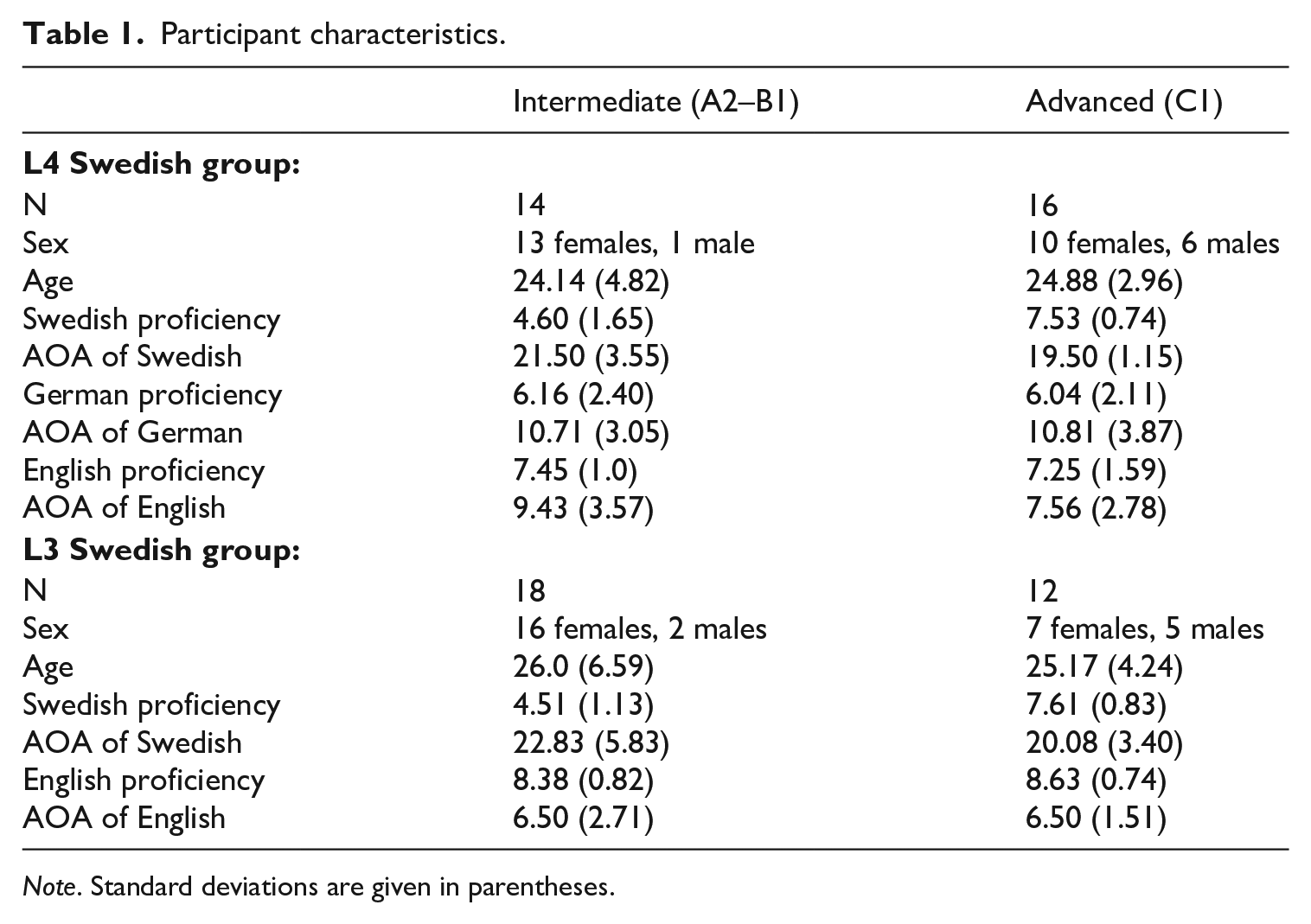
Proficiency in Swedish, English, and German was assessed using a self-report on a scale of 1–10, separately for writing, speaking, listening, reading, grammar, and vocabulary. The proficiency was then determined by calculating an average score from all six self-ratings. Table 1 gives an overview of the participants.
Participant characteristics.
Note. Standard deviations are given in parentheses.
One-way ANOVA provided evidence of a main effect of Swedish proficiency (F(2,56) = 39.64, p < .001, η2 = .65). The post hoc Games-Howell test showed that intermediate learners were less proficient in Swedish than advanced learners both within the L4S (p < .001) and the L3S (p < .001) groups. The analysis also provided evidence of an effect of English proficiency (F(2,56) = 5.50, p = .002, η2 = .23). The post hoc Bonferroni test showed that intermediate learners from the L4S group were less proficient in English compared to intermediate (p = .043) and advanced learners (p = .010) from the L3S group. Likewise, advanced learners from the L4S group were less proficient in English compared to advanced learners from the L3S group (p = .027). These differences were expected given that the L3S group received intensive instruction in English, whereas the L4S group did so in German.
The four learner groups did not differ from one another with regard to age (F(2,56) = 0.28, p = .837, η2 = .02), AOA of Swedish (F(2,56) = 2.92, p = .054, η2 = .11), and AOA of English (F(2,56) = 2.90, p = .051, η2 = .16). When it comes to German in the L4S group, the independent sample t-test did not reveal any difference between the intermediate and advanced participants with regard to German proficiency (t(28) = 0.14, p = .891) and AOA of German (t(28) = -0.08, p = .940).
All four groups were, therefore, similar with respect to a number of factors that could affect gender agreement processing in L3/Ln Swedish. Most importantly, German proficiency was kept constant in both the intermediate and advanced L4S groups. This enabled us to isolate the effect of knowledge of German in determining the learners’ outcomes.
2 Materials
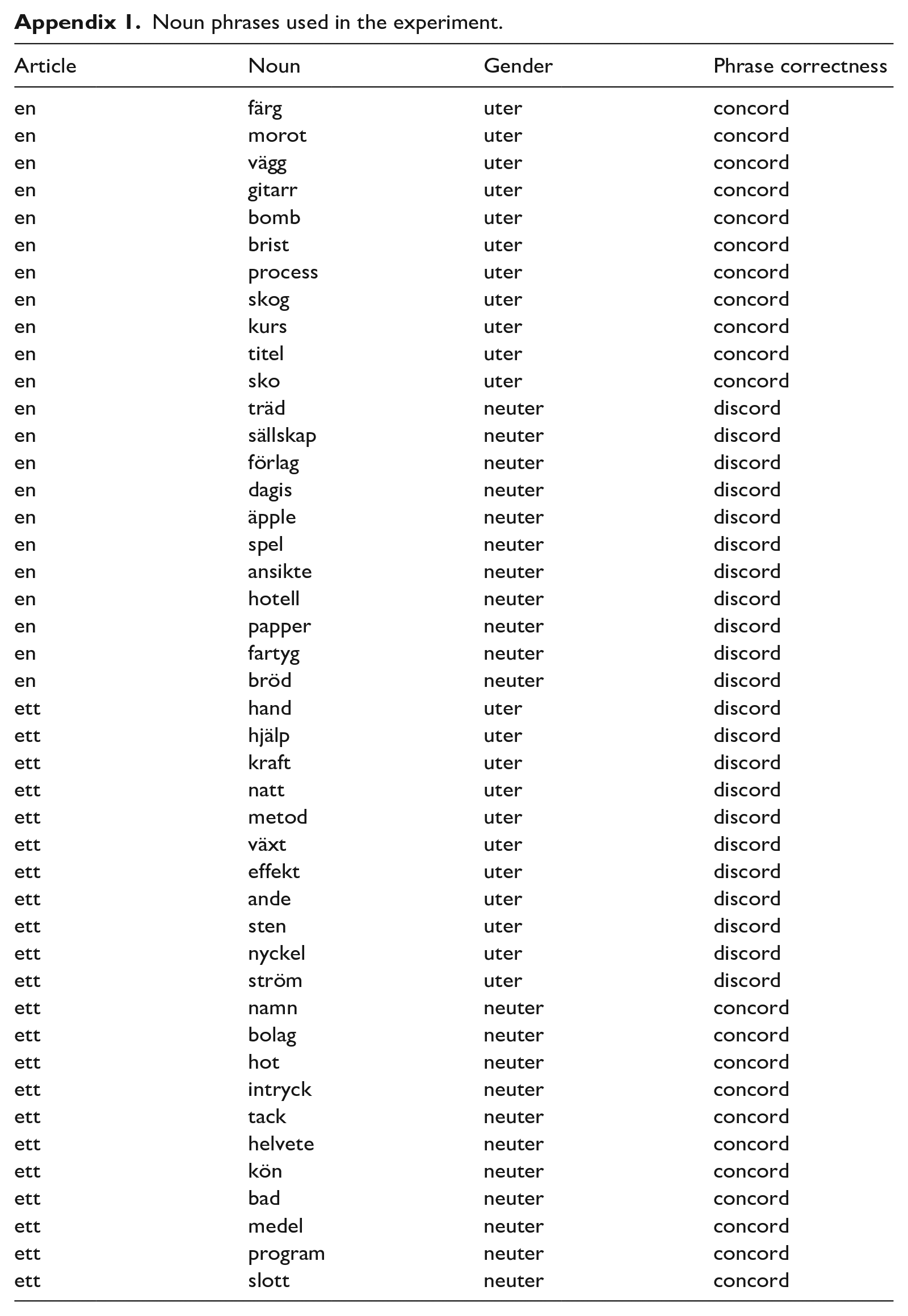
To study gender agreement processes in Swedish as L3/Ln, a timed grammaticality judgment task was developed. It involved 44 determiner phrases consisting of an indefinite article and a noun, which either agreed (n = 22) or did not agree in gender (n = 22). Half of them included nouns of uter gender, e.g. ‘en gitarr’ (a guitar), while the other half included nouns of neuter gender, e.g. ‘ett namn’ (a name). All nouns were inanimate, and their gender could not be predicted by their morphophonological shape.
The article–noun pairs were presented in isolation rather than in a sentence context in order to reduce the influence of factors involved in sentence processing such as prediction of an upcoming noun or its gender (for a similar procedure, see von Grebmer zu Wolfsthurn et al., 2021), which go beyond the scope of the present study.
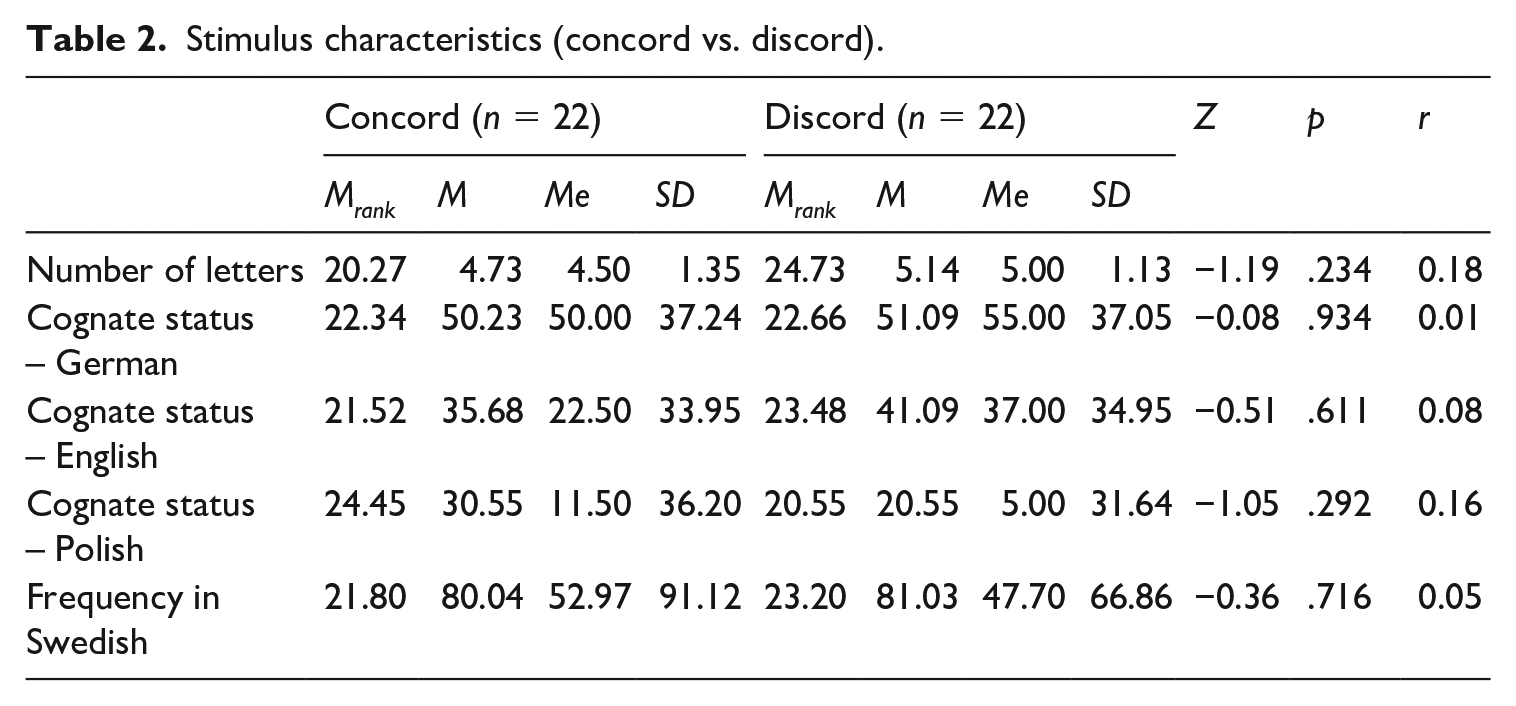
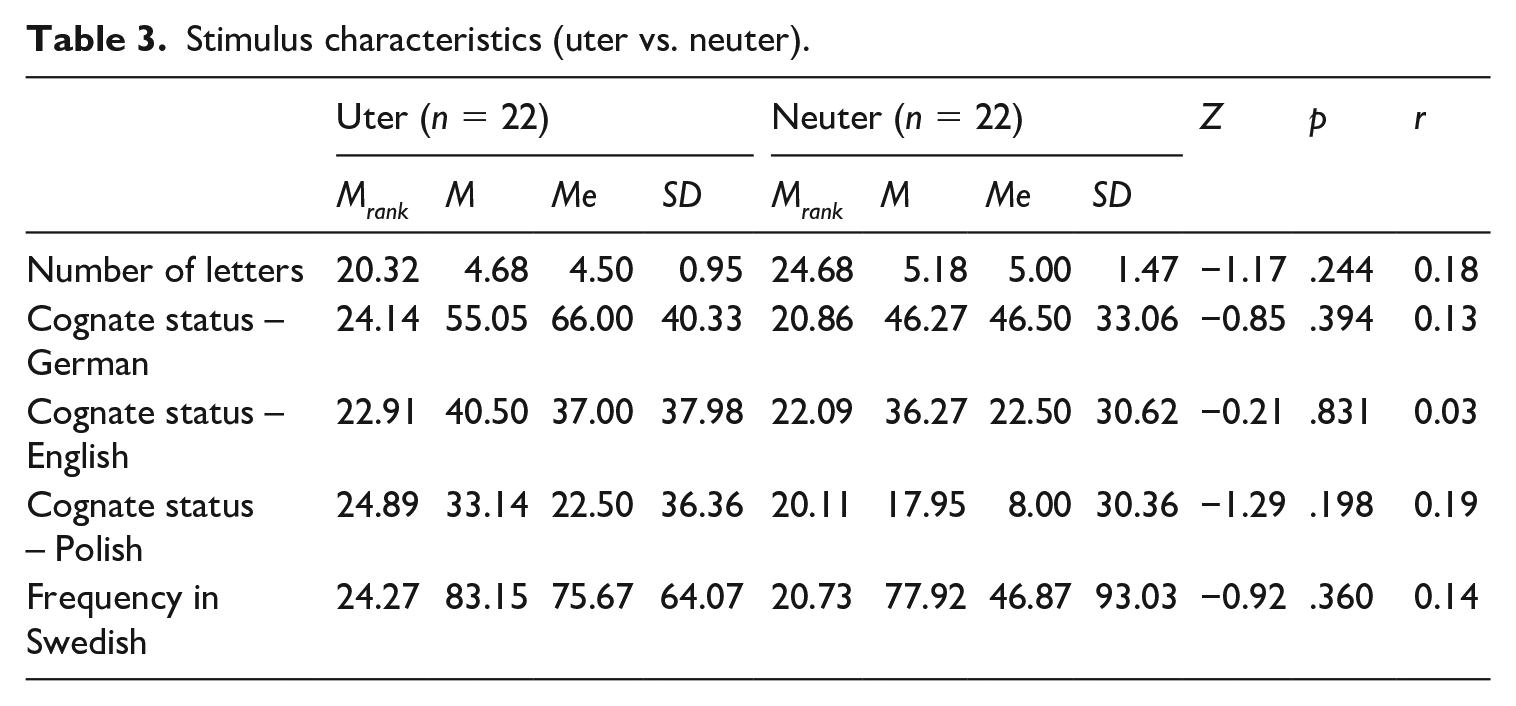
To enable comparisons between the two genders (uter vs. neuter) and the two phrase types (concord vs. discord), the nouns were selected so that they were balanced in terms of variables that influence noun processing. Therefore, they were matched as closely as possible for number of letters, cognate status with respect to Polish, English, and German, and frequency in Swedish using the Swedish Kelly-list (Kilgarriff et al., 2014). Cognate status was determined using the AWSM Tool (https://awsm-tools.com) which calculates text resemblance in per cent based on Levenshtein distance and length of source/target nouns. The Mann–Whitney U test did not yield any significant differences between the nouns of the two genders (see Table 2) and phrase types (see Table 3) for any of the variables. The noun phrases are given in Appendix 1.
Stimulus characteristics (concord vs. discord).
Stimulus characteristics (uter vs. neuter).
However, due to the difficulty in noun selection, gender congruency was not controlled for. On the one hand, the vast majority of uter nouns in Swedish are gender-congruent with their Polish and German translation equivalents. Even if a noun is masculine in Polish but feminine in German, it still cannot be considered to be ‘truly’ incongruent, as uter gender corresponds to both masculine and feminine gender. To create a real gender-mismatch condition, one should use Swedish uter nouns whose Polish and/or German translation equivalents were of neuter gender, which turned out to be unrealizable when preparing the study design. On the other hand, the vast majority of neuter nouns in Swedish are gender-incongruent with their Polish and German translation equivalents. Therefore, finding 22 nouns that would share neuter gender across all the languages also proved to be unrealizable. On top of that, the nouns should be balanced for lexical factors across the genders (uter, neuter) and phrase types (concord, discord).
As a result of this, in our study, all uter nouns were congruent in gender with their Polish and German translation equivalents; 11 uter nouns were of feminine gender and 11 uter nouns were of masculine gender in both Polish and German. As concerns neuter nouns, 11 were of neuter gender in Polish but of masculine or feminine gender in German, and 11 were of neuter gender in German but of masculine or feminine gender in Polish. An obvious disadvantage of this design is that gender congruency is confounded with noun gender, making it impossible to isolate the effect of one of them. We will return to this concern in Section III.
3 Procedure
The participants were presented with the indefinite article–noun pairs on a computer screen. They were instructed to decide as quickly as possible whether the article–noun pair on the screen was correct in Swedish or not. The letters ‘j’ (correct) and ‘n’ (incorrect) were used, which were meant to represent the Swedish words ja (‘yes’) and nej (‘no’). The task began with a written instruction in Swedish explaining the experimental procedure and ten practice items, which were then excluded from the analysis. Before each stimulus, a fixation dot was presented for 500 ms. The stimulus stayed on the screen until a deadline of 2,000 ms was reached, or until a key-press response was registered. The inter-trial interval was 1,000 ms. The presentation order of the items was randomized per participant. The presentation of the stimuli was controlled by PsyToolkit, web-based software for programming and running reaction-time experiments (Stoet, 2010, 2017).
To control for knowledge of gender assignment, an untimed Gender Assignment Task (GAT) was administered. Participants were confronted with a list of the nouns from the article–noun pairs used in the Grammaticality Judgment Task (GJT) in Excel and were asked to assign gender values to them. They were free to use the gender names (‘uter’, ‘neuter’), letter signs (‘u’, ‘n’) or indefinite articles (‘en’, ‘ett’).
Participants first performed the GJT, followed by the GAT, and finally the language background questionnaire. Each session lasted approx. 90 minutes and included two other tasks used for another experiment (not reported here). The participants were tested individually and received gift cards for a bookstore for their participation.
III Data analysis and results
1 Control Gender Assignment Task
Starting with the GAT, the participants assigned Swedish gender to all nouns used in the experiment (n = 2460). The L3S group achieved accuracy of 85.3% for uter and 74.9% for neuter nouns. The L4S group performed with accuracy of 87.1% for uter and of 79.7% for neuter nouns.
For the sake of consistency, the data were analysed using the same method as the data from the target Grammaticality Judgment Task (see below for more details). Assignment Accuracy was entered into a Generalized Linear Model (GLM) with binary distribution and logit link function in IBM SPSS Statistics 26.0. The factors were Group, Noun Gender, and Proficiency. In addition, the interactions Group × Noun Gender and Group × Proficiency were included to check whether the two groups differed depending on Noun Gender and Proficiency.
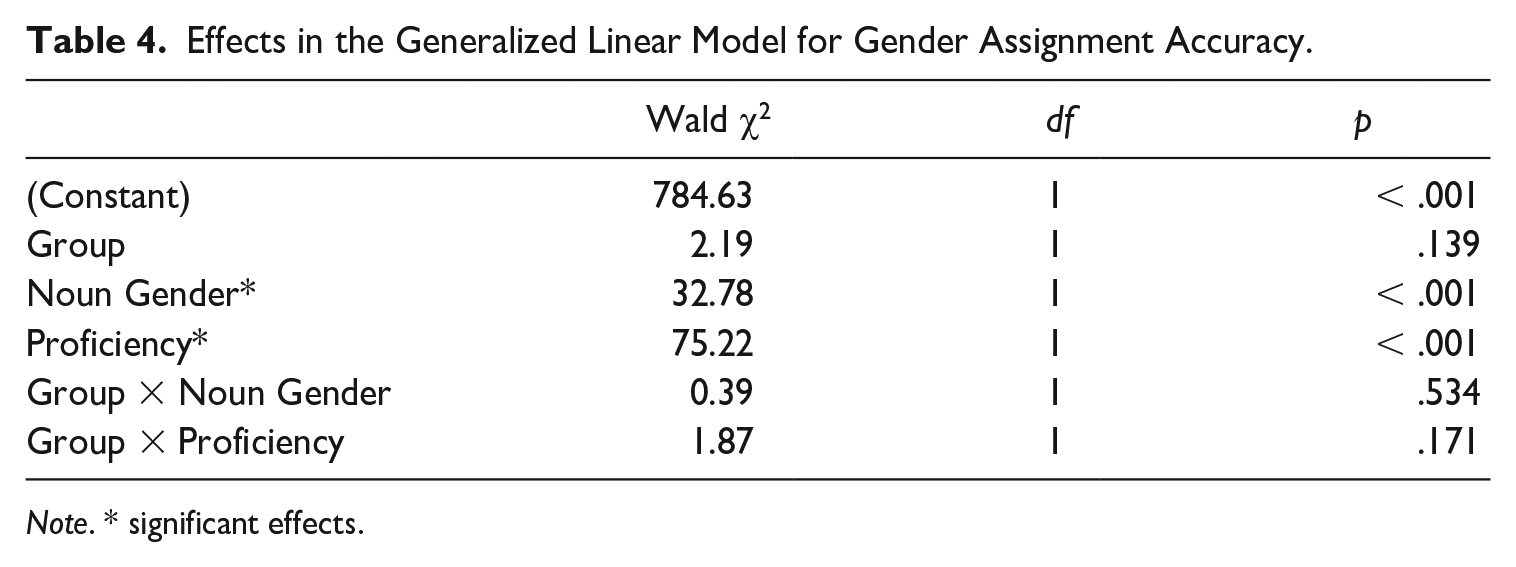
The analysis provided evidence of a significant effect of Noun Gender and Proficiency (see Table 4). The effect of Group was found not to be significant, meaning that the L4S group was no more accurate at assigning gender to nouns than the L3S group. The post hoc Bonferroni test revealed that Gender Assignment Accuracy was higher for uter than for neuter nouns (88.7% vs. 74.9%; odds ratio (OR) = 0.535; p < .001), and for advanced than for intermediate proficiency (86.2% vs. 77.2%; OR = 0.375; p < .001). The estimated parameters are presented in Table 5.
Effects in the Generalized Linear Model for Gender Assignment Accuracy.
Note. * significant effects.
Estimated parameters of the model for Gender Assignment Accuracy.
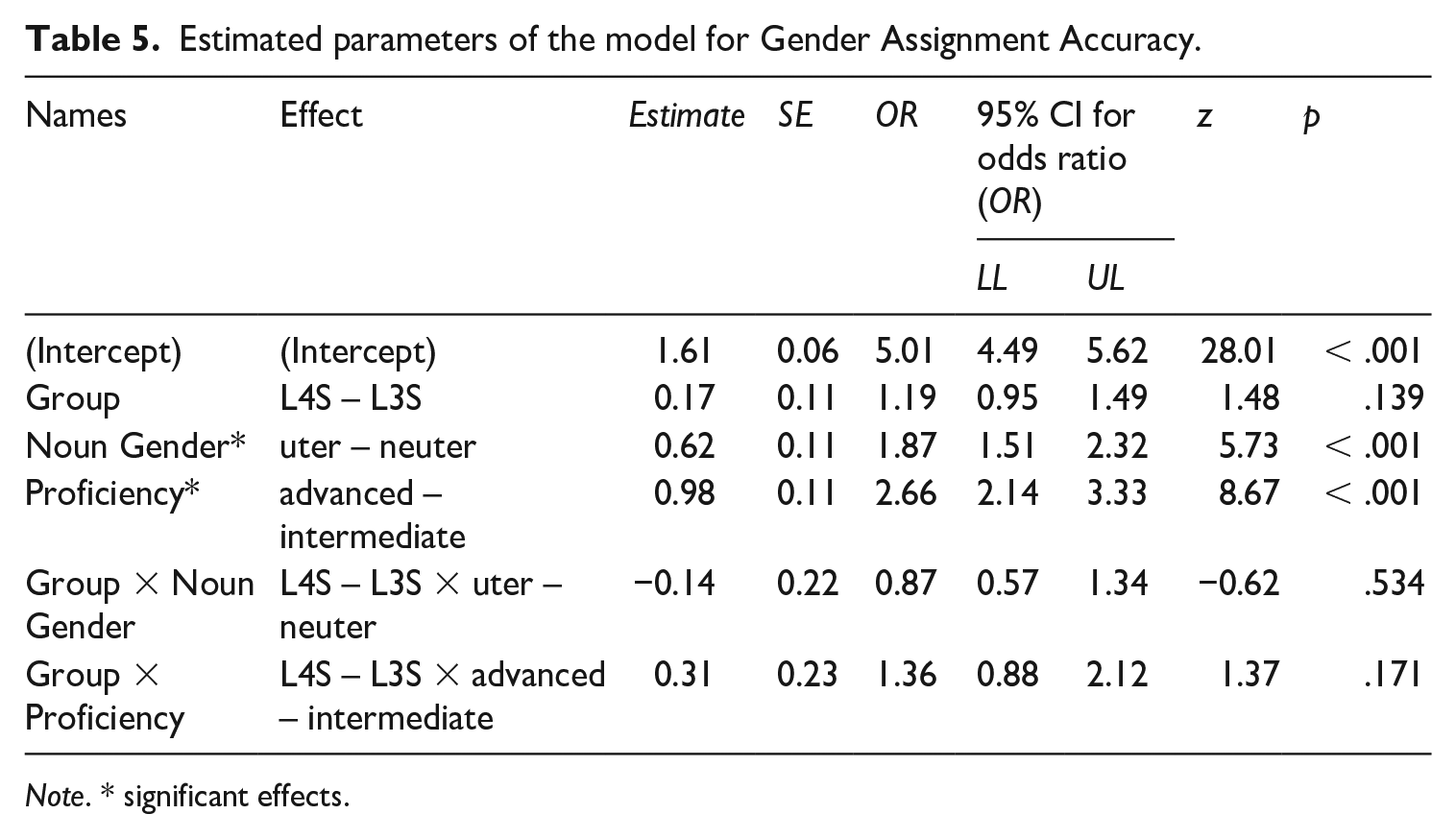
Note. * significant effects.
2 Grammaticality Judgment Task
The target Grammaticality Judgment Task generated two scores: Judgment Accuracy and Response Time in milliseconds. Judgment Accuracy was treated as a binary variable (1 – correct judgment, 0 – incorrect judgment) to allow for linking each individual judgment on a noun phrase with the gender assignment to the noun from this phrase. Both accuracy and response time data were cleaned with the same criteria. Out of 2,460 responses, 209 had to be excluded because they fell outside the 2-second response window (8.49%). Outliers were defined as any response time that was above or below 3 SDs of the mean. One response met this criterion and was excluded from the analysis (0.04%). The proportion of excluded responses did not differ by group, χ2(1) = 2.63; p = .105. The overall mean Judgment Accuracy was 73.9% (SD = 12.4), and the overall mean Response Time was 1,258.18 ms (SD = 243.9). In what follows, the detailed results and statistical analyses of Judgment Accuracy and Response Time are presented.
The judgment data was analysed using a GLM with binary distribution and logit link function, and the response time data was analysed using a GLM with identity link function. To answer the research questions guiding this study, the following factors were included in the models: Group (L3S, L4S), Proficiency (intermediate, advanced), Phrase Correctness (concord, discord), Noun Gender (uter, neuter), and Gender Assignment Accuracy (accurate, inaccurate). To address the prediction regarding research question 1, that learners with knowledge of German can be more sensitive to discord, the interaction Group × Phrase Correctness was included in the models. Since research question 2 asked about the effect of German in relation to proficiency in L3/Ln Swedish, the interaction Group × Proficiency was entered into the models. Research question 3 asked about sensitivity to discord in relation to proficiency in L3/Ln Swedish. Therefore, the interaction Phrase Correctness × Proficiency was considered in the analysis. The interaction Group × Gender Assignment Accuracy was not considered because the analysis of Gender Assignment Accuracy in Section III.1 revealed no differences between the groups. All models were checked for convergence.
Returning to the concern about gender congruency being confounded with noun gender, only the factor Noun Gender was entered into the GLM. The rationale behind this was as follows: If the effect of Noun Gender turned out to be significant, it could indicate an influence of both noun gender and gender congruency, as all uter nouns were fully gender-congruent across Swedish, German, and Polish. Such a result would require additional analyses. However, if the effect of Noun Gender turned out not to be significant, it could suggest that neither Noun Gender nor the full overlap in gender plays a role. Note that better performance is generally expected for uter than neuter nouns (Andersson, 1992; Lahtinen, 1998), and for gender-congruent than gender-incongruent nouns (e.g. von Grebmer zu Wolfsthurn et al., 2021). Therefore, even if gender congruency and Noun Gender are confounded, a positive effect is expected for both. The results described below showed no effect of Noun Gender on Judgment Accuracy and Response Time. However, there was still a possibility that the L4S group could show some gender congruency effects for the uter nouns due to a larger overlap (Polish/German/Swedish), compared to the L3S group (Polish/Swedish). To explore this possibility, the interaction Group × Noun Gender was included in the GLMs, but it also turned out not to be significant for Judgment Accuracy and Response Time, as described in detail below.
a Judgment accuracy
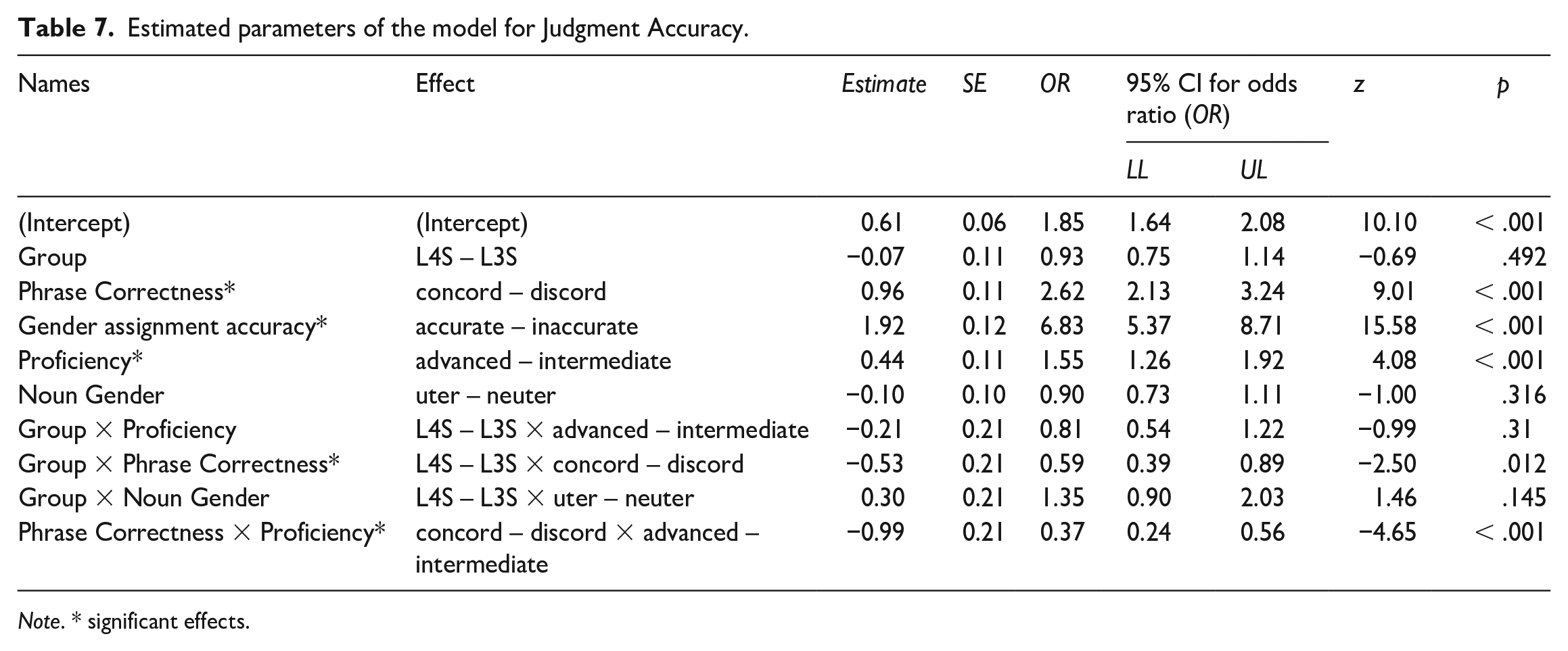
The analysis using a GLM with binary distribution and logit link function provided evidence of significant main effects of Proficiency, Phrase Correctness, and Gender Assignment Accuracy as well as two significant interactions: Group × Phrase Correctness and Phrase Correctness × Proficiency. The effect of Group and Noun Gender were found to be not significant, nor were the interactions Group × Proficiency and Group × Noun Gender (see Table 6).
Effects in the Generalized Linear Model for Judgment Accuracy.
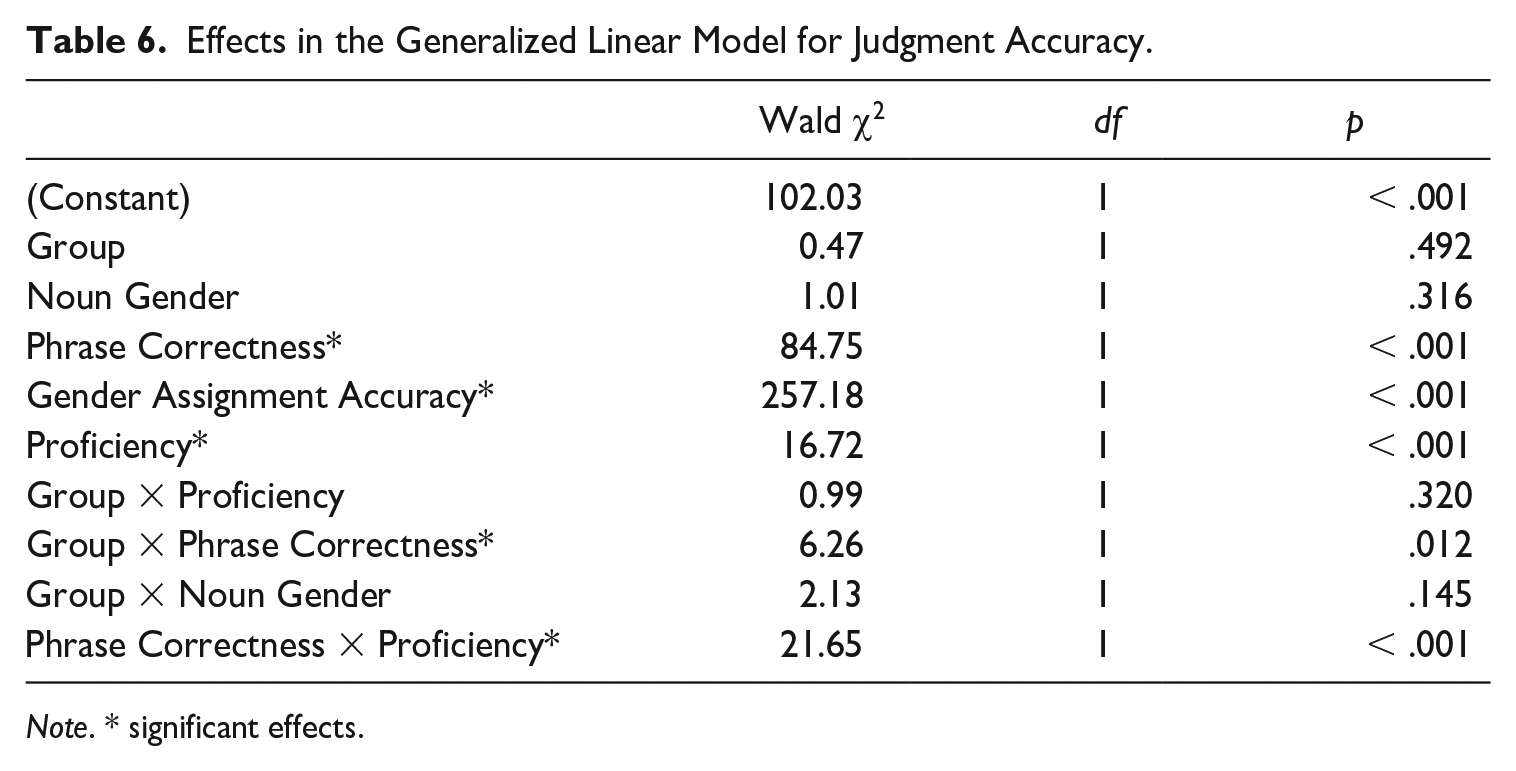
Note. * significant effects.
The post hoc Bonferroni test revealed that Judgment Accuracy was higher for advanced than for intermediate learners (81.1% vs. 67.2%; OR = 0.644; p < .001), for concord than for discord (82.4% vs. 65.3%; OR = 0.381; p < .001), and for accurate than for inaccurate gender assignment (81.4% vs. 40.3%; OR = 0.147; p < .001).
The analysis of interaction between Group and Phrase Correctness revealed that in the L3S group, judgment accuracy for discord was lower than for concord (OR = 0.292; p < .001). The L3S group also performed worse on discord than the L4S group did on concord (OR = 0.412; p < .001). In the L4S group, judgment accuracy for discord was lower than for concord (OR = 0.499; p < .001). The L4S group was also less accurate on discord than the L3S group was on concord (OR = 0.353; p < .001). Importantly, the two participant groups did not differ in their judgments when analysing only concord or only discord. The interaction Group × Phrase Correctness is illustrated in Figure 1.
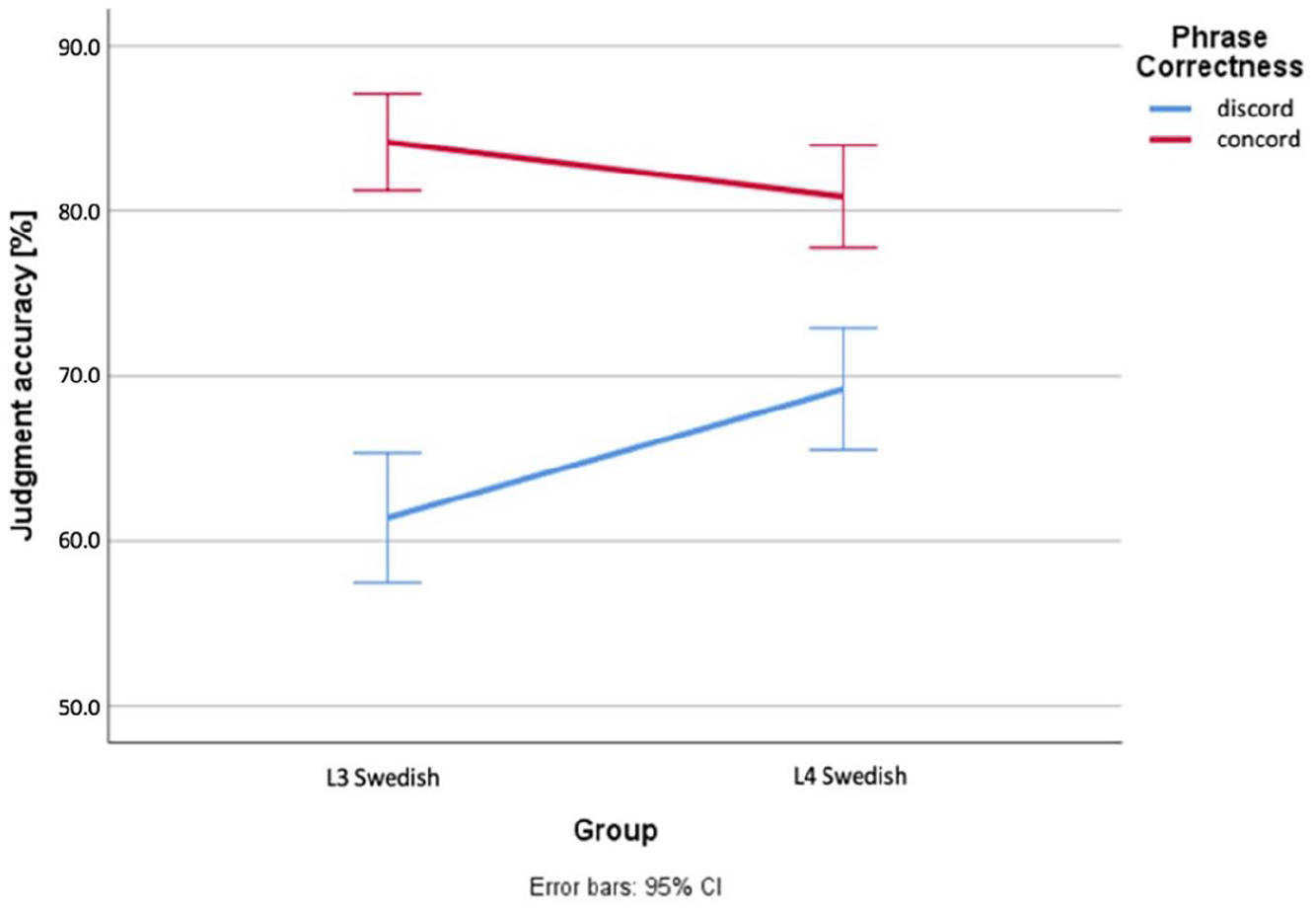
The interaction between Phrase Correctness and Group for Judgment Accuracy.
The analysis of interaction between Proficiency and Phrase Correctness showed that the intermediate participants performed better on concord than the advanced participants did on discord (OR = 1.688; p = .004). Performance on discord was worse than on concord in both intermediate (OR = 0.232; p < .001) and advanced participants (OR = 0.627; p = .020). Finally, the intermediate participants were less accurate on discord than the advanced participants were on both concord (OR = 0.246; p < .001) and discord (OR = 0.392; p < .001). The interaction Proficiency × Phrase Correctness is depicted graphically in Figure 2. The estimated parameters are presented in Table 7.
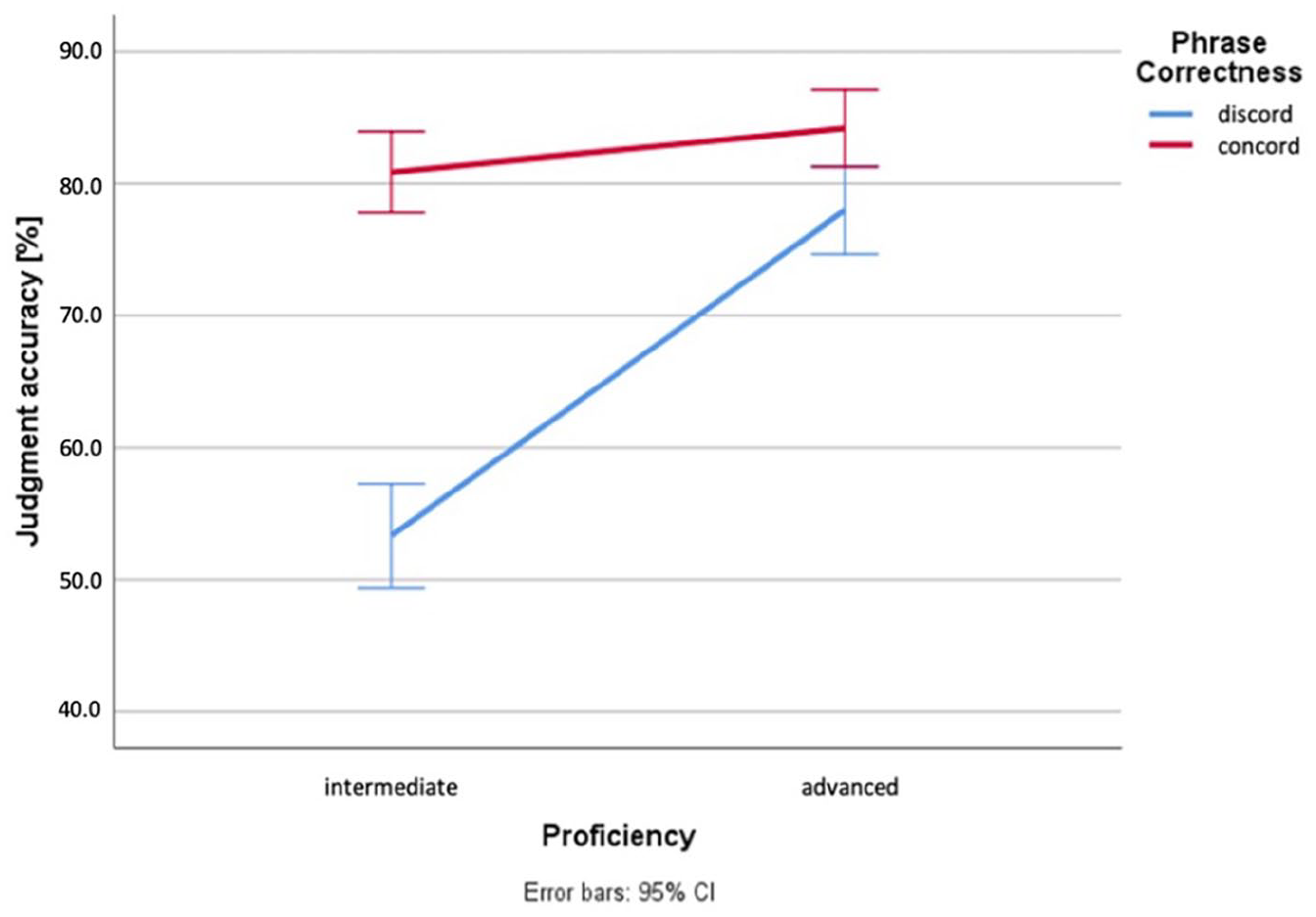
The interaction between Proficiency and Phrase Correctness for Judgment Accuracy.
Estimated parameters of the model for Judgment Accuracy.
Note. * significant effects.
b Response time
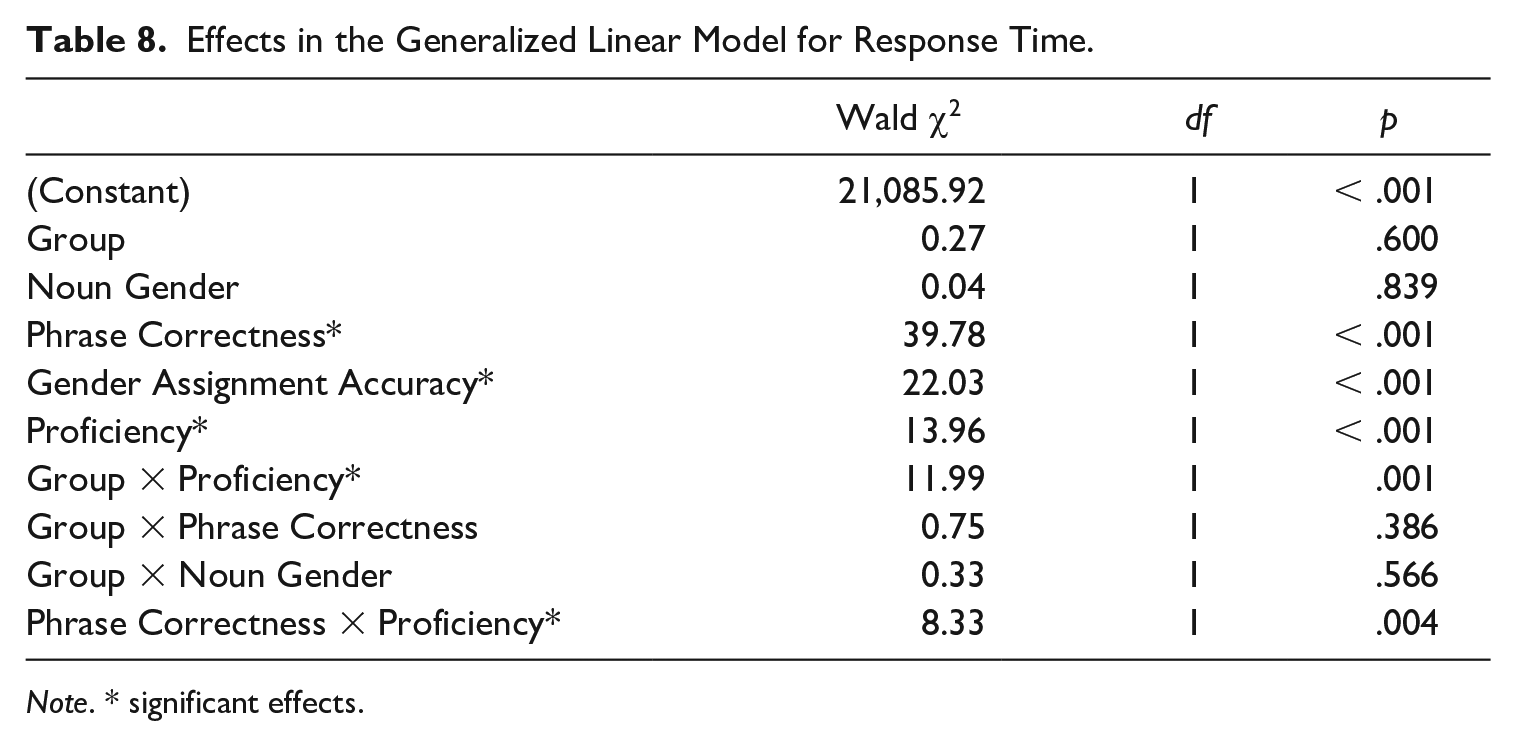
The analysis using a GLM with identity link function provided evidence of significant main effects of Phrase Correctness, Gender Assignment Accuracy, and Proficiency as well as two significant interactions: Group × Proficiency and Phrase Correctness × Proficiency. The effect of Group and Noun Gender were found to be not significant, nor were the interactions Group × Phrase Correctness and Group × Noun Gender (see Table 8).
Effects in the Generalized Linear Model for Response Time.
Note. * significant effects.
The post hoc Bonferroni test revealed that the participants responded faster to gender concord (M = 1,239.68; SE = 11.11) than to gender discord (M = 1,324.38; SE = 11.06). Responses were also faster for the nouns whose gender was known by the participants (M = 1,240.26; SE = 7.47) compared to the nouns with unknown gender (M = 1,323.81; SE = 16.06). Finally, the advanced participants (M = 1,256.30; SE = 11.89) responded faster than the intermediate participants (M = 1,307.76; SE = 10.42).
Analysis of the interaction between Group and Proficiency revealed longer response times in the intermediate (M = 1,334.70; SE = 13.35) compared to the advanced participants (M = 1,234.37; SE = 15.98; p < .001), but only within the L3S group. Furthermore, intermediate participants from the L3S group took longer to respond than both intermediate (M = 1,280.83; SE = 14.69; p = .026) and advanced participants (M = 1,276.23; SE = 14.64; p = .039) from the L4S group. The interaction Group × Proficiency is illustrated in Figure 3.
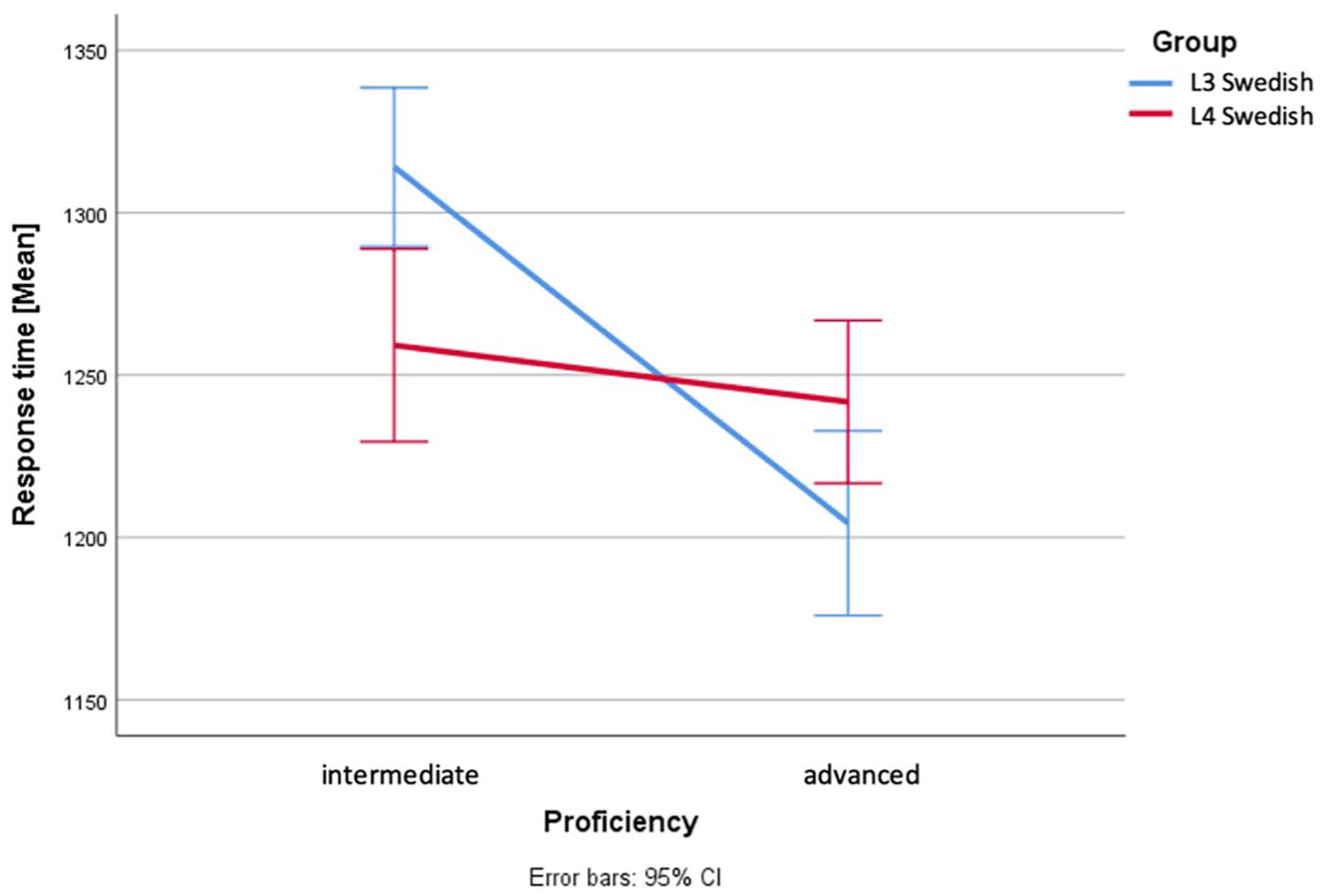
The interaction between Group and Proficiency for Response Time.
As for the interaction between Phrase Correctness and Proficiency, the analysis showed that the advanced participants responded faster to concord (M = 1,194.44; SE = 15.26) than to discord (M = 1,318.16; SE = 15.34; p < .001). Also, Response Time to concord in advanced learners was shorter than Response Time to both concord (M = 1,284.92; SE = 14.03; p < .001) and discord (M = 1,330.61; SE = 14.02; p < .001) in the intermediate learners. Figure 4 illustrates the interaction Phrase Correctness × Proficiency. The estimated parameters are presented in Table 9.
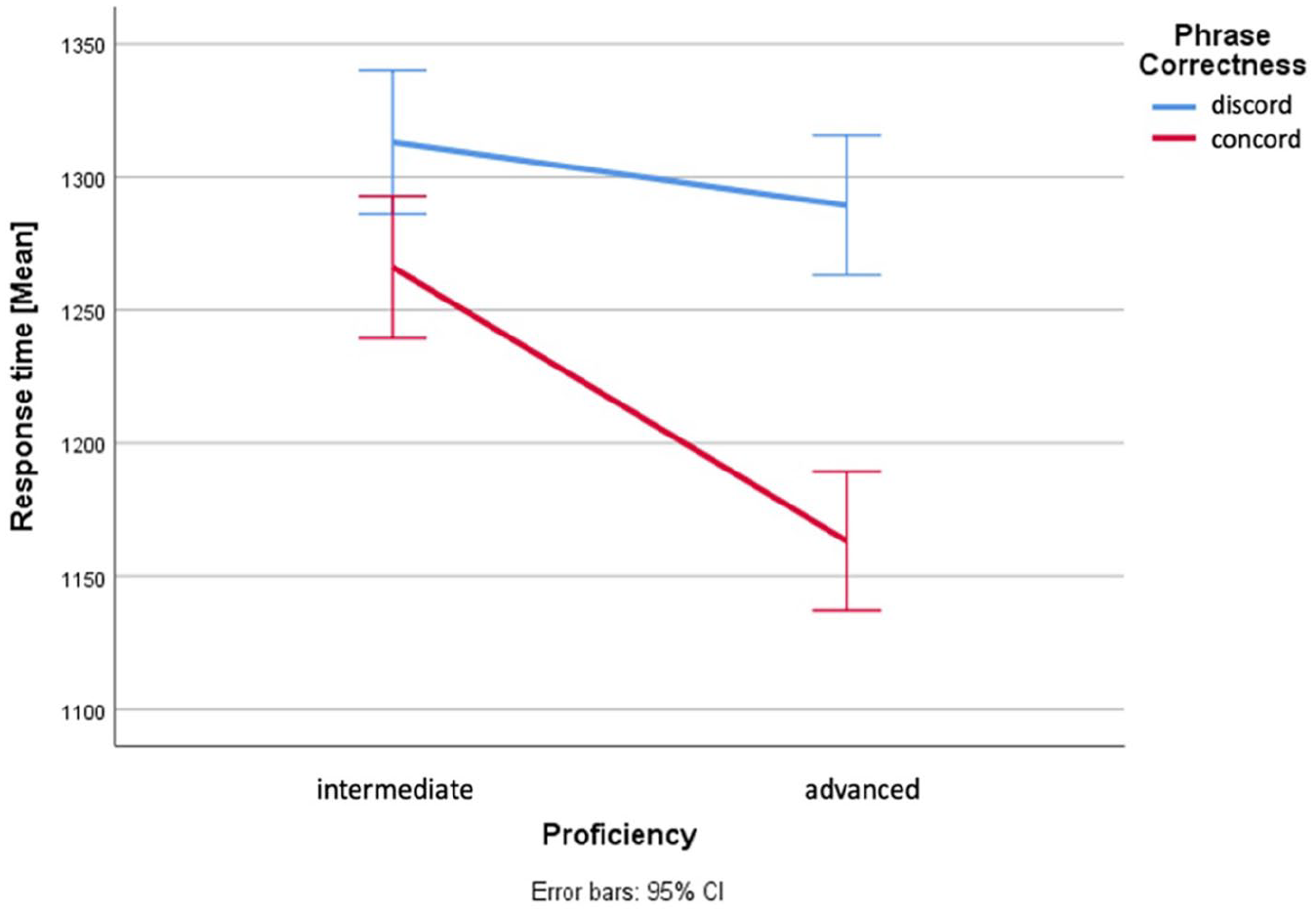
The interaction between Phrase Correctness and Proficiency for Response Time.
Estimated parameters of the model for Response Time.
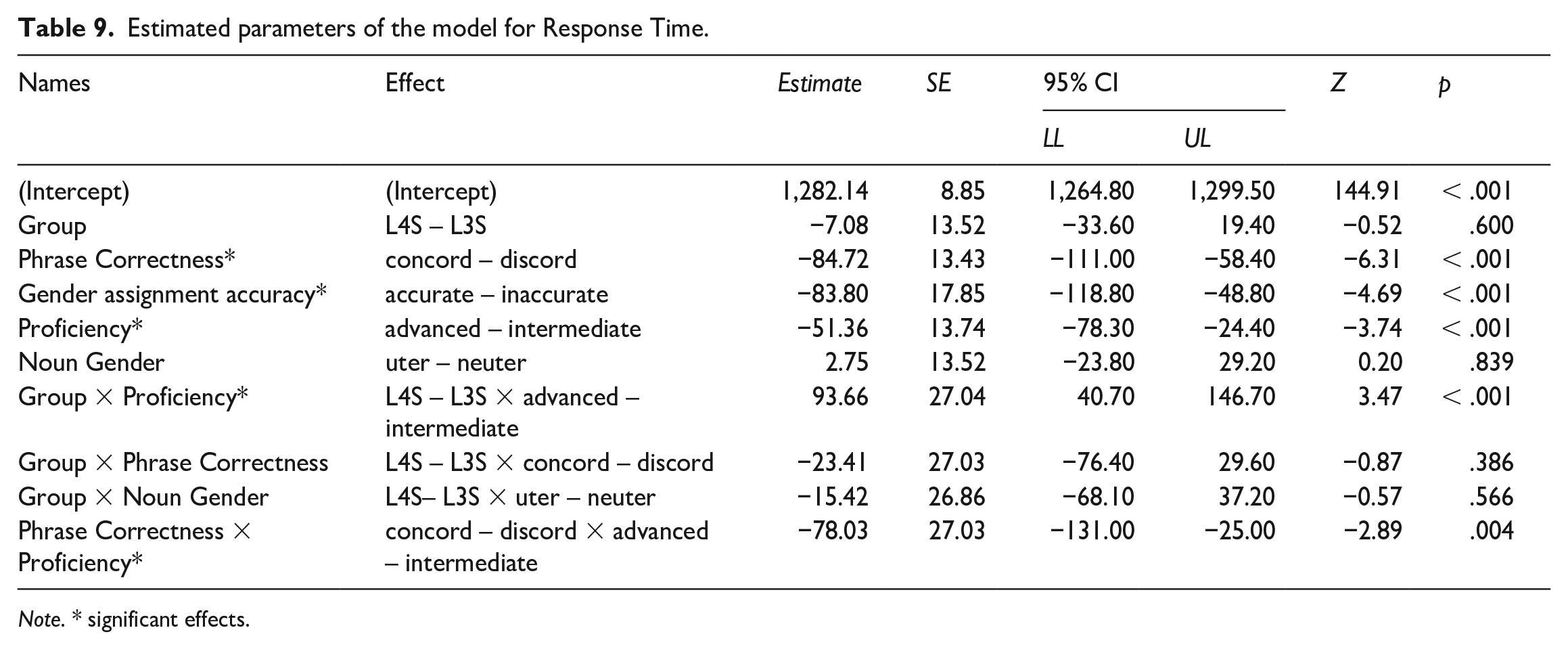
Note. * significant effects.
IV Discussion
The data analysis in the previous section answers the study’s four research questions. Regarding the main research question concerning the effect of German on gender agreement processing in L3/Ln Swedish, the data suggests no overall advantage for those who learned German over those who did not. A positive effect of German, however, was found in the intermediate learners: L4S learners processed the noun phrases significantly faster compared to the L3S learners (–53.87 ms). At this stage of L3/Ln acquisition, the learners were more proficient in German than in Swedish, and the proficiency in German (B1/B2) was high enough to exert an influence on L3/Ln Swedish. The difference between the L3S and L4S groups, however, disappeared at the advanced level. Thus, the prediction that facilitative influence should occur when learners are less proficient in their L3/Ln was borne out (e.g. Bardel and Lindqvist, 2007; Sánchez, 2014). Interestingly, the intermediate L4S learners did not differ from the advanced L4S learners in terms of processing speed, suggesting that the facilitative transfer was strong enough to override proficiency effects.
However, knowledge of German in the group of L4S learners turned out to have no effect on their grammaticality judgments, thus contradicting the prediction that a previously learned non-native language entails higher sensitivity to ungrammaticality (e.g. Klein, 1995; Lago et al., 2019). This may indicate that the underlying cause of the advantage found in processing speed in the intermediate L4S group is a direct effect of previous knowledge of gender agreement patterns rather than a general effect of multilingualism. As argued by Sabourin and Stowe (2008), learners can transfer their processing routines from L1 to L2 when gender agreement between determiner and noun works in a congruent fashion in both languages. For this type of influence, Sabourin et al. (2006: 3) also proposed the term ‘surface transfer’, which includes the transfer of morphologically similar gender marking. In both German and Swedish, gender is marked on preposed indefinite articles, which differ in form depending on the gender. Thus, the L4S learners probably transferred the gender marking from German to Swedish, which resulted in more automatized gender agreement processes at lower proficiency levels. Arguably, the role of transfer diminished at the advanced level because the L3S learners had had enough time to develop automatized knowledge of gender agreement and become indistinguishable from the L4S learners.
The lack of a positive effect of German on judgment accuracy can be explained by the fact that more automatized gender agreement processes need not translate into a smaller number of agreement errors in processing. Processing gender agreement means processing both gender concord and discord. Under this logic, one can process gender discord faster but still accept it for different reasons. Therefore, the nature of the task used in the present study must be taken into account. In the judgment task, the learners needed to read (process) noun phrases and evaluate their correctness at the same time. These are two different cognitive activities and hence two different measures. While accuracy scores reflect sensitivity to gender-agreement violations and can directly be affected by metalinguistic knowledge (Lago et al., 2019), response time is additionally indicative of the degree of processing automatization (Segalowitz and Hulstijn, 2005). The present study demonstrates that knowledge of two languages with gender only affects the latter. The finding that both groups showed comparable sensitivity to gender-agreement violations but different response times might also be interpreted as evidence that the L3S learners had knowledge of gender agreement, but they were slower to access it at the intermediate level. The difference of 53.87 ms between the intermediate L3S and L4S groups is rather unlikely to have direct consequences for learners. However, the difference may have been larger at lower proficiency levels, which may have led to noticeably slower language processing and thus to possible communication breakdowns in the L3S learners, compared to the L4S learners.
Remember that all learners in the present study were Polish native speakers. Polish is a gendered language, but in terms of gender agreement, it is less similar to Swedish than German is. On the one hand, given the important role of structural similarity for the transfer of gender agreement rules, it is possible that learners did not benefit from their knowledge of Polish. On the other hand, the mere presence of gender in the L1, even with dissimilar gender marking, gave learners in the studies by Sabourin et al. (2006) and Ellis et al. (2012) a considerable advantage. The learners in this study achieved an overall judgement accuracy of 81.1% (irrespective of the factors analysed) with no difference between the L3S and L4S groups. This score can be considered high given the scores reported in previous studies. For example, in the offline study by Sabourin et al. (2006), only the L1 German learners and native speakers of Dutch performed on gender agreement between the noun and a relative pronoun with accuracy above 80%. In addition, the learners in the present study performed a timed task, which did not prevent them from achieving very high accuracy. Under this logic, it is likely that a deep transfer of the abstract gender category from L1 Polish had indeed taken place. Unfortunately, this issue cannot be settled based on the results of the present study.
The findings are in support of the LPM (Westergaard et al., 2017), which assumes facilitative influence at any stage of L3/Ln acquisition when a linguistic feature shares structural similarity between L3/Ln and either or both previously learned languages. At the same time, they add to our understanding of how cross-language similarities influence L3/Ln processing. Namely, it seems that learners can benefit directly from any previously learned language by transferring morphosyntactic features in processing as long as their surface realization patterns are similar in the source and target languages.
The other three research questions considered gender agreement processes from a more general perspective of non-native language processing, rather than multilingualism. Regarding the second research question that asked whether sensitivity to gender discord depends on proficiency in L3/Ln Swedish, the results suggest that the intermediate learners were less sensitive to gender-agreement violations compared to the advanced learners. This confirms that sensitivity to ungrammaticality increases with advancing proficiency in the target language (Sagarra and Herschensohn, 2010, 2011). However, no evidence of a proficiency effect on response time to concord vs. discord was found, thus confirming the dissociation between sensitivity to ungrammaticality (as indexed by accuracy) and processing automatization (as indexed by response time).
The third research question was concerned with the tendency to overgeneralize neuter gender observed in previous studies on the acquisition of gender in Swedish (Andersson, 1992; Lahtinen, 1998). The analysis conducted in the present study yielded no effect of noun gender on judgment accuracy and response time, thus showing that the learners were equally accurate and fast when judging uter and neuter nouns. Note that noun gender was confounded with gender congruency in the analysis. Note, however, that all uter nouns were gender-congruent across Swedish, German, and Polish, which, according to previous research (e.g. von Grebmer zu Wolfsthurn et al., 2021), should have led to higher accuracy and faster responses. This was clearly not the case in the present study. Therefore, it is very likely that the learners did not treat neuter gender as a default during gender agreement processing in Swedish. The reason could be that they have neuter gender in their L1 Polish (and the L4S group also in their German) and, therefore, pay more attention to this gender value, as compared, for example, to Anglophone learners learning Swedish. Indeed, previous research has suggested that learners of non-gendered L1s like English may rely on a default more (for evidence of using masculine as a default in English/Spanish learners, see Alarcón, 2011). To arrive at a definite answer to the third research question, one would need to control for gender congruency of nouns, which is not realizable in the language combination in this study (provided that one wants to use a proper number of stimuli).
The fourth and last research question concerned the positive effect of lexical knowledge of gender. The analysis conducted in this study provided evidence of a large difference both in judgment accuracy and response time depending on the learners’ knowledge of gender assignment. When the learners knew the correct gender of a noun, they achieved a judgment accuracy of 81.4% and needed 1,240.26 ms to judge the noun phrase. When they did not, however, they performed below chance, with a judgment accuracy of 40.3% and a response time of 1,323.81 ms. This confirms the important role of gender assignment knowledge for target-like gender agreement processing (e.g. Hopp, 2013; Sabourin et al., 2006). This finding is in line with the Lexical Gender Learning Hypothesis (Grüter et al., 2012; Hopp, 2013), which posits that difficulties with gender agreement lie at the level of lexical representation of gender. This hypothesis holds that L2 learners develop weaker links between nouns and gender nodes and hence less stable gender representations. As a consequence, L2 learners retrieve gender information from the lexicon more slowly and make less use of gender cues during online processing.
The findings of the present study must be seen in the light of certain limitations. First of all, both learner groups had knowledge of English, and, even more importantly, the L3S group was more proficient in English. Although English has no gender, one could argue that it could exert some kind of ‘blocking’ influence on gender processing in L3/Ln Swedish, an idea that is not easy to test in behavioural research. Note that English is the dominant foreign language in Poland taught to over 96% of children at all levels of education starting from primary school (Statistics Poland, 2019), which makes the task of finding participants with no knowledge of English impossible.
The present study would have also benefited from including a group of Anglophone learners of Swedish. This would enable comparisons to be made between learners who learned none, one, and two gendered languages to isolate the effect of bi- vs. multilingualism or to tease apart the effect of increased metalinguistic awareness due to knowledge of multiple languages and the effect of previous knowledge of gender. For such a group to be comparable with the L3S and L4S groups, however, participants should be university students of Swedish with no knowledge of additional languages. This is hardly possible because on the one hand students usually already have some knowledge of foreign languages at the onset of higher education, and on the other study programmes typically offer other languages in addition to Swedish.
Another limitation of the study was the overlap of the factors noun gender and gender congruency, which made it impossible to tease apart their effects. Future studies on gender agreement processing in L3/Ln should consider language combinations in which gender congruency can be controlled for. Furthermore, the results should be interpreted with the relatively small sample size and the limited number of trials per condition in mind.
Finally, it was the aim of the present study to make a first step towards better understanding of gender agreement processing in multilinguals by looking at simple indefinite article–noun phrases in isolation. Nevertheless, future research should undoubtedly analyse gender agreement processes in a sentence context, including other determiners and adjectives.
V Conclusions
The investigation of processing gender agreement between indefinite article and noun in L3/Ln Swedish has shown that knowledge of two languages with gender, native Polish and non-native German, which both mark gender similarly to Swedish (albeit with some differences), leads to faster processing at the intermediate proficiency level. This multilingual advantage is claimed to result from a direct positive influence of German that consists in a surface transfer of similar gender agreement marking from German to Swedish. The transfer, in turn, gives rise to more automatic gender agreement processes already at earlier stages of L3/Ln acquisition. The results are in line with the LPM (Westergaard et al., 2017), which argues for a facilitative influence from any language that reveals a structural similarity with the target language at any stage of L3/Ln development, and allows a combined influence from more than one language to L3/Ln.
The study contributes to the field of second and additional language acquisition in numerous ways. It is the first to provide evidence of a multilingual advantage in processing gender agreement in L3/Ln. Furthermore, the study confirms and extends findings from previous L2 studies to L3/Ln processing and to Swedish, the most important being the crucial role of gender assignment knowledge for gender processing and the positive relationship between proficiency and sensitivity to gender-agreement violations. The study also has broader implications for the field as it reveals influence from L3 to L4. This means that future studies on transfer will have to account for what drives influence in L4 learning and processing. For example, non-nativeness (Bardel and Falk, 2007) will not be a sufficient explanation anymore given the existence of two non-native languages, L2 and L3, which can exert an influence on L4. Moreover, the study shows a multilingual advantage in processing speed, but not in judgment accuracy. The positive effect of multilingualism on L3/Ln learning is thus selective and so, it is the task of future research to test the limits of the multilingual advantage.
Footnotes
Appendix
Noun phrases used in the experiment.
| Article | Noun | Gender | Phrase correctness |
|---|---|---|---|
| en | färg | uter | concord |
| en | morot | uter | concord |
| en | vägg | uter | concord |
| en | gitarr | uter | concord |
| en | bomb | uter | concord |
| en | brist | uter | concord |
| en | process | uter | concord |
| en | skog | uter | concord |
| en | kurs | uter | concord |
| en | titel | uter | concord |
| en | sko | uter | concord |
| en | träd | neuter | discord |
| en | sällskap | neuter | discord |
| en | förlag | neuter | discord |
| en | dagis | neuter | discord |
| en | äpple | neuter | discord |
| en | spel | neuter | discord |
| en | ansikte | neuter | discord |
| en | hotell | neuter | discord |
| en | papper | neuter | discord |
| en | fartyg | neuter | discord |
| en | bröd | neuter | discord |
| ett | hand | uter | discord |
| ett | hjälp | uter | discord |
| ett | kraft | uter | discord |
| ett | natt | uter | discord |
| ett | metod | uter | discord |
| ett | växt | uter | discord |
| ett | effekt | uter | discord |
| ett | ande | uter | discord |
| ett | sten | uter | discord |
| ett | nyckel | uter | discord |
| ett | ström | uter | discord |
| ett | namn | neuter | concord |
| ett | bolag | neuter | concord |
| ett | hot | neuter | concord |
| ett | intryck | neuter | concord |
| ett | tack | neuter | concord |
| ett | helvete | neuter | concord |
| ett | kön | neuter | concord |
| ett | bad | neuter | concord |
| ett | medel | neuter | concord |
| ett | program | neuter | concord |
| ett | slott | neuter | concord |
Acknowledgements
I am grateful to three anonymous reviewers for their thoughtful and constructive comments on an earlier version of this manuscript.
Declaration of Conflicting Interests
The author declared no potential conflicts of interest with respect to the research, authorship, and/or publication of this article.
Funding
The author disclosed receipt of the following financial support for the research, authorship, and/or publication of this article: This work was supported by the National Science Centre, Poland (grant number 2019/33/N/HS2/00349).
