



Abstract
Aims and Objectives:
English allows inanimate objects to be sentence subjects (e.g., “The knife cut the bread”) but Korean and Japanese restrict subjects of causal sentences on the basis of animacy. In previous work, we found that Korean speakers relaxed their native grammatical animacy constraint when immersed in English (e.g., found knives to be acceptable sentence subjects in Korean). We suggested this L2 influence occurred because the Korean animacy constraint does not map cleanly onto the semantic representation of animacy—some inanimate objects (e.g., “fire”) can be subjects of causal sentences. In the current study, we further test this idea by examining the case of Japanese–English bilinguals. We predict that because the Japanese animacy constraint aligns well with the semantic representation of animacy, it will be less susceptible to L2 influence.
Methodology:
We first independently assessed the semantic representation of animacy by comparing animacy ratings from native speakers of Korean, Japanese, and English for 60 objects. We then asked Japanese–English bilinguals and Japanese monolinguals to provide grammaticality judgments for sentences that varied in subject animacy.
Data and Analysis:
We analyzed participants’ animacy ratings and grammaticality judgments using mixed-effects models.
Findings:
Animacy ratings supported a closer correspondence between semantic representation of animacy and the grammatical animacy constraint for Japanese grammar than for Korean grammar. In contrast to previous results for Korean speakers, Japanese–English bilinguals’ grammaticality judgments did not significantly differ from those of Japanese monolinguals.
Originality:
The current study is unique in that it suggests the vulnerability of structures at the syntax–semantics interface to L2 influence varies across different language groups based on the alignment between syntactic and semantic features.
Implications:
The current findings support the possibility that representations at the syntax–semantics interface may only be vulnerable to influence when syntax is incongruent with semantic features.
First-language (L1) syntax was traditionally considered impervious to influence from a second language (L2; Chomsky, 1986; Schmid, 2011). However, there is mounting evidence for L2 influence on L1 syntax (Azaz & Frank, 2018; Ben-Rafael, 2004; Bosch & Unsworth, 2021; Chamorro, Sorace, & Sturt, 2016; Chamorro, Sturt, & Sorace, 2016; Dussias & Sagarra, 2007; Gürel, 2004; Lebkuecher & Malt, 2021; Liu et al., 2020; López Otero, 2022; Ramirez, 2003; Ribbert & Kuiken, 2010; Stolberg & Munch, 2010; Wolff & Ventura, 2009). A common explanation for these observations of L2 influence is that they reflect errors in retrieval rather than altered representation of syntax (Chamorro & Sorace, 2019; Schmid, 2011). However, some recent research suggests L2 influence may cause long-term changes to L1 syntactic representations themselves (Lebkuecher & Malt, 2021; Malt & Lebkuecher, 2017).
L2 influence on L1 syntax
Syntactic representations may differ in how vulnerable they are to cross-linguistic influence. Some syntactic representations may undergo a great deal of restructuring while others remain more native-like. Several factors appear to make elements of L1 syntax more vulnerable. A representation is more likely to be vulnerable if it is more constrained in L1 than L2 (Azaz & Frank, 2018; Gürel, 2004; Jachimek et al., 2022; Mishina-Mori, 2020; Mishina-Mori et al., 2018; Pavlenko, 2010; Schmid, 2010; Sopata et al., 2021; Stolberg & Munch, 2010; Wolff & Ventura, 2009). Employing a single, flexible syntactic constraint in both L1 and L2 may be less cognitively demanding than managing multiple structures or consistently utilizing a highly constrained structure.
The interface hypothesis further argues that syntactic structures located at the syntax–pragmatics interface are vulnerable to cross-linguistic influence, but not those that interface with semantics (Chamorro & Sorace, 2019). There is consistent evidence for cross-linguistic influence at the syntax–pragmatics interface (Chamorro, Sorace, & Sturt, 2016; Contemori et al., 2019; Ergün, 2021; Foryś-Nogala et al., 2020; Jachimek et al., 2022; Liu et al., 2020; Sopata, 2021; Sopata et al., 2021; Torregrossa et al., 2021; Van Dijk et al., 2022; Zhou et al., 2021). However, evidence for influence at the syntax–semantics interface is mixed (Bolonyai, 2007; Chamorro, Sturt, & Sorace, 2016; Jachimek et al., 2022; Lebkuecher & Malt, 2021).
Our previous research evaluating the grammaticality judgments of Korean–English bilinguals found evidence for L2 influence on an L1 structure at the syntax–semantics interface (i.e., constraints on what types of entities can occur in subject position), but not on word order, which has different defaults in Korean (subject–object–verb [SOV]) and English (subject–verb–object [SVO]); Lebkuecher & Malt, 2021). We hypothesize that the vulnerability of structures at the syntax–semantics interface may depend on the degree of alignment between syntactic and semantic representation. In the current study, we specifically examine how this alignment influences the vulnerability of L1 animacy constraints to L2 influence. In addition, we propose that word order as a case of “narrow syntax” may not be as vulnerable to cross-linguistic influence as interface structures since one pattern is dominant regardless of semantic or pragmatic considerations.
Animacy
Semantic representation
In the broadest sense, the animacy of an object can be defined as how “alive” it is perceived to be (VanArsdall & Blunt, 2022; Yamamoto, 1999). The perception of an object’s animacy is highly related to the level of agency attributed to it (Lockwood & Macaulay, 2012; Mascalzoni et al., 2010; Oshima, 2007; Pae et al., 2014; VanArsdall & Blunt, 2022; Yamamoto, 1999). In other words, the more an object is capable of acting on its environment, the greater the animacy attributed to it. Given that a basic understanding of animacy is crucial for organisms’ survival and their ability to interact with the surrounding environment, it may even be innate in humans and some animals (Mascalzoni et al., 2010).
Supporting this idea, there is evidence to suggest that objects with a high level of animacy are very conceptually accessible, which makes them easily retrievable from memory (Branigan et al., 2008; McDonald et al., 1993; Tanaka et al., 2003). There is also some evidence to suggest agreement across speaker groups and cultures with regard to an animacy hierarchy among objects. Humans are the most animate, closely followed by animals, and all other objects occupy a lower level on the hierarchy (Lockwood & Macaulay, 2012; Oshima, 2007; VanArsdall & Blunt, 2022; Yamamoto, 1999).
Syntax
Given the consistency across speakers of diverse languages, we might expect to observe a similarly high level of consistency in the syntactic treatment of animacy across speaker groups. However, the treatment of animacy varies across languages. The variation falls into two main categories. Type A languages (e.g., Korean and Japanese) restrict which objects can be the subject of a causal sentence based on animacy. Type B languages (e.g., English) have no restrictions on which objects can be causal sentence subjects (Guilfoyle, 2000; Wolff et al., 2009; Wolff & Ventura, 2009). For example, “The man cut the bread” is an acceptable utterance across both Type A and Type B languages. However, only Type B languages consider “The knife cut the bread” to be grammatical since “knife” is an inanimate object.
As Type B languages, both Japanese and Korean require a speaker to use semantic considerations in applying grammatical constraints. However, the Japanese case is more straightforward than the Korean one. The animacy constraints of Japanese syntax align neatly with the conceptual hierarchy of animacy in that only living beings (i.e., humans and animals) are acceptable as the subject of causal sentences in most contexts (Uchiyama, 1991; VanArsdall & Blunt, 2022; Yamamoto, 1999). In Korean, however, there is a gradient in the acceptability of inanimate objects as sentence subjects, apparently based on the level of energy that an object is able to internally generate (Wolff et al., 2009). For instance, air conditioner is considered highly acceptable while key receives low acceptability ratings.
Integrating syntax and semantics
A mismatch between the semantic representation of animacy and the syntactic constraint in Korean could lead to increased difficulty integrating the syntactic and semantic components of animacy during language use. Thus, we propose that the vulnerability of structures at the syntax–semantics interface depends on the difficulty of integrating across linguistic domain. To determine whether conflict in the representation of animacy across linguistic domains allows for L2 syntactic influence, it is necessary to compare L2 influence on L1 animacy for speaker groups where this conflict is and is not present. The current studies provide this contrast by testing L1 Japanese speakers to compare with our previous results from L1 Korean speakers.
Word order
Unlike animacy, word order preference in the languages of interest (i.e., Korean, Japanese, and English) is narrow syntax because it does not require the integration of information from other domains of language. As in previous work (Lebkuecher & Malt, 2021), investigating L2 influence on both L1 animacy and word order will allow us to distinguish whether L2 influence on L1 grammar is restricted to interface structures. Korean–English bilinguals maintained a preference for SOV word order over SVO word order in Korean while loosening animacy constraints (Lebkuecher & Malt, 2021). While English has a highly constrained SVO word order (Onnis & Thiessen, 2013), Korean and Japanese speakers strongly prefer SOV word order (though case-marking in Korean and Japanese allows for some flexibility; Bratt, 1996; Tanaka et al., 2003; Yamashita, 1997). We anticipate that Japanese–English bilinguals will continue to exhibit a preference for SOV word order in their L1 judgments, further supporting the idea that syntactic structures which require integration with other domains are the most vulnerable to L2 influence.
Current experiments
To test the hypothesis that the vulnerability of animacy constraints to L2 influence depends on the alignment between the semantic and syntactic representation of animacy, the current study evaluated L2 influence on L1 animacy and word order in Japanese–English bilinguals. Similar to Study 1 from Lebkuecher and Malt (2021) examining Korean, participants completed grammaticality judgments in Japanese and English for sentences that varied in the level of animacy of the sentence subject. To test whether L1 narrow syntax is also susceptible to L2 influence, we also manipulated the word order of sentences to be either SOV or SVO structure.
In the previous experiment conducted with Korean–English bilinguals, we adapted sentence stimuli from an experiment evaluating animacy constraints across Korean, Chinese and English speakers (Wolff et al., 2009). The sentence subjects in this stimulus set were inanimate objects that were either acceptable or not to monolingual Korean speakers. Since all inanimate objects are unacceptable as subjects in Japanese, we needed to add sentences to the stimuli for the present study with acceptable (i.e., human and animal) sentence subjects. Thus, the stimuli for the present study consist of the full set from Lebkuecher and Malt (2021) as well as additional sentences with human and animal subjects. We compared the bilinguals’ judgments of these sentences in each language with that of Japanese and English monolinguals.
If syntax–semantics interface structures are vulnerable to cross-linguistic influence in general, then we would expect that native Japanese speakers immersed in English will no longer use animacy in a native-like way when making grammaticality judgments, and their performance will differ from that of Japanese monolinguals (parallel to the immersed Korean–English bilinguals from our previous work). Conversely, if the vulnerability of these interface structures depends on the degree of compatibility between semantic and syntactic features, then Japanese–English bilinguals and Japanese monolinguals may use animacy cues in the same manner (since animacy cues in Japanese grammar do not conflict with the semantic representation of animacy), in contrast to the Korean–English bilinguals from the previous work.
Experiment 1: semantic representation of animacy across speaker groups
To ensure that all speaker groups were conceptualizing animacy similarly, we asked individuals from all speaker groups in this study to provide animacy or “aliveness” ratings of various humans, animals, and objects. A similar approach was employed in a recent norming study (see VanArsdall & Blunt, 2022). Anticipating the need for this check, we had also obtained ratings of the same stimuli from Korean speakers after making the grammaticality judgments reported in Lebkuecher and Malt (2021). The animacy data were not reported there. We expected that individuals from all speaker groups would rate the items in accordance with an established conceptual animacy hierarchy (Lockwood & Macaulay, 2012; Oshima, 2007; VanArsdall & Blunt, 2022; Yamamoto, 1999), distinguishing inanimate from living (human and animal) entities.
Participants
Thirty-nine Japanese–English bilinguals, 23 English monolinguals, and 19 Japanese monolinguals participated in both this study and Experiment 2. English monolingual participants were recruited through the Introduction to Psychology subject pool at Lehigh University as well as through acquaintances of the first author. Japanese bilingual and monolingual participants were recruited through an advertisement on linguistlist.org, Asian and Japanese student associations at Lehigh University and Penn State University, and through Japanese-speaking colleagues of the authors. Seventeen bilingual participants only completed grammaticality judgments for a subset of the stimulus sentences that are parallel in content and word order to those used with Korean speakers in (Lebkuecher & Malt, 2021). We compared the performance of these bilingual participants with the remaining 22 who completed the study with the full set of stimulus sentences to ensure that any differences in the grammaticality ratings between the Japanese–English and Korean–English bilingual groups did not occur as a result of the difference in the stimulus sets.
Language history was assessed using a survey described below. Bilingual participants were all native speakers of Japanese who grew up in Japan and were not immersed in a predominantly English-speaking environment until age 14 years or later (although many participants received some schooling in English before the age of 14 years). English monolingual participants were native speakers of English who grew up in the United States and resided in the United States, and Japanese monolinguals were native speakers of Japanese who grew up in Japan and resided in Japan. Participants from both monolingual groups had never been immersed in an environment where the dominant language was other than their native language. They were also minimally proficient in all languages other than their native language. Bilingual participants were compensated $15 for two online experimental sessions and Japanese monolingual participants were compensated US$5 equivalent for one online session. Both Japanese participant groups were compensated in the form of online Amazon gift cards. Some English monolingual participants received a US$5 online Amazon gift card for one online experimental session and others received course credit for participation.
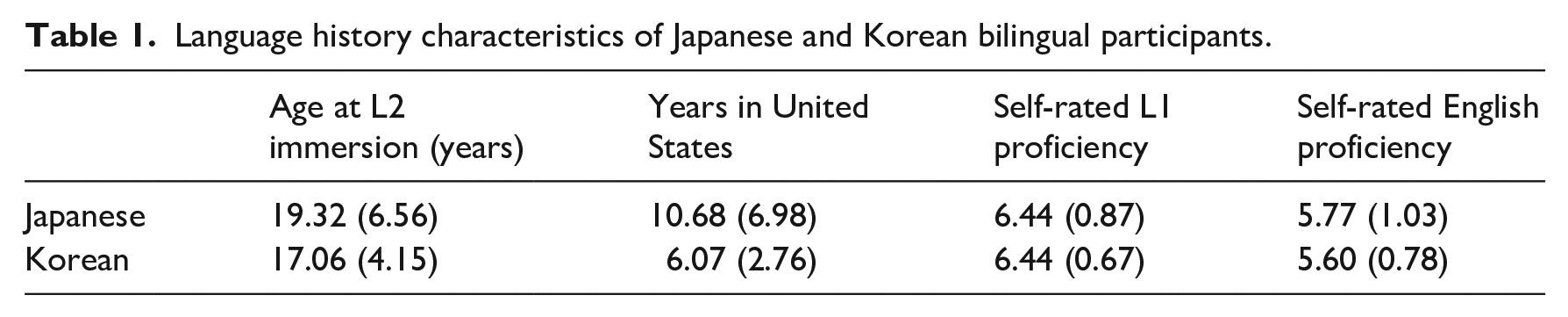
For Experiment 1 we also include data from Korean–English bilinguals (N = 24) and Korean monolinguals (N = 34) collected in prior research (Lebkuecher & Malt, 2021), but not previously reported. Korean bilingual participants were all native speakers of Korean who grew up in Korea and were not immersed in a predominantly English-speaking environment until age 14 or later (although many participants received some schooling in English before the age of 14). Table 1 summarizes the language history characteristics of the Japanese–English and Korean–English bilingual participants.
Language history characteristics of Japanese and Korean bilingual participants.
Design
We compared the animacy ratings of objects across speaker groups using a 5 (Korean–English bilingual vs Korean monolingual vs Japanese–English bilingual vs Japanese monolingual vs English monolingual speaker group) × 2 (inanimate objects vs human and animal entities) mixed design.
Materials
Stimuli consisted of images of all 60 sentence subjects used for the grammaticality judgment task. Utilizing an internet search, we obtained publicly available images that represented the subjects of the sentence stimuli (e.g., man, dog, knife). The full set of images is publicly available online: https://osf.io/39sze/.
Procedure
Participants completed the animacy rating task after completing Experiment 2, but we report the results here first to validate the suggestion that the animacy constraint on sentence subjects in Japanese grammar is more aligned with the semantic representation of animacy than the constraint in Korean grammar. The task was completed at the end of the first session for monolingual participants and the end of the second session for bilingual participants.
Participants were presented with the 60 images of the sentence subjects individually, in a random order, and were asked to rate each object in terms of how animate or “alive” it was on a scale from 1 = not at all animate to 7 = completely animate. The task was presented in Japanese, Korean, or English as relevant. As noted earlier, the animacy ratings from Korean–English bilinguals and Korean monolinguals were obtained in prior studies (Lebkuecher & Malt, 2021).
Results
We conducted linear mixed-effects models to analyze animacy ratings across speaker groups. All mixed-effects models were conducted with the lme4 (Bates et al., 2015) and lmerTest (Kuznetsova et al., 2017) packages in R version 4.0.5 (R Core Team, 2021). We chose the maximal random effects structure that permitted model convergence for each model (Barr et al., 2013). These same procedures were also used for the analyses presented in Experiment 2. The data and R scripts used for analysis are publicly available online: https://osf.io/39sze/. To find out whether the semantic representation of animacy aligns with Japanese grammatical animacy constraints, we compared animacy ratings for human and animal versus inanimate objects across the speaker groups. Mean ratings are displayed in Figure 1.
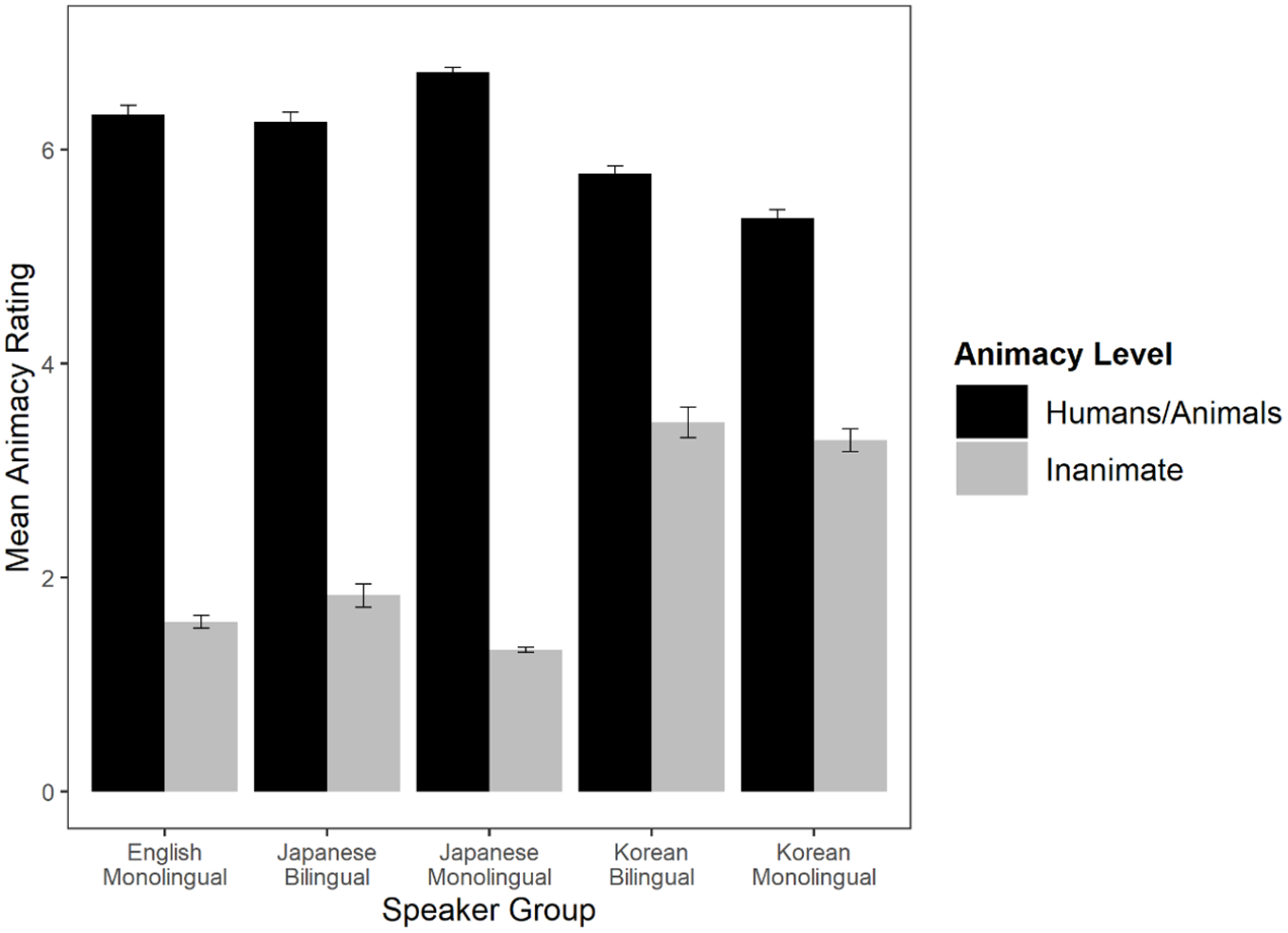
Mean animacy ratings across speaker groups.
Animacy rating was the outcome variable of a linear mixed-effects model with animacy (human and animal vs inanimate objects) as a within-subject fixed effect and speaker group (Japanese bilingual vs Japanese monolingual vs English monolingual vs Korean bilingual vs Korean monolingual) as a between-subject fixed effect. We also included an interaction between animacy and speaker group. The random effects structure consisted of a by-participant intercept, a by-participant random slope for animacy, a by-item intercept, and a by-item random intercept for speaker group. There was a significant main effect of animacy (β = 3.80, t(200.01) = 22.99, p < .001) and speaker group (β = −0.52, t(188.11) = −3.56, p < .001) as well as a significant interaction between animacy and speaker group (β = 3.24, t(178.78) = 9.04, p < .001). All participants rated humans and animals (M = 6.11) as more animate than inanimate objects (M = 2.23) regardless of speaker group (β = 3.80, t(200.01) = 22.99, p < .001). This confirms that individuals across speaker group conceptualize humans and animals as having higher animacy than other objects and that Japanese grammatical constraints align with the conceptual representation of animacy.
Korean speakers produced a higher animacy rating than other speaker groups on average (β = −0.52, t(188.11) = −3.56, p < .001). To better understand the interaction between animacy and speaker group, we investigated the simple effect of animacy within each speaker group. There was a significant main effect of animacy for all speaker groups: Korean monolinguals (β = 2.20, t(187.55) = 6.26, p < .001), Korean bilinguals (β = 2.52, t(173.58) = 5.86, p < .001), English monolinguals (β = 4.78, t(150.16) = 11.00, p < .001), Japanese monolinguals (β = 5.43, t(157.88) = 16.30, p < .001), Japanese bilinguals (β = 4.46, t(154.84) = 12.67, p < .001).
Experiment 2: grammaticality judgments by Japanese speakers
Participants
The same individuals who participated in Experiment 1 participated in Experiment 2.
Design
The study used a 2 (high vs low animacy) × 2 (SVO vs SOV word order) × 3 (Japanese–English bilingual vs Japanese monolingual vs English monolingual speaker group) mixed design. We treat the within-Japanese bilingual group comparison (those who received the full set of sentences versus those who received the subset of sentences from Lebkuecher & Malt, 2021) as a separate comparison.
Materials
Language history survey
A language history survey containing questions about participants’ demographics and language background was used to assess participants’ language experience. Monolinguals completed an abbreviated version of the language history survey for the bilinguals. The survey was given to the bilinguals in English and translated into Japanese for Japanese monolinguals. The full language history survey is publicly available online: https://osf.io/39sze/.
Sentence stimuli
Stimuli for the grammaticality judgment task consisted of 120 sentences that crossed animacy and word order such that there were 30 sentences of each combination: high animacy subject and SOV word order, high animacy subject and SVO word order, low animacy subject and SOV word order, low animacy subject and SVO word order. Only the sentences with a high animacy subject and SOV word order are completely grammatically acceptable in Japanese. Sixty of the sentences were parallel in content and word order to the Korean ones used in Study 1 of Lebkuecher and Malt (2021), and the other 60 were sentences of a similar structure but contained human and animal subjects. See Table 2 for some sample stimuli. The full list of sentence stimuli is publicly available online: https://osf.io/39sze/
Sample sentence stimuli for Experiment 2.
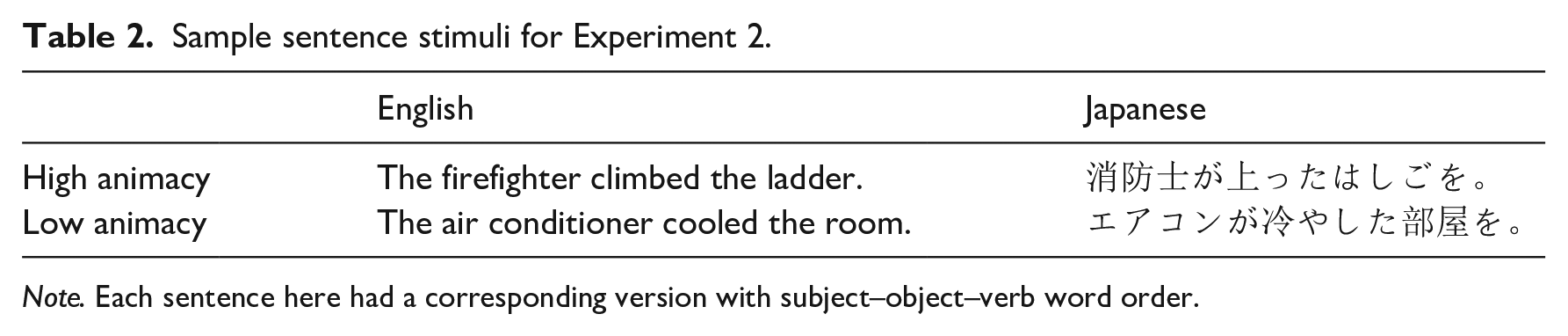
Note. Each sentence here had a corresponding version with subject–object–verb word order.
Procedure
The study was hosted on Qualtrics (http://www.qualtrics.com) and completed online. All participants viewed a web page containing the consent information for the study. They then answered several screening questions to ensure that they were qualified to take part: “Did you grow up in Japan?” “Is Japanese your native language?” “How old were you before you traveled to an English-speaking country?” and “How long have you been in the U.S.?” To proceed to the rest of the tasks, bilingual participants had to report growing up in Japan with Japanese as their native language, to have been in the United States for at least 1 year, and to not have traveled to an English-speaking country before the age of 14 years (to ensure that they acquired native-like Japanese before being immersed in English).
Monolinguals completed one session in their native language. They completed the language history survey followed by a grammaticality judgment task and then the animacy rating task. For the grammaticality judgment task, participants were presented with each sentence individually in their native language, in a random order. They were asked to rate each sentence in terms of how grammatical it was on a scale ranging from 0 = not at all acceptable to 100 = completely acceptable.
Bilingual participants completed two sessions, one in English and one in Japanese, at least 1 week apart. The order of the sessions was counterbalanced across participants. During the English session, participants began by completing the language history survey in English. They began the Japanese session by answering several open-ended questions about their school or work experience in Japanese before continuing to the main tasks to establish a Japanese language context. They then completed the grammaticality judgment task in the language of the current session. Bilingual participants completed the animacy rating task just once at the end of their second session administered in the language of the session. All participants were debriefed and thanked for their time upon completion of the experiment with bilinguals being debriefed after the second session.
Results
Since we collected grammaticality judgments from bilingual participants in both L1 (Japanese) and L2 (English), we were able to investigate both L1 and L2 influence on grammaticality judgments. Here we focus on L2 influence as it is relevant for our central hypotheses. A supplementary analysis of L1 influence is available in the Appendix 1. The data and R scripts used for all analyses in Experiment 2 are publicly available online: https://osf.io/39sze/.
Utilizing the same analysis procedures as Experiment 1, we compared the Japanese grammaticality judgments of bilinguals who completed the task with the full set of sentence stimuli with those of the Japanese monolinguals to investigate evidence for L2 influence on L1 Japanese grammaticality judgments of animacy and word order. This comparison is the critical one for evaluating our main hypothesis. Mean grammaticality ratings for each speaker group by sentence type are represented in the left panel of Figure 2 alongside a graph (the right panel) illustrating the mean grammaticality judgments for this same comparison with Korean–English bilinguals in previous research (Lebkuecher & Malt, 2021).
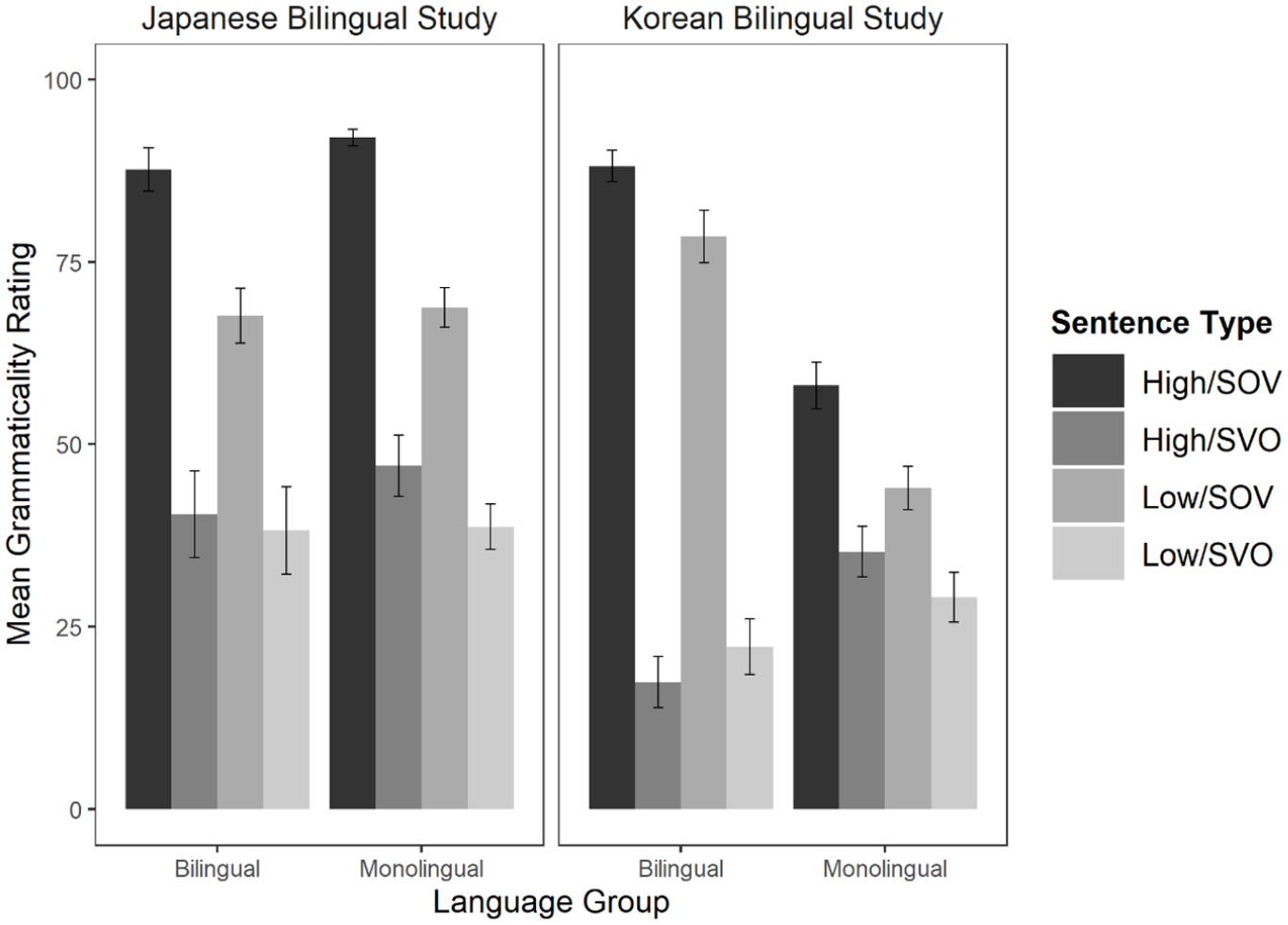
Mean L1 grammaticality ratings across speaker group.
We conducted a linear mixed-effects model with grammaticality rating as the outcome variable. Animacy (high vs low) and word order (SOV vs SVO) were within-subject fixed effects while speaker group (monolingual vs bilingual) was the between-subject fixed effect. We also included interactions between speaker group and animacy, speaker group and word order, and animacy and word order. The final random effects structure consisted of a random by-participant intercept, random by-participant slopes for animacy, word order and their interaction, and a random by-item slope for word order. There was a significant main effect of animacy (β = 13.51, t(39.20) = 8.28, p < .001), a significant main effect of word order (β = 37.96, t(42.26) = 6.13, p < .001), and a significant interaction between animacy and word order (β = 16.45, t(39.99) = 5.91, p < .001).
To follow up this interaction, we analyzed the simple effect of animacy in each word order separately. High animacy sentence subjects were rated higher than low animacy sentence subjects for both SOV (β = 21.73, t(39.82) = 8.78, p < .001) and SVO (β = 5.28, t(39.38) = 3.02, p = .004) word order. There was no significant main effect of speaker group (β = 1.35, t(39.00) = 0.36, p = .72) and no significant interactions between animacy and speaker group (β = 5.26, t(39.00) = 1.71, p = .09) or word order and speaker group (β = 0.19, t(39.00) = 0.02, p = .99). Given that speaker group was non-significant as both a main effect and when interacting with other variables, these results show no evidence of L2 influence on Japanese bilingual speakers’ L1 syntax. Both speaker groups demonstrated a preference for high animacy sentence subjects and SOV word order.
We also compared Japanese bilingual speakers’ grammaticality ratings with those of a comparison group of Japanese bilinguals who completed the study with the subset of sentence stimuli parallel to those used with Korean bilinguals in Lebkuecher and Malt (2021). Since all sentence subjects from this subset are considered “low animacy” according to canonical Japanese grammar, we only had one within-subject fixed effect, word order (SOV vs SVO), in addition to the between-subject fixed effect of experimental group (full sentence stimuli vs subset of sentence stimuli) and grammaticality rating as the outcome variable. As predicted, there was a main effect of word order (β = 1.00, t(50.54) = 3.15, p = .003), but no main effect of experimental group (β = 0.19, t(39.00) = 0.02, p = .99) and no interaction between word order and experimental group (β = −0.17, t(37.00) = −0.30, p = .77). Both experimental groups exhibited similar ratings for the different sentence types and the anticipated preference for SOV over SVO sentences. Since Japanese bilinguals who rated a stimulus set parallel to that given to Korean speakers in Lebkuecher and Malt (2021) did not significantly differ from Japanese bilinguals who rated the full stimulus set, the absence of L2 syntactic influence here cannot be attributed to a difference in stimuli between the studies.
General discussion
The current study investigated how L2 influence on L1 animacy constraints is affected by the alignment between semantic and syntactic representations of animacy. In Experiment 1, all speaker groups (including Korean monolingual and bilingual speakers from previous work) were asked to rate images representing each sentence subject from the stimuli in terms of the level of animacy or “aliveness” that they attributed to each object. As expected, all speaker groups (Japanese bilingual, Japanese monolingual, English monolingual, Korean bilingual, Korean monolingual) rated humans and animals as significantly more animate than inanimate objects (see Figure 1). Higher animacy ratings for humans and animals relative to other entities maps directly onto the animacy constraint observed in Japanese grammar.
In Experiment 2, participants rated sentences that had either high animacy (e.g., “the woman”) or low animacy (e.g., “the kettle”) subjects, and SOV or SVO word order, for grammaticality. The ratings provided by Japanese–English bilinguals in each language were compared with those of monolingual speakers. In contrast to our findings from Korean–English bilinguals, Japanese–English bilinguals’ grammaticality ratings did not significantly differ from monolingual speakers in either language. In Japanese, both bilinguals and monolinguals strongly preferred sentences with high animacy subjects and SOV word order (see Figure 2). To ensure that the observed lack of L2 influence on L1 judgments of Japanese bilinguals in the current study did not occur due to differences in sentence stimuli, we asked a separate sample of Japanese bilinguals to complete the grammaticality task with only the subset of sentences that comprised the stimuli in the study with Korean speakers (Lebkuecher & Malt, 2021). There were no significant group differences in grammaticality ratings on these items, confirming that the lack of L2 influence in the current study did not arise due to differences in the stimulus set.
Taken together, these results suggest no cross-linguistic influence on Japanese–English bilinguals’ representation of animacy constraints and word order. Unlike Korean bilingual speakers (Lebkuecher & Malt, 2021), Japanese bilingual speakers appear to maintain access to native-like animacy constraints in their L1 grammar. The differing L2 influence between Japanese–English and Korean–English bilinguals cannot be explained by longer L2 immersion or higher English proficiency for Korean bilingual participants. The two speaker groups had a similar mean age of exposure to L2 and length of immersion in an L2 environment (see Table 1). Because the Japanese speakers had actually been in the United States several years longer than Korean speakers on average, we would expect greater L2 influence for Japanese rather than Korean speakers if length of immersion had an effect on the likelihood of L2 influence. Furthermore, most bilingual participants across both speaker groups were students at American universities. Therefore, participants from both speaker groups likely spent a substantial proportion of their daily time in an L2 context. In addition, Korean and Japanese bilingual participants reported similar levels of L1 and English proficiency, suggesting that proficiency level is not a sufficient explanation for the differences in cross-linguistic influence exhibited by Japanese and Korean bilinguals.
Thus, we propose that differences in the alignment of syntactic and semantic features of animacy between Japanese and Korean are the source of this differing crosslinguistic influence. Our findings from the animacy ratings indicate that animacy constraints in Japanese grammar have a higher level of correspondence with the semantic representation of animacy than animacy constraints in Korean grammar. A mismatch between syntactic and semantic features may lead to a difficulty integrating these features for grammatical structures located at the syntax–semantics interface (e.g., animacy). This added difficulty may result in greater vulnerability of Korean L1 animacy constraints to L2 influence relative to Japanese L1 animacy constraints.
In sum, our findings suggest that not all structures at the syntax–semantics interface are equally vulnerable to cross-linguistic influence. A syntactic structure’s vulnerability to cross-linguistic influence may depend not only on their location at the interface with other linguistic domains per se, but also on the level of conflict between the grammatical rules specified by the structure and the representation of non-syntactic features (e.g., semantic/conceptual features). This may provide an explanation for seemingly conflicting findings from prior research investigating cross-linguistic influence at the syntax–semantics interface.
Footnotes
Appendix 1
Acknowledgements
The authors thank Kiri Lee for helpful discussion and assistance with the recruitment of research assistants and participants and Junko Kanero for translating Japanese materials and recruiting and collecting data from participants.
Declaration of conflicting interests
The author(s) declared no potential conflicts of interest with respect to the research, authorship, and/or publication of this article.
Funding
The author(s) disclosed receipt of the following financial support for the research, authorship, and/or publication of this article: This work supported was by the National Science Foundation (grant number 1057885).
