




Abstract
This study investigated what psychological and social factors predict ‘perceived nativelikeness’ in late second language (L2) learners of French (L1 Swedish) (N = 62) with a minimum length of residence (LOR) of 5 years in France. The included factors were: language aptitude (LLAMA), acculturation (VIA), personality (MPQ), target language engagement and social networks (number of relations in L2). LOR and Length of French studies were also included as extraneous variables. Multiple linear regression analyses showed that positive effects were found for LLAMA D (sound recognition), acculturation (VIA France and VIA Sweden), number of relations in L2 and LOR. A negative effect was found for the personality variable Social initiative. The strongest effects were found for LLAMA D, Social initiative and LOR. All variables together explained 25% (adjusted R²) of the variance in the sample, which represents medium-sized effects in relation to other studies on individual factors. In sum, these findings confirm results from earlier studies on the importance of language aptitude and acculturation in late L2 acquisition. They also add evidence of the importance of personality, social networks, and LOR. On a more general note psychological and social factors combine to explain different outcomes in adult L2 acquisition, although the effects of psychological variables are deemed somewhat stronger.
Keywords
I Introduction
Research on adult second language acquisition has shown that late second language learners (i.e. who started learning the language after puberty), may display nativelike performance for specific linguistic features. However, they generally do not perform within the first language (L1) speaker range when assessed across a number of second language (L2) structures (e.g. Abrahamsson and Hyltenstam, 2009; Granena and Long, 2013a). In Abrahamsson and Hyltenstam (2009), the authors scrutinized the language proficiency among 41 L1 Spanish L2 Swedish speakers through a variety of linguistic measures known to be difficult for learners of L2 Swedish. They found that no late learner performed within the L1 speaker range for all linguistic measures.
While the possibility to attain nativelike levels in an L2 thus seems highly limited, one of the results, not often highlighted when speaking of the results of Abrahamsson and Hyltenstam (2009), is that 19% of the late learners were actually perceived as native speakers (NSs) by NSs of Swedish (for details, see Section IV.2). This phenomenon is labeled ‘perceived nativelikeness’ by Abrahamsson and Hyltenstam (2009), as opposed to ‘scrutinized nativelikeness’, which is the objective performance on the totality of linguistic tests through which the participants’ proficiency level is assessed. The fact that these 19% of late learners did come across as L1 speakers is not in focus of the Abrahamsson and Hyltenstam (2009) study, yet in our view, this is a noteworthy figure. Inspired by Abrahamsson and Hyltenstam (2009), Forsberg Lundell et al. (2014) followed the same procedure to investigate (among others) perceived nativelikeness among 30 late learners of L2 French (L1 Swedish). In this study, 10 out of 30 participants were perceived as NSs. However, even among those learners who were perceived as NSs, there were differences in their oral production with respect to morphosyntactic errors, formulaic language and lexical richness in comparison with the L1 control group. These findings corroborate the idea that across-the-board, scrutinized nativelikeness is rarely found in late L2 learners, but they also show that perceived nativelikeness is a possibility for some late L2 learners.
A relevant follow-up question for both of these studies is then: why do some late L2 learners attain perceived nativelikeness and others do not?
Research on age effects in second language acquisition (SLA) has suggested that the importance of social and psychological factors increases after puberty (see also Hyltenstam, 2018), and several researchers have stressed the need to examine factors such as language aptitude, motivation and personality among adult second language learners (Moyer, 2014; Muñoz and Singleton, 2011). This also aligns well with recent proposals from the Douglas Fir Group (2016), who argued that SLA research needs to be conducted under a more transdisciplinary framework, accounting for emotional, social, and ideological factors that affect language learners in today’s world characterized by globalization and mobility. The present study aims at responding to these calls and takes perceived nativelikeness as a starting point.
It is not entirely clear what linguistic features are decisive for perceived nativelikeness, but it could reasonably be assumed that pronunciation is an important component. Pronunciation is likely to be the linguistic feature that is most affected by maturational constraints (e.g. Granena and Long, 2013a). At the same time, it is also suggested that pronunciation is affected by a range of social and psychological factors (e.g. Moyer, 2004, 2013; Nagle, 2013). Perceived nativelikeness could thus be a useful variable in the endeavor to understand the role of social and psychological factors in adult SLA.
The study includes adult L2 learners of French who started learning French in puberty or later and who have resided in France for at least 5 years. They are L1 Swedish voluntary migrants who have spent at least 5 years in the host community, but often much longer. This particular group is interesting for the purpose of the study, since Forsberg Lundell et al. (2014), as stated above, showed that a considerable proportion of speakers with this language pairing and similar socio-educational profiles were perceived as NSs. There was, however, as well important individual variation, which will potentially allow for a fruitful study into the role of individual factors. The study focuses on three psychological factors, namely, language aptitude, personality, and acculturation, as well as the two following social factors: language engagement and social networks. It also includes length of residence (LOR) and length of French studies as extraneous variables. The research question to be answered is: What psychological and social factors predict perceived nativelikeness in long-term L2 residents?
II Background
1 Perceived nativelikeness
a Conceptual aspects
In spite of the fact that ‘nativelikeness’ can be problematic to define in objective terms and can entail ideological issues (Dewaele, 2018; Hyltenstam et al., 2018), perceived nativelikeness is still a notion that corresponds to a reality from the participant perspective. Both L1 speakers and L2 speakers categorize the speech of other speakers on a daily basis. Numerous studies testify to the capacity of NSs to detect non-native speech (e.g. Munro et al., 2010). Speaker perception has also long been the object of inquiry of sociolinguistics and research into language attitudes. As Moyer (2013: 14) states, ‘as social beings, we inevitably size up one another according to perceived similarity–difference’. She presents two separate points which motivate the present study. She argues that, from a theoretical concern, it is puzzling that some L2 speakers end up sounding like NSs and others do not. From an applied perspective, given the practical importance of sounding foreign, it is of importance both for the individual and for society to deepen our knowledge about this phenomenon (Moyer, 2013).
Studies that have investigated the specific issue of perceived nativelikeness are quite scarce to date. There are however numerous studies that have been carried out on ‘perceived foreign accent’ (e.g. Birdsong, 2003; Bongaerts et al., 2000; Hopp and Schmid, 2013; Nagle, 2013), which all account for some participants being perceived as having no foreign accent. However, we will not review this literature in detail, since ‘perceived foreign accent’ is a more limited concept, targeting specifically accent, whereas perceived nativelikeness is plausibly a more holistic rating, also involving other linguistic features. An important difference between studies on foreign accent and studies on perceived nativelikeness can be exemplified by the study of Bergeron and Trofimovich (2017) (same methods used in Saito et al. (2017) as well). In their study, they defined accentedness as ‘how strongly speakers’ speech was influenced by their L1 or was colored by other nonnative features’ (Bergeron and Trofimovich, 2017: 554). They asked raters, on a sliding scale, to rate speakers from ‘no accent at all’ to ‘heavily accented’. The main difference compared to our operationalization (see Section IV), is that they clearly direct raters toward the concept of accentedness and foreignness, whereas our concept of perceived nativelikeness is more general and does not specify any linguistic categories. It is accordingly less precise, but possibly also more similar to categorizations in everyday life.
In the studies reviewed in the next section, perceived nativelikeness is conceptualized in a very simple manner. NS evaluators listen to samples of speech and are asked whether the person they listen to is a NS or not of their own L1. Only studies which apply this specific concept are included – for conceptual reasons, but also in order to limit the reviewed research.
b The incidence of perceived nativelikeness
In what follows, we will review studies in terms of the incidence of perceived nativelikeness in L2 speakers. While the concept remains unclear in specific linguistic terms, some of the reviewed studies give us a few ideas about what linguistic features are involved in the judgment.
One of the first studies that examined perceived nativelikeness was that of Ioup et al. (1994), although the authors did not use this precise term. In their study on two exceptional learners of L2 Cairean Arabic, Julie and Laura, 8 out of 13 NS evaluators rated them as NSs of Cairean Arabic. The five raters who did not identify them as NSs referred to features of pronunciation that they believed revealed their non-nativeness.
Moyer (1999) designed a study including several oral tasks of which some were controlled tasks and included phonological aspects known to be difficult in German for English speakers. A sample of 24 participants with high levels of motivation as well as several years of previous formal studies of German was selected. However, they had quite short LOR in a German-speaking country (M = 2.7 yrs). Four NSs of German were also included as a control group. A group of four NS judges were asked to evaluate the different productions on a scale from 1 (clearly native) to 6 (clearly not native). To the author's surprise, only 1 of the 24 non-native speakers (NNSs) obtained judgments that were in the range of the native control group. None of the others passed as a NS. Moyer (1999) further requested that the judges identify the errors that influenced their decisions and cited segmental errors, non-native intonation errors, syntactic errors, and vocabulary choices as the most frequent.
Two larger studies both used perceived nativelikeness as a screening criterion. Montrul and Slabakova (2003) searched for near-native speakers of L2 Spanish (L1 English). Raters were asked to rate their overall impression of speech samples from NSs’ and NNSs’ spontaneous speech on a scale from 1 (definitely non-native) to 5 (definitely native). All the NNSs that received scores within the NS range were classified as near-natives (‘passing as NSs’). Out of 64 NNS included, 17 participants passed as NSs, which is almost 27%. Abrahamsson and Hyltenstam (2009) conducted a study on Spanish/Swedish bilinguals and included both those who had started learning Swedish before puberty and those who had started learning after puberty. A 'pass-as-native' test was used as a tool to ensure that the informants had a high level of proficiency (2009: 258). 104 participants out of 195 participants were perceived as NSs. Out of the 104 participants, 17 had started learning the language after puberty (19%). As also mentioned in the introduction, Forsberg Lundell et al. (2014) used the same methodology for late L1 Swedish L2 French participants and it turned out that 10 out of 30 (33%) participants passed as NSs.
To pass or be perceived as a NS has also been discussed from a sociolinguistic point of view. In Piller’s study (2002), 27 of 73 (37%) participants judged, through self-assessment, that they passed for NSs. Piller (2002) argues that for her participants, reaching a nativelike level is not a stable phenomenon. It is a linguistic behaviour adopted by the NNSs in certain situations, in which passing as a NS seems appropriate or desirable. An interesting linguistic aspect that emerges from Piller's study is that she observes, while interacting with the participants, that the use of regional variation helps the participants to pass for NSs. In Forsberg Lundell (2013), a small-scale study was conducted on speech samples that had been perceived as being produced by NSs and those that had not (8 PASS-samples, 8 NON-PASS-samples). The analysis showed that the speech samples that had been characterized as ‘passing’ included a few characteristic linguistic features that could not be found in the corresponding ‘non-pass’ samples. These features were: features of local sociolinguistic variation in pronunciation and in lexis, and use of idiomatic expressions. These limited findings lend support to Piller’s (2002) suggestions. Gnevsheva (2016) further adds to this growing body of research in her study on listener perceptions and ratings to different varieties of English and non-native speech. She concluded that raters rely to a large proportion on pronunciation, but that socio-cultural clues are often also mentioned, such as ‘she sounded like a Kiwi girl [. . .]’ i.e. the New-Zealand variety of the speaker is taken as a guarantee for her nativeness (2016: 266).
In sum, the research findings as regards perceived nativelikeness suggest that it is not infrequent in populations within extended LORs, although it is always a minority of the populations that ‘pass as natives’. In addition, it is interesting to observe that perceived nativelikeness seems to involve sociolinguistic variation, idiomaticity and pronunciation. All of these are features which psychologists Doucerain, Segalowitz and Ryder (2017) mention as linguistic categories that are dependent on host culture acculturation. Accordingly, it could be assumed that perceived nativelikeness would relate to acculturation and possibly also to other social and psychological factors in a migratory context.
2 Nativelikeness, perceived nativelikeness and individual factors
The factors chosen for this study are mainly identified through their prevalence in relation to perceived nativelikeness and similar constructs in earlier studies. A more overarching guiding theoretical principle for our multi-factorial approach is the framework presented by The Douglas Fir Group (2016), which emphasizes the importance of considering cognitive, social, affective as well as ideological factors in explaining outcomes in second language acquisition. Since the present study concerns long-term L2 users, residents in the host community, it seems particularly adequate to adopt such an integrative approach. In the framework of the Douglas Fir Group (2016), three inter-dependent levels are identified: 1) The Micro-level (The individual’s neuro-biological, cognitive, and emotional capacities and his/her interaction with others in a specific social context), 2) The Meso-level (socio-cultural institutions and communities, economic, cultural, and political circumstances) and 3) The Macro-level (ideological structures, belief, and value systems). In the current study, the focus is on the Micro-level, considering cognitive and emotional capacities as well as social language practices. The framework does not present a coherent theory of language learning, but builds on the assumption that the three levels interact. This means that we are fully aware of the limitation of the current study, which focuses on a contribution to our understanding of the Micro-level.
To date, research is scarce on psychological and social factors and perceived nativelikeness and we need to resort to studies on neighboring constructs such as foreign accent, to gain insights into and hypothesize what factors may have an effect. In the present study, two factors have been singled out as more likely to be related to perceived nativelikeness: language aptitude and acculturation/identity. These will be reviewed first. Second, factors that have rarely been investigated, but could potentially be relevant for perceived nativelikeness will be reviewed. The factors can thus be divided into primary and exploratory independent variables in the analysis.
Language aptitude is one of the individual factors that has received most attention in research on nativelikeness (e.g. Abrahamsson and Hyltenstam, 2008; DeKeyser, 2000; Granena and Long, 2013a). Granena and Long (2013b: 1) confirm that, after age, language aptitude is the second-best explanatory factor for differential outcomes in second language acquisition. As Saito et al. (2019: 204) explain, a high language aptitude helps learners to fully benefit from their L2 experience, when processing, analysing and extracting regularities from the input. As regards perceived nativelikeness, the most compelling study is that of Abrahamsson and Hyltenstam (2008) on L2 Swedish (L1 Spanish). Their study showed that all the late starters (N = 11) in their pool of pre- and post-puberty learners, who were perceived as NSs, also had above average scores on the LLAMA aptitude test (Meara, 2005), which is the same test used in the present study (including four sub-components described in Section IV.2). Abrahamsson and Hyltenstam did not, however, analyse the importance of the different sub-components, but used a composite score of language aptitude. Another highly relevant study is that of Granena and Long (2013a), who studied the impact of age and aptitude on three linguistic domains in L2 Spanish (L1 Chinese). Their study shows that there is a significant correlation between language aptitude, also measured through LLAMA, and foreign accent ratings in the late starters of their group (age of onset (AO) 16–29, N = 18). Of the sub-components, LLAMA E (sound-symbol correspondence) and LLAMA F (grammatical inferencing) were associated with foreign accent ratings. Both of these studies suggest an important role for aptitude in naturalistic late L2 acquisition, but the impact of different sub-components is not conclusive.
In a large-scale study, Dollmann et al. (2020) investigate the effect of ‘compensatory’ variables for the acquisition of nativelike accent beyond the critical period in a naturalistic setting. Compensatory here refers to variables that may compensate for a late start in learning the L2. Their study includes a large pool (N = 1843) of immigrants of various L1 backgrounds in Germany. They did not specifically study language aptitude, but based on the findings regarding the positive effects of aptitude, they propose that cognitive skills in general could have a positive effect on foreign accent. The test included to measure cognitive functioning is a language-free Culture Fair Intelligence test (Weiβ, 2006), measuring fluid intelligence (taps into problem-solving skills and contrary to crystallized intelligence, does not depend on experience or education). They also include attendance or completion of upper secondary studies. The study shows that there is indeed a compensatory effect of both of these measures on degree of foreign accent in learners who start their acquisition after age 10.
An additional psychological (social psychological) factor is acculturation. As early as 1976, Schumann proposed the Acculturation model for second language acquisition, which implied that social distance between the learner and the host community would have an important impact on the process of second language acquisition. Findings have been inconclusive and the model was abandoned for a while, but the concept re-emerges from time to time. Lybeck (2002) discusses the importance of acculturation for pronunciation, in a small-scale study on 9 L1 English L2 Norwegian learners. In her study, she operationalizes acculturation through social network theory and indeed found that the participants who entered into more social networks, and thus had the opportunity to acculturate, reached higher levels of nativelike pronunciation. Moyer (2004) reported similar relationships in her population of 25 immigrants in Germany of varying backgrounds, investigating the role of cultural identification for accent. In a similar vein, Gatbonton and Trofimovich (2008) found a significant link between ethnic group affiliation (EGA) – a construct similar to acculturation – and second language proficiency in terms of pronunciation.
Using the Vancouver Index of Acculturation (VIA) questionnaire (see Section IV.2), which measures affiliation with both the heritage and the host cultures (a construct thus different from Schumann’s but nevertheless related), Panicacci and Dewaele (2017) showed that lower degrees of acculturation were also related to feeling different when speaking in one’s L2. In addition, Panicacci (2019) showed a significant relationship between L1/L2 dominance and acculturation in a population of L1 Italian L2 English speakers. Panicacci (2019) argues that the cognitive and cultural embrace of the target language contributed to the participants’ sense of belonging in the host community.
In view of earlier studies, perceived nativelikeness is possibly related to language aptitude, but also to acculturation and identity. However, in the present study given our theoretical conviction that language learning in a migratory setting benefits from a multi-factorial approach, it is also important to reflect upon what other factors might have an impact on perceived nativelikeness. In what follows, we will address a number of other individual factors that may be related to perceived nativelikeness.
Given that acculturation and identification may be of importance, it is also likely that perceived nativelikeness could be related to personality. Kormos (2013) suggests that affective factors, including personality, can have more importance than aptitude in naturalistic settings, where capacities for creating opportunities for learning are so important. However, this variable has, to date, generally not yielded strong correlations in SLA (see Dewaele, 2013). However, an interesting study is that of Verhoeven and Vermeer (2002), who investigate the link between communicative competence and personality variables according to the Big Five model in L1 and L2 speaking children. They found that in L2 learners, communicative competence was primarily related to the trait Openness to Experience. This finding resonates with Forsberg Lundell and Sandgren (2013), studying the relationship between personality and productive collocation knowledge. They found that mastery of collocations in L2 French was related to the personality dimensions of Openmindedness and Cultural Empathy in the Multicultural Personality Questionnaire (MPQ, van der Zee et al., 2013), a personality questionnaire which measures a person’s capability to adjust to a new cultural environment (see Section IV.2).
This last finding can be related to the study of Hu and Reiterer (2009) who examine the link between pronunciation talent and personality. Among all the personality variables investigated, the only one related to pronunciation is that of Empathy (as measured by the E-scale, a psychometric sound instrument). They argue that this is in line with earlier research from the 70’s on the role of ‘ego boundaries’ and empathy for pronunciation (e.g. Guiora et al., 1972). Personality thus seems to be a factor worth exploring in a study on the impact of multiple factors and perceived nativelikeness.
With respect to social factors, the role of target language use and social networks has increasingly been highlighted within SLA research (see also Moyer, 2014). Language use is difficult to measure, but successful attempts have been made by the LANGSNAP-project (see Mitchell et al., 2017) which investigated the role of language engagement and social networks in second language acquisition during a year abroad. Research on these variables carried out in a study abroad context has yielded conflicting results with respect to the importance of sheer quantity of target language use for linguistic development during a stay abroad, but correlations have been observed between different social network variables and measures of language gains during study abroad (e.g. Baker-Smemoe et al., 2014; Freed et al., 2004; Mitchell et al., 2017). Also, as stated above, Lybeck (2002) found a correlation between the capacity to enter into social networks and nativelike pronunciation. This study was, however, small-scale, including only 9 participants.
Finally, the large-scale study by Dollmann et al. (2020) mentioned in relation to aptitude did not only find an effect of cognitive ability on foreign accent, but also an effect for three social network variables, namely language use with family and friends, share of immigrants in immediate neighborhood and language use with partner. These findings related to both pronunciation and general proficiency taken together suggest that language use and social networks could be of importance when trying to explain differential outcomes in perceived nativelikeness.
All in all, it seems likely that the different factors discussed above could have an effect on perceived nativelikeness. Besides the advantage that language aptitude seems to confer to late L2 learners, positive affect and identification with the host community, a particular personality profile open to new cultural experiences, social relationships and language use, could all be potentially important for the development of perceived nativelikeness.
3 Motivation for the current study
As seen from the literature review above, perceived nativelikeness has not been investigated to any extent in relation to psychological and social factors and specifically, we concur with Moyer (2013: 51) in that ‘few researchers have tested multiple factors at once to get a full picture of their [the learners’] L2 experience’. There are a few studies that indicate the importance of language aptitude and acculturation, but since studies are scarce and there are no studies involving other factors, there is a clear research gap. This specific study is concerned with perceived nativelikeness, but it is part of a larger project, devoted to the understanding of the multi-factorial nature of adult SLA in a migratory context.
III Research questions and hypotheses
The research question of this article is: To what extent do the following factors predict perceived nativelikeness?
Language aptitude
Acculturation
Personality
Language use
Social networks
This question relates to the five psychological and social factors that we are mainly interested in in this article (in total 13 separate independent variables in the statistical analysis, see Table 1). The regression analysis also includes two extraneous variables – LOR and length of French studies. As Higby and Obler (2016) argue, findings with respect to LOR are inconsistent – some studies show LOR effects even after 5–10 years in the TL community, while others do not. It also depends on the linguistic variable included. Similarly, the role of instruction in L2 ultimate attainment is not clear-cut either, as discussed by e.g. Muñoz and Singleton (2011). Therefore, these variables cannot be excluded from having an effect, although they are not central to the theoretical interest of the present study, which is a typical characteristic for extraneous variables. In order to control for them, they are included as additional independent variables in the analysis.
Factors vs. independent variables included in the study.
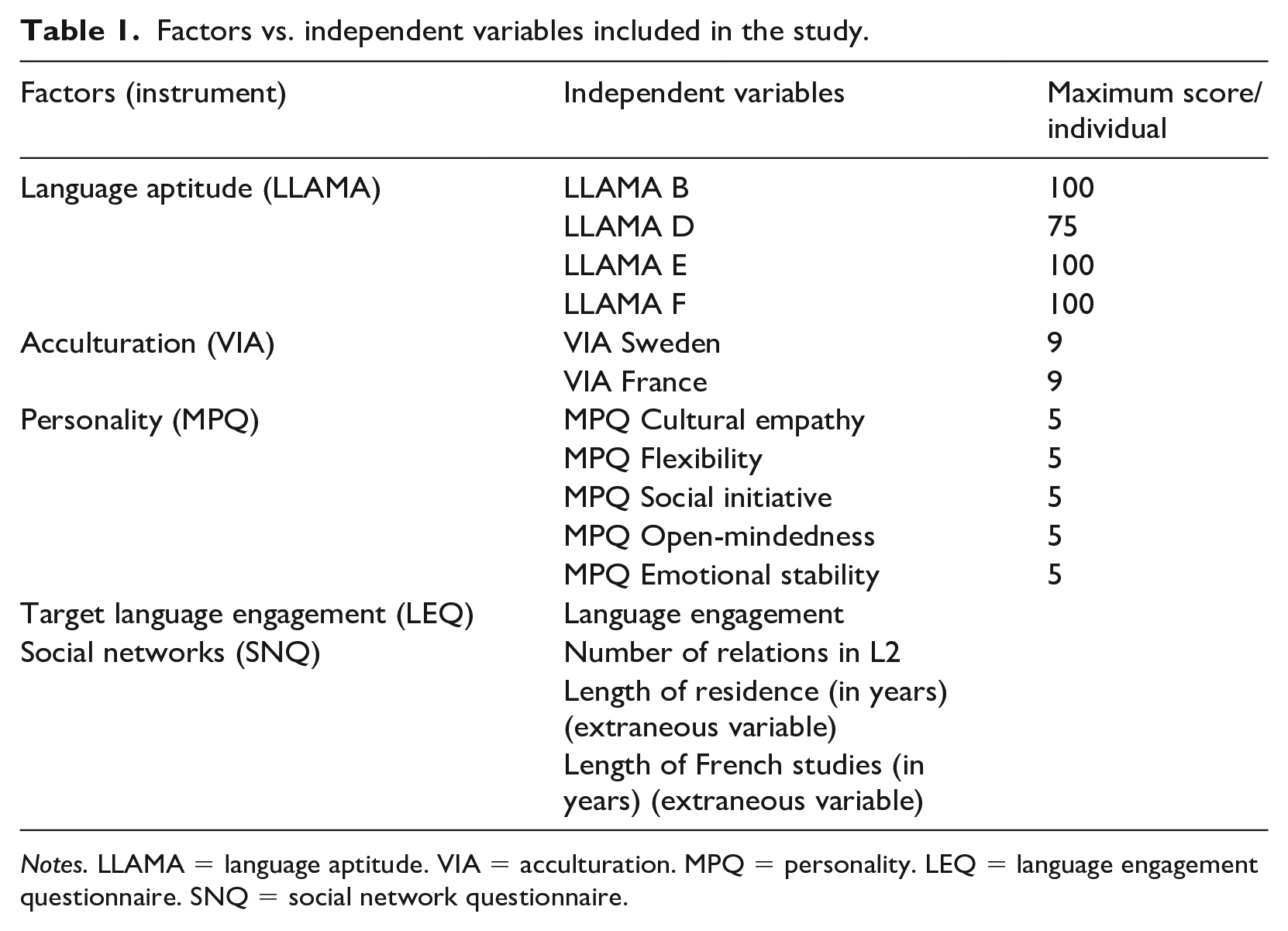
Notes. LLAMA = language aptitude. VIA = acculturation. MPQ = personality. LEQ = language engagement questionnaire. SNQ = social network questionnaire.
Based on the previous research, we propose the following hypothesis: Perceived nativelikeness will be related to language aptitude given its general importance for late L2 acquisition and specifically for perceived nativelikeness (see Abrahamsson and Hyltenstam, 2008). Perceived nativelikeness will also be related to acculturation since earlier research points to the importance of identification and identity for pronunciation. (Gatbonton and Trofimovich, 2008; Moyer, 2014)
Language aptitude and acculturation are thus our primary factors and the others are exploratory. In addition, no specific predictions regarding the subcomponents of language aptitude will be made, since earlier findings are scarce and the study largely exploratory.
IV Methods and procedures
1 Participants
The present study includes 62 L1 Swedish L2 French speakers. The participants consisted of 53 women and 9 men. Their mean age of testing was M = 45.84 (SD = 1.96), ranging from 26 years to 76 years. Their LOR was M = 20.94 (SD 11.45), ranging from 5 to 54 years. All of them finished secondary studies in Sweden, before coming to France, except one participant who spent a year in a French school during her adolescence. Of the 62 participants, 57 were raised in a monolingual home. The remaining 5 grew up in a bilingual home, where L1 Swedish and English (n = 1), Finnish (n = 2), Italian (n = 1) or Hungarian (n = 1) were spoken. The participants were carefully selected based on the following socio-biographic criteria:
They all had Swedish as their main L1 (as can be seen above, a few were however raised in bilingual homes, although none of them with French as the other L1).
They all had finished upper secondary education.
They had started learning the French language no earlier than 12 years of age.
They had all spent at least 5 years in France.
SLA research has earlier shown that LOR effects tend to diminish after 5 years of residence (Cummins, 1981), which led us to set the limit at 5 years. However, as stated above, findings as regarding LOR effects are not conclusive.
Recruitment of participants relied on the method of convenience sampling. In a first phase, participants were recruited through the Facebook group Svenskar i Paris (‘Swedes in Paris’). Advertisements were also sent to The Swedish Church in Paris, The Swedish School in Paris and the Swedish Institute, also in Paris. In a second phase, participants were recruited through snowball sampling, using acquaintances from those recruited in phase one. The entire recruitment and data collection process was carried out by the second author of this study. The participants were offered two promotional products from Stockholm University as a token of appreciation, but no financial compensation was given in accordance with Stockholm University practices.
The initial aim was to collect data from more participants than the final 62 included. However, it turned out impossible, due to time and financial constraints, to recruit a larger number of participants. Although this would have been desirable for reasons of reliability, we would like to insist on the value of the present dataset, given the relative scarcity of data on this category of participants in SLA.
2 Instruments: Perceived nativelikeness (dependent variable)
The assessment of perceived nativelikeness was based on the method developed by Abrahamsson and Hyltenstam (2009) (also used by Forsberg Lundell et al., 2014).
The participants in our study were asked to speak for two to three minutes, either about ‘their favorite hobby’ or ‘their favorite spot in Paris’ (two topics and a length of recording similar to the one used for eliciting ‘spontaneous speech’ by Moyer, 2004). Following Abrahamsson and Hyltenstam, 20–30 second extracts were selected from the middle of a 3-minute recording. This length has been shown to be sufficient in speech-judgment tasks involving naïve listeners (cf. Flege, 1984). Care was taken that the 20–30 second extracts contained no information which would reveal the origins of the participants. Then, also following Abrahamsson and Hyltenstam (2009), 10 L1 evaluators were asked to evaluate each speech sample. The L1 evaluators were all from the Paris region (the site for data collection for the study and the home of the L2 participants). They were between 25 and 40 years old and had a post-secondary education. Many of them had knowledge of two foreign languages, or even three, but no knowledge of Swedish, which was a criterion. They were recruited through the second author’s group of acquaintances based on the criteria given (minimum 18 years, secondary studies completed, not linguist, no knowledge of Swedish). We decided to use naïve listeners, following Abrahamsson and Hyltenstam (2009), since our main interest is perception of everyday speech. For the same purpose, they were only allowed to listen to the same sound file once, in order to ascertain ecological validity. For an overview of listener effects, see e.g. Saito et al (2017).
Furthermore, the L1 evaluators were told that they would participate in a task covering recognition of speaker origin, both in terms of regional features and foreign features. Abrahamsson and Hyltenstam (2009) described this procedure as a means of distracting evaluators from focusing solely on foreignness, since research has shown that slight deviances in advanced L2 speech can be interpreted as regional variation (Markham, 1997). A similar procedure was also used by Marinova-Todd (2003) for the evaluation of very advanced L2 speech. The raters listened to the participants’ speech samples as well as five equivalent speech samples from L1 speakers of French 1 (all of whom were rated as NS by 10 out of 10 evaluators). They were asked to choose between the following options: (A) this person has French as her/his mother tongue, and she/he comes from the Paris region; (B) this person has French as her/his mother tongue, and she/he does not come from the Paris region; (C) this person does not have French as her/his mother tongue. Accordingly, (A) or (B) means that a speaker is perceived as a NS whereas (C) means that they are not.
In the present study, perceived nativelikeness was operationalized as the number of evaluators rating the person as a NS of French (A or B). The score thus ranges from 0 to 10 (given that there were 10 evaluators) and reflects the plausibility that a person will be considered as a NS by other NSs. Each participant’s score of perceived nativelikeness is, accordingly, the collective perception of dichotomous judgments made by 10 raters (a continuous variable in the statistical analysis, ranging from 1 to 10). It should be noted that in Abrahamsson and Hyltenstam (2009), a participant was considered to ‘pass as a NS’ if s/he is evaluated as a NS (options A and B) by at least 6 out of 10 L1 evaluators. In the present sample, 21 out of 62 participants ‘pass as a NS’ according to their criterion, which represents 34% of the included population.
3 Psychological tests and questionnaires (independent variables)
The LLAMA aptitude test (Meara, 2005), is one of the most recently developed tests of language aptitude. It has previously been used by Abrahamsson and Hyltenstam (2008) and Granena and Long (2013a), among others. It was validated by Rogers et al. (2017), in a population of 404 participants, yielding robust results across a range of individual differences. The test measures language aptitude with respect to vocabulary learning (LLAMA B), sound recognition (LLAMA D), sound-symbol correspondence (LLAMA E) and grammatical inferencing (LLAMA F). Each test has 100 as a maximum score, except for LLAMA D which has 75 as the maximum score.
The Multicultural Personality Questionnaire (MPQ), short form (Van der Zee et al., 2013) measures an individual’s potential to function in a new cultural environment. It is a questionnaire based on the Five-factor model (McCrae and Costa, 1987), the most influential personality model to date. The MPQ has been adapted for the purpose of testing multicultural effectiveness. It includes 40 items and measures personality along five dimensions, with scores ranging from 1–5 (totally not applicable – completely applicable) on each dimension:
Cultural Empathy: the ability to empathize with cultural diversity and to understand feelings, beliefs and attitudes different from one’s own heritage.
Open-mindedness: an open, unprejudiced attitude towards diversity.
Social Initiative: the tendency to approach social situations actively, to take the initiative and engage in social situations.
Flexibility: the ability to learn from new experiences, including adjusting behavior according to contingency and enjoying novelty and change.
Emotional Stability: the tendency to remain calm in stressful situations and to control emotional reactions.
The VIA Acculturation questionnaire (Ryder et al., 2000) was developed by psychologists in Canada to measure levels of acculturation in the target community among migrants. Here, ‘acculturation’ refers to a process taking place as a result of contact between individuals having different cultural origin, during which many aspects of self-identity are modified to accommodate experiences within the new culture. This process involves changes in a number of different domains, including attitudes, behaviors, values, and sense of cultural identity. The questionnaire was recently used by Panicacci and Dewaele (2017) in a study on L2 use and migratory experiences. It consists of 10 items assessing migrants’ attachment to their heritage culture (VIA Sweden) and 10 items assessing their host culture attachment (VIA France). Respondents were asked to consider their culture of origin as their heritage culture and the culture of the country they were residing as their host culture. Participants were asked to express their preference for typical values, traditions, and practices for each culture on a 9-point Likert scale ranging from 1 (disagree) to 9 (fully agree).
4 Sociological questionnaires (independent variables)
The language engagement questionnaire (LEQ) (McManus et al., 2014) measures frequency of language use and was developed by the LANGSNAP-project (Mitchell et al. 2017). It has been successfully used in both French and Spanish contexts. Participants were asked to indicate how often they carry out 23 activities in the target language (the original includes 27 activities, four of which were not relevant for the present context), including both passive and active language use. The six response options range from ‘never’ to ‘every day,’ which we then coded with numerical values ranging from 0 (never) to 5 (every day). In this study, ‘language engagement’ was operationalized as the average frequency of target language use, calculated by adding up the 23 values corresponding to the 23 activities and then dividing the sum by 23.
The social network questionnaire (SNQ) (McManus et al., 2014) provides detailed information about the number of people included in the social networks of the participants in the target community, how they interact with these people and in what languages. It has also been successfully used in both French and Spanish contexts. The questionnaire generates rich information regarding e.g. nature of relationships and frequency of interactions. However, since social networks is one of many variables in the present study, we were only able to include one social network variable, namely the number of people with whom the participant regularly interacts (only) in L2 French.
In addition, a socio-biographic questionnaire was also filled in, including e.g. education, age and LOR based on Moyer (2004). LOR and Length of French studies were used for the present study.
To sum up, the following factors were included in the study, operationalized as a number of independent variables in the regression analysis. Table 1 shows the factors with the instrument used in parenthesis and the variables corresponding to each factor and finally, the extraneous variables.
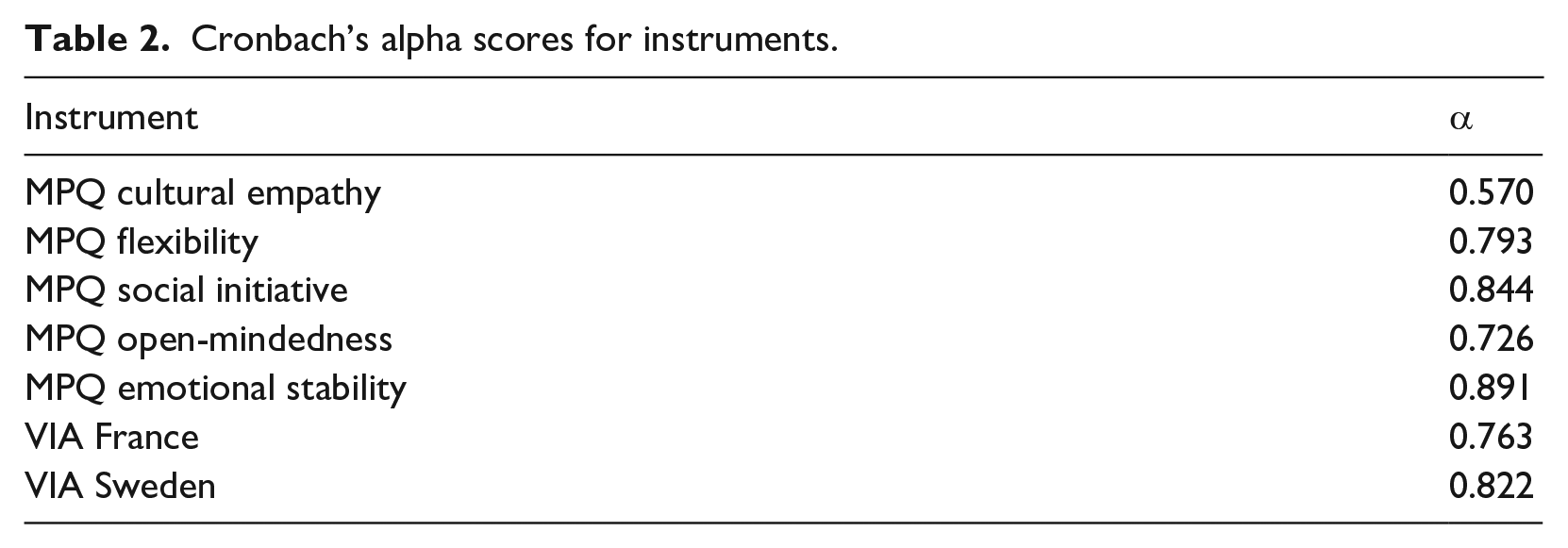
Cronbach’s alpha was used to calculate a measure of reliability in the cases where the tests were compatible with this type of calculation. The Multicultural Personality Questionnaire is divided into five dimensions and the VIA questionnaire in two dimensions, with alpha scores calculated for all of these. Scores can be found in Table 2. As the table shows, all reliability scores are acceptable, except for the MPQ dimension Cultural empathy.
Cronbach’s alpha scores for instruments.
5 Data analysis
A general important feature of the present data analysis is our adherence to recent recommendations to abandon significance testing. The recommendations come from individual researchers (e.g. McShane et al., 2019) as well as from The American Statistical Association (ASA) (Wasserstein and Lazar, 2016; Wasserstein et al., 2019). Similar recommendations have also been discussed within the specific domain of SLA by Larson-Hall and Plonsky (2015). Consequently, in Section V, we will focus on estimates of effect sizes and the uncertainty associated with measures, instead of declaring an effect ‘significant’ or ‘not significant’ based solely on p-values.
a Multiple linear regression analysis
To test our hypotheses and investigate the possible effects of our other variables, multiple linear regression analyses were conducted with perceived nativelikeness as the dependent variable.
b Assumptions
The following applies to both models described in Section V. Inspection of scatterplots with residuals and predicted values indicated linear relationships. The inspection also indicated that heteroscedacity of variance was not a problem. Furthermore, inspection of Q-Q plots and kernel density plots indicated that residuals were approximately normally distributed, thus we did not transform the data. The models were also tested for multicollinearity. The variance inflation factor for all variables was lower than 2 and the tolerance levels all exceeded .5. Consequently, multicollinearity was likely not a problem. The analyses in Section V were conducted using the statistical software R version 3.6.3 (R Core Team, 2020).
V Results
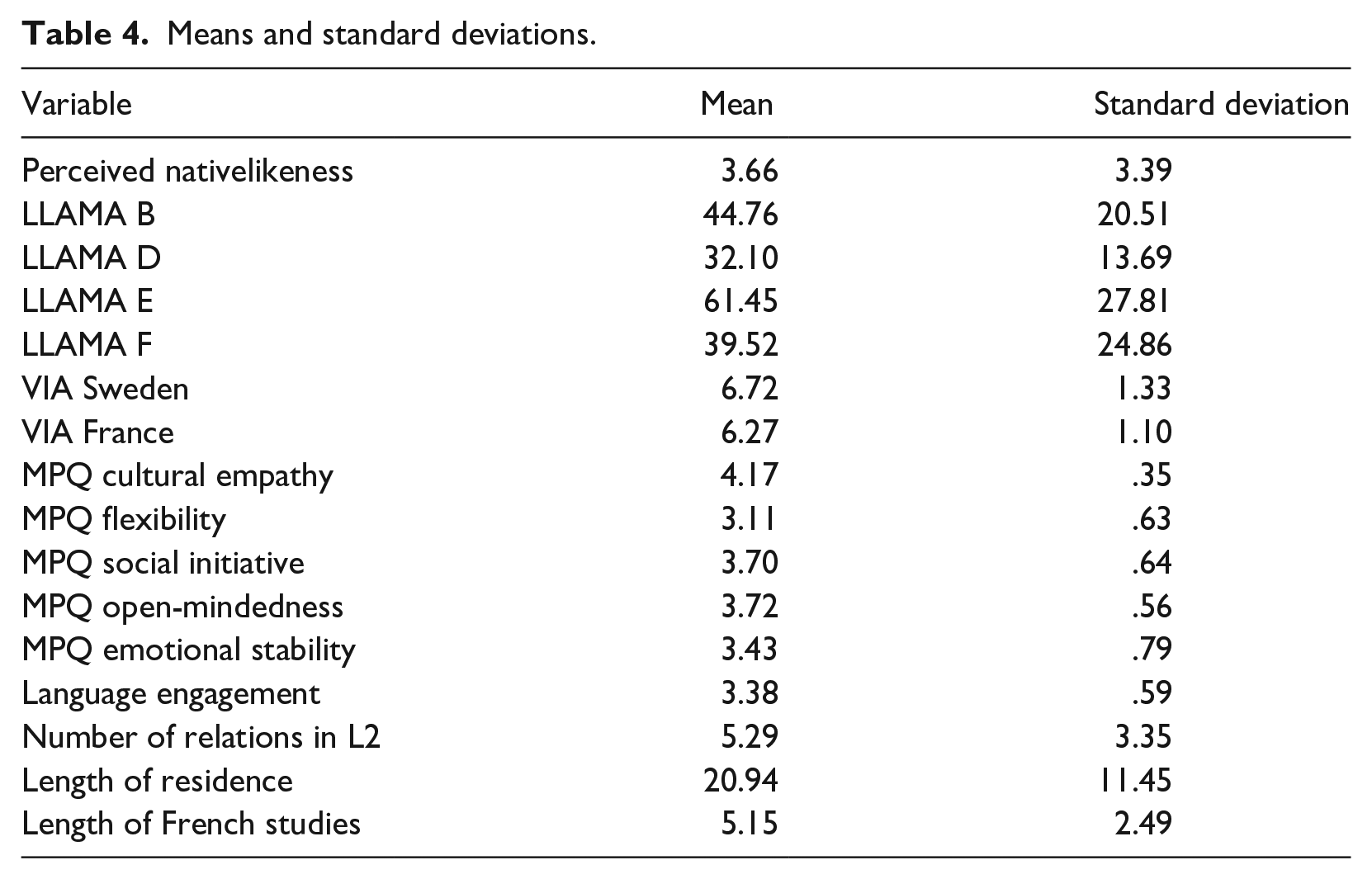
In order to illustrate each variable’s effect on perceived nativelikeness, we present the effects in terms of how much a person’s score on a variable would have to increase to change perceived nativelikeness by one evaluator and how much it would need to increase to change perceived nativelikeness by one SD (3.39 evaluators). We understand that this may be unconventional. However, in line with our attempt to adhere to current ASA recommendations, this presentation of the statistics attempts to make the effects more meaningful. Furthermore, to better understand what these changes mean, please be reminded that perceived nativelikeness ranges from 0 to 10, and that 0 means that no evaluator judged the speaker as a NS, and that 10 means that all the evaluators judged the speaker as a NS. For descriptive statistics for all variables, see Table 4 below; for a correlation matrix, see Appendix in supplemental material.
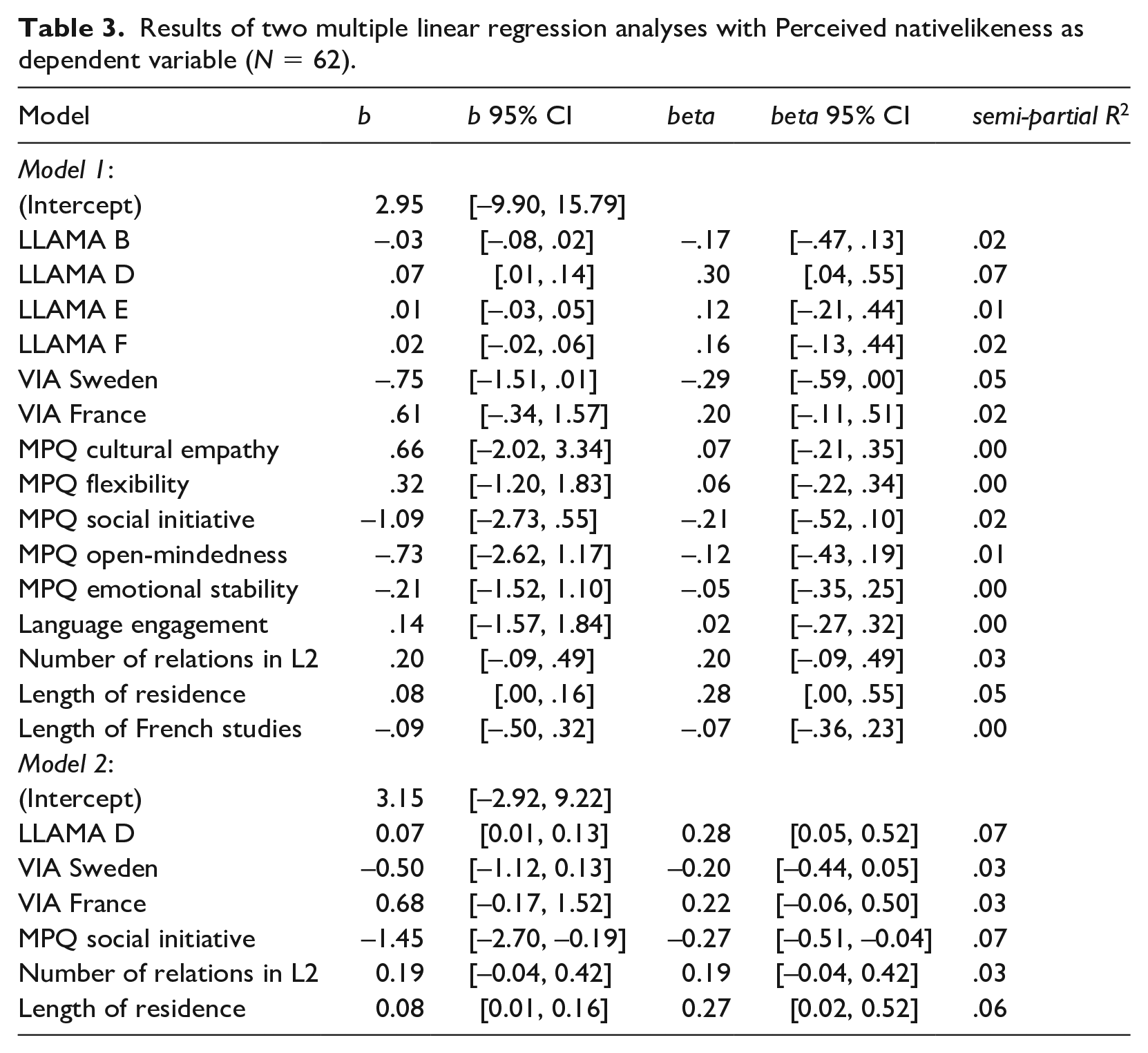
We present two multiple linear regression analyses below. The reason for this is the exploratory nature of the present study. First, in Model 1, all of the study’s variables are included to present their respective effects or lack of effects on perceived nativelikeness. Thereafter, in Model 2, we present a more compact model which only includes the variables that we judge had an important effect on perceived nativelikeness, based on the results from Model 1. That is, Model 2 is our proposal for what factors are important for understanding perceived nativelikeness. The effect of each variable is presented for each factor separately, and both for Model 1 and 2. For the results of both multiple linear regression analyses, see Table 3.
Results of two multiple linear regression analyses with Perceived nativelikeness as dependent variable (N = 62).
Model 1
Including all variables as predictors, Model 1 explained 39% of the variance in perceived nativelikeness. This effect is to be considered a medium sized effect according to Plonsky and Ghanbar (2018: 724). However, since R2 automatically increases with the number of variables, adjusted R2 (19%) is a more correct estimate of the explained variance given the number of predictor variables in the model. This effect is considered small/medium according to Plonsky and Ghanbar (2018: 724).
a Language aptitude
Please be reminded that the LLAMA B, E, and F measures range from 0 (poor) to 100 (excellent) percent while LLAMA D ranges from 0 (poor) to 75 (excellent) percent. In line with our hypothesis, Model 1 indicates that language aptitude (LLAMA variables) is important for perceived nativelikeness. The analysis indicates that LLAMA D has an effect on perceived nativelikeness while the other measures have no or small effects. Specifically, the regression coefficient for LLAMA D (b = .07) indicates that one extra evaluator would rate a speaker as a NS for each 14.29% (i.e.
b Acculturation
Both VIA measures range from 1 (lower) to 9 (higher) on a continuum. The analysis supports our hypothesis that a person’s acculturation affects perceived nativelikeness. More precisely, for VIA Sweden the regression coefficients (b = −.75) indicate a decrease of one evaluator per 1.33 points and one SD per 4.52 points. For VIA France the regression coefficient (b = .61) indicate an increase of one evaluator per 1.64 points and one SD per 5.56 points. In other words, it indicates that a person’s cultural orientation towards their heritage culture may have a larger impact on perceived nativelikeness than their orientation towards the host culture. However, the effect sizes are fairly similar, and because of the uncertainty in our measurements (see the 95% confidence intervals in Table 3), the order of these effects may differ in the population. Nonetheless, the analysis suggests overall that perceived nativelikeness will be influenced by peoples’ orientation towards their heritage and host cultures.
c Personality
Each of the personality measures range from 1 (lowest) to 5 (highest). Overall the analysis indicates that personality only has a small effect. More precisely, the largest effect of personality is from a person’s social initiative. The analysis suggests that the higher social initiative score a person has, the lower perceived nativelikeness. That is, the regression coefficient (b = −1.09) indicates that for every .92 points on the social initiative scale, perceived nativelikeness drops by one evaluator and it takes 3.11 points to lower perceived nativelikeness by one SD. This surprising result will be further discussed in Section VI. For the remaining personality measures, the regression coefficients indicate that if they have an effect, they will be small. Specifically, for cultural empathy (b = .66) it takes an increase of 1.52 to raise perceived nativelikeness by one and 5.14 to increase it by one SD; for flexibility (b = .32) a move of 3.13 is required to increase perceived nativelikeness by one and 10.59 to increase it by one SD; meanwhile for open-mindedness (b = −.73) it takes an increase of 1.37 to drop perceived nativelikeness by one and 4.64 to drop it by one SD; and finally, for emotional stability (b = −.21) it takes 4.76 to lower perceived nativelikeness by one and 16.14 to lower it by one SD. The negative result for open-mindedness is unexpected and will be briefly discussed in Section VI.
d Language engagement
The language engagement measure ranges from 0 (lowest) to 5 (highest). The present analysis indicates that a person’s language engagement does not have any important effect on perceived nativelikeness. More precisely, the regression coefficient (b = .14) indicates that a person needs to increase 7.14 points (more than the maximum of the measure), to increase with one evaluator on perceived nativelikeness, and 24.21 points to increase it by one SD.
e Social networks
A person’s social network in which they interact using L2 (Number of relations in L2) has an effect on perceived nativelikeness, but the results indicate that the effect may be small. The regression coefficient (b = .20) suggests that the speaker needs to gain 5.00 more relationships in L2 French for one more evaluator to judge him or her as a NS and 16.95 relations to increase perceived nativelikeness by 1 SD.
f LOR and length of French studies
Besides all the above-mentioned variables, we also asked the participants to report how long they have lived in France and their length of French studies. The results indicate that a person’s LOR influences perceived nativelikeness, but that the effect is small. The regression coefficient (b = .08) indicates that a speaker needs to have lived an additional 12.50 years in France for perceived nativelikeness to increase by one evaluator, or 42.38 years to increase it by 1 SD.
For length of French studies, the analysis indicates there is probably no effect of studying French on perceived nativelikeness (b = −.09). More precisely, the analysis suggests a person would lower perceived nativelikeness by one evaluator for each 11.11 years they study French and lower it by one SD for each 42.38 years, which does not make sense.
Model 2
Based on the results of Model 1, we propose a compact model including only a subset of the variables. Specifically, we selected the variables that had effects large enough to be considered important for understanding perceived nativelikeness. We did this while also considering the variables’ confidence intervals to make sure they were narrow enough for us to, with some certainty, judge that the effect likely exists in the sample. That is, Model 2 included LLAMA D, both VIA variables, social networks, LOR, and MPQ social initiative.
All in all, Model 2 explained 33% of the variance, which is lower than for Model 1, but this is to be expected with the lower number of variables. More importantly, the adjusted R2 was 25% (medium effect according to Plonsky and Ghanbar, 2018), which is higher than for Model 1 (19%). Thus, Model 2 is a better model of what variables influence perceived nativelikeness. As can be seen in Table 3, the selected variables’ effects differ slightly from what Model 1 suggests. Therefore, in the next section, each variable’s effect on perceived nativelikeness will be described again. Because our sample was small, the estimates in the model are fairly imprecise (see confidence intervals in Table 3).
a LLAMA D
According to Model 2, LLAMA D (b = .07) needs to increase by 14.29% on its 0 to 75 percent scale in order to change perceived nativelikeness by one evaluator, or 48.43 for an increase of one SD (3.39). Should we consider this effect important? As can be seen in Table 4, the SD of LLAMA D was 13.69%. Thus, approximately a change of one SD on LLAMA D is required to change perceived nativelikeness by one evaluator and about four SD to change it by a SD. Thus, we judge that the effect of LLAMA D is important, but small.
Means and standard deviations.
b VIA Sweden and VIA France
The model indicates that both VIA variables have approximately the same effect on perceived nativelikeness, but the effect of VIA Sweden is negative (b = −.50) whereas VIA France is positive (b = .68). Perceived nativelikeness is estimated to be lowered by 1 for each increase of VIA Sweden by 2.00 and increase by 1 for each increase of 1.47 in VIA France. That is, increases of 6.78 in VIA Sweden and 4.99 VIA France are required to change perceived nativelikeness by one SD. The VIA measures range from 0 to 9 and their SD are fairly small (VIA Sweden: 1.33; VIA France: 1.10). Thus, the changes required in a person’s orientation toward their heritage and host cultures would have to be rather drastic to have substantial effects. Nevertheless, although small, there is an effect. Furthermore, because of the imprecision of our measurements (see the confidence intervals in Table 3), it is difficult to say which of the VIA variables is more important.
c Number of relations in L2
According to Model 2, the number of relations in L2 (b = .19) increases perceived nativelikeness by one for each 5.26 relations and one SD per 17.84 relations. In our sample, the average participant had 5.15 relations in L2 and the SD was 2.29 relations. Thus, to have large effects on perceived nativelikeness, the number of relations would have to change by several SD.
d LOR
The effect of how long a person has lived in France was the same in Model 2 (b = .08) as in Model 1. That is, the model estimates that an additional 12.50 years is needed for perceived nativelikeness to increase by one, and 42.38 years to increase it by 1 SD. Hence, the numbers indicate that LOR has a small effect on perceived nativelikeness.
e Social initiative
Finally, a person’s tendency to take social initiatives influences perceived nativelikeness negatively (b = −1.45). Specifically, for each increase of .69 points on the 5-point scale, it is estimated that one fewer evaluator will judge the speaker as a NS, and for each 2.34 points it lowers perceived nativelikeness by one SD. The SD of social initiative is .64, that is, shifts by these magnitudes are quite large. Thus, although important, a person’s social initiative has a rather small effect on perceived nativelikeness. This effect will be further discussed in Section VI.
Summary
Model 2 indicates that the six included variables can be divided into two categories, that is, the more and the less influential variables. Specifically, the standardized regression coefficients (beta in Table 3) indicate that LLAMA D, MPQ Social initiative and LOR are the most influential variables of the six. However, the effects are too close in size and the confidence intervals are too broad for us to determine which of these three variables has the largest effect. The remaining three variables, VIA France, VIA Sweden, and Number of relations in L2, are less influential on perceived nativelikeness. Again, these three are also close in size, thus we cannot conclude which is more influential. Given the width of the confidence intervals, the order of these variables may differ in the population. However, the present order is the most likely, based on our sample.
VI Discussion and conclusions
In the present study, the main aim was to investigate which psychological and social factors best predict perceived nativelikeness in long-term L2 users. Perceived nativelikeness was chosen as dependent variable based on the assumption that it displays considerable variation among generally proficient late L2 speakers, and based on theoretical arguments for its dependence on various psychological and social factors.
The analysis included five main psychological and social factors and two extraneous variables. The psychological factors were: language aptitude (LLAMA, measured along four subtests), acculturation (VIA Sweden and VIA France), and personality (multicultural effectiveness, MPQ). The social factors were target language engagement and social networks (Number of social relations in L2). The extraneous variables were: LOR and Length of French studies. By means of a multiple linear regression analysis including all five factors (their corresponding variables) and the two extraneous variables, a first model singled out the variables that seemed to have an effect on perceived nativelikeness. They were: LLAMA D (sound recognition), MPQ Social initiative, LOR, VIA Sweden, VIA France, and Number of social relations in L2. Having identified these variables, a second model (Model 2) was proposed which included only these variables. This model accounted for 25% of the variance in the sample (adjusted R²), which is to be considered a medium-size effect. According to our analysis, the strongest effects can be found for LLAMA D, MPQ Social Initiative and LOR. The remaining three variables, related to acculturation and social networks, also have effects, but they are judged somewhat weaker. We also need to consider that our sample is fairly small (n = 62) and that the effect sizes of the different variables may be different in other samples. There is of course also a possibility that a variable would lose its effect if the analysis were to be replicated in another sample. However, since this study’s multi-factorial design is unprecedented in the study of perceived nativelikeness, Model 2 is, to date, the best explanation that we have for the incidence of perceived nativelikeness in an L2. Having a good capacity for sound recognition and a somewhat introverted personality, coupled with a long LOR in the host community, seem to constitute the best predictors for perceived nativelikeness. Identifying less with one’s heritage culture and more with one’s host culture as well as having many social relations in the L2 also have an importance.
The results thus confirmed the proposed hypothesis to some extent i.e. that both language aptitude and acculturation would predict perceived nativelikeness. As regards aptitude, the effect was, as reported, only found for LLAMA D (sound recognition). This aligns with the results from Abrahamsson and Hyltenstam (2008) and Granena and Long (2013a), who also found effects for aptitude. However, Abrahamsson and Hyltenstam (2008) used a composite aptitude score and Granena and Long (2013a) did not find an effect for LLAMA D, but found effects for other LLAMA subtests, namely LLAMA E and F. The difference between our result and that of Granena and Long (2013a), could be explained by the fact that they use foreign accent ratings, which is a slightly different dependent variable than perceived nativelikeness. In our understanding, the relationship between LLAMA D and perceived nativelikeness can be theoretically explained by the fact that LLAMA D measures the capacity to remember sound sequences, which could be a more important asset for producing nativelike speech, than phonemic coding ability (LLAMA E) and grammatical inferencing (LLAMA F). In Model 1, we unexpectedly found a negative, although unimportant effect for LLAMA B. Granena and Long (2013a) did not either find a significant positive effect for LLAMA B, which suggests that the capacity for vocabulary learning is not important for foreign accent or perceived nativelikeness.
With respect to acculturation, effects were found both for VIA Sweden and VIA France, although these effects are judged to be smaller than that for LLAMA D. Both of these variables address the same concept, that of cultural orientation, but from two different directions. As stated above in the literature review, Panicacci (2019), also using VIA, demonstrated a relationship between acculturation in the L2 community on the one hand, and L2 dominance on the other hand. L2 dominance is not the same dependent variable as perceived nativelikeness, but it also implies a nativelike proficiency level. Our results thus point in the same direction as those of Panicacci (2019). They also align well with those of Gatbonton and Trofimovich (2008), who found an observable link between what they call ethnolinguistic affiliation and pronunciation, even though both the dependent and independent variables that Gatbonton and Trofimovich (2008) use are different than those used in the present study. A question is whether a weaker cultural affiliation with Sweden and a stronger affiliation with France leads to developing perceived nativelikeness or whether, by contrast, being perceived as a NS leads to a weaker affiliation with Sweden and a stronger affiliation with France? This question requires further research.
Two of the exploratory variables also showed effects i.e. MPQ Social initiative (one of the three strongest variables) and Number of relations in the L2 (one of the three weaker variables). When personality in terms of multicultural effectiveness (MPQ) was included in the present study, the idea was that a personality disposed towards adjustment in a new cultural setting and thus a high score on all dimensions of the MPQ would have a positive effect on language proficiency, in view of e.g. the proposals of Kormos (2013). The one important effect that we found, was, on the contrary, negative. Besides the uncertainty of our measures and the relatively small sample, we can advance one possible explanation. The dimension Social initiative is based on the dimension Extraversion in the Five factor Model (McCrae and Costa. 1987). In his overview on Personality in SLA, Dewaele (2013) puts forward that findings regarding Extraversion/Introversion in SLA are inconclusive. One finding that may help to explain ours, is the one from the study of Biedrón (2011), who studied the effects of personality (according to the Big Five Model) on foreign language aptitude. In her study, Extraversion had a consistently negative effect on foreign language aptitude. Of interest to us, is that it affected MLAT 2 (Phonetic script) negatively, which like LLAMA D (although not the same constructs), taps in to the capacity to recognize different sounds. Given that aptitude, and especially phonetic memory, is important for perceived nativelikeness, there may be a connection here. Although less theoretically supported, this result is worth further exploration. Furthermore, it does not seem unlikely that a more introverted, less socially active personality type, would be more prone to observe and listen to others attentively, which could be important for developing perceived nativelikeness. It was also surprising that a negative effect was found for Open-mindedness in Model 1, given that this dimension is identified as an advantageous factor in earlier research. However, the effect was considered weak and unreliable and it was not included in Model 2. All in all, the unexpected results with respect to personality in the present data set, suggests that the role of personality deserves further exploration.
With respect to social networks and more precisely, Number of social relations in the L2, the effect was smaller than expected, especially given the effects observed in the recent study by Dollmann et al. (2020). It seems reasonable to assume that the more numerous the relations in an L2, the more the individual is exposed to important amounts of input of varying types, which facilitates language learning, but plausibly also facilitates acculturation, which was shown to have a positive effect.
One of the extraneous variables, LOR, also had an effect and was part of Model 2. Since our participants had very long LORs in general (mean 20 years), the effects of LOR were not expected. However, exposure is obviously important for perceived nativelikeness, so the observed effect makes sense. As Higby and Obler state (2016: 49–50), findings are inconclusive regarding LOR effects, but our study suggests that effects persist after the common assumption of 5–10 years in the host community and that it is a variable worthy of more attention. Besides the effects on exposure, one explanation could be that LOR reinforces the effects of acculturation and social relations in the L2. This would need further detailed analysis.
No effects were found for the other MPQ variables, target language engagement nor for length of French studies. This could be attributed to the homogeneity with respect to target language engagement (relatively high mean and little variance) and the other MPQ variables, with high means and low variance for e.g. Cultural Empathy, a dimension which could have been relevant in view of the literature. With respect to Length of French studies, it could possibly also have had an effect if participants with very little instruction had also been part of the sample. The participants included in the sample were not highly instructed in French in general, but the mean was around 5 years, most of them having been exposed during their secondary studies. It is, however, likely that their extensive experience outside of the classroom has played a more significant role for perceived nativelikeness.
The findings of the present study align well with those of Dollmann et al.’s (2020) large scale study, who found effects for cognitive ability and language use/social networks in the target language for degree of foreign accent. Our study as well as theirs indicate that it is a combination of psychological and social factors which explain perceived nativelikeness in an L2. In view of this overlap, it would indeed be relevant to further explore the linguistic correlates of the concept of perceived nativelikeness in a future study.
It needs to be acknowledged that the current results are limited to a specific population, their specific proficiency level and their LOR. When investigating other data sets it is possible that variance is greater and that other effects will emerge as important. More research into the effects of the variables in the present study with other populations is indeed needed. Given the results from the Study Abroad research mentioned in the Background, it is possible that some of these factors are more important in earlier stages of residence abroad.
Furthermore, in view of the prominent role of language aptitude and specifically LLAMA D, future studies need to pay specific attention to the validity and reliability issues related to the LLAMA aptitude test that have been raised by both Bokander and Bylund (2020) and Suzuki (2021).
While calls have been made by e.g. Moyer (2013, 2014) and the Douglas Fir Group (2016) for a multi-factorial approach to adult L2 acquisition, it is rare to find studies that include both psychological and social variables in one and the same study. This allows for an understanding of the relative importance of each factor; however, we have not studied the interaction of these factors, which would constitute a welcome way forward. It is always difficult to disentangle what pertains to the psychological from what pertains to the social. Nevertheless, the current study allows us to propose that those factors that we label as psychological do seem to have a more prominent role for perceived nativelikeness than social factors.
Supplemental Material
sj-docx-1-slr-10.1177_02676583221091396 – Supplemental material for What factors predict perceived nativelikeness in long-term L2 users?
Supplemental material, sj-docx-1-slr-10.1177_02676583221091396 for What factors predict perceived nativelikeness in long-term L2 users? by Fanny Forsberg Lundell, Klara Arvidsson and Andreas Jemstedt in Second Language Research
Footnotes
Acknowledgements
We would like to express our gratitude to the anonymous reviewers and the editors for their important contributions to this text. In addition, we would like to thank Anders Sand for his valuable advice on statistical matters.
Declaration of Conflicting Interests
The author(s) declared no potential conflicts of interest with respect to the research, authorship, and/or publication of this article.
Funding
The author(s) disclosed receipt of the following financial support for the research, authorship, and/or publication of this article: This research was funded by Vetenskapsrådet (The Swedish Research Council), grant number 2017-01196.

Notes
References
Supplementary Material
Please find the following supplemental material available below.
For Open Access articles published under a Creative Commons License, all supplemental material carries the same license as the article it is associated with.
For non-Open Access articles published, all supplemental material carries a non-exclusive license, and permission requests for re-use of supplemental material or any part of supplemental material shall be sent directly to the copyright owner as specified in the copyright notice associated with the article.
