




Abstract
There is emerging evidence that collocation use plays a primary role in determining various dimensions of L2 oral proficiency assessment and development. The current study presents the results of three experiments which examined the relationship between the degree of association in collocation use (operationalized as t scores and mutual information scores) and the intuitive judgements of L2 comprehensibility (i.e. ease of understanding). The topic was approached from the angles of different task conditions (Study 1), rater background (first language or L1 vs. second language or L2) (Study 2) and cross-sectional vs. longitudinal analyses (Study 3). The findings showed that: (1) collocation emerged as a medium-to-strong determinant of L2 comprehensibility in structured (picture description) compared to free (oral interview) oral production tasks; (2) with sufficient immersion experience, L2 raters can demonstrate as much sensitivity to collocation as L1 raters; and (3) conversational experience is associated with more coherent and mutually-exclusive combinations of words in L2 speech, resulting in greater L2 comprehensibility development.
I Introduction
Whereas scholars have begun to examine the lexical characteristics of second language (L2) speech which can be judged to be fluent (Tavakoli and Uchihara, 2020), comprehensible and contextually appropriate (Saito, 2020), and highly proficient (Kyle and Crossley, 2015), the existing literature has suggested the use of multiword units (collocations) as a key factor when assessing L2 vocabulary. In this investigation, we aim to examine the variance in the predictive power of collocation under different task and rater conditions from both cross-sectional and longitudinal perspectives.
1 Collocation, n-gram, and L2 proficiency judgements
According to usage-based accounts of second language (L2) acquisition, language is formulaic in nature, with language exemplars stored as ‘chunks’ in the mental lexicon (Bybee and Hopper, 2001). Such chunks, which represent a single or function, are termed as ‘formulaic sequences’ (Wray, 2005). It is thought that sufficient exposure to these chunks in a variety of different contexts can help learners automatize their access to them in response to any relevant contextual and linguistic cues (Ellis, 2012). There is ample research evidence that both L1 (first language) and L2 speakers receive and produce collocations more rapidly, accurately, and subconsciously than novel strings of words (e.g. Ellis et al., 2008; Sonbul, 2015). There is some corpus research showing that multiword combinations make up approximately half of written and spoken English (Erman and Warren, 2000), and are particularly characteristic of oral discourse among native speakers (Biber et al., 1999), although such estimates may vary as per scholars’ definitions and operationalizations of collocation.
To date, researchers have illustrated the formulaicity of language using various different constructs, such as collocation, n-grams, and lexical bundles (for comprehensive reviews, see Wood, 2019). To further understand the various illustrations of formulaicity, one useful notion in corpus linguistics concerns (1) co-occurrence and (2) recurrence (Paquot and Granger, 2012).
Co-occurrence ‘consists in the co-selection of (usually) two lexical items, which may be, but are not necessarily, contiguous’ (Paquot and Granger, 2012: 136). Broadly speaking, one such form of co-occurrence is collocation, defined as adjacent word pairs that co-occur repeatedly in certain contexts (e.g. ‘reception desk’, ‘information desk’, ‘sports desk’), and/or as a part of linguistic functions (e.g. phrasal verb plus object for ‘think of him’). In the field of L2 vocabulary research, however, the precise definition of collocation widely varies across studies (for the phraseology vs. corpus-based approaches towards collocation, see also Boers and Webb, 2018).
The other dimension, reoccurrence refers to ‘the repetition of contiguous strings of words of a given length (e.g. bigrams, trigrams)’ (Paquot and Granger, 2012: 138). Following this line of thought, the ‘lexical bundle’ approach conceptualizes formulaic language based only on the frequency of discoursal rather than semantic functions (Biber et al., 1999). Thus, any combinations of words are allowed as long as they frequently occur in a reference corpus regardless of the semantic partnership of word combinations (‘think highly of’ and ‘think of the’). Under this lexical bundle approach, a growing number of scholars have focused on the frequency of multiword expressions consisting of specific numbers (‘n’) of words (i.e. n-grams) in a reference corpus as an index of collocation. Raw n-gram frequency scores include not only semantically and structurally complete sequences (e.g. ‘think’ and ‘of’), but also random co-occurrences of incomplete lexical items (e.g. ‘think’ and ‘desk’).
Numerous adjusted measures have been devised to index the strength of meaningful associations (i.e. greater than chance). They differ in terms of how they capture three dimensions of formulaicity: dispersion (the extent to which a particular combination of words occurs across a reference corpus), exclusivity (the extent to which one word occurs exclusively with specific partner words but not with others), and directionality (the extent to which words in a collocation are asymmetrically attracted to each other). In this article, we focus on t-scores and mutual information (MI) as there is psycholinguistic evidence that MI significantly relates to native speakers’ recognition and production of formulaic sequences, while t-scores reflect L2 speakers’ collocation processing (e.g. Ellis et al., 2008). Thus, using t-scores and MI allows us to assess the nativelikeness of L2 collocation use, respectively. Furthermore, most L2 collocation research has extensively focused on t-scores and MI (Gablasova et al., 2017). By using the same indices of collocation, we ensure the comparability of the current study and its findings.
T-scores highlight the use of high-frequency collocations. These typically consist of high-frequency words which may have multiple potential partner words (e.g. function words). MI indexes the ‘mutual exclusivity’ of word associations, weighing combinations of less frequent, more abstract, and more complex words which likely have fewer partner words. Collocations with higher MI scores entail greater coherence, more distinctive meaning and clearer discourse functions due to the limited number of partner words (for details of the calculation procedure for t and MI scores and their examples, see Section IV.1).
To date, there is some research evidence that the MI scores of the collocations speakers use are weakly but significantly associated with global L2 written proficiency (e.g. Kyle and Crossley, 2016, for r = .10–.20 in TOEFL Writing; Garner et al., 2019, for r = .20–.30 in CEFR Writing). Scholars have begun to investigate the relationship between collocation and L2 speaking proficiency assessment and development. For example, Kyle and Crossley (2015) examined how both single-word and collocation measures related to holistic proficiency scorings on TOEFL iBT Speaking tasks. Results of the statistical analyses indicated that trigram frequency (MI) explained the largest amount of variance in L2 speaking proficiency (r = .59; see also Eguchi and Kyle, 2020). Though revealing, one critique regarding this line of research is that the findings have exclusively relied on trained raters’ judgements of general proficiency test performance. In such high-stake assessment settings, raters receive extensive training in order to score each L2 sample consistently and reliably with reference to pre-existing and detailed descriptors. However, as pointed out by Koizumi (2012), trained raters may pay attention to certain lexical factors (e.g. collocation) simply because they are explicitly asked to do so. This raises the question of whether collocation use impacts L1 listeners’ intuitive judgements of the comprehensibility and appropriateness of L2 speech.
2 Intuitive judgements of L2 speech
In L2 speech research, many scholars have emphasized the importance of probing how listeners intuitively comprehend foreign-accented speech 1 without any reference to predetermined descriptors. They are also interested in how such L2 speech judgements vary according to rater background (e.g. monolinguals vs. bilinguals; linguists vs. non-linguists; musicians vs. non-musicians) (for an overview, see Derwing and Munro, 2015). Understanding the behaviors underlying intuitive judgements of this kind is crucial, arguably because such intuitions ultimately matter in real-world L2 communication (Levis, 2018). To date, much scholarly attention has been given to the concept of comprehensibility, defined as ‘how easily a listener can understand L2 speech’ (Isaacs et al., 2018). Upon hearing a sample of spontaneous L2 speech, raters are asked to assess it in terms of ease of understanding on a 9-point scale. 2 According to the existing literature, L2 comprehensibility judgements can be greatly influenced by a range of phonological factors, such as segmental details (e.g. Suzukida and Saito, 2019), adequate prosody (e.g. Kang et al., 2010), and temporal fluency (e.g. Suzuki and Kormos, 2020; for a meta-analytic review, see Saito, forthcoming-a). However, a growing number of studies have delved into how L2 comprehensibility could be influenced by other linguistic features, such as lexicogrammar appropriateness, fluency and sophistication. Little is known about which vocabulary factors make certain L2 speech samples easier to understand despite foreign accentedness, and which vocabulary factors are crucial to successful L2 comprehensibility development.
In previous L2 comprehensibility research, raters listened to and assessed audio recordings. In contrast, Saito et al. (2016b) proposed a different methodological paradigm to examine the lexical profiles of comprehensible L2 speech, where raters read and evaluate the comprehensibility of speech transcripts rather than audio files (for a similar methodology, see Crossley et al., 2015, for ‘collocational accuracy’; and see Foster and Wigglesworth, 2016, for ‘weighted accuracy’). Using this method, it has been shown that raters attend to the appropriate and fluent use of diverse vocabulary items during L2 comprehensibility judgements (Saito et al., 2016b); that the raters’ behaviors could vary according to their backgrounds (e.g. Saito et al., 2016a), and that the comprehensibility of spoken L2 vocabulary continues to develop as long as L2 learners continue to practice the target language in classroom and naturalistic settings (Saito, 2015, 2019, forthcoming-b).
More recently, Saito (2020) explored the role of collocation in L2 comprehensibility in the context of 85 Japanese learners of English with varied proficiency levels. According to the results, the collocation factor (MI scores) explained a medium to large amount of the variance in L2 comprehensibility ratings (40%–50%), confirming the generalizability of Kyle and Crossley’s (2015) earlier findings in TOEFL iBT Speaking. These findings bring to light multiple research avenues to explore the complex relationship between multiword factors and raters’ intuitive judgements of L2 comprehensibility. In this article, we extend the scope of this topic by focusing on the two predictor variables – task effects (Study 1) and rater effects (Study 2) – from both cross-sectional and longitudinal perspectives (Study 3).
II Study 1: Task effects
In the precursor research (Saito, 2020), participants were given an eight-frame picture cartoon and asked to describe the events that occur therein (for details, see Derwing and Munro, 2013). According to Skehan’s (1998) model of task complexity, this format (i.e. picture description) can be considered as more formal and structured, since speakers are not given much freedom to conceptualize the productive content of the task. They are rather asked to explain information which is already known to the listener and is not personal. As such, picture description tasks are thought to induce speakers to prioritize producing accurate language without much stress on conceptualization (i.e. what to say). This allows raters to focus on how speakers accurately describe the sequence of events without needing to evaluate the content, creativity, and organization of each speaker’s performance. In this context, it is possible that individual differences in speakers’ targetlike and accurate use of collocations may be salient and thus serve as a good predictor of L2 oral proficiency.
To test the presence/absence of the task effects, the current study re-examined the relationship between collocation and rater behavior using speech samples elicited from both structured (picture description) and free (oral interview) speaking tasks. The latter format was believed to allow L2 speakers to discuss a familiar topic and elaborate on their own ideas with some level of freedom, creativity and organization of the content. According to Skehan’s (1998) model, oral interview tasks could be considered as informal, personal, less structured, as they promote the ability of individual speakers to conceptualize and produce speech. In the process, they may risk using more complex and sophisticated words that they may not have full control over at the expense of accurate and controlled production (for empirical evidence, see Skehan and Foster, 1999).
1 Method
a Participants
A total of four native speakers of English recruited from a university in the USA participated as raters (Mage = 24.8 years). Each rater was individually interviewed to confirm that none had any experience in linguistics nor in teaching English as a foreign language. Their backgrounds are similar as none of them reported any prior training in linguistics and they can all be considered linguistically naïve under Isaacs and Thomson’s (2013) definition. In previous comprehensibility research, the number of raters has substantially varied. Instead of recruiting multiple raters with diverse backgrounds which inevitably affect L2 comprehensibility judgements, efforts were made to recruit a small number of raters with relatively homogeneous backgrounds. We found this to be reliable as their scores are relatively consistent (see below).
b Speech materials
The same dataset from Saito (2020) was used for the comprehensibility judgments. This dataset consisted of speech samples from 85 Japanese speakers of English with different levels of L2 proficiency and immersion experience. As such, the data was assumed to provide a general index of the collocation effects in L2 proficiency (without the findings being limited to either beginner or advanced L2 proficient users). Sixty-one of these speakers completed not only the picture description, but also the oral interview task, and served as the main data in the current study. Twenty-seven participants were university students in Tokyo, Japan who had no experience overseas. The remaining 34 participants were mid- to long-term residents in the USA (Mlength of residence = 15.3 years; Range = 1–28 years).
Each speech recording session took place individually with a researcher. All the speakers engaged in the picture description and oral interview tasks in this order. For the picture description task, participants were asked to describe an eight-frame cartoon picture depicting an accidental exchange of suitcases on a busy street. For the oral interview task, participants were prompted to speak more freely about a personal and familiar topic. Following the procedures of the IELTS long-turn speaking task, participants received a card which described the assigned topic (i.e. What was the hardest and toughest change in your life?). This came with a set of possible discussion points for participants to extend and elaborate on their speech (e.g. Why was it so challenging?). The participants first spent one minute familiarizing themselves with the content of the task. Then, they spoke for two minutes. Finally, the researcher asked one follow-up question in response to the content of their speech (e.g. What did you learn from the experience?) (for the materials used in the study, see Appendix A in supplemental material).
For transcription, two research assistants participated. Both were Japanese native speakers with high-level L2 English proficiency and an extensive amount of experience on L2 speech analyses of this kind. They separately transcribed the same 10 samples (not included in the main dataset) as a part of their training then compared their transcriptions for consistency. They resolved any disagreements before continuing. The first and second coders transcribed about 50% of the dataset for the picture description and oral interview tasks, respectively. The length of speech was shorter in the former (M = 228.3 words; SD = 96.1 words; Range = 95–424 words) than the latter task (M = 424.8 words; SD = 198.7 words; Range = 189–939 words).
c Comprehensibility judgements
Comprehensibility is one of the most extensively researched topics in L2 speech research (Derwing and Munro, 2015). Comprehensibility is typically operationalized via raters’ intuitive judgements of ease of understanding. While many previous studies have been concerned with the role of phonological errors in perceived comprehensibility (e.g. Kang et al., 2010), the current study aimed to explore the relationship between vocabulary (collocation) use and L2 comprehensibility. As initially proposed and developed in Saito et al. (2016b), and later extended in Saito (2019, 2020), the raters read transcripts instead of listening to audio samples. Using this framework, we intended to look at the raters’ reactions to the lexical characteristics of speech while controlling for phonological factors. 3
All rating sessions were conducted individually with a trained research assistant. The raters were first explained the objective of the study: to explore linguistically naïve raters’ intuitive judgements of comprehensibility (ease of understanding) while reading transcribed L2 speech samples. In order to tap into such intuitions, comprehensibility was given a simple definition that did not mention language accuracy, vocabulary, or collocation use (summarized in Figure 1). This procedure is essentially different from high-stakes L2 proficiency assessments, where linguistically experienced raters receive much training on specific evaluation criteria in accordance with detailed rubrics and descriptors (e.g. IELTS).
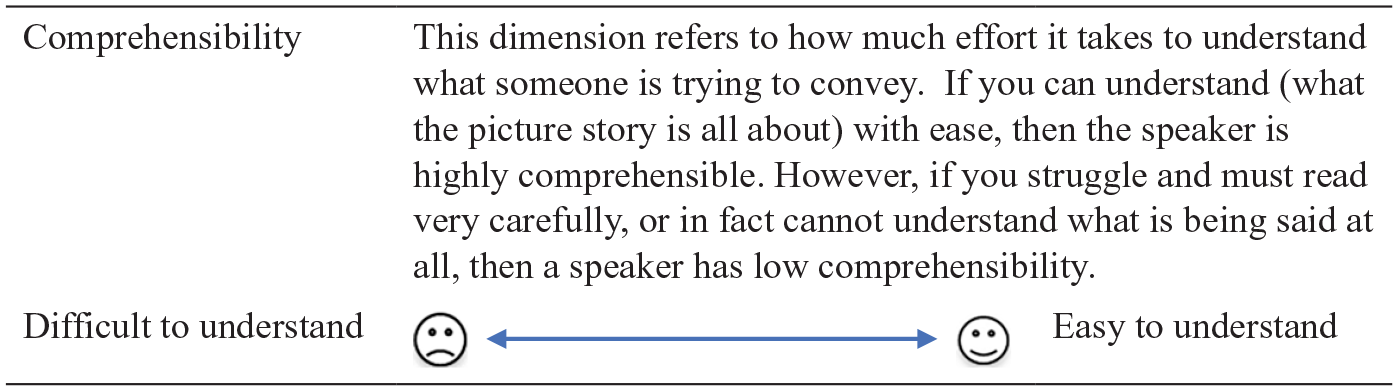
Training scripts and onscreen labels for comprehensibility ratings.
All transcripts were displayed to the raters in a randomized order on a computer screen using a MATLAB-based program. The raters read and rated the comprehensibility of each transcript using a moving slider. Each end of the continuum featured a smiling or frowning face to clearly indicate each end of the 0 to 1,000-point continuum (0 = ‘difficult to understand’, 1,000 = ‘easy to understand’; see Figure 1). To reduce fatigue and any extraneous distractions, the entire session (90+ minutes in total) was administered across two days (Day 1 for 61 picture descriptions and Day 2 for 61 oral interviews).
Interrater agreement was calculated using Cronbach’s alpha. As found in Saito (2020), the four raters demonstrated relatively high inter-rater agreement for the picture description (α = .879) and oral interview tasks (α = .883). Therefore, the four raters’ comprehensibility scores were averaged to generate a single score for each sample under each task condition.
d Collocation measures
Following Saito (2020), the collocation use of L2 speech was analysed via bigram and trigram association measures – i.e. t-scores and mutual information (MI) scores – using the Tool for the Automatic Analysis of Lexical Sophistication 2.0 (TAALES) (Kyle and Crossley, 2015). Since the speakers and raters used General American English, we chose the spoken dimension of the Corpus of Contemporary American English (Davies, 2009) as the reference corpus.
In TAALES, random co-occurrences of words were first calculated by dividing the number of any possible combinations within a fixed window size of five words by the total number of tokens in the reference corpus. To generate t-scores, the difference between raw frequency and random co-occurrence frequency were divided by the square root of the raw frequency. To generate MI scores, the frequency of collocations is divided by the frequency of random co-occurrences of the words, and then logarithmized. Whereas t-scores are thought to index how much a sample is made up of combinations of relatively frequent words (function words in particular), which are likely to have many other partner words (i.e. high-frequency associations), MI scores are thought to reflect the extent to which a sample features combinations of mutually exclusive words that do not have many other partner words (i.e. low-frequency associations). For examples of bigrams and trigrams, see Appendix B in supplemental material.
2 Results
a Constructs of comprehensibility and collocation measures
The results of normality tests (a one-sample Kolmogorov–Smirnov test) indicated that the comprehensibility scores were not significantly different from a normal distribution in both task contexts (p > .05). According to the results of independent sample t-tests, the averaged comprehensibility scores did not significantly differ between the picture description (M =573; SD = 174; Range = 262–910) and oral interview tasks (M =513; SD = 217; Range = 172–861), t = 1.675, p = .096, d = 0.34. As for the collocation measures, a series of Kolmogorov–Smirnov tests found the bigram t-scores in the picture description task to be positively skewed (p = .015) and the trigram t- and MI scores in the oral interview task to be negatively skewed (p = .007, and .016). After these scores were transformed using the log10 function, they were shown to follow a normal distribution (p > .05). To facilitate the interpretability of the data, the directions of all the factor scores were kept consistent (larger values indicating stronger associations).
b Relationship between comprehensibility and collocation
To examine the role of collocation in L2 comprehensibility judgements, a set of Pearson correlation analyses were performed with alpha set to .01 (Bonferroni corrected). As summarized in Table 1, both bigram and trigram MI scores demonstrated significant, moderate-to-strong associations with comprehensibility in the picture description task (r = .356 to .713). Only bigram t-scores demonstrated significant correlations with comprehensibility in the oral interview task (r = .343).
Summary of simple and partial correlations between collocation and comprehensibility.
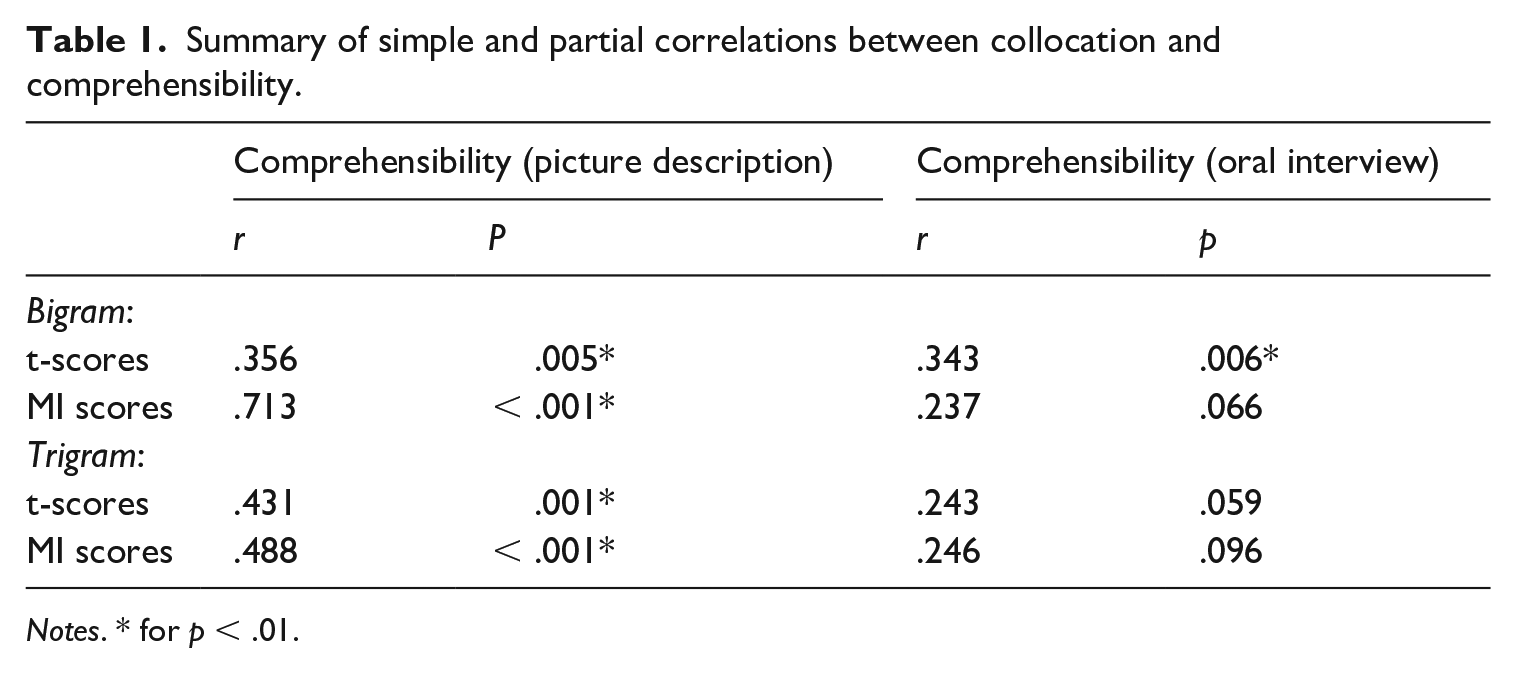
Notes. * for p < .01.
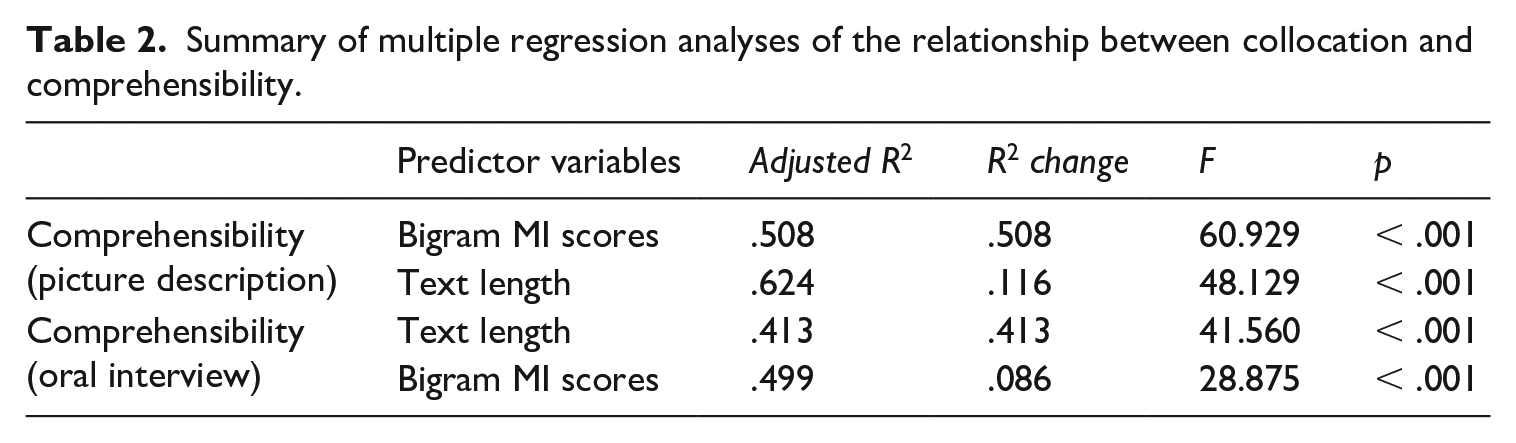
In the precursor study (Saito, 2020), it was suggested that text length could be related to the collocation-proficiency link (i.e. longer speech samples tend to feature more likelihood of targetlike collocation use). Indeed, significant correlations between comprehensibility and text length were found in both the picture description (r = .356, p = .005) and oral interview (r = .643, p < .001) tasks. To investigate the relative weights of collocation, text length and comprehensibility, stepwise multiple regression analyses were performed with comprehensibility scores as a dependent variable relative to five predictor variables (bigram and trigram t- and MI scores, the number of words per sample). As summarized in Table 2, the collocation factor (bigram MI scores) accounted for 50.8% of the variance in the comprehensibility judgements in the picture description task. Collocation effects were much weaker in the oral interview task (accounting for 8.6% of the variance). There was no clear instance of strong multicollinearity in any model; VIF (variance inflation factor) < 1.412.
Summary of multiple regression analyses of the relationship between collocation and comprehensibility.
3 Discussion
The results of the precursor research showed that L2 speakers’ collocation use (operationalized as t- and MI scores) was a primary determinant of native raters’ intuitive comprehensibility judgements (ease of understanding) (Saito, 2020). The primary aim of the current study was to examine the generalizability of collocation effects across different task conditions (i.e. picture description and interview task). While the findings showed clear collocation effects in the picture description task (accounting for 50.8% of the variances), the predictive power of collocation was smaller in the oral interview task (explaining 8.6% of the variances).
As predicted earlier, this could be due to the nature of the tasks themselves. From raters’ perspectives, the picture description remained the same across all participants. Once the raters knew the story, they could focus more on the linguistic characteristics than semantic content/details of their speech. In contrast, the content of the interviews inevitably varied according to each speaker. Thus, the raters had to pay more attention to the content of their speech (for similar discussion on the role of task structure in intuitive L2 speech judgements, see Crowther et al., 2015, 2018; Derwing et al., 2004).
As stated in Skehan’s (1998) task complexity framework, the picture description task has been found to induce speakers to focus on processing already-given information whose structure is well-known (the eight-frame cartoon picture). Thus, speakers may prioritize accuracy and fluency in conveying their message (for empirical evidence, see Skehan and Foster, 1999). In light of these phenomena (speech being more accurate and fluent in picture description than interview), raters may pay much attention to assessing linguistic accuracy and fluency, while simultaneously understanding what the speaker intends to say (Derwing and Munro, 2015).
Since there is emerging evidence that collocation is linked to accuracy (Saito, 2020) and fluency (Tavakoli and Uchihara, 2020) aspects of L2 speech, it is understandable that collocation use could be most clearly and strongly predictive of L2 oral proficiency performance and assessment when tasks are well-structured with known content. Comparatively, the oral interview task was assumed to induce speakers and assessors to focus on elaborating on familiar and personal topics (What was the hardest challenge in your life?) with ample room for conceptualization (what to say). Under this task condition, speakers and assessors are likely to prioritize content rather than form. Since the task format inevitably results in more diverse, unpredictable word choice, speakers and assessors are likely to rely on the amount of information (i.e. text length) as a primary cue, and collocation use as a secondary cue.
III Study 2: Rater effects
It is noteworthy that all the findings so far have been exclusively based on the intuitive judgements of native English raters. In Study 2, therefore, we explored the role of rater background (L1 vs. L2 raters) in L2 comprehensibility judgements. Although there has been ample research examining the mechanisms underlying various raters’ comprehensibility judgements (for an overview, see Derwing and Munro, 2015), the existing literature has exclusively relied on intuitive evaluation of audio samples. To our knowledge, our study is the first attempt to pursue this topic in the context of intuitive judgements of transcript samples. In what follows, we first briefly review a set of studies on the relationship between rater backgrounds and audio L2 speech assessment. Accordingly, we introduce some studies which have provided some insights on how different types of raters evaluate the use of collocation in L2 speaking and writing.
Within the L2 speech assessment literature, there is ample evidence that biographical background affects rater behavior. For example, certain native raters have been shown to evaluate familiar foreign accents more leniently because of their language experience (Winke et al., 2013), linguistics training (Isaacs and Thomson, 2013), bilingual experience backgrounds (Saito and Shintani, 2016), and/or professional ESL/EFL teaching experience (Saito et al., 2016a; for a meta-analysis, see Saito, forthcoming-a).
Given that English is used as a lingua franca in today’s globalized world, an increasing amount of attention has been given to the mutual comprehensibility of L2 English speakers (Pennycook, 2017). Though limited, the findings have thus far been mixed. Some studies have shown that L1 and L2 raters assess foreign-accented speech similarly (Crowther et al., 2016; Munro et al., 2006). Other studies have demonstrated that L1 and L2 raters’ evaluation of accented speech behaviors could be substantially different (Foote and Trofimovich, 2018; Ludwig and Mora, 2017). It could be argued that the variation in results is caused by the large degrees of individual variation in L1–L2 distance, L2 proficiency, experience, attitude, and familiarity with particular foreign-accents, and therefore that L2 users cannot be treated as a single group.
For example, some L2 raters show much difficulty understanding other foreign-accented speech (resulting in stricter L2 comprehensibility judgements) due to the lack of enough conversation experience with a wide range of foreign language speakers. In contrast, certain L2 raters may be capable of paying attention to both the form and meaning aspects of language and provide more lenient comprehensibility judgements. The perceptual representations of these raters can flexibly accommodate and decode a wide range of novel voices, and by extension foreign-accented speech (for a comprehensive review on the psycholinguistic phenomenon of perceptual adaptation, see Witteman et al., 2013). Such lenient raters regularly use the target language with different types of interlocutors with a clear appreciation of and positive attitude towards foreign-accented speech (Saito et al., 2019).
It is noteworthy that all the aforementioned literature on rater effects has been exclusively concerned with audio samples. However, surprisingly little is known about how L1 and L2 speakers and assessors differentially process collocation during speaking, writing, and assessment tasks. Some empirical evidence has indicated that L2 users overly rely on a combination of high-frequency words during writing tasks (resulting in greater t-scores) (Durrant and Schmitt, 2009) and demonstrate less sensitivity to the way patterns of low-frequency words are used together (indexed as MI scores) (Ellis et al., 2008). In the current study, we would like to further pursue whether and to what degree L1 and L2 raters differentially attend to collocation use when making intuitive judgements of L2 comprehensibility. Corresponding to two different learning contexts (learning L2 English through foreign language instruction vs. through immersion), we recruited two different groups of L2 raters: (1) 34 Chinese students of English as a foreign language (EFL) (without any experience abroad) and (2) 28 Chinese students of English as a second language (ESL) in the UK. We then compared their rating behaviors with those of five native speaking raters.
1 Method
a Participants
The objective of Study 2 was to analyse the L2 comprehensibility judgement patterns of two groups of L2 raters with diverse bilingual experience profiles (i.e. experienced vs. inexperienced L2 raters). 4 Rater background was operationalized via the presence of immersion experience (rather than any professional speech assessment experience). The immersion experience variable was chosen for the following reasons.
First, it is easy to quantify whether L2 raters have ever had any immersion experience in English-speaking environments. Secondly, the quantity and quality of L2 learning is substantially different between immersion vs. non-immersion (i.e. foreign language contexts). In the former case, L2 learning takes places in various social settings where learners process language for both meaning and form (e.g. social conversations, ESL classrooms, content-based classes). In the latter case, while some students do have opportunities to participate in conversation-based English classes or/and subject matter education in English, many EFL classrooms are form-oriented (Nishino and Watanabe, 2008). More importantly, EFL learners’ access to a target language (either through form or meaning-oriented instruction) is severely limited outside classrooms (for further discussion on the contextual differences between immersion vs. foreign language settings, see Muñoz, 2014). Third, the presence/absence of meaning-oriented, conversational experience (characteristic of immersion) has been found to affect L2 listeners’ behaviors: L2 raters who have used their target language on a daily basis likely have more flexible mental representations, providing higher and more lenient comprehensibility scores to foreign-accented speech (Saito et al., 2019).
Efforts were made to maximize between-group distinction (Chinese learners of English in English-as-a-Second-Language [ESL] settings vs. EFL settings) as much as possible and minimize within-group variation (the homogeneity within each group condition). A total of 28 Chinese postgraduate students in London, UK were recruited as the experienced ESL raters. They were relatively homogeneous in terms of the quantity and quality of L2 immersion experience. They had approximately one year of study abroad experience (Mlength of immersion = 9.6 months, SD = 3.4, Range = 6–24 months) and similar levels of general L2 English proficiency (MIELTS = 7.4 out of 9 points, SD = 0.3, Range = 7–8 points). The inexperienced L2 raters (n = 34) were carefully recruited from a university in China by screening for any experience travelling to English-speaking countries (i.e. immersion experience). All of them had relatively high-levels of L2 English proficiency (MIELTS = 7.2 points, SD = 0.2, Range = 7–8 points), but without any experience of living or studying abroad. They also reported that their classroom experience was mainly form-oriented with little experience in conversation- and content-based classes at the time of the project.
As a result, the biographical backgrounds of the two rater groups (ESL vs. EFL raters) were different in terms of the presence/absence of L2 immersion experience, but generally comparable in many other respects, such as L2 English proficiency, age of learning, and familiarity with Japanese accented English. For a summary of rater backgrounds, see Appendix C in supplemental material.
For the purpose of comparison, a total of five native speakers of English (Mage = 25.4 years) were recruited at an English-speaking university in Montreal, Canada. Similar to Study 1, they were naïve raters (no experience in linguistics training and EFL/ESL teaching) who communicated mainly in English (95+% per day).
b Speech materials
A total of 50 samples were randomly selected from the 85 picture descriptions used in the precursor study (Saito, 2020). The length of each speech sample varied from 89 to 221 words (M = 123.6 words; SD = 34.3 words). We consider the length of the samples sufficient as the range (89–221) was comparable to Koizumi and In’nami’s (2012) guidelines for robust vocabulary analyses (i.e. 100 words).
c Comprehensibility judgements
The raters comprised 34 EFL raters, 28 ESL raters and 5 native speaking raters. Following the same procedure in Study 1, they read 50 transcripts (displayed on a computer screen in a randomized order via a MATLAB-based software), and rated them for comprehensibility using a moving slider (recorded on a 1,000-point scale). All rating sessions took place individually in the presence of a researcher who provided a brief explanation of the project, described the rating construct, and explained the procedures. After the raters practiced with three samples (not included in the main dataset), they proceeded to assess the main dataset (n = 50 picture descriptions). Similar to Study 1, the raters showed relatively high Cronbach alpha in accordance with their group category: α = .899 for EFL Group, .946 for ESL Group, and .905 for Native Baselines. Thus, the raters’ comprehensibility scores were averaged across the raters and group conditions, respectively.
d Collocation measures
The same four collocation measures (bigram t- and MI scores, trigram t- and MI scores) were employed to index the collocation quality of each transcript sample.
2 Results
a Constructs of comprehensibility and collocation
According to the results of normality tests (Kolmogorov–Smirnov), all comprehensibility scores appeared to follow a normal distribution, p > .05. The results of one-way ANOVAs demonstrated that the three groups assigned significantly different comprehensibility scores to the 50 picture description samples, F(2, 147) = 14.304, p < .001, η2 = .163. Post-hoc multiple comparison analyses showed that the ESL raters’ comprehensibility scores (M = 567, SD = 103, Range = 339–796) were significantly greater (and thus more lenient) than the EFL raters (M = 497, SD = 133, Range = 273–794) with moderate effects (d = 0.67); and the Native Baselines (M = 440, SD = 166, Range = 238–774) with large effects (d = 1.23). However, the EFL and Native Baselines appeared to be comparable (p > .05). In terms of collocation measures, the results of Kolmogorov–Smirnov tests found only Bigram MI scores to be positively skewed (p = .006). After transforming the values via the log10 function, their distribution pattern became normal (p = .067). To facilitate the interpretability of the findings, the directionality was set positive (larger values indicating stronger associations)
b Relationship between comprehensibility and collocation
The role of collocation in L2 comprehensibility judgments was examined via simple Pearson correlation analyses with alpha set to .01 (Bonferroni corrections). As shown in Table 3, bigram MI scores demonstrated significant associations with L2 comprehensibility for all three groups of raters (ESL, EFL, Native Baselines), suggesting that both L1 and L2 raters used collocation information similarly during their intuitive judgments of L2 speech.
Summary of simple correlations between collocation and comprehensibility.
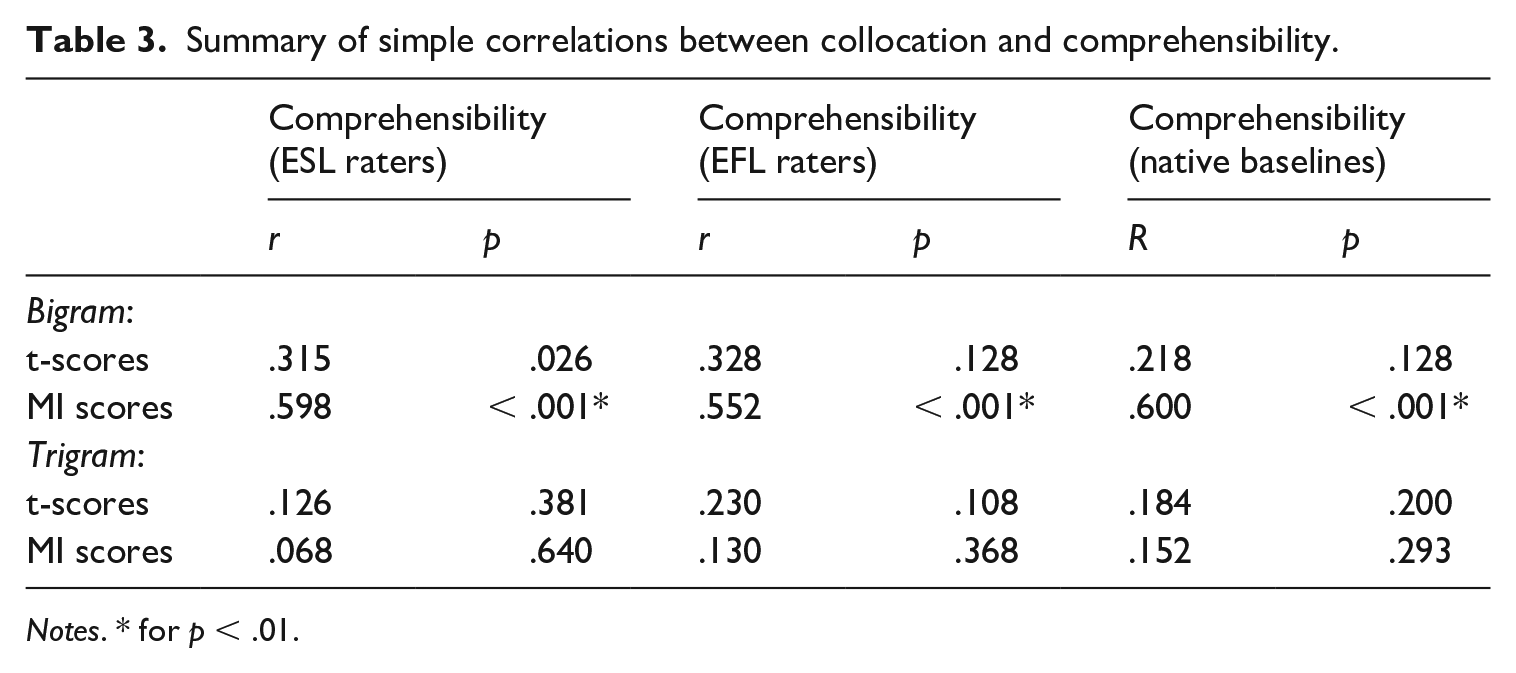
Notes. * for p < .01.
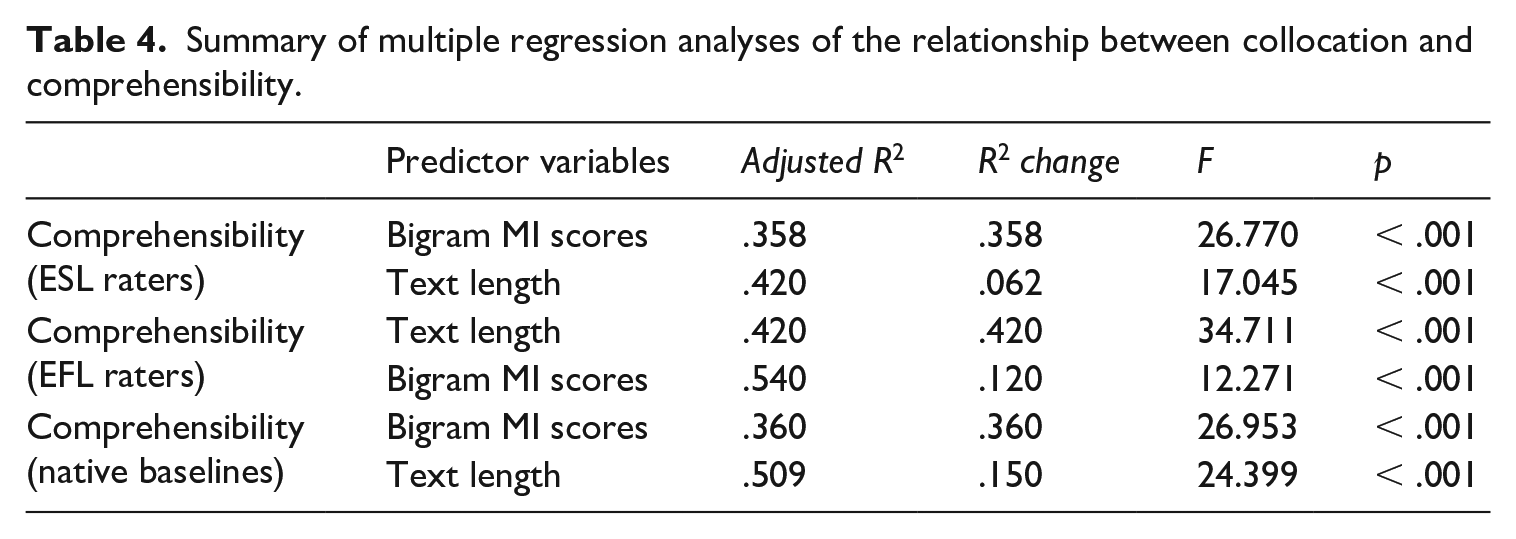
Interestingly, we also found that the raters’ comprehensibility scores were significantly associated with the length of speech samples. Such length effects were clearly observed among the EFL raters (r = .648, p < .001) in contrast with the ESL raters (r = .444, p = .001) and the native baselines (r = .573, p < .001). A set of stepwise multiple regression analyses were performed to further examine how the three groups of raters – ESL, EFL and Native Baselines – differentially used collocation and text length information to assess L2 comprehensibility. The models featured L2 comprehensibility scores as a dependent variable and five predictor variables (bigram t and MI scores, trigram t and MI scores, text length). According to the results, summarized in Table 4, both ESL and native raters showed very similar patterns, i.e. using collocation (bigram MI) as a primary cue (accounting for 35.8%–36% of the variances) and text length as a secondary cue (6.2%–15%). However, the EFL raters’ comprehensibility judgements were mainly determined by the text length factor (42.0%) followed up by the collocation factor (bigram MI) (12%). There was no indication of strong multicollinearity; VIF (variance inflation factor) < 1.23.
Summary of multiple regression analyses of the relationship between collocation and comprehensibility.
3 Discussion
Much scholarly attention has been directed towards examining the diverse rating behaviors of L1 and L2 raters when assessing the comprehensibility of foreign-accented speech (e.g. Ludwig and Mora, 2017 vs. Crowther et al., 2016; for a meta-analysis, see Saito, forthcoming-a). In the context of 50 picture description samples produced by Japanese learners of English, Study 2 examined how the three different groups of raters – (1) experienced Chinese users of English in the UK (ESL raters), (2) inexperienced Chinese users of English in China (EFL raters), and (3) native speakers of English (Native Baselines) – differentially rely on collocation information during L2 comprehensibility judgements.
The experienced L2 users (ESL raters) assigned higher scores than the other groups, which may indicate a more lenient attitude towards evaluating other foreign-accented speech. They also seemingly adopted the same strategy as the native baseline raters in their evaluations, prioritizing the frequency of mutually exclusive combinations of words (i.e. mutual information) over other lexical factors (e.g. text length). The results here line up with previous evidence showing that (1) L2 raters are more adaptable, flexible, and lenient as a result of more experience with and exposure to different types of foreign accents (Kang and Lu, 2019); and (2) that MI scores serve as a primary correlate of L2 oral/speaking proficiency (Eguchi and Kyle, 2020; Kyle and Crossley, 2015).
By contrast, our results indicate that inexperienced L2 users (EFL raters) made their comprehensibility judgements by focusing on the quantity (text length) rather than quality (collocation) of L2 speech. This lack of sensitivity to collocation among L2 users has been reported in the dimensions of writing (Garner et al., 2019), word recognition and production (Ellis et al., 2008), acceptability judgments (Wolter and Gyllstad, 2013), and speaking (Kyle and Crossley, 2015). As pointed out by many scholars, this could be due to the fact that the majority of EFL learners do not have sufficient opportunities to access authentic input in their L2 English classrooms (see Biber et al., 2004; for the analyses of collocation use in ESL and EFL textbooks, see Boers et al., 2017).
Although the current study used a cross-sectional dataset (i.e. comparing the rater behaviors of experienced and inexperienced L2 users vs. native listeners), the findings shed light on how L2 users develop, revise and elaborate their ability to comprehend other L2 speakers. To grasp what other L2 users say, L2 users may initially prioritize the amount of information delivered without paying attention to any collocational aspects of use (i.e. the mutual exclusivity of word strings). This is arguably because these inexperienced L2 users cannot afford to allocate sufficient cognitive resources to such sophisticated vocabulary analyses, especially when they focus on using language for meaning rather than form (Skehan, 1998); and/or because they have yet to develop sufficiently robust collocation knowledge (Boers et al., 2017). With increasing L2 experience, L2 users can start to encode language into multiword units, and store frequently occurring combinations as chunks which can be accessed more accurately, fluently, and automatically (Ellis et al., 2008).
These tentative suggestions are reminiscent of the psycholinguistic phenomenon of perceptual adaptation (Witteman et al., 2013). Perceptual adaptation occurs when listeners revise their existing perception systems upon engaging in intensive, systematic and repeated exposure to novel sounds, words and sentences. For example, there is empirical evidence that brief listening experience helps L1 listeners adjust to unfamiliar acoustic signals that they have never heard before, and integrate them into their phonetic systems such as acoustically manipulated sounds (Norris et al., 2003), or foreign-accented speech (Bradlow and Bent, 2008). The findings of the current study suggest that perceptual adaptation could also occur in L2 listeners’, facilitating understanding of foreign-accented speech after a certain amount of immersion experience (e.g. one year of study abroad in the current study) has taken place. They also provide insight into the mechanisms of perceptual adaptation on a micro level, i.e. obtaining more robust sensitivity to the association of low-frequent, exclusive multiword networks (mutual information).
Here, it is important to stress that the current investigation adopted an exploratory methodology by asking raters to read transcripts (rather than listening to audio samples) in order to factor out the influence of phonology on the relationship between collocation and comprehensibility judgements. Although many studies in Second Language Acquisition and psychology have extensively examined the role of rater experience in L2 speech assessment, such literature has been exclusively concerned with listening rather than reading (see Saito, forthcoming-a). Due to the lack of literature on unique methodology that we used in the current study (reading rather than listening), we discussed our findings in line with the relevant theories of human speech perception in psychology (perceptual adaptation). Our assumption is that the way raters evaluate L2 speech shares similar mechanisms, even though the modality is different (reading vs. listening) and the domain is different (vocabulary vs. phonology). However, we acknowledge that such assumption needs further empirical investigation which will scrutinize whether, to what degree and how raters differently (or similarly) process lexical information in L2 speech when reading transcripts vs. listening to audio samples (e.g. Saito et al., 2016b vs. Saito et al., 2016c).
IV Study 3: Collocation, comprehensibility, and longitudinal L2 speech development
Recently, scholars have begun to show that comprehensibility can serve as a developmental index of L2 speech learning. With sustained use of the L2, learners can continue to enhance the comprehensibility of their speech even while remaining foreign-accented (Derwing and Munro, 2013). Study 3 adopts a longitudinal perspective to further examine the causal effect of collocation use on the development of L2 comprehensibility. Following the assumption that collocation knowledge and use could drive L2 speech assessment and development, we made two predictions. First, if L2 learners practiced the target language over time, they would improve their L2 speech, especially in terms of comprehensibility. Secondly, such enhanced L2 comprehensibility could be linked to the development of their L2 collocation use, and vice versa.
1 Method
a Participants
As a part of a larger project, we invited interested L1 Japanese university students in Tokyo, Japan to participate in a semester-long language exchange project. All participants were paired with native speakers of English who were enrolled in college-level schools in the USA. The pairs used a video-conferencing tool installed on their computers to engage in 10 individual meetings over the course of 10 weeks in accordance with their schedules and time differences between Japan and the USA. For each meeting, they chatted for one hour, 30 minute in Japanese and 30 minutes in English. As prompts for conversation, they were asked to bring two images that corresponded to a weekly theme (e.g. sports, pop culture). The current study focuses on a cohort of 28 Japanese students who completed the project in Spring 2014. All participants engaged in the same picture description task used in Studies 1 and 2 one week before and one week after the language-exchange project (28 speakers × 2 pre/post-tests = 56 samples). We have reported some parts of these results elsewhere (e.g. the participants’ L2 English pronunciation and fluency performance and development; Saito and Akiyama, 2017).
The participants varied in terms of their general L2 English proficiency at the time of the project (measured via TOEIC) (M = 681.8 out of 990, SD = 165.5, Range = 350–900), indicating that their general proficiency spanned Basic (B1) and Proficient Users (C2) as per CEFR benchmarks. Similarly, their amount of immersion experience in English-speaking countries was varied substantially (M = 8.3 months, SD = 15.97, Range = 0–48 months). While they took a few hours of English classes per week at their university-level schools at the time of the project (M = 3.9 hours, SD = 2.3, Range = 1.5–6), they reported having limited opportunities to practice English outside of the classroom (M = 0.45 hours, SD = 1.05, Range = 0–3 hours).
A total of five native speakers of English were recruited in Montreal, Canada (Mage = 23.8 years) to rate the comprehensibility of the speech samples. They all reported English as their L1 and primary language of communication (100% per day). All of them were undergraduate and graduate students at an English-speaking university at the time of the project. Like Studies 1 and 2, they were naïve raters as they lacked any experience in linguistics and ESL/EFL teaching.
b Speech materials
The participants engaged in a range of different speaking tasks one week before the outset of the project (T1) and one week after the end of the project (T2). As reported in our earlier study (Saito and Akiyama, 2017), the participants’ English speech was elicited using a timed picture description task and analysed for phonological accuracy and fluency. However, such short, fragmented speech samples (20–30 words per speaker) may not be adequate for robust vocabulary analyses. Thus, the samples used for phonological analyses and reported in the earlier study were not used for the current investigation.
As in Studies 1 and 2, the current study reports on participants’ speech elicited from the picture description task (M = 115 words, SD = 38.9, Range = 75–226 words). To ensure comparability between participants’ performance at T1 and T2, we used the same picture cartoon twice. 5 Like before, two coders first separately transcribed the same 10 out of the 56 samples (18% of the entire dataset: 28 speakers × T1/T2) to check for agreement. There were few disagreements between their transcriptions. After agreeing on transcription standards, they proceeded to transcribe 28 samples.
c Comprehensibility judgements
Following the same rating procedure in Studies 1 and 2, all the sessions took place individually with a trained research assistant. After the five raters familiarized themselves with the same picture cartoon featured in the speech samples, they received a brief explanation of the construct of comprehensibility and the rating procedure (for details, see Studies 1 and 2). They first practiced with three transcripts not included in the current dataset, and then rated the main dataset (56 transcripts). All the transcripts were displayed in a randomized order. The raters evaluated each transcript for comprehensibility on a 1,000-point scale using a moving slider via a MATLAB-based program. Like Studies 1 and 2 (and Saito, 2020), the raters’ agreement was relatively high, Cronbach α = .910. Thus, their scores were averaged to generate a single score for each speaker at each testing point (T1, T2).
d Collocation measures
The same four collocation measures (bigram t- and MI scores, trigram t- and MI scores) were employed to index the collocation quality of each transcript sample.
2 Results
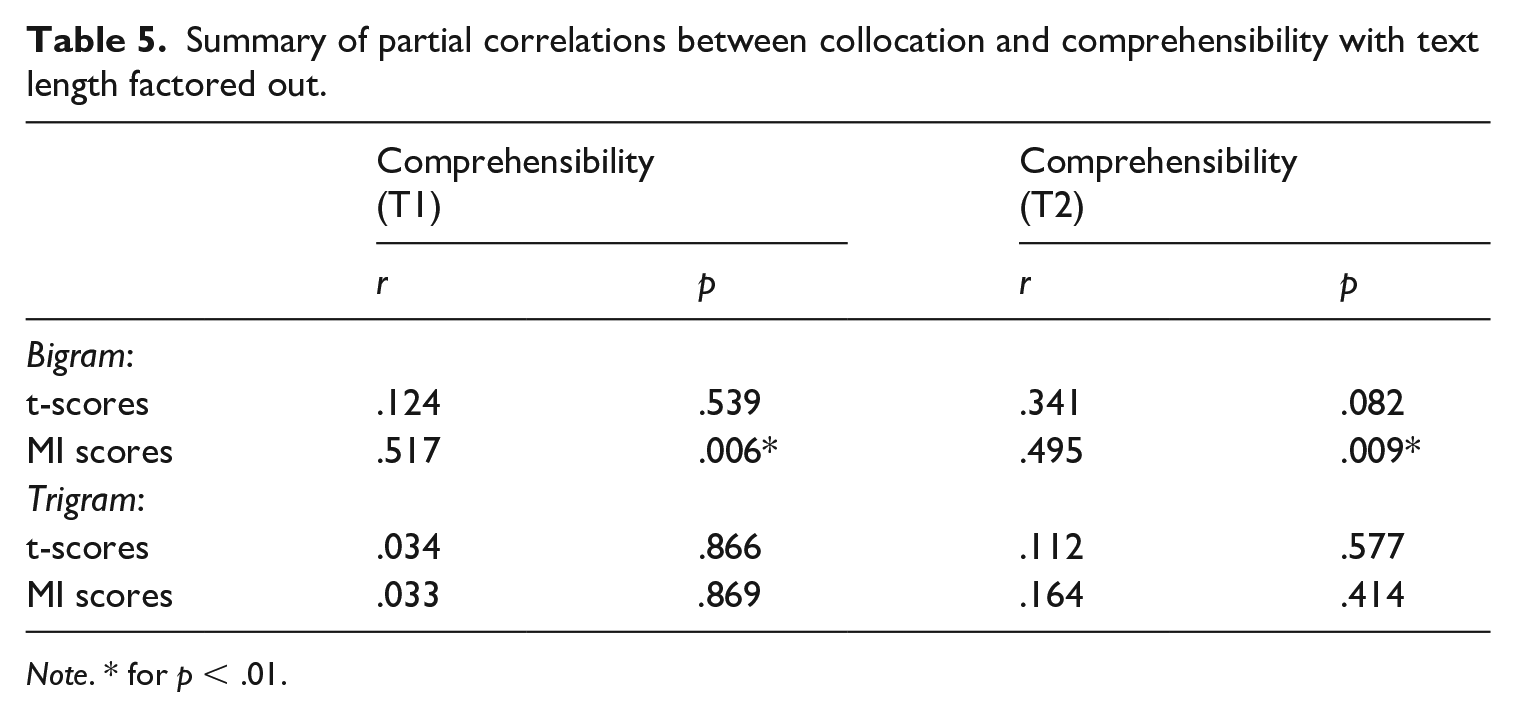
According to the results of Kolmogorov–Smirnov tests, the pattern of comprehensibility and collocation scores were not significantly different from normal distribution (p > .05). In the main analysis, we first examined the predictive role of four different collocation measures (bigram, trigram, t, MI scores) in L2 comprehensibility judgements at T1 and T2 by conducting a set of partial correlations controlling for text length. As summarized in Table 5, the participants’ MI scores were significantly correlated with their L2 comprehensibility scores at both T1 (r = .517, p = .006) and T2 (r = .495). Echoing the findings of Studies 1 and 2, collocation appeared to serve as a relatively strong predictor of L2 comprehensibility, even when the length of each transcript was factored out.
Summary of partial correlations between collocation and comprehensibility with text length factored out.
Note. * for p < .01.
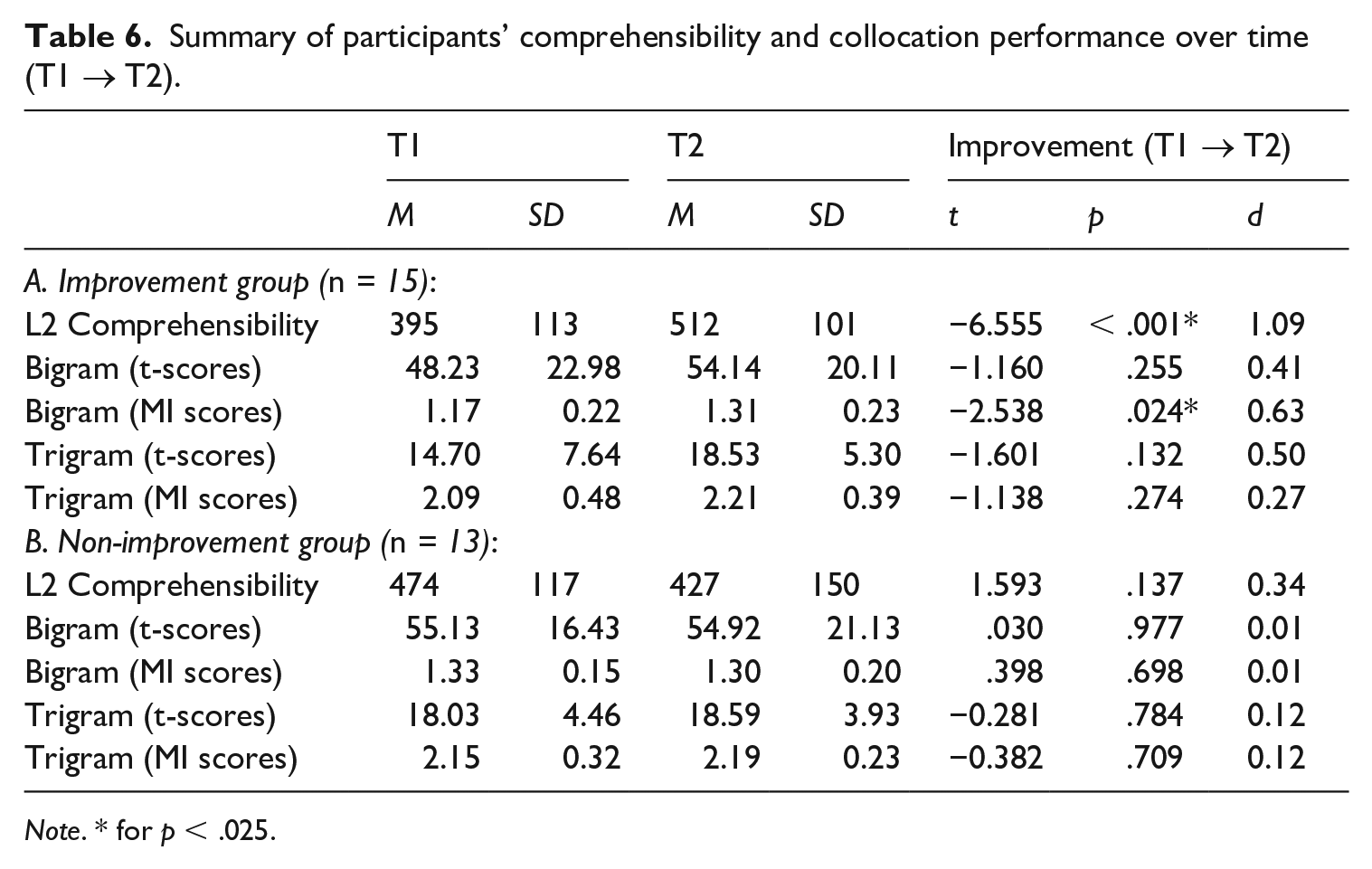
To examine the collocation-proficiency link from a longitudinal perspective, we probed whether and to what degree participants’ collocation proficiency and comprehensibility changed over time. On the whole, the results of paired-sample t tests did not find significant improvement in participants’ comprehensibility over time (t = −0.580, p = .567, d = 0.11), suggesting that the extent to which they had benefitted from video-based conversation activities was subject to a great deal of individual variation. The participants were subsequently divided into two groups: (1) those who demonstrated positive change in L2 comprehensibility between T1 and T2 (n = 15); and (2) those whose comprehensibility levels did not show any improvement within the timeframe of the project (n = 13). According to the results of paired-sample t-tests (summarized in Table 6), participants in the Improvement Group significantly enhanced their bigram MI scores over the course of the project with medium effects (p = .024, d = 0.63).
Summary of participants’ comprehensibility and collocation performance over time (T1 → T2).
Note. * for p < .025.
3 Discussion
The goal of Study 3 was to test the predictive role of collocation use in native speakers’ intuitive judgments of L2 comprehensibility from a longitudinal perspective. Our assumption was that improvements in L2 comprehensibility would be accompanied by improvements in collocation use. Focusing on a group of Japanese EFL learners who engaged in a series of video-based conversation sessions (1 hour per week × 10 weeks) with American conversation partners, we found evidence that L2 comprehensibility development could be related to, and by extension driven by, their ability to access and sensitize more frequent and targetlike use of mutually exclusive word combinations (collocations with higher MI scores). The results here confirm that native speakers’ processing of second language speech could be significantly determined by collocation qualities (as they process first language speech) (Kyle and Crossley, 2015), and that L2 learners improve their speaking proficiency thanks to an increasing amount of attention and control over their collocation knowledge and use (Kim et al., 2018).
V Conclusions and future directions
In the field of L2 speech, there is a consensus that L2 oral proficiency should be evaluated in terms of comprehensibility rather than nativelikeness (Derwing and Munro, 2015). Some scholars have begun to examine which lexical factors make L2 speech more easily understood (via comprehensibility judgements), and which factors underlie comprehensibility improvement as a function of increased experience (comprehensibility development). Extending the precursor work (Saito, 2020), the current study reports the results of three different experiments. In discussing them, we aim to provide further empirical support for the role of collocation use in L2 comprehensibility judgements and speech development. Overall, the findings align with the emerging findings that collocation acts as a primary cue during L2 speaking assessment (Kyle and Crossley, 2015) and L2 speaking development (Kim et al., 2018).
More specifically, we found that raters rely substantially on collocations while making intuitive judgements, particularly when the lexical context of speech is relatively limited and predictable (structured picture description rather than freely-constructed oral interview; Crowther et al., 2016, 2018), as long as they have a sufficient amount of collocation knowledge (native speakers and experienced L2 users but not inexperienced L2 users) (Saito et al., 2019). These overall findings led us to make tentative conclusions regarding how L2 learners develop oral comprehension (better ability to understand others) and production (making themselves more easily understood) skills. Although L2 learners rely on different strategies to understand other foreign-accented speech, relying on the length of speech rather than details of speech, they may begin to analyse, sensitize and attend to the quality of multiword units with increasing amounts of L2 learning experience. Similarly, their production becomes more comprehensible and thus more advanced despite non-nativelike use of language as they refine their control over the use of multiword units which have very limited sets of collocates (collocation with higher MI scores).
In closing, we call for more studies which delve into the complex mechanisms underlying the development of L2 lexical networks. It is important to remember that the findings in Studies 1, 2, and 3 were significant when collocation was operationalized in terms of mutual information scores (the degree to which words pairings are mutually exclusive) rather than t-scores (how often word combinations co-occur). That is, L2 speech was judged to be, and became more comprehensible when it included more distinctive and coherent combinations of content words. As for single word units, Crossley and colleagues have conducted a range of longitudinal studies showing that L2 learners’ use of content words becomes more diverse, abstract, infrequent, and complex in nature with more conversational experience (e.g. Crossley and Skalicky, 2019). Following this line of thought, it is possible that more experienced and proficient L2 learners are able to strengthen their lexical networks in terms of both function words (which are relatively frequent) and content words (which are relatively infrequent). Our argument echoes a usage-based account of language acquisition, which assigns a central role to formulaic sequences in language analysis, processing, comprehension, production, and acquisition (Ellis, 2012). In some studies, the extent to which single word frequency measures were associated with the development of L2 oral proficiency remains unclear (Crossley et al., 2015; see also Crossley et al., 2019). However, if we focus on multiword units, we can predict that more infrequent combinations of content words will be produced in the later stages of acquisition, an assumption that our findings suggest and future studies should test (see Kim et al., 2018).
Supplemental Material
sj-pdf-1-slr-10.1177_0267658320988055 – Supplemental material for Roles of collocation in L2 oral proficiency revisited: Different tasks, L1 vs. L2 raters, and cross-sectional vs. longitudinal analyses
Supplemental material, sj-pdf-1-slr-10.1177_0267658320988055 for Roles of collocation in L2 oral proficiency revisited: Different tasks, L1 vs. L2 raters, and cross-sectional vs. longitudinal analyses by Kazuya Saito and Yuwei Liu in Second Language Research
Footnotes
Acknowledgements
We are grateful to Masaki Eguchi, Second Language Research reviewers and the journal editor, Alice Foucart for their insightful comments on earlier versions of the manuscript.
Declaration of conflicting interests
The author(s) declared no potential conflicts of interest with respect to the research, authorship, and/or publication of this article.
Funding
The author(s) disclosed receipt of the following financial support for the research, authorship, and/or publication of this article: The project was funded by Arnold Bentley New Initiatives Fund, Leverhulme Trust Research Grant (RPG-2019-039), and Spencer Foundation Research Grant (202100074).

Supplemental material
Supplemental material for this article is available online.
Notes
References
Supplementary Material
Please find the following supplemental material available below.
For Open Access articles published under a Creative Commons License, all supplemental material carries the same license as the article it is associated with.
For non-Open Access articles published, all supplemental material carries a non-exclusive license, and permission requests for re-use of supplemental material or any part of supplemental material shall be sent directly to the copyright owner as specified in the copyright notice associated with the article.
