




Abstract
This study investigates the acquisition of the Spanish Imperfect by 60 English learners of Spanish at three different proficiency levels (beginner, intermediate and advanced). Two oral production tasks and one interpretation task show that although the Imperfect is used from early on, the full array of interpretations associated with this form (habitual, continuous and progressive) is not completely acquired even at advanced levels. Learners accept the Imperfect in imperfective contexts but have problems rejecting the Preterit. This problem persists even at advanced levels in continuous contexts. The continuous is conveyed in English by Past Tense, which is used in both perfective and imperfective contexts, whereas in Spanish only the Imperfect is appropriate. We argue that the incorrect low rejection of the Preterit signals a mapping problem of aspect-related features present in both English and Spanish onto a new form (the Imperfect). These results support the problematic nature of feature reassembly in the acquisition of the Spanish Imperfect by English speakers.
I Introduction
In this study, we investigate the second language (L2) acquisition of aspect-related morphology, which is a grammatical area known to be challenging for L2 speakers. In particular, we examine the role played by the native language in the acquisition of Spanish imperfective morphemes (those expressing unbounded eventualities) by English learners. It is well known that English and Spanish express aspectual distinctions by different means: whereas Spanish uses specific inflectional forms (Imperfect for imperfective and Preterit for perfective), this distinction is not grammaticalized in English; see (1). This difference has been found to be a major challenge for English speakers of Spanish, in particular for the acquisition of the Imperfect (see review in Salaberry, 2008).
(1) a. Marta ‘Marta b. Marta ‘Marta
Currently, there is no consensus on the specific nature and the extent of first language (L1) transfer to explain challenges with this grammatical domain. On the one hand, Montrul and Slabakova (2002) and Slabakova and Montrul (2002) have argued that difficulties arise from grammatical differences between English and Spanish (i.e. the feature specification of the functional category AspP), and that English speakers are influenced by how aspectual distinctions, such as imperfective and perfective, are expressed in their L1. These authors claim that L2 speakers can overcome the effects of L1 transfer. On the other hand, Salaberry (2008) has argued that English speakers associate the Past tense with the Preterit in Spanish, and predicts widespread use of Preterit from early on, even in imperfective contexts. He also argues that L1 influence can still be found at advanced levels of proficiency. The present study aims to resolve this debate by approaching the Imperfect as a form that encodes three different meanings: habitual, continuous and progressive (see example (2)), which we examine separately as these three meanings can pose different levels of difficulty depending on how they are morphologically encoded in the learners’ L1. This allows us to provide a fine-grained analysis of the role of the L1 for the acquisition of the Spanish Imperfect.
1
(2) a. Marta Marta play3.sing.imp to-the tennis when was3.sing.imp little ‘Marta played/used to play/would play tennis when she was little’ b. Marta Marta was3.sing.imp very beautiful when she was3.sing.imp little ‘Marta was very beautiful when she was little’ c. Marta Marta play3.sing.imp to-the tennis when her father wash3.sing.imp the car ‘Marta was playing tennis when her father was washing the car’
Much of previous research on this topic has also assumed, following Giorgi and Pianesi (1997), that the perfective is part of the categorical matrix of features defining English (eventive) verbs. In this study, however, we follow the current standard view that perfectivity is defined within the higher functional structure of the clause, rather than at the root. Among the significant consequences of this analysis are that all eventualities (events and states) and all the possible viewpoint interpretations receive a unified account, and events are not necessarily associated with a perfective interpretation by default. Following Arche (2006, 2014), we also assume that Past is a form which is ambiguous in English as it can express both imperfective and perfective viewpoint as shown in example (1).
In our analysis, perfective and imperfective interpretations are achieved by the same syntactic features in English and in Spanish, although these interpretations are only associated with specific surface morphology in Spanish. This, in turn, means that the learning task for English speakers does not include the acquisition of a new formal feature (see Montrul and Slabakova, 2002; Slabakova and Montrul, 2002), but the reassembling of existing features onto new forms consistent with Lardiere’s (2009) ‘Feature Reassembly’ (FR) approach. Based on evidence gathered by two oral tasks and one interpretation task, we argue that this re-assembling process (reconfiguring existing features onto new lexical items in the L2) is essential in the acquisition of the Imperfect and its associated meanings and can explain the difficulties that English speakers face when acquiring this form. We propose that English speakers find the continuous meaning particularly problematic, not because they fail to acquire the Imperfect, but because they find it difficult to reject the Preterit in this context, as both aspectual meanings (perfective and imperfective) are expressed by the same form (the Simple Past) in their L1 in this context.
II The encoding of Aspect in English and Spanish and its consequences for L2 learners
Aspect is a syntactic category conveying semantic information about the temporal development of an eventuality, i.e. whether it is in progress, finished or about to start, and about the number of occasions that the eventuality has been instantiated, i.e. either once or more (Arche, 2006; Comrie, 1976; Demirdache and Uribe-Etxebarria, 2000; Klein, 1994; Smith, 1997; Verkuyl, 1993). Both Tense and Aspect have been described as ordering predicates that take intervals as their arguments (Demirdache and Uribe-Etxebarria, 2000; Klein, 1994, 2009). They are conceived as time-denoting phrases represented in the syntax, as defined in Stowell (1993, 1996). According to Demirdache and Uribe-Etxebarria (2000), Aspect and the intervals it orders are represented in the syntax, just as Zagona (1990) and Stowell (1993, 1996, 2007) had proposed for Tense. Under this approach, the differences between the available tense and aspectual distinctions can be accounted for by the intervals they take. Tense takes what Klein calls the Topic Time (TT) (the interval that the utterance refers to) and orders it within, before, or after the Reference Time (e.g. Speech Time). Aspect takes the Topic Time and orders it within, before, after or completely overlapping with respect to the Event Time (EvT) (the interval over which the whole situation extends).
In addition to the interval known as Topic Time, the information about the number of occasions in each eventuality is also represented in the syntactic structure by a quantificational node, called Q<occasions> by Arche (2006, 2014). The specific properties of the interval predicate and the quantifier can account for the imperfective vs. perfective distinction, and for the three interpretations associated with the Imperfect (progressive, continuous and habitual) as illustrated in the structures in (3). Following Klein (1994) and Arche (2014), we assume that the predicate corresponding to the perfective is ‘complete overlap’:
2
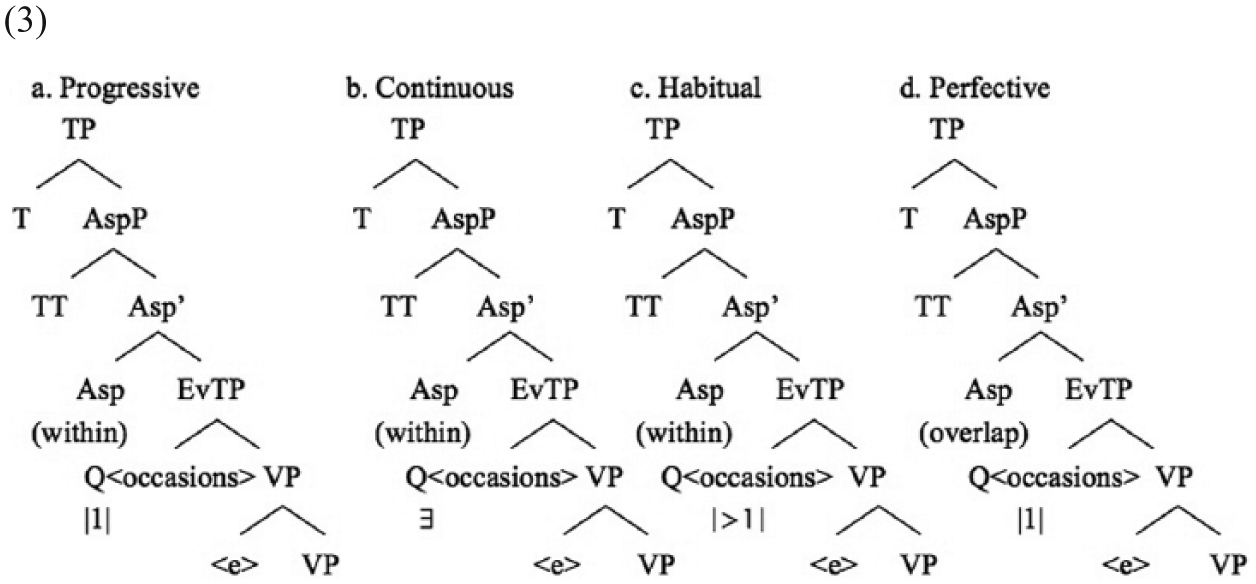
These trees show that the imperfective (3a, 3b and 3c) vs. perfective (3d) distinction arises from a different ordering predicate (‘within’ for imperfective vs. complete ‘overlap’ for perfective); all imperfective readings (3a, 3b and 3c) share the same ordering predicate ‘within’ but differ in the information represented in the quantifier over occasions. The progressive, whereby the eventuality is understood to be in progress, includes a quantifier indicating a single occasion (represented by |1|) in (3a)); the continuous reading emerges in the absence of any cardinal quantification (assumed to involve only existential quantification, represented by ∃ in (3b)); finally, the habitual interpretation, according to which an eventuality is understood to take place regularly, emerges in the presence of a proportional quantifier of occasions of the type of many (represented by [>1] in (3c)).
In our analysis, the syntactic structure and the semantic interpretations associated with perfective and imperfective aspect are invariable in English and in Spanish. It is how these meanings are expressed, and whether they are mapped onto specific morphological forms (i.e. whether the distinction is grammaticalized) or not, that varies across these languages. This implies that English learners of Spanish do not need to acquire a new Aspect-related feature, as all relevant features are already present in their L1. The challenge for these learners is to map those existing features onto the correct morphological forms. In Spanish, perfective semantics (bounded, finished intervals) is expressed with the morphology of the Perfective Preterit (called Preterit in most L2 literature), while imperfective semantics (unbounded, unfinished intervals) is expressed with Imperfect morphology. In contrast, as Table 1 shows, the English Past tense form can be used to express both perfective and imperfective semantics. Other (non-inflectional) means can also be used to express habituality (e.g. used to) and must be used to express progressivity (e.g. be + V-ing). Notice that the ‘continuous’ is the only imperfective meaning that is expressed by Past tense alone.
Characteristics of Perfective and Imperfective in English and Spanish.
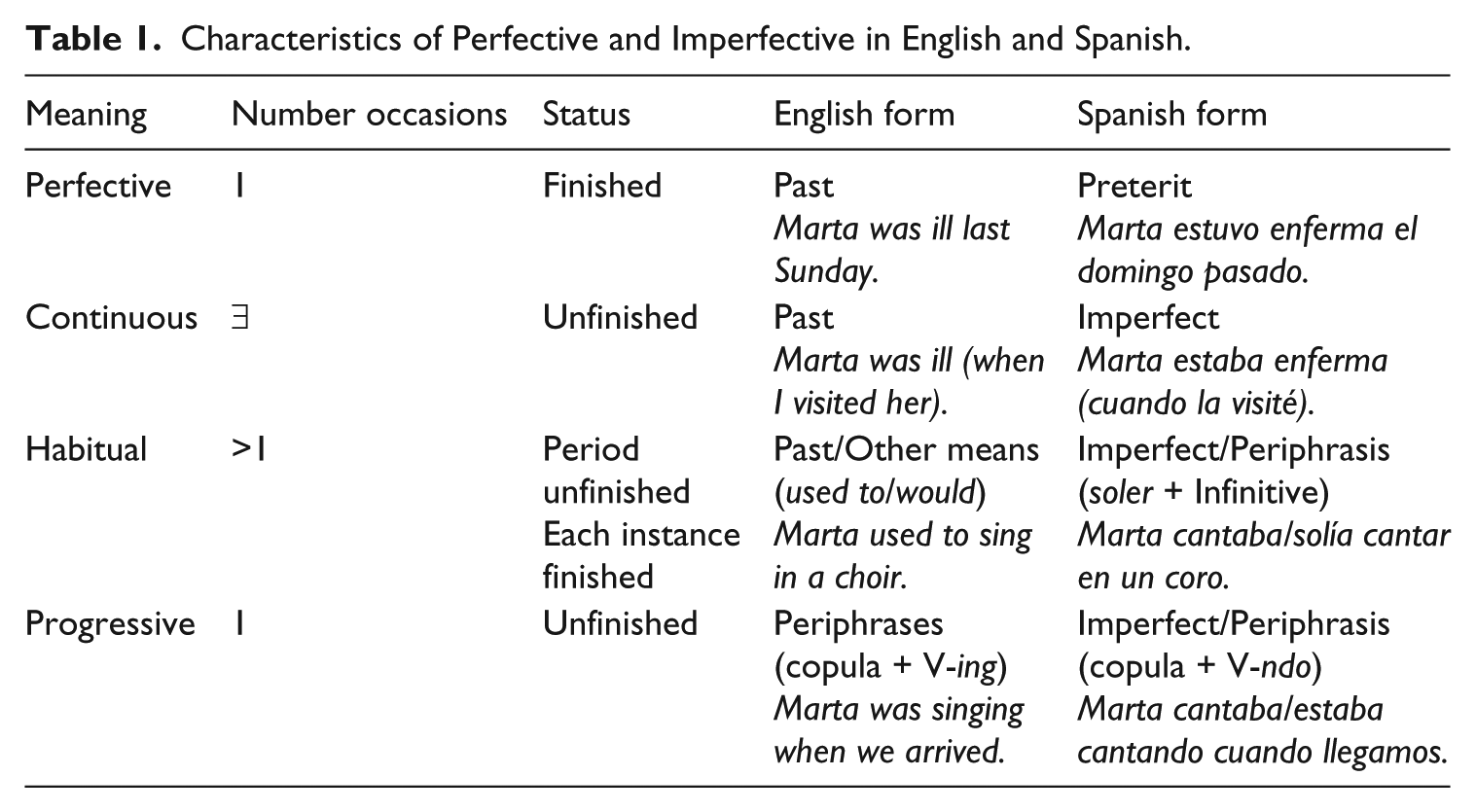
Example (4) illustrates how the Past can be used in both perfective and imperfective contexts in English, whereas Spanish has specific perfective (i.e. Preterit) and imperfective (i.e. Imperfect) forms:
(4) a. Did you see Marta last Sunday at the party? No, ‘No, she b. Did you visit Marta? How is she? Fui a verla pero no me quedé porque ‘I went to see her but I didn’t stay because she
Arche (2014) has argued that the Past form in English is also compatible with expressions of habituality (see also Montrul and Slabakova, 2002, 2003; Slabakova and Montrul, 2002).
3
(5) My grandfather visited us every Sunday. He often strolled in the park in the afternoon. (imperfective, habitual)
Since the Past in English can be used to express two different semantic interpretations (imperfective and perfective) 4 across contexts, Arche (2014) characterizes it as being an ambiguous form. That is, a sentence such as When Marta was a child, she played in the park can have either a perfective (i.e. she played once) or an imperfective (i.e. she used to play habitually, more than once) interpretation. This analysis differs from previous accounts, which have argued that the Past in English receives a perfective interpretation by default (Brinton, 1988; Smith, 1997), and from those which have proposed that English (event) verbs are intrinsically perfective (Giorgi and Pianesi, 1997). This has important consequences for theory of second language acquisition (SLA) and our understanding of the learning task that English speakers face when acquiring the Spanish Imperfect vs. Preterit distinction. Previous research examining the acquisition of these two forms has generally assumed that English Past tense encodes perfective aspect by default ignoring the fact that this form is often used in imperfective contexts as well (see Andersen, 1991; Montrul and Slabakova, 2002, 2003; Salaberry, 2008; Slabakova and Montrul, 2002). In particular, Slabakova and Montrul (2002), following Giorgi and Pianesi (1997), have argued that Spanish verbs can be associated with either a [+perfective] and a [–perfective] feature, whereas English verbs are only associated with [+perfective]. In their account, these features are checked through Simple Past morphology in English but through Preterit and Imperfect morphology in Spanish, congruent with the fact that the English Past has often been characterized as a marker of perfective aspect. 5 However, how speakers override the presumed ‘default interpretation’ in imperfective contexts (see example (6)) is left unexplained by this account.
(6) a. When I was a child I b. When I lived in France
One key difference between the theoretical model followed by Montrul and Slabakova and the one we follow in this study regards the description of (im)perfectivity itself. In Arche (2014) (im)perfectivity is not described as an unanalysed single feature but as a constellation of semantic features of specified nature (namely, interval ordering predicates and quantifiers over occasions) located in identified syntactic heads that are the same in English and Spanish (see example (3)). This analysis allows us to identify the differences between the perfective vs. imperfective and, importantly, to distinguish among the imperfective interpretations available in a precise and straightforward fashion. It also allows us to define cross-linguistic differences according to how the various meanings associated with the different aspect-related features are mapped onto morphological forms in the two languages, rather than whether the L2 features themselves are selected in the L1 or not (see Domínguez et al., 2011).
According to this analysis, English learners of Spanish need to (1) learn that each morphological form available in Spanish (Preterit and Imperfect) expresses either perfectivity or imperfectivity (i.e. there is no ambiguity), and (2) redistribute the meanings associated with the English Simple Past onto these two forms. The specific mapping of relevant features (understood here as properties in an abstract sense as these are characterized as interval-ordering heads) onto specific forms in English and in Spanish is represented in Figure 1. This figure shows that the features, which are assembled under the same heads to provide the same interpretations in both English and Spanish, are expressed differently in these languages. Crucially, the three meanings associated with the imperfective are straightforwardly mapped onto the Imperfect in Spanish but onto more than form in English. One of these forms is the Past, which expresses situations that represent both ongoing (within) and finished (overlap) intervals in English.
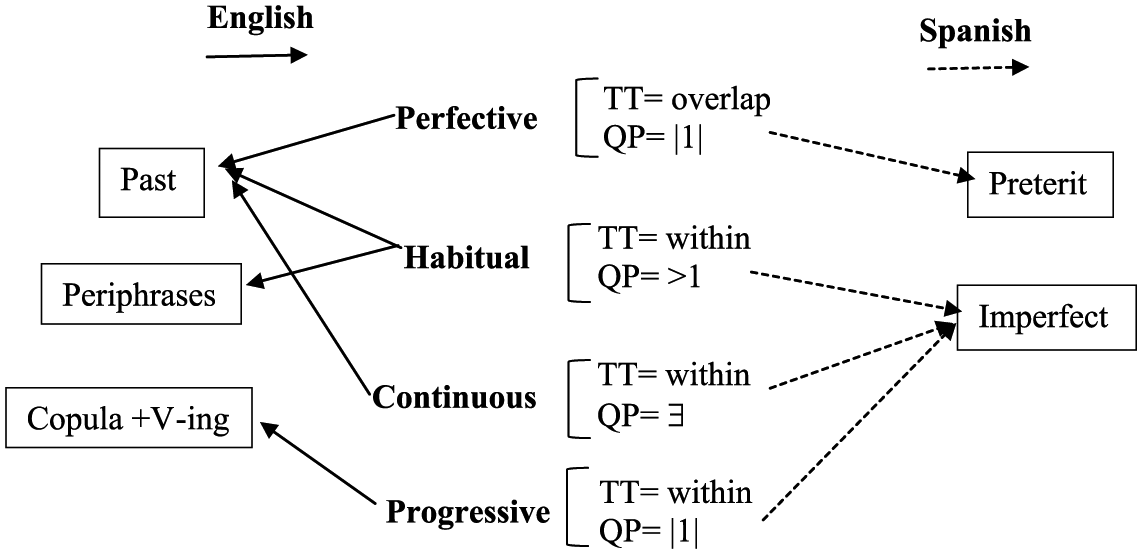
Mapping of features of Aspect (Asp) and the quantifier <occasions> (Q) for the perfective and imperfective (habitual, continuous and progressive) onto corresponding forms in English and in Spanish.
When acquiring Spanish aspectual morphology, English speakers will have to learn that the distribution of correspondences between forms and meanings differ in these two languages. In particular, that the same form (Past) cannot be used to express both finished and unfinished events in Spanish. According to this model, the continuous-Imperfect and habitual-Imperfect remappings would be potentially challenging since English speakers would need to dissociate the Past (used to express perfective aspect in English) from these meanings and form.
The re-mapping process we describe can be understood as a process of feature reassembly (FR) as proposed by Lardiere (2005, 2007, 2008, 2009) and Hwang and Lardiere (2013). Assuming full L1 transfer, Lardiere proposes that L2 acquisition involves the reassembling of specific features into new functional categories and lexical items where mismatches between the L1 and L2 exist. Consequently, successful acquisition depends on whether learners can effectively reconfigure L1 features which do not have the same morpholexical expressions in the L2. The FR approach is framed within Chomsky’s (1995, 1998, 2000) Minimalist Program, which assumes that the Faculty of Language comprises a universal computational system (CHL) and a lexicon (LEX) that contains lexical items constructed from well-defined matrices of formal, phonological and semantic features (F). Such features are part of a universal inventory, made available by Universal Grammar, which can be accessed during the process of acquiring a first language. Chomsky (2000, 2001, 2004) argues that acquiring a first language is characterized as including two equally relevant processes: feature selection (selection of a subset [FL1] of F) and feature assembly (assembly of features of [FL1] into particular lexical items [LexL1]). We assume that these are one-time processes (only available whilst the language-specific feature specifications are selected in each language), triggered by exposure to the available linguistic input. This results in each language selecting a particular [FL1] and assembling a particular [LexL1]. Differences between languages can then be said to be determined by differences in both the features selected and how these are specifically assembled onto functional categories and lexical items.
III L1 influence and the reassembly of features in the L2
There are no previous studies examining the acquisition of the three meanings of the Spanish Imperfect (progressive, habitual and continuous) separately. Some studies have analysed the emergence and use of these meanings in L2 French, although results arising from these studies are mixed and do not reveal a clear path of acquisition. For instance, whilst Harley (1992) observes that French learners acquired the progressive before the habitual, Kihlstedt (2002) argues that French learners’ use of the Imperfect emerged in the habitual context before the progressive. In contrast, the opposite result is reported in a study by Howard (2005). It is clear that more theoretically sound research on the acquisition of the three meanings is necessary in a variety of languages.
Recent research has shown evidence of L1 influence in the acquisition of aspect-related morphology in a second language (see, for example, Chin, 2008; Duff and Li, 2002; Gabriele, 2005, 2008, 2009; Gabriele et al., 2005; Gujord, 2013; Izquierdo and Collins, 2008; McManus, 2015; Montrul and Slabakova, 2002; 2003; Roberts and Liszka, 2013; Salaberry, 2000, 2008; Slabakova, 2000, 2001, 2002, 2008; Slabakova and Montrul, 2002). There is, however, no consensus regarding the source and the extent of L1 transfer in the acquisition of aspectual distinctions in a second language.
On the one hand, the ‘Aspect Hypothesis’ (AH) (Andersen and Shirai, 1994, 1996) argues that the inherent lexical semantic properties of the verb guide the acquisition of aspect and bias the use of certain morphological forms. Under the AH, the choice between Imperfect and Preterit in L2 Spanish is determined by semantic features such as whether the event is [+/–dynamic], [+/–durative] or [+/–telic]. One relevant prediction of this hypothesis is that perfective and imperfective morphology emerges in a series of stages (i.e. learners first associate perfective forms with telic events (events that need a culmination point to be substantiated such as read a book) before these forms spread to the atelic classes, and that imperfective forms emerge after perfective forms (Andersen, 2002: 79; Andersen and Shirai, 1996: 533). The AH does not take into account differences in the expression of aspectual distinctions between the native and the target languages, in particular whether these distinctions are grammaticalized (e.g. Spanish) or not (e.g. English); instead, the AH proposes a universal path of acquisition for all speakers regardless of the learners’ L1. Mixed results have been obtained by studies that have examined the AH and its role in understanding L1 transfer in this domain. Although some studies (e.g. Collins, 2002, 2004) have shown that both lexical aspect (i.e. the inherent lexical semantic properties of the verb and its complements) and L1 transfer interact, use of imperfective forms in the earliest possible stages in L2 Spanish has been widely attested (Bergström, 1995; Camps, 2002; Dominguez et. al., 2013).
Recently, Gujord (2013) examined the acquisition of Norwegian Past morphology by Vietnamese and Somali speakers and could not conclude that L1 effects were determined by lexical aspect, against the predictions of the AH. In a study examining L1 transfer in the acquisition of English by 21 French learners, Ayoun and Salaberry (2008) found limited L1 effects for some of the learners. Gabriele et al. (2005) examined whether Japanese learners of English can assign target-like interpretations to inflectional morphology (e.g. the progressive be + ing) used to express aspectual information. In Japanese, the aspectual marker te-iru can have either a progressive or a perfective interpretation depending on the lexical semantics of the verb and the event context. In contrast, in English the marker be + ing usually denotes progressivity regardless of the lexical semantics of the verb. 6 They argue that although learners have more problems with the progressive than with the simple Past, this was not due to L1 transfer of lexical semantics. The authors claim that transfer is not determined by lexical semantics and propose that mismatches in form and meaning pairings between the L1 and the L2, which are independent of the lexical content shown of forms, are the source of problems.
Salaberry (2000, 2008) assumes that the prototypical aspectual interpretation of the Past tense in English is perfective (punctual, single events) (see Andersen and Shirai, 1996; Dhal, 1985) and that in Spanish the Preterit is the basic Past tense marker (see Doiz-Bienzobas, 1995, 2002), which English speakers quickly identify as the Past tense equivalent. Salaberry reports that English learners of Spanish start using only Preterit with all verb types, a result that he interprets as evidence that English speakers initially assume that the Preterit is the past prototype in Spanish (see also González, 2003). He refers to this possibility as the ‘Default Past Tense Hypothesis’ (DPTH). Importantly, this author argues that learners’ early overuse of the Preterit signals that they are not marking aspectual distinctions at this stage (but, for evidence of the contrary, see Domínguez et. al., 2013). The use of the Preterit as a default tense marker is generalized in very early stages, according to Salaberry, and persists until advanced stages of proficiency (2008: 246). 7
Some other studies examining L1 transfer effects have argued that the problem resides in acquiring the semantic contrasts associated with Imperfect and Preterit forms. For instance, Izquierdo and Collins (2008) found support for positive transfer when both the L1 and the L2 grammaticalize aspectual distinctions. Recently, using a self-paced reading task, Roberts and Liszka (2013) also provided support for L1 influence in the acquisition of aspect in an L2 as they found that advanced French speakers of English are more sensitive to tense/aspect mismatches than German speakers of English. They argue that the grammaticalization of aspect distinctions, which is present in French but not in German, is an advantage for learning English.
Despite these results, it remains unclear how much of the difficulty of acquiring aspect in a second language resides in acquiring new morphological forms. 8 There is some evidence of L1 effects in the acquisition of new aspectual forms (see Duff and Li, 2002; Gabriele, 2008). Gabriele (2008) explicitly argues that in order for learners to understand how telicity works in the target language, they need to acquire how telicity is morphologically expressed. Recent studies have also shown that those contexts in which the same semantic interpretation is expressed differently in the L1 and in the L2 are particularly prone to L1 transfer. In a recent study, McManus (2015) notes that L1 transfer may apply when one form expresses different meanings in the L1, but the same meanings are mapped onto separate forms in the L2.
The studies carried out by Slabakova and Montrul (2002) and Montrul and Slabakova (2002, 2003) have been crucial for understanding the learning task faced by English speakers of Spanish and the nature of transfer in this domain. These studies provide a parametric-type analysis of aspectual distinctions where the focus is on how formal features of aspect-related functional categories, such as AspP, are expressed in the L1 (English) and the L2 (Spanish). They argue that since aspectual distinctions are grammaticalized in Spanish, English learners need to learn which morphological form corresponds to which semantic interpretation. Montrul and Slabakova (2002, 2003) and Slabakova and Montrul (2002) propose that the learning task for English speakers involves four steps: (1) recognizing key syntactic characteristics of verbs in Spanish that are different in English (e.g. the fact that they are associated with an imperfective feature in their analysis), (2) learning the appropriate morphological forms, (3) acquiring a new [–perfective] feature, and (4) mapping each feature to the corresponding form. Despite the complexity of this task, these authors argue that ultimate attainment in this area is possible.
Slabakova and Montrul (2002) also make specific predictions based on L1 transfer. They hypothesize that English speakers would map the English Progressive onto the Imperfect and the English Past tense onto the Preterit (see also Salaberry, 2008). The mapping would entail transferring the [+progressive] feature from English onto Spanish which, the authors argue, would provide the correct interpretation for the dynamic classes but not for states, as these eventualities are not compatible with a progressive meaning in either language (e.g. ‘*I was knowing the truth’ *Estaba sabiendo la verdad). 9 They propose that acquiring the semantic interpretations with states would be particularly difficult because the bounded/unbounded distinction is neutralized in English with states but not in Spanish, and because learners cannot transfer the [+progressive] feature from English in this case. However, in their study, learners did not perform worse with states, perhaps, as these authors suggest, because they were already too advanced to show any signs of L1 transfer.
Slabakova and Montrul (2003) hypothesize that acquiring the morphological distinction encoded by the Preterit and the Imperfect will be sufficient to acquire the missing [–perfective] feature and the missing semantics (in their data speakers who show knowledge of the aspectual distinctions are also aware of the Preterit/Imperfect contrast). Montrul and Slabakova (2002: 144) propose that ‘perhaps the acquisition of the morphology triggers acquisition of the feature value [–perfective], and once this feature is acquired the perfective/imperfective aspectual contrasts appear to emerge in interlanguage.’ However, as they themselves acknowledge, it is not completely clear how much parameter resetting depends on learners’ noticing of the morphological paradigm. Furthermore, the authors do not make it explicit what triggers what in this specific context, i.e. whether the selection of a new syntactic–semantic feature triggers the acquisition of the corresponding morphology, or whether noticing the morphological contrast drives the acquisition of the formal feature. If the acquisition of a semantic feature triggers the acquisition of its associated morphology, as they propose, the acquisition of the Spanish Imperfect would be particularly challenging for English speakers who would need to acquire the missing [–perfective] feature. However, such difficulty was not completely obvious in their data. In our view, one problem with Slabakova and Montrul’s argument is that it becomes circular because of the assumption that ‘the choice of the Imperfect or the Preterit in Spanish has effects on the semantic interpretation of the event’ (Slabakova and Montrul, 2002: 369). Whether it is the morphological contrasts or the [–perfective] feature which needs to be acquired first, remains unresolved under this approach. The analysis we presented in Section 2 does not suffer from such circularity since the bundle of features encoding aspect semantics are assumed to be available in both English and Spanish (i.e. no new feature needs to be acquired). In our analysis, the morphological forms in Spanish are mere expressions of a particular aspectual meaning (perfective or imperfective) that are encoded in interval-ordering heads which exist in both languages (see Arche, 2014; Arche et al., 2015). Under this approach, the forms themselves (Imperfect and Preterit) cannot act as the trigger of the acquisition of the aspectual contrasts they encode, since we assume that the heads containing the relevant information are present and hence transferrable from the start.
IV Predictions
We follow Lardiere’s Feature Reassembly in assuming that during L2 acquisition speakers will first look for a form in the L1 that is analogous to the L2 form. The challenging cases are, thus, those where the same feature exists but it is assembled onto different lexical items in the two languages. When acquiring the Spanish Imperfect, English speakers will detect that two different morphological forms (Preterit and Imperfect) exist through positive evidence; however, they still need to realize that those forms are used to contrast perfectivity and imperfectivity in Spanish, unlike in English where the same form (simple Past) can encode both. Following this analysis, the following two predictions for the acquisition of Spanish Imperfect and Preterit by English speakers are proposed:
Prediction 1: The Imperfect will not be more problematic than the Preterit for English learners since we are assuming (1) the same syntax–semantics of aspect for English and Spanish, and (2) that English Past tense does not receive a perfective interpretation by default. This means that L1 influence will not bias learners to immediately identify the Preterit with English Past tense.
Prediction 2: English speakers will accept the Imperfect in the appropriate contexts but they will not reject the use of the Preterit in ‘continuous’ and ‘habitual’ contexts, the scenarios where reassembly of an existing feature onto a new form is required (see Figure 1). We are assuming that English learners of Spanish will not be able to disentangle the perfective from the Imperfect completely in this context due to influence from English.
The validity of these predictions is tested in the following study, which examines data obtained from 60 English learners of Spanish through two oral tasks (a picture-based story retell and an interview), and a comprehension task (an online Sentence-Context Preference Matching Task or SCPMT).
V The study
1 The oral tasks
a Participants
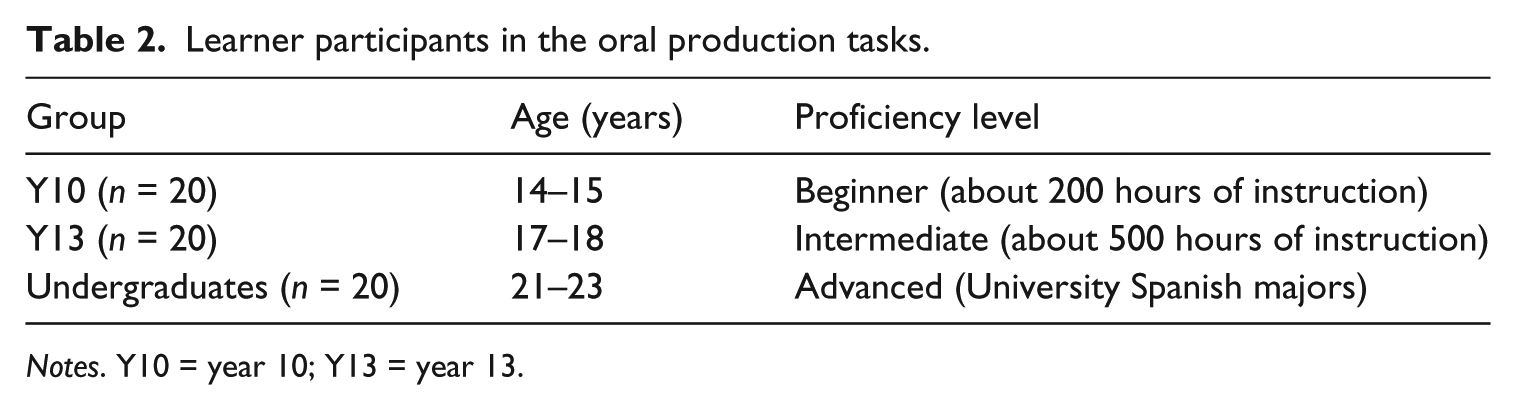
The 60 English learners of Spanish were divided into three different proficiency groups (beginner, intermediate and advanced) according to their education level in the UK system: lower secondary school (Year 10), final year of upper secondary school (Year 13), and university undergraduate students (UG) in the final year of their Spanish degree. These represent three key language learning stages in a typical instructed setting. 10 A background questionnaire completed by the learners allowed us to exclude participants who had not chosen Spanish as their main foreign language and those who could be classified as bilingual (i.e. those who spoke Spanish at home, for instance). A control group of 15 native speakers from Spain performed the same tasks as well.
Learner participants in the oral production tasks.
Notes. Y10 = year 10; Y13 = year 13.
b Task design
Table 3 shows details of the two especially designed tasks used to collect the oral data: one impersonal narrative (Cat Story) 11 and one personal narrative (elicited as part of a semi-structured interview). 12 They were piloted with native speakers and with a sample of learners with the same age and proficiency as our three experimental groups.
Oral tasks used in the study.
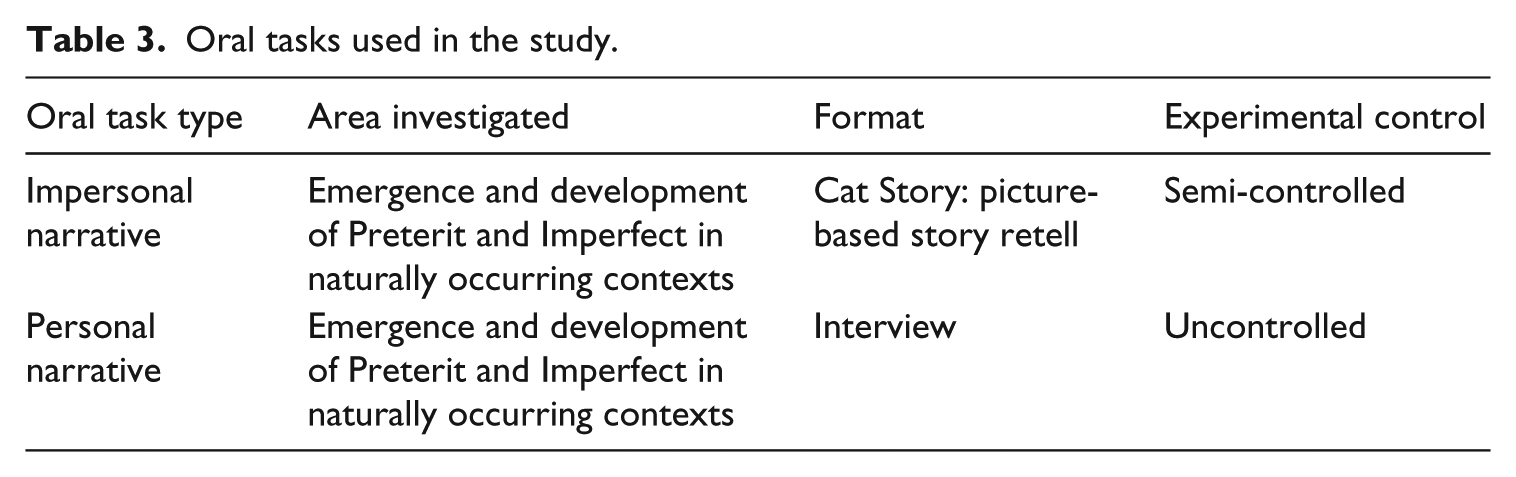
In the Cat Story learners looked at a series of pictures chosen to depict both perfective and imperfective situations. Only two written prompts were included: one which provided imperfective contexts (Todas las mañanas eran iguales ‘Every morning was the same’) and another one for one-off/perfective contexts (Hasta que un día … ‘until one day …’). It was necessary to include an Imperfect form (eran) in the imperfective context. Although this may have lead some of the participants to use the imperfect, the fact that learners from all proficiencies also used Imperfect forms other than eran as well as other tenses (e.g. present, Preterit) indicates that learners were not merely reproducing the form used in the prompt in this context. In the Interview task learners were free to talk about their childhood and their upbringing. The experimenters use specific questions to elicit both the Imperfect (e.g. ¿Qué te gustaba hacer de pequeño? ‘What did you like to do when you were a child?’) and Preterit (e.g. ¿Qué hiciste el fin de semana pasado? ‘What did you do last weekend?’) but no further controls applied. This was necessary to ensure that all learners were given an opportunity to use the target forms. 13
The data were audio-recorded and the sound files were transcribed using CHILDES/CHAT transcription conventions (MacWhinney, 2000). The accuracy of the transcriptions was checked by at least two members of the team. Part of speech (POS) tagging of the CHAT transcripts was carried out using the Spanish MOR and POST routines with further accuracy checks applying at this stage. The data obtained by the two tasks were coded according to lexical aspect, semantic context (habitual, progressive and continuous), and forms produced (Preterit, Imperfect, Present, etc.). The manual coding of contexts was carried out by the full-time research assistant after careful training. A subset of the data was also coded by other members of the team to ensure at least 95% of inter-rater coding reliability following common practice in the field.
c Results
In this section we examine learners’ choice of form (Imperfect, Preterit or Other) in each of the three interpretations (habitual, progressive and continuous) in imperfective contexts in the two oral tasks. In all these contexts the imperfect is the obligatory form. In progressive contexts we have included uses of the progressive form (e.g. Ana estaba jugando ‘Ana was playing’) under the Imperfect category as well. The category ‘Other’ includes a variety of non-target forms including present tense (the most frequent form), uninflected forms, gerunds and the subjunctive.
Table 4 shows the percentage of use of the options in the Cat Story. In this task, the beginner year 10 (Y10) group used mostly ‘Other’ forms (mostly present tense) and very low rates of Imperfect and Preterit are observed in the three contexts. Compared to the beginner group, more use of past tense forms is observed for the intermediate group. Overall, intermediate year 13 (Y13) learners produced more Imperfect in progressive contexts (58%) followed by continuous contexts (44%), and habitual contexts (24%). Preterit rates were higher in the habitual (41%) and progressive (42%) contexts than in the continuous (12%) context. The advanced UG group show higher use of the Imperfect than the Preterit in all three contexts.
Use of Preterit, Imperfect and other forms in three imperfective contexts (Cat Story).
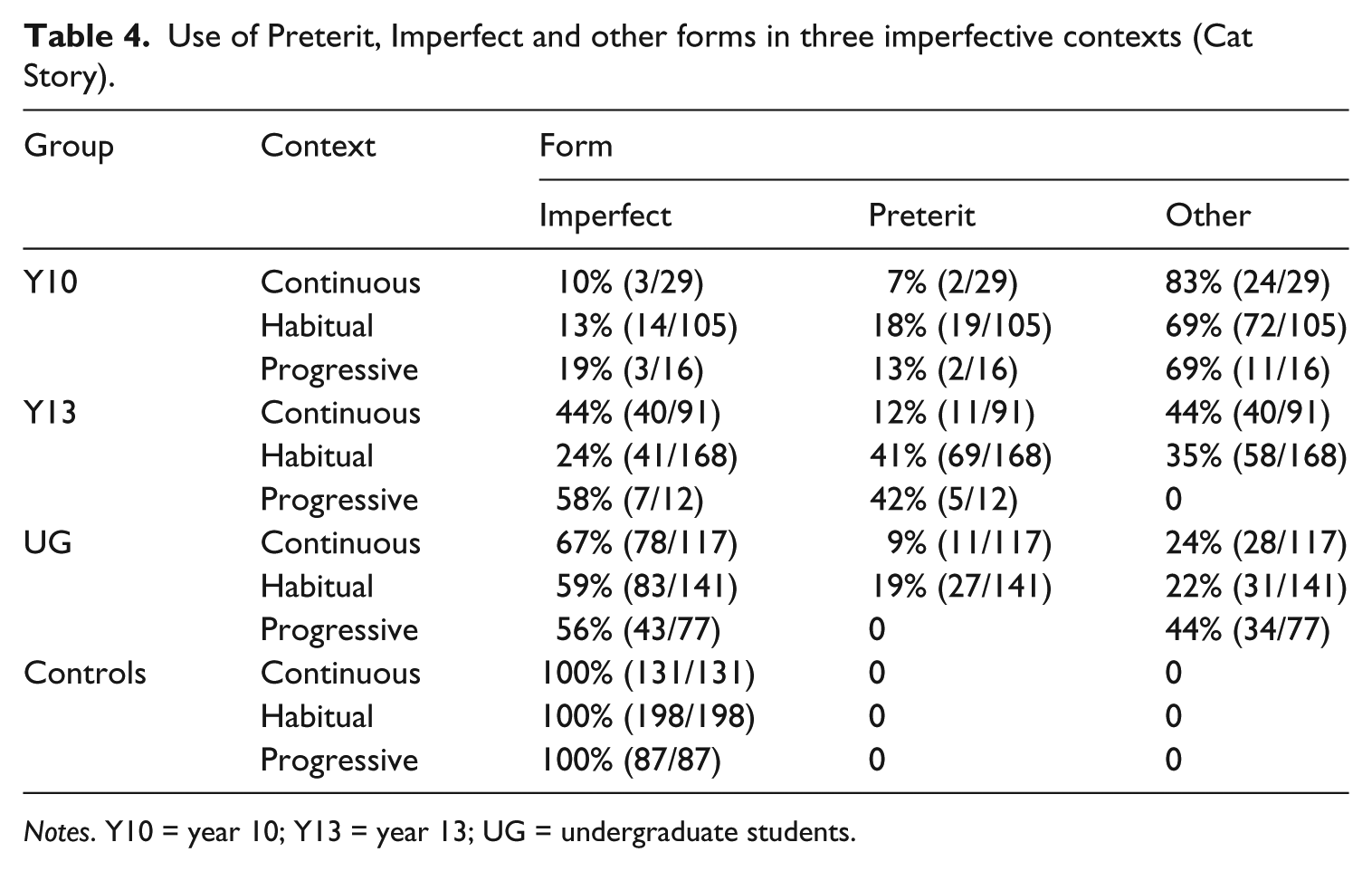
Notes. Y10 = year 10; Y13 = year 13; UG = undergraduate students.
Example (7) shows a beginner learner using both present tense (escala ‘climbs’) and the correct Imperfect (perseguía ‘followed’) when describing events in an imperfective-habitual context to the investigator:
(7) C11: um Pancho * INV: un árbol C11: un árbol, um Pancho um C11: um, Pancho climbs [^eng: oh I can’t think of tree] INV: a tree C11: a tree, um Pancho um was chasing um the butterfly
In example (8) another beginner learner uses mostly Preterit, the incorrect form, to describe the events in the same imperfective/habitual context:
(8) C9: Natalia C9: Natalia was doing a picture and went to the park and went on her bike with a friend and climbed up a, something, and Pancho slept in a basket and slept in the sun.
The results of the Interview task are shown in Table 5. The Y10 group also produced a high percentage of ‘Other’ forms in this task. Again, we see the highest rates of Preterit (30%) are found in the habitual context (only 5% of Imperfect was produced in this scenario). Beginner learners also produced 50% of forms with Imperfect and no Preterit in progressive contexts.
Use of Preterit, Imperfect and other forms in three imperfective contexts (Interview).
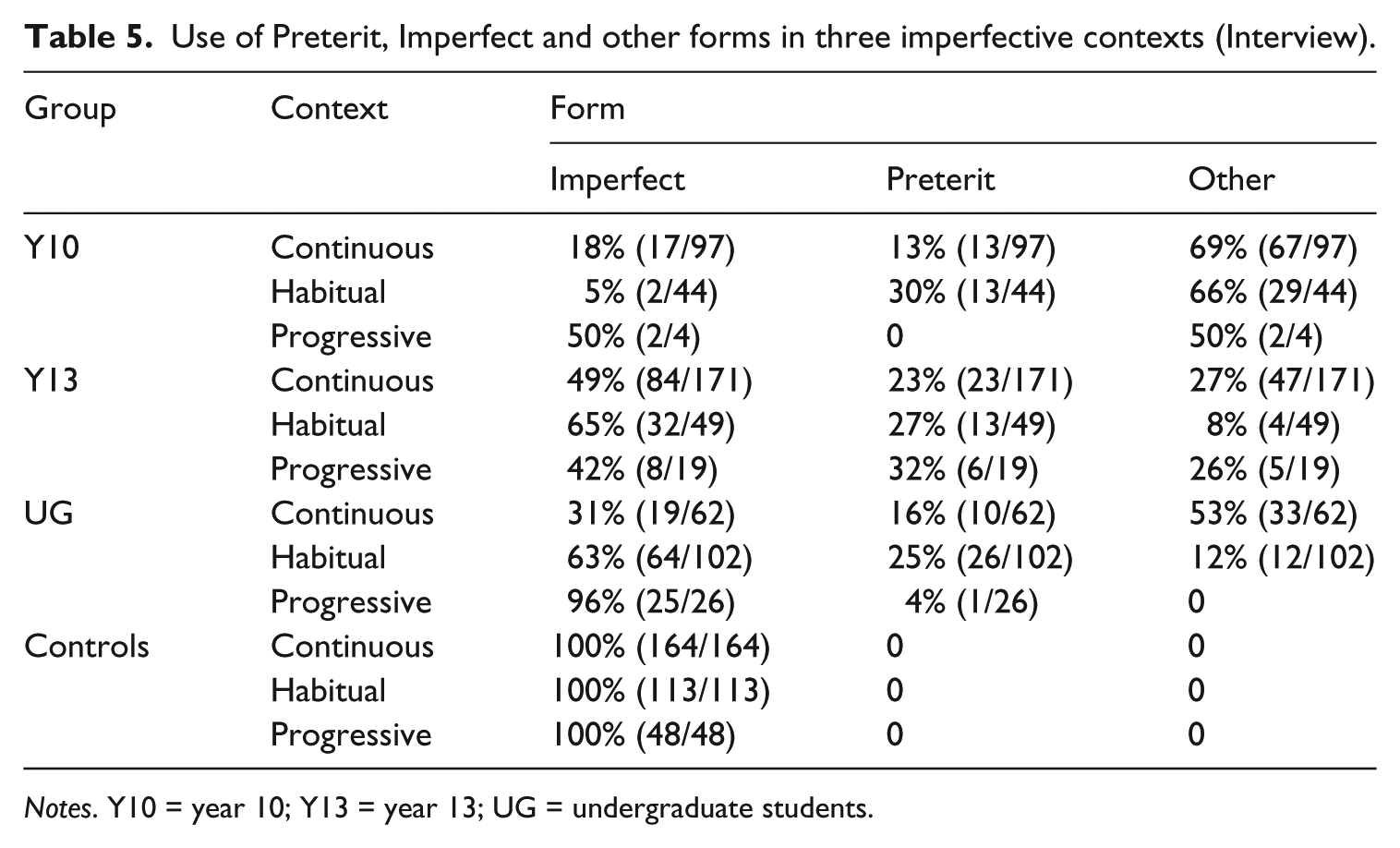
Notes. Y10 = year 10; Y13 = year 13; UG = undergraduate students.
The intermediate learners used the Imperfect mostly in habitual contexts (65%), followed by the continuous (49%) and progressive (42%) contexts. In contrast to the Y10 group, intermediates prefered the Imperfect over the Preterit in the three contexts. In example (9) an intermediate learner correctly uses the Imperfect to describe a memory about the past in a continuous context:
(9) I52: I52: I can … I remember my first day in school and I was very sad because I missed my mum and I couldn’t do the work because it was too hard for me.
In example (10) the same learner appears more unsure about the correct form as this learner uses present tense, Preterit and Imperfect in the same sentence:
(10) INV: ¿lloraste? I52: sí oh mucho INV: ¿pero después no? ¿estabas bien? I52: Sí, reconu … INV: Did you cry? I52: Oh yes, a lot. INV: But not later? Were you ok? I52: Yes, I recog … recognize many people and I hav … had … used to have many friends later on.
The highest use of the Imperfect in the UG group was found in progressive contexts (96%). Notice that some Perterit is still observed in the data of the advaned group, in particular in habitual (25%) and continous (16%) contexts as illustrated in example (11) which shows both correct use of the Imperfect and incorrect use of the Preterit:
(11) I82: pues mi primer recuerdo I82: ‘so my first memory would be, I don’t know how old I was, perhaps I was in Italy because I have family in the north of Italy and we went every year when I was little.’
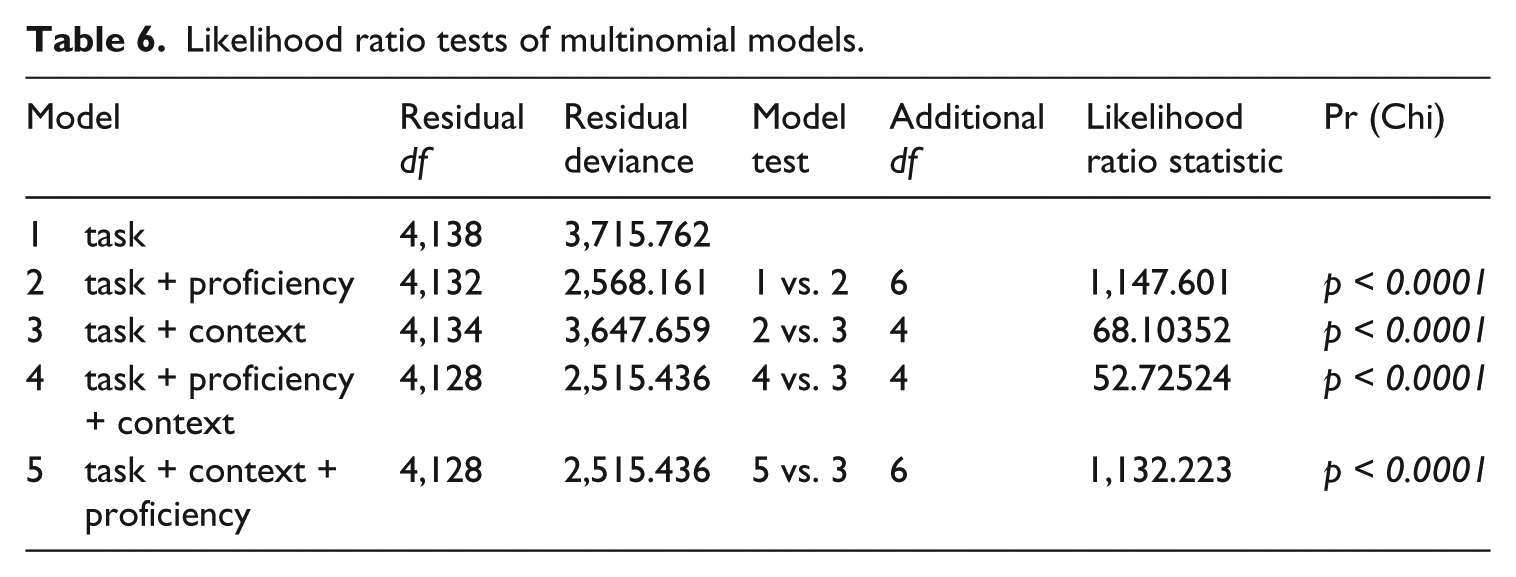
A multinomial logistic regression model was used in order to determine whether the use of form (preterit, imperfect, other) depends on the type of context (habitual, continuous, progressive) or group (Y10, Y13, UG, NS). The parameter values were calculated using maximum likelihood estimation. The ANOVA in Table 6 shows how the addition of each predictor variable in the model, in all combination of orders, reduces the residual deviance, and whether or not the size of the reduction is significant. There is very strong evidence to suggest that both context and proficiency have a significant effect on which form is used (p < 0.0001). Since the residual deviance after adding proficiency to the model with task alone is lower than that for adding context (2,568 vs. 3,647), this means that proficiency explains more of the variation in the choice of form and therefore has a greater effect than context.
Likelihood ratio tests of multinomial models.
Fitted probabilities indicating the likelihood of a speaker using each form (preterit, imperfect, or other) within each predictor variable (within task, within context, and within group) were obtained. These probabilities were used to calculate the fitted likelihood ratios in Table 7 (for each task), Table 8 (for each group) and Table 9 (for each context). In Table 7 we see that no statistical differences were observed for the likelihood of using the Imperfect over the Preterite in the two tasks. However, a speaker is 1.49 times more likely to use the Imperfect over the ‘other’ form in the Cat Story; this increases to 2.09 in the Interview. In contrast, a speaker is 3.09 times more likely to use the ‘other’ form over the Preterit in the Cat Story task, but this decreases to 1.84 in the Interview.
Fitted likelihood ratios (task).
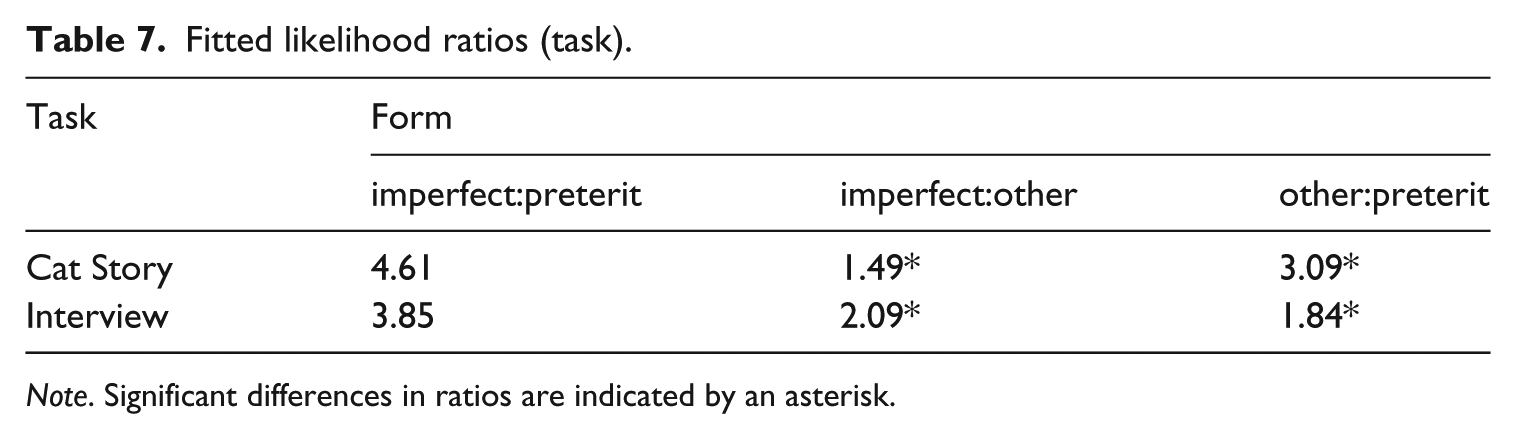
Note. Significant differences in ratios are indicated by an asterisk.
Fitted likelihood ratios (group).
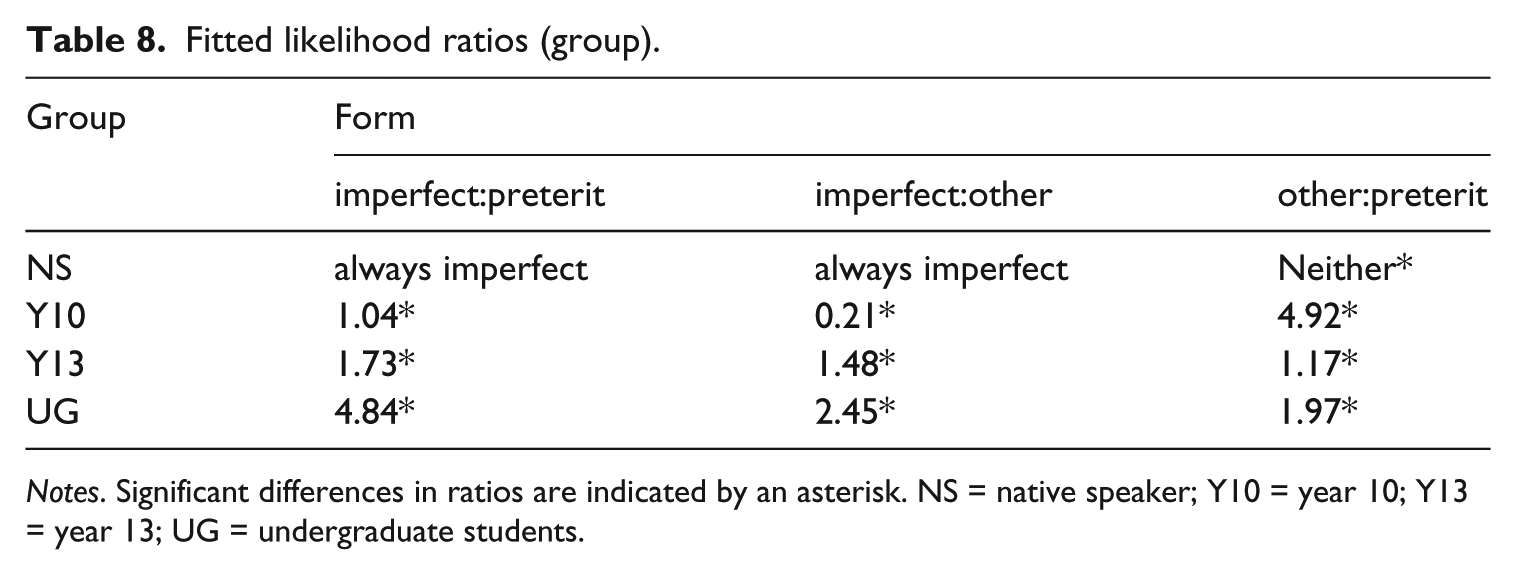
Notes. Significant differences in ratios are indicated by an asterisk. NS = native speaker; Y10 = year 10; Y13 = year 13; UG = undergraduate students.
Fitted likelihood ratios (context).
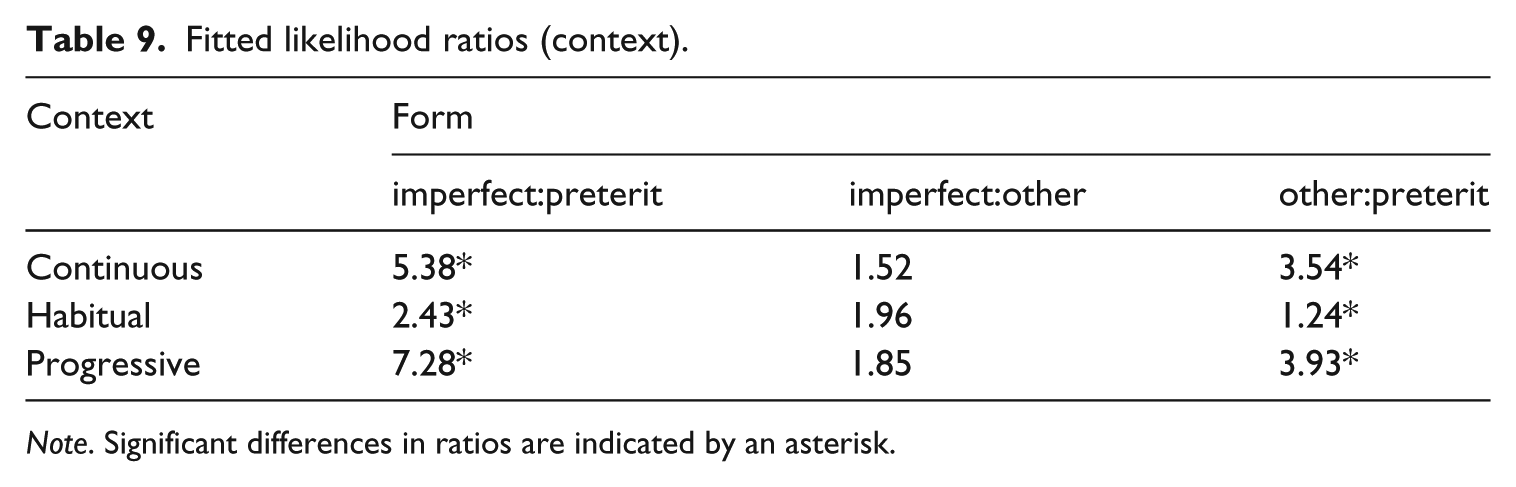
Note. Significant differences in ratios are indicated by an asterisk.
Table 8 shows that the likehood of using the Imperfect over the Preterit and other forms increases with profiency. A UG speaker is 4.84 times more likely to use the Imperfect over the Preterit, whereas this reduces to only 1.04 for a Y10 speaker. A Y10 speakers is more likely to use an ‘other’ form over the Preterit than the other two learner groups.
As for context, Table 9 shows that a speaker is 7.28 times more likely to use the Imperfect over the Preterit in progressive contexts, followed by the continuous (5.38 times) and the habitual (2.43 times). A speaker is also 3.54 times more likely to use the ‘other’ form over the Preterit form when the context is continuous, but this decreases to 1.24 times when the context is habitual. Finally, a speaker is 1.24 times more likely to use other forms over the Preterit when the context is habitual, but this increases to 3.93 times when it is progressive.
In summary, there are significant differences in the choice of form between all combinations of the four levels by proficiency level. Within context, there are significant differences in the choice of form between continuous and habitual, and between habitual and progressive, but not between continuous and progressive.
2 The comprehension task
An online Sentence-Context Preference Matching Task (SCMT) was designed to investigate possible L1 effects in the acquisition of the Imperfect by examining learners’ interpretations of each of its three associated meanings.
a Task design
The same 60 English learners of Spanish took part in the comprehension task as well. Twenty native speakers of peninsular Spanish, tested in Spain, formed the control group. Two sets of variables were examined: the type of predicate (eventive or stative) and the type of context (one-time event, habitual, progressive, or continuous). These were combined to produce 7 situations and 32 test items as shown in Table 10. 14
Sentence-Context Preference Matching Task (SCMT) design.
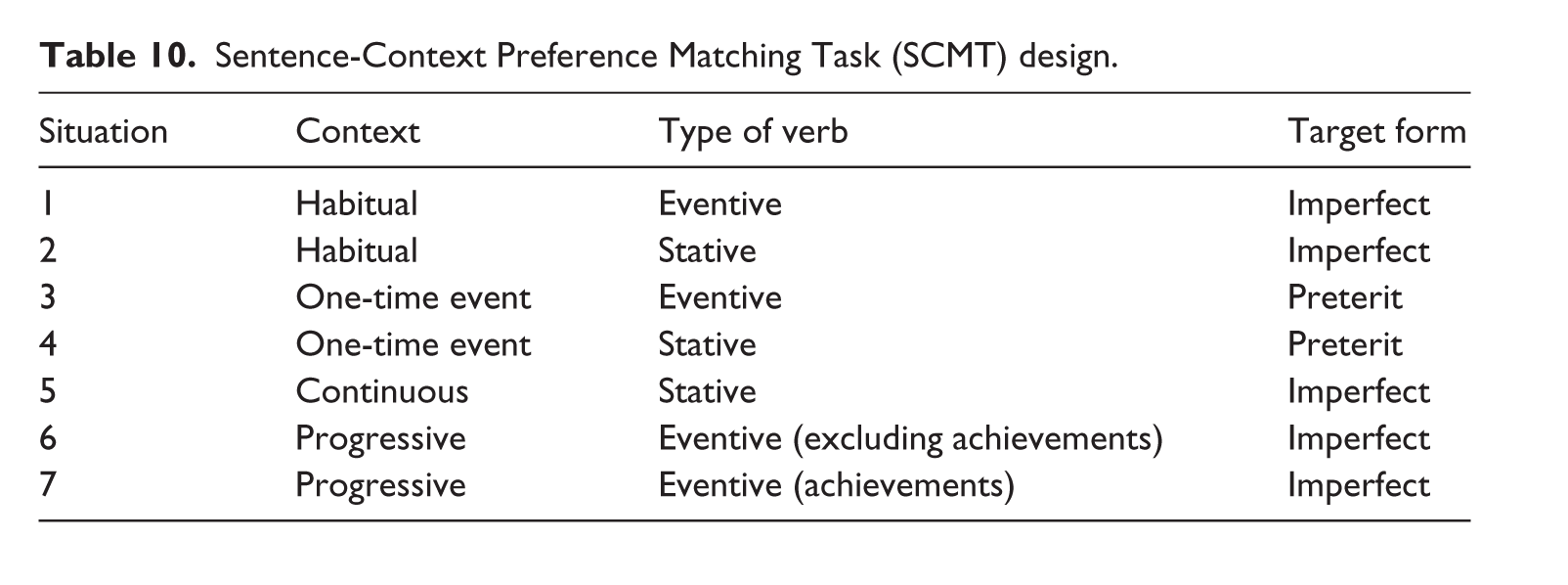
The 80 participants were asked to rate the appropriateness of a pair of Imperfect/Preterit sentences using a 5 point Likert scale (−2, −1, 0, +1, +2), where (−2) means completely inappropriate and (+2) completely appropriate. Each context was designed to bias the acceptance of either the sentence with perfective morphology (contexts depicting a one-off event) or the sentence with imperfective morphology (contexts depicting continuous, habitual, or progressive events). Example (12) illustrates a sample test item where the introductory context represents a habitual action. Option (12b) with imperfective morphology is appropriate in this context:
15
(12) When Ana was a child she had a very close friend, Amy, and she liked to spend a lot of time at her house after school. a. Ana ‘Ana was in Amy’s house a lot after getting off school’ b. Ana ‘Ana was in Amy’s house a lot after getting off school’
The choices made by each participant were counted, and the mean scores of each chosen option in each experimental condition were calculated.
b Results
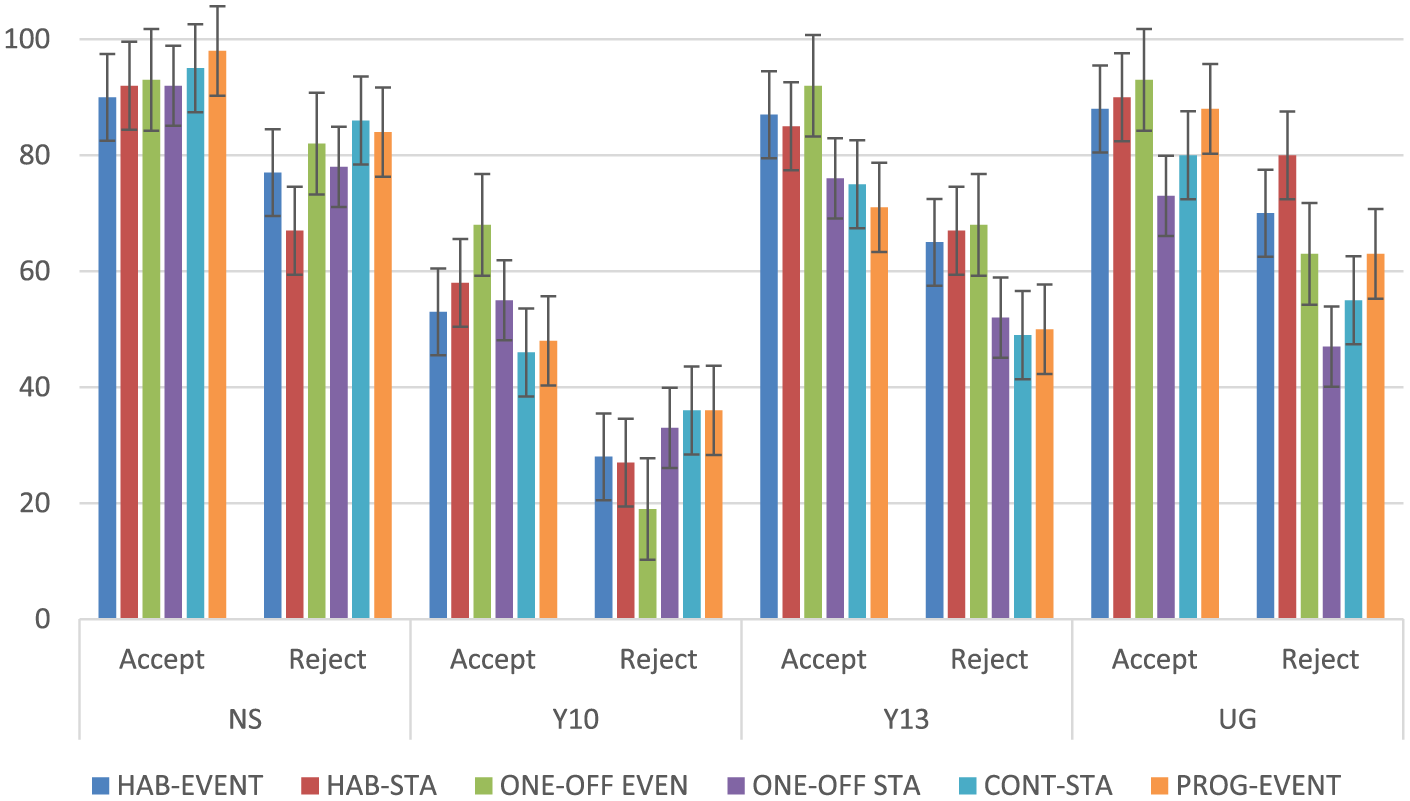
We present the mean percentages for acceptance/rejection of the correct and incorrect options in Figure 2. Note that the Imperfect is the correct form in all contexts except in ‘One-time event’ contexts where the Preterit is appropriate. It was possible for the participants to accept and/or reject both target sentences in this task. Each percentage shows the combined proportion of responses for 1, and 2 (accept), and for −1 and −2 (reject) in each of the six situations:
Mean acceptance and rejection scores for the two input sentences across contexts.
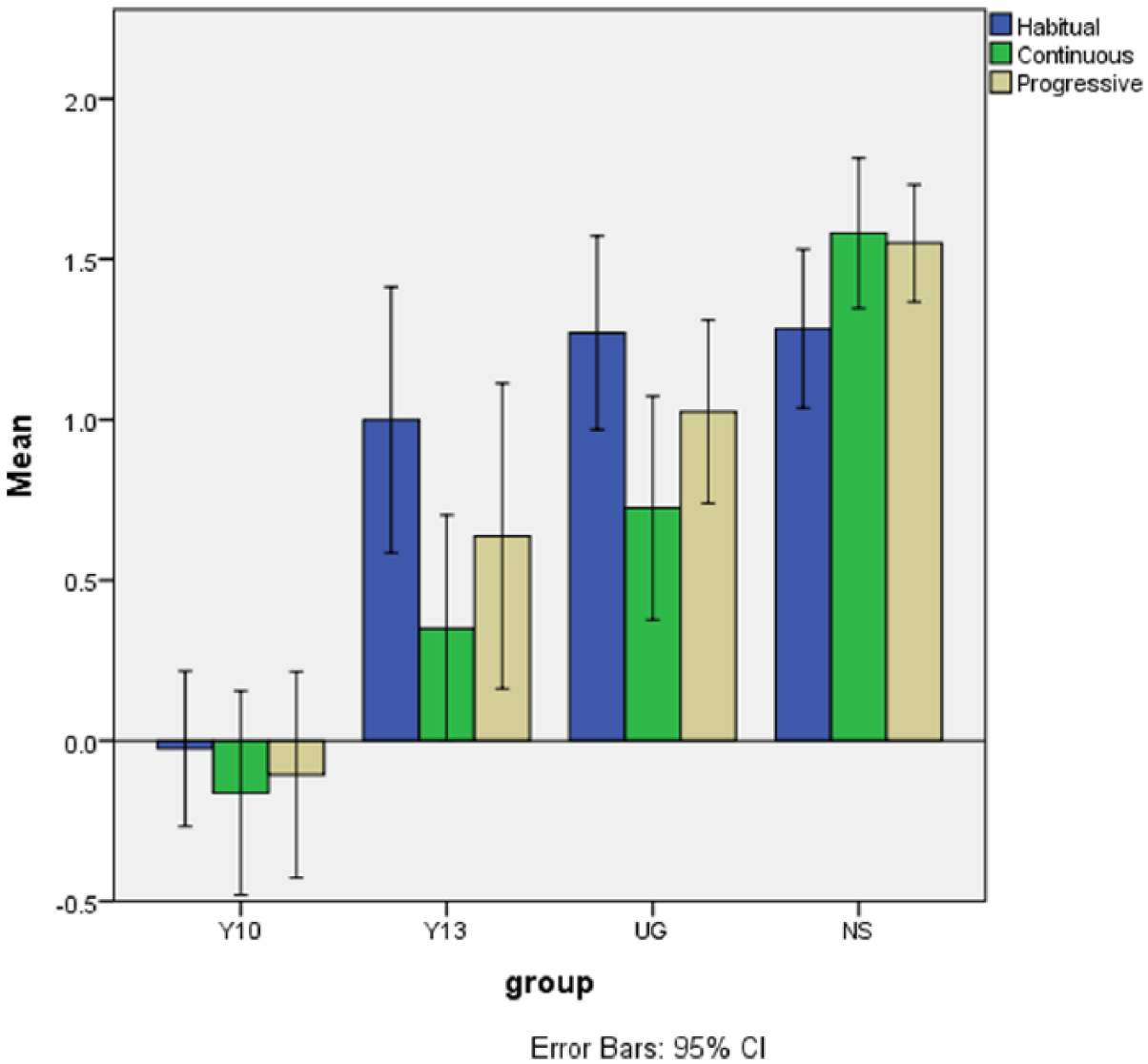
The native controls accepted and rejected the Imperfect and the Preterit in each context mostly as expected. 16 In contrast, the beginner Y10 group show much more indeterminacy in their choices in all contexts. The acceptance rates for the appropriate form range from 46% in continuous contexts to 68% in eventive, one-off contexts. The Imperfect was only accepted at a rate of 48% in progressive contexts by this group. This result contrasts with the high rates of acceptance of the Imperfect by the other two learner groups. The highest acceptance rates are found in the one-off contexts where the Preterit is the correct option (68% with events). The rejection rates for the inappropriate sentences are quite low as well. The intermediate group was more accurate accepting the appropriate sentence than rejecting the inappropriate one. They had difficulty rejecting the Preterit in continuous (40%) and progressive contexts (50%). The results of the advanced group are very similar to those of the controls for the appropriate sentence (the sentence that was correct). There is a clear acceptance of Imperfect and Preterit when these are appropriate, showing that these speakers know that the sentence with Imperfect is the right option in the three imperfective contexts. In contrast, the rates for the inappropriate sentence (the sentence they had to reject) were lower, in particular in One-off contexts and in the Continuous context where they only rejected the Preterit at a rate of 55%. The highest appropriate rejection rates of the Preterit were in habitual contexts, a result which contrasts with the high use of the Preterit in habitual contexts observed in the oral tasks. Next, we examine the overall means of correct answers (combining both correct acceptance of imperfect and correct rejection of preterit) for the three contexts. Figure 3 shows that the acceptance of the Imperfect increases with proficiency across all three situations. The lowest scores are observed in the continuous context even for the advanced group (0.73 for UG and 0.43 for Y13).
Correct answers in the three semantic contexts, across groups.
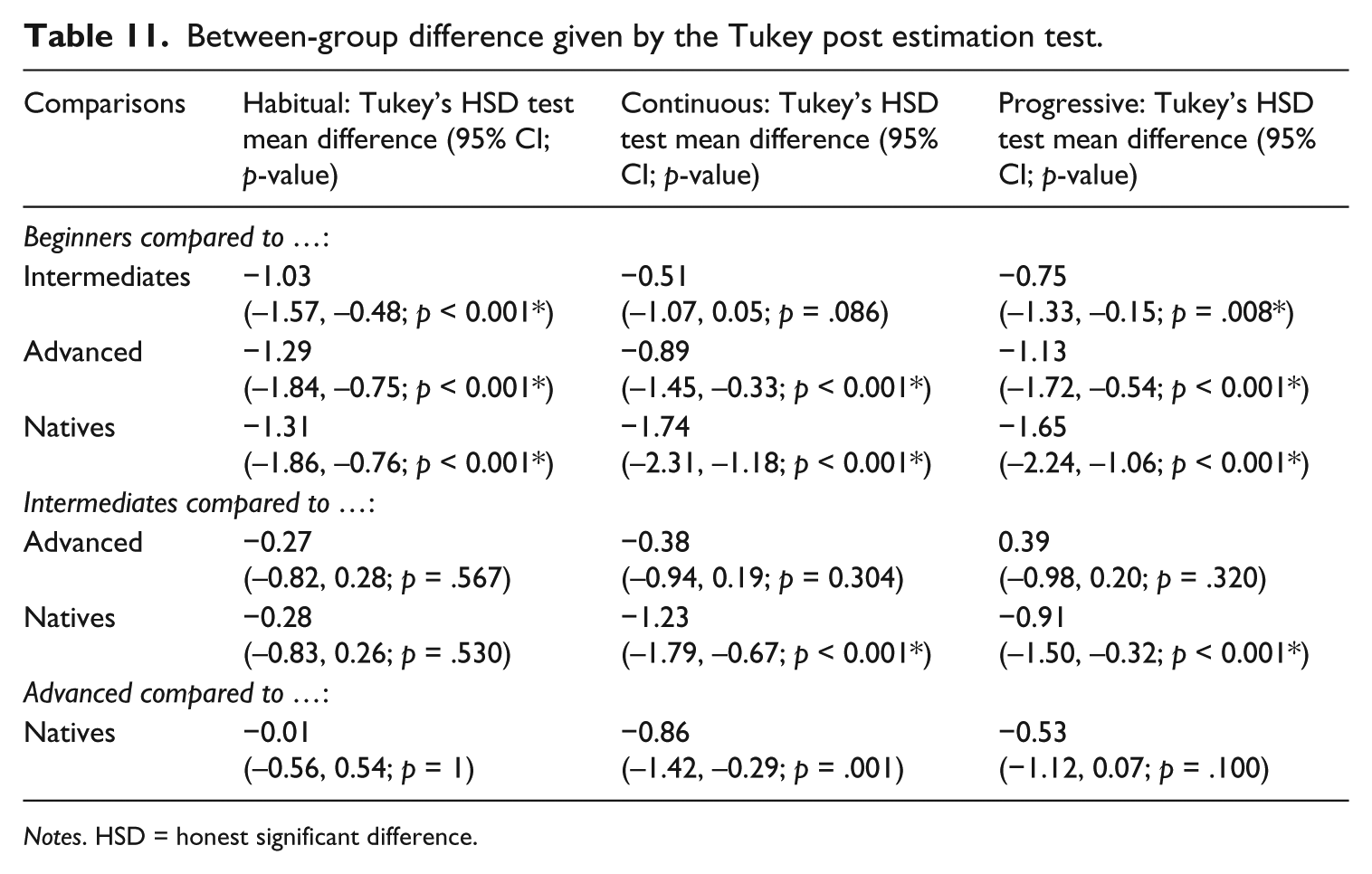
An ANOVA shows a significant difference between the groups in the habitual context (F(3,76) = 17.58, p < 0.001), the continuous context (F(3,76) = 23.61, p < 0.001) and the progressive context (F(3,76) = 19.18; p < 0.001). Table 11 shows the comparisons between groups for the three contexts (habitual, continuous and progressive). Beginners’ responses were significantly different to the other two groups in all contexts except for the continuous. Intermediates were significantly different to the native controls in continuous and progressive contexts only, whereas significant differences were found for the advanced group in continuous context only when compared with the controls.
Between-group difference given by the Tukey post estimation test.
Notes. HSD = honest significant difference.
Next, we examine the difference between the controls and the advanced group in more detail to find out whether this difference is observed in both the acceptance of the Imperfect and the rejection of the Preterit (both are correct options in this case). An ANOVA shows a significant effect of proficiency on the acceptance rate F(2, 55) = 6.12, p < .01. Bonferroni tests reveal a significant difference between native speakers and year 13 (p < .01) in the acceptance in continuous contexts, no significant difference between UGs and year 13 (p = 1), and the difference between UGs and native speakers was approaching significance (p = .051). This indicates that advanced learners have more problems abandoning perfective morphology than accepting the Imperfect in continuous contexts.
VI Discussion and conclusions
We predicted that English learners of Spanish would not find acquiring the Imperfect more problematic than the Preterit since we assume that Past tense forms in English are not perfective by default, contra previous research. This prediction was corroborated by our data. The two oral tasks in the production study showed that although the use of the Imperfect increases with proficiency, this form is already used by our less-experienced learners. The comprehension data also show that when the advanced group make the wrong choice of form, they do this because they incorrectly accept the Preterit in imperfective contexts. These results suggest that English speakers at all proficiencies know that the Imperfect is a form available in Spanish to mark imperfectivity 17 (see also Domínguez et al., 2013). The results of the two oral tasks also show that learners incorrectly overuse the Preterit mostly in habitual contexts. However, evidence from the comprehension task contradicts the oral data as these speakers correctly accept the Imperfect and reject the Preterit in this context. In Spanish, habituality can be expressed with either a periphrasis (soler + infinitive ‘used to + infinitive’) or with the Imperfect form. In an oral production task, which is known to pose extra challenge to learners, these speakers would face an even bigger challenge in habitual contexts as they would need to choose between the two options available. Note that learners would not face this difficulty in a comprehension task, which might explain the difference in the results obtained in each of the tasks regarding the choice of Preterit in habitual contexts.
We also predicted that the ‘continuous’ and ‘habitual’ meanings, the meanings that require feature reassembly, would be persistently problematic for the English learners. We hypothesized that English speakers would have problems dissociating the ‘continuous’ and the ‘habitual’ from the Preterit since these meanings are expressed with forms that also convey perfectivity in English. Our results fully support this prediction for the continuous meaning in all tasks, and partially support it for the habitual as only some of the oral data show problems with this meaning. The comprehension results show persistent problems with the ‘continuous’ even at advanced level. These advanced learners were found to have problems rejecting the Preterit in this context, but not in the other two contexts. 18 In this respect, the beginner data provides support for Slabakova and Montrul’s (2002) suggestion that L1 transfer particularly affects the acquisition of states, which they could not corroborate as they did not include beginner speakers in their study. However, in contrast to Slabakova and Montrul (2002, 2003) and Montrul and Slabakova (2002), results from our comprehension task show that L1 effects persist in the grammar of advanced speakers as problems rejecting the Preterit in imperfective/continuous contexts are observed in the results of all three learner groups (see also Salaberry, 2008). 19 Overall, these results indicate that problems acquiring the Imperfect cannot be generalized to the acquisition of this form as a whole, and that the difficulty can be traced down to existing mismatches in certain form–meaning associations between the native and the target grammars.
Recently, Roberts and Liszka (2013) have proposed that the fact that aspect is grammaticalized in the native language can in some way facilitate the acquisition of aspect marking in a second language even if the marking works in different ways. Their study examined the acquisition of English by French and German speakers. Whereas German does not mark any aspectual distinction morphologically, French and English distinguish aspectual differences with overt morphology but in different ways; for instance French distinguishes the imperfective/perfective distinction whereas English marks the progressive/non-progressive interpretations. In their study, French learners performed better than the German learners. They suggest that although French and English do not encode aspect in the same way, aspectual forms are a feature in both grammars. French speakers may have an advantage over German speakers because they are more sensitive to the grammatical marking of aspect in English. They propose that it is the fact that aspect itself is morphologically marked, regardless of how it is marked, which provides the advantage. This proposal, however, cannot explain why English speakers find marking imperfectivity, and not acquiring the Preterit per se, problematic in Spanish. In our view, the edge that aspect marking in English provides may have a facilitative effect, but it is not sufficient to ensure full acquisition of the Imperfect/Preterit distinction. What seems to be relevant in this case is whether the aspectual forms available in the target grammar are used to represent the same interpretation in both languages; in other words, it is not only about whether a feature exists or it is expressed in the grammar, but whether that feature is assembled onto forms expressing the same meaning in both languages.
In contrast to Montrul and Slabakova (2002, 2003), we have argued that problems in the acquisition of the Spanish Imperfect are not due to the need to acquire a new syntactic–semantic feature. In our data, the persistent problems with rejecting the Preterit in continuous contexts in the interpretation task are difficult to account for by the unavailability of a [–perfective] feature since the problem does not affect the acceptance of the Imperfect but the rejection of the Preterit. In the present study, we have shown that the process of remapping existing aspectual meanings onto new forms is influenced by the learners’ native language (see Lardiere, 2009). This is an important finding since the role of the native language in acquiring new aspectual morphology has recently been questioned. Specifically, in a study examining the acquisition of the imperfective marker te-iru in Japanese by Chinese speakers, Gabriele and McClure (2011) (see also Gabriele, 2009) have argued that the complexity of the interpretations encoded by the forms and its transparency (whether there is a one-to-one form–meaning mapping for instance) can explain how easily learners acquire the new forms regardless of L1–L2 differences. Gabriele and McClure (2011: 63) reject a pure L1 transfer explanation arguing that ‘Languages in which the morphemes for tense and aspect are not easily decomposed will present a challenge, regardless of whether or not those semantic concepts are present in the native language of the learners.’ In our view, it is difficult to dissociate L1 influence from the assembling or remapping task completely; in fact, an approach such as Lardiere’s FR, which we have investigated in this study, makes the link between these two aspects of the task both explicit and necessary as forming new mappings is completely influenced by how these mappings are established in the learners’ native grammar. This can explain why some aspects of the Imperfect, rather than the Imperfect as a whole, present challenges to English speakers. This seems particularly relevant since there is no reason to assume that the imperfective/perfective grammaticalization offers the same level of transparency for each of the morphological forms available in Spanish (Imperfect and Preterit). However, although our results support the view that the L1 influences the mapping of meanings onto new forms, learners still need to acquire each of the relevant morphological forms (as noted by Gabriele and McClure, 2011; Montrul and Slabakova, 2002). What determines the difficulties in acquiring the morphological forms themselves is an issue that requires further examination. For instance, our beginner learners appear not to distinguish between the two forms in the interpretation task, which may support the view that the acquisition of the forms themselves precedes the acquisition of the new mappings; however, the intermediate learners already show knowledge of the morphological distinction but still have problems mapping the right interpretation onto the Imperfect. This seems to suggest that knowledge of the morphological distinctions does not guarantee acquisition of the appropriate semantic interpretations in this domain. More research examining different pairs of languages with varying degrees of morphological transparency (i.e. one-to-one mappings) is necessary to fully resolve this issue.
Looking forward, our results have shown that the Feature-Reassembly approach can provide testable hypotheses to elucidate the problematic nature of the acquisition of aspectual morphology in a second language. The specific predictions outlined in this study provide a basis for future research examining other languages pairs and other types of form–meaning (re)mappings. We argue that this is essential for research that aims to provide an explanatory account of the role that the L1 plays in the acquisition of aspect in another language.
Footnotes
Acknowledgements
We are grateful to Dr. Sonya Ridden for her advice carrying out the statistical analyses.
Declaration of conflicting interest
The author(s) declared no potential conflicts of interest with respect to the research, authorship, and/or publication of this article.
Funding
The author(s) disclosed receipt of the following financial support for the research, authorship, and/or publication of this article: This work was supported by the UK Economic and Social Research Council (ESRC) (Grant number RES-062-23-1075).