




Abstract
This article analyses how the role and remit of public service media (PSM) and its relationship to current media and societal developments are framed in recent media policy discourses in Finland, Sweden, Norway, and Denmark, countries often described as Media Welfare States (MWS). Employing the framework of discursive (media) institutionalism and frame analysis as a method, we analyse policy documents covering a 10-year period to identify differences in national PSM framing. Our findings confirm shared challenges related to platformisation, disinformation, audience fragmentation, and competition with commercial media. More interestingly, clear national differences emerge in how PSM is framed. Comparing these national findings to the four pillars of the MWS, we identify a recent paradigm shift where the consensus on the societal role and remit of PSM has weakened. We argue that future policymaking should consider these developments when discussing how best to safeguard Nordic PSM.
Keywords
Introduction
The appropriate role and remit of public service media (PSM) is a perennially contested topic in all countries where such media exist. Especially in recent years, PSM organisations and their supporters across Europe have been forced to defend the role of PSM against strategic attacks aimed at undermining its legitimacy. Even in the Nordic countries, the public service media faces challenges from various fronts, including market-liberal and populist political arguments, lobbying by commercial media, and the influence of global digital platforms (e.g. Jakobsson et al., 2021, 2024).
These challenges reflect material realities, such as conflicting economic interests and changing technological environments. The debates also reflect discursive contestations over the definition of public service, the values it is associated with, and its framing as a problem or a solution in relation to various developments in society and media (e.g. Puppis and Ali, 2023). In this article, we analyse how the remit of PSM has been framed in Nordic media policy documents and assessments in the last decade. Through framing analysis of reports and policy documents from 2013 to 2022, we analyse the values associated with public service as well as the problem definitions, causal interpretations, and suggested remedies invoked in PSM policy discourses in Finland, Sweden, Norway, and Denmark. Iceland, the Faroe Islands, Greenland, and Åland are not included due to the different workings of their PSM.
Leaning on the framework of discursive institutionalism (Schmidt, 2008) and its development into ‘discursive media institutionalism’ (Ganter and Löblich, 2021), we approach PSM as an institution that is discursively constructed, reproduced and transformed by policy actors. We analyse how the aims of PSM policy, the challenges it faces, and the values it is associated with are understood in the policy discourses of four countries.
In line with discursive institutionalism, we focus on how ideas and discursive frames matter, both as explanations for national differences and as factors that guide future policies by drawing attention to particular issues over others or by delineating the range of policy options considered legitimate. Given the similarities in media systems, differences in framing PSM policy issues reveal the political, cultural, and institutional factors shaping national media policy discourses.
Our research questions are:
- How is the PSM's role framed in Finland, Sweden, Norway, and Denmark in relation to contemporary issues and changes in the media landscape? - What do these framings reveal about the underlying political developments and policy priorities shaping Nordic media policies?
We identify similarities and differences in framing PSM policy by a qualitative analysis of policy documents, including government platforms, official reports, public service broadcasters’ strategies, and contracts between PSMs and governments.
Our findings indicate shared problem definitions discussed across the four countries, such as challenges caused by digitalisation, coping with disinformation, reaching younger audiences, and coexisting with commercial media. Yet, there are also clear national differences in terms of how PSM is framed in relation to these challenges and how its societal role is justified. In the conclusions, we discuss the implications of these findings for the evolving debate on the Nordic ‘media welfare state’ (Jakobsson et al., 2024; Syvertsen et al., 2014).
PSM and the media welfare state
Public service media is a cornerstone of the Nordic media welfare state model, embodying its four pillars of universal availability, institutionalised editorial freedom, extensive cultural media policy, and consensual policymaking with stakeholder compromise (Syvertsen et al., 2014: 71). The main national public service broadcasting companies are at the core of the study: Norwegian NRK; Swedish SVT, SR and UR; Danish DR; and the Finnish Yle. Companies, such as the Danish TV2 and Norwegian TV2, are also considered public service media, but since they operate on a commercial basis, they were left outside the corpus. Although there are differences in the way Nordic PSM is governed, funded and organised, they share central characteristics, such as substantial public funding as the main income source, status as central national institutions with universalistic scope, and the arm's length principle towards government influence or political pressure (Syvertsen et al., 2014: 71–75).
PSM companies maintain a strong position across the Nordic countries. They enjoy high public trust (Engelke et al., 2019; Strömbäck et al., 2020) and are considered important among citizens (Nielsen and Newman, 2023). Nordic PSM organisations have also developed significant online presences, adopting new methods to deliver core services (e.g. Sehl et al., 2016: 19).
While being grouped together under the label of the media welfare state, previous studies have observed differences between Nordic countries in terms of media policy priorities. According to Ala-Fossi (2020), none of the Nordic countries have strictly followed the ideal principles associated with the media welfare state model. Finland, in particular, has chosen a more market-oriented ‘competition state’ model (Ala-Fossi et al., 2023). Clearly, national policymaking significantly shapes media structures and PSM in particular.
Puppis and Ali (2023: 10) note that support for public service media across Europe has weakened among policymakers in general due to several factors. Given their financial problems, many commercial media perceive PSM as a threat, framing them as ‘market distortion’ or ‘unfair competition’ (Ala-Fossi et al., 2025). As news media have become dependent on platforms (Nielsen and Ganter, 2022), research shows that PSM must adapt their creation, distribution, marketing, and monetisation of news to the new situation (Poell et al., 2023: 1396). Consequently, PSM organisations are under scrutiny in terms of their funding and for their role in the digital domains. Consequently, they resort to a defensive position in order to ‘take control of the narrative of PSM’ (Puppis and Ali 2023: 10; see also Lowe and Maijanen, 2019; Olsen et al., 2024).
From the perspective of discursive institutionalism, we focus on regulatory solutions and the dynamics of change and continuity on the basis of ideas and discourse (Ganter and Löblich 2021). This includes problem definitions and criteria used to assess the role of public service media in society. We thus assume that the problems PSM policies aim to address are not self-evident or objective (Bacchi, 2009; Fischer, 2003). Instead, problem representations and policy frames reflect different underlying policy presuppositions and political rationalities that shape policy considerations and guide policy objectives and alternatives. These stem from political and institutional factors, including ideological shifts, industry lobbying, public debates, and cultural influences (e.g. Ganter & Löblich, 2021).
Framing in media policy
Discursive institutionalism (DI) is interested in how policy actors think and how they define and communicate policy problems (Schmidt, 2008; Ganter and Löblich, 2021). As Hay (2002: 258) explains, ‘it is the ideas actors hold about the context in which they find themselves, rather than the context itself, which ultimately informs the way in which they behave’. By analysing dominant and competing ideas in the ‘coordinative’ discourse among policy actors, DI reveals how ideas, discourse, and institutional change interact in PSM policy. These ideas can be inferred by analysing how political actors and institutions frame the policy issues on their agendas. As Entman (1993: 52) puts it: ‘To frame is to select some aspects of a perceived reality and make them more salient’. Frames thus constitute an important element of public discourse and provide central organising ideas that help make sense of relevant events, suggesting what is at issue (Gamson and Modigliani, 1989).
Entman (1993, 53) distinguishes four functions (frame elements) that a frame serves: it defines a problem, identifies causes, provides evaluations, and recommends solutions or remedies. In this way, the framing of policy issues produces political effects since it guides the relevant criteria and arguments that stakeholders can raise and limits the range of possible alternatives open to them.
Framing analysis has been widely used in media studies and in media policy analyses, including PSM policy debates (see Burri, 2015; Kluknavská, 2024).
In this study we analyse the framing of PSM in four relatively similar Nordic countries, aiming to understand the discursive development of the Nordic media welfare state model as well as possible differences between the national debates.
Data and coding
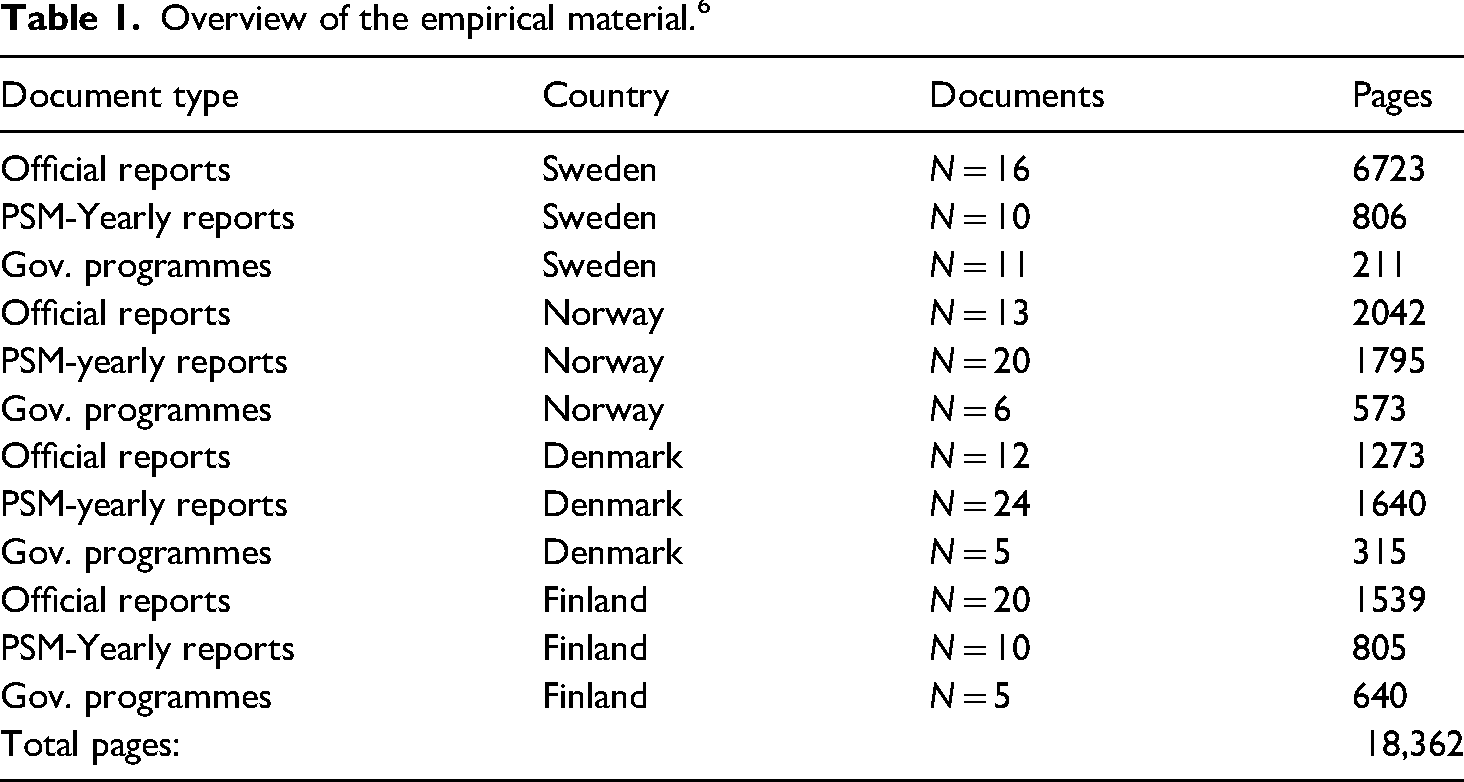
Our research material covers policy discussions in four countries over 10 years (2013–2022) and includes 152 official documents (18,363 pages) in three categories: (1) government programmes and PSM contracts outlining national guidelines; (2) official reports from parliamentary bodies and expert groups; and (3) PSM annual reports. Table 1 summarises the material.
Government programmes and PSM reports are readily available in each country. The Centre for Nordic Media Research, Nordicom, provides a list of official Nordic reports from 2000 to 2023. 1 We selected those that explicitly discuss PSM from 2013 to 2022. The selected documents represent what Schmidt (2008) calls ‘coordinative discourse’, where policy actors create and justify policy and programmatic ideas.
The government programmes, in particular, present normative views on the role and duties of PSM. Although wording on PSM is generally sparse in these documents, variations in their framing reflect changes in the underlying political ideologies between governments of different alignments.
The second category, parliamentary and expert reports, constitutes the largest volume of the material and represents in more detail the shifting framing of PSM within the policy community. These reports include expert and stakeholder views on PSM, which most evidently reflect competing problem, causal, evaluative, and treatment interpretations among different policy actors.
Finally, the PSM annual reports, as statutory documents that perform ‘a legitimating function both within and outside an organisation’ (Olsen et al., 2024), provide insight into how PSM organisations themselves frame their contribution to society in response to other policy actors. Together, these sources allow for a comprehensive diachronic analysis of ideas and framings related to PSM. The unabridged, national language versions have been used throughout for the coding, and the final quotes have been translated into English.
While document analysis has obvious value for gaining an overview of policy debates and issues over time, it also includes important challenges and limitations (Karppinen and Moe 2019): For example, documents only give a partial picture of policymaking and leave out factors, such as informal lobbying, that do not leave a paper trail to be analysed. Thus, it is important to note that document analysis alone does not allow us to make any definite claims about causes or drivers behind the policy developments.
Having studied the selection of relevant documents, the Atlas.ti software was chosen to aid with the coding, which was inductively conducted in stages using a beta version of the new AI-coding feature. The AI engine initially analysed all sentences and paragraphs and produced a cluster of ‘tags’ describing the essence of the text. The AI tags were then combined into higher-level codes that were further collated into code groups in reference to the PSM remit, such as duties, economy, platforms, audiences, and most importantly, ethos. Next, the examples from these groups were studied for relevance and quotes, with context, were consolidated into thematic spreadsheets in the final corpus.
Our analysis follows Entman's (1993) framing model. The thematically sorted final corpus was compacted into 100 pages of paragraphs with relevant content. From here, we could extract common problem definitions and common ‘master frames’ across the countries. We then focused on finding emergent problem definitions specific to each country. Having thoroughly discussed the candidates, we chose one or two master frames per country that we considered the most discrepant and relevant for further study.
Common problem definitions
We identified four common problem definitions across all four countries, prominent in policy documents and academic literature (e.g. Olsen et al., 2024): challenges from digitalisation, coping with disinformation, reaching younger audiences, and coexisting with commercial media. In the following, we briefly illustrate these common frames before examining country-specific framings.
Unsurprisingly, the rise of online platforms is a central problem definition in the material. As discussed in recent PSM literature (e.g. Olsen et al., 2024; Poell et al., 2023; Puppis and Ali, 2023), balancing traditional broadcasting with online presence is a complex problem with bearing on the legitimacy of PSM. PSM organisations cannot disregard the platforms; rather, they are forced to define and delineate their approach and policies with regard to them. The one-way dependence on social media platforms is also seen to constitute a risk for editorial independence in the policy documents. As one Swedish PSM report puts it: ‘Many of the actors act as gatekeepers who determine what content gets out and what the audience sees. In many cases, this limits the independence of the media’ (SVT, 2022).
The inevitable challenge of having to compete with streaming services is a common theme in the PSM policy documents. Retaining a critical stance towards online platforms is a common framework. In Denmark, a report suggests an alternative to the platforms, where the whole Danish audiovisual industry, including the PSMs, could jointly establish their own platform for Danish-produced content that would be free ‘from dependence on international technology companies’ (Kulturministeriet, 2017: 107). The main concern being that allowing for a systematic presence of DR's contents on the platforms will ‘result in less Danish audiovisual content in the long term’ (Kulturministeriet, 2017: 116). Moreover, with a large choice of foreign online content, there is a concern that the gap between those interested in news and those who are not will grow. Consequently, while ‘media have historically equalised knowledge gaps and connected people together’, they may not be able to do the same in the future. (Kulturministeriet, 2016b: 91). Furthermore, it is noted that focus on online presence may lead PSM to lose their important position as agenda-setting ‘watchdogs’ in service of society (Kulturministeriet, 2016: 48). Taken together, these problem definitions focused on digitalisation imply a concern for rising inequality and that future citizens may not be sufficiently educated to make informed decisions if their interest in PSM is further reduced.
The ongoing platformisation is also strongly associated with the problem of disinformation in the policy discourses. PSM organisations themselves, in particular, justify their own role with reference to them promoting resilience to disinformation.
The need for critical media literacy is further emphasised in a time of increased misinformation and disinformation on the internet, as well as hybrid influence. By offering diverse information, general education, and common experiences that support citizens’ participation, public service activities support democracy (Yle, 2021: 12).
This framing seems to allude to research that has argued that the resilience to disinformation is strong in the Nordic countries, partly due to the role of PSM (Humprecht et al., 2020, 2021; Dragomir et al., 2024). The normative ethos of supporting media literacy and resilience to disinformation is further reflected in PSM policy phrases, such as ‘increasing resistance’ (SOU 2022:28: 12) and helping citizens ‘sift through what is actually true and false’ (SVT, 2017: 55).
A specific common problem definition related to the platforms emphasises the risk of losing younger audiences: There is scarcely any doubt that the risk of losing grip of the younger users is present, and if this battle is lost, a generation of future public-service users is likely to be lost as well. (DR Audience Research, 2016: 28)
Already in their 2014 report, the Norwegian Ministry of Culture argued that NRK ‘must be where the audience is at any given time’ (Kulturdepartementet, 2014: 80). The Storting agreed that this was a good basis for a modern, public broadcaster in 2015. However, later in 2022, NRK realised that they should develop their own platforms, where they maintain full editorial control.
Similarly, in Sweden, SVT aims to meet audience expectations, and their ambition is ‘to provide their content on the distribution platforms that the audience chooses to use’ (SVT, 2022: 52). Consequently, a tension arises between maintaining a critical distance to the platforms and the necessity to provide important PSM content on these platforms favoured by the younger audiences.
In contrast to the framing where PSM is seen as a counterweight to online platforms, the framing focused on the problem of reaching young audiences and audience attention thus resembles a commercial media logic, where the PSM ethos is not about citizen needs but rather surviving the competition in the market. This has been termed a ‘neoliberal trap’ by Puppis and Ali (2023: 15).
Finally, the platformisation and the online presence of PSM have complicated the dynamic between PSM and commercial media. In order to position themselves against the commercial media, PSM claims to be more credible, relevant, and trustworthy in both broadcast and online content. In Finland, Yle's vision is to provide a ‘world-class public service’ (Yle, 2014: 13). Similarly, the Swedish SVT's goal is ‘to be the best in Sweden in news videos. By focusing on moving images, SVT's online news service differs from most commercial media’ (SVT, 2022: 34).
Policy documents also emphasise the importance of coexistence. The Norwegian government, for example, takes a stance that ‘strong public service in combination with commercial media provides a diversity of independent media throughout the country’ (Granavolden, 2019: 17). Similarly, a Danish report downplays the competition by emphasising that there is limited evidence that PSM negatively affects private media (Kulturministeriet, 2016: 92). Although the conclusions on the impact of PSM on commercial media differ between countries and reports, they all reflect a frame where PSM is assessed in their relation to and as a competitor to the commercial media in market terms. Next, we present characteristic country-specific differences in how PSM is framed in the data.
Sweden: Safeguarding PSM independence
In comparison to other Nordic countries, a master frame that emphasises the need to protect the independence of PSM against political threats is especially prominent in the official Swedish reports. Much of this discussion diagnoses the polarisation of the political climate and some political actors’ declining confidence in PSM as the main causes of these threats. The suggested remedies to safeguard the independence of PSM also include constitutional protections, as discussed in expert evaluations on the need for constitutional reforms.
All Nordic countries apply the arm's length principle to guarantee the appropriate separation between PSM and the government (Moe and Mjøs, 2013). Strong editorial principles in Sweden (Nord and Von Krogh, 2021) have traditionally protected PSM from external political pressure, and ‘politicians have not been given access to the rooms where editorial decisions were made’ (SOU 2022:28b: 146). Such framing of political polarisation as a threat implies that existing editorial and legal mechanisms may not be sufficient to ensure independence. Also, the switch from a license fee to tax-based funding in 2019 may have increased state influence on PSM (Nord and Von Krogh 2021: 372).
The emphasis on the independence of PSM has been present in the government programmes since 2019. The common framing in the government programmes characterises PSM as a core democratic institution in need of protection, although it is unclear what it must be protected from. However, the recent government report on the regulations of the PSM (SOU 2024:34, 2024) indicates the reasons behind this framing. There was a late divide between political parties over the report, and the framing of the political discrepancies around the work as crises and controversy is indicative of the expected policymaking of the future government, where right-wing Sweden Democrats will have considerable influence. 2
The Swedish PSM policy discussions are largely framed in a language of democratic values, focused on preserving PSM independence and protecting it as a democratic institution.
Denmark: Informed citizens in the public sphere
The Danish discussions on PSM share the concern about democracy with Sweden but also extend the discourse on the remit of PSM to the ideal concept of the public sphere. The remit of the Danish public broadcaster DR includes the aims to provide Danish citizens with access to high-quality information, debate, and diverse programmes and services, with a particular focus on Danish language and culture. The 2022–2025 Media Policy Agreement strongly emphasises strengthening democratic discourse, stating that ‘there is no democracy without a free and informed public conversation’.
Examples of similar references to the public debate are also prominent elsewhere in the Danish documents to the extent that we can identify a ‘Habermasian' master frame (see Habermas, 2006): The social position of public service media as independent institutions is subject neither to the market nor to government power, independence being an important prerequisite for the creation of a public sphere in which society's dialogue with and about itself can take place. (Kulturministeriet, 2016: 54)
Furthermore, a distinction is made in the Danish discussion, framing users more as ‘citizens in society than customers in a market’ (Kulturministeriet, 2016: 88). This frame highlights the responsibility of the PSM towards civil society, civic enlightenment, and democratic debate, as well as the remit of the PSM to ‘develop citizenship, which is necessary in a well-functioning democracy’ (Kulturministeriet, 2016: 40). Similarly, the current government programme refers to civil ideals, such as supporting an ‘enlightened and committed population’ and ensuring a ‘free and strong media’ to counter a declining trust in politicians and societal institutions on the whole (Fredriksen, 2022).
Another frequent framing from 2018 onwards is the emphasis of PSM's ‘obligations towards Danish culture’. Analogous tendencies in the Swedish and Finnish material suggest that this framing likely correlates with the rise of conservative and right-wing parties in the governments.
Finland: Market distortion and technological determinism
Finnish policy debates are framed largely in terms of the market position of the PSM and also in reference to the importance of technological development. Although the Finnish public broadcaster Yle is the most trusted news provider in Finland, its editorial line and position have been increasingly challenged by politicians, especially on the right (Bleyer-Simon et al., 2024). Consequently, an EU rule of law report on Finland recommended that ‘public service media would welcome further safeguards for their independence’ (SWD, 2024: 19).
The framing of Yle's role in the media market and its impact on commercial media becomes evident in the ministry report: The most important role of media policy is to guarantee a fair competition environment. If YLE transitioned to a more competitive operating model than currently by reducing its own production, this would benefit the entire Finnish media market (Vanjoki et al., 2015).
Following a complaint by the Finnish Media Federation to the EU Commission, a legal amendment now limits Yle's text-based content online (see Ala-Fossi et al., 2025). The distinction between ‘Public Service Media’ (PSM) and ‘Public Service Broadcasting’ (PSB) becomes conceptually significant, as the latter is now implied in the requirement that Yle primarily produce audiovisual content online. Considering that ‘broadcast’ as a term has long since expanded to encompass various modern transmission technologies, this construct is controversial and exemplifies institutional power in action. Furthermore, the Finnish amendment of the law has set a precedent for the Sweden Democrats, who solicit a similar change in Sweden.
Another prominent framing in the Finnish government programmes is the strong focus on digitalisation and technological development promoting disruptive technological solutions such as fast wireless solutions, AI, and quantum computing. Only the Marin government differs, in that Yle's ‘important role as a public medium serving all Finnish people, will be strengthened’ (Finnish Government, 2019). This framing contrasts sharply with the current government, which has introduced major cuts to Yle funding.
This uncertainty in funding is reflected in the policy documents. The remit of the PSM is largely framed defensively in response to political and industry critiques. However, the framing is directed towards Yle's competitive position in the market rather than focusing on its function in democracy or in public culture, as in the other Nordic countries.
Norway: Collaboration for cultural life
In Norway, the role of the PSM is framed in terms consistent with the broader ethos of the Nordic media welfare state. In the government programmes, Norway is framed as a ‘sustainable welfare society’, supporting cultural innovation and the transition to new online platforms (Granavolden, 2019). The programmes are also concerned with the quality of journalism, making sure all groups in society have a good media offering and sufficient media literacy (Hurdalsplattformen, 2021).
Similarly to Finland, digitalisation and innovation are common threads in the Norwegian government programmes. However, rather than technology being an end in itself, it is framed more instrumentally as a means for increasing the value for the citizens, as ‘cultural life and civil society are important preconditions for an enlightened public’ (Jeløya, 2018). We also find a strong emphasis on diversity, such as with the Media Diversity Committee's work on media diversity as an essential component of democracy, ‘ensuring freedom of information and expression’ (NOU 2017: 22).
In contrast to Finland, the relationship between the PSM and commercial media in Norway is framed as benefiting from collaboration, not as competition for resources or a distortion of the media market. This culture of stakeholder collaboration, as one of the traditional pillars of the Nordic media welfare state, is epitomised in the role of Faktisk.no, a non-profit, fact-checking organisation that was born out of a collective need and collaboration between major media companies, including the NRK (Grönvall, 2023).
The less antagonistic relationship between PSM and the commercial media industry is also reflected in PSM policy, as seen in a recent proposal to the government that suggests that NRK policy is not in need of revision.
The ministry will continue NRK's access to offer both broad and narrow content, including the same type of offer that is also offered by commercial players. (Kultur- og likestillingsdepartemente, 2022: 203).
Altogether, the Norwegian policy documents highlight the state's responsibility to promote freedom of expression and democracy by fostering an open, informed public conversation through high-quality, independent journalism, including a strong PSM.
Discussion
Whereas our analysis focuses on differences and national characteristics, the material reflects a provisional consensus on the importance of PSM as a central part of the democratic and cultural aims of the Nordic media model in all four countries. The main challenges to the PSM are attributed to technological and market changes, with remedies sought from strategic and organisational streamlining. This is hardly surprising, given the ongoing debates and research on the technology-driven disruption of the news-media in general and PSM in particular (e.g. Lowe and Maijanen, 2019; Nielsen and Ganter, 2022; Sehl et al., 2016). This framing is generally reactive in the sense that it is guided by external challenges to the PSM institutions rather than suggesting proactive visions of what future PSM could look like.
Beyond this, however, we can also identify changes and contestations in how PSMs are framed, which are particularly interesting from the perspective of discursive institutionalism. These changes and differences demonstrate how power operates through discourse, where the choice of framing legitimates particular ideas and delegitimates others (see Ganter and Löblich 2021). In particular, we highlight here two underlying political developments, which have also been discussed in previous literature on the future of the Nordic media welfare state (e.g. Jakobsson et al., 2024). First, the Nordic countries are showing a development similar to that happening elsewhere in Europe where populist right-wing parties have increasingly campaigned against PSM (Holtz-Bacha, 2021; Kluknavská, 2024; Sehl, Simon and Schroeder 2022). The influence of right-wing populist parties has grown in all four countries. Our material further shows a correlation between the political inclinations of different government cabinets and shifts in the coordinative discourse of policy actors. For example, when the Norwegian Solberg government included the right-wing populist Progress Party as a coalition partner in 2013, their Government Programme framed NRK's position in terms of having to limit their ability to use their ‘secure financial position to weaken the activity base of independent institutions’ (Sundvolden, 2013: 53). In Denmark, during the Rasmussen cabinet (2018), which was supported by the right-wing populist opposition Danish People's Party, DR staff was reduced by 382 full-time positions, with the framing that due to the digital transformation, DR should focus on news and current affairs. 3
In Finland, under the Orpo cabinet (since 2023), the right-wing populist Finns Party has actively campaigned against Yle, which is currently cutting 309 full-time positions. 4 The framing in Finland was similar to Denmark, Yle competes in the same market with commercial media, and their remit should be carefully restricted. 5
Similarly, the current Swedish cabinet’, the opposing Sweden Democrats are maintaining a coordinative discourse that is contesting the importance of PSM. In both Denmark and Finland, the importance of ‘national culture’ is increasingly emphasised in PSM documents at the expense of multiculturalism. In Sweden, this threat is implicit in the framing of a need to solidify the constitutional protection of PSM as a democratic institution.
The second factor that is evident in the findings relates to the attempts by commercial media actors to frame PSM in terms of ‘market distortion’ and ‘market logic’. This framing introduces a shift away from the traditional cultural and democratic ethos associated with the PSM (e.g. Puppis & Ali, 2023). This trend is evident especially in Finland (see Ala-Fossi et al., 2023), where, unlike in the other Nordic countries, PSM policy is assigned to the Ministry of Transport and Communications, which is primarily focused on infrastructure rather than on cultural policy. In contrast, Norway displays an interesting example of PSM duties being framed as part of an open relationship with commercial actors, with government programmes emphasising strong cultural policy support and proactive aims to serve the public cultural life in general.
Previous research has shown that the framing of policy discourses is subject to organised influence attempts (Ali and Puppis 2018). Populist and market-driven campaigns against PSM are examples of this. However, such lobbying does not always succeed. In line with discursive institutionalism, we have examples in the discourse where policy ideas fail to make an impact. For example, demands to safeguard the independence of PSM by solidifying the constitutional legislation failed in Sweden. Conversely, programmatic ideas where the commercial media industry accused the PSM as market distortion, have resulted in changes to the PSM law in Finland (Ala-Fossi et al., 2025). National differences in political culture, PSM policy traditions and other institutional factors, thus clearly moderate the way discursive changes impact actual PSM policymaking.
Conclusions
There is ongoing scholarly discussion about whether the media welfare state (Syvertsen et al., 2014) remains a useful concept and to what extent its core principles have been challenged by factors such as neoliberalism, populist politics, and digitalization (e.g. Jakobsson et al., 2024). We contribute to this discussion by contrasting our findings with the four pillars central to this ideal concept.
Regarding the first pillar of universal availability and the conceptualization of communication services as public good, our article shows that this idea persists, at least as a discursive strategy to justify PSM. Despite challenges from shifts in media use, references to PSM's role in reaching all audiences and promoting equal access to information remain central to how the Nordic PSM ethos is represented in our material.
Similarly, the second pillar of institutionalised editorial freedom continues to be upheld as a central value within PSM discourses. Nevertheless, PSM independence is widely seen as challenged by its dependence on digital platforms, reflecting the broader process of platformisation. Moreover, concerns about political polarization and anti-democratic trends have intensified. These concerns are also visible in government programmes that call for special protections for journalists to safeguard freedom of expression. This discursive shift and increasing worry about political interference correlates with the global rise of populist movements. The third pillar, the presence of an extensive cultural policy for the media, is where national differences are most evident. While PSM policy in the other three countries is framed as part of broader cultural policy aims, policy debates in Finland are framed in terms of infrastructure, market considerations and technological development.
Finally, the fourth pillar of consensual policymaking and compromise between key stakeholders, is perhaps the most clearly challenged aspect of the Nordic media welfare state in the last decade. Politically, consensus on the importance of PSM and the principles of the welfare state have been contested by populist and anti-democratic forces questioning their value. Meanwhile, the media industry faces pressures from digital market transformations, often perceiving PSM as competitors in a disrupted market. These challenges affirm the vulnerability of the media welfare state model.
To conclude, our analysis of institutional discourse and framing of PSM indicates an ongoing paradigm shift in how the Nordic PSM remit is perceived. The consensus regarding the core purposes and legitimacy of PSM has weakened. Therefore, we argue that it is imperative for future policymaking to take these developments into account when discussing how best to safeguard PSM in the Nordic Media Welfare States.
Overview of the empirical material. 6
Footnotes
Declaration of conflicting interests
The authors declared no potential conflicts of interest with respect to the research, authorship, and/or publication of this article.
Funding
The authors disclosed receipt of the following financial support for the research, authorship, and/or publication of this article: This work was supported by the Svenska kulturfonden (grant number 200415).
