




Abstract
This article introduces the multidimensional approach to media ownership and control adopted by the Euromedia Ownership Monitor (EurOMo). This monitor emerged as a response to a call of the EU Commission to set up an instrument to improve transparency in media ownership and control. After considering the context of the EU media policy, the text outlines the theoretical and methodological choices of the monitor, advocating for an approach that addresses the topic in several dimensions defined as ‘ownership structure’, ‘management’, ‘economic control’, ‘relations’, ‘distribution’ and ‘public policy’. In the final part, it engages in a critical reflection both on the project and on the political goal of increasing media ownership transparency. Drawing on this experience, it is possible to affirm that there are good conditions for transparency of the basic media ownership structure in Europe, but all other dimensions need better regulatory frameworks and corresponding adaptions in the monitoring instrument.
In December 2020, the EU Commission led by Ursula von der Leyen launched a document called ‘European Democracy Action Plan’ (European Commission, 2020). Echoing contemporary concerns about the future of liberal democracy, it proposes three pillars to make European democracy more resilient: improving the conditions for elections, strengthening independent media and countering disinformation. Among the measures for independent media, it foresees the development of a ‘new Media Ownership Monitor, a pilot project setting up a publicly available database containing relevant information on media outlets’ (European Commission, 2020: 16).
To achieve this goal, the Commission has funded in 2021–2023 the Euromedia Ownership Monitor (EurOMo, https://media-ownership.eu). A consortium of more than 100 researchers from Higher Education Institutions (HEIs) and NGOs in all 27 EU countries developed the methodology, collected data and assessed the results. Eventually, this pilot project built a database of around 600 media outlets and 2600 owners (among legal and natural persons) from all member states, available on the website via a search engine. On top of that, country reports point to pressing issues in each member state. In addition, the project offers a ‘risk index’ with several indicators based on both granular outlet-owner data and expert assessments.
As the leader of this project alongside Josef Trappel, I propose in this text a reflection on this endeavour. I do not intend to ‘discuss findings’, but to use our experience in this project to think about current conditions of media ownership in Europe. First, I contextualise the emergence of the monitor against the background of the EU media ownership policy, which in the last decades has focused on transparency. Then, I describe the methodology of the monitor, pointing out conceptual and methodological choices. I conclude with a critical reflection on the project and the broader political goal of increasing media ownership transparency.
Ownership transparency as EU's quest for media pluralism
The EurOMo emerged in the context of the EU media policy debate on pluralism, a topic that gained momentum in the mid-1980s. Following the decline in public monopoly on broadcasting, the European Parliament urged the Commission to limit media mergers, safeguarding pluralism and dispersal of opinion power (Iosifides, 1997). The rationale was that media ownership could evolve into private monopolies, harming the European competition policy based on the belief that market mechanisms can ensure balance and access to information. After many proposals and resolutions over the years, those discussions culminated in the publication of the 1992 Green Paper on Pluralism and Media Concentration by the Commission, which handled over issues of pluralism to member states (Iosifides, 1997).
While the early debates were focused on ownership restriction, the 2000s saw a new, more diversified wave of policy discussions on media pluralism, considering also formats, genres, types and points of view (Valcke et al., 2015). In this context, the EU started co-funding the Centre for Media Pluralism and Media Freedom, at the European University Institute in Florence, whose flagship has been the Media Pluralism Monitor (MPM). This well-established instrument reports since 2014 about current developments and risks to media pluralism in European countries across several dimensions (Centre for Media Pluralism and Media Freedom et al., 2023).
More recently, media ownership transparency gained prominence in this debate. The topic has appeared in several recent EU documents, such as the Audiovisual Media Services Directive (AVMSD), recommendations of the Council of Europe (CoE) and now the European Media Freedom Act (EMFA), which entered into force in May 2024 and mandates the disclosure of the names of beneficial owners and the amount of revenues from public authorities and institutions. These media regulatory developments are coupled with the broader framework of corporate ownership in the Anti-Money Laundering Directive (AMLD), which requires member states to create national ownership registries and make them publicly accessible.
Indeed, the concept of transparency has played a growing role in normative discussions on good governance, closely related to accountability. The idea is that democratic societies require major powers to be accountable, and such scrutiny is only possible with high transparency levels (de Fine Licht and Naurin, 2022). Transparency measures have been considered as one group of structural policies to support media pluralism, alongside restrictions in ownership (especially concentration), promotion of alternatives (such as public service and nonprofit media), economic interventions (subsidies, tax breaks) and organisational measures (promotion of employment, professionalisation and balanced representation of vulnerable groups in the workforce) (Karppinen, 2013: 99–100).
If pluralism has been originally addressed from the perspective of ownership restrictions, why now turn to transparency? It is important to acknowledge that pluralism is everything but an uncontested concept. Already in the 1990s, the EU parliament voting on media pluralism agreed on the principle but advocated as divergent measures as ‘stricter rules’ and ‘liberalisation’ (Iosifides, 1997: 100). In such a context, stronger ownership restrictions become contentious.
But there are also more structural causes. Media policy in Europe has been increasingly more inclined to the neoliberal paradigm in which stronger interventions by governments are seen as paternalistic, and the role of media policy is to promote well-informed consumer choice (Karppinen, 2013; Picard and Pickard, 2017).
The liberalisation of communication in Europe in the 1980s and the rise of digital media in the 1990s, promising more democratic communication through abundant supply, have contributed to a loss of legitimacy of government intervention in media. Other ‘interventionist’ measures such as the promotion of public service broadcasting or press subsidies have experienced a similar fate. Since then, the focus has shifted from broader social structures of which the media are part to individual media use. In terms of public policy, this has meant the rise of ‘soft’ instruments (recommendations, best practices and, more recently, risk assessments) and institutions (regulators and transnational coordinators) (Michalis, 2007).
Media policy is not alone in its neoliberal paradigm. The EU project as a whole evolved primarily throughout the establishment of a ‘single market’ among member states – the core business of the EU – that should be achieved with the liberalisation of the national economies (Faure and Lequesne, 2023: 6; Sliwinski, 2018). However, the picture has become more nuanced over time.
In fact, communication policy is an area where many scholars recognise a recent attempt at active governance, pursuing further objectives in addition to competitiveness (Heidebrecht, 2024). One main driver is the ‘techlash’ since the Cambridge Analytica scandal and its alleged influence on Brexit, highlighting threats, instead of potentialities, of digital technology for democratic communication (Miller and Vaccari, 2020). In addition, concerns about media capture and editorial independence, spurred especially by the perceived attempt of Central and Eastern European governments to gain control over their information ecosystems (Surowiec and Štětka, 2020), are also pushing the EU to a more interventionist approach in the hope to safeguard media pluralism.
In the case of news media policy, the current balance seems to be the search for ownership transparency, regarded as a progressive step towards stronger interventions for media pluralism in the future. This idea appears, for example, in the latest CoE recommendation on media ownership transparency, in the EMFA and in the call for the media ownership monitor.
Simply resorting to transparency, however, does not solve all political issues. One dilemma is the balance between disclosure and privacy. The European human rights framework has been interpreted both as an encouragement for more ownership transparency requirements and, at the same time, as a call to proportionality, avoiding the infringement of the fundamental right to privacy (Craufurd Smith et al., 2021).
This has led to conflicting policy measures and court decisions on what – and how – should be disclosed. One example is the decision of the EU Court of Justice (ECJ) in November 2022, ruling illegal the disclosure of beneficial owners in national business registries to the general public on the grounds of possible harms to the owners’ right to privacy (Cassin, 2022). This decision has directly impacted the EurOMo, as I will explain later.
Another crucial aspect is transparency to whom. The CoE recommendation speaks of promoting awareness of the ‘public’ and ‘regulatory authorities’, matching the categories of downward (to the public) and upward (to public authorities) transparency widely used in the academic literature on the topic (Council of Europe, 2018; Craufurd Smith et al., 2021: 553). While downward transparency can be justified under the liberal understanding of consumer choice, republican models of democracy might also support this idea, assuming that democratic flourishing demands informed, mindful and participative citizens. On the other hand, elitist models of democracy tend to favour rather upward transparency, arguing that experts, journalists, interest groups and elected representatives should take over the responsibility of holding accountable powerful entities, such as media corporations (Held, 2006). Therefore, targeting citizens and public authorities also entails different, often contradictory rationales, whose implications might not always be clear but require political negotiation as soon as more transparency requirements are enforced. The decision of the ECJ, again, illustrates the point, once it curbs only downward transparency.
Finally, one must consider the limits and even negative effects of transparency. Merely having transparency does not necessarily lead to the dispersal of opinion power. For that goal, it must indeed be a step followed by contentious measures that will necessarily curb the economic and political power of (some) media owners and controllers. In some cases, though, as Craufurd et al. (2021: 549) remind us, transparency can even hinder democratic developments. One can think about contexts in which the knowledge of the voices operating critical media can lead to their persecution by powerful interests.
Media ownership transparency, therefore, is not a neutral, universal, apolitical concept. It has a history, reflects the outcome of political struggles over media policy and establishes a trend that opens up future developments, but also closes down some possibilities. With this background in mind, I move on to discuss the proper development of the EurOMo as a monitor of media ownership transparency.
Building a monitor of media ownership transparency
In the call to set up the monitor, the EU Commission clearly outlined the expected outputs, namely to create a country-based database with information on news media ownership and a systematic assessment of legal, economic and technological risks. The call also pointed to the work done by the MPM, indicating that the new monitor should take into account the progress made so far by that action. Drawing on the long-standing experience of the Euromedia Research Group, a cross-country network of scholars focused on EU media policy and democracy, a consortium of research teams was arranged to meet the requirements.
From strict legal ownership to a broader understanding of control
The first question was the definition of media ownership. All policy documents mentioned above pinpoint beneficial ownership as their main concern. The EurOMo addresses this issue in a dimension called ‘ownership structure’, which seeks to determine all relevant shareholders of news media, with direct or indirect participation, both legal or natural persons.
However, there is a growing understanding that a broader definition of control should be used as well. The CoE recommendation speaks not only of ‘direct and beneficial ownership of the media’, but also of ‘other interests that influence the strategic decision-making of the media in question or its editorial line’, explicitly mentioning legal, economic and managerial spheres of influence (Council of Europe, 2018: 4.1). The AMLD has also broadened the understanding around the keyword ‘beneficial ownership’, including for example ‘senior management officials’ among possible beneficial owners (European Parliament and Council of the European Union, 2021).
In addition, the EU is increasingly concerned with ‘soft power’ coming from affiliation with government bodies, political parties, churches and interest groups, as well as closeness to politically exposed persons. The AMLD introduces provisions for the disclosure of politically exposed persons. This matters even more to media in times of economic decadence, as the relevance of their control lies not so much in their economic returns, but in the ability to influence and shape public discourse (Sjøvaag and Ohlsson, 2019). The EU concerns beyond shareholding are in line with recent scholarly literature, according to which the analysis of media ownership and control must go beyond legal ownership and refer to the ultimate decision-making power (Benson, 2018; Gallego Ramos, 2021).
The EurOMo translated these concerns into further three dimensions, namely ‘management’, ‘economic control’ and ‘relations’. ‘Management’ refers to persons and bodies with the power to allocate resources in a media organisation, such as CEOs, general directors and editors-in-chief. It is important to understand not only who these persons are, but also what their actual capacity is, for example to what extent editors-in-chief have autonomy to decide on editorial matters. ‘Economic control’, in turn, concerns the resources news media have at their disposal, their origin and possible conflict of interests they can bear. Owners’ participation in other businesses and the role of public funding, for example, become relevant information regarding the interests controlling editorial decisions. Finally, ‘relations’ tries to grasp ‘soft power’, understood as institutions, groups or individuals with the capacity to influence decision-making in a news organisation without direct legal, managerial or economic stake. This is naturally the most contentious and fluid aspect of ownership and control.
The monitor operationalises all these dimensions in two major efforts, a ‘database’ and a ‘risk assessment’.
Operationalising a database of outlets and owners
The database consists basically of two types of entities: media outlets and owners. As media outlets, we select news publications with opinion-shaping relevance. The EurOMo considers exposure to news – market share – as the main criterion to assess influence. Some outlets are also included because of their agenda setting potential (citation and/or recommendation by other relevant media), assessed by local research teams. The sample varies from 10 to 40 outlets in each country, depending on the media market size, covering print (newspapers and magazines), broadcasting (TV and radio) and online outlets (web-only or web version of print and broadcasting). The focus on news media comes from the call itself and follows the rationale of the EMFA, for which news and current affairs content has ‘the potential to play a major role in shaping public opinion’ (European Parliament and Council of the European Union, 2024, Recital 14).
As media owners, we seek for legal and natural persons with shareholdings in the outlets of our sample or in other media companies already connected to these outlets. The target has been to list every owner of a company with at least 5% participation or the most important ones, in the case of widespread ownership where no entity would be above the threshold. Only natural persons are considered beneficial owners, in accordance with the approach of the AMLD.
Both media outlets and owners are inserted in a relational database as entities connected by ownership relations. We adopt an exhaustive approach to account for the ‘ownership structure’, meaning that we try to include every single company in the vertical ownership chain that connects an outlet to its beneficial owners. This approach allows to search for any outlet or company with media shareholdings and find, in a structured way, all entities related to it, even if added by EurOMo teams from different countries (see Figure 1 for the example of the RTL Group S.A., a company with outlets in several countries). Register numbers such as VAT help to clarify possible duplicates in the data insertion.
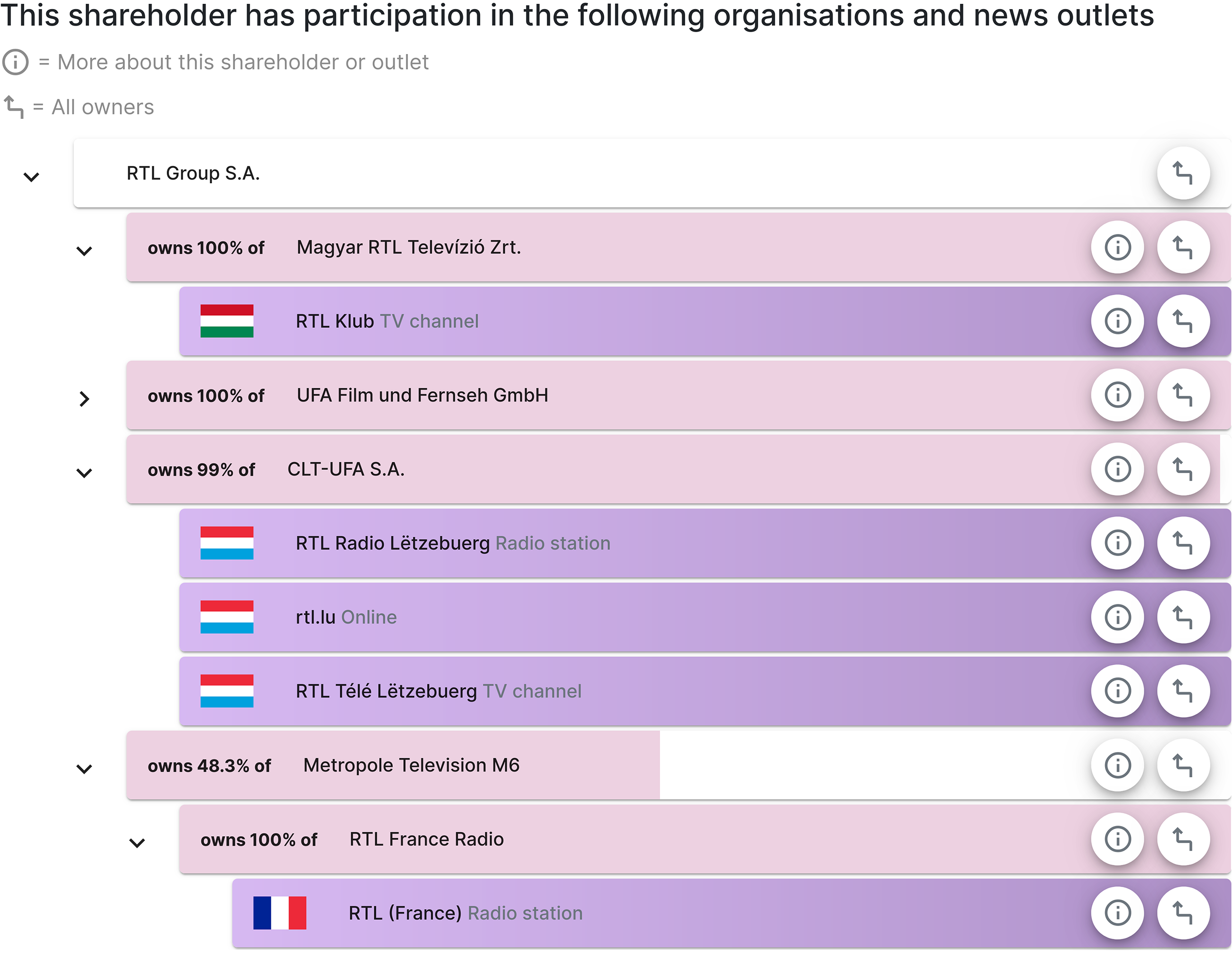
Ownership structure of the RTL Group S.A. in the EurOMo search engine.
The other dimensions are covered with attributes attached to these entities (see Table 1 for the main attributes). For the dimension ‘management’, the monitor displays the names of CEOs and editors-in-chief. The dimension ‘economic control’ provides information on the market position of news outlets (circulation, audience) and the economic power of their shareholders, focusing on revenues and hired staff. In addition, to account for the EU concern on media capture by governments, the monitor looks for information on public funding both as subsidy and advertising. Last, the monitor operationalises the dimension ‘relations’ disclosing whether the outlets or their owners have close ties with any institution, group or politician, self-acknowledged or claimed by the press, advocacy groups or academic research.
EurOMo entities: most relevant attributes and their dimensions.
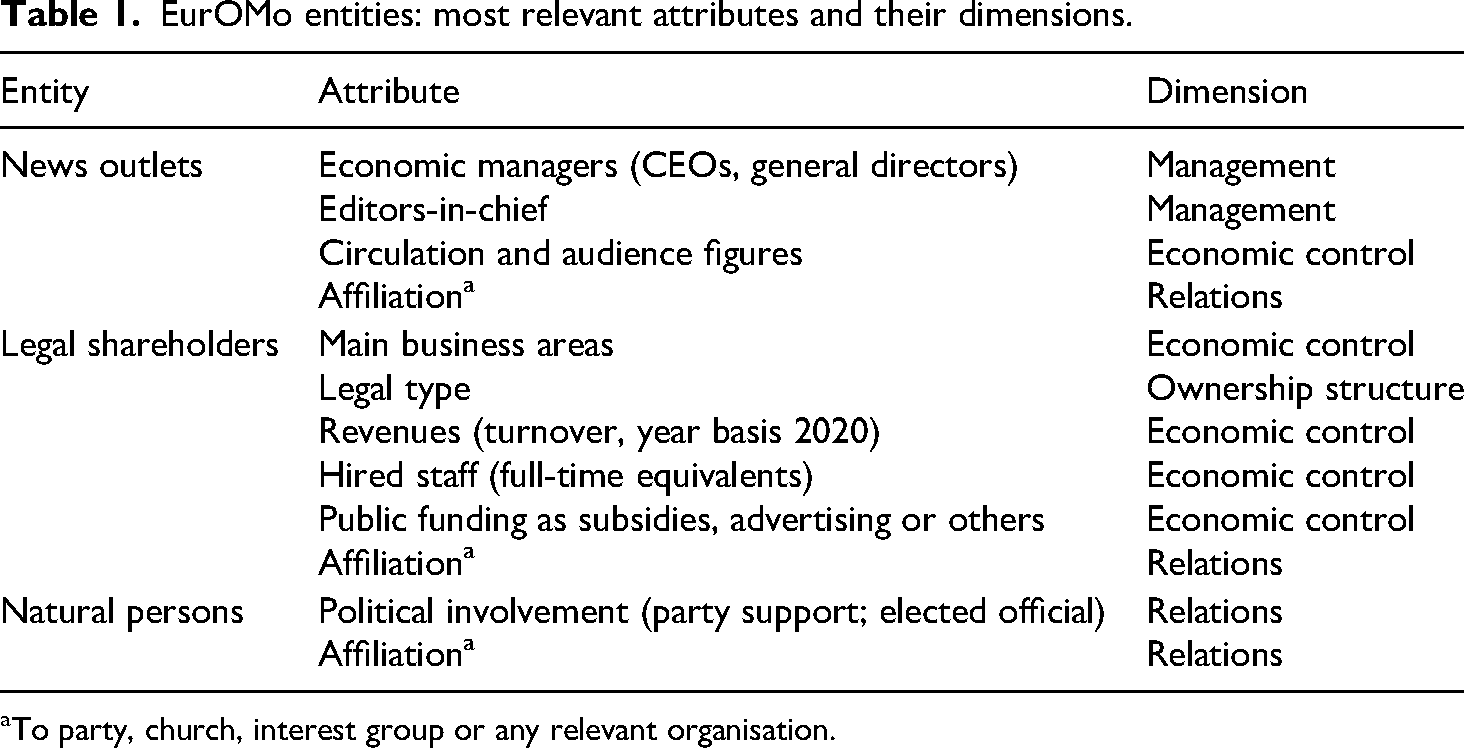
To party, church, interest group or any relevant organisation.
The choice of the attributes is normative, considering both EU policy and scholarly literature. The information collected appears as a table in the search for the specific entity.
The double goal of the database has been to provide a broader understanding of the actual decision-making power in relevant media organisations, but also to point out when this information should be available and is missing. For this reason, we collect only data available from public sources (for free or behind a paywall). These sources were defined as follows: media outlet and company websites; company registers and reports; reports by National Regulatory Authorities or similar public bodies; press; and publicly available research. Information obtained by interviews or close contacts, for example, could not be used in this database.
Assessing risks to transparency in ownership and control
Additionally to the database, the monitor provides a risk index, in which countries are assigned a score that represents their performance regarding risks to transparency in ownership and control (from 0 to 3, where 3 is the best performance and lowest risk, see Figure 2). The index methodology draws on guidelines for composite indices by the OECD (OECD et al., 2008).
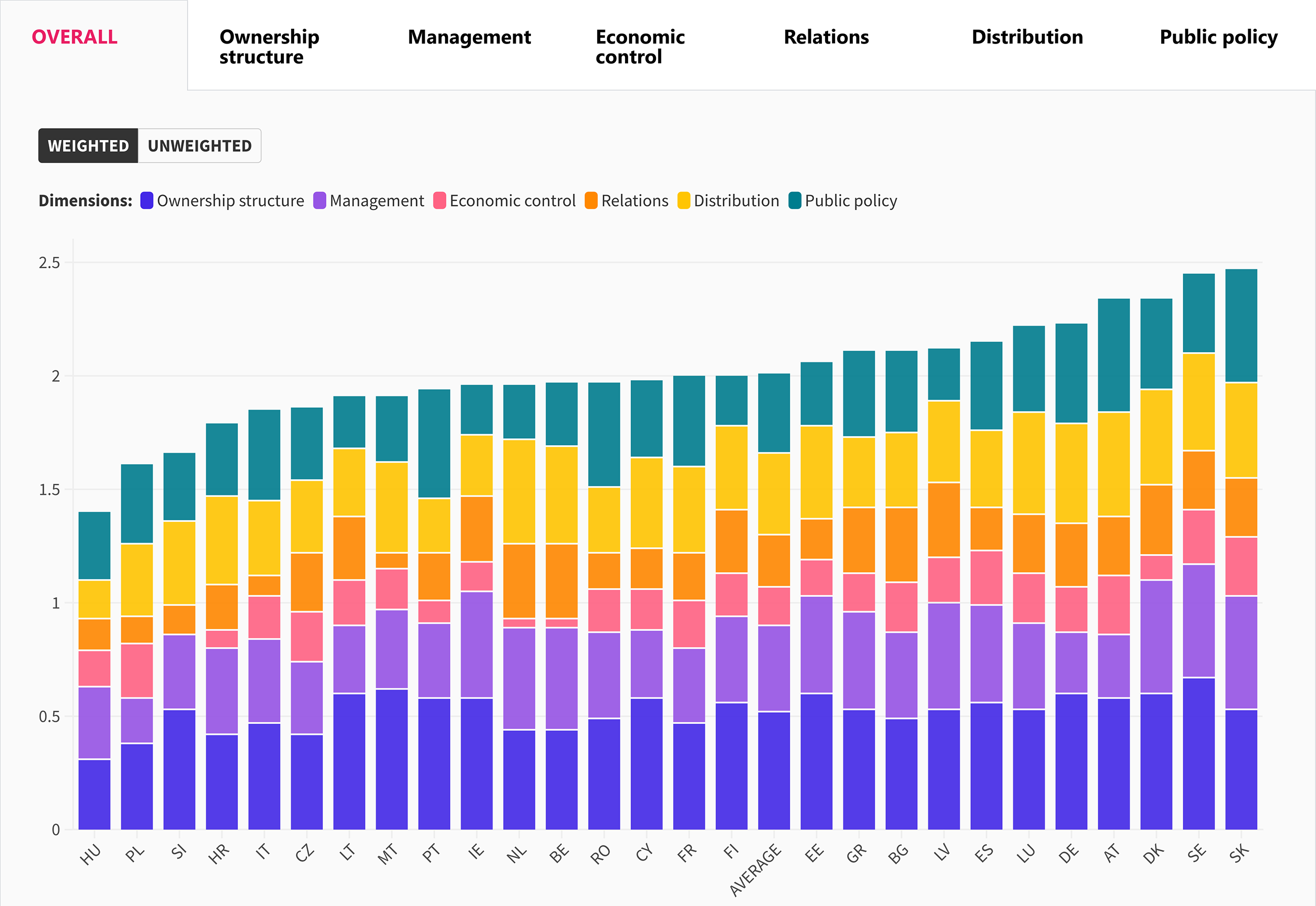
EurOMo dimensions of media ownership and control.
The indicators are of two types: qualitative and quantitative. The qualitative indicators ask, for example, whether there are cases of contested ownership (‘ownership structure’) or breaches of editorial independence (‘management’). With these kinds of indicators, the monitor assesses the conditions for the public and authorities (downwards and upwards) to understand who is making decisions and in whose interest. Better conditions – e.g. no breaches in editorial independence – would mean that people and authorities can reasonably know who controls the news provision, lowering the risk of transparency in ownership and control. This type of indicator is heavily inspired by the expert-coded variables of the Media for Democracy Monitor (MDM) (Trappel and Tomaz, 2021), in which many researchers of the consortium had participated. The Media Pluralism Monitor and the Varieties of Democracy (V-Dem) also assess risks with a similar methodology, influencing our choices.
The quantitative indicators emerged from an even more experimental approach, in which we consider the availability of data in the recently built database as a proxy of transparency in that dimension (e.g. public data about the economic managers and editors-in-chief in a country as evidence of transparency in management). Lack of transparency, in turn, becomes the second group of variables in the risk assessment. The assumption is that the existence of information itself represents a precondition to know who makes decisions and, therefore, a lower risk to transparency.
In total, the risk index includes 43 indicators, each of them normatively weighted by the research team. Several indicators concern the four dimensions of the database explained above. These dimensions, however, concentrate on content production. As relevant as it is, the assessment of control over news in the current information environment must also consider institutions and processes involved in content distribution, especially with the rise of non-linear distribution with digital platforms. These players curate content (promoting, prioritising, downranking, or even suppressing) and directly influence the prominence of news stories, professionals and organisations (Johnson, 2020; Mazzoli and Tambini, 2020). In fact, the CoE explicitly recommends to ‘improve the transparency of the processes of online distribution of media content, including automated processes’ to make clear to the public who makes decisions with regard to the (news) content available (Council of Europe, 2018: 2.5).
In the risk index, this assessment happens in a fifth dimension called ‘distribution’, which accounts for transparency in the influence of digital intermediaries in technical and economic aspects. The technical one refers mostly to the transparency of the criteria for automated content curation. The economic influence addresses commercial deals between intermediaries and news content providers. The ‘distribution’ indicators also include traditional distribution (print, TV and radio) in a relational way, that is, the weight of distribution indicators changes depending on a country's usage of print, TV, radio or online news. This way, the risk index accommodates the issues raised by digital intermediaries without falling into the trap of ‘everything-has-become-digital’.
Last, to account for the assessment of legal risks, the EurOMo proposes a sixth dimension called ‘public policy’, analysing the regulatory framework in which both media content production and distribution operate. The decisions about the indicators were largely inspired by the EU policy documents and the critical scholarly literature mentioned above. Indicators range from provisions for information disclosure (e.g. national implementation of the AVMSD) to disclosure obligations of public funding to the role of National Regulatory Authorities (NRAs) to rules for discoverability and prominence in digital intermediaries, among other topics.
Despite an overall balanced result of the risk index, it is important to stress the experimental nature of our attempt to deal with data-oriented indicators. The actual data collection process has shown us that further iterations of the monitor require adaptations if we want to systematically use this data for an index, as I will address in the final part of this article.
Critical reflection
In this last section, I want to engage in some reflections derived from our work on this monitor, addressing both existing conditions (regulatory framework, professional standards, political economy) and our own choices to deal with them via this instrument.
Good standards for transparency of ownership structure
Most national teams have been able to find direct and beneficial owners of the majority of their news media. This is evidence that the EurOMo approach is adequate to grasp this kind of information and that European media are relatively transparent regarding their ownership structure. The existing regulatory framework, especially the AMLD and national media and corporate laws, already plays an important role in requiring disclosure of beneficial ownership. Professional standards emphasising transparency might also be an important driver.
It does not mean that everything is perfect, though. Frequently, finding all the links of an ownership chain requires navigating intricate company reports or business registries. Establishing the full chain of transnational companies doubles the challenge. Often, two EurOMo national teams found conflicting information about the same company when searching for information in their respective countries. Scholars, journalists or advocacy groups can live with this, provided they are trained and have resources, but a regular citizen would be quickly overwhelmed, bringing to the fore again the discussion about downward and upward transparency.
A bigger problem stems from the rise of complex legal incorporation arrangements, such as private foundations whose boards can be designed in a way to hamper efforts of identifying the actual beneficial owner(s) (e.g. some media organisations in Belgium and in Austria). As seen above, the AMLD seeks to tackle this issue to a certain extent by broadening the definition of beneficial owners. The enforcement of the EMFA, which will require every media service provider to disclose their beneficial owner(s), might benefit from this, but it is yet to be seen how this will be interpreted in cases in which, strictly speaking, there is no natural person as the owner. In any case, corporate law could introduce more sophisticated provisions, such as the requirement of publicity of foundation bylaws, which would facilitate the identification of the decision-making procedure.
The increasing complexity of legal developments indicates that monitoring decision-making power will require more than connecting legal entities and shareholders. In organisations without clear owners, such a monitor should keep track of board members and categorise their kinds of decision-making power.
Serious problems in other dimensions
The main challenges, however, lie in other dimensions. Monitoring economic control, for example, has proven a daunting task. First of all, we wanted to have a clear view of the economic size of media organisations with their market share, number of workers and revenues (turnover). Few companies provide this data in a structured way. In most cases, there is no public data at all.
The EU framework, however, is mostly concerned with public funding of media, concentrating on transparency for the allocation of state subsidies and advertising. This concern is correct, but there is no standardisation in the requirements so far, making it hardly impossible to assess the transparency of this allocation. Article 6 of the EMFA might contribute to solving this problem, requiring media outlets to disclose the ‘total annual amount of state advertising allocated to them and the total annual amount of advertising revenues received from public authorities or entities of third countries’. After its enforcement, further iterations of this instrument can give a clearer picture.
Even more dramatic, though, is the absolute lack of consideration regarding transparency in private funding. The EU's focus on public money emanates from the liberal belief in the neutrality and independence of market mechanisms in the distribution of resources, ignoring market failures such as biases, inequalities, concentration and even censorship exercised by advertisers, harms exacerbated in digital journalism (Baker, 2004: 14; Pickard, 2020: 78–84, 160). It is nearly impossible to assess the values that shape news coverage if there is no systematic information about the whole of news media revenues, and any monitoring focused only on public money will reveal an extremely partial and skewed picture in this respect.
Furthermore, growing policy discourses seek to mandate digital platforms directly funding news organisations, following the model of the Australian News Media Bargaining Code. If successful in EU countries, these measures will create a whole new array of economic incentives for both platforms and media. In Australia, the results are ambiguous with little to no transparency (Bossio and Barnet, 2023). This issue also directly concerns the dimension ‘distribution’, since the role of these platforms in providing professional media content tends to become even more central. This is another development that requires a much broader perspective of economic transparency than the mere ‘public funding’ approach.
The issues addressed in the dimension ‘relations’ are, by their own nature, the most difficult to be solved. Monitoring these relations involves a much more active role on the side of researchers, activists and journalists. There is a need to create proper categories for these relations. Because of its contentious nature, information about affiliation also requires higher standards of documentation, allowing users – citizens, journalists or regulators – to have adequate context for this information. In the EurOMo, this only became clearer throughout and after the data collection process.
On top of these methodological issues, the current implementation of the EurOMo has a significant shortcoming related to the decision by the EU Court of Justice (ECJ) in favour of the non-disclosure of beneficial owners in business registries. To comply with the decision and under the orientation of the DG CNECT, the EU unit overseeing the project, the EurOMo decided not to display names of natural persons in the ownership chains presented by the search engine. Their names were kept in the country reports, which do not constitute a searchable database as targeted in the ECJ decision.
In the database, a placeholder was assigned to each natural person, as exemplified in the case of Silvio Berlusconi (see Figure 3). Then, the search engine has been programmed to display the placeholder, instead of the real name. The advantage of this solution is that, whenever the ECJ changes the understanding of the matter, the search engine can easily be reverted to show the real names.
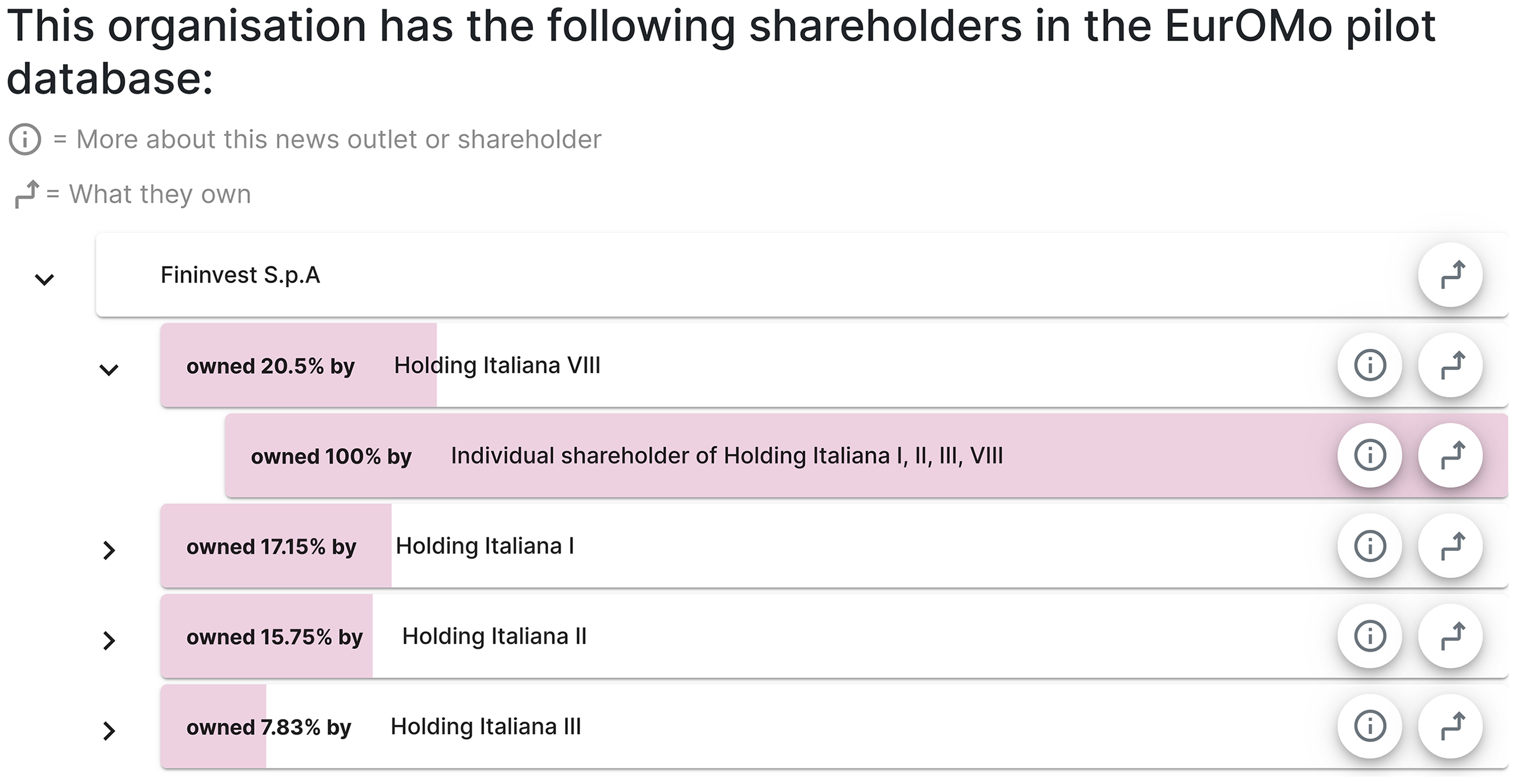
Placeholder for Silvio Berlusconi as beneficial owner of Fininvest.
This solution allows to trace the whole media ownership structure under one person provided one knows at least one media outlet or company under their property. This works for well-known media owners, such as Berlusconi, but is a significant hindrance in ownership transparency of smaller outlets.
Another shortcoming relates to the ephemerality of the data. One only needs to think again about Berlusconi, who died in June 2023, after the end of the data collection. Purchases, mergers and divestitures are constantly occurring in this business. Without continual updates, any media ownership transparency initiative will fall short of its goals within a few months or years. If the EU is really keen on monitoring media ownership, a permanent instrument must be set.
Finally, it is of utmost importance to see ownership transparency as a step to pluralism, and not a goal in itself, as discussed above. It is difficult to imagine that ‘consumers’ will make different choices regarding the news media they use based on discovering on such a website who the owner is. If people are to use ‘better’ media, policymakers and regulators will be called to make difficult choices and employ the full package of policy measures for pluralism, including restrictions to ownership concentration and promotion of independent media (Karppinen, 2013). Such an instrument could help more, of course, by evolving to systematic monitoring of ownership concentration, including issues such as EU and non-EU shareholders, patterns of ownership forms and historical trends. In the end, however, the political will needs to accept its responsibility and draw the lines for media pluralism.
Final remarks
The multidimensional approach adopted by EurOMo takes into account the most recent developments both in EU regulation and scholarly literature to monitor media ownership and control, recognising it as a complex issue that requires more than the knowledge of direct legal owners. This instrument provides a clearer picture of the kind of relevant information that already exists and what is missing, allowing further considerations on methodological possibilities to fill the gap and regulatory measures to enforce higher levels of transparency. Ultimately, it is important to admit that making media ownership and control more transparent seems to be a chase after a moving target and, more importantly, must be seen as a step to achieve the goal, which is safeguarding and promoting media pluralism.
Footnotes
Declaration of conflicting interests
The author(s) declared no potential conflicts of interest with respect to the research, authorship, and/or publication of this article.
Funding
The author(s) disclosed receipt of the following financial support for the research, authorship, and/or publication of this article: This work was supported by the Directorate-General for Communications Networks, Content and Technology, (grant numbers LC-01678544, LC-01901373).
