




Abstract
This article examines media ownership transparency through the lens of European human rights policy and evaluates media ownership transparency in over 30 European countries based on data returned to the Media Pluralism Monitor. Using these data, we examine the existence and quality of two types of disclosure, ‘upwards’, to public bodies and ‘downwards’, directly to the public, enabling both the monitory and informational functions of ownership transparency to be fulfilled. We conclude that regulation is patchy and variable across Europe and that a coordinated, multi-actor approach is necessary to give effect to internationally recognized standards in the field.
Introduction
In this article, we evaluate media ownership transparency in 31 European countries based on the data returned to the Media Pluralism Monitor (MPM) for the year 2017 (Centre for Media Pluralism and Media Freedom (CMPF), 2018). We consider media ownership transparency to be a necessary, though by no means sufficient, policy response to both media plurality and trust-based concerns. Prominent scholars argue that democracy requires dispersal of communicative power and, hence, of media ownership (Baker, 2006; Croteau and Hoynes, 2006; Curran, 2002; Voltmer, 2013). Although societies are increasingly characterized by communicative abundance, many of the largest media companies at the national level have developed into strongly consolidated multinational corporations (Birkinbine et al., 2017). Traditional media owners are being replaced by new actors, such as private equity firms without an obligation of transparency to shareholders; national or transnational business oligarchs with a great deal of political influence, and even states or state-owned companies (Crain, 2009; Dragomir, 2019; Foster, 2012; Noam, 2018; Schiffrin, 2017). At the global level, digital players such as Google, Facebook and Apple increasingly determine the rules of the game (Nechushtai, 2018; Newman, 2019).
Such structural trends demonstrate that an easily accessible abundance of content does not necessarily correspond with dispersed control over news production, curation or distribution. And where control is also opaque it becomes more difficult to detect underlying bias or strategic omissions, potentially leading to a lack of trust in the news media. Indeed, various aspects of media transparency have been found to be among the most important conditions for individual trust in news (Knight Foundation, 2018).
This article explores the extent of media ownership transparency in Europe and whether further steps are required to support its realization in practice. In the beginning of the article, we consider why access to ownership information is important, noting its ability to facilitate democratic functions associated with the Fourth Estate. We then explore the extent to which media ownership transparency is recognized within the European human rights framework and the steps taken by the Council of Europe (CoE) and European Union (EU) to promote media ownership transparency. In the section “Transparency of media ownership in Europe: The state of play”, we review the data obtained from the MPM on the state of transparency in the countries studied. We conclude by making a number of recommendations.
Why media ownership transparency matters: Information asymmetries and democratic accountability
Media ownership transparency and democracy
A number of democratic functions have been ascribed to the media in political theory and legal jurisprudence (Charney, 2018; Karppinen, 2013; Raeijmaekers and Maeseele, 2015; Voltmer, 2013), of which two in particular can be assisted by media ownership transparency. The first, associated with liberal conceptions of democracy, is to provide citizens with relevant, accurate and timely information about politics and current affairs. By analysing and contextualizing this information, the media can assist individuals to form their own opinions and make better-informed political decisions (Williams and Delli Carpini, 2011). But with growing economic pressures and political polarization, the news media have become more vulnerable to investments from authoritarian regimes and more exposed to loss of political impartiality (Lucas, 2020). Citizens are increasingly relying on social media where it is difficult to detect the source of information, its credibility and potential purpose.
A recent Reuters Institute report found that, faced with these uncertainties, over a quarter of individuals surveyed had started to rely on ‘more reputable’ sources of news (Newman, 2019: 23), but for this they require the tools to make such evaluation meaningful. The ability to identify reliable journalism not only helps to ensure the survival of responsible reporting and a diverse media ecosystem (Cairncross, 2019: 35–37), it also helps to locate facts and expertise in public discourse in a post-truth politics era.
The second of the democratic functions ascribed to the media and supported by ownership transparency is the ‘watchdog’ function. This looks to the media to monitor both state and corporate sectors for failures, wrongdoing and abuses of power (Barendt, 2007: 418). Media power is itself based in part on the ability to expose information that might eventually lead to correction of abusive practices (Stiglitz, 2017: 9–10). Because this role is inevitably compromised where the media are ‘captured’ by powerful political and economic interests (Dragomir, 2019), ownership transparency is a necessary component of any regulatory environment designed to foster investigative journalism and media diversity. In particular, it provides policymakers and regulators with the information they need to develop, monitor and enforce ownership limits and media-related competition rules.
Media ownership transparency is not, of course, a sufficient condition for informed democratic engagement. Behind any news service there is potentially a range of actors – advertisers, sponsors, public relations professionals, journalists, editors – all seeking to influence the information relayed (Tsetsura and Aziz, 2018). The nature of their involvement, alongside that of the owner, should also be disclosed (Williams and Delli Carpini, 2011: 291–292). Similarly, provenance is just one among a number of factors, including reputation, competence, corroboration and timeliness that assist in assessing the quality of media content (Kelton et al., 2008: 363–366; Nurse et al., 2014). There may also be contexts in which transparency could deter investment in the media because of potential negative repercussions, thereby limiting rather than enhancing democratic debate.
The European human rights framework and media ownership transparency
EU Member States are parties to the European Convention on Human Rights (‘ECHR’) and, within the field of EU law, must respect the EU Charter of Fundamental Rights (‘CFR’). These two documents establish the European human rights framework within which State or EU measures on ownership transparency operate. Before examining the steps taken to date, it is thus necessary to consider whether this framework imposes any constraints on the type of measures that can be introduced or, alternatively, positively requires the adoption of certain measures.
The European Court of Human Rights (‘ECtHR’) has recognized the importance of the democratic interests discussed above, namely the interests of individuals in having access to information ‘on all matters of public interest’ and the ability of the media to perform their ‘vital role of “public watchdog”’ (Thoma v. Luxembourg, 29 March 2001, Application no. 38432/97, para 45). Moreover, Protocol 1, Article 3, ECHR (CoE, 2018a: Guide Art. 3) requires contracting States to establish free elections and the conditions that will enable individuals to participate effectively in the democratic process.
The ECtHR has held that States may take proportionate measures to restrict freedom of expression under Article 10 ECHR in order to promote media plurality (Radio ABC v. Austria, 20 October 1997, Application no. 19736/92) and in Centro Europa 7 (Centro Europa 7S.R.L. and Di Stefano v. Italy, 7 June 2012, Application no. 38433/09) it referred directly to the CoE Committee of Ministers’ 2007 Recommendation on media pluralism and diversity of media content (CoE, 2007), which calls on Member States to adopt the regulatory and financial measures necessary ‘to guarantee media transparency and structural pluralism’ (CoE, 2007: preamble, para 14 and Recommended Measures III.1-2). In the EU context, Article 11.2CFR calls for the freedom and pluralism of the media to be respected, the importance of which has similarly been stressed by the CJEU (Case C283/11, Sky Österreich GmbH ECLI:EU:C:2013:28, para 52).
It is thus unlikely that transparency requirements would be found unlawful from a human rights perspective. As noted, however, there may be cases in which the fear of prejudice or retaliation could chill investment and thus speech, particularly in the political domain. Such cases should thus be accommodated in relevant national laws and industry codes (CoE, 2018b: Appendix, Guideline 4(3)).
Is it possible to go further and argue that State measures to enhance media ownership transparency are not just legitimate but actually required? In Centro Europa 7, the ECtHR recognized a positive obligation on States to ‘put in place an appropriate legislative and administrative framework to guarantee effective [media] pluralism’ (Centro Europa 7S.R.L. and Di Stefano v. Italy, 7 June 2012, Application no. 38433/09, para 134) and, as suggested above, such plurality cannot be fully ‘effective’ without a clear indication of provenance.
Article 10 ECHR also informs the interpretation of Article 11CFR and, though the Charter rights and principles cannot extend the scope of EU law (Arts. 52.3 and 51.2CFR), respect for democracy and pluralism are among the foundational values of the EU recognized in Article 2 TEU. A serious breach of these values may trigger the ‘rule of law’ mechanism in Article 7 TEU, which can ultimately lead to the suspension of certain Treaty rights. A case can certainly be made, therefore, that media ownership transparency is a necessary prerequisite both for effective democratic participation and the establishment of an ‘appropriate legislative and administrative framework’ to guarantee media plurality.
Policy recognition of media ownership transparency at the European level
In the media policy field, the political institutions of the CoE have been active in setting standards and providing guidelines designed to enhance media freedom, pluralism and democratic government, most recently in Recommendation CM(2018)1 on media pluralism and transparency of media ownership (CoE, 2018b). The Guidelines annexed to the Recommendation explicitly refer to the positive obligation of Member States to ensure the ‘transparency of media ownership, organization and financing’ (CoE, 2018b: Appendix, para 1.7). Such information must be accessible to the public, up-to-date and include details of direct and beneficial ownership and ‘other interests that influence’ . . . the editorial line (CoE, 2018b: Appendix, para 4.1).
Both downward and upward facing dimensions of transparency are recognized: enhancing not only individual understanding but also enabling regulators to evaluate and, if necessary, intervene in media markets to ensure that pluralism is realized in practice (CoE, 2018b). The Recommendation covers print, broadcast and online media. In particular, it notes the increasing control of Internet intermediaries over ‘the flow, availability, findability and accessibility of information . . . online’ and the need for greater transparency as the basis on which they select and distribute content (para 6 and Appendix, Introduction and para 2.5).
Recommendations and declarations such as these are persuasive, and gain greater traction when referred to in judicial decisions, as in the Centro Europa 7 case, but are not directly legally binding. In contrast, the 1989 CoE European Convention on Transfrontier Television (CTT) imposes legal obligations on ratifying states (CoE, 1989), but its scope remains limited to traditional broadcasting services, further extension to on-demand services having stalled (Mac Sigith, 2015). Article 6.2CTT provides that ‘[i]nformation about the broadcaster shall be made available, upon request, by the competent authority of the transmitting Party’, which is to include details of the ‘composition of the capital’, though further specification is not provided.
In the EU context, revisions to the Audiovisual Media Services Directive (AVMSD) (European Parliament and the Council, 2010), the main EU measure regulating broadcast and on-demand services, by Directive (EU) 2018/1808, explicitly address ownership transparency (European Parliament and the Council, 2018b). Recital 15 to Directive 2018/1808 confirms the ‘direct link’ between freedom of expression, democracy and media ownership transparency and the importance of users having access to information regarding the ‘ownership structure’ of media providers, notably those interests that afford significant influence or control over the content provided. This is, however, qualified by the statement that ‘Member States should be able to determine whether and to what extent information about the ownership structure of a media service provider should be accessible to users’ (emphasis added). But Recital 15 also provides that the ‘essence’ of the fundamental rights and freedoms concerned must still be respected. One might conclude, in light of the discussion above, that such rights and freedoms will not be respected where transparency is not realized in practice.
This ambivalence is carried over into the substantive part of the revised Directive. Article 5.2AVMSD falls short of guaranteeing access to even the limited ownership information required by Article 6.2CTT, stating merely that Member States ‘may’ require that media service providers make accessible information about their ownership structure, including beneficial owners. Article 5.2 should, however, be read in light of Recital 15 and Article 11 CFR, so that the latitude afforded states should not be understood to allow the ‘essence’ of freedom of expression and democratic government to be compromised by a failure to act.
Alongside steering reform of the AVMSD, the Commission has been working to collate further information on the state of media freedom and pluralism in the EU. This is required to assess Member State compliance with EU fundamental democratic values identified in Article 2TEU and whether steps should be taken to initiate the rule of law procedure in Article 7TEU. One aspect of the Commission’s fact-finding programme has been its support for the development and application of the MPM, which forms the basis of the data analysed in this article.
Media ownership transparency and corporate governance: Is further media transparency required?
Although there has been limited European-level adoption of binding ownership transparency requirements in the media field, more general corporate transparency requirements have been widely established. A pertinent question is whether these adequately meet the standards mapped out in the 2018 CoE Recommendation discussed above, obviating the need for further media-specific initiatives.
These measures date back to the 2004 Transparency Directive (2004/109/EC) (European Parliament and the Council, 2004), amended in 2013 (European Parliament and the Council, 2013). The Directive establishes mechanisms for obtaining information on the ownership of companies whose shares are traded in the EU, both from the companies themselves and from national repositories. It provides for the exchange of information at the European level and effective sanctions.
Access to information on beneficial interests has been enhanced by the amendments to the EU’s Fourth Anti-Money Laundering Directive (AML) (European Parliament and the Council, 2015; European Parliament and the Council, 2018a). The Fifth ALM Directive defines interests that constitute direct and beneficial ownership in corporate and other legal entities and requires Member States to develop national registers of such interests in entities incorporated within their territory (Article 13). The data stored are to be ‘adequate, accurate and current’ and a fee to cover administrative and maintenance costs can be charged for information on the register (FATF) (2019). Member States are to ensure that information relating at least to name, the month and year of birth, the country of residence and nationality of the beneficial owner, as well as the nature and extent of the beneficial interest, is made available to ‘all members of the public’ (European Parliament and the Council, 2018a). The national registers are to be inter-connected through the European Central Platform (European Parliament and the Council, 2018a at (g)).
Although providing useful information, these measures are not designed to meet specific media-related concerns. An individual wishing to know about the ownership profile of a particular news outlet may well be deterred by the need to locate and search for a distinct corporate ownership register for which a fee may be charged. Ease of access and clarity are here of primary importance.
Transparency of media ownership in Europe: The state of play
Media ownership transparency and the media pluralism monitor
The main aim of the Media Pluralism Monitor (MPM), coordinated by the Center for Media Pluralism and Media Freedom (CMPF) at the European University Institute in Florence, is to measure risks to media pluralism in four areas: basic protection, market plurality, political independence and social inclusiveness (CMPF, 2018). In 2017, media ownership transparency was one of five indicators of market plurality. The countries covered were the then 28 EU Member States, together with Serbia, the Republic of North Macedonia and Turkey. Participating experts collected data on whether there is a legal requirement in their country to disclose media ownership information either to regulatory bodies or to the public and the level of transparency actually achieved.
The definition of transparency used in the MPM2017 goes beyond a narrow understanding of ownership to include both direct and beneficial ownership, thereby indicating the locus of effective control. It follows the definition of beneficial ownership used by the Financial Action Task Force (FATF) (2019), the intergovernmental body that sets global anti-money laundering standards: A company’s beneficial owners are the individuals (or single individual) who ultimately own or control the company, either directly or indirectly. This means the persons who control the actions of the company and/or who ultimately receive the profits. Significantly, a beneficial owner must be a real, live human being, and not another company or a trust. For companies with complicated ownership structures, involving many different corporate vehicles and, in some cases, private agreements over ownership and/or control, the beneficial owners are the individuals who are right at the very top of the chain.
Media ownership transparency extends beyond simply providing access to data: the data must also be reliable, meaningful and accessible. The MPM2017 focused on the elements that were possible to measure in the scope of the monitoring exercise, that is, asking whether the information was up-to-date and accessible, and whether there were sanctions for non-compliance. One of the constraints of the MPM methodology was the limited scope of questions, which did not reveal, for example, the broader political context, while the data from certain countries were not comprehensive. Nevertheless, the overall response enables a number of provisional conclusions to be drawn, set out below.
Upward and downward transparency
The MPM2017 was designed to assess two distinct functions of transparency – ‘upwards’ (legal and administrative) and ‘downwards’ (civic). Upward transparency renders media actors accountable to regulatory bodies or public administration (for the purposes of auditing and monitoring of media performance and markets). Downward transparency makes the media accountable to civil society, investors and the general public (Bernstein, 2017; Edwards and Hulme, 1996; Fox and Haight, 2010; Kolker and Kulldorff, 2013) and facilitates informed financial, personal and political decision-making.
The notions of ‘upward’ and ‘downward’ transparency have been widely used in the academic literature and are closely related to the concept of accountability. A body is accountable where it can be monitored and institutional or legal constraints can be imposed on its exercise of power (Plattner et al., 1999). These concepts have been explored by Fox and Haight (2010); Fox (2007), who distinguishes between two qualities of transparency and accountability (see Table 1). ‘Opaque transparency’ refers to a situation where information is accessible only in theory, or whose significance is not clear, or which is unreliable (Fox and Haight, 2010: 356). ‘Clear transparency’ arises where information about the actual practices and their results are comprehensible, trustworthy and accessible.
The relationship between transparency and accountability.
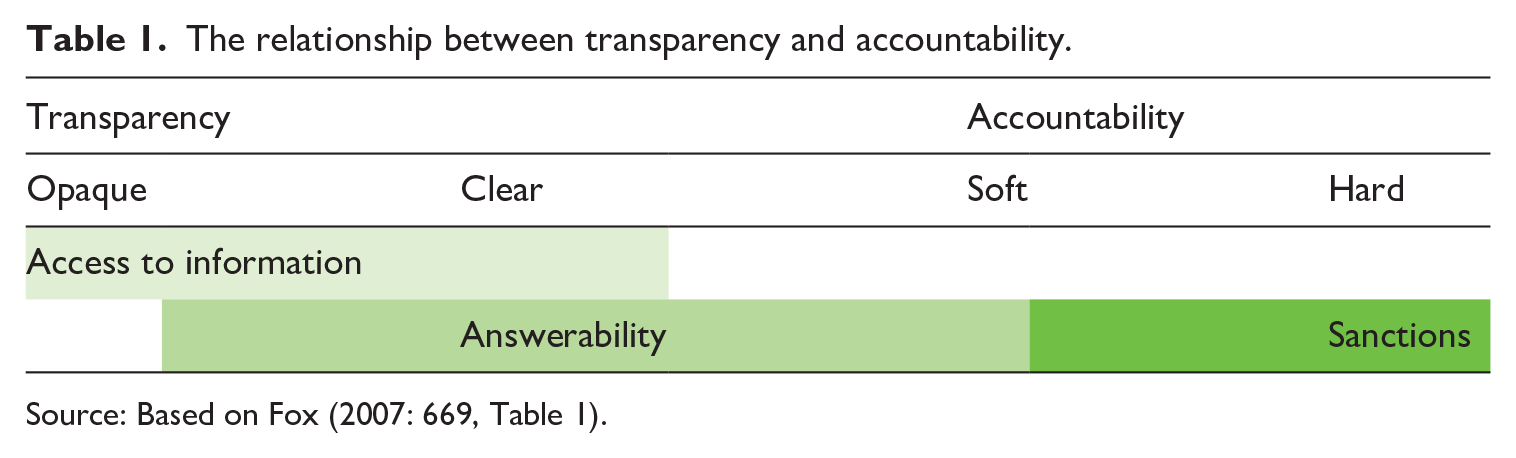
In Fox’s model, the dimensions of clear transparency and soft accountability overlap: if information enables one to understand how an organization functions, the organization is rendered not only more transparent, but also more accountable, what Fox terms as ‘soft accountability’ (Fox, 2007: 668). Accountability can entail not just a measure of answerability (i.e. providing an account of actions undertaken) but also enforceability (i.e. sanctions for unethical or illegal behaviour), which, in Fox’s model, corresponds to ‘hard accountability’. To attain the highest level of accountability – hard accountability – public sector actors must not only demand transparency but also intervene to apply sanctions, compensation and/or remediation (Fox, 2007).
We have adapted Fox’s (2007) model to the topic of our article, mapping the seven relevant MPM2017 variables, set out in Table 2, according to the level of transparency and accountability that they may entail. Variables 53–56 concern legal media-specific transparency requirements; variables 57–58 concern related enforcement measures and their application in practice, while variable 59 asks the national media experts whether the public is able to access information about the ultimate owners of media outlets.
The operationalization of Fox’s model of transparency and accountability with the MPM2017 variables on transparency of media ownership (coding matrix).
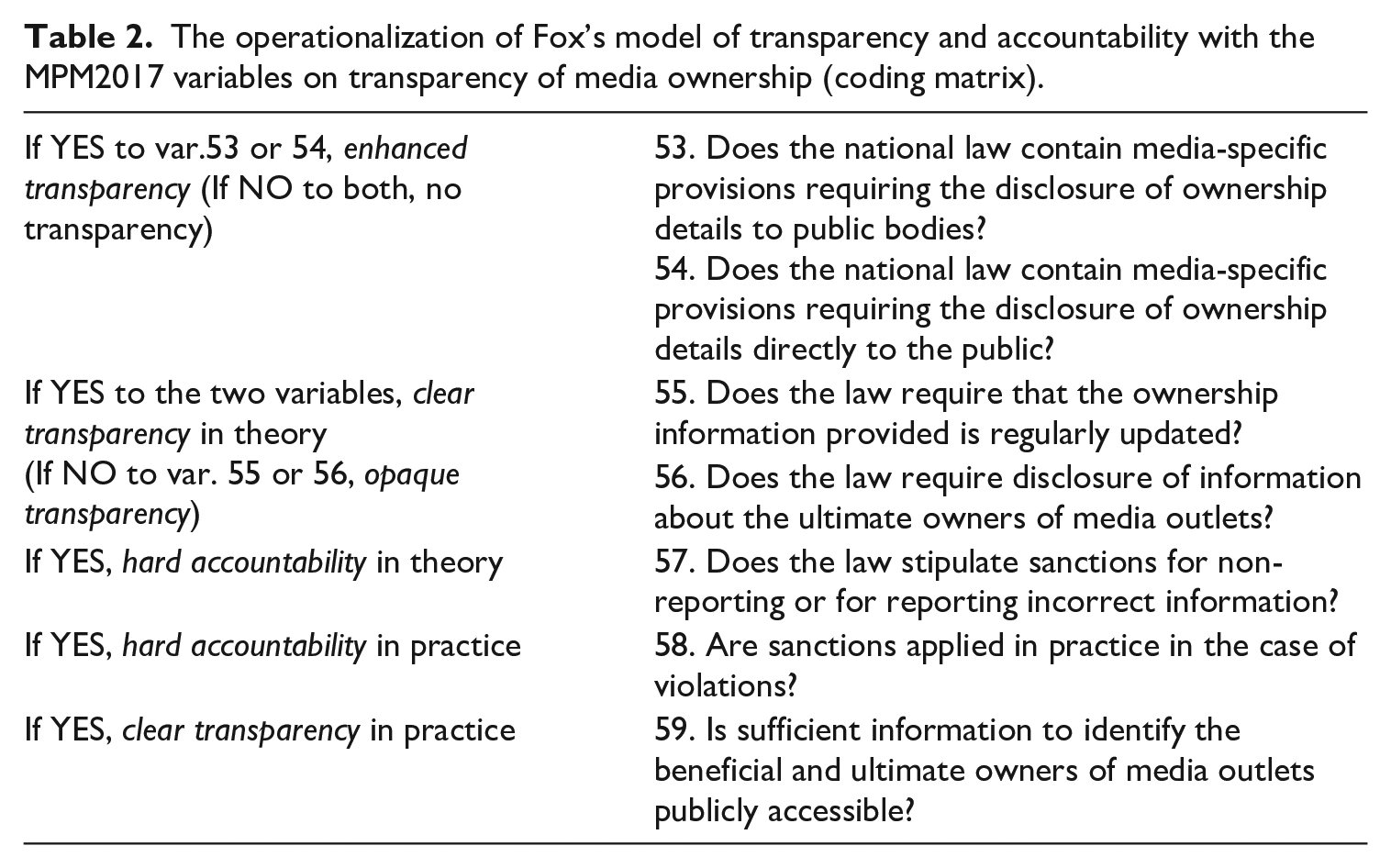
Upward disclosure was assessed only at a basic level by the MPM2017, examining whether national law specifically requires the disclosure of media ownership details to public bodies (variable 53). All the other MPM variables (54–59) referred to downward disclosure, which affords direct public access without having to rely on public intermediaries (Craufurd Smith and Stolte, 2014).
For purposes of evaluation, we consider that the existence of legal requirements of upward or downward disclosure (variables 53–54) enhances transparency, though it is not possible to conclude from the coding of these variables alone whether the transparency is clear or opaque. MPM variable 59, noted above, in coordination with variables 55–58, do, however, enable one to evaluate whether clear transparency and soft or hard accountability are likely to be realized in practice.
Results
From transparency to accountability
Our results show that a significant proportion of countries assessed in the MPM (7 of 31) do not have media-specific laws requiring either upward or downward disclosure. 1 Nevertheless, the majority of countries (24 of 31) achieve a minimum level of transparency by requiring the disclosure of ownership to public bodies (Figure 1). At the same time, only a minority of countries (14 of 31) require disclosure directly to the general public. 2
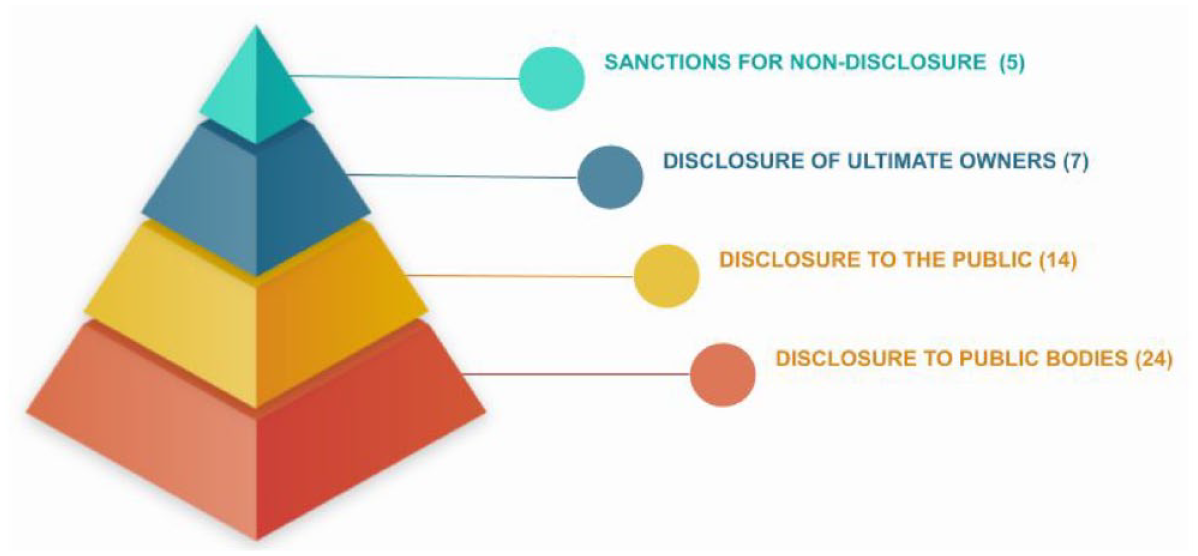
An overview of media ownership disclosure provisions (number of MPM2017 countries in brackets).
Belgium is a special case, 3 in that the Walloon media laws require the media regulators to collect, analyse and publish ownership information and make it accessible to the general public. To fulfil this obligation, the authority for audiovisual media in French-speaking Belgium maintains an online database covering basic ownership information. 4 This is therefore a hybrid variant, with information moving upwards before it is then relayed downwards, a process envisaged in the European Convention on Transfrontier Television. In contrast, the Flemish media law in Belgium does not oblige the regulator to disclose ownership information, though in practice the Flemish media regulator does publish annual reports containing information on ownership and diversity.
As illustrated in Figure 1, the disclosure of ultimate media owners is provided for in law in only seven countries, while countries that apply sanctions for violations of these norms in practice are even more rare (five countries).
According to our coding matrix (Table 2), clear transparency is guaranteed if there is a requirement to regularly update the information (variable 55) and to disclose information about the ultimate owners of media outlets (variable 56). Our analysis shows that law-makers are aware of the importance of timeliness. All of the 14 countries that guarantee disclosure to both public bodies and the public, also require that the information be regularly updated. However, this requirement is not applied uniformly across countries or always clear. 5 The most common requirement is annual reporting, applicable in Austria, Belgium,Croatia, Cyprus, France, Germany (for broadcasters), Lithuania and Luxembourg.
Only seven countries provide information on beneficial ownership to the general public (Figure 1). 6 The data also suggest that countries adopt different (a) provisions to different types of media (e.g. print/audiovisual), (b) definitions of beneficial ownership and (c) shareholding thresholds to trigger disclosure.
According to our coding scheme, countries that establish clear transparency also facilitate soft accountability, enabling the public and public bodies to identify those who are, in some degree, answerable for an organization’s actions. Hard accountability 7 comes into play if the law stipulates sanctions for non-reporting or reporting incorrect information. The MPM results show that all but 2 (Luxembourg and Serbia) of the 14 countries stipulate sanctions for non-reporting or for incorrect information about owners, and thus aim for hard accountability (at least in theory).
Most of the sanctions are administrative and range from fines, denial or revocation of a licence, or suspension of public subsidies. For example, in Bulgaria and Lithuania, media companies do not receive a licence if they fail to provide information about owners, while in France print media can have their press subsidy suspended. A few countries stipulate very harsh sanctions; for example, Germany, 8 where nationwide broadcasters can be fined up to EUR500,000 and Cyprus, 9 where offenders can be punished with up to 3 years’ imprisonment. However, only five of the countries 10 apply the sanctions in practice and even here, action tends to be limited to warnings. Given that tangible sanctions are rarely applied, we conclude that hard accountability is very limited across the countries examined.
Legal obligations versus practice
The MPM results also suggest that legal obligations are not always necessary for achieving transparency. According to the assessment of MPM2017 experts, four of the seven countries that do not require disclosure to the public still make such information available: Denmark, Estonia, Ireland and Sweden. However, in practice, there may be other barriers to access and use of information.
Thus, in relation to Estonia, the national online Register of Economic Activities does indeed provide information on all types of companies at no cost but when the authors carried out a number of sample searches on the data, the information was minimal or missing altogether. 11 In the case of Sweden, up-to-date 12 information about legal entities, including beneficial ownership, is available in the database of the Swedish Companies Registration Office. The data are offered in an open format (XML) that facilitates interoperability and data exchange across platforms and systems. However, users have to pay a high fee (over EUR600 just for connection), 13 and need to have an electronic identification (eID) from one of the six EU Members States that have implemented the eIDAS Regulation 14 to log in to the service. This represents a significant barrier to access for journalists carrying out cross-country investigations, not to mention for lay citizens who would like to know the interests behind their news.
Conclusion: The need for a coordinated, multi-actor approach
The MPM results show that in a significant proportion of European states there are no specific requirements relating to media ownership transparency and that only about half of the countries examined (14 of 31) require disclosure of ownership information directly to the public. There is also considerable variation regarding media covered (press/audiovisual), the extent of disclosure (beneficial/direct ownership) and approaches to enforcement. In many countries, even with detailed corporate filings, it will be difficult, time-consuming and sometimes expensive, to piece together a picture of media ownership. For most media users, simply interested in finding out who is behind a particular article or website, search through a corporate register is unlikely to be a realistic course of action.
We are thus faced with a situation in which detailed international guidelines have been established, founded on established rights to freedom of expression and democratic participation, but with patchy, often inadequate, implementation. How can this shortfall be addressed? At the national level, civil society, academics and other interested bodies should press their governments to implement the terms of the CoE Recommendation (2018)1 in full (CoE, 2018b: para 13). At the EU level, the European Regulators Group for Audiovisual Media Services (ERGA) can play a coordinating role in encouraging adoption of these standards, monitoring Member State responses to Article 5.2AVMSD and reporting back to the Commission on progress. Consistent implementation of the guidelines in the 2018 Recommendation will ensure that the public can obtain information both from the media organizations and an independent regulator. Information should ideally cover not just beneficial ownership but also details of financial and other relations that could result in editorial influence and conflicts of interest, such as the holding of a political mandate. It is also necessary that regulators have the human resources to collect and understand the data (CoE, 2018b: para 1.6).
An open question for future resolution concerns the standards and level of detail for data collection. The 2018 Recommendation sets out basic standards (para 4.5 of the Appendix), but also calls for high levels of transparency regarding financial sources and links to advertising companies or political parties that could affect the editorial line (at para 4.7). The FATF Guidance for collection of information could provide a detailed standard for beneficial ownership information (FATF, 2019).
We have also identified a need to create data repositories that can be shared across countries and jurisdictions. In line with the recent ‘Open Data Directive’ (Directive (EU) 2019/1024), which requires that data on companies and company ownership are made available free of charge and in machine readable formats (European Parliament and the Council, 2019), we recommend the creation of specific repositories of media ownership data in open formats that can be shared across countries, and that appropriate data quality standards are elaborated in multi-stakeholder forums. 15 This would allow public bodies in different countries and journalists to perform independent analysis, to cross-reference ownership data with other datasets (e.g. data on financial interests of politicians) and transform the data into easily digestible information for citizens and third parties.
A further question concerns ownership disclosure online, which poses logistical problems given the amount of news content circulating and the international context, with the risk that regulation could be either disproportionate or simply ignored. The 2018 Recommendation confirms the need to clarify which media are to be covered and identifies criteria such as commercial nature, audience reach, editorial control, and frequency and regularity of publication that can be used to delimit scope (CoE, 2018b: para 4.2). In relation to intermediary organizations, such as search engines, social media platforms and news aggregators, which decide what content is to be relayed, and with what prominence, we suggest that they should also be included in any disclosure regime (CoE, 2018b: para 6 and Appendix, Introduction and para 2.5).
Intermediaries can, for example, incorporate or link to information on the organizations whose content they publish (see The Trust Project, 2019). Recommendation CM/Rec (2018)1 also provides useful guidelines on forms of information and modes of disclosure that could be used in a more formalized way by the largest digital platforms. In line with the EU Code of Practice on Disinformation (2018), leading digital platforms, including Google and Facebook, committed in 2018 to ensure transparency ‘through indicators of trustworthiness of content sources, media ownership and/or verified identity’ (European Commission, 2018). As a result, Google has obliged news sources to publish contact details of the publisher, network or company behind the published content. 16 However, the user can only check the official company’s name and contact details (if available), not ultimate ownership.
Self-regulatory press and media bodies, as well as trade and other professional organizations could also introduce disclosure standards for their members, designed to enhance their reputation and trustworthiness. One incentive for the development of such indicators, noted above, is that adherence can be factored into the algorithms used by social media and search facilities to rank and push content. These algorithms increasingly examine the expertise, authoritativeness and trustworthiness of a particular site (see The Trust Project, 2019). 17
Finally, there are the individual news providers themselves, many of which actively support the flow of information to their users. Examples include the UK Guardian online and popular French news portal Mediapart, which provides on-site information about financial results, investors’ contribution, capital, governance and ownership structures.18,19
In sum, there are in place clear foundations on which a consistent practice of media ownership transparency in Europe can be built. Although States have a key responsibility to ensure full implementation of the guidelines in the CoE Recommendation CM/Rec (2018)1, there is much that other actors – regulators and trade bodies, social media and search companies, civil society organizations and the news media themselves – can do to turn democratic aspiration into tangible reality for Europe’s citizens.
