




Abstract
The study of online media use has been elemental in shaping the research on publics within communication and media studies in the last few decades. This article takes a critical view of this research by asking to what extent it has been informed by the long history of theoretical work on the concept of the public. Reviewing the literature on ‘networked publics’ as an illustrative example, we demonstrate how the lack of public-theoretical engagement creates both conceptual and empirical limitations to the study of online publics. We also indicate how the sociological, political theory and cultural studies traditions on the concept of the public can contribute to widening the perspectives of online publics research within communication and media studies.
Introduction
The concept of the public aims at capturing how people communicatively interact in the public realm, how that agency brings individuals into contact with strangers, and how it relates them to various social institutions. Given its broad cultural and political connotations, uses of the concept have never been limited to the field of communication and media studies, and both shifting historical circumstances and distinct disciplinary and theoretical premises have contributed to rich multi-disciplinary public-theoretical corpora (Fraser, 1990; Landes, 1988; Ripatti-Torniainen, 2022). Over the past two decades, the concept of the public has experienced something of a revival in academia along with the widespread interest in studying the participation of people through digital and network media. From ‘personal publics’ (Schmidt, 2014); ‘affective publics’ (Papacharissi, 2015), ‘hashtag publics’ (Rambukkana, 2015) to ‘calculated publics’ (Kennedy and Moss, 2015), ‘digital publics’ (Forestal, 2021) or simply ‘online publics’ (Kuo, 2018), the literature has produced multiple attempts to characterise the new online formations. As such, the research on online publics can be viewed as the latest attempt to redefine the public and explore the conditions for its emergence in the context of current societal transformations (also see Møller Hartley et al., 2023). Yet, how exactly the research on online publics understands the public, and to what extent it draws upon the extensive history of work on the concept remain understudied topics.
It is beyond the scope of this article to systematically address the study of online publics in all its manifestations. Instead, we focus on the literature on networked publics as an illustrative example of the broader area of online publics research. Since the late 2000s, the term ‘networked publics’ has appeared in the title or abstract of well over hundred journal articles and book chapters published mostly in the field of communication and media studies, but also in sociology, political science, cultural studies, and education research, among others. Due to its relative success among the variety of concepts that have been advanced to capture these online collectives, we contend that the networked publics literature is of key importance in shaping the broader understanding of publics within the research area.
In the first phase of the study, we conducted a literature review based on searches on the most relevant social science databases (Web of Science, Ebsco, ProQuest and Scopus) for journal articles, books and book chapters containing the term ‘networked publics’ in the title, abstract or keywords. After removing duplicates, the searches (conducted in December 2022) yielded 153 separate publications. As we failed to get access to the full texts of four of these texts, our final sample was 149 works. In the review, we observed (i) which publications were the most influential in terms of citations as well as directing the research agenda of networked publics; (ii) how each publication defined or characterised networked publics and on which sources it relied when doing that; (iii) what was the empirical referent for the term networked public(s) in each publication; and (iv) what was each study's primary research interest (as expressed in the abstract and/or introduction) when observing the operation of networked publics.
In the second phase, the review paved the way for a critical examination of the literature through the identification of underlying conceptual premises as well as neglected issues and perspectives. As a basis for this critical analysis, we drew a distinction between four theoretical or disciplinary traditions in the study of publics. In the communication and media studies tradition, the concept of the public emerges from the study of audiences and foregrounds their active role in the reception and generation of media contents (Livingstone, 2005). The sociological tradition has roots in the study of social interaction and collective action, conceptualising the public as a form of collective behaviour that enables individuals to articulate shared problems and debate with those with whom they disagree (Blumer, 1951; Park, 1972). The political theory tradition, in turn, dates back to European enlightenment philosophy and understands the public as an outcome of civic participation that seeks to turn public use of reason into a form of political power (Habermas, 1989; Kant, 1996). Finally, the cultural studies tradition draws from all of the above but emphasises how the public, as an imagined community, comes together through the exchange of shared symbols, reconstruction of meanings and reflexive circulation of discourse (Cayton, 2008; Warner, 2002).
Our methodological approach to reviewing the networked publics literature is thus ‘integrative’ (Torraco, 2016), with an aim not only to describe that research area but to also integrate it with scholarly history by cross-examining it against the four disciplinary traditions on the concept of the public. Through this exercise, we aim to make a two-fold argument. First, to enhance the critical (self-)understanding of the research on online publics, we show how the networked publics literature is thematically associated with various conceptions of the public. Crucially, however, we find the literature has largely failed to recognise and develop its connections to major public-theoretical traditions, which limits the analytical scope and depth of the research.
Second, we argue that these findings have broader relevance for the entire discipline. Due to the centrality of digital media as an area of study, research on online publics is highly influential for how communication and media studies more broadly understands the public. Therefore, the disengagement of digital media research from public-theoretical discussions risks narrowing the communication and media studies’ meanings and agendas regarding the public. To alleviate these concerns, we demonstrate how the research can rediscover connections to major public-theoretical traditions.
In what follows, we present our main findings and critical conclusions. The next section introduces the origins of the networked publics literature, its most influential works, and the two principal definitions of networked publics. In the subsequent sections, we critically examine the prominent research interests in the networked publics research from the perspectives of the media and cultural studies (third section), sociological (fourth section), and political theory (fifth section) traditions on the study of publics. In the concluding section, we sum up our findings and reflect on their implications for communication and media studies more broadly.
Defining networked publics
The concept of networked publics was introduced to academic literature in the late 2000s and has its roots in multi-disciplinary research on the internet and online interaction. Among the very first uses of the notion in academic publications was an edited collection with an unambiguous title Networked Publics (Varnelis, 2008), authored by a group of researchers at the University of Southern California's Annenberg Center for Communication and Journalism. Dealing with such issues as the transformation of space and spatiality, as well as new forms of cultural production, the book illustrated the group's ambition to an interdisciplinary exploration into the broad societal and cultural implications of digital networks. The underlying assumption, and object of empirical curiosity, was the idea that digital network technologies were reshaping the ways in which people socially interact, with potentially transformative impacts on social relations, cultural practices and lived experience (Varnelis, 2008).
The broad perspectives of Varnelis' anthology were complemented by a more focused ethnographic approach to online interaction in the work of another California-based digital media scholar, danah boyd, who quickly became the most prolific and influential author in the research area. Boyd's (2008b, 2008c) research on how ‘social network sites’ figured in the social life of American teens was highly consequential for the research on networked publics in terms of focusing the attention on social media platforms and introducing several themes and concepts that have since characterised much of the literature. These include an interest in the technological ‘affordances’ of different digital platforms, as well as in exploring certain psychological and cultural features of online interaction, such as the ‘invisibility of audiences’, ‘collapsing contexts’, and the negotiation of boundaries between public and private (Duguay, 2016; Kaul and Chaudhri, 2018; Lee, 2018; Marwick and boyd, 2014).
Based on our review, not only is boyd by far the single most cited author on the topic, but her publications also form the cornerstone for the definition of the concept of networked publics (see Table 1). Overall, up to 83 per cent of the reviewed publications that included a definition of the concept used one of boyd's texts as their primary source. Other than that, only Mizuko Ito's (2008) chapter in Varnelis’ (2008) anthology has become a widely consulted source for conceptual definition.
The most cited works in the networked publics literature.
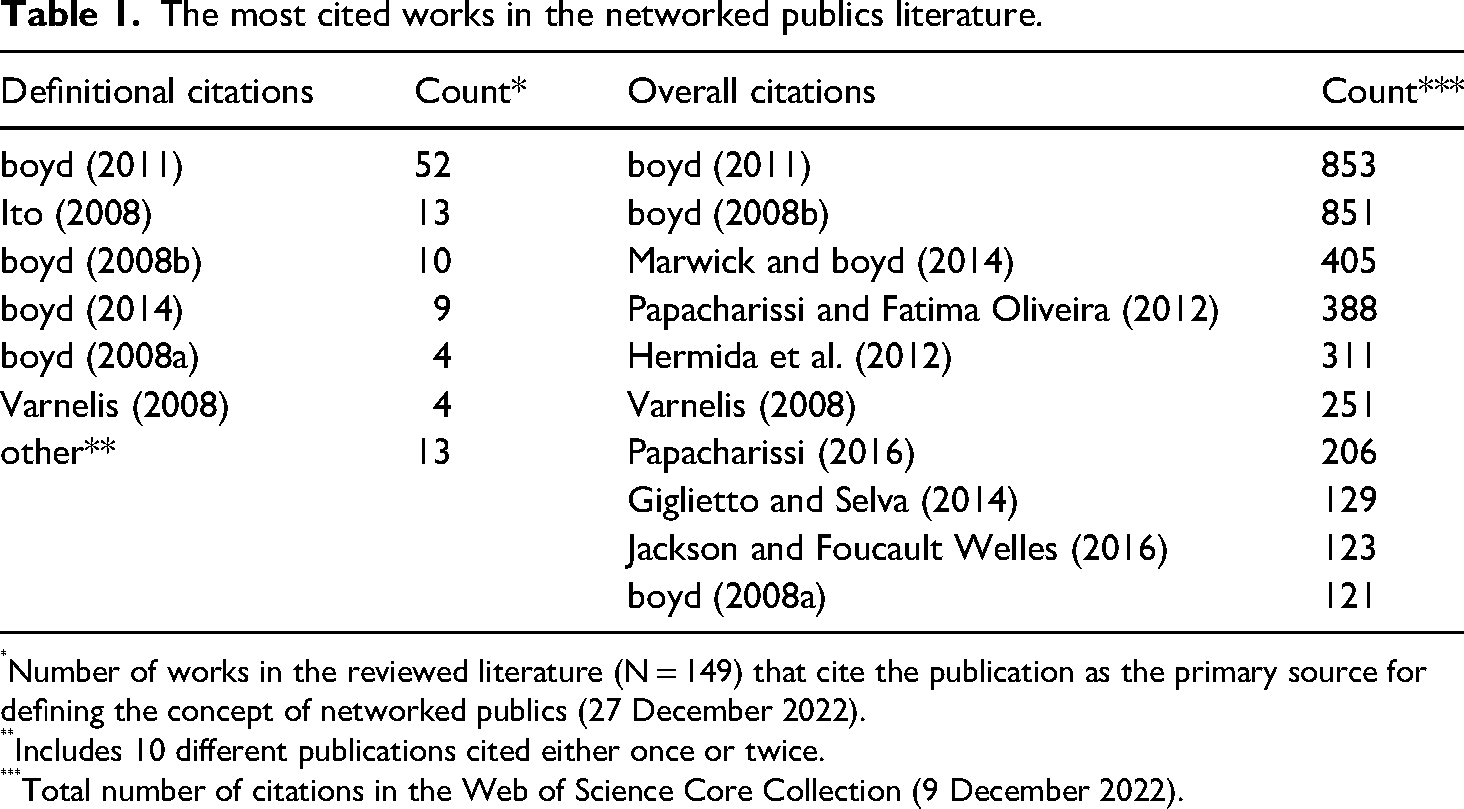
Number of works in the reviewed literature (N = 149) that cite the publication as the primary source for defining the concept of networked publics (27 December 2022).
Includes 10 different publications cited either once or twice.
Total number of citations in the Web of Science Core Collection (9 December 2022).
As the two principal precursors of networked publics research, boyd's work and Varnelis' book provide us with the first clue into the predominant understandings of networked publics as publics. In this respect, it is notable that neither boyd nor Varnelis engage in an extended theoretical exposition of the concept. Despite its title, Varnelis’ (2008) collection largely refrains from conceptual discussion and makes little effort to ground the concept of networked publics in any public-theoretical tradition. The only explicit attempt towards a definition appears in Ito's (2008) introductory chapter, which briefly explains the meaning of (networked) publics: The term networked publics is an alternative to terms such as audience or consumer. Rather than assume that everyday media engagement is passive or consumptive, the term publics foregrounds a more engaged stance. Networked publics take this further; now publics are bottom-up, top-down, as well as side-to-side. Publics can be reactors, (re)makers and (re)distributors, engaging in shared culture and knowledge through discourse and social exchange as well as through acts of media reception. (Ito, 2008: 2–3, original emphases)
Boyd's view of networked publics has a close affinity with that of Ito but also adds new layers to the concept. Building on established views within media studies regarding publics as users, consumers, and producers of cultural objects, as well as on Benedict Anderson's notion of imagined communities, boyd (2008b: 21) defines a public as ‘both a space where people may gather, interact, and be viewed and also an imagined community of people who share similar practices, identities, and cultural understandings’. Consequently, in what has become the single most relied upon definition in the literature, the networked public for boyd (2011: 39) is ‘simultaneously (1) a space constructed through networked technologies and (2) an imagined collective that emerges as a result of the intersection of people, technology, and practice’.
Rather than attempting to make any ontological claims about the nature of publics as networks (see Starr, 2021), boyd, much like Ito, adds the attribute ‘networked’ to publics simply as a reference to online worlds and digital media infrastructures. However, in contrast to Ito's (2008) understanding of publics as media users, boyd defines publics as spaces and imagined collectives. Such definitional decisions have striking implications for the study of networked publics. First, conceiving the public as a ‘space constructed through networked technologies’ not only conflates the public sphere with the public (for the relevance of analytically separating these notions, see Splichal, 2022), but it also motivates studies to assume that each online platform constitutes its own public. It therefore inspires analyses of how the technical features of the platforms shape the online interactions and practices of these platform-specific publics. Second, emphasising the public as something imagined draws attention to the ways in which social media practices are conditioned by users’ conceptions of the audiences they engage with. Through such moves, boyd steers the research on networked publics towards the kinds of concepts and interests that characterise the cultural studies tradition of the public.
Media audiences and cultural publics in the digital age
In addition to providing the literature with definitional backing, the contributions of boyd and Ito have been influential in driving the agenda of networked public research. As Table 2 illustrates, many of the empirical research objects and interests that prevail in the literature are grounded in the kinds of conceptualisations of networked publics as promoted by Ito and boyd. To begin with, the influence of the media studies tradition on publics is the most apparent in the stream of studies that associate networked publics with a particular audience, be it the followers of a social media influencer, YouTube channel, television programme, or a web series. Informed by Ito's conceptualisation, the publics in these cases are understood as active media consumers, and the research typically explores how online audiences interact with the social media influencers or cultural products they follow, or with other members of the audience.
Most frequent empirical referents for the concept of networked publics, and associated typical research interests.
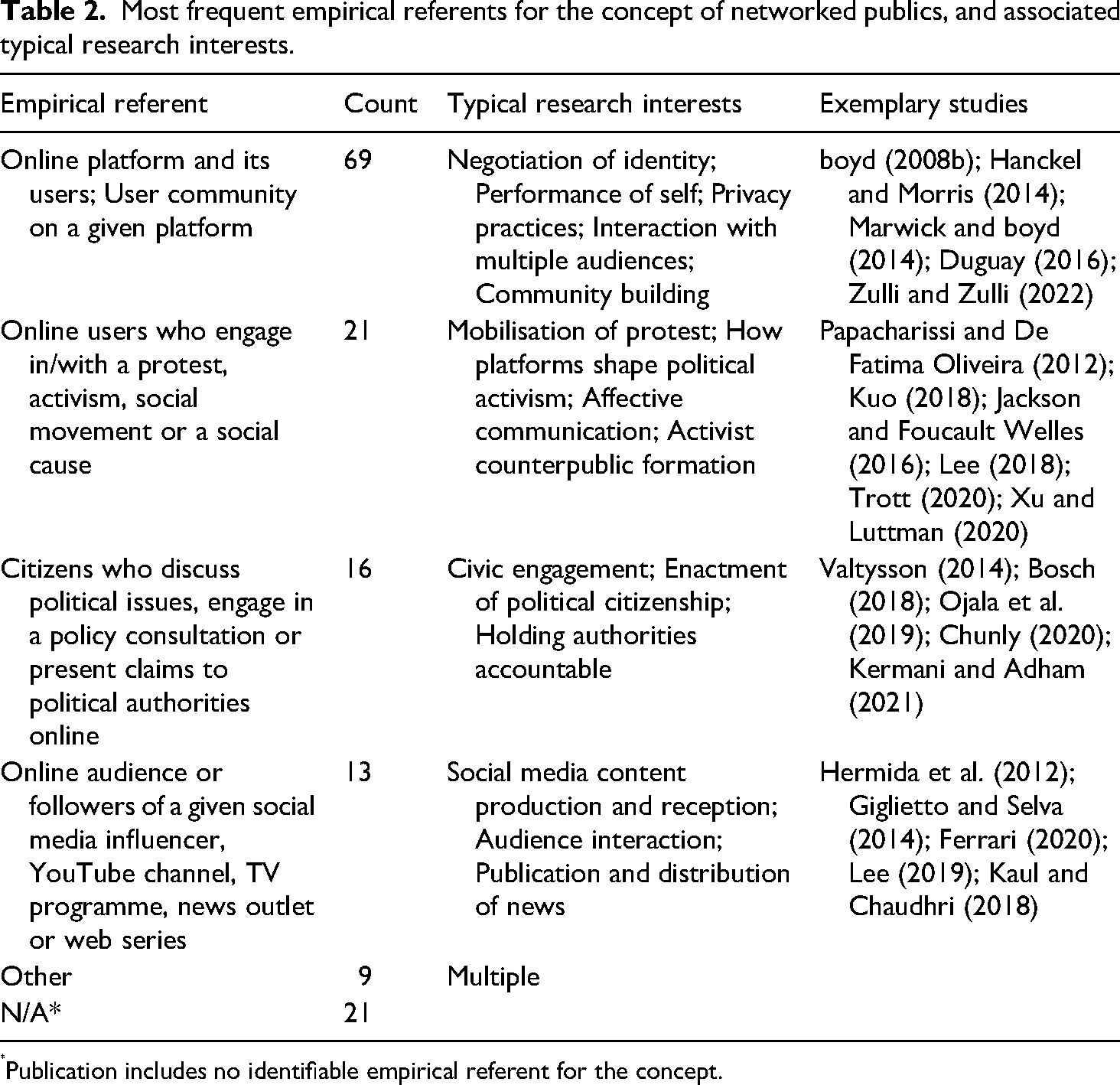
Publication includes no identifiable empirical referent for the concept.
Nonetheless, by far the largest number of works in the reviewed literature employ the notion of networked publics as a reference to a given social media platform or its users (Table 2). These studies reflect an understanding of the public as a collection of media users associated with a particular media infrastructure, and it is here that the cultural studies approach to the public intertwines with the media studies perspective. Following the research agenda introduced by boyd, these studies share an interest in analysing various social-psychological and cultural phenomena that characterise online interaction and networking on social media platforms. Often motivated by an ethnographic interest in the everyday uses of digital technologies, they foreground the users’ personal experience, creativity and motivations (e.g., boyd, 2008c; Click et al., 2017; Duguay, 2016).
The literature frequently observes how, through participation in networked publics, users work on their personal and social identities and feelings of belonging, as well as engage in expressions of solidarity and communal boundary-work between ‘us’ and ‘them’ (e.g., Alfonzo, 2021; Papacharissi and De Fatima Oliveira, 2012). Together with the technical features of the digital platforms, their use gives rise to collective, platform-specific user cultures that regulate the social behaviour and discursive forms on these platforms (e.g. Hanckel and Morris, 2014; Zulli and Zulli, 2022). Such interests are at the core of the cultural studies tradition of publics, which emphasises their nature as reflexive circulation of discourse, their constant openness to new meanings, and their role in collective world making and the construction of social relations and identities (Cayton, 2008; Ripatti-Torniainen, 2018; Warner, 2002). The networked publics research thus makes valuable contributions to updating the cultural theory of the public in the online era.
That said, the networked publics research could further strengthen its impact by engaging with the critical cultural studies tradition on the public. The latter addresses the preconditions of publics through critical approaches to ideology and discourse. Most notably, authors drawing from Foucauldian and ideology-critical traditions have analysed how the formation of publics is deeply embedded in broader dynamics of economic exploitation, disciplinary institutions, biopolitical government, and the associated commercial and political manipulation of public debate (e.g. Crath, 2016; Pamment and Cassinger, 2018; Terranova, 2007). The significant insight here is that the emergence of publics is not only an organic process of users coming together in a shared discourse and culture. Rather, this socialising process is always-already penetrated by power and institutions.
For the study of networked publics, the critical tradition thus points to a significant analytical reorientation: it is not enough simply to study what networked publics do; the institutions that shape them must also become objects of critical research. In terms of its emancipatory potential, this perspective calls for greater attention to the kinds of struggles that networked publics wage to collectively practice control over the digital environments that they depend on (e.g. Hong, 2014).
Networked publics as online activism: New form of collective behaviour?
In addition to boyd, a notable influence on the networked publics research can be found in Zizi Papacharissi's work (see Table 1). Papacharissi's contribution has been significant in terms of extending the study of networked publics to include more immediately political forms of activity beyond the kind of everyday socialising that boyd addressed. Papacharissi's work analyzes Twitter activities around the popular uprising in Egypt as well as the Occupy Wall Street movement, approaching them as online forms of political activism and social struggle (Papacharissi, 2015, 2016; Papacharissi and De Fatima Oliveira, 2012). This line of research has since continued in the work of several scholars who have applied the concept of networked publics to various instances of social media activism and online protest movements (e.g. Kuo, 2018; Lee, 2018; Trott, 2020; Xu and Luttman, 2020). They have contributed to discussions on the relevance of online networks for mobilising protests, providing insight into a range of topics from how platforms shape political activism to the role of affective communication in online activism and the dynamics of activist counterpublic formation (see Table 2).
Crucially, the research on social media activism and protest movements points to highly specific forms of online activities and represents a significant extension to the interpretation of networked publics as publics. To explore the specificity of this interpretation and its consequences, it is relevant to revisit the sociological tradition of the study of publics as developed in the late 19th and early 20th century works of French sociologists, such as Gustave Le Bon and Gabriel Tarde (1969), and US-American sociologists, including Robert E. Park (1972), Herbert Blumer (1951) and John Dewey (2016). In that earlier context of rapid societal transformation, differentiation and pluralisation, as well as new media developments, they observed prevalent forms of social interaction and identified the public as one of them.
In the sociological tradition, the public became understood as a form of collective behaviour that is spontaneous, volatile and amorphous, neither centrally organised nor directed by a shared objective or formal rules (Dolata and Schrape, 2016). As such, it was seen as distinct from other typical forms of collective behaviour, such as crowd and mass. Whereas the mass was characterised by individuals acting in unison in the absence of any intentional interaction or awareness of others, the crowd referred to behaviour that was strongly influenced by affective unification and directed towards a common purpose, such as the expression of a shared emotion, support, acceptance or denouncement (Caliandro, 2018; Stage, 2013). In contrast, the public was characterised by a conversation around a certain issue or problem that requires a collective response (Blumer, 1951; Park, 1972). The members of the public participated actively in the discourse, exchanging contrasting views and solutions, but participation was usually situation-specific and only temporary. Out of this unruly debate and argument among strangers, more organised forms of collective action may develop, including movements and communities (Dolata and Schrape, 2016). However, the public itself remained unorganised and incoherent. It was not assembled by any reflexive decision but emerged out of individual actions that contributed to the debate.
Based on our review, such sociological reflections about the public are nowhere to be found in the literature on networked publics. In terms of their theoretical frameworks, boyd, Varnelis and Papacharissi make no references to Tarde, Park, Blumer or Dewey, and the sociological concept of the public as a distinct collective form among others is absent in their work. Nor has it been explored in subsequent contributions to the research. Even so, we argue that the research on networked publics, and particularly the study of online activism within that literature, opens an implicit dialogue with the sociological tradition. It seems that the studies of the kinds of networked publics that build around various protest or movement hashtags, such as #Occupy, #Ferguson and #NoDAPL (Jackson and Foucault Welles 2016; Papacharissi, 2015; Xu and Luttman, 2020), share the sociological perception of the public as a mostly unruly, non-organised and ephemeral phenomenon that comes together around a particular topic. In other ways, however, the studied online protests appear to be quite distant from what the classical sociologists conceptualised as publics.
Confusingly, as opposed to the sociological view of the public formed by people in disagreement who nevertheless choose to address a point of controversy through discursive interaction, the networked publics research tends to foreground online communities of likeminded people motivated by a common experience and identity, or movements that advance a certain societal cause. Alternatively, the objects of study in the networked publics research often resemble what the sociology of collective behaviour conceptualises as crowds, characterised by a common will, shared feelings, affectivity, and the repression of individual criticism and reflection. These emphases are often supported by observations of ‘homophily’ that are seen to characterise people's social media networks (Wang and Chu, 2019; Xu and Luttman, 2020).
Read sociologically, the networked publics research appears to claim that, in online environments, publics tend to merge with crowds, communities and movements. However, by claiming this, the research on networked publics ignores recent work done in the fields of online sociology and digital ethnography suggesting that analytic distinctions between publics, crowds, masses, movements and communities are meaningful in online environments, too (Caliandro, 2018; Dolata and Schrape, 2016). For instance, crowd-like behaviour can be witnessed online when large numbers of people spontaneously coalesce around a topic or an actor and post short and affective expressions of support, compassion, rejection or judgement about it. In contrast, a public can be observed in online interactions between people who address shared problems but express diverging views and criticise each other. These are dialogues that transcend the networks, cliques and communities of the likeminded and compel people to present justifications to their personal views. In the sociologically defined online publics, individuals engage in reason-giving with people beyond a homophilic group and open themselves to potential transformation of their own thinking about the issues (Splichal, 2022).
In sum, the sociological tradition poses significant questions to contemporary discussions on publics in communication and media studies. Does the study of networked publics evince that current online environments induce people to behave as crowds and movements rather than as debating publics? Or is this partly a misconception created by the choice of research objects that have been tuned towards conspicuous protest activities? To gain a better grasp of what we are currently witnessing online, the analytical distinctions that draw from the sociological reading of the public have much to offer to the study of online publics. Through the identification of public-like collective behaviours, research could partly reorient itself from the study of likeminded groups towards identifying the kind of discursive interaction in the current public debates that is directed to the articulation of shared problems beyond conflicts and divisions among societal groups (see, e.g. Kangaspunta, 2018).
Networked publics as civic agency: Democratic relevance of online participation
In addition to studies that focus on online protest activism, we found another, fledgling strand within the reviewed literature that approaches networked publics from a political perspective. These studies deal with online users who discuss social and political issues, engage in policy consultations or present claims to political authorities (see Table 2). They are primarily interested in exploring how people use digital platforms for civic purposes, to perform political citizenship, and to express public dissent through various online practices.
During elections, for instance, networked publics tend to form around particular issues, exchanging opposing views and arguments and influencing what topics become salient in the national debate (Bosch, 2018; Kermani and Adham, 2021). In between elections, people use online platforms to evaluate and criticise public officials, present direct claims to them, and demand explanations, thereby generating forms of public accountability (Chunly, 2020; Ojala et al., 2019; Valtysson, 2015). They can also have an impact on legislation through participation in government-initiated online consultations (Shepherd, 2019; Valtysson, 2014). Alternatively, online users may simply want to participate in public debates over important social issues that demand collective responses, such as sexism or the safety of nuclear power (Li et al., 2016; Maireder and Schlögl, 2014).
Such practices of participation, criticism and debate constitute core elements of the political theory tradition on publics that is rooted in classical Greek ideas about citizens’ self-government and political liberty in the public realm (Arendt, 1958). When these ideas were reformulated in European enlightenment thought, the public emerged as a counterforce to the ruling authority (Laursen, 1996). It embodied the ideals and practices through which civil society could delimit the sovereign power of the state and subject it to the criticism and control of public reasoning (Habermas, 1989; Kant, 1996). In political theory, the public thus typically operates as a normative concept that articulates the role of citizens in democratic self-government. For instance, Kant's (1996) foundational essay underscores the ideal of critical reasoning between free and equal citizens who engage in public deliberation over matters of the state. Similarly, in the republican democratic tradition, citizenship is premised on active participation in collective decision making based on sound judgement, solidarity and fundamental equality (Held, 2006; Weintraub, 1997). Theories of deliberative democracy, in turn, foreground reciprocity in public communication, emphasising that legitimate decisions are outcomes of discursive proceedings in which claims must be justified and are subjected to critical scrutiny (Habermas, 2006; Held, 2006).
So far, the networked publics research has shown little interest in the political theories of the public. Strikingly, boyd (2008a, 2008b: 20) has explicitly diverted the concept of networked publics away from the political tradition and questioned the potential of social network sites to engender political participation. Similarly, the studies on online protest movements by Papacharissi and others, even while concentrating on online activities that are overtly and self-consciously political, have overlooked the political theories of the public. Finally, even the emergent study of networked publics as participating citizens has largely ignored the public as a political-theoretical concept (for a notable exception, see Valtysson, 2014). That constitutes a serious omission, taking away an important normative and analytical dimension from the research on networked publics. As a result, the research has had little to say about the political and democratic relevance of networked publics.
Normative theories of democracy are often dismissed as dubious, unrealistic and even exclusionary perspectives that are unfitting for the analysis of citizen communication in ‘real life’. But this misunderstands the purpose of normative theory. Instead of outlining unachievable ideals, it aims to analyze the principles and assumptions that lie behind existing institutions and communicative practices, those that make contemporary democracies possible in the first place (O'Mahony, 2013; Habermas, 2022). In this regard, the emergent interest within the networked publics research to study citizen participation has significant untapped potential to contribute to the development of the contemporary political theory of publics. For one, these studies could have much to say about the kinds of discursive practices that shape civic communication in the age of digital platforms, as well as the kinds of possibilities and limitations that online environments pose for democratic participation.
Conclusion: Implications for communication and media studies
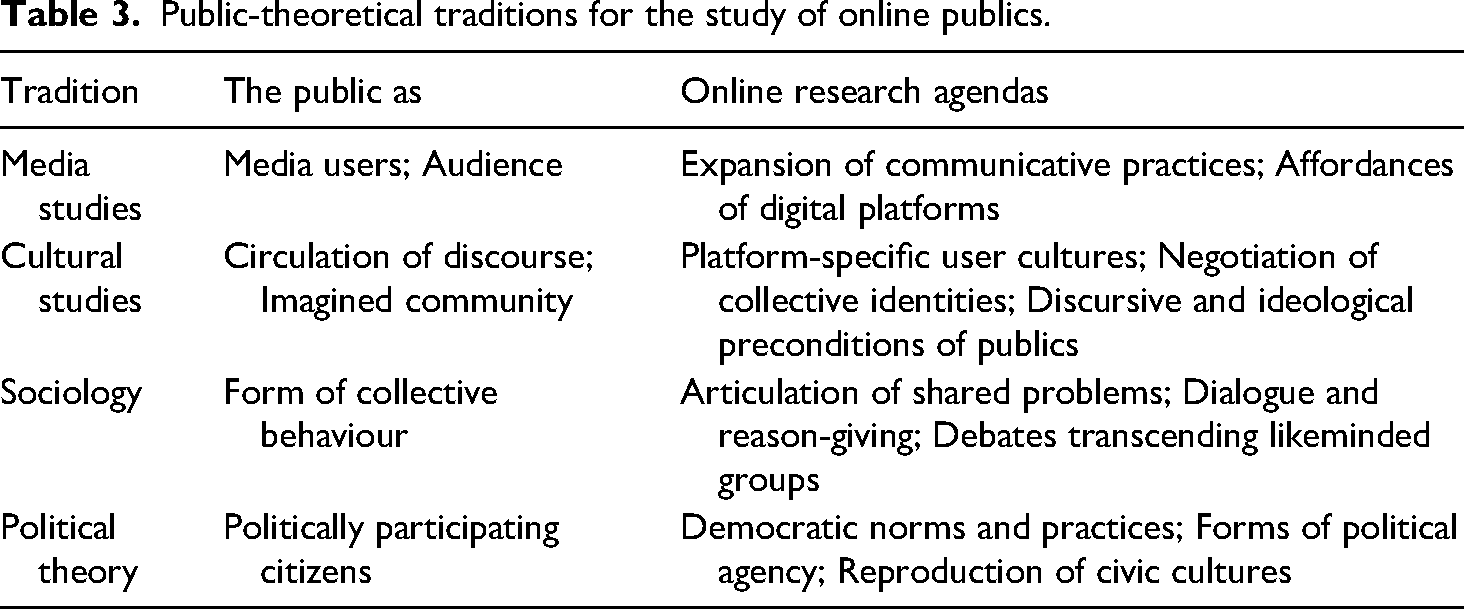
This article has critically probed the networked publics literature, examining its customary understandings of the public as well as its typical objects of empirical analysis and research interests. We found that the literature has been heavily shaped by the media and cultural studies traditions on publics. In terms of conceptual definition, the literature has relied on understandings that foreground publics either as media users or as technology-driven spaces for communal interaction. Such approaches have also dominated the empirical research on networked publics, which frequently emphasises the significance of media technologies for the quotidian practices of sociability and personal identity work, as well as for the building of (imagined) communities. In doing so, the networked publics research has not only neglected theoretical discussions about the public, but also overlooked the various thematic connections the research nevertheless has to the sociological and political conceptions of the public. Table 3 summarises these conceptions and the different questions they raise for the study of online publics.
Public-theoretical traditions for the study of online publics.
As our analysis concentrated on the networked publics literature, our conclusions cannot be generalised to all research on online publics within the field of communication and media studies. Nevertheless, due to the centrality of the concept of ‘networked publics’ in this research area, it is safe to assume that the reviewed research shapes the way online publics are perceived more broadly within the field and that, therefore, our findings have significant implications for communication and media studies in general.
In this respect, our study indicates a worrying development in which the study of online communication has become detached from key public-theoretical concerns that have historically been at the core of the research field. Scholarship on online publics has largely developed without conceptual rigour or even interest in previous theoretical work that would provide perspective and analytical depth for current research. Consequently, communication and media studies have lost sight of the sociological, democratic-theoretical, normative, and to some extent cultural implications of the public. Understood primarily as media users, active audiences and likeminded communities, the concept of the public risks losing its critical and democratic relevance.
The choice to remain outside or to re-engage with public-theoretical traditions will have wider implications for how communication and media studies approach online environments. In addition to opening fruitful interdisciplinary dialogues, drawing from the rich public-theoretical corpora would push online publics research towards new analytical and empirical directions. For instance, it would enable research to critically question some of the popular analyses about bubbles and echo chambers that point to online communication as something conducive (only) to social polarisation, group thinking, tribalism and crowd-like behaviour. As a challenge to such commonplace views, the sociological public-theoretical tradition emphasises that it may be possible to identify elements of a debating public also in formations that at first seem to promote consensual thinking and conformist behaviour. Moreover, by focusing on the kinds of norms and expectations that debating users reproduce in their discursive online practices, research could develop greater understanding of how networked publics may or may not express democratic ideals and embody civic cultures (see Hermes, 2020; Iannelli and Marelli, 2019; Pell, 2014). Finally, the critical cultural tradition on the public points to the need to subject the formation of online publics, and the institutional-technological infrastructures that shape them, under critical and normative scrutiny. These challenges have become increasingly urgent in the age of datafication and platforms (Møller Hartley et al., 2023).
As these examples indicate, re-building connections to the extensive history of public-theoretical work will significantly change prevailing understandings about online phenomena in communication and media studies. Conversely, without theoretical engagement, the online publics research keeps unfulfilling its critical potential, and the new coming of the public onto the communication and media studies’ research agenda will remain detached from over a century of scholarly work.
Footnotes
Funding
The authors disclosed receipt of the following financial support for the research, authorship, and/or publication of this article: Research Council of Finland (grant number 332231) and Helsingin Sanomat Foundation (project Voluntary exclusion from social media as experienced by different non-user groups).
