



Abstract
Global businesses are known to use their social media accounts for legitimisation aspirations and national market assimilation. Still, we lack empirical tools for identifying the kind of public corporate social responsibility communication (CSRC) that helps along positive branding and social relevance. This is particularly important information in view of whitewashing aspirations by the vice industries. This study develops a content analytical tool for assessing gambling companies’ social media strategies by comparing CSRC by state-owned and licenced gambling operators in Finland and Sweden. The diachronic comparative design allows us to point out how the companies advance along ambitions to communicate responsible gambling (RG), affiliate with public interests, shape the companies’ public role as societal benefactors and normalise gambling as an activity. The concepts of tactical and strategic CSRC help us to expose these communication strategies in view of national policy changes, state control and public opinion.
Keywords
Introduction
Social media outlets have become valuable platforms for corporate reputation building and business image whitewash. Content on social media accounts is strategised to help along the legitimising aims of controversial industries, such as the alcohol beverage industry, the pharmaceutical industry, the fast food industry and the cannabis industry (e.g., Ju et al., 2021; Kauppila et al., 2019; Mishra and Sanghvi, 2020; Parekh et al., 2016). Even if research often has indicated that social media-based communication helps companies gloss over their products’ doubtful character and build positive business reputation (de Lacy-Vawdon and Livingstone, 2020; Visser, 2014), it is unclear precisely how this is manifested in the content.
Among the vice industries, the rapidly growing 450 billion dollar global gambling business is an interesting case in point. While gambling is now primarily a virtual and net-based form of capitalism, it is still regulated and overseen differently in different jurisdictions. This has resulted in a glocal social media choreography: businesses want to incorporate citizens in a global commercial culture, while building brand reputation in line with national legal and ethical requirements (see Markham & Young, 2015; Dumitrescu & Vinerean, 2010).
The focus of this study is the legitimacy work embedded in gambling operators’ social media content in view of their sociolegal operation context. We set out to investigate Finnish and Swedish gambling operators’ social media-based image construction during 2017–2020, at a time when the gambling industry in both countries underwent significant changes. Our objectives are twofold: first, we unfold the roles and formats of social media-based corporate social responsibility communication (see Nielsen and Thomsen, 2018 on CSR legitimacy) and how the content fluctuates in an interplay with changing national regulation contexts. Second, and in order to meet the first objective, we have taken on the task of operationalising CSRC empirically in a way that reflects an interplay between social media content and gambling control regime.
In order to draw conclusions regarding the CSRC ambitions of the gambling companies, we needed to develop a study design that would provide evidence of how businesses’ CSR messages alter with changing control regimes. We settled for a diachronic comparative design in which we audited gambling operators’ social media CSRC content in two changing political realities in 2017–2020. In Finland, the state monopoly on gambling provision grew stronger in the 2017 operator merger, while in Sweden, the state monopoly was replaced by a licensing system in 2019.
The Finnish monopoly merger meant that corporate social responsibility messages were communicated by the single all-encompassing state monopoly Veikkaus. The company maintained its peculiar social good doer-role as a benefactor: gambling proceeds are channelled to third-sector organisations, which is regulated in the Lotteries Act (1047/2001) (see also Egerer et al., 2018b; Marionneau, 2015). In 2021, Veikkaus channelled 680 million euros to beneficiaries such as sport clubs and other NGOs, museums and the Academy of Finland (Veikkaus, 2021). In Sweden, in 2019, both offshore and previously monopoly-based national gambling operators needed to quickly adapt to responsible conduct regulations in order to gain a licence to operate in the Swedish market. The requirement of responsible gambling was laid down in the new Gambling Act (SFS 2021:1254) as a key priority. There was thus a new need for companies to comply with and fit into the Swedish definition of responsible conduct.
The operators’ communication of their positive role in Finnish and Swedish society has never been more important than in 2017–2020. Also, due to increased public awareness of gambling-related harms, it may have been harder than ever for the operators to succeed in this endeavour.
Our dataset includes 11 860 curated social media posts by gambling companies targeted at Finnish and Swedish audiences on Facebook, Instagram, Twitter and YouTube. We audited fluctuations in the CSRC content that could be argued to reflect changes in the operational contexts (shift to licensing or stronger monopoly). We begin by situating our study in view of the concepts of responsible gambling (RG) and strategic and tactical CSRC, which form the basis of our design. We then move on to discuss the empirical findings and in the end we draw some conclusions on how the study furthers understandings of social media-based CSRC. Specifically, we highlight the role of social media outlets in enabling the gambling industry to blend into the national markets. The study's unique contribution to communication studies is that it operationalises ways to discern how businesses’ social responsibility image creation reflects and interacts with regulation regimes and public opinion.
Communicating responsible conduct
Research on CSRC is an expanding and fragmented interdisciplinary field. The question of how CSRC can serve businesses’ image creation and public acceptance as part of a sociolegal operation regime, has not been an emphasised focus in this research field. Attention has more often been directed towards organisational and project-based communication activities that support CSR-goals. Researchers have typically inspected and assessed such strategies and practices (Crane and Glozer, 2016; Verk et al., 2019). In the present study, we stress a perspective that has entered the communication literature rather recently (Verk et al., 2019): We are interested in the self-serving functions of the CSRC that is targeted at the wider public. Schoeneborn and colleagues (2020) describe this activity in terms of the relationship between ‘the walk’ (actual practices of CSR) and ‘the talk’ (CSR messages to the public). This type of public CSRC aims to integrate businesses into the social role of respectable social actors and benefactors, and to establish fan communities, signalling honesty and transparency (Caluzzi et al., 2022; Sandoval, 2014; Veldung et al., 2022). Our focus differs also from previous research on gambling companies’ use of social media, which has thus far mostly focused on exposing how they use the platforms for marketing and normalising their products (Lindeman et al., accepted/in press; Gainsbury et al., 2015b).
The global gambling industry needs to market gambling as a fun activity, while it is often also obliged to acknowledge the problematic potential of its products (Newall et al., 2022; van Schalkwyk et al., 2021). Emphasising responsible gambling (RG) has offered ways to navigate this paradox. RG entails ways of proceeding ethically when addressing consumers, comprising information on games, age limits, consumer behaviour, risks of problem gambling, self-exclusion and information on how the company practises social responsibility in, for example, staff education, protection of minors from gambling and limiting advertising (e.g., Blaszczynski et al., 2011; Hing et al., 2018; Wood and Griffiths, 2014). Links to counselling services and helplines are also typical RG messages (e.g., Parke et al., 2014). RG has also shown to be a great PR tool for gambling companies, portraying the business as a lawful part of society in a healthy and honest relationship with citizens and authorities (see Binde, 2014; Fiedler et al., 2020; Gainsbury et al., 2015a; Monaghan and Blaszczynski, 2009). Still, previous research has also pointed out the (in-)effectiveness of RG messages (Auer and Griffiths, 2020; Monaghan and Blaszczynski, 2009) and the deceitfulness of RG as a message of a ‘safe’ way of gambling (Rintoul et al., 2017).
As in most countries in the world, both Finland and Sweden have legal requirements for RG efforts to prevent and reduce gambling-related harm. In 2017–2020, operators active in Finland and Sweden faced increased regulation and pressure by the authorities to include RG in their communication to consumers. The introduction of the Swedish licensing system required that operators demonstrate RG both in their practices and communication. In Finland, RG regulations have successively increased: as of 2022 the state monopoly Veikkaus is required to identify all players, there are new marketing restrictions, and the customers have been set a mandatory annual loss limit.
The RG messages in our dataset can be seen both as an expression of the operators’ need to comply with national regulation, and of a documented general trend of a heightened focus on CSR on corporate social media accounts (Stohl et al., 2017). In Finland, one could imagine that the position of the state gambling monopoly – justified by public health – translates into tricky contradictions in accommodating both commercial objectives (selling games) and aims of harm prevention. In comparison, the Swedish licensing system may separate more clearly between corporate interests and those of legal gambling control. Furthermore, public health-based monopolies’ CSRC may have a greater need to validate their status in the market showing that the model in which they operate is a guarantee for responsible conduct. They need to manifest themselves as reliable societal institutions with health-related functions – something that has come naturally to alcohol monopolies in the Nordic countries (Cisneros Örnberg and Ólafsdóttir, 2008).
In addition to the obvious and legally required RG social media content, there is more subtle communication that enhance the companies’ credibility and moral profile. Social media posts by gambling operators may, for example, cover environmental awareness activities and youth sports hobbies, or shed light on how civil society supports vulnerable groups. Such content can be regarded as a long-term image creation investment, corresponding to the concept of strategic CSRC (Stohl et al., 2017; Vishwanathan et al., 2020). While there are several definitions of strategic CSRC (Frynas, 2015), we define it here as communication that enhances and aligns the company with the interests and the common good of the society of which it is part (see also Farjoun, 2002). Strategic CSRC entails ‘activities that appear to further some social good, while at the same time benefitting the firm /-/ by either enhancing its reputation, increasing stakeholder reciprocation’ (Vishwanathan et al., 2020: 339). Typically, strategic CSRC involves a company's long-term image creation of morally committing to a path that involvers resource commitments (Bansal et al., 2015). Social media-based stakeholder reciprocation and the appearance of furthering a social good are ways for companies to communicate shared social values, interests and activities in societies in which they want to keep or increase their market share. In comparison, RG can be seen as corresponding to the notion of tactical CSRC, which comprises more transactional activities and requires relatively few organisational resources (Bansal et al., 2015: 69). RG messages are more or less automatic additions to social media posts to ensure that the gambling companies have followed legal requirements to inform consumers about gambling-related risks and harms. The concepts of tactical and strategic CSRC underlie the empirical operationalisation in our study.
Hypotheses
At the outset, we formulated the following expectations regarding trends in the gambling operators’ social media activities:
Adjustments to a licence-based system lead to a sudden increase in tactical CSRC, as previous off-shore companies as well as previous monopoly companies want to comply with RG requirements in the new system and retain their licence. Thus, we expected a rise in tactical CSRC in the Swedish material from 2019 onward.
In comparison to licensing systems, state monopoly-based gambling companies rely less on tactical CSRC, as their position as a state-owned actor justified by public health involves a certain starting point of assumed responsible conduct. Instead, they need to continuously reproduce their image of corporate responsibility through advanced strategic CSRC. Consequently, we expected that the level of strategic CSRC would be higher in the Finnish monopoly operator's social media content than in the Swedish operators’ content.
The main PR task for state monopoly companies is to continuously justify themselves as an important, needed and responsible part of society. Therefore, strategic CSRC on stakeholder reciprocation was expected to be especially important and more emphasised in comparison to other gambling provision systems. Compared to the Swedish dataset, we expected to find more content in the Finnish data on strategic CSRC regarding stakeholder reciprocation.
Overall, the theoretical assumption underpinning our study is thus that one can see ‘the talk and the walk’ of CSR as overlapping: communication is not only understood as a vehicle for mediating messages of CSR, but the phenomenon of CSR comes into being through communication. Long term strategic CSRC is coupled with companies' ambitions to become integrated in society as a normalised, genuine and good societal actor.
Proceedings
Data and coding
The data was collected from the gambling operators’ national accounts on Facebook, Instagram, Twitter and YouTube. The 29 Finnish accounts were all administered by the single mainland operating monopoly company Veikkaus. The Swedish sample included in total 28 operators, of which 21 were offshore companies before the new licence system in 2019 (material from 2017–2018). By November 2021, all but two operators had obtained a licence to operate in the Swedish market. The studied operators are ATG, Bethard, Betsson, Bingolotto, Casino Heroes, Casinostugan, Casumo, ComeOn!, Expekt, Folkspel, Kombispel, LeoVegas, Lottoland Sverige, Miljonlotteriet, Mr Green, Multilotto, Ninja Casino, NordicBet, Paf, Rizk Casino, SuperLenny, Svenska Postkodlotteriet, Svenska Spel, Sverigeautomaten, Thrills Casino, Unibet, Vera&John and Vinnarum. Seven operators are registered in Sweden, 19 in Malta and one in Gibraltar. Paf is registered on the Åland Islands (an autonomous part of Finland). The 28 operators were selected on the premise of being the most commonly used and known gambling brands in Sweden. To assure that the sample really included these companies on the Swedish market, we used membership lists of the Swedish Trade Association for Online Gambling (BOS) and results from surveys by Mediavision (2015–2018) and Novus (2012–ongoing) regarding brand recognition among citizens (Lindeman et al., accepted/in press).
The 29 Veikkaus accounts have in total around 620 000 followers, and the total number of followers for the 71 Swedish accounts is around 2 123 000. The followers may partially include the same people. The number of followers or subscribers varies significantly by account from zero to several thousand: for example, Svenska Postkodlotteriet had almost 197 000 likes on its Facebook account in April 2018. We chose to examine only the curated content of the accounts, but the brand visibility and content spread can be exponentially more prominent, especially if paid advertisements were included.
At the beginning of the data collection in 2017, we started gathering all curated posts from the existing accounts on Facebook, Instagram, Twitter and YouTube, the most popular social media platforms in both countries (Kohvakka and Saarenmaa, 2019; Internetstiftelsen, 2020). We collected the operators’ curated material on the national language platforms in the sample month of March from 2017, 2018, 2019 and 2020. The same month was chosen for each year to make comparisons and spot possible trends. We chose March as our sample month after reviewing the nature of the seasonal content in terms of specific (sports) events or holidays in both countries. The material comprises a total of 11 860 posts, of which 4 498 (38%) came from Finnish sites and 7 362 (62%) from Swedish accounts. The material was collected manually through screenshot documentation of posts on Facebook (n = 2466), Instagram (n = 1145), Twitter (n = 7840) and YouTube (n = 409). The material from both countries included standard generic social media communication. The posts and tweets concerned games and gambling (information on results and timetables for betting, horse raising and online events); short notices on people winning at the lottery; references to sports activities (upcoming ice hockey matches and behind the scenes in the lives of sports stars); and other topical contents such as congratulations on International Women's Day or humorous videos with celebrities (for a more thorough description, see Lindeman et al., accepted/in press).
The data from both countries was coded in line with classic content analytical proceedings (Drisko and Maschi, 2015) covering a 49-item coding protocol. This was made as inclusive as possible to capture the nature, functions, content and formats of the postings, which ranged from technical information such as the number of likes, comments and shares to more inductively acquired and meaning-based representational dimensions such as features of national identities and emotional appeal. The coders proceeded in cooperation, checking, evaluating and confirming the codes in view of examples and tricky cases (see Neuendorf, 2017). Intercoder reliability was assessed continuously, and uncertain cases were discussed in four workshops, which also gathered the non-coding members of the project team.
Operationalisation of CSRC
We needed to view all contents that could be argued to entail CSRC on the broad criteria of featuring topics that oriented the reader toward appreciating a relationship between the company realm (products, brand, organisation, etc.) and the realm of the public and the commonly experienced (communities, jurisdiction, cultural and temporal phenomena).
On the basis of an internal research team consensus-striving group assessment (Neuendorf, 2017), nine often overlapping codes were defined as entailing public relations CSRC in a broad sense. These codes are explained in Figure 1, which also contains information about how the codes were argued to correspond to the concepts of tactical and strategic CSRC.
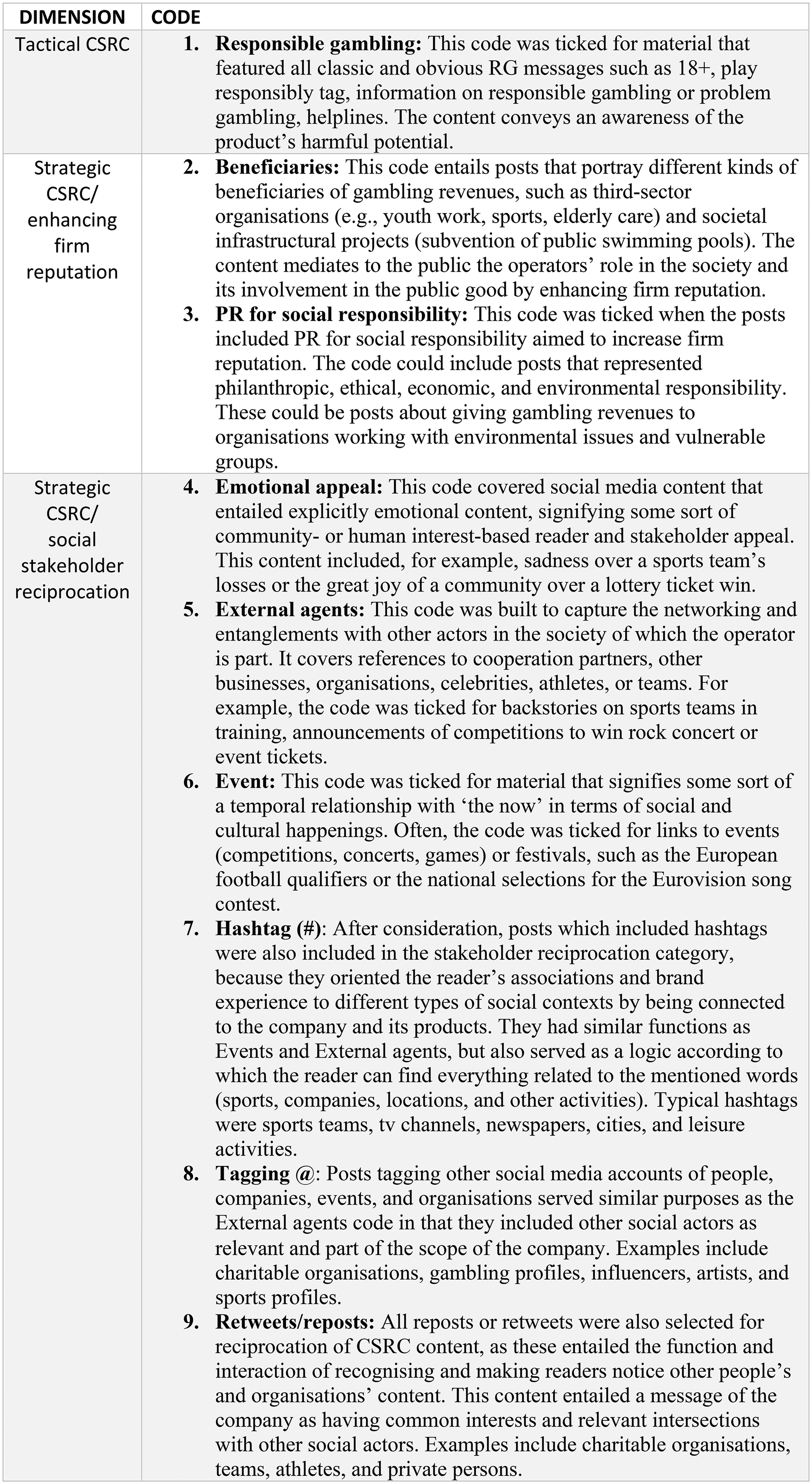
Nine CSRC codes and dimensions of social media-based meaning-making that they are seen to correspond to.
Tactical CSRC comprises gambling companies’ adaption to RG demands. It entails messages on responsible and lawful conduct, and acknowledges the products’ harmful potential. The identification of strategic CSRC content followed a definition of mechanisms of which two had specific relevance for this study, the first pertaining to enhancing firm reputation and the other to increasing stakeholder reciprocation (Vishwanathan et al., 2020: 316). Both have shown to be important for gambling companies in their mediating proper and responsible conduct (Dhandhania and O’Higgins, 2021; Kim et al., 2017; Leung and Snell, 2021).
When accounting for our results we will refer to the content categories in Figure 1 as “tactical CSRC”; “strategic CSRC enhancing firm reputation” and “strategic CSRC for stakeholder reciprocation”.
Results
Tactical CSRC
The RG messages comprised mostly of small mechanical 18 + labels and Play responsibly texts. Overall, RG content was ticked for around 10% of the contents in both materials. Figure 2 portrays variance in the prevalence of RG messages in the datasets during the studied periods.
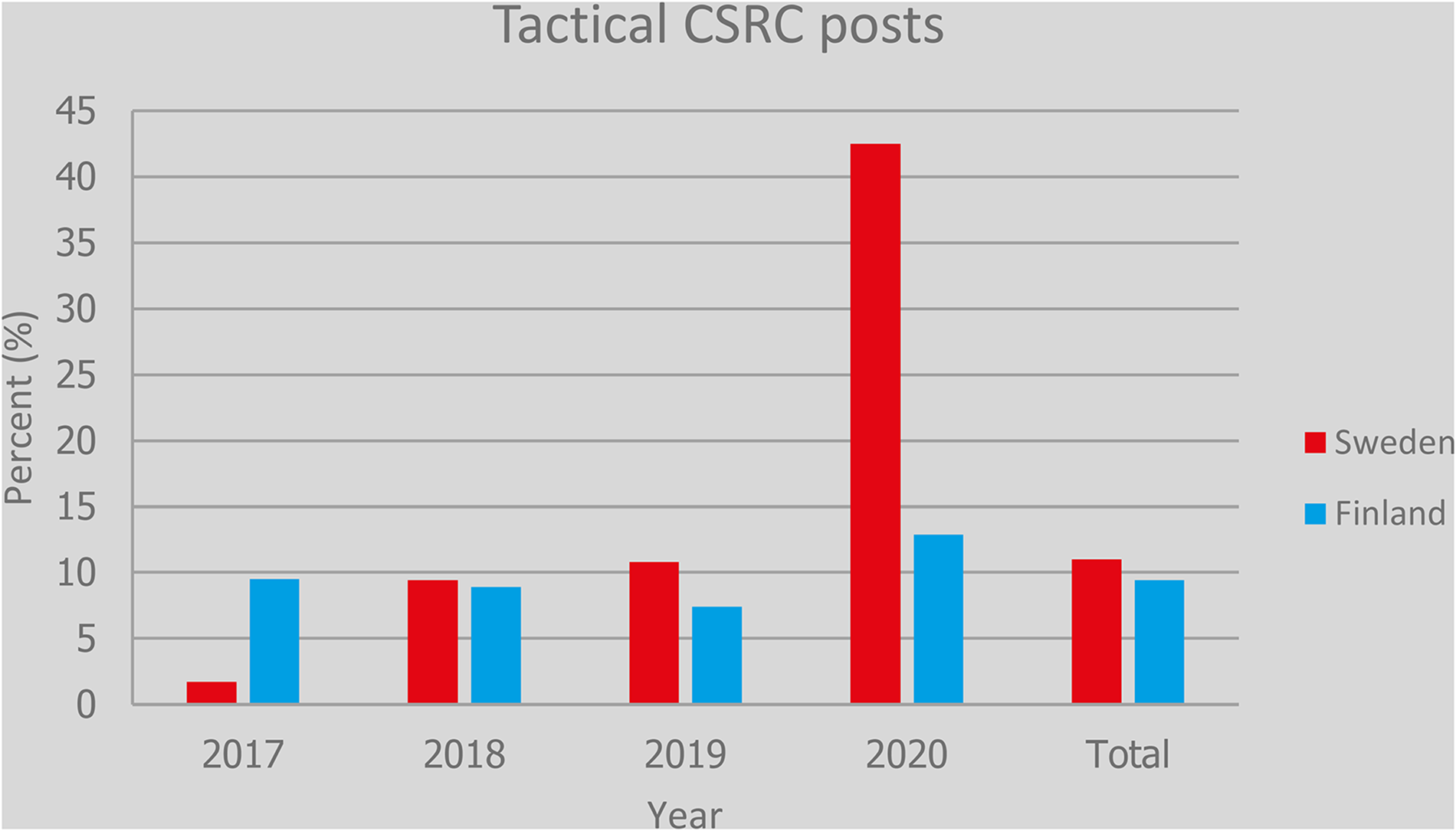
Share (%) of posts that included responsible gambling messages in the sample month of March in Finnish and Swedish materials.
We had expected a sudden rise in tactical CSRC in the Swedish material as of 2019 (H1), when the new licensing system came into effect. However, only a small rise was noticeable between 2018 and 2019 (from 9.4% to 10.8%). A substantial increase from 11% to over 42% was visible only in the following year (2020). Perhaps gambling operators were still adjusting to the new regulations in March 2019, and social media accounts were not the highest prioritisation in this work. Online casinos and gambling facilities may have been viewed as more important places to start emphasising RG messages. Another and perhaps a more likely explanation could be a report published in 2019 by the Swedish Consumer Agency (Konsumentverket, 2019). The agency drew attention to the fact that many licensed gambling operators had failed to inform customers of age restrictions and that consumer information on where to find help for gambling-related problems was not visible enough. Also, the internet links that the gambling operators referred to, were non-existent or led to sites of international support organisations, which was not adequate for the Swedish consumers and their needs. As the consumer agency is able to fine the gambling companies, one could assume that the companies quickly responded with increased RG messaging (tactical CSRC) on their social media accounts.
The prevalence of tactical CSRC messages was, as expected, more stable in the Finnish material, around 10% throughout. The lowest point was March 2019 (7.4%) and the highest point in 2020 (12.9%). The lack of variation in the frequency of Veikkaus RG posts supports our hypothesis of state monopoly gambling companies being less reliant on tactical CSRC (H2). They are regarded by themselves and others as inherently representing the same public interests that protect citizens from gambling-related harm. They may thus feel confident to ‘automatically’ and through their very existence to serve the objectives of RG measures. The difference between the materials points to an important public check and control mechanism of public supervision agencies in licence-based systems, which can react to the communication of private enterprises (Sweden). This function is missing in the Finnish gambling provision system and evident in the state monopoly's CSRC on social media.
Strategic CSRC enhancing firm reputation
The average prevalence of strategic CSRC enhancing firm reputation by emphasising beneficiaries of gambling revenues and PR for social responsibility is displayed in Figure 3. This feature declined in the Finnish data over time, whereas the reverse trend was observed the Swedish dataset.
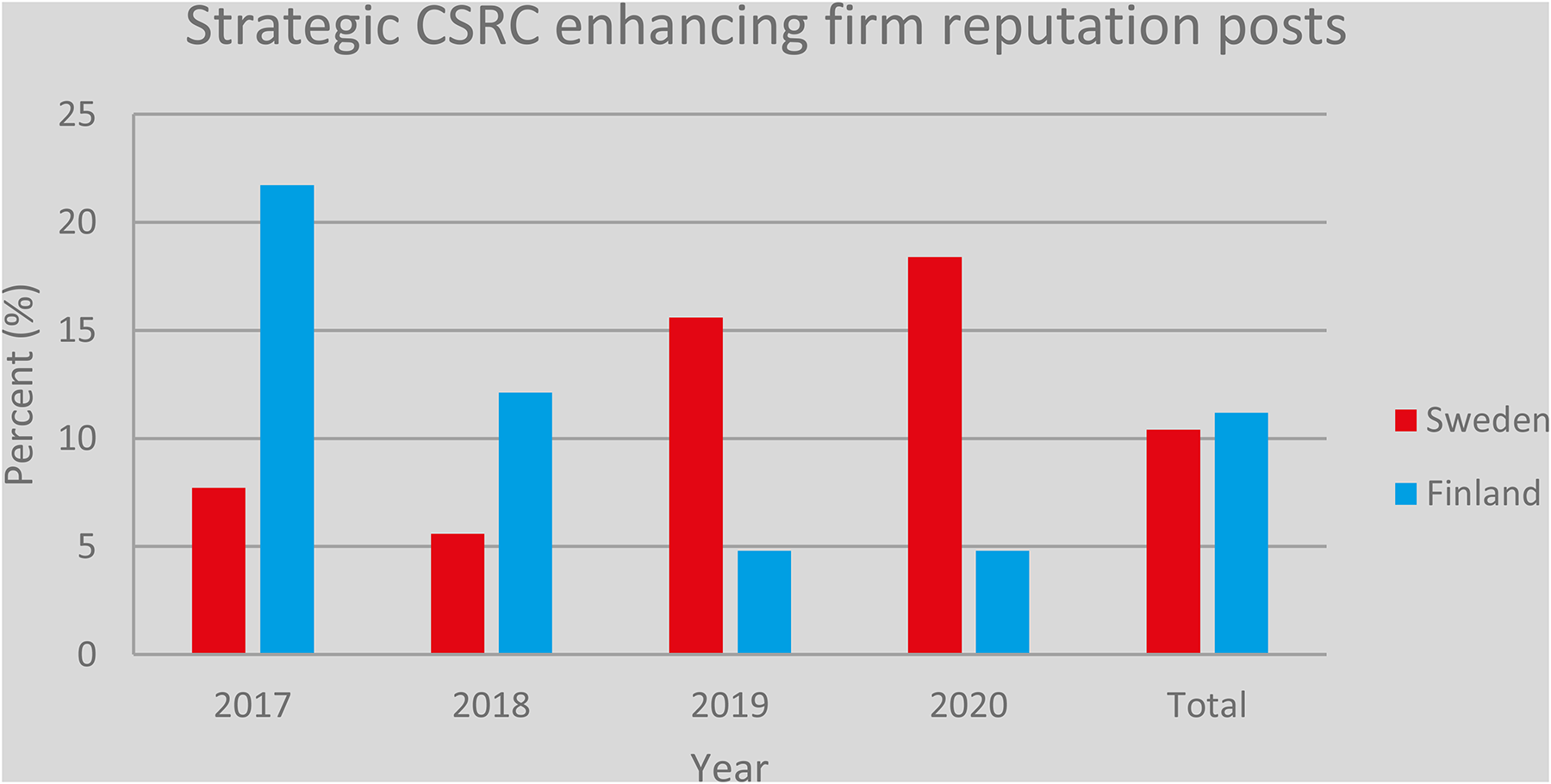
Share (%) of posts enhancing firm reputation in the sample month of March in Finnish and Swedish materials.
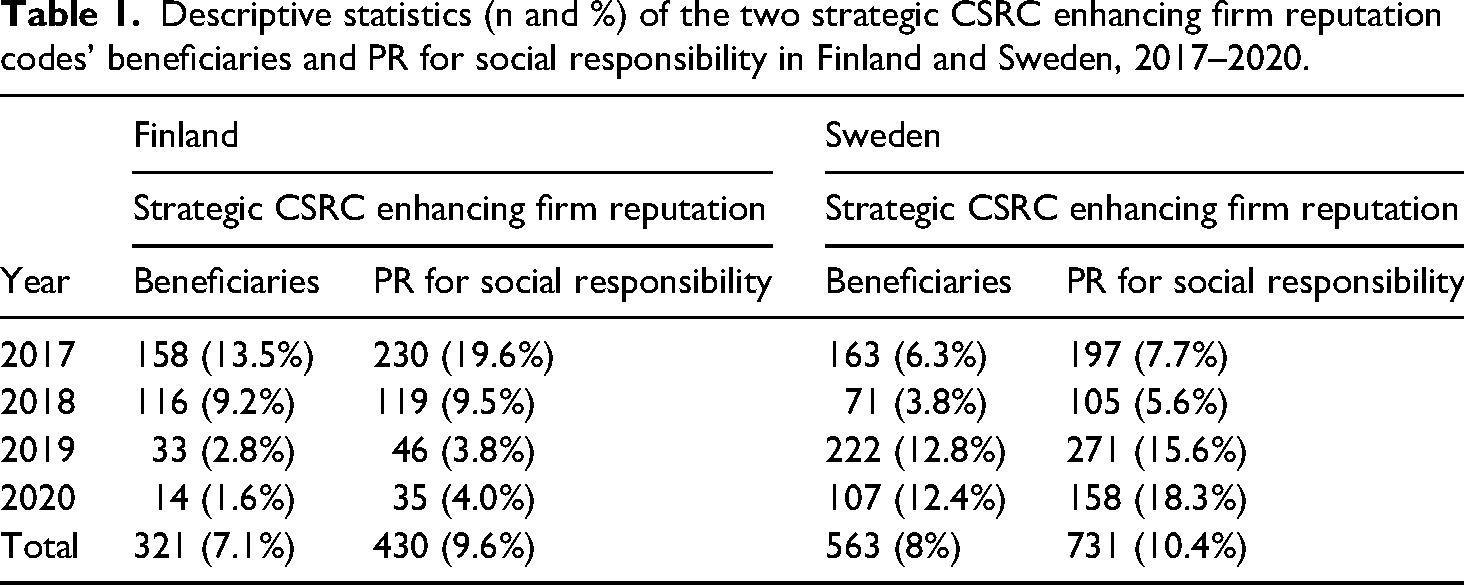
Table 1 shows the prevalence of codes which were included in the content category of strategic CSRC enhancing firm reputation (beneficiaries and PR for social responsibility). A decrease is noticeable in both codes in the Finnish dataset: messages on beneficiaries decreased from 13.5% of all CSRC data in 2017 to only 1.6% in 2020. Content with PR for social responsibility decreased from 19.6% in 2017 to 4.0% in 2020. In 2017, for instance, a Veikkaus Twitter account used the hashtags #possibilities #for all of us to announce that the company had funded the Finnish Red Cross and a non-profit association that supports families with children. In March 2020, only 14 of the 883 postings involved this kind of pride and joy over corresponding societal contributions. The great decrease is explained by the public climate change following moral concerns with a state monopoly system that channels revenues to the public good. This change in the public climate has for example been observed by Lerkkanen and Marionneau (2019) pointing out a general increase in public interest regarding gambling problems and gambling revenues and a heightened awareness of the monopoly system's ethical problems.
Descriptive statistics (n and %) of the two strategic CSRC enhancing firm reputation codes’ beneficiaries and PR for social responsibility in Finland and Sweden, 2017–2020.
The moral dilemma of encouraging people to gamble and marketing Veikkaus as a societal benefactor has invited plenty of attention in recent years (Lerkkanen, 2019; Tuorila, 2019); it has appeared in interviews with citizens (Egerer et al., 2018a; Egerer et al., 2019) and has been scrutinised by experts in the press and scientific publications (Egerer et al., 2018b; Kankainen et al., 2021; Marionneau and Hellman, 2020). The contradictory values are seen to threaten the validity of the system (Kankainen et al., 2021; Marionneau and Lähteenmaa, 2020; Selin et al., 2019a, 2019b) and has shown to hit the most marginalised and vulnerable groups the most (Hellman and Alanko, 2021; Selin et al., 2018; Sulkunen et al., 2018). The public attention has led to Veikkaus becoming the elephant in the room – a situation that can no longer be overlooked. Authorities and politicians have reformed the Lotteries Act to impose on Veikkaus more controls and demands on responsibility. In addition, a recently published gambling policy programme aims to decrease gambling harms and includes new measures on, for example, channelling gambling provision in a uniform manner in the future instead of current direct money transfers to beneficiaries (Finnish Government, 2022). The datasets from 2017–2020 are likely to reflect a situation in which the problematic aspects of the gambling system have become so established that Veikkaus would seem completely tone-deaf if it were to continue bragging about supporting beneficiaries and conducting socially responsible activities.
The Swedish data depicts a trend that is the reverse of the Finnish one: there is a rather steady rise in references to beneficiaries (6.3%) and PR for social responsibility (7.7%) from 2017 to the 2020 data, where 107 posts (12.4%) mentioned beneficiaries from gambling revenues and 158 referred to social responsibility work (18.3%). The increase may seem small, but it is significant considering the companies under study: most are commercial global gambling firms that have started communicating local socially responsible engagement in Sweden in Swedish. For example, in March 2020 Unibet announced giving prizes to private persons and organisations engaging in social projects; the online casino company Rizk casino congratulated all women in Sweden on the international women's day; and Casinostugan posted a picture of two odd socks on the World Down Syndrome Day, urging people to ‘rock the socks’ (i.e., wear different colour socks). Such PR stunts present the companies as a part of a general Sweden-specific culture of societal philanthropy.
In the new licensing system, the global gambling industry is putting down roots in the Swedish society, seeking to normalise and legitimise itself and its products. This sociocultural process of normalising the gambling industry that accompanies the introduction of a gambling licence system is something on which we have not been able to find any previous empirical research.
Strategic CSRC stakeholder reciprocation refers in the definition by Vishwanathan et al. (2020) to action benefitting and involving at least one stakeholder group. In our operationalisation of CSRC, it entails social media content that pulls other social institutions and actors into its image realm while spreading awareness of their brand and activities. We operationalised this feature in a broad sense by summarising characteristics of the posts that integrate and communicate with other societal actors and depict the gambling operators as responsible social actors: emotional appeal, external agents, events, hashtags (#), @ tags and reposts/retweets (as explained and exemplified in Figure 1).
Figure 4 presents the category of strategic CSRC stakeholder reciprocation content for both countries. It is slightly more frequent in the Finnish datasets (98.5% overall, in comparison to 98.0% in the Swedish data), which gives diminutive support to H3 that there is more content pertaining to stakeholder reciprocation in the Finnish data. Together with the higher prevalence in the strategic CSRC enhancing of firm reputation content, it also supports the hypothesis (H2) of strategic CSRC being overall more prevalent in the state monopoly's communication to the public. The differences are marginal between Finland and Sweden in 2017, 2018 and 2019. However, in 2020, there was a larger discrepancy, with more activity by Veikkaus than on the Swedish accounts. We suspect that this is a sign of the state monopoly compensating its decreased emphasis on the benefactor role.
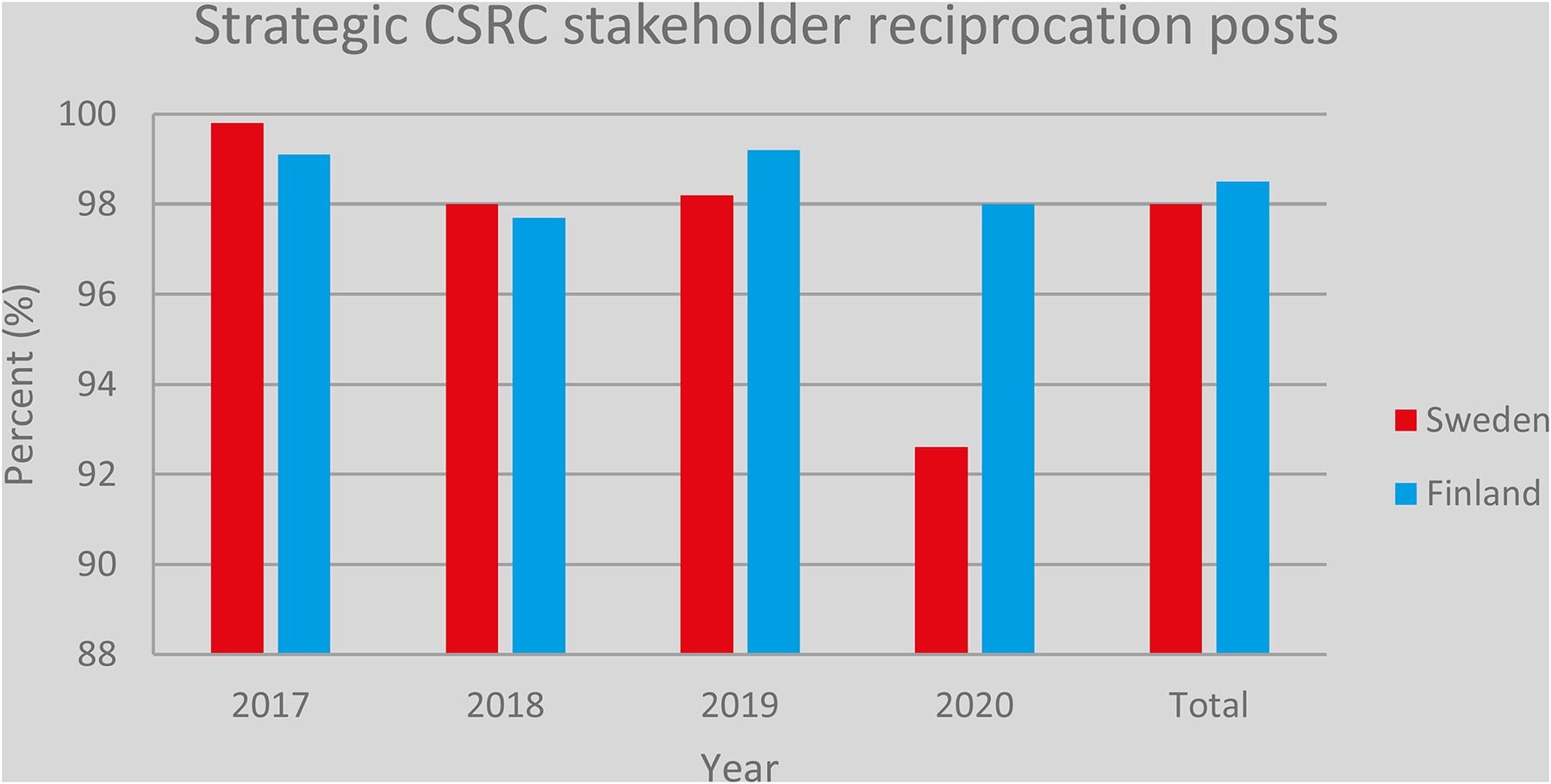
Share (%) of posts that included strategic CSRC stakeholder reciprocation messages in the sample month of March in Finnish and Swedish materials.
Overall, and in comparison to the business reputation categories of tactical CSRC and strategic CSRC enhancing firm reputation, it is harder to explain the trends in CSRC stakeholder reciprocation. This is because the codes stand for several other communication-based functions, some of them basic generic features in social media postings (e.g., tagging, hashtags). Still, the gathered prevalence of the six codes congregated into this category can be regarded as some sort of measurement of the level to which the companies are reaching out and involving other brands and social actors in the communication of the studied social media accounts. A closer inspection of the places, people and organisations that the operators plug into their posts could clarify the cultural and social everyday space that the gambling business is trying to associate with and be part of.
Breaking down the prevalence of separate codes in the category of strategic CSRC stakeholder reciprocation in the Swedish dataset shows that most codes are less prevalent, both in frequency and the share of all posts, particularly between 2019 and 2020. Posts tagged for emotional content are the exception; their frequency increases until 2019–2020. A plausible explanation to the decline between 2019 and 2020 may be the COVID-19 pandemic and the subsequent restrictions, which affected the number of public events, and thus fewer hashtags (#) and at signs (@).
Most separate codes included in strategic CSRC stakeholder reciprocation are also less prevalent in the Finnish material, both in frequency and the share of all posts, particularly between 2019 and 2020. The exception in this general trend in the Finnish material is the prevalence of hashtags (#). The number of these posts is broadly at the same level but increased in terms of percentage in 2020. Here, the consequences of the pandemic might be compensated for by awareness of gambling-related harm, especially after Veikkaus closed its large network of Electronic Gambling Machines (EGM) at the beginning of the pandemic between March and July 2020.
The decline in the prevalence of posts tagged for events and at signs (@) is likely to be a result of the corona pandemic-related restrictions. One can additionally speculate that the more frequent use of hashtags (#) in the Finnish material is down to Veikkaus using its social media platforms to compensate for losing its previous public visibility in everyday Finnish contexts due to the shutdown of EMGs. The company also assumed a societal role in posting about the effects of the pandemic for sport clubs or discussing how restrictions increased loneliness.
Discussion
The content of social media-based CSRC tells its own story about the aspirations of the global gambling industry to blend into national markets. We have focused on two kinds of CSRC: A rather mechanical corporate social responsibility communication that is required by regulatory and legal circumstances (tactical CSRC, known as Responsible Gambling, RG), on the one hand, and a communication that comprises a corporate image creation enhancing the company's social status, on the other hand (strategic CSRC). By operationalising these functions in large data sets from two regulation contexts, we have been able to unfold social media sites as spaces where the companies live up to national RG requirements, polish their façade and take certain roles in the society of which they are part. The analyses of extensive datasets from the two systems of regulations have helped us to unfold developments in the global and national gambling industry's communication with the public.
As Sweden's gambling market was transformed into a license-based market, the gambling operators active in the preceding market model (a mix of offshore and state monopoly) could, to a larger extent, openly and fully represent (global) business interests, ensuring that their tactics live up to the Swedish RG requirements. Thus, we expected a rise in tactical CSRC in the Swedish material from the year of 2019 and forward (H1). Presuming that a state monopoly justified by public health is less reliant on tactical CSRC content as it has a certain starting point of assumed responsible conduct, we expected a less proportion of this content in the Finnish material. Instead, we assumed that Veikkaus in Finland would need to continuously reproduce their image of corporate responsibility through more advanced strategic CSRC enhancing firm reputation (H2). We also expected to find more content in the dimension of strategic CSRC regarding stakeholder reciprocation in the Finnish data, as the main PR task for a state monopoly is to justify themselves as important, respected and responsible societal actors (H3). Overall, in line with our operationalisation of the phenomena under study we found strong support for H1, no support for H2 and some support for H3. Our study thus indicates that a certain combination of tactical and strategic CSRC can be expected in the communication targeted at the public by a state-owned, health-justified monopoly. The new licensing system in Sweden, on its part, involves the companies in more mechanical and tactical CSRC in the format of routine RG messages. More sociocultural strategic CSRC seems to serve primarily the corporate ambitions to assimilate into national contexts as societal benefactors.
The content of the studied social media accounts reflects the fact that Swedish licence companies raison d’être does not depend on a public agreement on their role as a socially responsible institution. In the Swedish material, tactical CSRC increased most noticeably between 2019 and 2020, most likely because global offshore corporations must live up to legal requirements to communicate responsible conduct. ‘The talk’ just needs to communicate the level of ‘walk’ that is in concord with the jurisdiction's requirements (see Schoeneborn et al., 2020). We explain the delay of the rise to the year 2020 by the social media not being necessarily the first place to implement new RG requirements and by the pressures that the Swedish Consumer Agency put on the companies in an investigative report pointing out flaws in the RG communication. In the Finnish material, the prevalence of RG content remained stable at around 10% throughout. The state-owned monopoly does not seem to have a need for tactical CSRC or for going an extra mile for routine RG ‘talk’ on social media.
Strategic CSRC content is not regulated by law and thus reflects the companies’ own aims to create a good public image over time. We argue that the primary reasons for this are commercial, and for the vice industry in particular a way to legitimise themselves in a national context; to whitewash their products and controversial activities. The strategic CSRC content is more sensitive to national sociocultural codes of doing good and seems more sensitive to the public opinion. Our findings show that posts containing our operationalisation of strategic CSRC with content enhancing firm reputation grew less frequent over time in the Finnish material, whereas the proportion increased in the Swedish dataset. The decline in the Finnish material is likely to stem from a great shift in the public debate, where the mission of Veikkaus to encourage people to gamble as a societal good has been heavily criticised. The increase in the Swedish material coincides with the reregulation of the Swedish gambling market (2019). This suggests that when a market is transformed into a license-based market, both previously illegal but now legal offshore companies and former monopoly-based gambling operators recognise the need to enhance their image as promoters of the public good.
To summarise, the social media speaker position of the gambling companies seems more aligned with the companies’ commercial interests in the license-based system; RG appears as a mandatory enforced ‘extra’. The Finnish monopoly company posted more content that largely seeks to strengthen its image as a sustainable responsible social actor. With the position of a responsible state monopoly comes sensitivity to public critique, which has led Veikkaus to decrease its communication in the area of beneficiaries, emotional appeal and PR on its social activities. It is no longer kosher for the company to emphasise this role; the political and cultural climate has shifted. In Sweden, the new license-based system has provided the global industry social media-based entry points to become part of a legal business and to melt into the cultural and legal codes of Swedish society. The RG content has increased as a result of requirements of the new regime.
Strengths and limitations
The study has some theoretical and empirical limitations. Creating our own operationalisation of tactical and strategic CSRC, we acknowledge that we are painting with a very broad paint brush. The study involves only observational data of social media activities. A more in-depth analysis could put flesh on the bones regarding how the gambling industry establishes networks and becomes part of societies with the help of social media platforms. An obvious empirical limitation is the choice of sampling only one month from each year. Another obvious weakness pertains to data-related validity in that the study captures only curated posts – although this can also be argued to strengthen its value by representing the official (thought-through) image constructs of the companies under study. The COVID-19 pandemic is likely to have marked the nature and content of social media-based CSRC in 2020.
Conclusions
The relationship between gambling regulation regime and corporate image creation can be discerned in CSRC content on the social media. Through a unique research design, this study has addressed the question of how social media-based CSRC image building by a global ‘vice’ industry can be seen to vary in national contexts and how legal frameworks affect companies’ PR efforts. The study shows that the walk (doing good) is the talk (talking about being good): The regulation of gambling operators includes ways in which they should communicate responsibility and it affects directly how they address consumers and present their business as an integrated part of the society. For state monopolies, the benefactor role and an enhancement of reliability and accountability are important, because the justifications for limiting market competition depend on a public support for them securing these aspects. Global companies with national licences need to conform and become part of the national cultural and legal contexts by associating with social events and actors and by complying with RG-legislation. Insight into how messages of tactical and strategic corporate responsibility are adjusted for gambling regulation systems holds great value for the many European jurisdictions that are facing challenges in regulating the gambling industry. Furthermore, our operationalisation model can serve as a basis for European comparisons in CSR communication also in other business sectors.
Footnotes
Acknowledgements
We thank Emmi Kauppila and Stella Wahlström together with the author Robin Nilsson for gathering the material and for original coding of the data.
Funding
The author(s) disclosed receipt of the following financial support for the research, authorship and/or publication of this article: This work was supported by the Forskningsrådet om Hälsa, Arbetsliv och Välfärd, Finnish Ministry of Social Affairs and Health's Execution of the Lotteries Act (1047/2001) Section 52 research with the focus of gambling harms, Svenska Spel Research Council (grant number 2016-07091, 2017-0174, and Swedish Research Council for Health, Working Life and Welfare (Forte) under grant 2016-0017 and 2017-0174.
