



Abstract
Especially in times of (corona) crisis, the German press plays a crucial role in communicating Germany’s economic policy orientation, influencing how the crisis is communicated to the public. The issue of joint European debt has never been more visible than in these times, as has the threat of a new euro crisis—Italy in focus. This study explores the German media framing of coronavirus disease 2019 (COVID-19) using Italy as an example. Applying quantitative content analysis, the relative prevalence of frames rooted in competing economic policy paradigms (neoliberal/Keynesian) in press coverage from February to July 2020 is examined. The Keynesian paradigm dominates coverage. Using logit analysis, issue-specific neoliberal frames are identified as solution oriented, while Keynesian frames focus on evaluations. With Germany's policy shift regarding European joint debt and toward European greater fiscal integration, a paradigm shift is observable. Overall, findings demonstrate a relatively paradigmatic pluralistic reporting.
Keywords
Introduction
With the spread of the novel coronavirus in early 2020, only within a few months, the whole world was facing a global pandemic and responded with tough measures. Europe’s economy plunged into a deep crisis. With the suspension of the Maastricht criteria on March 20, 2020, months of struggle followed in the European Union (EU)—over joint financial aid, solidarity, and the future of the EU. A new crisis, the same narrative as in the euro crisis: the southern European countries, particularly Italy, France, and Spain, and the northern European countries, particularly Austria, the Netherlands, Denmark, Sweden, and later Finland—also called the “Frugal Four/Five”—were opposed to each other. The former argued for coronabonds and (non-repayable) grants, the latter for drawing on funds from the European Stability Mechanism (ESM) and for providing aid via (repayable) loans.
Although the Eurogroup reacted in early April and agreed on a joint rescue package with loans of over 540 billion euros, it was unable to resolve the conflict. With the Franco-German proposal on May 18, 2020, for a recovery fund consisting also of grants, then-German Chancellor Angela Merkel made a political U-turn by agreeing to joint debt, after having previously always rejected them. Subsequently, the fronts between the northern and southern European countries hardened. The “Frugal Five” presented a counter-proposal to disburse only loans and no grants. On May 27th, the EU Commission launched its 750 billion Next-Generation EU recovery fund, which also drew strong criticism from the “Frugal Five.”
The economic policy strategies of the European countries are fundamentally the result of the understanding of how markets work. In economics, supply and demand policies are two economic policy strategies that have become accepted as central paradigms (neoliberalism/Keynesianism). 1 The central question of how markets work can be answered in different ways: Is there a need for government intervention or does the market regulate itself? The orientation determines the preferred economic and fiscal policy, resulting in two counter-narratives that have been popularly used in research to characterize economic policy debates in European crises (e.g. Dullien and Guérot, 2012).
Neoliberalism has significantly shaped economic thinking, particularly in Western countries, driving mainly extensive privatization, deregulation, and the reduction of social services through a state regulatory framework (Krüger et al., 2021). Although German policy is considered more ordoliberal (Dullien and Guérot, 2012)—a school of thought rooted in neoliberalism that emphasizes austerity and compliance with European rules, while opposing (Keynesian) viewpoints urge more flexibility in European debt rules and reject austerity—this article draws on the views of several European countries, not merely Germany. Given the widespread prevalence of neoliberalism in politics, economics, and science across Europe, neoliberalism (and Keynesianism) may best describe the underlying economic policy worldviews in the European debates on COVID-19 aid programs. The paradigms are seen as strategic tools in the public legitimation of policies: The southern European countries persistently called for expansionary spending policies and therefore adopted more Keynesian strategies in the debates, while its counterparts—the northern European countries—opted for neoliberal views—austerity policies.
Scholars have shown that European economic policy journalism in crisis times has favored the neoliberal paradigm through austerity in its reporting (e.g. Mylonas, 2012). In Germany, economics, politics, and economic policy reporting are primarily shaped by the neoliberal paradigm, the so-called mainstream (Krüger et al., 2021).
Economic policy paradigms become visible in public discourse through frames. The mass media must select specific information to communicate about a topic and rarely adopt exactly the information provided, but processes and modifies the information, for example, based on news values or by constructing (media) frames. Thereby, it actively participates in the interpretation and thus also influences political discussions.
The present study explores how the European economic policy discourse 2 on European COVID-19 aid programs is reported in daily newspapers and magazines, using Italy as an example. Italy is considered to represent the more indebted EU countries, which, unlike the northern European countries, did not emerge stronger from the 2008/2009 financial crisis. Following the 2018 sovereign debt crisis and the escalated budget dispute with the European Commission over higher debt than permitted by the Stability and Growth Pact (SGP), Italy has repeatedly and vociferously called for greater debt flexibility and a joint European debt (Schneider and Syrovatka, 2020). Considering joint European debt, Germany plays a key role as the strongest economy in the EU and therefore faces the highest liability risk. Analyzing German media is thus particularly relevant as Germany's sudden U-turn regarding joint debt was crucial for the EU recovery fund.
Media framing and performance requirements
Framing has been particularly useful for understanding how the media construct different realities (Gamson and Modigliani, 1989).
The research on frames in communication studies was mainly shaped by Entman (1993): To frame is to select some aspects of a perceived reality and make them more salient in a communicating text, in such a way as to promote a particular problem definition, causal interpretation, moral evaluation, and/or treatment recommendation for the item described. (Entman, 1993: 52)
Framing focuses on selection and salience for frames: framing primarily means emphasizing certain aspects of a topic and neglecting or omitting others. The selected aspects are thus considered important by the recipient—the more frequently the recipient is confronted with them, the more important they become and the more strongly they shape his/her interpretation of a topic (Matthes, 2014: 67). Through the process of selection and salience, the press favors certain perspectives and actors in its reporting. Thus, it conveys certain interpretations of an issue both passively (e.g. by selecting certain actors to comment on an issue in the press) and actively (e.g. by selecting one-sided perspectives; Matthes, 2014). 3
According to this definition, frames consist of different frame elements:
The problem definition is at the center of a frame and defines the topic and the relevant actors (negative or positive). The causal interpretation is understood to mean cause(s) traced back to a situation or relevant actor. The moral evaluation refers to evaluations of the named responsible actor and/or the actions taken by the responsible actor. The evaluation facilitates the contextualization of the problem(s) and cause(s). The treatment recommendation suggests solutions and/or concrete policy options to solve the problem or to maintain the situation if the central frame aspect has been defined positively.
Ideally, the individual frame elements can be linked to form a logically consistent horizon of meaning. Media frames can thus be understood as patterns of statements that repeatedly occur together in journalistic contributions and can influence the interpretation and thus the opinion of recipients (Matthes, 2014).
Discourses are conducted via frames. Frames serve—by not only expressing the problem (situation definition) but also suggesting what is right and desirable—to guide action. Especially in the case of political issues, multiple and conflicting aspects exist. Through frames, different perspectives can be systematically considered and holistically grasped. Thus, the press can exert political influence on public opinion by framing (Entman, 2003).
In Germany, the press is of great importance for obtaining information for citizens: In 2021, German newspapers reach 38.6 million people (ma Pressemedien, 2022). The press observes political and economic events, processes this information, and makes it available to the population. The performance requirements placed on the press are based on the Constitution of the Federal Republic of Germany (Article 5), which in turn are specified in the state press laws of the Länder.
Thus, the press is obliged to report in a balanced manner. Different opinions should be presented in a balanced manner. According to Entman (2003), balance also refers to frame parity. This means that the mass media should report on two (or more) interpretations roughly equally and should therefore provide at least one counter-frame, a complete alternative narrative of problem, cause, evaluation, and solution, to the dominant frame. Conversely, one-sidedness can influence the formation of citizens’ opinions (Entman, 2003: 418). In addition to the requirement for balanced coverage, reporting should also be pluralistic, which derives from the democratic role of journalism (Harjuniemi, 2021: 3): Specifically, the media should promote fundamentally different worldviews to promote a pluralistic democracy. This means that journalism should discuss economic issues based on different views rather than declaring particular ideas or paradigms beyond contestation. Kay and Salter (2014) argue that crises offer the media—in providing space for democratic debates—an opportunity to provide critical analysis of the status quo.
Another requirement imposed on the mass media refers to analytical quality, which addresses the contextualization of events in the press. Entman’s framing concept can provide information about how sound reporting is: whether the media tend to communicate via complex frames including different information or frames that only focus on one or two aspects and thus tend to focus on individual actors/events (Stark et al., 2021: 433).
In this way, the (framing of) mass media exert a strong influence on the formation of citizens’ (political) opinions, particularly in crisis times, such as the COVID-19 pandemic (e.g. Bendau et al., 2020).
Research overview
Media framing has been a significant research subject during the past years. Prior research generally confirms the crucial role that the mass media play in conveying information during economic policy crises. The mass media form the space in which different problem definitions and interpretations are presented, provide justifications for chosen policies, and shape public perceptions of the crisis (e.g. Basu, 2019; Ojala and Harjuniemi, 2016).
Current international studies on media framing during the COVID-19 pandemic primarily examine the frames prevailing throughout coverage (generic frames). Of these, some studies also identify economic policy frames, but do not elaborate on economic policy reporting (e.g. Bhatti et al., 2022; Hubner, 2021). Here, the focus is on media framing of economic crises, especially in the EU/eurozone.
Kay and Salter (2014) analyze the BBC's online coverage of the British government's Comprehensive Spending Review 2010. The authors find that BBC helped to maintain and legitimize the dominant economic policy paradigm of neoliberalism during economically difficult times. Cuts to public spending and necessary investments were the dominant media narrative. The authors criticize the lack of paradigmatic plurality in such difficult times and that neoliberalism as an economic policy strategy was covered as being beyond political contestation (Kay and Salter, 2014: 769). Basu (2019) also examines British coverage of the economic crisis from 2008 onwards and corroborates that the austerity narrative was prevalent in framing the crisis, which she argues is evidence of a poorly diverse coverage.
Some (international) studies focus on economic policy framing of the German press, confirming Germany's key role in the EU and its (neoliberal, ordoliberal) economic policy influence during European economic crises, and are therefore particularly relevant for this study:
Wallaschek (2020) compares press coverage in Germany and Ireland during the euro crisis from 2010 to 2015. Through political claims analysis, he shows that the German press primarily referred to austerity and linked it to solidarity in framing the crisis, while Irish coverage concentrated on responsibility and solidarity. The study extrapolates Germany’s central position within the eurozone from the dominant coverage of German actors in both countries. Ojala and Harjuniemi (2016) come to a similar conclusion regarding Germany’s role in the EU. Analyzing press coverage in eight eurozone member states during the 2010–2012 eurozone crisis, the authors show that Germany’s ordoliberal framing—centered on new fiscal rules, austerity, and structural reforms—dominated European policy-making. The authors stress that the German narrative focused on problematizing public debt, lack of fiscal discipline, and loss of competitiveness as reasons for the crisis. Teschendorf and Otto (2022) also extrapolate from their study of German media framing of the Italian sovereign debt crisis that the neoliberal paradigm in the form of austerity demands has dominated the German quality and tabloid press. Italian actors and their perspective of taking on more sovereign debt to stimulate the economy through policies were negatively evaluated. According to the authors, the press failed to present the issue in a (paradigmatically) pluralistic and balanced manner.
The research overview shows that previous studies on media framing confirm that not only powerful media within a state but also that particularly German media helped to normalize neoliberal viewpoints during European economic crises. It is broad consensus that Germany, respectively, the German media, is seen as a key initiator and enabler of (austerity) policy measures during European crises (Ojala and Harjuniemi, 2016) and that in their view, (Keynesian) crisis interpretations in terms of a lack of aggregate demand in the economy and all ideas of sovereign debt are seen as particularly damaging (Matthijs and McNamara, 2015: 242). The German media have therefore often failed to provide a paradigmatic pluralistic portrayal of crisis interpretations.
Examining the German media’s framing of economic policy at an early stage of the COVID-19 pandemic is significant as the EU took significant steps toward greater fiscal integration during these months in response to the economic impact of the pandemic—which was almost exactly the opposite way the EU dealt with the eurozone crisis (Matthijs and McNamara, 2015). A media analysis of this controversy raises potentially important questions regarding the German media’s role as driver and legitimator of these rapid shifts and therefore also raises the question of a possible paradigm shift in Germany's economic policy reporting.
The study chooses Italy as the keyword since this allows the multilayered conflict at the European level to be adequately portrayed in the media. Italy is one of the main actors in these political debates (one main proponent of eurobonds), having the highest public debt ratio after Greece and thus carries the risk of a euro crisis and an associated domino effect on other countries. No other keyword in combination with German media reflects the conflict between south and north so comprehensive, objectively, and from different perspectives.
Research questions
The study aims to analyze German press coverage of the European discourse on COVID-19 aid programs in 2020 by examining the articles in German national dailies/magazine. This article opts for a series of analytical subquestions:
Does an economic policy paradigm dominate the German coverage of the European discourse on the COVID-19 aid programs? How is the European discourse on COVID-19 aid programs framed in the German quality and tabloid press? Can a paradigm shift be identified in times of crisis?
Research design
The investigation period runs from February 15 to July 31, 2020, thus deliberately targeting coverage of all discussions on European COVID-19 aid programs up to the historic EU summit at the end of July. The objects of investigation are journalistic articles of the national dailies “Frankfurter Allgemeine Zeitung,” “Handelsblatt,” “Süddeutsche Zeitung,” “die Welt,” “tageszeitung,” “BILD,” and the magazine “Spiegel.” This selection is based on positioning in the political right–left spectrum and on the representation of different media types (tabloid/quality newspapers).
The articles are accessed via online databases or archives and collected using the search term “Italy” (full coverage survey). After independently reviewing all articles, 623 articles could be identified as a database.
Quantitative content analysis is used as the method of analysis. There are two approaches to identify frames: deductive (adopting frames from previous research) or inductive (identifying frames from the research material). This study chooses a deductive–inductive approach: first, the root categories (frame elements) are adopted from Entman, before the concrete variables within the root categories, each from a Keynesian and neoliberal perspective, are inductively generated from 15% of the articles. Neoliberal and Keynesian framing is thus understood as the use of popularized paradigmatic ideas in public discourse to construct a simple but realistic crisis portrayal that includes problems, causal interpretations, evaluations, and solutions. The characteristics to be analysed are recorded in a category system. Generally, a range of Keynesian and neoliberal perspectives can be identified as frame elements in the articles examined (see codebook for detailed information).
Coding is carried out by six trained coders using the predefined codebook. After some coding training, two pilot coding tests are performed with a time lag. The second pilot coding test with 32 identical articles reveals an acceptable average Krippendorff's alpha inter-coder reliability coefficient of 0.724 (Krippendorff, 2018).
The longitudinal study design allows for recording the development of the thematization processes over time. First, the frequencies of the concrete variables within the respective frame elements are considered in relation to each other using cross-tabulations. Second, all frame element variables are simultaneously included in the analysis and statistically tested using multivariate logistic regression (logit model).
From a statistical perspective and given that media frames are understood as specific, distinctive patterns of a text consisting of several selectively chosen elements, the goal is to uncover superrandom (significant) correlations of a problem variable with different variables for causal interpretation, evaluation, and treatment recommendation (predictor variables). The method used does not suggest that certain frame elements trigger the appearance of the problem (causality)—rather, it “proves” an occurrence of certain frame elements with each other and the problem. If there is such a significant effect of predictor variables on the “probability of occurrence” of a certain problem, they are consequently interpreted not as its cause, but as a typical pattern of the frame in question (cf. Marcinkowski, 1999). Thus, the (crucial) question can be answered by logit analysis: How strong is the correlation between the problem and its related elements? The answer provides insights into how the German media framed the European debates.
If the individual logit models show statistically significant, positive coefficients of the respective variables, this entirety of variables is interpreted as an issue-specific media frame. Not all frame elements must necessarily be present for a coherent frame (Matthes, 2014).
In research, there are several regression-based methods for the statistical analysis of media frames (for an overview: Matthes, 2007). This study uses a combined approach. Logit with the central frame element problem as dependent variable represents a suitable method, as it corresponds to the conceptual framework of frames and its process of coding. The starting point is not to directly code the complete frame, but its elements. The coding of the problem precedes the coding of all other frame elements (their specifications), that is, starting from the problem, coding continued. If no problem is addressed in an article, none of the other frame elements are coded. The major advantage, according to Matthes (2014), is that since the individual frame elements are easier to code than whole and relatively abstract frames, the intersubjective comprehensibility and objectivity increase. Therefore, logit is the most suitable statistical procedure to identify not article-bound media frames over time.
Results
Descriptive results
Of the 623 articles examined, articles with Keynesian problem perspectives dominate each month. Almost 74% of all articles deal with Keynesian problem definitions, while only about 36% (also) convey neoliberal problem definitions (multiple answers possible).
Problem definitions
A total of eight problem definitions are examined. The color-coded graphs in the following figure represent the contrasting views (neoliberal/Keynesian) on a given topic (Figure 1).
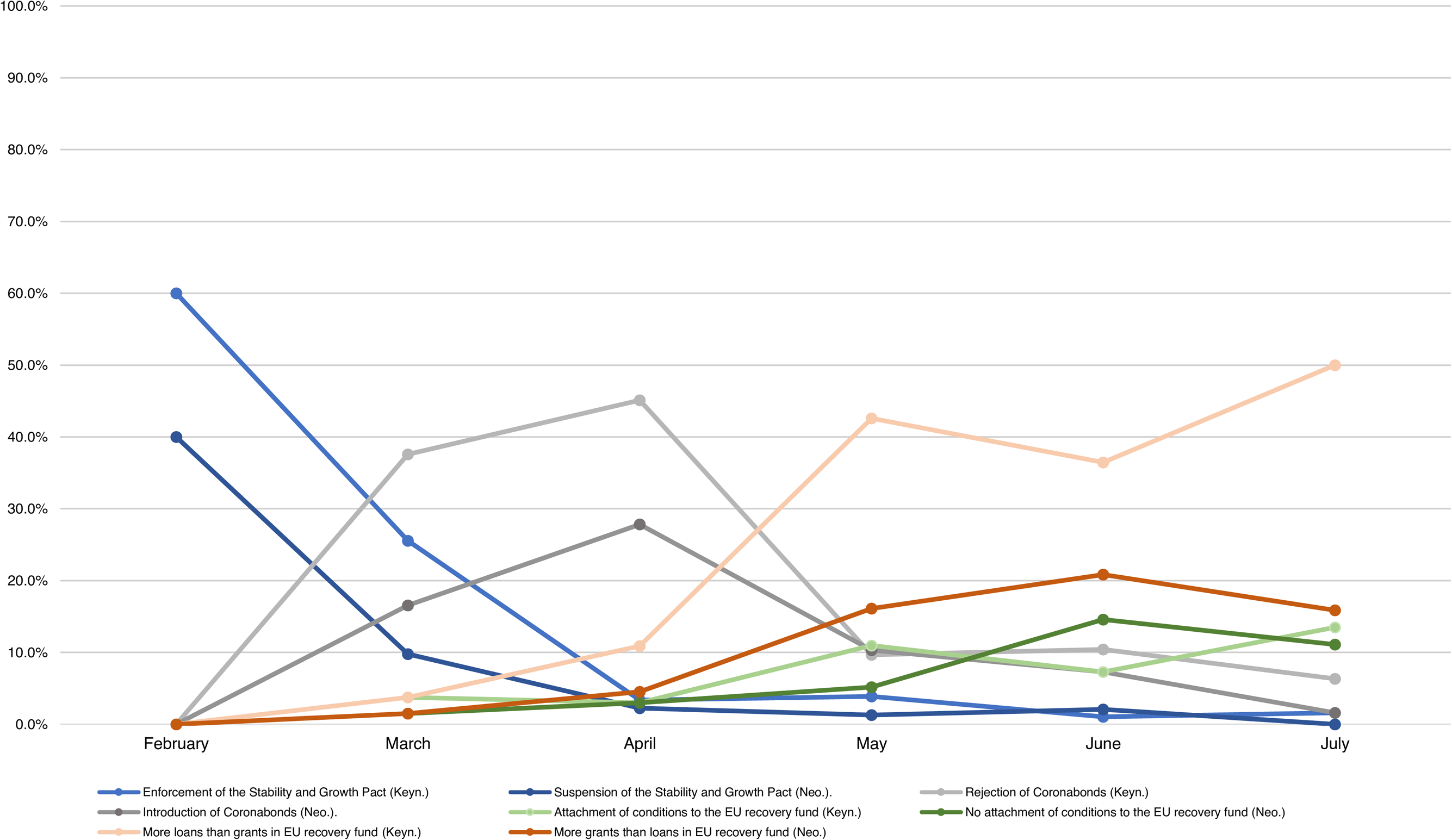
Frequency of neoliberal and Keynesian problem definitions in the print media in 2020 (by month, in percent, n = 623).
Three topics dominate the German coverage: the SGP, coronabonds, and the recovery fund. The SGP problems are addressed in 12.5% of all articles, the coronabond problem definitions in 48%, the “attachment of conditions” in 15.4%, and “the grants versus loans” in 42.2%. The share of articles with Keynesian views dominates in all problem definitions.
In February, only the SGP problems are reported. After the Economic and Financial Affairs Council decided on March 23rd to allow deviations from the Maastricht criteria, media attention drops sharply. Both problem definitions around the coronabonds reach their absolute thematic peaks in April. With Germany's policy shift in mid-April/early May and the Merkel–Macron proposal to provide a recovery fund in the form of grants, reporting focuses on the question of the ratio between non-repayable grants and loans—especially when the EU Commission presented its recovery plan on May 27th. Finally, following the EU summit of July 17th–21st, the EU Commission adopted the 750-billion-euro recovery fund under its 2021–2027 multi-year financial framework of 1.8 trillion euros. The comparatively high level of media attention for neoliberal perspectives from April onward can be interpreted as reactions of the neoliberal camp to Merkel’s political change: the press frequently cites leading neoliberal economists from Germany and other countries such as Austria, who, for example, stood alongside Germany in defending European austerity during the Greek debt crisis, and called for more loans to be paid as grants.
Causal interpretation
Keynesian causes, referring to the Keynesian-aligned countries quickly wanting to introduce joint debt/grants, citing reasons such as the need for aid to particularly hard-hit countries, are discussed in about 70% of all articles. Neoliberal reasons aimed at preventing joint debt are cited only in 36.6%.
Different actors are held responsible for the problems by the press. Primarily Germany (35%), the “Frugal Four/Five” (35%), Italy (21%), and France (9%) are attributed responsibility for the problems.
Moral evaluation
Overall, evaluations introduced by articles with both perspectives are mentioned in 64.7% of all articles, including Europe's generally poor macroeconomic situation and Germany’s change in policy. In just under 34%, these evaluations are made exclusively from a Keynesian perspective, such as the accusation that the “Frugal Four/Five” lack solidarity, and in about 17% neoliberal evaluations, such as the negative impact of the recovery fund. The data suggest that both “conflict sides” often evaluated the opposing position and/or events in the same way, such as the lack/necessity of solidarity, but that their views, based on their economic thinking, of why there is lacking solidarity and how to achieve it differed.
Treatment recommendation
In 71.3% of all articles, solutions are presented from Keynesian media perspectives, in only 37.7% neoliberal solutions are mentioned. Here, solutions refer to the allocation of loans, reduction of grants, and a conditional recovery fund. The Keynesian perspective mainly refers to a joint European recovery fund, the allocation of grants, and the acceptance of joint debt. When it comes to specific policy options, the ratio is more balanced: 54.1% mention Keynesian policy options such as coronabonds and granting of 250 billion euros in low-interest loans (lower amount demanded by the opposing position), and 36.8% neoliberal policy options such as a recovery fund linked to structural reforms, the EU financial package of 540 billion euros and the time limit on aid.
Framing of COVID-19 in German media—A logit regression analysis
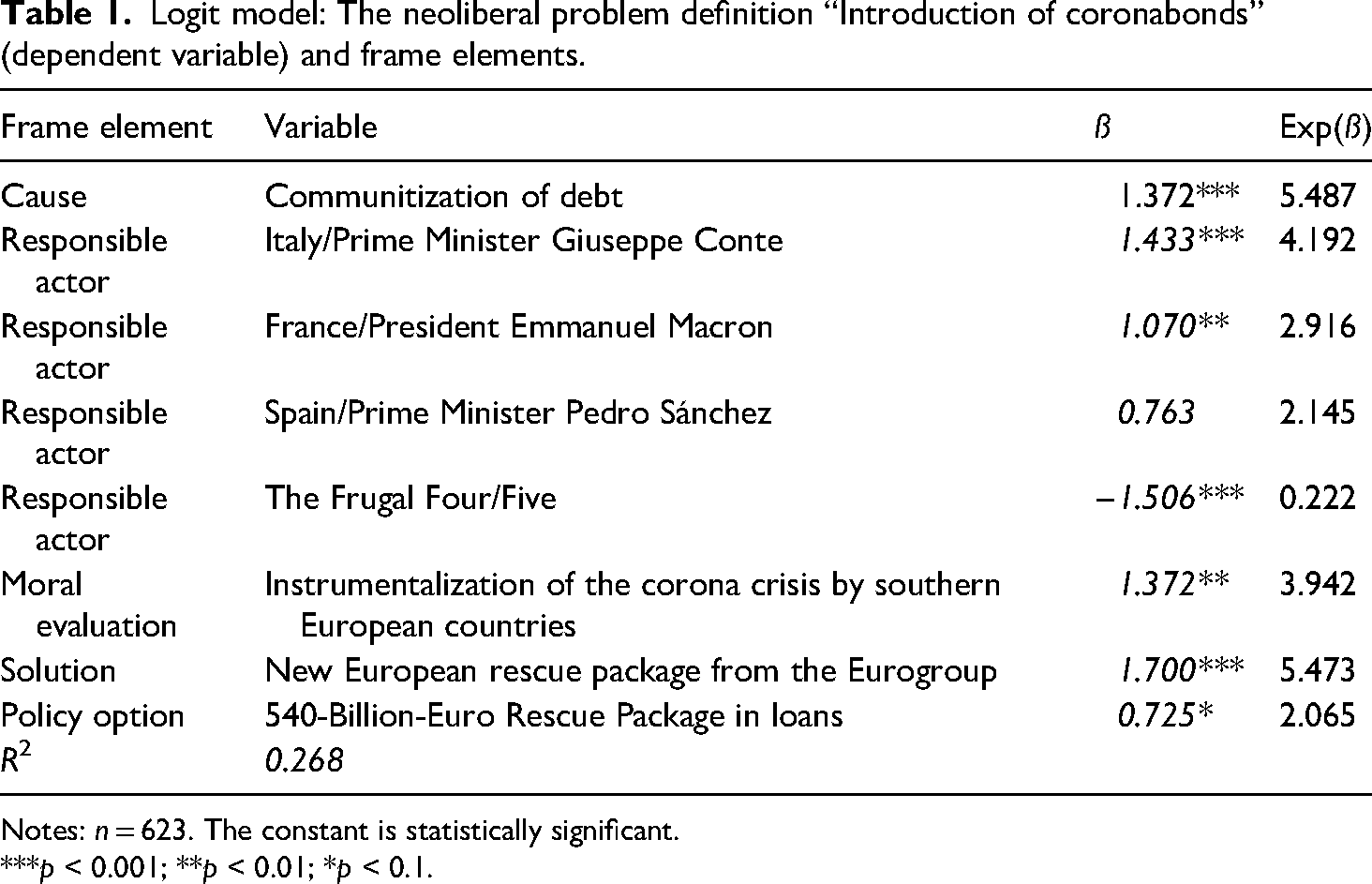
In the following, the results of the frame analysis for both paradigms are presented. For this purpose, a distinction was made between the neoliberal and Keynesian problems. The individual problem definitions represent the dependent variable in each model. Of the eight problem definitions considered, the four most relevant are selected due to the low thematization frequencies: introduction versus rejection of coronabonds and loans versus grants (recovery fund). Issue-specific frames in reporting are interpreted here as the entirety of all highly or very significant elements. The significant, positively correlated predictor variables are part of the media frame and highlighted in green in the following tables 4 (Table 1).
Logit model: The neoliberal problem definition “Introduction of coronabonds” (dependent variable) and frame elements.
Notes: n = 623. The constant is statistically significant.
***p < 0.001; **p < 0.01; *p < 0.1.
The reason for the rejection of coronabonds relates to the fear of countries with high credit ratings and lower debt ratios, which are also the major net contributors to the EU budget, that would be liable for the debts of countries with low credit ratings and high overall debt. The press frequently cites actors such as Austrian Chancellor Kurz, who spoke of a “debt union through the back door.” 5 The press sees Italy and France as responsible actors due to their strong commitment to the bonds. As Europe’s second and third largest economies with the highest public debt ratios (2020: Italy 155.8%, France 115.7%, Federal Statistical Office, 2021), they are the most present actors arguing for debt communitization. By contrast, Austria and, initially, Germany were strictly opposed to these bonds. From the neoliberal perspective, due to the urgency with which the corona crisis had to be combated, the southern European countries seemed to take advantage of the situation to introduce bonds. For this reason, in addition to using the ESM program, Eurogroup’s proposal for a new common rescue package is seen as a sensible option in the press. The proposal is already discussed in press reports in March, when the European finance ministers agreed on a concrete elaboration on April 9th and adopted the 540-billion-euro package on April 23rd (Table 2).
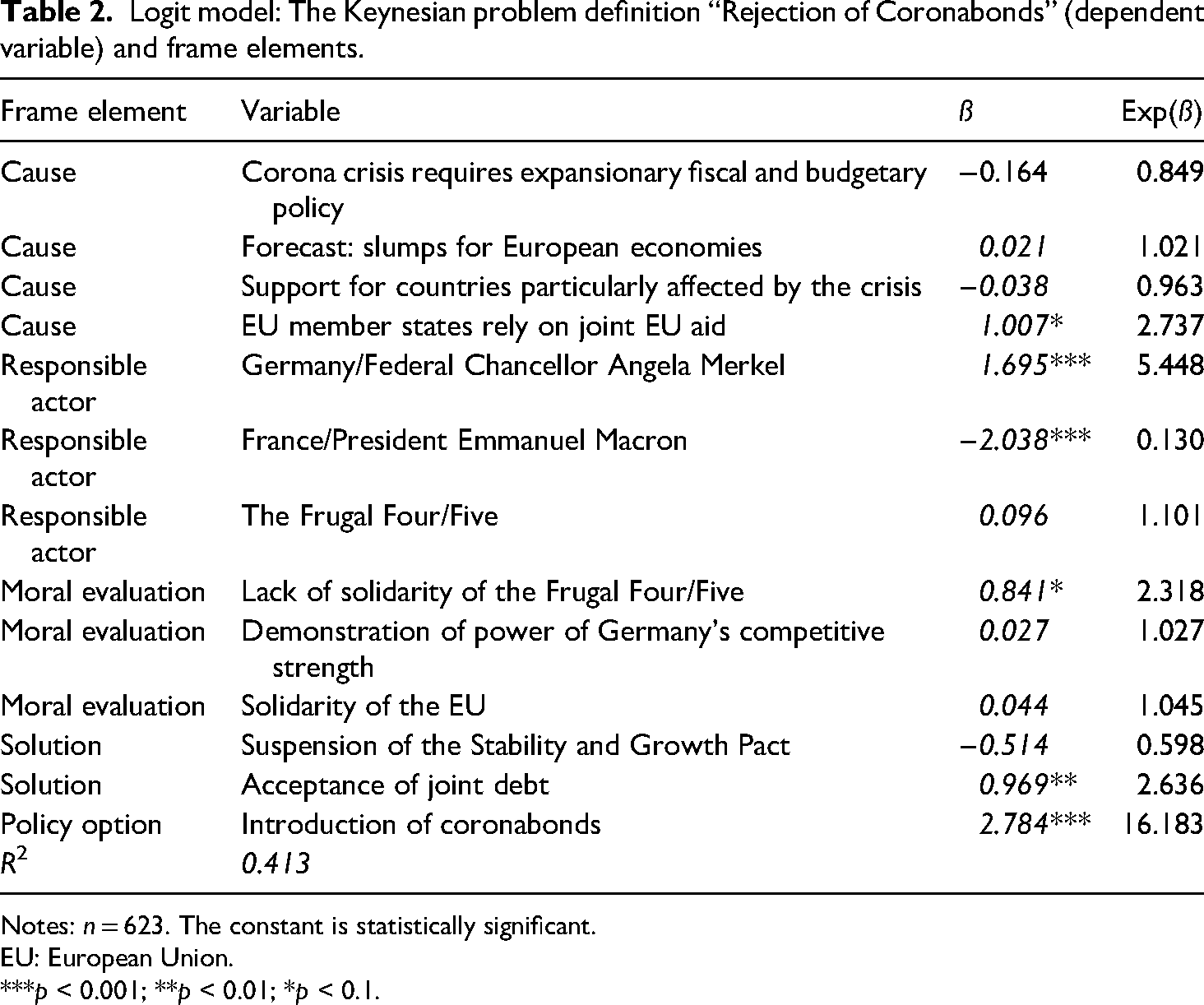
Logit model: The Keynesian problem definition “Rejection of Coronabonds” (dependent variable) and frame elements.
Notes: n = 623. The constant is statistically significant.
EU: European Union.
***p < 0.001; **p < 0.01; *p < 0.1.
The respective Keynesian problem definition—the rejection of coronabonds—is causally based on the assumption that the EU member states rely on joint EU aid. With the introduction of coronabonds, the EU borrows collectively and is collectively liable for them. In this way, Italy, Greece, and France could have borrowed money more cheaply on the financial market. Due to the massive economic downturns caused by COVID-19, precisely these countries helped to reignite the debate from the financial crisis about eurobonds. The arguments center on cohesion and solidarity: the EU must have instruments ready in such extreme situations to help economically strong and weak countries. The fact that Germany is seen as the responsible actor can be attributed to its strict rejection of the bonds. “Der Spiegel” wrote: ‘Once again, the German government is to approve eurobonds, this time called coronabonds. Again it is resisting. And again Europe shows itself in bad shape in a severe crisis.’ 6 At the same time, the “Frugal Four/Five” are negatively evaluated because, as low-debt EU countries, they speak out against joint debt and in favor of other instruments such as ESM loans tied to strict conditions (Table 3).
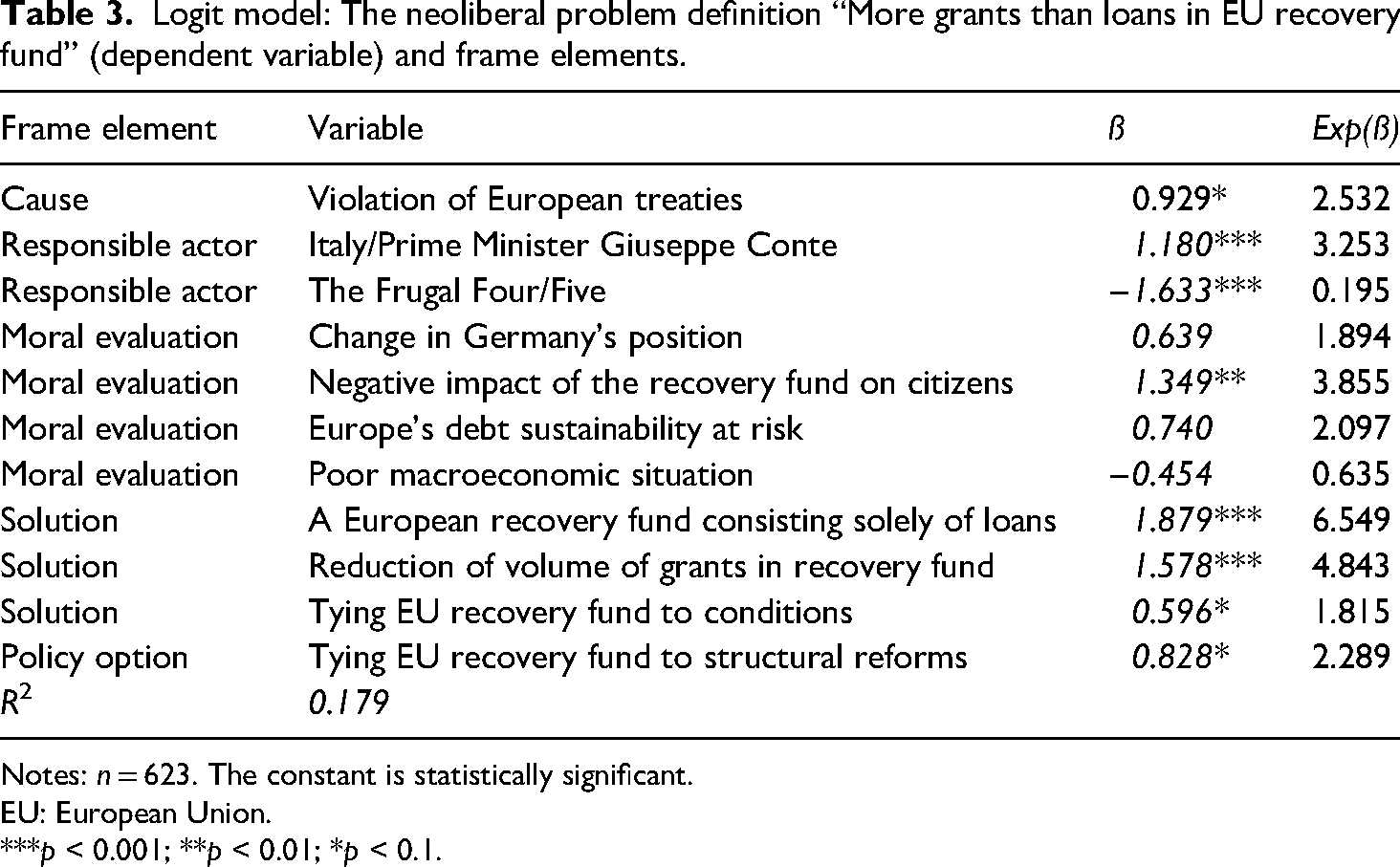
Logit model: The neoliberal problem definition “More grants than loans in EU recovery fund” (dependent variable) and frame elements.
Notes: n = 623. The constant is statistically significant.
EU: European Union.
***p < 0.001; **p < 0.01; *p < 0.1.
In the dispute over the ratio of loans and grants, the press again names Italy as the actor held responsible. The neoliberal perspective corresponds to that of the “Frugal Four/Five,” who intended by their demand for increasing loans and reducing grants that the European debt rules should not be lightly disregarded. The recovery fund should be limited and linked to reform conditions. These concrete solutions were at the heart of all discussions, which were fueled above all by the Merkel–Macron proposal for a fund consisting of 500 billion euros in grants (Table 4).
Logit model: The Keynesian problem definition “More loans than grants in EU recovery fund” (dependent variable) and frame elements.
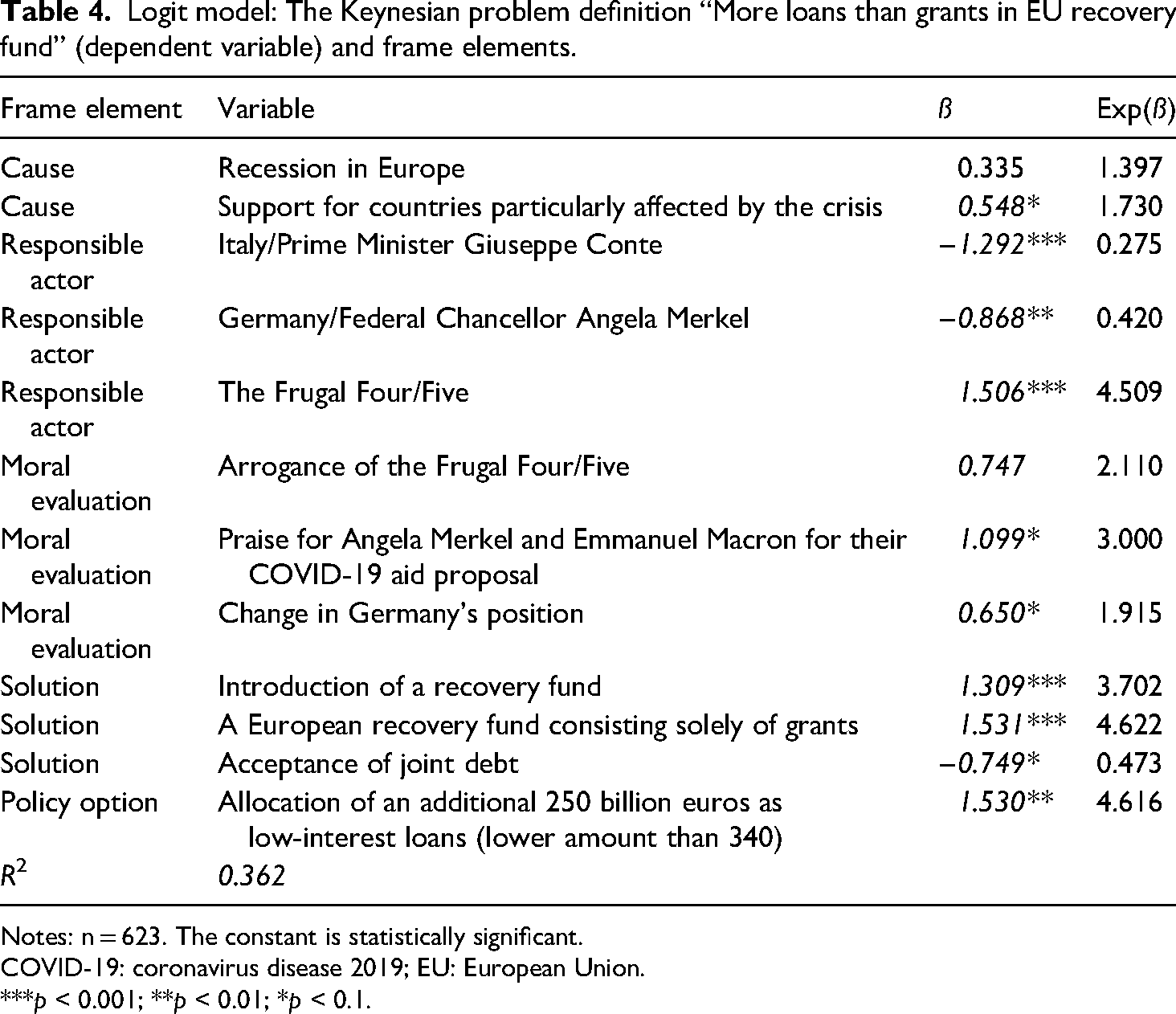
Notes: n = 623. The constant is statistically significant.
COVID-19: coronavirus disease 2019; EU: European Union.
***p < 0.001; **p < 0.01; *p < 0.1.
Seeing two evaluations of Germany/Angela Merkel as part of the Keynesian media frame reflects the political shift in Germany. In the coronabonds debates, the Keynesian perspective saw Germany as a political opponent accused of a powerful demonstration of its economic strength and lack of solidarity. This changed with the Merkel–Macron proposal, which also changed the view of German policy, especially among French and Italians, to positive evaluations and expressions of praise. The policy option refers to the recovery fund design. The Keynesian-oriented actors demanded that the loans be reduced from 390 to 250 billion euros. Finally, the EU Commission and the heads of government were able to agree on a compromise: of the 750 billion euros, 390 billion euros are paid as grants and 360 billion euros as loans.
Discussion
In times of crisis, the press plays a particularly important role, as the press influences how the crisis is communicated and framed. Since economic policy issues in Germany are mainly reported from a neoliberal perspective, other views are often neglected, alternative solutions are not considered, and plurality is prevented. However, politically effective decisions, which in a democracy should correspond to the preferences of the population, are not fixed from the outset. They emerge in an open discourse and are formed under the influence of public, mass media communication.
The most important national dailies and the magazine selected provide the majority of (economic) political information for the German population due to their reach, circulation strength, and the right–left political spectrum represented.
Previous research evidences the influence of German media in normalizing the ordoliberal or neoliberal paradigm during economic crises (e.g. Basu, 2019). Some of the studies reveal that the German media played a key role in framing the debate during the eurozone crisis on eurobonds and preventing the introduction of joint European debt (e.g. Ojala and Harjuniemi, 2016).
It is therefore remarkable that the Keynesian paradigm dominated coverage of the COVID-19 aid programs. Neoliberal media perspectives can be identified in just under 30%, whereas Keynesian problem perspectives are addressed in about two-thirds of the articles—both perspectives combined were represented in just under 10%. This finding seems to corroborate the initial assumption of a possible paradigm shift in the German economic policy coverage and complements observations on neoliberalism in German media by Krüger et al. (2021). The authors note that the historical dominance of neoliberal frames and narratives in (economic policy) reporting was partially displaced by Keynesian views during the financial crisis starting in 2008. They also argue that the current COVID-19 crisis requires, to an even greater extent, a paradigm shift toward Keynesian perspectives.
Complex frames are identified for the problem definitions surrounding the (non)introduction of coronabonds and the design of the recovery fund. In this respect, the logit results provide evidence that neoliberal framing tended to focus on solutions, while Keynesian framing focused on evaluations. These results advance the idea that the Keynesian media perspective argued more strongly in terms of European solidarity and unity. In contrast, from the neoliberal media perspective, the discourse was more solution oriented, rational, and focused on serving the best interests of one's country. The mass media portrayed the European debates on COVID-19 aid programs as a bipolar conflict between southern and northern European countries.
It is also interesting to note that although Germany and/or Angela Merkel are often evaluated negatively in reporting, these evaluations are not part of a frame, but the positive evaluations. This reveals that the press frequently criticized Germany, but that this criticism is not significantly placed in a more complex context in contrast to Germany’s political change, which can be held partly responsible for the European course change in economic policy. Germany is considered the engine of the EU and took over the EU Council presidency on July 1, 2020. Its economic policy orientation accordingly has a major impact on a controversy that has been reignited partly because of historical circumstances and calls for quick and consensual solutions.
Ojala and Harjuniemi (2016) and Wallaschek (2020) seem to support findings regarding Germany’s role in the (Keynesian) transformation of European economic policy. The authors illustrate that the European press seemed to act as a transnational mediator of German views. Thus, the authors were able to demonstrate Germany’s large political impact on European public framing in crisis times.
There was also a broad consensus in literature that, due to the dominant neoliberal paradigm in its economic policy reporting, the German media have often failed to report in a paradigmatically pluralistic way (e.g. Kay and Salter, 2014; Teschendorf and Otto, 2022).
In contrast to the conclusions of the mentioned studies (e.g. Basu, 2019; Harjuniemi, 2021), no lack of plurality can be attributed to the mass media. The German political and media landscape has shown a willingness to present alternatives to the normalized narrative of austerity from other economic crises and to offer a comparatively high level of pluralism that challenged the status quo significantly—as argued by Kay and Salter (2014) to be desirable but was not fulfilled by the British media during the euro crisis. This conclusion is in line with Harjuniemi's (2021) findings that COVID-19-induced disruptions in economic policy decision-making can increase pluralism in economic policy journalism and provide scope for a paradigm shift.
Did the press fulfill the role of chronicler rather than conscious pluralistic reporting? It largely fulfilled both roles, even if they are mutually dependent. The press adequately presented the course of the debates: When relevant actors, such as Italy/France or the “Frugal Four/Five” clarified their respective paradigmatic orientation in the negotiations, the press conveyed these perspectives more frequently. Thus, one can observe a certain frame parity or balance desired by Entman: the press provides complex counter-frames (neoliberal), including causal interpretations, evaluations, and solutions, to the dominant Keynesian frames.
Overall, the problems identified from the respective paradigmatic perspective were mostly presented in complex contexts of meaning, and thus the demand on the media to classify political processes and soundly report on them was fulfilled to a large extent (Stark et al., 2021).
However, this study has some limitations and therefore offers new research gaps. First, the results regarding Germany’s key role and the increased attribution of responsibility to Italy should be treated with caution due to the study design. It would be interesting to examine the media coverage of other countries that strongly participated in the debates (e.g. France, Italy, and the “Frugal Five”), and to question Germany’s influence on European policy change and the role of relevant parties such as Italy.
Furthermore, this study examines media frames that include journalistic frames, both terms sometimes used as synonyms in practice (Matthes, 2014). Nevertheless, journalistic framing should be researched, either using interviews with journalists or content analysis of only journalists’ commentaries/editorials, to distinguish between choices that can be truly attributed to journalistic discretion. In this context, this study assumes that the press is free to choose how it reports. Here, it seems necessary to consider other factors for framing choices, such as the editorial line of the medium, frame sponsors, the adoption of frames from competing elites or the pure reflection of political reality.
Besides, due to the complexity and media functioning, only two economic policy paradigms have been taken into consideration in explaining the paradigm shift. It should not be taken as generalizing or oversimplifying complex European economic policy processes as other factors such as public pressure driven by skeptical public opinion, or the rise of challenger parties can also influence policy change. Nevertheless, a lasting paradigm shift can only be examined with a longer-term study.
Conclusion
The role of the central economic policy paradigms can be revealed in the frames uncovered in press coverage. This study reveals a dominance of Keynesian economic policy views in the German coverage of the European discourse on COVID-19 aid programs. While neoliberal views still dominated in the coverage before, a paradigm shift toward Keynesianism slowly emerged thereafter, even softening entrenched neoliberal viewpoints. This shift not only illustrates that economic policy must be adjusted in such difficult economic times, but also that Germany's sudden policy change regarding European joint debt was crucial for the EU toward greater fiscal integration.
The press can be seen as a mirror of reality, but it also creates different versions of reality—depending on interests, social structures, and agendas. Given its responsibility to the public to report on economic policy issues in a paradigmatically pluralistic way, the press needs to put the problem definitions that divide the EU into two camps into a holistic context—notably as the press contributes to the rationalization and normalization of chosen policies and thus shapes public perceptions of crises.
This study illustrates that the press communicating using frames argued about complex interrelationships of statements about European COVID-19 aid, particularly regarding coronabonds and the recovery fund design. It therefore strengthens the position that the press adequately reflected different problem views. The mass media succeeded in providing a (paradigmatically) plural, diverse and relevant coverage in times of constantly changing circumstances. One challenge, however, was evident in the 2020 coverage, as negotiations were often driven by populist statements that provoked negative evaluations and often recriminations in the press. Keynesian media framing tended to argue for European solidarity through evaluations, while neoliberal framing was more solution oriented, rational, and nationally centered.
Anyway, the press should consider different economic policy interpretations in its reporting. Otherwise, monocausal explanations would characterize reporting and thus influence the formation of citizens’ opinions in a one-sided manner. One-sided and abbreviated portrayals of entire perspectives increase the risk that marginalized views and their bearers will be denied rationality. Citizens may thus be given the image of a policy without alternatives—exactly the opposite of the actual definition of politics.
This study extends the existing literature on framing in reporting, analyzing a highly relevant topic for the EU's economic orientation and filling the research gap related to economic policy framing during the COVID-19 pandemic. Here, it makes a significant contribution to the methodological approach. The study introduces a new, combined framework for identifying and testing frames by developing issue-specific frames in a deductive-inductive approach, contextualizing them in the economic policy paradigms, and testing them using multivariate logistic regression. Future research should build on this existing base.
Supplemental Material
sj-docx-1-ejc-10.1177_02673231221130926 - Supplemental material for The German media as amplifier of the political agenda: The economic policy framing of European conflicts in times of COVID-19
Supplemental material, sj-docx-1-ejc-10.1177_02673231221130926 for The German media as amplifier of the political agenda: The economic policy framing of European conflicts in times of COVID-19 by Victoria Sophie Teschendorf in European Journal of Communication
Footnotes
Data availability statement
The data that support the findings of this study are available from the corresponding author upon reasonable request.
Funding
The author disclosed receipt of the following financial support for the research, authorship, and/or publication of this article: This work was supported by the Otto-Brenner Stiftung (grant number 2020-225).

Supplemental material
Supplemental material for this article is available online.
Notes
References
Supplementary Material
Please find the following supplemental material available below.
For Open Access articles published under a Creative Commons License, all supplemental material carries the same license as the article it is associated with.
For non-Open Access articles published, all supplemental material carries a non-exclusive license, and permission requests for re-use of supplemental material or any part of supplemental material shall be sent directly to the copyright owner as specified in the copyright notice associated with the article.
