




Abstract
Over the past decade, the European Union has lost the trust of many citizens. This article investigates whether and how media information, in particular visibility and tonality, impact trust in the European Union among citizens. Combining content analysis and Eurobarometer survey data from 10 countries between 2004 and 2015, we study both direct and moderating media effects. Media tone and visibility have limited direct effects on trust in the European Union, but they moderate the relation between trust in national institutions and trust in the European Union. This relation is amplified when the European Union is more visible in the media and when media tone is more positive towards the European Union, whereas it is dampened when media tone is more negative. The findings highlight the role of news media in the crisis of trust in the European Union.
Trust is an important factor for creating and stabilizing support for political institutions. In recent years, however, many European citizens have lost trust in the European Union (EU). EU trust levels are now slowly recovering after a considerable decline following the 2009 European debt crisis. Yet, according to the latest Eurobarometer trends, far less than half of all European citizens trust the EU or its institutions (European Commission, 2017). Pervasive levels of distrust threaten the EU’s democratic legitimization. Not only does distrust inhibit political participation, particularly turnout (Levi and Stoker, 2000), and satisfaction with democratic processes (Hetherington, 1998), it may also further the crumbling of the Union, as exemplified by the British vote to leave the EU. Given these far-reaching potential consequences, understanding the determinants of political trust is essential. Previous research indicates that trust in the EU depends on emotional attachment and utilitarian considerations (Harteveld et al., 2013). The most important predictor of trust in the EU, however, is not inherent in the EU itself. Due to a lack of actual knowledge about the EU, citizens extrapolate from trust in national institutions – trust in the EU is heavily influenced by trust in national institutions (Harteveld et al., 2013).
However, these three determinants do not arise in a vacuum. Citizens receive most information about the EU from the media (Vliegenthart et al., 2008), which may influence attachment to the EU as well as utilitarian evaluations. Furthermore, the media may provide citizens with information that they can use to form (dis)trust in the EU instead of relying on cues from national politics. At this point, the role of media information for EU trust is unclear. Mere visibility of the EU in the media environment might increase trust, as citizens grow more familiar with it. On the other hand, visibility of an institution might not always reflect positively on it; increased negative reporting could decrease trust in the EU. We expect direct effects of media visibility and tone on trust in the EU. But media information may also moderate the impact of other factors, particularly by dampening the impact of extrapolation – that is, relying on cues from national political institutions. The lack of knowledge and distinct opinions that cause extrapolation may in part be explained by the lack of media reporting on the EU – citizens have few opportunities to learn about the EU and how it functions. However, when there is more media coverage of the EU or when the Union is evaluated more positively or negatively, citizens may have more opportunities to form a judgement. Therefore, we hypothesize that the mechanism of extrapolation is weaker when media visibility of the EU is higher or when the coverage is more evaluative. These assumptions are tested using a mixed-effects multi-level approach, combining 23 rounds of Eurobarometer survey data (N = 193,182) and an automated content analysis of EU and Euro coverage from 10 European countries between 2004 and 2015. The results of this study contribute to a better understanding of media effects on the formation of political trust in the EU.
Determinants of trust in the EU
A certain extent of trust in political institutions is vital for a democracy in which citizens feel adequately represented (van der Meer, 2010). While a moderate amount of distrust can be healthy, too much causes dissatisfaction (Hetherington, 1998) and discourages citizens from political participation (Levi and Stoker, 2000). As van der Meer (2010) puts it, ‘political trust functions as the glue that keeps the system together and as the oil that lubricates the policy machine’ (p. 518). Trust can be conceptualized as the evaluation of a social relation, based on violations of or compliance with certain expectations (Kasperson et al., 1992). 1 This implies that trust is continually re-established in the light of new information. For political trust, evaluations can relate to, among other factors, the level of corruption, the degree of proportional representation in government and macro-economic performance (van der Meer, 2010; van der Meer and Hakhverdian, 2017). Concerns about declining political trust are hardly new (Citrin and Luks, 2001). But while some are warning of a ‘crisis of trust’ in almost all arenas (Edelman, 2017), there is little evidence that political trust is subject to a long-term decline – rather, fluctuating trust levels are evaluations of political performance (van der Meer, 2017).
Harteveld et al. (2013) systematized the three main explanations for why citizens trust or distrust the EU. First, the ‘logic of rationality’ assumes that citizens’ trust is based on the perceived performance of the EU. Second, the ‘logic of identity’ conceptualizes trust as a consequence of emotional attachment to the EU. These two logics tap into a similar underlying idea as Easton’s (1975) conceptualization of political trust as either utilitarian or diffuse, and have been identified as the central explanations of Euroscepticism in a broader sense (Hooghe and Marks, 2005). However, for trust in EU institutions, a third logic is particularly important: the ‘logic of extrapolation’, according to which citizens base their trust in the EU on their trust in more familiar national institutions. On the individual level, citizens who trust their own government also trust the EU more than those who distrust their government (Anderson, 1998; Armingeon and Ceka, 2014; Harteveld et al., 2013; Muñoz et al., 2011). However, the pattern reverses on the aggregate level: Citizens from countries where the average trust in the government is low tend to trust the EU more than those from countries where the average trust in the national government is higher (Hobolt, 2012; Muñoz et al., 2011). In both cases, trust in the national government functions as a proxy for trust in the EU. See Armingeon and Ceka (2014) for a number of arguments that support the causal effect of trust in national institutions on trust in the EU (and not vice versa).
One reason for using proxies is a lack of knowledge (Lau and Redlawsk, 2001). The relation between trust in national institutions and trust in the EU is weaker for individuals with greater knowledge about the EU (Armingeon and Ceka, 2014; Muñoz, 2017); knowledgeable citizens base their evaluations more on actual characteristics and developments of the EU (Harteveld et al., 2013; van der Meer and Hakhverdian, 2017).
Media effects on political trust
In order to gain knowledge and form political opinions, citizens rely on the mass media, particularly when an issue is distant and abstract, such as the EU and how it functions (Kleinnijenhuis et al., 2006; Vliegenthart et al., 2008). Especially for Eurosceptic populist parties, the media are crucial to get their message across to voters (Mazzoleni, 2014). Yet, evidence on the effects of media content on political trust is inconclusive so far. In some studies, the consumption of online news (Ceron, 2015), newspapers and radio news (Avery, 2009) and news media more generally (Strömbäck et al., 2016) is associated with higher political trust. In others, media use is associated with decreased political trust (Pietsch and Martin, 2011) or reinforces previously held trust judgements (Ceron and Memoli, 2015). A third group of studies find no effects of media use on political trust whatsoever (Gross et al., 2004; Moy and Scheufele, 2000).
A possible explanation for these mixed findings is that most of these studies rely on self-reported media use and do not take actual media content into account. Media visibility (the sheer amount of coverage of a topic) and media tone (the evaluation of a topic) can have complementary effects on political attitudes and behaviour (Geiß and Schäfer, 2017; Hopmann et al., 2010). Similarly, trust is conceptualized as an evaluation of a political institution, which can be changed by new information. Because previous research showed that attitudes towards EU enlargement were influenced by the general media environment, rather than by individual media exposure (Azrout et al., 2012), we focus on the information environment and how it influences EU trust over time.
Mere exposure to an object can create a more favourable evaluation of the respective object, as long as it is not connected to negative cues (Zajonc, 2001). Increased media reporting about political institutions provides more transparency (Moy and Hussain, 2011). Transparency (Norris, 2001), familiarity and knowledge about a political institution (Armingeon and Ceka, 2014; Karp et al., 2003) in turn increase political trust. Especially in the case of the rather distant EU, increased media reporting has the potential to increase trust. Higher media visibility of the EU is associated with increased knowledge about it (Hobolt and Tilley, 2014), which in turn is associated with more support (Scharkow and Vogelgesang, 2010; Vliegenthart et al., 2008). Exposure to the EU can reduce Euroscepticism (de Vreese, 2007). We therefore assume that sheer visibility of the EU in the media increases citizens’ trust in the European Union.
H1: (a) Higher media visibility of the EU is associated with higher trust in the EU.
However, not all publicity is good publicity. Besides visibility, the tone of media reporting can also change political attitudes (Balmas and Sheafer, 2010). Based on the media-malaise hypothesis (Robinson, 1976), particularly negative information about politics (Ceron, 2015; Kleinnijenhuis et al., 2006) and uncivil political discourse (Mutz and Reeves, 2005) decrease political trust. Like political news in general (Soroka and McAdams, 2015), the EU is often subject to rather negative media coverage, particularly in the older member states (de Vreese et al., 2006; Peter et al., 2003). Negative news has stronger effects on recipients than positive news (Soroka and McAdams, 2015); however, positive news content has also been found to positively affect EU attitudes (Desmet et al., 2015). Based on this evidence, we hypothesize the following:
H1: (b) More positive media coverage of the EU is associated with more trust in the EU, while (c) more negative coverage is associated with less trust.
When the news environment provides citizens with more information about the EU, citizens might also rely more on it and less on cues from national politics. As discussed, previous research found proxies from trust in the national government to be the strongest predictor of trust in the EU, but less so for individuals who are more knowledgeable about politics (Armingeon and Ceka, 2014; Muñoz, 2017). We hypothesize that citizens will rely less on proxies from the national government when forming their EU trust when the EU is more visible in the media environment, because they can acquire more information to base their judgement on. A similar mechanism is plausible for tonality: Very positive or negative information might make citizens rely more on these media evaluations of the EU instead of extrapolation, seeing that more emotional information tends to have a stronger effect on attitudes than neutral information (Soroka and McAdams, 2015).
H2: The impact of trust in the national government on trust in the EU is weaker when the EU is (a) more visible in the news and when the news coverage is (b) more positive or (c) more negative.
Method
We combined data from an automated content analysis with survey data. The content data are obtained from a newspaper archive for the following 10 countries: Austria, Denmark, Germany, the United Kingdom, France, Ireland, Italy, the Netherlands, Poland and Spain. For each country, we chose the broadsheet with the largest circulation that is also available in the archive (see Supplemental Appendix A). We made this methodological choice for three main reasons. First, there is evidence that EU coverage in broadsheet newspapers reflects a diverse range of stances towards the EU (Conti and Memoli, 2017). Second, broadsheet newspapers often set the agenda for other news outlets (Picard, 2015) and therefore reflect how a topic is covered more generally (Vliegenthart et al., 2008). Third, by including country fixed effects, our analytical approach focuses on changes in trust over time within countries, while controlling for between-country differences, making the analysis less sensitive to the broadsheets’ specific editorial stances. In sum, albeit not a comprehensive account, we deem the selection of one broadsheet per country suitable for the purpose of our study.
We collected two separate media corpora. The first one focuses on coverage about the EU as an institution and includes every article that mentions the words ‘European Union’ or the abbreviation ‘EU’ in the headline or subtitle. We developed this search string with the goal to only include articles whose main topic is the EU. This enables us to conduct an automated content analysis without including articles that are only remotely or not at all related to the EU. However, one of the most important European issues of the last decade is not necessarily covered in this corpus. The Euro crisis made European integration a more important political issue (Otjes and Katsanidou, 2017) and had severe consequences for citizens’ evaluations of the EU. Therefore, we collected a second corpus of media coverage on the Euro, which includes articles with references to the Euro in headlines and subtitles.
The algorithm used to determine the tone of the headlines is SentiStrength (Thelwall et al., 2012) in Python. This algorithm automatically estimates positive and negative sentiment in short texts in different languages, 2 based on keywords, taking negation and booster words into account. Given SentiStrength’s purpose of analysing short units of text, we focused only on the headlines and subtitles of the articles, which are also the most prominent and most read part of the newspaper and reflect broader changes in the media environment. Positivity and negativity in our dataset reflect the average sentiment scores in the period between the survey waves, with 1 being a neutral sentiment and 5 being the maximum positive or negative sentiment possible. Visibility is measured as the average number of articles per month between the survey rounds. In total, the EU corpus includes 53,378 articles, while the Euro corpus includes 52,141 articles. The distribution across newspapers is included in Supplemental Appendix A.
The corresponding survey data were obtained from the biannual Standard Eurobarometer from 2004 to 2015 (23 time points). It is typically conducted in the first and the third quarter of a year. The total number of respondents in all 10 countries and at all time points in our sample is N = 193,182. Trust in the EU and in the national government are dichotomous variables and consist of the answer to the question whether the respondent ‘tends to trust’ or ‘tends not to trust’ the EU or the government, respectively. Further control variables include age in years, education (measured as the age at which full-time education was stopped) and gender. Respondents were excluded if they did not answer the relevant questions. Table 1 shows descriptive statistics of all variables.
Descriptive statistics.
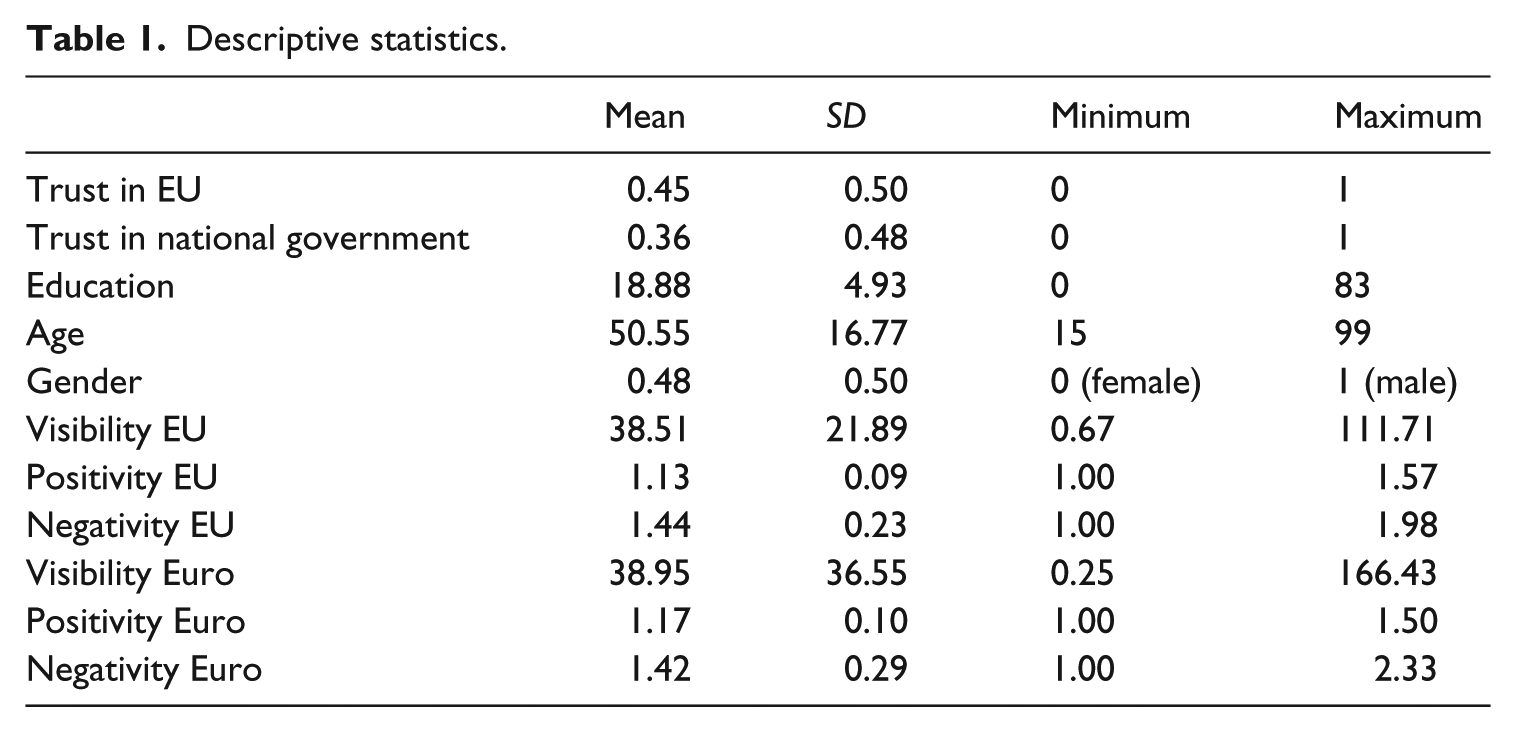
Using the lme4 package (Bates et al., 2015) in R (R Core Team, 2016), we estimated a two-level mixed-effects generalized linear model with random slopes and intercepts for the different survey waves, country fixed effects and media information as a contextual moderator of the relation between trust in the national government and in the EU. Using this approach, we control for between-country variation in the newspaper coverage due to different editorial stances of the selected newspapers. 3 Individuals are at the first level and survey waves at the second. The predictor variable trust in the national government was group mean centred and media visibility, positivity and negativity were grand mean centred (Enders and Tofighi, 2007; Kreft et al., 1995). The results are visualized using the R packages stargazer (Hlavac, 2015) and ggplot2 (Wickham, 2015).
Results
Figure 1 displays the development of EU and Euro media visibility over time, while Figure 2 shows the development of tonality. EU visibility decreased over the last decade, which is in line with research on election campaign statements, in which salience of the EU decreased in the 2000s (Hoeglinger, 2016). Euro visibility skyrocketed during the Euro crisis. There was some fluctuation in the positive sentiment, but in general, there is little positivity in EU and Euro coverage. The tone became increasingly more negative over time, particularly around the Euro crisis.
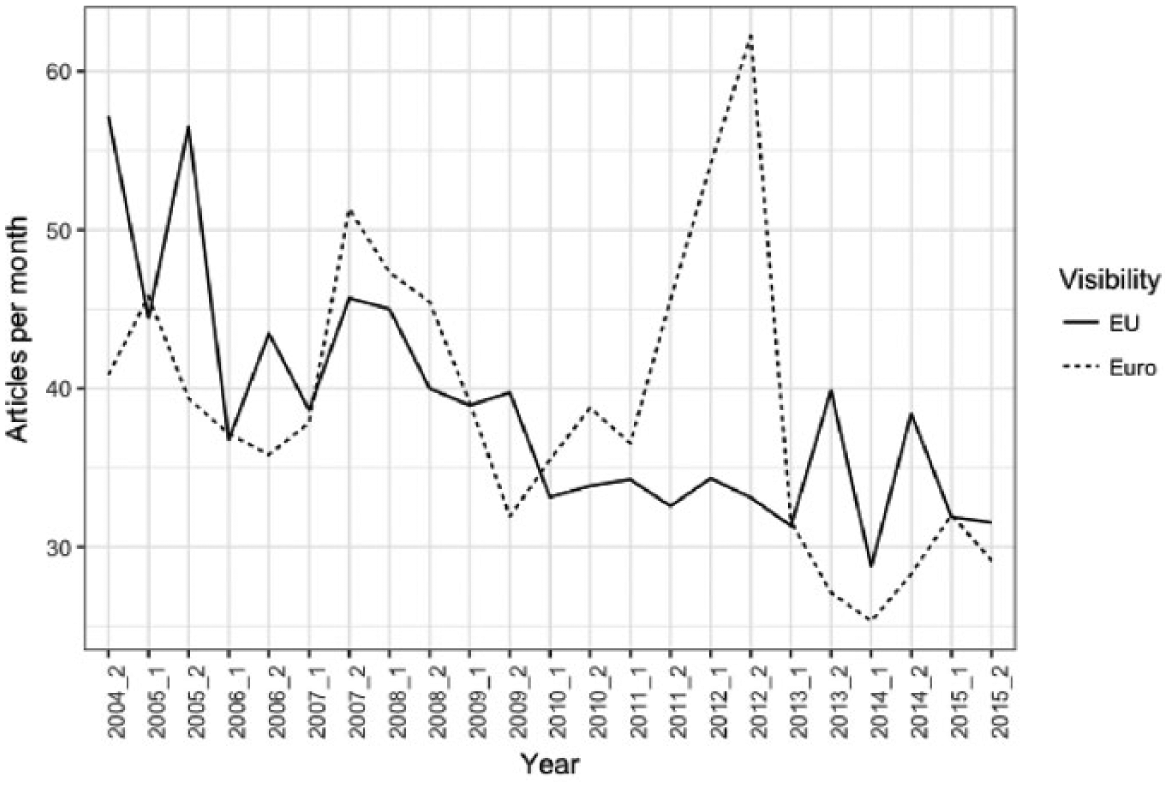
Development of EU and Euro visibility over time.
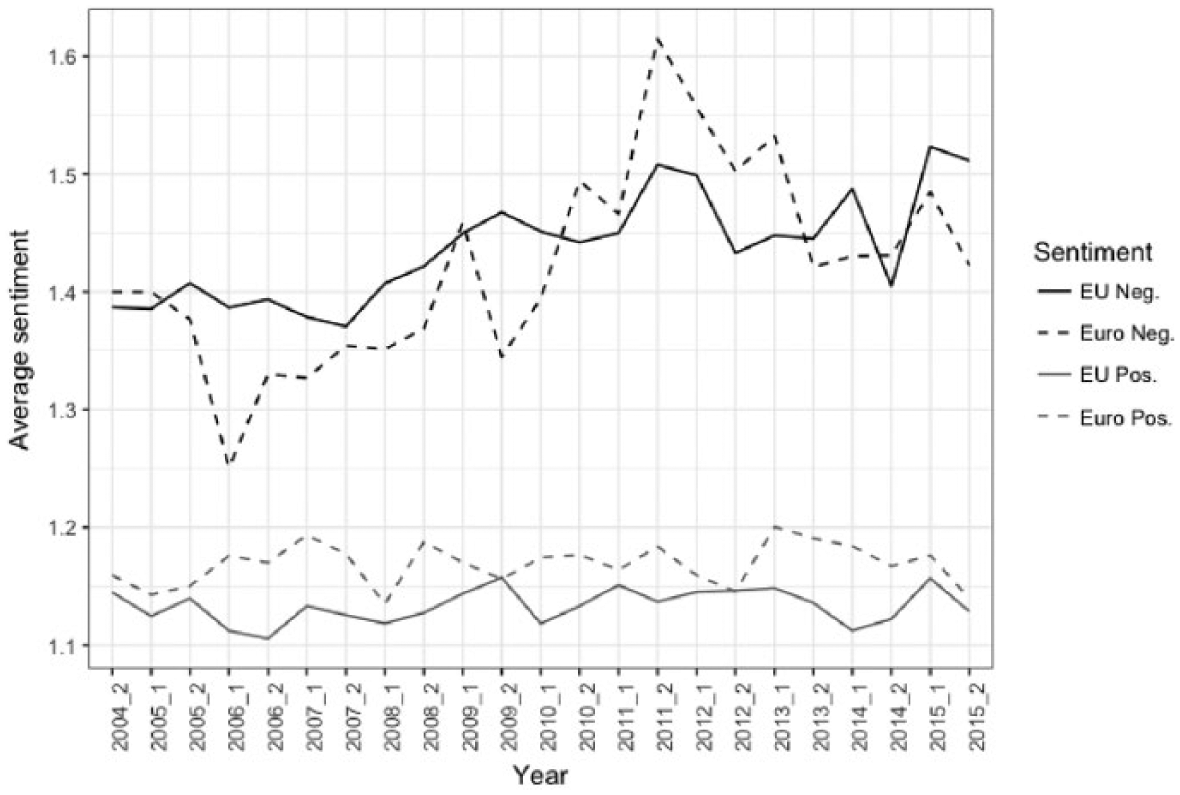
Development of positive and negative sentiment in EU and Euro coverage over time.
Table 2 shows the results of the stepwise specification of our model. Model 1 is the baseline model without any predictors. In Model 2, we added education, age, gender, trust in the national government and country dummy variables, with fixed slopes and random intercepts at the survey level. In Model 3, we added the group predictor variables EU visibility, positivity and negativity and freed the slope of trust in the national government, allowing the impact of trust in the national government on trust in the EU to vary over time points. In Model 4, we added cross-level interaction terms for trust in the national government and all media variables. Models 5 and 6 replicate Models 3 and 4 for the Euro coverage variables. Given that it is not possible to compare higher-level variances and regression coefficients across logistic models, because they are rescaled in each model (Browne et al., 2005; Hox, 2010: 133–134), we calculated predicted probabilities for statistically significant media effects, based on Model 4 for the EU coverage and Model 6 for the Euro coverage, using the effects package (Fox, 2003) in R, which averages over all other terms in the model.
Trust in the EU.
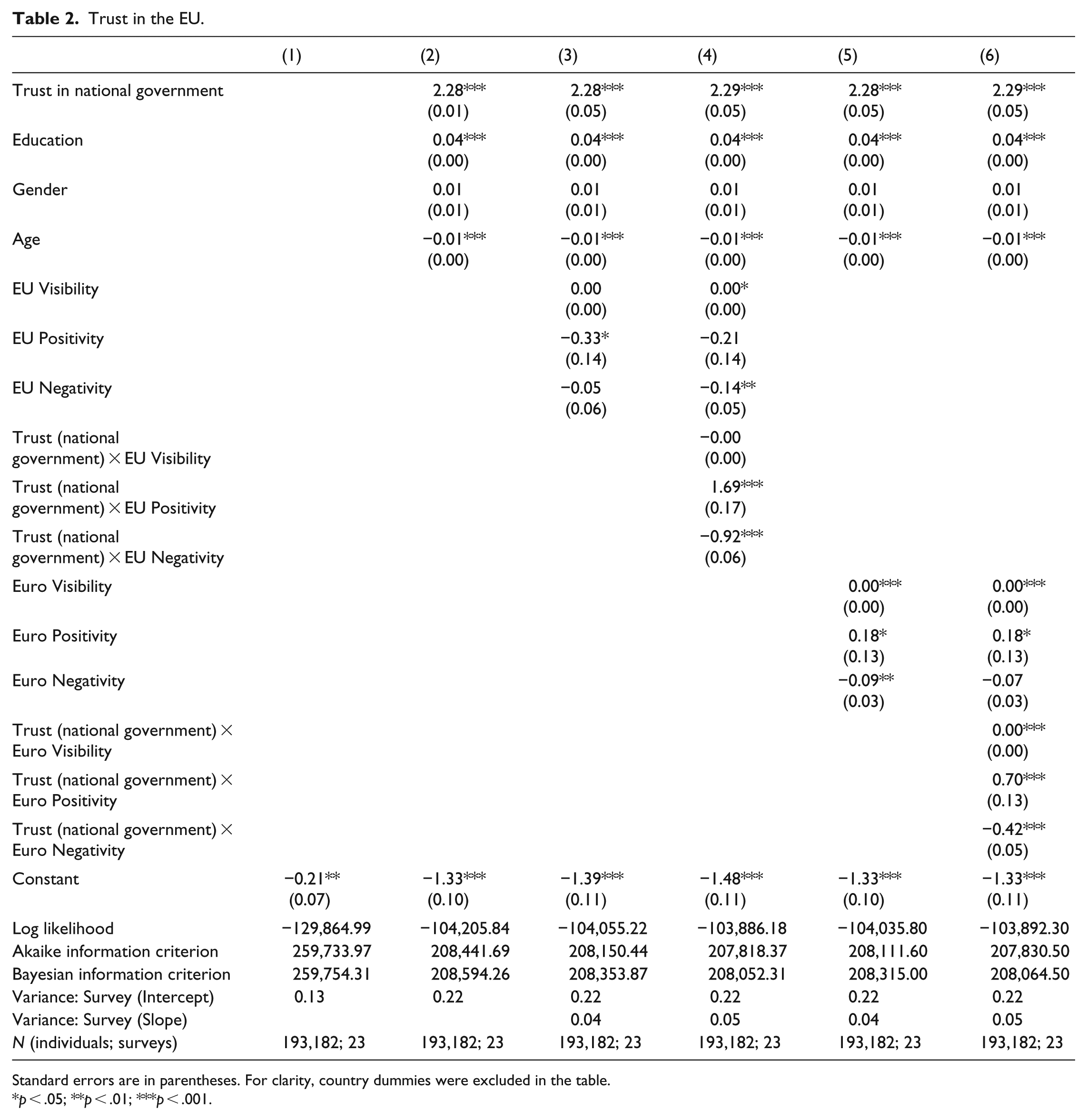
Standard errors are in parentheses. For clarity, country dummies were excluded in the table.
p < .05; **p < .01; ***p < .001.
The control variables influence trust in the EU as expected: Younger and more educated people trust the EU more, while gender has no effect. Trust in the national government exerts a strong positive influence on trust in the EU, which replicates previous research on the importance of national heuristics (Anderson, 1998; Harteveld et al., 2013). Turning to the hypotheses, media visibility of the Euro and the EU has a significant, but small, positive relation to trust in the EU: If Euro visibility increases from no visibility to high visibility (100 articles per month), the predicted probability to trust the EU increases from 41.9% to 47.8%. For EU visibility, it increases from 43.0% for no visibility to 45.7% for high visibility (100 articles per month). This supports Hypothesis 1a: Higher media visibility of the EU is associated with higher trust in the EU when media tone is held constant. We also find direct effects of the tone of coverage. For the Euro coverage, the predicted probability to trust the EU increases from 43.5% in a neutral media environment (positivity score 1) to 45.6% in the most positive media environment (positivity score 1.5). However, positive EU coverage does not exert statistically significant effects. Furthermore, the effect of positive Euro coverage did not hold up in a test excluding Danish respondents. These results offer only limited support for Hypothesis 1b, and the effect size is marginal. Negative Euro coverage has a significant negative effect on trust in the EU; the predicted probability to trust the EU decreases from 45.6% in a neutral media environment (negativity score 1) to 42.0% in the most negative media environment (negativity score 2). However, the effect is not replicated for the EU coverage. Hypothesis 1c is therefore also only partly supported. Overall, the hypothesized main effects remain either small or statistically insignificant.
Turning to the interaction effects, visibility of the Euro strengthens the relation of trust in national institutions and trust in the EU. For those who trust their national government the least, the probability to trust the EU only increases from 19.6% to 20.9% when Euro visibility increases (from 0 to 100 articles per month), while it increases from 76.7% to 89.2% for those who trust their national government the most (see Figure 3). This indicates that, with increased coverage, people rely more on cues from national politics when forming their EU trust judgement. EU visibility has a similar effect, which, however, only approaches statistical significance. Hypothesis 2a is therefore not supported.
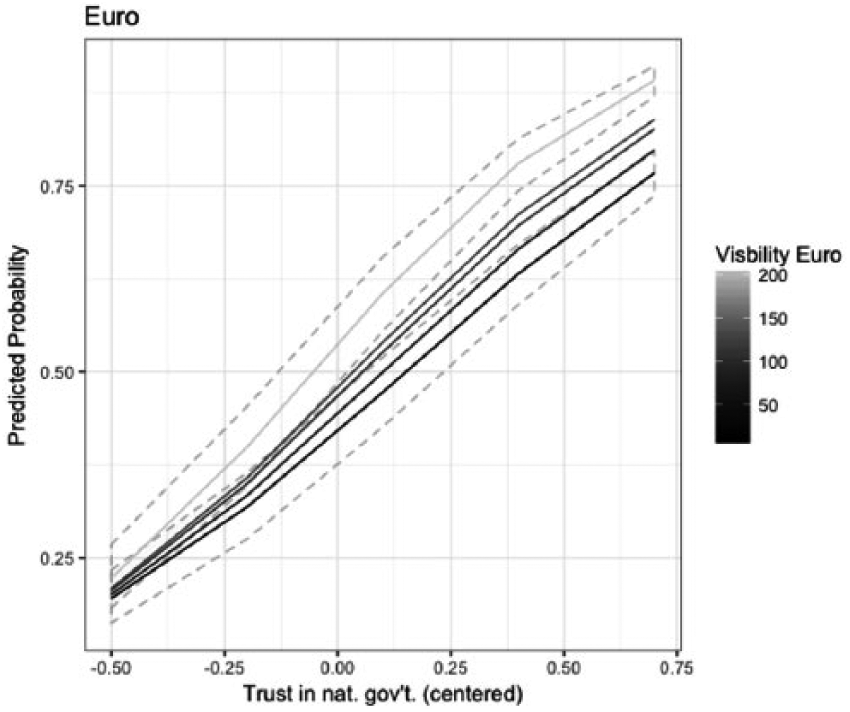
Interaction effects of Euro visibility and trust in the national government on trust in the EU.
Positive information also strengthens the relation between trust in the national government and trust in the EU: For the EU coverage, positivity decreases the probability to trust in the EU for those who do not trust their national government from 22.3% to 16.2 %, while it increases it from 77.1% to 84.0% for those who trust their government. For the Euro coverage, positivity does not change the probability to trust the EU for those who do not trust their national government, while it increases it from 77.9% to 83.1% for those who do trust their government (see Figure 4). This means that positivity reinforces the relationship between trust in the national government and trust in the EU, which does not support Hypothesis 2b.
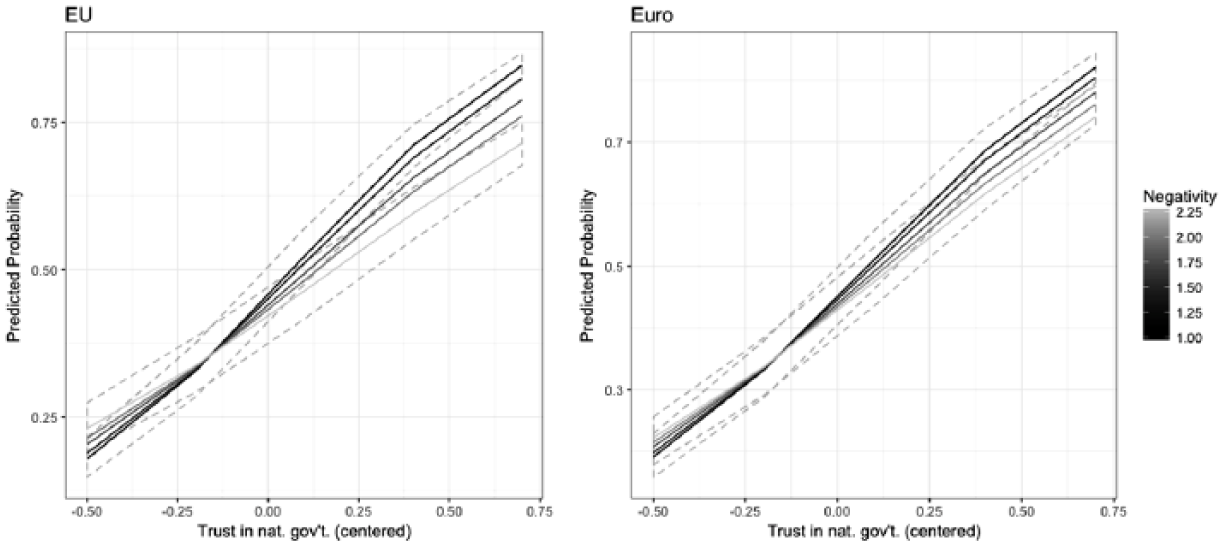
Interaction effects of EU and Euro negativity and trust in the national government on trust in the EU.
Negativity weakens the relationship between trust in the national government and trust in the EU. For those who do not to trust the national government, negativity changes the probability to trust from 17.7% to 23.4% (EU coverage) or 19.1% to 22.3% (Euro coverage), while it decreases the probability to trust much more substantially for those who do trust from 84.2% to 72.2% (EU coverage) or 82.1% to 74.1% (Euro coverage). This means, negativity weakens the relation between trust in the national government and trust in the EU, which supports Hypothesis 2c (see Figure 5).
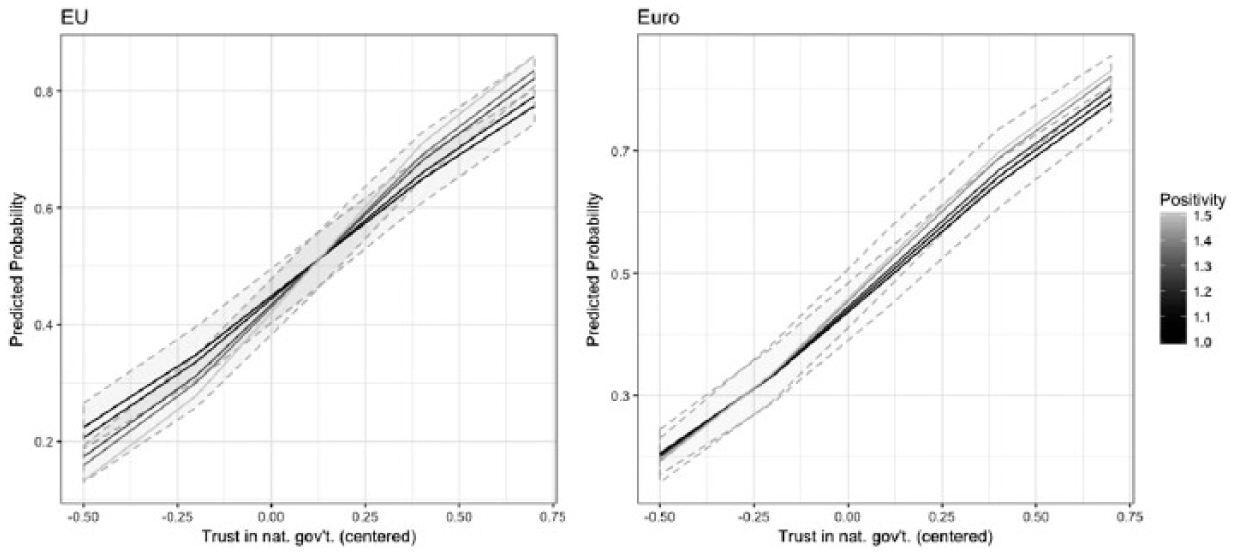
Interaction effects of EU and Euro positivity and trust in the national government on trust in the EU.
Discussion
The present study investigated how media coverage of the EU and the Euro contributes to the formation of trust in the EU among citizens. While previous studies on media effects on political trust have often relied on self-reports of media use (Avery, 2009; Moy and Scheufele, 2000) or estimated proxies for media content based on political positions (Ceron and Memoli, 2015), the present study uses an alternative approach by analysing actual media content and connecting it to survey data in different country contexts and over a period of 10 years. The results show that trust in the Union is higher when the EU and the Euro are more visible in the media and when the coverage is more positive. Negative EU and Euro coverage dampens the relationship between trust in the national government and trust in the EU, while positive EU and Euro coverage and higher visibility of the EU amplify this relation.
This study contributes to the extant literature in multiple ways. It shows that media coverage and EU trust are related, even though direct effects are moderate in size. Previous research found mixed results that suggested positive, negative and no effects of media use on political trust. The results of the present study suggest that these differential effects on trust could be explained by differences in both media visibility and tone. This is in line with recent findings that media tone and visibility can have complementary effects on political attitudes and vote choice (Geiß and Schäfer, 2017; Hopmann et al., 2010).
The interaction effects are particularly interesting. Citizens use proxies ‘when in doubt’ (Anderson, 1998). The extent to which they doubt, however, may be reduced by media information. Concerning negativity, citizens rely less on cues from national politics if there is more negative information about the EU available. There are two possible explanations for this. First, citizens might gain knowledge through the negative information in the media, for example, about how the EU handled the European debt crisis. In this case, the implication would be that media coverage helps citizens make more informed judgements about political institutions and prevents ‘blind trust’. Especially seeing that citizens generally have little knowledge about the EU, it seems plausible that media coverage provides citizens with information to educate their political stances. However, not everyone learns from the media under all circumstances. A second explanation is that citizens do not actually gain knowledge, but that they use the negative media climate as a new proxy for their judgement. In that case, citizens would not necessarily make more informed judgements but rather use a different proxy to extrapolate from.
Positive media information and visibility, however, have the opposite effect and strengthen the relationship between trust in the government and in the EU. While the likelihood to trust the EU did not increase for those who do not trust their government, it increased for the citizens who do trust their government. In that sense, positive information and visibility of the EU had a polarizing function, creating a bigger divide between those who trust a number of institutions and those who do not trust any institution. This finding is in line with some previous research (Ceron and Memoli, 2015) and has two interesting aspects. On one hand, it supports our expectation that, when there is more positive or neutral information available, some citizens (who already trust their own government) are more likely to also trust the EU. This means that positive media coverage may strengthen the cues that they get from national politics. For these citizens, ‘to know it is to love it’ (Karp et al., 2003). On the other hand, there are many citizens who distrust both institutions and whose opinions are very unlikely to be changed by media information, regardless of whether it is positive or negative. Positive EU coverage cannot outweigh the cues to distrust. Does this mean that some citizens have a syndrome of distrust in political institutions that cannot be changed? This conclusion may seem unwarranted, given that trust is a complex construct, influenced by many factors (van der Meer, 2010) – and only one of them being media information.
Several limitations underlie the interpretation of these findings, mostly regarding the data used. While the Eurobarometer offers representative survey data from different European countries and over time, the questionnaire design also imposes certain restrictions. In particular, the trust variables are measured on a dichotomous scale, which does not allow for analysing varying degrees of trust. Furthermore, the lack of some relevant individual-level control variables could conceal hypothesized media effects. For example, it is possible that media effects are stronger for individuals who have a higher media use. Future research could overcome these problems by employing surveys that offer more nuanced measures of political trust and individual media use. The country-level media data also have certain limitations, as we only analysed one newspaper per country. Even though changes in broadsheet newspaper coverage reflect general developments in the media landscape, a more inclusive analysis of multiple news media outlets could paint a more comprehensive picture of the available information about the EU. This is particularly the case in a time in which people increasingly lose trust in the mainstream media (Edelman, 2017) – possibly, new media sources exert a stronger or different influence on EU trust than broadsheet newspapers. Finally, the use of longitudinal data offers a dynamic perspective on media coverage and EU trust, yet repeated cross-sections do not allow for establishing causal relationships in any strict sense. And while it is intuitive that public opinion is influenced by the media, especially when most citizens receive information about the EU through the news, it is also possible that the media merely imitate societal trends (Cappella, 2002).
Taken together, the present research suggests that trust in the EU is associated with the amount of media reporting about the EU and its tonality in national news media. It opens up new perspectives on antecedents of EU trust and EU evaluations more generally, highlighting the role of news media in the recent decline of trust in the EU. This is particularly important in a time in which pervasive levels of distrust could threaten the democratic legitimization of the EU, which is now dubbed a ‘crisis of trust’. More neutral and positive information may increase transparency, knowledge and trust and thereby reduce the EU’s democratic deficit. Increased trust could go hand in hand with higher turnout rates, which were historically low in the elections for the European Parliament in 2014 (European Parliament, 2014). And while it is not possible to change the news at one’s will, this study could help inform how the EU communicates its activities to journalists. This is particularly relevant, given the EU’s notorious ‘communication deficit’ and the fact that the EU typically only becomes visible in the media during crises (Van Noije, 2010). However, the results also show that there are some distrustful citizens whose opinions can hardly be swayed by media content.
Supplemental Material
EJC_EU_trust_R1_appendix – Supplemental material for Trust in the European Union: Effects of the information environment
Supplemental material, EJC_EU_trust_R1_appendix for Trust in the European Union: Effects of the information environment by Anna Brosius, Erika J van Elsas and Claes H de Vreese in European Journal of Communication
Footnotes
Declaration of Conflicting Interests
The author(s) declared no potential conflicts of interest with respect to the research, authorship, and/or publication of this article.
Funding
The author(s) disclosed receipt of the following financial support for the research, authorship, and/or publication of this article: This research is funded by a grant from the European Research Council (ERC), grant number 647316.
Supplemental material
Supplemental material for this article is available online.
Notes
References
Supplementary Material
Please find the following supplemental material available below.
For Open Access articles published under a Creative Commons License, all supplemental material carries the same license as the article it is associated with.
For non-Open Access articles published, all supplemental material carries a non-exclusive license, and permission requests for re-use of supplemental material or any part of supplemental material shall be sent directly to the copyright owner as specified in the copyright notice associated with the article.
