



Abstract
We present Meteor, a new inventory for European news sources (i.e. EU + UK, CH, NO, IL): https://wp3.opted.eu/. This inventory will facilitate researchers’ efforts to select sources across platforms and gather related textual data. It contains the names of print and online news sources, social media accounts, news blogs, and alternative news media sources, as well as rich meta-information for each entry (e.g. language, audience size, topical focus, ownership structures, access to full-text archives, secondary data, related research). Meteor accounts for the fuzziness of hybrid media systems through an interlinked knowledge graph. Entries are submitted by researchers, validated, continuously updated, and openly accessible to the public. Our inventory allows users to find various European news sources based on a wide range of criteria, putting scholars in a better position to navigate the European media landscape.
Introduction
News texts are nowadays produced by diverse groups of actors such as traditional media organisations, alternative journalism initiatives, or journalistic blogs. Traditional means for distributing news texts are complemented and partially replaced by information and communication technologies such as e-papers, online newspapers, social media, apps, and streaming platforms (Mattoni and Ceccobelli, 2018). The rise of digital media has caused a fragmentation of the media landscape and simultaneously an integration of ‘newer’ and ‘older’ media logics (Chadwick, 2013: 15; Mattoni and Ceccobelli, 2018: 541). With the digitalization of media, the interactions between audience and newsmakers are changing, and the relationship between politics and media is shifting as well (Deuze and Witschge, 2018; Ryfe, 2018). Relatedly, some scholars observe the boundaries of journalism to become increasingly ‘fuzzy’ (Maares and Hanusch, 2020). Valuable insights into the hybrid media logics have been generated via surveys of media workers and audiences, as well as indicators at the system level (e.g. Brüggemann et al., 2014; Hallin and Mancini, 2017; Hanitzsch et al., 2019; Mattoni and Ceccobelli, 2018). Yet, comprehensive assessments of hybrid media systems and its dynamics should also be based on content characteristics, yet this is rather rarely done (e.g. Popescu et al., 2010).
Responding to these empirical and analytical challenges of a very rich yet highly fragmented hybrid media landscape (Neuman, 2016; Prior, 2007), this research note introduces the OPTED Media Text Analysis Open Registry (Meteor). Meteor is a new inventory for European news sources – sources that create and distribute journalistic mass-mediated political texts. The registry is implemented as a web application in which users can not only query entries but also make contributions to the registry, keeping it dynamic and adaptable. The repository aims to benefit research projects using methods that require content analyses of news texts, or meta-information about news sources and media organisations. Therefore, it also includes a curated collection of available full-text archives and access to secondary data.
There are a number of good reasons for collecting news sources and related meta-information in a new registry. First, journalism and the global media landscape are in transformation (Deuze and Witschge, 2018; Lewis, 2012; Mythen, 2010). The same can be said for political communication (Negrine, 2008). Moreover, alternative media are increasingly taking up space in the media landscape. With an encompassing registry of news sources, we put scholars in a better position to study these transformations.
Second, a new inventory is useful from a research practice perspective as it seeks to overcome the disadvantages of existing inventories, such as LexisNexis 1 , Factiva 2 , or the Europe Media Monitor (Steinberger, 2013). What these lists have in common is that they are driven by data availability and not by source availability and that they do not include meta-information per source but are (mere) lists of source names. Wikipedia is another example of an existing registry: it provides several pages that list news sources for different countries 3 . Although Wikipedia's lists are already useful for gaining an overview, they do not provide a standardised set of required meta-information and get sparse on the subnational level. Digital media channels (e.g. social media, or messengers) are also not part of Wikipedia lists. Both the source lists by media data archives and Wikipedia are not necessarily curated and reviewed by the research community, who are the experts for and targeted main users of Meteor. An example for an expert-curated list of media sources in Europe is euro|topics 4 . However, their collection only covers news sources with the largest audiences per country and also does not include alternative media, which have become an important boundary phenomenon in today's media systems.
Third, the registry helps balance sample selection biases. The available choices in archives typically depend on the agreements of the archive proprietor and publishing houses. Not all publishers choose to make their content available, which limits the coverage of text archives. Although the growing numbers of available data sources and text archives are welcomed, they lack organisation, curation, and a systematic overview (e.g. Esser and Vliegenthart, 2017, p. 11). Therefore, Meteor shows which news sources are included in large archives, which in turn helps researchers to choose their sample based on other criteria than availability of data.
Last but not least, country-comparative research projects will benefit from the inventory. In fact, comparative communication scholars call for classifications and typologies to identify similarities and differences (Esser and Hanitzsch, 2012) and regret that there is no reliable international catalogue where one can look up media sources (Esser and Vliegenthart, 2017: 11). In sum, Meteor is tailored to the needs of researchers and will assist scholars to make well-informed research decisions.
In the following sections, we outline the theoretical foundations for Meteor and introduce its implementation which can be accessed at https://wp3.opted.eu/. We then provide a brief summary of the inventory limitations and a future outlook. Finally, we invite researchers to query news sources and contribute new entries and to use the registry for research but also for training and teaching.
An inventory of news sources
Meteor's scope
‘News sources’ are the foundation of Meteor. They have the primary purpose to regularly report and comment on recent events and ideas (see also Anderson, 2012). News sources are operated by collective actors (i.e. organisations) with a standardised set of practices (e.g. editorial control) and aim to maximise their reach within a defined target audience in order to maintain a habitual and repeated exposure (Potter, 2013). They produce output that claims to be non-fictional, and the audience also generally accepts this claim (Jensen, 2002).
Within this general scope, Meteor more specifically includes print news sources (e.g. The Guardian), online news sources (e.g. theguardian.com), news agencies (e.g. AFP), social media accounts distributing news, as well as websites that provide transcripts to self-created audio-visual contents (transcripts of tv, radio, or podcasts). Sources for multinational audiences (e.g. https://www.euronews.com/) are included as well as sources for national audiences (e.g. https://www.derstandard.at/) and subnational audiences (i.e. for a region or city, e.g. https://www.standard.co.uk/). The registry also includes news blogs as long as they are published by a group of people (i.e. different authors), and appear to be created with editorial support (see e.g. https://globalvoices.org/). Finally, alternative news media sources that for instance propagate that they provide an alternative view in contrast to mainstream media (e.g. https://order-order.com/) are part of the inventory.
By highlighting the news producing activity of a source, we exclude news aggregation services (e.g. Google news). We also exclude other forms of news such as blogs by individuals (e.g. citizen journalism), or news by political actors, NGOs, think tanks, or corporations. More specifications are listed in the contribution guidelines on the Meteor website.
A last general clarification relates to the geographical and temporal scope of Meteor. The aim is to cover all EU member states as well as the UK, Switzerland, Norway, and Israel. In addition, the classification should be suitable for sources actively published today (starting from 2021).
Collected information per source
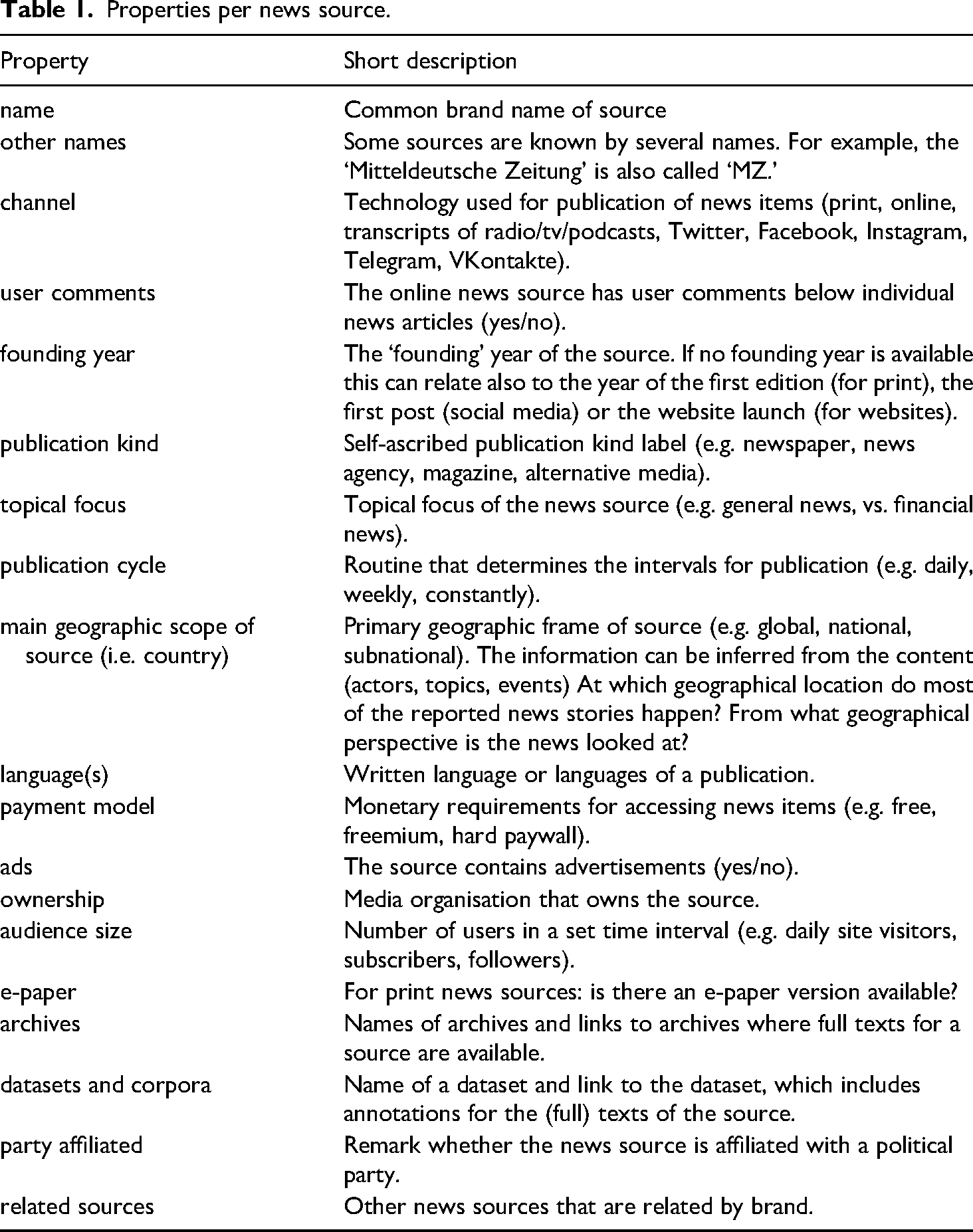
Meteor does not only consist of a list of sources that fall in the above-mentioned scope but in addition includes a set of meta-information or properties per source, potentially relevant to subfields of political communication (McNair, 2017; Semetko and Scammell, 2012) and journalism studies (Carlson et al., 2018; Wahl-Jorgensen and Hanitzsch, 2019). Through a qualitative literature review (see Appendix) of 48 handbooks relating to media, communication, and journalism research, as well as 18 journal articles, we distilled the key properties of news sources to inform the structure of the inventory. In addition, the selected properties were refined within a feedback and test round with the OPTED consortium team as well as with two external experts, an expert for social media and automated content analysis and another for journalism studies. Table 1 summarises the properties covered for the different sources. Given its central role in potential inventory queries and its non-trivial definition, we elaborate on our understanding of channels.
Properties per news source.
Channel
Channels are the technologies used for disseminating the news to the audience (e.g. website, print). They determine the potential format of the content, such as the maximum length of the text, attached images, or videos (Erdal, 2012; Robinson, 2012; Veglis, 2012). Channels also provide varying degrees of interaction possibilities between the news source and their users (Fletcher and Young, 2012), and also among users (e.g. discussion sections). Thus, if a newspaper publishes the exact same text in print and online, both versions are embedded in different contexts. Furthermore, many news sources also have different editorial processes or ownership structures for each channel. Therefore, the inventory distinguishes news sources according to their used channel. For example, the website of The Guardian and its print edition are listed as separate entries. The same applies to each social media channel under the brand The Guardian. Finally, news sources are grouped according to the brand that they share, and the inventory shows this linkage clearly.
Development and implementation
As mentioned, ‘journalism’ is blurry, ambiguous, and context-dependent, yet there are ways that can account for fuzzy and inter-related phenomena and to ‘deal with the mess (we made)’ (Witschge et al., 2018: 651). Therefore, we implemented a knowledge graph structure for Meteor 5 . A knowledge graph is ‘a large semantic net’ (Fensel et al., 2020: 6) with a nested and interlinked structure.
Meteor distinguishes between various entity types, including news sources, countries, organisations, channels, data archives, corpora, and datasets. All these entity types can be linked with each other with a subject-predicate-object relationship. For example: ‘The Guardian Media Group’ (organisation) publishes ‘The Guardian’ (news source).
‘The Guardian Media Group’ is located in ‘UK’ (country).
‘The Guardian’ is distributed as a ‘Print Publication’ (channel).
This also allows linking available data sets to news sources, which enables researchers to query Meteor based on readily available secondary data, archives, or corpora (e.g. the European Parliament Election Study 2009 (Schuck et al., 2010) investigated The Guardian).
Querying and creating entries
PROJECT has two main functions. First, users can query the inventory, second, they can contribute information to the registry. Figure 1 shows which information is displayed to the user after a source has been successfully searched and retrieved.
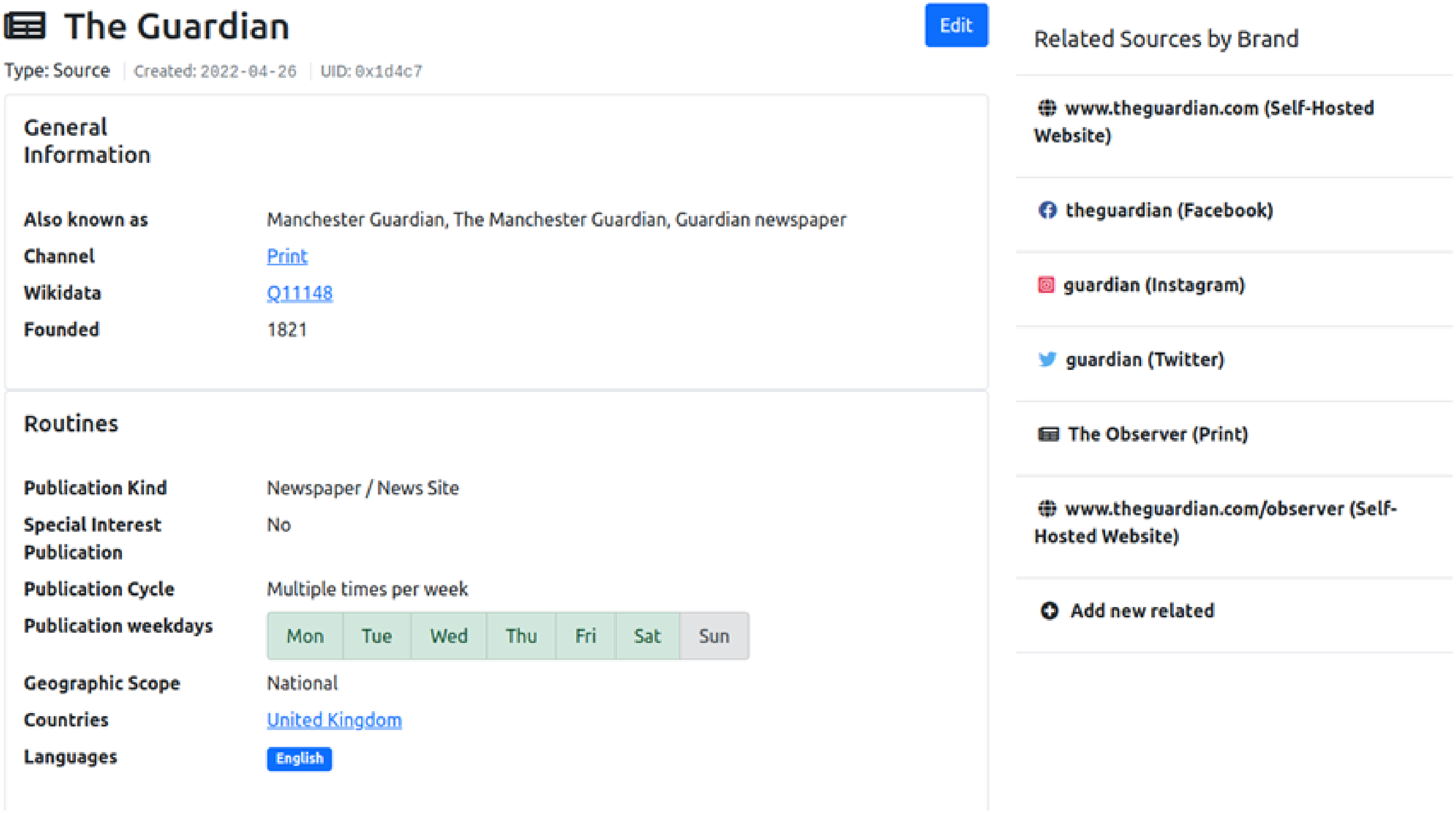
Query the inventory (example).
When a user contributes a new entry to Meteor, a questionnaire guides the user to enter the properties as listed in Table 1. After the new entry is submitted, Meteor leverages available APIs to enrich the information as much as possible 6 . Figure 2 displays the start of the questionnaire which users can complete to add a new source. The questionnaire includes various explanations and examples for each question to complete.
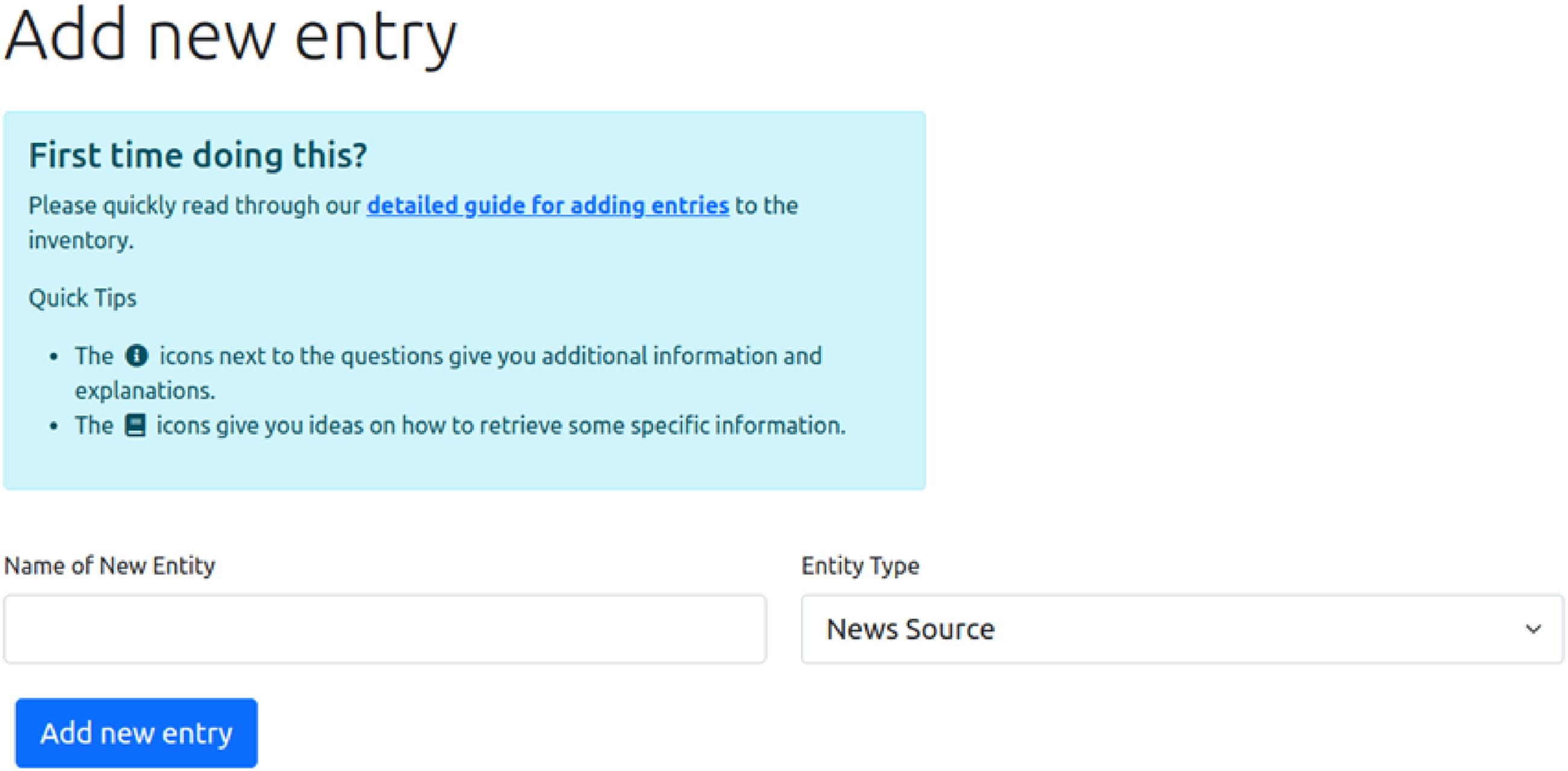
Contribute a new source.
The new entry is not automatically displayed publicly, instead it enters a review process. Reviewers with expertise in the respective area (country or source type such as alternative media) double-check the information before it becomes publicly visible.
Participation
As of now, Meteor shows over 1500 news sources from 17 countries, as well as over 300 organisations, and 17 full-text data archives. These are just the entries from an internal test period, and now we invite the community to add news sources, organisations, and data archives to Meteor.
Meteor is designed to be a platform for researchers investigating news sources in Europe. We believe that members of this diverse research community can greatly benefit from participation. By contributing to news sources and media organisations, researchers gain a better overview over their area of expertise and identify potential blind spots. Researchers can also discover data archives where full-text data are available.
Furthermore, Meteor is also a utility for teaching courses related to news media in Europe. We successfully conducted a seminar 7 for master students, where the participants compared media systems in Europe based on their contributions to the inventory. The students learned methodological and theoretical foundations of comparative research, typologies of media systems, and the current development of hybrid media systems and new information ecologies. The course materials also include a curated collection of resources that are useful for gathering information on news media in Europe (e.g. databases for subscriber counts).
Summary and outlook
With this research note, we presented a new inventory of European news sources. With an internal test period, we have already laid a solid foundation with over 1500 entries. Meteor will help researchers to rapidly find (comparable) data sources, background information about news sources, links to related full-text archives, as well as annotated media data sets if available. This will facilitate the selection, access, and work not only with sources but also with textual data. Due to the flexible structure of the database, additional meta-information can be added upon request. It is also possible to integrate newly emerged channels (e.g. Gettr).
Identifying the fundamental properties that capture the essence of news sources was a non-trivial task. Critically assessed, one could say that the scope of our inventory and the definition for included sources is already highly blurry. ‘Journalism’ is notoriously difficult to define, hence we prefer to have a fairly wide understanding of this concept. Further, media organisations have been affected by globalisation and are thus not anymore strictly separated by country borders. For example, online, audiences interact with mediated content from any country and in any language by using translation tools. Thus, at this stage, it remains to be seen how well an inventory works that still categorises sources by country. Ideally, the advantages of using a knowledge graph become evident. They allow for multiple and nested properties and therefore make it possible to account for news sources that are, for instance, operating across borders and have international audiences. Knowledge graphs can not only store complex structures but also enable browsing and querying the data flexibly.
Some properties are not easily available for various reasons. For example, while determining the audience size is straightforward for news sources using a social media profile, it may remain unknown for printed newspapers that do not publish subscriber counts. Even though there will likely be gaps in the data, we believe that this is acceptable, because we are convinced that an inventory that tries to include as much data as possible is useful for other researchers and also shows clearly where research is left to be done.
Looking ahead, ultimately, we maintain a registry that is practically useful and caters to various research interests. Meteor is designed to benefit researchers who a) investigate the output of news sources through content analysis, b) track ownership structures of media organisations, c) analyse media production logics, d) study media systems, or e) are interested in boundary phenomena such as alternative media.
Being fully aware that journalism is a living phenomenon, we seek ways to ensure that Meteor is capable of accounting for the ever-changing nature of the media landscape. In the near future, Meteor will additionally serve as a hub, where researchers can not only contribute news sources but also present their publications related to news media research, datasets, and computational text analysis tools. Researchers will be able to enter their publications and link them with news sources and the corresponding datasets. By entering their datasets and tools to Meteor, other members of the community can find their work more quickly and reuse it for further research. This also contributes to understanding which news sources have been studied frequently and which might have not received enough attention yet. Through these extensions, we invite the community to work together with us towards a more complete map of the European media landscape to untangle its hybridity.
Footnotes
Acknowledgements
The authors would like to thank Celina Dinhopl for her assistance and contributions to Meteor, as well as Marvin Stecker and Christian Baden for their constructive and helpful comments.
Funding
The author(s) disclosed receipt of the following financial support for the research, authorship, and/or publication of this article: This project has received funding from the European Union's Horizon 2020 research & innovation programme under grant agreement No 951832. The document reflects only the authors’ views. The European Union is not liable for any use that may be made of the information contained herein.
