




Abstract
This study tests how perceptions of misinformation and disinformation in one’s general news media environment relate to media trust and media consumption patterns, relying on survey data from 10 European countries. The results show that perceptions of misinformation and disinformation are both related to reduced trust in the news media. Furthermore, they go hand in hand with reduced consumption of traditional TV news, but with no changes in newspaper and (mainstream) online news use. Finally, those with stronger perceptions of misinformation and disinformation are more likely to consume news on social media and alternative, non-mainstream outlets. This pattern is stronger for those with higher perceptions of disinformation. These findings indicate that news users who distrust the veracity and honesty of the news media may turn to alternative outlets that reflect anti-establishment worldviews.
When citizens distrust the mainstream media, they have a tendency to withdraw from it and turn towards alternative sources (e.g. Müller and Schulz, 2021; Tsfati and Cappella, 2003). One reason to distrust the news media, and to increasingly use alternative outlets, could be an impression that the information reported in the mainstream media is false or even intentionally misleading. However, not all false information is the same; extant literature distinguishes between inadvertent misinformation and deliberate disinformation (Jack, 2017; Karlova and Fisher, 2013; Wardle, 2017). This is not purely a scholarly distinction; citizens may also, to an extent, distinguish between the two (Hameleers et al., 2021). The present study focuses on how perceptions of misinformation and disinformation applied to general news media coverage relate to media trust as well as the use of mainstream and alternative news sources, which we consider as a broad category of online non-journalistic news coverage, such as Tweets, blogs, or alternative online news sources reflecting (hyper) partisan views. The key aim is to comprehensively map the news diets of people who are concerned about misinformation and disinformation in the news media.
In tandem with populist discourse, traditional news media are increasingly scapegoated for misleading the people – which is exemplified by the salience of the ‘Fake News’ label used to delegitimize traditional news media (Egelhofer and Lecheler, 2019). Citizens might respond to this by seeking out information from other platforms, specifically more alternative news sources online (Müller and Schulz, 2021). At the same time, this online news environment is also argued to be particularly conducive to the spread of misinformation and disinformation (Bennett and Livingston, 2018; Tambuscio et al., 2015; Van Aelst et al., 2017). Thus, susceptibility to misinformation and disinformation and perceptions of communicative untruthfulness may be reinforced in a spiral of distrust: The more citizens perceive the (mainstream) media as dishonest and inaccurate, the more likely they are to select media content from sources that adhere less to the standards of verified, objective journalism (i.e. news shared on social media), which could in turn intensify perceptions of misinformation and disinformation. In addition to that, Zimmermann and Kohring (2020) show that those who trust the media less are also more likely to believe online disinformation. Other research has indicated that citizens in countries with low levels of polarization, populist communication, and high levels of media trust are most resilient to false information (Humprecht et al., 2020). Trust may thus be a crucial factor related to people's susceptibility to disinformed worldviews.
To better understand the consequences of misinformation and disinformation perceptions related to the news media, the aim of this paper is twofold. First, we test whether perceptions of misinformation and disinformation in the media relate differently to trust in the media. Second, we explore how different media diets and media exposure patterns of news consumers relate to different levels of perceived misinformation and disinformation. The study relies on original survey data (N = 6643) from 10 European countries and offers insights into the democratic implications of citizens’ perceptions of communicative untruthfulness.
Perceived misinformation and disinformation
The present paper discerns two types of perceived communicative untruthfulness; perceptions of misinformation; and perceptions of disinformation (Hameleers et al., 2021). Misinformation has been defined as ‘inaccurate information’ (Karlova and Fisher, 2013). Misinformation can also be regarded as an umbrella term for information that is untrue or inaccurate without being intentionally harmful or misleading (e.g. Vraga and Bode, 2020) – hereby also reflecting the more general term of ‘pseudo-information’ (Kim and Gil de Zúñiga, 2021). Misinformation can be harmful and misleading, but it does not offer a clear indication about the motivations or political agenda underlying its creation or dissemination.
Disinformation, in contrast, is defined as ‘deceptive information’ (Karlova and Fisher, 2013), ‘deliberately false and misleading’ (Jack, 2017), or the ‘deliberate creation and sharing of information known to be false’ (Wardle, 2017). Among other things, the aim of disinformation may be to change political attitudes and behaviour, demobilize citizens, bolster polarized divides, or raise political cynicism across society (Bennett and Livingston, 2018; Marwick and Lewis, 2017). In line with these conceptualizations, we regard disinformation as a more extreme and politically motivated type of pseudo-information that specifies the harmful intentions of the sender of falsehoods. The crucial difference between misinformation and disinformation is the intentional dimension central to disinformation.
In line with this theoretical conceptualization of misinformation and disinformation, we study citizens’ beliefs about news media information as misinformation and disinformation. Misinformation perceptions relate to general beliefs in the veracity and accuracy of news reporting, similar to media scepticism (see e.g. Pinkleton et al., 2012). Disinformation perceptions, in contrast, imply the more extreme belief that the news media deliberately mislead people and purposefully spread false information – an idea that resonates more with populist ideology (e.g. Mudde, 2004). Consequently, the delegitimizing ‘Fake News’ label has mostly been associated with (radical) right-wing populists (Egelhofer and Lecheler, 2019) and citizens with populist attitudes are likely to view the news media as an ‘enemy of the people’ (Fawzi, 2019; Schulz et al., 2020).
Taking this political context into account, we conceptualize disinformation beliefs as perceptions related to the deliberate nature of false information, and delegitimizing beliefs related to the honesty and neutrality of the news media (also see Tong et al., 2020). Just like ‘Fake News’ is weaponized in political discourse (Waisbord, 2018), we argue that news users can hold the news media accountable for spreading disinformation, consequentially believing that they are an enemy of the people. In our distinction between general beliefs of inaccurate and erroneous reporting (misinformation beliefs) and specific delegitimizing/weaponized perceptions about the dishonest press (disinformation beliefs), we focus on the evaluation of the news media in general. This aligns with the ways in which delegitimizing ‘Fake News’ labels are typically used to attack the mainstream or established press (Egelhofer and Lecheler, 2019). As beliefs about mainstream versus alternative outlets, or other classifications, are highly subjective and different across regions, we decided to refer to the ‘news media’ in general, which also allowed for contextual differences in what news media entailed for different people in different countries.
There are concerns that the growing doubts about the veracity and honesty of political information are associated with decreasing levels of trust in the news media (e.g. Bennett and Livingston, 2018; Van Aelst et al., 2017). This may seem intuitive; trust is an evaluation of how likely a trustee fulfils expectations by a truster (Baier, 1986; Bauer, 2014; Coleman, 1990; Hardin, 2006). In democratic societies, informing citizens reliably and correctly is the main task of the news media. A lack of trust in the news media would thus indicate that citizens do not think that the media reliably fulfil this task. This may be expressed as either an absence of trust (i.e. scepticism, or a more critical attitude towards the news media and other institutions) or distrust (i.e. cynicism, or a blanket rejection of the news media or political system; see e.g. Pinkleton et al., 2012; van der Meer, 2017). In either case, when citizens believe that the information provided by the media is largely inaccurate, or even deliberately misleading, this likely damages their trust.
There are good reasons to assume that perceptions of misinformation and disinformation are strongly associated with reduced media trust. However, in the light of their distinction based on intention, citizens may have more nuanced reasons to trust or distrust the media: Misinformation, while surely undesirable, could be seen as an ‘honest mistake’. Therefore, its negative impact on trust in the media could be weaker than the effect of disinformation, which implies the intention to mislead. The first central aim of this paper is therefore to understand how perceptions of misinformation and disinformation are related to general trust in the media. We expect that perceived misinformation (i.e. inaccurate reporting) undermines trust in the news media to a lesser extent than perceived disinformation (i.e. deceptive reporting). In line with this, we hypothesize that both perceptions of misinformation and disinformation are related to lower trust in the media (H1a); however, we expect that perceptions of disinformation have a stronger negative relation to media trust (H1b).
Selective exposure and avoidance among distrustful news consumers
In today’s European media context, citizens largely have the freedom to avoid channels that they distrust and select those they do trust. In general, trust in the media and mainstream media exposure are positively related (e.g. Tsfati and Cappella, 2003; Tsfati and Peri, 2006). This implies that citizens who distrust the media are less likely to be exposed to mainstream news sources. There is also evidence that citizens with lower levels of media trust or higher levels of media scepticism choose to follow non-mainstream, alternative news sources (Tsfati and Cappella, 2003), and specifically also social media and blogs (Fletcher and Park, 2017). Even though the causal relationship between media trust and media use is not determined, this indicates that selective exposure could be based on user’s trust in different types of media outlets.
Perceiving the media to contain higher levels of misinformation in general, however, is not necessarily comparable with encountering challenging or incongruent information. In contrast to literature on partisan selective exposure, we do not focus on the selection or avoidance of partisan news sources, but rather on the selection of mainstream versus alternative sources, irrespective of their ideological orientation. Based on previous findings on the relationship of media trust and use, we expect that those who believe that the media in general disseminate false information tend to avoid news coverage by the mainstream media. Causality could also be reversed; for example, those that are more exposed to mainstream news media may develop higher levels of trust in it. Regardless of causal order, we hypothesize that citizens with higher levels of perceived misinformation and disinformation are less likely to be exposed to mainstream news coverage (H2). For the purpose of this study, we define mainstream media as publications that dominate public opinion, are influential, and typically produced by bigger media companies. Online media can be part of the mainstream media (i.e. the websites of established news companies such as Fox News or the New York Times in the US). Alternative media, then, is understood as all online sources that are less centrally organized, and more focused on addressing certain segments of the news audience that identify less with the mainstream news institutions.
Mainstream vs. alternative media
If citizens do not trust the mainstream media, they have plenty of alternative media options at their disposal. Alternative media, in contrast to mainstream media as we defined them, are typically published online, but not by a bigger media company. Most importantly, alternative media sources offer content, opinions, and interpretations of events that are not as present in mainstream media (Haas, 2004; Harcup, 2005). Of course, not all media can be clearly categorized into either group and routines of mainstream and alternative journalists can overlap considerably (Harcup, 2005).
Previous research shows that citizens who are more skeptical of the news media’s credibility tend to seek alternative media sources more (Haas, 2004; Harcup, 2005), possibly in search of more reliable information. In reversed causal order, exposure to alternative, non-legacy outlets may increase perceptions of misinformation and disinformation as such outlets often delegitimize mainstream media (Egelhofer and Lecheler, 2019). Indeed, content analyses show that non-journalistic news coverage, such as Tweets, blogs, or alternative news sources, often contain attacks on the legacy media (e.g. Craft et al., 2016; Figenschou and Ihlebæk, 2019). We therefore focus on the relationship between consuming news from non-journalistic online outlets that offer an alternative to mainstream coverage and perceptions of misinformation and disinformation. We focus on political news as this category is associated most with the alternative or anti-establishment perspectives that are emphasized in alternative news outlets, which oftentimes express hyper-partisan or ideologically extreme viewpoints (see e.g. Heft et al., 2019). Causal order notwithstanding, we hypothesize that citizens with higher levels of perceived misinformation and disinformation are more likely to expose themselves to alternative online news sources (H3).
Perceived misinformation and disinformation may not influence media choices in identical ways. We expect that perceptions of disinformation correspond to a stronger tendency to approach alternative media outlets than perceptions of misinformation, as disinformation implies deliberately misleading news consumers. We therefore hypothesize that the tendency to (a) avoid mainstream media and (b) approach alternative media is stronger for those with stronger perceptions of disinformation than misinformation (H4).
Misinformation beliefs and trust across regions
Misinformation and disinformation perceptions differ across regions (e.g. Nielsen et al., 2020). For this reason, we focus on ‘most different’ cases with respect to contextual factors that could make misinformation and disinformation beliefs more likely – such as press freedom, perceived corruption, and overall levels of trust in the media. In the selected countries, indices of press freedom range from a strong score of 7.2 in Sweden to a poor value of 31.8 in Hungary (scales run from 0 to 100; the higher the score, the lower the press freedom, see Reporters sans Frontières, 2020). Media trust also strongly differs in our sample, as indicated by the 2021 Reuters Digital News Report. In France, only 30% trusts the news most of the time, whereas this is almost twice as high in Denmark (59%). Incorporating these regional differences, the aim of the comparative scope is to assess how universal misinformation and disinformation beliefs are across regions differing on the key concepts of interest (Przeworski and Teune, 1970). We raise the following research question: Are there regional variances in misinformation and disinformation perceptions? (RQ1).
Method
For the purpose of this study, we rely on data collected by the survey company Kantar and its partner panels in the context of a large-scale EUROPINIONS multi-wave survey (N = 6643) in the Czech Republic (N = 733), Denmark (N = 563), France (N = 776), Germany (N = 518), Greece (N = 494), Hungary (N = 586), the Netherlands (N = 1067), Poland (N = 857), Spain (N = 552), and Sweden (N = 497). The surveys were conducted as online questionnaires in the respective country languages. Light quotas were enforced to ensure representative samples based on age, gender, region, and education. Respondents participated in a total of three to seven survey waves, depending on the country. Appendix B.2 shows response and re-contact rates for all waves.
For our core variables related to media use, we asked respondents how many days in a typical week they read the country’s main newspapers, watched public and private TV newscasts, used the most visited online news websites, and saw news on the biggest social media platforms, including Facebook, Twitter, Instagram, Snapchat, YouTube, and Reddit. Usage of each outlet is measured on a scale ranging from 1 (outlet is not used at all) to 8 (seven days a week). A list of all news outlets for each country can be found in Appendix A. The selection of the suggested outlets was based on the Reuters Institute Digital News Report 2018 (Newman et al., 2021) and supplemented with additional sources and the help of experts from the respective countries. We added up the days that respondents used the specific outlets, resulting in four separate scores for TV news, newspapers, online news websites, and news on social media[1]. We conceptualized newspapers and TV as traditional mainstream media sources. The most used online news sources are often, but not always, owned and produced by larger media corporations and therefore are somewhat less mainstream on average, but by no means fully alternative. Social media is more likely to provide respondents with alternative information than legacy TV networks or newspapers; however, simply using social media does not equate to receiving news from alternative sources. Therefore, we asked respondents whether they received political news from alternative sources, that is, not established news organizations or journalists, on social media, including family and friends, acquaintances and colleagues, online connections, politicians and political parties, celebrities, comedians and satirists, forums, Facebook groups, YouTubers, and other sources. The question wording specifically asked how many days in a typical week respondents received news from these outlets and channels. While not all of these sources will necessarily contain alternative information, respondents that use these sources have a higher chance of exposure to alternative content. Respondents could answer yes or no to each question, and their total score was added up to an index. All other media variables were measured in the May 2019 wave.
Media trust was measured as the average agreement with the five statements ‘I think you can trust the news most of the time’, ‘I think you can trust news organizations most of the time’, ‘I think you can trust journalists most of the time’, ‘The news media are independent from undue political or government influence most of the time’, and ‘The news media are independent from undue business or commercial influence most of the time’ (items from Newman et al., 2021, Cronbach’s alpha = .93) on a scale from 1 (fully disagree) to 7 (fully agree). Although it can be argued that the general trust evaluations and the items used to measure independence reflect different dimensions, their high correlation shows that participants do not distinguish between these beliefs as separate constructs. The rationale to include ‘independence’ was based on the conceptualization of media trust as the belief that the media fulfils its role in society to inform the public in a truthful, honest, and independent way (i.e. independence corresponds to news coverage free of biases, which enables journalists to perform the watchdog role, see e.g. Newman et al., 2021). Robustness checks excluding the ‘independence’ indicators yield the same results – which supports the notion that independence does not affect the relations differently compared to the other indicators. Perceptions of misinformation and disinformation were measured as the average agreement on a scale from 1 (fully disagree) to 7 (fully agree) with the statements ‘The news media do not report accurately on facts that happened’, ‘To understand real-life events, you cannot rely on the news media’, ‘The news media are an unreliable source of factual information’, and ‘The news media insufficiently rely on expert sources’ for misinformation (Cronbach’s alpha = .89) and ‘The news media are an enemy of the ordinary people’, ‘The news media are deliberately lying to the people’, and ‘The news media only serve their own interest’ for disinformation (Cronbach’s alpha = .89). The items for disinformation beliefs were derived from literature that has defined disinformation as the intentional deception or goal-directed manipulation of information to serve (political) interests (e.g. Bennett and Livingston, 2018) and literature on the weaponization of the ‘Fake News’ label (Egelhofer and Lecheler, 2019). Measures of misinformation perceptions were based on the conceptualization that regards misinformation as general untruthfulness in which there is no necessary intentional dimension. Here, we refrained from explicating the ‘unintentional’ dimension as misinformation does not necessarily assume the lack of intentions (see e.g. Vraga and Bode, 2020). Appendix B.1 shows an overview of when each variable was measured in the different countries. We aimed to always use the most recent measurement.
Analytical strategy
The data were analyzed using R (R Core Team, 2016) and visualized using the packages ggplot2 (Wickham, 2016) and stargazer (Hlavac, 2018). We estimated regression models with media trust and different forms of news use as the dependent variables, predicted by perceptions of misinformation and disinformation as well as a number of control variables: age, gender, political interest, education, and left-right ideological self-placement (see e.g. Hanitzsch et al., 2018). We control for respondents’ different countries by including country-dummies in the model. Due to the high correlation of perceptions of misinformation and disinformation at r = .79, we included them in separate regression models.
We included the results of a multilevel model with countries at the second level in Appendix G as a robustness check. The substantial conclusion that can be drawn from this model is the same as for the regular regression models; effects sizes only differ marginally. Furthermore, since the media use variables are positively skewed and show some signs of heteroscedasticity, Appendix H includes the results of linear regression with log10-transformed dependent variables. The statistical significance and direction of the effects stay consistent, but the coefficients require different interpretations to estimate effects sizes. In the interest of easier interpretation, we include the results for the non-transformed dependent variables in the main study. Finally, we do not intend to make causal claims on the relationship between news media use and misinformation and disinformation perceptions. Rather, we aim to explore the media diets of participants that hold or do not hold these beliefs.
Results
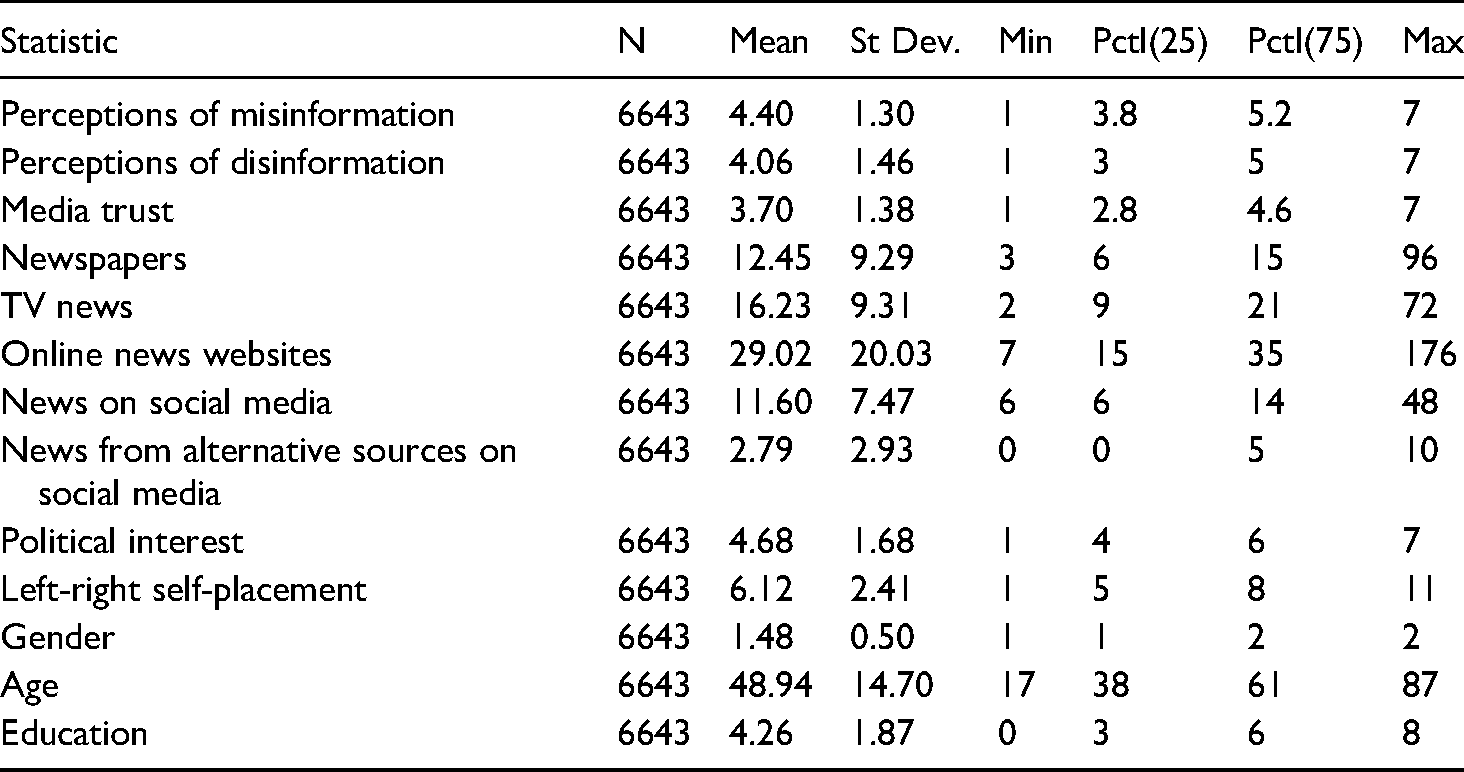
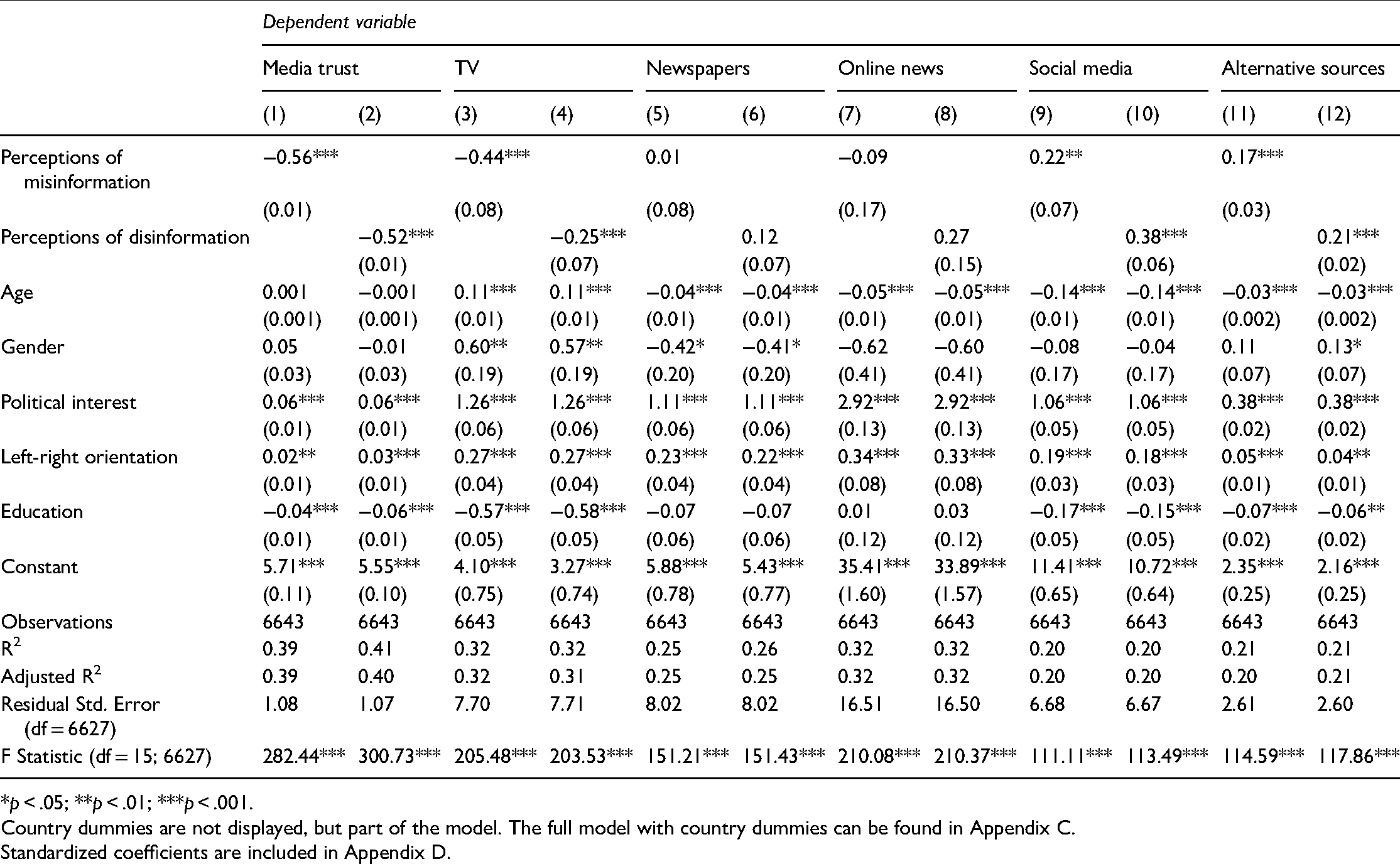
Table 1 shows descriptive statistics for all variables measured in this study. On average, citizens are more likely to associate the news media with misinformation than disinformation. Across countries, trust in the media is rather modest, with a mean below the mid-point of the scale. Table 2 shows the tests of Hypotheses 1–3. Models 1 and 2 show that both perceptions of misinformation and disinformation are significantly and strongly related to lower levels of trust in the media, which supports Hypothesis 1a. However, there is only a very small difference between the two effects, which means that there is no support for Hypothesis 1b. If we run the models separately for misinformation and disinformation beliefs, we see that the correlations between both separate beliefs and media trust are very similar (the difference in the relationship between both distinguished beliefs is also not significant). The correlation between media trust and misinformation perceptions is r = −.53, which is very similar to (and not significantly different from) disinformation (r = −.55). Hence, we conclude that perceptions of disinformation are not more related to trust than perceptions of misinformation.
Descriptive statistics.
Regression results.
*p < .05; **p < .01; ***p < .001.
Country dummies are not displayed, but part of the model. The full model with country dummies can be found in Appendix C.
Standardized coefficients are included in Appendix D.
Models 3 and 4 show that citizens with higher levels of perceived misinformation are less likely to use traditional TV news. This negative relationship is stronger for misinformation perceptions than disinformation perceptions. Model 5–8 show that perceptions of misinformation and disinformation have no statistically significant relationship with respondents’ newspaper or online news use. This may partially be explained by the heterogeneity of newspapers as a news category – which may involve both tabloid (popular) and broadsheet (quality) newspapers. However, robustness checks in which we distinguish between both categories yield similar results (although it may be argued that the categorization of outlets across regions is partially an arbitrary practice). Thus, there is only some support for Hypothesis 2: Respondents with higher levels of perceived misinformation and disinformation consume only some types of traditional media coverage less – specifically TV news. Here, it also makes no difference to distinguish between different categories of TV news (i.e. hard versus soft). Furthermore, these results offer no support for Hypothesis 4a, as respondents with disinformation perceptions are not more likely to avoid mainstream media outlets than those with misinformation perceptions.
Models 9 and 10, as well as 11 and 12, show that those with a stronger perception of misinformation and disinformation in their media environment are more likely to use social media as well as alternative media sources, that is sources other than journalists or traditional news organizations, which offers support for Hypothesis 3. These relationships are stronger for disinformation perceptions than misinformation perceptions, suggesting that in particular the idea that there is deliberately false information in the media is related to the use of social media and alternative sources, offering some support for Hypothesis 4b.
Looking at country-level differences (RQ1), we can find some noteworthy differences related to the level of misinformation and disinformation beliefs in contexts with different levels of press freedom, news trust, and perceived corruption (see Appendix C). To illustrate these regional differences: In settings where press freedom and media trust is higher, such as Denmark, average perceptions of misinformation (M = 3.76, SD = 1.22) and disinformation (M = 3.30, SD = 1.41) are substantially lower than in cases where press freedom and media trust are low, such as Hungary (misinformation: M = 4.81, SD = 1.24, disinformation: M = 4.42, SD = 1.32). This is reflected across all regions (see Appendix C for detailed country-level comparisons) and also holds when we look at separate indicators that should offer a more suitable opportunity structure for misinformation and disinformation beliefs, such as overall levels of media distrust or perceived corruption.
As another example focusing on distrust as a contextual factor, we take France as point in case. Although the remarkable high levels of misinformation (M = 4.91, SD = 1.19) and disinformation (M = 4.51, SD = 1.38) in France deviate substantially from those of neighboring countries (i.e. Germany), we can explain these high levels of misinformation and disinformation beliefs in the context of high media distrust (30%). These comparative findings show that contextual variances related to the (perceived) trustworthiness and independence of the news media can make misinformation and disinformation beliefs more or less salient: When there are structural issues with the trustworthiness and independence of the news media in a country, people are also more likely to evaluate the news media as peddlers of misinformation and disinformation.
Discussion
The present paper aimed to provide insights into citizens’ perceptions of misinformation and disinformation in the news media and how these perceptions relate to general levels of media (dis)trust and exposure to mainstream versus alternative media sources. Our key findings indicate that general levels of distrust in the media are related to both perceived misinformation and disinformation. Perceptions of the media purposefully spreading false or misleading information do not have a stronger negative relation with media trust than the perception of unintentional misinformation. However, media trust relates differently to news media use than perceptions of misinformation and disinformation, with media trust being generally associated with simply increased news media use, including social media (except for the use of alternative sources), whereas increased perceptions of misinformation and disinformation are associated with a somewhat increased use of social media and alternative sources, but a slightly decreased (TV) or unchanged (newspapers and online news) use of traditional news media. A first implication is therefore that we might need to distinguish between perceptions of misinformation and disinformation on one hand and general levels of media trust on the other hand to understand how news consumers perceive the trustworthiness and veracity of information.
Our findings are also in line with the relationship between general media trust and media consumption identified in earlier research: the less people trust the media, the less news they consume (e.g. Tsfati and Cappella, 2003; Tsfati and Peri, 2006). To a limited extent, this is also the case for perceptions of misinformation and disinformation. However, in line with research on media credibility (Jackob, 2010; Prochazka and Schweiger, 2019), higher levels of misinformation and particularly disinformation correspond to increased consumption of news from alternative outlets (see also Tsfati and Cappella, 2003, who find this for reduced media trust). This finding also resonates with the conclusions of Müller and Schulz (2021), who found that people with populist perceptions consume more news from alternative outlets. The stronger relationship we find between disinformation perceptions (as compared to misinformation perceptions) and increased use of alternative sources may be due to ideas about disinformation being rooted in populist worldviews, whereas misinformation perceptions relate more to the perspective of critical news consumers.
The country-level differences reveal that some regions offer a more receptive opportunity structure for misinformation and disinformation perceptions than others. Press freedom makes people less likely to doubt the news media’s honesty and accuracy, whereas distrust in the news ecology stimulates misinformation and disinformation beliefs addressed to the news media. These findings have practical recommendations. It shows that a potential remedy to increasing levels of relativism towards factual information and perceived distrust in the credibility and honesty of the press may be remedied by focusing on structural factors. A stronger independent press and restored trust in the media’s role to inform society in an independent, honest, and transparent manner may make citizens less vulnerable to attacks on the legitimacy of the press.
In line with research showing that the active avoidance of attitude-inconsistent information is less likely than the approach of attitude-consistent information (Garrett et al., 2013), our findings indicate that misinformation and disinformation beliefs may – to a limited extent – be associated with alternative media, but not necessarily with the active avoidance of all legacy media. This may have important democratic implications. In some versions of an ideal-type deliberative democracy, citizens are expected to engage in cross-cutting news selection and rely on the news media to offer objective information that is disseminated without the intention to deceive. As long as the media provides this type of information, excessive levels of distrust may weaken the media’s ability to inform citizens. Our findings indicate that misinformation and disinformation perceptions are not associated with decreased media use across the board, but with more exposure to sources that are less likely verified and monitored. The causal direction of this relationship is unclear; either those who think that misinformation and disinformation is common to seek out alternative sources or those who consume news from alternative sources are more likely to believe that misinformation and disinformation is common. The former might be problematic; research by Zimmermann and Kohring (2020) also shows that those who distrust the media are more likely to believe disinformation. At the same time, a healthy scepticism towards information from the media is desirable from a democratic perspective, especially when there are reasonable concerns about a media systems’ quality. Under this assumption, citizens turning away from media sources they do not trust and seeking out alternatives could also be considered a positive outcome. It is noteworthy that less demanding models of the media’s role in a democracy would allow for more leeway in both directions: Representative democracy does not necessarily require all citizens to be highly informed about political matters (e.g. Strömbäck, 2005) and may thus be able to withstand a certain number of citizens that are overly distrustful or trustful towards the media.
Despite offering new insights into how perceptions of misinformation and disinformation can aid relate to media preferences, the present study has specific limitations. We relied on self-reported measures of media use. Future research could incorporate, for example, observational measures or connect media use measures to fine-grained analyses of media content. Results may also be more nuanced when using multi-dimensional measures of media trust (e.g. Prochazka and Schweiger, 2019; Kohring and Matthes, 2007). We also rely on rather general measures of (news) media use. Due to the complexity of classifications across various media systems, we did not take into account whether the relationships are different when we compare tabloid or popular newspaper use to quality outlets, or entertainment ‘soft’ news to traditional ‘hard’ news formats. This may even be more problematic for the conceptualization of ‘alternative’ news media, for which an overarching definition that acknowledges contextual differences is lacking (e.g. Heft et al., 2019). Future research may rely on a more refined measure of media use that makes a distinction between formats that are more or less likely to cater to the preferences of a (dis)trusting news audience. We also note that the measures we used for trust in the media, misinformation and disinformation were based on literatures and conceptualizations that have not reached full consensus (yet). Hence, misinformation beliefs could also explicitly refer to the lack of intentions, although it is up for debate whether unintentional untruthfulness (misinformation) should always explicate the lack of a political or strategical agenda. Future research may assess the robustness of our conceptualization using different formulations (i.e. the news media are unintentionally reporting inaccurately).
Although our empirical evidence does not allow us to fully comprehend the causality of the relationship between perceptions of misinformation and disinformation and media exposure, we believe that selection and avoidance of established and alternative media, on the one hand, and levels of perceived misinformation and disinformation, on the other hand, could reinforce each other in a reciprocal relationship, possibly in a spiraling mechanism of distrust and anti-established news consumption.
Footnotes
Authors’ Note
Dr Michael Hameleers (PhD, University of Amsterdam) is Assistant Professor in Political Communication at the Amsterdam School of Communication Research (ASCoR), Amsterdam, The Netherlands. His research interests include populism, misinformation, framing, (affective) polarization, and the role of social identity in media effects.
Funding
The author(s) disclosed receipt of the following financial support for the research, authorship, and/or publication of this article: This work was supported by the European Research Council and the data collection was part of the EUROPINIONS project.
