




Abstract
This article focuses on the ambiguous ideological work of citizen-produced humor in protest. Using the case of the 2017 Romanian anti-corruption protests as empirical data, the article shows how humor can simultaneously signal grassroots creativity and resistance to power structures, and reproduce conservative gender and class hierarchies. Unlike other types of texts, humor presents itself as an innocent and light message, absolved of the need for critical scrutiny. However, protest studies need to engage in a more nuanced way with the ideological articulation of democratic politics via protest humor by asking not only how humor helps protest communication, but also how it achieves shared enjoyment, for whom, and to what consequences for the ideological articulation of democratic politics. The article concludes by proposing that researcher reflexivity can afford a new sensitivity to the ambiguousness of protest humor.
Introduction
This article focuses on the ambiguous ideological work of citizen-produced humor in protest. While generally scarce, scholarship is often attracted to the positive contributions of humor to collective mobilization: challenging power, contributing to the creation of a collective identity, and amplifying protest. The oppressive effects of humor receive a reference in passing at best. This treatment echoes Billig's (2005) criticism that the study of humor is often biased towards the positives, while too easily dismissing its negatives.
Using the case of the 2017 anti-corruption protests in Romania, this article foregrounds the symbolic violence and conservative effects of protest humor. Grassroots political jokes have not only been a staple of the political culture in Romania, but also an individual “quiet protest” during the communist history of the country (Davies, 2017). Political humor has continued after Romania transitioned to a democratic system, moving to the public realm in the form of satirical shows or newspapers. Yet, while the political culture of a place inevitably colors the format and content of humor, protest communication has become transnational. This makes the discussion of the Romanian case of interest to the analysis of protest humor in other political cultures.
This article takes a critical stance on the liberatory and empowering functions of protest humor. However, it foregrounds the disciplinary and conservative dimensions of protest humor in the empirical case. It draws explicit attention to how researcher reflexivity can help balance ideological positivism in the study of humor. The article thus starts with a theoretical discussion of humor and its role in protests. After introducing and explaining Billig's (2005) ideological positivism critique, this briefly describes the background of the empirical case and the research design. The findings first showcase the reading of protest humor as grassroots criticism of political power, moving on to exposing the disciplinary and conservative work that the same texts perform. This brings forth the ambiguity of humor's ideological work, illustrating its usefulness as a framework for analyzing protest communication.
Humor in protest
While often present in protest, the study of humor remains limited (Guenther et al., 2015). With the exception of the 2007 special issue of the International Review of Social History which takes a historical perspective to this topic, articles and book chapters are scattered across different disciplinary publications. When explicitly considered, protest humor is often approached as a form of “liberatory politics” (Holm, 2017: 15), with scholarship emphasizing humor's role in challenging the distribution of power in society (Bozzini, 2013; Bruner, 2005; Davies, 2007; Salmi-Niklander, 2007). Often taking the Bakhtinian perspective on carnival as a temporary moment of freedom, such studies of protest humor focus their analysis on the subversion of social norms and hierarchies. Parody and satire, particularly popular in the political realm magnify injustice, incompetence, and oppression, reclaiming grotesque, humiliating, and vulgar insults to dismantle hierarchies.
Protest humor can also take on a framing role, communicating about the cause and helping with the claims-making in collective action. By provoking laughter, it can make protests accessible to different audiences, either by presenting the cause in simple and catchy terms, or by “relax[ing] and engag[ing] audience members in a way that may allow them to hear a new message” (Kutz-Flamenbaum, 2014: 298). The framing of the cause and its opponents via protest humor is also intertwined with the creation and maintenance of a collective identity for protesters (Fominaya, 2007; Guenther et al., 2015; ‘t Hart, 2007). Laughing at the same jokes can create the feeling of a community and provide long-lasting, iconic symbolic resources for protest (Fominaya, 2007; Pizzolato, 2007). Additionally, the light nature of humor can create new opportunities for hard-to-reach groups’ participation (Graefer et al., 2019). This is even more so in digitally-mediated contentious collective action, as humor is more spreadable online (Jenkins et al., 2013), and as such, potentially mobilizing “young people, who may be inattentive to mainstream media but who are otherwise “wired” (Grabosky, 2016: 396; also Kutz-Flamenbaum, 2014).
Finally, protest humor is a form of “image events” (DeLuca, 1999) attracting news coverage. While most protest humor is spontaneous, organizers can also use it strategically, asking protesters to bring their own funny poster or even providing such templates themselves. Activists are often aware of the power of humor to trigger attention and publicity to their cause (Sombatpoonsiri, 2015: 96), actively encouraging the production and dissemination of humorous messages during face-to-face activities and events.
Yet, the impact of protest humor remains difficult to assess (Bozzini, 2013; Davies, 2007). Humor can misfire, jokes can be misunderstood, and people can be alienated from the cause. Some studies warn about the ambiguous nature of protest humor, which can simultaneously “contest and confirm normative assumptions” (Graefer et al., 2019: 172). However, overall empirical research on protest humor often celebrates its potential as a public voice or an enabler of civic action against power structures. This may be the result of a selection bias, as most of the research consulted for this literature review examines protests with liberal democratic agendas. In such contexts, the oppressive or conservative sides of protest humor can easily be brushed to the side and addressed as recommendations for future research (Bozzini, 2013; Daǧtaş, 2016; Fominaya, 2007; ‘t Hart, 2007).
The ambiguity of political humor
In provoking laughter, political humor often appears as overwhelmingly positive (Holm, 2017; Pickering and Lockyer, 2005). While a comprehensive review of the different approaches to humor is beyond the scope of this article (e.g. Kuipers, 2008), humor has traditionally been theorized through the superiority, relief, and incongruity frameworks. Superiority theory suggests humor makes us feel good about ourselves by laughing at the failures of others. The relief theory sees humor as a mechanism of coping with anxiety and frustration by laughing at authority or rules. Finally, the incongruity theory focuses on how humor is generated by first setting some expectations, then creatively vexing them.
An important aspect of studying humor is clarifying what makes a communicative act funny. Holm (2017) distinguishes between humor as a feature of the communicative act and laughter as a subjective reaction to it. Humor is inscribed in the text through a variety of conventions, while their recognition as funny is an important (though not exclusive) dimension for the reaction they provoke. The interaction between the content of the utterance, its performative dimension, and the context within which it is being uttered contribute to the production of humor. In terms of content, humorous messages can entail the creation and frustration of an expectation or can be provoked by deriding someone or something. Humorous communicative acts also have to be signalled as such via cues telling others what comes is a joke (e.g. the ritualized practices of stand-up comedy). Finally, the context within the message is generated and the symbolic repertoires it draws upon also participate in the production of humor.
Not all humor lands well. Racist or homophobic humor, for instance, often aims at difference or inclusivity as a normative framework in order to reinforce conservative values and identities (Billig, 2001). Such ‘disparagement humor’ re-affirms group identities by making fun of others while deflecting criticism by claiming it is ‘just a joke’ (O’Connor et al., 2017: 568). Revealing “the line in the sand between offensiveness and humor” (Pickering and Lockyer, 2005: 12), ‘disparagement humor’ draws attention to the relation between the ambiguity and the politics of humor. As Pickering and Lockyer (2005: 14) put it, “humor is only possible because certain boundaries, rules, and taboos exist in the first place”. While challenging these boundaries, rules and taboos can be an act of resistance to power, it can also be an act of oppression, by ridiculing “someone's sense of themselves as individual subjects, or […] the sense of social and cultural identity of a particular social group or category” (Pickering and Lockyer, 2005: 4). A joke can thus be simultaneously empowering and disparaging.
This ambiguity is also at play in political satire and parody, which use ridicule and mockery to produce political criticism. Reminiscent of carnivalesque challenges to power, political satire and parody are often celebrated for making politics accessible and thus enabling new forms of participation. Yet, their potentially damaging effects on political life (for instance, by generalizing cynicism, exclusion, and mistrust) remain widely debated (O’Connor, 2017). As Holm (2017: 27) puts it, political satire and parody are thus approached as “either inevitably trivialising or inherently subversive”. Political humor is thus ambiguous, “used to unify as well as divide” (Meyer, 2000: 328). To some extent, this stems from political humor's overlapping rhetorical functions: it affords identification between speaker and audience and helps to make the message memorable, while also subtly enforcing specific sets of social norms and targeting opponents.
Humor as disciplinary and conservative
The study of humor gravitates towards its positive social functions, while its destructive side is often brushed to the side. Billig (2005) argues that this is a form of ideological positivism: a preference for focusing on the benefits and positive sides of humor on the part of researchers.
Humor that involves laughing at someone is a learned, social act. Individuals are not only taught what to laugh at, but also that the break-down of the hegemonic codes of social behavior will be sanctioned. Thus, the act of laughing at someone also disciplines the individual by signalling that trespassing the codes of acceptable social behavior will be sanctioned. Being laughed at in such situations is experienced as frustrating and annoying. Furthermore, when laughing at other people, the moral duty of empathy with them is temporarily suspended in favor of hedonistic pleasure in their troubles: “perhaps enjoyment, not empathetic embarrassment may be a major reaction to watching the embarrassment of others” (Billig, 2005: 227).
Analytically focusing on the disciplinary side of humor foregrounds the question of how protest humor participates in the reproduction of social order. As a form of contentious action, protest not only challenges the status quo, but is also a (temporary) disruption of everyday life. Where ideological positivism foregrounds humor as rebellious, attention to its disciplinary dimension draws attention to its complicity with the normative order. Importantly, the two can coexist. Billig notes that while joking can be aimed against those in power, “a feeling of rebellion and an enjoyment of humor that transgresses social demands do not necessarily equate with a politics of rebellion” (Billig, 2005: 209). This is an important warning for the study of humor in protest, prompting researchers to always be on guard against their own tendency to focus on the subversive dimension of protest humor. Informed by Billig's arguments, protest humor is approached here with an eye to its disciplinary and conservative potential. However, the article does so by acknowledging the ambiguity of humor, embracing the idea that humor should not be reduced “to a single function or meaning” (Kuipers, 2008: 389).
Humor in the anti-corruption movement in Romania
In 1989, Romania's political regime changed from communism to democracy. Since then, the political culture has embraced ideals of citizenship and democracy, preserving a presidential model where power is concentrated in the hands of the party/country leader. Against endemic corruption, anti-corruption and incompetence have become over-arching political frames among an increasingly active citizenry (Abăseacă, 2018).
In January 2017, against the background of discontent with the government's attempts to decriminalize corruption, citizens across the county took to the streets to protest. Surprisingly, the protests were not confined to the capital or major cities, spreading across smaller towns loyal to the ruling party and generally passive. Citizens took to the streets in large numbers weekly for the first few months, then sporadically throughout 2017 and 2018.
The political targets of the 2017 anti-corruption protests
The main target of protest humor was the ruling party (represented by its president, the government, and its political allies). The Social Democrat Party (PSD) was in power at the time, under the leadership of its president, Liviu Dragnea. A controversial character with previous convictions for fraud, Dragnea was still under criminal investigation for other acts of corruption. By July 2017, while his party was in power, the Romanian anti-corruption unit formally opened a new criminal investigation of Dragnea. 1 In November 2017, a new PSD government was sworn into office. Within days, the new government announced its intent to amend the legal framework on the prosecution and punishment of criminal offenses. Among these changes, the provision to decriminalize acts of corruption under 40,000 euro would have exonerated Dragnea of the new corruption charges.
Announced on January 24 by Justice Minister Florin Iordache, the proposed changes not only drew the ire of the Romanian president and the anti-corruption unit, but also of many citizens. On January 29, Romanian media reported that around 90,000 citizens protested these changes across the entire country. Yet, on January 31, the legal amendments were nonetheless passed by the government through an emergency ordinance (known as OUG13/2017). To add insult to injury, at the subsequent press conference, Iordache refused to take any question on these changes – constantly asking journalists for the “next question”. As we shall see next, this transformed Iordache into a preferred butt of the joke during the protests.
Within hours of the news about OUG13/ 2017 spreading on social media, citizens took to the streets, in spite of the cold winter night (another recurrent reference in protest humor). In Bucharest, they gathered in front of the Parliament building, chanting “By night, like thieves” (referring to the passing of the emergency bill during a late evening government meeting). On February 5, the Prime Minister nullified OUG13/2017 and a few days later, the Minister of Justice resigned. The protests, however, continued daily. What followed was a mouse-and-cat game, with the government attempting to re-introduce these laws in different formats and protesters returning to the streets.
Methodology
This project focuses on the protest humor used during the first wave of protests (January 31 – February 15, 2017). Data was collected from photographs of protest circulated via:
various online archives (put together by both bloggers and news media, such as https://www.lozinici.ro, http://www.ziare.com, and http://www.artofprotestro); Instagram. With the help of 4 K Stogram, I searched for and saved Instagram posts with hashtags popular during the early stage of the protests: #altaintrebare, #coruptiaucide, #neamsaturat, #romaniatrezeste, #romaniainstrada.
From these different sources, I have selected around 220 images of humorous posters used during protests (some images contained more than one poster) during February–April 2017. To identify the posters, I followed Palmer's (1994) view of humor as interactional and relied upon my knowledge of Romania, as well as my understanding of the protests informed by a month-long fieldwork in Romania (summer 2017), interviewing protest organizers and speaking to civil society representatives about the use of social media during the protests. My native language skills and larger politico-cultural knowledge (having lived in Romania for approx. 23 years and preserving social ties over there) helped assess whether a poster could be perceived as humorous and why. I approached humor as an aesthetic quality of the text, “whose presence can, in most instances, be agreed upon within the context of shared cultural conventions” (Holm, 2017: 19). Even though I did not appreciate the joke, I could still explain what made it funny within the immediate political and larger cultural context.
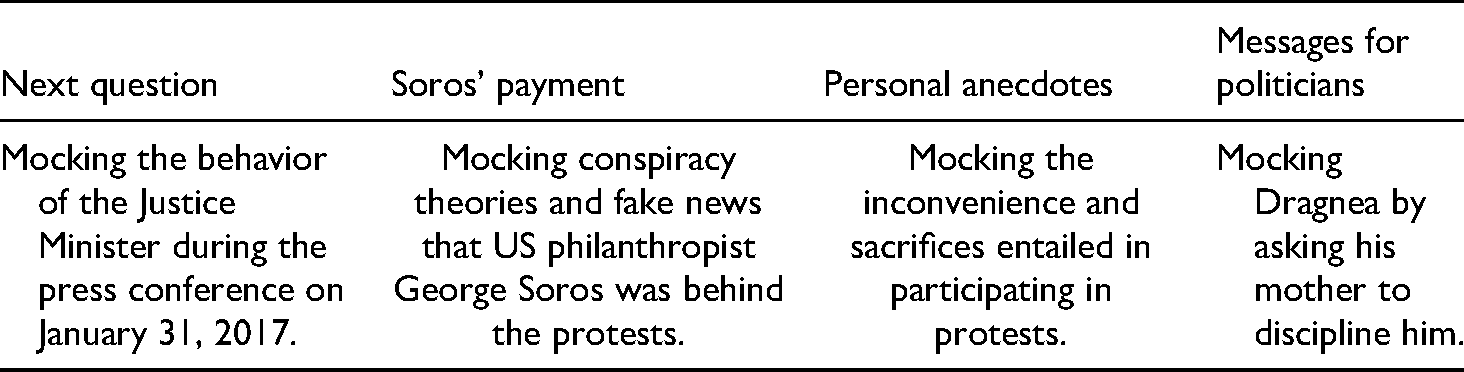
The analysis started with clustering posters in an inductive manner, looking for similarities in terms of their target (what/who they were making fun of) and format (how they delivered the punch) (see Table 1). Posters in each cluster were subsequently analyzed by focusing on: what made them funny; how they framed politicians; and, how they referenced the protesters. This stage was informed by discourse analysis principles, paying attention to the three layers of a text: content, format, and relationship to various contexts (i.e. Romanian politics; the protests).
Overview of the clusters of humor.
The researcher & ideological positivism
To foreground the danger of ideological positivism in studying protest humor, this section engages with the researcher's own journey to the analysis of this data. As a form of reflexivity, this engagement clarifies how “the researcher is part of the researched and shares the participants’ experience” (Berger, 2015: 219). In qualitative research, reflexivity supports transparency in analysis and interpretation, drawing attention to how “meanings are made rather than found (Mauthner et al., 1998)” (Mauthner and Doucet, 2003: 414).
As a researcher studying grassroots mobilization, the first wave of the 2017 anti-corruption protests piqued my professional interest. News of the protests, pushed by friends and acquaintances living in Romania, had flooded my Facebook wall. This content was exclusively supportive of the protesters’ diagnostic and prognostic frames, eventually bringing me to one of the Amsterdam protests organized by the Romanian diaspora in the Netherlands (my current country of residence) in February 2017. At the site, the first thing I noticed was the creativity of handwritten and printed posters brought along to the protest. Yet, most protesters also seemed to have brought along a flag, or drawn it on their poster. I generally shy away from displays of patriotism and national identity, even though I can recognize their communicative functions in the context of a diasporic protest seeking coverage from local media. During the protest, I also became uncomfortable with the swears and threats on some of the signs.
This set me on a path of ambivalence: I admired the dedication and the energy of the citizen organizers and participants, while remaining uneasy about the display of national symbols and the symbolic violence of some protest posters and chants. This made me question how my own position was influencing my resonance with, and interpretation of, protest humor, bringing me to Billig's ideological positivism critique. The findings section reflects this ambivalence, showcasing how reflexivity can keep researchers alert to ideological positivism in the study of protest humor. The first section reads the posters as a creative grassroots criticism of the political regime. The second shows how protest humor functions as a conservative force, restoring class and gender hierarchies and legitimizing violence in the political space.
Creative resistance: Protest humor as a symbol of democratic criticism
A poster is a tangible and visible representation of individual grievance. Collectively, protest posters transcend the individual, signalling grassroots criticism and participation (Holm, 2017). My initial impression that no two posters were the same was solidified while collecting the data set for this article, prompting an appreciation of the posters as an expression of agency and creativity at the political grassroots.
Posters combined different formats and cultural resources, re-appropriating them to the political context in order to spur laughter (see Figure 1). Half of them were handwritten; the other half were printed. Most had a text or text-image structure. A few were elaborate, photoshopped collages or three-dimensional installations. Some used templates drawn by artists and shared online for anyone to use. Yet, even those were often tweaked to create a variation on the same theme.
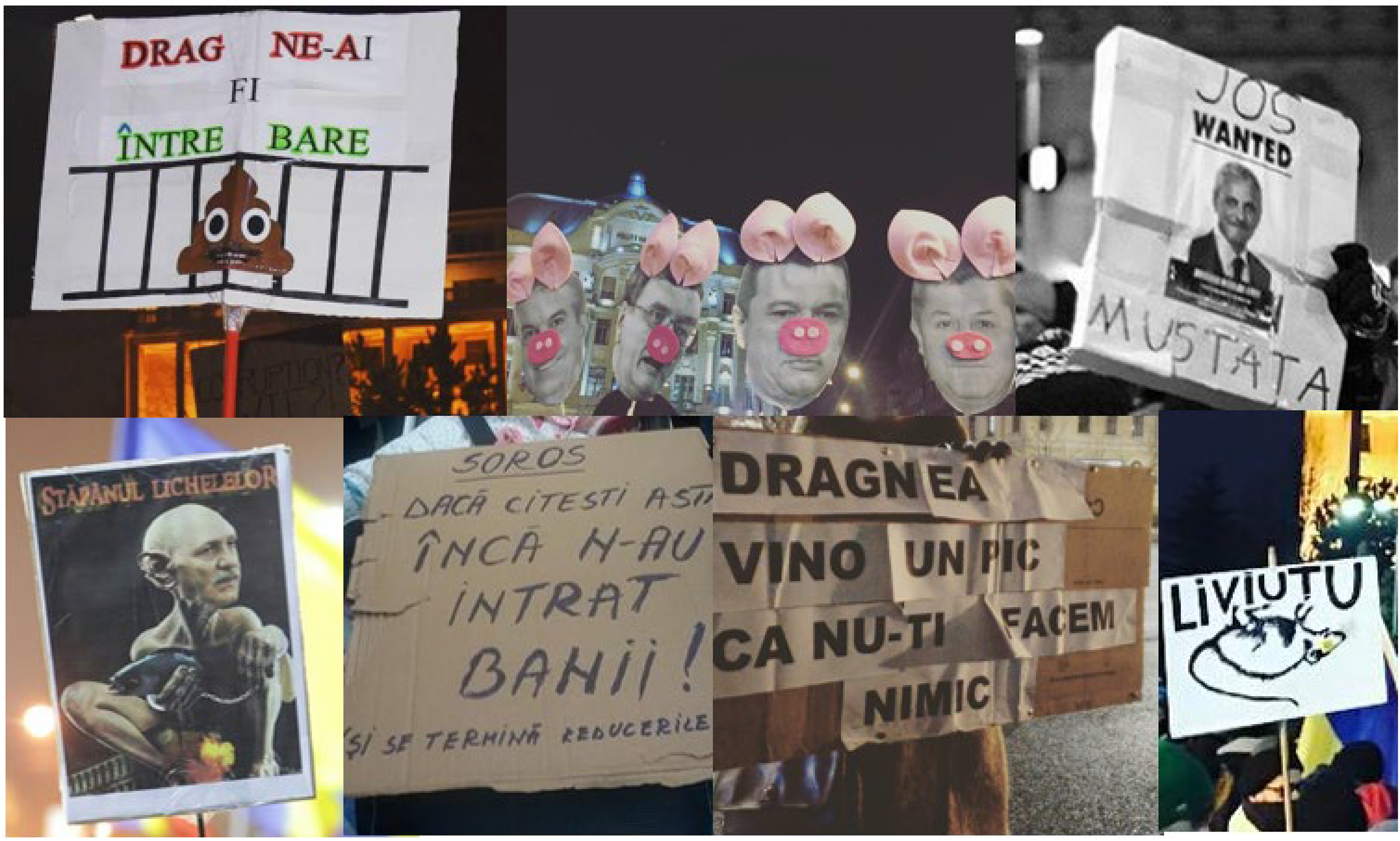
Diversity and creativity in humorous posters.
Creativity was also signalled through the format and content of humor. The posters used knock-knock jokes, husband/ wife jokes, nursery rhymes, slogans (or lozinci, the Romanian term for the communist wooden-language propaganda), puns, anagrams, curses, sayings, national stereotypes, religious scripts, classifieds, and culture jams. In some cases, the incongruity between the format and the political context created a humorous effect. For instance, one poster transformed the saying “Banii sau Viaţa” (translated as “your money or your life” – a common line in Western films, incorporated into the Romanian cultural repertoire as a comic, yet friendly way of making a request) into “Banii, Viaţa sau Mustaţa” (“your money, your life, or your moustache”) – a reference to the moustache of PSD leader Dragnea. By adding the moustache to an already known saying, the poster crafted a trivial yet personal imposition on a powerful politician, with the comic effect compounded by the rhyme between ‘viaţa’ and ‘mustaţa’.
In other cases, apolitical content was appropriated to criticize the government. One poster mixed a religious script with Iordache's (in)famous statement “next question”. The religious script consists of a ritualistic turn-taking preparing believers to be cleansed of their sins. The priest asks the parishioner “Do you give up the devil” and the parishioner responds “I do”. This script is re-written as turn-taking sequence between “the People” and Iordache. Furthermore, by changing the letter g to c, the name Dragnea is altered to include the Romanian word for “devil” (a reoccurring association in the data set). Thus, “the People” ask Iordache “Do you give up the devil/ Dragnea?”, while Iordache deflects the answer by saying “Next question!” This portrays the PSD leader as the devil, while the Justice Minister's failure to abide by the conventional script positions him as the devil's servant and the butt of the joke.
Finally, the creative medley of (seemingly) global cultural resources further adds to the seductive framing of protest humor as a positive phenomenon (see Figure 2). As in other recent protests in Turkey and Bulgaria (Daǧtaş, 2016; Kaptan, 2016; Koycheva, 2016), protesters used Romenglish (the intentional mix of Romanian and English) and various international cultural resources, placing “[the] protest both within a fairly contemporary global cultural framework and a very local one with historical precedents” (Koycheva, 2016: 243).
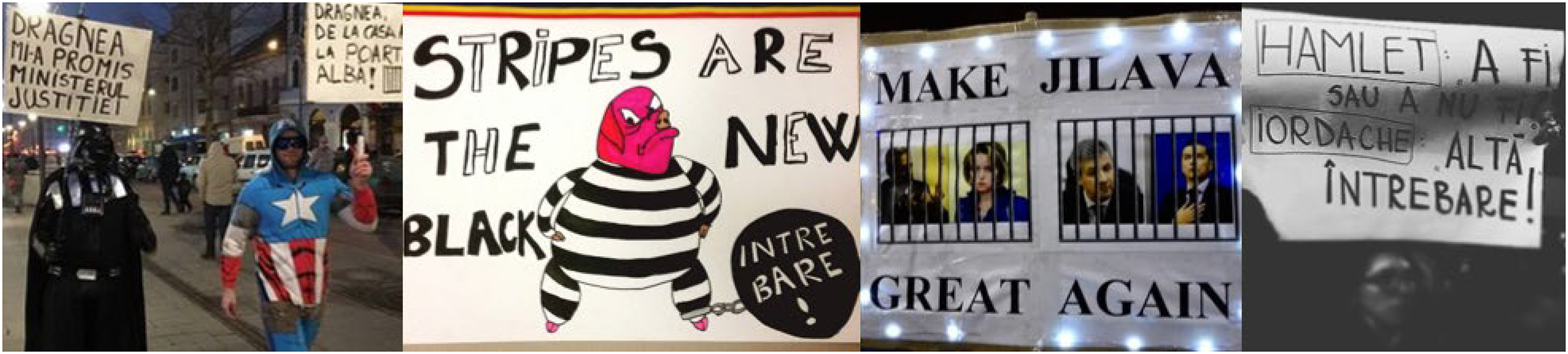
Re-appropriation of global cultural resources in protest humor.
Restoring hierarchy: Protest humor as a conservative force
While the focus on creativity was seductive, my ambivalence on some aspects of protest humor deserved more attention. This ambivalence was rooted in my middle-class sensitivity, favoring discussion and debate over threats or insults. My fieldwork in Romania a few months later deepened the awareness that, in spite of their intensity and numbers, the protests did not represent the majority of the electorate. This prompted me to look deeper into the exclusionary dimensions of these posters. This section further explains how protest humor also functioned as a conservative force, restoring class and gender hierarchies, and legitimizing violence in politics.
The humor in the data set re-constructed class-based hierarchies. As a contributor to the construction of a collective identity for protesters (Fominaya, 2007; Guenther et al., 2015; ‘t Hart, 2007), protest humor participates in the construction of the symbolic boundary between “us” and “them”. The uproar caused by the government's attempt to decriminalize corruption was rooted in a larger ideological rift in Romanian society. My own fieldwork, as well as other commentators, suggest protesters were mainly drawn from the young, middle-class, professional/ entrepreneurial class (Adi and Lilleker, 2017; Poenaru, 2017). Protesters often took a technocratic view of politics informed by a corporatist focus on the efficiency of decision-making. To them, Dragnea, the government, and PSD were not only corrupt and incompetent, but also communist—a charge with historical depth in post-communist Romania, silencing criticism to the free market economic model (Abăseacă, 2018; Velicu, 2012). After all, the politicians targeted by protesters were ruthless businessmen who have made their fortunes by exploiting the opportunities of unrestrained and unregulated capitalism (Voinea and Delcea, n.d.). It was their mix of populism (e.g. increasing pensions even though this is unlikely to make a real difference) and corruption (e.g. misusing and dilapidating publicly funded contracts) that marked them as “communist”.
The posters in the data set echoed this middle-class and corporatist ethos through the use of specific joke butts, transnational cultural resources, and bilingualism (further discussed in a different article). One cluster consisted of personal anecdotes ridiculing and hyperbolizing the ideological rift within the family caused by one's participation in the protests. Such anecdotes created incongruity by juxtaposing political-ideological divisions to family life. “Thank you, mother, for voting for them” read one poster. “Yes, mother, you were drunk [when you voted for them]” read another. Older family members became proxies for the PSD's supporters, as, at the time, the party's electorate consisted of older (mostly retired and living off a state-provided pension) and small towns/ rural voters (in the 2016 elections, PSD had obtained 45% of the votes for the Parliament). During my fieldwork, I was often told that protests were breaking families apart: where younger generations were taking to the streets, their (often retired) parents and grandparents who supported the PSD (also Mutler, 2017). Such protest humor depicted the PSD's electorate as politically inept and turned them into the butt of the joke.
This image of the inept PSD-supporter also appeared in posters re-using the middle-class critique of fake news and conspiracy theories as riding on people's stupidity. For example, a sub-set of the posters played upon one such conspiracy theory claiming the U.S. philanthropist George Soros was paying people to go out to the protest. One poster ironically asked Soros to wire the money as the protester had showed up on the streets; another seemingly informed Soros participation came free of charge for that night. The posters were funny only when their reader could understand and empathize with the inter-generational and class-based ideological conflict within which they were rooted. Such messages reinforced a sense of collective identity among supporters, but also disparaged the opponent's supporters as dogmatic and stupid.
Other protest signs reproduced gender hierarchies. In such instances, humor re-legitimized patriarchal understandings of sexuality and womanhood. For instance, a sub-set of posters re-attributing Trump's infamous words “grab them by their pussy” to PSD's leader Dragnea. In one poster, Dragnea was depicted as uttering these words to (the goddess of) justice. In another, the words “Don't grab her by the DNA!” function as a warning to the politician. 2 The reader is invited to read them in a critical register only to the extent that they magnify Dragnea's disregard for social norms. The reference to the physical abuse of women and the implied taboo on female sexuality (broken through the use of the word “pussy”) remain consistent with a culturally conservative context where street harassment of women is common and attitudes towards raping women often exonerate the man. Billig(2005: 209) points out that while some forms of humor may appear rebellious, “the consequences of such humor might be conformist rather than radical”. The use of personalization (justice as a woman/ goddess) makes it, perhaps, easy to dismiss the gendered violence entailed in these words as the target is not a “real” woman. The very presence of the protester holding this sign acts as a reminder that people will eventually hold politicians accountable for what they say and do.
While disciplining politicians, the humorous effect also disciplines women. The gendered violence implied is never directly deconstructed or problematized, but merely used as a light reference to draw attention to something deemed as way more serious or important. The abundant use of sexuality in curses and swears in the data set supports this reading. In the Romanian cultural repertoire, swearing revolves around the use of sexuality as a form of punishment inflicted on women. In protest humor, this use of sexuality ridicules politicians’ bodies or citizens’ (alleged) powerlessness. “[R]iddled with both transgressive and conservative tendencies” (Graefer et al., 2019: 179), such forms of humor subvert power by emasculating the targets of humor, and in doing so, reproduce the hegemonic status of heterosexual masculinity.
This is the case of a poster altering the French revolution slogan by replacing its last word with a sexual curse: “Egalité, Franternité, Muie PSD!” The incongruity between the expectation created by the first two terms and the use of a word from a completely different semantic register makes it funny. This is compounded by the fact that the new term mimics the sound of French to a Romanian ear. The Romanian language dictionary includes several meanings for “muie”: to invite a woman to engage in oral sex on a man; to invite a person, regardless of sex, to engage in oral sex, with the intention of offending and degrading that person; or to defy social norms (DEX Online, 2014–2019). The slogan of the French revolution is thus appropriated as a derogatory act of violence upon a feminized political opponent. While the slogan's revolutionary spirit is retained (it is, after all, used in a protest sign), its construction of oral sex as punishment, of the implied female body as subordinate, and of feminization as powerlessness and passivity remain deeply conservative, disciplining sexuality as an act of power and control that is both gendered and shameful.
A similar dynamic is at play in a Romenglish poster reading: “Dragnea! Gheata-ceai-picior (in Engleza) #Rezist” and a drawing of a hand showing the middle finger. The sequence of Romanian words – gheata, ceai, picior – is meaningless and translates to ice, tea, foot. The text in-between parentheses recommends reading these words in English, for their English pronunciation sounds almost the same as the sentence “Come here, I’ll fuck you” spoken with a Romanian regional accent. That a young female is holding this sign adds punch: claiming the word “fuck” (an act/ verb traditionally ascribed to men) turns her into an “unruly woman” subversively appropriating “aggressive, humorous strategies of the offense giving that have been associated with masculine cultures’’ (Graefer et al., 2019: 188). Yet, political subversiveness does not automatically undermine the patriarchal construction of “penetrative masculinity” and its implied gendered roles. Where offensive humor can be a “worthy political tool” (Graefer et al., 2019: 189), the poster discussed here does not challenge the idea of sexual intercourse as dominated by a “penetrator … who imposed his masculine will on an emasculated object of desire” (Berco, 2008: 358).
The use of gendered sexuality to discipline Dragnea and his party is a recurrent theme in the data set (see Figure 3). In some cases, the swear threats also have a homophobic element to them. In others, sex-as-punishment implies rape – with laughter caused by recasting powerful politicians into powerless recipients of sexual acts. Yet, precisely because this rape is recontextualized as the “people's punishment” of the powerful, the reproduction of gender hierarchies and the conservative framing of sexuality can be easily dismissed as pedantic.
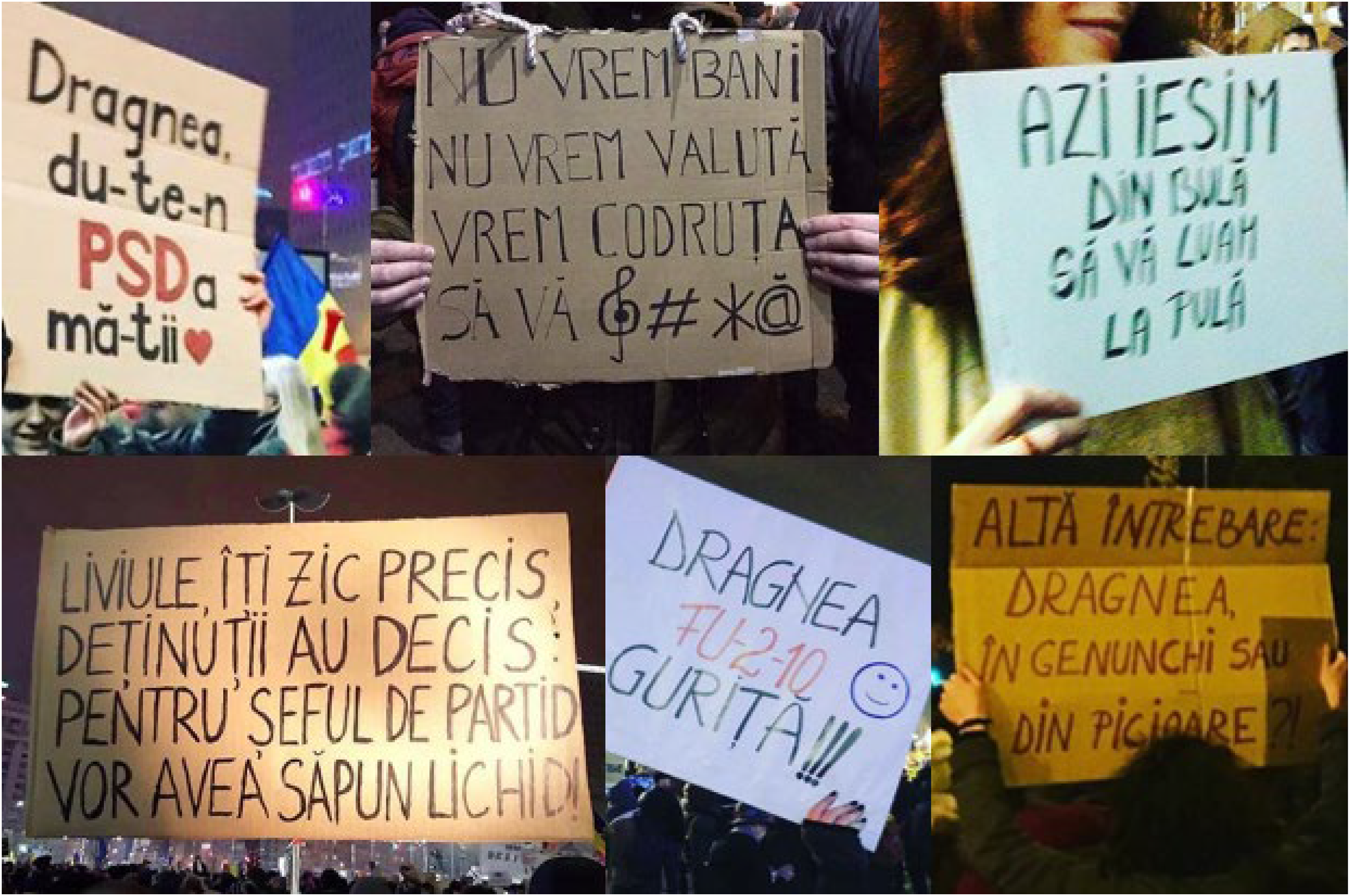
The use of sexual violence in humorous posers.
Next to gender, physical violence functions as a source of humor. Rehearsing the revolutionary imaginary of the people punishing the political class, some posters depict or imply hanging, shooting, or punching Dragnea and his fellows (see Figure 4). One poster advises Dragnea to take a selfie with a gun; another uses the attempted suicide of another Romanian politician jailed for corruption to remind Dragnea to “be a man” by making sure the bullet does not miss. Juxtaposing the most powerful politician in the country with a request to kill himself creates an incongruity between reality and the poster's desired outcome. As the poster expresses protesters’ anger, it provides a relief often associated with the “positive degradation and humiliation” of political carnival (Bruner, 2005: 139). Relief, however, does not negate that in such jokes, anger becomes enough of a reason to disregard the social norm of respect for human life – and of course, the humorous format helps argue this transgression is not real. Not only is suicide normalized here, but the patriarchal saying “be a man” – equating manliness with strength – is also inconspicuously reproduced.
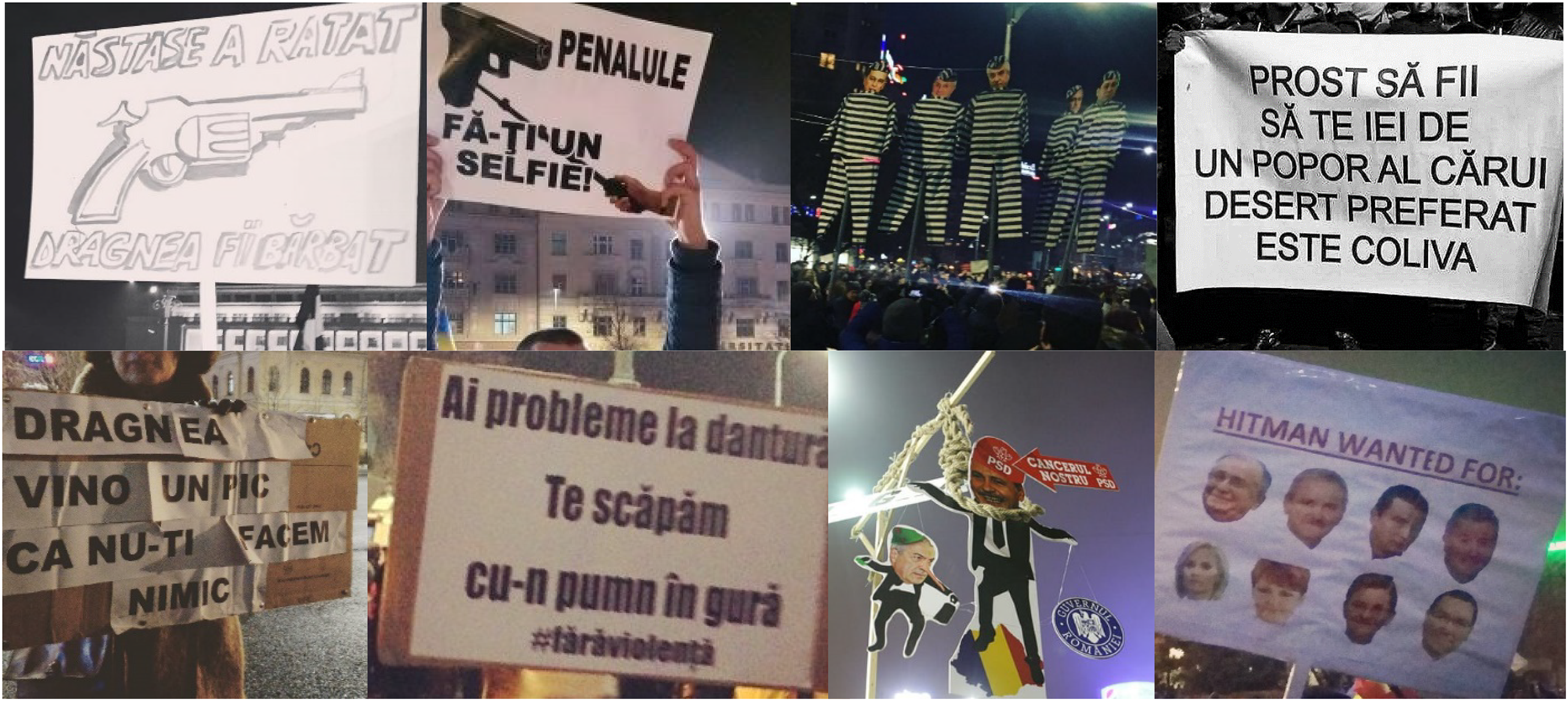
Posters using the threat of physical violence.
Discussion: Protest humor and ideological positivism
Protest humor can subvert dominant political discourses, signal grassroots agency, help amplify a collective message and build collective identity. I do not argue against these functions of protest humor, as my sample supports them. However, taking the charge of ideological positivism seriously produces an alternative reading of protest humor as disciplinary and conservative. The progressive and conservative functions of protest humor coexist, marking this type of symbolic resource as inherently ambiguous (Graefer et al., 2019). Humor is both social and anti-social; in sharing laughter, people are brought together, but in making others the butt of the joke, people are excluded. Furthermore, in learning when and how others can become the butt of a joke, humor contributes to the reproduction of social order (Billig, 2005).
In contentious protests, humor pits “the people” against the political elite in power. Like other forms of political humor, protest humor is moralistic, depicting politicians as incompetent and immoral. While challenging power, it can also perpetuate violence and exclusion not just towards politicians, but also towards other groups. Yet, unlike other types of texts, humor presents itself as an innocent and light message, absolved of the need for critical scrutiny. However, protest studies need to ask not only how humor helps protest communication, but also how it achieves shared enjoyment, for whom, and to what consequences – for the ideological articulation of democratic politics (Palmer, 1994). Such an analysis can move the discussion beyond the fascination with grassroots creativity, while still recognizing the agency entailed in the grassroots production of political communication.
With respect to the relationship between protesters and the larger social body, protest humor contributed to the vilification of not just the political elite (PSD and its political allies), but also of its electorate. Framing the latter as stupid for their electoral choices diverts from recognizing the social and economic inequalities faced by retired or rural citizens, perpetuating middle-class political imaginary labelling concerns about social and economic injustices as “communist” and ignoring that corruption feeds upon inequality (Abăseacă, 2018). The words of one protest mobilizer quoted are evocative here: “we should not let those who sell their votes and those that expect the intervention of the state, as if we still lived in the communist regime, and took decisions in our place. Activism is a fight for values, not for bigger salaries and social houses” (Abăseacă, 2018: 52). Thus, an anti-corruption protest can conservatively reproduce class-based social injustice.
The ridicule of the political opposition and its supporters delegitimizes the latter as political participants. While cathartic for protesters, allowing them to vent anger while asserting agency, such forms of protest humor also further the polarization of the civic body. Of course, polarization cannot be reduced to protest humor. The latter, however, can reflect and circulate latent views of who should engage in politics and how. When left unaddressed and incorporated within the collective framing of the protest message, such views perpetuate unhealthy antagonisms within the civic body, by deeming some groups as unsuitable for participation in democratic politics (Dreyer Hansen and Sonnichsen, 2014).
Where protest humor frames the political opponent as the ‘other’ of a shared collective identity, this is not a uniform process. In the Romanian anti-corruption protests, the revolutionary narrative legitimizing violence towards politicians was a source of dissent among the citizen collectives mobilizing for collective action. While, as a whole, it portrayed politicians as inept and immoral, the proposed solutions for dealing with the corruption of the political class differed. Some resorted to gender or physical violence, while others rehearsed the rule-of-law frame asking for jail time for corruption. During my fieldwork, interviews with protest mobilizers and participants revealed that while some were willing to use the frame of violence, others actively worked to dissociate the protests from it. Protest humor mirrors the struggle for normative and discursive legitimacy among mobilizers and participants, speaking to the ongoing tension between the formation and the dissipation of the collective “we”.
Approaching protest humor as inherently ambiguous can thus enrich the analysis and interpretation of both protest communication and protest politics. It foregrounds the ongoing struggle between competing narratives within the social body and across the different social groups temporarily brought together in protest. This can shed light on the (ideological) tensions within the civic body and draw attention to the socially conservative narratives within progressive protests, helping to re-focus collective claims-making processes.
Conclusion
This article has engaged with the disciplinary and conservative dimensions of protest humor. The study of protest humor remains focused on its positives: a critique of power, a means of building collective identity, and recruiting new supporters. Using the case of the 2017 anti-corruption protests in Romania, this article shows that protest humor reproduces class and gender hierarchies, while simultaneously signalling the democratic exercise of holding power accountable. Taking this ambivalence seriously will lead to more nuanced analyses of the complex ideological work performed by protest humor.
Finally, this article extends the call for a reflexive turn in social science research (Mauthner and Doucet, 2003) to scholarship on protest communication. Ongoing acknowledgment of resonance or dissonance with protest humor sensitizes researchers to how data interpellates them as political subjects. Recognizing and reflexively incorporating this within the research process can actively orient the researcher towards alternative interpretations in the analysis process, better capturing the ideological ambiguity of protest humor. As many protest and social movement researchers gravitate towards empirical cases broadly representing progressive (as in social justice-oriented) causes, failure to openly interrogate our moral resonance with the cause can easily become a source of methodological blindness and ideological positivism.
Footnotes
Declaration of Conflicting Interests
The author(s) declared no potential conflicts of interest with respect to the research, authorship, and/or publication of this article.
Funding
The author(s) received no financial support for the research, authorship, and/or publication of this article.
