




Abstract
Controversy over immigration and integration intensified in German news media following Chancellor Merkel’s response to the refugee crisis of 2015. Using multidimensional scaling of word associations in reporting across four national news publications in conjunction with key event, moral panic and framing theories, we argue that reporting of events at Cologne station on New Year’s Eve 2015–2016 reframed debate away from terror-related concerns and towards anxieties about the sexual predation of dark-skinned males, thus racializing immigration coverage and resonating with a long history of Orientalist stereotyping. We further identify an increased clustering of ‘race’, gender, religion, crowd-threat and national belonging terms in reporting on sexual harassment incidents following Cologne, suggesting an increased criminalization of immigration discourse. The article provides new empirically based insights into the dynamics of news media reporting on migrants in Germany and contributes to scholarly debates on media framing of migrants, sexuality and crime.
Introduction – The Cologne New Year’s Eve 2015–2016 attacks and the politics of immigration, sex and crime in contemporary media
The stereotype of migrant men as perpetrators of sexual violence has a long history in European imaginaries, including in Germany (Leiprecht and Lutz, 2009; Scheibelhofer, 2018). This trope has resurfaced in recent debates around immigration, for example in France in the reporting of gang rapes in Parisian suburbs in the early 2000s (Ticktin, 2008). French newspaper reports of gang rapes increased ten-fold between 2000 and 2001 (Mucchielli, 2005), triggering a moral panic (Cohen, 1972) arguably best understood ‘in the larger context of debates in France about immigration, national security, and a growing Europe-wide form of Islamophobia’ (Ticktin, 2008: 864).
Different scholars have responded critically to this trope (Attia, 2007, 2009). For example, Stöckle and Wegscheider (2016) have emphasized that sexualized violence targeting women in Germany is a widespread problem and not specifically related to migrants. Farris (2016, para 11) has argued that sexism should not be represented as the ‘exclusive domain of the non-western or non-Christian other’ as ‘the large majority of cases of sexual violence and abuse [. . .] do not involve Muslims or migrants’.
Yet in both Europe and in the United States, there remains a persistent linkage in media discourse between immigration and criminality (Schemer, 2014: 531), including sexual crime (Ticktin, 2008), and evidence shows that this stigmatization has consequences for public opinion and policy. As Martinez et al. (2015) comment in the US context: ‘singling out immigrants for discrimination or punitive treatment will likely have a deleterious impact socially’ (p. 303). In Switzerland, a location culturally closer to our German case, in the context of campaigning in a referendum (2006) which resulted in further restrictions on immigration, researchers found that ‘repeated exposure to news depictions of asylum seekers as criminals and freeloaders resulted in more pronounced prejudicial attitudes at a later point in time’ (Schemer, 2014: 537). Conversely, however, exposure to positive representations of refugees, as presented by: humanitarian organizations, churches, and labor unions [who] supported the claim made by the political left that the asylum law restriction would be inhumane, inefficient, and inconsistent with Switzerland’s humanitarian tradition of protecting refugees. (Schemer, 2014: 533)
. . . reduced negative attitudes (Schemer, 2014: 537). In other words, positive changes in media representation can impact public opinion and hence potentially arrest the downward spiral of a moral panic, in which public anxieties trigger punitive responses from the authorities which penalize and discriminate against immigrants, hence – given established links between stigmatization and deviancy – increasing the likelihood of their involvement in criminal activity (Cohen, 1972; Martinez et al., 2015).
Turning to New Year’s Eve 2015–2016 in Germany, while events remain contentious, accounts agree that a serious breakdown of public order occurred, involving multiple sexual assaults on women and thefts in and around Cologne station, mainly perpetrated by young men from North African backgrounds. These incidents were not restricted to Cologne, but were reported on smaller scale in other German cities such as Hamburg and Dusseldorf (Landesregierung Nordrhein-Westfalen, 2016; Ministerium für Inneres und Kommunales des Landes Nordrhein-Westfalen, 2016). However, Cologne became the epicentre of the media event that followed. In a critical assessment of media coverage and a reconstruction of events from police and media reports 4 months later, Bremer and Ohlendorf (2016) conclude that accounts quickly became exaggerated, and that a more accurate description of what happened last New Year’s Eve might be: several dozen young men, many of North African origin, are suspected of sexually assaulting and robbing hundreds of women in the crowd. The crimes were made possible by the crowded New Year’s Eve conditions in and around Cologne’s main train station [and] further facilitated by poor coordination among the different police forces responsible.
While previous research has identified the impact of negative mass media reporting on attitudes towards immigration in Germany through the 21st century (Czymara and Dochow, 2018), of social media stories on attacks on refugees (Müller and Schwarz, 2018), and analysed the impact of the Cologne attacks on subsequent crime reporting (Arendt et al., 2017), we make an original contribution by examining the event as a turning point in news coverage, investigating the portrayal of male migrants in relation to topics associated with sexuality, using a large data sample from three German newspapers and a political weekly before and after the Cologne events.
The main objectives of this research are hence to examine the Cologne New Year’s Eve attacks as a ‘key event’ underlying a ‘discursive shift’ (Krzyżanowski et al., 2018) in news media representations of migrant men and to reflect on the association of racialized, gendered, national and religious categories in the media portrayals of male migrants, their sexuality and association with threatening crimes. The underlying rationale is two-fold: The analysis focuses on the semantics of the news coverage of migrant men from May 2015 to the end of January 2017, with an interest in the words and combinations of words and truncations during this entire period and not only before and after New Year’s Eve 2015–2016. Second, we have used key event theory in conjunction with survey data to reflect on how media reporting can affect public opinion of migrants. This part of the analysis mainly aims to illustrate the intensity with which words and truncations were used before and in the aftermath of the Cologne events.
Using this data set, we ask what associations related to the sexuality of migrant men are produced by examining which terms or truncations are most frequently used in articles thematizing migrants and sexuality. We examine the German news media’s representations of male migrants as a case study of how the clustering of words with a potential for discrimination (e.g. relating to religion, nationality, race and ethnicity) may act together to create an intersectional effect, that is, a compound effect greater than the sum of individual pejorative terms. We argue that the Cologne attacks constitute a significant ‘discursive shift’ or ‘key event’ in the coverage of migration and integration issues in several dimensions (sexual, criminal, collective) tapping into historical associations and contributing to a contemporary construction of the male migrant as ‘folk devil’ (Cohen, 1972), with consequences for ongoing public debate, policy formation and politics.
Reception of migrants, ‘Welcome Culture’ and the impact of the Cologne attacks in Germany
At the peak of the arrival of refugees into Europe in 2015, ‘sexual desire’ and attacks by migrant men became a widely discussed topic among German news outlets, politicians and the broader public (e.g. Panorama TV programme Deutsche Frauen: Bedroht von lüsternen Flüchtlingen? (Television broadcast, 8 October 2015): Bolz and Jolmes, 2015; https://www.welt.de/vermischtes/article148547764/Warnung-vor-Sex-mit-Fluechtlingen-sorgt-fuer-Empoerung.html).
These news reports stand in sharp contrast to the concurrent image of a welcoming public created by coverage of ‘Refugees Welcome’ initiatives (Conrad and Aðalsteinsdóttir, 2017; European Journalism Observatory (EJO), 2015; Vollmer and Karakayali, 2018). However, violent crimes against migrants arriving in Germany, outbursts of hostility from right-extremist groups and anti-migrant marches organized by the German PEGIDA group in major German cities, show that opposition to the new arrivals was already present. Furthermore, work on attitudes to the reception of refugees before and after New Year’s Eve 2015–2016 show that welcoming attitudes even before Cologne were limited to a small minority; ‘Welcome Culture’ was the creation not of German society as a whole, but of a small visible active minority supported by perhaps a fifth of the population – the proportion who said they would welcome a hostel for refugees in their own neighbourhood in November 2015 (Liebe et al., 2018: 3).
However, while opposition to local refugee resettlement programmes remained consistent before and after Cologne, public support proved much ‘softer’, with support for such initiatives falling from 20% in November 2015 to 12% by November 2016, a decline which may plausibly be linked to the impact of increasingly negative media coverage following the Cologne events on this liberally inclined minority (Liebe et al., 2018: 9). While our data shows that the spike in negative, sexualized and criminalizing terms to describe male migrants did not last long (see Figure 7 in Appendix 1), we argue that such ‘critical discourse moments’ (Krzyżanowski et al., 2018: 3) may be sufficient to reframe the terms of debate and shift critical segments of public opinion, thus potentially altering political and policy directions.
Thus, our study contributes to explaining how and why the Cologne attacks gave far-right populist groups rhetorical ammunition, and raised public anxieties to the level of a moral panic (Welt-Dossier, 2017), creating pressure on more moderate conservative politicians to call for restrictive public security and immigration measures, including an upper limit on acceptance of refugees (Democracy Lab, 2017), harder entry requirements for refugees, faster deportation of illegal and criminal migrants, and controversial restrictive changes to the Asylum and deportation legislation, approved by the German Bundestag in 2017 (Verschärfung Welt, 2017). Together with the fear of terrorist attacks the perceived threat of sexually aggressive refugees led to homeland security becoming the most important election issue in the German national election of 2017 and related debates impacted on federal and national elections (Yendell et al., 2017). At the same time different surveys on prejudices and xenophobia reveal that the derogation of refugees, asylum seekers, and foreigners more broadly, as well as Islamophobia and anti-Muslim sentiments, have increased further since the refugee crisis began (Decker et al., 2018; Pickel and Yendell, 2018; Yendell and Pickel, 2019).
The Cologne attacks received great national and international attention not only because of the nature of the crimes but also because the police were publicly accused of not having been able to control the situation and of trying to downplay the incidents. Moreover, German news media did not report the assaults until several days later and faced criticism for trying to cover up crimes by migrants. Yet within a few days the news had spread across the world, making international news headlines, and the topic came to dominate the news in Germany for several months (Frank, 2017).
The fact that these assaults were mainly committed by migrant men often labelled ‘Muslim’ provoked different reactions from politicians: while the German Minister of Interior Affairs urged people not to put refugees under general suspicion, other conservative politicians demanded a public debate on ‘violence-legitimizing norms of masculinity in Muslim culture’ (Kristina Schröder, CDU). Sexual assaults by ‘Muslim’ men also became a prominent part of the agenda of far-right populists such as the Islamophobic PEGIDA group and the AfD (Alternative for Germany). Other sex crimes by migrants also contributed to a public outcry mainly from the far right (Klasen, 2016; Schulz, 2017).
Male migrants in contemporary German news media
The attacks on German women during New Year’s Eve 2015–2016 in Cologne and some other cities were undoubtedly serious criminal incidents. It is worrying that the authorities initially failed to follow up cases, and in the public interest that the media reports openly on such incidents and about police investigations. However, the representation of migrant men in Germany’s news media arguably already went beyond open reporting and legitimate criticism to promoting stereotypical perceptions of ‘Muslim Arab’ male migrants as ‘lecherous’ threats to ‘German women’ and has worsened since.
For example, in its coverage of the attacks, the liberal Süddeutsche Zeitung (SZ) published the image of a White naked female with a Black arm rising between her legs – an image with racist and sexist connotations similar to the cover page image of Focus magazine of a naked White woman’s body covered with Black handprints (see Figure 1). Such images strongly resonate with those used in previous episodes in German history, such as the ‘Black Horror on the Rhine’ campaign during the Weimar republic (Wigger, 2010: 36, see Figure 2).
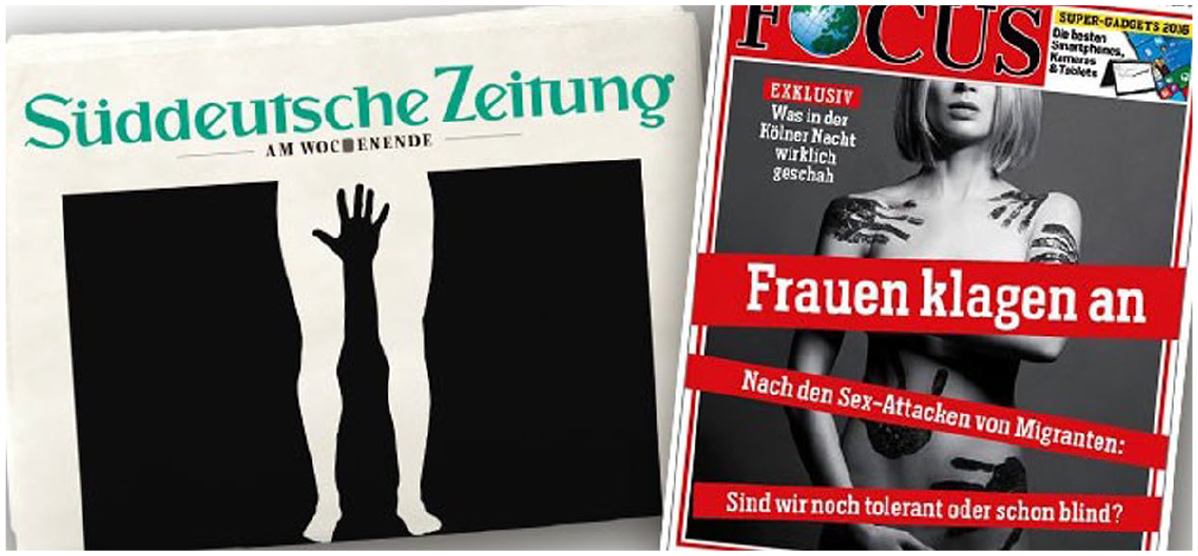
Süddeutsche Zeitung and FOCUS Jan 2016.
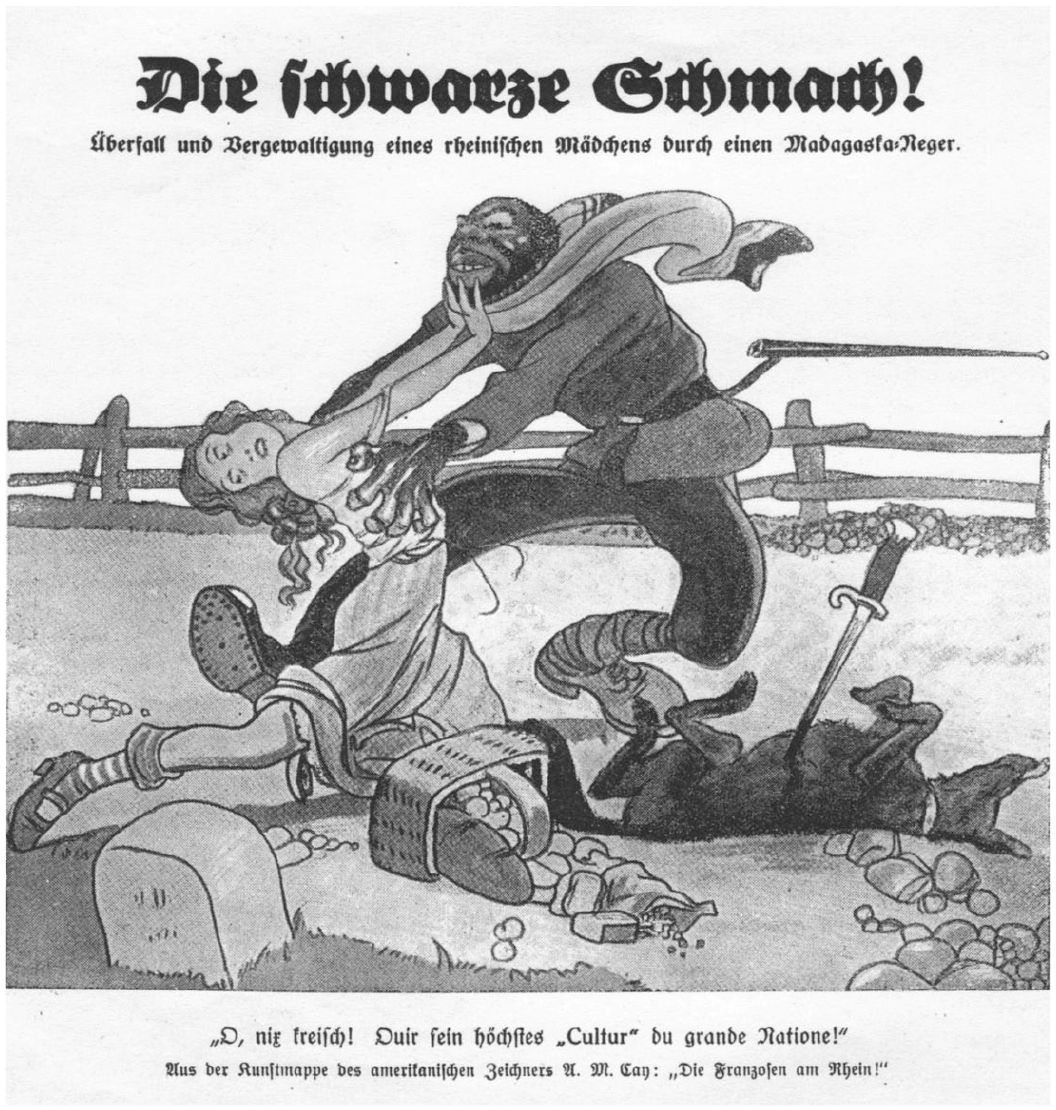
Illustration, Die Schwarze Schmach! (The Black Shame). Franzosen im Ruhrgebiet. A.M. Cay. Berlin 1923.
After Cologne, newspaper reports of sexual offences involving migrants were shown to increase significantly (Arendt et al., 2017; Dietze, 2016), including some fabrications (Taylor, 2017). While German public discourse on migrant sexual threat predates Cologne (e.g. Panorama TV programme: Bolz and Jolmes, 2015), Arendt et al. (2017) argue that after Cologne words describing the origin of a suspected criminal (foreigner, migration background, North African and asylum seeker) are mentioned significantly more often in major newspapers than before the incident, suggesting a strengthening of the association between immigration background and crime in German media culture.
Media stereotyping of migrants and the Cologne events in academic discussion
Such negative rhetoric is problematic, as negative media reports on migrants can contribute to a stereotypical Worldview and promote hostility. Mass media and especially social media have been shown to fuel populist nationalist discourses concerning immigration in Europe and a rising global media and digital populism (Mazzoleni, 2014). International research has shown that media reports on migrants are mostly framed negatively because they concentrate on crimes (Arendt, 2010; Shoemaker and Reese, 1996) or on an alleged inability of migrants to integrate into mainstream society (Ruhrmann et al., 2006). The negative impact of such stereotypical representations on attitudes towards migrants and especially Muslims has been highlighted by several scholars (Arendt, 2010; Eyssel et al., 2015).
Especially since 2001, media coverage of Arabs and Islam in Western countries has concentrated on ‘bad news’ and especially terrorism (Hafez, 2010; Nacos and Torres-Reyna, 2003). A consequence of negative reporting in relation to Islam is that negative attitudes towards Muslim migrants lead to many German Muslims feeling stigmatized (Pollack et al., 2016). Experiences of stigmatization relate especially to their religion, but also to their nationality and ethnicity (Brettfeld and Wetzels, 2007: 364ff; Open Society Institute (OSI), 2010: 80ff). The experience of exclusion among people of Muslim heritage is exacerbated by the intersection of discriminatory narratives in the ‘intersectional stereotyping’ of Muslim migrant men (Wigger, 2019).
Following Cologne, sexual attacks and violence have frequently been represented as particularly associated with Muslim heritage men, even though the German National Office for crime data show clearly that criminality is not specific to one particular cultural or religious group (Bundeskriminalamt, 2017). While we will argue that the reporting of Cologne has increased media focus on migrant men as sexual offenders and criminals, such framing is not a new phenomenon. The stereotype of sexually threatening racialized others has been embedded in German history and culture for centuries and has played a major role in the history of Western racism and Orientalism (Hund, 2017; Wigger, 2017, 2019).
There is extensive scholarship on anti-immigrant sentiment, Islamophobia and racism in Germany. Attia (2007) and others (Hark and Villa, 2017) have critically reflected on ‘anti-Muslim racism’ in German society and media. Dietze (2016) and Weber (2016) have argued that sexism was ethnicized as a problem specific to Muslim migrants to mobilize against the ‘Muslim other’. Dietze highlighted ambivalences in the Cologne attacks discussion and drew attention to feminist and other critical attempts to question their stereotypical representation.
In conclusion, two main problems regarding the media coverage of migrant men in German society have been identified: first, the focus on ‘bad news’, crime stories and the negative stereotypical labelling of migrant men with attributes of specific culturally grounded sexist attitudes and sexual violence. Second, the effects of the derogation and stereotypical representation of migrant men is compounded when different narratives of identity and difference such as religion, ‘race’, gender and nationality are interwoven. What is lacking, however, is an analysis of the patterns and shifts in discourse over time, before and after the critical watershed of Cologne, and it is this gap that our article seeks to address.
Theoretical frame: ‘Stereotypical Othering’, intersectionality, key event and moral panic theories
This study’s theoretical frame uses key event theory to make sense of changes in the discourse recent media reporting about migrant men in Germany, and moral panic theory to analyse how media coverage which identifies a particular group as a threat to social order can trigger a wave of reaction in politics and policy, justifying harsher measures against the new ‘folk devil’ which are likely to exacerbate the social dynamics which are most productive of criminal behaviour (Cohen, 1972). Our analysis draws on concepts of media stereotyping, Islamophobia and intersectionality to identify stereotypical dimensions within the media portrayal of migrant men, which combine stereotypes of religion with racialized, national and gendered narratives of difference.
Media stereotyping of groups labelled as ‘Others’ has a long tradition in Western society. Hall and others have demonstrated how mass media produces a reservoir of ‘racialized others’ embedded in the history of Western popular culture (Downing and Husband, 2005; Hall, 1997). An intersectional perspective can help us to reflect on the media portrayal of migrant men and explore the overlapping of discriminatory narratives in their representation. As a theoretical perspective, intersectionality enables us to examine the interplay of different categories of social distinction such as gender, ‘race’ and ethnicity, nation and class in relations of oppression and discrimination (Hill Collins and Bilge, 2016; see also Lutz et al., 2011).
A key intersectional question relevant for an analysis of the Cologne New Year’s Eve events is, to what extent are different attributes with potential for discrimination interwoven in the portrayal of migrant men? More specifically, how closely do media representations of (aggressive) migrants’ sexuality relate to their gender, national, ’racial’ origin and/or cultural and religious background? We will investigate this by examining their proximity and frequency in news media texts. This intersectional dimension of the analysis complements the qualitative strand of our research project, an in-depth qualitative thematic analysis of a smaller illustrative sample of articles, which was analysed within an original theoretical frame of ‘intersectional stereotyping’ combining Hall’s concept of media stereotyping with the Black Feminist Intersectionality theorem (Wigger, 2019).
The theory of key events (Leitner, 2000; Rauchenzauner, 2008) refers to the observation that after an extraordinary event, media coverage tends to change, both in the terms in which related events are reported (‘framing’, Scheufele, 1999), and in the prominence and frequency of coverage of related stories (‘agenda-setting’, McCombs and Shaw, 1972). This can impact on public perceptions, because what is reported more frequently and prominently tends to be perceived as actually occurring more often and being more problematic; this in turn can feed into public debate and influence policy.
A key event, then, can trigger waves of reporting which give the impression that similar events occur more frequently, regardless of any actual change in frequency. In the case of the Cologne attacks, this meant a noticeable increased level of reporting on crime committed by migrant men, and increased mention of their migration background (Arendt et al., 2017). Research focusing on the negative framing of migrants in mass media and the role of criminality in this has a long trajectory (e.g. Delgado, 1972; Jäger, 2000; Schneider et al., 2013). We will argue that the Cologne attacks can be considered a key event which altered the media portrayal of migrant men in the German media. The concept of ‘key event’ may usefully be further nuanced by drawing on the distinction between ‘discursive shift’ and ‘discursive change’ made by Krzyżanowski et al. (2018: 3, building on the work of Fairclough, 1992). We understand key event here to correspond to the level of a ‘discursive shift’, that is, not a major ‘global or transnational, macro-level dynamic framing of discourse’, which would be a discursive change, but rather a ‘a set of local, micro-level appropriations of discursive changes . . . actor-specific responses to social, political, and economic macro-level transformations. . . . nonsimultaneous, contextual, and field dependent’ (Krzyżanowski et al., 2018: 3). Thus, our claim concerning the impact of the Cologne events is limited to German media coverage – we recognize that European coverage varied widely in nationally specific ways (see Triandafyllidou, 2018) – and is confined to a specific period; we recognize that coverage was volatile at this time (Vollmer and Karakayali, 2018). Nonetheless, our theoretical claim has broader relevance – for we suggest that such mediatized key events (see also Cottle, 2006) can serve as turning points within a national debate, with potential long-term consequences for politics and policy.
Research questions
Against the theoretical and empirical background described we ask the following:
What associations with migrant men’s sexuality are found in selected German news publications, and to what extent do these associations differ in selected different news media outlets? Which words or truncations are often used in articles where migrants and sexuality are thematized?
How closely associated are racialized, gendered, national and religious terms in German newsprint reports of male migrants, and how do media reports link their depiction of migrants to threatening forms of criminality?
How did the Cologne New Year’s Eve attacks act as a key event impact on and shift the media portrayal of male migrants?
We answer these questions via an examination of the portrayal of migrant men and sexuality in four German news publications which identifies the association of this topic before and after the Cologne attacks with attributes related to ‘race’, gender, religion, nationality and terms denoting group threat.
Methodology
Sampling process
To examine news media reports about migrant men and identify patterns of proximity between racialized, gendered, national and religious attributes and threatening descriptions of criminality, we analysed the three daily German newspapers Süddeutsche Zeitung (SZ), Frankfurter Allgemeine Zeitung (FAZ), Die Bild and the weekly news magazine Focus. This purposive and opportunity diversity sample is based on our interest in newspapers and magazines with a high print run and/or high click rate (and hence likely influence on public opinion), selected for the diversity of their thematic emphasis and political orientation. Thus, the SZ has a strong focus on cultural and social issues, and journalists perceive it as a leading liberal voice in German society. The FAZ is a conservative newspaper with an emphasis on economy and politics.
The most-read newspaper is Die Bild, which is Germany’s number one tabloid newspaper and its often sensationalist reporting has been an ongoing subject of public contention. The Weekly Focus is one of the highest circulation German news magazines and has a proportionally large share of the advertising market. It was founded as a modern and more conservative weekly magazine to compete with Der Spiegel, Germany’s most read weekly. For readerships of these publications, see Tables 1 to 3.
Sold newspapers (print), first quarter, 2016.
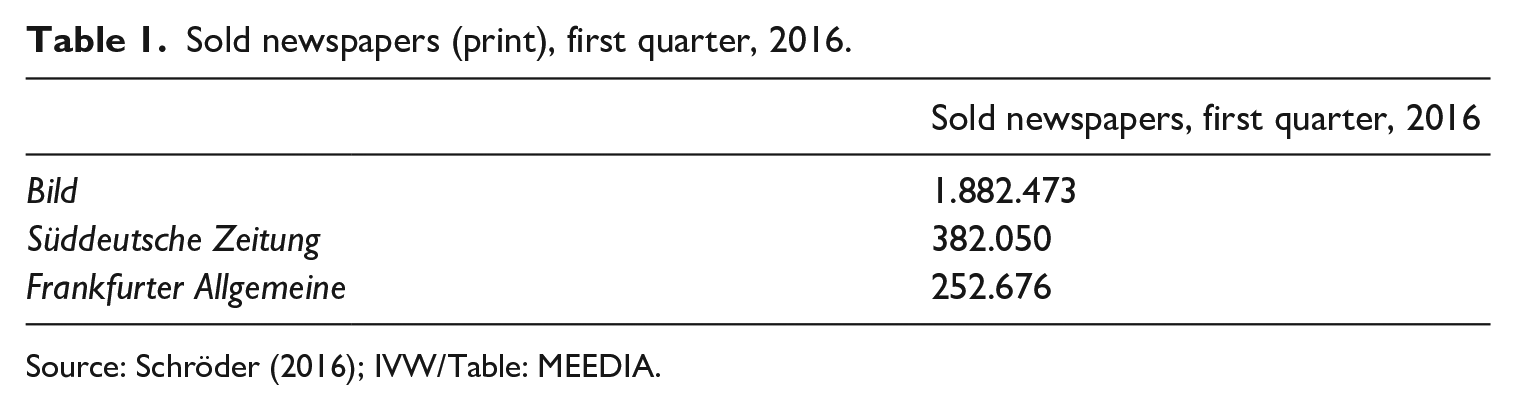
Source: Schröder (2016); IVW/Table: MEEDIA.
Sunday editions and weekly magazines print.
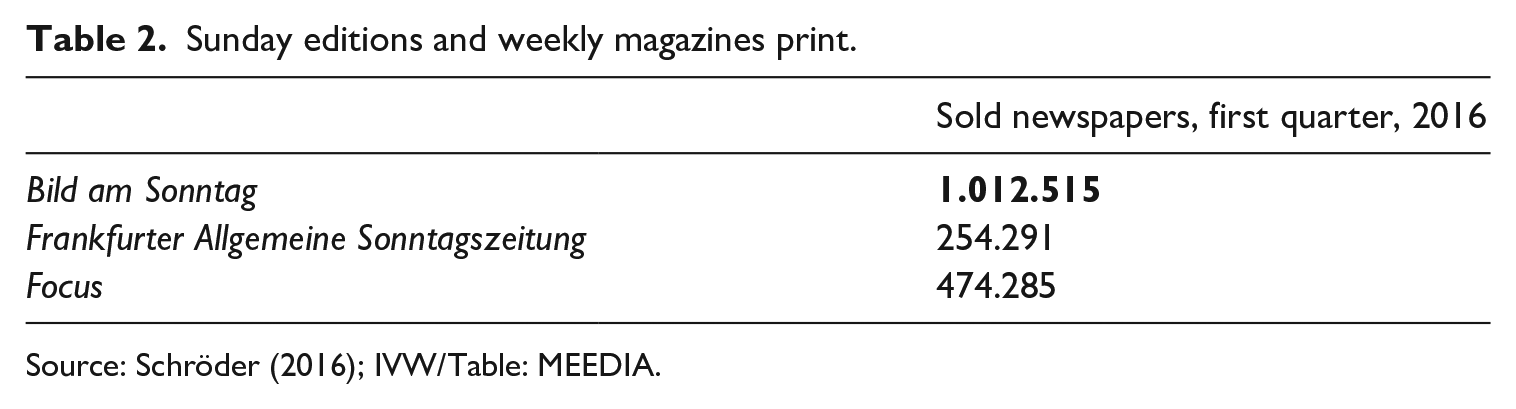
Source: Schröder (2016); IVW/Table: MEEDIA.
Net coverage online offers.
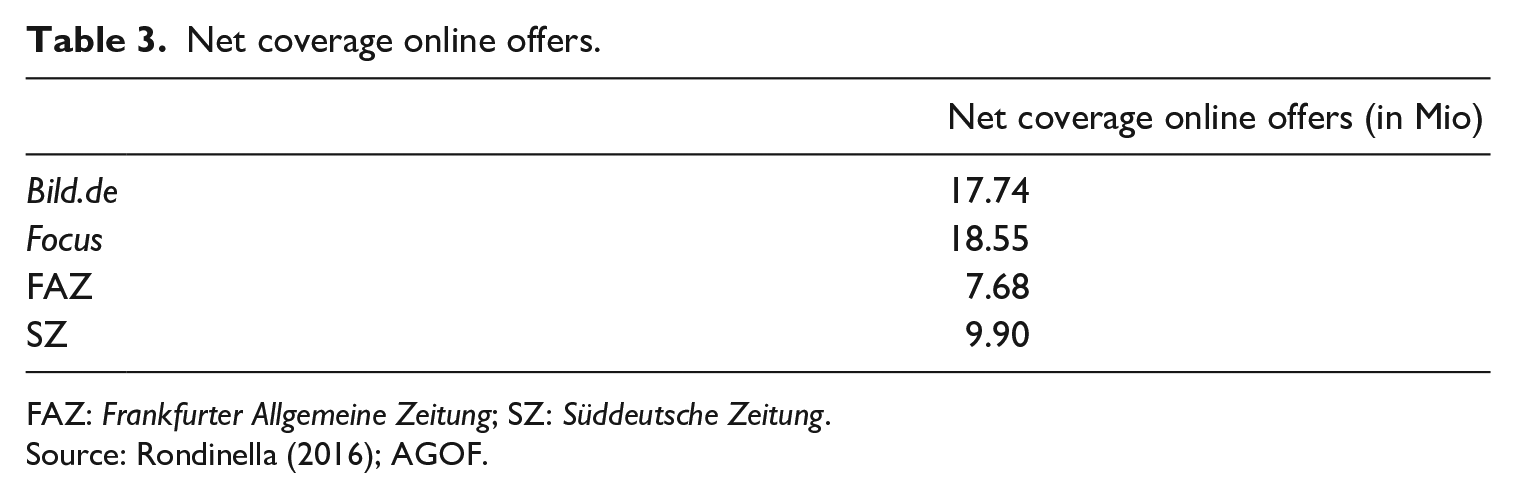
FAZ: Frankfurter Allgemeine Zeitung; SZ: Süddeutsche Zeitung.
Source: Rondinella (2016); AGOF.
The Focus was included in the sample as Germany’s second most widely circulated political weekly magazine, because it has played a prominent role in the media coverage and public debate unfolding on migrants in Germany in the direct aftermath of the Cologne events. The Focus has influenced the discussion surrounding migrants in the direct aftermath of the Cologne New Year’s Eve night noticeably and controversially with the publication of its controversial title ‘The night of Shame’ – showing the photographic image of an attractive young naked white woman covered in black handprints. The caption reads ‘After the sex attacks of migrants are we still tolerant, or have gone already blind?’ (see Figure 1). The Spiegel, as a more liberal oriented news outlet was not included in our news print media sample due to practical data access problems. While we had originally considered to include both major weekly political magazines in our sample, this proved not practicable, as the Spiegel online archive was to costly compared to the other sampled news media and we would not have been able – due to financial and time constraints – to conduct an in-depth research in the Spiegel’s archive as part of this broader study. Hence, the majority of the four sampled news media (FAZ, Bild and Focus) have a conservative orientation, and this limitation and possible conservative bias has been considered in our analysis.
The sample was not intended to be representative of German print media as a whole, as this was not necessary for the design of our study. We were interested in whether there was a change in the language of coverage particularly among conservative oriented newspapers, which were more likely to be critical of government immigration policy, and so a good place to detect such a shift. If so, then we wanted to see if there was any discernible shift in public opinion around the same time. Then, with a change in discourse (albeit only demonstrated across a purposive sample) plus a change in public opinion, we have a plausible pathway of influence from discursive shift to public opinion and on to policy shifts occurring at the time. While a parallel shift in liberal discourses would also be of interest, we restricted the sample for this research to some of the core conservative newspapers and included a liberal spectrum paper for comparison. Even if it turned out there was no shift in liberal discourse (unlikely given the communicative structure of the media ecosystem) or even a counter-reaction, the shift in conservative discourse and its impact on the broader media ecosystem still provides a plausible mechanism for the measured decline in support for local asylum centres (Liebe et al., 2018).
Our sample of two conservative newspapers (the tabloid Bild and the Frankfurter Allgemeine Zeitung), one newspaper in the liberal spectrum (Süddeutsche Zeitung) and the conservative political weekly Focus was an ‘opportunity sample’ in so far as it was based on what could be accessed by the researchers given the resources available. In this context we iterate that, when selecting the sample, we considered it interesting and relevant despite its limitations and notable conservative bias, as it is covering a considerable spectrum of opinion in German society nonetheless and allows a critical insight into the reporting of some of Germany’s mainstream highly influential newspapers. The key role of the sampled newspapers in the German media landscape and their market share illustrate this clearly: Despite a changing landscape due to other competitive players in the advertising market, like broadcasting and digital media, the periodical press today still plays a major role in disseminating political background and local information, encouraging analysis and critique, forming opinions, educating, counselling, and entertaining. (Thomas, B and Horz, C https://medialandscapes.org/country/germany)
The Bild, the Frankfurter Allgemeine Zeitung and the Süddeutsche Zeitung are the three most-read German newspapers (https://deutschland.de, platform of the German Federal Foreign Office). The tabloid Bild for example is owned by Axel Springer SE, a key player among the ‘big five’ large companies dominating Germany’s newspaper market in 2016 (Thomas, B and Horz, C https://medialandscapes.org/country/germany). The Focus.de news online platform is market-leading with 28.3 million users and is currently ahead of the Spiegel’s online news platform Spiegel Online with 22.47 million users. https://cmds.ceu.edu/article/2020-04-09/turning-mirror-next-generation). While we acknowledge that the sample is biased to the right, it also includes, with the SZ, a centre–left source for comparison.
We searched for articles between 1 May 2015 and 31 January 2017, which includes reporting from the period of peak flow of refugees into Europe in the summer of 2015 and the periods before and after the Cologne New Year’s Eve 2016 assaults. To identify print as well as online newspaper articles we used the archives of S.Z. and F.A.Z., which include online and print articles, and an archive with print articles of Focus. As the archive with Focus articles included only 20, we decided to use online articles which we found on the Web (with search by Google). Die Bild does not offer an archive and provides only a paid service to search for articles. Due to cost and lack of transparency regarding the selection method of this service, we decided to use only articles which were found on the web (with search by Google) and on BildPlus, a monthly subscription service.
Our word search used a purposive sampling strategy. In the first phase of preparation for data collection we searched for striking words in the publications’ descriptions of migrants which we reduced to truncations and counted in the first phase of analysis. We used the qualitative-heuristic method of text analysis (see Kleining, 1995) to determine which words to include. This method conceptualizes the research process as an iterative interaction between the researcher and research subject. Instead of testing predefined hypotheses, the process is one of sensitizing the researcher to the field, in this case a body of texts.
In the run-up to the analysis, the different topics that the articles deal with were identified and determined by the two involved researchers in the coding of the data. Both researchers were also involved in determining the subject area of the sampled articles during the data collection. In the first step the first researcher determined the topic of the sample article, which was then in the second step confirmed by the second researcher. To maintain reliability, in case of diverging opinions about the topic areas, both researchers discussed and decided together to which topic area the respective article belonged.
To select which words and truncations were significant, we asked, Which striking words are used in association with migrants, sex, race, gender, religion, nationality, crime and violence? For this stage, we initially selected a smaller sample of 40 articles (10 per publication) in which the topic of migration and sexuality played a role. First, one researcher searched for words and truncations, then, another researcher discussed the selection against the background of theoretical ideas on media stereotyping and intersectionality, producing a refined list. The following truncations were then used to analyse the larger sample of 406 articles (see Table 4 ).
Truncations used in the analysis.
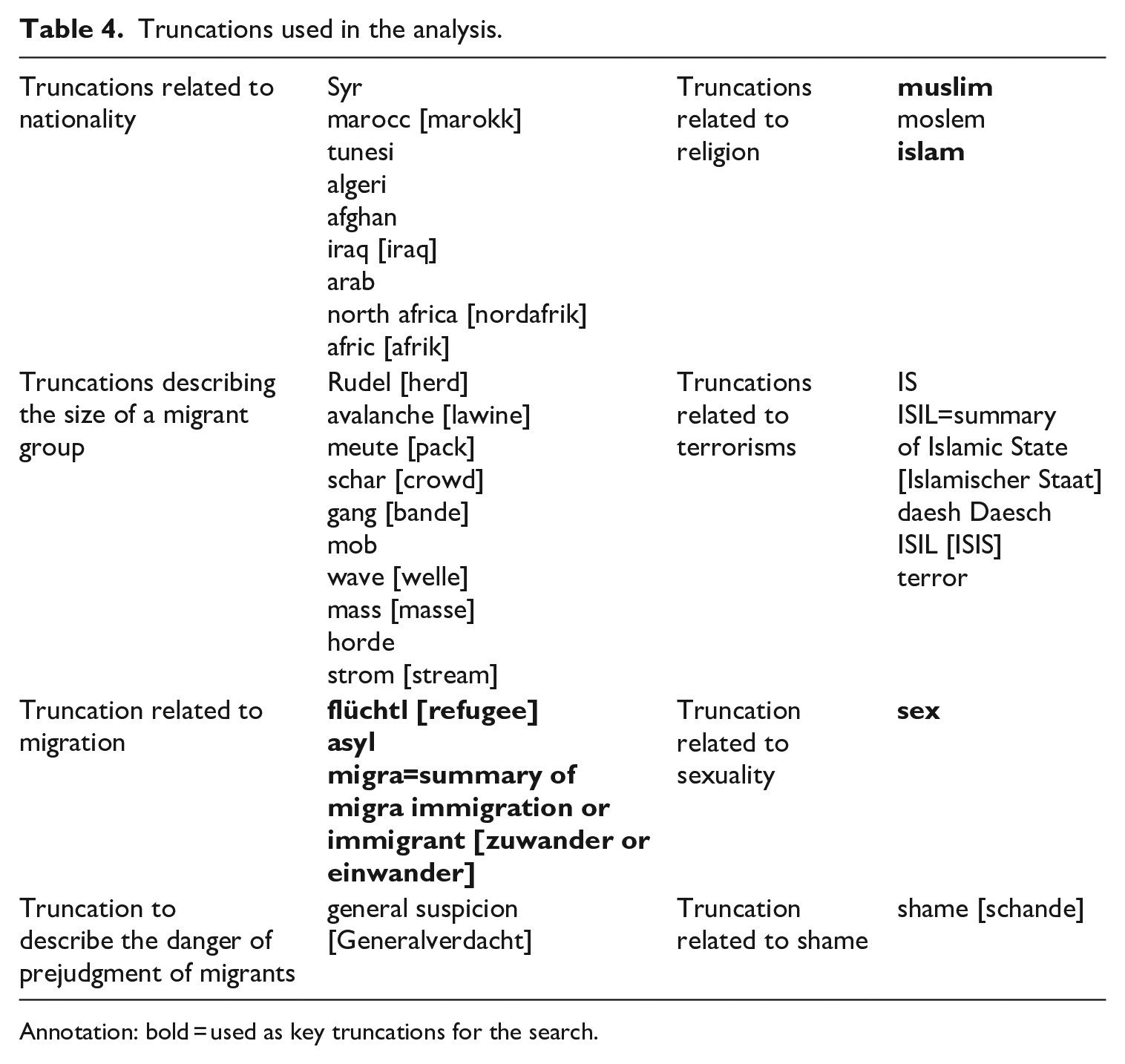
Annotation: bold = used as key truncations for the search.
In addition, we identified in which section of the newspaper the article was published, whether there was a link to crime statistics and how this was interpreted, whether an academic expert was asked to give an opinion and whether any kind of theory was offered to explain why people commit sex crimes. Each found truncation was checked, to establish if it occurred in the text, the subtitle or underneath a picture or chart. Semantically irrelevant truncations for example, ‘mob’ in mobile were excluded.
The keywords/truncations used for the search were: sex and: flüchtling [refugee] or asyl or migra or einwand [immigra] or zuwand [immigra] or muslim or islam. The truncation ‘flüchtling’ [refugee] could have been part of various words such as refugee home [Flüchtslingsheim or Flüchtlingsunterkunft] or policy on refugees [Flüchtlingspolitik]. Similar word combinations within one word could also apply to the other truncations (for instance:
Using these key words, our search resulted in an overall sample of 1592 articles found in the SZ, and a comparable 1607 articles in the FAZ (including print and online articles). The total sample of the Focus is made up of all the print articles found in the Focus print article archive (n = 20) that was available to us and additional online articles that we found using the extended Google search. The Google search could seem possibly problematic because Google does not display all the results of the search and the Google algorithm determines the hits. This restriction also applies to the Bild newspaper for which we also used Google search due to lack of access to an archive. With Google we were able to find 311 Focus online articles and 304 Bild online articles which fit into the period.
The Google algorithm looks at many different factors including the words of the query, the relevance and usability of pages, the expertise of sources and the location and settings of the use. The weight applied to each factor varies depending on the nature of the query – for example, the freshness of the content plays a bigger role in answering queries about current news topics than it does about dictionary definitions. This is opportunistic but aligns with our research design because the algorithm is likely to provide an indirect proxy of popular articles and hence the most influential. To demonstrate the plausibility of a connection between a discursive shift and a shift in public opinion it does not matter that part of our sample is random and part is based on the Google algorithm – all we need to show is a relationship between change in discourse and change in a segment of public opinion, and we have a plausible (not proven) mechanism of influence.
From this corpus we used a simple random technique to select at least 100 articles per publication for detailed analysis. Inspection revealed some articles with no link to the news topic, instead comprising criticism of a fictional book, film or theatre play, and articles reporting sexual assaults against migrants. These were removed, and other articles added to replace them until we produced a final sample of 407 articles for detailed statistical analysis. We selected a random sample for four reasons: (1) each article had to be read and analysed by a researcher as automation overlooks exceptions, for example, when words or truncations are considered which do not belong to the actual text; (2) we had full access to only two archives (SZ and FAZ) but not to Focus and Bild, which means that some selection was inevitable; (3) it was not possible to control the correct count of truncations for the complete sample within the limited time and funding of the project and (4) we believe that our sample size reflects the editorial lines of the newspapers.
Due to the difficulties of sampling, which are inherent in the analysis of newspaper articles, the present study cannot provide a complete structural picture of media reporting, but it does provide valuable information about the intensity of reporting and the differences between four German news media publications. In addition, the results of this quantitative analysis are discussed along the results of other studies, for example, the qualitative sub-study as part of the research project discussed here (see Wigger, 2019).
Statistical and computational data analysis
We conducted a univariate statistical analysis, including ANOVA (analysis of variance) which enables the analysis of group means in a sample (groups here = different newspapers) and multidimensional scaling (MDS) to visualize the level of similarity of individual cases regarding the frequency and distribution of truncations. The basic assumption here is that ‘key words and concepts tend to occur together in relatively close proximity in natural language communication’ (Brier and Hopp, 2011: 104). MDS enables the lexical proximity between words to be represented as points in space, enabling visual analysis of their association in texts and comparison across multiple texts (Brier and Hopp, 2011: 115–123). Using these methods we can describe how publications report on migrants and which associations with migrant men are circulated by these media, for example, if sexual assaults are linked to religious labelling (Muslim/Islam), or if threats associated with criminal male migrants are linked to deviant sexual behaviour.
Results
An initial observation is that most articles were written after the Cologne New Year’s Eve events from 2016 (total 84%; SZ, FAZ and Bild each 82% and Focus 89%; see also Figure 7 in the Appendix 1). As we sampled 7 months before 31 December 2016 and 13 months after, an even distribution of articles throughout the period would produce a distribution of 35% before ‘Cologne’, and 65% afterwards. The higher frequency afterwards suggests that the migrant sexuality theme became more frequent after the incident, supporting the contention that ‘Cologne’ functioned as a key event for this kind of content. There are some differences between newspapers in this regard. After January 2016, the number of articles in the Bild is reduced more significantly than in the FAZ and SZ, which is a cautious indication for us that the Bild profited from the event itself and the fear of the recipients and was less interested in a longer term factual discussion.
Figure 3 shows that topics differ between publications. The Cologne incident featured with similar frequency in FAZ, Focus and Bild (24%, 23% and 22%) but less (14%) in SZ. The SZ articles discussing migrants and sexuality focused more frequently on the refugee crisis (21%), than in Bild (13%), FAZ (6%) and Focus (3%), for example, when discrimination and sexual assaults against women in countries refugees fled from were mentioned as an indicator of unbearable living conditions. The Cologne incident itself was not the most frequent migrant and sexuality-related topic in Bild and FAZ, where stories of other sex crimes were more frequent, suggesting that the agenda setting effect of Cologne extends beyond impact of the initial ‘key event’ for these publications. As more discursive publications it makes sense that FAZ and SZ have more articles discussing religion and/or culture and sexuality (17% and 11%), than the tabloids Focus and Bild (4% and 3%). The frequency of reports on other sex crimes than New Year’s Eve’s quadrupled after the Cologne; whereas only four out of the 66 articles written before the Cologne events (6.1%) deal with sex crimes, 93 out of 341 (27%) afterwards dealt with unrelated sex crimes, consistent with key events and agenda setting theories. The result also fits with that of Arendt et al.’s (2017) survey. Furthermore, while the sample size is small, the chi-square test shows highly significant differences regarding the distribution of words associated with migrants and sexuality before and after Cologne, suggesting a discursive shift, or change of framing (Pearson’s chi-square 71.172***).
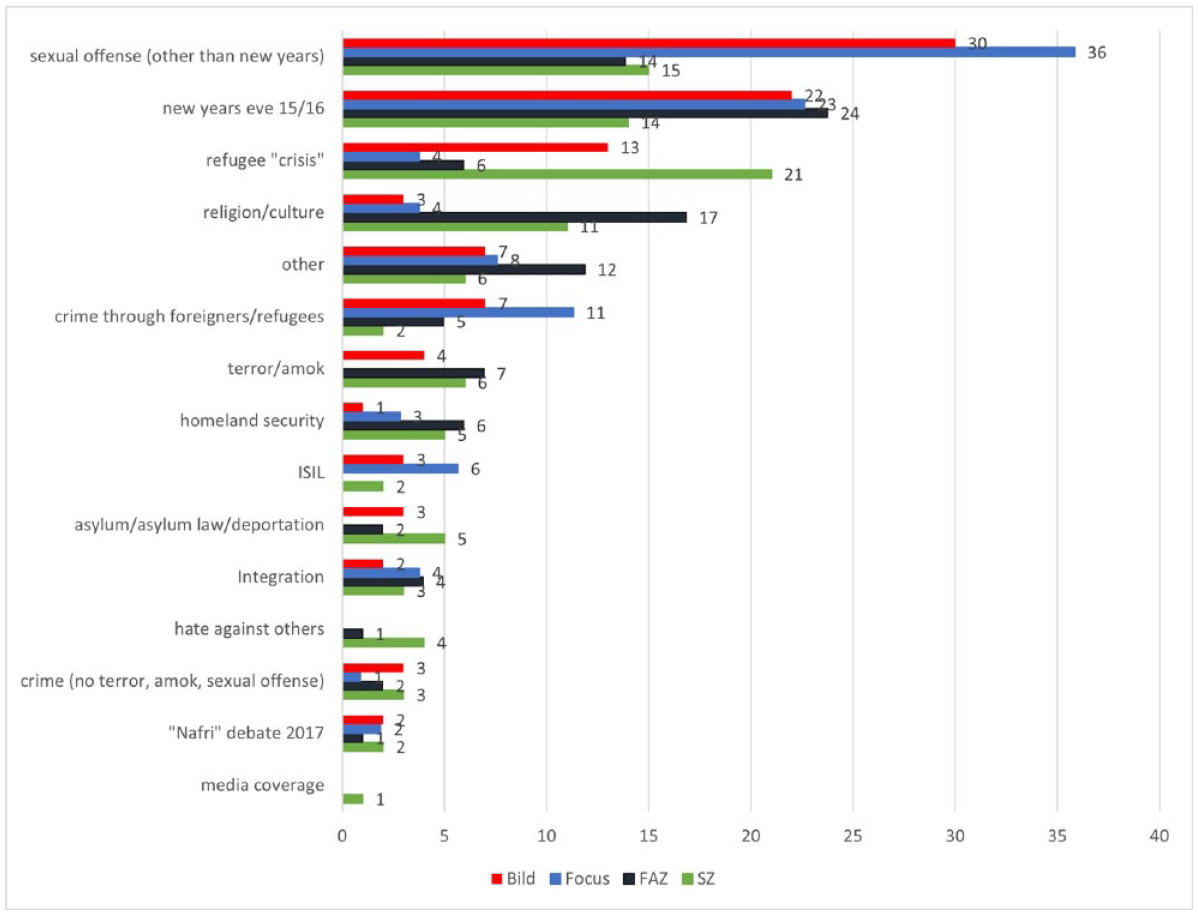
Topics of the articles by newspaper and weekly magazine Focus.
Figure 4 shows the average mention of each truncation in an article. The word sex was of course found frequently, as a key search term. Still, variations in frequency by publication are of interest, as they suggest the relative importance of sex to the editorial line. Sex is most used in Bild (3.34) followed by FAZ (3.33) (tabloid and conservative, respectively), and less in Focus (2.54) and SZ (2.19), differences significant at the .05 level. Other frequent truncations are refugee [flüchtli], migra, islam, muslim (also used in the search) and terror. An analysis of variance (ANOVA) found that the truncation syr (**), afghan (*), sex (*), refugee [flüchtli] and mob [***] differ significantly between newspapers. The truncation syr can be found more frequently in Focus (mean = 0.81) and Bild (0.64) than in FAZ (0.28) and SZ (0.54); afghan more often in the SZ (0.73) than in Bild (0.51), Focus (0.24) and FAZ (0.14). The SZ shows more interest in the humanitarian situation of refugees from countries other than Syria whereas the others focus mostly on refugees from Syria, comprising the largest refugee group in this time. The truncation refugee [flüchtli] is less often used in articles related to migrants and sexuality in FAZ (1.43) than in the SZ [3.1] Focus (3.12] and Bild (3.18). The biggest difference concerns the truncation mob, which Bild (1.25) and Focus (0.37) use often, but in SZ (0.14) and FAZ (0.099) significantly less. Mob is the term which is most used in reports on the Cologne attacks especially in Bild. As an inferiorizing term with negative, threatening connotations it represents male migrants as uncontrollable masses of disorderly people, ‘bent on riotous or destructive action’, associating them with crime and danger (https://www.merriam-webster.com/dictionary/mob).
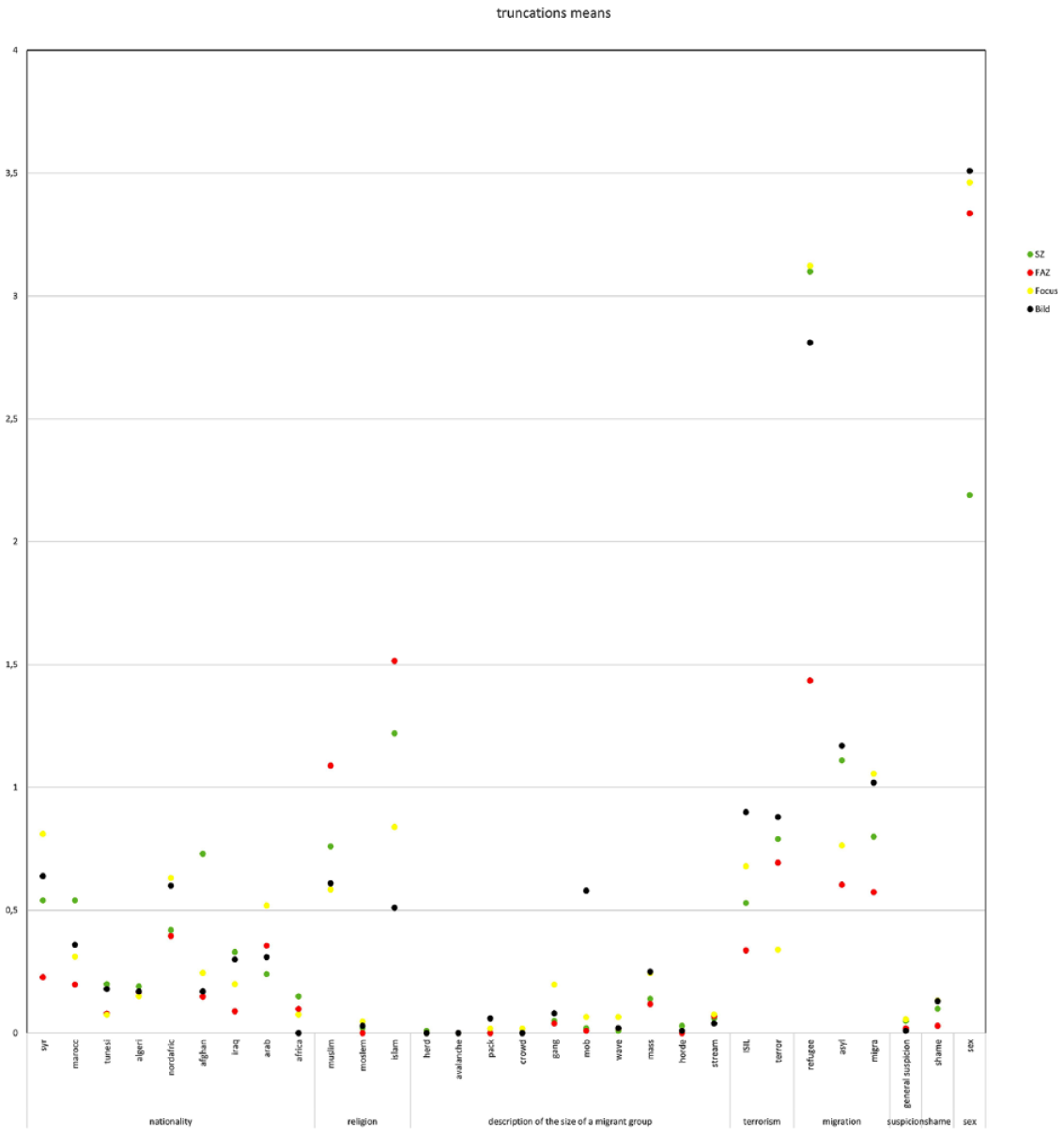
Truncations (means).
Consistent with key event theory there should also be differences in the frequencies of truncations before and after New Year’s Eve 2015–2016 (see Figure 5). The ANOVA shows that the truncations Iraq (*) [irak], Africa (***) [africa], terror [***], islam [**] and ISIL (***) [Index of ISIS, Islamischer Staat, Daesch and IS] were mentioned significantly less after Cologne. In contrast the truncations marocc (*) [marokk], algeri (*), northafric (**) [northafrik], mob (*) and sex (*) were used significantly more often. This more frequent connotation of national and regional background (North Africa) after Cologne, coupled with decreasing connotation of terrorism (ISIL) and Islam suggest a discursive shift or reframing of stories relating to migrant sexuality.
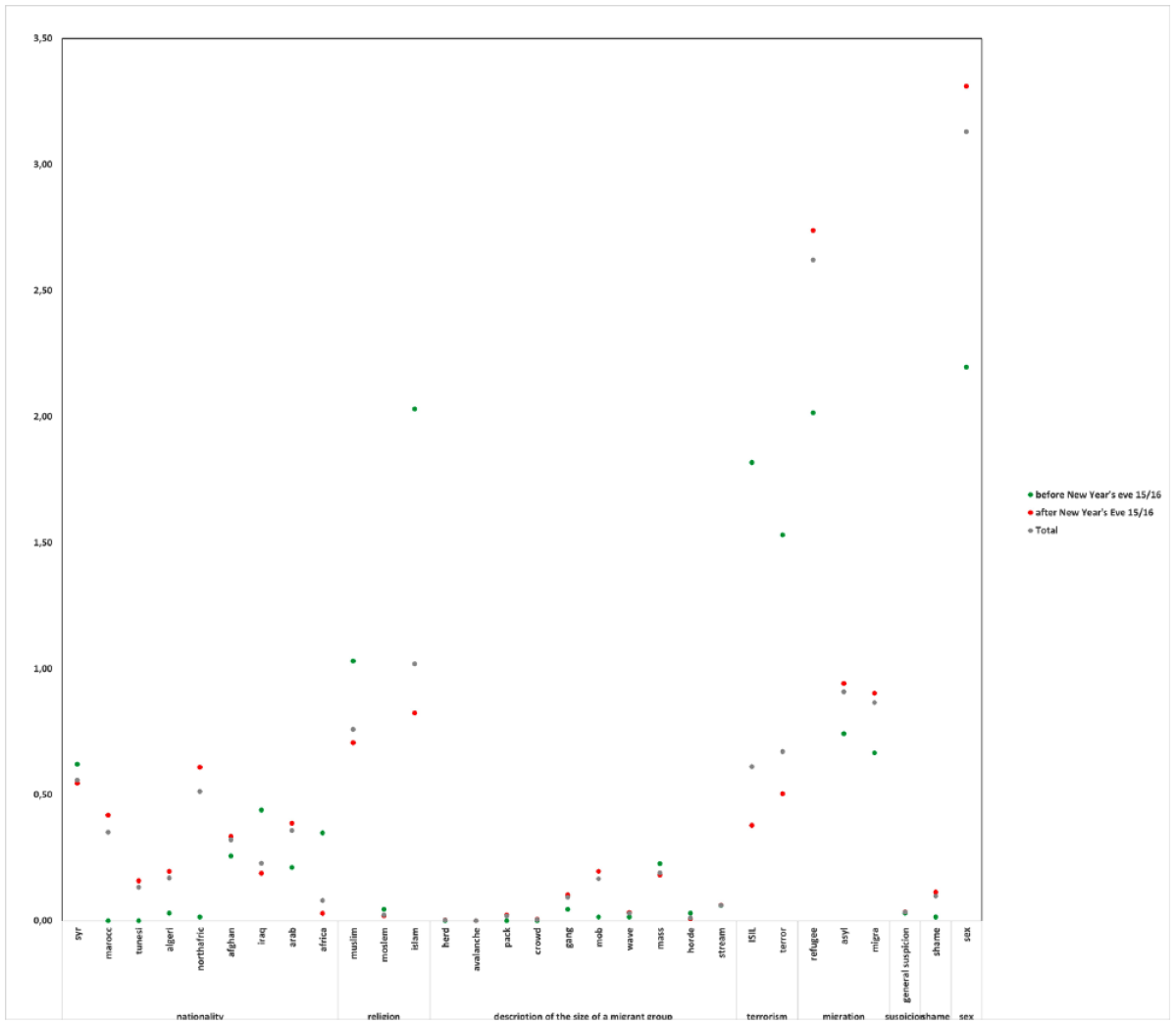
Truncations before and after New Year’s Eve 2015–2016.
We used MDS to visualize the distances between truncations in the articles, and hence what images of migrants are suggested by the publications’ depictions. This enables us to visualize whether migrant sexuality is, for example, related most closely to religion, national origin, ethnicity or words associated with crowd-threat like mob, mass and so on, which could provoke anxiety and prejudice. The analysis includes all mentioned truncations in Table 4 except general suspicion [Generalverdacht], herd [rudel], avalanche [lawine], pack [meute] and crowd [schar], as these were not used enough for MDS to be reliable.
First, the statistical quality criteria for the MDS of the truncations of all three newspapers and the Focus were met (SZ: stress .06, R²= .99; FAZ: stress .001, R²= .99; Focus: stress 0.07, R²= .99 and Bild: stress .08; R²= .99).
The visualizations are interpreted in the following way: The further the truncations are away from each other, the more dissimilar they are and the closer they are to each other, the more similar they are. We have not named the two dimensions in the presentation of the MDS because this does not make sense against the background of the many different truncations. However, this is irrelevant for the question because we are primarily interested in the distances between the truncations. The visualizations show that the newspapers SZ, FAZ and the Focus have in common that the truncation refugee [flüchtli] is very distant from all other truncations. The truncation is linked to the refugee crisis debate and therefore a topic in itself. 1 In each case truncations relating to migrant group size such as mob, stream and mass are close to nationality and regional truncations (i.e. north africa [nordafric] suggesting there is some attempt to distance refugees from sexual offences, and to link these to national or regional origins. The word mob is mostly used by the Bild, followed by Focus, but less often used by SZ and FAZ.
There is considerable variation in word proximity between the publications. For SZ (see Figure 6(a)), the truncations afghan, muslim, islam, terror and refugee [flüchtli] are relatively distant from other truncations of nationality and words which describe the size of migrants groups such as mob, mass, stream and so on . But other truncations are close to each other for example, asyl, stream, mass, shame and mob.
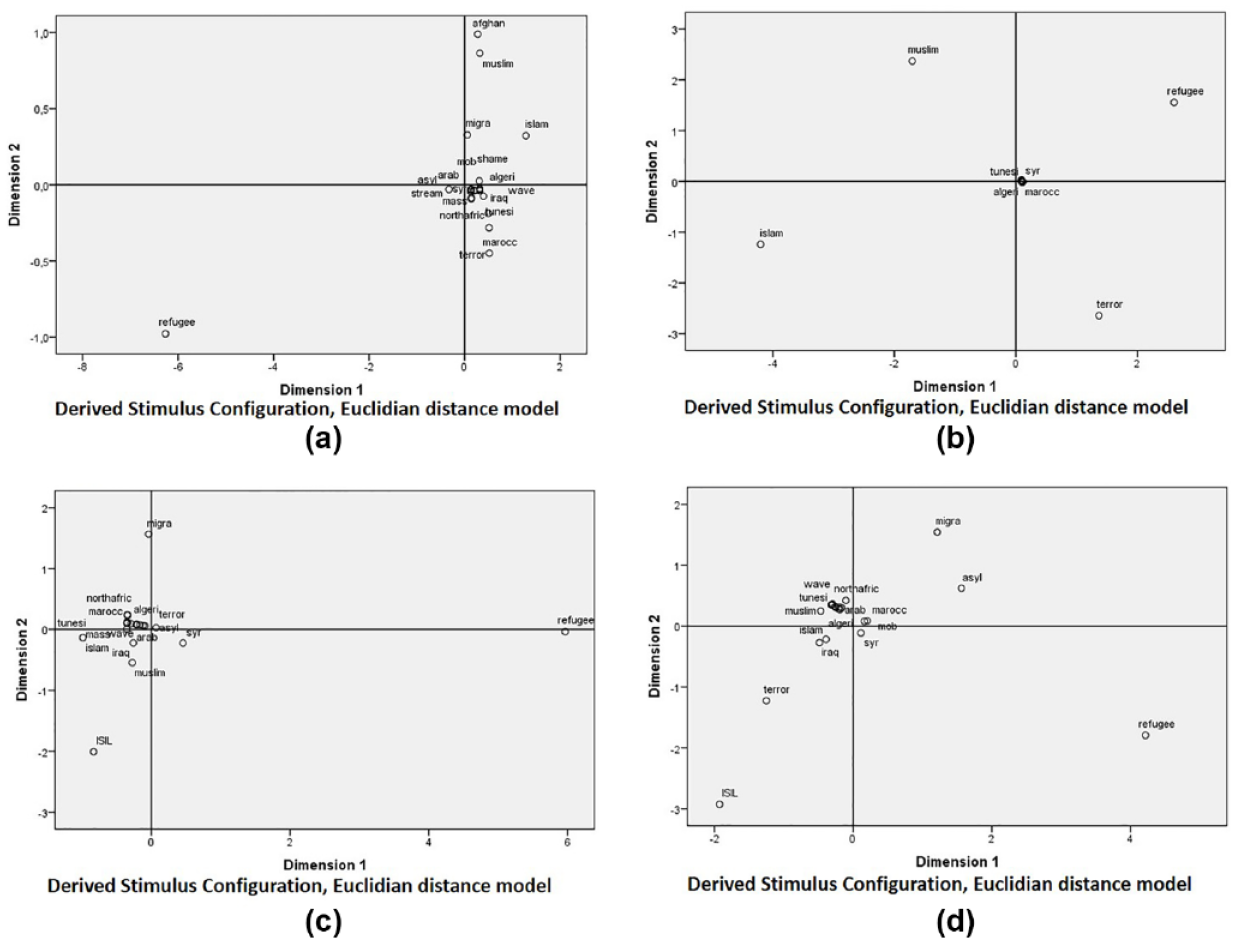
Multidimensional scaling. (a) Süddeutsche Zeitung (SZ). (b) Frankfurter Allgemeine Zeitung (FAZ). (c) Focus. (d) Bild.
The truncations in FAZ (see Figure 6(b)) have a distinctive configuration. Refugee, islam, muslim and terror are very distant from each other and from the other truncations. All other truncations including nationality, size terms and shame and so on. are very close to each other, so close that they overlap in the visualization. This suggests a strong national and group threat framing of coverage of male migrant sexuality.
The magazine Focus’ reporting of migrants contrasts with that of SZ and FAZ (see Figure 6(c) and compare Figure 6(a) and (b)). This is expected as Focus is generally regarded as more sensationalist. The visualization shows that refugee [flüchtli], ISIL [index of Islamischer Staat, ISIS, IS and Daesch] and migra are distant from each other and from the other truncations, but the truncations asyl as well as islam and muslim are much closer to clearly negatively connoted crowd words [e.g. mob] and the truncations for shame [Schande] and terror than in SZ and FAZ. This indicates that Focus contributes to a more religiously connoted and negative framing of migrant sexuality.
For Bild (see Figure 6(d)), ISIL-related terms, refugee, migra, asyl and terror are at a significant distance from the other truncations. Like Focus, truncations which stand for nationality and region (North Africa) and religion (Islam, Muslim) are close to mob, shame [Schande] and truncations linked to group size. The profile resembles Focus, but terror is more clearly differentiated from words connoting nationality, crowd threat and religion. Both publications show a shift in popular discursive framing from concerns with terror and the plight of refugees to concerns with group and sexual threat linked to nationality and religion.
Discussion and conclusion
Media reporting of the Cologne assaults did not end German ‘Welcome Culture’, which remains anchored in supportive elements of civil society and government policy (Fleischmann, 2019). But it seems to have damaged support for the policy (Liebe et al., 2018: 9), through the stigmatization and criminalization of male migrants, part of which we have traced here. While popular support for ‘Welcome Culture’ appears less widespread than early media reports suggested (Liebe et al., 2018: 9), and the themes Cologne highlighted have a long history in Germany (Wigger, 2010, 2017), as elsewhere in Europe, nonetheless our results suggest that reporting of the event marked a discursive shift (Krzyżanowski et al., 2018: 3).
Thus, significantly more articles which problematize male migrant sexuality, and a greater focus on reporting of sex crimes involving migrants appear after the event. This applies especially to the outlets Focus and Bild, which focus intensively on sex crime stories related to male migrants. Here, religion is bound up with a new emphasis on nationality and the mob in the articulation of sexual threat, contrasting with SZ and FZ – ‘higher brow publications’. This pattern suggests that reporting follows the template of key event theory, whereby after major stories the media concentrates on similar events and uses frames influenced by coverage of that key event, creating the impression that such events occur more often than before, reframing their discussion, and setting the agenda for subsequent public discussion and policy action, potentially triggering the stigmatizing and criminalizing spiral of a moral panic (Cohen, 1972).
This is worrying as media have been shown to circulate stigmatizing stereotypes of migrants which impact negatively on public perceptions (Czymara and Dochow, 2018). In the context of reporting sexual assaults by migrant men this may lead to exaggerated perceptions of such crimes and increase prejudice and discrimination against them.
We also found that the attributes of nationality and regional origin (North Africa) and group size became more frequent and were closely associated with a range of negatively connoted terms concerning group threat and migrant sexual deviancy, creating the danger of resonating with long-standing racist frames of representation of the sexuality of men of colour. In contrast, in all publications the term ‘refugee’ was distant from these terms, which may reflect journalists’ efforts to distinguish (‘genuine’) refugees from (‘criminal’) migrants (Liebe et al., 2018: 10).
However, beyond this basic differentiation, the proximity of migrant sexual deviancy to terms connoting religion and terror varied, from close in the populist Focus, to some distance for ‘terror’ in the tabloid Bild, to significant distancing of terms connoting religion in the case of SZ, and a marked differentiation of religious terms in FAZ. The problem in terms of media reception and likely social effects is that this nuancing in the high-brow publications may be overwhelmed by the clear and consistent messaging across publications linking North African migrants with sex crimes and crowd-threat.
Our research has demonstrated that German media reporting on the sexuality of male migrants has linked various negative stereotypical attributes to migrant men which evokes a potential risk of compound (or ‘intersectional’) discrimination. It promotes the perception among the public that all these factors are related to the cause of sexual aggression, especially as most media articles do not consult an expert to explain possible reasons for sexual crimes. This applies to all four examined media outlets. While we found some media reports, even in Bild and Focus, showing a more reflexive and positive attitude towards migrants, warning against general suspicion and thematizing the problems of migrant stereotyping, most articles in our sample did not critically reflect on the media coverage of migrants and did not report in a well-differentiated way about this sensitive subject.
While the increase in occurrence of the stigmatizing terms we identified varied in duration – with the ‘half-life’ longer for SZ and FAZ than for Bild – our argument is that this coverage may have been significant in shifting ‘soft’ liberal public opinion away from support for ‘Welcome Culture’, with repercussions for the subsequent course of political debate and policy direction; findings such as those of Liebe et al. (2018: 3, 9), showing that support for opening a refugee support centre in one’s neighbourhood declined by 40% (from 20% to 12%) between late 2015 and late 2016 support this reading.
Beyond our case study, our use of method also shows the value of combining qualitative approaches (qualitative-heuristic method) with quantitative analysis (word count and ANOVA) and computational techniques (MDS) to shed light on complex socio-cultural phenomena such as the relationship between public opinion and media coverage in a rapidly evolving media ecosystem.
Footnotes
Appendix 1
Acknowledgements
This article presents key findings from our research project ‘The end of tolerance?! Race, Sex and Violence in Germany’s media discourse on migration’. We would like to thank the British Academy and the Leverhulme Trust very much for supporting our research on this topic and for funding this research project. We would also like to thank Line Nyhagen, Emily Keightley and John Downey from LU for their support and comments on earlier drafts. We are very grateful to the reviewers and editors of the European Journal of Communication for their thorough and helpful comments in the review process.
Funding
The author(s) disclosed receipt of the following financial support for the research, authorship and/or publication of this article: We would like to thank the British Academy and Leverhulme Trust for funding this research in the Small Research Grants Scheme [Grant SG160101].
