




Abstract
Public service media face an existential crisis. Many governments are cutting their budgets, while questioning the role and value of public service broadcasting because many citizens now have access to a wide range of media. This raises the question – do public service media supply a distinctive and informative news service compared to market-led media? Drawing on the concept of political information environment, this study makes an intervention into debates by carrying out a comparative content analysis of news produced by UK public service broadcasters and market-driven media across television, radio and online outlets (N = 1065) and interviewing senior editors about the routine selection of news. It found that almost all BBC news and commercial public service media platforms reported more news about politics, public affairs and international issues than entirely market-driven outlets. Online BBC news reported more informative topics than market-based media, which featured more entertainment and celebrity stories. The value of public service media was demonstrated on the United Kingdom’s nightly television news bulletins, which shone a light on the world not often reported, especially BBC News at Ten. Most market-driven media reported through a UK prism, excluding many countries and international issues. Overall, it is argued that the influence of public service media in the United Kingdom helps shape an information environment with informative news. The focus of the study is on UK media, but the conceptual application of interpreting a political information environment is designed to be relevant for scholars internationally. While communication studies have sought to advance more cross-national studies in recent years, this can limit how relevant studies are for debates in national political information environments. This study concludes by recommending more scholarly attention should be paid to theorising national policy dynamics that shape the political information environments of media systems within nations.
Keywords
Introduction
Across Europe many public service media organisations face an existential crisis with national governments cutting their funding (EBU, 2019), and questioning their role and purpose given many citizens today can access a wide range of commercial media (Van Aelst et al., 2017). This raises the question – do public service media supply a distinctive service compared to market-driven media? If so, how do they enhance the media environment?
This study makes an intervention into these debates by interpreting the informative value of news produced by different types of public service broadcasters and commercial media in the United Kingdom. It examines the supply of news on four of the largest UK public service broadcasters, and compares their routine output with commercial media across television, radio and online platforms. A comparative content analysis study was conducted, identifying the main topic of news in 1065 items over a 3-week period.
In comparing coverage between different news media, the study draws on the concept of political information environment to explore ‘the quantitative supply of news and public affairs content provided to a national audience by routinely available sources’ (Esser et al., 2012: 250). The premise of the concept is that the more people are exposed to information, the more likely they are to be influenced by it. Of course, interpreting the informational value of news is not straightforward. But for the purposes of this study, it represents news that is likely to inform and empower people in democracy, such as supplying news about politics, the environment, social policy, public affairs and international issues (Delli Carpini and Keeter, 1996), rather than lighter topics about celebrities, sport or entertainment. Put simply, the study asks: is the United Kingdom’s political information environment enhanced by the presence of public service broadcasters, or do they largely report the same news topics as market-driven media?
Debates about the informative value of media systems are relevant world-wide (Hallin and Mancini, 2004). But the United Kingdom was chosen for this study because it has a public service broadcaster (the BBC) with a global reputation that has been a model for broadcasting systems internationally. Ever since the 1950s, however, the United Kingdom has developed a hybrid media system, with a licence-fee funded public service broadcaster (the BBC), as well as the introdcution of commercial public service broadcasters over time, including ITV, Channel 4 and Channel 5. They all have different licence agreements which the regulator – Ofcom – oversees that require them to produce specific types of news (local, say, or international) at peak time schedules. Beyond broadcasting, the United Kingdom’s press and online media are largely market-driven and operate without state intervention. In other words, the United Kingdom’s mix of public service broadcasting models (either supported mostly by public funds or commercially operated) and largely online market-driven news environment is a useful case study internationally to explore which media system offers the most informative news service.
The study focusses on the quantitative range of routine news topics within the UK media system, rather than comparing the qualitative depth of coverage between outlets. In order to support the content analysis findings, interviews with either the heads or senior editors from BBC, ITV, Channel 4 and Channel 5 were conducted. The interviews provide insights into the editorial values of different public service broadcasters, and reveal the challenges associated with routinely providing informative news.
Political information environments: Towards more analysis of news within a national media system
Over recent years, debates have intensified about which media systems offer the most effective way of informing people about what is happening in the world (Curran et al., 2009). One of the most comprehensive longitudinal studies to date was offered by Esser et al., (2012), who examined the scheduling of news across 13 European media systems over three decades. They found ‘higher levels of political information programs on public than private channels’ (Esser et al., 2012: 261). In doing so, the study drew on the concept of the political information environment to explore what kind of news people were routinely exposed to across different national media systems. The theoretical framework of this concept, according to Esser et al., (2012), is twofold. First and foremost, it relates to interpreting the routine opportunities citizens have to access news that is likely to make them more informed about the world. Put another way, the concept suggests many citizens do not actively search for informative news, but they are exposed to it on their televisions or radios in-between watching a film or listening to music. Second, the political information environment theorises the relationship between the systemic structural features of national media systems that shape the type of news produced. It seeks to interpret the relationship between news operating within a media system and the comparative quality in the supply of news. Esser et al., (2012), following Aalberg et al., (2010), primarily focussed on quantifying the scheduling and type of news programming comparatively produced by broadcasters operating under different funding models and editorial aims. However, as the authors acknowledged, their research design offered limited analysis of news quality or performance.
The focus of this study is on assessing the informative value of news. It does so by examining the main news topics different outlets supply across television, radio and online news within the United Kingdom’s media system. More specifically, the theoretical rationale for the study was to compare the opportunities different news media provide for citizens to learn about the world and to interpret whether the type of media system influences the editorial selection of news. Of course, when the media supply informative news it cannot be assumed that people will closely follow these topics because they may well avoid watching, reading or listening to them (Ytre-Arne and Moe, 2018). But the scope of the study relates to the political information environment and which type of media system gives citizens the opportunities to learn about informative news topics, such as politics and international affairs, even if they are not taken up by the public.
The normative diet of information likely to benefit citizens in a democracy is most often related to news about international affairs or domestic policy issues, rather than lighter topics such as celebrities, entertainment or human-interest stories (Benson et al., 2018). Reinemann et al., (2016), for example, analysed news content in 160 outlets across 16 countries and identified a more informative news agenda on public service media than commercial television networks, broadsheet newspapers and websites. Their study is perhaps the most substantive international contribution to debates about the value of public service media in national political information environments. But again, as the authors of this and other cross-national studies have acknowledged, while there is considerable value in comparing news output across a large number of countries, they can often provide more breadth than depth when analysing national political information environments. After all, many cross-national studies mainly rely on just a few private and public media to compare news topics. Moreover, they do not always reflect content across all media sectors such as radio, TV, online and social media. As Hallin and Mancini (2004) acknowledged decades ago in their landmark study of media systems in 18 countries, it is highly challenging to theorise the characteristics of national media systems and broadly categorise them. They developed three media systems – liberal, democratic corporatist and polarised pluralist – which broadly categorised nations based on their political and journalistic identities. In the case of the United Kingdom, it was grouped in the liberal model, which included Ireland and the United States. It was defined ‘by a relative dominance of market mechanisms and of commercial media’ (Hallin and Mancini, 2004: 11).
In the wake of Hallin and Mancini’s (2004) intervention, debates about the complexity of classifying media systems have intensified with scholars finding new ways of empirically interpreting and theorising them. Brüggemann et al., (2014), for example, have suggested that a key dimension of Hallin and Mancini’s model of media systems – the role of the state – should be reclassified into three dimensions: public broadcasting, ownership regulation and press subsides. In doing so, they argued, it would make the United Kingdom more distinctive from the United States because of its state support for public support broadcasting, and stricter regulation of broadcasting and media ownership policies. It is only the UK press and online media that have limited state intervention with light-touch regulation. But while the theorising of cross-national media systems has become more sophisticated in recent years, less attention has been paid to understanding the differences within national media systems. This study will assess any differences in output within the United Kingdom’s hybrid media model in the context of interpreting whether different types of public service broadcasters supply more informative news than market-driven media.
Debates about the value of public service broadcasting for citizens in a democracy are long-standing (Donders and Moe, 2014). Broadly speaking, they are seen to create pluralism within a media system, supplying diverse content and being distinctive from the commercial market, while safeguarding programming that might suffer from market failure (Humprecht and Esser, 2018). News is viewed as central to the remit of public broadcasting (Cushion, 2012). In normative terms, the informative value of news produced by public service broadcasters is to supply topic diversity that raises public understanding of complex social, economic and political issues, while remaining sufficiently distinctive from the editorial content of market-based media and ensuring they do not have an impact on their commercial revenue 8; Cushion, 2012; Humprecht and Esser, 2018). In a Norwegian context, for example, Sjøvaag et al., (2019) asked whether public service broadcasting was a threat to commercial media and found they supplied a distinctive diet of news. Drawing on a content analysis of NRK online news with a range of commercial media outlets, they discovered that NRK largely ‘stays away’ from content segments distinct to commercial competitors – local sports, lifestyle and crime coverage in the regional market and football coverage, popular culture and economics in the national market . . . and it has more of the hard news topics than commercial operators. (Sjøvaag et al., 2019: 822)
In fact, they concluded that far from being NRK’s news agenda being too similar to commercial media, market-driven news outlets were similar to each other.
There have been concerns in the United Kingdom about the BBC not being sufficiently distinctive from commercial media and of limiting the growth of market-driven media. Or, put another way, it has been argued that the United Kingdom’s main public service broadcaster operates at a commercial advantage with state assistance. While there has been considerable debate at a media, policy and academic level about the accuracy and impartiality of BBC journalism (Barwise and York, 2020), there has been little systematic research that has compared the news topic output of the United Kingdom’s main public service broadcaster with other broadcasters, or with the press and online media market. Without any rigorous studies, often policy debates have been driven by assertations rather than credible evidence. By drawing on the concept of the political information environment, this study offers a systematic way of comparing the routine editorial selection of news on publicly funded public media, commercially funded public media, and market-based media. Although the focus of this article is on the United Kingdom, more broadly it recommends how studies exploring the political information environment should be methodologically designed, analysed and interpreted in order to identify which media system most effectively supplies informative news output.
The research questions of the study are: What topics are routinely selected in news produced by BBC, commercial public service and market-driven news across TV, radio and online outlets? On what basis do senior editors working for public service broadcasters routinely select news? Do public service broadcasters supply informative news that is distinctive from each other and market-driven news media?
Method
This study draws on a content analysis of a large sample of UK national TV, radio and online news. It provided a quantitative, systematic and objective assessment of the range and BBC news, commercial public and other market-driven news outlets. The sample period was from 3 to 21 June (excluding weekends) in 2019, which represents an important point of the calendar when all the UK political bodies were in session. In this sample period, there were a few notable stories and events, including the UK Prime Minister’s resignation and the Conservative leadership contest, along with coverage of the D-Day 75th anniversary and the US President’s visit to the United Kingdom and Europe.
By analysing comparative news topics across a large sample of media, the aim was to assess their routine editorial character. The focus was on the range of stories reported by different media at the same point in time. They were classified into sub-genres of news (e.g. UK politics, international news, education, health and celebrity/entertainment).All international news stories were examined in finer detail in order to identity what parts of the world were covered and, crucially, which countries were excluded.
The sample of television news included BBC News at Ten, the BBC News Channel (5–6 pm) Channel 4 News, ITV News at Ten, Channel 5 News at 5 pm, Sky News Channel 5–6 pm. For BBC radio, Today (8–9 am), Newsbeat, (12.45–1 pm) and Radio 5 Live Breakfast (8–9 am). For commercial media, news on Heart, Capital, talkRADIO, and LBC was examined during its main news update at 8 am each weekday. For online news, items on the front pages of the BBC News homepage, The Guardian, The Daily Mail, The Telegraph, The Sun, the Mirror, BuzzFeed, and the Huffington Post each weekday morning. The sample was constructed on the basis of including the most widely consumed news media across the United Kingdom (Newman et al., 2020). We selected online rather than news in print because much of the content is replicated online and because it was easier to code the five most prominent topics according to their prominence online rather than in physical copies.
The unit of analysis for broadcast media was every item according to the news convention (e.g. edited package, say, or live two-way). For online news, individual items were easier to identify as a distinct unit of analysis. Given the daily supply of online news is considerable across the news outlets examined, the sample was limited to the most prominent five news items identified each day at the same point in time. While this does not capture the full diversity of news produced by each online outlet, it does convey their most prominent stories at the start of the day. For radio programming, we analysed the main news headlines at a set time each weekday so they could be fairly examined at the same time of day. A research team (made up of five coders in total) examined every individual item (not clusters of stories) and selected the most salient topic. Topics were broadly classified at the first phase by their domestic or international focus. The second phase involved developing a set of generic topics that could broadly characterise the stories during the sample period.
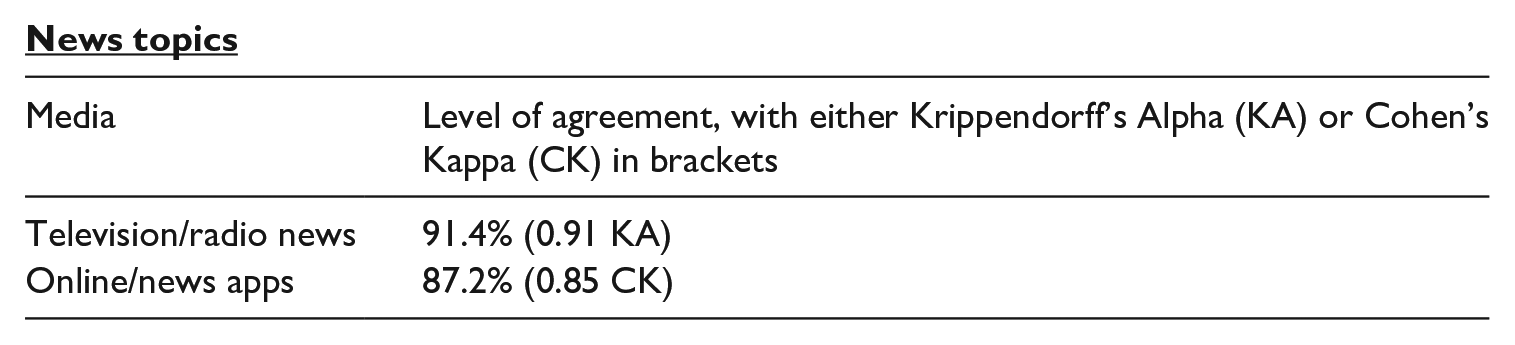
Approximately 10% of the sample was recoded to generate intercoder reliability scores. To ensure all variables were robust, the Cohen’s Kappa (for variables when two researchers coded material) and the Krippendorff’s alpha (for variables when three researchers coded output) coefficients were used to test the reliability of the descriptive variables. There was a consistently high level of intercoder agreement across all variables (see Appendix 1). 1
Since the primary aim of the study was to examine the informative value of news produced by public service broadcasters, interviews were carried out with a senior editor or head of news from the United Kingdom’s main public service broadcasters rather than representatives of all UK media examined. The main purpose of the interviews was to explore their editorial choices judgements in the routine selection of news. This included Paul Royall, the Editor of the BBC Six and Ten television news bulletins, Michael Jeremy, Director of News and Current Affairs at ITV, Dorothy Byrne, Head of News and Current Affairs at Channel 4 and Cait FitzSimons, Editor of 5 News. The content analysis findings were not revealed to the interviewees. The focus was on the editorial selection of news generally rather than just the specific sample period. The interviews were conducted on 9 and 10 October 2019, and lasted approximately 40 to 90 minutes. They were subsequently transcribed and analysed by the author’s close reading of them. In doing so, interview material was critically examined in the context of understanding why editors choose certain news topics and interpreted according to whether they reflected the normative aims of public service broadcasting.
Findings
Domestic news selection
Over the first week of the sample period, there were two major events – the 75th D-Day anniversary and the US President’s visit to the United Kingdom and Europe – which, in total, made up between 10% and 20% of news output across all television programmes (see Table 1). This may have influenced the degree of coverage about routine coverage in areas such as health, education and social policy reporting.
The percentage of main topics covered in all television news items (by time; N in brackets).
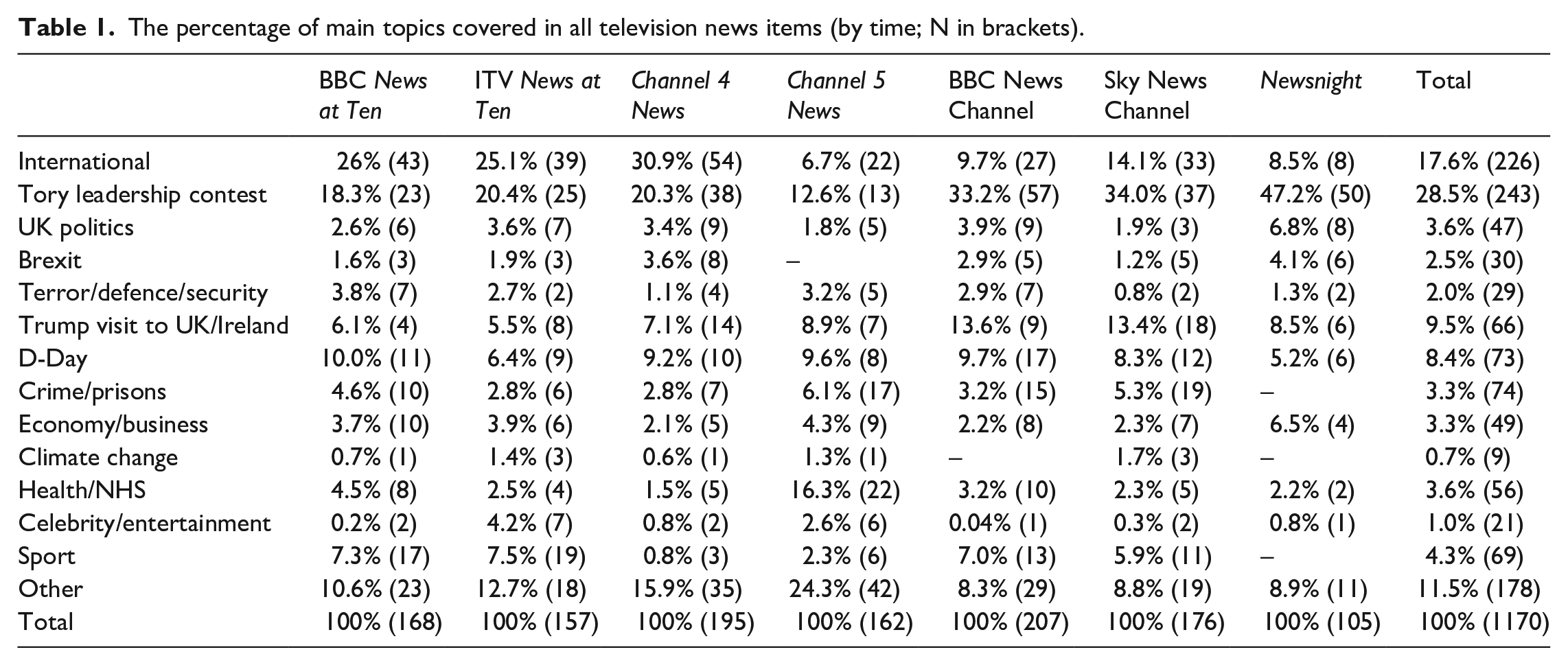
The most reported topic was the Conservative party leadership contest, which accounted for 18.3% of airtime on BBC News at Ten, 20.4% on ITV, and 20.3% on Channel 4. Perhaps due to various breaking news developments with candidates vying to be the next Conservative party leader, the 24 hour news channels spent approximately a third of their total output reporting it. Only Channel 5 spent more airtime reporting other stories than the leadership contest, adopting a different news agenda than other broadcasters. It spent 27.5% of airtime covering health, education and crime, whereas the corresponding figure was just 7.3% on the BBC News at Ten.
According to the editor, Channel 5's news agenda was designed to go beyond the institutional focus of Westminster politics, with stories focussed on specific locations and individuals rather than political systems. As she revealed when explaining what Channel audiences wanted: if you say to them here’s a political story, they won’t be interested, but if you say to them here’s a story about how your local flood defences aren’t being funded, or your local hospital is struggling, or even corruption, or things like that, then they’ll sit up and take notice. So it’s about how you present certain kinds of stories, so you don’t shy away from Brexit and politics, but it’s where you tell them . . . And then, in other issues, I always talk about things that feel local to them on their doorstep. So it’s about their health services, their schools, crime, those kind of issues, but done in a way that is very much about the actual experience of it rather than led by the policy of it, and I think that’s the twist that we do. (Cait FitzSimons, Editor of Channel 5 News)
So, for example, Channel’s 5 coverage of health was more than triple the airtime this topic was given on the BBC’s News at Ten, and between 7 and 10 times more than on ITV’s and Channel 4’s evening bulletins. This suggests Channel 5 News approaches its public service obligations differently to other broadcasters. The editor also alluded to Channel 5’s specific audience demographic, which is typically viewers from low social economic groups who do not express an interest in Westminster-based politics. In other words, the commercial public service broadcaster was attempting to raise public understanding by reporting political issues from a social perspective that resonated with audiences.
There was a tacit acknowledgement by the BBC’s News at Ten editor that news reporting could be more people than policy-led in order to ensure politics was not seen through a Westminster bubble. As he put it, we have to cover up to a point what goes on at Westminster, but actually the issues that politicians are addressing and grappling over are probably much better reported out of Westminster and around the country in terms of housing, the health service, education, all those inequality, the world of work, all those things. That then takes you to an interesting journalistic place . . . I don’t think we’re there yet but that’s what we aspire to. (Paul Royall, Editor of BBC News at Ten)
In order to advance public knowledge about political issues and meet the normative ideals of public service broadcasting, the BBC News at editor Ten also acknowledged the difficult balancing act of reporting formal, Parliamentary decisions, while also showing audiences the social, economic and cultural implications of them.
The Conservative party leadership contest was the most reported topic in BBC radio programming, apart from Newsbeat (see Table 2). This topic was especially high on BBC’s Today and World at One, accounting for 22.3% and 29.8% of airtime respectively. As with television news, Trump’s visit to Europe and the D-Day celebrations took up a large share of total airtime over the 3 weeks, with limited attention to social policy issues. On Today, for instance, 5.4% of airtime was spent on housing, education and transport combined, whereas 6.0% was dedicated to news about art, history or heritage.
The percentage of main topics covered in all radio news items (by time; N in brackets).
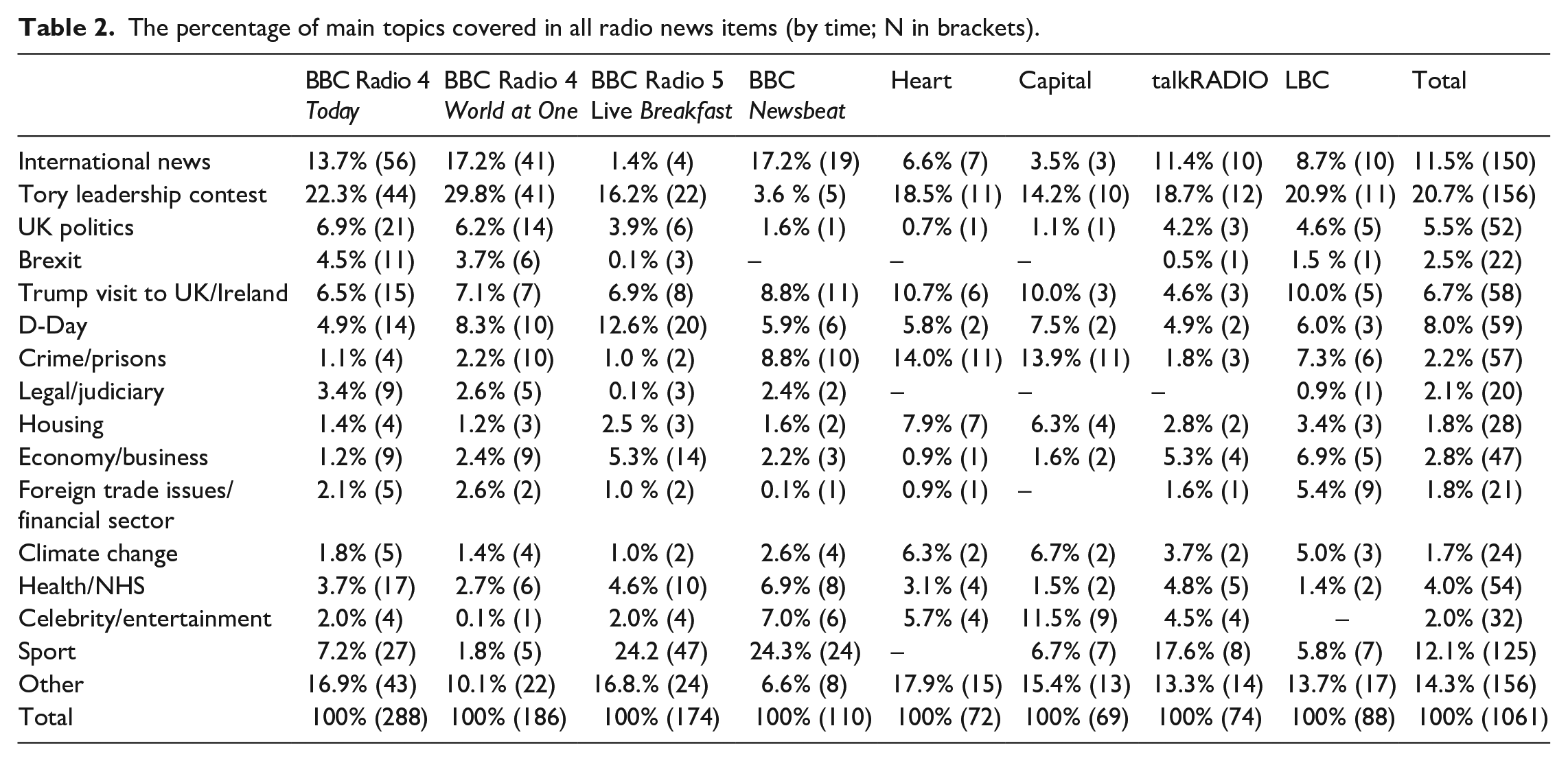
BBC Radio 4 news was different to BBC Radio 1 and 5 bulletins. On BBC 5 Live Breakfast and Radio 1 Newsbeat, a fifth of airtime focused on sports news, compared to 7.2% on Today and 1.8% on News at One. Newsbeat, in particular, was different to other BBC programming, since it included a far higher proportion of news about crime, health and celebrity/entertainment stories. Once again, there were differences in how broadcasters met their public service requirements, such as Newsbeat – a programme aimed at younger audiences – departing from formal coverage of Westminster politics and focussing on a wider range of issues. But, overall, radio news output on public service broadcasting contrasted with commercial media, which spent more time covering celebrity and entertainment stories than BBC programming.
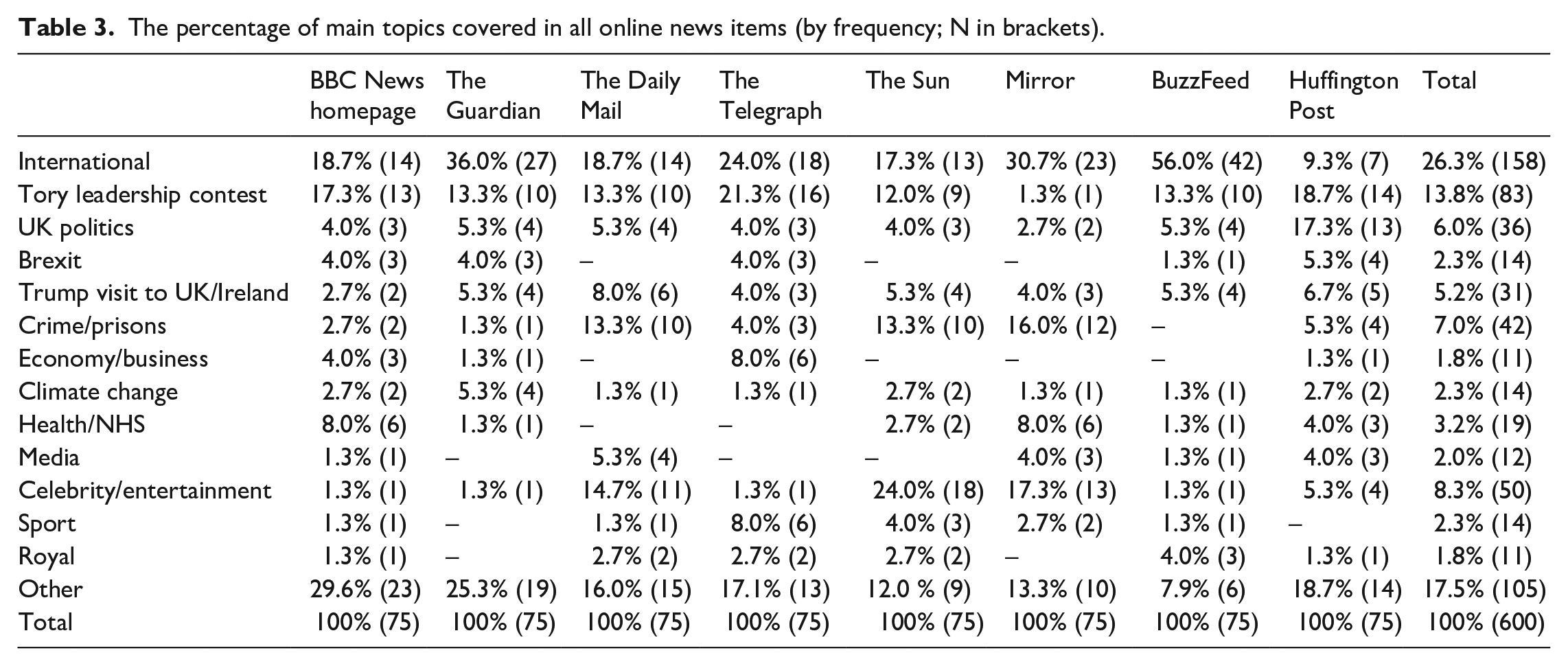
In online news, once again the Conservative party leadership contest made up the largest single reported domestic topic, in total 17.3% (Table 3). Only the Telegraph at 21.3% and Huffington Post at 18.7% covered the story more often. No single story dominated the news agenda across competing online news outlets. There were a wide range of stories in areas such as crime, health, education, transport, housing, education, the economy and the environment. While it has been claimed BBC News online increasingly resembles the downmarket agenda of some UK national newspapers (Oliver & Ohlbaum Associates Ltd and Oxera Consulting LLP, 2016), there was little evidence to support this assertion. So, for example, entertainment and celebrity stories made up 24.0% of news in the Sun, 17.3% in the Mirror and 14.7% in Daily Mail, whereas the BBC had just one item about these topics over the 3-week sample. This broadly demonstrates that the United Kingdom’s main public service broadcaster is prominently reporting informative online news that is distinctive from the market.
The percentage of main topics covered in all online news items (by frequency; N in brackets).
Finally, with the exception of covering a major government bill to cut greenhouse gas emissions to zero, the reporting of climate change barely registered across television, radio or online news over the three-week sample period (see Tables 1 to 3). While all interviewees acknowledged that climate change should be a story high up the news agenda, they explained it was often difficult to editorially maintain coverage of this issue on a daily or even weekly basis. So, for example, the Editor of the BBC’s Six News at Ten revealed that they had: planned and commissioned a lot of coverage which is off-agenda in the sense that it’s not pegged to a particular announcement or news event. For example, in the lead up to the UN coverage [October 2019] . . . we ran a series across the preceding month from the melting ice-sheet to the drying up of the Dead Sea, to how peat bogs in Scotland can be used for carbon capture, and things like that. So . . . it doesn’t sort of need the news-peg element to drive it (Paul Royall, Editor of BBC News at Ten).
ITV’s Director of News and Current Affairs also stressed the importance independently developing a climate change agenda, while ensuring it does not escape day-to-day reporting: It’s a news programme [ITV News at Ten] so we want to cover the things that are new, but if you never put things in context, you’re not serving your viewers well. So we do try to cover the day’s development, but also find resource and people to do wider coverage (Michael Jermey, Director of ITV News and Current Affairs).
In order to enhance environmental coverage, Channel 4’s Head of News and Current Affairs – Dorothy Byrne – revealed that a senior journalist was appointed to the topic of climate change because, in her words, ‘He’s massively known by the audience and he’s also get heft in the newsroom, so if he really wants to do something, he’s more likely to get the resources to do it’. Finally, The Editor of 5 News suggested that reporting climate change was a resource issue because their editorial team did not have the finances to support reporting from affected countries around the world. This suggests that editorial resources within a newsroom limit the degree to which commercial broadcasters can meet the normative aims of producing informative public service news coverage. While all interviewees provided anecdotes about independently reporting climate change stories, they acknowledged the challenges associated with covering it day-to-day. At times, there appeared to be pressures to follow the news cycle rather than lead with stories they wanted to editorially prioritise.
International news
Over the three-week sample, international news was the highest single category on news television bulletins. On Channel 4 News it made up 30.9% compared to 26.0% on BBC News at Ten and 25.1% on ITV News. The only outlier was Channel 5 News, which had just 6.7% of its airtime dedicated to international news topics. On rolling news channels–Sky News and the BBC News Channel – international news was considerably lower, with 14.1% and 9.7% focussed on foreign issues respectively. Overall, there was not a huge disparity in the volume of international news between public and commercial service broadcasters in the United Kingdom. In fact, the commercial broadcaster, Sky News, featured more international news than the BBC’s public service news channel. Only Channel 5, the broadcaster with the least public service responsibilities, had a relatively low level of international news at 6.7%.
Of course, compared to its competitors, Channel 5 has a far more limited budget which it can spend on routine international news reporting. This was pointed out by its editor: ‘Our remit from the channel is primarily domestic news, so we have a very small foreign budget–small even by our standards relative to our coverage budget’. The BBC’s flagship News at Ten, by comparison, has a globally rich team of journalists to draw upon to report from around the world. The Editor of the BBC News at Ten explained that reporting international issues was central to his editorial remit. He revealed that the level of national and international news was closely monitored over a set period of time. In his words: on a monthly basis it [the balance of national and international news] generally lands in the same place, which is the 10 O’clock News is usually about two-thirds domestic, one-third global, and then the 6 O’clock News might be more like three-quarters, or maybe 80% domestic, 25% / 20% global and that number generally sort of comes out across the course of a month (Paul Royall, Editor of BBC News at Ten).
At the same time, the BBC News at Ten Editor, along with the other interviewees, stressed that international news was not shaped by a quota system, but by the editorial strengths of each story. ITV’s Director of News and Current Affairs, for example, explained that its a balance, a judgement made on the news of the day and a desire to give people a rounded view of the world over time . . . we have a pretty strong commitment to international news, and not just the stories that are the big headline news of the day
All interviewees acknowledged the difficulty in covering parts of the world not just because of the heavy resources involved in reporting but in selecting stories relevant to UK audiences. As Channel 4’s Head of News and Current Affairs put it: it’s really important to us that we cover international news . . . we’re aware that parts of the world disappear. Every now and again over the years I’ve drawn a map of the world, according to how it’s perceived on TV . . . Britain’s huge and then actually Europe is currently quite big but for many years Europe hardly existed, and then there was the Middle East, and Africa hardly existed, China existed but was only very small, and then Washington was huge but the rest of America was tiny. Donald Trump has been a challenge because almost every day he says something extraordinary that you have to report; you’re not reporting the lives of people in the rest of the United States, so they can tend to disappear. (Dorothy Byrne, Channel 4 Head of News and Current Affairs)
Overall, in discussing the selection of international news topics interviewees revealed the tension between, on the one hand, having the resources to immediately respond to events around the world and, on the other hand, forward planning coverage so major issues would be covered. The financial constraints of reporting beyond the United Kingdom along with the editorial drive to cover different parts of the world clearly informs the selection of international news topics. Once again, it can be observed that the financial resources of broadcasters limit their ability to produce informative news consistent with the normative goals of public service broadcasting. Conversely, it shows how a well-funded broadcaster, such as the BBC, can use its considerable resources to report from around the world in order to meet its public service obligations.
It is important to not just understand the volume of international news, but the nature of coverage. War and conflict was the most reported international topic on television news, making up 39.8% on the BBC, 28.3% on Channel 5 News, 26.6% on ITV News at Ten, and 23.4% for Channel 4 News. On BBC News at Ten, items about war and conflict were largely about civil unrest in Sudan and diplomatic tensions in the United States and Iran. By contrast, over half of Sky News’s international agenda was about war and conflict − 54.9% – while it made up roughly a third of coverage (32.4%) on the BBC News Channel. The almost exclusive focus on both rolling news stations was about a conflict between the United States and Iran.
Across the evening news bulletins, coverage of specific nations was relatively similar (largely on United States and Iran). But the BBC News at Ten was distinctive in that it covered the civil conflict in Sudan more than other broadcasters. So, example, when it was possible to identify the geographic focus of an international news item, Sudan accounted for 16.7% of airtime on the BBC News at Ten, 7.8% on Channel 4 News, 2.6% on ITV News at Ten, while Channel 5 News at 5 pm had no substantive coverage. Another prominent theme in international reporting on television news related to social affairs and human rights. More specifically, this was primarily about protests in Hong Kong after China announced new extradition laws to mainland China. On the BBC News at Ten, for example, it made up almost a quarter of international news airtime, 23.4% on Channel 4 and 5, and 6.3% on ITV News at Ten. Social affairs and human rights accounted for 17.1% on Sky News and 20.9% on BBC News Channels. Meanwhile, the proportion of items about international politics, mostly about Donald Trump and US politics, was different across the news bulletins. It accounted for 8.7% BBC News at Ten airtime compared to 16.7% on Channel 4% and 25.9% on ITV News. On BBC News it was 11.4%, almost twice as much as Sky News’s 6.4%. Overall, the BBC provided a distinctive international ‘window on the world’ compared to commercial public service broadcasters.
Compared to television, radio did not supply the same level of international news but there were differences within programmes. On Radio 5 Live Breakfast, for example, it made up just a 1.2% share of total airtime, while on BBC Radio 4’s Today programme and BBC Newsbeat it accounted for 17% of airtime. By contrast, a lower level – between 3.5% and 11.4% of airtime – related to international topics on commercial radio stations. As with television news, war and conflict made up a large share of international news reporting (for instance, roughly a quarter to a third of coverage on Today and World at One) and largely related to the United States and Iran conflict or the civil unrest in Sudan. Of the BBC programmes examined, news about celebrity and entertainment made up more than a quarter of international news items on Radio 5 Live Breakfast and Newsbeat, a higher proportion than items about war and conflict. Since commercial stations had a limited supply of international news, it was difficult to compare topics. But celebrity and entertainment made up 22.6% of international news airtime, compared to two-thirds of airtime on Heart. In the stories selected for news on radio, the United Kingdom’s main public service broadcaster selected a more diverse range of international news topics than market-based media.
The amount of international news across online news was radically different between outlets. While 18.6% of BBC News items were about international news, 9.3% of articles were in the Huffington Post and 56.0% in Buzzfeed. The level of international news across the main newspaper online sites – Guardian, Telegraph, Sun, Mirror and Mail – was broadly between 20% and 30% of total articles. But the differences between BBC and commercial media was apparent in the nature of coverage. The biggest single international topic on the BBC was the dispute between the United States and Iran followed by Hong Kong Protests. In The Daily Mail, the Sun, the Mirror and BuzzFeed there was a greater focus on celebrity and entertainment in international news (making up 21.4%, 15.4%, 21.7% and 14.3%, respectively) than the BBC’s 7.1% focus on these topics. Overall, BBC news online covered more informative international news topics – about politics, war and conflict – than market-driven media.
Towards an understanding of national policy dynamics in political information environment research
Across TV, radio and online, we found almost all BBC news outlets and most commercial broadcasters selected far more informative news topics than entirely market-driven media. BBC News online, for example, covered topics such as politics and international affairs whereas the Daily Mail, Sun and Mirror featured more entertainment and celebrity stories. The value of public service media was also demonstrated on the United Kingdom’s nightly television news bulletins. Most of them shone a light on the world not often covered by market-based media, notably the BBC’s News Ten. Overall, this systematic comparative study of news topics revealed public service broadcasters supplied more informative news about political, social and economic issues both domestically and internationally than market-driven media. Even Sky News, a broadcaster with no public service obligations, editorially selected more informative news topics than online market-based media. While commercial public service media also met their public service obligations by reporting a diverse range of informative topics, there were limits to reporting internationally due to financial resources.
While communication research has called for more cross-national comparative over recent years (Van Aelst et al., 2017), this study has argued for more comprehensive comparative studies within national media systems. When systematically comparing the content of news nationally or internationally, studies often focus on a few outlets either within a country or just one or two outlets per nation, rather than assessing the wider information environment. This study, for example, included digital native media and commercial radio bulletins. It is understandable why samples are small given the significant resources involved in analysing a large number of news outlets within a country or cross-nationally. But, in doing so, cross-national studies can often overlook the relative value of different news organisations, programmes or online sites within a media system. So, for example, many studies have focussed on a particular public service broadcaster, such as the BBC in the United Kingdom, ARD in Germany or NRK in Norway (Cushion, 2012), but this overlooks the role of other public service broadcasters operating within a national media environment. This study has not only shown the informative value of the BBC, but also the high informational quality of commercial public service broadcasters.
Although the emperical focus of this article has been UK specific, the study’s conceptual application of assessing a political information environment is relevant to debates internationally. By designing a study that empirically compares the informative value of news topics across a breath of the most significant national news media outlets, it can help scholars draw evidence-based conclusions about which media systems best serve citizens. Cross-national studies in recent years can often have more limited relevance to key stakeholders, such as national governments and media regulators. After it, media policy is primarily determined at the national rather than international level. Of course, cross-national studies are still needed. They help compare and contrast different national media systems, and highlight the effectiveness of different political information environments (Van Aelst et al., 2017). But they do not always capture the theoretical or empirical nuances within a national political information environment. This study would recommend more scholarly attention should be paid to theorising national policy dynamics that shape the political information environments of media systems within nations.
Footnotes
Appendix 1
|
|
|
|---|---|
| Media | Level of agreement, with either Krippendorff’s Alpha (KA) or Cohen’s Kappa (CK) in brackets |
| Television/radio news | 91.4% (0.91 KA) |
| Online/news apps | 87.2% (0.85 CK) |
Funding
The author(s) disclosed receipt of the following financial support for the research, authorship, and/or publication of this article: The research in the article was funded as part of a 2019 Ofcom review into BBC News and Current Affairs. The author was commisioned to produce a content analysis to inform Ofcom's report. See here: 