




Abstract
This article examines how and when populist discourses were mobilised within the 2016 UK European Union (EU) Referendum campaign, by examining the specific temporal conjunctions between the changing strategy of the official ‘Vote Leave’ campaign, British national newspaper reporting of the Referendum and shifts in public opinion. Our analysis shows that Vote Leave only started to utilise anti-elitist and exclusionary populist rhetoric at the mid-point of the campaign, in response to constricting political opportunities, but by so doing transformed the dynamic of the Referendum. We term this an example of ‘strategic populist ventriloquism’, where elite politicians appropriate the language of insurgency for political advantage, and argue that current conceptual frameworks on media and populism need to be broadened to accommodate these occasions.
Introduction
‘Brexit’, the term used to label the United Kingdom’s withdrawal from the European Union (EU), has become characterised as a predictable manifestation of a populist wave sweeping across many nations (Eatwell and Goodwin, 2018; Norris and Inglehart, 2019). When making such claims, however, there is a need to guard against what Thompson (1963) once termed ‘the enormous condescension of posterity’ (p. 12) and lapse into post-facto determinism. From contemporary vantage points, it is easy to forget how unexpected the outcome of the UK EU Referendum vote was, even among those advocating the UK’s withdrawal (e.g. Vine, 2016). Brexit may demonstrate a growing potency of populist discourses across the political mainstream, but we should remain curious about the specific contexts and contingencies of their mobilisation.
In this article, we examine how and to what extent political populism was used to frame the official ‘Leave’ campaign that preceded the EU Referendum vote. This analysis will examine the representation of populist discourses in mainstream national newspaper reporting of the Referendum and in turn how this mediation intersected with temporal changes in the campaigning strategies of the ‘Leave’ campaign. We argue that populist discourses only mobilised as the campaign progressed in response to a range of contingent conditions. Furthermore, we contend that a time-sensitive analysis of the type we develop here is not only of intrinsic significance in understanding the Referendum outcome but also in enhancing understanding of mainstream media responses to political populism. To explain this broader relevance, it is necessary first to relate the detail of our analysis to the wider literature on populism and the media.
Defining populism
For a term so freely invoked, there is surprising disagreement as to how ‘populism’ should be defined. In this article, we follow Jagers and Walgrave’s (2007) definition, who argue that ‘complete’ (or ‘thick’) populism has three constituent parts: (1) it makes reverential reference to ‘the people’, (2) it is anti-elitist and (3) it defines ‘the people’ by the rhetorical exclusion of other population categories (e.g. immigrants).
The first component in this categorisation (characterised by Jagers and Walgrave as ‘thin populism’) is ubiquitous and invoked by politicians of all stripes. For this reason, we focus on the presence of anti-elitist and exclusionary rhetoric in the 2016 EU Referendum, to arrive at a settled estimation of the presence of ‘complete’/‘thick’ populism within the campaign. As noted, our analysis focuses on assessing these dimensions in mainstream newspaper discourses and by so doing seeks to contribute to an emerging literature on media and populism that explores the mutual tensions, commonalities and dependencies of that relationship.
Populism through and by the media
The relationship between media and populism is gaining increasing attention (e.g. De Vreese et al., 2018; Esser et al., 2016), particularly in relation to whether the media act as ‘initiators or catalysts’ of populist public attitudes and as allies, even if unintentional ones, of populist leaders and parties (Mazzoleni, 2003: 2, see also Krämer, 2014; Mazzoleni, 2008). As Moffitt argues, the media can ‘no longer be treated as a “side issue” when it comes to understanding contemporary populism. It must be put at the centre of our analysis’ (Moffitt, 2016: 94).
Media populism, according to Krämer (2014), comes with the adoption of populist stylistic and ideological elements by media. Mazzoleni (2008) argues that there is widespread ‘media complicity’ in many cases in the rise of populist leaders, parties and movements because media institutions have legitimated certain populist issues, keywords and communications styles (p. 50). This is not to claim that media institutions necessarily actively support populist ideas but that the charismatic and contentious communication styles of populist politicians feeds a commercial media logic which thereby provides a favourable environment for populist ideas and projects. Indeed, some media are quite capable of denouncing the successes of populist parties while unwittingly contributing to public awareness and support for the populist worldview through their routine practices (Deacon and Wring, 2016; Krämer, 2016; Picard, 2016).
In formalising these distinctions, scholars have drawn out typologies of media relations with populists. Wettstein et al. (2018) suggest three roles that journalists can play: a ‘gatekeeper’ role (opening or closing the news gates to populist actors), an ‘interpretative’ role (evaluating populists positively or negatively in their coverage of them) and an ‘initiator’ role (active engagement in propagating populist ideas). In their analysis of print media in 10 European countries, they found that, contrary to suggestions of media complicity or vulnerability, the ‘news gates’ often remain closed to populists, and when they do appear populists tend to receive negative assessments. However, journalists can also initiate populism by presenting themselves as the ‘voice of the people’ in adopting an ‘anti-establishment bias’ (Wettstein et al, 2018: 14).
Similarly, Esser et al. (2016) propose a typology consisting of populism by the media, populism through the media and populist citizen journalism. Populism by the media ‘refers to media organizations actively engaging in their own kind of populism’, an exemplar of which, the authors argue, is the British media’s permanent and hostile cynicism towards politicians (akin to Wettstein et al.’s ‘initiator’ role). Populism through the media suggests the notion of a vulnerable media, who serve as a conduit for populists’ communication strategies. In this model, there is a convergence ‘which is usually unintentional, between the “production logic” of commercialized media and of populist political movements’ (Mazzoleni, 2008: 54–55). In other words, populism through the media comes about largely through the high news value of populism, which populists capitalise on and journalists struggle to resist (Esser et al., 2016).
Lifecycle populism
There is also a need to consider the temporal aspects of the mediation of populism. The most influential conceptual framework on temporality developed to date is (Stewart et al.’s (2003) lifecycle populism model, which identifies four phases for populist movements. The ground-laying phase entails the creation of a public climate of opinion receptive to populist political responses through the publication of stories emphasising elite corruption and the alleged harms caused by outsider groups. This climate helps to give rise to populist movements during the insurgent phase leading to the creation of populist political parties who challenge the mainstream parties at elections. The formation of populist political parties is often enabled by the presence of a charismatic leader skilful at playing both the elite media who find themselves in an ethical dilemma about whether and, if so, how to report insurgents (as not to report their progress would be anti-democratic while to report their progress may have anti-democratic consequences) and the tabloid media who give populist parties considerable attention because of their controversial qualities. The established phase concerns the period where the populist party has become a durable presence in parliament and even in government. This greater institutional importance increases elite media engagement but reduces tabloid media interest. This is because once populist parties are forced to engage with the complexities and compromises of everyday politics, they lose their ‘power to scandalise’ (Stewart et al., 2003: 223) which in turn initiates a decline phase.
The existing literature on media and populism in the United Kingdom suggests that the British experience has tended to see populist parties remain at an inchoate ground-laying phase, never quite progressing to the latter stages of Stewart et al.’s model (e.g. Manucci and Weber, 2017). Furthermore, the quality press tended to give more coverage of populist parties than the tabloids (Akkerman, 2011; Deacon and Wring, 2016). The British print media has, however, also been associated with laying the ideational foundations of populist sentiment through the adoption across sections of the press of an anti-establishment and anti-migrant agenda (Stanyer et al., 2016). In the context of Brexit, it is also important to note many newspapers’ sustained contributions to Euroscepticism (Daddow, 2012; Startin, 2015). But this ground-laying did little to open the gates for populist insurgents in media terms prior to the Referendum. For example, Deacon and Wring’s (2016) study of the United Kingdom Independence Party (UKIP) showed the party broadened its rhetoric to take on elites and immigrants to raise public antipathy to the EU, but this had little immediate impact in mainstream media terms, with UKIP being virtually ignored by the media in an editorial response that Deacon and Wring (2016) refer to as ‘passive’ containment (p. 176). Later, UKIP managed to gain considerable media attention in the 2014 European elections and the 2015 General Election as the party’s ‘electoral momentum made it impossible to ignore’ (Deacon & Wring, 2016: 180, see also Deacon and Smith, 2020). This coverage was largely negative; marking a move towards the ‘active containment’ of UKIP, in which UKIP was routinely derided as racist.
The trajectory of UKIP seems, therefore, to complicate the predictions of the lifecycle model. But a full assessment of the value of the model should go beyond its applicability to specific political contexts. On the positive side, as well as foregrounding temporality in understanding media responses to populism, it focuses attention on the importance of supply-side questions in explaining the growth of any ‘populist zeitgeist’ (Mudde, 2004): that is, how effective strategic actions by political sources, involving media engagement, are needed to exploit any demand-side opportunities. Nevertheless, there are limitations to the model in our view. First, as noted, empirical exceptions have been found to this ambitious, archetypal model (e.g. the assumption that tabloid media are more engaged in driving the insurgent phase than elite media). Second, the model solely conceptualises populist political actors as emergent ‘outsiders’ who gain power and influence and by so doing become ‘insiders’ (however reluctantly). This neglects instances where established political sources, whose politics are not ordinarily conveyed via exclusionary or anti-elite rhetoric, commandeer the populist baton. We term this strategic populist ventriloquism and any understanding of the potency of political populism needs to appreciate the significance of ‘insiders representing themselves as outsiders’ (Clarke and Newman, 2017: 101). Third, this recognition challenges the implicit linearity of the lifecycle model, as it shows how politicians and parties can move from ‘established’ to ‘insurgent’ positions and then return, when conditions and contingencies are more favourable. Finally, the opportunism that drives strategic populist ventriloquism by established political figures can occur quickly and to great effect. This means any temporal perspective needs to be alert to the significance of short-term change, particularly during moments of political crisis, as well as the longer-term, phased transitions suggested by the lifecycle model. The pertinency of these points are revealed in the details of the political and media dynamics of the 2016 EU Referendum. And it is to these matters that the discussion now turns.
Research design and methods
Our research design sought to identify the origins and mediation of populism in the campaign by exploring temporal and political links between (a) the political strategies of key protagonists in the ‘Leave’ campaign, (b) the parameters of mainstream newspaper reporting of the contest and (c) public opinion trends. The analysis of the Leave campaign is based on a qualitative summary of primary and secondary evidential sources.
The analysis of national newspaper coverage is based on twin quantitative content analyses. The first analysed the prominence of ‘immigration’ as a theme in coverage, which we take as a signal of the likely presence of exclusionary discourses within mainstream news reporting. The second concerned the usage of anti-elite terms or concepts. Through this twin-track approach, we seek to assess to what extent ‘thick populism’ was activated through and/or by the newspapers or contained.
We recognise that our sole emphasis on newspapers needs explanation and justification, particularly in the new media ecology. Certainly, this emphasis is not intended to deny the significance of other social and legacy media whether generally or in the specific communication of the Referendum campaign. Research consistently shows that TV news remains the most widely trusted and accessed mainstream news source in the United Kingdom and social media has become a significant player in its own right, not least in the rapidity and intensity with which it can channel public reactions to political events.
We focused on the press for four reasons. First, UK national newspapers still have significant public reach, despite declining circulations of their published iterations, whether through their own online platforms or the circulation of their content via social media (Chadwick et al., 2018). Second, the UK press has long been recognised as a significant driver of British public and media opinion on Europe, particularly in feeding Euroscepticism (Anderson and Weymouth, 1999). In these respects, we see national press coverage as a ‘critical case sample’ – that is, the media arena where populist (and anti-populist) sentiments and persuasive intentions regarding EU membership would be most clearly and stridently articulated. Third, and notwithstanding the previous point, in terms of immigration coverage our wider research also showed that its temporal distribution in the press was replicated in national TV news coverage. In this respect, therefore, the press analysis can be deemed as a ‘typical case sample’ – that is, telling us something about wider mainstream media responses to this part of the Referendum (see Deacon and Wring, 2017: 41–43). We did not include TV news results in this component of the analysis, as we wanted to ensure that our analysis of the presence of exclusionary and anti-elitist discourse was based on a like-for-like comparison. Fourth, voting analysis after the Referendum showed ‘age’ to be among the most consistent and significant predictors of how people voted (e.g. Norris and Inglehart, 2019: 385–391), with the groups most likely to support withdrawal (i.e. older people) being less dependent on social media for news and most likely to read the national press. Research also demonstrated an association between reading a Eurosceptic newspaper and voting Leave (Goodwin and Milazzo, 2017: 459).
The newspapers sampled were the printed weekday editions of all national titles between 6 May and 22 June 2016. Five of these newspapers supported Leave (Daily Telegraph, Daily Mail, Daily Express, Sun and Star) and five supported Remain (Guardian, Times, Financial Times, Daily Mirror and i). Data about the prominence of immigration as a theme of newspaper coverage are taken from a wider content analysis of TV and newspaper coverage during this period (see Deacon and Wring, 2016). For the press component, we monitored all election related items on the front pages, the first two pages of the domestic news section, the first two pages of any specialist election campaign section and the page containing and facing newspapers’ leader editorials. All news items, comment pieces, feature article and leader editorials in these spaces were analysed and this analysis focuses on those items where immigration appeared as a prominent theme or subtheme. This produced a dataset of 374 newspaper articles published in the last 7 weeks of the referendum campaign.
The dataset for the analysis of anti-elite rhetoric was generated separately, using the Nexis newspaper database. A bespoke keyword query design was generated by assessing public speeches and texts delivered by key Leave campaigners to identify common terms used to disparage elite actors and institutions in the campaign. 1 The resulting keyword search returned 276 news items published in the off-line weekday editions of the newspapers. (Note that this search included all printed national newspaper content during the sample period, rather than just prioritised editorial spaces.) Intercoder reliability tests were conducted on both content analyses. 2
Findings: Vote Leave, the media and the public
We begin our analysis by outlining the strategy that the official anti-EU campaign (Vote Leave (VL)) implemented during the referendum, and how this shifted. We follow this with an analysis of the way this strategy interacted with and was mediated by the UK print media, in terms of its coverage of immigration and anti-elite rhetoric during the campaign. Finally, we connect the VL strategy and the media coverage of the campaign with public opinion trends during this period.
The dynamics of the Leave campaign
When David Cameron unexpectedly gained a majority government in the 2015 General Election, several anti-EU campaign groups started to form in response to his commitment to hold a public vote on the UK’s membership of the EU. The 8 months between the election and the announcement of the referendum date were marked by infighting between these groups. This was no jostling on a pinhead: at stake were divergent views of the reasons for withdrawal and the strategies for securing that outcome.
VL was launched in October 2015 and was designated by the Electoral Commission as the official campaign for Leave in April 2016. Its supporters included many senior Conservative party figures (including Michael Gove, then Justice Secretary), prominent Labour MPs like Gisela Stuart and UKIP’s sole Member of Parliament, Douglas Carswell. It also eventually secured the backing of Boris Johnson, after weeks of public prevarication. Two figures of fundamental significance were Dominic Cummings, previously a special adviser to Michael Gove, who became VL Campaign director, and Matthew Elliott, a renowned political lobbyist, who was appointed asChief Executive. Both figures played a key role in formulating the VL campaigning strategy. At the outset, VL sought to advance an economic case for withdrawal: promoting a ‘positive’ and ‘internationalist’ vision for Britain (Cohen, 2016) while also seeking to ‘neutralise the fear that leaving may be bad for jobs and living standards’ (Cummings, 2014).
Leave.EU (LE) was co-founded and funded by businesspersons Arron Banks and Richard Tice and launched in September 2015. It drew directly on the populist rhetoric cultivated by UKIP to which it had strong connections. Banks had been a long-term donor for UKIP and Nigel Farage, the then UKIP leader, publicly endorsed LE. Farage subsequently went on to co-found Grassroots Out (GO) in January 2016, purportedly out of frustration at the divisions between VL and LE. Other members of GO included the Labour MP, Kate Hoey, Conservative MPs, Liam Fox and Peter Bone, and members of the Democratic Unionist and Respect parties. In reality, the differences between Leave.EU (LE) and GO were negligible and we treat them here as one and the same. LE/GO promoted an insular, nationalist line, targeting immigration as a key battleground and constructing increased migration as an economic and security threat to the nation. Their Communications Director later conceded that their treatment of this sensitive matter tested the boundaries of political acceptability (Briant, 2018).
Virdee and McGeever (2018) identify two competing racialised narratives in the VL and LE/GO campaigns. Both emphasised the reassertion of sovereignty, but the VL campaign was rooted in an ‘imperial longing’, in which an unfettered British nation could once again bestride the globe. In contrast, the barely codified racial attacks of LE/GO campaign advocated a ‘retreat from a “globalizing” world, one that is no longer recognizably “British”’ (p. 1802). What is undeveloped in Virdee and McGeever’s analysis, however, is that these characterisations represented the starting point for both camps during the formal referendum campaign, and neglected the significant shift in the ‘discursive architecture’ of VL from late-May onwards, in which it moved decisively towards the terrain set out by LE/GO.
This was evident in several ways. From the end of May, VL’s discussion of the positive economic case for Brexit focused on a single, and subsequently discredited, claim that leaving the EU would provide an additional £350 million per week to the National Health Service. At the same time, VL started to focus on immigration concerns in its public pronouncements. This followed a meeting between Boris Johnson, Michael Gove and Dominic Cummings, in which the Campaign Director urged them to jettison qualms about party disloyalty and ‘hit [the Prime Minister] and [Chancellor of the Exchequer] over the head with a baseball bat with immigration written on it’ (quoted in Parker, 2016, see also Cummings, 2017). This shift is confirmed by analysis of VL official news releases produced during the campaign. Between 6 and 26 May, only 2 out of 21 press releases mentioned immigration in the title or first paragraph, whereas 8 of the 15 produced between 27 May and 5 June did so. 3 On 29 May, Johnson and Gove wrote an open letter to the Prime Minister ridiculing his attempts to reduce net migration and accusing him of ‘corroding public trust’. The following week, VL sought to stoke public concerns about the economic and security implications of open borders by issuing a controversial leaflet that emphasised the prospect of large-scale migration from Turkey were it to accede to the EU and security concerns about its shared borders with Syria and Iraq. Campaigners in the LE/GO camp were delighted by this turn: on 1 June, Farage (2016) tweeted, ‘Everything I’ve said on immigration, for which I’ve been condemned, is now mainstream. I now believe we will win this referendum’.
Simultaneously, leading VL spokespersons started to articulate anti-elite sentiments, the most famous example being Michael Gove’s comment to Sky News on 3 July that the British people ‘have had enough of experts’. A few days previously, Priti Patel, then Conservative employment minister, suggested the ‘luxury’ lifestyles of those in the Remain camp meant they were ‘insulated’ from the impact of immigration.
It has been claimed that this shift towards exclusionary and anti-elitist rhetoric was part of a deliberate long-term strategy of the VL campaign (see Shipman, 2016: 49, 298), but there are grounds for suspecting that they were as much a product of necessity. By mid-May, the political opportunity structures seemed to direct VL down this avenue. Leave were losing ground in the polls; credible business sources and economic experts almost entirely endorsed Remain; and the immigration figures released at the end of the month showed net migration levels had not reduced in line with Government forecasts. The key question is whether this shift to a populist terrain by the officially sanctioned Leave campaign had any appreciable effect on media coverage during the remaining weeks of the campaign?
Immigration coverage
Figure 1 compares weekly fluctuations in immigration-related coverage for the last 7 weeks of the Referendum campaign. The bar chart data compare the frequency with which pro-Leave and pro-Remain newspapers reported on immigration as the campaign unfolded. The line graph data then weigh these results by circulation. We provide this additional detail since the pro-Leave press had far greater circulation than the pro-Remain press during the campaign, even though the number of newspapers supporting each campaign was equal.
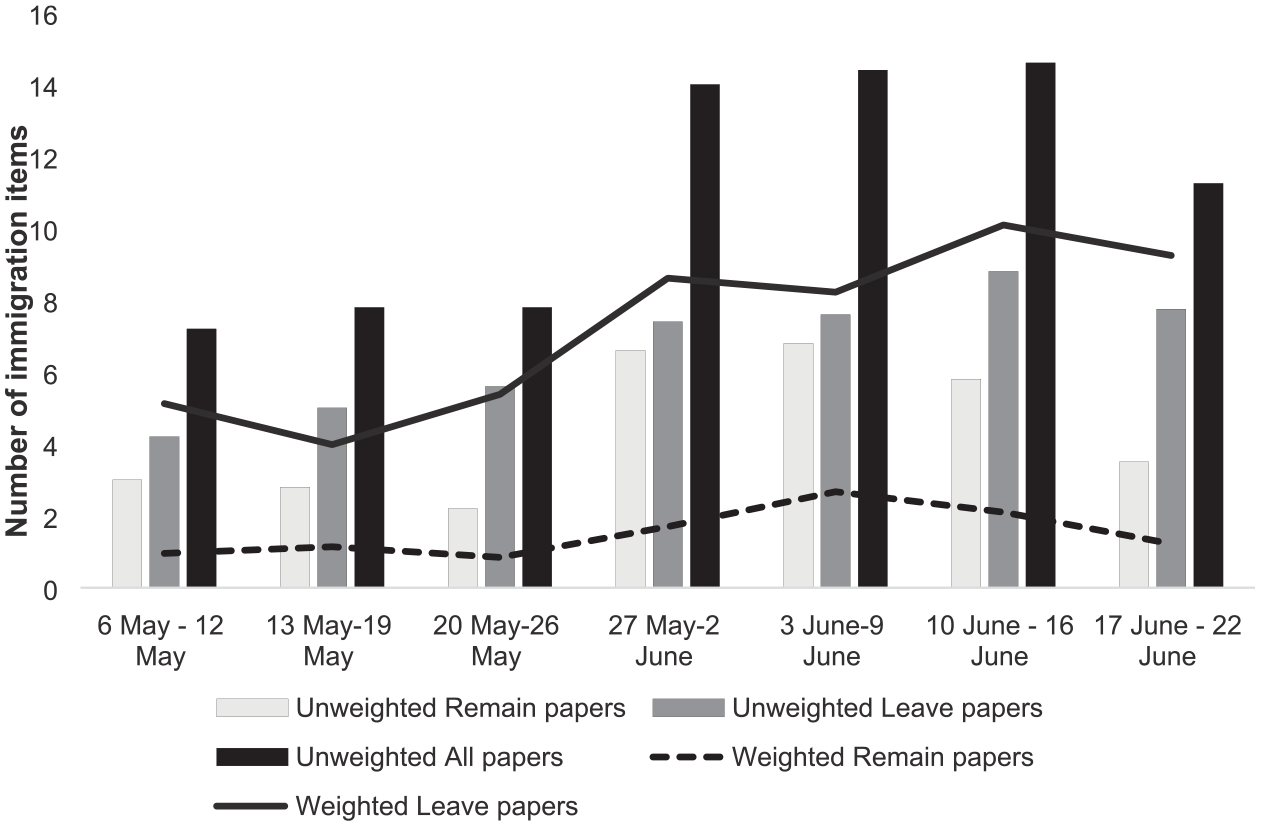
Average daily newspaper coverage of immigration.
The results show that pro-Leave newspapers contained consistently higher levels of coverage of immigration in the sections analysed for every sample week. The rise of immigration coverage was steady and consistent over weeks 1–6 of the sampling, reducing slightly in week 7 as ‘horse race’ coverage increased in anticipation of the vote. For Remain-supporting newspapers, the increase was more dramatic in weeks 4 and 5, where levels of coverage nearly matched those in pro-Leave newspapers. Coverage tailed off as the vote neared.
The timing of the convergence in increased attention to immigration across all newspapers between 27 May and 9 June is significant as it maps directly onto the moment VL decisively changed its campaign emphasis. Our analysis also shows that VL’s two main figureheads (Johnson and Gove) accounted for more than one-third of all direct quotation by any person or organisation featured in immigration coverage over this period.
When these comparisons are weighted for circulation, a clearer sense of differences in the mediated visibility of immigration as a Referendum issue emerges. In terms of public reach, any reduction of pro-Remain newspaper emphasis in the final weeks of the campaign had little compensatory effect when set against the sustained and increasing levels of attention in the pro-Leave press.
Coverage of immigration alone cannot be assumed to be an indicator of the kind of exclusionary discourse that features in ‘thick’ right-wing populism. It may be that a significant proportion of the coverage is countering such discourses or reporting the positive benefits of migration. To assess the evaluative nature of immigration coverage, we noted whenever it appeared as a theme, whether the reference was portrayed as having positive implications for ‘Leave’, ‘Remain’ or mixed/unclear political consequences (see Figure 2).
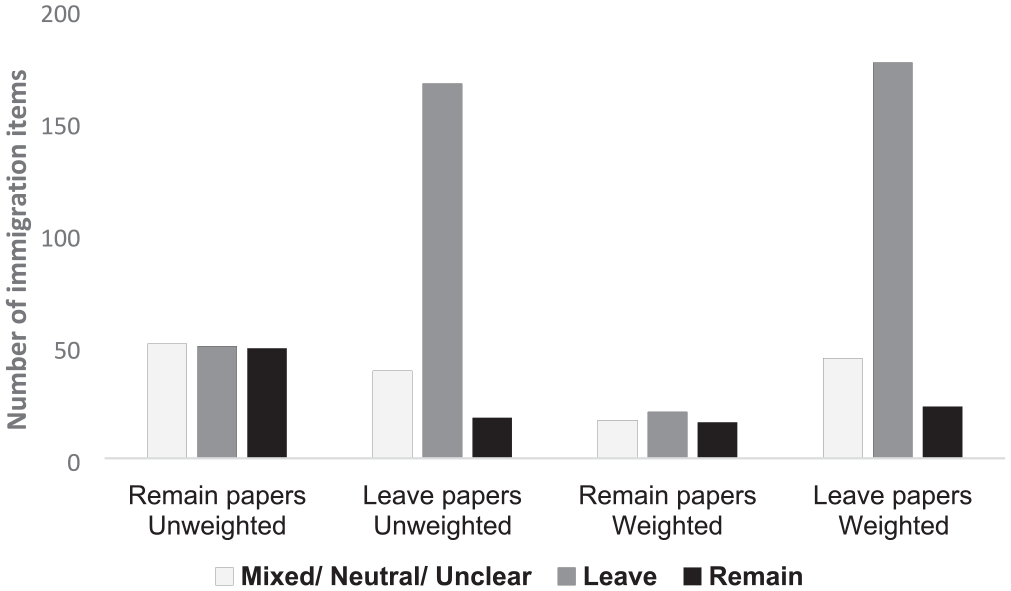
Campaign implications of immigration coverage.
The results show that pro-Remain newspapers cumulatively reported mixed implications for the protagonists. Pro-Leave newspapers, on the contrary, concertedly framed the implications as supporting pro-Leave arguments (i.e. the negative social and political implications of net migration). Circulation differences accentuate these differences.
Anti-elitism in referendum press coverage
Our analysis now moves to compare the relative prominence of anti-elite populism in national press coverage of the campaign. As noted, official VL campaigners started to voice anti-elitist terms and concepts at the same time as their campaign weaponised immigration. In this second content analysis, we differentiated between occasions where anti-elite terms or ideas were reported (1) factually/dispassionately, (2) supportively/sympathetically or (3) critically. Factual usage of these terms offers an example of populism through the media; sympathetic use is indicative of populism by the media; and critical usage is an example of active containment.
Figure 3 charts the trajectory of anti-elite-related press items across the last 7 weeks of the campaign. The line shows that in cumulative terms, their presence remained consistent for the first 5 weeks but increased in the last 2 weeks. The bar chart components reveal major shifts in the presentation and articulation of anti-elite as the campaign unfolded. For the first three sample weeks, anti-elite terms and concepts were principally conveyed in a neutral way – that is, they were recorded rather than appropriated or repudiated in their editorial presentation. From week 3, the difference between descriptive and supportive usage narrowed, and by the final days, supportive invocations most commonly occurred. In contrast, challenges towards anti-elite concepts and terminology occurred infrequently throughout, remaining a negligible element even during the latter stages of the Referendum.
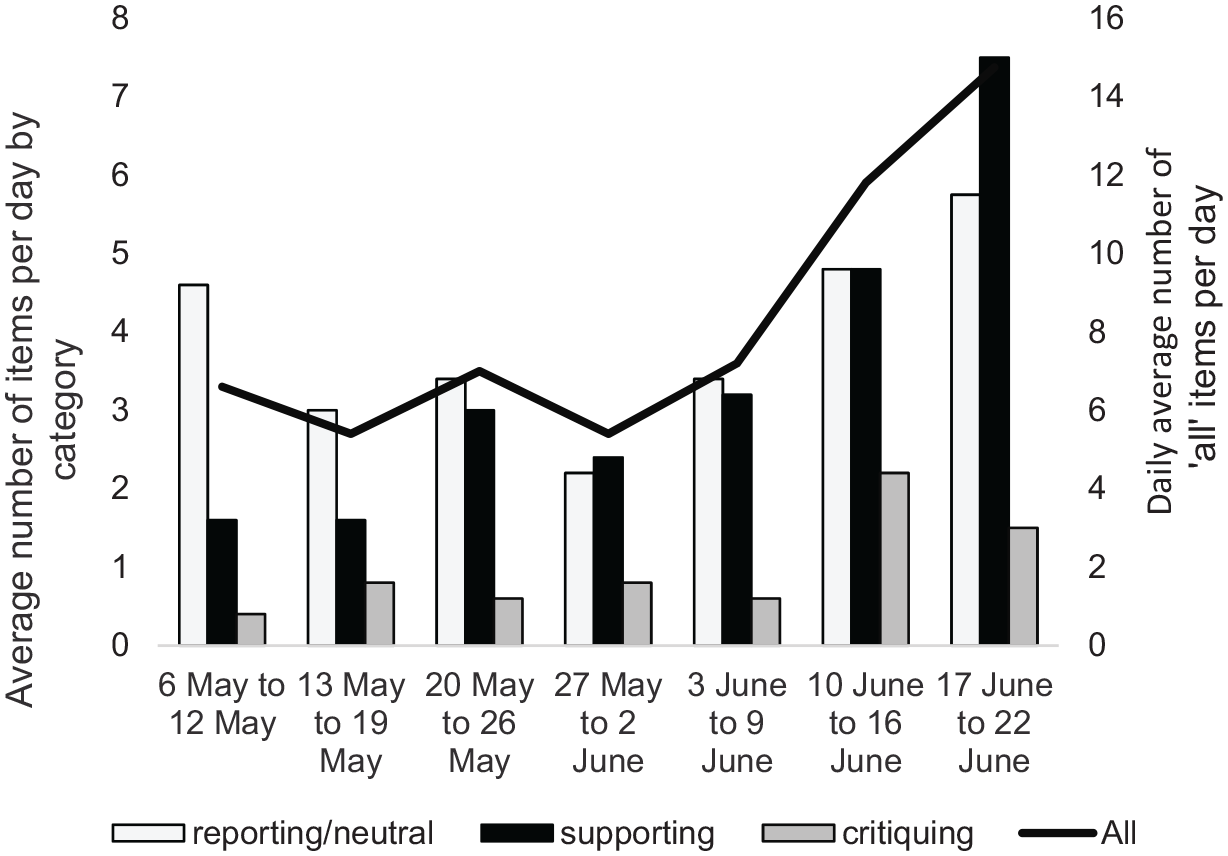
The presence and evaluation of anti-elite rhetoric in referendum newspaper coverage.
Figure 4 disaggregates these figures according to the stances of the newspapers on the Referendum. Critical treatment of anti-elite terms and discourses was almost completely absent in pro-Leave newspapers, whereas supportive usage dominated. Criticism was evident in the pro-Remain coverage, but neutral invocation more frequently occurred. When these distributions are weighted by circulation, the overall dominance of supportive references to anti-elite (AE) terms and discourses becomes even more accentuated.
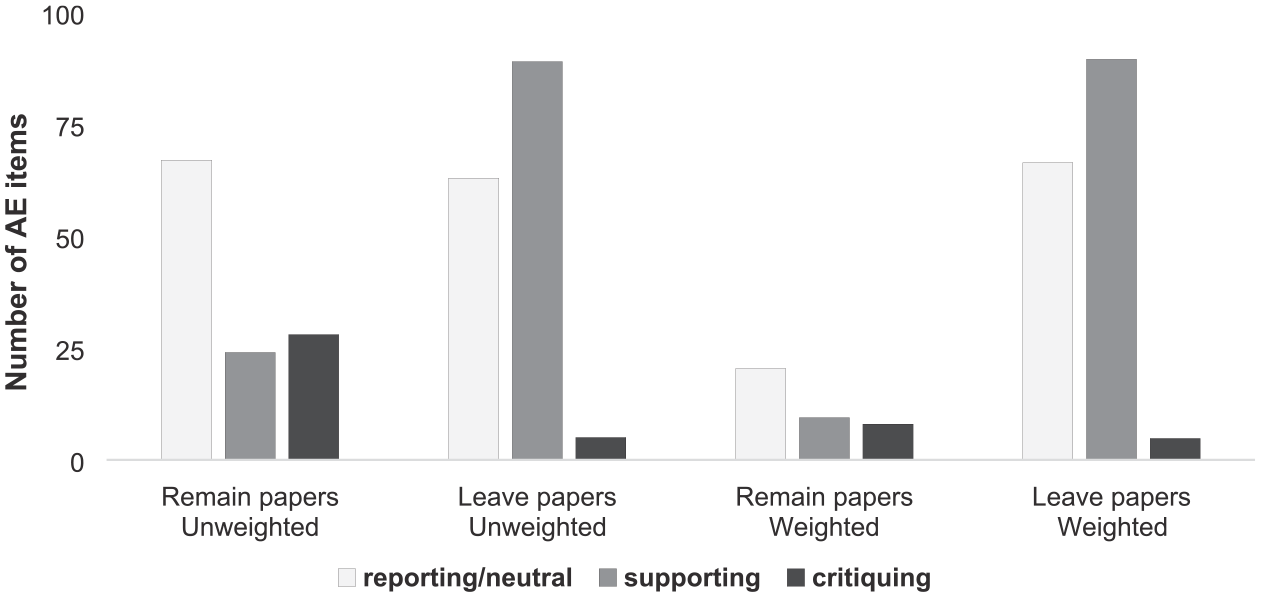
Treatment of anti-elite terms and concepts.
For each item, we identified the principal source of AE terminology or sentiments. In 47% of items, they were invoked directly by the journalists writing the piece, rather than through the quotation of accessed sources. Furthermore, the rise in AE-related coverage towards the end of the campaign was driven by a significant increase in journalistic commentary, as the domain of anti-elite coverage shifted from news reports to opinion pieces, columns and editorials. In weeks 1–3, 53% of AE-related items were news reports; by weeks 4–5, this reduced to 40% and in the final 2 weeks to 31%.
Journalists’ approbation of anti-elite terms in their coverage also varied depending on political and market orientation. In the pro-Remain press, which was dominated by up-market newspapers, journalistic usage was split relatively evenly between critical (34%), supportive (28%) and non-evaluative (38%). In the tabloid-dominated pro-Leave newspapers, supportive usage accounted for 90% of these instances.
Overall, this analysis of anti-elite populism in the press during the referendum campaign reveals that it gained in volume towards the latter stages of the campaign, and that Leave-supporting newspapers supplied a substantial increase in supportive coverage of anti-elite populism to the Leave campaign in the final fortnight of the campaign. Much of this seems to have been initiated by the shifting focus and rhetoric of the VL campaign but was subsequently amplified by the lexical choices of journalists themselves.
Public opinion
Most eve-of-voting polls mistakenly predicted a Remain victory in the Referendum. This failure attracted criticism, but, as the British Polling Council president commented ‘their central message – that this looked like a close referendum that neither side could be sure of winning – proved prescient’(BPC, 2016). What also tends to be forgotten is the volatility in opinion as the campaign developed. Figure 5 collates findings from 140 opinion polls held in the last weeks of the campaign (Natcen, 2016) and indicates a major rise in Leave support from 27 May onwards: the precise moment that the VL and media agendas shifted. Prior to that date, Leave was losing ground to Remain; by mid-June, Leave was consistently polling ahead of Remain and in line with the eventual vote.
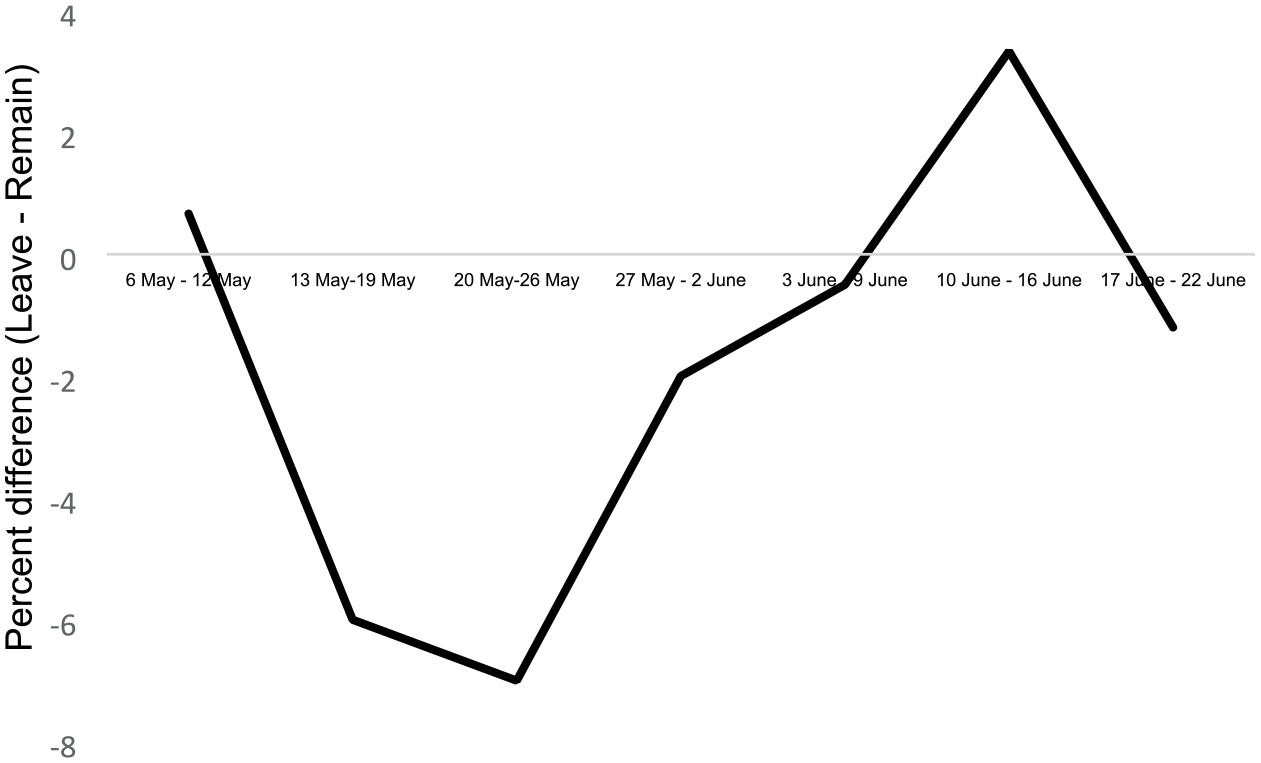
Pro-leave support minus pro-remain support (opinion polls, 6 May–22 June 2016).
We emphasise the need for caution when noting these links. Correlation does not prove causality. And even if one sought to make such a claim, where should the causal chain be deemed to have started? As shown, the shift in VL’s strategy was driven by their polling inertia, thereby casting it as a dependent rather than independent variable (if we were thinking in these terms). What can be claimed plausibly from this evidence is that a complex, interactive dynamic gained momentum at a critical moment in the Referendum campaign, and there is a strong evidence to suggest this was highly consequential in a situation where fine margins mattered. We do not doubt there were multiple participants and factors in creating, sustaining and amplifying this dynamic, including the mainstream media – whether by reporting prominently the changed priorities and terminology of leading campaigners (populism through the media) or enthusiastically appropriating these issues and terms in their own editorialising (populism by the media). There is no evidence, however, that any particular section of the national press played a significant, independent role in initiating this change.
Concluding discussion
Brexit is often now characterised as a paradigm case of an inexorable spread of populist insurgencies across Western political systems. When explaining the outcome of the 2016 EU Referendum, analyses of this kind often focus on the wider conditions that created a receptive environment for populism: years of trenchant Euroscepticism in the media and political classes, anxieties about cultural identity, growing economic inequalities, anger about globalisation and the erosion of the social contract through austerity (e.g. O’Rourke, 2018). Furthermore, while the first-past-the-post system of UK politics tends to suppress populist political representation, UKIP’s emergent successes in second-order elections suggested the existence of a groundswell of populist support among the population that was liable to exploitation given the simple voting system of the referendum campaign. But we contend these factors alone cannot explain the outcome of the Referendum. Any ‘conjunctural analysis’ of Brexit (Clarke and Newman, 2017) needs to account for short-term ‘supply side’ opportunism as well as long-term ‘demand side’ determinism. Our analysis of the political and media dynamics of the EU Referendum in the United Kingdom shows that populist discourses in the Referendum campaign did not emerge spontaneously: they were mobilised, crafted and amplified by key protagonists over a comparatively short time frame.
The critical moment was the decision taken by the official VL campaign at the end of May 2016 to change their focus and foreground exclusionary and anti-elitist discourses, thus emulating the nationalist rhetoric of the LE/GO campaign. This populist gambit led by senior political figures within the Conservative party provides an example of what we term ‘strategic populist ventriloquism’ and it was later to re-surface in the Conservative party’s 2019 General Election campaign, when Boris Johnson styled his campaign as a tribune of ‘the people’ against ‘parliament’.
This shift in the VL strategy transformed mainstream media reporting. The prioritisation of immigration immediately forced the topic up the national press agenda, regardless of newspapers’ political stance on EU membership. Differences were evident in the evaluation of this campaign shift, with pro-Remain newspapers emphasising its mixed implications for the protagonists and pro-Leave newspapers framing their coverage overwhelmingly as favouring the case for leaving the EU. The coincidental deployment of populist anti-elite rhetoric by senior VL figures took longer to embed in mainstream press reporting, but there was an appreciable increase in the last 2 weeks of the campaign. Here again, differences emerged between pro-Remain and pro-Leave newspapers: the former relayed the discursive shifts in the campaign, and the latter embraced and advanced them in their own editorialising. The eve of voting represented a critical juncture where the circuit of ‘complete populism’ was realised in aggregate media terms, with exclusionary discourses and anti-elitism at their highest levels. This convergent temporal shift in ‘cues from political elites’ (Goodwin and Milazzo, 2017: 458) and the mediation of the campaign coincided with a striking change in the political momentum of the campaign. One does not have to revert to crude causal explanations to suggest that, in a volatile, knife edge, ‘either/or’ political situation – in which every vote counted – this new dynamic had profound political significance.
These findings connect with and qualify existing work on populism and the media in several ways. The differences between pro-Remain and pro-Leave newspapers, respectively, offer examples of populism through the media and populism by the media. But what is striking is how dependent both these responses were upon the actions of the official Leave campaign. It may have been that news values of the largely tabloid pro-Leave press made them more receptive to the articulation of populist discourses than the mainly ‘up-market’ pro-Remain press but they only did so to a concerted extent after VL’s shift in campaign strategy. Before that, all the national press had disregarded the same arguments advanced by the competing LE/GO campaign. In other words, there was a similar collective ‘passive containment’ response, such as has been noted in other studies of media and populism: marginalising and ignoring insurgent voices. It was the mainstreaming of populism by VL midway through the campaign that licenced the pro-Leave press into more active ‘collaborative’ responses, whereas the pro-Remain press veered towards a more ‘active’ containment approach, although it had a half-hearted quality in terms of challenging anti-elitist populist discourse.
This study highlights the need to foreground temporality into understanding media responses to populism. In doing so, there is a need to move beyond linear, periodic models that describe media and populist orientations as developing and declining in a glacial manner. The 2016 Referendum offers an example of how sudden populist ebullitions can change significantly the parameters of media populism and with lasting consequences. Any explanation of this, in turn, requires closer consideration of the sources of populist rhetoric. ‘Thick’ populism is no longer (if it has ever been) the sole preserve of outsiders seeking to move from insurgent to established status. The 2016 EU Referendum demonstrates how established political actors can move in the opposite direction: appropriating the language of insurgency for political advantage. When this strategic populist ventriloquism occurs, the political radar of the mainstream news media can become scrambled and, to mix metaphors, gates that are generally held closed can be prised open.
Footnotes
Funding
The author(s) disclosed receipt of the following financial support for the research, authorship, and/or publication of this article: This research was funded by Loughborough University. The authors received no financial support for the authorship and/or publication of this article.
