



Abstract
The study examines Open-Source Assistive Resources (OSAR) as viable accessibility solutions for patrons with visual impairments in selected academic libraries in Zimbabwe's Midlands Province. The study was guided by three research questions: (i) How are selected academic libraries in Zimbabwe's Midlands Province implementing OSAR for patrons with visual impairments? (ii) What factors influence the adoption of OSAR in these libraries? (iii) What institutional capacities are required to sustain OSAR for patrons with visual impairments in the selected academic libraries? The study population comprised 59 participants drawn from five academic libraries (AL1–AL5) in Zimbabwe's Midlands Province, including library staff (n = 12), student services staff (n = 4), academic staff/lecturers (n = 5), students with visual impairments (n = 16), staff members with visual impairments (n = 10), alumni with visual impairments (n = 6), and Zimbabwe Library Association members (n = 6). Data were generated through questerviews, semi-structured interviews, focus group discussions, observations, and document analysis, and analysed using thematic analysis with QDA Miner Lite version 5. Findings reveal that OSAR implementation remains fragmented and largely opportunistic across four of the five libraries studied, with only AL4's dedicated Disability Resource Centre demonstrating sustained, strategic deployment. Cost advantage was widely recognised; however, inadequate infrastructure (cited by 35.60% of participants), limited OSAR awareness (33.90%), technical complexity, and absent management support constrain systematic adoption. Sustaining OSAR requires comprehensive institutional capacities, including needs assessment capacity (59.30%), infrastructure upgrades (54.20%), staff training and development (45.80%), inter-institutional networking (42.40%), and strategic planning. The study concludes that OSAR adoption is shaped primarily by institutional capacity deficits rather than technological limitations, and that sustainability requires structural transformation extending beyond mere software acquisition.
Keywords
Introduction
Academic libraries in Sub-Saharan Africa face a structural paradox: international legal frameworks United Nations Convention on the Rights of Persons with Disabilities (UNCRPD) (United Nations, 2006) and the Marrakesh Treaty (2013) obligate them to provide assistive resources for persons with visual impairments (United Nations, 2013), yet proprietary solutions such as Job Access With Speech (JAWS) cost thousands of dollars, placing them beyond institutional reach (Chimhenga, 2017; Majinge and Mutula, 2018; Munemo and Chiwanza, 2024). The result is chronic undersupply, compounded by technological obsolescence, negative staff attitudes, and institutional inertia (Ncube and Ngulube, 2025; Visagie et al., 2020).
Open-source assistive resources (OSAR), freely available, openly licenced tools such as NVDA (NonVisual Desktop Access) and open-source screen magnifiers, distinct from proprietary built-in features such as the Microsoft Ease of Access Centre, present a potentially viable low-cost alternative, offering comparable functionality at negligible licencing cost (Ahmad and Tripathi, 2024; Chigwada and Phiri, 2021; Wright et al., 2023). Yet empirical evidence on OSAR adoption, conceptualised as the organisational decision-making process from initial awareness to confirmed use, remains sparse in developing-world libraries, as does evidence on sustainability (Oussous et al., 2023; Rohwerder, 2018). Existing studies from Zimbabwe and across African contexts document inaccessibility as a condition but stop short of examining open-source alternatives as strategic responses (Ayiah, 2017; Chimhenga, 2017; Kadodo et al., 2016; Majinge and Msonge, 2020). Literature further tends to conflate proprietary and open-source resources without distinguishing their affordances or implementation requirements (August et al., 2020; Li et al., 2023).
Viewed through Rogers’ (2003) Diffusion of Innovation Theory, OSAR adoption presents distinct challenges beyond cost. Compatibility with legacy infrastructure, technical expertise requirements, and the organisational demands of active, configured deployment within library service environments create significant barriers (Chigwada and Phiri, 2021; Copeland et al., 2023; Visagie et al., 2020). Social system variables, organisational culture, communication channels, and change agents may operate differently for open-source than for proprietary systems (Silva et al., 2023; Wright et al., 2023). In the absence of contextualised implementation frameworks, many institutions remain in a state of “accessibility paralysis,” deferring action while awaiting unattainable proprietary solutions (Garwe and Thondhlana, 2019). Without systematic inquiry into OSAR feasibility and sustained attention to long-term sustainability, libraries risk entrenching digital exclusion through misallocation of scarce resources, neglect of assistive provision, or fragmented ad hoc deployment misaligned with international standards (Garwe, 2018; Li et al., 2023; Munemo and Chiwanza, 2024; Rohwerder, 2018).
This study addresses these gaps by examining OSAR as a viable accessibility solution within selected academic libraries in Zimbabwe's Midlands Province, a context whose contradictions are analytically instructive. Zimbabwe ratified the UNCRPD in 2013 and is bound by the Marrakesh Treaty (2013), while ZIMCHE requires institutions to provide adequate learning facilities under threat of de-accreditation (Garwe, 2018; United Nations, 2006, 2013). Yet a protracted economic crisis, marked by hyperinflation, foreign currency scarcity, and reduced public funding, has severely constrained institutional capacity to invest in conventional assistive resources (Munyoro and Musemburi, 2019). These challenges intensify in the Midlands Province, where libraries lack established support structures for patrons with visual impairment compared to institutions in Harare, such as the University of Zimbabwe's Disability Resources Centre. While existing Zimbabwean research identifies inadequate resources as accessibility barriers (Chimhenga, 2017; Kadodo et al., 2016), it has not systematically explored open-source alternatives as strategic responses, with systematic documentation of accessibility practices in Midlands Province representing a notable gap (Ncube and Ngulube, 2025).
Against this background, the study examines OSAR implementation, adoption factors, and sustainability requirements across five academic libraries in Zimbabwe's Midlands Province. Three interrelated research questions guide the inquiry:
How are selected academic libraries in Zimbabwe's Midlands Province implementing open-source assistive resources for patrons with visual impairments? What factors influence the adoption of open-source assistive resources in these libraries? What institutional capacities are required to sustain open-source assistive resources for patrons with visual impairments in the selected academic libraries?
The findings offer evidence-based guidance for libraries navigating the transition from proprietary to open-source models, contributing to library practice, accessibility policy, and international development agendas centred on information equity in resource-constrained settings.
Literature review
Literature exhibits persistent conceptual ambiguity, compartmentalising assistive resources into discrete categories: “assistive technologies” denoting hardware and software (Majinge and Mutula, 2018; Rohwerder, 2018) and “library services” referring to human-mediated support (Ncube and Ngulube, 2025; Rayini, 2017). This binary framing obscures accessibility's fundamentally socio-technical nature. Screen readers without trained staff remain inert software; well-intentioned staff without functional tools cannot deliver meaningful accessibility.
Accordingly, this study treats assistive resources as socio-technical systems whose effectiveness depends on sustained institutional capacity spanning technological tools, staff expertise, organisational culture, policy frameworks, and collaborative networks (Silva et al., 2023; Wright et al., 2023). While this framing is not novel in itself, its empirical application to OSAR in severely resource-constrained developing-country libraries generates evidence that illuminates how a technology–service binary perpetuates institutional inaction, where institutions defer adoption while awaiting comprehensive solutions and neglecting the institutional infrastructure any solution requires.
Cost is the most cited accessibility barrier in developing regions: commercial screen readers cost thousands of dollars, beyond the reach of most African academic libraries (Chimhenga, 2017; Kadodo et al., 2016; Majinge and Mutula, 2018; Rohwerder, 2018). OSAR offers comparable functionality at negligible licencing cost (Silva et al., 2023; Wright et al., 2023), yet adoption rates remain low despite this cost advantage (Oussous et al., 2023). Matter et al. (2016) distinguish acquisition cost from total cost of ownership, encompassing maintenance, training, and support. Open-source solutions eliminate licencing fees but generate new operational cost structures requiring sustained investment (Tebbutt et al., 2016), and few studies examine whether they offer viable pathways or merely shift barriers from acquisition to maintenance (Munyoro and Musemburi, 2019). Silva et al. (2023) and Wright et al. (2023) document open-source software capabilities, demonstrating functional parity with commercial alternatives. Ahmad and Tripathi (2024) specifically examine NVDA's performance against JAWS, concluding that open-source screen readers provide comparable functionality. These assessments establish technical viability, yet technical capability alone proves insufficient for understanding institutional adoption patterns.
Beyond economic constraints, negative staff attitudes toward disability provision, treating it as an additional burden, holding low expectations of patrons’ capabilities, and resisting practice adaptation, emerge as pervasive barriers (Ayiah, 2017; Visagie et al., 2020). These attitudes become institutionalised through organisational cultures that marginalise accessibility, and organisations where accessibility remains peripheral systematically underperform regardless of resource availability (Li et al., 2023). What drives cultural transformation from compliance burden to core institutional responsibility remains underexplored.
Empirical OSAR investigations in Sub-Saharan Africa remain sparse, particularly in Zimbabwe. Existing Zimbabwean research focuses predominantly on resource absence rather than viable alternatives (Chimhenga, 2017; Kadodo et al., 2016) and treats “assistive resources” as an undifferentiated category, rarely distinguishing proprietary from open-source options. While the University of Zimbabwe's Disability Resources Centre has made notable strides (Munyoro and Musemburi, 2019), the Midlands Province lacks systematic documentation of accessibility practices (Ncube and Ngulube, 2025), making it an analytically productive site for examining OSAR implementation under severe resource constraints. As an overview, the literature documents accessibility barriers extensively but leaves critical gaps regarding OSAR-specific adoption dynamics, total cost of ownership, and implementation in severely resource-constrained contexts, gaps this study addresses through its focus on Zimbabwe's Midlands Province.
Theoretical framework
This study adopts Rogers’ (2003) Diffusion of Innovation (DoI) theory to examine OSAR adoption, implementation, and sustainability in academic libraries in the study contexts. DoI conceptualises innovation uptake as a socially situated process shaped by communication channels, organisational structures, and temporal dynamics rather than purely technical or economic factors (Damanpour and Schneider, 2006; Rogers, 2003). Figure 1 maps how DoI theory is operationalised in this study.
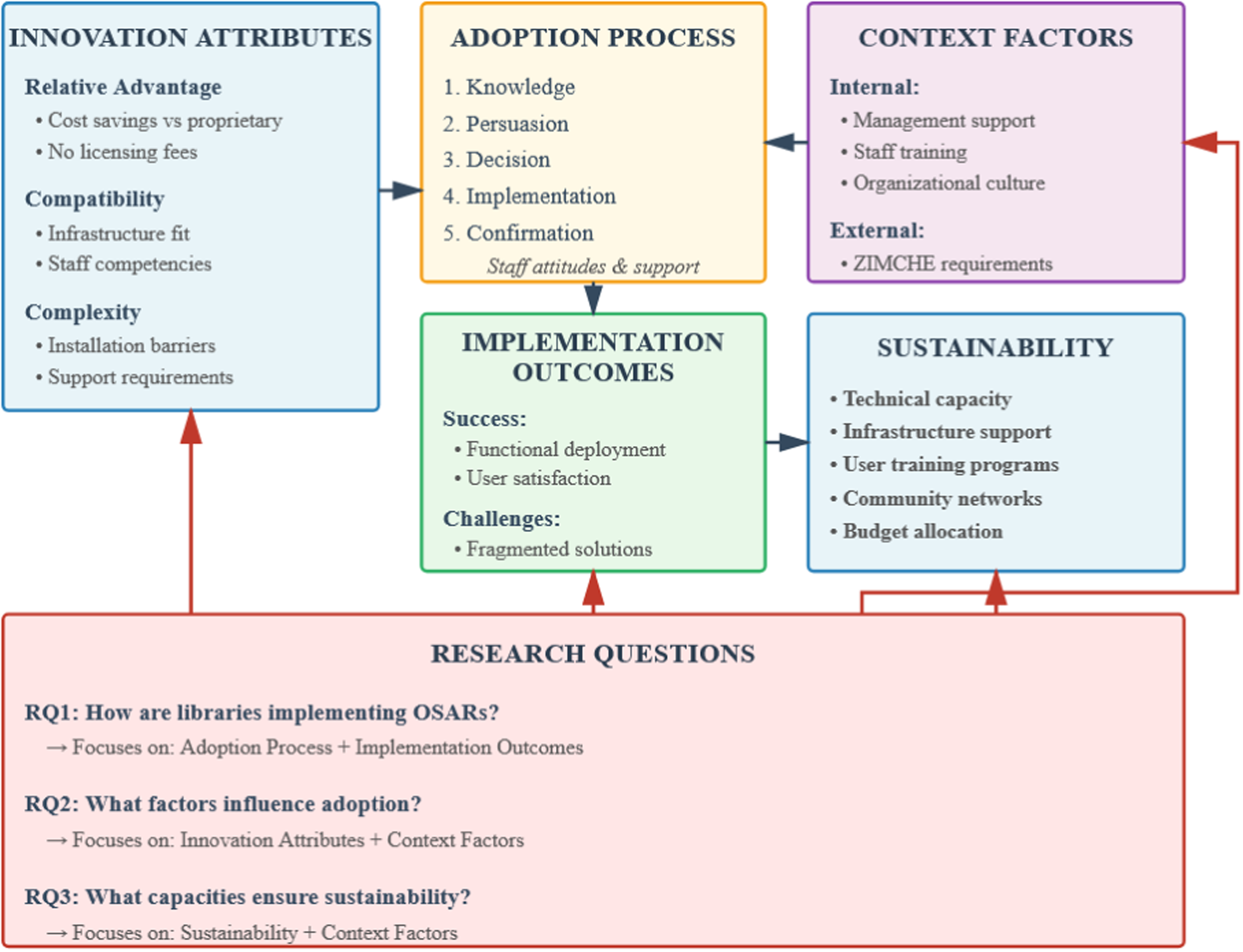
Diffusion of innovation theory applied to open-source assistive resources in academic libraries in Zimbabwe's midlands province (adapted from Rogers, 2003).
Application of the diffusion of innovation theory framework for open-source assistive resources
The innovation attributes represent perceived characteristics shaping librarians’ evaluations of OSAR. Relative advantage concerns cost savings over proprietary alternatives, particularly salient in hyperinflationary environments (Matter et al., 2016; Munyoro and Musemburi, 2019). Compatibility examines alignment across technical infrastructure, workflow integration, staff competencies, and organisational culture (Chigwada and Phiri, 2021); unlike Rogers’ original formulation, this study treats compatibility as an organisational accomplishment requiring deliberate structural alignment rather than a static attribute. Complexity is conceptualised as relational rather than inherent, emerging from technology, context interactions: OSAR may appear straightforward in well-resourced environments yet insurmountably complex where infrastructure is absent (Copeland et al., 2023).
The adoption process traces the five-stage journey from knowledge through persuasion, decision, and implementation to confirmation, embedded in social and organisational dynamics including staff attitudes, management support, and resource availability (Damanpour and Schneider, 2006; Scott and McGuire, 2017). The decision-to-implementation transition is a critical juncture where many initiatives falter in resource-poor contexts, providing an analytical foundation for documenting current implementation approaches.
Implementation outcomes distinguish successful adoption, functional deployment, user satisfaction, and sustained support from fragmented or discontinued adoption (Li et al., 2023). Context factors span internal variables (management support, staff training, organisational culture) and external pressures (accreditation requirements, UNCRPD, the Marrakesh Treaty, economic constraints), permeating every adoption stage and shaping the feasibility of sustained implementation (A’dillah Mustafa and Noorhidawati, 2020; Damanpour and Schneider, 2006). The sustainability component, an explicit extension of Rogers’ framework, identifies institutional capacities required for long-term OSAR viability: technical capacity, infrastructure support, user training, community networks, and policy alignment (Almakaty, 2026; A’dillah Mustafa and Noorhidawati, 2020). In resource-constrained contexts, moving from adoption to sustainability represents a distinct challenge warranting dedicated analytical attention.
This study uses DoI as a sensitising analytical framework rather than a predictive model to be tested. Its constructs, relative advantage, compatibility, complexity, trialability, and observability, provide productive vocabulary for organising findings, applied interpretively rather than mechanically. Where evidence reveals dynamics DoI does not fully account for, such as structural capacity constraints and sustainability requirements, these are treated as productive theoretical tensions that extend rather than simply apply the framework (Almakaty, 2026; Palm, 2022). This approach captures the study's central paradox, legal obligations to provide assistive resources clashing with severe budgetary and infrastructural constraints, and interrogates why adoption stalls, succeeds, or remains fragile in this context.
Methodology
Research design
This study employed a qualitative research approach grounded in interpretivism, recognising that understanding OSAR adoption is best achieved through stakeholders’ lived experiences and context-specific meanings (Asiedu, 2022). The research sought to uncover how academic libraries adopt, implement, and sustain OSAR as a dynamic process shaped by economic constraints, institutional capacity, staff attitudes, and policy frameworks (Kalu, 2019). The study used a descriptive case study design to examine OSAR adoption across five academic libraries in Zimbabwe's Midlands Province. This design enabled detailed exploration of implementation approaches, contextual factors influencing adoption, and sustainability strategies within resource-constrained environments (Yin, 2017).
The study population comprised all individuals with direct institutional responsibility for, or experiential knowledge of, OSAR provision and use across five academic libraries in Zimbabwe's Midlands Province. The population included two broad constituencies: (a) library and institutional professionals, comprising library staff, student services staff, academic staff (lecturers), and Zimbabwe Library Association (ZimLA) members, totalling approximately 85 potential participants across all five sites; and (b) library users with lived experience of visual impairment, including registered students, staff members, and alumni with visual impairments, estimated at approximately 120 individuals across the five institutions during the study period. These five institutions constitute the largest and most well-established academic library services affiliated with public higher education institutions in the province. Their selection is further justified by the systematic underrepresentation of the Midlands Province in the existing literature on OSAR adoption in Zimbabwean higher education (Ncube and Ngulube, 2025).
Sampling strategy and participant recruitment
Purposive sampling identified participants with direct experience or institutional responsibility in OSAR provision, implementation, and sustainability. Three complementary techniques were applied: First, criterion sampling selected libraries meeting specified criteria: (a) located within Midlands Province, (b) affiliated with higher education institutions, (c) well-established academic libraries within the largest colleges and universities in the province, (d) serving students with visual impairments, and (e) having implemented some form of assistive resources. Second, expert sampling recruited library staff, disability resource coordinators, student services staff, disability studies lecturers, and Zimbabwe Library Association (ZimLA) members whose expertise informed institutional decision-making perspectives.
Third, snowball sampling recruited students and alumni with visual impairments who had experience using library services and assistive resources. Initial participants were identified through disability resource coordinators, who then referred additional participants meeting the inclusion criteria. To ensure diversity and reduce bias inherent in snowball sampling, the researchers specifically requested referrals representing different academic disciplines, years of study, and levels of assistive resources proficiency.
Sample size and data saturation
Data saturation guided the determination of the final sample size (Fusch and Ness, 2015). A total of 59 participants were recruited across five academic libraries and stakeholder categories (Table 1). Saturation was assessed through concurrent data collection and analysis across the questerviews, semi-structured interviews, and focus group discussions. After data had been collected from the first 45 participants, the researchers conducted a preliminary thematic analysis of the questerview and interview transcripts together with the focus group discussion data. This analysis showed that no substantially new themes or conceptual categories were emerging across stakeholder groups.
Participant distribution and data collection methods.
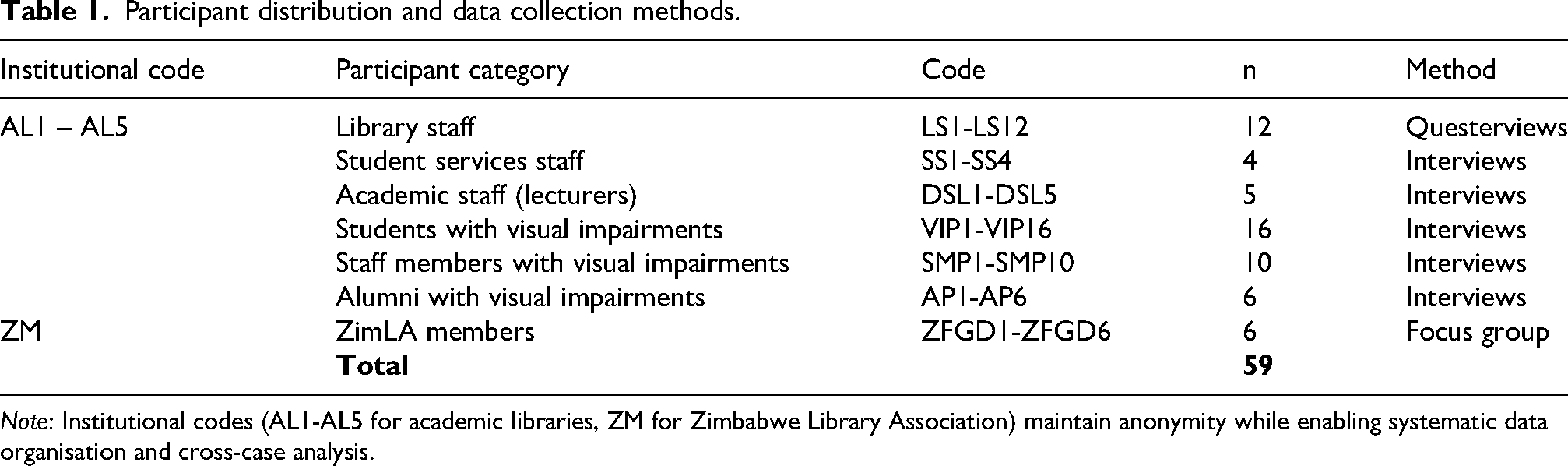
Note: Institutional codes (AL1-AL5 for academic libraries, ZM for Zimbabwe Library Association) maintain anonymity while enabling systematic data organisation and cross-case analysis.
To verify that saturation had been fully achieved, data collection continued with an additional 14 participants using only interviews and questerviews, excluding the focus group discussion. Analysis of these additional data confirmed saturation, as the responses reinforced existing themes without producing new analytical categories. The final sample size of 59 participants, therefore, resulted from an iterative, evidence-based assessment of thematic redundancy rather than from a predetermined numerical target, consistent with qualitative research standards (Fusch and Ness, 2015). This approach aligns with Guest et al.'s (2006) recommendation for saturation assessment in qualitative research.
Participant distribution across library sites was uneven by design, reflecting differences in institutional capacity and the availability of eligible participants with relevant roles and experiences. AL4 contributed the largest share of library-based participants (n = 17 of 53; 32.1%), consistent with its dedicated Disability Resource Centre and the comparatively greater number of staff occupying OSAR-related specialist positions. The remaining 36 library-based participants were drawn from AL1 (n = 9), AL2 (n = 8), AL3 (n = 10), and AL5 (n = 9). Zimbabwe Library Association (ZimLA) members (n = 6) participated through a separate focus group discussion convened at the national level and are not attributed to any individual library site.
Data collection methods
The study employed within-method triangulation, integrating multiple qualitative data generation techniques to enhance credibility (Fusch and Ness, 2015). Questerviews merged standardised questionnaires with in-depth interviews (Adamson et al., 2004), combining the strengths of both approaches. Library staff (n = 12) first completed structured questionnaires eliciting detailed technical information about OSAR implementation. These questionnaires were administered electronically one week before the scheduled interviews. During the subsequent face-to-face interviews, participants’ questionnaire responses were utilised as analytical prompts to facilitate deeper probing and elaboration of emerging issues. This two-stage approach enabled the collection of precise technical data while preserving flexibility for emergent themes.
Semi-structured interviews explored Diffusion of Innovation constructs (relative advantage, compatibility, complexity, trialability, observability), focusing on institutional decision-making, resource allocation, user experiences, satisfaction levels, and unmet needs (Rogers, 2003). Focus group discussions with ZimLA members (n = 6) captured collective perspectives on provincial accessibility trends, inter-institutional collaboration, and systemic barriers. Direct observations documented physical infrastructure accessibility, technology functionality, signage systems, staff-patron interactions, and actual technology usage across all five library sites. Document analysis examined institutional policies, procurement records, training materials, strategic plans, annual reports, and accessibility guidelines to contextualise qualitative findings and assess policy-practice alignment.
Data analysis
Thematic analysis employed QDA Miner Lite version 5 (Provalis Research, n.d.) to organise transcripts into categories corresponding to the research questions and case sites. A coding schema aligned with Diffusion of Innovation Theory and the research questions captured recurring concepts. Coding followed six sequential stages: transcript familiarisation; development of a preliminary deductive–inductive codebook; pilot coding and refinement; full dataset coding; code consolidation; and generation of higher-order themes. Quality assurance included explicit code definitions, analytical memos documenting coding decisions, and participant member checking to validate interpretations.
Analytical procedures examined relationships between innovation attributes and adoption outcomes, complemented by cross-case comparisons to identify facilitating or constraining institutional factors. Analytical memos captured emerging insights and theoretical linkages, while frequency tables, verbatim excerpts, and thematic synthesis supported pattern verification and interpretive depth. Frequency tables report two complementary metrics. First, Count refers to the total number of times each theme was coded across all data sources combined; % Codes expresses each theme's Count as a proportion of all 926 coded segments in the full dataset, not merely of the themes listed within any individual table. Consequently, the % Codes column within a single table does not sum to 100%. Second, Cases refers to the number of individual participants (out of 59) who discussed each theme; % Cases expresses this as a proportion of the total participant count and is calculated independently of the coded segments figure. These dual metrics distinguish between the frequency with which a theme appeared in the data and the breadth of participant engagement with it, providing a more complete picture of thematic salience than either measure alone.
Trustworthiness
Trustworthiness was ensured through multiple strategies (Lincoln and Guba, 1985): Credibility was established through triangulation across multiple data sources and methods, prolonged engagement with participants and sites, and member checking, where preliminary findings were shared with 12 participants (representing each stakeholder category) who validated interpretations. Transferability was enhanced through thick description of contexts, participants, and processes, enabling readers to assess applicability to their settings. Dependability was ensured through an audit trail documenting methodological decisions, data collection procedures, and analytical processes. Confirmability was supported through reflexivity via systematic researcher journaling documenting assumptions, biases, and how these were managed throughout the research process.
Ethical considerations
Institutional permission was obtained through written agreements with library authorities, and all participants provided informed consent after receiving detailed study information. Consent procedures were adapted for participants with visual impairments using Braille and audio formats and were administered by trained research assistants to ensure full comprehension.
Data were anonymised through institutional and participant codes, with additional safeguards, including omission of identifiable institutional details and aggregation of demographics, to protect confidentiality within the small study context. Digital data were securely stored on encrypted, password-protected devices. Interviews were conducted in accessible venues using participants’ preferred formats, and transportation support was provided where necessary.
Results
This section reports empirical results through the Diffusion of Innovation Theory to explain OSAR implementation, adoption, and sustainability patterns in line with the research questions of the study.
Current implementation of OSAR in midlands province academic libraries
Drawing on Rogers’ (2003) Diffusion of Innovation Theory, this section examines how the five stages of the innovation-decision process (knowledge, persuasion, decision, implementation, confirmation) manifest in academic libraries’ adoption of OSAR. Table 2 presents a thematic analysis of implementation approaches.
Implementation of open-source assistive resources (N = 59).
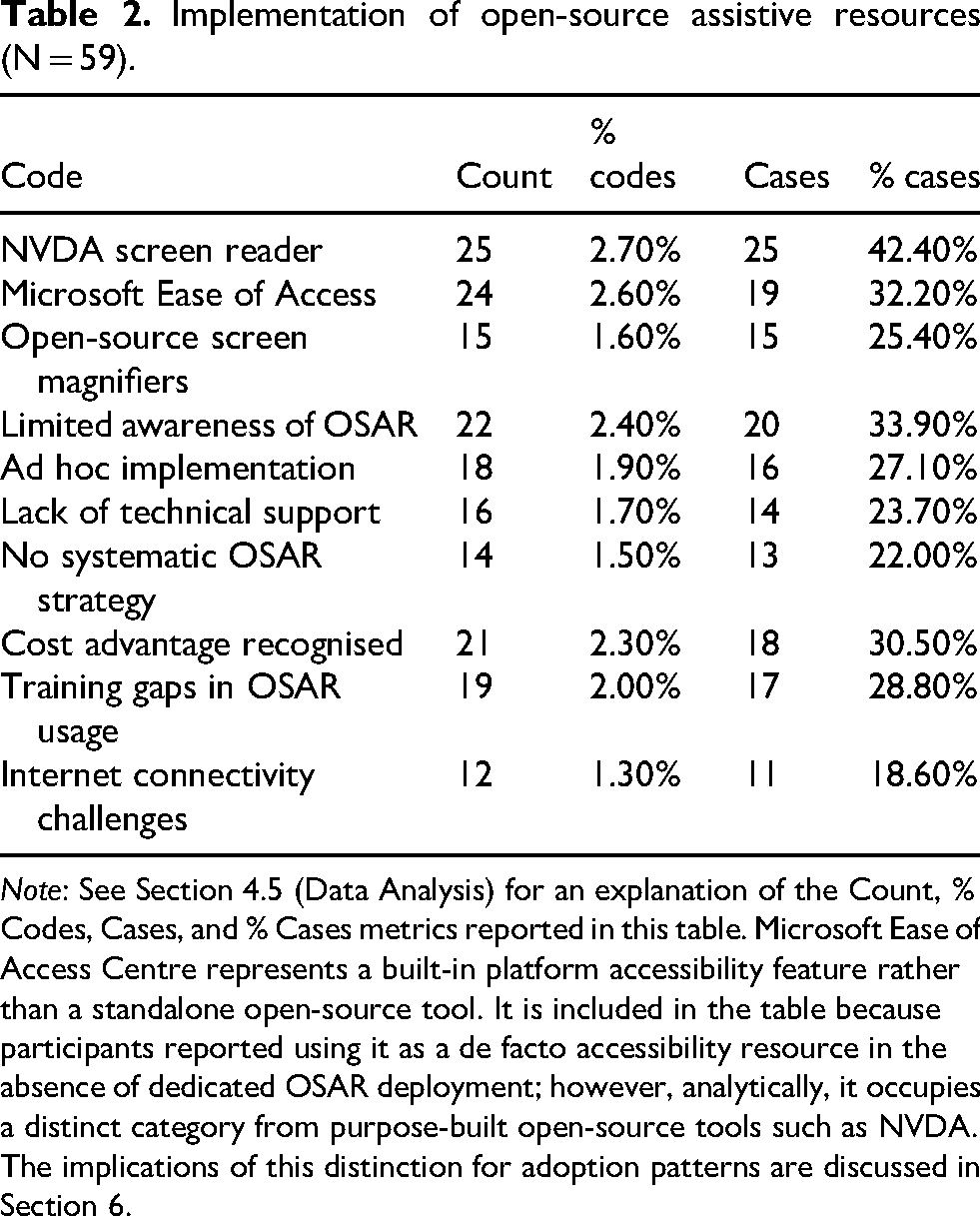
Note: See Section 4.5 (Data Analysis) for an explanation of the Count, % Codes, Cases, and % Cases metrics reported in this table. Microsoft Ease of Access Centre represents a built-in platform accessibility feature rather than a standalone open-source tool. It is included in the table because participants reported using it as a de facto accessibility resource in the absence of dedicated OSAR deployment; however, analytically, it occupies a distinct category from purpose-built open-source tools such as NVDA. The implications of this distinction for adoption patterns are discussed in Section 6.
Findings reveal fragmented OSAR implementation across Midlands Province academic libraries. NVDA screen reader emerged as the most commonly implemented OSAR (42.40%), though deployment was inconsistent within institutions. One library staff member noted: “We have NVDA installed on some computers because it is free and works well for basic tasks” (LS7). However, not all staff shared this positive assessment. A colleague at the same institution expressed reservations about NVDA's reliability, observing that “…it works sometimes but then causes problems with other software on the same machine, so staff quietly stopped recommending it to students” (LS4). This divergence illustrates that even where OSARs were technically present, their practical utility was contested among the very staff responsible for supporting them.
Microsoft Ease of Access Centre (32.20%) represented the most frequently utilised solution, resulting from pre-installation rather than deliberate adoption. As one staff member explained: “The Microsoft accessibility features are there by default, so patrons with moderate visual impairment can adjust screen settings without us having to purchase anything” (LS9). Notably, several participants with visual impairments expressed a clear preference for these default features over dedicated OSAR, precisely because of their predictability and consistent availability: “I know where to find the settings, and they always work. With NVDA, you never know when something will have changed after an update” (SMP3). This represents a rational user preference grounded in reliability rather than ignorance of alternatives, complicating a straightforward narrative of capacity-constrained adoption.
Open-source screen magnifiers showed limited penetration (25.40%), primarily confined to AL4's Disability Resource Centre. Despite cost advantages being recognised (30.50%), systematic awareness of OSAR options remained low (33.90%), contributing to ad hoc implementation (27.10%). One lecturer observed: “Most library staff do not know that there are free alternatives to expensive commercial software. They assume assistive technology must be purchased” (DSL3). Yet awareness alone did not guarantee adoption. At AL3, a library staff member acknowledged familiarity with NVDA but explained that the institution had made a deliberate decision to defer implementation: “We know about NVDA. The issue is not knowledge; it is that we are waiting for clearer institutional policy from ZIMCHE before we commit resources to something that may not align with future accreditation requirements” (LS6). This constitutes a considered institutional judgement rather than a capacity deficit, and challenges the assumption that awareness necessarily precedes adoption.
No library had developed formal OSAR implementation strategies (22.00%), and document analysis confirmed that acquisition policies, ICT plans, and disability frameworks contained no explicit reference to open-source solutions. Technical support deficits (23.70%) and training gaps (28.80%) were prominent barriers. One staff member framed this as a prioritisation problem rather than a technical one: “I could support NVDA if it were given to me as a formal responsibility. But it is treated as an add-on, so it falls through the cracks” (LS3). Connectivity challenges (18.60%) further constrained tools dependent on online updates.
Cross-case analysis revealed stark disparities. AL4, with a dedicated Disability Resource Centre and staff holding Special Needs Education qualifications, demonstrated substantially higher adoption and functionality. However, even AL4 was not without gaps: one alumnus participant noted persistent failures navigating the library catalogue system despite NVDA's availability (AP2), indicating that strong institutional capacity does not guarantee uniformly effective service delivery. The cross-case contrast, while real, should not be overstated.
Factors influencing OSAR adoption
This section examines factors influencing OSAR adoption through Rogers’ (2003) innovation attributes (relative advantage, compatibility, complexity) alongside contextual factors including organisational culture, management support, and external pressures. Table 3 presents a thematic analysis of adoption factors across participants and sites.
Factors influencing OSAR adoption (N = 59).
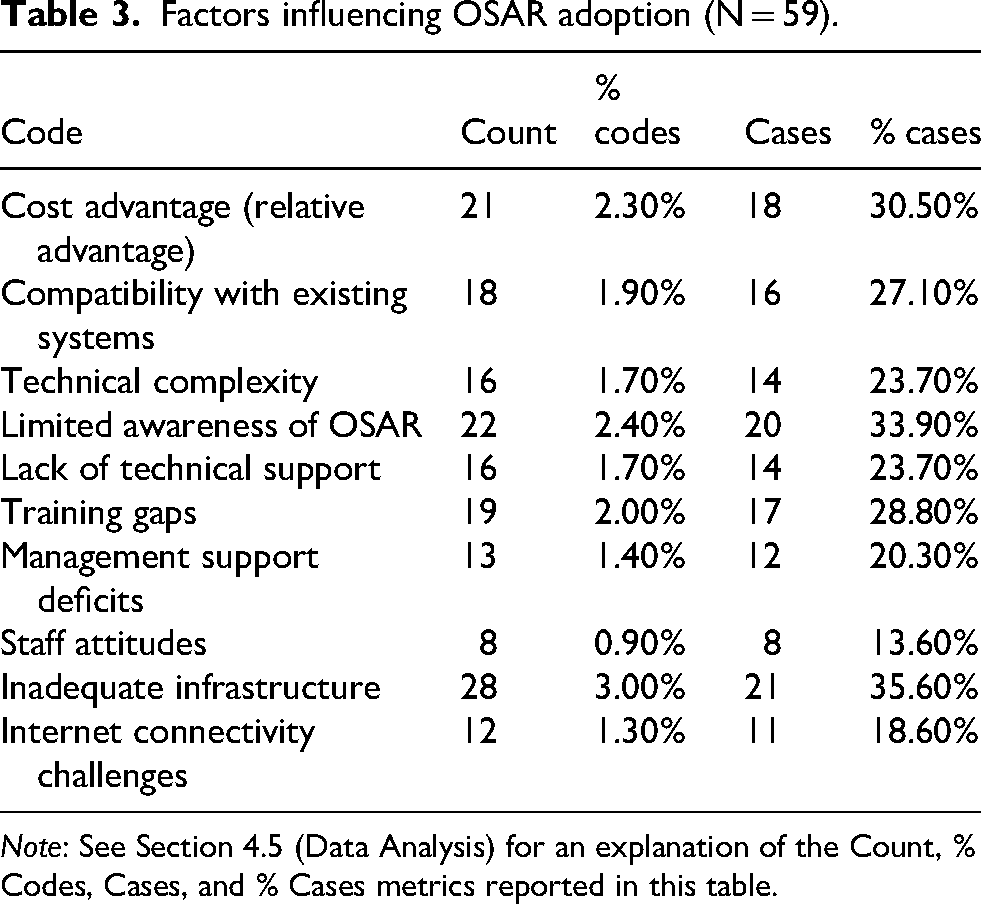
Note: See Section 4.5 (Data Analysis) for an explanation of the Count, % Codes, Cases, and % Cases metrics reported in this table.
Cost advantage emerged as the most recognised facilitator (30.50%), yet proved insufficient to drive systematic adoption. A lecturer emphasised: “The cost savings are obvious. JAWS costs thousands of dollars, while NVDA is free. For our budget constraints, this is the only viable option” (DSL1). However, only AL4 had explicitly incorporated OSAR into budget planning, suggesting that relative advantage requires complementary organisational support structures. Importantly, the cost argument was not universally persuasive. Two library staff members questioned whether the true cost of OSAR was actually lower than proprietary alternatives once staff time, training, infrastructure demands, and ongoing troubleshooting were accounted for: “People say it is free, but free software is not free when you factor in the hours staff spend fixing problems that a vendor would otherwise handle” (LS1). This suggests that, in practice, the cost advantage was more limited and conditional than it initially appears.
Compatibility concerns (27.10%) manifested across technical, workflow, and competency dimensions. A disability resource coordinator noted: “We researched free magnification tools online and installed ZoomText alternatives, but maintaining them requires technical knowledge we do not always have. They do not always work smoothly with our other software” (LS8). AL4 achieved higher compatibility through deliberate organisational adaptation, demonstrating compatibility as an organisational achievement requiring institutional restructuring, extending Rogers’ (2003) original conceptualisation. However, one staff member at AL1 challenged the view that compatibility was primarily an institutional problem, arguing instead that some OSAR were genuinely technically inferior for the library's specific use context: “NVDA is fine for simple documents, but our catalogue system uses a proprietary interface that NVDA simply cannot navigate properly. That is a software limitation, not a capacity problem” (LS2). This observation points to a legitimate technical constraint that institutional investment alone cannot resolve, and warrants acknowledgement alongside the structural explanations.
Technical complexity (23.70%) operated at multiple levels. One staff member explained: “The free screen readers need constant updates, and when something breaks, we do not know how to fix it. With commercial software, you call support. With open-source, you are on your own” (LS9). Internet connectivity challenges (18.60%) exacerbated complexity, revealing complexity as emerging from gaps between technological demands and institutional capacity rather than inherent software characteristics. However, several patrons with visual impairments offered a counterpoint, noting that they found NVDA straightforward once initial setup: “I set it up myself on one machine. It is not complicated once you know what you are doing. The problem is that staff remove it because they do not understand it, not because it does not work” (VIP9). This friction between staff-perceived complexity and user-experienced usability surfaces an important asymmetry in how complexity is understood across different stakeholder groups.
Limited awareness (33.90%) was embedded in institutional documentation, with no formal policy referencing OSAR. However, the awareness gap was partly an information routeing problem: ZimLA had disseminated information at the provincial level, but low forum attendance and inadequate representation of decision-makers prevented it from reaching responsible staff (ZFGD3). This structural dimension of awareness deficits requires mechanisms beyond simply making information available.
Inadequate infrastructure emerged as the most extensively discussed barrier (35.60%), encompassing hardware inadequacy, connectivity deficits, and physical infrastructure barriers. One staff member noted: “Our computers are old. They barely run basic software, let alone additional assistive technology programmes. Free software does not help if the hardware cannot run it” (LS5). AL4's purpose-designed Disability Resource Centre with modern equipment enabled effective implementation, while other libraries faced compounding infrastructure deficits.
Management support deficits (20.30%) and staff attitudes (13.60%) emerged as organisational barriers. One staff member explained: “Management does not see assistive devices as a priority. We have to fight for every resource. Open-source seems attractive because it's free, but management does not understand that it still requires investment in staff time, training, and infrastructure” (LS2). However, staff attitudes appeared to reflect organisational failures rather than individual resistance. A Student services staff member offered a perspective that complicated this framing, noting that competing institutional demands, rather than indifference to accessibility, shaped resource allocation decisions: “We want to provide these services. But we are also dealing with inadequate staffing, deteriorating buildings, and budget cuts. Accessibility is important, but so is keeping the library open” (SS4). This response illustrates that non-adoption at some sites reflected genuine resource scarcity and competing priorities rather than straightforward managerial neglect.
Cross-case analysis positions AL4 as exhibiting early adopter characteristics against Rogers’ (2003) typology, while AL1, AL2, AL3, and AL5 reflect late majority or non-adoption patterns. This characterisation requires qualification: limited adoption at the latter sites reflected structural capacity constraints, absent infrastructure, training, and resources, rather than organisational resistance. Applying diffusion labels uncritically risks attributing institutional failure to adopter disposition, obscuring the structural determinants this study identifies as central.
Institutional capacities required for OSAR sustainability
This section examines institutional capacities required to sustain OSAR. Table 4 presents a thematic analysis of sustainability requirements across participants and sites.
Institutional capacities required for OSAR sustainability (N = 59).
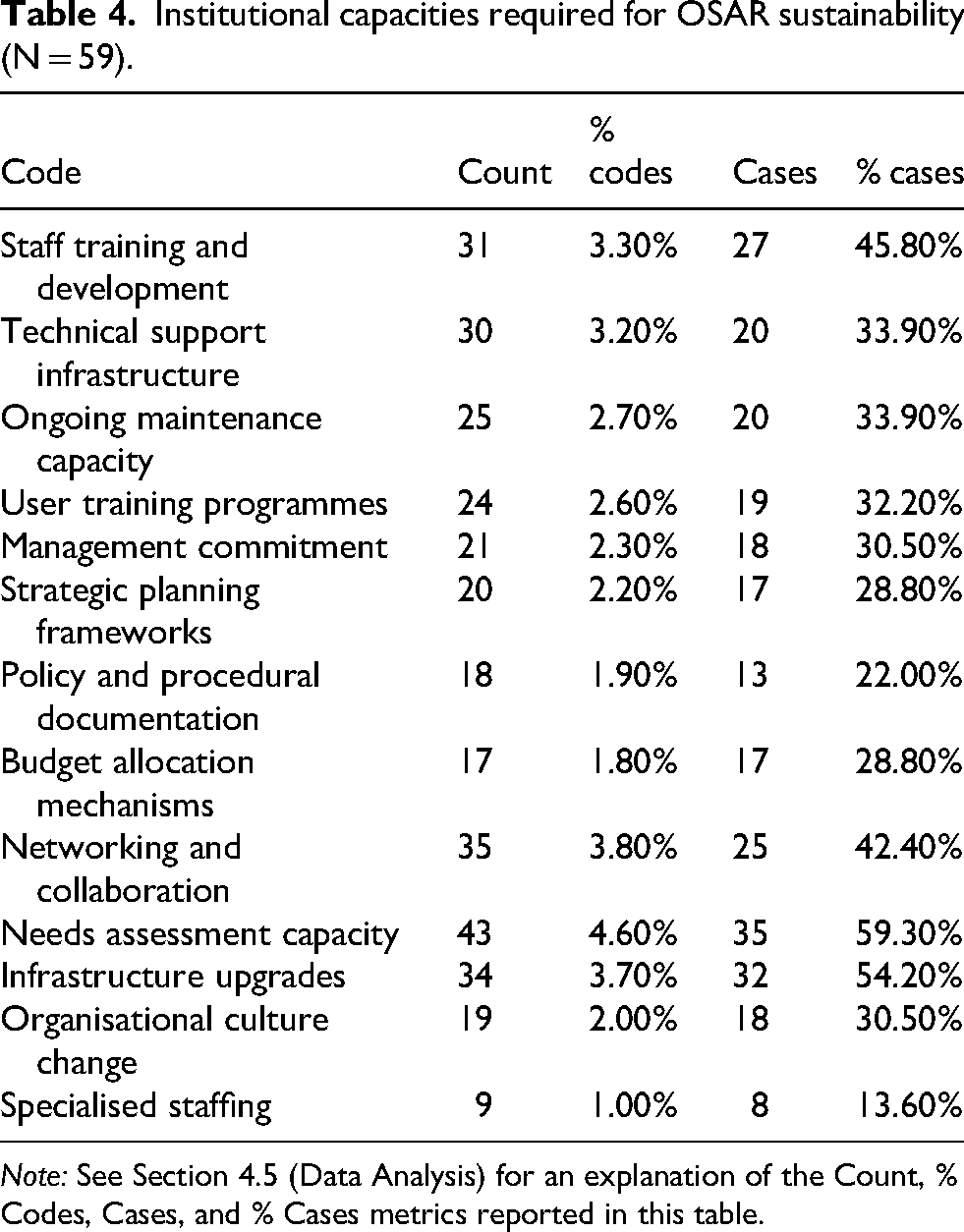
Note: See Section 4.5 (Data Analysis) for an explanation of the Count, % Codes, Cases, and % Cases metrics reported in this table.
Needs assessment capacity emerged as the most extensively discussed sustainability requirement (59.30%). One staff member explained: “We cannot sustain services that do not meet actual needs. Regular needs assessment ensures we are implementing appropriate tools, addressing real barriers, and adapting as needs evolve” (LS11). However, document analysis revealed no library had conducted systematic needs assessments for patrons with visual impairments. One library's annual report acknowledged: “The library did not manage to undertake user needs and satisfaction analysis during this period. This remains a critical gap” (AL5 annual report). A dissenting perspective came from one library staff member who questioned whether a formal needs assessment was a realistic expectation given existing staffing constraints: “We know what our patrons need, they tell us directly. A formal assessment process is a luxury when we are running on skeleton staff” (LS10). This tension between the normative ideal of systematic needs assessment and the practical constraints of under-resourced institutions surfaced in multiple interviews and reflects a broader gap between recommended practice and operational reality.
Infrastructure upgrades (54.20%) emerged as fundamental. A lecturer explained: “Sustainability requires more than just software. You need modern hardware, reliable internet, accessible physical spaces, backup systems, and ongoing infrastructure investment. Libraries cannot expect decade-old computers and unreliable internet to support modern assistive resources” (DSL2). However, one participant cautioned against framing infrastructure upgrades as a straightforward solution, noting that AL4's hardware had itself become partially outdated and that even relatively well-resourced environments faced ongoing maintenance challenges: “Our equipment was new five years ago. Now some of it is already causing problems. Technology does not stay current, and we do not have a replacement cycle” (LS8). This observation complicates the implicit assumption that a one-time infrastructure investment produces durable sustainability.
Staff training and development (45.80%) required technical competency, pedagogical skills, and disability awareness. Even at AL4, training was not accompanied by protected time for application: “We were trained… but then we went back to our normal duties, and there was no time to practise” (LS8). User training (32.20%) was essential but contested: some patrons questioned the value of library-delivered training where staff expertise was perceived as inferior to their own (VIP11). Specialised staffing (13.60%) proved critical; AL4's staff with Special Needs Education qualifications enabled sustained implementation that generalist staffing elsewhere could not replicate.
Technical support infrastructure (33.90%) and ongoing maintenance capacity (33.90%) required routine updates, troubleshooting, customisation, and integration. One lecturer observed, “The challenge with open-source is that you do not have vendor support. Libraries need in-house technical capacity or reliable external partnerships to provide ongoing support. Otherwise, the first time something breaks, the system becomes unusable” (DSL3). Only AL4 had documented maintenance protocols. A contrasting perspective emerged from one ZimLA member who argued that the absence of vendor support need not be a barrier where inter-institutional networks were functional: “Open-source communities are the vendor. If libraries connected to those communities and to each other, they would have more support than any single commercial contract provides” (ZFGD2). This view, while aspirational given the limited collaboration documented in this study, identifies a potential sustainability pathway that the dominant institutional capacity narrative tends to overlook.
Management commitment (30.50%) proved essential. One student services staff member articulated: “Senior leadership sets the tone. When management genuinely prioritises accessibility, resources follow, staff are accountable, and sustainability happens. When accessibility is just rhetoric, initiatives fail” (SS3). As noted in Section 5.2, however, some staff members presented a more complex picture in which accessibility was not deprioritised through indifference but through inescapable resource scarcity. Organisational culture change (30.50%) required attitudinal, normative, behavioural, and structural transformations. One staff member articulated: “Some staff still see serving students with disabilities as extra work, not core work. Until that attitude changes, sustainability is impossible. We need cultural transformation where accessibility is just how we do things, not something special” (LS10). A minority of participants pushed back on culture-change framing, however, suggesting it risked placing the burden of systemic failure on individual staff dispositions: “It is easy to say we need a culture change. But if management does not resource it, if policies do not require it, and if there is no accountability, telling frontline staff to change their attitudes achieves nothing” (DSL4). This account aligns with the broader finding that structural conditions, rather than attitudinal deficits, are the primary determinants of sustainability outcomes.
Strategic planning frameworks (28.80%) and policy documentation (22.00%) emerged as interconnected requirements. One staff member explained: “We do not have a plan. Sometimes we try something if we hear about it or if someone requests it. But there is no systematic approach to identifying needs, selecting appropriate tools, implementing them properly, and maintaining them over time” (LS11). Document analysis revealed that library policies made no explicit reference to OSAR. Budget allocation mechanisms (28.80%) required operational, capital, training, and contingency budgets. A lecturer emphasised: “While OSAR eliminate licencing fees, the total cost of ownership includes technical support, training, infrastructure, maintenance, and opportunity costs. Libraries need realistic budgets reflecting these actual costs. Otherwise, initial savings become long-term failures” (DSL3). Only AL4 had explicitly incorporated OSAR support costs into recurring budgets.
Together, these findings demonstrate that OSAR sustainability requires coordinated institutional capacity across human, technical, organisational, and financial domains. AL4's relatively stronger performance reflects broader capacity development across these dimensions, though with persistent gaps. Fragmented implementation at the remaining sites reflects multi-domain capacity deficits, underscoring that sustainability requires institutional transformation rather than technical deployment alone. The recurring friction between staff and user perceptions of complexity, between cost advantage and total cost of ownership, between awareness and deliberate non-adoption, and between training provision and training effectiveness, indicates that sustainability challenges are more varied in their origins than a single capacity-deficit narrative can adequately capture.
Discussion
This section interprets findings through Diffusion of Innovation Theory as an organising framework, structured around the three research questions.
Beyond linear affordability: the economic paradox revisited (RQ1 and RQ2)
The findings demonstrate the limitations of linear affordability models. Although OSAR eliminate licencing costs (Majinge and Mutula, 2018; Rohwerder, 2018), financial relief alone does not yield institutional transformation. Consistent with Matter et al.'s (2016) distinction between acquisition cost and total cost of ownership, OSAR shifts rather than removes financial burdens, relocating them to training, technical support, infrastructure, and maintenance. Library staff questioned whether OSAR were genuinely cheaper once these operational costs were accounted for, qualifying the headline cost-advantage claim.
These results challenge development discourses that position cost as the primary adoption barrier, revealing instead that persistent constraints reflect deeper institutional capacity deficits (Chigwada and Phiri, 2021; Li et al., 2023). Cross-case comparison shows that institutional capacity, rather than absolute funding, mediates adoption outcomes, evidenced by AL4's sustained implementation through a dedicated Disability Resource Centre. Yet even AL4 exhibited gaps, with patrons reporting persistent difficulties navigating the library catalogue despite NVDA's availability; institutional capacity is therefore a mediating rather than deterministic factor. Comparable findings in Tanzanian and Ghanaian contexts (Ayiah, 2017; Majinge and Msonge, 2020) reinforce the regional relevance of this paradox.
Participant perspectives were more varied than a single explanatory framework accommodates. Some expressed considered doubts about volunteer-maintained software, preferences for proprietary systems, or deliberate deferral pending national policy clarity; others framed non-prioritisation as a product of competing resource demands. These accounts suggest that some non-adoption reflects reasoned institutional judgement rather than incapacity. The analysis, therefore, does not claim institutional capacity as the sole determinant, but as the most pervasive and consistently evidenced structural constraint across this sample.
Compatibility as organisational achievement (RQ2)
Rogers’ (2003) notion of compatibility as alignment with existing values and needs insufficiently accounts for the multidimensional adjustments OSAR require. Compatibility spans technical, procedural, competency, and cultural domains, each demanding deliberate institutional transformation (Chigwada and Phiri, 2021; Copeland et al., 2023). Technical challenges generally reflect infrastructural limitations rather than software deficiencies; however, there were instances where OSAR could not navigate proprietary catalogue interfaces regardless of staff expertise, a category of incompatibility that institutional investment alone cannot resolve (Ahmad and Tripathi, 2024; Oussous et al., 2023). Libraries with obsolete hardware complicate assumptions that open-source solutions reduce resource requirements, as OSAR often necessitates contemporary infrastructure absent vendor-managed support (Silva et al., 2023).
The findings support treating compatibility as an organisational achievement rather than a static precondition, consistent with Damanpour and Schneider's (2006) observation that innovation attributes are actively shaped by organisational action. AL4 addressed compatibility through deliberate structural adaptation, dedicated roles, specialist qualifications, and integrated workflows, rather than by selecting inherently compatible tools. Where genuine software limitations exist, these constitute a distinct constraint requiring tool selection criteria and vendor engagement, not capacity-building alone.
Complexity as relational phenomenon (RQ2)
The findings problematise Rogers’ (2003) framing of complexity as an inherent innovation attribute, showing it instead as emergent from technology–context interactions. Complexity is best understood as the gap between technological demands and institutional capacity (Scott and McGuire, 2017). Crucially, this gap was experienced differently across stakeholder groups: experienced users with visual impairments reported NVDA to be straightforward once configured, while staff-perceived complexity led to tools being removed or left unmaintained. This asymmetry extends Mais and Yaum's (2025) argument that adoption barriers are differentially distributed, complexity is not only context-dependent but stakeholder-dependent, shaped by whose knowledge is centred in the assessment.
Proprietary solutions embed support costs in licencing fees, providing predictable expense structures and vendor accountability (August et al., 2020), whereas OSAR generate diffuse, unpredictable support demands that resource-constrained institutions struggle to absorb (Matter et al., 2016; Tebbutt et al., 2016). Infrastructure deficits amplify these challenges (Lavric et al., 2024). A ZimLA perspective that open-source communities could substitute for vendor support if libraries were structurally connected to them represents an unrealised complexity-mitigation pathway, consistent with Silva et al.'s (2023) finding that community network embeddedness predicts open-source sustainability. These findings extend DoI by showing that innovation attributes successful in well-resourced environments do not transfer seamlessly to resource-constrained settings (Almakaty, 2026; Palm, 2022).
Systemic awareness deficits and institutional knowledge gaps (RQ2)
Limited OSAR awareness reflects systemic institutional failures in professional development and organisational learning rather than individual knowledge gaps alone. Document analysis confirmed that awareness gaps are embedded in formal institutional documentation and absent from strategic planning (Garwe and Thondhlana, 2019), creating self-reinforcing cycles consistent with Rogers’ (2003) concept of organisational innovation resistance.
Awareness was not, however, uniformly absent. Deliberate non-adoption at AL3 reflected managerial familiarity with NVDA but deference pending national policy clarity. OSAR information was disseminated provincially through ZimLA, but structural barriers, low professional forum attendance and inadequate decision-maker representation prevented it from reaching responsible staff. This suggests the awareness gap is partly an information routeing and organisational dissemination problem rather than an absolute knowledge deficit, consistent with Munemo and Chiwanza's (2024) finding that information asymmetries in accessibility contexts are structurally produced. AL4's awareness advantage, derived from deliberate international disability network engagement, illustrates that information access is as structurally determined as financial access. As Li et al. (2023) show, organisational cultures systematically marginalise accessibility knowledge, and in less-resourced contexts these exclusions are compounded by absent professional development infrastructure, making awareness gaps simultaneously a knowledge, organisational, and structural problem.
Assistive resources as socio-technical systems: sustainability requirements (RQ3)
The findings challenge technocentric models that treat assistive resource provision primarily as procurement. Needs assessment capacity, the most frequently cited sustainability requirement, reveals systematic misalignments between available technologies and patron needs, with libraries implementing OSAR opportunistically in response to cost rather than documented user requirements (Ncube and Ngulube, 2025). This inverts the needs–solution relationship and reflects the technology–service binary identified by Fernández-Batanero et al. (2022): screen readers, magnification software, and text-to-speech tools are ineffective without trained staff, structured protocols, and accessible library materials (Rayini, 2017; Visagie et al., 2020). Notably, some library staff regarded formal needs assessment as unrealistic under existing staffing conditions, viewing informal patron feedback as functionally equivalent, a tension between prescriptive best practice and operational constraint that purely normative frameworks would obscure.
Infrastructure demands further complicate sustainability: OSAR may require upgrades exceeding those for proprietary solutions, which typically include vendor-managed support and device optimisation (August et al., 2020; Silva et al., 2023). The subsidy proprietary vendors provide through bundled services is unavailable with OSAR, making institutional capacity non-negotiable (Matter et al., 2016). Even AL4 experienced equipment failures and lacked a hardware replacement cycle, qualifying any tendency to present well-resourced cases as sustainable end-states, consistent with Tebbutt et al.'s (2016) argument that assistive technology sustainability requires continuous investment cycles. Assistive resources are accordingly best understood as socio-technical systems whose sustainability depends on continuously renewed human capacity, organisational structures, and material infrastructure.
Organisational culture and structural change (RQ3)
Effective OSAR support demands multidimensional expertise across information technology, library science, and disability studies (Majinge and Msonge, 2020; Wright et al., 2023). AL4's employment of staff with Special Needs Education qualifications enabled sustained implementation, whereas reliance on generalist staff produced fragmented approaches (Copeland et al., 2023; Oussous et al., 2023). Two complications qualify this: training provision was not accompanied by protected time to apply new skills, revealing a gap between formal training and effective capacity-building; and patrons expressed scepticism about library-delivered training where staff expertise was perceived as inferior to that of experienced users, dimensions that frequency-based metrics do not capture.
Organisational culture shapes sustainability outcomes: staff perceptions of disability services as additional rather than core work reflect institutional cultures that marginalise accessibility (Ayiah, 2017; Visagie et al., 2020). AL4's contrasting culture demonstrates that embedding accessibility into institutional structures produces more durable outcomes than attitudinal adjustment, supporting Li et al.'s (2023) argument that cultural transformation requires structural reorganisation. However, some participants resisted the culture-change framing, arguing it risked displacing responsibility onto individual staff when the primary drivers were structural and managerial, reinforcing the finding that interventions targeting culture without addressing governance and accountability are unlikely to produce lasting change (Ayiah, 2017; Ncube and Ngulube, 2025).
Management support operates through sustained resource allocation and accountability enforcement rather than symbolic endorsement (Damanpour and Schneider, 2006). Only AL4 incorporated OSAR support into recurring budgets; the absence of explicit OSAR strategies elsewhere institutionalises ad hoc, reactive adoption (Garwe and Thondhlana, 2019). Staff attributed this in part to resource scarcity and competing priorities, a distinction with practical implications for how sustainability interventions are designed.
Theoretical contributions and limitations of diffusion of innovation theory (RQ1, RQ2, and RQ3)
The findings highlight both the utility and limitations of DoI theory. Rogers’ (2003) constructs offered productive analytical vocabulary but required adaptation to capture the socio-technical dynamics of this resource-constrained context (Damanpour and Schneider, 2006). Four context-situated analytical extensions are offered as contributions grounded in empirical evidence rather than as major theoretical advances.
First, innovation attributes are not fixed: compatibility emerged through deliberate structural alignment, though genuine software limitations existed that institutional action cannot fully mediate (Damanpour and Schneider, 2006; Mais and Yaum, 2025). Second, complexity is relational and stakeholder-dependent: the same tool was experienced as straightforward by users, and as complex by staff, a distinction DoI's original formulation does not accommodate (Mais and Yaum, 2025; Scott and McGuire, 2017). Third, sustainability requires explicit analytical attention as a distinct adoption phase: DoI's focus on the adoption decision inadequately addresses the institutional conditions that determine whether adoption endures (A'dillah Mustafa and Noorhidawati, 2020; Scott and McGuire, 2017). Fourth, institutional capacity mediates diffusion throughout, though even capacity-sufficient environments remain vulnerable to sustainability gaps where renewal investment is absent (A'dillah Mustafa and Noorhidawati, 2020).
DoI's individualistic and linear assumptions are limited in developing-country contexts. Structural barriers produce recursive, non-linear adoption patterns inconsistent with DoI's staged diffusion model (Almakaty, 2026; Palm, 2022), and its adoption-centric focus inadequately addresses sustainability. The friction across the findings, between staff and user perceptions of complexity, between cost advantage as principle and total cost as practice, between awareness and deliberate non-adoption, and between training provision and training effectiveness, reveals adoption and sustainability dynamics more varied in their origins than a linear model accommodates. These findings suggest that DoI requires adaptation to account for structural determinants and the divergent stakeholder rationalities that shape how the same innovation is experienced, evaluated, and sustained differently across and within institutional settings (Almakaty, 2026; Palm, 2022).
Conclusions and recommendations
This study concludes that OSAR, while technically viable and cost-advantageous, remain largely unrealised as a sustainable accessibility solution across the four libraries lacking dedicated disability infrastructure, principally because of institutional capacity deficits rather than technological limitations alone. Findings across the three research questions converge as follows. OSAR implementation remains fragmented and largely opportunistic, driven by the availability of free tools rather than strategic planning or documented user needs (RQ1). Adoption is shaped not primarily by cost, which is widely recognised as an advantage, but substantially by inadequate infrastructure, limited OSAR awareness, technical complexity without institutional support, and absent management commitment (RQ2). Sustainability requires comprehensive institutional development across human resources, technical infrastructure, organisational culture, strategic planning, and financial mechanisms, conditions met in this sample only by AL4 (RQ3). The study supports and contextualises prior evidence from sub-Saharan Africa on open-source adoption barriers, contributing context-specific empirical detail on the institutional capacities that determine sustainability outcomes. Cost remains a relevant facilitator, but its impact is mediated by the institutional conditions that determine whether low-cost tools can be effectively deployed and sustained over time.
The following recommendations derive directly from the study findings. First, since 59.30% of participants identified the absence of systematic needs assessment as a barrier, libraries should establish regular, structured assessments of patrons’ assistive technology needs before and during OSAR deployment, rather than selecting tools based on cost alone. Second, given that inadequate infrastructure was the most extensively cited barrier (35.60%), institutional investment strategies must prioritise hardware, connectivity, and physical accessibility alongside software selection. Third, because staff training emerged as the second most critical sustainability capacity (45.80%), libraries should develop structured, ongoing training programmes encompassing technical skills, disability awareness, and user support, modelled on AL4's staffing approach. Fourth, as awareness of OSAR options remains low (33.90%), ZIMCHE and the Zimbabwe Library Association should establish collaborative networks and professional development forums that circulate information about open-source tools and implementation models. Fifth, the absence of explicit OSAR strategies across four of five libraries suggests that accreditation frameworks should incorporate minimum requirements for accessibility planning documentation. In addition, funding models should shift from one-time capital grants to sustained operational budgets covering technical support, training, and maintenance, reflecting the total cost of ownership rather than acquisition cost alone.
Limitations and areas for further research
This study is constrained by several methodological and contextual limitations that affect the generalisability of its findings. The focus on five academic libraries in Zimbabwe's Midlands Province limits transferability to other geographical and institutional settings with different political, economic, and regulatory conditions. Although purposive sampling enabled detailed exploration of OSAR adoption, the restricted sample and concentration on academic libraries exclude perspectives from public and special libraries, where implementation dynamics may differ. The cross-sectional design further restricts analysis of longitudinal adoption trajectories and sustainability outcomes. In addition, the study primarily addressed visual impairments, overlooking other disability categories whose technological needs and implementation challenges may vary substantially. The absence of quantitative indicators of performance, user satisfaction, and cost-effectiveness also limits comparative evaluation between open-source and proprietary solutions.
Future research should, therefore, employ longitudinal and cross-national designs to examine OSAR diffusion over time and across diverse policy environments. Expanding investigations to include multiple disability categories would provide a more comprehensive understanding of OSAR applicability. Mixed-methods approaches integrating qualitative insights with quantitative performance and cost-benefit metrics are recommended to strengthen evaluative rigour. Further studies on collaborative implementation models and emerging technologies, including artificial intelligence and machine learning, would illuminate innovation pathways. In addition, policy-focused research assessing regulatory and funding frameworks is essential for informing sustainable, evidence-based accessibility strategies in resource-constrained academic libraries.
Footnotes
Acknowledgements
The authors thank the participating academic libraries, library staff, disability resource coordinators, and students with visual impairments who generously shared their experiences. We also acknowledge the Zimbabwe Library Association members who contributed valuable perspectives.

Ethical considerations
Institutional permission was secured from participating libraries through written agreements with library management and institutional research offices.
Consent to participate
Written informed consent was obtained from all participants. Consent procedures were adapted for participants with visual impairments through Braille formats and audio recordings.
Consent for publication
All participants provided written informed consent for publication of anonymised data.
Funding
The authors received no financial support for the research, authorship, and/or publication of this article.
Declaration of conflicting interests
The authors declared no potential conflicts of interest with respect to the research, authorship, and/or publication of this article.
Data availability statement
The data supporting the findings of this study are available from the corresponding author upon reasonable request. Due to ethical considerations regarding participant anonymity, raw data cannot be publicly shared.