



Abstract
This research examined the association between technology readiness of farmers and their behavioral intention to adopt a mobile agricultural finance app called the e-AgriFinance app, as well as if gender, age, and educational level affect their technology readiness and behavioral intention. A questionnaire survey was conducted to collect primary data from 334 farmers cultivating oil palm, rubber, cocoa, and pepper in Sarawak. Data were analyzed using correlation analysis and independent t-tests. The study revealed that the motivator dimension of technology readiness relates positively with behavioral intention while the inhibitor dimension relates negatively with behavioral intention. Female farmers were found to have higher mean scores in the motivator dimension and behavioral intention than male farmers. Farmers who are older and received lower education were found to have lower mean scores in the motivator dimension than those younger and have higher education. The findings provided alternative explanation of the role of demographic variables – gender, age, and educational level in the technology adoption literature in the context of farmers. For practice, the findings provided the Sarawak government and other stakeholders with insights about promoting digital inclusion among farmers.
Keywords
Introduction
The invention of smartphone in 2007 and advancement of communication technology have brought about disruptive impact to every segment of society. The use of smartphone applications has become ubiquitous in our daily lives, ranging from communication, education, travel, gaming, and many more. The relationship between ICTs and development is constantly evolving. The earlier use of ICTs for development (i.e., ICT4D 1.0 and ICT4D 2.0) was significantly shaped by the Millennium Development Goals (MDGs) adopted by the United Nations (Heeks, 2020). The development priorities have then been changing to embrace the themes of transformation, inclusion, and sustainability, when MDGs were replaced by the Sustainable Development Goals (SDGs) at the end of 2015 (Heeks, 2020). One of the changes include the use of digital technologies that replaced ICTs, reflecting the broader nature and roles of these technologies (Heeks, 2020). Digital finance is one of the segments that leverages on the advantages of digital platforms to offer financial services at a lower cost to boost financial inclusion in many developing countries such as Bangladesh (Aziz and Naima, 2021), India (Siddik and Kabiraj, 2020), and Indonesia (Shofawati, 2019), especially to the underserved communities.
Sarawak, the largest state in Malaysia, takes this opportunity to implement Sarawak Digital Economy Strategy in 2018, with an aim to achieve a high income and advanced state by the year 2030 (Sarawak Multimedia Authority, 2021). In this strategy, the agricultural sector has been identified as one of the key sectors that contributes to the main source of income for rural people. Various initiatives have been implemented to promote digital inclusion among farmers in the rural areas with an aim to improve the livelihood and standard of living of the communities. For instance, provision of high-speed broadband connectivity across suburban and rural areas by Sarawak Rural Broadband Network (MySRBN), Digital Village Accelerator's provision of seed grants to local startups to accelerate their growth and maturity with emphasis on increased revenue generation, market expansion and investment potential, and Sigfox IoT Testbed for development of agricultural applications such as smart soil quality sensor (SDEC, 2021). Therefore, this study is aligned with the Sarawak government's digital economy agenda.
The use of digital technology such as mobile apps in agriculture has been documented in the literature. For instance, farmers in Germany used mobile apps to access agricultural information for livestock management and crop protection (Michels et al., 2019, Michels et al., 2020). Nevertheless, farmers in the developing countries may not have benefited from the digital technology in the same extent of their counterparts in the developed countries. One of the crucial issues is the low adoption rate of technology among farmers in the developing countries which may be attributed by various types of barriers (Anadozie et al., 2022; Kiconco et al., 2019; Purnomo and Kusnandar, 2019). Literature indicated that the low adoption rate of technology among farmers can be viewed from the perspectives of technology, economic, institutional, and socio-cultural (Mwangi and Kariuki, 2015). This study focused on the technology and social-cultural factors that affect the behavioral intention to adopt a mobile agricultural finance app among farmers in Sarawak. This study examines technology readiness as the technology factor, and gender, age, and educational level as socio-cultural factor. Specifically, this study aims to examine the association between technology readiness of farmers and their behavioral intention to adopt a digital finance app called the e-AgriFinance app, and the effect of gender, age, and educational level on the two dimensions of technology readiness – motivator and inhibitor, and behavioral intention. In this study, the e-AgriFinance is defined as a mobile app that incorporates farming and farm-related information, activities and transactions including input supply, processing, wholesaling, and marketing of agricultural produce. The e-AgriFinance app prototype was developed on a smartphone platform and demonstrated to the respondents during data collection.
The ICT4D criticism emphasizes the need for user-centric projects and avoid excessive techno-optimism (Schelenz and Pawelec, 2022). This study is therefore important to understand the role of demographic variables on the adoption of digital technology so that the implementation of ICT projects would meet the needs of people with different backgrounds. This study attempts to contribute to the technology adoption literature by providing empirical evidence of the role of demographic variables in affecting technology readiness and behavioral intention to adopt digital technology from the perspective of farmers. For practice, this study provides insight into intervention programs initiated by the Sarawak government and other relevant stakeholders in promoting the use of digital technology in the agricultural sector and at the same time preventing the stakeholders from being overly optimistic about the impact of digital technology on socio-economic development in the state.
Literature review and hypothesis
Adoption of Mobile apps among farmers
Advancement of digital technology has impacted the operations of all sectors including agriculture. Literature revealed that farmers and herders have gained benefits from the digital technology in various aspects. For instance, in Germany, Michels et al. (2019) found that smartphone apps were used to source for information about reproduction management, animal health, and other livestock management. Michels et al. (2020) also reported the use of smartphone apps in crop protection for accessing useful information about weather, pest scouting, and infestations forecasts. During the COVID-19 pandemic, Mahapatra (2020) and Kaur et al. (2020) identified the advantages of using mobile apps for dissemination of knowledge related to agriculture to farmers in the poorest communities in India. Using mobile and cloud computing technologies, farmers can determine the requirements for seeds and water level in conjunction with weather information and monitor soil conditions in preparation for the next planting and harvest season. In Africa, Emeana et al. (2020) reported that provision of information through mobile phone-enabled farm information services has the potential to revolutionize agriculture and significantly improve smallholder farmers’ livelihoods. In sum, the benefits of farming app services include enabling farmers to access financial services and gathering information from agriculture on input use, activities, and market prices. However, none of the above studies focused on the adoption of mobile apps in agricultural finance. It should be noted that adoption of mobile apps in this study is conceptualized using behavioral intention as the e-AgriFinance is a prototype and not a fully developed app. Behavioral intention to adopt new technology has been found to strongly correlate with actual use behavior in the technology adoption literature (e.g., Davis et al., 1989). Other relevant studies in the agricultural sector that conceptualized technology adoption using behavioral intention include Nova et al. (2022) and Purnomo and Kusnandar (2019).
Technology readiness
Technology readiness is defined as the mental motivators and inhibitors that collectively determine a person's predisposition to use new technologies (Parasuraman, 2000). The construct of technology readiness is multifaceted, consisting of two components and their respective dimensions. Motivators consist of optimism and innovativeness, while inhibitors consist of discomfort and insecurity. Motivators are contributing to technology readiness while inhibitors are detracting from it. An individual may possess both dimensions of technology readiness as the four dimensions of the two components are relatively distinct from one another (Parasuraman and Colby, 2015). Generally, prior relevant studies found support for the relationship between technology readiness and use or behavioral intention to use new technology (e.g., Chen et al., 2018; Lee et al., 2012; Lin and Hsieh, 2007). Recent studies that examined the relationship between technology readiness and adoption of new technology in the agricultural sector include Schukat and Heise (2021) who found technology readiness positively influenced behavioral intention to adopt and actual use of smart products in livestock farming in Germany, and Duang-Ek-Anong et al. (2019) who reported the positive role of readiness of Internet of Things (IOT) in the adoption of smart farming in Thailand. Nevertheless, it is worth noted that the above two studies did not focus on the adoption of mobile apps and were not in the field of agribusiness.
The effect of demographic variables
The study selected three demographic variables - gender, age, and educational level as these variables are aligned with the Millennium Development Goals (i.e., 2 and 3) and the Sustainable Development Goals (i.e., 3, 4, 5 and 10) which promote equalities among people of different gender, age, and educational level. From the ICT4D perspective, the gap among people with different gender, age, and educational level in their perception and use of digital technologies remains prevalent, in both developed (e.g., Elena-Bucea et al., 2021) and developing countries (e.g., Antionio and Tuffley, 2014).
Gender plays an important role in fully understanding the phenomenon of technology (Dixon. 2014). Mumporeze and Prieler (2017) opined that gender divide in accessibility and use of ICT contributes to gender inequalities. In a systematic review on gender digital divide conducted by Acilar and Sæbø (2023), a significant difference was revealed between women and men in terms of accessing and using ICT in developing countries. Age is generally acknowledged as the main contributor in the ICT adoption literature (United Nations, 2012). Older people are found to have higher level of technophobia (Hogan, 2009; Nimrod 2018) and experience higher degree of computer anxiety than the younger people (Dos Santos and Santana, 2018). Older people were stereotyped as less receptive or reluctant to accept new technologies (e.g., Knowles and Hanson, 2018; Lin et al., 2020; McMurtrey et al., 2011). Educational attainment is found to be a significant predictor of ICT use and engagement of online activities, in both developed (e.g., Van Deursen et al., 2015) and developing countries (e.g., Nishijima et al., 2017; Pazmiño-Sarango et al., 2022).
In addition, past studies in the agricultural technology adoption literature have produced mixed findings in terms of the role of demographic variables. For instance, Hidrobo et al. (2022) found that male farmers in Ghana have higher willingness to pay for a digital platform that provides nutrition-sensitive agricultural information than female farmers. In Vietnam, Hoang and Nguyen (2023) found that gender, age and educational level significantly predict vegetable smallholders’ adoption of mobile phones for marketing purposes. Specifically, farmers who are male, younger, and received higher education are in a better position to adopt mobile phones for marketing of vegetables than farmers who are female, older and have lower educational level. On the contrary, Doss and Morris (2001) reported that the adoption of agricultural innovations in modern varieties and chemical fertilizer was not dependent on gender but on access to resources because male farmers tend to have better access to these resources than women farmers. Age was found to be positively related to the adoption of chemical fertilizer and years in formal education is positively related to the adoption of modern varieties.
Omonona et al. (2006) found that gender, age, and years in education are positively related to the adoption of new cassava varieties among farmers in Nigeria. On the other hand, Obisesan (2014) reported slightly different results where only gender and years in education have an effect on the adoption of the same technology in the same country. In Tanzania, Mignouna et al. (2011) revealed that age and years in education but not gender affect the adoption of imazapyr-resistant maize among farmers. In a more recent study, the relationship between predictors and adoption of agricultural technology was found to vary according to two gender groups. Notably, Khoza et al. (2021) reported that male farmers’ actual adoption of climate-smart agriculture was associated positively with adoption intention and negatively with prior experience, but female farmers were positively influenced by social processes such as voluntariness and subjective norms.
Older farmers tend to use prior knowledge and experience to make decisions concerning the adoption of new technology if they perceive that new technology would bring more benefits to their crop production (Mignouna et al., 2011). This finding is consistent with the behavior of older people in general where they are faced with various barriers to using the technology but have the likelihood to use the technology if they are exposed to the functionality of the technology (Vaportzis et al., 2017) and perceive the benefits of technology use do outweigh the costs of such use (Mitzner et al., 2010). In the similar vein, if they find that the technology poses a risk to them, they tend to reject the technology. Younger farmers, on the other hand, may not have the necessary knowledge and experience compared with the older farmers, but they are more willing to take the risk to try out new technologies. Contrarily, Thar et al. (2021) revealed that farmers who are younger and with higher education in Myanmar are more knowledgeable and better skilled to adopt agricultural mobile apps. The finding on the influence of age on the usage of IoT in smart farming in Iran (Ronaghi and Forouharfar, 2020) is consistent with the technology adoption literature. Moreover, by using the COM (capabilities, opportunities, and motivations) user readiness framework in examining the use of digital agricultural technologies, McCampbell et al. (2023) found that the younger farmers in Rwandan scored higher in reflective motivation and social opportunity than the older farmers, and the farmers with higher education scored 10 times higher in all components of user readiness framework than the farmers who did not attend school.
Among the three demographic variables investigated in this study, educational level tends to produce more consistent findings in relation to adoption of new technology among farmers. Farmers with higher level of education tend to be able to access, process, and comprehend the information related to the impacts of new technology on their farm and farm-related activities, and thus are more likely to adopt new technologies compared to farmers with lesser years in education. For instance, Krell et al. (2021) reported that farmers who completed more years of formal education had a higher likelihood to use m-services for farming and alerts; Paltasingh and Goyari (2018) found that education enhances farm productivity in the case of adoptors of modern agricultural technology. Nonvide (2021) reported that education but not gender and age, significantly increases the adoption of agricultural technology among rice farmers in Benin. Likewise, household heads of smallholder farmers who are younger and obtained higher educational level have the higher intensity of using mobile money in Ghana (Asravor et al., 2022). In the Malaysian context, Rosli et al. (2013) found that educational level significantly influenced the adoption of technology in pepper farming. Nevertheless, it should be noted that none of the above studies are focused specifically on the relationship between technology readiness and adoption of mobile apps and in the context of agribusiness.
Based on the above review, this study tested the following hypotheses:
H1a: The motivator dimension of technology readiness is positively related with farmers’ behavioral intention to adopt the e-AgriFinance app.
H1b: The inhibitor dimension of technology readiness is negatively related with farmers’ behavioral intention to adopt the e-AgriFinance app.
H2a: Male farmers score higher in the motivator dimension of technology readiness than female farmers.
H2b: Male farmers score lower in the inhibitor dimension of technology readiness than female farmers.
H2c: Male farmers have higher behavioral intention to adopt the e-AgriFinance app than female farmers.
H3a: Older farmers score lower in the motivator dimension of technology readiness than younger farmers.
H3b: Older farmers score higher in the inhibitor dimension of technology readiness than younger farmers.
H3c: Older farmers have lower behavioral intention to adopt the e-AgriFinance app than younger farmers.
H4a: Farmers with higher educational level score higher in the motivator dimension of technology readiness than farmers with lower educational level.
H4b: Farmers with higher educational level score lower in the inhibitor dimension of technology readiness than farmers with lower educational level.
H4c: Farmers with higher educational level have higher behavioral intention to adopt the e-AgriFinance app than farmers with lower educational level.
Research method
Population, sample, and sampling procedures
The target population of this study was farmers in Sarawak. The sample was selected from farmers cultivating the four major crops which are oil palm, rubber, cocoa, and pepper in the top three divisions in terms of production in Sarawak. The lists of famers for the first three crops were obtained from the respective boards. One-hundred and twenty farmers from the top producing divisions were randomly selected and contacted to participate in the survey. For pepper, the board refused to release the farmer list. As such, the sample was identified in an agricultural event called AgroFest in Kuching where 60 farmers were approached to participate in the survey. In sum, 420 farmers were approached, and 337 responses were received, of which 3 cocoa farmers did not complete the demographic variables and were discarded from further analysis, a response rate of 79.5% (334/420). The participants consist of 107 farmers from oil palm, 99 from rubber, 86 from cocoa and 42 from pepper. The demographic details of the respondents are presented in Table 1.
Respondents’ Profile (n = 334).
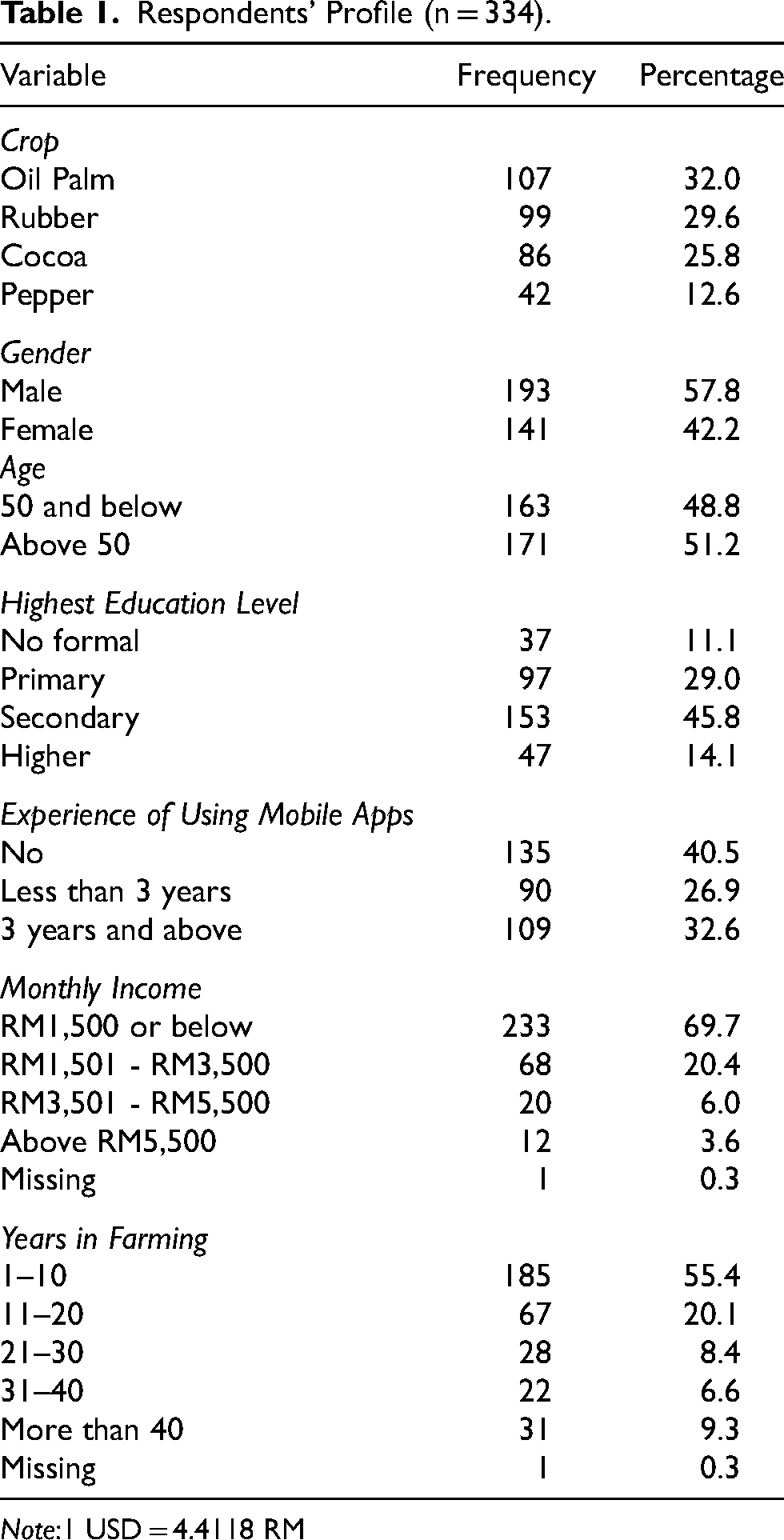
Note:1 USD = 4.4118 RM
Data collection method
A researcher-administered questionnaire was used to collect primary data from farmers cultivating oil palm, rubber, cocoa, and pepper in Sarawak. This data collection method allowed the researchers to directly explain the content of the questionnaire and demonstrate the prototype of the e-AgriFinance app to the respondents. The purpose of the prototype was to provide the farmers a preliminary overview of an agricultural finance app. The prototype contains agricultural information, activities and financial transactions along the agricultural value chain that are represented by 12 icons with a brief description.
Variables and measurement
The questionnaire also includes seven demographic variables – gender, age, highest educational level, monthly income, major crop, years in farming, and experience of using mobile apps.
Data analysis techniques
A correlation analysis was used to test the association between technology readiness and behavioral intention to adopt the e-AgriFinance app (H1). Independent t-tests were employed to test the differences in technology readiness and behavioral intention between gender, age, and education level of farmers (H2, H3, and H4 respectively). Both analyses were conducted using Microsoft Excel for Office 365. Age and educational level of farmers were categorized into two groups as below 50 years vs. 50 years and above, and no formal education and primary education vs. secondary education and tertiary education, respectively. The categories were based on methodological consideration, that is having the appropriate number of respondents in each group for meaningful comparison using statistical analysis tools.
Ethics approval
The researchers granted email approval to use TRI 2.0 from the researchers who developed the instrument. Besides, the researchers also obtained the approval from the Curtin University Human Research Ethics Committee (Approval code: HREC2019-0753) to conduct this study which must comply with the National Statement on Ethical Conduct in Research 2007 (updated 2018), Australia.
Results
The correlation analysis revealed that the motivator dimension of technology readiness was positively associated with behavioral intention (r = .454, p < .001), and the inhibitor dimension of technology readiness was negatively associated with behavioral intention (r = -.147, p < .01). The strength of association was stronger between motivator and behavioral intention than between inhibitor and behavioral intention. Therefore, the data supported H1a and H1b respectively.
One-hundred and ninety-three male farmers were found to have a lower mean score (M = 5.227, SD = 1.056) than 114 female farmers (M = 5.458, SD = 0.897) in behavioral intention, demonstrating a significant lower mean score, t(332)=-2.103, p = .018. Similarly, the male farmers had a lower mean score (M = 3.752, SD = 0.735) than the female farmers (M = 3.935, SD = 0.587) in the motivator dimension of technology readiness, demonstrating a significant lower mean score, t(332)=-2.434, p = .008. Both the results contradicted the prediction of this study. Besides, no statistically significant difference was found between the two gender groups of farmers in the inhibitor dimension of technology readiness, t(332)=-0.283, p = .389, despite the male farmers attaining a lower mean score (M = 3.124, SD = 0.902) than the female farmers (M = 3.154, SD = 0.978). Therefore, the data failed to support H2a, H2b, and H2c.
One-hundred and sixty-three farmers aged 50 years old and below were found to have a higher mean score (M = 3.934, SD = 0.613) than 171 farmers aged above 50 years old (M = 3.730, SD = 0.729) in the motivator dimension of technology readiness, demonstrating a significant higher mean score, t(332) = 2.760, p = .003. Similarly, the younger farmers had a higher mean score (M = 3.225, SD = 0.974) than the older farmers (M = 3.053, SD = 0.888) in the inhibitor dimension of technology readiness, demonstrating a significant higher mean score, t(332) = 1.691, p = 0.046, a result that also contradicted the prediction of this study. Besides, no statistically significant difference was found between the two age brackets of farmers in behavioral intention, t(332) = 0.011, p = .496, despite the younger farmers attaining a slightly higher mean score (M = 5.325, SD = 0.869) than the older farmers (M = 5.324, SD = 1.109). Therefore, the data supported H3a but not H3b and H3c.
Finally, 134 farmers who received no formal education or primary education were found to have a lower mean score (M = 3.727, SD = 0.808) than 200 farmers who received secondary or higher education (M = 3.898, SD = 0.573) in the motivator dimension of technology readiness, demonstrating a significant lower mean score, t(332)=-2.263, p = 0.012. However, no statistically significant difference was found in the inhibitor dimension of technology readiness between the two farmer groups of different educational levels, t(332)=-1.035, p = 0.151, despite farmers with lower education attaining a lower mean score (M = 3.072, SD = 0.999) than the farmers with higher education (M = 3.180, SD = 0.893). Similarly, no statistically significant difference was found in behavioral intention between the two farmer groups of different educational levels, t(332)=-1.265, p = 0.103, despite the farmers with lower education attaining a lower mean score (M = 5.240, SD = 1.123) than the farmers with higher education (M = 5.381, SD = 0.902). Therefore, the data supported H4a, but not H4b and H4c. The results of independent t-tests are presented in Table 2.
Independent t-test results (n = 334).
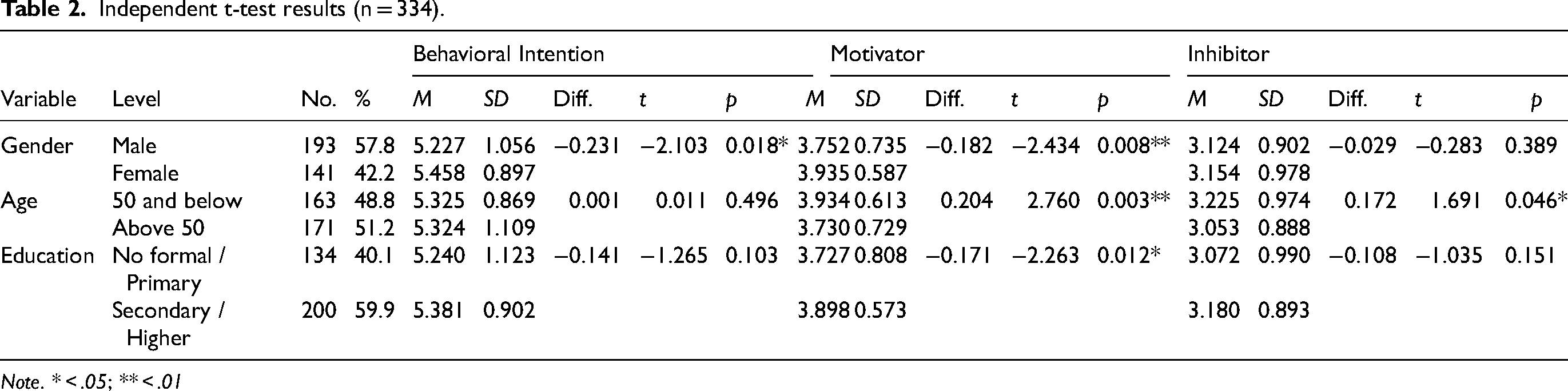
Note. * < .05; ** < .01
Discussion
The findings confirmed the prior literature that when individuals including farmers are technology ready, they have a higher behavioral intention to adopt new technology (e.g., Lin and Hsieh, 2007). While the motivator dimension of technology readiness had a positive relationship with the behavioral intention to adopt new technology, the inhibitor dimension was negatively related to behavioral intention. The findings further confirmed the prior studies on technology adoption among farmers (Duang-Ek-Anong et al., 2019; Schukat and Heise, 2021). In general, when farmers have a higher motivation level in technology, they tend to have a higher likelihood to use the e-AgriFinance app to perform agribusiness activities. On the contrary, farmers with a higher inhibitor level may not appreciate the potential benefits of mobile apps and thus the probability of using the e-AgriFinance app would be lower.
Contrarily, this study provides different explanations for the role of gender, age, and educational level in technology adoption literature. For instance, unlike most prior studies, male farmers in this study were found to score lower than women farmers in the motivator dimension of technology readiness and behavioral intention to adopt new technology. This finding can be explained by the increased level of self-efficacy among female farmers, which can be attributed to the rising trend of formal education. This is evident in the higher proportion of female candidates being admitted to higher education (Azuar, 2022). This finding is also consistent with the findings of the meta-analysis conducted by Cai et al. (2017) in the education literature but inconsistent with the general systematic review done by Acilar and Sæbø (2023).
Similarly, farmers who are younger were found to score higher in both motivator and inhibitor dimensions of technology readiness but not in behavioral intention. Moreover, the findings implied that older farmers are on par with their counterparts who are younger in their behavioral intention to adopt new technology. This finding can also be explained by the perception of older farmers who may perceive the benefits of using mobile apps as outweighing the associated costs. This explanation is consistent with the findings reported by Mitzner et al. (2010). Nevertheless, the younger farmers also showed a higher perception of motivator and inhibitor dimensions of technology readiness than the older farmers. This finding can be attributed to the reasons that younger farmers who are motivated to adopt new digital technology are also more aware of the barriers of using such technology than their older counterparts (Flavián et al., 2022).
In terms of educational level, farmers with higher educational level were found to score higher in the motivator dimension, but not in the inhibitor dimension of technology readiness and behavioral intention. This finding partly contradicts prior studies in technology adoption where educational level is viewed as a strong predictor of technology readiness and technology adoption (e.g., Nonvide, 2021). This finding can be attributed to the fact that smartphones and mobile apps have become more ubiquitous in all levels of society and behavioral intention to adopt the e-AgriFinance app would not necessarily depend on farmers’ educational level. Farmers with higher educational level would be able to better capitalize on the benefits and opportunities of new technology for agricultural activities and yet acknowledge the negative impacts of new technology.
In sum, the findings of this study revealed that gender affects farmers’ motivator dimension and behavioral intention to adopt new technology, age influences farmers’ both dimensions of technology readiness, and educational level only influences the motivator dimension of technology readiness.
Conclusion
Implications
This research served as one of the few studies that focused on farmers’ technology readiness and their behavioral intention to adopt a mobile agricultural finance app from the perspective of a developing country. This research also contributed to the technology adoption literature by providing empirical evidence on the differences in technology readiness and adoption intention among different groups of farmers in terms of gender, age, and educational level. Notably, some findings are not consistent with the technology adoption literature. Specifically, female farmers are found to be more motivated and have higher behavioral intention to adopt digital agricultural finance apps than the male counterparts. Moreover, younger farmers are more motivated and at the same time are aware of the barriers to adopt agricultural finance apps than the older farmers. Finally, farmers with more years of education demonstrated higher motivation but not behavioral intention to adopt agricultural finance apps as compared with farmers with lesser years of education. This study provided alternative explanation in terms of the role of demographic variables – gender, age, and educational level in technology readiness and behavioral intention to adopt mobile apps among farmers in a developing country. The study highlighted the needs for participation from various stakeholders of ICT4D projects to design and implement digital technology applications that would meet the needs of people with different backgrounds.
The Sarawak government through Sarawak Digital Economy Corporation (SDEC) and NGOs such as Sarawak Women for Women Society may play important roles to promote gender equality in digital space among female farmers, consistent with the initiatives taken by the UNESCO. For instance, creation of more role models to share their positive experiences of using mobile agricultural apps to other female farmers. Meanwhile, farmers who are older and with lower educational level may increase their technology readiness and behavioral intention to adopt mobile agricultural apps with the support from their community leader (i.e., tuai in long house) and officers of agricultural boards who may help promote the benefits of using mobile agricultural finance apps to farmers to enhance their technology readiness and reduce barriers to using new technologies. Universities and NGOs may offer innovative training and support mechanisms to attract farmers to use new technologies and provide practical solutions when they face problems in using these technologies. Meanwhile, these stakeholder groups may also initiate intergenerational mentor-up programs that have been successfully implemented in the healthcare sector (e.g., Lee and Kim, 2019). College students can also be engaged to tutor farmers who are older and have lower educational level to be familiar with the use of mobile agricultural apps.
Limitations and recommendations for future research
The sample of this research consists of farmers cultivating the four major crops – oil palm, rubber, cocoa, and pepper, and thus it may not be representative of the whole population of farmers in Sarawak. This study also did not include the social and institutional antecedents of technology readiness and behavioral intention to adopt mobile agricultural finance apps. Future researchers are recommended to investigate technology readiness and behavioral intention to adopt digital technology among other groups of farmers and herders as well as other actors in the agricultural value chain who contribute to the GDP of Sarawak. Antecedents such as institutional perspective in terms of the roles of extension agencies and boards of agriculture and social-cultural factors such as family support and social influence can be also investigated by future researchers who are interested in the topic of farmers’ technology adoption.
Footnotes
Funding
This research was funded by Sarawak Multimedia Authority (SMA).
