



Abstract
This study holds the view that the m-government success depends on the adequate intervention and support of government. Given this, the study seeks to investigate the role that government support can play on m-government services acceptance. Particularly the study examines the moderating influence of perceived government support (PGS) on m-government services usage. A structural equation model (SEM) method was deployed with Smart PLS 3.0. Analysis from the data captured using a comprehensive Unified Theory of Acceptance and Use of Technology (UTAUT) model, demonstrated that contrary to the initial held view, performance expectancy (PE) did not impact the acceptance behavior of m-government services. Facilitating conditions, security and privacy, trust in m-government and quality of information had a direct positive influence on m-government services adoption. The findings also revealed that PGS had a significant moderating influence on PE, facilitation conditions, and trust towards the adoption of mobile government services. However, perceived government support had no significant moderating effect on security and privacy and information quality on the adoption of m-government services. These results guide researchers and practitioners in respect of the role government support plays in making m-government a success and how government aid should be designed to have the maximum impact on changing the adoption behavior of citizens.
Introduction
The cutting-edge technology in the mobile technology industry has empowered and continued to provide fertile grounds for stakeholders and governments to redesign and provide innovative public services. The supply of innovative public-driven services by state institutions/government through the enabling environment of mobile technology is known as m-government (mobile government). M-government seeks to complement the traditional electronic government (e-government) systems to better reach citizens with quality services regardless of their physical locations. Wang and Teo (2020) defined m-government as the deliberate government's strategy of providing services to stakeholders through mobile technology systems without the constraints of space and time. M-government is also described as the second layer of e-government that has to do with the strategic implementation of ICT mobile technologies (tablets, smartphones, and cell phones) to improve the interaction of key participants (citizens, government, and businesses) involved in the e-government environment (Mandari and Koloseni, 2021; Mossey et al., 2019). Additionally, it is defined as the use of mobile communication devices to empower access and provision of government public services with increased speed and efficiency (Gerger, 2021; Quintanilla, 2015). Scholars have further indicated that m-government is an extension, complementary, valued addition in terms of its technological advancement of e-government (Kumar and Sinha, 2007; Kushchu and Kuscu, 2003; Shareef et al., 2016a). The improvement enabled by m-government has changed the nature of the interaction between government and citizens (Al-Obaithani et al., 2018). M-government is also considered a tool to bridge the technological digital divide which empowers citizens to have access to mobile skills that will enable them to enjoy uninterrupted government services (Mossey et al., 2019).
M-government services can be grouped into four areas such as communications, services, democracy, and administration. The communication dimension of m-government services empowers local government and state institutions to use mobile systems (devices) to relay or interact with citizens through the use of short message services (SMS) functions to deliver information on tax, marriage registration, passport renewal, and application processes, etc. (Goyal and Purohit, 2012; Jotischky and Nye, 2011). In terms of the services aspect of m-government, transactional interaction occurs in the form of payment of fines, wages, transportation fees/ticketing (Goyal and Purohit, 2012; Jotischky and Nye, 2011). Additionally, the democratic function of m-government uses the mobile system to strengthen and support democracy activities which permit the public and citizens to contribute to the political and policy decision-making progresses (Goyal and Purohit, 2012; Jotischky and Nye, 2011). The last dimension of m-government services has to do with the administration which utilizes the mobile systems to enhance and strengthen internal operations and communications between the agencies, department, and ministries (Goyal and Purohit, 2012; Jotischky and Nye, 2011) with a view of integrating data and information across several government agencies and departments.
The success of m-government strategy and implementation cannot be achieved fully without government intervention and support. Government support is the fundamental success driver for the execution of any public policy or project that seeks to benefit the masses. The government is considered the only institution that has the motivation and capacity to invest and spend resources on programs/activities that will result in attaining public good goals (Fei, 2021). Particularly, government support has been indicated to be the key influencing factor for the adoption of technology applications such as m-government (Mandari et al., 2017) and mobile banking (Rambocas and Arjoon, 2012). The interventions and support from the government in the expansion and diffusion of m-government can be in the form of massive investment in ICT and mobile technology infrastructure, other related infrastructure, the promulgation of policy and regulations, adequate budget allocations, and the provision of strategic blueprint to guide the design and implementation of mobile government (Kushchu and Kuscu, 2003).
Furthermore, the government can be instrumental in the positioning of technology innovations in various areas like information and education, collaboration (cooperation), technology development, policy formulation, and market development (Fei, 2021; Mofleh et al., 2009; Busolo, 2021). First, in the information and education aspect, the government deals with the propagation of information, edification, and training, technical support, and transfer of technology. Second, the cooperation (collaboration) dimension role includes the exchange of communication, shareholder facilitation, business interaction and networking, and alliance/partnership development (Fei, 2021; Busolo, 2021). Third, in technology development, the government plays roles such as scientific research and development, investment in technology, and supervision of intellectual property rights. Forth, in policy formulation, the government role includes acts like policy promulgation, awareness, analysis, design, and implementation. Finally, the government plays a market development role in the deployment of technology such as market assessment and scrutiny, barrier dismantlement, standards, economic development, procurement, funding strategies, and backing transaction expansion at the marketplace (Fei, 2021; Mofleh et al., 2009).
The paper aims to analyze the moderating impact of perceived government support (PGS) on the adoption of m-government services by using an extended model of the Unified Theory of Acceptance and Use of Technology (UTAUT). Based on the outcome of this study, policymakers and practitioners will not only understand the need to ensure maximum government intervention and support in the deployment of m-government technology but also its impact on driving (positively or negatively) the interest in m-government acceptance. To achieve the goals of this study the UTAUT was utilized as the theoretical underpinning of the research and was integrated with elements like trust, security and privacy, information quality, and government support accompanied by its key variables (performance expectancy and facilitation conditions). The moderating impact of government examined, endeavors to contribute to m-government acceptance research (literature) by indicating the magnitude to which perceived government support can contribute to enhancing the effect of performance expectancy, facilitation conditions, security and privacy, trust, and information quality on the citizens’ m-government services utilization. The main questions to be interrogated in this paper are: What factors drive the adoption of m-government services? What are the significant impacts of these elements on m-government adoption? To what extent does the perceived government support moderate the outcome of facilitation conditions, performance expectancy security and privacy, trust, and information quality on m-government services acceptance?
The remainder of the article is prepared as outlined: literature review, the research foundation, hypothesis advancement, model, and methodology, and result section, discussion with implications, conclusions, and limitations.
Literature review
Mobile government
In recent times, the advancement of digital technology has radically changed the concept of mobility (Rosenbaum et al., 2018; Albesher and Stone, 2016). Mobility in general terms does not only refer to migration of labor from one point to the other, neither is it a restricted term to technology revolution but can loosely be associated with the ability of businesses and or governments to provide an enhanced socio-technical infrastructure through mobile applications and services. This has made mobility adoption in the public space a paramount activity if governments are to satisfy the growing demands of citizens (Kushchu, 2007; Mengistu et al., 2009; Almarashdeh and Alsmadi, 2017). Although m-government enhances the portability and delivery of services (public) in real-time as well as personalizing accessible information, it is in no way a substitute to the concept of electronic government. M-government plays a corresponding role to e-government thereby enhancing the government's ability to deliver quality services to businesses and citizens promptly hence qualitative improvement in e-government service (Mengistu et al., 2009; Shareef et al., 2012; Al-Hubaishi et al., 2017; Wang et al., 2020a). A definition advanced by Kuscu et al. (2008) states that m-government is a scheme and its realization entails using digital devices and mobile technology applications to enhance the advantages of stakeholders (citizenry, businesses, and government departments and organizations) utilization of e-government services. In this vein, m-government can be viewed as playing neither a superior role nor a second fiddle but rather becomes an integral part of e-government in the quest to offer value-added services to all actors and increase the potential of e-government (Shareef et al., 2012; Wang and Teo, 2020).
M-government is increasingly becoming the desirable vehicle for countries and governments the world over to deliver services in a convenient and timely fashion (Sharma et al., 2018). Although China has made a quantum leap in technology and has gone to great lengths digitalizing the economy and society, there is a still vast rural community highly ‘disconnected’ from government services (Liu et al., 2014). This has made it a pressing need for governments (including the Chinese) to scramble for alternatives of inclusive governance, that is, participation of a greater number of the population in governance issues (Tang et al., 2021; Liang et al., 2021). Therefore, the proliferation of mobile technology and digital devices (Liu et al., 2014; Albesher and Stone, 2016; Al-Hubaishi et al., 2017) come in handy for the fulfillment of the inclusiveness aspect of m-government (Ahmad and Khalid, 2017).
Despite the continuous efforts of governments, the behaviors of the citizens are salient to the success of m-government (Almarashdeh and Alsmadi, 2017; Wang et al., 2020b), since they are the focal stakeholders in the m-government architecture. Therefore the behavioral traits of citizens cannot be ignored and thus paramount to understand the behavioral pattern of citizens to better explain the driving forces behind m-government services adoption.
Challenges of mobile government
Besides the users’ adoption and acceptance factors which is undoubtedly a critical success element to m-government, (Mengistu et al., 2009) assert that factors like interoperability, usability, and privacy protection feature greatly in the implementation of m-government. Furthermore, issues like the high cost of the internet, compatibility, low internet speed, security, and legal ramification dominate the thought of the users when accepting m-government (Mengistu et al., 2009). Mobile phone, it is believed, has narrowed the digital divide across the globe, making them an ideal medium to convey government services to businesses, citizens, and other states/regional organizations. This is because the mobile phone is estimated to reach almost all citizens of the global population by 2018 (Albesher and Stone, 2016). However, Albesher and Stone (2016) posit that due to the device's mobility, there is a high tendency to lose the device anywhere and anytime, a situation that heightens security and privacy risk with m-government adoption and use.
According to Wang and Teo (2020), though there has been a vigorous push for the use of m-government services, it has failed to leave up to its potential, especially in developing countries. This is partly a result of perceived value attained and information quality. It has been asserted that perceived value is the economic benefit a user expects to get in parting with a cost, therefore if the net benefit does not reflect the cost associated with it, a user will prefer otherwise (Wang and Teo, 2020). In the same vein, quality of information is the degree to which the information produced satisfies the requirement of the user as the information is supposed to reflect timeliness, accuracy, conciseness, reliability, and relevance (Al-Hubaishi et al., 2017). Wang and Teo (2020) argue that examining factors that help in the sustained usage of m-government is crucial because there is more cost in attracting a first-time user than client retention. Consequently, successful implementation of m-government hinges on the continuance usage. In this regard, Wang and Teo (2020) named security and perceived value among the determining factors that drive and sustain the usage of m-government. In a study in Oman, it was revealed that trust, performance expectation, and information quality are influential factors in adopting m-government (Sharma et al., 2018). Additionally, barriers to m-government adoption emanate from technical and non-technical difficulties; the technical barriers consist of infrastructure and availability of digital devices whilst the non-technical barriers constitute cultural factors such as trust, language, management support, and users’ expectation that can encourage or inhibit e-government utilization (Al-Hadidi and Rezgui, 2010). Although the impacts of barriers may differ from country to country due to cultural substance, in recent times, resistance to change has been featuring in most countries, a situation which leads to poor m-government management, lack of funding, lack of political will, and technological failure (Al-Hadidi and Rezgui, 2010; Rosenbaum et al., 2018; Shareef et al., 2016b).
Research in the United States (U.S) indicated that m-government services enjoyed a great deal of support from the government and top management level, a situation that swayed the success of the m-government roll-out. The program implementation got momentum largely as a consequence of the ingenuity taken by the central government and top management personnel (Tang et al., 2021).
Unified theory of acceptance and Use of technology (UTAUT)
Predicting the behavioral pattern of citizens towards the embracing of a new system and technology is one of the common ways of measuring the suitability and sustainability of the system and the technology (Almarashdeh and Alsmadi, 2017; Wang et al., 2020a). Interestingly, in the research field of behavioral attitude, there are few models to choose from, when predicting the use of technology systems. Popular among the models is the Technology Acceptance Model (TAM), the Unified Theory of Acceptance and Use of Technology (UTAUT), Rogers Innovation Diffusion Theory, Theory of Reason Action (TRA), Theory of Planned behaviour (TPB), the Motivational Model, Social Cognitive Theory, and Concerned-Based Adoption Theory (CBAM) (Albesher and Stone, 2016; Straub, 2009). Different researchers try to explain the success of technology systems in this instance m-government with different theories based on what these researchers view as a significant factor or construct. Some researchers based on the strength of a chosen theory, try to predict the behavior of users that influences adoption patterns (Straub, 2009; Albesher and Stone, 2016; Aggelidis and Chatzoglou, 2009; Yfantis et al., 2013; Alotaibi, 2013). Although TAM is widely used, some of the inefficiency in TAM prompted some researchers to combine theories to hone home arguments of quality prediction behavior (Ahmad and Khalid, 2017; Saxena, 2017; Shareef et al., 2016b; Shareef et al., 2012).
However, researchers have developed a more parsimonious theory out of TAM which is preferred by others. This is because the argument against TAM has been taken care of in the new theory of UTAUT (Venkatesh et al., 2003; Venkatesh and Morris, 2000; Venkatesh, 2000). That is, as a consequence of the severe criticisms leveled at TAM, the model was expanded with other models noticeably the theory of reasoned behavior, which ultimately was modified to birth the UTAUT (Straub, 2009; Venkatesh et al., 2003; Ohme, 2014). Under the UTAUT model, new constructs which have social consequences (influence intention) were added to extend the scope of the model beyond the field of technology system adoption (Venkatesh et al., 2003). Therefore, UTAUT had embedded concepts like effort expectancy, performance expectancy, social influence, and facilitation conditions being the pillars of the theory that help defines social phenomena that influence users’ behavior (behavioral intention). This particularly is suitable for the choice of this study as the study seeks to predict and explain the phenomena which induce the adoption of m-government and how perceived leadership role, in other words, government support, influences (moderates) these phenomena or constructs in explaining m-government service utilization.
This research though recognizes the predictive prowess of the UTAUT model in its original form, will seek to do some modification that is, extend the model by adding and modifying with constructs like trust, security, and privacy, and information quality to reflect the prevailing challenges digitalization is causing world over. This is consistent with the usual practices in research (Saxena, 2017) as the extension will help elucidate a substantial percentage of the discrepancy within users’ intention to adopt m-government (Ajzen, 1991). Under the origin model, the constructs PE (performance expectancy), signifies the degree to which a person believes that a system is beneficial in performing a specific duty. It is worth noticing that this construct is synonymous with perceived usefulness in TAM (Almaiah et al., 2020). Effort expectancy – this signifies the extent to which a person believes that a particular technology system can be used at ease. Again, it is worth mentioning that this is also synonymous with perceived ease of use in TAM. Social influence tells how a person gets the impression that society can somewhat influence an individual to some degree in deciding on adopting a technology system. This construct takes its root from the theory of reasoned action. Facilitation conditions – the extent to which a person thinks an institution supports the decision of adopting a technology system (Straub, 2009).
This study modifies and extends the constructs with trust – trust in this context will be a lack of confidence in the prospective technology system, its content, and the faith in the providers (leadership) (Rosenbaum et al., 2018). Security and privacy – this is the risk which a person feels being exposed to the invasion from a third party and criminal elements, also the fear of losing control of personal information (privacy) (Ohme, 2014). Meanwhile, information quality will be considered as information, which is highly personalized in functions, comprehensive in nature, relevant to circumstances, understandable, and reliable (Wang et al., 2020a). Perceived government support moderates all these constructs in the quest to determine adoption behaviors. In this paper, perceived government support is considered as the magnitude to which state institutions and government agencies are willing and ready to help individuals and institutions adopt m-government through various mechanisms.
Different researchers extend and modify the UTAUT model to suit specific purposes and contexts. For instance, a study in India mixed multiple theories to elucidate the behavior of m-government service adoption. The study looked at eight different hypotheses within a mix of perceived usefulness, facilitation condition, compatibility, trust, influence, self-efficacy, attitude, perceived ease of use, and behavioral acceptance. The discoveries publicized that trust, facilitation condition, and perceived usefulness were significant in the construct (Saxena, 2017). Another study indicated that the adoption of m-government services by the elderly was determined by enables such as performance expectancy, effort expectancy, and facilitating conditions except for social influence (Talukder et al., 2020). The same study revealed that inhibitors such as resistance change, technology anxiety, and declining physiological conditions were significant predictors of the m-government acceptance among elderly citizens (Talukder et al., 2020). A related study merged UTAUT and E-government Adoption Model (GAM) to evaluate the factors of m-government service adoption where trusts of government, perceived security, and trust of internet, were added to the constructs. The result showed that both trusts in the internet and trust of government were statistically significant to stimulate m-government acceptance (Almaiah et al., 2020). And perceived security proved significant in inducing m-government usage (Almaiah et al., 2020). Furthermore, a study in Saudi Arabia used the extension of UTAUT which is UTAUT2 to determine m-government utilization. The study concluded that though performance and effort expectancy have a positive influence on citizens’ behavior in adopting including trust, however, perceived risk had a negative effect on citizens in adopting m-government service (Baabdullah et al., 2014).
It must be noted that none of the extended model research and other known existing research has made use of government support as moderating factors. The above-related studies discussed also revealed that extending the existing theory to fit for a purpose is a normal research practice especially when the added constructs will help in a great way to explain the phenomenon under investigation. The reviewed literature has shown abundantly that the added constructs and the extension therein are well grounded in this study. In this connection, this study becomes relevant and unique in its contribution to literature.
Hypothesis development
Performance expectancy
Performance expectancy is the measure to which a user understands that using technology brings benefits in executing a particular task (Venkatesh et al., 2003; Purwanto and Loisa, 2020). It is considered as the benefits/value citizens anticipate getting when adopting m-government. When a system's adoption is complex and the utility that comes with the adoption is minimal, users mostly avoid such systems but when a user compares the benefit to the cost and understands that the benefits outweigh the cost, there is a high propensity of the system's adoption (Davis, 1989). This is one of the crucial constructs in UTAUT in predicting users’ behavior to adopt and has consistently featured in previous studies with significant and positive impact. Thus it testifies to the fact that performance expectancy plays a salient character in predicting the adopting pattern of m-government. Studies have indicated that performance expectancy is a major determinant of behavioral adoption of m-government including e-government (Alotaibi, 2013; Chao, 2019; Mutaqin and Sutoyo, 2020). In this light, we, therefore, hypothesized and proposed H1.
Facilitation conditions
The facilitation condition is described as the perception of users that the required infrastructure (organizational or technical) support is present to facilitate the execution of technological systems (Venkatesh et al., 2003). It is also the perceived availability of supportive resources to drive the adoption of any technology such as m-government (Gupta et al., 2018; Lee et al., 2019). Facilitating conditions such as widespread interface access and penetration, easy access to mobile devices and handsets (Ambarwati et al., 2020), reduced cost of mobile data, and availability of innovative mobile technology such as 5G can be instrumental in shaping the development and diffusion of mobile government services. It has been indicated that facilitation conditions have a significant predictive prowess on users’ behavioral adoption of m-government (Thao, 2017). Whilst studies have shown that facilitating conditions had no positive impact on the adoption of m-government service (Sausi et al., 2021), other research revealed contradictory outcomes that have demonstrated that facilitation conditions have a significant effect on the behavioral adoption of technology (Sim et al., 2018; Mandari and Chong, 2018). With this, we can therefore surmise and propose H2.
Security and privacy
The rapid evolution of digitalization coupled with the revolutionary flow of data has made security and privacy a grave concern among citizens (Khan et al., 2019; Sun, 2020). Security and privacy symbolize risk-free factors such as cyber intruders, inherent software protection of personal data that can enhance the acceptance of the technological services (Joshi et al., 2018; Sookhak et al., 2018). The design of technological systems to be resilient to attacks, data authentication, access control, and users’ privacy is critical to influencing the diffusion of such technology among uses (Sun et al., 2018; Weber, 2010). Security (information security) is considered as a wide range of policies, technologies, and controls that are deployed to protect data, applications, and the associated infrastructure in the Internet of Things (Sun et al., 2018; Chen and Zhao, 2012). Privacy is described as the rights and obligations of individuals and organizations concerning the duty and responsibility of collecting, using, retention, and disclosure of personal information and data (Chen and Zhao, 2012; Wang et al., 2020b). The concerns of privacy and security issues about whether stored personal information can be used or read by unauthorized third parties without consent or if third parties can access and track web pages that users have visited (Chen and Zhao, 2012; Wang et al., 2020b). An additional concern is whether browsing engines/websites collect, store and share users’ personal information (Chen and Zhao, 2012; Ferrag et al., 2020). In this regard, when users feel secure in using m-government systems, they will display a higher inclination to use m-government services. Studies have concluded that security and privacy had a direct impact on the technology system's usefulness (Wang et al., 2020b; Aloudat et al., 2014). Research has shown that security and privacy have a significant impact on m-government adoption (Althuwaini and Salem; San et al., 2017). Accordingly, H3 was proposed.
Trust
Trust is seen as an expectation placed on another party to behave responsibly following certain societal norms (Hetherington and Hetherington, 2018; Sapienza et al., 2013). Trust is defined as the readiness and preparedness of people to be susceptible to the action undertaken by trusted parties based on the feeling of confidence (Simpson, 2012; Gibson and Manuel, 2003). It is also explained as one's belief in a trustee's integrity, competence, and benevolence (Bernard and Makienko, 2011; Siegrist, 2021). In the environment of mobile technology applications such as m-government, trust plays a critical role since people share private and key details while interacting with m-government services. Users expect the government to develop a secure and reliable m-government system and when users perceived that the system is secure and reliable trust is naturally built and the tendency to adopt the system becomes high. The element of trust has been established by previous studies as the main ingredient to accepting and using m-government systems (Ishengoma et al., 2022; Junnonyang, 2021). Therefore H4 was suggested.
Information quality
Information quality has to do with the ultimate outcomes that information technology systems generate (Alshikhi and Abdullah, 2018; Ayyash, 2017). Information quality can be described in dimensions such as accuracy, completeness, consistency, and currency (Ariza-Jiménez et al., 2021). Other researchers have also indicated that the characteristics of information quality include content, accuracy, format, ease of use, and timeliness (DeLone and McLean, 2003; Wang and Liao, 2008). The content of information measures the importance of the information generated and presented to the user and the accuracy and completeness of such information (Dewi et al., 2019; Gorla et al., 2010). The format of information implies the nature and style of presentation of the information and seeks to determine if the information generated is in a format that can be easily understood and make meaning off (Dewi et al., 2019; Gorla et al., 2010). Information quality tends to sustain users to a technology system and therefore, information quality is significantly associated with the sustainable use of technology systems such as m-government (Kang and Malmgren, 2017; Kim et al., 2017). If users of m-government will get unreliable, irrelevant, and incomplete information then it will become a disincentive for users to opt for it. However, if users are mostly satisfied with the content of information given, then accepting and using m-government becomes an easy choice. Prior studies indicate that the quality of information corresponds positively to the acceptance of m-government (Althunibat et al., 2021; Rouibah et al., 2018). Based on the arguments above, H5 was suggested.
Perceived government support (PGS)
M-government is a complex and dynamic structure that needs behavioral change both technologically and socially (Shareef et al., 2016b). This is because the rapid proliferation of advanced digital technology has created two parallel worlds (virtual and the real) but strangely, both dimensions happen to influence each other. In this vein, leaders and or governments have a significant role to play in psyching up businesses, citizens, and agencies with the challenges that come with the digital transformation of the economy caused by digitalization and digital technology (Pesha and Shramko, 2020; Ukolov and Afanasyev, 2020). This study is unique in the form that, there is no known extant literature of the moderating impact of perceived government support on the constructs discussed. As such leadership or government support comes in different forms and shapes in encouraging and changing citizens’ attitudes towards adopting a new technology system. According to Mandari (2017) government support towards the uptake of m-government can be in the form of providing infrastructure, setting up predictable regulatory policies, investing in m-government platforms and applications, etc. Thus, we posit that, if perceived government support for the adoption of m-government is high, the tendency of people to adopt this technology will increase. Subsequently, it is concluded that government support contributes to users’ acceptance of technology.
As noted, security and privacy are significant constructs that determine the acceptance of m-government. However, if the state/government can guarantee the privacy and security of citizens, then the propensity of citizens adopting m-government can be high (Kushchu and Kuscu, 2003). Thus, the government, through regulatory intervention and other mechanisms can assure citizens and other stakeholders of privacy and security of accepting and using m-government which could subsequently encourage the adoption and use of m-government to increase.
Furthermore, Yfantis et al. (2013) argue that lack of trust in the system usually undermines adoption. Therefore, for a significant impact to be made in the line of trust, the government, before rolling out m-government service, could test run m-government services on selected areas and individuals to win the trust in the system and the government before setting the stage for mass implementation. Successful m-government implementation also depends on the m-government readiness of a country. Thus, the system must have an integrated approach among all agencies of the government and not treat m-government as a stand-alone system, with deliberate policy supporting its implementation. This support must be reflective of the political will of the government (Munyoka and Manzira, 2014).
In addition, the provision of infrastructure to support the use of digital devices as well as training the capacity of government staff to become salient determinants of users’ intentions to adopt (Munyoka and Manzira, 2014; Rambocas and Arjoon, 2012). Rambocas and Arjoon (2012) assert that government support in the form of creating a conducive environment for easy access to m-government services will encourage m-government adoption. According to Munyoka and Manzira (2014), besides trust, privacy, and security, the state can increase the acceptance chances of m-government by creating awareness of the system and constantly improving the quality of information flow. This information quality includes the reliability of the information and the content approach of the information. However, information quality will be improved if there are competent government agencies and staff to mount the facilities and it is through this that performance expectancy of the system can be realized (Yfantis et al., 2013).
In a similar finding, Yfantis et al. (2013) indicated that the human development index, a key indicator of government effort towards digital transformation influenced performance expectancy, facilitation conditions, trust, and content of use which in turn affect users’ intention to adopt. Hence when users perceived that there is ample government support for a system through various actions discussed, the inclination of users to accept and use the technology system is higher. Accordingly, H6 to H10 were proposed.
Research model
The research model for this paper is illustrated in Figure 1.
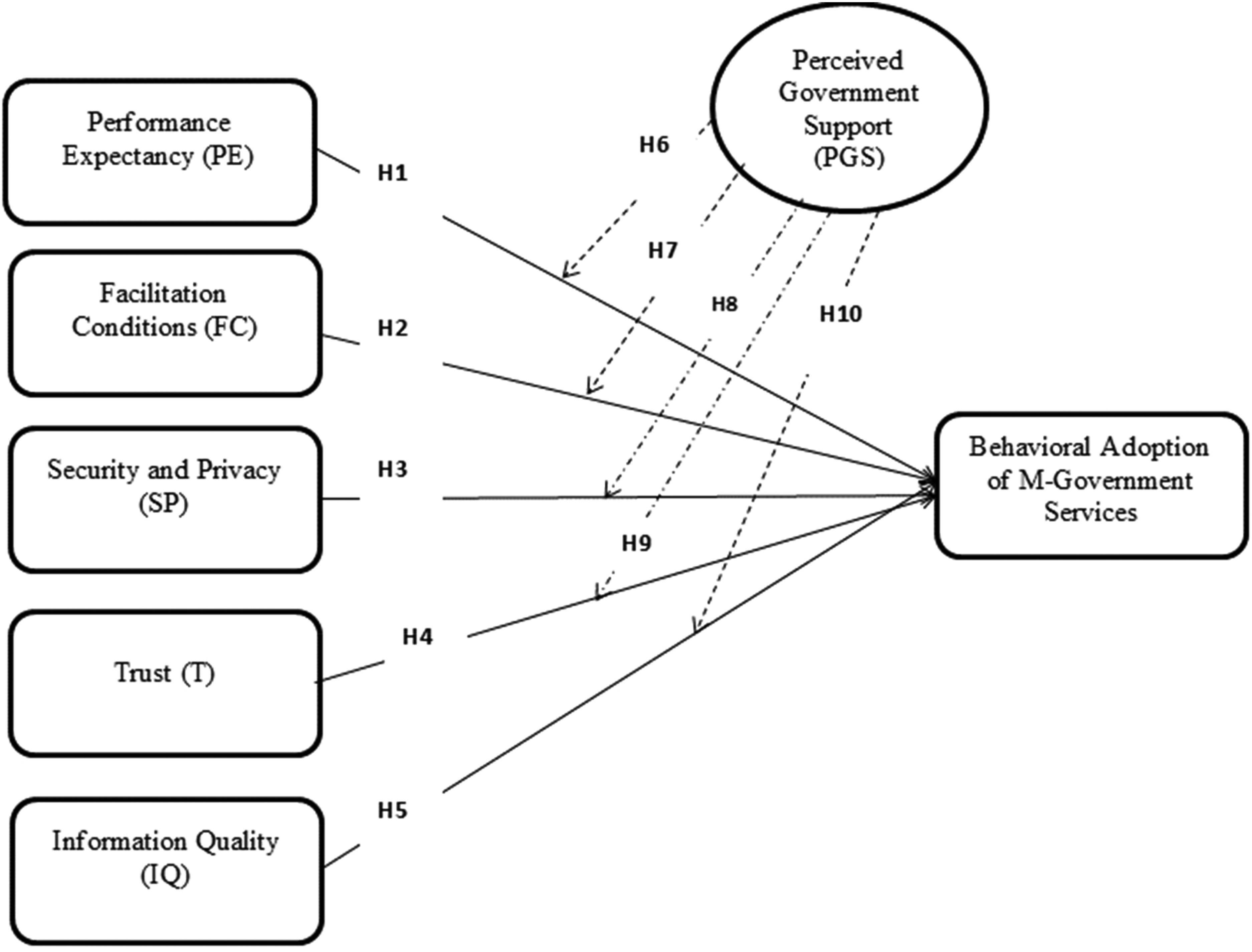
Research model.
Research methodology
A survey instrument was developed to enable the collection of the desired data to test the research hypothesis as well as the validation of the projected model of the paper. The survey was developed with constructs adapted from preceding research but was amended to mirror the perspective of the research work. They were taken from the following sources: performance expectancy, facilitation conditions and intention to use (Venkatesh et al., 2003; Venkatesh et al., 2012), security and privacy (Escobar-Rodríguez and Carvajal-Trujillo, 2014), trust (Gefen et al., 2003), information quality (Escobar-Rodríguez and Carvajal-Trujillo, 2014; Lee and Levy, 2014; Rasool and Warraich, 2018) and government support (Chong et al., 2010). The questionnaire instrument is attached as appendix A (both English and Chinese versions). The constructs were examined on a five-point Likert scale which ranged from 1 = Strong Disagree to 5 = Strongly Agree. The questionnaire was administered online to the university community (teachers, students, and non-teaching staff) of Jiangxi University of Science and Technology.
Before the organization of the research instrument, the survey was pre-tested and piloted to a cross-section of the expected population. This was undertaken to ensure that the inputs and concerns of the respondents are captured in the questionnaire and importantly to aid in reducing any ambiguity and confusion that they may have in answering the outlined questions. The piloting and pre-testing period is an opportunity for the researcher to determine the correctness of survey questions and hence can review questions for inclusion or exclusion based on the feedback from the respondents (Addington-Hall, 2007; Bowden et al., 2002). The feedback from the pre-testing and piloting was instrumental in improving the content of the research questionnaire and thus provided a good basis to elicit quality responses from the respondents. The instrument was put online for about two months for data collection and at end of the period, a total of 414 valid responses were received. The online questionnaire was designed in a way that respondents could not submit their questionnaire unless they complete all the sections outlined in the questionnaire. This thus contributed to eliminating non-responses or invalid responses.
The 414 valid responses received were used for the analysis. The analysis was undertaken with the assistance of SPSS and Smart PLS 3.0 by employing the (SEM) structural equation modeling method. SEM is considered one of the most widely used analytical tools over other methods due to its ability to manage the effect of measurement errors, greater flexibility for model specification, ensure an acceptable fit of the model to the data, and an array of more analytical options (Hayes et al., 2017; Tarka, 2018).
Data analysis
Respondents (profile)
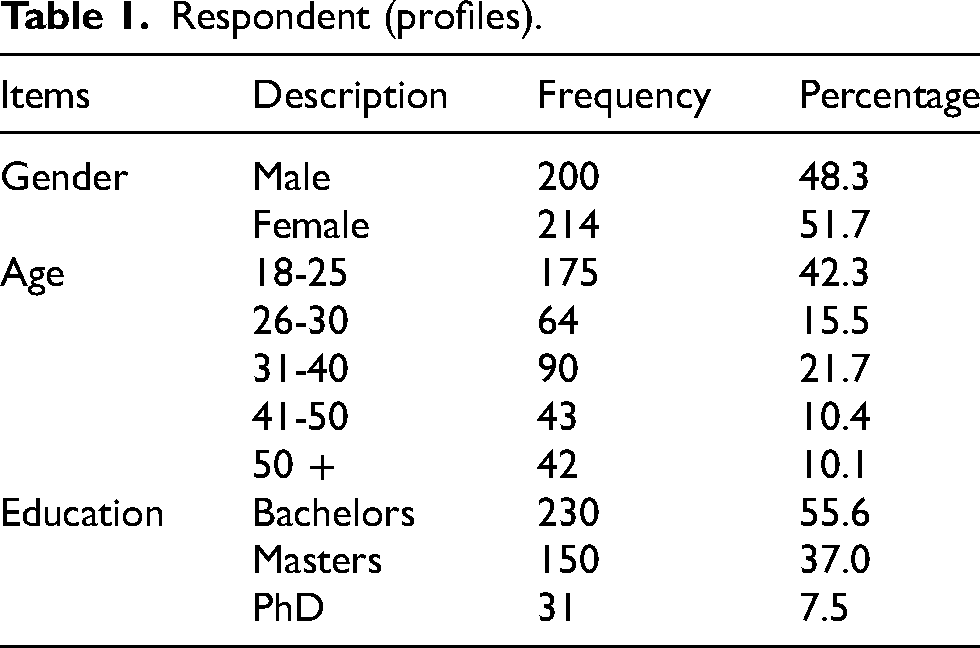
The respondents’ profiles are broken down in Table 1. The majority of the respondents were female (51.7%). About 42.3% of the respondents were between the ages of 18 to 25 years while the majority were undergraduate students.
Respondent (profiles).
Measurement model
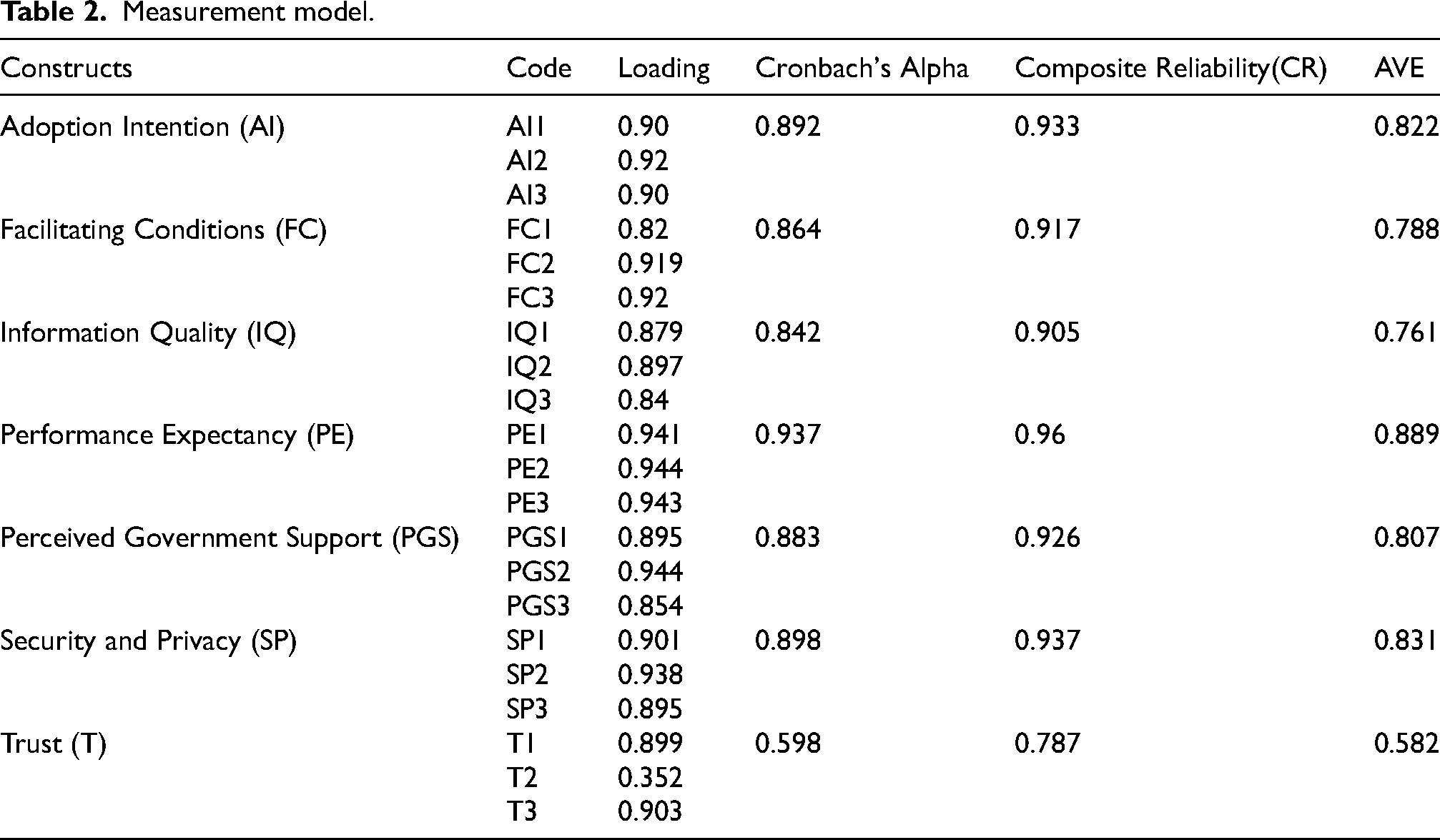
The outcomes of the measurement model are displayed in Table 1. They were assessed through the use of internal reliability, convergent and discriminate validity. The internal reliability has competed with Cronbach alpha and composite reliability which are recommended to be 0.70 for internal consistency to be achieved (Hair et al., 2017; Henseler et al., 2016). The convergent validity was evaluated by the application of average variance extracted (AVE) and item loadings which are recommended to be not less than 0.050 (Hair et al., 2012). The respective loadings for AVE, composite reliability, and Cronbach alpha are shown in Table 2 which meets the recommended standards and thus indicates that the parameters for determining the convergent validity have been achieved. Also, we tested the discriminate validity of the constructs. This was undertaken by evaluating the square root of AVE and the cross-loading matrix. The square of the AVE of the variable is required to be above its correlation with other constructs for a discriminant validity to occur. In addition, the diagonal sections should be greater than the corresponding values to satisfy the discriminant validity criteria (Fornell and Larcker, 1981). As indicated in Table 3, the outcomes have established that the constructs validate the discriminant validity of the data.
Measurement model.
Discriminant validity.
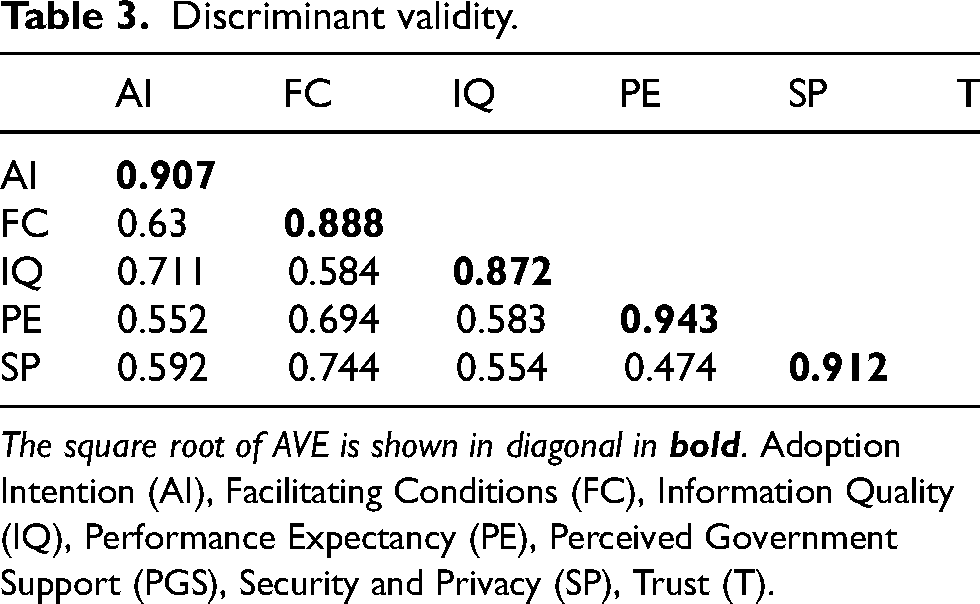
The square root of AVE is shown in diagonal in
Structural model
The research results are indicated in Table 4. Performance expectancy was not a significant predictor of the intention to use m-government services (β = 0.069, p > 0.05). H1 was therefore not supported. Additionally, facilitating conditions (β = 0.163, p < 0.05) and security and privacy (β = 0.142, p < 0.05) were found to be significant determinant of the acceptance to use respectively. Accordingly, H2 and H3 were supported. Also trust (β = 0.071, p < 0.05) and information quality (β = 0.459, p < 0.05) were also significant predictor of the intention to use m-government services. H4 and H5 were thus confirmed. In terms of the moderating impact analysis of perceived government support (PGS), it was found that perceived government support moderated significantly the effect of performance expectancy (β = 0.037, p < 0.05) and facilitation conditions (β = - 0.041, p < 0.05) on the adoption of m-government services. H6 and H7 were statistically supported. Furthermore, while perceived government support was not significant in moderating the impact of security and privacy on the adoption of m-government services (β = 0.087, p < 0.05), it was however significant in moderating the effect of trust (β = −0.017, p < 0.05) on the adoption of m-government. Consequently, H8 was not supported while H9 was supported. Finally, the results have revealed that perceived government does not moderate significantly the impact of information quality on the adoption of m-government services (β = −0.073, p < 0.05). H10 was thus not supported. The structural model (with results) is shown in Figure 2.
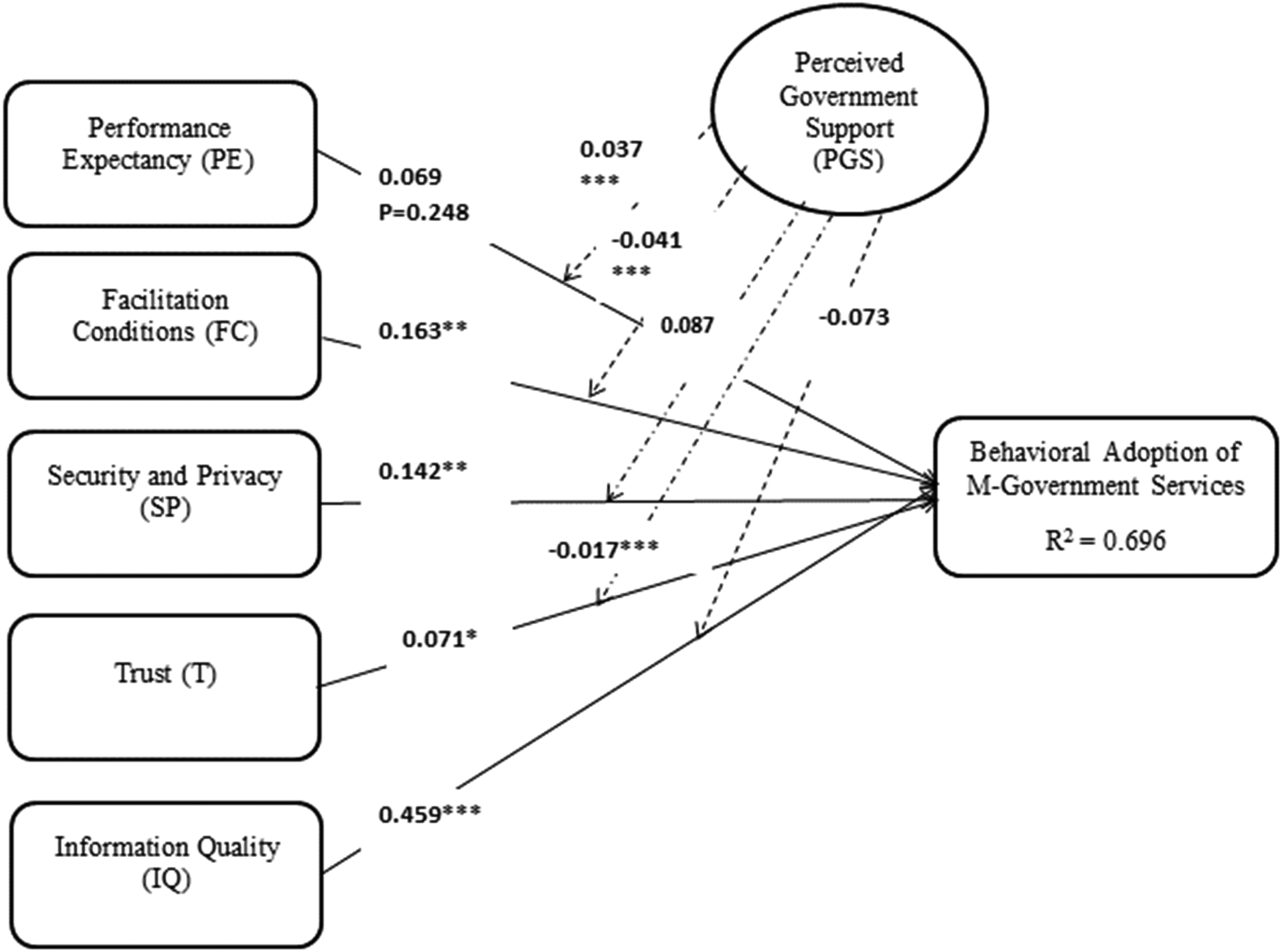
Results of validated research model.
Structural model (hypothesis).
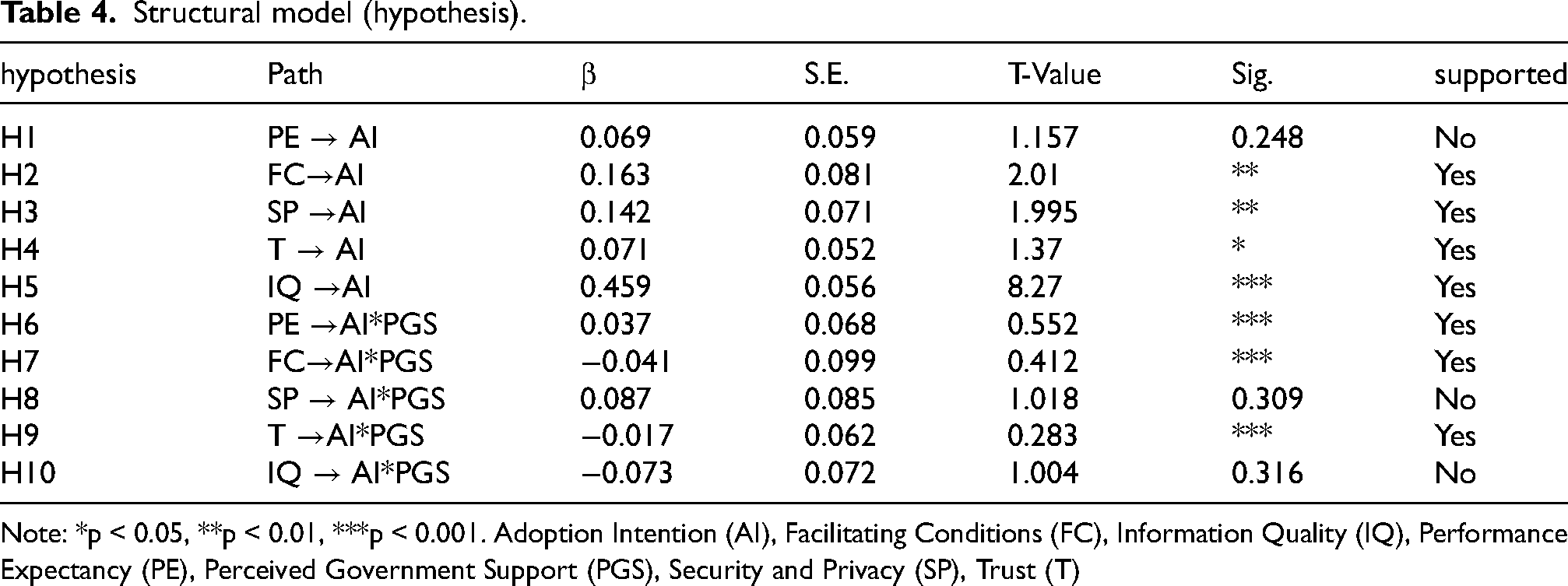
Note: *p < 0.05, **p < 0.01, ***p < 0.001. Adoption Intention (AI), Facilitating Conditions (FC), Information Quality (IQ), Performance Expectancy (PE), Perceived Government Support (PGS), Security and Privacy (SP), Trust (T)
Discussion
The adoption of mobile government is one of the criteria that determine the success, as well as the good return on investment on the huge financial and human capital governments, make into the development of m-government projects. This article examined the factors driving the use of m-government with a special focus on the essential role government support can play in influencing the adoption of services delivered through the empowered m-government environment. The analysis from the data captured has illustrated that with the direct relationship experimented, facilitation conditions, security and privacy, trust in m-government, and information quality showed a positive impact on the adoption of m-government. Conflicting to our held view, performance expectancy did not affect m-government services usage. But it supports research that showed that performance expectancy does not influence adoption (Mensah, 2019). This contradicts other research works that demonstrated that performance expectancy has a direct effect on the adoption of m-government systems (Almaiah and Nasereddin, 2020).
The significant effect of facilitating conditions on m-government services utilization is corroborated by past studies (Almaiah et al., 2020; Noor and Said, 2021) that have demonstrated that when there are available adequate conditions such as good broadband systems, technological infrastructure, cheap data bundle, etc. it can drive m-government services acceptance. This denotes that key stakeholders must be interested in creating the right environment for m-government utilization should be successful. Besides, the significant effect of security and privacy on m-government services acceptance is supported by other studies that have also demonstrated the same result findings (Almaiah et al., 2020; San et al., 2017). This means that addressing the security and privacy concerns of citizens while they engage in the mobile virtual space, especially in the development of m-government services encourages the adoption of m-government services.
Another finding that exhibited that trust in m-government is directly related to the adoption of m-government services is coherent with other research that highlighted that trust is instrumental and positively related to the acceptance of technology-focused services such as m-government (Almaiah et al., 2020; Liang et al., 2021; Shahzad et al., 2020). Trust is fundamental to the building of any successful relationship and particularly in the context of technology, trust is crucial since it creates a dependency of users towards technology usage (m-government). This trust built through the system user may impact the confidence of users towards the ability of the m-government system to deliver as promised. Hence, stakeholders should endeavor to build m-government services that can win the trust of citizens by providing services that correspond to the anticipations of populaces which may have a subsequent effect on the acceptance of m-government service.
Furthermore, the significant influence of information quality on the acceptance of m-government service agrees with previous research which demonstrated that information quality is directly related to adoption behavior (Talukder et al., 2019; Wang and Teo, 2020). This implies that adherence to the service quality magnitudes such as tangibility, reliability, responsiveness, assurance, and empathy in the scheme and implementation of m-government services can ultimately drive users to use m-government services. Also, the non-significant influence of performance expectancy on the adoption of the m-government service is a complete departure from studies that have shown that performance expectancy has a direct significant effect on m-government adoption behavior (Talukder et al., 2020; San et al., 2017). But it does support other studies that have reported similar findings that performance expectancy does not influence technology applications (m-government) (Olasina and Mutula, 2015). The non-significant impact of performance expectancy on the adoption of m-government services in this study could be due to the over familiarization of the sample population with m-technology trends and thus may underestimate the added advantages and benefits that may arise from m-government services utilization.
Additionally, in terms of the moderating effect of perceived government support on the adoption of m-government services, the analysis has shown that perceived government was significant in influencing (moderating) the impact of performance expectancy, facilitation conditions, and trust on the adoption of mobile government services. On the other hand, perceived government support failed to moderate significantly the effect of security and privacy and information quality on the adoption of m-government services. These results (moderating impact of perceived government support) are unique contributions to the literature on m-government and thus could not be compared with other studies.
The significant moderating impact of perceived government support on the effect of these constructs (performance expectancy, facilitating conditions, and trust) on the adoption of m-government services does demonstrate the unique role and centrality of government when it comes to the development and diffusion of m-government. It thus means that for m-government to be successful government commitment and support to drive the implementation of m-government projects cannot be overlooked or underestimated. Governments make and initiate policy decisions as well as the needed laws and regulations to guide the implementation of any public policy programs of which m-government is one. Furthermore, the moderating role of government support also comprises all possible government actions which have the propensity to strengthen the role of the given constructs to tilt citizens’ behavior to adopt a particular policy - in this case, m-government initiative. These actions are not limited to policy initiatives, legal and regulatory frameworks but also the provision of infrastructure and the attempt to improve the purchasing power of citizens, etc. therefore, as per this study, the government perceived support for the successful m-government implementation is crucial.
Theoretical implications
Theoretically, the paper has contributed to the m-government adoption literature by specifically establishing through the UTAUT model, the constructs (performance expectancy, facilitating conditions, security and privacy, trust, and information quality) examined accounted for 69.6% of the factors inducing the acceptance of the m-government service. The major research contribution of this research is the testing of moderating effect of perceived government service on the impact of these factors (performance expectancy, facilitating conditions, security and privacy, trust, and information quality) on m-government services acceptance.
Managerial implications
The direct significant influence of facilitation conditions on the acceptance of m-government services has implications for the implementation of m-government initiatives. Government and key players who are critical in the scheme and execution of m-government services ought to pay attention to the extent of facilities and infrastructure that can propel the citizen interest in m-government services usage. Facilities and infrastructure such as good internet conditions, provision of quality broadband connection, free WIFI hotspots for easy access and download, cheaper mobile handsets and technology, and low costs of mobile bundle data will be instrumental in encouraging the uptake of m-government services.
Furthermore, the security and privacy concerns should be integrated into the strategy and execution of m-government services since citizens are much concerned about how the information and data they provided as they use m-government services are protected from any unauthorized use. Protection of security and privacy aspects of m-government services should be a top priority and thus should encourage the development of proper regulations to regulate the exchange and sharing of information and data across m-government systems. When citizens are confident that their information is secured and protected from any abuse by other third parties, then they will repost their trust and confidence in m-government systems that will result in higher uptake of m-government services.
Another important practical implication is the concern of trust in the implementation of m-government projects since we have demonstrated through the analysis that trust drives the adoption of m-government services. M-government builds important connections and interaction between government and citizens and therefore trust is necessary to strengthen the interaction generated through the virtual environment of m-government. The actions and policy directions of government and policymakers should be geared towards increasing the trust of citizens in m-government technology. People should have the conviction that state institutions and organizations would use m-government technology to deliver better public service as promised. Once the trust is solidified through the services provided, it will augment the superiority of the interaction between state organizations and citizens which will ultimately drive m-government services acceptance.
Also, information quality has practical implications for the scheme and promotion of m-government structures since it can drive the use of m-government services. Information quality is key to the implementation of m-government projects since it demonstrates how m-government systems can present information in such a manner that it becomes an asset and facilitate the better delivery of services. For the information quality of m-government services to be considered as top-notch the information provided should be good, useful, current, and accurate. The information quality of m-government should be designed to meet government and IT standards in terms of information accessibility, accuracy, objectivity, believability, reputation, security, availability, interpretability, ease of comprehension, conciseness, and constituency. Meeting these quality dimensions of information quality will drive m-government use.
Furthermore, the positive significant moderating effect of perceived government support on the effect of performance expectancy on the adoption of m-government services has strong managerial implications for m-government policymakers. Government support is inevitable in the strategy and execution of m-government services and thus government policies can contribute to enhancing the benefits that will accrue to citizens when they use m-government systems. Policies and laws initiated by the government will ensure maximum protection of citizens who engage in the virtual m-government arena against any form of online fraud, imposter, and misuse of personal and transaction information.
Again, the confirmed positive moderating impact of perceived government support on the influence of facilitation conditions on the acceptance of the m-government service demonstrates the role that government support can contribute to driving the indirect adoption of m-government services through facilitation conditions. The provision of adequate resources both financial and human through the dedicated government systems and support can impact positively the nature and kind of conditions that will drive the adoption of m-government. Government support that will ensure that there is enough budgetary and monetary allocation for m-government projects can instigate the acquisition of technology and IT infrastructure that will propel the development of m-government systems. This will positively drive the availability of the right environmental conditions that will boost m-government services acceptance.
Finally, the study has demonstrated that perceived government support is a positive contributor to understanding and influencing the effect of trust on m-government services acceptance. Adequate support from the government and its relevant agencies towards the advancement and execution of m-government projects tends to sway the trust and confidence of citizens towards the ability of m-government systems to deliver quality and efficient services as promised.
Conclusion
Governments the world over are picking on the momentum of e-government to initiate m-government. Mostly the policy of m-government is quickly initiated but the implementation process is left to chance. These initiatives most of the time fail. This is because policymakers and implementers leave crucial elements out and take the implementation processes for granted. Accordingly, this study addressed this concern by developing a framework that sought to emphasize the crucial role government support plays in the implementation process as well as m-government acceptance. Thus, the role of government is not an event of enacting policy only but also supporting the policy in various ways to see the success of the policy. As evident, the findings supported the view that government continuous action to boost performance expectancy, facilitating conditions, and trust has an enormous impact in changing the behavior of citizens to adopt m-government ultimately leading to the long-term success of m-government.
Further, a practical contribution is the fact that the study draws attention to the crucial role government needs to play in the implementation process and the essential features to consider when designing an m-government initiative. The need for the government's constant support for the implementation process is accentuated by the positive and significant impact perceived government support has in contributing to the predictive powers of performance expectancy, facilitating conditions, security and privacy, and trust on m-government services acceptance. Additionally, the concept of m-government development rests solely on the doorsteps of the government, which has all the necessary state machinery and power to translate the vision and goals of e-government via mobile government into reality. Due to the powerful nature of m-government which grants full access to citizens and the general public of government and its operations, some governments may display a lack of interest wholeheartedly owing to the fear that citizens may be empowered to fight (misuse of public funds and corruption, demand for openness and accountability, etc.) the government. Governments need to overcome this fear and stop the inadequate budgetary allocations to oversee the development and diffusion of m-government systems. Rather government should make a massive investment in technological infrastructure development to drive the upward development and promote the utilization of m-government systems both within public sector agencies and for citizens who are active stakeholders in the m-government architecture. With the right mechanisms, governments can facilitate technology (m-government) development and deployment efficiently and effectively to attain public good outcomes. The following suggestions are made to encourage and strengthen government intervention and support toward m-government development and diffusion: The government should;
Liaise with donor partners to secure adequate funding for technological infrastructure investment and m-government development. Take deliberate adequate commitment and action to influence resource allocation to facilitate technology development and commercialization. Institute well-designed institutional structures to support m-government innovations Design proper regulatory framework to guide the development and diffusion of m-government systems. Come up with innovation or technology policy to influence uniform ICT/mobile technology adoption standards and development in public sector agencies. Provide FREE Wi-Fi and broadband hotspot systems to facilitate people's access to m-government. Coordinate, partner, and collaborate with the private sector to drive the innovations in m-government development. Design and implement policy to drive market mechanisms that facilitate m-government deployment. Devise economic systems that will lead to a reduction in the cost of mobile data and handsets. Promote and ensure adequate funding for research and development (R&D) to deal with the imperfections in the development and deployment of m-government innovations.
Limitation and future study
The perception that citizens may have towards government and thus the anticipated government support may differ. This means that support from the government is not the same across different countries and may give divergent results when applied in other contexts. Secondly, the data used may not be representative of the population sampled, and thus in the interpretation and generalization of the study care should be exercised. In addition, the methods and models applied in this study do not necessarily generate the same results in different conditions and environments.
Footnotes
Declaration of Conflicting Interests
The author(s) declared no potential conflicts of interest with respect to the research, authorship, and/or publication of this article.
Funding
The author(s) received no financial support for the research, authorship, and/or publication of this article.

Appendix A: Questionnaire Constructs
PE1: I think m-government is simple and easy to access
PE2: I believe m-government is clear and comprehensible
PE3: I think m-government is useful as compared to the traditional government services
FC1: I think I have all the request apparatus to use m-government
FC2: I believe I possess the mobile skills required to use m-government
FC3: Overall, I think there is available both technical and managerial support for me to use m-government.
SP1: I think m-government is secure enough for electronic transactions
SP2: I believe that the m-government will guard and keep my personal and transactional data safe
SP3: Overall, I think m-government has adequate security and privacy setting that prevents third-party breach.
T1: I believe that m-government can be trusted
T2: I think m-government delivers as promised.
T3: I believe m-government environment is dependable online interaction
IQ1: I believe m-government gives accurate information
IQ2: I think m-government is easier to browse and offers comprehensive information
IQ3: I believe that m-government offers timely and updated services information
PGS1: I believe that the government has good policies that drive the interest in m-government
PGS2: I think the government has put in place the right mechanism to promote the development of m-government
PGS3: I believe that financial and legislation backing from the government is essential for m-government success.
BA1: I think I will use m-government
BA2: I will use m-government in the future
BA2: I will introduce m-government to my friends and family to use.
PE1:我认为移动政务简单且易于访问。
PE2: 我认为移动政务清晰且易于理解。
PE3: 我认为相比于传统政务服务,移动政务更有用。
便利条件(FC)
FC1: 我认为我有硬件条件去使用移动政务。
FC2: 我认为我具备能力去使用移动政务
FC3: 总体而言,我认为技术层面和管理层面都支持我使用移动政务。
安全和隐私(SP)
SP1: 我认为移动政务是安全的,可以进行电子交易。
SP2: 我认为移动政务可以保护我的个人数据和交易数据安全。
SP3: 总体而言,我认为移动政务有足够的安全和隐私保障措施,可以防止第三方泄露。
信任(T)
T1: 我认为移动政务可以被信任。
T2: 我认为移动政务兑现了承诺。
T3: 我认为移动政务的环境是可靠的在线互动。
信息质量(IQ)
IQ1: 我认为移动政务提供了准确的信息。
IQ2: 我认为移动政务易于浏览,且提供了全面的信息。
IQ3: 我认为移动政务提供了及时更新的服务信息。
感知政务支持(PGS)
PGS1: 我认为政府制定了良好政策鼓励我使用移动政务。
PGS2: 我认为政府建立了正确机制促进移动政务的发展。
PGS3: 我认为政府财政和立法支持是移动政务的关键成功因素。
行为采纳(BA)
BA1: 我会使用移动政务。
BA2: 我将来会使用移动政务。