



Abstract
Library and information science (LIS) education in Pakistan requires students to undergo in-depth supervised practicum placement as part of the course requirements. The purpose of this study was to explore the supervision styles of LIS practicum supervisors, and to examine how these supervision styles are perceived by the practicum students. Forty-three semi-structured in-depth interviews were conducted with practising librarians (n = 21) who supervise practicums in their respective libraries, and LIS students (n = 22) who had completed their practicums. Data were collected across 13 higher education LIS institutions in Pakistan. Constructivist Grounded theory was used as a method of data collection and analysis. Findings revealed four distinct styles of practicum supervision: (1) directed, (2) developmental, (3) independent, and (4) reflective. While LIS practicum supervisors practise a combination of these supervision styles, one style was found dominant among others. Also discovered was a mismatch of supervision style preferences between supervisors and students, which can negatively impact the promotion of learning and consequent development of professionally competent graduate librarians. Findings of this study warrant the need for more research to explore impacts of supervision on professional practice.
Keywords
Introduction
The importance of Experiential Learning Programmes (ELPs) such as an internship, practicum, fieldwork, or a placement can be drawn from the history of Library and Information Science (LIS) education. Melvil Dewey (American librarian and educator, inventor of the Dewey Decimal system of library classification, 1851–1931) first spoke of learning through practice and recommended guided-supervised work (fieldwork/placement) as part of library education in 1879 (de Súmar and Talavera Ibarra 2011). Now ELPs (collectively referred to internships, fieldworks, placements, apprenticeships) are widely conducted in LIS education around the globe (Južnič and Pymm 2016). During an ELP, students work with an experienced professional who extends on the teaching from the students’ university coursework. It is widely considered that the professionally supervised library experience offered as part of the library school's ELP is as beneficial to student learning as university coursework itself (Khan 2021). The student earns the grade, and the library school oversees administration of the placement, but it is the site supervisor who guides the student and supervises the learning process (Brannon 2015).
Research substantiates that supervision of experiential learning (EL) influences students’ experience, learning, and professional competence (Ibrahim 2013). In other disciplines such as education, medical science, and social work, supervision of ELPs is a well-researched topic. Non-LIS literature puts significant emphasis on supervision of ELPs and there is an abundance of literature on supervision styles in non-LIS disciplines (Ghazali et al., 2015; Khan 2021). However, several authors argued that the definitions of supervision style have not been consistent (Johnston (Johnston 2006). Ambiguity and lack of precise definition of supervision style threatens its utility across disciplines, particularly when it comes to interpret results of the prior studies. Nevertheless, supervision style is a diverse concept and built primarily on the purpose and objectives of supervision (Peetoom and Nuttgens 2019). This study focuses on the supervision style in context of ELPs such as fieldworks, practicums, internships, and placements in the LIS field. Supervision of EL is usually linked with the teaching and training component and therefore, Friedlander and Ward’s (1984) definition of supervision style as “a distinctive manner of approaching and responding to trainees and of implementing supervision” (p. 541) appears to be relevant to this study.
LIS literature shows that student learning is highly influenced by the degree and quality of the supervisory sessions undertaken in ELPs (Ladany, Mori, and Mehr 2013). The value of EL, for both students and supervisors, is widely acknowledged in LIS literature. Despite abundant research on ELPs in LIS, there is a paucity of research on its supervision. Empirically, there is hardly any study that understands or informs the supervision styles that facilitate library students’ learning and professional competence during ELPs. Due to this dearth of literature, it is not clear how ELPs are being supervised by the supervisors, and what supervision methods and techniques are being practiced in the field of LIS. Moreover, a large body of LIS literature on EL is lacking especially in research concerning the site supervisors’ perspectives (Khan and Qayyum 2019). Though not explicitly, many studies in the LIS literature such as (Ferrer-Vinent and Sobel 2011; Lavy and Rashkovits 2019; Pacios 2013; Raszewski and Peterson 2020) stressed the need to explore supervision methods and supervisors’ perspectives on how supervision takes place during ELPs within LIS field.
Literature also shows that due to the absence of a theoretical understanding, supervisors may be ill informed about the supervision styles to be used and/or as are preferred by students that promote learning and professional competence. Moreover, literature shows that because of a lack of supervisory skills, supervisors tend to espouse their own methods and techniques based on their awareness and beliefs (Khan and Qayyum 2019). Individual supervision techniques adopted by a supervisor leads to two main problems: supervisors remain uninformed of the supervision style preferred by the students; and students find themselves struggling to cope with issues arising due to inconsistency in supervision styles of their supervisors. Furthermore, commentators agree there is a need to explore supervision styles to inform supervisory practice so that supervisors adopt evidence-based practices that facilitate student learning and professional competence (Raszewski et al., 2012).
The knowledge gaps identified above have been addressed in this current study. The purpose is to identify and explain the different supervision styles based on the understanding and experiences of students and educators working in the LIS sector. The study setting and context are situated in Pakistan as explained in the methodology section below. Key objective of this study is to explore and identify the ELP supervision styles in Pakistani LIS community by interviewing students and experienced supervisors. This study attempts to answer a broad research question: What are the supervision styles of supervisors practiced in ELPs as perceived and experienced by supervisors and students? Specifically, the study looks at different approaches that ELP supervisors use to supervise students in the field of LIS. Moreover, the study also mapped any possible mismatches existing between the perceptions of students and supervisor regarding ELP supervision, and the implications of these mismatches are outlined so that supervisors can recognise and eliminate them.
Review of literature on EL supervision style in various professions
The concept of supervision and supervision style has been widely studied in management science, social work, education, and medical science (Hawkins and Shohet 2012). These two authors conclude that while the concept of supervision itself has been widely researched, the term supervision style is viewed differently by different professions depending on contexts, goals, requirements, and objectives of supervision. For example, supervision style in the fields of management science and social work is administrative in nature, and relates to employee performance appraisal, supporting goal setting, and providing feedback (Peetoom and Nuttgens 2019). In education, supervision styles are connected with the conversations between experienced teacher (supervisor) and the student teacher. Ibrahim (2013) reported on five supervision styles: telling, coaching, guiding, inquiry, and reflecting, that are mainly concerned with how supervisor tend to influence student by suggesting areas of improvement. The counselling literature talks about interpersonally-sensitive and task-oriented styles and focuses more on teaching, supporting, and delegating aspects of supervision (Ladany and Bradley 2001). Holistically, the latter style is a “distinctive manner of approaching and responding to trainees and of implementing supervision” (Shaffer and Friedlander 2017, p. 167).
From the other disciplines, several discipline-specific supervision models have been proposed based on different theories of supervision such as social role models, developmental models, and integrative models (e.g. Bordin 1983; Holloway 1995; Ladany and Bradley 2001; Littrell, Lee-Borden, and Lorenz 1976; Loganbill, Hardy, and Delworth 1982; Stoltenberg and McNeill 2012). Discipline-specific models emphasise roles and functions of supervisors who supervise learning activities of students. For example, ‘Social role models’ assume that the supervisee has the resources for personal and professional growth and the supervisor should work collaboratively with the supervisee to impart knowledge and skills (Basa 2017). ‘Developmental models’ are based on the assumption that the process of supervision changes according to the developmental stages of the supervisee, thus, different supervision skills and techniques are required in different stages (Lambie and Sias 2009). ‘Integrative models’ suggest that there are infinite number of “integrations” possible within supervision because of the existence of a large number of theories and methods of supervision (Bernard and Goodyear 2004).
Another model is the Discrimination model, which is comprised of three separate foci for supervision (i.e. intervention, conceptualisation, and personalisation) and three possible supervisor roles (i.e. teacher, counsellor, and consultant). The supervisor may take on the role of teacher while focusing on a specific intervention used by the supervisee in the client session or assume the role of counsellor while focusing on the supervisee's conceptualisation of the work. Because the response is always specific to the supervisee's needs, supervision style changes within and across sessions. Similarly, the System Approach Model (Holloway 1995) describes seven dimensions of supervision: the functions of supervision, the tasks of supervision, the client, the trainee, the supervisor, the institution, and their relationship. The functions and tasks of supervision are at the foreground of interaction in this model, while the latter four dimensions represent unique contextual factors that are, according to Holloway, covert influences in the supervisory process. In this model supervision is seen to be reflective of a unique combination of these seven dimensions.
These traditional supervision models (social, developmental, integrative models) do not directly align with the specialised work of librarianship that ELP supervisors undertake with their students during their placements. For instance, existing models of supervision do not include supervision styles that focus on the diverse roles and tasks required of information professionals, such as, information seeking, information management, organisation of recorded knowledge, reference and user services, information architecture, sources, and products. Premise of this study is that discipline specific issues inherent to students’ placements in libraries have an influence on supervision style and needs to be explored holistically to understand supervision styles of ELP supervisors in libraries.
While supervision styles in other professions offer some insights, which may be considered in the LIS settings, the duration, activities, scope, and purpose of ELPs in LIS are largely different from other fields. Moreover, LIS profession has unique connotations of the professional requirement, which is the key influencing factor and motivation behind this current study. Currently in LIS, supervisors deploy various techniques in different contexts as is necessitated by the scope and objective of work, such as teaching, training, professional development, and integration of students into the workplace during supervision of ELPs (Khan and Qayyum 2019). As early as the 1980s, studies from the United States and the United Kingdom “illustrated that a supervisor's approach differs because of the variation in methods and techniques that a supervisor adopts in different settings” (Khan and Qayyum 2019, p. 4).
A comprehensive review of literature shows that there is limited information available on different styles that LIS supervisors use to supervise students. Research in LIS has also highlighted the need to examine ELP supervisors’ perspectives to promote learning and professional competence of students. For example, recent studies conducted by Brannon (2014) and Bird, Chu, and Oguz (2016) considered the perspectives of the practicum and internship supervisors. Brannon (2014) focused on the assessment and evaluation techniques used by the supervisors while Bird, Chu, and Oguz (2016) focused on the benefits that practitioners gain (who engage in fieldwork within libraries) to renew their skills and reconnect current theoretical approaches. However, these studies had little discussion on the supervision styles of supervisors when supervising LIS students, and did not provide much information on the preferred supervision style of LIS students.
Overall, LIS literature does not discuss supervision styles specifically (Khan and Qayyum 2019). Furthermore, LIS schools generally do not train practitioners (who engage in EL) in those supervision methods or styles that may facilitate learning and professional competence of LIS students, or teach them about the kinds of experiences students need to make learning experiences worthwhile. Hence the ‘sink or swim’ analogy prevails whereby supervisors must succeed through their own efforts or fail completely when supervising LIS students. Inevitably, over time, supervisors gain experience with supervision through trial and error while supervising students (Khan and Qayyum 2019). However, the absence of evidence-based supervision practice leaves supervisors unclear of the impact of their supervision, and they potentially engage in a range of supervision styles that may not be effective in promoting learning and professional competence of LIS students. This style variance has implications for the quality of learning that students may have during the EL programme. Therefore, the current research is significant as it identifies not only the prevailing supervision styles of the LIS supervisors but also the preferred ones. These supervision styles are practiced by LIS professionals and perceived as useful for learning by the LIS students.
As has been discussed above, there are no existing theories, frameworks or models in the field of LIS to draw from for this study. Therefore, the researchers studied models in other disciplines and framed the purpose and objectives of this study accordingly to derive a new set of style recommendations that ELP supervisors in LIS can draw from to inform their practice.
The study methodology
Constructivist grounded theory (CGT) methodology (Charmaz 2014) was employed to collect and analyse data gathered from 43 participants comprising of librarians (n = 21) and LIS students (n = 22) about their understanding and experiences during supervised placement. Grounded theory (GT) methodology suited this study because the researchers aimed to develop an understanding of the basic social processes (Birks and Mills 2015) of supervision styles during experiential learning programmes in libraries and information centres. Note that due to the limitations of the study (described at the end of this research paper) and the comparatively narrow context of the study, the researchers have no plans to derive a theory from the findings. Only the GT methodology is being used here as it is very relevant and suited to gather and analyse this type of data set.
Constructivist grounded theory aligns well with a constructivist theoretical perspective whereby knowledge is seen as a human construction and that multiple realities are constructed. A constructivist viewpoint realises that experiences do not hold meaning; rather, it is the interpretation of these experiences that provides meaning for individuals (Bryant and Charmaz 2019). Therefore, adapting a constructivist style of analysis was well suited for this study as the emphasis was on the importance of perspectives of supervisors and LIS students. Moreover, it is their experiences and realities that were explored, and the study endeavoured to develop and construct an understanding of supervision styles.
Participants
After gaining approval of the university's human research ethics committee approval, recruitment of participants commenced. This recruitment took place using purposeful theoretical sampling whereby participants were selected according to their suitability to provide knowledge of the research problem (Charmaz 2014). LIS professionals and students were the best informants for this research as it was their understanding and experiences of supervision styles that this study planned to explore. A general invitation for participation in the research study was shared on the largest listserv of LIS professionals (www.paklag.org) in Pakistan. The first sample comprised 3 LIS professionals who met the eligibility criteria and provided consent to participate in the study. The eligibility criteria were that they should have at least five years of work experience in a library and had supervised at least two ELPs within the last two years. An invitation for students to participate in the research study was displayed on multiple LIS school's notice boards across Pakistan, with the permission of the heads of departments. Eligibility criteria for students to participate in the study required them to be currently enrolled in an accredited LIS programme and they needed to have completed their placement within the last six months. The first set of 3 participants was selected on first come first serve basis.
Data collection
Data were gathered in two separate but interrelated phases to “bring an open mind to what is happening” as recommended by Charmaz (2014, p. 3). An initial proof-of-concept (PoC) phase (Howren et al., 2018; Silva, Moeckel, and Clifton 2020) was conducted to sensitise the researchers to the broader context of supervision of ELPs in the LIS setting. The PoC technique aligns with an essential element of all grounded theory studies whereby data is collected and analysed concurrently (Birks and Mills 2015). Such a concurrent activity allows for an ongoing refinement of the data collection instrument (which in this study was the refinement of the interview protocol as outlined below).
Three librarians and three LIS students participated in the PoC phase. The purpose of this PoC study was to discuss concerns of ELP supervisors and students, and to prepare themes to be explored in the main study. In the PoC phase a general discussion took place with the participants around the questions:
What is happening in ELPs in libraries? How supervisors and students interact with each other? And, What the participants feel important about supervision activities?
Discussion from the PoC phase was analysed and used to prepare interview protocol for data collection and analysis in the second phase of the study.
Analysis of the transcripts from the PoC phase was done using a content analysis technique and no grounded theory methodology was applied at this stage. Data revealed that the main concerns of the participants were modes of instruction, method and technique of supporting students’ work and learning, the feedback processes, and task follow-ups. Besides, one of the important issues that the participants discussed was the level of freedom and control that supervisors believe should exist in the supervision process. In light of these findings, necessary adjustments and question refinements were made to the interview protocol before going into phase two. For example, the interview protocol for phase 2 was redesigned to elicit detailed discussion around participants’ understanding and experiences around the issues relevant to modes of instructions, task follow-up, student support and learning, and freedom and control mechanism.
In the second phase, 21 LIS professionals and 22 students participated in face-to-face, semi-structured interviews. All participants were asked about how and what they experienced about the styles of supervision during experiential learning programmes. For example, LIS professionals were asked questions such as “how do you engage in supervising students?” and “Tell me about how supervision takes place during experiential learning programs?” Whereas, students were asked questions such as “Tell me about your experiences of interaction with your supervisor” and “Could you share your experiences about supervision process during the placement?”.
Informed consent was obtained from the participants before conducting the interviews as per ethics requirements. Interviews were audio recorded and transcribed verbatim. Transcribed interviews and the researchers’ reflective memos were analysed using computer-assisted qualitative data analysis software (NVivo pro version 12). Semi-structured interviews allowed the interviewer to conduct subsequent interviews that had been guided by previous interviews by changing the direction of the questions or by probing (Ayres 2008). Interview transcripts were emailed to participants to review and to check for errors, confirmation of the context and meaning (member-checking), and to provide their feedback (Creswell 2017).
Data analysis
Three phases of coding (initial, focused, and theoretical coding) as are aligned with the constructivist grounded theory (Charmaz 2014) were implemented to analyse the interview transcripts. Data from supervisors and students were analysed separately because there was a slight difference in the focus of each data set. The focus of data collection from librarian was to identify their supervision styles, and the focus of data collection from students was to identify the supervision style they preferred. Findings from both data sets, however, were compared to derive the most preferred supervision styles.
During the initial coding stage, analysis was concerned with identifying, categorising, naming and describing important concepts found in the text. Every segment of the text was read to answer the question, “What is this data a study of?” (Charmaz, 2014, p. 407). Transcripts were scanned line-by-line, concepts were identified and coded. NVivo 12 pro software was used to organise and maintain the complex and growing coding system. All codes were grouped in an NVivo folder (called a Node) for further analysis to address the study's research questions. This process included scanning the codes, reading through the data carefully, and highlighting important instances where participants talked about how they experienced the process of supervision during ELPs. Initial coding of transcripts yielded 273 codes.
During the second phase of coding, called focused coding, relationships between codes were identified to form distinct categories and properties of these categories. During this process, the set of 273 codes were merged together and categories were developed on the basis of similarities and differences. Consideration was given to the phenomenon (a concept of interest e.g. strict monitoring, using parameters), causal conditions (e.g. what causes similar categories to merge), and consequences (e.g. outcome of the causal condition) (Corbin and Strauss 2015).
In the third phase of coding, called theoretical coding, relationships between the emergent categories were derived to form core categories. This third phase is an advanced level of coding that leads to theoretical integration (Charmaz 2014). Initially, the emergent categories from the first two stages of coding were compared with each other for similarities and then with the existing literature on supervision from other fields of study. This constant comparison process resulted in combining, merging and dropping of the categories to consolidate the findings. Finally, this analysis resulted in four core categories that described the supervision styles: 1) directed, 2) independent, 3) progressive, and 4) participatory.
Quality of the data analysis was determined in a number of ways. First, the interview protocol was authentically created via the initial PoC study. Second, quality of data was ensured through member-checking of interview transcripts (Birt et al., 2016). Third, code-recode and peer examination strategy was adopted to validate categories emerged from the data analysis (Phillips et al., 2019). Fourth, the peer debriefing technique was used to plan ahead when designing a study to include variations on the topic (Janesick, 2015). Together, these strategies guarded against researcher bias and ensured that the findings authentically reflected the participants’ experiences (Corbin and Strauss 2015).
Findings and discussion
Participants of this study discussed different methods and techniques used by supervisors in various settings to supervise students. Using CGT constant comparison methods, the primary categories identified by the participants’ discussion yielded 8 distinct supervisory techniques: structured, controlled, developmental, indirect, reflective, autonomous, collaborative, and observational. In the discussion to follow here around these techniques and the formation of supervision styles, first these techniques will be explained briefly to set the ground for explicating supervision styles emerged in this study. After that, supervision styles will be elaborated using verbatim excerpts from interview transcripts as representative quotes from supervisors (denoted by “Sup”) and LIS students (denoted by “Std”). Lastly, the implications of the mismatch in preferences between supervisor and student, regarding supervision styles, will be discussed.
Supervision techniques in ELPs
Discussion with research participants revealed that, during ELPs, supervisors use different methods to supervise students. For example, some said supervisors consider the need for highly structured experiences while others preferred more collaborative approach to supervise students. Elaborating on different methods and techniques, participants talked about overall environment, level of autonomy, monitoring techniques and other aspects. These aspects together contributed to identifying several techniques that supervisors use to supervise students. Table 1 summarises the supervisory techniques that was derived from the data analysis, which led to formation of distinct supervision styles.
Different supervision techniques experienced by the participants.
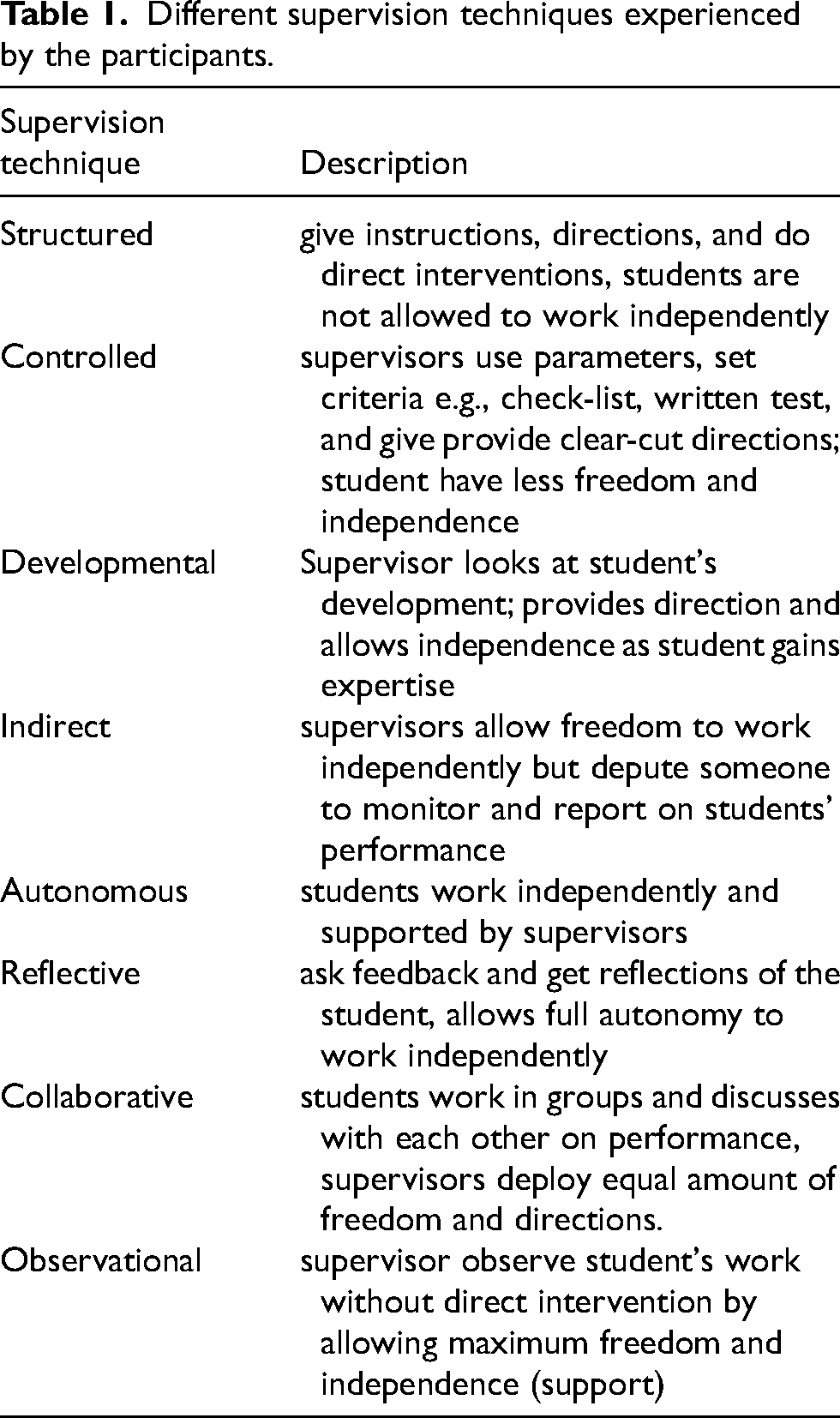
Among the participants, some supervisors believed in a structured approach to supervising students. For example, they followed a controlled environment, offered less freedom for students to work independently, and implemented a strict monitoring technique, which denoted a structured approach to supervision. Other supervisors believed in applying a stricter criterion, such as using parameters to observe students’ progresses, developing check-list to assess tasks and conducting tests during the ELPs. Opposite to structured approach to supervision, participants indicated that some supervisors believed in a more open environment allowing freedom to students to work independently.
Based on the data collected from participants, the different techniques stated in Table 1 were further drilled down till four distinct supervision styles emerged: 1) directed, 2) independent, 3) progressive, and 4) participatory style, which currently prevail in the ELPs within LIS field.
Directed supervision style
Directed style of supervision is characterised by a highly structured and controlled approach to supervision. Data analysis revealed that in a directed approach, the supervisor believed in giving frequent instructions, used parameters, and followed predefined criterion e.g., checklists and written tests to follow up with the students’ progresses. Supervisors provided clear-cut directions for students on what to do and what not to do in the role of a librarian. The supervisor also used a prescriptive technique and complied with strict rules and regulations. For example, one supervisor stated, “I used to follow up with them [students] by monitoring the work directly and worked in a precise manner” (Sup-03). Another supervisor said, “I could not let them do the work on their own… [I would] take tests regularly from the students on a weekly basis…I usually give them written tests about what they have learnt previously” (Sup-06). Such statements showed that supervisors were engaged in a supervision process where they exercised a significant level of control over the supervision.
From the students’ perspectives, they had less freedom to work independently under this approach. They were also limited in taking initiatives or to try different ways of working. Supervisor was the one who intervened in all activities of the student such as strict monitoring and regular scrutiny of what students were doing. There was little opportunity for students to take decisions or to have the freedom to work independently. The supervisor was also perceived to be the primary decision maker and the students were given little chance for self-direction. For example, one student commented, “the supervisor used to be with me all the time and he was supervising all my activities. I had no opportunity to work independently or try new things” (Std-02). Another student stated: “Rather, if someone stands on your shoulders and watches your every move, to spoon feed you is absolutely not desirable in my case” (Std-01).
The directed style of supervision bears some resemblance to the “telling and teaching” style of supervision, which is built on the adaptive counselling therapy model (Dow, Hart, and Nance 2009) and involves high direction and low support provided by the supervisor. In the directed style of supervision, knowledge is imparted one-way from supervisor to student, and there is little opportunity for students to collaborate or to demonstrate their personal and professional growth. Rather, supervision is tightly managed and directed by the supervisor and the student merely replicates the practices of their supervisor. The supervisor uses a prescriptive approach, and their students follow strict rules and regulations.
Independent supervision style
The independent supervision style is in contrast to the directed supervision style. This style is characterised by a supervisor's belief in providing students with a complete freedom to experience the practical work. In the independent style witnessed in the current study, supervisors acted as facilitators and rarely intervened or directly monitored students while students were viewed a colleague by the supervisors. One supervisor said: “We do not take them as students. They are our inexperienced colleagues, and it is just a practice to support them to learn professional work” (Sup-03). Another supervisor said: “I also support them [students] in professional work and non-professional [work] because I want them to understand each and every aspect of the librarianship field … I also intend to train them to work independently” (Sup-02). Student comments also confirmed that some of the supervisors encouraged them to explore possibilities and make their own decisions. For example, one student said: “It was very encouraging that my supervisor always let me make my own decisions… I think I have developed my expertise and skills in doing so” (Std-16). Another student participant commented: “I always felt like I am working as a professional because he [supervisor] provided me with a freedom to handle different situations on my own… he [supervisor] used to say you are professional so make your own decision” (Std-20). Therefore, supervisors who engaged in the independent style of supervision saw students as colleagues and encouraged them to explore, and to understand the role and responsibilities of a librarian through authentic experiences.
Independent style of supervision depicts the professional characteristics of the supervisor as the one who is open, friendly, and supportive. This style is aligned with the social role model in that supervisors had the assumption that the student had the resources for personal and professional growth (Wierda 2016). Supervisors and students worked collaboratively. However, a point of difference between the independent style of supervision and the social role model is that in the independent style of supervision, supervisors avoid intervening or directly monitoring students. Rather, they allow students to work independently, and it is usual for supervisors to actively teach knowledge and skills. The independent style of supervision had a laissez-faire approach, and no consideration was given to adjusting supervision styles to suit the developmental stage of the student as would be evident in a developmental model of supervision.
The independent style of supervision can be compared to the collaborative style of supervision found in the fields of psychology and education, where the supervisor and student work together as colleagues. There is an interpersonally-sensitive relationship between supervisor and student and they are task-oriented. The independent approach to supervision is similar also to the attractive style of supervision that is evident in the field of clinical psychology where the supervisor provides freedom to students to work independently with little or no intervention (Ladany, Mori, and Mehr 2013). The student is thus free to make decisions and explore work using trial and error and learn by their successes or failures.
Findings of the current study showed that, unlike the directed style of supervision, there were no frequent instructions given by the supervisor and the intervention level was minimal by supervisors who practiced an independent style of supervision. Usually, the supervisor would give a task with basic directions and the student was required to report back to the supervisor after completion of the task. Findings of this study also indicated that the ELP supervisors, who practiced an independent approach to supervision believed in granting increased autonomy and extended support to the student, where the progress and performance of the student is discussed mutually to enable the student to understand the implications of their practice, rather than simply monitoring students closely.
Progressive style
In the progressive style of supervision, the supervisors adjust their supervision activities to suit a student's level of development and expertise. Participants reported that supervisors who were engaged in progressive style appeared to allow a certain degree of freedom to students during their placements to suit their individual development. Participants also said that the students needed more guidance and advice from their supervisors at the early stage of their placements. As the students gained experience, more independence and freedom was offered by the supervisor to work and make decisions. Hence, supervisor's intervention progressed along a continuum from highly scaffolded approach to an independent approach. For example, one supervisor commented, “After some time I felt that he [the student] has developed expertise and I got confident that he [the student] can do the work independently” (Sup-02). At this point in time, the supervisor relaxed the structure of the supervision to give the student more autonomy during the placement. A student confirmed this supervisory approach and said, “My supervisor judged me for what I can do and then he assigned another task which was usually a [more] complex one” (Std-07). These comments suggested that some supervisors closely monitored the competencies of their students, and carefully scaffolded the tasks given to them to ensure those tasks were appropriate enhanced student learning.
The progressive style of supervision emerging in this study parallels the Stoltenberg and McNeill; (2011) developmental supervision model, which is common in the field of clinical supervision. The main focus in developmental supervision is the change and growth experienced by supervisees as they gain competence while being supervised through various stages of development (Bernard and Goodyear 2004). Students develop their competence stepwise rather than through a random selection of activities (Poncy 2020). Similarly, in the progressive supervision style that emerged in this study the supervisors observed rather than monitored, and followed up with the students on their professional growth. Participants also discussed that the supervisors, who followed this style of supervision, looked at gradual improvement in students’ competencies and kept track of how the student adapted to changes. Supervisors gave full liberty to students who were developmentally ready, and those students enjoyed freedom in their work during placement. This approach is aligned with the primary assumption underlying the developmental supervision i.e., ongoing growth of the supervisee, where adaptation to change is depicted not only from the skill enhancement but also from the attitude and aptitude of the student (Göksoy 2018).
Participatory style
The fourth style of supervision that emerged from the data in this study was the participatory supervision style. This supervision style incorporates some features of independent and progressive supervision styles where supervisors viewed students as inexperienced colleagues and allowed them autonomy in their work independently. In participatory style, however, the supervisors added the benefit of reflection and learning from the students’ experiences. For example, one supervisor said: “My style of supervising students is more an autonomous and I prefer that students should reflect on things because I also learn from their experiences” (Sup-08). A student participant said, “His [supervisor's] asked us to work, take initiatives… discuss and reflect on possible solutions to emerging issues with him” (Std-21).
Unique to the participatory supervision style was that supervisors actively encouraged students to reflect on their practice and learning, and consider what works or does not work, and why. Supervisors believed that participation of students is instrumental to promoting confidence and a deep level of learning that contributes to the development of a professional and competent librarian. Participants who discussed this style also emphasised shared ownership in activities, and some supervisors talked about involving students in designing new tasks and developed goals mutually. For example, a supervisor commented, “In my case, I am more concerned about the compatibility of the aptitude and attitude of students and the supervisor… mutually developed goals and activities are crucial for student learning” (Sup-04). Participants stated that supervisors encouraged the students to exchange ideas, take initiatives, and share experiences in the form of writings or presentations. Both supervisors and students participated equally in different tasks, and supervisor acted as a facilitator rather than as a teacher or instructor. One supervisor participant stated: “One thing that I’m doing regularly is that I ask my students to create a chart and reflect what they already know and what they want to learn, what is lacking in the programme, and what additionally they wanted me to do” (Sup-01).
The participatory supervision style partially resembles the laissez-faire supervision style, usually termed as delegative leadership in management and driven by the principle “leave alone” (Tarsik, Kassim, and Nasharudin 2014), where the supervisor maintains a hands-off approach and allows the supervisee to make decisions, develop mutual goals, and work collaboratively. In participatory supervision, discovered in this study, the supervisors were focused on reflective thinking of the student and believed that supervision rests primarily on reflection and feedback mechanism. So, the delegation of powers was mutually agreed upon between supervisor and student, similar to what the laissez-faire supervision style suggests. The supervisor was responsible to provide an enabling environment and to help the student develop a good workplace relationship. These findings are similar to the basic assumption behind the laissez-faire supervision style, that there is minimum interference by the supervisor and maximum freedom to subordinates (Strebel et al., 2021), including encouragement of developing problem-solving skills (Tarsik, Kassim, and Nasharudin 2014). Although, participatory supervision from this study partially resembles the laissez-faire style where the supervisor focuses on problem-solving skills of the student, the difference between the two lies in accepting and incorporating comments, suggestions, and ideas to encourage input from the supervisee/student. In the participatory supervision style, a supervisor encourages the student to reflect on activities, give feedback and suggestions, which is absent in the laissez-faire supervision style.
Prevalent and preferred supervision styles
Data were scrutinised to examine which supervision style was prevalent and if participants preferred any style among the identified one or otherwise. For that purpose, the data were analysed in two rounds. Initial round took place to identify prevailing supervision styles by looking at which supervisory technique the participants spoke about frequently. Simple text search query in NVivo to explore hypothetical words such as “if”, “because”, “and then” helped investigate participant beliefs and understanding when a particular approach was important, conventional, and ongoing. Number of instances were counted, and surrounding texts were scanned, to identify participants’ intentions, actions, and interactions that denoted specific style. Table 2 presents number of instances that participants spoke about during their discussions.
Different supervisory techniques appeared in number of times in the data and participants spoke about.
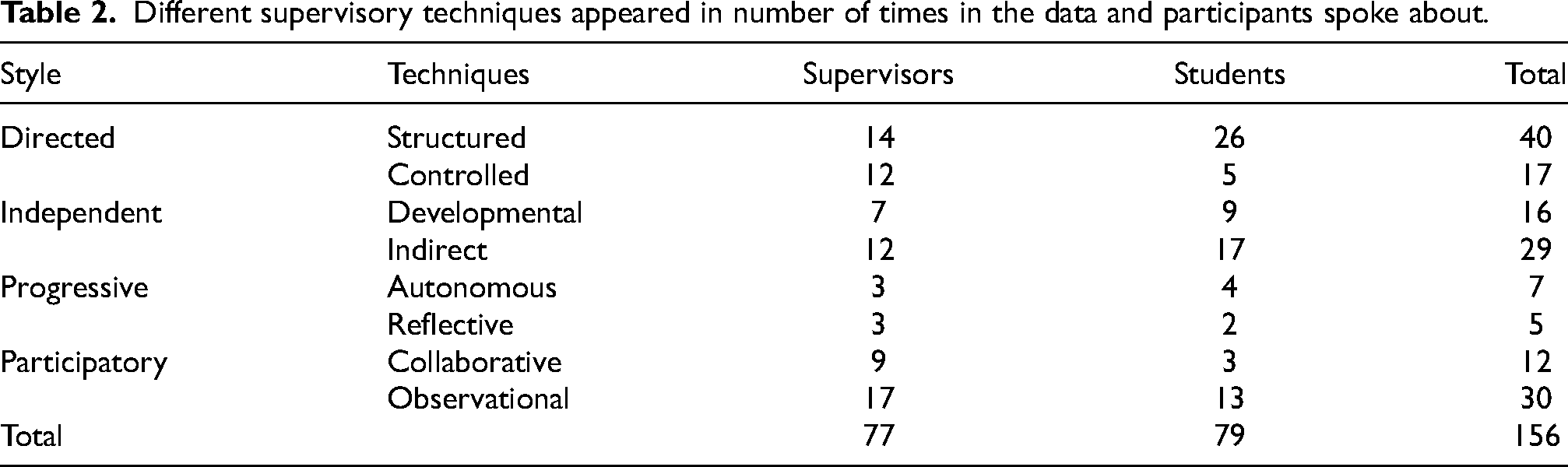
As shown in Table 2, structured, indirect, and observational techniques were found to be frequently referred to by the participants during their discussions. It can be concluded from Table 1 that directed supervision style seems to be prevalent among LIS supervisors in Pakistani libraries as experienced and discussed by the participants.
Second round took place to identify preferred supervision style. For this reason, NVivo's text search query “prefer* OR like OR interest* OR wish* OR want* OR desir* OR inclin*” was used to find words that denoted preferences. Use of Boolean operator and wildcards helped to find stemmed words (e.g. interesting, interested) within large data set. Result of searching one word “prefer” is shown in Figure 1, below:
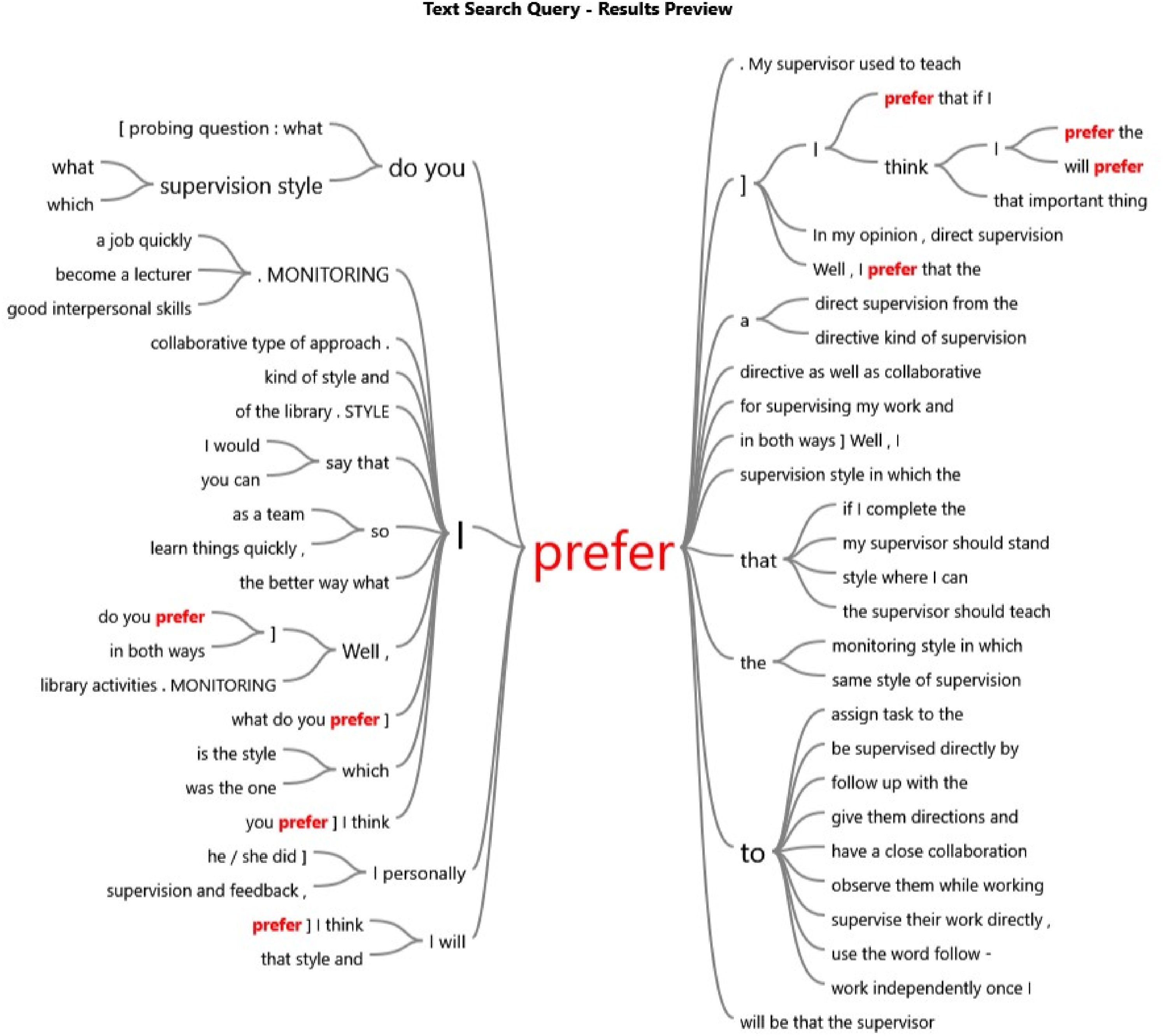
Text search query results from nVivo.
From the results, number of participants (both students and supervisors) were counted to find how many participants indicated their preference and interest in a particular supervisory approach. Results are summarised in Figure 2, which reflects that reflective and collaborative techniques, which denotes progressive and participatory supervision styles) were mostly highlighted by the students as their preferences. Whereas, in the data from supervisors, it was found that structured and developmental techniques, which corresponds to directed and independent supervision styles, were preferred by supervisors. Researchers of this study further analysed the data to find out the reason of mismatch in participants’ preferences which is discussed next.
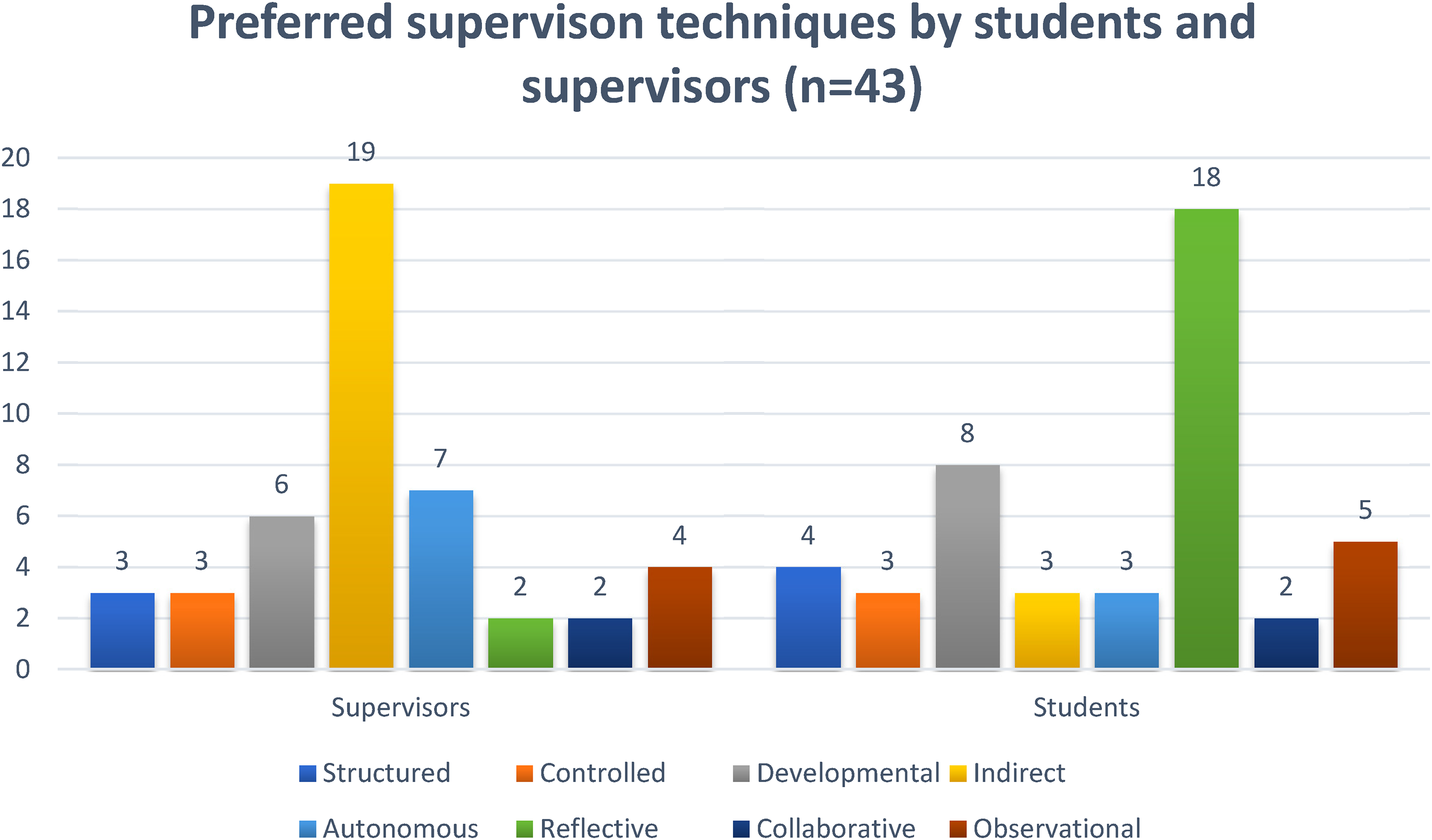
Preferred supervision techniques based on number of participants.
Implications of mismatch in prevailing and preferred supervision styles
As is evident from the findings stated above, prevalent supervision style of the supervisors was the directed style, however, students preferred reflective and autonomous style of supervision which allows freedom to work independently. This mismatch of supervision preferences between supervisors and students has implications for the quality of the supervision experience of students to promote learning, and to consequently develop professionally competent graduates.
In this study the directed supervision style was characterised by the supervisors as providing clear instructions and maintaining strict control over what students could experience during placement. The supervisor essentially exercised full control over the process and practices of supervision. While this style may provide the student with structured experiences of the workplace learning, a student's experiences may be limited to contexts as per the experiences of the supervisor. Therefore, supervisors, who have not had any formal training in supervising students, adapt practices that are not evidence-based. Hence, it is unclear whether this style of supervision promotes learning and produces professionally competent graduates. Even though the directed supervision style was essentially illustrated by the data, it was not the preferred supervision style, as largely voiced by the participants. Hence, the four supervision styles emerging in this study move beyond focusing solely on the activities and consider the level of control and freedom that a supervisor believe should exist in the process of supervision. The supervisors’ belief, therefore, seems to be the influencing factor that may have implications for the quality of supervision rendered during ELPs in LIS settings.
Limitations of the study
The supervision styles derived in this research may be used to explain and inform the supervision of ELPs in other disciplines, but the chosen context and research method imposed some limitations on generalising the results of this study. One limitation is that interviews were conducted with participants representing the LIS community in Pakistan where ELPs can vary between 30 and 90 days of duration. The duration of such programmes varies in other parts of the world, for example in Australia it varies between 2 and 3 weeks. Therefore, the results of this study may not be applicable where short-term interactions happen between LIS professionals and students during the ELPs. This is because in a short-term interaction, supervisors may not be able to adjust their style according to students learning needs and expectations while the programme is in progress. Moreover, only the initial constructs for supervision styles have been identified in this study. Further investigation into other factors that lead to inconsistency in supervision styles and students’ expectations may be useful to gain an in-depth understanding of effective supervision styles in ELPs in the LIS setting. Similarly, involvement of students in the design and delivery of ELPs needs further scrutiny because some participants of this study reflected that supervision approach is worthwhile only if the goals and objectives were commonly understood by both the supervisor and the student.
Conclusion
In a nutshell, this study concludes that there are four distinct supervision styles i.e., directed, independent, progressive, and participatory that are being used by the LIS professionals in ELPs of 1–3 month durations. These styles pertain to the variance between freedom and control that the participants of this study perceived as prevailing in ELP supervision. The study makes no attempt to derive a theory here due to the limitations identified above, and focus is on simply guiding ELP supervisors to better supervisory practices.
Supervision styles of ELPs found in this study bears partial resemblance with the supervision styles existing in other disciplines. For example, the directed supervision style bears some resemblance to the “telling and teaching” style of supervision, which in-turn is built on the adaptive counselling therapy model. Independent style is parallel to the supporting style found in psychology and education. Similarly, progressive style is roughly similar to developmental supervision style of counselling, while participatory style is typified by characteristics similar to laissez-faire style found in the management.
The above discourse revealed two main points. First, the four styles (directed, independent, progressive, and participatory) present a clear picture and distinct features of the supervision of ELPs in the LIS settings, which are non-existing presently in the LIS literature. Therefore, the results of this study provide a clear understanding of the supervision styles existing in longer ELPs in the LIS field. Second, there is a clear mismatch in prevailing supervision styles and that of preferred supervision styles by the students in the LIS field. This mismatch must be recognised and eliminated for effective learning and career development of students during an ELP.
Footnotes
Declaration of Conflicting Interests
The author(s) declared no potential conflicts of interest with respect to the research, authorship, and/or publication of this article.
Funding
The author(s) disclosed receipt of the following financial support for the research, authorship, and/or publication of this article: This work was supported by the Australian Government Research Training Program.
About the authors

Her field of research links closely with her vast classroom experience and her in-depth insight into the lived experiences of teachers. Her research predominantly focuses on teacher pedagogy and teaching practice that promotes wellbeing and learning.
Her particular interests are teachers’ pedagogical practices with children and families experiencing parental separation and divorce and other family disruption; pre-service teacher experiences straddling multiple policies during practicum placement; social emotional learning and wellbeing; and English, language and literacy.