




Abstract
Health Education England (HEE) through its publication of Knowledge for Healthcare (HEE (2014) Knowledge for Healthcare: a development framework for NHS Library and Knowledge Services in England 2015–2020. https://www.hee.nhs.uk/sites/default/files/documents/Knowledge_for_healthcare_a_development_framework_2014.pdf sets out an ambitious vision to transform NHS Library and Knowledge Services at a time of great change for the health service. Five years on this article outlines the key strand of work undertaken to mobilise evidence and organisational knowledge at scale across the health service in England. Using evidence and knowledge is crucial to drive and sustain change and the role of librarians and knowledge specialists is business critical to underpin this service transformation in healthcare. Driver diagrams were used to plan the work to encourage NHS organisations to apply and use evidence, build know-how, continue to learn and drive innovation. Engagement with senior stakeholders was a critical enabler and the impact of the #AMillionDecisions advocacy campaign to highlight the multiple benefits of working with librarians and knowledge specialists is considered. The development of practical tools has supported delivery. These have included a maturity model self-assessment tool to identify opportunities to use evidence and knowledge by senior leaders and updating of the NHS Knowledge Mobilisation Framework e-learning and postcards to enable healthcare staff to use simple knowledge management techniques to share their knowledge and learning. This work was dependent upon developing the skills of existing health librarians and various approaches are described. The article concludes with a reflection on the recommendations from the Topol Review (Topol E (2019) The Topol Review. Preparing the healthcare workforce to deliver the digital future. An independent report on behalf of the Secretary of State for Health and Social Care. https://topol.hee.nhs.uk/wp-content/uploads/HEE-Topol-Review-2019.pdf (accessed 31 January 2020)) to expand the knowledge specialist workforce and outlines future developments planned for the next 5 years and beyond.
Keywords
Introduction
The NHS in England is a complex health system, with a growing need to reduce costs to deliver and finance high-quality effective care for patients who have a number of co-morbidities (Allen, 2020). There are challenges with a growing and aging population and a shortage of skilled clinicians, but also opportunities from medical advances to improve health outcomes (NHS England, 2019). Furthermore, the health service needs to tackle unwarranted variation to improve quality, productivity and efficiency ensuring a ‘getting it right first time’ approach (Carter, 2016).
Evidence and knowledge will be crucial to enable a successful move to place-based care, focusing on keeping people healthy as well as to take advantage of new digital technologies (NHS England, 2019). However, ‘evidence does not speak for itself, but needs to be mobilized at the right time, and through the right people, to make a difference in decision making’ (Swan, 2012, p. 19). The role of librarians and knowledge specialists is pivotal to underpinning this.
This article outlines the transformation of the role of librarians and knowledge specialists to become business critical in mobilising evidence and organisational knowledge across the NHS in England. It explains how this work was planned, priorities identified and delivered to enable this transformation to take place. An initial evaluation of successes and future planned work are described.
Context
In 2014, Health Education England (HEE) published Knowledge for Healthcare, sharing a vision that: NHS bodies, their staff, learners, patients and the public use the right knowledge and evidence, at the right time, in the right place, enabling high quality decision-making, learning, research and innovation to achieve excellent healthcare and health improvement. (HEE, 2014, p. 9)
The challenge for HEE is to mobilise evidence and knowledge at scale across multiple organisations and within existing budgets. This entails working with 458 provider and commissioning organisations, not counting the 7454 primary care general practices, 853 independent sector organisations delivering healthcare, or the 7 Arm’s Length Bodies such as NHS Improvement, Care Quality Commission and National Institute for Health and Care Excellence (NICE) (NHS Confederation, 2017). Despite being bound together by the Values within the NHS Constitution (Department of Health and Social Care, 2015), each have separate organisational priorities.
Key to success is to engage and up-skill the existing workforce of 626 qualified librarians based in 185 NHS Library and Knowledge Services across England (HEE, 2018a). They require the skills, knowledge and confidence to advocate and deliver change from within commissioning and provider organisations, with their work aligned to organisational priorities. A cultural shift is also required, to recognise that use of evidence to inform decision-making and knowledge mobilisation is integral and embedded in everyday work and no longer about techniques reserved just for project managers.
Planning
A first step was to identify the priorities in this area. Building upon an extensive literature review and knowledge of existing pockets of good practice, the strategic tool of driver diagrams was adopted (NHS Improvement, 2018) to identify key objective and secondary drivers. The overarching aim was to mobilise evidence and knowledge across the NHS in England so that all healthcare decisions would be based upon evidence from research and knowledge of best practice held within organisations. Three secondary objectives were identified to achieve this: NHS organisations will apply and use evidence, build know-how, continue to learn and drive innovation. Healthcare staff will use the right tools and techniques to share their knowledge and learning, to improve the quality of care, drive innovation and productivity. Health librarians and knowledge specialists will identify and implement business critical tools and techniques to better mobilise evidence and knowledge.
A small working group oversees the delivery of the outcomes, working in partnership with other knowledge specialists and the national library leads group. The Knowledge for Healthcare Board was established to provide strategic direction and ratify decisions which are communicated to the Library and Knowledge Service workforce via a blog and monthly briefings.
What do we mean by knowledge mobilisation?
Our preferred term for this work soon evolved from being described as knowledge management to mobilising evidence and knowledge. This shift emphasised how evidence and knowledge could be used, the implicit and the tacit, to inform health care decisions. At the outset we were keen to build on the positive contribution librarians have made supporting evidence-based healthcare (Hopkins, 2017, p. 104). The aim was to extend beyond provision of information and evidence or just the management of knowledge. The focus shifted to ensuring that external evidence, best practice and organisational knowledge were actively mobilised by knowledge brokers to underpin decision-making.
NHS organisations will apply and use evidence, build know-how, continue to learn and drive innovation
#AMillionDecisions
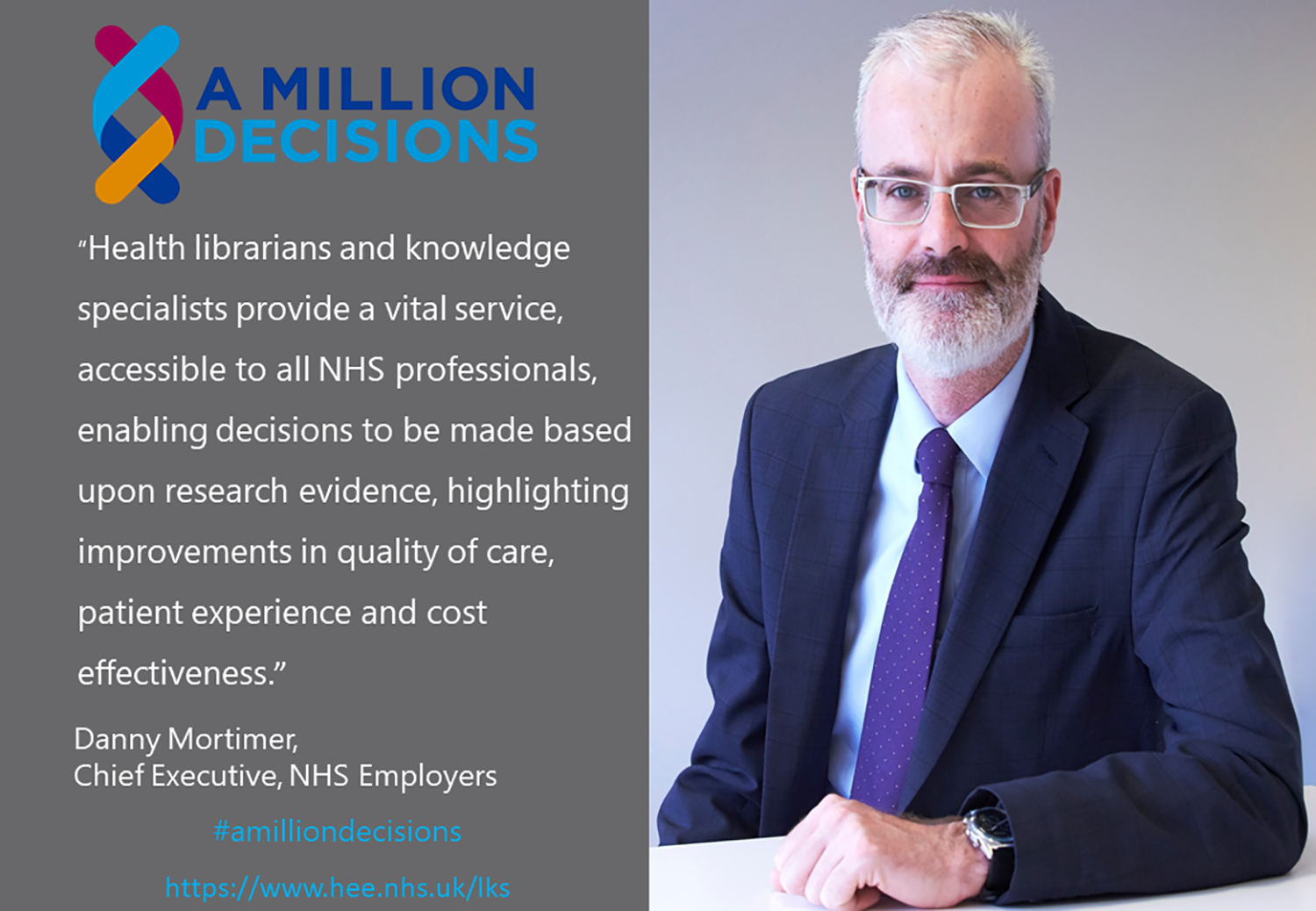
Engagement with stakeholders was crucial for the transformation outlined in Knowledge for Healthcare to succeed. A series of briefings were sent to senior stakeholders and links with partner organisations such as the arm’s length bodies of NICE, NHS Digital and Public Health England were strengthened. This was stepped up in 2017 with the launch of the social media campaign #AMillionDecisions (CILIP, 2016). Working in partnership with the Chartered Institute of Library and Information Professionals, a 6-month campaign was devised, targeted at very senior leaders and politicians about the critical role of librarians and knowledge specialists in ensuring the use of evidence and organisational knowledge to inform decision-making in healthcare. A launch at the All-Party Parliamentary Group for Libraries took place in January 2017 and was swiftly followed by invitations to senior figures to endorse the campaign messages calling for all decisions in the healthcare sector to be fully evidence-based, and for health service providers and commissioners to employ and make use of the expertise of librarians and knowledge specialists in meeting their obligations under The Health and Social Care Act 2012.
#AMillionDecisions was an opportunity to draw attention to The NHS Library and Knowledge Services in England Policy (HEE, 2016). This set out for the first time an approach to delivering on the key objective of enabling access to knowledge and evidence for healthcare decision makers. It states that HEE is committed to: Developing NHS librarians and knowledge specialists to use their expertise to mobilise evidence obtained from research and organisational knowledge to underpin decision-making in the National Health Service in England. Enabling all NHS workforce members to freely access library and knowledge services so that they can use the right knowledge and evidence to achieve excellent healthcare and health improvement. Developing NHS Library and Knowledge Services into a coherent national service that is proactive and focused on the knowledge needs of the NHS and its workforce
The campaign was to culminate in a breakfast discussion highlighting the multiple benefits from working with health librarians and knowledge specialists. However, the calling of an early General Election forced these plans to be adapted. Due to political uncertainty, the focus shifted to gaining senior health leaders support. Messages about the essential role of this workforce were shared on social media and at events such as the NHS Confederation conference.
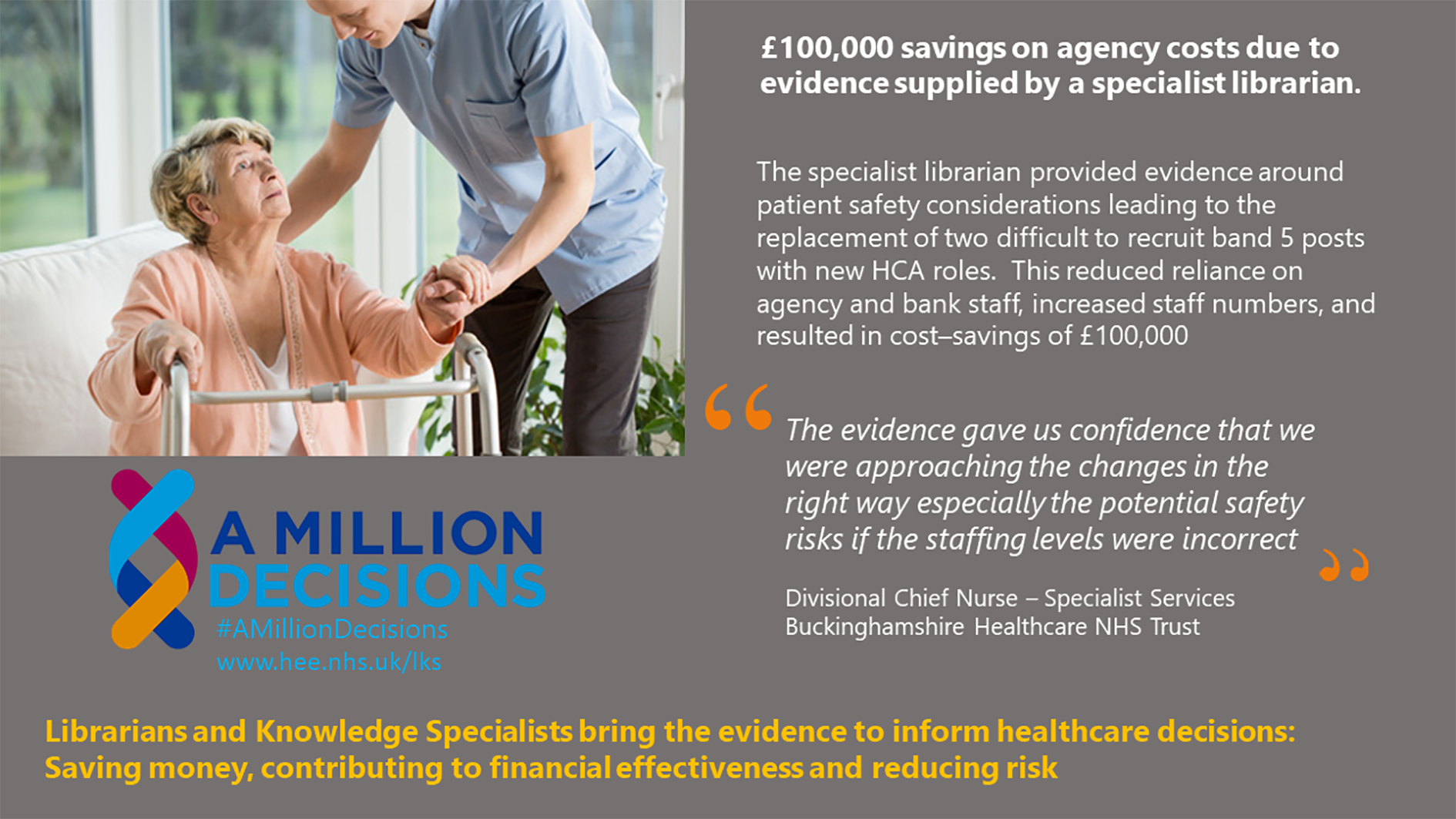
Deemed a success, the campaign articulated to employers that the role of health librarians and knowledge specialists is business critical, raising the profile and expressing a common purpose that all librarians can support. It was also an opportunity to highlight the many benefits of working with librarians and knowledge specialists – efficiencies of time and money and improvements to healthcare outcomes were illustrated using a series of case studies drawn from everyday practice. A significant body of evidence supporting these claims has been gathered and skills in seeking case studies that illustrate impact rather than just collecting positive feedback have been developed. The next stage of this work will be the creation of a model to assess more of this impact in real financial terms and thus express the service in terms of money saved.
Evolving into an ongoing initiative senior leaders continue to share messages of support and these are published via social media, at events and used to open conversations with a wider range of organisations thus extending the reach of this work.
In 2020, two animations were commissioned (HEE, 2020a, 2020b) to distil the key messages of the campaign and encourage people to recognise the benefits of working with health librarians and knowledge specialists to mobilise evidence and use organisational knowledge to power change.
Using external evidence and organisational knowledge self-assessment tool
To help shape conversations with senior leaders about the opportunities of using external evidence and organisational knowledge, a self-assessment tool has been developed, based on previous work by Rachel Cooke (2015) and Chris Collison and Geoff Parcell (2004, p. 75). The tool consists of a maturity matrix and incorporates the Information as an Asset Checklist (CILIP and KPMG, 2019) to enable the quick assessment of opportunities to make better use of information, evidence and knowledge. The 23 criteria are arranged into four category areas: Leadership, Behaviours, Capabilities and Working Practices, and Knowledge Services. Stakeholders are invited to assess what is working well and what more could be done, consider which initiatives will make a positive impact on bottom lines and then, working with a librarian or knowledge specialist, prioritise these and draw up an action plan to help meet objectives.
The self-assessment tool has been used to promote and demonstrate the range of services that can be offered to an organisation. Piloting of the tool in Surrey and Sussex Healthcare NHS Trust has transformed the way the Library and Knowledge Service is now regarded by the Medical Division. Knowledge Specialists drive the development and maintenance of internal documents acting as guardians for ensuring divisional policies are fully evidence based, updated and easy to access. This has led to the Chief of Medicines remarking: The library team should be our knowledge stewards in the same way as microbiology are the antibiotic stewards for the Trust.
Extending reach
With strong leadership within HEE from the Director for Innovation and Transformation and the success of the #AMillionDecisions campaign, it has been possible to engage with many more health organisations than before Knowledge for Healthcare was published.
Conversations have been held with over 20 organisations that do not currently have access to a full service to promote the role of librarians and knowledge specialists. There have been opportunities to pilot embedded roles working closely alongside teams in the Academic Health Science Networks and within the National Association of Primary Care. Links have also been strengthened with knowledge managers working in other parts of the health system such as at NHS Improvement and NHS England.
Within HEE a dedicated internal knowledge management team has been established to ensure the work of the organisation is informed by evidence and best practice with colleagues kept up-to-date about the latest published evidence. The team also encourage corporate knowledge to be managed more effectively and facilitate staff to tap into the know-how of colleagues.
Knowledge for Healthcare was published just before the formation of the geographical Sustainability and Transformation Partnerships (STPs) in England and it was clear that these new partnerships would benefit from using evidence and sharing best practice to inform decisions about the delivery of place-based care. In the North East, a novel ground-up approach has been adopted to bring together all of those working within an STP area that recognise the need to use evidence and share knowledge. This informal Sustainability and Transformation Evidence Mobilisation (STEM) Club has modelled an approach that has been used elsewhere to enable transformation teams to work with librarians and knowledge specialists to pool expertise and ensure that decisions are based upon evidence.
The NHS Long Term Plan (NHS England, 2019) recognises the growth of Integrated Care Systems and place-based care which will present further opportunities for co-production of evidence. Librarians and knowledge specialists will occupy a central position in building local communities of practice to share evidence and techniques to learn before, during and after to sustain learning and enable innovation.
Healthcare staff will use the right tools and techniques to share their knowledge and learning
If knowledge mobilisation techniques are to make a real difference to healthcare outcomes, then they need to be used by all staff as part of their routine practice. Encouraging widespread adoption of knowledge mobilisation techniques by all those working within the NHS is a key aspiration of the Knowledge for Healthcare Mobilising Evidence and Knowledge work stream.
Knowledge Mobilisation Framework
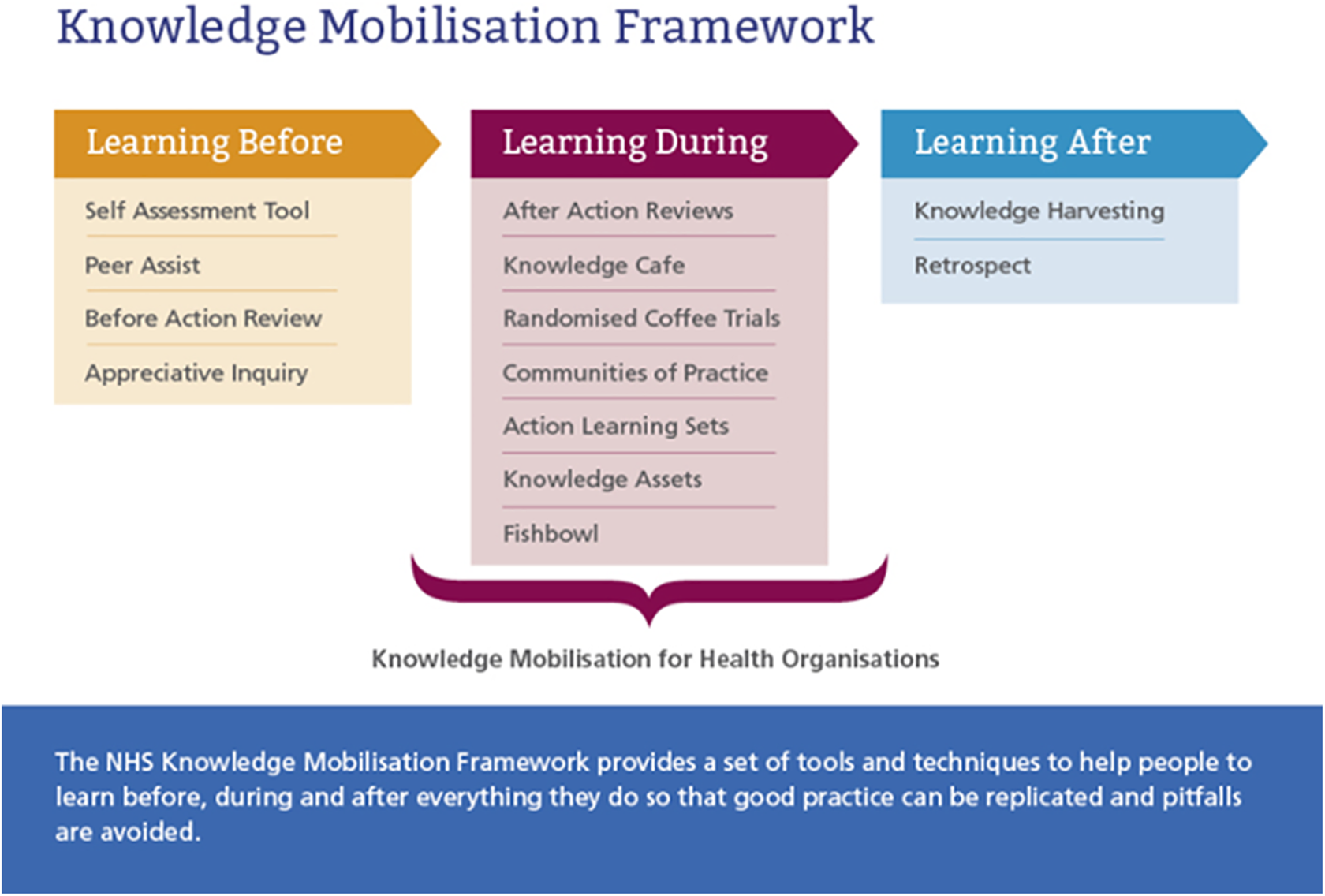
The NHS Knowledge Mobilisation Framework (HEE, 2018b) is designed to support the healthcare workforce to learn before, during and after everything that they do so that pitfalls can be avoided and best practice replicated. It comprises of a suite of open-access e-learning modules and accompanying quick reference postcards introducing simple techniques, which are designed to help individuals to develop and use skills to mobilise knowledge effectively in their organisations. The framework offers a cyclical process – learning before can lead to learning during and learning after which then feeds back into learning before.
The Framework updates a basic e-learning package about knowledge management produced in 2010 by the then Department of Health, Connecting for Health Knowledge Management Team and the Kent, Surrey and Sussex Library and Knowledge Services Team. Following a basic introduction, each module highlights benefits, offers a quick overview and invites learners to have a go at using each technique either by completing a short activity or by planning to use it in a real-life situation. The quick reference postcards describe some additional techniques, including a short guide to conducting Appreciative Inquiry and holding a Fishbowl conversation.
Throughout 2018 and 2019, the Knowledge Mobilisation Framework has been actively promoted. Printed copies of the digital postcards have been distributed across the country and shared at events such as the NHS Confederation annual conference. Librarians and knowledge specialists are sharing the framework with healthcare colleagues, offering guidance or agreeing to facilitate use of the techniques.
Based on the introduction of the simple After Action Review at a Primary Care Improvers Conference GP Trainer, Appraiser and Coach Dr Farzana Hussain commented: I would recommend everyone to learn about this. It has changed my staff meetings and significant-event analyses, the non-judgemental approach supporting a no-blame culture – not bad for 4 simple questions I learnt in under 20 mins.
Building confidence and capability of librarians and knowledge specialists
Soon after the publication of Knowledge for Healthcare, it became clear that to become truly business critical librarians and knowledge specialists would need to transform existing services. A greater emphasis was placed upon the use of evidence and knowledge to inform healthcare decision-making, including enabling the public to find, appraise and use good quality health information. To support this, it was recognised that the current workforce needed to develop skills and a variety of approaches were adopted.
Building a knowledge base
Several library and knowledge services were already successfully facilitating knowledge mobilisation activities for their organisations and to spread this good practice and stimulate ideas a reference toolkit (HEE, 2015) was created describing techniques, illustrated with examples of how and where they had been used. Techniques are linked to seven goals to nurture the right organisational culture for successful knowledge management as set out in Knowledge for Healthcare (HEE, 2014, p. 23). Over 30 techniques are described which relate to connecting people to people, people to the evidence-base, people to best practice, keeping people up to date, sharing learning, connecting people to corporate knowledge and collegiate working. Over 20 stories illustrating knowledge management activities in practice have been added to the toolkit to date. These include setting up an innovation forum; developing a knowledge asset using interactive Microsoft Sway for use by champions supporting the armed forces community; building communities of practice around Internet chat rooms and running randomised coffee trials to break down organisational silos. There have been over 15,000 unique page views of the toolkit since inception and Horizon Scanning has been the most visited page.
Connecting people to the evidence base
Two workshops were commissioned to build confidence in synthesising and summarising evidence and in handling enquiries relating more to business needs. Complex literature searching and critical appraisal to support clinical decision-making is a standard activity provided by NHS librarians and knowledge specialists, but there was less familiarity with synthesis and summarising evidence for management, commissioning and service improvement related enquiries. Following the workshops, there was an increase in this type of activity.
Enhanced summarised searches, conducted by knowledge specialists embedded within healthcare teams, make tangible differences to saving people time. They enable the team to work to the top of their professional licence and encourage the spread and adoption of best practice leading to efficiencies and improvements in healthcare delivery and outcomes.
As a member of the Product Selection Committee, the clinical librarian at Brighton and Sussex University Hospitals NHS Trust provided evidence to support decisions about purchasing clinical products. The summarised evidence ensured that quality, safety and patient experience are considered as well as identifying time and cost efficiencies. These evidenced-informed decisions led to cost savings of £1.9 million between 2015 and 2016.
Encouraging organisational learning
To build expertise to facilitate knowledge mobilisation techniques, a series of cascade workshops and follow-up webinar sessions were delivered by an in-house expert team. Techniques such as Peer Assist, After Action Reviews, Randomised Coffee Trials and Knowledge Cafés were introduced that could be adapted and implemented in local organisations. These sessions were cascaded to managers of the 185 library and knowledge services across England.
As part of the work of Knowledge for Healthcare, HEE commissioned a series of leadership development programmes. As a component of the programme participants were assigned a project that related to knowledge mobilisation. These led to the creation of toolkits exploring methods for knowledge capture and dissemination; establishment of institutional research repositories and guidance about involvement in creation and management of organisational policies, procedures and guidelines.
In 2018, two groups worked on developing regional events to share ideas to encourage pledges for #KNOWvember about how librarians and knowledge specialists would introduce some knowledge mobilisation activities in their own organisations. #KNOWvember is now a fixed date in the calendar as an opportunity to promote and celebrate involvement in facilitating the use of best practice and knowledge not just in healthcare but other sectors too.
Measuring success
Library quality assurance framework
The Library Quality Assurance Framework is a tool to enable a robust quality assessment of NHS library and Knowledge Services designed so that an organisation can assess its level of compliance to national standards. It includes a criterion that relates specifically to mobilisation of evidence and knowledge: ‘5.4a Members of the Library Knowledge Services Team are actively involved in the creation, capture, sharing, utilisation or re-use of knowledge in the organisation(s) served’. In 2018, there was a 7 per cent reduction in non-compliance and an 11 per cent increase in partial and full compliance for the criterion compared to 2014, which is when it was introduced.
Each service was asked to support their score by submitting evidence and providing a narrative about their work. These were grouped thematically and the most popular knowledge mobilisation activities taking place relate to organisation and reuse of knowledge. Examples included repositories, intranet page design and supporting the production and use of guidelines and policies. There were many examples of novel knowledge sharing activities including ‘Hello Interviews’ for new staff, diversity calendars and lightening learnings to rapidly disseminate evidence request findings. Several services were involved in some form of activity to build or use corporate memory, often associated with the commemoration of the NHS at 70 years. Two submissions stated an active role in developing a knowledge mobilisation strategy for organisations.
Impact, Satisfaction and Confidence Survey
In August 2018, an Impact, Satisfaction and Confidence Survey was conducted for librarians and knowledge specialists working in healthcare. Two questions related to knowledge mobilisation. Sixty-one per cent of the 353 respondents agreed that they were satisfied with having had an opportunity to develop the knowledge and skills needed in knowledge mobilisation. Fifty per cent agreed that they were confident about putting knowledge mobilisation skills into practice.
Continuing to develop skills and raise confidence levels remains a key focus. This will be achieved by highlighting to the workforce the inherent skills they already possess to facilitate and promote knowledge mobilisation activities within their organisations. A network of champions is being built to develop a buddying-system supporting those less familiar with knowledge mobilisation concepts and enabling shared learning supported through a community of practice.
Evaluation Framework
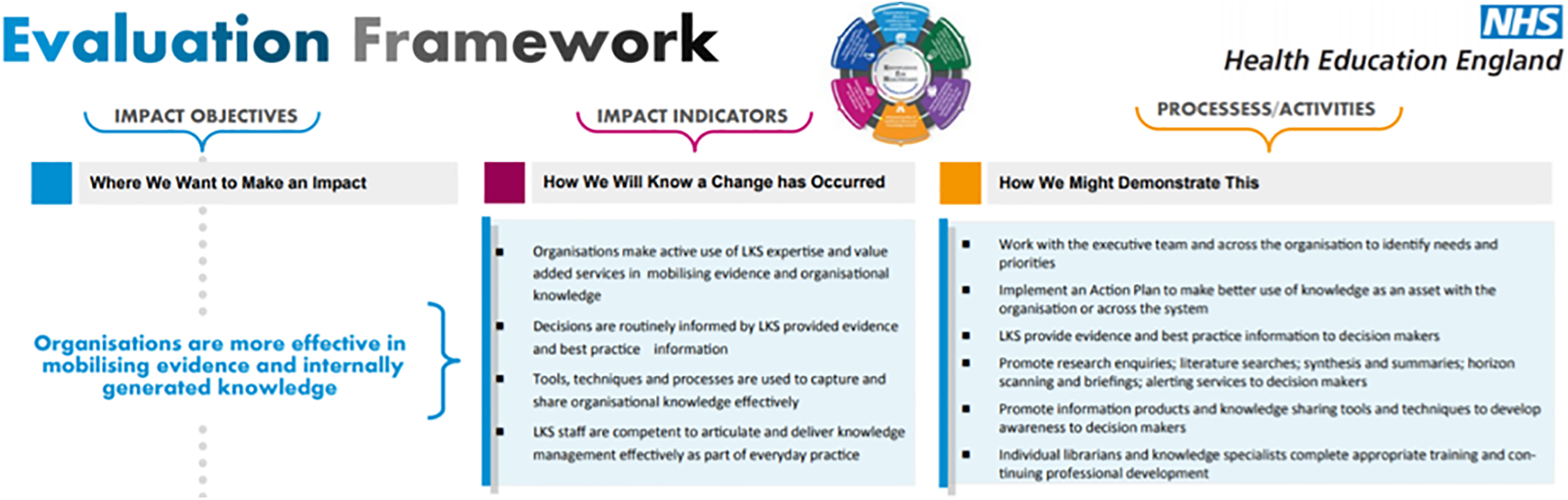
To assess the delivery of Knowledge for Healthcare, including the impact of mobilising evidence and knowledge, an evaluation framework has been developed. The Framework provides an outcomes-based approach to evaluation and performance providing qualitative and quantitative data to demonstrate impact, assure quality of services and enable service improvement. Four impact indicators for evidence and knowledge mobilisation have been agreed and suggestions on how a change can be demonstrated using qualitative and quantitative measures is underway.
Planning for the future
The work completed so far creates a bedrock on which to base the refresh of Knowledge for Healthcare scheduled for publication in 2021. Advocacy work will be stepped up using the #AMillionDecisions messages to engage with employers at a grass-roots level. Introduction of a new quality improvement outcomes framework will provide leverage with employers to highlight the pivotal role of health librarians and knowledge specialists to underpin organisational priorities to enable improved healthcare outcomes.
Opportunities to embed knowledge mobilisation techniques into the daily work of the wider healthcare workforce continue to be developed building upon the existing e-learning and face to face events.
It is apparent that librarians and knowledge specialists will have a vital role in preparing the healthcare workforce to deliver the digital future as outlined in the recommendations of the Topol Review: Effective knowledge management is essential to enable the spread and adoption of innovation, with lessons from early adoption shared widely (OD6): an innovation culture is dependent on a learning culture. The NHS must build a reputation as a learning organisation that values and enables the transfer of learning about successes and failures (OD5). This can only happen with the creation of new senior knowledge management roles. (Topol, 2019, p. 68)
Conclusion
In the last 5 years, we have seen a substantial sea change in the way NHS librarians and knowledge specialists are regarded. By focusing on the benefits of knowledge specialists to facilitate the effective use of evidence and knowledge, we have shown that librarians and knowledge specialists are business critical for the NHS.
Our next big challenge is to position knowledge specialists to develop and implement strategies working with organisations to create strong learning cultures, where knowledge sharing is the norm. This will lead to the breakdown of silos enabling evidence and knowledge to truly drive change across the NHS in England.
Example of a social card used in the #AMillionDecisions campaign.
Example of an impact case study.
The NHS Knowledge Mobilisation Framework.
Growth in skills of knowledge specialists.
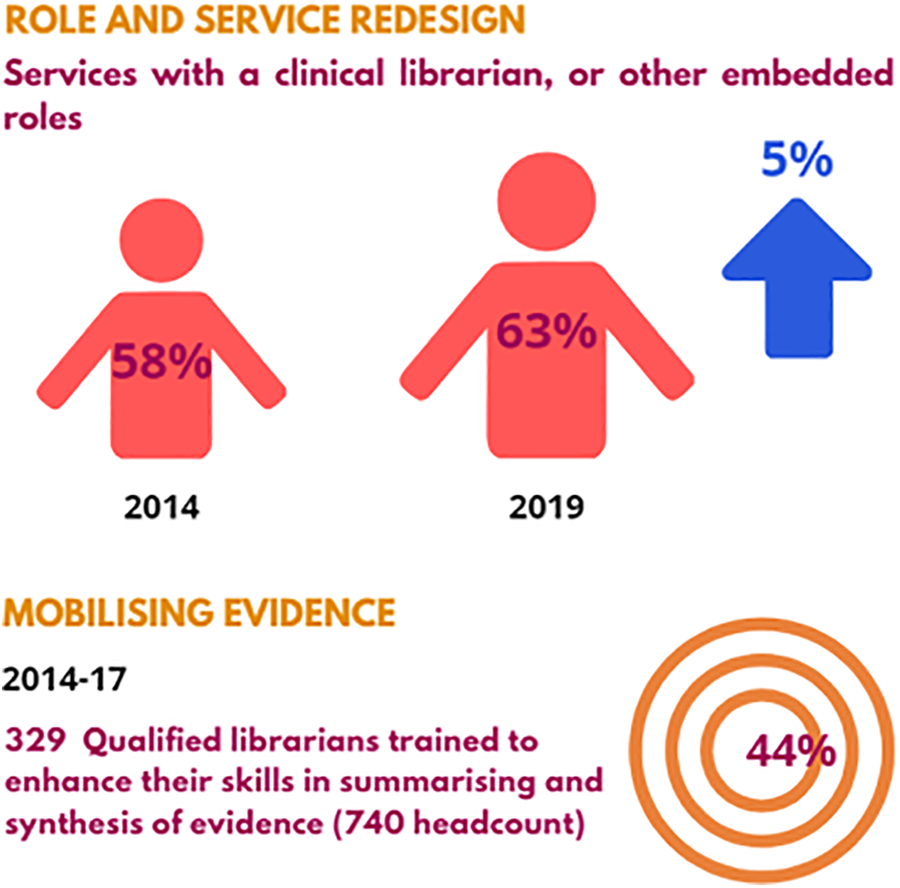
Extract from the Knowledge for Healthcare Evaluation Framework.
Footnotes
Acknowledgements
The authors acknowledge the support of Sue Lacey Bryant, National Lead for NHS Library and Knowledge Services and members of the NHS Library and Knowledge Service Team who have assisted with the production of this manuscript.
Declaration of conflicting interests
The author(s) declared no potential conflicts of interest with respect to the research, authorship, and/or publication of this article.
Funding
The author(s) received no financial support for the research, authorship, and/or publication of this article.
