




Abstract
“Failing fast” features prominently in entrepreneurship discourse as a mechanism for reallocating resources and strengthening ecosystem resilience. However, existing research has yet to explain how entrepreneurs decide when to terminate an unviable venture, as failure studies remain focused on individual biases, while ecosystem studies largely overlook the early failure phase. Addressing this gap, this study examines how social, economic, and cultural dynamics within Amsterdam’s entrepreneurial ecosystem shape entrepreneurs’ decisions to discontinue their ventures. While stakeholders adopt a fast-failure rhetoric and entrepreneur-centred support framing to maintain legitimacy, their practices are driven by diverse institutional interests, thereby creating conditions that prolong failing ventures rather than enabling timely exit. These insights shift the locus of entrepreneurial failure from individual decision-making to systemic conditions and challenge the dominant view of ecosystems as entrepreneur-centric, showing instead that they primarily serve stakeholder interests, rendering them in effect Untrepreneurial ecosystems.
Keywords
Introduction
If and when to terminate an unviable venture is one of the most crucial and challenging decisions an entrepreneur must make. Not doing so in time can lead to escalated financial losses and psychological distress (Shepherd et al., 2009). The majority of research on entrepreneurial failure focuses on the individual entrepreneur, drawing on psychological concepts to examine how cognitive biases (DeTienne et al., 2008), emotional attachment, and personality traits (Shepherd et al., 2009) shape their response to a failing venture. Hence, extant work on entrepreneurial failure echoes the prevailing individual-centric bias in entrepreneurship research by underemphasising both the broader context in which entrepreneurs operate and external stakeholders involved in supporting the entrepreneur (Amankwah-Amoah and Wang, 2019; Dimov, 2007; Johannisson, 2011). This omission is surprising, given the recognition that entrepreneurs do not operate in isolation but are embedded within communities of interdependent actors (Zahra et al., 2014). This has prompted numerous calls within the entrepreneurial failure literature to move beyond the individual entrepreneur (Amankwah-Amoah and Wang, 2019; Byrne, 2021; Cope, 2011; Ucbasaran et al., 2013). This study adopts the entrepreneurial ecosystem concept to account for the broader context in which entrepreneurs operate. The concept’s originality lies in its systemic approach (Wurth et al., 2022), examining how “combinations of social, political, economic, and cultural elements within region[s] [. . .] support the development and growth of innovative startups and encourage nascent entrepreneurs and other actors to take the risks of starting [. . .] high-risk ventures” (Spigel, 2017: 50).
Ironically, while the failure literature has yet to examine the interdependent interactions among contextual actors and factors shaping entrepreneurial behaviour, ecosystem studies to date have focused primarily on venture startup and growth, paying limited attention to failures (Wurth et al., 2022). Emerging work has started to explore failure within entrepreneurial ecosystems, but this work has predominantly focused on a specific part of the process of entrepreneurial failure, namely the outcomes and consequences following venture termination. These studies effectively show that failure can contribute to ecosystem growth and resilience by releasing valuable resources for subsequent ventures (Espinoza-Benavides et al., 2021; Guerrero and Espinoza-Benavides, 2021a, 2021b; Mason et al., 2025). However, these benefits depend on the timely termination of unviable ventures (Davidsson, 2004; Shepherd, 2003). Hence, to fully understand entrepreneurial failure, it is essential to examine how entrepreneurial ecosystems shape founders’ decisions regarding venture termination.
In order to address these gaps, this study brings together the entrepreneurial failure and entrepreneurial ecosystem literatures to examine how and when entrepreneurs persist with or terminate unviable ventures from an ecosystem perspective. We pose the following research question: How does the entrepreneurial ecosystem shape the decisions of startup entrepreneurs to terminate their unviable ventures? We address this question through a qualitative study of Amsterdam’s entrepreneurial ecosystem. Amsterdam represents one of Europe’s strongest entrepreneurial ecosystems, yet it struggles to develop thriving scale-ups, resulting in many ventures stagnating and failing to progress beyond the seed stage (Stam, 2014; Techleap and Utrecht University, 2022). We draw on interviews with 30 founders of failed businesses and 25 key ecosystem stakeholders, secondary data, and 10 participant observations at ecosystem events. Our analysis uncovers the significant yet, paradoxical role that the entrepreneurial ecosystem plays in the responses from entrepreneurs to venture decline. Thus, even though ecosystem stakeholders advocate that entrepreneurs should “fail fast,” their actions and the underlying cultural values contradict this, leading entrepreneurs to prolong venture failure. Moreover, while stakeholders claim to support entrepreneurs at this critical stage, entrepreneurs often feel that they lack the guidance needed to make informed decisions and fail fast.
Building on these insights, this study extends the literature in two significant ways. First, the findings illustrate that venture termination decisions are socially embedded processes shaped by ecosystem-level generative mechanisms—which we have labelled narrative contradiction, signal distortion, authoritative pressure, and support pipeline breakdown—thereby moving beyond the emphasis on individual psychological explanations that dominate the entrepreneurial failure literature (Casas and Hilb, 2016). Second, we challenge the dominant framing of entrepreneurial ecosystems as collaborative, entrepreneur-centred, and purpose-driven systems (Acs et al., 2017; Isenberg, 2011; Mason and Brown, 2014). Instead, our findings suggest that ecosystem support structures are organised around stakeholder interests, reflected in a decoupling of rhetoric and practice: while ecosystem stakeholders adopt a fast-failure rhetoric and entrepreneur-centred support framing to maintain legitimacy, their practices are driven by diverse, often conflicting institutional interests. This stakeholder-centric logic drives support structures that enable founders during growth but constrain them during decline, a dynamic we term the Untrepreneurial ecosystem (Hartmann et al., 2022). These insights carry theoretical and practical implications for how entrepreneurial ecosystems are understood and governed. Theoretically, we call for a reconceptualisation of entrepreneurial ecosystems beyond their current entrepreneur-centric framing, and for research into what characterises genuinely founder-centric ecosystems. Practically, we argue that ecosystem success metrics need to move beyond entrepreneurial activity to incorporate founder well-being and fulfilment, and that genuinely independent, founder-centred support during venture decline represents a market failure that current ecosystem governance leaves uncorrected.
Theoretical background
Entrepreneurial failure and venture termination decisions
Although research examines the post-failure stages of the entrepreneurial journey, the decision-making period preceding failure remains underexplored (Byrne, 2021). However, scholars increasingly recognise the importance of the decision to terminate a venture, broadening the definition of entrepreneurial failure to include this critical stage. Khelil (2016: 76), for example, describes entrepreneurial failure as “a psycho-economic phenomenon characterised by the entry of a new venture into a spiral of insolvency and/or the entrepreneur’s entry into a psychological state of disappointment.” Informed by this definition, research on venture termination decisions mainly focuses on individual-level factors that influence them. Studies find that these decisions “are not fully rationally or economically driven” (Yamakawa and Cardon, 2017: 12), with cognitive biases, emotional attachment, and personality traits affecting the entrepreneur’s judgement and ability to make objective assessments regarding their venture’s viability. These comprise, for instance, the sunk cost fallacy, where prior investments create a reluctance to abandon the venture; the refusal to admit businesses failure (Yamakawa and Cardon, 2017); the belief that additional resources will improve the situation (Wennberg et al., 2010); the attribution of failure to external factors (Shepherd et al., 2009); the need to save face and self-identity (Singh et al., 2015); as well as personality traits such as optimism, overconfidence (Hayward et al., 2010), and persistence (Lin et al., 2022). Casas and Hilb’s (2016) decision-making model of persistent venture underperformance integrates these findings by framing venture termination decisions primarily at the level of the individual entrepreneur and emphasising the role of cognitive and affective biases (see Figure 1). Accordingly, Casas and Hilb (2016: 406) contend that “founders holding onto the last ditch are akin to free men and women building their own prison,” thereby framing the living-dead trap of prolonged persistence despite sustained underperformance as the outcome of entrepreneurial agency and responsibility.
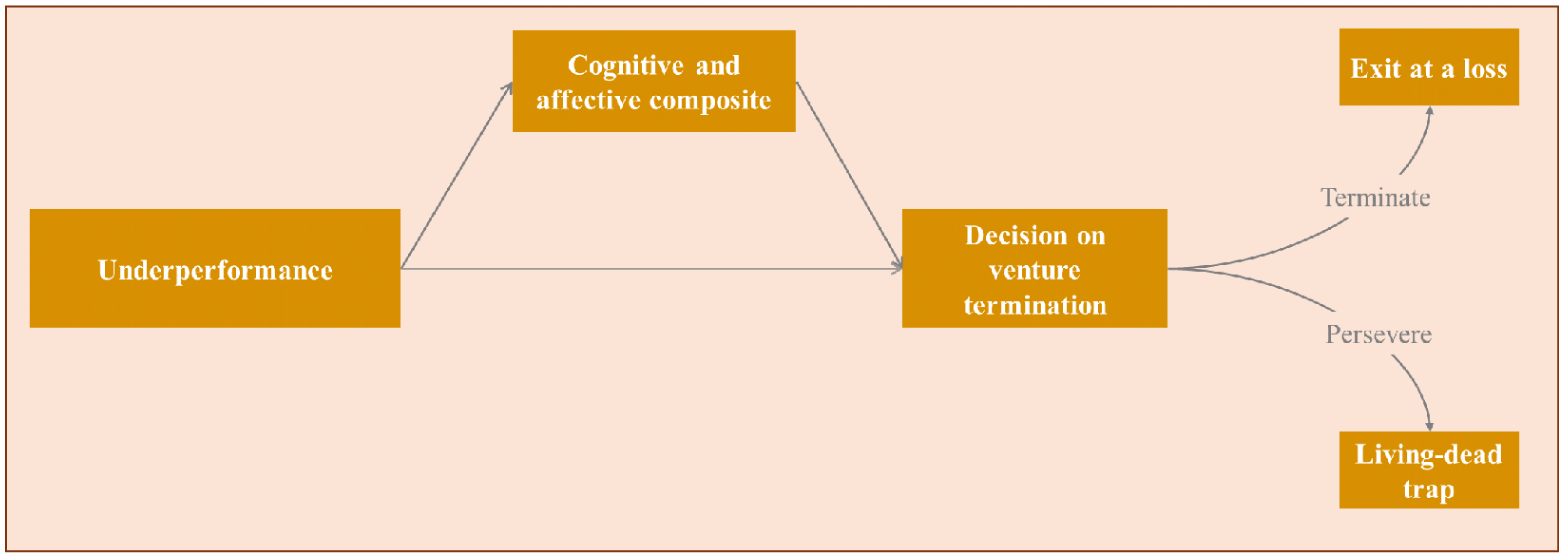
Decision-making process leading to the living-dead trap, reproduced from Casas and Hilb (2016).
In sum, while extant work on venture termination decisions provides valuable insights into individual-level decision-making, the broader contextual conditions that influence these decisions have been largely neglected. Few studies address the role of specific external stakeholders, including investors (Birmingham et al., 2003; Devigne et al., 2016), advisors (Elfenbein et al., 2017), and policymakers (Lee et al., 2007); however, they examine them within their own disciplinary silos. This fragmented approach limits our understanding of how different contextual elements interact to shape venture termination decisions. Thus, Cope’s (2011: 620) comment that “there remains a pressing need to examine the influence and perspectives of ‘significant others’ at various stages of the failure process” remains pertinent. We adopt the entrepreneurial ecosystem framework to address this issue. This approach provides a holistic and systemic perspective on factors shaping place-based entrepreneurial activity, enabling a more comprehensive understanding of how individual decision-making interacts with broader social and economic structures in entrepreneurial failure processes (Wurth et al., 2022). We explain this approach in more detail in the next section.
An ecosystems approach to entrepreneurial failure
With the increasing awareness that entrepreneurs do not exist in a vacuum, scholarly research has shifted away from individualistic, personality-based studies towards a broader perspective on the entrepreneurship process. This perspective incorporates the role of social, cultural, and economic forces and has given rise to the concept of entrepreneurial ecosystems (Wurth et al., 2022). While this concept has its roots in early systemic views on entrepreneurship (Dubini, 1989; Van de Ven, 1993), innovation systems (Cooke et al., 1997), and the cluster concept (Porter, 2000), its novelty stems from three distinct features.
First, it focuses on local environments conducive to productive entrepreneurship rather than overall rates of new business formation and self-employment (Brown and Mason, 2017). Second, this perspective recognises that entrepreneurial activity is embedded within regional configurations of social, political, economic, and cultural elements (Spigel, 2017; Stam and van de Ven, 2021; Wurth et al., 2022). Third, the entrepreneurial ecosystem approach is dynamic, highlighting the circulation of resources to explain how ecosystems come into being and transform over time (Spigel and Harrison, 2018). The latter feature of entrepreneurial ecosystems is central to our study. While these resource flows are triggered by both successful exits (Mason and Harrison, 2006) and venture failure, research largely focuses on processes triggered by the former. This omission is problematic, as venture termination as a result of business failure also benefits entrepreneurial ecosystems by releasing valuable resources—such as founders, knowledge, and talent—that become available for new and potentially more promising initiatives (Hoetker and Agarwal, 2007; Mason et al., 2025). Thus, “dynamic ecosystems depend on death to replace senescent organisms with vigorous growth” (Coelho and McClure, 2005: 13), with failure an essential mechanism that strengthens the vitality of the overall ecosystem and fosters a culture of resilience.
For resources to flow to more productive uses at the ecosystem level, ventures that fail to demonstrate viable market or technological potential should terminate early, consistent with the widely accepted practice-oriented notion of “fail fast” (Ries, 2011; Shepherd and Gruber, 2021). Building on this, we define failure as a condition in which a venture does not demonstrate such potential or no longer justifies the founder’s continued investment of time and resources. In turn, fast failure refers to the timely alignment between this condition of non-viability and the termination of venture activities, thereby avoiding prolonged resource lock-in in so-called “living dead” states (Casas and Hilb, 2016; DeTienne et al., 2008; Shepherd et al., 2009). However, this requires the ecosystem to support the timely release of resources from unproductive ventures (Simmons et al., 2019), for instance by supporting entrepreneurs in rapidly assessing the feasibility of their ideas and by helping them overcome psychological barriers and the fear of failure (Paço et al., 2016; Shepherd and Gruber, 2021; Ucbasaran et al., 2013). This recognition has given rise to, for example, accelerator programmes that help startups rapidly transition through the critical pre-startup stage by providing knowledge, networks, and resources, thereby “leading to quicker growth or quicker failure” (Cohen, 2013: 21).
Despite the widely recognised importance of timely venture termination, literature suggests that various ecosystem actors may impede and delay this decision. For instance, private investors often continue to invest in failing ventures due to emotional attachment and cognitive biases, such as the sunk cost fallacy (Devigne et al., 2016), while government funds may maintain support to prevent job losses (Coelho and McClure, 2005) and mitigate reputational concerns associated with the failure of publicly funded ventures (Mason et al., 2025). Further, cultural stigmas on failure can lead to entrepreneurs withdrawing and refraining from seeking professional support (Singh et al., 2015) or deciding to stay with their failing venture to save face (Cardon et al., 2011; Efrat, 2006; Singh et al., 2015). A few recent studies have addressed venture failure from an ecosystem perspective but focus on the period after the decision to terminate a venture has been made, examining resource flows at firm level (Mason et al., 2025) and entrepreneur level (Espinoza-Benavides et al., 2021; Guerrero and Espinoza-Benavides, 2021b; Guerrero and Peña-Legazkue, 2019; Simmons et al., 2019). A comprehensive understanding of the role of the entrepreneurial ecosystem in the responses of entrepreneurs to the decline and failure of their ventures is, therefore, lacking.
In summary, our study addresses two poorly understood aspects of entrepreneurial failure (see Figure 2). First, we address the prevailing neglect of the various ecosystem actors and factors and their interdependencies in shaping an entrepreneurs’ decision to terminate an unviable venture. Second, by focusing on entrepreneurial failure, we contribute a critical dimension to the entrepreneurial ecosystem literature, which has largely been concerned with venture startup and scale-up, with only a few studies examining failure after venture termination (Espinoza-Benavides et al., 2021; Guerrero and Espinoza-Benavides, 2021b).
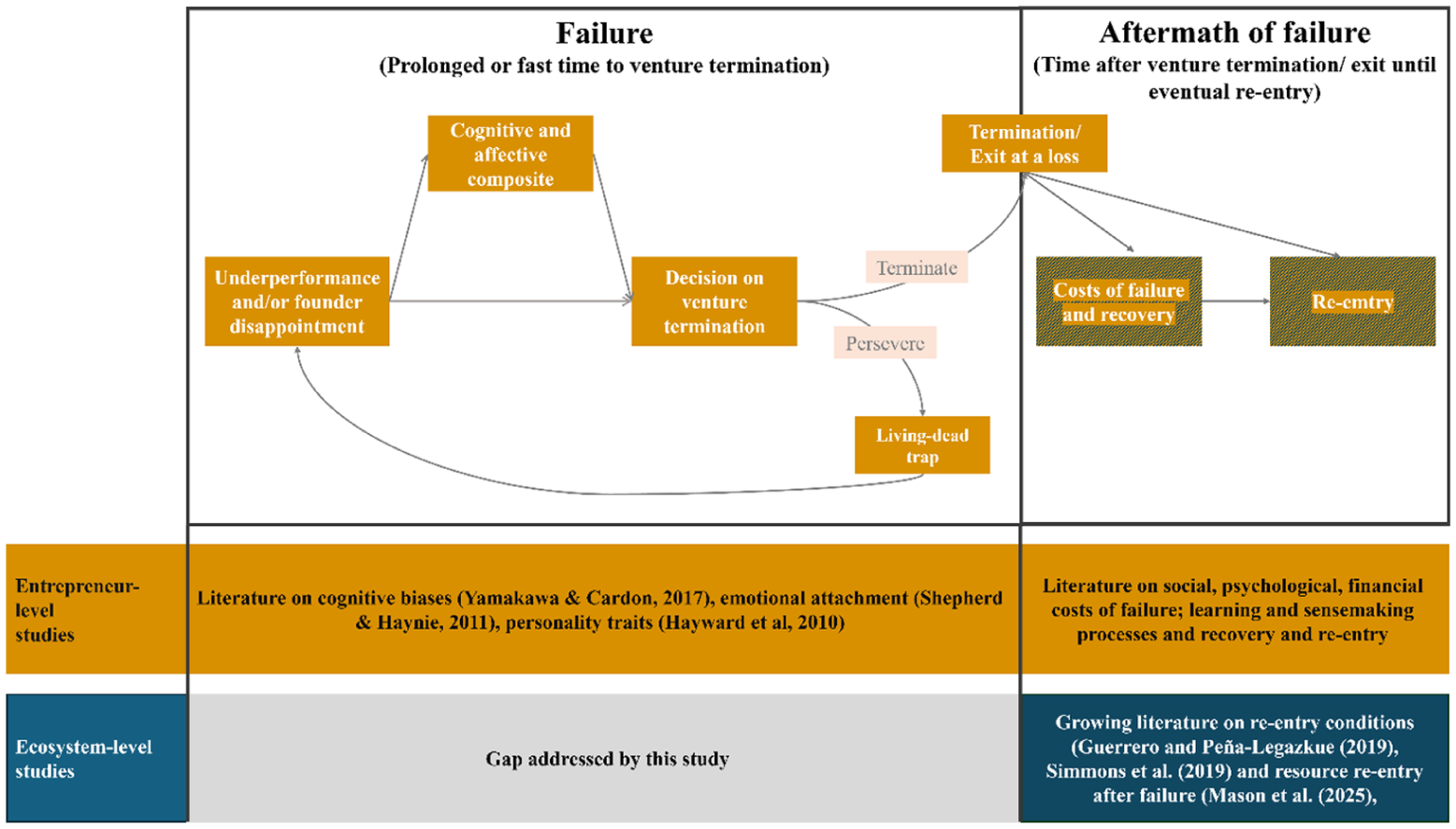
The venture decline and termination decision-making process (adapted from Casas and Hilb, 2016), situated within entrepreneur-level and ecosystem-level research streams.
Methodology
To gain deeper insight into how the entrepreneurial ecosystem shapes the decisions of startup entrepreneurs during venture failure towards termination, the study employs a qualitative case study approach informed by critical realism. Case studies are widely used in contextualised entrepreneurship research (Hruskova, 2024; Wurth et al., 2022), as they allow for an in-depth analysis of complex real-life phenomena within specific settings (Easton, 2010; Yin, 1994). A critical realist lens further enables us to move beyond observable elements to examine the underlying social, economic, and cultural factors, as well as the causal mechanisms shaping these phenomena (Sayer, 2000; Wynn Jr and Williams, 2012). The study is situated in the entrepreneurial ecosystem of Amsterdam, the Netherlands. Despite being recognised as Europe’s third strongest ecosystem, it struggles to convert its robust pipeline of early-stage startups into thriving scaleups, with many ventures stagnating and failing to progress beyond the seed stage (Stam, 2014; Techleap and Utrecht University, 2022). This context presents a suitable critical case to explore the impact of a thriving entrepreneurial environment on entrepreneurs’ decisions to discontinue unviable and moribund ventures (Flyvbjerg, 2006).
Research setting
In recent decades, Amsterdam has become one of Europe’s fastest growing entrepreneurial ecosystems, exhibiting one of the highest rates of new startups (Henz et al., 2022). This development has been driven by a favourable local cultural environment that values starting a business (Snijders et al., 2023; Techleap and Utrecht University, 2022). Additionally, many higher educational institutions—including two academic universities, a university of applied sciences, and numerous vocational schools—offer entrepreneurship education. Together with more than 35 accelerators, incubators, and venture builders, and myriad events and communities, this environment encourages and guides aspiring startup entrepreneurs that generate a significant volume of startups (Simon, 2019). Furthermore, early-stage capital is relatively accessible, and the affluent, innovation-friendly market offers a significant initial customer base (Sifted, 2022). However, the ecosystem’s support for scaling these startups is significantly weaker. This phenomenon has been described as the “Dutch Entrepreneurship Paradox” where increased startup activity does not inherently lead to increased innovation and economic growth because many ventures fail to progress beyond the seed stage (Stam, 2014; Techleap and Utrecht University, 2022). The Netherlands’ scaleup ratio of 21.5% is below the European average of 23%, and is significantly outperformed by Germany (40.6%), the United Kingdom (27.4%), and the United States (54%) (Techleap, 2025). Cultural factors such as risk aversion and a preference for stability and work–life balance deter many entrepreneurs from pursuing growth (Techleap and Utrecht University, 2022) The small size of the Dutch market necessitates early international expansion, and those entrepreneurs who do aim to expand their ventures face substantial challenges on account of the scarcity of growth capital and talent (Henz et al., 2022). Moreover, there are relatively few successful exited founders in Amsterdam who can invest in and mentor growth-oriented entrepreneurs (Sifted, 2022; Techleap, 2025).
Data collection
This study draws on several data sources to conduct a holistic analysis of the role of the entrepreneurial ecosystem in shaping the venture termination decisions of entrepreneurs. These sources include semi-structured interviews with the founders of failed businesses and key stakeholders, participant observations at entrepreneurship events, document analysis, and a stakeholder feedback event (Eisenhardt, 1989).
The first author recruited the participants via a multi-stage sampling approach. First, potential participants were identified through online sources and startup media (Simon, 2019; StartupAmsterdam, 2024). Following a snowball sampling strategy (Khelil, 2016; Neergaard, 2007), those who participated in the research made referrals to additional relevant participants. To ensure broader representation, internet-mediated purposive sampling (Hewson, 2014) of entrepreneurs was also conducted, with participants identified through LinkedIn, startup websites, and industry blogs. This combination of stakeholder-driven snowball sampling and online purposive sampling helped mitigate network biases and ensured a holistic sample of both diverse stakeholders and entrepreneurs, each with strong ties to numerous different stakeholders and those operating more independently in the ecosystem.
Subsequently, the first author conducted 30 interviews with entrepreneurs whose ventures had failed (see Table 1). These entrepreneurs were selected based on three main criteria. First, they had to demonstrate ambition in their venturing efforts, 1 reflecting the focus of the entrepreneurial ecosystems on fostering high-growth and innovation-driven entrepreneurship (Mason and Brown, 2014; Wurth et al., 2022). Second, they were required to have experienced entrepreneurial failure, following Khelil’s (2016) definition. Accordingly, the sample includes not only entrepreneurs whose ventures became technically insolvent, but also those whose ventures were discontinued after failing to reach their anticipated potential (Cooper and Artz, 1995), a situation often associated with resource misallocation at the ecosystem level (Coelho and McClure, 2005). Third, we purposively sampled entrepreneurs at different stages of ecosystem engagement (0.5–9 years in business) who were interacting with various support organisations (see Table 1) to capture diverse ecosystem interaction experiences. The interviews focused on the interconnected factors that influenced the entrepreneurs’ decision to terminate their ventures. The interviews were conducted in English, lasted an average of one hour, and were conducted either in-person or online. Relevant passages were transcribed, resulting in 1220 pages 2 of data.
Overview of interviewed entrepreneurs whose ventures failed.
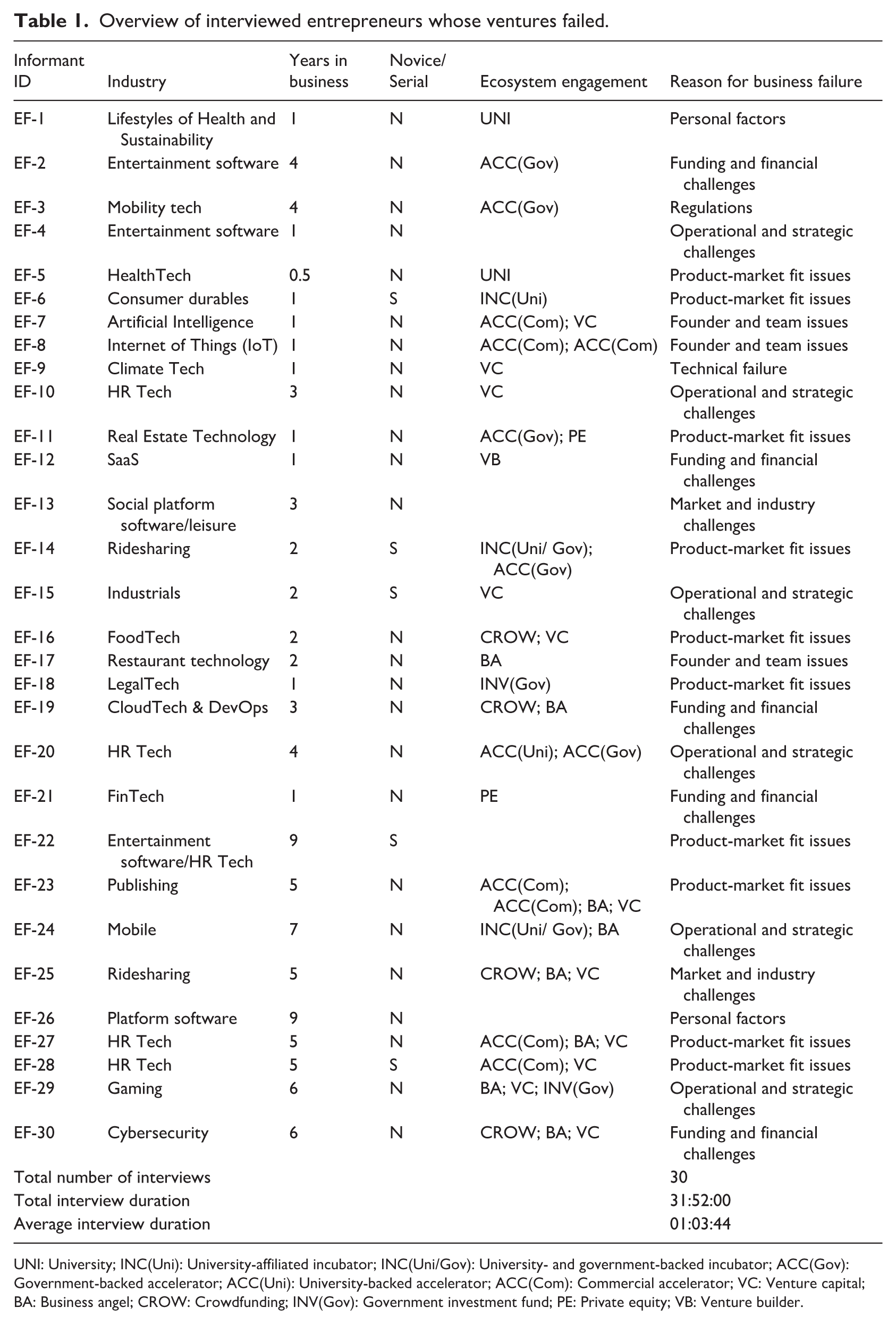
UNI: University; INC(Uni): University-affiliated incubator; INC(Uni/Gov): University- and government-backed incubator; ACC(Gov): Government-backed accelerator; ACC(Uni): University-backed accelerator; ACC(Com): Commercial accelerator; VC: Venture capital; BA: Business angel; CROW: Crowdfunding; INV(Gov): Government investment fund; PE: Private equity; VB: Venture builder.
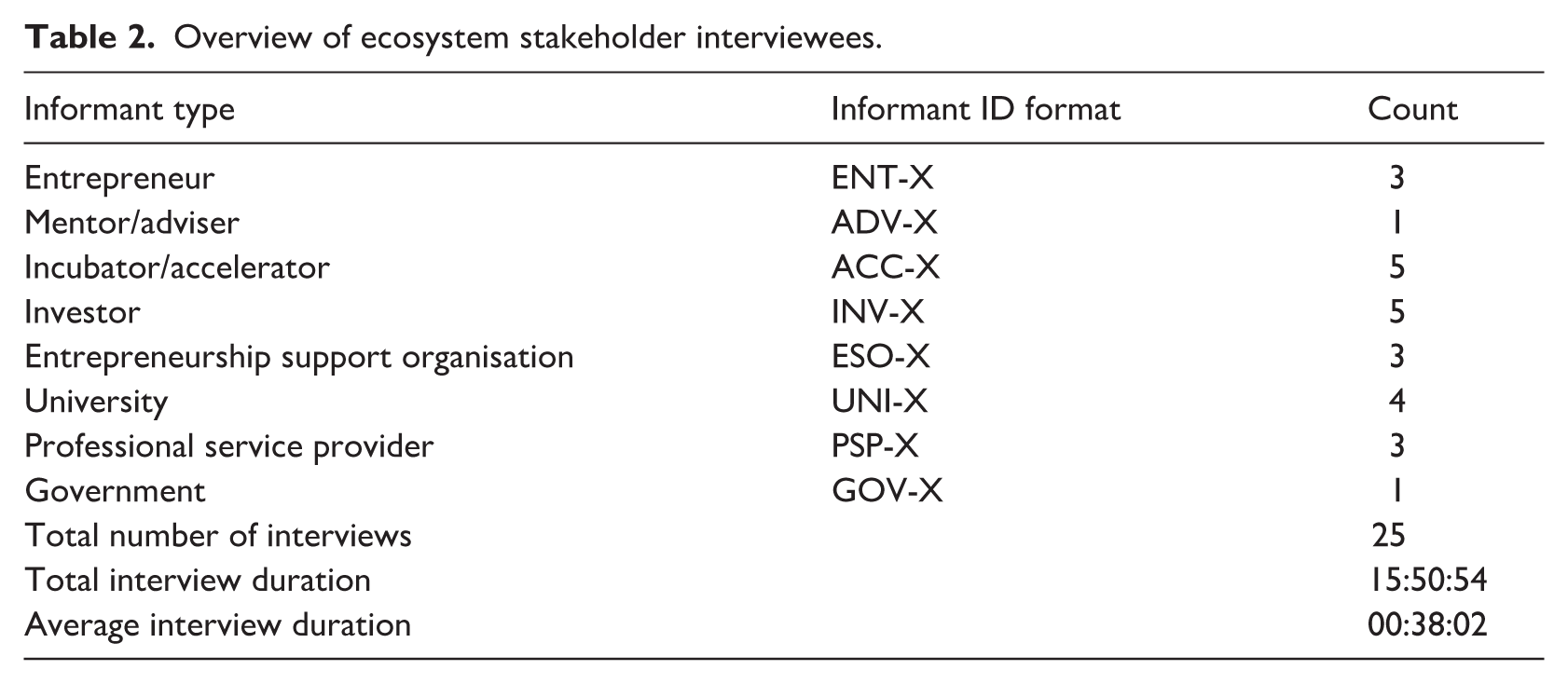
In addition, 25 ecosystem stakeholders, including university educators, support organisation employees, investors, and government officials, were interviewed (see Table 2). These interviews focused on the perceptions of stakeholders of the local failure culture and ways they prepare entrepreneurs for failure or extend their support to entrepreneurs during venture decline. These interviews were also conducted in English, audio-recorded, and lasted on average 38 minutes.
Overview of ecosystem stakeholder interviewees.
Secondary data were also collected to complement the interviews. In total, we reviewed over 120 sources, including more than 40 electronic articles from Dutch startup media outlets such as Silicon Canals and MT Sprout, as well as blog entries and LinkedIn posts from Dutch entrepreneurs whose businesses failed. These sources provided additional insights into the business failure trajectories of the entrepreneurs we studied and helped to identify additional interviewees. In addition, we examined global and European startup rankings (approximately, 5000 pages), industry reports (1500 pages), government policy documents (275 pages), and books (440 pages). Together, these secondary data sources enabled us to establish an overview of Amsterdam’s entrepreneurial ecosystem and its support structures related to business failure, while also serving to verify and cross-check key trends in the broader Dutch startup ecosystem identified in the interviews. Moreover, 10 entrepreneurship events were attended by the first author. Particular attention was given to both the official topics discussed and the informal conversations among participants and whether they centred on growth and success or on discussions of struggles and failure experiences. Beyond these insights, the attendance at these events helped in identifying four interview participants. Finally, a stakeholder feedback event was conducted after the initial data collection phase where preliminary findings were shared with participants and other key stakeholders. Their reflections provided additional insights that were incorporated into the analysis. The use of multiple data sources helped not only to develop a clear and nuanced understanding of the research setting, but also in triangulating data for enhanced validity and reliability (Eisenhardt, 1989).
Data analysis
We followed an inductive, grounded data analysis approach consistent with the Gioia methodology (Gioia, 2021; Magnani and Gioia, 2023) to move iteratively from participants’ accounts toward theoretical abstraction. Our analysis involved systematic cycling between empirical data and emerging theory, using retroductive reasoning to develop plausible explanations for observed patterns (Downward and Mearman, 2006). Throughout the process, the authors engaged in regular discussions to challenge interpretations and refine emerging insights (Locke, 2011).
We began by transcribing all interviews and constructing case records for each entrepreneur, combining interview transcripts with secondary materials (e.g. media coverage and online profiles) related to the entrepreneur and their firm’s failure. These materials were used to enrich contextual understanding and to mitigate potential recall or hindsight bias (Fischhoff, 1982), but are not cited directly to preserve confidentiality. Stakeholder interviews were organised by stakeholder type and triangulated with secondary sources (e.g. policy reports and media coverage) to establish background context prior to coding.
In the first stage of analysis, we conducted open, informant-centric coding, developing first-order concepts that closely reflected participants’ own language and meanings (Gioia, 2021). Although the paper focuses on the entrepreneurial ecosystem, we initially attended to experiences and interpretations at the entrepreneur, venture, and ecosystem levels to avoid premature conflation. Coding captured both the entrepreneur’s narrated failure experiences and stakeholders accounts of ecosystem dynamics, allowing parallel perspectives on the same phenomena. In the second stage, we engaged in iterative comparison and abstraction to develop second-order themes that reflected more theory-informed interpretations of recurring patterns, processes, and tensions across interviews. While remaining grounded in the data, these themes increasingly drew on existing theoretical concepts to explain how entrepreneurial failure trajectories and support unfolded within the ecosystem. Entrepreneur and stakeholder datasets were compared and integrated at this stage to surface shared dynamics and contradictions. In the final stage, we distilled the second-order themes into a smaller set of aggregate dimensions that captured the core theoretical insights of the study. Through this process, we identified two central paradoxes, the fast failure paradox and the failure support paradox, which create persistent tensions between promotional discourses, ecosystem practices, and cultural orientations shaping entrepreneurial failure outcomes. These paradoxes form the core of the analysis presented in the next section. Figure 3 illustrates the resulting data structure, progressing from first-order concepts to second-order themes and aggregate dimensions.

Visualisation of data analysis (entrepreneur codes in blue; stakeholder codes in orange).
Findings
Our analysis identifies two distinct paradoxes: the fast failure paradox and the failure support paradox. The fast failure paradox arises when narrative of ecosystem stakeholders encourages fast failure, yet misaligned incentives and governance gaps produce “support traps” that delay it. The failure support paradox reflects a disconnect between ecosystem stakeholders who are willing to provide support and founders who experience a lack of confidential, objective, and expert guidance, and who may hesitate to seek help due to cultural norms of pride and shame.
The fast failure paradox
Promotion of a “fail-fast” ethos
The lean startup methodology and the associated concept of “failing fast” are widespread within Amsterdam’s entrepreneurial ecosystem. The lean startup methodology encourages rapid experimentation, validated learning, and customer feedback to develop products in a resource-efficient manner (Ries, 2011; Shepherd and Gruber, 2021), “instead of just build[ing] an idea, and not knowing if it’s really solving a problem and how it’s solving a problem” (EF-16). The underlying idea behind this methodology is that it allows entrepreneurs to quickly identify flaws and pivot or abandon unviable concepts as soon as possible. Amsterdam’s ecosystem stakeholders promote and embed this methodology through various mechanisms such as university education, accelerator programming, and entrepreneurial events.
Educational entrepreneurship programmes at universities incorporate the principles of lean startup in their curricula (EF-1, EF-3, EF-17), requiring students to develop their own business concepts and apply the taught methodologies to rapidly decide on whether to proceed, pivot, or discontinue the venture (UNI-2, UNI-3). Similarly, startup accelerators follow the lean startup methodology (EF-6, EF-27, EF-28, ACC-1, ENT-1) teaching entrepreneurs that “if you need to fail, do it fast” (ACC-1). Investors also foster this mindset by encouraging their portfolio startups to “experiment, fail fast, [and] use the outcomes to your advantage” (INV-1). Additionally, many entrepreneurs “learn [. . .] about fail fast and lean startup approaches through attending events” (EF-16). Failing fast has been the focus of conferences and events hosted by VCs, co-working spaces, and other stakeholders (Guzun, 2021; TNW, 2024). In one instance, for example, Eric Ries, successful entrepreneur and writer of the book “The Lean Startup,” delivered a talk on the topic (Amsterdam, 2016). Another example is the hosting of “failure nights” (INV-1, INV-2, INV-3) “where they talk about failing forward” (EF-15). One investor elaborates that a reason why we hosted these [failure nights] is because hearing a failure story from a successful entrepreneur [. . .] makes talking about failure way more easy and adds [. . .] perspective on what failure actually is [. . .]. It is not necessarily bad to fail your startup because you learn a lot from it. And probably in the next startup, that you’ll build, you won’t have all the failures (F2).
Together, this evidence illustrates the widespread promotion of a fail-fast ethos in Amsterdam’s ecosystem. This ethos, however, presents a paradox, being counterbalanced by cultural values glorifying perseverance and various failure-prolonging mechanisms, which we examine in turn.
Cultural reinforcement of persistence
First, the broad promotion of “failing fast” stands in sharp contrast with the focus on perseverance that is deeply engrained into Dutch culture (EF-4, EF-8, EF-15, EF-20, EF-28, UNI-1, ACC-2, GOV-1, ESO-2, PSP-1). Participants (EF-4, EF-8, UNI-1, ESO-2, PSP-1) emphasise how this notion is rooted in the Dutch educational system, in which they are taught from a young age “that [. . .] if you’re failing, you’re not a good person. This early lesson goes quite deep psychologically” (PSP-1) and ultimately shapes the prevailing mindset that failure is something to be avoided at all costs, rather than an opportunity for growth. As a result, many entrepreneurs struggle to embrace fast failure and instead default to the “perfect product syndrome” (UNI-3). EF-17 elaborates on how this tendency unfolds during the startup process: I’ve always learned from growing up [. . .] that you need to do it right the first time. [. . .] And then you learn about Lean Startup, and that all makes sense until you’re building your own product. And then you’re like: “No, but I want it to be perfect. I’m not going to produce a shitty product.”
By perfecting their product, however, entrepreneurs delay market testing, and the critical feedback needed to decide whether to proceed, pivot, or abandon their venture.
The emphasis on perseverance is further reinforced by media narratives and educational programmes through the idea that “the entrepreneurs that persevere and keep trying, are the ones who succeed” (EF-17). Though potentially motivating, this mindset also encourages founders not to give up when they encounter setbacks, as illustrated by EF-26’s statement: “They always say: ‘never give up’. But that’s an issue; sometimes the best thing you can do is to be smart and quit.”
Failure prolonging mechanisms
Second, failing entrepreneurs receive signals from ecosystem stakeholders that cause them to prolong their failure. For example, while accelerator programmes claim to speed up the venture cycle, entrepreneurs find that these programmes actually “take lots of time because you have to present something, or you have to prepare something [. . .]” (EF-20), and participants are required to attend mandatory workshops which are described as “very academic and corporate” (EF-8) whereas “it would be good to focus more on your company” (EF-3). Furthermore, ecosystem stakeholders observe the presence of so-called “wannapreneurs” (UNI-1) or “lifestyle entrepreneurs” (EF-28, ADV-1) who “live off of the funding from accelerators [. . .] and it [. . .] sort of takes the pressure off for them to try to raise funding” (EF-28). One accelerator manager (ADV-1) states that this behaviour is increasing because the “[. . .] the market of startup accelerators and incubators is so saturated,” causing accelerators to accept lower quality startups: If I look at our programme this year, we only selected seven startups and everybody was putting pressure on to go for more because we have the capacity. But we shouldn’t take second best [. . .] because then you’re just [. . .] paying for the failure.
Similarly, university-based technology transfers offices (TTOs) find that their portfolio companies often turn into zombie ventures.
3
One entrepreneur, now in their role as a TTO manager (EF-9), observes that many of their portfolio companies do not achieve progress and ultimately morph into grant machines, because for lots of governmental academic grants you need to collaborate with a business. And then the professor has his or her own business, which they then write on the grants [. . .] and that then becomes a way of funding academic research.
Governments also provide failing ventures with funding, thereby taking over the “lemons” from the market which sustains uneconomic ventures (Coelho and McClure, 2005). This concept applies both to the ongoing support that the municipal government provides to financially troubled businesses in the Netherlands and the emergency funding that governments provided during the COVID-19 pandemic. Thus, while both forms of funding might provide essential relief to distressed companies, their support may sustain underperforming firms without addressing their underlying weaknesses.
Private investors also exert significant pressure on entrepreneurs to continue. An investor (INV-4) explains that “there’s not a real incentive from an investment perspective to close down operations” and instead “there may a benefit in keeping on trying to pivot and make it successful.” Beyond purely monetary motivations, investors also develop emotional attachment to the startups they have invested in. They often “spend [. . .] years of blood, sweat, and tears” supporting them which makes it “hard to let go” (INV-1). The pressure that investors exert on their investee ventures to continue was reported by numerous entrepreneurs in this study (EF-20, EF-21, EF-23, EF-29, EF-30). For instance, EF-20 felt drained and wanted to terminate their venture but “every time they [investors] saw a little bit of energy, they kept pushing me a little bit towards continuing [. . .]” until “at one point, I just said that enough is enough, I can’t do it anymore.” This was also the case for EF-30 whose investor added further pressure: They became very vocal and were sort of threatening to sue us. It was unpleasant because you want to stop running the company, but if you stop too soon the investors may sue you; and then they have all the money and the power, and you are broke.
Ultimately, these entrepreneurs continued with their failing ventures despite exceeding both their physical and mental capacity under duress from those with a financial stake in the business.
In summary, these findings point to a fast failure paradox. While ecosystem stakeholders promote the principle of failing fast, they simultaneously reinforce persistence through reproducing cultural narratives, providing distorted signals, and exerting pressure to continue. Taken together, these dynamics show that venture termination decisions are shaped not only by individual characteristics but also by the broader ecosystem context; dynamics that, as the next section shows, also underpin the paradox of failure support.
The failure support paradox
Stakeholder narratives of support provision
Many ecosystem stakeholders have a variety of structures in place to offer failing entrepreneurs guidance and support. For example, one accelerator manager explains that they “put programmes and support systems in place to make sure that they actually turn around potential failure” (ESO-1). Another accelerator manager (ACC-2) advises founders on whether “it’s smart to actually close down.” They explain that they “try to sell them [alumni startups] before they close down for a minimum price” whereas if they “believe in the founder” they may also “try to find another solution with them.” In another case, an accelerator manager who previously experienced failure as an entrepreneur developed a performance-based exit strategy with a founder who “was unsure about whether to continue the business or not” (EF-28), which prevented the entrepreneur from persisting with their failing venture for too long.
Investors also position themselves as “active stewards” (INV-3), monitoring their startups through monthly reports which allows them to spot any issues early on (INV-1, INV-2, INV-3). Further, they emphasise that they are “founder-friendly” (INV-3), building trusting relationships that encourages their founders to communicate any issues “quite early on instead of waiting until things really go badly” (INV-3).
Finally, government stakeholders extend their support to entrepreneurs whose ventures are facing difficulties. For example, the local municipality offers personal assistance to failing entrepreneurs: When you’re starting to fail or starting to have the feeling that this might fail, then you come to us. And that’s when we chip in to see what we can do. And we always hope that there’s still some saving of the business possible. (GOV-2)
Similarly, the Dutch Chamber of Commerce introduced the “Zwaar Weer” (“Heavy Weather”) programme on their website, including a phone number for personal support, a guide on navigating financial difficulties, and a list of independent organisations that offer support (GOV-2, KvK, 2024).
This evidence shows ecosystem stakeholders claiming to actively support entrepreneurs during times of business distress. However, the analysis simultaneously indicates that entrepreneurs feel ashamed about their situation with the consequence that they refrain from seeking support, or struggle to access support that meets their needs. We examine these dynamics in turn.
Cultural and emotional barriers to seeking support
Entrepreneurs “don’t really share when they fail” (EF-4) due to feelings of shame: “I don’t know, how [they] could have known that we were about to close down, because you sort of put on a brave face at the time” (EF-12). Another founder (EF-4) went on to elaborate: There’s quite a few [entrepreneurs] who go on with their failing businesses. And that gets to a certain level of pathetic, because everybody knows, but nobody also speaks out like, “hey, maybe you should stop,” because you don’t talk about it. It’s just very pathetic.
Numerous entrepreneurs (EF-12, EF-15, EF-17, EF-18, EF-24) reported that they tried to solve the issues that occurred at the end of their ventures on their own. They believed that “I should fix it myself because [. . .] entrepreneurs are self-supporting [and] it’s a founder’s pride to deal with stuff yourself” (EF-18). Participants further stated that if they did discuss their struggles, they “always show the positive side” (EF-11). But because having to put on a “happy face” (EF-30) or a “brave face” (EF-12) during business distress “was tiring” (EF-30) or caused them to “become sarcastic about your own situation” (EF-30), they ultimately ceased engaging with the entrepreneurial community.
This hesitance of entrepreneurs to seek support when their ventures are failing makes it more difficult for ecosystem stakeholders to help. As one founder (EF-17) stated, From the moment things were going downhill [. . .] I started sending less updates to them [because] it doesn’t feel great to write an investor update if you’re not doing great. [. . .] And if I had done that, maybe one of the investors would have said: “Hey, let me help you. I’m going to invest more, or I’m going to connect you to this person or this coach.”
This is endorsed by an employee at the local municipality (GOV-2): “It’s just in the entrepreneur’s nature to try to solve the problem themselves. So, it’s not only that they don’t come to us, but they don’t speak to colleagues, they don’t speak to families. It’s a big problem.” The TTO manager, who “doesn’t get emails from founders that are about to fail” (UNI-4), echoes this view. One ecosystem stakeholder (UNI-1), who managed an accelerator programme for many years, further highlights the challenge entrepreneurs face when they must proactively seek support during times of trouble: It is sort of a social norm to say that you accept it [failure]. I’ve seen hundreds of startups, and when I talked to the founders about how things were going, it was almost impossible for them to share their problems with me. And many times, it required some more extensive talks or some trust building until they started to share their problems.
Entrepreneurs and perceived lack of appropriate support
Entrepreneurs struggle to access objective, confidential, and expertise-based support within the ecosystem. Entrepreneurs highlight the need for objective support from “somebody who is independent, who is there for you, and not somebody who has a double interest in shares” (EF-20). Beyond that, they stress the importance of confidentiality because “if you say at a meeting that it’s not going that well, often rumour gets spread” (EF-9). Entrepreneurs further illustrate the importance of expert advice: “You need people who understand where you’re coming from. [. . .] It’s delicate.” (EF-21). Hence, they (EF-21, EF-23) emphasise the importance of “talk[ing] to someone who has gone through the same” (EF-21) as these individuals are able to empathise with the distressed startup founder and offer practical insights that can typically only be gained through first-hand experience.
While founders emphasise the need for objective, confidential, and expert support during the business decline phase, they also highlight a lack of clarity about where to seek such assistance (EF-17, EF-20, EF-21, EF-23). One entrepreneur emphasises that this is caused by an overarching problem of misaligned incentives in the ecosystem, stating that “it is always in pretty much everyone’s interests to keep building the company except for the founders [. . .] who are putting their time and money and life on the line” (EF-23). For example, some entrepreneurs (EF-12, EF-20) felt that their investors were not neutral advisors “because when you’re invested, you want a good average return on investment and that is biasing you, especially during hard times” (EF-20). This founder further illustrates how colliding interests between them and their investors took a mental toll on them: During hard times an invested advisor would advise me against what’s best for me as a person because they really look at their own interests. [. . .] For example, they said, “things are not going well, why don’t you do recruitment, just to get cash into the company?” And I specifically didn’t want to do recruitment, because I wanted to help people. So, they were just looking at the financial side, while I was looking at: what do I want to do.
Furthermore, entrepreneurs articulate a lack of knowledge about what to do when they fail. While educational programmes have integrated the lean startup paradigm into their curricula, entrepreneurs (EF-8, EF-11, EF-27) note that there was “no particular workshop to talk about failure” (EF-27), which results in “not enough [education about] what happens when things don’t go according to plan” (EF-8). The consequence is that entrepreneurs lack the ability to identify early warning signals of failure, and don’t know where to seek help when facing adversity.
None of our participants received support during business distress from the accelerators they previously joined. They felt that “accelerators are not designed to support startups long-term” (ADV-1) and hence “never really followed up [. . .] or checked how the startup is going or anything” (ENT-2). Similarly, although government organisations have programmes available for entrepreneurs experiencing business distress, none of our participants knew about or utilised this support. A municipality employee (GOV-2) explains that this is because entrepreneurs “don’t know that our support exist [. . .]” or believe that “[. . .] going to the municipality for help [. . .] is the only alternative from jumping off the roof [. . .] because they have this image about civil servants who don’t know what it is like to run a business.” This issue is further complicated as the support provided by the municipality and the Chamber of Commerce are targeted at “the self-employed [and] the really small businesses, not the startup ecosystem” (GOV-2), which creates the perception amongst founders that they “don’t even know how to handle startups, because they are used to freelancer[s] and not to startup-ish, young, ambitious people” (EF-20).
Taken together, these findings reveal a failure support paradox. While the support pipeline for ideation and early-stage development is relatively robust, it appears to falter at the failure stage. Although stakeholders claim to support entrepreneurs in navigating business decline, founders in distress often withdraw from the entrepreneurial ecosystem. This withdrawal is shaped by the stigma associated with failure, cultural expectations around self-reliance and personal responsibility, and dominant startup narratives that celebrate rapid success and reinforce feelings of inadequacy among struggling founders. As a result, founders become disconnected from the very support structures that might help them navigate venture decline.
Discussion
This article offers two significant contributions to the literature. First, we address the individual-centric bias in failure research by examining how ecosystem actors and conditions shape founder venture termination decisions. In doing so, we challenge the prevailing assumption that “founders holding onto the last ditch are akin to free men and women building their own prison” (Casas and Hilb, 2016: 406). Instead, our findings illustrate that founder decisions during venture crises are deeply influenced by the ecosystem in which they are embedded. Hence, ecosystem stakeholders provide the very materials from which those prison walls are built. As such, our findings unpack the paradoxical role of external support identified in prior work (Sleesman et al., 2018), showing how the same actors that enable venture development can, under conditions of decline, contribute to its persistence. More precisely, we uncover four generative mechanisms through which ecosystem dynamics prolong venture failure: narrative contradiction, signal distortion, authoritative pressure, and support pipeline breakdown. Each mechanism is rooted in the empirical patterns reported above and offers a causal account of how ecosystem-level conditions shape founders’ persistence in failing ventures.
Second, we theorise how these generative mechanisms are reflections of how stakeholders pursuing their own institutional goals shape ecosystem support structures, which enable founders during growth but constrain them during decline. This challenges the dominant framing of entrepreneurial ecosystems as entrepreneur-centric systems (Acs et al., 2017; Isenberg, 2011; Mason and Brown, 2014). It reveals that although ecosystem stakeholders invoke a fast-failure rhetoric and entrepreneur-centred support framing to maintain legitimacy, their practices are driven by diverse, often conflicting institutional interests. Our second contribution thus lies in the reconceptualisation of entrepreneurial ecosystems as being mainly stakeholder-centric rather than entrepreneur-centric, rendering them, in effect, Untrepreneurial ecosystems (Hartmann et al., 2022). We elaborate on each of these contributions below.
Beyond the individual: Ecosystem mechanisms of prolonged failure
Our empirical findings challenge the prevailing assumption that the decision to terminate a struggling venture is solely an individual psychological act over which entrepreneurs have full agency, by identifying four generative mechanisms through which ecosystem dynamics prolong venture failure. Each operates at the interface between individual cognition and ecosystem structure, and each offers an explanation that individual-level theory alone cannot provide. The promotion of a fail-fast ethos and the cultural reinforcement of persistence, two aggregate dimensions identified in our data, coexist in tension within the Amsterdam ecosystem. This tension is produced by a mechanism we term narrative contradiction. Entrepreneurship education, accelerators, and events promote the lean startup methodology and its associated “fast failure” narrative. However, these are contradicted by dominant startup narratives that glorify perseverance and promote a “never give up” ethos (Chua, 2025; Nightingale and Coad, 2014; Olaison and Meier Sørensen, 2014), which reinforce the deeply embedded societal culture of failure aversion and stigma (Techleap and Utrecht University, 2022). At the ecosystem level, both paradigms serve a crucial function: fast failure prevents resource misallocation (Mason et al., 2025; Schumpeter, 1942), and perseverance sustains entrepreneurial activity (Hartmann et al., 2022). Crucially, stakeholders do not attempt to resolve this contradiction, causing it to fall onto individual founders, who, in the absence of clear institutional guidance, default to what their cultural formation taught them: that failure is weakness and persistence is virtue.
The failure-prolonging mechanisms identified in our findings such as: accelerator acceptance of weak ventures to fill cohort quotas, government funding of struggling businesses, TTO portfolio padding all point to a second generative mechanism: signal distortion. As Salancik and Pfeffer (1978) show, information in one’s social environment shapes attitudes and behaviour. Ecosystem signals, such as accelerator acceptance or government emergency funding, therefore become powerful sources of self-assessment for founders: being chosen by a legitimate institution is received as evidence that their venture is viable. However, the signals founders receive are structurally decoupled from underlying venture quality; ecosystem stakeholders send positive signals not solely because they believe in the venture but because doing so serves their own institutional interests. When founders accept these signals at face value, they simultaneously receive positive signals from the ecosystem and negative signals from the market. This ambiguity allows them to selectively attend to favourable information and discount unfavourable signals (Joseph and Gaba, 2015). The ecosystem thus, actively traps founders in continued commitment to ventures the market has already rejected.
Our findings also reveal that some founders who had explicitly voiced their desire to terminate their venture were threatened by investors to continue, pointing to a third mechanism: authoritative pressure. Prior research assumes that entrepreneurs ultimately retain control over whether and when to terminate their ventures (Birmingham et al., 2003; Bourgeois III and Eisenhardt, 1987; Ruhnka et al., 1992), and that authority pressures in escalation situations merely suppress founders from voicing critical concerns (Sleesman et al., 2018). Our data tell a different story. Investors actively deployed threats of bankruptcy proceedings and litigation to prevent venture termination, while avoiding further financial commitment themselves. By pushing entrepreneurs to continue without additional funding, investors minimised their own financial risk while shifting the burden onto founders who bore the costs in time, effort, and financial instability. This finding has a clear theoretical implication: venture termination cannot be adequately theorised as a voluntary individual decision when ecosystem actors retain legal and financial power over founders. Authoritative pressure operates as a mechanism of venture persistence that is analytically distinct from escalation of commitment, it does not require the founder to be cognitively committed to the venture, only that they lack the power to leave it.
Finally, the failure support paradox reveals a structural gap in the ecosystem’s support infrastructure: while the pipeline for ideation and early-stage development is relatively robust, it breaks down at the failure stage. Two dimensions of this breakdown emerge from our data, which together constitute the fourth generative mechanism: support pipeline breakdown. First, our findings show that stakeholders report a willingness to support founders in distress if approached, echoing a broader assumption underlying ecosystem support that entrepreneurs are proactive actors who mobilise resources and build networks (Hoang and Antoncic, 2003; Vissa, 2012). But when ventures encounter serious difficulty, our data show that founders withdraw from networks due to emotional strain, stigma, and threat responses (Cope, 2011; Singh et al., 2015). These feelings of shame are further reinforced by the startup culture with its celebration of rapid success stories (Chua, 2025; Hartmann et al., 2022), discouraging them from reaching out for support that might otherwise help them navigate venture decline (Gladstone et al., 2021). Hence, the support infrastructure, designed around the assumption of founder visibility and proactivity, is structurally unsuited to support founders at their most vulnerable moment. Second, founders reported that ecosystem actors carry their own interests in the venture’s survival, making genuinely independent support unavailable. The networks founders had built during growth were unsuitable for navigating decline, as they included the very stakeholders who had gained a stake in the venture and could not provide confidentiality.
Taken together, these generative mechanisms contribute to the entrepreneurial failure literature by reframing founders’ decisions to continue or terminate struggling ventures as a socially embedded process. Prior work highlights the importance of critical feedback and guidance for entrepreneurs in underperforming ventures (Casas and Hilb, 2016). However, ecosystem research has largely focused on supporting venture creation and growth (Wurth et al., 2022), overlooking how these same structures, as we show, become unavailable during venture decline, not because support does not exist, but because the conditions of decline make it structurally inaccessible. This results in a market failure in the provision of independent, founder-centred support, leaving entrepreneurs to navigate venture distress alone.
Untrepreneurial ecosystem dynamics: Institutional decoupling and stakeholder-centric logic
The four mechanisms identified above are not isolated phenomena. They are expressions of a single underlying dynamic, which constitutes our second and overarching theoretical contribution: we identify how stakeholders pursuing their own institutional goals shape ecosystem structures that enable founders during growth but constrain them during decline.
Existing ecosystem research frames collective action among ecosystem stakeholders as purpose-driven and entrepreneur-centred (Acs et al., 2017; Hruskova, 2024; Isenberg, 2011; Mason and Brown, 2014). Our findings suggest that this framing oversimplifies a more complex picture. Actors do not pursue a shared purpose, but rather a shared outcome of increased entrepreneurial activity which serves diverse institutional goals: investors seek returns, accelerators seek cohort activity, TTOs seek portfolio numbers, and policymakers seek favourable statistics. To maintain legitimacy within the ecosystem, stakeholders adopt entrepreneur-centred rhetoric, while continuing to pursue behaviours aligned with their own institutional interests. This reflects a decoupling between rhetoric and practice (Bromley and Powell, 2012; Meyer and Rowan, 1977), which operates through the mechanisms we have identified. Stakeholders promote fast failure, while cultural norms penalise it and stakeholder actions often contradict it (narrative contradiction). Ecosystem stakeholders send positive signals through endorsement or funding not solely because they believe in the venture but because doing so serves their own institutional interests (signal distortion). Investors deploy threats of bankruptcy proceedings and litigation to prevent venture termination while avoiding further financial commitment (authoritative pressure). Support infrastructure assumes founder proactivity, while the conditions of decline produce withdrawal (support pipeline breakdown). Taken together, these mechanisms reflect how stakeholder dynamics produce conflicting signals and pressures that remain unresolved at the ecosystem level, leaving founders to navigate venture decline without independent guidance or support.
This has consequences for how the entrepreneurial ecosystem is conceptualised in literature. Stam and van de Ven’s (2021) entrepreneurial ecosystem model, for example, defines ecosystem outcomes in terms of entrepreneurial activity, reflecting stakeholder interests rather than founder fulfilment, self-actualisation, and well-being. However, designing and evaluating ecosystems through activity-based indicators—without accounting for founder interests—produces unintended consequences for founders, including prolonged commitment to unviable ventures that hinders efficient resource allocation. Building on this, we propose the term Untrepreneurial ecosystem, derived from Hartmann et al.’s (2022) description of the Untrepreneurial economy, to describe an ecosystem that is entrepreneur-centred in rhetoric but stakeholder-centric in practice, resulting in support structures that enable founders during growth but constrain them during decline. In order to move beyond Untrepreneurial dynamics and foster truly entrepreneurial ecosystems, success metrics need to expand beyond entrepreneurial activity to include founder fulfilment and well-being.
Bringing these contributions together, we extend Casas and Hilb’s (2016) model on venture termination decision-making by incorporating the four generative mechanisms through which ecosystem dynamics prolong venture failure, and the Untrepreneurial ecosystem dynamics that shape these mechanisms (see Figure 4).
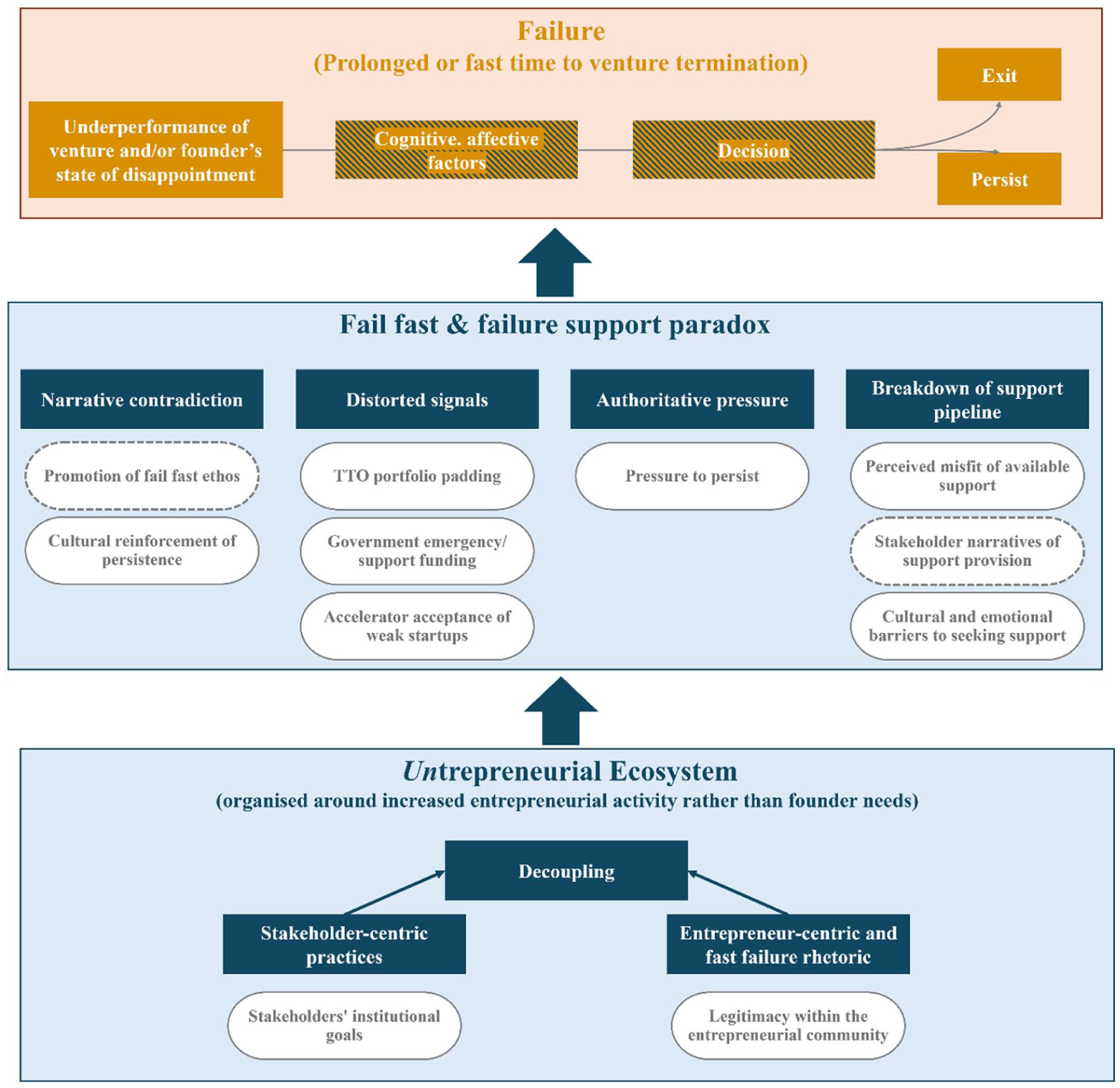
Venture decline and termination decision-making model adapted and extended from Casas and Hilb (2016) to an ecosystem-mediated process, impacted through generative mechanisms and Untrepreneurial ecosystem dynamics.
Implications for policy and practice
These insights carry important implications for policy and practice. The ecosystem stakeholders’ interests strongly influence and shape founders’ venture termination decisions, often prolonging venture commitment to unviable ventures and limiting effective resource re-allocation. Together, these dynamics sustain low-quality entrepreneurial activity at the ecosystem level.
At the founder level, ecosystem discourse often frames support as founder-centric (Hruskova, 2024; Isenberg, 2011; Mason and Brown, 2014; Stam and van de Ven, 2021), yet our findings show that support is frequently shaped by stakeholder-specific interests. As effective decision-making depends on access to honest and critical feedback about the decision environment (Gonzalez, 2005), founders need to be aware of these dynamics and critically assess stakeholder motivations and signals of endorsement. This also points to the importance of independent support structures, such as peer networks, that are not tied to vested interests in the venture.
At the ecosystem level, our findings underscore the need for policymakers and ecosystem builders to rethink how ecosystem success is defined and measured. Current ecosystem performance assessments are largely based on counts of entrepreneurial activity and support infrastructure such as incubators and accelerators (OECD, 2025). These assessments should also incorporate entrepreneur-centric indicators, such as the quality of support during venture decline, time to constructive disengagement, and rates of healthy re-entry. Ultimately, the success of an entrepreneurial ecosystem should be judged not by how many ventures it sustains, but by how effectively it enables founders to thrive, whether through growth or timely venture termination.
Limitations and future research avenues
We recognise that our study is not without its limitations, and identify four key areas to consider. First, although our single case methodology provides in-depth insights into ecosystem failure dynamics, each entrepreneurial ecosystem is unique, and the identified generative mechanisms might manifest differently in ecosystems with more failure-positive cultures or different success metrics. Comparative research across contrasting ecosystem configurations could clarify the conditions under which the identified generative mechanisms are amplified or attenuated, including contexts with more permissive failure norms (Bahrami and Evans, 1995) or chronic business turbulence (Boso et al., 2019). Moreover, research should examine Untrepreneurial ecosystem dynamics in ecosystems that are differently governed or evaluated through success measures that go beyond entrepreneurial activity, to explore whether these produce different configurations of support structures and outcomes, for instance, more founder-centric ones.
Second, this study focuses on the impact of the ecosystem on founders’ failure experiences up to venture termination, without considering subsequent failure stages or long-term and multi-level effects. We encourage future research to examine the full consequences of prolonged commitment to unviable ventures, including potential positive outcomes such as increased activity (Hartmann et al., 2022) or entrepreneurial learning, and negative consequences such as resource misallocation or founder burnout (Palmer et al., 2021), and how these consequences interact across individual, venture, and ecosystem levels. Studies could also research how these consequences impact post-termination experiences of failure, and how ecosystem dynamics shape these later stages.
Third, this study relies on retrospective accounts. While these provide us with a holistic image of the entrepreneurial failure process leading up to venture termination, retrospective accounts are also prone to recall bias and attribution errors (DeTienne et al., 2008; Fang He et al., 2018). Hence, we encourage future research that employs longitudinal and ethnographic methods, which could offer real-time insights into failure by capturing emotions, behaviours, learning, sensemaking, and stakeholder dynamics as they unfold (Fang He et al., 2018).
Fourth and finally, our study calls for research into what characterises genuinely founder-centric ecosystems. This requires a deeper understanding of differences in failure experiences as well as differences in ambitions and needs across different founder types, such as those related to mission orientation (Smollan and Singh, 2024) or founder identity (van Merriënboer et al., 2025). Future research can then explore how metrics and support structures designed around these diverse needs affect both founder outcomes and broader ecosystem dynamics.
Conclusion
The decision to terminate a failing venture is among the most consequential yet, least understood moments in the entrepreneurial journey (Casas and Hilb, 2016). While prior research has illuminated individual-level drivers of this process (Hayward et al., 2010; Lin et al., 2022; Singh et al., 2015), our study extends a contextualised view of venture termination decisions, showing how a founder’s cognitions, emotions, and agency are co-constructed through ongoing interactions with ecosystem actors and institutional narratives (Zahra et al., 2014). This reframes venture termination as an ecosystem-mediated process rather than a purely individual psychological act, advancing failure research beyond its current individual-level focus. Our study challenges the dominant framing of entrepreneurial ecosystems as collaborative, entrepreneur-centred, and purpose-driven systems (Acs et al., 2017; Isenberg, 2011; Mason and Brown, 2014). We show that ecosystem support structures are organised around stakeholder institutional goals, producing unintended consequences for founders such as prolonged commitment to unviable ventures that hinders efficient resource allocation at ecosystem-level. We thereby reframe ecosystems that measure success through entrepreneurial activity alone, such as conceptualised in Stam and van de Ven’s (2021) model, as stakeholder-centric rather than entrepreneur-centric, what we term Untrepreneurial ecosystems (Hartmann et al., 2022). For entrepreneurial ecosystems to become truly founder-centric, research needs to establish what founder-centric measures mean from founders’ own perspectives. This encompasses both the diverse goals founders pursue through their ventures including social, ecological, and community impact, and their personal fulfilment, self-actualisation, and well-being, before these can be meaningfully incorporated into ecosystem conceptualisations and used to guide the design and public funding of support structures. This opens up a new direction for ecosystem research that requires both conceptual development and empirical inquiry into what genuinely founder-centric ecosystems would look like in research and practice, moving from Untrepreneurial to truly entrepreneurial ecosystems.
Footnotes

Ethical considerations
The study was approved by the Ethics Committee of the College of Social Sciences, University of Glasgow (Ethics Approval Number: 400210002).
Consent to participate
Verbal informed consent was obtained from all participants.
Funding
The authors disclosed receipt of the following financial support for the research, authorship, and/or publication of this article: This study was supported by a PhD scholarship from the College of Social Sciences, University of Glasgow.
Declaration of conflicting interests
The authors declared no potential conflicts of interest with respect to the research, authorship, and/or publication of this article.
Data availability statement
Qualitative data from this study are not available for reuse as they are protected by confidentiality agreements.
AI use declaration
AI-assisted tools were used to support language editing and improve clarity and concision during manuscript preparation. These tools were used solely to enhance readability and structure and did not generate new content, data, interpretations, or analyses. All substantive arguments, theoretical contributions, and empirical analyses are the responsibility of the authors.