



Abstract
In this article, we examine the experiences of women digital entrepreneurs in navigating anticipated and experienced bias in venture capital and digital entrepreneurship ecosystems. Where prior research has focused primarily on evaluator-side bias and structural barriers, we develop the construct of anticipated bias as a socially produced cognitive filter, demonstrating how expectations of bias circulated through media, peer narratives, and academic discourse shape women’s interpretations of interactions with investors and ecosystem actors. Anticipated and experienced bias interact recursively, forming a cyclical process that validates expectations and informs entrepreneurial behaviours. By theorising this recursive loop, we apply stigma consciousness theory to women digital entrepreneurship and suggest lower venture capital uptake is a strategic response to constraint rather than an ambition deficit. Providing empirically grounded accounts from women-founded startups, we counter celebratory narratives portraying digitalisation as a levelling force. Instead, we show how male-centred prototype and routinised practices of othering produce layered role incongruity, positioning women as outsiders.
Introduction
Despite hopes that digital technologies would democratise entrepreneurship (Nambisan, 2017) and reduce gender disparities (Martinez-Dy et al., 2017; McAdam et al., 2020; Suseno and Abbott, 2021; Ughetto et al., 2020), women remain persistently underrepresented in digital entrepreneurship (DE). Only 17% of startup teams include women, falling to 8% at later growth stages (Teare, 2021), and women-led unicorns remain rare (Pantin, 2021). Women capture only a small sliver of startup funding: in 2024, startups founded exclusively by women attracted only 1% of total venture capital (VC) investment in the United States, a decline from 2% in 2023 (PitchBook, 2025b). The pattern is even more pronounced in Europe, where all-women founding teams secured just 0.5% of VC funding, down from 1.8% the previous year (PitchBook, 2025a). In Australia, where women received only 2% of start-up funding over the 2025 financial year (Blackbird Investment Report, 2025; McGuire and Bennett, 2025), 82% of women founders believed gender affected their ability to raise VC funding (Deloitte Access Economics, 2022).
Explanations remain contested. Some scholars emphasise biased investors (Tonoyan and Strohmeyer, 2021) and gendered questioning and expectations in pitching and evaluation (Balachandra et al., 2019; Kanze et al., 2018). Male overrepresentation in digital entrepreneurship is sustained not solely by entry barriers but by a self-reinforcing cycle that perpetuates a predominantly male status quo (Sperber and Linder, 2023). Persistent beliefs that equate entrepreneurial success with men (Eddleston et al., 2016) sustain a prototype of the ideal founder – a young, white, tech-savvy male – that shapes investor judgements (Durand and Paolella, 2013; Marlow and McAdam, 2012) and renders women digital entrepreneurs “too distinct” for fair evaluation (Kanze et al., 2020; Sperber and Linder, 2023: 914). Another stream of research suggests that women’s lower capital inflows reflect differences in the amount of funding they seek, rather than solely discriminatory treatment (Coleman and Robb, 2009; Morris et al., 2006). As Ewens and Townsend (2020) note, underrepresentation among funded founders may mirror underrepresentation in the applicant pool. Guzman and Kacperczyk (2019) attribute around 65% of funding disadvantage faced by women-led startups to observable differences in startup types (fewer patents or intellectual property), with the remaining share reflecting an unexplained gap consistent with gender bias.
Importantly, however, the evidence on gendered funding outcomes is not uniform across sources. Research shows that crowdfunding campaigns are more successful when founders explicitly signal gender, adopt female-oriented language, avoid overtly promotional tones, operate in male-dominated sectors, and set higher funding targets (Wesemann and Wincent, 2021). Emphasising female founder identity can enhance outcomes by activating solidarity among women and fairness motivations among men, reframing gender from a disadvantage into an asset (Bapna and Ganco, 2021; Greenberg and Mollick, 2017). In this context, stereotypes and resource-provider biases, typically disadvantageous in raising VC, may paradoxically generate positive effects for women entrepreneurs (Johnson et al., 2018).
These mixed findings illustrate the need for context-sensitive research on how gender bias operates across entrepreneurial settings (Williams et al., 2019). Yet, evidence on how bias is experienced by entrepreneurs themselves remains limited (Titus et al., 2025), in part because prior work has largely centred on evaluator decisions such as investors allocating capital (Johnson et al., 2018; Kanze et al., 2020) or judges assessing pitches and competitions (Lee and Huang, 2018). Despite repeated calls for new research approaches and clearer articulation of the mechanisms and rationales through which gender bias shapes outcomes (Jennings and Tonoyan, 2022), the field has yet to address these important shortcomings (Foss et al., 2019). To advance this perspective, we engage with the concept of stigma consciousness (Pinel, 1999) and contend that bias affects individuals not only through direct experience but also through perceived or observed incidents (Rim and Kim, 2024). Stigma consciousness refers to a chronic expectation of being stereotyped on the basis of group membership (Pinel, 1999). It is associated with greater vigilance for bias and a higher likelihood of attributing ambiguous negative outcomes to bias, over and above prior experiences of bias (Pinel, 2004). Although often treated as an individual difference, its expression is shaped by situational cues that make stigma salient (Pinel, 2004). Accordingly, we ask: how do women digital entrepreneurs experience bias during start-up processes? We address this question through a qualitative study of 31 women-founded digital startups in Australia. We specifically explore two interrelated research questions:
Within this article, we offer three contributions. First, we advance entrepreneurship research on gender bias by theorising anticipated bias as a socially produced cognitive filter through which women digital entrepreneurs interpret and respond to interactions with VC investors and DE ecosystem actors. Moving beyond work centred on investor-side biases and decision logics (Anglin et al., 2022; Kanze et al., 2018; Lee and Huang, 2018; Malmström et al., 2017), we develop a process model showing how anticipated and experienced bias interact recursively, continually reshaping expectations, reinforcing inequities, and influencing strategic responses. This extends stigma consciousness theory (Pinel, 1999) into entrepreneurship research, by specifying how anticipation is sustained through ecosystem-level circulation of narratives and cues, consistent with evidence that expectations of bias shape behavioural strategies in professional settings (Aksoy et al., 2023; Alston, 2022; Charness et al., 2020). We suggest this recursive relationship is particularly influential in VC-facing startup contexts characterised by high uncertainty (Conti et al., 2013; Edelman et al., 2021). Second, we contribute to digital entrepreneurship scholarship by questioning the “democratisation” of digital entrepreneurship (Nambisan, 2017: 1032) and showing that digitalisation can intensify gendered legitimacy dynamics. Specifically, we outline how VC-facing DE ecosystems reproduce a male-centred “ideal founder” (Sperber and Linder, 2023) and routinise othering through discursive markers (“female founder” and “woman entrepreneur”), symbolic inclusion (tokenistic visibility roles), and exclusionary cultural repertoires (“boy’s club” networking). As othering shapes women’s perceptions of DE and their expectations of future interactions, we frame DE ecosystems as gendered arenas where legitimacy judgements are continually reproduced and normalised. By identifying multi-layered forms of othering, we reconceptualise DE as a space where structural inequities are not dissolved but re-inscribed through new mechanisms (Heizmann and Liu, 2022; Martinez-Dy and Jayawarna, 2020; Martinez-Dy et al., 2017). Third, our findings reframe women’s lower uptake of VC funding as strategic agency under constraint rather than an ambition deficit. We show how women’s decisions to not to engage with VC investors are anticipatory adaptations to bias, challenging explanations that attribute gendered funding disparities primarily to lower growth orientation or weaker demand for capital (Coleman and Robb, 2012; Kwapisz and Hechavarría, 2017; Morris et al., 2006).
This article is structured as follows. We first situate women’s digital entrepreneurship within debates about the democratising promise of digitalisation and the persistence of gendered legitimacy dynamics in VC-facing startup ecosystems. The theoretical framing that underpins our arguments is developed, drawing on stigma consciousness theory (Pinel, 1999) to conceptualise anticipated bias alongside established accounts of investor-side bias. Next, we outline our qualitative research design and analytic approach. We then present the findings in three stages: the shared cognitive frameworks through which women appraise DE ecosystems, the sources through which anticipated bias is socially produced and circulated, and how anticipated bias shapes engagement with VC processes. Finally, we discuss implications for theory and practice and conclude with limitations and directions for future research.
Theoretical background
Women digital entrepreneurship
DE is often framed as a “great leveller” for women (Martinez-Dy et al., 2017: 286) because digital technologies can lower coordination costs and broaden access to markets, information, and networks (Suseno and Abbott, 2021; Sussan and Acs, 2017). At the individual level, DE is associated with flexibility and reduced mobility demands (Ughetto et al., 2020). At the startup level, it can facilitate market research, reduce operating costs, and enable global reach through digital channels (Nambisan, 2017). Research also highlights that DE can broaden access to customers and enable new forms of support and legitimacy-building (McAdam et al., 2019, 2020; Meurer et al., 2022). Although the advantages of DE are well documented, there has been comparatively little attention paid to the potential drawbacks it may impose on entrepreneurs and their startups (Nambisan and Baron, 2021). Despite the egalitarian promise of digital technologies, the notion “to think of a successful entrepreneur is to think of a man” persists in the field (Eddleston et al., 2016: 497). Pre-existing social hierarchies in the offline world tend to be reflected, replicated, and possibly intensified online (Martinez-Dy et al., 2017), which can lead to the marginalisation of women within digital contexts (Duffy and Pruchniewska, 2017; Heizmann and Liu, 2022). Martinez-Dy and Jayawarna (2020) further show that entrepreneurship is often framed through a meritocratic imaginary that privileges the mythologised figure of the heroic (implicitly male) entrepreneur, shaping who is readily recognised as entrepreneurial and credible. Research on gender disparities in DE shows that gendered expectations shape startup evaluations (Gupta et al., 2019; Lee and Huang, 2018), constrain networks and perpetuate inequities in VC access (Alsos and Ljunggren, 2017; Kanze et al., 2018, 2020; Malmström et al., 2017). As digital technologies continue to evolve and disrupt traditional business landscapes, it becomes increasingly important to assess their implications on individuals, economies, and societies (Randerson and Estrada Robles, 2023).
Gender bias in VC funding
These aforementioned gendered expectations become especially salient under high uncertainty in VC-facing DE ecosystem (Conti et al., 2013; Edelman et al., 2021), where limited verifiable information narrows who is seen as investable. Under these conditions, evaluators often default to a culturally dominant ideal founder prototype – male-centred and associated with technical expertise – as a cognitive reference point for decision-making (Durand and Paolella, 2013; Sperber and Linder, 2023). Interestingly, these judgements extend beyond investors: job seekers report lower application intentions toward female-led startups (Tonoyan et al., 2025). Gender bias in the VC ecosystem operates through mechanisms such as double standards in evaluation, framing bias, prototypical bias, and tokenism. Women are often asked risk-oriented questions, while men are asked growth-oriented ones, producing self-reinforcing perceptions of caution versus ambition (Kanze et al., 2018). Thus, positioning women as “playing not to lose” and men as “playing to win,” sustaining the stereotype that women lack growth ambition and reinforcing structural inequities in access to funding (Kanze et al., 2018: 586). Linguistic and rhetorical framing further activates stereotypes, privileging dominant, agentic communication styles (Duong and Brännback, 2024) and penalising feminine-coded expressions (Balachandra et al., 2019, 2021). Other perspectives argue that investor judgements are not triggered solely by the founder’s gender, but by the extent to which entrepreneurs display behaviours culturally coded as feminine (Balachandra et al., 2019). Consequentially women are pressured to pitch using hegemonically masculine linguistic forms while suppressing feminine forms (Balachandra et al., 2021). Tokenistic inclusion practices also reinforce exclusion under the guise of diversity (Holgersson and Romani, 2020). Yet, there is a gap with current literature overlooking the two-sided nature of the investment process (Ewens and Townsend, 2020) and the heterogeneity of women’s responses across industries, business models, and growth trajectories (Brush et al., 2019; Pistilli et al., 2023). In response, we examine the perspective of those experiencing this bias.
Stigma consciousness theory
Stigma consciousness theory (Pinel, 1999) provides a lens for understanding how members of stigmatised groups (those experiencing bias) anticipate bias, interpret social interactions in which bias may be present, and adjust their behaviour accordingly. Stigma refers to a socially constructed label that emerges when a perceived difference is marked and devalued (Crocker et al., 1998). Stigma is produced through social interpretation within particular cultural and institutional settings, rather than residing in individuals themselves (Crocker et al., 1998; Goffman, 1963; Major and O’Brien, 2005). When traits such as gender are constructed as stigmatising within a DE context, they can become linked to discrediting expectations that invite negative evaluation and stereotype reinforcement (Jones et al., 1984; Major and Eccleston, 2004) and can be sustained through broader patterns of prejudice and power asymmetries (Link and Phelan, 2001).
Stigma consciousness as a cognitive schema
Stigma consciousness theory argues that people who are highly stigma-conscious are more attuned to how group membership shapes interpersonal dynamics and are more likely to expect biased treatment in everyday interactions (Pinel, 1999). Empirical work links higher stigma consciousness to stronger perceptions of bias at both personal and collective levels (Pinel, 1999), greater expectations of negative treatment from outgroup members (Pinel, 2002), and heightened attention to cues that threaten social identity (Kaiser et al., 2006). For instance, African American students with high stigma consciousness prior to university entry were more likely to perceive race-related discrimination, experience social tension with peers and instructors, and feel less accepted during their initial weeks of study (Mendoza-Denton et al., 2002). Applied to digital entrepreneurship, this lens shifts attention from bias as only an external event to bias as an anticipated condition that can shape interpretation and strategic choice (Charness et al., 2020).
Collective representations, cues, and personal characteristics
At the collective level, members of marginalised groups develop shared understanding of how society perceives and evaluates their social identity (Crocker, 1999; Crocker et al., 1998; Steele, 1997). Through exposure to dominant cultural norms and personal experience, they acquire a collective awareness of devaluation, prevailing stereotypes, and recognise the potential for biased treatment (Crocker et al., 1998). These collective representations are widely recognised, even by those who do not personally endorse them (McKown and Weinstein, 2003). They shape how members of stigmatised groups interpret and respond to situations that may signal bias, influencing perception and behaviour even in the absence of explicit bias (Major and O’Brien, 2005). Since people carry these collective representations into their professional contexts, the same environment may be experienced very differently by individuals. Those who are highly attuned to group-based stereotypes are more likely to interpret ambiguous signals as indicators of bias, whereas others may remain unaware or dismiss them altogether (Major and O’Brien, 2005). Perception, therefore, does not always mirror objective reality: some fail to recognise bias even when it occurs, while others perceive it in its absence (Major et al., 2002).
Whether bias is acknowledged depends on an interplay of personal, situational, and structural factors, including the salience and clarity of cues signalling inequality. Situational cues include evaluative environments such as testing (Spencer et al., 1999), being outnumbered by members of dominant groups (Inzlicht and Good, 2006), evaluation by outgroup authorities (Marx and Roman, 2002), and exposure to discourse or media reinforcing stereotypes (Davies et al., 2002). It can also arise from subtler cues, such as being asked to reveal a concealable stigma (Quinn et al., 2004) or overhearing sexist remarks from evaluators (Major et al., 2003).
Individual dispositions, including stigma consciousness (see above), group and domain identification, and goals, also shape how people perceive and appraise such contexts. Individuals who regard their stigmatised identity as central to their self-concept are more likely to view bias as directed at both themselves and their group (Branscombe et al., 1999), especially when cues are ambiguous (Major et al., 2003). For such individuals, stigma-relevant events become deeply personal, often eliciting threat responses, lower self-esteem (McCoy and Major, 2003), and diminished performance in stereotype-salient domains (Schmader, 2002). Conversely, individuals motivated to preserve beliefs in fairness and meritocracy may discount bias, even when it is evident (Jost et al., 2003).
At the societal level, collective representations about appropriate behaviour for men and women are gendered (Eagly and Karau, 2002). Women are typically associated with communal and interpersonally oriented traits such as warmth, empathy, and expressiveness (Powell and Butterfield, 2015), whereas men are linked to agentic, task-focused traits such as assertiveness, dominance, and independence (Powell and Butterfield, 2015). These collective gender representations become embedded in DE and VC investment contexts as shared cognitive frameworks that shape how actors make sense of processes (Cornelissen and Werner, 2014), coordinate action (Porac et al., 1989), and align meaning under uncertainty (Gibbons et al., 2021). Within these frameworks, the digital entrepreneur is understood through a masculine lens (Eddleston et al., 2016), shaping how legitimacy and credibility are attributed (Sperber and Linder, 2023). In this way, shared cognitive frameworks provide the cognitive infrastructure through which collective representations of gender are translated into individual-level perceptions, and gender stereotypes do not merely reflect external attitudes but actively structure how actors within DE interpret and enact their roles.
Anticipated bias
Anticipated bias, grounded in stigma consciousness (Pinel, 1999), is an individual’s expectation that they will be judged, devalued, or excluded in a particular context based on a socially stigmatised identity or group membership (Sawyer et al., 2012). It theorises a future-oriented, schema-driven process in which expectations of bias act as a cognitive filter, shaping how individuals interpret cues, anticipate interactions, and structure their entrepreneurial trajectories.Existing constructs provide partial insights but do not capture the anticipatory dynamics at play in women’s entrepreneurial decision-making. Stereotype threat (Steele, 1997), for example, explains performance decline under evaluative pressure; yet, it is confined to task outcomes rather than strategic choices. Role incongruity theory (Eagly and Karau, 2002) accounts for investor perceptions of women as a poor fit with entrepreneurial prototypes, but it overlooks how women themselves internalise and act on such expectations. Learned helplessness (Martinko and Gardner, 1982) stresses resignation after repeated failure, but it overstates the passivity of women’s responses in entrepreneurial contexts. In contrast, anticipated bias is related to agentic and strategic adaptations to manage gender bias before it is enacted.
Anticipated bias can shape behavioural strategies among minority groups and may play an even more significant role in shaping decision-making processes than experiencing bias (Charness et al., 2020). Also, observing the bias experiences of colleagues can evoke emotional responses that shape broader views of gender bias (Schnurr and Fuchs, 2023). For instance, women within science, technology, engineering, and mathematics (STEM) fields may expect potential bias and, therefore, strategically avoid choosing that career path (Charness et al., 2020). Ethnic minorities or immigrants alter their names to enhance economic opportunities (Biavaschi et al., 2017) or conceal their ethnic identities to avoid discriminatory treatment (Kudashvili and Lergetporer, 2022). Women may withhold indicators of their gender identity due to anticipated bias (Aksoy et al., 2023; Charness et al., 2020), while gender and sexual minorities often adjust their behaviour to avoid stereotypical judgements (Mohr et al., 2019; Newheiser and Barreto, 2014). In leadership contexts, women frequently anticipate gendered expectations and adjust how they communicate and present themselves accordingly (Zheng et al., 2018).
Theoretical framework
Prior research in labour markets and education shows that anticipated bias shapes career choices, identity presentation, and behavioural adaptation (Aksoy et al., 2023; Biavaschi et al., 2017; Kudashvili and Lergetporer, 2022), but we know far less about how these anticipatory dynamics operate in DE. Specifically in relation to VC, digital technologies may improve market reach and networking opportunities (Meurer et al., 2022; Nambisan, 2017) but may also carry over offline hierarchies and limit information for investment evaluations (Conti et al., 2013; Edelman et al., 2021; Heizmann and Liu, 2022). Accordingly, we ask how women digital entrepreneurs anticipate gender bias, and how those expectations shape whether and how they engage with VC. Stigma consciousness theory helps to explain why women digital entrepreneurs do not encounter these ecosystems as neutral; they carry socially produced understandings of how gender is evaluated and read situational cues through schemas that make bias plausible (Major and O’Brien, 2005; Pinel, 1999). Anticipated bias thus, operates as a future-oriented cognitive filter that structures how women interpret interactions and how they adapt strategically (Charness et al., 2020; Sawyer et al., 2012). We conceptualise anticipated bias not as individual cognition but as socially reinforced and transmitted through ecosystem narratives and repeated cues, shaping how women digital entrepreneurs decide whether, when, and how to engage with VC and DE processes (Pinel, 1999).
Methodology
Research design and methodology
Our study adopts a qualitative research design rooted in a feminist social constructivist framework (Longino, 2017; Silverman, 2020). Qualitative methods were chosen for their suitability for in-depth exploration of individual narratives on how women perceive and experience biases, uncovering layers of meaning that quantitative data may not provide (Braches and Elliott, 2017; McAdam et al., 2019, 2020; Stead, 2017). This design aligns with calls for feminist-sensitive research approaches (Leavy and Harris, 2018) aimed at understanding women’s lived experiences (Fullagar et al., 2019), recognising that their startups often embody significant and complex resource needs (Oakley, 2015).
Data collection
To examine our research questions, in-depth, semi-structured interviews were conducted (Anderson and Jack, 2015) with women digital entrepreneurs in Australia. To gather diverse perspectives, we used a purposeful sampling approach to select potential participants for our interviews (Silverman, 2020). Digital startups were defined as newly established, independent ventures in which digital technologies are central to business innovation, scalability, and competitive advantage (Nambisan, 2017; von Briel et al., 2018). To ensure alignment with this criterion, we selected women digital entrepreneurs who had independently founded high-growth-orientated tech businesses where digital technologies were pivotal to the venture’s value creation and scaling. These women were engaged in VC-desirable industries (Brush et al., 2017) and have comparable funding needs to their male counterparts (Morris et al., 2006), ensuring that their experiences in securing VC reflect broader industry patterns rather than sector-specific limitations (see Table 1 for participant details). Data were collected between 2023 and 2024, from 31 women digital entrepreneurs, who pitched or did not pitch to VC investors. Interviews lasted approximately 1 hour each, were recorded, and transcribed verbatim to ensure precision. Methodological rigour was ensured through adherence to standards of data validity and traceability (Pratt, 2007). Interviews were complemented through insights from 5 accelerator managers, 18 participant-submitted articles, fieldnotes from industry events, and archival materials.
Participants.

VC: venture capital.
While the startups varied in age and founder engagement, most participants either sought or intended to seek VC investment around 18–24 months after founding, situating their funding experiences within the early growth phase typical of digital startups. Interviews focused on participant’s experiences of navigating DE, including fundraising, networking, and interactions with investors, rather than startup outcomes such as survival or resource acquisition. Some successfully secured investment, others attempted to raise VC funds without success, and several chose to delay or forgo VC funding. This approach allowed us to anchor participant narratives in relation to the stage at which key funding experiences occurred rather than their current maturity at the time of interview. The resulting variation in startup profiles was purposeful and consistent with qualitative sampling logic, which seeks to capture a spectrum of experiences to illuminate both shared mechanisms and divergent pathways (Tracy, 2024).
Consequently, differences in startup maturity mattered only insofar as they shaped what participants had experienced and how they made sense of it (Clarke and Holt, 2010; Cope, 2005). These retrospective, process-oriented accounts capture perceptions as evolving over the startup lifecycle, persisting or shifting as entrepreneurs interpret subsequent events (Martinez-Dy et al., 2017; McAdam et al., 2019). In doing so, we respond to calls for deeper theoretical and empirical attention to the experiences of women digital entrepreneurs (Martinez-Dy et al., 2017; McAdam et al., 2020; Pergelova et al., 2019; Ughetto et al., 2020).
Data analysis
The analysis combined inductive and deductive elements of reflexive thematic analysis (Braun and Clarke, 2006, 2022), informed by the Stigma Consciousness Theory (Pinel, 1999). This approach was suited to capturing how women digital entrepreneurs perceive, anticipate, and navigate bias within male-dominated DE and VC ecosystems. Thematic analysis coded these processes as dynamic, socially situated constructions, grounded in participant experiences (Braun and Clarke, 2022).
The analytic process was iterative, involving repeated immersion, interpretation, and synthesis (Yin, 2013). We first familiarised ourselves with the dataset by reading all transcripts in full and documenting preliminary meanings, theoretical sensitising concepts, and emerging tensions related to gender. Early analytic memos captured these reflections and informed the subsequent stages of coding. In the initial coding phase, we developed first-order codes that reflected the participant’s own words, preserving the specificity of their experiences (“accounts of exclusion,” “friends bias stories,” “bootstrapping choice”). These codes captured how women described their experiences with and expectations of bias. Next, first-order codes were clustered into second-order sub-themes that reflected emerging conceptual patterns such as male-centred entrepreneurial prototype, discursive otherness, or experienced bias in evaluation. Through iterative comparison and constant refinement, sub-themes were integrated into broader aggregate dimensions, including Shared Cognitive Frameworks, Sources of Anticipated Bias, Experienced Bias, Anticipated Bias as Cognitive Filter, and Strategic Agency under Constraint (coding structure is shown in Table 2). Finally, through this iterative process, we identified a cyclical interaction between anticipated and experienced bias, showing how cognitive expectations of bias are continuously reinforced and reshaped through lived encounters.
Coding Structure.

VC: venture capital.
Findings
The findings are presented in three stages. First, we show how the interplay between otherness and the male-centred ideal prototype generates a persistent sense of exclusion that fosters stigma consciousness among women digital entrepreneurs. Second, we identify sources of anticipated bias that sustain and amplify these frameworks. Third, we demonstrate how these expectations operate as a cognitive filter through which women approach interactions within DE and VC ecosystems.
Shared cognitive frameworks: Appraising DE as male-coded
The “ideal” digital entrepreneur as a male founder
DE often introduces an additional layer of incongruity. All participants consistently described the DE ecosystem as “male-dominated,” “gender-biased,” “sexist,” “boy’s club,” and “a tough environment for women.” These descriptions reflected more than unequal representation. DE was experienced as structurally and culturally calibrated around “male norms of success,” producing an ideal prototype of digital entrepreneur. This prototype was repeatedly depicted as “the white male founder” whose traits are treated as the benchmark for who counts as credible and against which others were judged. This ideal prototype was particularly discussed in descriptions of unequal thresholds of legitimacy. Participants described how women were required to demonstrate more traction, revenue, and partnerships before being treated investable, while male entrepreneurs were perceived to attract funding on potential alone. As Jenna explained: it’s a very biased system, that’s the conclusion statement… I know that because I have direct examples of male-run companies who have far less traction than we do… but they have received funding and … we have all these indicators that they love as VCs but then they (VC investors) say we just want to wait to see you hit this threshold or this threshold and they didn’t ask the dude who just had an idea, no customers, no product and they gave him $500,000 or a million and a half to do the same thing - to meet certain thresholds to prove out that we could actually succeed… the requirement for us is so much higher… I can’t explain that beyond bias, frankly.
Rachel echoed this frustration: Investors just say you’re too early . . . I’m making this amount of money, I’ve got a product, I’ve got customers, I’ve got partnerships. I know for a fact this company does not have a product, no sales, and they’ve just received over $12 million in investment . . . Don’t tell me that you need a product or sales before you can invest because you’re absolutely *******. It’s because I’m a female. I did not get any investment because I am a woman, 100%.
Such comparisons highlight the double standard embedded in the ideal prototype: men are legitimised as entrepreneurs at the idea stage, trusted to prove out their potential with investors’ resources, while women are required to over-demonstrate viability in order to offset assumptions of risk.
Participants also stressed that the male-centred ideal prototype often failed to accommodate their lived realities, including caregiving responsibilities or remote work models, both central to their own priorities. Rather than ecosystem adapting, women felt pressured to perform legitimacy by conforming to this dominant script while also resisting its exclusionary logic. This ongoing tension between assimilation and resistance produced a persistent sense of othering that compounded structural barriers. As Bec explained: I think the problem is . . . both funding and tech industry have been set up by men. They’re male industries, right? And we’re trying to fit into them because there’s no other way for us to do it . . . It doesn’t work for women with small children. It doesn’t work for women who have businesses that need to do it remotely . . . It’s very much set up for one particular type of founder and one particular type of business that is a male way of doing business.
Sense of “otherness” in DE and VC ecosystems
Nearly all participants described being positioned as outsiders (“othered”) in the DE and VC ecosystems. This was not limited to overt exclusion. Instead, othering emerged through routine discourses, symbolic practices, and informal cultural norms that repeatedly marked women as deviations from the male-centred ideal prototype. We identified that “othering” was not experienced in a single form but manifested discursively, symbolically, and culturally, reinforcing anticipated bias and shaping how women appraised their belonging.
Discursive otherness: Labels and language
Participants described language practices that centred gender as the defining feature of their entrepreneurial identity rather than their expertise or entrepreneurial achievements labelling them as “female founders” or “women entrepreneurs.” Such labels, while seemingly neutral, acted as stigmas that diminished the seriousness of women-led startups and framed them as outside the DE mainstream. Reese described how her legitimacy was repeatedly questioned through presumptions a male authority figure must exist behind her, reflecting that a solo woman digital entrepreneur is treated as an anomaly requiring explanation: I even get asked, can I please speak to the director? And I said you’re speaking to her. And who’s your co-founder? I said that would be my right side of my brain or my left side of my brain. And, you do these all by yourself, so condescending.
Carla expressed resistance to being categorised through gendered labels which she felt erased her professional standing: “I don’t like being referred to as a female entrepreneur. I just wanna be . . . a business person working in this space or recognised as an XR (extended reality) professional or an XR expert.”
Discursive othering also extended to how startup types were categorised. Participants described how cultural narratives underpinning the male-centred ideal prototype diminished the value of their own startups. Stella contrasted the media-celebrated, “white male-led unicorns” (a privately held startup company valued at $1 billion or more) with women-led startups, which she described as “successful, profitable, and sustainable businesses.” However, because these startups failed to align with the ideal prototype, they were often categorised as “lifestyle businesses” or “passion projects,” thereby diminishing their perceived investment attractiveness. Stella perceived the “lifestyle business” label as dismissive and patronising, reinforcing the perception that women-led startups “are not enough” and are not taken as seriously by VC investors resulting in no funding: “we’re given the label that we’re a lifestyle business and it just . . . some sort of on the side hobby that you know, look at these girls over here doing this plague thing.”
Symbolic otherness: Tokenism and visual diversity
Othering was also sustained through tokenistic inclusion, particularly in public-facing roles (panels, boards, events), where representation did not translate into substantive inclusion. Carla reflected on the ambivalence of being visible as “the only woman in the room” while simultaneously questioning whether the role was symbolic. This visibility created a heightened vigilance and the need for continual legitimacy work: Sometimes I find myself the only woman in the room . . . It’s a double-edged sword . . . you feel like you might only be there to tick that box for visual representation . . . You feel like you have to work twice as hard just to earn half as much.
Participants further described superficial approaches to inclusivity, such as clustering women onto single-gender panels. While well-intentioned, these practices not only reinforced the contrast with the ideal prototype and sense of “otherness” but also signal that women are “exceptions” or even “outsiders” and their contributions belong in a separate category, rather than in mainstream entrepreneurial discourse. The “all-women panel end up with an all-women audience,” reinforcing a self-contained echo chamber that limits the impact of their perspectives. This setup inadvertently confines discussions about gender diversity to women alone, missing the opportunity to integrate these perspectives across panels and expose a broader audience to diverse voices. What is needed instead is consistent integration – “at least one woman on every panel” (Carla) – to normalise women’s presence.
Cultural otherness: Exclusion from the “Boy’s Club.”
Beyond discourse and representation, participants highlighted informal cultural structures that controlled access to networks and opportunities. Anna characterised DE as a “tribal culture” where the male-centred ideal prototype defined insiders and outsiders. She distinguished between being “included” “tolerated” and “belonging.” Anna explained that women were not considered as active members who shape the industry, but experienced their position as peripheral, describing it as “unconscious bias”: I think it’s kind of like if they’re planning an event . . . there’s this whole call: Yeah, we’ve gotta invite the women type stuff . . . But then if it’s a smaller intimate invite . . . it feels like you’re not in the inner sanctum, you’re still out here. And it’s great to be here because before it was felt naturally on the outside, now you feel like you are kinda tolerated, but it doesn’t feel still like you’re part of the inner tribe, natural.
Naomi similarly pointed to the “boy’s club” dynamics that sustained a homogeneous group identity that reinforces a narrow standard of belonging. For her, exclusion fostered imposter feelings, not because of any lack of ability, but because she did not match the mould of the male-centred ideal prototype: . . . because it’s the boy’s club. That’s the problem, not me . . . You guys are ********* and don’t let anyone in the club . . . I shouldn’t sit with this fear of being an imposter just because it’s a homogeneous group. You’re always going to feel like an imposter because I don’t look like these people. I don’t come from the same background as these people.
Violette described cultural otherness as a form of conditional access: being “let in” the male-dominated spaces, but only on terms that sustain male dominance. The derogatory remarks she overhears, even when not directed at her, serve as background cultural signals that subtly remind her of her outsider status: I do feel a lot of judgement . . . I’ve definitely had plenty of inappropriate comments made by men that are not necessarily like sexual in nature, but a little bit derogatory towards women, even if it’s not directed at me . . . I almost feel a sense of as if I’m being controlled like “oh, we’re letting you in our boys’ club. But we’re still going to talk about other women in this way” and like that doesn’t suit right with me . . .
What Violette emphasises most is the absence of authentic belonging. She identifies social isolation (“not having those interactions with people my age or other girls around my age regularly”) as the most mentally taxing aspect of participation in DE ecosystem. This underscores how cultural otherness is reproduced not only through overt exclusion but also through the maintenance of environments where women’s legitimacy is acknowledged superficially yet denied substantively.
Managing otherness
Participants addressed this sense of otherness in different ways. For some, the path to legitimacy involves necessity of using masculine behaviours to align with the ideal prototype. Their experience was less an inclusive arena for diverse expressions of entrepreneurial identity, and more as a site where women navigated ongoing pressures and respond by adopting male-centric traits. Phoebe described this: We need to think like men and it doesn’t matter if we know it or not. We just need to fake it till we make it and we probably need to lie and we need to be ruthless and that’s it . . . I had one person (VC investor) telling me that I was too nice and I smiled too much.
Others, however, articulated their response to these pressures through their refusal to let exclusion disable them. Rather than assimilating to normative expectations, they persisted despite structural signals of otherness. This approach resists complete assimilation while sustaining entrepreneurial engagement, yet it too entails emotional labour: I don’t belong in that sense of belongingness, and I think to myself I do feel like that. I felt like that many, many, many times but at the end of the day, I don’t let it make me imbalanced . . . I don’t let it take a hold of me and cripple me. (Charlotte)
Sources of anticipated bias: How expectations are socially produced
Our findings demonstrate how anticipated bias is not an individual trait but a socially produced cognitive schema transmitted through two primary sources of information: secondary data sources such as statistical data on gender disparities in VC funding and the DE industry and mediatised academic research highlighting structural biases, and peer-shared experiences of bias.
Mediatised statistical data and academic research
A key source of anticipated bias were widely circulated reports and statistics on women’s underrepresentation and underfunding in DE. Repeated exposure to such data, fostered a collective awareness of systemic inequities and an expectation of discriminatory treatment aligned with anticipated bias. All the participants repeatedly referenced these statistics in their narratives, invoking phrases such as “women are underfunded,” “only 3% of us receive investment,” “funding disparity,” and “extremely difficult access to capital for women.” Even among those who had not yet pitched to investors, these data contributed to an expectation that access to VC would be unequal.
Beyond media narratives, another source of anticipated bias is mediatised academic research with many participants referencing academic studies, notably the double standard bias studied by Kanze et al. (2018). Bridget, for example, acknowledged the well-documented funding gap between male- and female-led startups, noting that the gender disparity in Australia is even more pronounced. She highlighted how women digital entrepreneurs, including herself, are often presumed to be less competent with financial data, which results in a more intense and sceptical line of questioning from investors. She cited the findings that investors frequently ask women “prevention-focused” questions related to risk, while men receive more “promotion-focused” questions about growth. This anticipated bias was validated through her experiences, as she perceived that investors subjected her to a high level of scrutiny on financial matters. From this experience, Bridget’s perceptions of anticipated bias become self-fulfilling, shaping how women perceive their roles and interact with potential funders: Australian investors are really skewed towards viewing women before they even open their mouths that they are not very good with the money and then asking you lots and lots of hard questions around the money with an assumption that you’re just not gonna be able to do it. There is some research that says that investors will ask males questions around growth and ask women questions around risk. So, it’s just that much harder to raise money.
Lauren offered another perspective, citing both the funding disparity statistics and evidence that “women-led businesses often outperform men in revenue generation.” However, she noted that this success is not translated into increased respect or credibility from investors. Instead, the investor’s dismissive attitude suggests that financial performance alone does not mitigate deeply ingrained biases. She describes how women are frequently reduced to subordinate roles, despite their contributions and success. Her anticipated bias is confirmed by experienced bias during a recent VC meeting, where she and a woman investor were relegated to tasks like “fetching coffee” and “faced interruptions throughout the meeting.” Based on her anticipation of disrespect and lack of alignment with her values, she is responding by setting boundaries and contemplating rejecting the funding. Such responsive actions indicate strategic behaviour may be shaped by anticipated bias, as she weighs the emotional and ethical costs of working with investors she expects will not respect her or her work. In the VC world, because they’re handing out big chunks of money, they kind of act like they got the right to do that . . . being sexist. They really have shocking behaviour. It’s very hard from a values perspective to even think about taking them out on the weekend, I thought “could I possibly go back and say I’m not interested in your money if they do offer?.” It’s so bad they’ll take up board positions, they’ll waste my time. Is it worth the 1-2 or $3 million that they’re going to invest for me to be taken out listening to the ******** that they speak?
Peer-shared narratives of bias
The second major source of anticipated bias emerged from peer networks, where participants circulated stories of experienced bias that acted as cautionary tales, shaping women’s expectations before entering VC interactions. Michelle illustrated this dynamic by describing a local women-only network who regularly exchange accounts of exclusion, dismissal, and harassment: We’ve got a group of female founders in our city that we all share similar experiences (of bias), that’s not a one-off. And some of their other experiences were quite horrific, too. Some of the sexual harassment that these women have been through because investors tend to think that if you’re looking for money, you’re going to do whatever they want and that they can treat you anyway they want. Yeah, there’s some really horrible stories, that group have got those really quite shocking experiences when looking for funding.
Such peer exchanges reinforced a shared cognitive framework of anticipated bias, providing women with a collective lens for interpreting VC investor interactions. Sofia captured how these circulating narratives that position solo women entrepreneurs as disadvantaged shaped her expectations to be held back even in the absence of personal experience: As a solo female founder I do think that I’ve heard that it’s going to hold me back. I don’t think it has held me back so far, but I’m anticipating that it will. But having said that, I see it as a strength . . . I’ve built this business, it’s my idea . . . but to other people it might be demoralising and concerning for them.
By framing her “solo female founder” status as “pride” and “strength,” Sofia converted what might be seen as barrier into legitimacy. Yet her qualification “to other people it might be demoralising and concerning” highlights how anticipated bias can be interpreted through a deficit lens.
The peer exchanges not only circulated expectations of bias, they also disseminated practical scripts for managing it. Leigh described where expectations come from and what to do with those expectations illustrating pre-emptive cognitive work designed to convert unfavourable frames into legitimacy signals as response to anticipated bias. While Leigh framed this as pragmatic agency, such strategies also oblige women to manage bias individually and respond by aligning their talk with masculine orientated growth discourse. This reframing confirmed the expectation of biased encounters and reinforced anticipation: So it’s the growth versus risk focus questions. I’ve definitely read that research, and I’ve spoken to a number of other female founders who’ve raised recently about this. You’re just generally having top conversations around this sort of topics. . . . if we move away from that and that changes and everyone just gets the same types of questions, and it’s not based on gender, that’ll be great. But when I’m with other female founders, it’s like “OK, so if someone asks you a risk question, how do you turn it around to turn it into a growth answer?”
Anticipated bias and women’s engagement with VC and DE ecosystems
Cognitive filtering: Interpreting ambiguous encounters through anticipated bias
Participants indicated that gender bias operated across two interconnected levels, the DE and the VC ecosystems, and manifested in two forms: anticipated bias and experienced bias. Anticipated bias established expectations of bias before women engaged with VC investors and peers. With this preconceived notion that bias exists, participants interpreted ambiguous or negative peer/investor behaviours through the lens of pre-existing expectations rather than as neutral practices. Their interpretation was perceived as confirmation of gender bias, even when other factors, such as industry trends or market fit concerns, might also be influencing peer/investor behaviour. Conversely, if no such bias was anticipated, the same peer/investor behaviour might be interpreted as standard due diligence rather than a gendered barrier. When participants encountered experienced bias, these experiences further validated anticipated bias, reinforcing perceptions of systemic barrier. Reese illustrated how anticipation of being “caught out” could generate heightened vigilance and defensive interactional strategies (“playing mind games”): I feel like it’s such a sexist world out there. I feel like especially in tech sometimes they don’t take you seriously. And I feel like there’s a bias against us (women), even trying to have conversations or they’re trying catch you out. So, I always go on the front foot: if I find that I’m biased . . . I’m going to switch it. I’m like, I can’t be bothered. So, it’s fun to play those mind games sometimes.
She also described how anticipated bias shaped her interpretation of being chosen over male peers as possible tokenism (as evidence of “bias toward me”) rather than straightforward merit. Anticipation of bias primed her to question the legitimacy of outcomes, even when they appeared favourable. What could be read as achievement is instead processed through a schema of suspicion and bias is felt both when women are excluded and when they are included on terms that appear symbolic. I’ve been in situations where there were two guys and me going for to represent something and they chose me. And I thought, you know what, I’m not a token woman. Like, that’s how I felt. I wasn’t the right person for it either, but they still chose me and I felt there was bias toward me . . . So yeah, I think it’s a very slippery slope, isn’t it? Like, you know, I can see it, I hear it, I feel it but it’s both positive and negative and really for what outcome?
Similarly, anticipated bias shapes Phoebe’s perception and responses, making her vigilant about potential discriminatory comments or advice, like the suggestion to include a male co-founder: We have to be realistic when talking about why this is hard and it is hard because VC’s in general are biased towards women. I had a VC that say that I showed on board a male cofounder, so it would look better and was like: no thank you, I can do this alone . . . I mean, there’s already plenty of proof that girls do better companies but you know, I don’t know how to fix it.
However, the suggestion to add a male co-founder to “look better” can also be interpreted through a second lens: as an investor applying established industry heuristics about team composition, particularly when a founder is non-technical. Phoebe does not have a technical background, and VC investors often rely on prototypes derived from past successful startups when assessing risk. Y Combinator, for example, repeatedly emphasises that companies without a technical co-founder consistently underperform in their dataset of more than 5000 funded startups (Caldwell, 2023). Their partners argue that non-technical founders frequently underestimate how strongly investors rely on such patterns, which leads to persistent pressure to “complete the team” in ways that signal execution capability. From this viewpoint, the suggestion may not necessarily stem from a direct bias against women’s capabilities but rather from the belief that a more gender-diverse team with technical co-founder might enhance the attractiveness of the startup to potential investors. Nevertheless, for Phoebe, the interaction reinforces her perception of anticipated bias and sustains a sense of structural inequality in how opportunities are evaluated; thus, she responds “no thank you, I can do this alone.”
Naomi recalled how her all-women founding team presented their technical expertise as a strength – “we are three technical women . . . building the product ourselves” – only to be told by a VC that he was “not really comfortable investing until you have a technical team.” When she challenged him – “sounds like you’re just asking where the men are” – the investor replied, “well, you’re not really that diverse, are you?” On the surface, the investor’s statement can be read through a conventional corporate logic that frames “diverse teams” as those that mix men and women. Yet ambiguous investor language is processed through a schema already saturated with empirical evidence of gendered exclusion. Naomi explicitly linked her interpretation of the investor’s “diversity” remark to both published statistics and research: there’s a whole challenge in getting funding if you’re a woman . . . and I’m pretty sure the stats are like 0.03% of funding in Australia goes to all women led start-ups. The questions you get are very different . . . That whole VC space is really rubbish for women.
Thus, her anticipation is informed by widely documented gendered funding disparities and repeatedly reinforced through interactions with investors.
Anticipated bias and fundraising engagement
We interpret that anticipated bias influences women digital entrepreneurs’ behaviour. This anticipation as a lens through which subsequent experiences are interpreted and understood, often reinforcing the initial perceptions, with gender often identified as the main barrier to securing VC. Thus, some participants who acknowledged the prevalence of bias in VC without having personally experienced it, described pre-emptive avoidance choosing to avoid the VC process entirely and opting instead for bootstrapping (launching and growing startups with minimal or no reliance on external capital; Winborg, 2009), as a way to sidestep potential negative experiences. Thus, Megan explains: I think bias definitely happens. Have I experienced it personally? No. The stories that I’ve heard around it are horrific . . . I have taken a bit of a different track in that: I have wanted to bootstrap to a point where the growth is so good that I don’t have to go cap in hand to investors. So, I made a choice really early on not to pitch for investment in a hard way, so I guess I haven’t really thrown myself out there to be exposed to that . . . I haven’t put myself in that position. I found a way to do it without it.
Similarly, Michelle concluded her narrative about the anticipated bias shared by their peers. Aware of her city’s “bad reputation” for treating women founders, she and her team responded by deliberately postponing pitching locally: “We did not want to go through that.” When they eventually did, her concerns were confirmed: “and it was as expected . . . His (investor’s) advice was, ‘You should know where you’re at,’ as if I wasn’t good enough to be there.”
Where participants did enter fundraising, some described rejecting VC after encountering gender bias. Vera referenced the “3%” statistic and explicitly connected her experience to the academic literature on gendered funding bias: “I’ve experienced all the issues in the research . . . the different questions they ask females . . . more risk-averse questions.” This awareness heightened her sensitivity to bias during fundraising. As she recalled, an investor once prefaced a due-diligence query with, “As a woman with a young baby, I just need to know that you have the ability to run this business . . . cause we expect that entrepreneurs to be working 10 to 15 hours a day.” While such questions about commitment are common in VC, the discriminatory force lay in their framing. By linking entrepreneurial capability to gender and caregiving, the investor reaffirmed her perception of the male-centred prototype of the entrepreneur. “I was pretty floored that he started a sentence ‘as a woman’ . . . what the **** has that got to do with anything? . . . And you would never ask that of a man.” Her subsequent response by deciding to reject the offer demonstrates how anticipated and experienced bias intersect. Having already internalised expectations of inequity, she read the investor’s remarks as confirmation of cultural misfit: “It just did not feel like it was gonna be a good fit.” Turning down the investment, she reflected, that it “probably led to most of the hardships I’ve faced since.”
Rachel attributed her failure to secure investment “100% because I am a woman,” repeatedly validating this belief through mediatised statistics. In response, she chose to avoid VCs entirely and bootstrap her business: “I used every single bit of my savings.” Though this approach entailed significant personal and professional sacrifice, she reframed it as empowerment: “You’re putting your future in someone else’s hands where you just might as well have it in your own hands, and you can go as fast and hard as you want.” After years of persistence, Rachel’s statement that she is “doing well now” and self-characterisation as “an absolute powerhouse” marks a reversal of power dynamics. Having once sought validation from investors, she now rejected VC offers outright: “Bad luck, it’s not enough. I don’t care anymore.” Her language conveys defiance and closure transforming bias into autonomy control: “I’ve made it this far and I’m going still.”
Discussion
Based on our findings, we distinguish two aspects of bias relating to women’s entrepreneurship: first, how gender bias is anticipated and experienced within the VC and DE ecosystems; and second, how this recursive relationship influences women’s engagement with VC funding processes. Following this, we develop an empirical framework that illustrates the cyclical interaction between anticipated and experienced bias, and their influence in shaping entrepreneurial behaviour and subsequent outcomes, as shown in Figure 1.
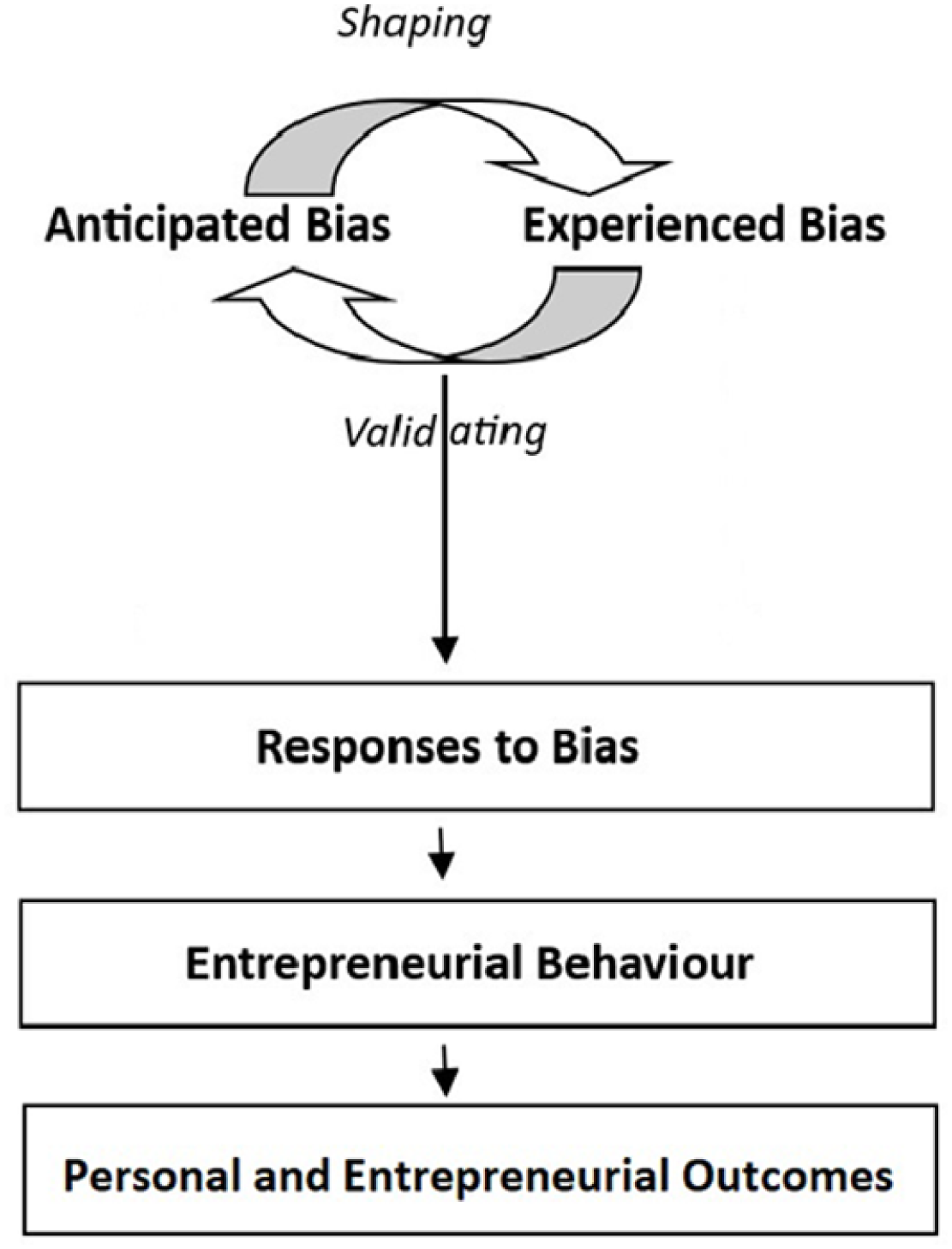
Gender bias in DE.
Our findings extend Stigma consciousness theory (Pinel, 1999) by demonstrating how, in DE contexts, such anticipatory schemas are not only activated in the moment but recursively validated through subsequent experience. As shown in Figure 1, anticipated bias and experienced bias are mutually reinforcing processes: experiences of bias validate prior expectations, while anticipated bias shapes the interpretation of new encounters, perpetuating a self-reinforcing cognitive loop of shaping and validating. These dynamics influence how women interpret and respond to bias within DE ecosystems. Responses to bias represent the behavioural and cognitive adjustments entrepreneurs make. These responses, in turn, shape entrepreneurial behaviour, influencing strategic choices such as bootstrapping, self-censorship, or team composition. Ultimately, these behavioural adaptations lead to varied outcomes at both individual and startup levels. Anticipated bias thus, functions as a self-reinforcing lens: once bias is expected, it becomes easier to perceive, and once perceived, it further entrenches expectations. In this way, anticipated bias perpetuates gender disparities even in the absence of overt discriminatory acts, aligning with recent studies showing that anticipation shapes behavioural strategies among women and minority professionals (Aksoy et al., 2023; Alston, 2022; Charness et al., 2020).
As we focused on women digital entrepreneurs operating in sectors typically targeted by VC and with growth-oriented capital requirements (Brush et al., 2017; Morris et al., 2006), this recursive cycle is likely to be especially consequential in VC-facing evaluations characterised by high uncertainty, where early-stage startup quality is difficult to observe and assessors rely more heavily on heuristics and readily observable cues, including founder-team characteristics (Conti et al., 2013; Edelman et al., 2021). In such contexts, reliance on male-centred ideal founder prototype intensifies (Sperber and Linder, 2023), shaping who is perceived as a “natural fit” for DE roles (Kanze et al., 2020: 2) and rendering women’s presence persistently incongruent (Eagly and Karau, 2002). This aligns with evaluator-centred evidence that gendered screening and interpretation are amplified under uncertainty (Alsos and Ljunggren, 2017; Kanze et al., 2018; Tonoyan et al., 2025).
Women digital entrepreneurs described prototypical bias as a persistent sense of otherness expressed through intersecting discursive, symbolic, and cultural mechanisms. Discursively, women were marked as deviations from the norm through labels such as “female founder,” which prioritise gender over expertise and can operate as a form of stigma signalling diminished legitimacy (Crocker et al., 1998). Symbolically, visibility was often experienced as tokenistic inclusion, where being “the only woman in the room” offered representational diversity without substantive integration, reinforcing outsider status and ongoing legitimacy work (Holgersson and Romani, 2020). Culturally, participants described exclusion from “boy’s club” networking, where resource access is mediated through homosocial ties that shape deal flow, information, and credibility circulation (Heizmann and Liu, 2022; Marlow and McAdam, 2013; Martinez-Dy and Jayawarna, 2020). These patterns support the view that DE ecosystems can re-inscribe rather than dissolve offline hierarchies, even in settings commonly framed as democratising (Martinez-Dy and Jayawarna, 2020; Martinez-Dy et al., 2017).
One significant psychological outcome of such shared cognitive frameworks is the development of stigma consciousness (Pinel, 1999), which heightens attentiveness to potential bias, increases the likelihood of attributing negative outcomes to discrimination, and shapes expectations in subsequent interactions (Crosby et al., 1989; Major et al., 2003; Steele, 1997). This can increase sensitivity to bias-relevant cues in DE contexts such as funding evaluations, mentoring access, and visibility opportunities, thereby intensifying anticipated bias and shaping engagement strategies (Inzlicht and Ben-Zeev, 2000; Pinel, 1999). Importantly, our participants described bias as anticipated and experienced and our model captures how they become recursively linked over time.
This theorisation extends gender and DE research by shifting attention from bias as only an external event to bias as a cognitive filter. Much of the prior literature has examined gender bias primarily through experienced inequities (Eddleston et al., 2016; Malmström et al., 2017) or through resource-provider behaviour (Anglin et al., 2022; Johnson et al., 2018; Kanze et al., 2018, 2020; Lee and Huang, 2018) with less insight into how women entrepreneurs interpret bias, anticipate future interactions, and strategically adjust their trajectories in response. Responding to calls to better specify mechanisms and boundary conditions of gender bias in entrepreneurship (Jennings and Tonoyan, 2022), we show that anticipated bias operates as a socially reinforced schema shaped through peer narratives, mediatised accounts, and wider industry discourse (Crocker et al., 1998; Major and O’Brien, 2005). Public initiatives including awareness campaigns, diversity events, media reporting of funding gaps may function as cultural signals that repeatedly foreground women’s underrepresentation in VC funding, DE, and innovation domains (Ahl and Marlow, 2021; Brush et al., 2019), thereby strengthening collective expectations of bias. Consistent with this, participants referenced not only public statistics but also widely circulated academic findings (Brush et al., 2017; Kanze et al., 2018; Malmström et al., 2017). Rather than acting as neutral information, these narratives can shape anticipatory interpretations of ecosystem interactions and influence how women respond to both overt and subtle cues of bias (Major et al., 2003).
Finally, the study suggests that the limited engagement by some women entrepreneurs with VC is better understood as pre-emptive avoidance shaped by anticipated bias rather than as an ambition deficit. This challenges prior work often attributing gendered funding disparities to lower growth orientation or weaker demand for external finance (Coleman and Robb, 2012; Kwapisz and Hechavarría, 2017). In our data, however, participants often described deciding early to avoid or postpone VC, sometimes without having personally experienced gender bias, because peer stories, public statistics, and local ecosystem reputations made biased treatment seem likely. They instead pursued bootstrapping (Winborg, 2009) to reduce exposure to potentially devaluing experiences. When some participants did enter fundraising interactions, gendered cues were read as confirmation of a misfit with VC culture, prompting withdrawal or rejection of offers. This pattern reframes reduced VC engagement as a strategic response to anticipated and experienced bias.
Implications
Practical recommendations for women digital entrepreneurs
Our findings indicate that women digital entrepreneurs actively develop strategies to navigate the DE and VC environments. Drawing on these insights, we outline several actionable recommendations for women building startups. First, assess whether VC is necessary for the business model and timing. Several participants described revenue-based financing, hybrid capital (revenue-share), or early profitability as routes that preserve autonomy and reduce exposure to investor gatekeeping and “growth at all costs” pressures. Second, sequence fundraising to build legitimacy before approaching VC investors, for example by starting with angel investors, VC-backed accelerators, or strategic corporate partners. Participants viewed these as lower-barrier entry points for building early legitimacy, refining pitches, and gaining access to networks before approaching institutional VC. Third, systematically seek institutional support, particularly grants, R&D tax incentives, and export support, to extend the runway and reduce dependence on early-stage VC. Several participants observed that these mechanisms remain underutilised by women, despite offering valuable early-stage resources. If time is tight, outsource applications to a specialist on a success-fee/percentage basis to reduce admin load. Fourth, approach fundraising as a relational rather than transactional process. Participants emphasised that trust was established over repeated interactions, progress updates, and informal conversations not through a single pitch. Treating investor engagement as a long-term relationship can help gradually reshape perceptions of their legitimacy. Target the investors most relevant to your startup, identify founders in their most successful deals, and request an introduction through those shared ties. Fifth, prepare for predictable evaluation asymmetries by rehearsing responses to risk-framed questions and redirecting them towards traction, market learning, and scalable execution.
Ecosystem- and policy-level recommendations
A primary challenge identified is the narrow definition of the ideal entrepreneurial prototype (Sperber and Linder, 2023) that continues to marginalise women. Rather than focusing on “fixing” women digital entrepreneurs, ecosystem actors should actively expand what counts as entrepreneurial success. Media, policymakers, and peak bodies can do this by consistently spotlighting outcomes beyond unicorn valuations (profitability, sustainability, social impact, etc.) so legitimacy is not anchored to a masculinised, VC-only script. Governments can reinforce this shift by incentivising portfolio diversification (co-investment conditions, reporting requirements, or matched funding tied to broadened sourcing practices) to widen the criteria through which credibility and potential are assessed. Accelerators and public support programmes can reduce the need for entrepreneurs to anticipate bias by redesigning selection and mentoring systems: use transparent evaluation rubrics, standardise pitch questions, diversify decision panels, and publish cohort-level data on acceptance and funding outcomes. Event organisers and accelerators can address structural constraints by scheduling during school hours, providing childcare, and offering hybrid participation options, reducing the penalty attached to caregiving and travel. Ecosystem leaders and event organisers should also reconsider gender-segregated programming (e.g. women-only panels or “Women’s Day” events) that can unintentionally reproduce marginalisation; where such initiatives remain, they should be built around mixed-audience integration (guaranteed representation across mainstream panels) rather than quarantined visibility. Finally, investors, accelerators, and media should adopt language that avoids marking women as a gendered category first, as many participants preferred being framed simply as “founders” or “entrepreneurs.”
Limitations and future research agenda
While this study has offered significant theoretical and practical contributions, there are several limitations that present avenues for future research. First, our sample is focused on a qualitative study of women in Australia. Future research could broaden the scope by engaging with larger, more diverse samples across different countries to provide a more comprehensive understanding.
A further avenue for future research concerns the strategies women digital entrepreneurs deploy to navigate male-dominated DE and VC environments. Prior scholarship has identified several such mechanisms. Godwin et al. (2006) theorised that women may strategically add male cofounders to their teams to enhance legitimacy, broaden network access, and align with institutional expectations in masculinised sectors. Kanze et al. (2018) demonstrated the effectiveness of regulatory-focus reframing, showing that women can counteract prevention-focused questions by responding with promotion-focused narratives, thereby improving investor evaluations. These insights, however, are largely conceptual or derived from experimental field contexts, and we know far less about how women themselves understand, interpret, and enact these strategic responses in lived entrepreneurial settings. While our study provides some detail as to resource seeking in these settings, future research can go further in detailing how these are applied and whether these approaches interact.
Additionally, our participants suggested that women often pitch relatively conservative, realistic projections based on achievable goals, while men frequently present more ambitious, sometimes unrealistic figures, which tend to secure funding. Exploring how entrepreneurial pitch language can be strategically adjusted to appeal to different audiences would be highly beneficial (Falchetti et al., 2022; Giorgi, 2017). Future research could examine the specific strategies women digital entrepreneurs use to navigate gender bias in VC contexts. For instance, scholars could investigate how women consciously engage in cognitive and communicative strategies to align with investors’ expectations while preserving authenticity. Moreover, emerging tools such as AI-assisted writing and presentation platforms present new avenues for women digital entrepreneurs to rehearse and optimise their pitches. Future work could explore whether these technologies amplify or constrain agency by helping women simulate, adapt, or resist gendered communication norms in VC interactions.
Finally, while we focused on how the interplay between anticipated and experience biases, we recommend that future research investigate potential business and personal outcomes of these dynamics. Examining the opportunity costs and trade-offs associated with delaying startup growth or strategically avoiding VC could show how these choices shape not only startup performance but also founder well-being. Such work would contribute to a more nuanced understanding of coping through growth strategy, offering insights into how women actively construct viable entrepreneurial pathways within gendered ecosystems. For instance, our findings have indicated that anticipated bias may have detrimental effects on mental health, even in the absence of direct discriminatory events. Extending this framework could clarify how chronic anticipatory stress shapes psychological and professional functioning potentially fostering learned helplessness and undermining motivation and performance – processes linked to depressive symptoms (Martinko and Gardner, 1982; Rosander and Nielsen, 2023).
Conclusion
This article investigated how women digital entrepreneurs navigate gender bias during startup processes, focusing on how expectations of bias shape engagement with VC and DE ecosystem actors. The findings challenge the narratives of the “democratisation” of digital entrepreneurship (Nambisan, 2017: 1032) by showing that VC-facing DE ecosystems remain organised around a male-centred ideal-founder prototype. As a result, participants described recurring forms of discursive, symbolic, and cultural othering that foster stigma consciousness and structures how women perceive their fit and prospects within DE and VC spaces.
The analysis advances stigma consciousness theory in digital entrepreneurship by theorising anticipated bias as a socially produced cognitive filter, sustained through mediatised statistics, academic discourse, and peer-shared narratives. Anticipated bias was collectively transmitted and repeatedly activated in ambiguous evaluative encounters. Importantly, anticipated and experienced bias operated recursively: prior expectations shaped interpretation and vigilance, while lived experiences validated and intensified those expectations, generating a self-reinforcing cycle that structured subsequent interactions and decisions. These dynamics help explain gendered funding outcomes beyond investor-side bias alone. Women’s strategic responses such as selective engagement with VC investors were not reducible to lower ambition or weaker demand for capital. They reflected pragmatic adaptations to an ecosystem experienced as predictably devaluing or culturally misaligned. The findings suggest that gender inequality is sustained not only through overt biased treatment but also through anticipation that organises attention, attribution, and strategic choice before VC investor contact occurs.
Footnotes

Ethical considerations
Ethics approval for this research 2023/ET000276 has been granted in accordance with the requirements of the National Statement on Ethical Conduct in Human Research (National Statement) and the policies and procedures of The University of Western Australia.
Consent to participate
All participants provided informed consent before engaging in the study. They were informed of the voluntary nature of participation, the confidentiality of their responses, and their right to withdraw at any stage without consequence. The study adhered to principles of anonymity and confidentiality, with all data securely stored and de-identified to protect participant identities.
Funding
The authors received no financial support for the research, authorship, and/or publication of this article.
Declaration of conflicting interests
The authors declared no potential conflicts of interest with respect to the research, authorship, and/or publication of this article.
Data availability statement
The data supporting the findings of this study are not publicly available due to confidentiality agreements with participants and ethical considerations protecting their anonymity. However, anonymised excerpts relevant to the study’s analysis can be made available upon reasonable request to the corresponding author*, subject to approval by the Ethics Committee of The University of Western Australia and in compliance with research ethics and data protection guidelines.
Other identifying information
Any other identifying information related to the authors and/or their institutions, funders, approval committees, etc., that might compromise anonymity.