



Abstract
While significant research addresses social responsibility in small businesses, studies on small business social responsibility (SBSR) overlook its political aspects. This gap persists despite a noticeable ‘political turn’ in corporate social responsibility research, which focuses on large multinationals tackling societal challenges amid ineffective state regulation. However, micro- and small businesses also engage with the political dimensions of social responsibility, albeit differently. This conceptual article introduces the concept of small business political responsibility (SBPR) and develops an original SBPR model centred on the political identities of owner-managers. It suggests that SBPR is dynamic, shaped by individual agency and highlights the importance of analysing the private sector’s political role from a small business perspective. Here, SBPR depends on managerial discretion rather than normative evaluations from civil society or local communities.
Introduction
Small business social responsibility (SBSR) refers to the activities of small businesses that contribute to positive social change (Jenkins, 2006; Soundararajan et al., 2017). The concept was developed to identify and distinguish the socially responsible business practices of small businesses from those of larger multinational corporations (Spence, 2016). The SBSR literature indicates that small businesses, due to their direct social connections, are more deeply embedded in societal challenges and feel an obligation to address them (Westman et al., 2020). Rather than viewing them as ‘little big firms’, this literature explores the specific characteristics small businesses utilise to respond to social responsibilities (Jamali et al., 2009). Studies propose that small and medium-sized enterprises (SMEs) frequently extend their focus beyond economic responsibilities, actively engaging in actions such as environmental protection (Williams and Schaefer, 2013), community well-being (Evans and Sawyer, 2010), gender equality (Shortall, 2019) and decent work (Soundararajan et al., 2018). Prior research indicates that the centralised management structure of small businesses affects their involvement in these areas that lie beyond economic responsibilities. This influence is closely linked with the personal characteristics and idiosyncrasies of the owner-manager (Lepoutre and Heene, 2006).
While the social responsibilities of small businesses have been widely studied, their role in what has been termed political corporate social responsibility (PCSR) remains largely overlooked (Wickert, 2016). PCSR ‘involves businesses taking a political role to address “regulatory gaps” caused by weak or insufficient social and environmental standards and norms’ (Wickert, 2016: 792). Research on PCSR has traditionally focused on multinational corporations, under the assumption that small businesses, constrained by limited resources, prioritise operational stability over broader political engagement. However, small businesses are not entirely absent from such political engagement. For instance, micro- and small businesses are recognised as key partners in collaborating with local governments to promote new recycling regulations (Local Government Association, 2024), while also advocating for stricter governance mechanisms to improve working conditions, ensure fair pricing practices and advance inclusive policies (Solidaridad Network, 2024). Therefore, it seems that small businesses, with their deep community ties, can certainly be engaged in political activities, especially on matters affecting their local environments. Unlike multinational corporations, this engagement tends to be informal, sporadic and driven by the personal values of the owner-managers rather than formal strategies (Soundararajan et al., 2017; Westman et al., 2020; Wickert, 2016). Thus, there remains a significant gap in understanding how small businesses navigate social responsibilities that are more political in nature, despite their constraints and particular community connections.
Understanding the nuances and contingencies of micro- and small business’s engagement with these political responsibilities is crucial because they constitute the majority of all businesses and make a substantial contribution to GDP (BEIS, 2023). For example, in the U.K. alone, out of 5.5 million SMEs, 5.47 million are classified as ‘micro and small’ businesses, employing between 0 and 49 people (Local Government Association, 2024). Thus, their aggregate political influence can be significant. Furthermore, recognising their political potential goes beyond merely expanding the scope of SBSR; it involves understanding whether and how their specific situation can involve them in more systemic political changes intended to drive meaningful societal change. This conceptual paper focuses on the political responsibilities of micro- (0–9 employees) and small businesses (10–49 employees), distinguishing them from medium-sized enterprises (50–249 employees) (Hutton, 2024) due to significant differences in resources, management structure, decision-making and Corporate social responsibility (CSR) approach (Sánchez and Benito-Hernández, 2015), which are likely to result in qualitatively different political activities. We propose a renewed focus on small business political responsibility (SPBR), aiming to complement the limited existing insights (Shortall, 2019; Werner, 2021; Westman et al., 2020; Wickert, 2016) with a stronger theoretical foundation. This raises the question: How do micro and small businesses engage in political responsibility?
To address our research question, we introduce a new conceptualisation, small business political responsibility (SBPR), which complements existing research on both SBSR and PCSR. Our conceptualisation of SBPR shifts the focus from a normative notion of responsibility arising from stakeholder and institutional pressures (as found in PCSR) to one that emerges from the political identity of managers (as in SBPR). Political identity refers to an individual’s perception of themselves based on beliefs about how a social and political system should function (Grove et al., 1974). Making political identity our focal point, we emphasise the decision-making agency of owner-managers to act on their subjective viewpoints on political responsibility when deciding their business’s strategy. We suggest that the views emerging from an owner-manager’s political identity inform their understanding of political responsibility (Fernandes-Jesus et al., 2018; Fingerhut, 2011) and, in turn, are highly likely to influence micro- and small business engagement with SBPR. Accordingly, we propose that owner-managers use their business’s limited resources to engage in the governance of social and environmental issues aligned with their political identities. We argue that based on their view of an issue, micro- and small business owner-managers might form either protagonistic or antagonistic political identities regarding those issues. Subsequently, we develop a conceptual model that offers a nuanced account of how political identity formation and activation shape SBPR. Our model shows that micro- and small business engagement in SBPR is likely to be dynamic, reflecting the fluid nature of the owner-manager’s political identity and the influence of relational, structural and institutional factors in shaping and activating such identities.
We make a twofold contribution to the literature. First, our research complements and extends research on SBSR by building on the idea that the personal values of owner-managers matter in shaping their approach to SBSR to encompass how their political views shape engagement in political responsibilities (SBPR). We show how the perceptions of political responsibility are influenced by micro- and small business owner-manager’s political identities, leading to dynamic decision-making and ambivalent engagement with political issues. This represents a shift from conceiving SBSR as being driven by the constant and enduring personal values of owner-managers to SBPR as driven by their more fluid political identities. Second, our research contributes to a new understanding of how businesses engage in the political dimensions of social responsibilities that are suitable for small and micro-firms rather than large and medium ones. By emphasising the role of an owner-manager’s political identity in decision-making, we challenge assumptions in the PCSR literature that organisational actors primarily respond to external institutional factors. We propose that owner-managers are politically motivated actors whose engagement in societal issues varies based on their political identities. This suggests a need for a deeper understanding of the private sector’s involvement in the public sphere beyond procedural steps, emphasising the importance of the political identities of owner-managers in shaping engagement.
Theoretical background
Corporate social responsibility and small businesses social responsibility
CSR emphasises the ethical obligations of businesses to go beyond profit maximisation and consider their impact on society and stakeholders. This includes voluntary activities in areas such as community engagement, environmental protection, fair labour practices, philanthropy, transparency and accountability (Crane et al., 2008). However, the approaches that firms adopt towards social responsibility are heavily influenced by their size, which creates notable differences between large corporations and small businesses (Jenkins, 2006; Murillo and Lozano, 2006). This distinction has led to the development of SBSR as a framework tailored specifically to the unique characteristics, motivations, strategies and challenges faced by smaller enterprises (Jamali et al., 2009; Soundararajan et al., 2017). Unlike large corporations, which rely on formal structures and sophisticated management tools to integrate CSR into their strategies, small businesses often operate through centralised, informal power dynamics, where decision-making is heavily personalised and influenced by the owner-manager’s values (Spence, 2016). This difference is not merely a matter of scale but reflects fundamentally distinct approaches to social responsibility. For large corporations, CSR tends to focus on standardised practices, such as formal reporting and broad stakeholder engagement to build reputation and trust (Brammer and Pavelin, 2006; Minor and Morgan, 2011). In contrast, in small businesses, the personal values of owners significantly shape the understanding and importance of reputation (Lähdesmäki and Siltaoja, 2010). SBSR, therefore, involves actions that are more localised, flexible and context-specific, closely reflecting the personal beliefs and priorities of business owners and often addressing immediate community needs (Niehm et al., 2008; Sen and Cowley, 2013). Consequently, tensions arise when larger corporations pressure SME owner-managers to replace or align these deeply held, personally embedded CSR values with externally imposed standards, causing discomfort or resistance (Morsing and Spence, 2019).
The motivations driving SME engagement with social and environmental responsibilities are shaped by both instrumental and normative factors. On one hand, small businesses may pursue social responsibility initiatives to enhance productivity, attract a loyal workforce and improve local reputation (Lähdesmäki and Siltaoja, 2010; Stoian and Gilman, 2017). On the other hand, owner-managers are often motivated by deeply held values, such as religious beliefs, cultural norms or personal commitments, which significantly shape their personal and organisational-level engagement with environmental and social issues (Discua Cruz, 2020; Schaefer et al., 2020; Worthington et al., 2006). These values are intentionally embedded into their organisational culture through deliberate processes (Oldham, 2024). Unlike large firms that may prioritise global issues to align with broad stakeholder expectations, smaller businesses tend to focus on localised initiatives that directly affect their communities, reflecting their closer social embeddedness. Strategically, small businesses differ from their larger counterparts in how they engage with social responsibility. Large corporations typically implement standardised CSR strategies, using resources for large-scale projects and extensive outreach. Smaller firms, by contrast, often adopt more personal and flexible approaches to social and environmental engagement, driven largely by the owner’s personal convictions, values and localised priorities (Oldham, 2024; Soundararajan et al., 2017). Their SBSR activities are often modest in scope, focusing on internal policies that reduce externalities or support local stakeholders, rather than formalised reporting or expansive social campaigns.
Equally, small businesses face distinct challenges in implementing their social and environmental responsibilities, especially within supply chains. Unlike large firms that possess the resources to monitor their supply chain effectively, SMEs often lack the necessary expertise and tools to enforce upstream compliance, making it difficult to extend SBSR practices and mitigate negative externalities (Baden et al., 2011). Limited financial and human resources, competing organisational demands and tensions between personal values and business practicalities also restrict their capacity to adopt formal social responsibility policies or recognise the long-term benefits of engaging in SBSR (Johnson and Schaltegger, 2016; Oldham, 2024). These constraints mean that smaller businesses often rely on informal practices driven by the owner-managers personal values rather than comprehensive CSR frameworks as is the case with larger firms. Thus, although CSR and SBSR share similar underlying principles, they manifest differently due to the particular motivations, strategies and resource limitations faced by SMEs. Recognising these distinctions is essential for understanding how small businesses can contribute to social and environmental change, especially given their substantial presence in the economy and their deep connections within local communities.
Political corporate social responsibility and small business political responsibility
While CSR and SBSR focus on voluntary and frequently reactive initiatives to fulfil a firm’s social responsibilities, political CSR (PCSR) explores how corporations assume a more proactive, political role in shaping policies and addressing governance gaps (Wickert, 2016). Scholars have contextualised this shift within a landscape shaped by globalisation, firm internationalisation and evolving operating spaces (Whelan, 2012). Key studies emphasise that globalisation has weakened state governance, increased pressures from external stakeholders and encouraged the rise of private governance structures (Matten and Crane, 2005; Scherer and Palazzo, 2011). By synthesising these dynamics, the literature connects the growing political influence of firms with the broader effects of globalisation (Di Nardo et al., 2024). PCSR is frequently framed through the lens of deliberative democracy, where businesses are seen as collaborators with civil society to promote transparency and accountability in societal governance (Scherer and Palazzo, 2011). This perspective assumes that large corporations, especially in weakly regulated environments, bear the responsibility to establish governance practices, such as multi-stakeholder initiatives (MSIs), to uphold social and environmental standards (Soundararajan et al., 2018). For instance, MSIs such as the Bangladesh Accord, formed after the Rana Plaza disaster, illustrate practical applications of deliberative democracy by enabling collaboration among corporations, NGOs and unions to bridge governance gaps (Huber and Schormair, 2021). As corporations become dominant actors in transnational contexts where state regulatory power may be limited, they are expected to move beyond purely instrumental CSR approaches towards self-regulatory frameworks, such as implementing human rights standards (Donaghey and Reinecke, 2018). In parallel, others have drawn on Rawlsian political theory to argue that corporations play a crucial role in maintaining social structures that distribute societal benefits, especially where the state’s presence is limited (Bishop, 2008; Cohen, 2010).
While PCSR encourages corporations to fill governance gaps, critics warn that without adequate institutional frameworks, unchecked corporate influence can lead to a democratic deficit (Frynas and Stephens, 2015). Although MSIs are designed to address these gaps, they often lack effective enforcement mechanisms and may marginalise key societal actors, highlighting the need for continued state involvement (Schrempf-Stirling, 2018). Critics also question the assumption that PCSR efforts are purely normative; Whelan (2012) argues that these initiatives are frequently profit-driven rather than genuinely ethical responses to institutional voids. Similarly, Mäkinen and Kourula (2012) suggest that corporations may engage in self-regulation strategically for economic gain, particularly where state influence is weak. Frynas and Stephens (2015) highlight that self-interested corporate political activities, such as lobbying to shape regulations, should be integrated into PCSR frameworks, though Lock and Seele (2016) caution that such activities can contradict CSR principles. These critiques collectively suggest that while corporations have a role in societal governance, their actions may not always align with the public interest, making state oversight crucial. In light of these concerns, Néron (2013) calls for moving beyond the CSR label to critically examine the political dimensions of business practices, specifically addressing issues such as resource distribution, inequalities, managerial authority and the very nature of commercial activities.
Despite these valuable insights, existing PCSR conceptualisations have not been extended to provide substantial theoretical insights into how smaller businesses engage with such political responsibilities. This has been brought into focus by recent empirical findings that have highlighted the distinctive approach taken by such firms in contributing to political, as well as social, change (Werner, 2021; Westman et al., 2020). For example, Morea and Dalla Chiesa (2024) highlight how small art collectives in Italy address governmental gaps by mediating local demands and offering sporadic, unsystematic cultural projects. Similarly, studies have examined how small businesses work with the government to deliver effective environmental solutions (Deschamps and Slitine, 2024). Other scholars have employed concepts such as social capital (Russo and Perrini, 2010) and social proximity (Lähdesmäki and Suutari, 2012) to examine how SMEs, due to their deep integration within local communities, expand their economic and social responsibilities. This embeddedness often leads them to engage in governing social issues and actively seek to have a positive impact on their communities. Although the studies mentioned above do not directly address the terminology and principles of PCSR, they indirectly touch on aspects of this broader political engagement, prompting a closer examination of how we theorise such activities. The work most directly exploring how SMEs engage with PCSR is Wickert’s (2016) study. However, his framework primarily focuses on medium-sized enterprises, neglecting the specific needs of micro- and small businesses. Wickert’s model includes two key dimensions: social connection, based on Young’s (2004) theory that firms are responsible for injustices to which they contribute and the integration model by Zadek (2004), which suggests a standardised five-stage procedure for CSR engagement.
Wickert assumes that SMEs engage in political CSR primarily for ethical reasons. However, this view neglects the distinctive characteristics of micro- and small firms, such as owner-manager discretion and deep community embeddedness (Jamali et al., 2009) as well as insights suggesting that micro-firms engage in such actions primarily for instrumental reasons (Nybakk and Panwar, 2015). These businesses face less institutional pressure and enjoy greater autonomy, enabling owner-managers to shape their political responsibilities based on personal values. Unlike larger firms, small business owners often resist external pressures, creating opportunities to engage in PCSR not solely for ethical reasons but also for strategic gains. In contrast, while medium-sized firms may retain some informal, owner-driven elements, typical of small businesses, they more often adopt structured, strategic approaches influenced by external pressures, similar to larger firms (Preuss and Perschke, 2010). This highlights the need for micro-level theories that reflect the informal and centralised structures of small businesses, where decisions are deeply influenced by owner-manager beliefs (Frynas and Stephens, 2015). Furthermore, the five stages of Wickert’s integration model – defensive, compliance, managerial, strategic and civil – are less relevant to micro- and small firms, which have limited resources. Instead, evidence shows that these businesses engage in local governance through community-driven initiatives (Campin et al., 2013; Moore et al., 2009). For example, the Seattle Good Business Network unites small enterprises to establish local standards and resources for fostering a circular economy (Bottom Line, 2018). Rather than addressing global supply chain governance, micro- and small firms focus on local service provision, peer-led standards and lobbying local policymakers to fill governance gaps (Werner, 2021; Westman et al., 2020).
Therefore, we still lack a full understanding of why and how micro- and small businesses choose to engage in political CSR (Baden et al., 2011; Scherer et al., 2016), or why they choose to participate in the governance of some issues and not others. Our reading of previous research is that micro- and small business engagement with PCSR is influenced by the political perspectives of the business owner and their interpretation of institutional norms and stakeholder expectations, along with associated commercial benefits (Husted et al., 2016). Thus, a distinctive focus on SBPR is required due to their lack of visibility and subsequent resistance to institutional pressures, as well as their highly centralised decision-making. Unlike managers in medium- and large-sized businesses who address their political responsibilities by participating in MSIs, micro- and small business owner-managers are more likely to do so by using their business’s limited resources to take unilateral actions in their communities.
Using a micro perspective, we introduce the concept of SBPR and focus on how the political identity of owner-managers affects how they engage with their political responsibilities. Figure 1 provides a simplified comparison of SBPR in relation to CSR, SBSR and PCSR. As firm size decreases (y-axis), the concepts of CSR and PCSR become less appropriate, and SBSR and SBPR become more appropriate. Likewise, as social responsibility practices become more political – relating to societal governance and rule-making – (x-axis), concepts of CSR and SBSR become less appropriate, and PCSR and SBPR more appropriate.
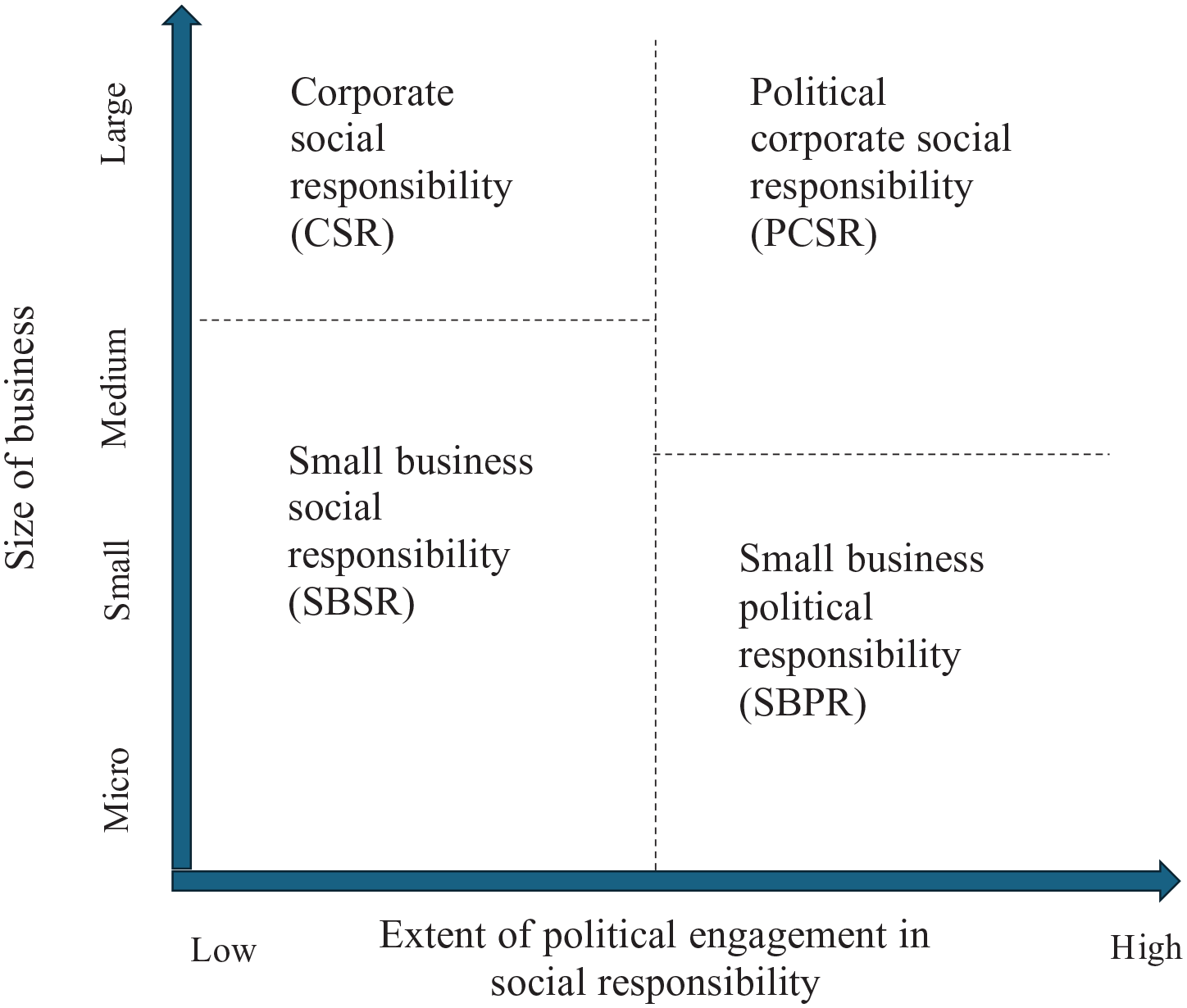
Business size and political engagement in social responsibility.
Political identity, identity politics and SBPR
Like all individuals, micro- and small business owner-managers have a range of social identities, which they express within their personal, social and professional lives. Whereas in the past, social identities were seen as rigid and immobile, researchers have increasingly recognised that identity is more fluid and that individuals typically place themselves within various identity categories (Bauman, 2001; Giddens, 1991; Iatridis et al., 2022). The categories that individuals identify with include aspects of professional life, such as ‘entrepreneur’ or ‘healthcare worker’, or more cultural aspects of society, such as being a fan of a sports team or pop group (Trepte and Loy, 2017). To add meaning and coherence to their identity, individuals uphold beliefs and undertake actions that are consistent with those of the social and political movements that have been created to represent their identities (Polletta and Jasper, 2001).
Political identities are social identities that have become ‘politicised’ by a desire for recognition of their social group’s interests and perceived societal challenges (Huddy, 2001). Although all individuals can develop political interests and form political identities, the latter are usually based on a combination of innate characteristics, such as gender, race, sexuality, nationality and ethnicity, or constructed categories, such as being a ‘taxpayer’ or ‘environmentalist’ (Fernandes-Jesus et al., 2018; Greenebaum, 2012; Taylor, 2017). Actions in response to political identities can be considered ‘identity politics’, in which social groups develop a collective belief that individual-level actions are required to further their political interests or overcome societal challenges they are experiencing (Chuck et al., 2016; Selvanathan et al., 2018). Identity politics sit at the intersection between ideology and party alignment (Bernstein, 2005). Those who share a political identity are represented across the ideological spectrum and within different political parties. So, while in some instances, partisanship has been effective in explaining how likely a business is to address societal challenges (Di Giuli and Kostovetsky, 2014; Rubin, 2008), the impact of identity politics on business is unlikely to follow party lines.
These insights are particularly relevant in the context of SBPR, as one could argue that owner-managers engage in SBPR as a form of identity politics to address the political responsibilities associated with their political identity. For example, an owner-manager believing that current anti-discrimination laws are insufficient to prevent LGBTQ+ discrimination might participate in political processes to promote policies aimed at building an inclusive, non-discriminatory culture for LGBTQ+ individuals in their communities (Shortall, 2019). At the same time, identity-driven political engagement does not always align with socially responsible practices. Some owner-managers may resist or even oppose responsible business norms, creating tensions within businesses, particularly when employees or customers hold conflicting political views. For instance, participation in ‘anti-woke’ business networks (Nerkar, 2023) illustrates how some SME owners actively reject diversity, inclusion or environmental sustainability initiatives, viewing them as unnecessary political correctness rather than corporate responsibility.
Like social identities, political identities are likely to be latent and activated by individuals in certain situations or contexts (Carter, 2013). For instance, a web developer from Hong Kong, whose latent ‘pro-democracy’ identity was activated by China’s extradition bill, used his business to develop an app that distinguished between ‘pro-China businesses’ and ‘pro-independence’ ones, allowing consumers to shop according to their political identities (Li and Whitworth, 2021). However, due to their latent and fluid nature, political identities do not necessarily dictate all actions. Unlike values, which are stable, deeply held principles that guide moral reasoning and remain relatively constant over time (Rokeach, 1973; Schwartz, 1992), political identities are more responsive to social and political contexts. They are shaped by exposure to media, peer influence and salient events (Greene, 2004; Huddy, 2001). In fact, in some politically significant situations, individuals may be unaware of certain actions that might seem to contradict their political identities. Within their personal lives, owner-managers will express their political identity through lifestyle and consumer actions, as well as more traditional forms of political participation, such as activism or protesting (Bennett, 1998).
An owner-manager’s engagement in political activities may stem from a sense of responsibility or self-interest. On one hand, their latent political identity might be activated when they recognise how their business can contribute to an issue about which they have strong feelings. This generates a sense of responsibility to use their resources and position within the community to address their political responsibility. This awareness also creates an internal desire to ensure coherence between their political identity, its associated values and their actions as business owners, further reinforcing the sense of responsibility. On the other, their engagement may also be driven by self-interested motivations. For instance, when certain issues gain prominence in society, such as the heightened focus on racism and inclusivity following the 2020 Black Lives Matter protests, aligning their business with these causes can offer instrumental benefits. In such cases, responding to stakeholder expectations and pressures may lead to greater alignment with the identities of key stakeholders, which can enhance their business’s reputation and relationships (Scott and Lane, 2000). Conversely, if the social or political climate is not supportive of their political stance, owner-managers may perceive fewer strategic benefits and even potential reputational risks, prompting them to hold back from publicly activating their political identity until conditions become more favourable.
Conceptualising SBPR engagement
In light of the issues identified above, we developed a conceptual model, summarised in Figure 2, that addresses our research question: How do micro and small businesses engage in political responsibility? Our model takes a micro-analytical approach to SBPR and discusses how micro- and small business owner-managers form and enact different political identities that are likely to lead to different SBPR outcomes. At the same time, we acknowledge the influence of contextual factors in the formation and activation of the political identities of owner-managers and discuss how relational, structural and institutional factors contribute to shaping such identities.
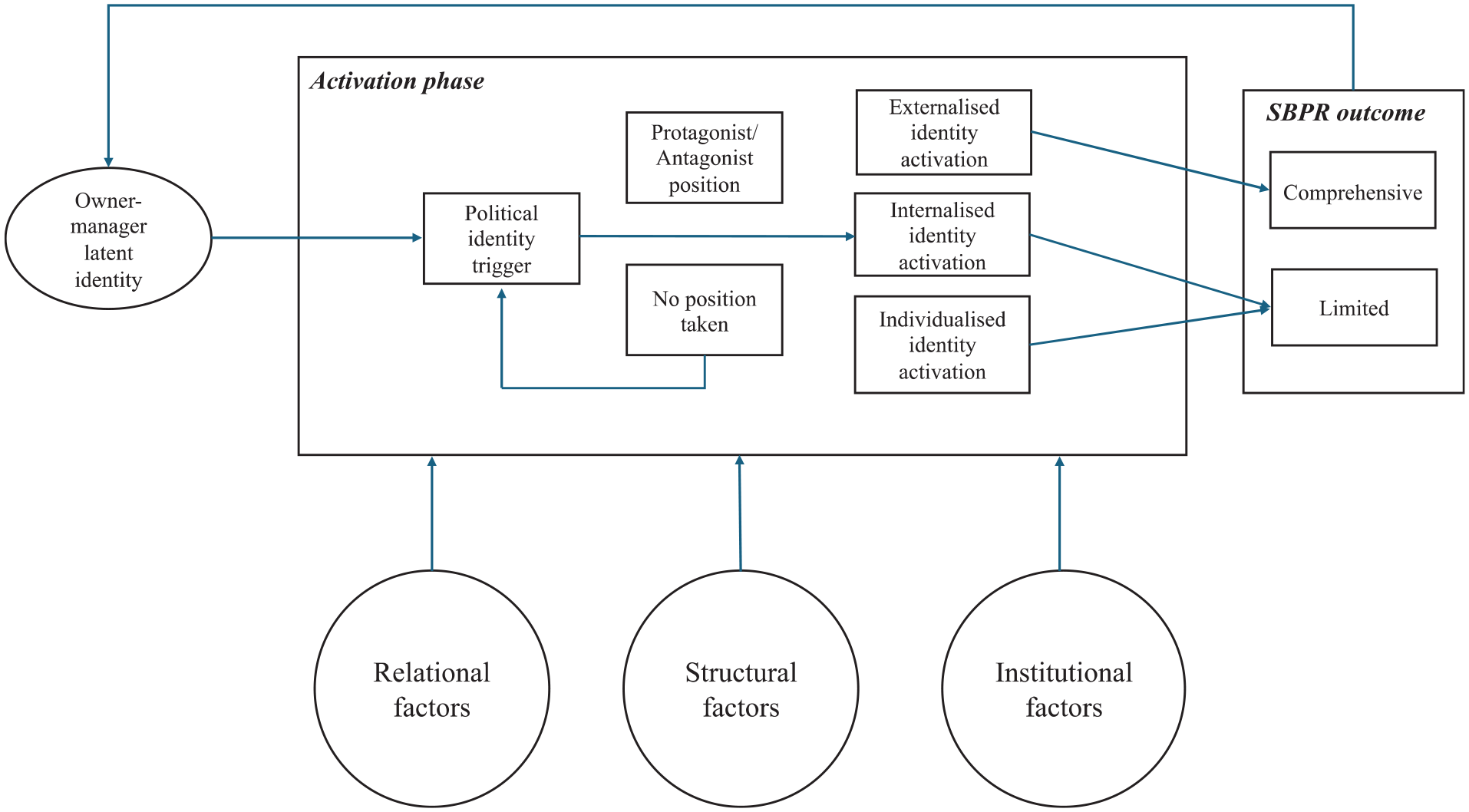
Micro- and small business owner-manager’ political identity and SBPR outcome.
Latent political identity
On the left side of the conceptual model, the focus is on how micro- and small business owner-managers form their latent political identity. This identity remains inactive until it is influenced by a political identity trigger, which initiates the activation phase. For this reason, latent political identity is illustrated outside the activation phase box. Identity salience, that is, ‘the probability that a given identity will be invoked in social interaction’ (Brenner et al., 2014: 232), plays a key role in political identity formation. Those who have a highly salient identity are strongly committed to the values and actions associated with that identity, compared to the values and actions associated with less salient identities. It is expected that those with a highly salient identity are more likely to activate their latent political identities, join organisations, including political parties and political networks, and surround themselves with other individuals who share the same political identity. Such cases are more likely to result in a strong political identity and a commitment to undertaking changes to their consumer habits, professional behaviours or lifestyles (Bennett, 2012; De Moor, 2017; Micheletti, 2003; Wright et al., 2012). In contrast, in the context of an individual’s less salient identities, they are less likely to form a political identity that is strongly associated with a particular political issue, often because they are not directly experiencing it themselves (Fingerhut, 2011). Thus, the highly salient identities of owner-managers are more likely to be expressed as political identities in their business than their low-salience identities.
As identity salience is unstable, however (Diamond, 2020; Unsworth and Fielding, 2014), SBPR in micro- and small businesses that arises from the identity politics of owner-managers is dynamic, as it is shaped by the changing salience of the political identities of owner-managers. Indeed, owner-managers can have a mixture of political identities that are often conflicting based on the intersection of their social identities. For example, Rumens and Ozturk (2019) found that LGBTQ+ entrepreneurs negotiate conflicting identity expectations at the intersections between heteronormative entrepreneurial identities and their gay identities. In instances where a hybrid, social, professional, or other identity weakens their political identity, evidence shows that organisational decision-makers might adopt narratives that distance themselves from political practices relating to the issues they might otherwise identify with (Allen et al., 2015; Carollo and Guerci, 2018). These narratives allow an owner-manager to take up business practices that may otherwise undermine their identity claims (Nyberg and Sveningsson, 2014). In the case of LGBTQ+ entrepreneurs, Rumens and Ozturk (2019) found that they can adopt heteronormative discourses on gender, sexuality and entrepreneurship that allow them to identify as ‘normal entrepreneurs’.
Triggering latent political identities
Trigger events can stimulate a higher salience of certain latent political identities, making an individual more likely to engage in forms of political participation and take stronger actions (Chuck et al., 2016). For instance, a YouGov poll (Smith, 2019) found significant spikes in concern for the environment after the 2014 winter flooding event in the U.K. and again in 2019 after the Extinction Rebellion protests, which highlighted environmental injustices. Similarly, Selvanathan et al. (2018) show that immediate anger and empathy over social or environmental challenges are predictors of efforts towards social change, particularly when an individual has a close, proximate, or positive relationship with the social group experiencing the challenge. Accordingly, we expect that owner-managers are most likely to activate their latent political identity within their business after a trigger event, which increases the salience of their identity (Boyer et al., 2022). Because political identity salience is time-dependent, individualised political actions, including those of business owners, are sometimes only temporary until the challenges are no longer top of mind. Unlike deeply ingrained values, which function as enduring belief systems resistant to external change (Schwartz, 1992), political identity is shaped by exposure to evolving political discourse and external triggers (Mason, 2018; Tajfel and Turner, 1979). Studies on political engagement indicate that individuals may recalibrate their political identities in response to triggers such as new information, shifts in media narratives, or major socio-political events (Greene, 2004; Huddy, 2001), making political identity inherently more dynamic than values. We illustrate political identity triggers inside the activation phase box, positioning them as the first box on the left within this phase in our model.
Taking a position
Following triggering events, individuals might enact protagonist or antagonist political identities in response to a societal challenge, or they might not take a position at all (middle box within the activation phase in our model). Protagonist political identities refer to cases where the political identity formed is fully aligned with the position of a social group experiencing a major societal or environmental challenge. Individuals develop protagonist political identities because doing so fully aligns with the values and norms of their own identities or because they believe their ambitions for change will have a positive impact on their social groups (Trepte and Loy, 2017). In contrast, antagonist political identities emerge when individuals believe that the societal or environmental challenges experienced by a social group conflict with the values and norms of their own political identities. In addition, those with such identities may be driven by marginal anti-liberal political values, leading them to take potentially controversial stances on issues such as race and gender. For instance, Nerkar (2023) found that more than 65,000 small businesses were signatories to PublicSquare, an ‘anti-woke’ platform where businesses openly reject policies on inclusion, diversity and a host of other social and environmental issues. Respectively, owner-managers who have no connection to a challenge and/or think that the issue is unlikely to affect their business (Wickert, 2016), will not take a position.
Type of political identity activation in micro- and small businesses
Once an owner-manager has taken a position on a political issue, they will activate their political identity within their business. Due to the personalised management structure of micro- and small businesses, once an owner-manager’s identity is activated, this is likely to be embodied within the firm’s identity. It is anticipated that identity activation occurs to different degrees (Wickert, 2016), with some identity activations being highly externalised, others internalised, and yet others remaining ‘silent’ or individualised (right box within the activation phase in our model).
Externalised identity activation occurs when the owner-manager makes addressing a societal or environmental challenge central to their business’s image and is very vocal externally about their position. The firm might gain official accreditations, and its marketing material might explicitly express the owner-manager’s political identity (Brickson, 2005). It is also highly likely for such owner-managers to collaborate with like-minded people and organisations (Brickson, 2000) in the communities in which they are embedded and to join initiatives that exemplify their commitment to tackling the issue concerned to their stakeholders (Werner, 2021). When conflict arises with their business peers and non-business social ties, they will explicitly reassert their politicised identity as a justification for their SBPR practices, and they may even break off their supply chain relationships (Ciliberti et al., 2008). For instance, LGBTQ+ entrepreneurs in communities experiencing societal challenges and discrimination are likely to build their business’s identity and marketing strategy around their sexual orientation and participate in support networks within the LGBTQ+ business community (Essers et al., 2023).
An internalised identity activation, in contrast, involves adopting SBPR-based business practices without launching any public-facing initiatives that explicitly address the societal challenge relating to their activated political identity (Wickert, 2016). In such cases, owner-managers are less likely to make their political identity a feature of their stakeholder social ties, including supply chain contracts. They are also less likely to collaborate with business networks and external stakeholders. Instead, owner-managers with internalised political identities will make the political identity part of the business’s internal culture so that it guides decision-making, internal policies and practices and the behaviour of their employees (Murillo and Lozano, 2006; Wickert, 2016). For instance, several micro- and small food start-ups in London, without publicly promoting their activities and driven by their belief that businesses can be a vehicle for tackling issues ‘as disparate as social inclusion and fighting disease’, have adopted business models that are directly informed by the owner-manager’s desire to make a change and positively contribute to their local communities (Covello and Iatridis, 2020: 98).
In the case of individualised or ‘silent’ identity activation, owner-managers will also activate their political identity when making business decisions; however, they will not articulate it to their internal or external stakeholders. Mirroring what Meyerson and Scully (1995) called ‘tempered radicals’, such owner-managers will not make their identity explicit, to the point that individuals involved with or connected to the business will not notice that these owner-managers frame their business practices around a political identity. Tempered owner-managers are likely to balance their political identities against their professional identities, fulfilling their desire for coherence between their political identities and their business practices while submitting to the established cultures associated with their professional identity (Meyerson and Scully, 1995). This is reflected in the concept of ‘silent’ or ‘sunken’ CSR, in which owner-managers engage in small-scale CSR practices without promoting them or, in some cases, without even realising their engagement (Jenkins, 2004). Such political identity activation may be most prominent in businesses with very few employees and no formal processes, or where an owner-manager does not have many business relationships.
In sum, we propose that micro- and small business engagement in SBPR is subject to the political identity activation of owner-managers. The latter will be externalised, internalised, or individualised. The more externalised political identities are, the more likely it is for micro- and small businesses to publicly promote their SBPR engagement, while the more internalised and individualised political identities are, the more likely it is for micro- and small businesses to engage with SBPR implicitly.
SBPR outcome
SBPR outcome refers to the type of initiatives owner-managers undertake to engage with the governance of local issues. However, not all SBPR outcomes align with progressive social responsibility. Businesses with antagonistic political identities may actively resist responsible business practices, undermining governance efforts in areas such as climate action or human rights protections. Moreover, tensions may arise when employees or consumers do not share the owner-manager’s political commitments, leading to internal conflict or market backlash. We distinguish between comprehensive and limited SBPR outcomes (right box outside the activation phase in our model). Comprehensive SBPR refers to cases where small businesses publicly address their engagement in local governance by investing significantly in their participation in community-based initiatives and partnering with local charities, community institutions and NGOs to set and enforce standards or rules to address the social and environmental challenges local people are experiencing. In contrast, limited SBPR refers to cases where small businesses participate in little or no rule-making community initiatives and do not publicly promote their SBPR engagement in local governance.
Externalised identity activation and extensive SBPR outcome
We propose that owner-managers with externalised identity activation will opt for more comprehensive SBPR practices, as, due to their highly salient identity, they are less worried about bringing their position to the attention of conflicting stakeholders or social ties. This means that tackling societal or environmental challenges through systemic or political change can be a significant aspect of their business model and that they are also able to overcome barriers to engaging in SBPR through collaboration and cooperation with external organisations and individuals (Brick and Lai, 2018). For instance, the Manchester Gay Village Business Association, comprised of local business owners representing the LGBTQ+ community, stepped in to address a governance gap by organising efforts to combat HIV within the community (Maidment, 2021). Similarly, small businesses in Penzance partnered with a local charity to establish the ‘Plastic Free Penzance’ standards and have been actively encouraging local businesses to adopt the standards and commit to eliminating single-use plastics (Turns, 2020). Thus, we propose that the more externalised micro- and small business owner-managers’ political identities are, the more likely it is for their businesses to undertake comprehensive SBPR practices.
Internalised identity activation and limited SBPR outcome
Micro- and small business owner-managers with internalised identity activation will develop limited SBPR policies, as they will have less support from external organisations to overcome barriers and will not be able to tackle challenges on the same scale. Owner-managers will activate their political identity when making decisions on recruitment, energy and resource usage, training, wages and other business decisions related to the societal challenges they identify with. They may selectively implement voluntary standards from industry, community or private sector initiatives, although this is unlikely to involve changing their entire business model (Wickert, 2016). For instance, Williams and Schaefer (2013) found that despite incorporating business policy changes to tackle environmental concerns, many small business owners distanced their business from an ‘environmentalist’ label.
Individualised identity activation and limited SBPR outcome
In turn, we believe that owner-managers with a silent activation will limit the scope of SBPR outcomes and will prioritise business practices with a limited scope rather than broader projects or initiatives with internal or external stakeholders. This would involve incorporating a small number of voluntary practices into the business to tackle a specific social issue. They are likely to be aware of local or international standards and will have them in mind when making certain decisions. Moreover, in cases where owner-managers anticipate a conflicting reaction from a business or non-business relationship, they might decide not to activate their political identity at all. This is particularly likely when the owner-manager’s focus is on maintaining client and stakeholder ties at all costs at the expense of broader participation in community initiatives and implementing voluntary standards (Brickson, 2000, 2005). For example, a survey conducted by Proud Ventures in 2023 found that 75% of LGBTQ+ owner-managers surveyed hid their sexuality from investors during their fundraising phase (Nicol-Schwarz, 2023). Thus, we propose that the more internalised or individualised the political identities of owner-managers, the more likely it is for their businesses to undertake limited SBPR practices.
Contextual factors
The manner in which individuals develop their political identities and attribute meaning to their actions is a balancing act between ‘mediating the space between a “core” self and a value-laden, socially complex’ environment (Hall, 1992: 276). Thus, in discussing political identities, we must also consider how contextual factors shape such identities. We illustrate this by placing three contextual factors beneath our model, depicted as circles, representing how external influences shape the process.
Relational factors
The first circle focuses on relational factors, which we define as the owner-manager’s social connections with internal and external stakeholders (De Clercq and Voronov, 2011). The degree to which an owner-manager’s political identity is activated within their business is likely to be affected by the anticipated level of conflict or support within their professional and social ties. When political identities diverge, tensions may arise, particularly between owner-managers and employees or customers with opposing political commitments. For example, an owner-manager advocating against gender equality policies may face resistance from employees or customers who prioritise inclusivity. These relational conflicts can shape the scope and nature of SBPR engagement, potentially restricting its reach or leading to reputational risks. We expect that owner-managers who anticipate conflict with their ties because of political identity activation will tend to be cautious about the extent to which they activate their political identity. Conversely, owner-managers in business environments with complementary political identities are likely to have more salient political identities and an externalised political identity activation. Those in contradictory environments are expected to have lower salience identities and an internalised or individualised activation, or, in some cases, might not even experience an identity activation.
As relationships and individuals change, their relational support for their political identity may also rise and fall, potentially altering the salience of owner-manager identities and their political identity activation (Bucholtz and Hall, 2005). Additionally, the strength of an owner-manager’s ties with community stakeholders and the influence of collective action on identity formation play crucial roles in determining the extent of their identity activation. Strong connections with local stakeholders and institutions often increase the owner’s awareness of community issues and injustices (Meyer et al., 2017; Park and Campbell, 2018). Similarly, exposure to environments that promote collective action enables owner-managers to move beyond traditional entrepreneurial norms and collaboratively shape new, socially grounded identities (Solbreux et al., 2024). In both cases, we expect these factors to drive stronger external identity activation and a deeper commitment to SBPR.
Structural factors
There are also structural factors likely to influence political identity formation, activation and engagement in SBPR activities (Vickers and Lyon, 2012). These refer to internal organisational elements that affect an owner-manager’s access to business resources, such as human, financial and social capital, as well as tangible assets like tools and technologies (Roberts et al., 2006). Businesses facing significant resource constraints are more likely to limit their political identity activation and engage in minimal SBPR activities. In terms of human capital, many small businesses lack specialised employees capable of addressing governance gaps within their communities. Operational and administrative staff often lack the time to participate in community outreach, even when aligned with their values (Lepoutre and Heene, 2006). Financial constraints further limit the business’s ability to measure its social and environmental impact, adopt voluntary standards, or invest in local service provision (Baumann-Pauly et al., 2013). In addition, the substantial costs associated with ensuring full legal compliance can deter small businesses from implementing SBPR policies beyond the bare minimum (Baden et al., 2011; Jenkins, 2004). As structural conditions evolve, changes in a business’s resources may prompt shifts in an owner-manager’s approach to SBPR engagement.
Internal employee relations are another significant factor influencing SBPR involvement. For owner-managers to pursue extensive SBPR activities, they must leverage the informal dynamics typical of small businesses to foster a workplace culture that supports political engagement (Robertson and Barling, 2013). This requires strong leadership and employees who align with the business’s social or political goals. When employees are supportive, they may even initiate or take the lead on SBPR efforts, increasing the likelihood of comprehensive policies. Conversely, if there is no internal culture advocating for SBPR, or if the owner-manager anticipates employee resistance, a more internalised or silent approach to identity activation is likely, resulting in limited SBPR engagement (Maheshwari et al., 2020).
Institutional factors
Owner-manager identities and their salience are also shaped by the institutional environment; that is, the external organisational context surrounding business operations. This environment includes the regulations, norms and cultural expectations that owner-managers take into account when deciding whether to activate their political identity and engage in SBPR practices (Scott, 1995). Norms and customs are communicated through public discourse, heavily influenced by the state, political institutions and media, as well as industry bodies influential in setting the tone regarding which social and environmental challenges are prioritised by the institutional environment. Issues that dominate public discourse are more likely to remain top of mind for owner-managers, while those less emphasised tend to have a diminished impact on their political identities. As a result, highly promoted issues are more likely to prompt stronger political identity salience among owner-managers. In addition, changing regulations and industry standards are also likely to influence owner-manager perceptions of societal challenges, which in turn may activate more salient political identities around issues that have been the subject of such regulation. This, in turn, may lead to distinct SBPR behaviours shaped by identities specific to localised or national contexts, as individuals align with the most salient identities.
Institutional contexts vary in their cultural values regarding entrepreneurial practices, which can either suppress or encourage SBPR intentions (Audretsch et al., 2017). In environments where the state takes an active role in addressing social and environmental concerns – such as in market socialism or welfare state capitalism – owner-managers may feel less driven to activate their political identities or engage in extensive SBPR efforts, such as adopting voluntary business standards or providing community services. Conversely, in settings where the government adheres to a laissez-faire or liberal economic model, owner-managers are more likely to step into roles traditionally filled by local governments, motivated by the political expectations placed on the private sector (Mäkinen and Kourula, 2012).
Discussion
Despite a distinctive focus on SBSR and empirical evidence that small businesses do undertake activities to address their political responsibilities (Shortall, 2019; Werner, 2021; Westman et al., 2020), the recent political turn in CSR has not resulted in any comprehensive theoretical insights that explain how and why small businesses address their political responsibilities. We contribute to this debate by introducing the concept of SBPR and providing a stronger theoretical foundation for explaining how small businesses engage with political responsibility. In doing so, we complement current, albeit limited, empirical findings with more robust theoretical insights. Our theorisation contributes to and extends two main strands of literature – first, the literature on SBSR where we contribute new insights on the importance of political identity in driving firm behaviour; and second, the PCSR literature, where we contribute a distinct small business perspective on how political responsibilities are managed. Next, we discuss our theoretical contributions in detail, before presenting the implications of our study, its limitations and the avenues it opens for future research.
From SBSR to SBPR
Our first contribution is to research investigating SMEs’ engagement in societal challenges, which is addressed under the label of SBSR (e.g. Soundararajan et al., 2017; Spence, 2016). By shifting our focus from the social responsibilities of small businesses, captured by SBSR, to their political responsibilities (SBPR), we carve out new theoretical terrain for such research. In particular, while SBSR researchers have established the importance of owner-manager values and personalities in shaping their engagement in social responsibility (Jenkins, 2006; Lepoutre and Heene, 2006), we extend this line of thinking to argue that, in micro- and small businesses, perceptions of political responsibility are likely to be heavily influenced by the owner-manager’s political views and beliefs (Husted et al., 2016; Westman et al., 2020) regarding how a social and political system should function (Grove et al., 1974).
Theoretically, we demonstrate that owner-manager engagement with social and environmental issues at the political level is likely to be an expression of identity politics. When owner-managers experience an issue and recognise the contribution their business can make in addressing it, they may feel a sense of responsibility, which could activate their latent political identity. This activation occurs because owner-managers seek coherence between their political identity, values and actions. Once activated, their political identity becomes embodied within the identity of the business and is reflected in SBPR policies. The shift from conceiving SBSR as driven by personal values to SBPR being driven by identity politics is significant because it suggests that such decision-making is dynamic, reflecting the fluid nature of an owner-manager’s political identity and the likelihood of it being triggered – or not. While values operate as internal moral compasses that remain relatively stable across an individual’s lifetime (Rokeach, 1973; Schwartz, 1992), political identity is more fluid and evolving, fluctuating in response to external stimuli such as political discourse, societal expectations and situational factors (Huddy, 2001).
We argue that decision-makers might form protagonistic political identities, promoting positive action towards addressing a societal or environmental challenge (Scherer et al., 2016). Alternatively, antagonistic political identities do not support action towards addressing such a challenge, or might not even awaken latent political identities if the owner-manager has no personal connection to a challenge and/or thinks that the latter is not likely to affect their business. This variance in political identities demonstrates that micro- and small business owner-manager perceptions of political responsibility can differ based on individual circumstances. Owner-managers may address governance gaps on one social or environmental issue, but not another. Our model suggests that an owner-manager’s political engagement with social and environmental issues is likely to be ambivalent and shaped by individual agency. However, we also establish that this agency is significantly influenced by the broader context in which SBPR is enacted. This marks a departure from SBSR research, which often considers agency and structure in isolation (Soundararajan et al., 2017).
From PCSR to SBPR
Our second contribution is to research focusing on the political dimensions of social responsibilities (PCSR) from a distinctly small business perspective. This allows us to gain a better understanding of how PCSR decisions are made and why businesses choose to engage with specific issues while remaining passive on others, despite pressure from civil society to engage with a wide range of political issues. Our theorisation of SBPR being driven by political identity represents a significant break from existing approaches to PCSR, which assume that organisational actors engaging in deliberative processes with civil society are primarily responsive to exogenous, institutional factors. Our model indicates that organisational decision-makers are politically motivated actors who make decisions that may facilitate engagement in certain issues while ignoring others. In this regard, our model expands the recent literature examining the influence of external stakeholders in motivating SME owner-managers to engage in SBPR (Baumann-Pauly et al., 2013; Wickert, 2016). Our model challenges assertions that political responsibility in small businesses emerges normatively from community-based deliberations or from social connections with those experiencing societal challenges along their supply chains (Wickert, 2016). Instead, we demonstrate that owner-managers are only likely to act when they take a position on an issue that aligns with their own political identity. Thus, to fully appreciate the private sector’s political role across businesses of different sizes, we need to understand political responsibility not only as a series of procedural steps that allow the private sector to legitimise its role within political and economic systems but also as a dynamic and introspective process influenced by the political identities of owner-managers. In this sense, we concur with Gond and Moser (2021) that we need to complement existing insights focusing on ‘what’ type of engagement the private sector undertakes to fulfil its political role and responsibility with a micro-based focus on ‘who’ is likely to define such engagement. The conceptualisation offered by SBPR promotes a deeper and more holistic view of the private sector’s involvement in the public sphere.
Implications for policy and practice
Our theoretical model suggests that to promote political action among micro- and small businesses, organisations must appeal to the societal challenges with which owner-managers engage through their identity politics. In the absence of direct financial incentives, such as grants, to shape their business practices around a particular issue, owner-managers are unlikely to invest time and resources in addressing political issues unless they directly identify with them. For many micro- and small business owners, their political identity is likely to remain latent until it is activated (Fernandes-Jesus et al., 2018). Therefore, organisations or institutional bodies (including state institutions) seeking to promote governance involvement from micro- and small businesses on significant challenges, such as poverty or equality, should aim to activate the relevant political identities of owner-managers, making them more likely to act.
Our analysis suggests that organisations that want micro- and small business owners to address their political responsibilities should treat owner-managers as networked individuals and encourage collaborative engagement with professional and social ties, as well as with non-profit organisations. This approach will foster an externalised political identity activation, where owner-managers feel comfortable promoting their identifications externally and collaborating at an institutional level. This is particularly important because micro- and small business owners who do not believe they have the resources to make an impact individually may be persuaded otherwise if they see that other owner-managers in their professional and social networks are actively engaging in SBPR. Therefore, the focus for policymakers should be on promoting and facilitating networked interactions between owner-managers with a shared political identity, both in person and online. In addition, campaign materials should encourage collective thinking about political responsibilities by outlining the collective impact that micro- and small businesses can have and by encouraging them to initiate conversations about best practices with other business owners.
Directions for future research
The model presented in this article takes a micro-analytical approach to SBPR and situates the formation and activation of the political identities of owner-managers within relational, structural, and institutional factors. The model illustrates how micro- and small business owner-managers form and enact different political identities, which are likely to lead to different SBPR outcomes. However, as our model is not empirically tested, future qualitative and quantitative studies could elaborate and refine it by identifying and exploring how specific triggers are likely to activate latent political identities. Another boundary condition of our model is that we have theorised in relation to political issues in general, without paying attention to specific challenges. Future research should explore how businesses navigate ideological tensions when owner-managers, employees and customers hold divergent political commitments. Empirical studies could examine cases where political identity conflicts lead to workplace disputes, employee turnover or consumer boycotts.
Another interesting extension of this study would be to examine how the political identities of managers in medium and large businesses influence their political responsibilities. While our model is designed specifically for micro- and small businesses, it is important to assess the extent to which our insights can be applied to larger companies and under what conditions. Moving forward, our political identity approach to SBPR could, with modifications, be integrated with existing political responsibility frameworks used by large firms, contributing to a more holistic explanatory model. In addition, a limitation of our model is that it does not consider the political context in which political identities are formed. Future studies should investigate how different political regimes – such as authoritarian, democratic, or hybrid systems – influence the formation and enactment of political identities (Al-Esia et al., 2024a, 2024b). Finally, our model does not account for how psychological factors, such as locus of control and field independence, mediate the relationship between identity activation and SBPR outcomes. Future research could explore the role these factors play in political identity activation and how they influence SBPR engagement.
In conclusion, despite its limitations, the framework set out here enhances our understanding of how micro- and small businesses address their political responsibilities and how their involvement can allow micro- and small businesses to address some of the major political challenges of our time.
Footnotes
Funding
The author(s) received no financial support for the research, authorship and/or publication of this article.
Compliance with ethical standards
The authors confirm that there are no conflicts of interest associated with this research. The study was conducted impartially and without any external influences that could potentially impact the objectivity and integrity of the findings presented. Transparency and ethical practices have been maintained throughout the research process to ensure the credibility and reliability of the results. The research did not involve human participants and/or animals.
