




Abstract
The proliferation of multistakeholder initiatives (MSIs) over the past years has sparked an intense debate on the political role of corporations in the governance of global business conduct. To gain a better understanding of corporate political behavior in multistakeholder governance, this article investigates how firms construct a political identity when participating in MSIs. Based on an in-depth case study of the Accord on Fire and Building Safety in Bangladesh—an MSI established after the collapse of the Rana Plaza garment factory complex in 2013 to improve working conditions in the Bangladeshi garment industry—we introduce the construct of a political CSR (corporate social responsibility) identity (PCSRI) and explore how firms construct their PCSRIs in MSIs. Employing a qualitative, inductive theory-building method, we analyze interviews and archival data to develop a framework that elucidates how companies construct their PCSRIs within a continuum ranging from conservative to progressive. We show that constructing a PCSRI involves enacting specific, yet interrelated, political strategies that are themselves shaped by several forces over time. This article contributes to the literature by providing a political perspective on organizational identity construction that extends the emerging integrative perspective in political corporate social responsibility (PCSR) research. We suggest that MSIs should be conceptualized as inherently political governance mechanisms that are driven by multidirectional and dynamic political processes of identity construction. Our study shows that corporate political engagement in MSIs is a more nuanced and complex phenomenon than presently theorized.
Over the past decades, multistakeholder initiatives (MSIs) have become a central governance mechanism in the global economy, initiating a wave of private regulation (Abbott & Snidal, 2009; Djelic & Sahlin-Andersson, 2006; Vogel, 2009). MSIs generally involve a variety of actors, including corporations, civil society organizations, unions as well as, at times, governmental actors or representatives from academia, and usually aim at setting norms or standards to address social and environmental issues in global supply chains (Gilbert & Rasche, 2008; Levy, Reinecke, & Manning, 2016; Mena & Palazzo, 2012). The rise and proliferation of MSIs has sparked an intense debate over the past years, in particular within the political corporate social responsibility (PCSR) research stream, which theorizes the role of corporations in global governance.
On the one hand, several scholars stress the positive potential of MSIs by conceptualizing them as a step toward a more democratic and inclusive governance of increasingly complex problems (Scherer & Palazzo, 2011; Scherer, Palazzo, & Matten, 2013; Scherer, Rasche, Palazzo, & Spicer, 2016). According to these more optimistic scholars, corporations should no longer understand themselves as exclusively self-interested economic actors that limit their societal role to the (neo-)classical principle to abide by the rules and make a profit. Instead, these scholars advocate that corporations develop a political self-understanding as democratic global governance actors that proactively address global governance voids through democratic collaboration with affected stakeholders.
More critical scholars, on the other hand, raise serious doubts about the advocated democratic shift in PCSR, describing the increased political role of corporations in MSIs as a threat to democracy, and essentially see them as “de-politicization mechanisms that limit political expression and struggle” (Moog, Spicer, & Böhm, 2015, p. 474). Rather than praising the positive effects of MSI participation on corporate legitimacy, these scholars call into question the legitimacy and efficacy of such initiatives (Banerjee, 2007; Edward & Willmott, 2008a, 2008b; Utting, 2002). These scholars contend that corporations continue to understand themselves as primarily economic actors that use their political power to advance their own narrow financial interests to the detriment of the general interest (Fooks, Gilmore, Collin, Holden, & Lee, 2013; Levy, Szejnwald Brown, & Jong, 2009).
Recently, an integrative perspective aiming at a “synthesis” of the optimistic and critical perspectives has begun to emerge, suggesting that political CSR initiatives are driven by a dynamic political interplay between both processes of contestation and accommodation among stakeholders (Levy et al., 2016). Yet, despite corporations being at the center of the normative debate around multistakeholder governance, research investigating the “underlying processes” (Mena & Waeger, 2014, p. 1111) of corporate political engagement in MSIs is rather scarce. Although recent studies elucidate the interaction dynamics between corporations and civil society actors associated with CSR initiatives (de Bakker, den Hond, King, & Weber, 2013; den Hond, de Bakker, & Doh, 2012; Reinecke & Ansari, 2016), so far we know little about how companies actually understand their political role and interact with other actors when participating in MSIs.
Scrutinizing how corporations develop a distinct self-understanding, in turn, represents a central area of interest within research on organizational identity construction (Albert & Whetten, 1985; Gioia, Patvardhan, Hamilton, & Corley, 2013; Schultz, 2012; Whetten, 2006). This research stream suggests that a firm’s behavior is strongly affected by its organizational identity (i.e., how a company “develops a collective understanding of ‘who we are as an organization?’”; Gioia, Price, Hamilton, & Thomas, 2010, p. 4). As a set of shared cognitions and languages that emerge from distinct forms of communication and practice within an organization, organizational identity is often seen as an important antecedent of corporate behavior (Cornelissen, Haslam, & Balmer, 2007; Livengood & Reger, 2010). Although Wilts (2006) elucidates the implications of organizational identity for corporate political strategizing, we lack research that explores the political dimension of organizational identity in the context of CSR. Investigating how firms construct political CSR identities (PCSRIs) in MSIs thus promises to extend our understanding of corporate political behavior in multistakeholder governance.
In this article, we use a qualitative, inductive theory-building approach (Corbin & Strauss, 2015; Gioia, Corley, & Hamilton, 2012) to conduct an in-depth case study of the Accord on Fire and Building Safety in Bangladesh (Accord) building on both interviews (24 interviews with 29 persons) and archival data (Yin, 2013). The Accord was set up after the collapse of the factory complex Rana Plaza in Bangladesh in 2013, which caused the death of more than 1,100 garment workers. Bringing together corporations with unions and nongovernmental organizations (NGOs) to address a problem arising due to a governance void (i.e., the failure of the state of Bangladesh to uphold its building standards), the Accord represents an emblematic example of political CSR. It represents a case in which corporations act as rule-maker and rule-enforcer of building safety standards through an MSI to maintain their societal legitimacy.
Our study contributes to the literature by providing a political perspective on organizational identity construction (Gioia et al., 2010; Schultz, 2012) that extends Wilts’s (2006) strategic take on the notion of corporate political identity. We introduce the notion of a distinct PCSRI that corporations construct within MSIs. We define this identity as a corporation’s self-understanding as a political actor in the governance of social and environmental aspects of global business conduct, which consists of a set of beliefs, values, and goals ranging from conservative to progressive. On one hand, progressive companies understand themselves as co-responsible governance actors that proactively seek long-term solutions to global CSR challenges, along their supply chains, through collaborating with multiple affected parties. Conservative companies, on the other hand, construct a PCSRI as primarily economic actors that perceive the engagement with affected parties along their supply chains as exceeding both their core business responsibilities and their financial as well as managerial capacities.
Based on our qualitative case study of the Accord, we model the dynamic process by which companies construct their PCSRIs over time and outline the principal forces that steer the trajectories either toward the progressive or conservative end of the identity spectrum. Our findings suggest that identities provide a framework for the perception of economic interests and experiences with stakeholders. Yet, rather than being stable over time, identities are constructed through an ongoing interplay between shifts in these perceptions and adapted behavior. Companies either reaffirm or transform their PCSRIs by employing distinct, yet interrelated, political strategies that express their beliefs, values, and goals: progressive companies pushed for the comprehensive implementation of the Accord by either reaffirming (Trajectory 1) or discovering (Trajectory 2) the financial as well as ethical value of a proactive engagement within the Accord. Conservative companies, in turn, aimed at constraining the Accord by either reaffirming (Trajectory 4) or developing (Trajectory 3) a defensive posture within the Accord that is based on a more skeptical evaluation of the Accord’s benefits for the financial bottom line. We find that a distinct set of forces influences the evolution of a firm’s PCSRI, including firms’ prior CSR-orientation and economic interests; prior and new experiences with Accord stakeholders such as unions, NGOs, and signatory companies; as well as companies’ overall impression of the Accord process.
By showing the dynamic process through which PCSRIs evolve, this article contributes to the emerging integrative perspective within political CSR research (Levy et al., 2016). Our findings highlight that MSIs, as governance mechanisms, can be understood as neither a unidirectional move toward the democratic self-embedment of corporations, nor as hegemonic tools for the expansion of corporate power. Instead, MSIs should be conceptualized as inherently political governance mechanisms that are driven by dynamic political processes of identity construction.
We proceed by providing a brief review of the controversial debates in the literature concerning MSIs and corporations as political actors as well as by reviewing the literature on organizational identity construction. We then outline the context of our case study and the method used in the data analysis. Thereafter, we present the findings of our analysis and develop a framework of how corporations construct their PCSRIs in MSIs. Finally, we discuss the implications of our findings for theory and present the limitations of our study before offering directions for further research.
Corporate Political Engagement in Multistakeholder Governance—A Controversial Debate
MSIs are defined as “private governance mechanisms involving corporations, civil society organizations, and sometimes other actors, such as governments, academia, or unions, to cope with social and environmental challenges across industries and on a global scale” (Mena & Palazzo, 2012, p. 528). The rule-setting activities of MSIs can take various forms, ranging from establishing learning platforms without specific rules and enforcement mechanisms, to developing codes, standards, or certification schemes with varying degrees of rule specificity and rule enforcement (Mena & Palazzo, 2012). Examples include the Forest Stewardship Council (FSC), which aims to promote sustainability in forest management; the Global Reporting Initiative (GRI), setting standards for nonfinancial reporting; and the United Nations Global Compact (UNGC), which issues general principles for good corporate conduct (Rasche, Waddock, & McIntosh, 2012). MSIs usually produce rules and standards that are voluntary in nature and hence generally represent a form of soft law (Abbott & Snidal, 2000).
The rise and proliferation of MSIs is discussed in particular within the emerging literature on the political understanding of CSR. Although there are many different scholars drawing on political theory in the conceptualization and analysis of CSR (Mäkinen, Kourula, & Arnold, 2012), the term “political CSR” is mostly used to refer to the theory proposed by Scherer and Palazzo (2011) and colleagues (Scherer, Palazzo, & Baumann, 2006; Scherer et al., 2013; Scherer et al., 2016). Following this line of thought, corporations should increasingly understand themselves as democratic global governance actors that “engag[e] in public deliberations, collective decisions, and the provision of public goods or the restriction of public bads in cases where public authorities are unable or unwilling to fulfil this role” (Scherer et al., 2016, p. 276). According to Scherer and Palazzo (2007, 2011), the increased regulatory engagement of corporations has a distinctively political quality, as corporations move from being the object of regulation to being its subject. Drawing on Habermas’s (1996, 2001) theory of deliberative democracy, they argue that stakeholder deliberation within MSIs can both maintain corporate legitimacy and “at the same time [launch] a learning process through which democratization effects are strengthened” (Scherer et al., 2006, p. 522). Moreover, with reference to Risse (1999), Scherer and Palazzo (2007) note that corporate deliberative engagement in MSIs will lead corporations into an “argumentative self-entrapment” such that corporations will “increasingly contribute to an institutionalization of norms and the solution of political challenges” (p. 1111).
This argument is developed further within the literature on the constitutive aspect of CSR communication, suggesting that communication not only passively reflects but also actively shapes and creates the reality of CSR programs and initiatives (Christensen, Morsing, & Thyssen, 2013; Haack, Schoeneborn, & Wickert, 2012; Schultz, Castelló, & Morsing, 2013; Wickert, Scherer, & Spence, 2016). Accordingly, talking about CSR can have performative effects. Haack and colleagues (2012), for example, describe a process of “creeping commitment” by which low initial commitment of managers to their companies’ CSR claims is transformed into higher levels of commitment through internalizing the inherent aspirations of the companies’ CSR communications.
Critical scholars in turn describe the increased political role of corporations in MSIs in less favorable terms, stressing the risk of losing the “radical edge” (Banerjee, 2007, p. 92) of the CSR discourse by confining it to the narrow boundaries of the business case for CSR (Edward & Willmott, 2008a, 2008b; Fleming & Jones, 2013; Levy et al., 2009; Shamir, 2010). Fooks and colleagues (2013), for example, conclude in their study of British American Tobacco’s CSR policies and practices that “stakeholder dialogue . . . is primarily a defensive practice aimed at preventing stakeholders from forcing change on companies through formal government intervention” (p. 294). The growing political role of corporations in and through MSIs has been conceptualized as the privatization of regulation (Abbott & Snidal, 2009; Djelic & Sahlin-Andersson, 2006; Vogel, 2009) that risks undermining the democratic sovereignty of governments as “many supposedly sovereign polities are increasingly rule takers rather than rule makers” (Levi-Faur, 2005, p. 13). In addition, the problem-solving capacity of MSIs regarding social and environmental problems has been questioned by stressing the lack of “financial resources and jurisdictional authority needed to effectively regulate these trenchant problems” (Moog et al., 2015, p. 488). Hence, these critical scholars conceptualize the political self-understanding of corporations as primarily self-interested economic actors that use MSIs as political tools to increase corporate profits as well as corporate power over society at large.
The notion of corporations developing a distinct self-understanding has in turn been studied more closely within the literature on organizational identity construction. Scholars sharing the “social constructionist view” (Gioia et al., 2013; Schultz, 2012) suggest that identity “involves members’ negotiation of shared meaning about ‘who we are as an organization’” through “shared interpretive schemes that members collectively construct to provide meaning to their organizational experience” (Gioia et al., 2010, p. 5). Although the construct of identity is studied on the individual, group, and collective level, scholars converge in conceptualizing identity as a crucial element of an organization that provides its members with a shared “basis for action” (Ashforth, Rogers, & Corley, 2010, p. 1145). Organizational identity captures that which is “central, distinctive, and enduring” (Albert & Whetten, 1985, p. 265) and is (re)produced by specific actions and communicative practices within the organization (Corley et al., 2006; Cornelissen et al., 2007). These actions and practices relate to specific values, goals, beliefs, stereotypic traits as well as knowledge, skills, and abilities of the members of an organization (Ashforth, Harrison, & Corley, 2008). Recent social constructionist research adopts a more dynamic perspective describing identity as “an ongoing state of flux” (Gioia & Patvardhan, 2012, p. 53). This dynamic view suggests complementing static accounts of identity with more process-oriented research exploring how identity is collectively negotiated and constructed over time.
Although several studies shed light on the political character of identity construction at the managerial level (Maguire & Hardy, 2005; Musson & Duberley, 2007; Wright, Nyberg, & Grant, 2012), very few scholars have scrutinized political identity construction at the organizational level. Wilts (2006) defines the political identity of a corporation as a firm’s self-understanding “as an actor that is able to achieve competitive goals through political means” (p. 452). Wilts (2006) goes on to stress the role of political identities as important antecedents of corporate strategic behavior by pointing out that “it is the identities of firms that structure their perception of opportunities associated to political action and that condition their choices for particular . . . strategies” (p. 449). In this vein, Livengood and Reger (2010) find that a firm’s identity plays an important role for its competitive strategies, leading managers to make choices that reach beyond traditional economic explanations. However, the relationship between a firm’s identity and its behavior remains unclear. While the aforementioned scholars hold that a firm’s identity influences corporate behavior, social constructivists largely view the relationship between corporate behavior and a firm’s identity as “mutually recursive and constitutive” (Gioia et al., 2010, p. 6). This interrelated and dynamic perspective warrants further scrutiny concerning the underlying processes as well as the material and immaterial factors that shape the recursive relationship between corporate actions and communications and a firm’s identity.
Exploring processes of political identity construction in MSIs, in our view, holds the potential for new theoretical insights regarding the ongoing controversy in the literature between PCSR optimists and its critics. Examining the political dimension of organizational identity in the context of CSR initiatives can extend our understanding of how corporations act and interact with different stakeholders in MSIs. Insights into whether and how underlying CSR identities influence processes of corporate political engagement in MSIs can thus provide a more nuanced understanding of the governance behaviors that can be expected from companies in political CSR initiatives. Furthermore, such observations can advance the emerging integrative perspective on political CSR in the literature that calls for further research “to reveal differences in PCSR processes, associated with different sets of actors and institutional templates” (Levy et al., 2016, p. 396).
Method
Research Context
Given our research interest, we found the Accord to represent a particularly compelling context to study corporations as political actors. The Accord was initiated in the aftermath of the Rana Plaza factory collapse in 2013 and represents a legally binding agreement between more than 200 mostly European garment brands and retailers and two global unions (IndustriAll and UNI Global Union) as well as several local trade unions (Accord, 2013). The Clean Cloth Campaign (CCC), Worker Rights Consortium (WRC), International Labor Rights Forum (ILRF), and Maquila Solidarity Network (MSN) served as witness signatories to the agreement.
The Rana Plaza disaster sheds light on the substantial institutional weaknesses of Bangladesh in terms of rule enforcement of government agencies (Bolle, 2014). Although Bangladesh has experienced a substantial growth in GDP over the past two decades, it still counts as one of South Asia’s poorest countries (World Bank, 2013). While the precise numbers remain contested, approximately 5,000 garment factories currently exist in Bangladesh employing nearly four million predominantly female workers (Anner & Bair, 2016; Labowitz & Baumann-Pauly, 2015; World Bank, 2017). The Ready-Made Garment (RMG) industry represents Bangladesh’s most important industry sector today. Its growth, however, has been fostered by Bangladesh’s huge pool of cheap labor and has been accompanied by hazardous working conditions, low levels of unionization, a system of subcontracting, corruption, and strong industry associations (Reinecke & Donaghey, 2015).
In this context, over the past decade, a series of factory fires have occurred in the Bangladeshi RMG sector, costing the lives of many workers. Against this background, the international NGO network CCC (2013) had already started to engage with corporations in 2011 and devised a Memorandum of Understanding (MoU) to improve the safety situation in the Bangladeshi RMG sector. However, by the end of 2012, the MoU did not reach the minimum number of corporate signatories required to come into effect. With the collapse of Rana Plaza on the April 24, 2013, international media attention soared, providing a basis for a coalition of unions and NGOs to induce corporations to sign an altered version of the initial MoU which was relabeled into the Accord (Reinecke & Donaghey, 2015). Figure 1 illustrates major events concerning the Accord within the time frame of our study.
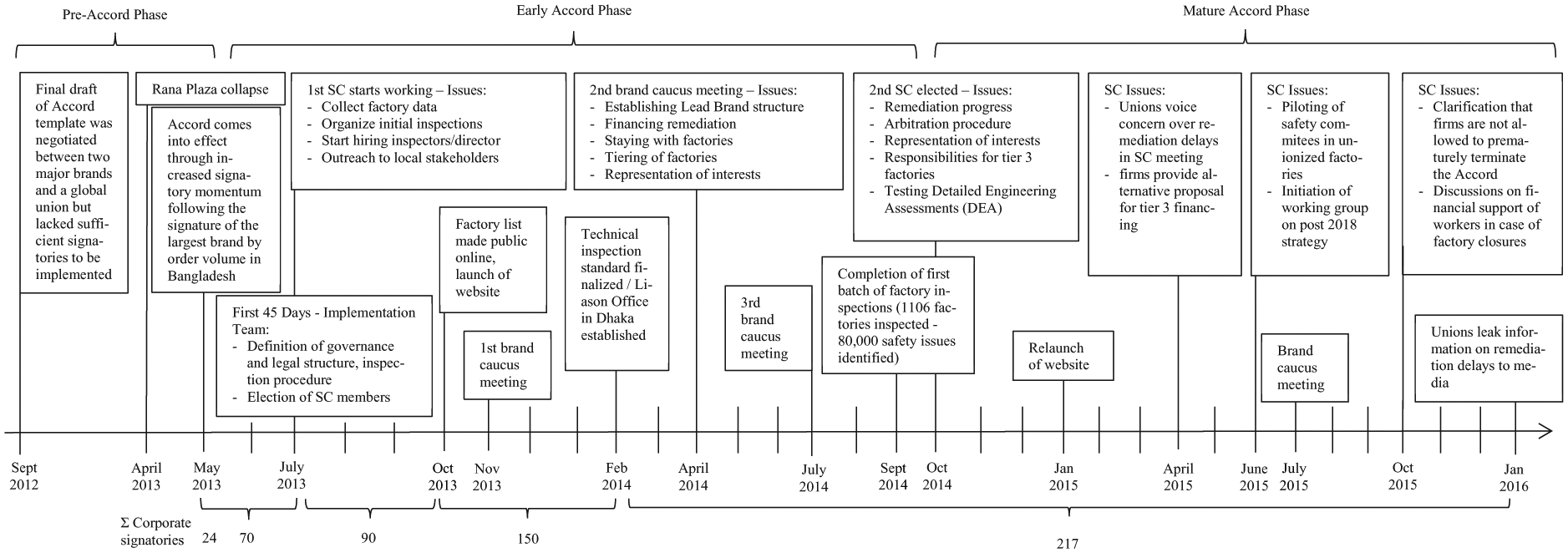
Timeline of selected events within Accord process.
Covering more than 1,600 garment factories in Bangladesh in which approximately two million workers are employed (Accord, 2018), the Accord provides a commitment made by the signing parties to implement a comprehensive fire and building safety program over a period of 5 years (2013-2018). This includes an independent fire, electrical, and structural inspection program as well as a remediation and worker participation program. The Accord also entails a financial commitment by signatories to contribute funding for necessary corrective actions in the factories (Accord, 2016). Through a complaints procedure and binding arbitration system, signatories may be pursued (e.g., the enforcement of fees, Reinecke & Donaghey, 2015). Signatory companies are assigned supplier factories in Bangladesh for which they are “in the lead,” meaning that they need to follow up on and communicate progress regarding safety issues with these factories.
The Accord has a two-tier governance structure: It includes a steering committee (SC) consisting of three representatives from trade unions and three signatory companies, as well as a neutral chairperson from the International Labour Organization (ILO) who serves as the executive organ of the Accord. The advisory board (AB) involves representatives of the government of Bangladesh, factory owners, and representatives from Bangladeshi civil society organizations operating without decision-making authority. Besides that, signatory companies regularly meet in company caucuses to discuss and consult with the company representatives in the SC.
The leading role of international trade unions in both the genesis and governance of the initiative makes the Accord a “unique and novel” (Reinecke & Donaghey, 2015, p. 734) governance mechanism that underlines the “distinctive position” (Harvey, Hodder, & Brammer, 2017, p. 45) of unions as a stakeholder group in CSR initiatives (Donaghey & Reinecke, 2018). Besides unions that steer the Accord together with companies, the Accord also involves a broader set of actors including civil society organizations and governmental actors. Accordingly, the Accord represents a multistakeholder governance scheme with a particularly strong role of international trade unions. By signing the Accord, companies found themselves co-responsible for fire and building safety of garment factories in Bangladesh and thus were no longer the object, but instead the subject of regulation and rule enforcement. The Accord put companies into a new role and challenged their self-understanding regarding CSR. Hence, the Accord represents a critical case for developing theory on processes of identity construction in the context of political CSR (Yin, 2013).
Data Collection
Data were collected over a period of half a year, between September 2015 and April 2016, from two main sources. First, we conducted 24 semi-structured interviews with 29 persons involved with the Accord. Besides covering union representatives that were active within the Accord as well as external experts, we conducted interviews with 16 German signatory companies ranging from small- to medium-sized companies and to large multinational corporations in the garment industry. We focused our analysis on German signatory companies, as they represent the largest group of signatories within the Accord and as a means to keep the cultural context of our study constant. The transcription of 26 hr and 33 min in total of recorded material resulted in 522 pages of single-spaced transcript.
Second, we triangulated the interviews with other sources of data (Miles & Huberman, 2008) by analyzing archival data. Included in these sources were Accord documents such as the SC and AB Meeting Minutes, the Accord’s twitter feed, and other external types of documentation such as newspaper articles as well as corporate documents such as press releases and sustainability reports. These additional sources allowed us to gain a deeper understanding of the temporal sequence of events and the broader context, dominant themes, and public perceptions against which interactions between the actors within the Accord emerged. Table 1 summarizes the data collected for this study.
Collected Data.
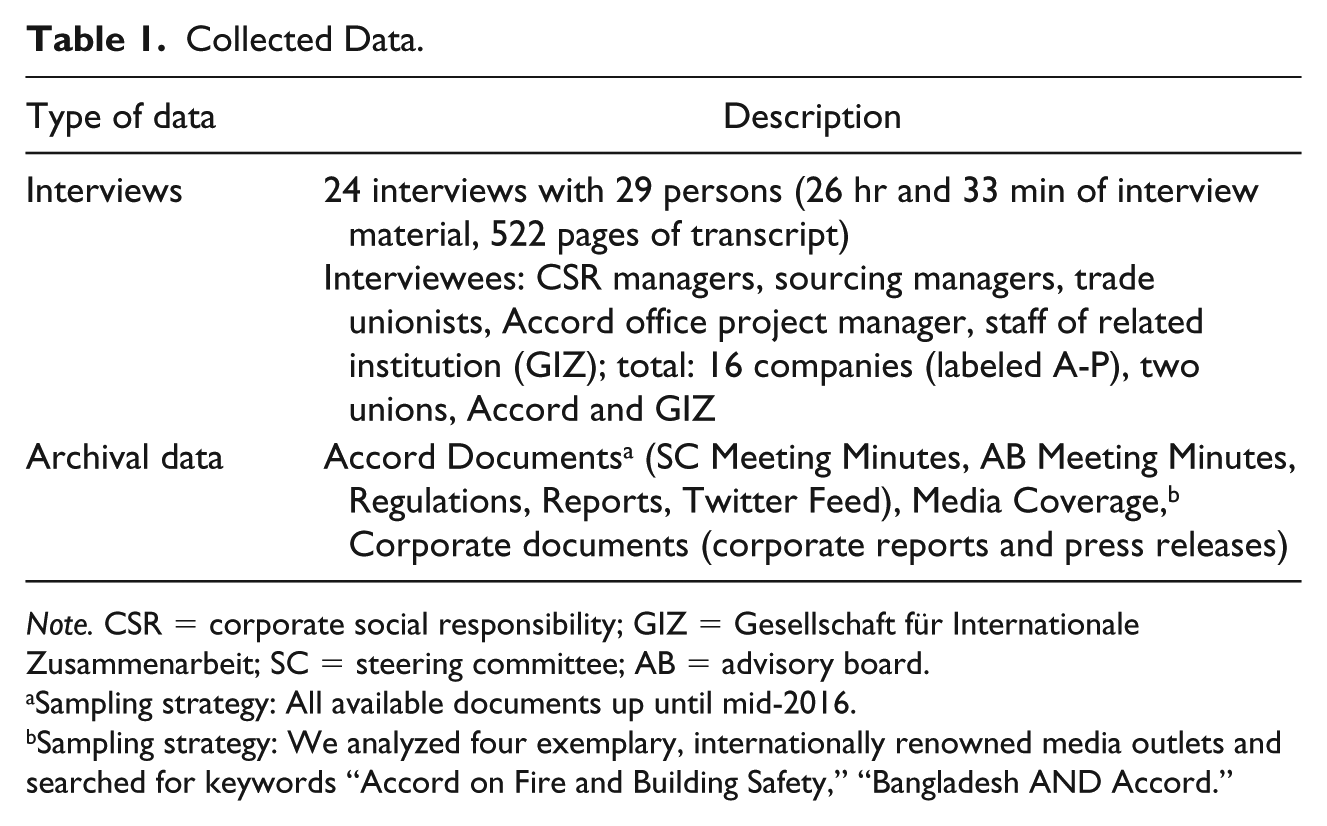
Note. CSR = corporate social responsibility; GIZ = Gesellschaft für Internationale Zusammenarbeit; SC = steering committee; AB = advisory board.
Sampling strategy: All available documents up until mid-2016.
Sampling strategy: We analyzed four exemplary, internationally renowned media outlets and searched for keywords “Accord on Fire and Building Safety,” “Bangladesh AND Accord.”
Data Analysis
In the analysis of the collected data, we employed a grounded theory-oriented approach (Corbin & Strauss, 2015; Gioia et al., 2012). Following each interview, we discussed emerging themes as well as observations that caught our interest. After the transcription of the interviews, we entered into formalized coding, which proceeded in four steps. In the first step, we imported all data into the qualitative data analysis software MAXQDA, which helped us to organize, develop, and refine our emerging codes. We both openly coded a number of interviews, using descriptive as well as in-vivo codes, thereby identifying initial, first-order concepts (Corbin & Strauss, 2015). In the second step, we discussed the open codes that we both had generated and entered into the phase of axial coding (Corbin & Strauss, 2015). We looked for relations and dissociations between the first-order codes we had identified, grouping them into more generic second-order themes (Gioia et al., 2012).
For the third step, in the spirit of the technique of constant comparison (Corbin & Strauss, 2015), we went back and forth between our emerging theory and data, constantly discussing occurring themes and analyzing further interviews to compare identified patterns. We also consulted the secondary sources of data and iteratively refined the second-order themes in light of new information. In particular, the Accord’s SC and AB meeting minutes as well as the Accord’s Twitter Feed were helpful in reconstructing the temporal sequence of events (see Figure 1). Through these comparisons, it iteratively became apparent that corporations displayed two different self-understandings of their political role in the Accord, which are associated with different beliefs, values, and goals (Ashforth et al., 2008; Wilts, 2006) and are expressed by both the way firms tend to behave and the way firms talk (Christensen et al., 2013; Haack et al., 2012) within the initiative. Drawing on the literature on corporate (political) identity construction (Gioia et al., 2010; Schultz, 2012; Wilts, 2006), we ultimately termed these distinct self-understandings as either progressive or conservative PCSRIs. We noted that these two broad PCSRIs are associated with “specific, but not always intentional or conscious” (Joutsenvirta & Vaara, 2015, p. 744) behaviors and communicative interactions, which we called political strategies of identity construction.
In the fourth step, we merged the existing codes into trajectories that characterize the process of how corporations constructed their PCSRIs within the initiative over time. We found that all corporations had entered the Accord with a specific mind-set and level of experience in dealing with different stakeholders. Yet, whereas for some corporations participating in the Accord could be interpreted as an affirmative experience in their construction of their PCSRI, for others the Accord participation could be interpreted as a transformative experience that significantly altered and shaped the construction of their specific PCSRI. Overall, we identified four distinct trajectories of identity construction. These trajectories related to either an affirmative or transformative construction of a conservative PCSRI or an affirmative or transformative construction of a progressive PCSRI, respectively. The data structure that resulted from this analysis is presented in Figure 2 and is outlined in detail in the following section. The online supplemental material shows sample quotations for selected first-order codes, providing a more detailed account of the data structure.
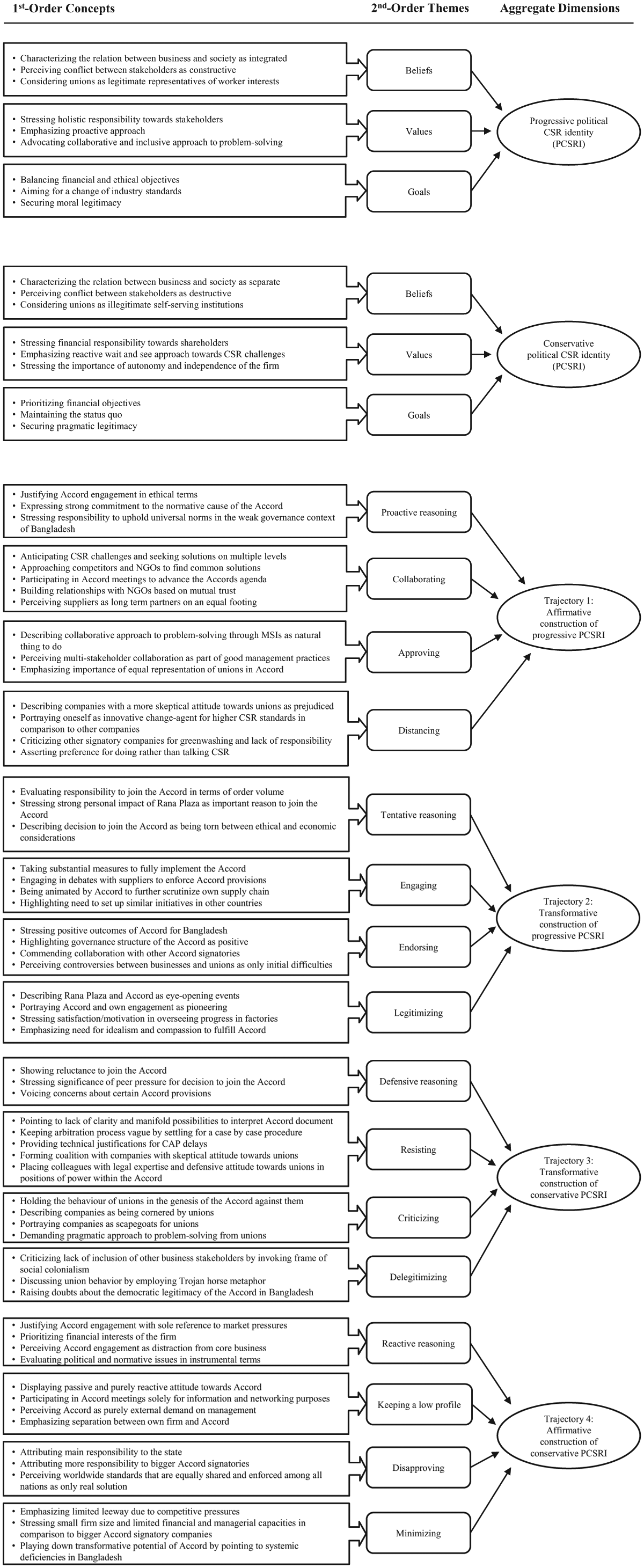
Data structure.
Findings: Constructing PCSRIs in MSIs
Progressive Versus Conservative PCSRIs
Our data reveal that companies constructed their PCSRIs within the Accord along a continuum between two opposite poles, which we labeled as a conservative and a progressive PCSRI. These labels emerged from in-vivo codes in our data. In resonance with Wilts (2006) and Ashforth and colleagues (2008), we found that these identities consist of a specific set of beliefs, values, and goals that corporations expressed through their actions and communications with other stakeholders within the initiative. Companies with a progressive PCSRI expressed their belief that business and society belong together and perceived the Accord as a necessary break-up of defensive corporate positions through conflict with unions and other civil society organizations. These companies considered critical stakeholders as representing legitimate interests and acknowledged their ultimately beneficial role in the Accord. In addition, progressive companies displayed a more holistic understanding of their supply chain responsibility by stressing the need to take a comprehensive and multidimensional perspective on global sustainability issues. These companies advocated a collaborative and inclusive approach to problem-solving by viewing the Accord as a “great example of how one can learn from each other” (Company E).
Companies with a progressive PCSRI pursued a specific set of goals with their participation in the Accord. These companies expressed their goal to balance financial and ethical objectives through CSR initiatives aiming at “a substantial upgrade” (Company D) of industry standards “to actually improve something in the short, middle, and long term” (Company B). Furthermore, these companies participated in CSR initiatives to secure their moral legitimacy toward their stakeholders and society at large, emphasizing their “moral duty” (Company D) to act after the Rana Plaza accident.
Companies with a conservative PCSRI displayed an opposing set of beliefs, values, and goals in our data. Believing that business and society are separate rather than integrated entities, they disapprove of political conflicts with other Accord stakeholders, and stressed instead an “operational standpoint” and “usefulness” (Company K) as more important factors for multistakeholder governance. Moreover, conservative companies asserted a negative attitude toward the involvement of unions or other NGOs in the Accord. Conflict with unions is not perceived as a “necessary evil” but rather seen as detrimental to the Accord’s cause, as union demands are perceived as excessive, largely destructive, and ultimately paralyzing for the implementation of the Accord. Conservative companies advocated a primarily economic perspective on their supply chain responsibility by aiming for solutions with minimal impact on their cost structures and internal processes. Rather than discussing the need for an industry upgrade, companies with a conservative PCSRI emphasized the limits of their engagement in the Accord by stressing their limited financial and organizational resources and expressed a reactive rather than proactive attitude toward future CSR challenges.
Instead, these companies stressed the responsibility “toward the company itself . . . to protect oneself from dropping out of the market” (Company H), thus emphasizing the importance of autonomy and independence for the firm. Furthermore, our data show that conservative companies assigned priority to reaching financial objectives and were interested in maintaining the status quo by refusing to “fulfill the role of the global police officer” (Company I) in governance initiatives, as one CSR manager put it. Rather than securing moral legitimacy, conservative companies aimed at securing pragmatic legitimacy toward their stakeholders (e.g., describing “to get orders from customers . . . and to process them on time” as the “most important” [Company H] task of management).
Trajectory 1: Affirmative Construction of Progressive PCSRI
From our analysis of the interviews as well as the secondary data, it became apparent that some companies entered the Accord with a strong progressive orientation. Company D, for example, had already in 2006 committed itself publicly to making its business “100% sustainable” and has since gained a reputation as a sustainability leader within the industry among both the general public and more critical NGOs. Company D was already actively involved in the pre-Accord phase where several unions and the CCC approached the company to draft an MoU which later became the Accord. The deep involvement with the Accord of Company D is captured by the following reconstruction of the companies’ rationale to join the Accord: We have discussed the subject matter very much internally, and then we decided to do it because the logic behind it, i.e., independent inspections, but also the whole aspect of the integration of unions, making sure, that employees ultimately have a grievance mechanism and have the support from the outside, that they ultimately are able to defend themselves in an emergency. So that were for us the aspects, where we said, okay, everything has to work together and that is why that made sense for us. (Company D)
Stressing in detail the advantages of the “logic” of the Accord, with a particular focus on improving the situation of factory workers, shows that Company D justified their engagement with the Accord by primarily referring to the benefits the Accord provides for workers in Bangladesh rather than for the company itself. The company thereby gave workers’ interests prevalence over corporate interests. Furthermore, companies with a progressive orientation expressed a strong commitment to the normative cause of the Accord and stressed their responsibility to uphold universal norms in the weak governance context of Bangladesh. We subsumed these first-order concepts under the second-order theme of proactive reasoning as these statements reflect a rationale behind the decision to engage with the Accord, dominated by an eagerness to set the initiative in motion.
Entering the Accord with this proactive rationale provided the background for companies to enact a political strategy, which we called collaborating. Company D, for example, collaborated with unions and the CCC way before the Rana Plaza incident because they anticipated the CSR challenge in Bangladesh and realized the need for a multistakeholder approach to this particular problem. Based on positive prior experiences in working with critical stakeholders, Company D approached competitors and civil society organizations to find common solutions and co-negotiated the draft framework for the Accord with unions and the CCC. Building upon its belief in the legitimacy of unions and the constructive role of conflict, Company D related to these actors on the basis of mutual trust. Participating actively in the early phase of the Accord, Company D sought to advance its agenda and to assist the initial set up of inspection procedures and governance structures. In addition, companies on Trajectory 1 related to their suppliers as long-term partners on equal footing by stressing frequent personal visits at supplier factories and by characterizing their relationship as close or “more similar to friendship then to a conventional client-producer relationship” (Company B).
Furthermore, Company D, for example, described its collaborative approach to problem-solving as “part of the 101 of sustainability management” as well as of “simply good management.” Accordingly, this manager portrayed the companies’ CSR policy as natural and logical approach to pursue. In addition, companies on Trajectory 1 commended the strong voice of unions within the Accord and asserted the preference for walking rather than talking CSR. We called this strategy approving as companies express a strong belief in the merits of the Accord in bringing diverse stakeholder together and rate the interactions with other stakeholders as largely positive. Intriguingly, companies associated with Trajectory 1 constructed their PCSRI not only by relating positively to other governance actors, such as like-minded companies or unions but also by creating distance between them and other signatory companies—a political strategy that we labeled distancing. Company D, for example, manifested its interest in establishing higher CSR standards in the industry by portraying itself as an innovative change-agent in comparison with other companies. Relating to Accord signatory companies with a skeptical attitude toward unions as “the other group” that is “driven by bad myths,” a CSR manger from Company D described these companies as prejudiced while at the same time positioning her own company at an advanced level. In addition, companies on Trajectory 1 distanced themselves from other Accord signatories by criticizing these companies for “signing but not really engaging with the Accord” (Company B) as well as for failing to take their supply chain responsibility seriously. Stressing their own innovativeness in comparison with others, these companies reaffirmed their progressiveness by portraying their set of beliefs, values, and goals as more advanced.
Trajectory 2: Transformative Construction of Progressive PCSRI
Rather than entering the pre-Accord phase with a progressive orientation, companies on Trajectory 2 joined the Accord with a more conservative orientation. Company J, for example, described the decision to join the Accord as being torn between economic and ethical considerations. Pointing to the fact that “90% of our production volume takes place in Bangladesh,” Company J justified its Accord participation primarily in relation to its order volume in Bangladesh, showing its economic interest to retain Bangladesh as a production source. Yet, the high financial costs associated with a participation in the Accord made the company initially hesitant to join. However, a CSR manager of Company J also stressed the strong personal impact of Rana Plaza as an important reason to join the Accord by emphasizing the “terrifying” nature of the factory collapse. The company ultimately decided to join the Accord “despite the costs.” We subsumed these first-order concepts under the second-order theme tentative reasoning as these statements reflect a rationale behind the decision to join the Accord torn between ethical and economic considerations, which reflect the initially more dominant financially oriented interests and values of companies on Trajectory 2.
Joining the Accord with this tentative rationale provided the starting point for the progressive transformation that companies experienced along Trajectory 2. After joining the Accord, these companies started to take substantial measures by creating new positions, policies, and processes dedicated to the full implementation of the Accord within their companies. A CSR manager from Company A, for example, stressed that “it is only through the Accord” that his company hired new staff and adapted sourcing guidelines elevating working conditions to the same level of significance as quality and price. Moreover, these companies engaged in debates with their suppliers to enforce the Accord provisions. Instead of resorting to pure commercial pressure, these companies tried to provide their suppliers with a rationale for implementing the Accord based on a win–win logic. In addition, companies emphasized being animated by their experiences within the Accord to further scrutinize their own supply chains by stressing the need to look “at the whole package” on the ground and not only on selected issues. Several companies continued in this vein by highlighting the need to set up similar initiatives in other countries. All of the aforementioned actions describe serious and substantial efforts by companies to engage with and implement the Accord that lead companies into a self-reinforcing positive feedback-loop. Hence, we subsumed these actions under a political strategy, which we called engaging.
Having engaged in several measures to implement the Accord, these companies then started to develop a positive stance toward the Accord—a strategy that we subsumed under the label endorsing. As these companies started to see the first safety improvements in factories, they praised the positive outcomes of the Accord. Furthermore, these companies portrayed the governance structure of the Accord in a positive light and commended the collaboration with other Accord signatory companies. In addition, controversies between businesses and unions within the Accord were described as only initial difficulties that were largely attributed to the chaotic circumstances in the early phase of the Accord. The situation within the mature phase of the Accord is instead characterized as “calmed down” with several stakeholders “being simply thankful that the Accord exists” (Company J). Hence, initially rather skeptical beliefs regarding the role of unions and the benefits of stakeholder conflict shifted toward much more positive views toward unions and the role of conflicts in MSIs.
Interestingly, our data reveal that companies on Trajectory 2 also enacted a strategy that served to reinforce their newly constructed progressive PCSRI. A CSR manager of Company A, for example, noted, In all my years [visiting suppliers] abroad, I have never noticed what possibilities are out there—somehow you have simply accepted the conditions as they are . . . When I started, I had more of this, let’s say, strictly numerical orientation, to somewhere make the most favourable business deals. However, through this role one learns, of course, also how business relations can go much easier if you can create a win-win-situations and so to say take care a bit of the local surroundings.
In this quote, the Accord is described as an eye-opening event leading to a fundamental change of perspective that makes prior practices seem one-dimensional and outdated. Another CSR manager from a different company called the Accord enthusiastically “an unprecedented big thing,” which he would have considered impossible only a few years ago, causing “goose bumps” (Company J). This manager portrayed the Accord and his company’s engagement as pioneering. Moreover, several companies stressed experiencing deep satisfaction and motivation in overseeing progress in supplier factories. In addition, these companies emphasized the need for idealism and compassion to fulfill their role in the Accord. As all of these arguments were oriented toward the internal justification of the CSR efforts of these companies within the Accord, we called this political strategy legitimizing. This strategy reinforced the shift toward a more progressive set of beliefs, values, and goals that companies developed on Trajectory 2.
Trajectory 3: Transformative Construction of Conservative PCSRI
Our data analysis shows another transformative trajectory along which companies constructed their political identity, albeit in a reversed direction. After entering the Accord with a rather progressive orientation, we identified a number of corporations that shifted toward a conservative PCSRI. Company G, which is a big brand with a long retail tradition in Germany, represents an illustrative example for this conservative transformation. Despite having demonstrated its belief in a close business-society relation and its goal to balance ethical and financial objectives over the last decades, Company G enacted what we called defensive reasoning in the pre-Accord phase. A CSR manager of Company G described their reluctance to join the Accord by emphasizing the very low recognition of the prior MoU among “the business world” as well as by characterizing the Accord draft document as “extremely union friendly.” This manager further noted that company G ultimately joined the Accord due to peer pressure as the room for negotiation with unions was “exhausted” after the signature of the largest brand, by order volume, in Bangladesh. Companies on Trajectory 3 felt treated unfairly by unions, which in their view breached an agreement to continue the negotiations by strategically “singling out” several companies to exert “massive pressure” (Company G) on them to sign the Accord without further changes. This perception of feeling forced into an initiative due to unfair negotiation tactics by unions shaped the PCSRI trajectory of these companies in a fundamental way by shifting initially held beliefs in the legitimacy of unions and the constructive role of stakeholder conflict into a more conservative direction. Hence, companies on Trajectory 3 joined the Accord reluctantly, feeling that several concerns about its governance structure and the role of unions had not been adequately addressed.
Entering the Accord with this defensive posture fueled the enactment of a political strategy which we called resisting. Based on their negative prior experience with unions in the phase leading up to the Accord, companies took several actions geared toward counterbalancing the perceived dominance of unions in the Accord. Several companies, for example, insisted right from the start that the Accord document contains several ambiguities, which enable manifold possibilities of interpretation. Several companies used this wiggle room strategically (e.g., by keeping the arbitration procedure of the Accord vague and settling with unions after intense debates on a case-by-case procedure as well as by providing technical justifications that blamed engineering procedures for remediation delays). The most emblematic expression of this political strategy in our data, however, consists in the circumstances of the second SC election of the Accord. As the election of the second SC was approaching, several companies with a skeptical attitude toward unions formed a coalition, through several informal interactions at caucus meetings, to coordinate the election of a stronger, more business-friendly representative to the SC. By placing a colleague with legal expertise and a more defensive attitude toward unions in a position of power within the Accord, one company explicitly emphasized its intention to resist unions by getting “into the driver seat” themselves. This election resulted in a more hostile atmosphere in the SC, as several union representatives confirmed in our interviews.
Furthermore, companies on Trajectory 3 criticized the behavior of unions feeling “pushed into a corner” (Company G) and portrayed themselves as being scapegoated by unions which in their view constantly blamed companies for profiting from human rights abuses instead of treating them as partners on equal terms. Moreover, unions are criticized for their unrealistic and excessive demands that leave businesses with no choice other than to raise “the voice of reason” by calling on unions “to get a little pragmatic here and focus on the issues” (Company G). As all of these first-order codes served to portray companies as the victim of unfair treatment by unions within the Accord, we called this political strategy criticizing.
After taking several actions to resist and criticize unions in the Accord, companies on Trajectory 3 started to voice more fundamental concerns about the Accord. Several companies raised doubts about the democratic legitimacy of the Accord in Bangladesh by emphasizing the right to self-determination of citizens and elected representatives of Bangladesh. In addition, companies criticized the missing inclusion of other business stakeholders such as factory owners and their industry associations by invoking the strong frame of “social colonialism” as illustrated by the following quote: . . . because we have to be careful, I believe, not to engage in social colonialism, because this is what it is after all. I say, ‘your opinion is of no interest to me, because I know what is right and this is why I am pushing through with this, and I do not even take you into the steering bodies that decide what I can force through in your country because we in the western hemisphere know exactly what is good for you. (Company G)
The term social colonialism bears extremely negative connotations and is deliberately used to rhetorically enforce the criticism that certain business stakeholders have been left out of the Accord. By describing the Accord as “some sort of trojan horse” (Company O) for promoting union interests in Bangladesh, another rhetorical instrument was employed to discredit both the Accord and the unions. As all of these criticisms aimed at questioning the efficacy and legitimacy of the Accord, we called this political strategy delegitimizing. Therefore, companies on Trajectory 3 stabilized their newly constructed conservative beliefs, values, and goals by stressing democratic deficits of the Accord and by criticizing unions for their lack of pragmatism.
Trajectory 4: Affirmative Construction of Conservative PCSRI
Finally, our data reveal a fourth trajectory along which companies constructed a conservative PCSRI. As opposed to Trajectory 1, companies that we associate with Trajectory 4 entered this trajectory with a conservative orientation which set the stage for the construction of an even more pronounced and substantiated conservative PCSRI within the Accord over time. As many of the companies on this trajectory were importers for large retailers, these companies justified their decision to join the Accord with the sole reference to market pressures exerted by either the general public or important customers. Furthermore, these companies reflected on their Accord participation with a mind-set that prioritized the financial interests of the firm as clearly illustrated by the following quote: I have to tell you honestly, our first priority is to take care of our business. That’s the most important thing. We have to get orders first. This is the most difficult aspect of all. Once we have them, we try to handle them on time. And then, of course, we try to make the factories better. But if the factory does not cooperate, what are we to do about that? . . . We cannot save the world that is not our approach. (Company H)
For this company, improving working conditions in supplier factories unambigu Sahlin-Andersson, K. (Eds.). (2006 ously plays a minor role, not only because Company H considers getting and processing orders from customers as more important but also because it perceives its influence on factory safety as very limited. In this vein, companies on Trajectory 4 perceived the Accord as a distraction from their core business, which “forces” suppliers to implement excessive demands and keeps businesses from “focusing on the things that really matter” (Company N). We subsumed these first-order concepts under the second-order theme reactive reasoning as these companies displayed a rather passive posture when contemplating to join the Accord, manifesting their belief in the separation between business and society as well as their goal to maximize profits.
As the Accord started operating, these companies displayed a passive and purely reactive attitude toward Accord processes. One CSR manager, for example, described the behavior of his company in the Accord as staying “under the radar” (Company P), which entailed staying passively focused on factory inspections by avoiding being drawn into discussions with unions and other brands as well as by avoiding participation in working groups. Several companies further explained their participation at Accord meetings and company caucuses by stressing their intention to stay informed about current and future developments within the industry rather than being motivated to actively participate in the Accord’s governance. Furthermore, these companies did not really see themselves as part of an initiative as they perceived the Accord as purely an external demand on management that is completely separated from their own firm. One general manager, for example, when asked about how he evaluates the semi-governmental role of the Accord in Bangladesh responded by stating, “The Accord has this role, not me” (Company K). As all of these actions were geared toward staying as little engaged in the Accord as possible, we subsumed these actions under a political strategy which we called keeping a low profile.
In addition, many companies on Trajectory 4, by describing the Accord as an “auxiliary structure,” argued that the state of Bangladesh should bear the main responsibility portraying law enforcement as the “core task” (Company H) of the state. Moreover, based on the conviction that “big players have more power to implement things” (Company N), companies attributed more responsibility to bigger signatory companies. Furthermore, companies adopted a global perspective when discussing their responsibility to improve working conditions in supplier factories. By portraying worldwide standards that are equally shared and enforced among all nations as the only real solution, these companies attribute the main burden of responsibility to the international community. As all of these first-order codes express negative attitudes toward the Accord, we called this political strategy disapproving.
Finally, several companies emphasized their own limitations regarding their engagement with the Accord by pointing to strong competitive pressures as well as by stressing their smaller firm size and their limited financial and managerial capacities in comparison with bigger Accord signatory companies. Companies on Trajectory 4 played down the transformative potential of the Accord by pointing to systemic deficiencies in Bangladesh, such as the challenge “to make it clear to a factory owner that you have to stick to the rules and laws when everyone else breaks them” (Company H). Adopting such a negative view significantly diminished the degree of change that seems achievable by the initiative and made it easier for companies to remain passive within the Accord. As all of the statements above aimed at downplaying companies’ own role within the Accord, we called this political strategy minimizing. Through this strategy, companies on Trajectory 4 further strengthened their conservative PCSRI by providing reasons that underline their conservative beliefs, values, and goals within the Accord and beyond.
How Companies Construct PCSRIs in MSIs
In this study, we aimed at understanding how companies construct their PCSRIs in MSIs. We found that a progressive PCSRI is constructed over time either through the affirmation of an already existing progressive orientation (Trajectory 1) or through a transformation of a previously conservative orientation toward a more progressive identity (Trajectory 2). The conservative PCSRI, by contrast, is constructed either through a conservative transformation of a previously progressive orientation (Trajectory 3) or through the affirmation of an already existing conservative orientation (Trajectory 4). Figure 3 provides a schematic representation of these trajectories and the political strategies that companies enacted to construct their PCSRIs. On the abscissa, we depict the three main phases that the Accord went through over time, while on the ordinate, we indicate the PCSRI continuum ranging from conservative to progressive. We illustrate how the progressive and conservative PCSRIs are constructed within the Accord over time through four distinct trajectories and their associated political strategies. In addition, we depict four forces that influenced these trajectories by shaping the political strategies of PCSRI construction in important ways.
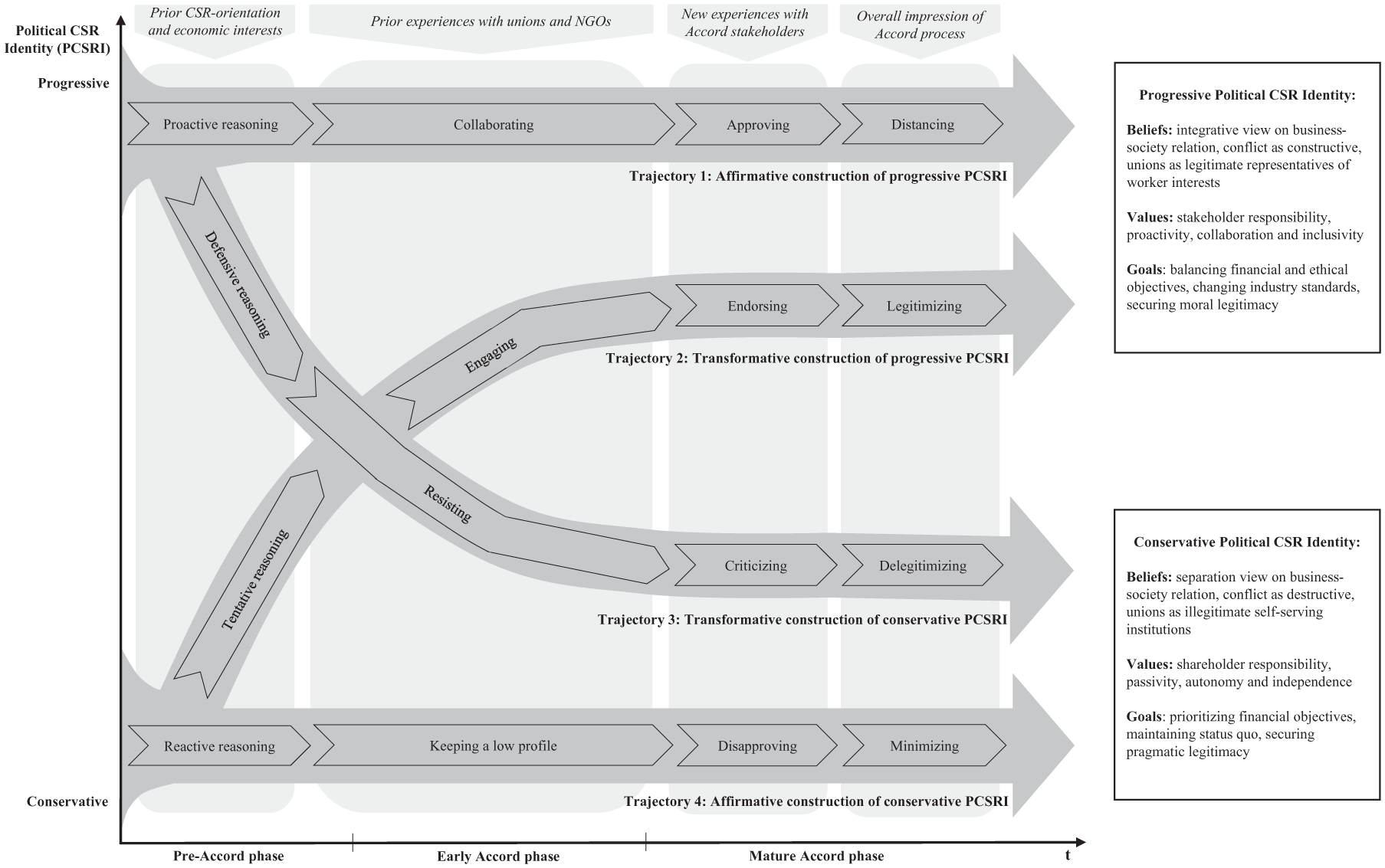
Trajectories of political CSR identity construction in multistakeholder initiatives—A framework.
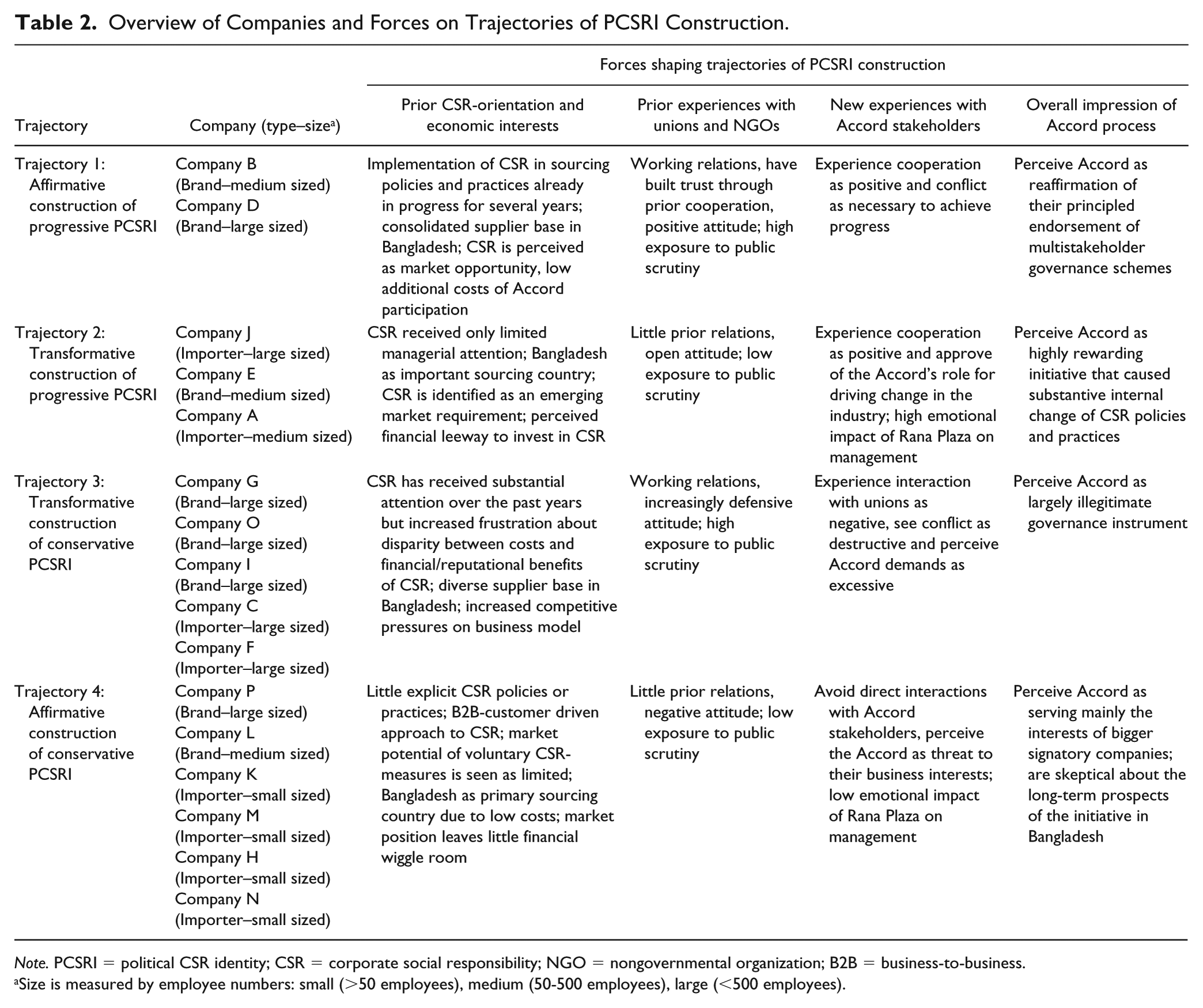
While each company in our sample is associated with a specific trajectory (see Table 2), we note some variation in our data as some companies followed the trajectory closer than others. Moreover, while we present the associated political strategies in a discrete and sequential manner, we note the stylized nature of our second-order codes and varying degrees of overlap between these codes in our data. As pointed out by several scholars, researching processes requires ensuring “that descriptive detail does not obscure analytical insights” (Eberlein, Abbott, Black, Meidinger, & Wood, 2014, p. 11). What we seek to highlight with our framework are the dynamic ways in which companies constructed their PCSRI within the Accord over time. We show that both the affirmation and the transformation of preexisting identity orientations involve the enactment of discrete, yet interrelated, political strategies that are themselves shaped by several forces over time. Table 2 provides a detailed description of these forces for each trajectory of identity construction.
Overview of Companies and Forces on Trajectories of PCSRI Construction.
Note. PCSRI = political CSR identity; CSR = corporate social responsibility; NGO = nongovernmental organization; B2B = business-to-business.
Size is measured by employee numbers: small (>50 employees), medium (50-500 employees), large (<500 employees).
The rationale by which corporations entered the Accord was critically shaped by a company’s prior CSR-orientation and economic interests. Companies on Trajectory 1, for example, entered the Accord with an already strong set of progressive beliefs and values. These companies had already committed themselves to the implementation of strong CSR-measures within their supply chains prior to Rana Plaza, and adapted their business model to reflect their conviction that such CSR-investments reduce reputational risks and open up new market opportunities with more conscious consumer segments. Companies on Trajectory 2, in turn, initially struggled to balance their rather underdeveloped CSR approach with the perceived urgency to provide an effective response to the Rana Plaza tragedy. These companies started to see the long-term economic benefits of investing in CSR-measures within their supply chain, given the importance of Bangladesh as a sourcing country for their business model. Companies on Trajectory 3 had a history of rather progressive CSR activities prior to the Rana Plaza disaster. However, the market position of these companies became more unstable due to increased competition, leaving less perceived leeway for additional CSR activities. These companies increasingly developed a sense of disappointment about the business case for CSR, perceiving that the total cost outweighs the reputational gains. Companies on Trajectory 4 joined the Accord with an already pronounced conservative identity orientation, participating mainly due to direct economic pressure from their key B2B (business-to-business)-customers, which made signing the Accord a condition for continued business relations. These companies perceived the competitive market pressures as too high to engage with voluntary CSR activities.
How companies then engaged with the nonbusiness stakeholders in the early phase of the Accord was further shaped by prior experiences with unions and NGOs and depended upon whether corporations had made positive, negative, or little experiences with these stakeholders prior to the signature of the Accord. Having had positive experiences in jointly working with unions and NGOs, companies on Trajectory 1 decided to collaborate with external stakeholders to move the Accord’s agenda forward. Companies on Trajectory 2, on the contrary, had little prior experience with these critical stakeholders. Yet, with the perceived urgency to act in the aftermath of Rana Plaza, they decided to cooperate with the Accord stakeholders and implemented the Accord requirements with their firms as well as within their suppliers in Bangladesh. Based on prior negative experiences with unions and NGOs in the run up to the Accord, companies on Trajectory 3, in turn, enacted strategies aimed at resisting and constraining the influence of critical stakeholders on core business operations. These companies had felt pushed into a corner by unions and perceived the demands of unions and NGOs in the pre-Accord phase as excessive and their behavior as unfair. Companies on Trajectory 4 that mostly were importers operating in a B2B market with little public exposure had also had little direct experience with international unions or critical NGOs prior to the Accord. However, with their business model strongly focused on profit maximization, they also showed little interest in establishing closer ties with these critical stakeholders and hence enacted strategies that were geared toward maintaining a passive posture in the initiative.
The new experiences gained with Accord stakeholders throughout the course of the initiative then shaped companies’ evaluation of the Accord, either positively or negatively reinforcing the trajectories that corporations had entered. For companies on Trajectory 1, the economic incentive to push proactively for the success of the Accord grew over time as sharing the economic burden as well as creating a level-playing field concerning fundamental production standards in Bangladesh strengthened their own market position. Approving of the experience with other stakeholders in the Accord, these companies then tried to push for a comprehensive implementation of the Accord and thereby further affirmed their progressive orientation. Companies on Trajectory 2, with the gradual implementation of the Accord on the ground in Bangladesh, started to see the long-term economic benefits of investing in CSR-measures within their supply chain and began to perceive improving their CSR performance as a market opportunity. Based on this shift in perception of economic interests and values, these companies continued their progressive transformation, endorsing the experiences with unions, NGOs, and other signatories within the Accord. Companies on Trajectory 3, on the contrary, perceived the increasing demands by unions and critical stakeholders throughout the Accord as costly, time-consuming, and threatening their market position. Hence, they engaged in criticizing the Accord with the aim to gain support from other conservative stakeholders to limit the Accord’s agenda. Experiencing the Accord meetings and demands as an obstacle to their “real” job, companies on Trajectory 4 engaged in what we term as disapproving of the Accord and thereby reinforced their conservative identity.
The political strategies that companies ultimately employed to consolidate their PCSRIs were shaped by their overall impression of the Accord process. On Trajectory 1, companies reaffirmed their progressiveness by reflecting positively on the merits of their engagement in the Accord, perceiving themselves as proactive drivers for a level-playing field regarding social production standards in the industry. Companies on Trajectory 2, in turn, solidified their more progressive PCSRI by portraying their own path within the initiative as a highly rewarding experience that caused substantial change regarding internal CSR policies and practices. On Trajectory 3, by contrast, companies described the Accord in less favorable terms raising fundamental concerns about the efficacy and legitimacy of its structures and composition of stakeholders. Companies on Trajectory 4, in turn, perceived the Accord as serving mainly the interests of bigger signatory companies while going against their core business interests. In addition, these companies provided a rather grim outlook about the Accord’s potential to achieve long-lasting outcomes in the difficult institutional context of Bangladesh.
Hence, on the transformative trajectories, companies gradually reevaluated and ultimately shifted underlying beliefs, values, and goals based on new experiences with unions, NGOs, and other signatory companies within the Accord. Companies on the affirmative trajectories, by comparison, experienced these interactions rather as a reassurance of their either progressive or conservative identities.
Discussion
Our qualitative study explored how corporations discursively construct PCSRIs through interactions with other stakeholders in the Accord and how these identities shaped the behavior of corporations within the MSI. By tracing the evolution of corporate PCSRI construction within the Accord, this article makes a twofold contribution to the literature.
The Multidirectional Political Processes of PCSRI Construction in MSIs
This article contributes to the discussion concerning optimistic and critical perspectives on corporations’ political role in MSIs by extending the recently proposed integrative view on political CSR (Levy et al., 2016). We show that PCSRI construction in MSIs is a dynamic and multidirectional political process involving the enactment of specific political strategies by corporations. Several strategies that companies enacted to construct a progressive PCSRI along Trajectories 1 and 2 resonate with arguments put forward by political CSR optimists. Political strategies like proactive reasoning or collaborating on Trajectory 1, for example, show that some companies indeed take on the role of proactive democratic governance actors that seek solutions for global governance problems by deliberating with affected stakeholders (Scherer & Palazzo, 2011). The already progressive orientation of these companies in the pre-Accord phase is affirmed and strengthened through their engagement in the initiative over time, demonstrating that talking about democratic political CSR can indeed have performative effects (Christensen et al., 2013; Haack et al., 2012; Wickert et al., 2016). In particular, political strategies such as engaging and endorsing on Trajectory 2 show that deliberative interactions between stakeholders in MSIs can serve as “schools of democracy” (Fung, 2003; Warren, 2001) for corporations in which they learn to collectively solve problems. These interactions can serve to argumentatively “self-entrap” (Risse, 1999) corporations, leading to a normative spiral in which corporations increasingly commit themselves to principles of human rights. Companies on Trajectory 2, for example, developed a more holistic perspective on their supply chain responsibilities and stressed their positive attitude toward critical stakeholders.
Furthermore, companies on the transformative progressive trajectory took substantial measures to implement the Accord by changing internal policies and practices despite entering the initiative with a more conservative orientation. This transformation again underlines the performative effects that can be caused by a company’s formal commitment to MSI policies. The progressive political strategies enacted by companies on Trajectories 1 and 2 are also reflected in several positive outcomes of the Accord. Since its inception 5 years ago, the Accord not only lead to a substantial progressive transformation of some signatory companies’ PCSR practices and identities, but the Accord also achieved significant improvements in fire and building safety with over 767 factories having completed more than 90% of remediation (Accord, 2018; Barrett, Baumann-Pauly, & Gu, 2018). Several progressive companies have already reaffirmed their commitment to the Accord beyond 2018, acknowledging that the initial 5-year time frame is not sufficient to complete remediation as well as to install worker safety committees in all factories (IndustriALL Global Union, 2017).
However, the political strategies that companies enacted to construct a conservative PCSRI on Trajectories 3 and 4 reinforce the critical perspective of corporate political engagement in MSIs. Political strategies such as reactive reasoning and disapproving mirror the view that companies approach CSR initiatives from a mainly instrumental perspective focusing on financial rather than ethical aspects of multistakeholder governance (Fleming & Jones, 2013; Shamir, 2010). Conservative political strategies like defensive reasoning, keeping a low profile, and resisting, in turn, relate to criticisms that companies use CSR initiatives to advance their economic rather than the public interest (Banerjee, 2007; Fooks et al., 2013). These strategies have complicated the effective implementation of the Accord and contributed to several negative outcomes such as the relatively slow pace of implementation regarding both remediation and worker safety committee installations in Bangladeshi supplier factories. Five years after the Accord’s inception, many of the over 1,600 factories have still not completed remediation and the safety committees trainings have only been completed in about 219 factories (Accord, 2018; Barrett et al., 2018).
Particularly, the conservative transformation of some companies’ PCSRI within the Accord over time suggests that constructs like argumentative self-entrapment and performativity of CSR talk should be conceptualized as bidirectional rather than unidirectional constructs implying that companies can be discursively entrenched as well as “disentrenched.” As much as talking CSR can open up a pathway to deeper political “responsibilization” (Schrempf-Stirling & Palazzo, 2016), it can also trigger a dynamic that minimizes the political role of companies in and through MSIs. Therefore, being part of an MSI and formally committing oneself to its CSR provisions does not imply that a company’s PCSRI and practices automatically converge toward democratic ideals.
This article hence contributes to the emerging integrative perspective within political CSR research by suggesting that MSIs, as governance mechanisms, can be understood as neither a unidirectional move toward the democratic self-embedment of corporations (Scherer et al., 2013; Scherer et al., 2016), nor as hegemonic tools for the expansion of corporate power (Banerjee, 2007; Fleming & Jones, 2013). Instead, MSIs should be conceptualized as inherently political governance mechanisms that are driven by multidirectional political processes of PCSRI construction.
The Construct of PCSRI
By substantiating the notion of a PCSRI, our research provides a political perspective on organizational identity construction (Gioia et al., 2010; Schultz, 2012) that extends Wilts’s (2006) strategic take on the notion of a corporate political identity with an explicit reference to CSR. By combining beliefs and values with underlying corporate goals, a PCSRI shapes corporate behavior in MSIs and is at the same time developed and reproduced in ongoing interactions with stakeholders. We show how identities are dialogically constructed through discursive interactions between “insiders” and “outsiders” (Ashforth et al., 2010, p. 1147), that is, between those that are perceived as like-minded and those that are associated with a differing PCSRI. Furthermore, our findings resonate with recent identity research stressing the dynamic nature of identity construction (Gioia & Patvardhan, 2012) in that PCSRIs evolve over time either through affirmation or transformation.
Moreover, by tracing the political strategies associated with corporations developing a PCSRI, our study further contributes to an enhanced understanding of the underlying processes associated with political CSR that has been called for in the literature (Mena & Waeger, 2014; Scherer et al., 2016). With our findings, we provide a better understanding of the constitutive role of communication in the process of identity construction (Corley et al., 2006; Gioia et al., 2010). The verbal formulations of beliefs, values, and goals associated with PCSRIs serve as political resources to identify and gain other like-minded corporations to promote the particular political ends in the initiative. In this respect, communication both stabilizes organizations’ PCSRI and mobilizes support for collective action. By elucidating different trajectories along which companies construct their PCSRIs, our study unpacks corporations as participant groups in MSIs, providing a more nuanced perspective on corporate political engagement in MSIs.
Our findings highlight that a gradual change in perceptions of economic interests and beliefs about the behavior of critical stakeholders, such as unions and NGOs in the Accord, can induce a transformative dynamic that ultimately shifts identities over time. Companies on Trajectory 2, for example, gradually started to see benefits of the Accord’s implementation in Bangladesh, such as a new level and quality of cooperation with suppliers and competitors. Companies on Trajectory 3, in turn, formed a strong belief that unions and NGOs are no longer trustworthy partners and increasingly perceived the cost of implementing the Accord as a burden on their competitive position. In addition, both affirmative trajectories show the dynamics involved in maintaining and strengthening identities over time. Therefore, our findings stress that material factors such as economic interests or experiences with stakeholders influence and shape identities. Companies construct PCSRIs by enacting political strategies that are in turn shaped by material forces. Accordingly, PCSRIs provide companies with frameworks for the perception of experiences and economic interests.
Furthermore, we find that forces referring to both the past and the present shape all PCSRI construction trajectories. Prior CSR-orientations and prior experiences with critical stakeholders determined the level of openness with which corporations entered the Accord. New experiences with stakeholders then further influenced how PCSRIs evolved in the Accord. The importance of prior experiences and preexisting economic interests and CSR-orientations suggests that the cumulative experience of companies with MSIs influences the propensity for identity change or stabilization. However, positive or negative new experiences with other stakeholders can also influence a company’s perception of goals and beliefs and thereby induce change, both in the conservative and in the progressive direction. Notwithstanding the contributions of our framework to the literature on political organizational identity and PCSR research, our findings open up several interesting avenues for future research.
Directions for Further Research and Conclusion
In this article, we introduced PCSRI as a dynamic construct consisting of specific beliefs, values, and goals. While we described these PCSRI components in relation to both ends of the progressive-conservative continuum, we suggest that both more conceptual and empirical research is needed to further disentangle our identified building blocks of PCSRI. Developing a deeper understanding of the relationships between these building blocks can provide further insights into PCSRI construction dynamics, particularly within transformative trajectories.
In our empirical study, we focused our attention on the role of interactions between corporations and other stakeholders in the MSI and traced how these interactions incited processes of identity construction. However, further research should explore the associated internal processes of identity construction within a focal corporation. As our findings suggest that corporate participants in MSIs perceive themselves as representing the PCSR views of the company rather than their own CSR perspective, we conceptualize PCSRI as residing at the organizational level, representing a shared system of meaning above and beyond the managers’ personal identity. Nonetheless, recursive interrelations between the managerial and the organizational level in the construction of PCSRI can be expected (Ashforth et al., 2010), which merit further academic exploration.
In addition, we conceptualized PCSRI as a facet of an organization’s identity that is concerned with its self-understanding as a political actor in the global governance of social and environmental issues. While this resonates with research on the multiplicity of identities in organizations (Corley et al., 2006, p. 92), future research should investigate how different identities of a corporation interact with each other as well as how different individuals and departments within an organization are involved in shaping different aspect of an organization’s PCSRI.
The trajectories of PCSRI construction that we identified in this article are likely to recur in other collaborative governance efforts that require interactions among businesses, unions, and civil society associations (Schrempf-Stirling & Palazzo, 2016). However, as the textile industry has received much attention by critical NGOs and the international media, less publicly scrutinized industries might be driven by different PCSRI dynamics. Future research should thus address pathways of political identity construction in a comparative setting across different MSIs in different industries. In our study, we primarily interviewed corporate participants of the Accord based in Germany, which limits our capacity to fully explore relationships between cultural characteristics, that is, explicit versus implicit CSR (Blindheim, 2012; Matten & Moon, 2008) and PCSRI.
To conclude, this article suggests that corporate political behavior in MSIs is driven by multidirectional dynamics of PCSRI construction. Accordingly, policies and practices of MSIs are shaped by an ongoing tension between progressive and conservative companies that construct their PCSRIs by enacting specific political strategies that relate to their beliefs, values, and goals. While progressive companies advance an MSI’s agenda, conservative companies seek to constrain it. Hence, the indeterminacy and contested nature of MSIs are related to the dynamics of PCSRI construction. Our findings show that material forces such as economic interests and experiences with stakeholders interact with political strategies of identity construction. This interaction can trigger both an identity reaffirmation and an identity transformation (i.e., conservative companies becoming more progressive and vice versa). Therefore, this article sheds light on the dynamic and recursive interplay between, on the one hand, discursive political strategies of identity construction, and material forces shaping these strategies on the other hand.
The tension between the proactive eagerness for change that describes the construction of a progressive PCSRI and the reactive reluctance toward change characterizing the construction of a conservative PCSRI reminded us of the British writer and journalist G. K. Chesterton, who once noted: “The business of Progressives is to go on making mistakes. The business of Conservatives is to prevent mistakes from being corrected.” Mistakes, setbacks, and criticisms are therefore an unavoidable and essential part of political CSR initiatives. In fact, completely easing the tension between conservatives and progressives might be neither feasible nor desirable. Our study rather suggests that it is precisely this tension and its underlying political processes that ultimately drive change through MSIs.
Supplemental Material
supplementary_material – Supplemental material for Progressive and Conservative Firms in Multistakeholder Initiatives: Tracing the Construction of Political CSR Identities Within the Accord on Fire and Building Safety in Bangladesh
Supplemental material, supplementary_material for Progressive and Conservative Firms in Multistakeholder Initiatives: Tracing the Construction of Political CSR Identities Within the Accord on Fire and Building Safety in Bangladesh by Kristin Huber and Maximilian J. L. Schormair in Business & Society
Footnotes
Acknowledgements
The authors would like to thank the editor David Levy and three anonymous reviewers for their thoughtful guidance and valuable suggestions. In addition, the authors thank the participants of the Society for Business Ethics Annual Meeting 2017 in Atlanta, the EGOS Conference 2016 in Naples, and the JMS Political CSR Workshop at Cass Business School 2016 in London for their feedback on earlier versions of this article.
Authors’ Note
Both authors contributed equally to this article.
Declaration of Conflicting Interests
The authors declared no potential conflicts of interest with respect to the research, authorship, and/or publication of this article.
Funding
The authors received no financial support for the research, authorship, and/or publication of this article.
Supplemental Material
Supplemental material for this article is available online.
Author Biographies
References
Supplementary Material
Please find the following supplemental material available below.
For Open Access articles published under a Creative Commons License, all supplemental material carries the same license as the article it is associated with.
For non-Open Access articles published, all supplemental material carries a non-exclusive license, and permission requests for re-use of supplemental material or any part of supplemental material shall be sent directly to the copyright owner as specified in the copyright notice associated with the article.
