



Abstract
This article examines how informal women entrepreneurs in Ghana navigate structural constraints to build thriving businesses. Drawing on De Certeau’s concept of ‘Tactics as an Art of the Weak’, we explore how these entrepreneurs exercise agency in the institutionally and resource-constrained environment of Ghana. Using a qualitative approach to collect data, we identify two forms of tactics: tactical resistances, where women subtly or overtly challenge restrictive policies by avoiding, defying, or bypassing regulations, and tactical alternatives/workarounds, where they creatively work around constraints by leveraging informal support systems. Our findings contribute valuable insights to the discourse on how entrepreneurial agency is enacted by a group of entrepreneurs for whom the success of their businesses is their only hope of survival. We offer research and policy implications that are relevant for empowering marginalised entrepreneurs and promoting sustainable economic empowerment for women in similar contexts.
Keywords
Introduction
The strong commitment of governments in developing African economies to promote entrepreneurship as a catalyst for economic growth – partly evident in initiatives like Tunisia’s 2018 Start Up Act (Start Up Tunisia, 2024), Uganda’s Micro, small and medium- sized enterprises (MSMEs) Policy (2015–2025) (UNCTAD, 2023), and incubators such as Nigeria’s National Board for Technology Incubation (NBTI, 2024) – is often met with the sobering realities of severe resource constraints (Sheriff and Muffatto, 2015; Friederici, 2016). For instance, some women entrepreneurs in Nigeria still struggle with inadequate training and limited access to start-up capital (Aladejebi, 2020), while some South African entrepreneurs lack access to sufficient capital and suitable infrastructure (UNCTAD, 2023). Entrepreneurship in such contexts necessitates a distinct approach to starting and running businesses that could significantly differ from that of counterparts in relatively more resourced contexts (Welter and Smallbone, 2011). Yet, research on entrepreneurship in resource-constrained contexts is very much underexplored (Refai et al., 2024).
This study aims to add to our understanding of entrepreneurship in such contexts, focusing specifically on how women entrepreneurs in Ghana’s informal sector navigate their environments to build thriving and sustainable businesses. The informal sector in Africa is the largest of any continent (ILO et al., 2020). It contributes approximately 62% to Sub-Saharan Africa’s GDP (ILO, 2018) and serves multiple other socio-economic developmental roles, offering jobs and a sense of dignity to those unable to find formal employment and providing goods and services at more affordable prices (Anderson et al., 2013). However, many governments in developing countries would rather eliminate informal businesses from their territories and pursue policies that are centred on 'how to move the informal sector to a formal economy' (ILO, 2015; Williams, 2022). This is partly because activities typical of the informal sector, such as street vending, seem to impede urbanisation goals, and authorities perceive discouraging these activities as necessary to establish a sense of order and ‘sanity’ in growing urban regions (Akuoko et al., 2021). In some jurisdictions, such as Uganda, informal businesses contribute small amounts to local authorities for maintaining the places they operate (Pimhidzai and Fox, 2011). However, both the literature (Rothenberg et al., 2016) and policy discussions (World Bank, 2022) primarily associate these businesses with tax evasion, leading to them being regarded as unproductive in relation to broader economic goals (Chen, 2012; Sultana et al., 2022). Such perceptions result in a lack of investment and restrictive measures that hinder the operations of these businesses. Thus, in addition to the limited financial, social and human resources with which entrepreneurs in developing countries must contend, the entrepreneurial attempts of those in the informal economy are further compounded by an economic and institutional context largely unsupportive of their activities. This mix of challenging factors generates what has been aptly labelled as constrained entrepreneurship, where acts targeted at entrepreneurship are constrained in various ways (Gittins et al., 2022).
Our study focuses on informal women entrepreneurs because existing research indicates that they face distinct gendered challenges and barriers compared to their male counterparts (Franzke et al., 2022). We are particularly interested in women who have limited access to opportunities and resources for business expansion, due to reasons such as low education, limited social capital for business growth and weak financial backgrounds. For these women, entrepreneurial agency – a refusal to be confined by challenging environments and instead creatively navigating or sometimes exploiting environmental and resource constraints for their businesses (McMullen et al., 2021; Refai and McElwee, 2023) – is not merely a choice, but a lifeline for personal and, at times, household survival. In other words, entrepreneurship by these women may transcend mere business endeavours, and serve, albeit gradually and perhaps imperceptibly, as a powerful tool for empowerment (Ojediran and Anderson, 2020). We believe that the intersection of biases against both informality and women enterprises, as well as socio-economic constraints against women can lead to specific ways of building businesses, which when unearthed, can contribute significantly to further knowledge in everyday entrepreneurship (Welter et al., 2017). We therefore, view these women as disadvantaged entrepreneurs and ask the question: ‘how do disadvantaged women entrepreneurs operating in Ghana's informal economy navigate constrained environments to ensure that their businesses survive and thrive?’.
To achieve our goal, this article draws inspiration from De Certeau’s spatial theory, in which he introduces and explores the concept of Tactics, as an Art of the Weak under the authority of dominant systems (De Certeau, 1984). De Certeau’s interest in this concept emerges from his curiosity and study of how marginalised groups in various cultures manage to survive (De Certeau, 1984). More specifically, he seeks to elucidate the ways the Weak, a term he uses to refer to marginalised and disadvantaged individuals, act when they are subject to the authority and principles of the Strong and powerful – those possessing the resources the Weak require (De Certeau, 1984). Due to their lack of resources, the Weak appear powerless, a victim even to the rule of the Strong. Yet, according to De Certeau (1984), the Weak demonstrates tremendous strength in clandestinely deploying various tactics to exploit the established rules of the Strong, to their advantage. De Certeau’s ideas are a powerful entry point and analytical lens for learning about the means of surviving practiced by Ghanaian women entrepreneurs in the informal economy because, like us, his focus lies not in portraying the Weak as victims, but in understanding the ‘methods of operation’ that such marginalised groups use to create opportunities for survival.
Our article makes important contributions to the literature on entrepreneurship in constrained contexts. The first two contributions arise from our use of De Certeau’s theoretical lens, which provides us with an alternative reading into what we currently know about the relationship between economic and environmental deficiencies and the responses of marginalised groups, particularly in the context of entrepreneurship. Specifically, our paper highlights how women entrepreneurs in the informal economy through their tactical acts, navigate systemic constraints and resource limitations in the environments that host their ventures. Similar to Webb et al. (2013, p. 611), we observe that researchers, usually due to a focus on the formal economy, tend to overlook factors, such as enforcement and ‘the tactics through which [informal] entrepreneurs avoid and manipulate institutions.’ Drawing on De Certeau’s (1984, 1998) ideas, we directly respond to this by highlighting possible tactics that informal women adopt to navigate such institutions.
Additionally, De Certeau’s work helps us to contribute to the paucity of research on SME resilience and resistance (Linnenluecke, 2017). When the Weak are confronted by the impositions of the Strong, they adopt imperceptible and subtle acts of resistance that enable them to be resilient. In this way, our work also contributes an empirical perspective that deepens the understanding of resilience as resistance (Ryan, 2015), by emphasising how the otherwise disadvantaged women entrepreneurs enact such resistance to build resilient informal businesses in Ghana. Additionally, by focusing on the actions of women entrepreneurs within the informal economy, we contribute to longstanding discussions (Tan, 2011) about the nature and role of agency – individual actions, experiences and activities – in influencing and in fact, exploiting structures, rules, norms and organisations, conventionally recognised for their ability to constrain actions. We specifically focus on agency in the context of entrepreneurship (Elkafrawi et al., 2022; Refai et al., 2024), highlighting the unavoidable everyday agentic tactics that women entrepreneurs resort to as they navigate restrictive institutions and constraining environments.
In the next section, we examine how Ghana's resource-constrained environment shapes and influences informal entrepreneurship, and provide a more detailed discussion of De Certeau’s ideas. We then move to explain the rationale for our qualitative methodology, identify two overarching tactics and four specific sub-tactics that emerged from our study, discuss these findings in relation to relevant literature and highlight contributions. We then identify limitations of our study and end with conclusions.
Entrepreneurship in resource-constrained Ghana
The empirical context of the study is Ghana, a country whose priorities for supporting entrepreneurship, are unfortunately met with insufficient resources to cater to the needs of the increasingly entrepreneurial population (Mohammed and Bunyaminu, 2021; Sheriff and Muffatto, 2015). Here, successive governments have made significant attempts to promote and support entrepreneurship. Recent initiatives include the National Entrepreneurship and Innovation Programme (NEIP) in 2017 (NEIP, 2024) and the YouStart initiative specifically to promote youth entrepreneurship (YouStart Ghana, 2024). The bulk of these initiatives are tied to specific, named funds, and thus, their scope and impact are largely influenced by the availability of financial resources. Partly for this reason, although often promoted as supporting an entrepreneurial population, these initiatives tend to selectively target specific groups – primarily the youth and businesses that can demonstrate high growth potential. For example, a recent support initiative, captured in Component 3 of the Ghana Economic Transformation Project (GETP), is aimed at ‘Accelerating entrepreneurship and MSME growth. . .’ across the country, yet, after ‘following a rigorous selection process, supported [only] 373 firms in maintaining their productive capabilities’ (The World Bank, 2022. [only] has been added for emphasis). This was done through incubator hubs in Ghana, which often set criteria and participation expectations that exclude many businesses operating informally due to their lack of formal registration or other administrative and structural requirements. In addition, the specialised focus of incubator hubs, particularly on high-growth businesses, argued by some to be more profitable for economic development (Shane, 2009), excludes businesses who are either severely constrained or do not fit the youth-centered profile often associated with high-growth businesses. This restricts support to business owners engaging in ‘everyday entrepreneurship’, an area which has for an enduring period, been written out of mainstream entrepreneurship narratives (Welter et al., 2017).
The limited reach of these well-intentioned initiatives draw attention to a wider challenge and gap in the support ecosystem for many Micro Small and Medium Enterprises in Ghana, heavily dominated by informal businesses (Adom et al., 2023). In fact, the World Bank 2022 report mentions that Ghana’s MSMEs still encounter significant obstacles including limited access to finance and high-quality technical assistance, as well as inadequate skills and management capabilities. Women-owned firms experience even greater difficulties, relating to restrictions in accessing land, capital, and advanced business practices required for growth (World Bank, 2024). This is worrying, considering that the nature and availability of resources entrepreneurs have access to is a powerful explainer of the survival of one business over another (Kellermanns et al., 2016; Yang et al., 2017), and at the individual level, healthy access to entrepreneurial resources at start-up could even improve the personal wellbeing of the entrepreneur, and in turn, their start-up persistence (Marshall et al., 2020).
The infrastructural environment also poses constraints on the activities of entrepreneurs. Ghana has enjoyed a smooth and stable democratic environment for decades, providing a safe and predictable environment for entrepreneurs. In a study, which establishes a positive relationship between good governance and entrepreneurship, Atiase et al. (2018) indicate that Ghana’s Global Entrepreneurship Index score of 22.0% is similar to other African countries with stable democracies, as opposed to a below-average score of 19.1% in war-torn African countries. Yet, few problems persist. Newly elected governments, particularly from opposing political parties abandon developmental projects started by previous governments, resulting in infrastructural deficits that sometimes impede entrepreneurial efforts (Akwei et al., 2020). Asitik, Sharpley and Phelan (2016) observe that inadequate road networks, water and electricity supply in Northern Ghana severely restrict entrepreneurial activities through high costs of production and challenging the transport of goods to markets. For about four decades, the country has also suffered from irregular supply of electricity (Boakye et al., 2016), which Mohammed and Bunyaminu (2021) highlight as the second major barrier enterprises in Ghana face, after access to finance. Three other barriers identified in their study are difficulties with accessing land, challenges with customs and trade regulations, and tax rates (Mohammed and Bunyaminu, 2021).
Our final point relates to constraints around formally starting a business; registering a business in Ghana is a cumbersome process and poses its own barriers. Applicants are required to undertake a name search (and pay to renew their registered name annually), obtain forms to complete manually or online, apply for a Tax Identification Number (TINs) if applicants do not already have one, pay registration fees, and submit various documents (Office for the Registrar of Companies, 2024). Ghana has one of the highest literacy rates in Sub-Saharan Africa; however, approximately 76% of its adult population are still registered as illiterate (Sasu, 2023). This high illiteracy not only presents a challenge for undertaking processes required to officially register businesses but may also cause anxiety and weariness about navigating the formal processes required. Partly as a result of this, a number of people do not formally register their businesses, which in turn, limits the support they can receive from government and other institutions within the entrepreneurship ecosystem.
In sum, Ghana, like most developing countries, is characterised by constraining institutional contexts (Gittins et al., 2022; Refai and McElwee, 2023). Such contexts do not only struggle to provide essential resources for entrepreneurs, but are also riddled with structures that inherently restrict entrepreneurial actions of individuals or groups. This leaves a significant number of Ghanaian entrepreneurs grappling with severe resource constraints, which in this study, is taken to mean severe difficulties confronting entrepreneurs in obtaining crucial resources at various stages in their venture development, to the point that it compromises their ability to advance immediately and productively in their entrepreneurial pursuits. In the next segment, we examine the ways in which informal entrepreneurs and their businesses are perceived, and resultant impact on how they are treated.
Informal entrepreneurship
According to Edwards et al. (2016), a common result of limiting resources and constraining environments is the informal, rather than formal pursuit of entrepreneurial goals. Specifically, individuals who are motivated for various reasons to start and operate new ventures, but do not have or cannot access the resources and/or legal permissions to do so, proceed to start and operate self-employed businesses without formal and legal government registrations. In other words, informality of businesses is ‘motivated by a lack of access to legitimate means, access to illegitimate means, and individual’s goals to either gain higher social status or just to survive’ (Webb et al., 2013, p.605). It is important to note, in line with De Soto (1989: 11), that informal entrepreneurs are not ‘antisocial in intent’. The businesses they operate are legitimate businesses through what may be considered illegitimate means. In this sense, the establishment of businesses in the informal economy could be similar in principle to the bootlegging and creative deviant behaviours of employees who persistently experiment and pursue their creative goals within organisations, defying clear orders not to, and often amidst constraints imposed by their employers (Criscuolo et al., 2014; Mainemelis, 2010; Sarpong et al., 2018). Due to the illegitimate means by which they conduct their business activities, informal entrepreneurs often do not formally disclose their operations to relevant authorities. This allows them to pursue their entrepreneurial goals while avoiding intrusive monitoring, placing them within the broader umbrella of subentrepreneurs (Refai and McElwee, 2023).
The informal economy is pervasive in economies worldwide, although they are more common in developing countries, where multiple constraints to legitimate businesses are present. In Sub-Saharan Africa, where this study is based, informal businesses contribute approximately 62% to GDP (ILO, 2018) and account for around 66% of total employment in the region (AUDA-NEPAD, 2022). Their high numbers and value to emerging economies (Akuoko et al., 2021) notwithstanding, they cannot formally rely on government and other institutionalised resources, partly because of perceptions that they do not contribute to society’s coffers in a similar way as their registered counterparts. While these informal businesses may sometimes be required to pay fees to local authorities (Pimhidzai and Fox, 2011), they are not formally registered businesses and thus do not pay taxes in the ways their formal counterparts do (Williams and Nadin, 2010). In addition, the activities of the informal sector are seen as marginal and temporary, only meeting the immediate subsistent needs of those involved. Anderson et al. (2013, p. 137) argue that informal businesses should not be seen as inferior to their formal counterparts, yet they are often treated as such. Here, the expectation is that the sector would gradually phase out or get formalised with increased development (ILO, 2015). For similar reasons, policy support for informal businesses is limited, with some calling for them to be eliminated or at best, pushed into formalisation (Williams and Nadin, 2010).
In Ghana’s cities and urban areas, informal businesses are constantly having to seek new locations and spaces for business operations as their activities are considered a detraction from urbanisation’s goals. In October 2021, Ghana’s President Akuffo-Addo launched the World Bank-funded initiative ‘Let’s Make Accra [Ghana’s Capital] Work Again.’ The campaign garnered substantial public support as residents rallied around the vision of transforming Accra into the ‘cleanest city in Africa.’ The Greater Accra Regional Coordinating Council was responsible for implementing the campaign, which it actioned through sanitation by-laws that allowed for the removal of thousands of street vendors, mainly informal businesses, from their trading locations (Ga East Municipal Assembly, 2021; Nyagamago, 2021). In essence, informal entrepreneurs are under-represented in mainstream narratives about sources of entrepreneurial value to economies, and subsequently, fail to access the support that is needed for their entrepreneurial activities. This is despite their potentially strong contribution to entrepreneurship outcomes (Welter et al., 2015), profound enterprising nature, particularly in how they leverage their skills and limited resources for entrepreneurial activities in challenging environments (Anderson et al., 2013), and a general persistence among entrepreneurship researchers to explore this group as a vital but often overlooked component of entrepreneurship (Welter et al., 2015).
Women entrepreneurs in the informal economy
Research has established that women often encounter significant role conflicts as they balance domestic, societal and workplace responsibilities (Wang, 2019). A study conducted in rural Nigeria by Xiong et al. (2020) shows that women in these regions are expected to manage their households while also running informal micro-enterprises, which often become the primary source of income for their families. Yet, a review of the literature on women entrepreneurship in the Global South reveals a widespread perception that their businesses are inferior to those of men (Ojediran and Anderson, 2020). Such perceptions not only shape broader socio-economic outcomes but also diminish their access to crucial support from family and friends, further complicating their ability to sustain and grow their informal businesses. Women operate 80% of all informal businesses in Ghana (Adom et al., 2018). However, they generally spend less time in formal education (Kavaarpuo and Yeboah, 2023), leading to a higher incidence of lower educational attainment. This leads to many women being already disadvantaged in various aspects of society, assuming a significant intersectionality that makes them come up against peculiar challenges in their bid to sustain their businesses (Lawton et al., 2015). For some of these women, their ‘only hope of escaping from the shackles of poverty is engaging in some form of entrepreneurship’ (Atarah et al., 2021: 362). Thus, when they feel disadvantaged in the ways that entrepreneurs in the informal economy of developing countries are, when their vulnerabilities are aggravated by systems that threaten their livelihood, they may resist, regardless of the imposing constraints they confront, in pursuit of what is necessary for their venture survival.
Entrepreneurial agency as a response to contextual constraints
Researchers have outlined the value of certain practices, such as frugal entrepreneurship, that is, developing solutions that depend on very little resources (Hossain, 2022), and bricolage, that is, using and re-using the resources entrepreneurs have at hand (Baier-Fuentes et al., 2023) to shape the direction of entrepreneurial ventures in resource-constrained environments. These are incredibly helpful approaches, and in fact, instrumental for the foundations we lay in this study. We believe that making creative use of limited resources in the entrepreneurial process is a valid strategy to ensure start-up survival, particularly in constrained environments. However, much of the research on these approaches seems to assume that entrepreneurs, when faced with a lack of accessible resources for their ventures, act contentedly and rely solely on what they have at hand. We believe that this is not always the case. Some resources are indispensable for start-ups, and in their absence, the experiences and success of the entrepreneur can be severely frustrated. In such instances, entrepreneurs may have to pursue or even fight for support or resources from external sources through various acts of resistance, which we briefly discuss below.
Entrepreneurship, creativity and innovation are often characterised by subtle forms of rule-breaking (Warren and Smith, 2015) and micro-resistances (Teasdale and Dey, 2013), which individuals and firms use to navigate restrictions imposed on them. Entrepreneurial agency argues similarly, and borders around individuals demonstrating autonomy over limiting and powerful structures which would have otherwise incapacitated their entrepreneurial pursuits. Such agency is evidenced when individuals critically ponder and decisively engage in entrepreneurial acts that attenuate the effects of constraining social structures (McMullen et al., 2021; Refai and McElwee, 2023; Villares-Varela et al., 2022). That is, rather than passive subjects of external or more powerful forces, the concept of entrepreneurial agency persuades us to recognise the potential and possibility for entrepreneurs to resist, and craft paths for viable ventures, because, and despite the dominant structures that appear to impinge on their successes (Lilja and Vinthagen, 2018).
Our study aligns with these views, recognising that entrepreneurs in constrained environments, specifically, in the informal economy of developing countries, are not oblivious of the fact that the resources and support they need may be available in various proportions in the context they operate, but scarcely within their reach. We believe that for the businesses of such entrepreneurs to survive, they are intentional about pursuing these resources. However, current research offers limited analysis of how this pursuit for survival happens. Our study strives to unravel the nuanced ways in which constrained individuals, driven by their aspirations, adopt alternatives and/or pursue the resources to which they are privy, but may not necessarily be qualified to pursue.
The notion of resistance has been subject to much attention from business and management studies (Vinthagen and Johansson, 2013). We know, for instance, that when individuals feel disadvantaged, unfairly treated or unrecognised by powerful entities, they engage in resisting behaviours as a means of asserting themselves and pursuing growth (Archer, 2022). However, we know little about how resistance manifests in practice. Where effort has been made in this direction, researchers primarily focus on visible and prominent forms of resistance (Duncombe, 2002). However, Scott’s (1985) framework demonstrates that besides overt forms, there are also subtle ‘everyday resistances’ that individuals who feel disadvantaged may adopt, and postulate that economically constrained individuals who operate businesses in the informal economy may prefer such subtle, covert and indirect resistances due to the fear of repercussions from bolder acts. We recognise and explore the potential value of both forms of resistance in our study context. In the next segment, we draw on De Certeau’s theory to further explore the subject of resistance.
De Certeau – tactics, an art of the weak
To probe into the resistant behaviours of women entrepreneurs in the informal economy of a developing country, Ghana, we borrow from De Certeau’s theory, particularly his labelling and exploration into resistance acts by the disadvantaged as Tactics, or the Art of the Weak (De Certeau and and Mayol, 1998). According to De Certeau (1984), society is divided into two distinct, but co-living groups: the Strong, who wield power because it has authority over a place and control its resources, and the Weak, which lacks resources and thus must depend on the Strong to survive. De Certeau introduces the spatial concepts of ‘place’ and ‘space’ to illustrate the polarised relationship between the Strong and the Weak. In place, the Strong exercises control through what he calls ‘strategy,’ imposing an autonomous 'dominant order’ over the Weak. In contrast, the Weak navigates and redefines this environment through ‘tactics,’ transforming place into space, to challenge dominant power structures (Dey and Teasdale, 2016). Put differently, the Strong (e.g. governments, banks and all sorts of producers) naturally deploy deliberate actions aimed at organising resources, connections and knowledge – to establish its rulership or authority over what it considers to be its territory (Sabella and El-Far, 2019). For instance, management, a manufacturer or governments represent different forms of strategy because they own a place, an organisation, production house or a country, where they prescribe appropriate behaviours, uses and actions for employees, users and citizens. As formidable as the Strong is, however, it often has loopholes and gaps in its systems and operations, which lends it to possible infiltrations (De Certeau, 1984).
For most of the time, the resource and power-constrained Weak appear to be a submissive party in their relationship with the Strong (Brownlie and Hewer, 2011), but this is often just a façade of their actual machinations (Dey and Teasdale, 2016). Clandestinely, the Weak creates spaces within the Strong’s ruled place, where it plays and exploits opportunities for survival (Appiah et al., 2021). Thus, although subjected and marginalised, the Weak demonstrates significant agency towards survival by poaching into resources that it is deemed unqualified for. It navigates through restricted and controlled places of the Strong to poach these resources (De Certeau, 1995).
Tactics or the Art of the Weak is the label De Certeau gives to these exploitative behaviours, which the Weak employs to navigate the limitations and constraints set by the Strong, in which the Weak has no option other than to live and survive (Appiah et al., 2021). At the core of De Certeau’s arguments is an emphasis on everyday practices. According to him, activities, such as walking, talking, cooking and reading, mundane as they are, enacted creatively, can be used by the Weak to generate an ensemble of new possibilities that overturn their subjugations, making them ‘poets of their own acts, silent discoverers of their own paths in the jungle of functionalist rationality’ (1985, p. xviii). They are the ‘dispersed everyday creativity’ that the Weak engage in (Dey and Teasdale, 2016: 489). According to De Certeau (1984), the Weak’s strength, mostly silent and imperceptible, lies in its ability to deploy various tactics to reassign and exploit the Strong’s established rules or principles, to its benefit. Thus, tactics, seemingly helpless in their initial encounter, wield a different kind of power from the strategy; the power to create spaces for unintended uses within the gaps left open in the established order of the strategy (Appiah, 2018). This idea about the mundanity of the Weak’s actions and our interest in it for exploring informal entrepreneurship fits very well with Welter et al. (2017) promotion of ‘everyday entrepreneurship’ as an alternative, but valid route through which constrained individuals enact entrepreneurship. Specifically, we see how borrowing from De Certeau’s conceptions allows us to explore ‘a deeper and engaged understanding of how impoverished women entrepreneurs starting informal ventures in contexts of deep cultural misogyny can improve their chances of survival and generate some degree of autonomy’ (Welter et al., 2017: 316).
Sabella and El-Far (2019) argue that a significant aspect of entrepreneurship manifest as acts of resistance. Inspired by De Certeau (1984) and Foucault (1978), they argue that significant forms of entrepreneurship happen in everyday interactions and are made up of various resistances against the status quo. Through such everyday resistances, individuals, considered insignificant or ‘microbe-like’ as De Certeau (1984, p. xiv) calls them, instigate in their own small ways powerful changes that allow them to operate and adapt dominant structures in a fruitful way for their benefit. Tactics in De Certeau’s conception fare well with research conversations within both creation and discovery research camps of entrepreneurial opportunities (Chetty et al., 2018; Vorley and Rodgers, 2014). While the Weak take advantage of opportunities, usually presenting themselves in the gaps or cracks of the dominant strategy, that is by ‘poaching in countless ways on the property of the others’ (De Certeau, 1984, p. xii), they also create opportunities by repurposing resources or rules in ways that the ‘Strong’ had not intended. He writes that the Weak
. . .is always on the watch for opportunities that must be seized ‘on the wing’ . . . It must constantly manipulate events in order to turn them into ‘opportunities’. . . This is achieved in the propitious moments when they are able to combine heterogeneous elements . . . in which the opportunity is ‘seized’ (1984: xix).
There is also significant value in De Certeau’s (1984) theory that helps us to further explorations of entrepreneurial effectuation and bricolage (Welter et al., 2016). All three theoretical perspectives emphasise the flexibility, adaptability and resource-prudent behaviours which constrained entities use to navigate various terrains for entrepreneurial success. One advantage De Certeau offers as an additional value to existing conversations here is his emphasis on the practices the low-resourced entity, the Weak, enacts while still relying on the well-resourced Strong. This is especially helpful given that much of entrepreneurship involves low-resource, and seemingly powerless entities navigating environments dominated by well-resourced, more powerful entities.
Some studies that have paid attention to De Certeau’s work for entrepreneurship studies include Vorley and Rodgers (2014) who draw on De Certeau’s distinction between Strategies and Tactics to create and seize opportunities in their analysis of home-based businesses (HBBs). Specifically, the authors demonstrate the tactics that underlie the motivations for starting HBBs, and the nuanced ways in which these HBBs operate within and around broader socio-economic structures. Similarly, Hjorth (2005) applies De Certeau’s concepts to explore how entrepreneurship creates heterotopias, spaces of play and creativity, within the structured places of formal organisational work. We follow the traditions of these studies and explore the value of De Certeau’s ideas in our research quest.
The informal enterprises our study concerns itself with are a classic example of the Weak in De Certeau’s conceptualisation. As explained, they are low-resourced ventures, run by low-resourced owners, and are considered a distraction that must be curbed to achieve urbanisation and developmental goals. Where support for entrepreneurial ventures is available, governments and other funders in developing countries follow advice to focus on high-growth and formally registered businesses whose tax and other contributions seem explicitly beneficial for societal progress. It is considered a waste to invest in informal businesses partly due to their survivalist models, which inhibit prospects of growth (Shane, 2009), and their non-tax contributions. Indeed, enterprises in the informal economy are perceived to contravene the ideal portrayal of entrepreneurial ventures. . .they are too transient to be noteworthy and are thus, often ignored. They are often relegated to the peripheries of entrepreneurial conversations and tagged “off-the-books,” “undeclared,” “shadow,” “cash-in hand” or “hidden” (Williams and Nadin, 2010, p. 363).
Interestingly, these are akin to descriptions De Certeau ascribes to the Weak. According to De Certeau, their susceptible everyday survival is achieved through subtle, under the radar, temporary, and often imperceptible actions (De Certeau, 1984). These ideas are exciting and could be helpful in our understanding of behavioural approaches in our quest to understand how entrepreneurs in the informal economy enact ‘the identification, creation and exploitation of opportunities’ (Vorley and Rodgers, 2015: 432) in their bid to survive and thrive within imposing and challenging socio-economic environments. In comparison to other theories of coping and resilience, De Certeau’s analytical terms offer an advantage as they enable an analysis of the various forms of agency that exist within a given social hierarchy. In addition, drawing on De Certeau’s spatial theory provides a means to explore the specific agentic capabilities and opportunities available to women entrepreneurs, and it directs our attention to the resilience of these women as they navigate the tensions between struggling economies and their own survival needs. To recap, our research question is ‘how do disadvantaged women entrepreneurs operating in Ghana’s informal economy navigate constrained environments to ensure that their businesses survive and thrive?’ In the following section, we will discuss the methodological approach we employed in our study.
Methodology
Our focus is on women entrepreneurs with low/no formal education, who own and run businesses classified under the informal economy. We believe that these women, especially those without access to various capital typically needed for venture survival, can add profitably to what we know about entrepreneurship in underprivileged contexts. According to Zahra (2007), the rigor and relevance of entrepreneurship research are greatly enhanced when researchers fully understand and embrace the specific contexts of their investigations. Contexts can explain the nature and development of entrepreneurship as well as the behaviour of entrepreneurs (Welter and Smallbone, 2011). Our study, thus, opted for a qualitative research methodology as a fitting approach, because it allows for a deep, context-rich understanding of phenomena (Yin, 2014). Furthermore, as Fadahunsi (2000) notes, the clandestine nature of the activities of some informal enterprises can make participants hesitant to disclose certain information, particularly regarding their strategies. Fadahunsi (2000) therefore encourages the use of qualitative approaches, which offer a less-structured data collection method and enables deeper probing. We were also further encouraged by prior studies that have effectively employed qualitative approaches to learn about informal women entrepreneurs in Sub-Saharan Africa (Adom et al., 2018; Okolien et al., 2022; Olarenwaju and Olabisi, 2012).
Our data collection employed two forms, semi-structured interviews and non-participant observations. We held narrative interviews with 21 women (Table 1) in areas in Southern Ghana that are popular for informal economic activities. The women were recruited in different ways, mainly through snowball sampling (Noy, 2008). Using a narrative approach to data collection, the women were invited to share their stories of actions that they consider as having ensured the survival of their businesses, despite or because of their lack of resources. Before proceeding to collecting data from our interviewees, we first held informal conversations with friends who run registered businesses in Ghana or have worked with SMEs in various capacities. These friends are mainly educated to, at least, degree level and thus, are better placed to exploit and access resources. Internally, they are able to access skilled human capital and digital tools to enhance operational efficiency, and externally, their education facilitates access to investment opportunities, professional networks, government support programmes, and industry-specific knowledge. These informal conversations were very helpful in gaining insights that explained to the research team the privileges and resources that certain SME owners had access to because of their educational background. Importantly, they also enabled the research team to explore how the low/no educated women respondents in our study manage their entrepreneurial pursuits without ready access to similar resources. In the course of our data analysis, we also found value in these conversations as these owners of formally registered businesses shared their experiences of how they regularly collaborate with informal and unregistered business owners, which the latter corroborated in our interviews as part of the tactics they relied on.
Profile of Interviewees*.
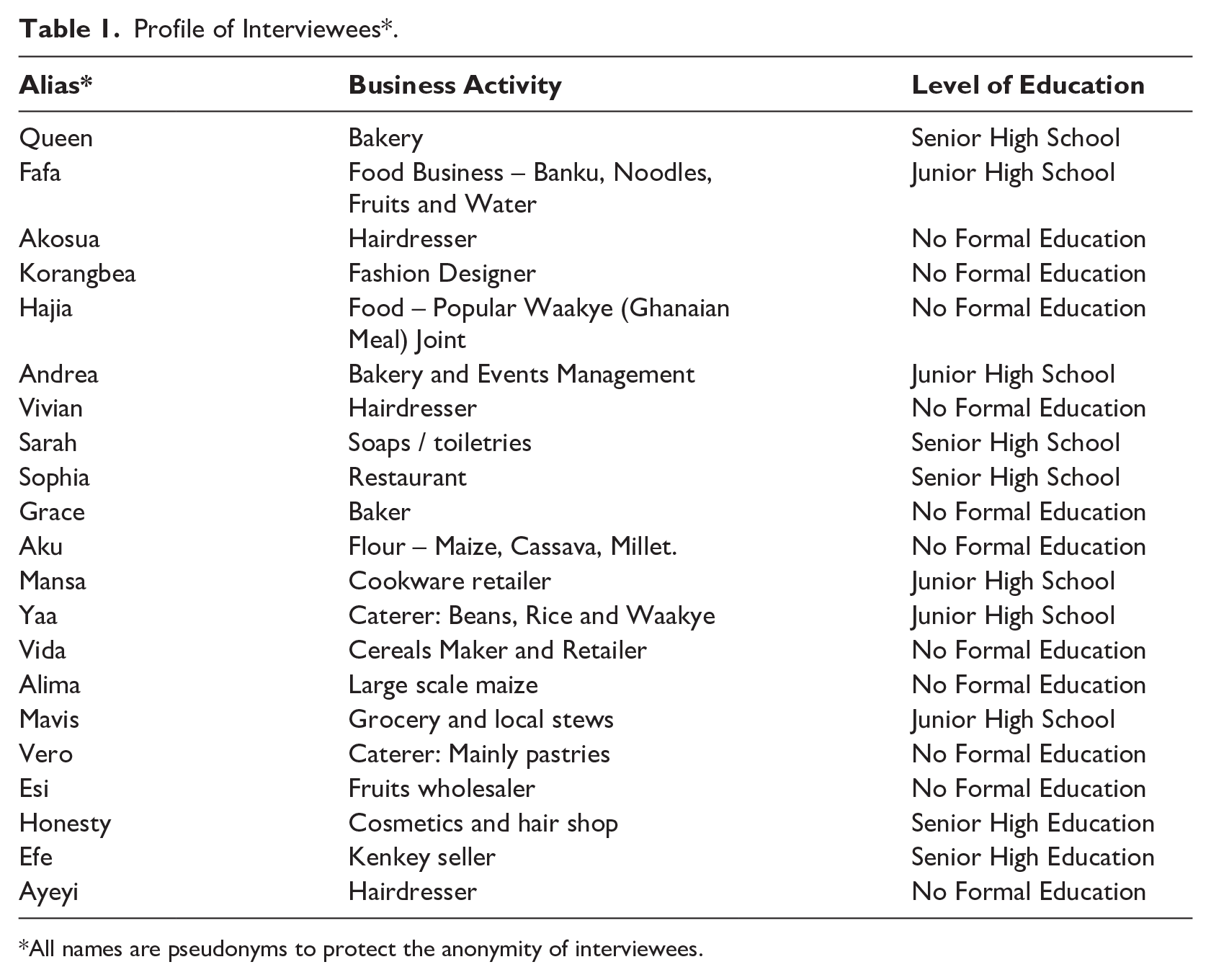
All names are pseudonyms to protect the anonymity of interviewees.
Interviews were conducted with verbal consent from the interviewees, and questions and answers took the form of conversations. The mode of most of the interviews was in Akan, a Ghanaian local language. One interviewee spoke English, while two others moved between English and Akan at varied points. There were two interviewers, the first author and a Research Assistant (RA), who did fourteen of the 21 interviews. The RA was important to continue the interviews due to the limited time the first author could spend in Ghana during the data collection process, and also the RA’s strong connections to the local areas we focused on. The first author took the Research Assistant through the purpose of the research and gave her a guide (Appendix 1). As shown in Appendix 1, questions bordered on what their experiences had been starting and running their ventures, what resources they considered most important to their ventures, how they accessed those resources, and any challenges experienced while trying to access them. Space to ply their trade seemed to come up quite a lot in initial interviews. Thus, subsequently, interviewees were also asked direct questions relating to how they had come to secure spaces for business operations. A point of note, in collecting data from these women, was the need for flexibility on the part of the data collectors. While some potential participants outrightly refused to participate in the study, citing fears over our taking their information to authorities, others obliged, but we had to use their services during the interview. For instance, the first author had her hair done and feet pedicured at two different places to have uninterrupted time with the participants. Where using their services was not possible, the data collectors had to make do with regular interruptions from clients or suppliers who needed the attention of participants.
In addition to the interviews, the first author undertook non-participant observations in the areas where these women ply their trade for a period of six weeks. This was to help provide relevant context for our interviews and subsequent analysis and started from the time of negotiating access to organising and holding participant interviews. Moving round areas known for clusters of informal businesses, she observed where well-known informal entrepreneurs had cited their ventures, the level of patronage they received and any obvious contraventions of government policies. The data obtained from the observations proved useful for analysing the interview transcripts and developing categories. For example, the observations provided valuable insights into the prevalence of rule-breaking among these businesses. The research team noted that some of these businesses were operating in permanent, but makeshift structures, despite ‘Stop Work’ orders written in red paint on the shops by local authorities, ordering them to cease operations until they obtained the necessary permits.
Due to the need for extensive travel and walking to meet interviewees, interview days were long, and it was not feasible to transcribe immediately after the day’s interviews. Interviews were simultaneously translated into English and transcribed within periods of breaks between interviews. The research team analysed the interviews manually, with the first stage being the identification of codes. These were written on A3 sheets and mind-mapped a number of times with various configurations, aimed at coming up with relevant themes. As part of this process, the research team worked through the codes and checked how they were related or not to one other, using the thematic analysis framework (Braun et al., 2014). While we had an idea of possible areas to focus on based on the frequency with which certain issues came up in our interviews, we also recognise that prevalence across transcripts does not necessarily indicate a relevant issue, and hence, theme (Friese et al., 2018).
Thus, after a period of back-and-forth iterations, checking and re-checking our transcripts, the research team came up with 21 basic and relevant codes, which were examined and evaluated for importance in relation to the research questions of this study. Following from this, the research team identified basic themes in constant dialogue with the theoretical framework, i.e. tactics by De Certeau. Through this, we identified both subtle and obtrusive acts aimed at subverting restrictions imposed on women by powerful authorities. In some, the research team found that the acts were mere practical alternatives adopted by women entrepreneurs when they were disqualified from the popular and formal laid-down process of the Strong (Noy, 2008). This process led to a thematic network, with our basic codes contributing to four organising themes (Tactics under the radar, tactics of subversiveness, tactics used for financial resource mobilisation, and tactics of capacity development). We further categorised them under two overarching themes in line with De Certeau’s conceptions of how tactics manifest, resistances/subversions and practical alternatives.
Our analytical process can be said to have started with inductive coding, letting the data we had collected shape our selection of codes, but as the analysis progressed, the research team were influenced by their reading of De Certeau’s works, and tended to seek codes that related to survival tactics of the Weak. In this sense, the analytical process combined both an inductive and deductive analysis, with a quest to balance issues observed from empirical data with what is known about tactics from De Certeau’s theory.
Contextual background – the strong and weak in Ghana’s informal economy
Before delving into our findings, we briefly articulate the position of the ‘Strong’ which in our case refers to Ghana’s regulatory and resource-constrained environment, within which informal entrepreneurship is practiced. In De Certeau’s parlance, this environment is the place where the rules and principles of the Strategy are enforced to reinforce its dominant power over the Weak (De Certeau, 1984). Like other countries, increased urbanisation, which directly correlates with higher per capita income, has been central to Ghana’s economic development (Crookes and Ijjasz-Vasquez, 2015). Urbanisation in Ghana has improved access to quality education and urban services, shifting employment from subsistence agriculture to industry and services. However, this shift has come at a cost. Significant rural-urban migration mainly from poorer regions in the North of the country to the south, mainly to the Ashanti region and the capital, Greater Accra Region (Urban Informality), has brought labour to cities that struggle to absorb it due to low education levels of the migrants and a lack of formal jobs. In 2023, 59.2% of the entire population of Ghana lived in urban areas, with the bulk of them working in the informal sector (World Bank, 2024). This has led to congestion, slum development – issues that threaten and undermine the economic development goals of urbanisation.
To actively address consequent risks, Ghana developed a National Urban Policy (NUP) in 2012 with the overarching aim to ‘promote a sustainable, spatially integrated and orderly development of urban settlements. . .’ (MLGRD, 2012). Here, governmental agencies and regulatory institutions have responded in ways that restrict the activities of the informal sector. Municipal assemblies (the highest local government offices in Ghana), through regular decongestion activities dictate where traders can operate, often relegating them to poorly equipped markets (Osei-Boateng and Ampratwum, 2011). As already discussed, national policies that favour formal businesses, such as incubator hubs and skills training, marginalise the informal sector further, leaving some entrepreneurs here without adequate support. The formal private sector has its own restraining effects on informal businesses. Formal banking systems impose stringent access requirements to finance, excluding many informal businesses (World Bank Group, 2022). In this sense, these regulatory bodies embody what De Certeau describes as the Strong, shaping the economic landscape through policies, zoning laws, and control over resources. As De Certeau (1984) notes of the Strong, their: ‘Imposed knowledge and symbolisms produce the necessary delimitations in which ‘proper’ actions and behaviours are expected, thus creating a sense of control over what is recognised, accepted, and valued within a space, leaving other practices to operate in the shadows.’ We firmly agree with De Certeau (1984) that there is much to learn about creative resistance in the everyday practices of the Weak who express their agency by resisting the Strong’s imposed restrictions.
Findings
Tactics often manifest by exploiting gaps left in the Strong’s systems and introducing levels of plurality against the Strong’s intention. We found that there are also tactics that manifest as practical alternatives the Weak resorts to for survival, in place of restrictive and more structured processes laid down by the Strong and Powerful. Table 2 provides a summary of findings from our study drawing attention to both kinds of tactics, and how we developed them from our interviews.
Summary of Findings – Tactics of the Weak.
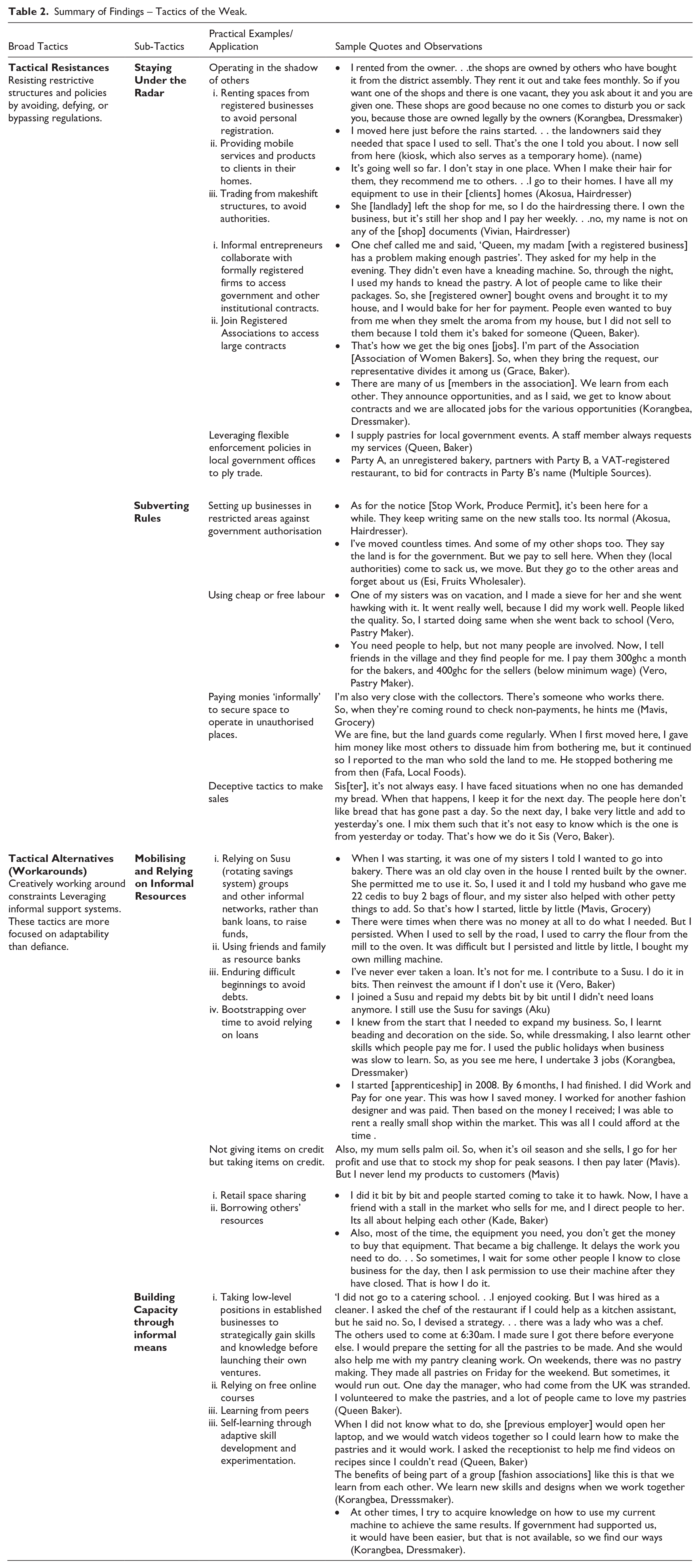
Tactical resistances
The first kind of tactics found in the data captures women entrepreneur’s attempts to resist impositions from systems and institutions whose policies disadvantage them. Findings reveal that these tactics strategically leveraged deficiencies in governmental oversight and enforcement mechanisms. These tactics took two forms: (1) subtle actions that were under the radar of regulatory authorities, (2) as well as more overt acts of rule-breaking that had, to a certain extent, become ingrained among the informal entrepreneurial landscape.
Under the radar tactics
We start with tactics that women entrepreneurs we spoke with had adopted to avoid drawing unwarranted attention from government authorities that could lead to damaging consequences for their activities. While businesses in the informal economy are a pervasive feature and often found in Ghana’s markets, busy traffic streets, and lanes dividing private and commercial residences, they face significant pressure from authorities, who aim to achieve organised residential places and commercial centres. These authorities, backed by formal regulatory structures, represent the Strong, wielding the power to determine what is permissible and what is not. In addition, engaging in informal work disqualifies participants from certain transactions, particularly with government organisations, where formal records need to be kept for the purposes of monitoring and evaluation. We found that women occupy a more precarious position, exemplifying the Weak who must constantly adapt to remain operational and to survive within such an ordered place, women operated under the radar. The intention here, we observed, was not primarily to hide from authorities, as the nature of their activities would make this impossible, but rather to prevent their activities from provoking authorities to act against their favour. We found three sub-tactics here, which we introduce below.
We label the first and second sub-tactics as ‘operating in the shadow of others.’ First, some of the women we spoke to shared how they rented spaces from established businesses to ply their trades. This enabled them to avoid registration processes required by decentralised government departments for securing stores and shops in popular areas. Importantly, by using someone else’s space, the informal women did not have to share any personal records with Local Assemblies/Compliance Authorities. According to Sarah,
I sell in Aunty Esi’s [store owner] store. She moved to Accra to take care of her grandchildren, so she doesn’t sell here any longer. . .I pay GHC 50 to her monthly as goodwill. The ‘Dwadie’ [Market Polls] people also come round with a chit daily and I pay GHC 2.00 for her. When any documents come [From the Local Authority relating to the Store], I call her [Aunty Esi] to come and sign.
Korangbea, a fashion designer and interior decorator who had previously operated from one of these stores further explained that
. . .The shop owners are like landlords. They own shops in the market and rent it out when one becomes empty. After my ‘Work and Pay’ [a practice where a qualified apprentice works for someone else to raise funds to set themselves up], I raised a small amount and rented a small cubicle with her [owner] for two years. . .I didn’t deal with the Assembly as I had no contract with them. I only dealt with the shop owner.
The ability to sell in the stores of others works perfectly for informal women entrepreneurs engaged in similar retail ventures as Sarah and Korangbea. First, it saves them from entering tedious, responsibility-laden contracts, which would require them to commit to personal details, and subsequently be monitored by Local Authorities. Second, and perhaps importantly, it suits the agile and often mobile nature of their operations, allowing them to move around with ease to areas with higher flow of traffic or in response to changes in demand for their products and services.
A second sub-tactic the women entrepreneurs used to stay under the radar is similar to the previous point. From our interviews, we observed that women entrepreneurs in the informal economy seek partnerships with registered businesses to offer services to government departments and other established organisations that will only partner with registered and VAT approved businesses. An insightful finding here is the fact that some of the women we spoke to had, through their networks, actively sought available government contracts and then approached registered businesses to enter into partnership with them in order to bid for such contracts. Where awarded, women entrepreneurs would render alone, or in collaboration with a registered business, a service or offer products using the latter’s registered business and VAT invoice details. Based on our interviews with the women and follow up with some registered businesses, we describe the process as follows:
Party A, a popular bakery is unregistered and cannot issue VAT. Party A finds a business opportunity to provide hot meals and baked goods to Party C, a business which will only transact with registered companies that are VAT issuers. Party A approaches a personal connection and an established and registered restaurant, Party B, and goes into an informal partnership, to come together and apply for the supply opportunity to Party C. This is, of course, done under the name of Party B only, but with proceeds shared between the two suppliers, based on an agreed split made between them.
Using this tactic, Party A is able to gain valuable contracts that they would otherwise have been unable to access acting on their own. Given that there are no formal mechanisms for authorities to investigate businesses which registered suppliers collaborate with, it becomes easy for informal business owners to take advantage of multiple collaborative opportunities here.
The third sub-tactic we found from our study was quite interesting, and directly reflective of what De Certeau (1984) refers to as the act of playing in the Strong’s exposed places by the Weak. As explained above, within Ghanaian government departments, official transactions with the private sector usually favours registered, well-established organisations. This naturally excludes informal entrepreneurs from accessing supply opportunities. Interestingly, our conversations with these women revealed that they were fully aware of this but also recognised that this criterion was more rigorously enforced within high-level government departments compared to their lower-level counterparts. Low-level departments, that is, those at the base of government hierarchies, including entities like Local Assemblies led by Assemblymen/women (Non-partisan leaders of electoral areas), are situated and work more directly with local communities. Through our interviews, we discovered that our women entrepreneurs strategically targeted high-profile individuals whose patronage seemed to endorse their activities, but also low-level government departments with their products and services, thereby evading stringent selection criteria and subsequent scrutiny. As Queen explained,
Oh, they all know me. Even celebrities like Celebrity A (Actor) and Celebrity B (Host of Popular Radio Morning Show) buy from here. I also supply for the Local Government events. There is a lady who works there. She really likes my pastries. So anytime there is an event, she requests for my services, and they all like it.
By leveraging the flexible prerequisites of low-level departments, the women in our study could conduct their business subtly with government organisations, without being subject to the same level of scrutiny and formal registration requirements that typically come with high-level government departments. This discretion allowed them to avoid unnecessary attention or bureaucratic processes, while facilitating their business activities.
Tactics of subverting institutional rules
In De Certeau’s (1984) work, tactics frequently manifest as resistant acts in response to rules and strategies perceived as oppressive by marginalised individuals. While the previous section discussed tactics of avoidance, or covert tactics, we delve in this section into tactics that pertain to a deliberate defiance of established rules and regulations.
Our first finding here is a common observation many will make when they visit Ghana’s capital cities and towns. This is an observation we could not disregard due to its ubiquity and more importantly, its reflection of the determination of women who believe they have no alternative but to defy regulations in order to ensure the survival of their businesses. Against Municipal and District Assemblies (administrative bodies responsible for local governance) directives, we found that a notable number of informal businesses site in unapproved locations and public places designated for other purposes. Five of the participants in our study had set up their shops in residential and public areas that are not designated for commercial activities. Interestingly, three of these businesses had received a note of ‘Stop Work, Produce Permit’ notice, painted in red on their storefront. This bold and visibly written directive by Ghanaian Local Authorities on the walls of unapproved structures is a common sight in Ghana’s urban centres. Its goal to restrict economic activities to a fraction of the business population, considered legitimate, emphasises the structural power of the Strong. Yet, a combination of weak enforcement by authorities, the cracks in the ‘dominant order’ (De Certeau, 1984), and a pursuit for opportunities to continuously engage in their trade without which their livelihood would be threatened appeared to have led these women to remain resolute.
The second finding here relates to using cheap labour as a measure to mitigate the financial burden of high employee wages. Unemployment rates in Ghana are deemed above the average of global rates (O’Neill, 2024). A significant number of people struggle to find employment with decent wages. This demographic represents an accessible resource pool for the entrepreneurs we engaged with, particularly those who had expanded their businesses to other locations. These entrepreneurs leverage this pool by employing low-cost labour for routine and manual tasks, and as well, to manage their establishments in various locations. For instance, during our interviews, Akosua, a hairdresser, shared an example about her acquaintance who assists with meal preparation and customer service for another one of the interviewees:
The woman that helps her had 3 kids before marrying her current man. All he does is drink. So, she does all the work and sends him the money. She is paid small amounts per day, but it’s still something. If she were to stop, there would be nothing else for her family to feed on.
It was also common for our interviewees to rely on their children (biological or adopted) as free labour for their activities.
I have 5 children who all go to school, but they come and help in the morning before they go to school. And come and help after school. I don’t employ adults because they are not reliable. When they are ladies, they come and flirt around. So, I just stick with the kids (Mavis, Grocery Shop Owner).
And
I had a little boy who lived with me. My husband’s nephew. When I started, he went hawking the pastries, and that was when I knew people liked it. He would tell them my house, where I baked at the time, and demand picked up at the time (Vero, Pastry Maker).
It is worth noting that though there is a set minimum wage in Ghana (GHC 14.88), it is common practice for employers within the informal sector to pay well below this threshold. Again, this could be partly explained by the lack of enforcement mechanisms, particularly among informal businesses. Thus, by using cheap and free labour, they are able to reduce overhead costs that come with running their businesses.
Another interesting observation we made here is that because women, primarily responsible for managing their households, relied on the support of their children and younger family members for home chores, it was natural to also involve these younger ones in tasks related to their businesses. This is because, unlike some of their male counterparts who would primarily only need to focus on their work, the women may not necessarily separate the two activities, viewing their businesses as an extension of their home life.
Finally, through our interviews, we uncovered a sub-tactic that appeared questionable but was used by the women to secure physical spaces for business operations. In certain cases, these entrepreneurs found themselves compelled to interact with individuals commonly referred to as ‘Land Guards’ [Often physically strong men, employed by self-declared ‘landowners’ to oversee specific land parcels]. These guards had been hired by neighbouring residents who had informally claimed ownership of government-designated spaces for possible future road expansions or sites for public utilities. The interviewee who provided these insights had set up her shop in a public thoroughfare, serving as a demarcation between two areas.
Those on the opposite side were sacked some time ago. . .The owner wanted his land. We are fine, but the land guards come regularly. When I first moved here, I gave him money like most others to dissuade him from bothering me, but it continued so I reported to the man who sold the land to me. He stopped bothering me from then (Fafa, Local Foods).
This practice, of securing unapproved land, not only paying for it but also paying their way to have the peace of mind to trade, underscores the tactics adopted by some women entrepreneurs to continue their business activities in places that they would otherwise not have been able to reach.
Tactical practical alternatives
As Refai and McElwee (2023) explain, agency is demonstrated in the constrained ability of individuals to access freedom and flexibility outside constrained environments. The second kind of tactics the women we interviewed were not outright resistances in the sense of the previous ones discussed, although for De Certeau (1984), these come extremely close, given how the Weak creatively use them to circumvent restrictions imposed on their daily attempts at survival. These tactics are centred on the pursuit of essential resources, including skill enhancement (capacity building) and financial resource mobilisation, particularly at start-up stage for women entrepreneurs. Like elsewhere, institutions that support knowledge and career growth limit access through high costs and strict qualifications. In De Certeau’s terms, this is how the Strong secures its territory. In response, we found that women entrepreneurs pursue opportunities to develop skills and career growth relevant to their ventures outside the limits placed by such institutions. Our study reveals that women entrepreneurs in Ghana’s informal economy, aware of their limited opportunities for accessing formal funding and skills through established institutions, deployed tactics aimed at informal avenues for acquiring these resources. According to De Certeau (1984), these are practical alternatives the Weak adopt to overcome disadvantaged positions they find themselves in because of not qualifying for more formalised support the ‘Strong’ controls.
Tactical resource mobilisation
The first theme relates to the mobilisation of resources. Here, we focus mainly on how the women raised funds for their ventures at start-up and in their processes of growth. Despite starting their ventures from severely restricted financial and material resources – when I started, I could only afford a bag of flour (Grace, Baker) – a good number of the interviewees to our surprise, seemed averse to taking loans from banks and other micro-finance institutions to finance their ventures. Their reasons bothered on two central ideas; first, because ‘You don’t want to sleep thinking always about being in debt (Korangbea, Fashion Designer)’ and second, because
‘My sister [referring to the interviewer], I will not be given. Who will give you a loan when you have nothing to show for it? Even I won’t do that. So, I understand them. It’s a risk to them to give you a loan when you are just starting (Andrea).
Women entrepreneurs recognised that the informal nature of their business activities made them less likely to qualify for institutional loans. Some, like Aku, a flour maker, had tried taking loans, but had gone into debts due to low demand for her flour at the start. She, thus, resorted to asking for help from others to take loans in their name for her, a situation she described as ‘almost collapsing her business’.
Almost all interviewees, recognising this limitation explained that they had started their businesses with the limited resources they had or could afford. In fact, we observed significant effectuation principles among the women, particularly, the Bird-in-Hand principle (Sarasvathy, 2023), as most relied on resources that were already available to them or to close family and acquaintances at start-up stages. For instance, Queen had first used ‘an abandoned but working oven belonging to my landlord in the shared house I lived when I started’.
A second sub-tactic we observed, relating to mobilising financial resources, is captured succinctly in the responses from one of our interviewees, who is an owner of a grocery shop and a caterer (making and selling local stews). Mavis exemplified a shrewd approach to not just mobilising finances, but broadly, tactical financial prudence. Unlike other women in our interviews who avoided loans, Mavis explained that she often took financial loans and sometimes procured inventory for her shop on credit. However, she exercises caution in extending similar credit facilities to her customers.
Yes. I take loans sometimes from the MicroCredit people. Sometimes, I also take a loan from my mum, especially during peak seasons for her products. Also, the man who supplies buckets, he’ll sell to me even if I don’t send him the money. . . He trusts me. All you need is to be honest. I owe people but they don’t bother me. They know I’ll pay back. Sometimes, they even ask if I don’t need anything.
Yet earlier in the interview, when asked some of the reasons she believes have helped her business over the years, she explained that,
I never lend my products to customers. It’s better that you reduce the price so that people can buy, rather than sell it for too high, and people can’t afford, and therefore need to borrow. If you put more [profit] on it and lend, your money has gone to the customer, and you have less to buy your next consignment with. Sometimes too, immediately you lend an item to a customer, you may find the next person who comes and want to pay in full for the item (Mavis, Grocery Shop Owner).
What Mavis demonstrates here is a tactic that helps her maintain consistent cash flow. In essence, she ensures that her money is not tied up with customers as she avoids lending, but at the same time, leverages and borrows the resources of others to build and grow her business.
A third sub-tactic we identified under the theme of mobilising financial resources was commonly shared by most of the women we interviewed. This entails joining or forming groups, commonly referred to as Susu Groups, where members contribute equal sums of money, typically entrusted to a designated leader or a Susu collection entity, with disbursements made in a rotational manner to each of the members. This rotational credit system, which has been found to be common among low-income women in other countries, such as Togo (Cruz, 2014), is widely used by women in Ghana, as it seamlessly facilitates or fits their roles in managing household finances and their businesses. It offers a flexible and discreet method of saving, while leveraging the community networks in which they are deeply embedded, and which are built on trust. From our interviews, we observed that the women we interviewed preferred this source of funds to other formal avenues, partly due to the reasons we have already mentioned. On their turn, the monies received from the Susu Groups were predominantly used to purchase items in bulk or grow aspects of their retail businesses. Aku, who deals in corn flour on a large scale explained that,
‘After going into debts consistently, I joined a Susu to help pay. When I receive my portion, I pay back. I did it bit by bit until I did not need the loans regularly. . .I still use the Susu today.’
Finally, we identified a sub-tactic that reflects both the communal aspects of many Ghanaian communities and the self-support mechanisms adopted by informal entrepreneurs, recognising the constraints in accessing external support. To address the challenge of limited financial resources for securing multiple retail spaces, the women we interviewed had formed partnerships with friends who also run informal businesses to showcase and sell each other's products in their respective shops. This tactic first came to our attention during one interview when a customer who had bought a snack from Fafa, one of our interviewees, sought a place to eat it. Fafa directed the customer to ‘Please walk a few steps till you see the yellow pub. They have seating and will serve you.’
Thinking that she had directed her customer to another business, I remarked on her generosity in making such a recommendation, to which she laughed and responded:
Oh, I have a man there who sells for me. Some of my customers don’t like the space here as it is too open to the passing public. So, I sell some of my snacks at that pub, and my customers can sit there to eat my pastries. . .The drinks on my shelf here are also his [the pub owner].
This turned out to be a very common practice where businesses with complementary products or services would collaborate, through, for instance, space sharing as above, to offer their products to customers at no financial cost to the collaborating parties. Indeed, they considered this a common-sense approach to make maximum use of the limited resources they had to work with.
Tactical capacity building
The need to constantly build one’s skills and knowledge cannot be overestimated for women entrepreneurs within the Ghanaian informal economy. This is, in part, because the informal sector is replete with many businesses offering similar products and services. To establish a distinctive presence in this competitive landscape, it becomes important for women entrepreneurs to differentiate themselves through continuous self-improvement efforts. We found three interesting tactics women used to achieve such skill development, in place of more formalised, and often expensive support.
Our first sub-tactic is related to how women entrepreneurs seek out free training opportunities. We discovered that four women had previously applied for and worked in low-skilled positions within businesses, which they had eventually established themselves. While working as employees, these women eagerly absorbed knowledge from their employers, who were often experienced professionals in the interviewees’ desired industries. After acquiring the necessary expertise, the interviewees would then leave to launch their own businesses, drawing on the knowledge they had gained. According to Queen, who previously worked as a cleaner in a popular continental restaurant in Ghana, she
‘Pried on what the kitchen staff did. . . I asked to assist in the kitchen because that’s what I was initially hired for, but the chef did not give me a chance. So in between my cleaning, I would take breaks and watch them [kitchen staff] when I had the chance. There was a lady, Madam C, who would sometimes invite me into the kitchen after the other staff had left so we could make simple meals. I observed her and the chef during the day till I got an opportunity to go into the kitchen as an assistant. By this time, I already knew a lot’.
This tactic is noteworthy because, although Queen and others like her were paid regular wages and salaries like other employees, they also acquired valuable skills that they later used to start their own businesses. In a way, they were being paid to learn and start their own businesses by their unsuspecting employers.
Some others had worked in established businesses without a deliberate intention to start on their own in the future. Thus, they may have worked in low-skilled roles due to their need for a job, coupled with a lack of clear direction of their next career steps. This seems to be the situation of Fafa, who had supported her senior and friend from her Senior-High School to start and run the latter’s business for a period of time before leaving to start hers. She explained that,
‘I wasn’t sure what to do with my life after school. I lived with this friend who was starting a Banku and Okro (Local Meal) business, so I supported her for two years. It was just for friendship’s sake. Later, she moved on, and I came here to start my own Noodle business. After a while, I added the Banku and Okro as I already knew how to make it well’.
A second tactic we outline here is the reliance on free online courses in areas of interest to interviewees. Those in the food sector, in particular, explained how they had self-taught the necessary skills from YouTube, finding it easy to keep coming back to improve. Queen, for example, shared that during her breaks while working as a cleaner in a popular restaurant, she would occasionally ask the receptionists to help her search for videos on recipes and processes for making certain pastries. The fact that she was not literate did not prevent her from demonstrating agency and educating herself to be better at what she sought to do.
Discussion
Ghana's entrepreneurship landscape, much like that of many developing countries, offers a positive yet frustrating paradox for entrepreneurs. While successive governments have actively promoted entrepreneurship as one way to salvage various demographics from economic stagnation, entrepreneurial activities are hindered by significant resource and environmental constraints. These are aggravated in the case of informal businesses because in line with developmental goals of their host countries, there is a push toward urbanisation and formalisation, which creates an environment that is unfavourable and inhibitory for such businesses (Broembson Von, 2024). Thus, at first glance, our findings seem to simply highlight the resulting nest of informal mundane acts through which women entrepreneurs create opportunities for their businesses to thrive in Ghana, and broadly, how they use entrepreneurship to overcome their economic hardships (Atarah et al., 2023). Indeed, our research, like Webb et al. (2013), finds that the growth of informal businesses stems from the aspirations of entrepreneurs to ensure their businesses survive and enhance their socio-economic status, in light of their limited access to legitimate opportunities to achieve these goals. The women we interviewed had not had formal education beyond senior high school. As a result, their options for formal career paths were limited. Taking advantage of low barriers to entry that pertain to informal businesses (Yepéz, 2019), they opted to start their own businesses, informally, as an accessible alternative.
Drawing on De Certeau’s (1984) Art of the Weak, however, allows us to burrow deeper, and to recognise the tactics that manifest in how women entrepreneurs in our study build and sustain their informal businesses. We observe that, beyond the crucial goal of economic wellbeing sought, women’s everyday entrepreneurial acts, mundane as they seem, are also a means to navigate and circumvent impositions in their operating environments, which increasingly disfavour informal businesses like theirs. As shown in our background context and findings, Ghana’s pursuit of structured urbanisation and economic development is accompanied by a dominant environment where formal economic structures are prioritised. This environment is made up of state institutions, municipal authorities and financial bodies that dictate urban planning, business registration processes and other economic policies. These actors establish rules aimed at eschewing pluralism, including the entrepreneurial efforts and activities of informal businesses. In De Certeau (1984) terms, these are the Strong, and the place they rule is their domain. Thus, much like the Palestinian women vendors in Sabella and El Far’s study (2019), we observe that the entrepreneurial acts of women entrepreneurs are not just business as usual, though that is certainly important, but are also acts of ‘resilient resistance’ (Ryan, 2015) against the oppressive status quo that marginalises them.
The women, the Weak in our study, ‘without leaving the place where [s]he has no choice but to live, and which lays down its law for him[her], [s]he establishes within it a degree of plurality and creativity’ (De Certeau, 1984: 30). For example, routine and normalised activities, such as relying on Susu systems to raise much-needed funds, as they would not meet the stringent criteria for bank loans, plying their trade in shops belonging to others and by doing so, avoiding direct dealings with local authorities, or relying upon unpaid labour from younger family members, are everyday actions that allow them to resist and subvert the limitations imposed by their environment. Vorley and Rodgers (2014) highlight similar responses in their study of home-based business owners, observing that tactics are intricately tied to the routine and everyday acts of the Weak. In this way, women’s actions also draw our attention to how the less studied, but widely practiced component of entrepreneurship, everyday entrepreneurship (Welter et al., 2017) is central to the ways in which individuals in constrained environments carve a niche for their businesses, and by extension themselves to thrive. In addition to the routine nature of tactics, our findings also show that covert tactics, especially those aimed at mobilising resources, building capacity and plying their trade in various locations are the most common forms of resistances. This is not surprising, as informal entrepreneurs often find themselves in environments where they are viewed as encroachers (Adamtey et al, 2023). In these environments, the Strong places various inhibitions that synergistically create an ordered place, where it controls and determines behaviours that are appropriate, as well as who is allowed to engage in those behaviours.
The Weak, as a result, relies on such subtle forms of resistance to navigate challenges and assert their agency, without attracting the attention of authorities. In line with Dey and Teasdale (2016) and Refai and McElwee (2023), who indicate how informal enterprises can appear on surface to comply with government directives while pursuing their own agenda, we view that the women in our study often outwardly adhere to government and other institutional policies, such as refraining from bidding for government contracts or applying for bank loans as that could provoke authorities to respond unfavourably. Instead, they opt for actions that align with what Dey and Teasdale (2016) refer to as tactical mimicry, which in our case, relates, for example, to collaborating with registered businesses who could bid for these contracts on their behalf. In essence, this mimicry enabled them to take advantage of gaps within their constrained environments for both personal and business gain, while appearing to comply with relevant policy directives.
However, our study diverges from Dey and Teasdale’s (2016) findings in one important way. While the social enterprises in their study appear to intentionally and strategically employ these tactics, women in our research do not seem to have had a similar carefully considered and premeditated strategic intent. Instead, they came across, during our interviews, as operating out of necessity arising from the disfavoured or Weak position they occupied in Ghanaian society, expressed in sentiments like ‘my sister. . .who will give you a loan? For them, these tactics are normal and expected responses within their specific hostile context to ensure their business survival. This aligns with Archer's (2022) work, which suggest that resistances often emerge spontaneously in atomised contexts through disconnected individuals rather than as intentionally planned and organised actions by a collective group. On the basis of this, we propose that informal women entrepreneurs, rather than engaging in premeditated strategies, engage in everyday tactical entrepreneurship as a means of survival and agency.
We observe some clear acts of defiance and overt resistance, such as siting their businesses in areas where local authorities disapproved. Because these women entrepreneurs are perceived to be in a Weak position, their defiance may seem unexpected to some. However, the first author, who has a deep understanding of the study's context, does not find it surprising. Over time, weak enforcement by authorities has normalised noncompliance with regulations, highlighting how women entrepreneurs exploit vulnerabilities in governance and control systems to their advantage. This demonstrates a classic example of how entrepreneurial agency (Refai and McElwee, 2023) unfolds, where women entrepreneurs take advantage of weak enforcement to access greater autonomy and flexibility, effectively reshaping their socio-economic environment to better suit their entrepreneurial endeavours.
Over time, persistent use of tactics by the Weak could lead to transformative shifts in their environments, gradually altering the dynamics and interactions between themselves and the Strong. In our case, the sheer prevalence of tactics that women utilise, ranging from subtle and overt acts of defiance to various workarounds dominant structures, render them increasingly difficult to suppress. As noted in our findings, one common observation first time visitors to Ghana make is the pervasiveness of the trading and sometimes production activities of businesses in central, but unapproved locations across major areas of cities and towns, despite clear markings by municipal authorities to not trade. As regulatory authorities grow weary of enforcement efforts that are continuously defied by the Weak, these practices become normalised, thus prompting shifts in institutional responses by continuously resisting existing institutions and the constraints they impose (Elkafrawi et al., 2022). More broadly, such tactical engagements, when sustained and widespread, may not only erode rigid institutional constraints but also create mechanisms for systemic change, whereby the informal gradually influences the formal. Thus, just as De Certeau (1984) describes the pedestrian’s reconfiguration of urban space, where everyday movement tactically subverts the strategic order imposed by planners, informal entrepreneurial resistance can similarly reframe institutional boundaries. Through continuous reappropriation, informal women entrepreneurs challenge and incrementally transform formal structures to their advantage. This is similar to Scott’s (1985) conceptions in his ‘Weapons of the Weak’, about how small, random acts of resistance, accumulate over time into broader transformations, forcing adjustments in governance. In this way, entrepreneurial actions that initially emerge at the periphery may, in time, reshape core institutional frameworks, challenging established boundaries between legitimacy and informality. On this basis, we propose that the normalisation of informal entrepreneurial resistance can lead to shifts in institutional responses and regulatory frameworks.
Implications
This article offers significant insights across various domains of small business and entrepreneurship research. First, we advance existing research in entrepreneurship by highlighting the central role of tactics in shaping the economic contributions of informal entrepreneurs. Prior studies have largely emphasised the significance of informal entrepreneurs in terms of their prevalence (Akuoko, Aggrey and Amoako-Arhen, 2021), diversity of businesses they engage in (World Bank, 2021), and through the sense of dignity in work they provide for individuals who might otherwise face economic exclusion (Anderson et al., 2013). We introduce De Certeau’s (1984) Tactics as a crucial but overlooked dimension that further explains the relevance of informal entrepreneurs, particularly in developing economies. We demonstrate, through our study, that their tactics enable them to navigate context-specific hostilities that threaten to inhibit their entrepreneurial goals, and that the ability of such entrepreneurs to deploy various tactics is a key factor in explaining entrepreneurial success in constrained entrepreneurship contexts. This focus on tactics expands the discussion on everyday entrepreneurship (Welter et al., 2017), particularly within the informal economy. Welter et al. (2017) have drawn attention to the significance of everyday entrepreneurs and called for further exploration of how they approach their entrepreneurial pursuits. Our study responds by illustrating how tactics enable women owned informal businesses to persist and adapt within restrictive environments. Recognising these tactics highlights the broader role that informal enterprises play in economic activity. While entrepreneurship research and policy have long prioritised high growth businesses (Shane, 2009), informal enterprises, often micro scale and not always focused on high growth, demonstrate a different kind of resilience and value. Acknowledging this helps to shift policy and research perspectives towards viewing the informal sector as an integral part of the entrepreneurial landscape of developing economies, one that reflects the everyday realities of business activity in developing economies, rather than a challenge that impedes the development and urbanisation agenda of such economies.
Second, our reliance on De Certeau’s (1984) Art of the Weak or tactics enables us to expand on the concept of sub-entrepreneurship (Refai and McElwee, 2023) in the broader research landscape of entrepreneurship. De Certeau’s work offers a powerful lens through which to understand how women entrepreneurs in the informal economy engage in sub-entrepreneurial activities, not simply as passive actors evading institutional constraints, but as powerful agents navigating, negotiating, and reappropriating their environments. De Certeau’s framework is particularly valuable in this context as it emphasises that the Weak cannot simply exit the Strong’s jurisdictions. They must operate within it, a challenge they confront by using various tactics to ‘establish within it a degree of plurality and creativity’ (De Certeau, 1984: 30), similar to the contextual fluidity described by Refai and McElwee (2023) in sub-entrepreneurial acts. Applying this perspective to sub-entrepreneurship allows us to move beyond perceptions of informal business activities as a group of entrepreneurial activities that are merely undeclared or hidden from authorities, to understanding how these businesses are actively sustained through ongoing tactical engagement with dominant structures. In addition, De Certeau’s work provides new vocabulary – e.g. Strong, Weak, Strategy, Art of the Weak, Tactics - to capture the tactical processes of the less powerful when dealing with the powerful, enabling a deeper understanding of how sub-entrepreneurship happens in practice.
Third, focusing on Ghanaian women entrepreneurs from low socio-economic backgrounds has allowed us to introduce important nuances to the literature on entrepreneurial agency. In current research, entrepreneurial agency is explained as a refusal to be confined by challenging environments and creatively navigating or sometimes exploiting environmental and resource constraints in ways that favour entrepreneurial businesses (McMullen et al., 2021; Refai and McElwee, 2023). We build on this understanding by demonstrating how individual factors shape the way agency is exercised. For example, because women often view their informal businesses as an extension of their household responsibilities, it is natural, as our findings show, for them to solicit the support of young family members, including their children, to help with their businesses, rather than pay for labour, just as they do with household chores. Additionally, women leverage their strong community connections and the associated trust to engage in informal savings systems such as ‘Susu’, which is used to support businesses during difficult financial times. In this sense, our focus on women informal entrepreneurs brings to the fore how their specific connections to family and community serve as valuable assets in entrepreneurial endeavours within constrained environments. On the basis of these, we believe and propose that individual factors, such as gender and age may play a significant role in how entrepreneurial agency is practiced and the kind of resources that are mobilised to facilitate its processes (Wang, 2019; Elkafrawi, 2022).
Finally, although our focus has been on the survival strategies of economically vulnerable women in Ghana, we believe that our article offers insights relevant to businesses operating in a wide range of contexts. Given the shifting global economic landscape, where previously resource-rich environments are now contending with increasing constraints (Keith Neal, 2022), there is a pressing need to reassess the relationship between resources and survival of small entrepreneurial businesses. The challenges faced by entrepreneurs in traditionally resource-scarce economies and the ways in which they respond now hold lessons for those in historically well-resourced contexts. By conceptualising tactical resistance and tactical alternatives as core entrepreneurial strategies, we provide an additional lens for understanding how businesses sustain themselves under constraint. As resources become increasingly scarce in developed economies, tactics (De Certeau, 1984) may take on greater significance, even though such tactics nature may differ in response to stronger regulatory enforcement and institutional frameworks.
We conclude with an important policy recommendation, which stems from our belief that with proper support, women entrepreneurship within the informal economy could offer significant contributions to economic development, as their tactics provide potent strategies for navigating constrained entrepreneurial environments. To harness these contributions, we recommend that their tactical resistances and workarounds are used to inform policy innovation models. This could be done by designing flexible regulatory policies that secure and legitimise informal entrepreneur’s approaches to business. For instance, developing business registration models that allow informal entrepreneurs to retain flexibility while accessing available support within the entrepreneurship ecosystem could be useful. In addition, although the Susu system offers a solid alternative financial support system for women who lack access to formal financial services, lack of governmental oversight in these traditional systems make it easy for individuals to exploit participants. This lack of regulation enables individuals to embezzle collected funds, default on repayments, or abscond after benefiting from contribution cycles, ultimately undermining the system’s sustainability and trust among participants (Alabi, Alabi, and Akrobo, 2007). Government interventions ensuring strict monitoring of fund collection, savings, and distribution could guarantee that women benefit from their savings and are not cheated. In fact, such disciplined operations could then make Susu systems serve as a legitimate creditworthiness measure for participants, that could further improve inclusivity for informal entrepreneurs seeking larger loans from institutional funders.
Limitations of the study and suggestions for future research
While the context-specific nature of our study has been valuable in revealing the specific tactics employed by women entrepreneurs in our study to excel in their entrepreneurial pursuits, we acknowledge that focusing solely on women entrepreneurs in the specific context of Ghana’s informal economy limits the generalisability of our findings. However, the high prevalence of informal sectors in other developing economies, coupled with similar resource constraints and government aspirations for urbanisation and development, makes our findings a useful starting point for broader discussions about entrepreneurship in such contexts. Thus, while acknowledging the limitations in terms of statistical and probabilistic generalisations (Carminati, 2018), the value of our findings lies in highlighting the importance of considering how specific contextual factors, such as gender and geographical settings, shape entrepreneurial activity. This strongly aligns with calls for researchers to adopt a situated and context-specific approach to studying entrepreneurship (Welter et al., 2019). In this regard, we encourage research that acknowledges male informal entrepreneurs, whose challenges are overlooked based on the assumption that entrepreneurship already accounts for men by default.
Conclusion
Our article critically evaluates the tactical approaches that women entrepreneurs in the informal economy adopt to navigate constrained entrepreneurial contexts and build their businesses. We situate this study in Ghana, a country context where resource scarcity, along with a drive for urbanisation and economic development, inherently inhibits the entrepreneurial activities of informal women business owners. While such businesses are often seen as hindrances to the economic goals of developing nations, our findings, grounded in insights from diverse literatures, highlight the specific and resilient entrepreneurial potential within this sector. Specifically, we illustrate how some women entrepreneurs in Ghana’s informal economy leverage various acts of resistance to build and sustain resilient businesses.
Footnotes
Appendix 1
Acknowledgements
The authors sincerely appreciate the valuable feedback provided by our anonymous reviewers and editors, which has significantly strengthened our article. We are also deeply grateful to the women who participated in the study and to our Research Assistant for her invaluable support in data collection.
Funding
The author(s) received no financial support for the research, authorship, and/or publication of this article.
