



Abstract
Entrepreneurship support services for refugees provide a wide range of services to support venture creation and build resilience. However, mental health supports to address issues of trauma are often not included in these programmes. This is problematic as trauma experienced by refugees can negatively influence elements of entrepreneurship critical for success and the entrepreneurial journey carries a risk of retraumatisation. We propose a framework for a trauma-informed approach to refugee entrepreneurship support that integrates insights from the literature on trauma-informed care. The framework emphasises three key components: temporal reorientation, identity reconstruction and preventing retraumatisation. Temporal reorientation helps refugees reconnect with the present and envision a positive future using tools like mindfulness and bridging practices. Identity reconstruction focuses on developing a cohesive entrepreneurial identity, enabling refugees to rebuild their sense of self through narrative identity work and cultivating a collective entrepreneurial identity within their communities. Preventing retraumatisation involves creating safe, culturally sensitive environments that foster trust while empowering refugees through holistic, peer-supported interventions. This framework offers a novel approach to addressing the unique challenges refugee entrepreneurs face, integrating mental health considerations into entrepreneurship support and paving the way for future research focused on trauma’s impact within entrepreneurship.
Introduction
The global refugee crisis, fuelled by escalating conflicts, has reached an unprecedented scale. Over the past decade, the number of refugees has tripled, surging 8% from 2022 to 2023 to 43.4 million (UNHCR, 2023). By the end of 2023, 3.6 million new individual asylum applications were registered, reflecting a 40% increase compared to the previous year, and 6.9 million asylum-seekers were awaiting decisions on their claims (UNHCR, 2023). Refugees often encounter significant institutional, social and economic barriers during their transition, further compounded by trauma, ongoing stress and poor mental health (Newman and Christensen, 2024; Rawhouser et al., 2024; Silove et al., 2017). Increasingly, refugee entrepreneurship is gaining recognition as a pathway for economic and social integration, with support services playing a crucial role in facilitating this process (Abebe, 2023; Newman and Christensen, 2024). These entrepreneurship support services combine business incubation, skill development, networking, financing and cultural assimilation to create frameworks that support venture creation (Harima et al., 2019; Meister and Mauer, 2019) and build resilience (Ayala and Manzano, 2014; Shepherd et al., 2020).
While refugees can often access mental health services to address issues of trauma, research has shown that these services are frequently separate (Disney and McPherson, 2020; Im et al., 2021; Silove et al., 2017). In other words, mental health support is typically available; yet, refugee entrepreneurship support organisations often do not address mental health issues or trauma within their programmes (Impact Hub, 2022; Newman and Christensen, 2021; Rawhouser et al., 2024; Richey et al., 2022a). In fact, it has been found that some organisations specifically choose to avoid addressing trauma to prevent triggering trauma-related responses (Newman and Christensen, 2021; Rawhouser et al., 2024). However, we argue that the siloed approach to entrepreneurship and mental health support services is problematic because it both reduces the chance of entrepreneurial success and increases the risk of retraumatisation. First, the trauma experienced by refugees can negatively affect elements of entrepreneurship critical for success. Refugees can experience temporal disintegration, where past trauma disrupts their sense of time, making it hard to focus on the present or plan for the future (Harima and Plak, 2024; Holman and Silver, 1998) – both critical temporal orientations for entrepreneurs (Alkhaled and Sasaki, 2022; Wood et al., 2021); and second, refugees often face profound disruptions to their sense of self when fleeing their home countries, making it challenging to reconstruct their identities in a new cultural context (Alkhaled and Sasaki, 2022; Berman et al., 2020; Märtsin, 2010; Rugina and Harima, 2024) and limiting their ability to build the necessary entrepreneurial identity (Radu-Lefebvre et al., 2021). While these two phenomena are significant in shaping refugee experiences and influencing their capacity to engage in entrepreneurial activities, they are neither exhaustive nor universal components of refugee trauma. For this reason, we also point to an overarching risk of retraumatisation that can occur during the entrepreneurial journey. Entrepreneurship support programmes require trust and risk-taking and often impose a rigid timeline. These expectations placed on refugees in entrepreneurial support programmes can add to the pressure they already face with regard to the risk of retraumatisation as they settle into the host country (Nascimento and Pureza, 2024; Salmon and Singleton, 2025). For this reason entrepreneurship scholars have recently called for integrating trauma-informed care into support services for refugee entrepreneurs (Newman and Christensen, 2024; Rawhouser et al., 2024). Despite the increasing attention to the mental health of entrepreneurs in the broader literature, the predominant focus is on neurodiversity, positive well-being, depression, stress and anxiety (Cubbon et al., 2021; Gish et al., 2022; Stephan et al., 2023); the existing literature does not capture the profound effects of displacement experienced by refugees. Given the potential negative impacts of trauma on critical entrepreneurial factors and the impact of entrepreneurship upon those who have experienced trauma, integrating mental health support into entrepreneurship support programmes can help refugees navigate related challenges, regain a sense of control and improve their chances of success (Impact Hub, 2022; Newman and Christensen, 2024; Rawhouser et al., 2024).
This article proposes a trauma-informed approach to refugee entrepreneurship support, addressing the profound psychological challenges that refugee entrepreneurs face due to their experiences of displacement. The proposed trauma-informed approach focuses on three key areas: Temporal Reorientation, Identity Reconstruction and Preventing Retraumatisation. By incorporating trauma-informed care principles (Huang et al., 2014) and practices (Harris and Fallot, 2001; Im et al., 2021; Miller et al., 2019; Reeves, 2015) into refugee entrepreneurship support services, this approach aims to better meet the needs of refugee entrepreneurs. In developing a framework for a trauma-informed approach to refugee entrepreneurship support, we make several contributions to the literature. Firstly, we bridge entrepreneurship studies with trauma-informed care, fostering a deeper comprehension of how trauma influences entrepreneurial behaviour and outcomes. In so doing, we develop an agenda for future research that builds on our framework and informs practice. The proposed framework encourages more tailored support within entrepreneurial support organisations, potentially improving refugee entrepreneur well-being and performance while influencing broader support strategies for marginalised communities. We recognise that the challenges for refugees still in camps are likely to be significantly greater than for those who have resettled and acknowledge that entrepreneurship may not always be a viable option for all refugees due to these challenges. However, our primary objective is to establish a foundational framework for trauma-informed research and practice in refugee entrepreneurship that can guide future work. As the field progresses, we anticipate more detailed, context-specific recommendations will emerge.
We begin by examining the existing literature on refugee entrepreneurship, focusing specifically on the challenges refugees face and the gaps in the support services offered, drawing on empirical studies of refugee entrepreneurship support organisations. Next, we delve into the complex nature of trauma experienced by refugees, exploring three areas of concern for refugee entrepreneurs, namely, temporal disintegration, identity dissolution and the overarching risks of retraumatisation. We then introduce a trauma-informed framework designed to address the three areas of concern, presenting strategies to foster Temporal Reorientation, Identity Reconstruction and Preventing Retraumatisation. Finally, we discuss the implications of this framework for refugee entrepreneurship support services and develop an agenda for future research.
Refugee entrepreneurship
Challenges in refugee entrepreneurship
Refugee entrepreneurship offers a crucial pathway to livelihoods and integration for refugees excluded from traditional labour markets (Abebe, 2023; Refai et al., 2018). Fostering their self-reliance and labour market participation drives economic development, enhances social cohesion and enriches cultural diversity (Skran and Easton-Calabria, 2020). Despite these benefits, refugee entrepreneurs face challenges such as adapting to socio-cultural norms, overcoming language barriers and learning local business practices. Limited social networks, institutional barriers – including legal and financial constraints – and issues such as xenophobia and discrimination – further restrict their access to essential entrepreneurial resources and opportunities (Bizri, 2017; Ivanova-Gongne et al., 2024; Refai et al., 2018).
The refugee entrepreneurship literature has extensively explored the factors supporting the resilience of these entrepreneurs in navigating the challenges (Ayala and Manzano, 2014; Shepherd et al., 2020). Alayarian (2018) defines resilience as the ability to endure severe trauma or neglect without a breakdown in psychological functioning. The literature emphasises resilience as essential for overcoming adversity, resulting in positive outcomes such as mental well-being and enhanced entrepreneurial performance (Shepherd et al., 2020). It also highlights the importance of positive psychological capacities such as persistence, optimism and entrepreneurial self-efficacy (Ayala and Manzano, 2014). The predominant focus on resilience aligns with cultural ideals of strength but fails to acknowledge the full extent of trauma resulting from cultural displacement (Cubbon et al., 2021; Gish et al., 2022). The resilience narrative and the portrayal of refugee entrepreneurs as heroes often obscures the deeper mental health issues and vulnerabilities that emerge during the resettlement process (Papadopoulos and Hulme, 2018). This critique extends to entrepreneurship support organisations, which, influenced by the resilience narrative, can undermine the need for mental health support and integrated interventions within their programmes.
Support services for refugee entrepreneurs
Entrepreneurial support organisations provide ‘an ecosystem that promotes and supports entrepreneurial activity’ (Tibaingana et al., 2022: 74), providing a variety of services that aim to enable refugees to build essential business skills, navigate legal and bureaucratic hurdles, integrate into local markets and adapt to the host country’s social and business norms (Harima et al., 2019; Jürgens et al., 2022; Newman and Christensen, 2021). However, a growing body of literature examining refugee-focused incubators and entrepreneurship programmes reveals several limitations – including studies on The Spice Kitchen (Newman and Christensen, 2021) and Lighthouse Charities in the United States (Rawhouser et al., 2024), The Entrepreneurial Refugee Network in the United Kingdom (Richey et al., 2022a), Inkomoko in Rwanda and Kenya (Richey et al., 2022b) and others in Germany (Harima et al., 2019; Jürgens et al., 2022; Rashid and Cepeda-García, 2021), the Netherlands (Babin, 2019; Marchand and Dijkhuizen, 2018), Turkey (Kachkar and Djafri, 2022), Finland (Ojasalo et al., 2023) and Uganda (Tibaingana et al., 2022). While these studies reveal many benefits emerging from entrepreneurship support programmes, they show that these services often emphasise individual agency and resilience limiting opportunities for shared learning and mutual assistance (Newman and Christensen, 2021; Richey et al., 2022a). For example, Newman and Christenson (2021: 21, 18) found in their study of The Spice Kitchen that, even though the incubator followed best practices by ‘giving incubatees access to customer networks and legitimizing the entrepreneurs to stakeholders in the community’, a ‘common feeling of isolation that remained, despite being part of the incubator program’. In fact, following the entrepreneurs over time allowed the researchers to see that social networks became smaller instead of growing. In addition, services can lack cultural sensitivity and customised programmes and resources, leading to mistrust and engagement barriers (Kachkar and Djafri, 2022; Meister and Mauer, 2019). Short-term, rigid timelines can fail to accommodate the challenges facing refugee entrepreneurs and the extended timeframes they need to succeed (Nair and Blomquist, 2020; Richey et al., 2022a). Furthermore, there is often a lack of transparency and inclusion in programme design, delivery and decision-making processes, reinforcing power imbalances and reducing programme responsiveness (Idris, 2019; Tibaingana et al., 2022). In Tibaingana et al.’s (2022: 119) review of entrepreneurial support organisations in Uganda, they found that the ‘hierarchical approach of many ESO. . . [used] externally set agendas around self-reliance, livelihoods and innovation. . . [instead of] agendas that emerge from the needs and priorities of communities’.
Together, these studies show that existing support services for refugee entrepreneurs, although well-intentioned, often prioritise economic outcomes over quality of life, including mental, emotional and social well-being. While entrepreneurship is promoted as a path to self-reliance, this approach often falls short of true empowerment, leaving many refugees under-supported (Nascimento and Pureza, 2024). The narrow focus on economic metrics fails to address the significant psychological impacts of trauma, displacement and cultural adjustment (Richey et al., 2022a). The resulting feelings of isolation and unaddressed emotional stress can, in fact, undermine the potential for entrepreneurial success by impairing an individual’s capacity to engage meaningfully with their ventures (Newman and Christensen, 2021; Salmon and Singleton, 2025). Most programmes refer participants to overwhelmed mental health support providers, and some even have strict policies barring staff from discussing any potential trauma-related subjects; the few that do offer in-house mental health services often have general mental health support not adapted for the demands of entrepreneurship (Newman and Christensen, 2021; Rawhouser et al., 2024). Because of these limitations, scholars have argued for a more holistic approach to support programmes, urging the integration of trauma-informed practices into entrepreneurship support (Newman and Christensen, 2024; Rawhouser et al., 2024).
Refugee trauma and entrepreneurship
Refugee trauma
According to the Substance Abuse and Mental Health Services Administration (SAMHSA), ‘Individual trauma results from an event, series of events or set of circumstances that is experienced by an individual as physically or emotionally harmful or life-threatening and that has lasting adverse effects on the individual’s functioning and mental, physical, social, emotional or spiritual well-being’ (Huang et al., 2014: 7). Refugee trauma is a multifaceted and complex issue, beginning with premigration events such as war, violence and displacement, which often significantly affect psychological well-being (Bemak and Chung, 2017; Fazel et al., 2005). The journey to a host country, often marked by danger and uncertainty, further exacerbates these traumatic experiences, while the resettlement process can retrigger past traumas, compounding mental health challenges (Bemak and Chung, 2017; Papadopoulos, 2018). Refugees are at a significantly higher risk of psychiatric disorders, including PTSD, depression, anxiety and mood disorders, and these conditions often persist long after resettlement (Fazel et al., 2005; Giacco et al., 2018). Key stressors such as family separation, economic hardship, social isolation and discrimination interact with past trauma in a bidirectional manner, continuously affecting mental health (Slobodin and De Jong, 2015), with daily environmental stressors significantly mediating the relationship between past trauma and current mental health symptoms (Schick et al., 2016). Additionally, restrictive asylum processes, prolonged detention and temporary visas often exacerbate mental health issues (Fazel et al., 2005; Li et al., 2016).
The complexity of refugee trauma is multifaceted and encompasses a range of psychological, emotional and social challenges. Among these, temporal disintegration, identity dissolution and risks of retraumatisation are particularly salient challenges faced by refugees that have a distinct impact on their entrepreneurial journey, though they are not exhaustive or universal components of refugee trauma. These phenomena are significant to this study as they often shape refugee experiences, influencing their capacity to adapt to new environments, engage in entrepreneurial activities and benefit from support services. Temporal disintegration, for instance, disrupts the ability to integrate past experiences with present realities and future aspirations, creating barriers to the forward-looking perspective essential for entrepreneurship (Harima and Plak, 2024; Holman and Silver, 1998). Identity dissolution, characterised by the fragmentation of social roles and professional identities, complicates the formation of entrepreneurial identities and the navigation of cultural integration (Alkhaled and Sasaki, 2022; Berman et al., 2020). Finally, the risk of retraumatisation arises from ongoing stressors and challenges, such as unrealistic expectations, lack of trust or power imbalances, which can echo the dynamics of past traumas (Carlsson and Sonne, 2018; Papadopoulos, 2018). The following sections explore these three aspects, demonstrating their interactions with refugee entrepreneurship and entrepreneurship support services.
Refugee temporal disintegration
In the context of refugee resettlement, temporality emerges as a critical psychological factor influencing adaptation, as it encompasses an individual’s existence within time and the intricate relationships they form between their past, present and future experiences (Kira et al., 2024). For most individuals, the flow between past, present and future is natural, but the trauma of displacement often disrupts this temporal orientation for refugees. This disruption, known as ‘temporal disintegration’ (Holman and Silver, 1998), manifests as an involuntary fixation on past traumas, impairing the individual’s ability to engage with the present and envision a future (Harima and Plak, 2024; Sagbakken et al., 2020). Temporal disintegration is often characterised by an inability to visualise a hopeful and plausible future, leaving refugees trapped in a precarious and undefined present that emerged from a damaging past (Holman and Silver, 1998). The literature encompasses various conceptualisations of this state of temporal disintegration. Nonetheless, they all describe a profound disruption in the temporal orientation of refugees, where time becomes oppressive and fragmented, deeply intertwined with their sense of place and future aspirations. For instance, ‘agency-in-waiting’ (Brun, 2015) reflects a refugee’s inability to act upon their goals as their capacity to exercise agency is suspended amidst uncertain and constrained circumstances. ‘Protracted uncertainty’ (Horst and Grabska, 2015) highlights the long-term instability that characterises refugee lives, where the passage of time fails to align with aspirations or the possibility of resolution.
Similarly, ‘indeterminate liminality’ (Alkhaled and Sasaki, 2022) or ‘perpetual liminality’ (Harima and Plak, 2024) emphasises the prolonged and pervasive nature of camp life, which obstructs the ability to envision a stable future and undermines the capacity for action. Kodeih et al.’s (2023) ‘indeterminate temporariness’ also emphasises the oppressive temporality of this state, marked by a bleak, uncertain future and an empty, meaningless present. Together, these concepts all converge to describe a suspended state of being that erodes agency and perpetuates the challenges of adapting to a new environment. The disruption in time manifests profoundly on both personal and psychological levels as refugees grapple with feelings of entrapment, disempowerment, memory disturbances and difficulty situating themselves in time and space (Sagbakken et al., 2020). Research shows that those with a negative time perspective – those who dwell on bad things that happened in the past or those who feel as if they have no control over their future – are more susceptible to depressive symptoms and lack of psychological fulfilment. They often struggle to appreciate positive memories and experiences, enjoy the present moment, set goals and work towards a better future (Marczak et al., 2021; Papastamatelou et al., 2021).
Temporal disintegration and refugee entrepreneurship
In entrepreneurship, a future-oriented time perspective is often considered essential for success. Entrepreneurs are expected to anticipate market trends, strategise long-term goals and adapt to emerging opportunities and challenges (Kapoor and Sinha, 2022; Levasseur et al., 2024). This forward-looking approach helps them navigate uncertainty, allocate resources efficiently and maintain resilience in the face of crises (Kapoor and Sinha, 2022); those with a strong future orientation are better equipped for opportunity recognition and long-term planning, which are critical for sustaining motivation and achieving goals (Levasseur et al., 2024). This creates significant pressure to constantly envision and work towards a better future, often requiring a proactive and optimistic outlook. Adopting a future-oriented perspective presents substantial challenges for refugee entrepreneurs, given the temporal disintegration they often experience (El-Shaarawi, 2015; Holman and Silver, 1998). The expectation to focus on long-term goals may clash with the psychological reality of refugees who are often more concerned with immediate survival and security than with future planning (Horst and Grabska, 2015; Sagbakken et al., 2020). This disparity can create a significant burden as refugee entrepreneurs struggle to align their internal temporal orientation with the external demands of entrepreneurship.
Jiang et al. (2021) observed that refugee entrepreneurs who remain predominantly focused on the past, characterised by a strong desire to return to their home country and reliance on past experiences, often struggle to progress beyond the conceptualisation phase of the opportunity-production process. This past-oriented perspective hinders their ability to engage with present opportunities and adapt their business ideas to the host country context, creating a critical barrier in navigating the entrepreneurial process. Moreover, refugees deeply embedded in their home country’s culture may generate ideas based on outdated knowledge and networks, resulting in ventures misaligned with the host market. Frémeaux and Henry (2023) have also highlighted that a rigid focus on productivity and future orientation can be detrimental to an entrepreneur’s well-being and the quality of work. The emphasis on a highly agentic future-oriented perspective, crucial in entrepreneurship, can clash with experiences of protracted uncertainty and instability, characterised by a state of agency-in-waiting (Brun, 2015). The pressure to adopt this outlook may not only feel unattainable but can also trigger memories of past failures and losses, exacerbating feelings of inadequacy and helplessness. This can reawaken past traumas, making it difficult for refugee entrepreneurs to focus on future goals without being overwhelmed by anxiety and fear (Grisham et al., 2023; Schick et al., 2016). Insights from this research demonstrate that entrepreneurial processes are shaped by the psychological ability to adopt a future-oriented perspective – a challenge for many refugee entrepreneurs (Alkhaled and Sasaki, 2022; Brun, 2015; Harima and Plak, 2024).
Temporal disintegration and refugee entrepreneurship support services
Support programmes are often short, with rigid timelines driven by funding constraints, which can fail to accommodate the iterative, uncertain nature of refugee entrepreneurship, placing unrealistic expectations on refugee entrepreneurs without fully considering their obstacles and the extended timeframe they may need to succeed (Nair and Blomquist, 2020; Richey et al., 2022a). Business education training often assumes that participants can easily engage in future-oriented planning and decision-making. However, the emphasis on long-term business goals and strategic planning may conflict with immediate concerns and preoccupations with past traumas, leading to frustration and disengagement (Harima and Plak, 2024; Holman and Silver, 1998). Concepts such as budgeting, saving and investment may seem irrelevant or unattainable to those stuck in a state of ‘agency-in-waiting’ (Brun, 2015), exacerbating feelings of inadequacy and hindering entrepreneurial progress. Additionally, a cognitive fixation on past traumas can make it difficult for refugees to trust new relationships or fully participate in community activities (Holman and Silver, 1998; Papadopoulos, 2018), leading to further isolation instead of building social capital – this social disconnection reinforces temporal disintegration, creating a cycle of alienation that complicates entrepreneurial efforts. Similarly, cultural orientation programmes, designed to facilitate understanding of social norms in the host country, can highlight the discontinuity between past cultural practices and new expectations, deepening the sense of loss and displacement (Schippert et al., 2021; Warren and Nigbur, 2024).
Refugee identity dissolution
Fleeing one’s home country and seeking asylum profoundly disrupts an individual’s established identity, creating significant biographical fractures and identity fragmentation (Alkhaled and Sasaki, 2022; Berman et al., 2020; Rugina and Harima, 2024). Forced migration strips individuals of the societal roles, professional recognition and community ties that once anchored their social identities (Alkhaled and Sasaki, 2022). The loss of home, as Alcock (2003) describes, represents more than physical displacement; it is a ‘rupture in the continuity of being’, leading to the fragmentation of the ego. The concept of ‘rupturing otherness’ highlights the self-estrangement refugees experience when there is a significant cultural gap between their culture of origin and the host culture (Märtsin, 2010). Navigating identity reconstruction amidst cultural dislocation and the challenges of resettlement intensifies the trauma of displacement and profoundly affects a refugee’s sense of self and social positioning (Colic-Peisker and Walker, 2003; Märtsin, 2010). This identity dissolution can also entail the permanent loss or deactivation of professional identities as many refugees must abandon their careers and aspirations, particularly affecting middle-class refugees who report a deep sense of lost potential and dissatisfaction with their current professional lives (Rugina and Harima, 2024; Warren and Nigbur, 2024). Beyond professional roles, displacement also disrupts personal identities tied to family and community connections, leaving refugees instead with an externally imposed administrative identity as ‘refugees’. This stigmatised and devalued label further exacerbates the erosion of self-worth and societal recognition (Alfadhli and Drury, 2018; Colic-Peisker and Walker, 2003).
The ‘cultural identity jolt’ often forces refugees to re-evaluate their identities and decide whether to maintain connections to their home country or adapt more towards the host community (Jones Christensen and Newman, 2024). To navigate this, refugees have been found to adopt various acculturation strategies, striving to balance their original cultural identity with the expectations and norms of the host society (Adeeko and Treanor, 2022; Bemak and Chung, 2017). Acculturation is a multifaceted process that involves cultural adaptation and change resulting from interactions between different cultural groups (Ellis et al., 2010) and is deemed essential for the psychological adjustment of refugees and their identity reconstruction (Ivanova-Gongne et al., 2024; Jones Christensen and Newman, 2024). However, the specific forms of identity work and acculturation strategies adopted by refugees vary depending on the levels of support and acceptance they receive in the host country (Alkhaled and Sasaki, 2022). The identity reconstruction process also varies based on the cultural gap between the refugee and the host country, as reconciling conflicting values can lead to culture shock, alienation and identity confusion (Bemak and Chung, 2017; Ellis et al., 2010).
Identity dissolution and refugee entrepreneurship
Entrepreneurial identity plays a pivotal role in entrepreneurial success, influencing strategies, behaviours and interactions while serving as a guidepost for decision-making, resource mobilisation and social capital development (Mmbaga et al., 2020; Radu-Lefebvre et al., 2021). For refugee entrepreneurs, this identity becomes even more significant, functioning as both a means of preserving their cultural roots and a vehicle for reinvention. Research highlights that identity choices in refugee entrepreneurship shape acculturation strategies, with the potential to help individuals navigate the complexities of integration (Jones Christensen and Newman, 2024). Additionally, entrepreneurial opportunities provide refugees with a powerful platform for identity reconstruction, allowing them to redefine themselves, gain agency and make meaningful contributions to their new communities (Rugina and Harima, 2024). However, refugees face significant challenges in forming an entrepreneurial identity due to identity dissolution and the complexities of their experiences. The identity void created due to losing their professional roles, societal status and community connections (Rugina and Harima, 2024; Wehrle et al., 2018) can be exacerbated by expectations to embody entrepreneurial traits such as self-reliance, risk-taking and innovation (Essers and Benschop, 2007; Swail and Marlow, 2018), which may conflict with their cultural norms and deepen the sense of identity loss and disconnection (Bemak and Chung, 2017; Märtsin, 2010). Without access to the foundational elements typically used to reconstruct identity, refugees can struggle to gather the resources and confidence needed to navigate entrepreneurial paths, making identity reconstruction a significant hurdle (Berman et al., 2020).
When there are significant cultural differences between the host and the home country, the acculturation process can further complicate entrepreneurial identity formation, as refugees must reconcile multiple, potentially conflicting identities. Adapting to new roles as cultural minorities while simultaneously developing an entrepreneurial identity can result in role conflict, cognitive dissonance and emotional distress (Bemak and Chung, 2017; Ivanova-Gongne et al., 2024). Refugees must also navigate the tension between honouring their cultural heritage and aligning with the norms of their new environment (Jones Christensen and Newman, 2024). There is not always a clear pathway to reclaiming professional roles or societal status, which can add to the challenges of developing a strong and coherent entrepreneurial identity. While some refugees navigate these challenges by creating ventures that specifically reinforce their cultural heritage or integrate into their new environment (Jones Christensen and Newman, 2024), the process remains fraught with emotional distress and barriers.
Identity dissolution and refugee entrepreneurship support services
Support services often take a passive approach, expecting entrepreneurs to seek help independently when needed (Salmon and Singleton, 2025; Skran and Easton-Calabria, 2020) and frequently overlook the importance of identity reconstruction (Rawhouser et al., 2024; Richey et al., 2022a). This has been found to lead to missed opportunities to support refugees in rebuilding identities and integrating into new communities and placing unrealistic expectations on them without fully considering their obstacles. The business education and language training offered to refugee entrepreneurs aim to equip them with the necessary skills to navigate the local business landscape. However, these programmes often require assimilation into the host country’s business culture, potentially alienating refugees who may already be struggling with identity dissolution. The emphasis on mastering a new language and business jargon can reinforce feelings of inadequacy and disconnection from one’s cultural roots, further complicating the identity reconstruction process (Bemak and Chung, 2017; Rugina and Harima, 2024). This pressure to conform to new norms can also exacerbate the trauma of losing one’s native language and cultural identity, leading to a sense of self-betrayal and internal conflict (Alayarian, 2018) and increasing the challenge of finding a new identity. Moreover, the focus on formal compliance and financial literacy can highlight the loss of professional identity, particularly for middle-class refugees who may have held prestigious positions but now struggle with basic administrative tasks (Colic-Peisker and Walker, 2003). This experience can deepen the sense of disempowerment and exacerbate the identity crisis by reminding refugees of their diminished status in the new country.
Networking for refugees experiencing identity dissolution can be a double-edged sword. On the one hand, it can help build social capital and connection that supports identity reconstruction; on the other, it can expose refugees to the stigmatisation and prejudices associated with their ‘refugee’ identity. Cultural orientation programmes aim to facilitate the integration of refugees by introducing them to the social norms of the host country; however, these programmes can function to highlight cultural differences, deepening the sense of ‘otherness’ (Adeeko and Treanor, 2022; Bemak and Chung, 2017). The emphasis on adopting new cultural norms can create a conflict between maintaining one’s original identity and conforming to the expectations of the host society, leading to cultural dissonance, identity confusion and a sense of alienation (Bemak and Chung, 2017). This tension can be exacerbated by the pressure to reconcile values from their country of origin with those of the host society, intensifying feelings of otherness and dislocation (Märtsin, 2010).
Refugee risks of retraumatisation
The refugee experience extends beyond initial displacement to include the long-term challenges of survival and adaptation in a new country (Papadopoulos and Hulme, 2018). The most distressing experiences can actually occur during the later phases rather than the initial traumatic events, as post-migratory factors can amplify the psychological impact of earlier traumatic events. Research suggests that the challenges refugees face during resettlement, such as inadequate living conditions, insecurity and legal uncertainties, often correlate more strongly with distress than the initial trauma of displacement (Carlsson and Sonne, 2018; Papadopoulos, 2018). These ongoing adversities, compounded by daily stressors such as bad news from relatives, family illnesses and community conflicts, increase anxiety and fear and trigger memories of past traumas, resulting in unpredictable fluctuations in PTSD symptoms (Bruhn et al., 2018; Carlsson and Sonne, 2018).Upon arrival in a host country, refugees often encounter situations that deprive them of autonomy and agency. As highlighted by Alayarian (2018), the dependency experienced by refugees, who must rely on external support and have limited control over their daily lives, can be deeply unsettling. Lack of financial stability and unemployment or underemployment are also significant contributors to the retraumatisation of refugees (Bruhn et al., 2018). The pressure to support themselves and their families in an unfamiliar environment, coupled with the uncertainty of their future prospects, can create a constant source of stress and anxiety (Carlsson and Sonne, 2018; Papadopoulos, 2018).
Retraumatisation is the reactivation or exacerbation of trauma-related symptoms and distress in individuals with pre-existing trauma (Pazderka et al., 2021). This can be caused by subsequent exposure to a wide range of triggering events or situations (Alexander, 2012; Butler et al., 2011; Dallam, 2010; Pazderka et al., 2021; Papa and La Bash, 2012), including those encountered in support service settings (Butler et al., 2011). For refugees, these triggers often include daily stressors associated with displacement, such as social isolation, poverty and discrimination, which are as influential on mental health as prior displacement trauma (Miller and Rasmussen, 2017). Additionally, these triggers can include the inherent stressors of entrepreneurship, insensitive interactions with support providers, customers and other stakeholders and situations that replicate the dynamics of their original trauma (Newman and Christensen, 2024; Rawhouser et al., 2024). Furthermore, the interactions refugees have with support service providers and other institutional representatives can also be a source of retraumatisation. Lack of privacy, power imbalances and cultural misunderstandings during these interactions can increase feelings of vulnerability and trigger trauma responses (Griffiths, 2018; Schippert et al., 2021). When support providers raise false hopes for change, it can lead to disappointment and further trauma (Weber, 2019).
Retraumatisation and refugee entrepreneurship
Entrepreneurship is inherently demanding, involving significant risk, stress, uncertainty, long hours, heavy workloads, time constraints and limited resources (Muñoz et al., 2023; Rauch et al., 2018). The entrepreneurial process is often likened to an emotional rollercoaster, with frequent shifts between stress and moments of success (De Cock et al., 2020). These ups and downs are especially pronounced for refugee entrepreneurs who face the added complexities of adapting to a new cultural context, navigating legal uncertainties and managing the psychological impact of past traumas (Newman and Christensen, 2024; Papadopoulos and Hulme, 2018). The constant state of alertness required in entrepreneurship can lead to emotional exhaustion and heightened anxiety, particularly when making decisions in uncertain conditions with scarce resources (Adeeko and Treanor, 2022; Salmon and Singleton, 2025). The high levels of uncertainty refugees experience may correlate with a greater willingness to embrace uncertainty in their entrepreneurial endeavours (Paksoy et al., 2023). However, it is important to consider the potential impacts of this risk-taking on trauma. While moderate PTSD symptoms might enhance risk tolerance and resilience, severe PTSD symptoms have been found to decrease risk-taking behaviour, potentially hindering entrepreneurial activities (Augsburger and Elbert, 2017). Additionally, refugee entrepreneurs may overwork because of the pressure to succeed and neglect personal well-being, exacerbating isolation and stress (Bruhn et al., 2018; Muñoz et al., 2023). The stigma against seeking help in entrepreneurial cultures can also pressure refugees into projecting resilience and suppressing emotional struggles, worsening mental health and leading to severe stress reactions, including depression, cognitive impairment and physical health issues (Louie, 2016; Rauch et al., 2018).
Retraumatisation and refugee entrepreneurship support services
Entrepreneurship support services for refugee entrepreneurs can unintentionally impose burdens that may retraumatise individuals. These challenges often arise from the design and delivery of these services, which may overlook the psychological and emotional needs of refugees. Berman et al. (2020) highlighted that trauma influences individual perceptions and integration of new experiences. Across all domains of support services – business education and language training, social skills and networking and cultural orientation – the expectations within these programmes can exacerbate existing mental health issues. The need to exert agency, maintain hope and make progress throughout the programme can lead to fear of failure or actual venture failure, echoing previous humiliations, feelings of incompetence and experiences of powerlessness. The vulnerability of refugee entrepreneurs can mean that even small ‘normal’ failures in the entrepreneurial journey are experienced as retraumatising. Moreover, while aiming to foster independence, support services can unintentionally reinforce feelings of dependency and lack of control; reliance on external advisers, mentors and bureaucratic systems can replicate dynamics of powerlessness, triggering traumas related to loss of autonomy and self-determination (Alayarian, 2018; Griffiths, 2018; Weber, 2019).
Framework for a trauma-informed approach to refugee entrepreneurship support
Trauma-informed care initially emerged in clinical and social service settings. This approach has now become a pivotal framework across healthcare, education and other areas of social interaction and emphasises the importance of understanding the impact that trauma can have on an individual’s well-being and life outcomes (Harris and Fallot, 2001; Miller et al., 2019; Reeves, 2015). A trauma-informed approach, as outlined by the SAMHSA, aims to realise the extensive impact of trauma, recognise the signs and symptoms of trauma, respond by integrating trauma knowledge into practices and actively seek to resist retraumatisation (Huang et al., 2014). The framework of trauma-informed care is built on strengths-based principles, where the focus is on identifying and enhancing the existing capacities of survivors, transforming potentially maladaptive responses into useful skills (Reeves, 2015).
The six guiding principles of trauma-informed care are designed to be adaptable across diverse settings. Safety involves creating environments where individuals who have experienced trauma feel physically and psychologically secure; trustworthiness and transparency are achieved through transparent and open organisational operations and decision-making processes, fostering trust among refugees, community members and the support organisation’s staff; peer support leverages the experiences of refugees to establish safety, hope and mutual recovery; collaboration and mutuality emphasise power-sharing and partnership at all organisational levels, recognising that healing occurs through relationships and shared decision-making; empowerment and choice focus on recognising and building upon individual strengths and fostering resilience; and finally, addressing cultural, historical and gender issues involves actively countering cultural biases and incorporating culturally responsive practices to meet the diverse needs of refugees (Huang et al., 2014). Implementing a trauma-informed approach requires comprehensive staff education, leadership support and sustained resources. Practitioners need training in evidence-based, culturally appropriate interventions using trauma-specific tools. Leadership must oversee the integration of trauma-informed care through policies prioritising this approach. Ongoing training and workforce development should embed trauma-informed principles in hiring, supervision and staff support, fostering environments that mitigate trauma’s impact on clients and staff (Huang et al., 2014).
The proposed trauma-informed approach to refugee entrepreneurship support is grounded in SAMHSA’s principles. It is structured around three main elements: Temporal Reorientation, Identity Reconstruction and Preventing Retraumatisation (see Table 1 for an overview). We discuss how services can be redesigned to address temporal issues and identity challenges and, subsequently, how integrating the principles of the trauma-informed approach can create an environment that prevents retraumatisation.
Framework for a trauma-informed approach to refugee entrepreneurship support.
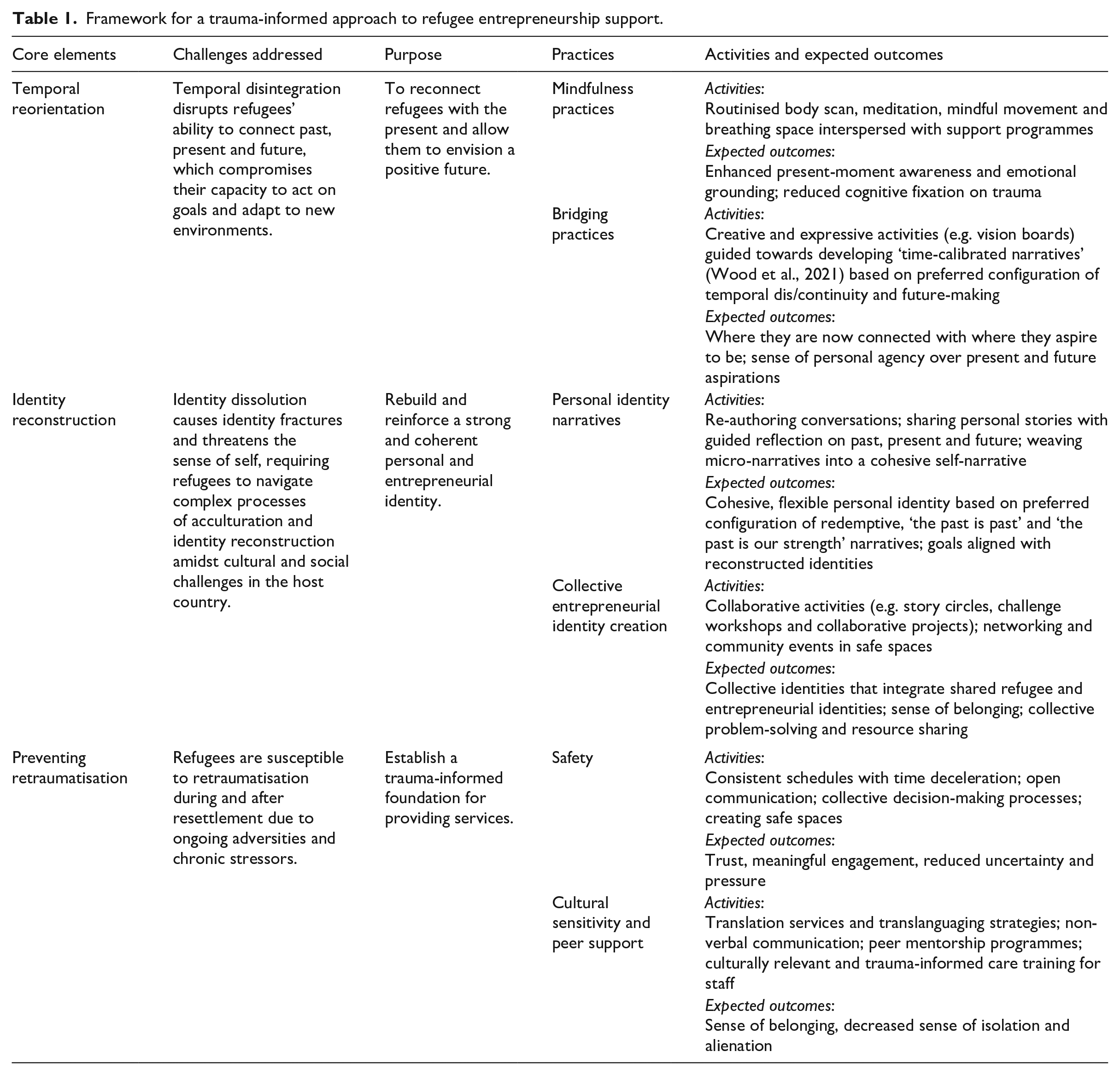
As the Table indicates, we show how (1) mindfulness and bridging practices help refugees reconnect with the present and envision a positive future, (2) personal and collective entrepreneurial identity development practices enable refugees to rebuild strong, cohesive identities, and (3) safety, cultural sensitivity and peer support help providers reduce the risks of retraumatisation.
Temporal reorientation
Addressing temporal disintegration and the resulting ‘agency-in-waiting’ (Brun, 2015) requires a multi-faceted approach. Jiang et al. (2021) specifically highlighted the importance of incorporating present-focused activities in support programmes to help refugee entrepreneurs balance present engagement with the more prevalent push for future-oriented thinking. Our goal is to offer practical support that transitions refugees from a place of suspended agency to active participation in their present and future lives. While organisations may adopt various approaches aligned with this principle, we propose two key interventions: mindfulness and bridging practices.
Mindfulness
Frémeaux and Henry (2023) emphasise the necessity of balancing high-paced activity with slower, reflective periods, particularly in entrepreneurship contexts. This principle highlights how, by fostering intentional periods of deceleration, entrepreneurs create space for reflection, creative thinking and present focus. We propose integrating the Mindfulness-Based Trauma Recovery for Refugees (MBTR-R) programme into current refugee entrepreneurship support services (Aizik-Reebs et al., 2021; Oren-Schwartz et al., 2023). MBTR-R is a structured, trauma-sensitive group intervention tailored to refugees’ mental health needs. It has been found to result in significant improvements in trauma-related mental health, inhibition of intrusive, trauma-related thoughts and increased self-compassion, aiding refugees in managing intrusive thoughts and remaining open to new experiences (Aizik-Reebs et al., 2021). For refugee entrepreneurs, moments of present-focused mindfulness can balance the push for future-focused entrepreneurial activities and aid temporal reorientation by unfixing the fixation on the past (Hinton et al., 2013; Oren-Schwartz et al., 2023). The mindfulness programme employs practices such as body scan, sitting meditation, mindful movement and the three-minute breathing space to enhance mindfulness and attention regulation. These practices promote awareness and acceptance of bodily sensations and emotions without judgement or repression, helping participants detach from past traumas and fear of the future to instead focus on the present (Aizik-Reebs et al., 2021; Oren-Schwartz et al., 2023). By focusing on present experiences without judgement, participants learn to manage overwhelm and disengage from trauma-related thoughts, manage trauma symptoms, regulate emotions and stay grounded (Oren-Schwartz et al., 2023). Once the stress attached to temporal disintegration is reduced, entrepreneurship support programmes can then engage in bridging practices that reconnect past, present and future within the entrepreneurial journey.
Bridging practices
To address temporal disintegration as it relates to the refugee entrepreneur’s complex relationship with the future, we propose two complementary mindsets to form the basis of bridging practices: continuity/discontinuity and future-making. First, entrepreneurship support programmes should adopt a balanced approach to temporal continuity and discontinuity (Kira et al., 2024). Continuities help refugees draw on positive aspects of their past, such as cultural traditions, while discontinuities allow refugees to envision a future separate from past traumas. This balance is essential for addressing temporal disintegration, as continuity offers stability, while discontinuity encourages growth (Kira et al., 2024). The second mindset, future-making, actively transforms thinking of the future in abstract visions into concrete, manageable plans and actions (Aleong, 2022). This approach incorporates activities that help refugees rehearse, experiment and enact new aspirations for the future. While support organisations may design other interventions that incorporate these mindsets to address temporal issues facing refugee entrepreneurs, we propose operationalising these two mindsets through creative interventions such as ‘vision board’ interventions infused with time-calibrated narratives, as described by Wood et al. (2021). These interventions can embody the balance of continuity/discontinuity and the actionable focus of future-making by helping refugees visually and narratively integrate their own configurations of past strengths, present stability and future aspirations. Creative interventions like vision boards go beyond artistic exercises to tap into the unconscious (Burton and Lent, 2016). Vision boards, which collage images, words and symbols of an individual’s aspirations, facilitate imaginative thinking and link subconscious desires to conscious goals (Burton and Lent, 2016; Waalkes et al., 2019). These boards can evoke positive emotions and hope, empowering individuals to take control of their future narratives and enhancing a sense of agency and active participation in defining and visualising goals (Burton and Lent, 2016; Scott-Poe and Patel, 2024). This is further supported by Frémeaux and Henry (2023), who highlight the importance of creating space for creative thinking within entrepreneurial activities.
Within these vision boards, entrepreneurs can then begin to tell time-calibrated narratives that support their entrepreneurial journey (Wood et al., 2021). Time-calibrated narratives are cognitive tools that entrepreneurs can use to organise their actions within uncertain timelines, including the timing of first steps (initialisation), time to outcomes (pace) and sequence of actions (chronology) (Wood et al., 2021). Support providers can guide refugees in constructing vision boards that revolve around these three temporal dimensions, encouraging participants to think about the ‘when’ of their entrepreneurial journey. Participants can be directed to identify immediate, short-term actions (initialisation) that serve as attainable first steps, anticipate the duration between actions and outcomes (pace) and set out a sequential path (chronology) for more complex milestones as they grow in confidence and skill. This encourages participants to mindfully sequence their entrepreneurial steps, starting with manageable tasks that build confidence and gradually moving to more complex goals. Such a process can assist participants in mentally connecting where they are now with where they aspire to be without feeling overwhelmed (Wood et al., 2021). These narratives are supported by sharing the vision boards with others to gain feedback and reinforce commitment to the narratives. This allows participants to articulate the meanings behind their vision boards through storytelling, helping them connect visual elements to their goals and preferred narratives, bringing the unconscious to the surface to become conscious and more concrete (Aleong, 2022; Burton and Lent, 2016) and to receive feedback and encouragement, strengthening their commitment to each step and helping them adapt their timelines as needed (Wood et al., 2021). Finally, service providers can encourage participants to continually reflect on their vision boards outside of the sessions, discussing the differences between their current narratives and the preferred narratives depicted on their boards (Burton and Lent, 2016; Scott-Poe and Patel, 2024; Waalkes et al., 2019).
Integrating vision boards into refugee entrepreneurship training offers specific benefits by addressing psychological challenges, such as temporal disintegration, that traditional tools like business plans or canvases often overlook. Vision boards creatively help refugees engage in imaginative, non-linear thinking and access to the subconscious, making abstract goals more achievable (Burton and Lent, 2016; Waalkes et al., 2019) and connecting their past, present and future (Scott-Poe and Patel, 2024). By focusing on proximate and feasible goals while visualising immediate entrepreneurial actions, these exercises encourage participants to bound their temporal horizons, fostering a sense of control over the near future and enabling them to navigate uncertainties with hope instead of fear. Such activities address Richey et al. (2022a) observation that refugee entrepreneurs need more time. Building on Kodeih et al. (2023), vision board exercises can serve as a form of ‘sheltering work’. Kodeih et al. (2023) emphasised the important role of entrepreneurship support services in helping refugees develop ‘a reclaimed experience of time’ characterised by a meaningful and extended present and a sense of control over the near future by focusing on proximate plans and concrete aspirations. This can enhance a sense of agency and reduce the overwhelming impact of indeterminate temporariness, increasing the likelihood of entrepreneurial success.
Thus, Temporal Reorientation can enhance several service categories in refugee entrepreneurship support organisations. For instance, mentorship and coaching programmes that incorporate Mindfulness and Bridging practices can help refugees manage trauma symptoms, regulate emotions and reduce the psychological burden of past traumas and future uncertainties: thus, fostering better engagement with support services and entrepreneurial activities. Business skills and knowledge development programmes that integrate temporal reorientation interventions can promote present-moment awareness and help develop feasible entrepreneurial plans for the near future, articulated through their time-calibrated narratives. Financial assistance services can also integrate temporal interventions to empower refugees to manage financial anxiety, set realistic financial goals and develop savings plans within their vision boards. Organisations providing resources and infrastructure can include access to quiet spaces for meditation or group mindfulness and bridging practice sessions.
Identity reconstruction
Entrepreneurial identity is a dynamic and multifaceted construct that emerges from the interplay of personal experiences and collective social interactions. Far from being static, it evolves through narratives, embodied practices and shared group memberships, reflecting both individual aspirations and relational dynamics (Gur and Mathias, 2021; Pan et al., 2019). This identity is particularly complex for refugee entrepreneurs, requiring them to balance the independence required for self-definition with the embeddedness of collective identities formed within their entrepreneurial ecosystems (Gur and Mathias, 2021; Pan et al., 2019). Such a dual focus can enable refugees to transform their stigmatised refugee identity into narratives of agency and belonging, fostering resilience and purpose amid adversity. While support organisations may design other interventions, we propose two main interventions: Personal Identity Narratives and Collective Entrepreneurial Identity Creation.
Personal identity narratives
Personal identity is an evolving, multidimensional construct reflecting an individual’s unique sense of self, shaped by life experiences and interactions while maintaining continuity across time and contexts (Haslam et al., 2003; Schwartz et al., 2011). Thus, an entrepreneur’s narrative personal identity reflects a dynamic interplay between their self-concept and their evolving venture experiences. It is shaped through storytelling, where they construct legitimacy and meaning for others, negotiating conflicts between personal ambitions and societal expectations (Gur and Mathias, 2021; Kašperová and Kitching, 2014; Pan et al., 2019). It has been found that entrepreneurs draw on various discursive resources to build and refine their identities, which include cultural narratives, personal stories and professional discourses (Alkhaled and Sasaki, 2022). Narrative identity, then, is an evolving internal story that integrates past experiences and future goals, providing coherence and meaning to life (McAdams, 2018). Shaped by cultural contexts and social interactions, it reflects both broad life themes and specific moments. However, refugees often feel disconnected from the building blocks necessary to construct a strong and positive identity. A structured narrative approach – building on the time-calibrated narratives above – can help provide the building blocks. Narrative identity building has been found to benefit refugees in general by fostering posttraumatic growth and supporting the development of a positive identity despite past trauma; it enhances self-awareness, restores life coherence and clarifies self-concept (Kerr et al., 2020). This process can empower refugees to regain agency, shift from victimhood to proactive action, pursue goals and build resilience, all of which are crucial for entrepreneurship (Yusefzade et al., 2024).
According to the literature, support services should consider three personal narratives when designing interventions: redemption narratives (McAdams et al., 2022), ‘the past is past’ and ‘the past is our strength’ narratives (Gemignani, 2011). First, redemption narratives play a crucial role in identity reconstruction by turning negative experiences into positive outcomes (McAdams et al., 2022). By reframing adversity as a source of strength and learning, individuals can shift from a passive, victimised identity to an empowered one. Second, when designing interventions for refugee entrepreneurs, it is crucial to find a flexible balance between the ‘the past is past’ narrative and the ‘the past is our strength’ narrative (Gemignani, 2011). Setting aside the past helps manage emotional pain and build a future-oriented identity while drawing on the past creates continuity and strength in disrupted lives (De Haene et al., 2018; Gemignani, 2011). Refugees will often lean towards one of these narratives more than the other: some pursue identity reinvention, consciously distancing themselves from previous identities associated with trauma (Jones Christensen and Newman, 2024), drawing on the ‘the past is past’ narrative; others engage in identity reinforcement, embracing and leveraging their cultural heritage in their ventures (Jones Christensen and Newman, 2024), which corresponds with the ‘the past is our strength’ narrative. Encouraging conscious, reflexive exploration of both narratives can allow refugees to develop a stronger sense of self. This flexible approach supports the ‘both/and’ approach in maintaining the balance between ‘the past is past’ and ‘the past is our strength’ (De Haene et al., 2018; Gemignani, 2011). This approach can help refugees transform trauma into self-healing narratives and establish strong, positive identities that incorporate both their heritage and future aspirations. We propose a Story Circle intervention designed to address the identity challenges of refugee entrepreneurs where they share, express and integrate small stories (Bonini Baldini, 2019; Moore, 2017); these small stories then build up to a cohesive narrative that reflects a coherent sense of self. It is important to note that this practice, in particular, requires expertise in trauma-informed care and managing potentially difficult conversations.
To begin, participants share personal stories in a group setting. This practice not only requires, but also fosters, trust allowing each participant’s story to emerge naturally, supporting identity reconstruction through dialogic and relational processes (Bonini Baldini, 2019; McAdams, 2018; McDonough and Colucci, 2021; Moore, 2017; Radu-Lefebvre et al., 2021). Facilitators guide participants to reflect on their past, present and future through micro-narratives – small, significant stories that reconnect them with their personal journeys, drawing out who they are (Yusefzade et al., 2024). Participants are encouraged to explore both distancing from past identities associated with trauma and embracing their cultural heritage, aligning with the ‘both/and’ approach (De Haene et al., 2018; Gemignani, 2011).
In the next step, participants select key themes to highlight across their stories, weaving together micro-narratives into a cohesive self-narrative (Bonini Baldini, 2019; McDonough and Colucci, 2021; Moore, 2017; Yusefzade et al., 2024). They explore alternative possible selves (Stewart and Neimeyer, 2001), including identity reinvention, identity reinforcement and repositioning of tradition (Alkhaled and Sasaki, 2022; Jones Christensen and Newman, 2024). Facilitators guide participants in making deliberate choices about which past experiences to include in their broader self-narrative, encouraging a flexible reinterpretation of self that integrates both their heritage and future entrepreneurial aspirations. In a supportive, non-judgemental setting, participants are encouraged to share openly, fostering mutual recognition. The feedback received helps strengthen their entrepreneurial identity and reinforces the positive aspects of their journey. This step also plays a crucial role in building community and mutual understanding among participants (Bonini Baldini, 2019; Schweitzer et al., 2014). Participants reinforce a positive self-concept by highlighting the redemptive aspects of their narratives and the flexible balance between the past and the future. The final step focuses on applying and reinforcing the newly developed personal identity while planning for the future, bringing together identity and temporal work (Chow, 2015; Yusefzade et al., 2024). With support from peers and service providers, participants envision and plan the next chapter of their life story by setting specific, actionable goals aligned with their reconstructed identities. To realise these goals, participants engage in detailed ‘re-authoring’ conversations (Hutto and Gallagher, 2017) that involve practical planning, strategising and identifying the necessary steps, resources and milestones (Yusefzade et al., 2024). Thus, by integrating redemption narratives and encouraging a flexible balance between neglecting and embracing the past, this intervention helps refugee entrepreneurs transform trauma into self-healing narratives and establish cohesive personal identities that incorporate both their heritage and future aspirations (Gemignani, 2011; De Haene et al., 2018).
Collective entrepreneurial identity creation
A strong entrepreneurial identity is important for success (Haşim and Soppe, 2023), and entrepreneurial support services are well-positioned to help refugees develop this identity through co-creation with other refugee entrepreneurs (Kodeih et al., 2023). Such collective entrepreneurial identity can emerge from the shared sense of belonging and mutual understanding among entrepreneurs in the programme, shaped by their social roles, group memberships and collaborative practices; it is a dynamic process where personal and collective identities intertwine, enabling entrepreneurs to navigate tensions between individual autonomy and community engagement (Gur and Mathias, 2021; Pan et al., 2019). Developing a collective identity among refugees can foster empowerment and mutual support. It builds social networks that provide emotional support, reduces stigma and buffers against the identity challenges of displacement (Byrne, 2016; Schmid, 2020). However, this identity cannot be defined solely by the stigmatised and liminal refugee label (Alfadhli and Drury, 2018; Schmid, 2020). Instead, this identity can arise from shared experiences and a sense of common fate (Alfadhli and Drury, 2018), enabling mutual aid, collective actions and access to identity resources that are more effective collectively than individually (Alfadhli and Drury, 2018; Byrne, 2016). We focus, in particular, on how refugee entrepreneurs can collectively develop a shared entrepreneurial identity.
Refugee entrepreneurship support organisations can play a key role in entrepreneurial identity co-creation by providing safe and nurturing environments (Kodeih et al., 2023). By fostering a local place and cultivating a sense of belonging among participants, refugees can then co-construct narratives of resilience and agency, reinforcing their shared entrepreneurial identity as they move through the programme and develop their ventures. It is through social interactions and sharing personal stories that refugee entrepreneurs form deeper connections and develop a cohesive group identity (Phillips et al., 2013). Importantly, support organisations can aid in co-constructing an identity that transcends the refugee label, encouraging participants to collectively view themselves as empowered entrepreneurs with a common purpose (Alfadhli and Drury, 2018; Byrne, 2016). This is not to deny the refugee label but instead to embrace a dual identity as a positive distinction that solidifies their collective identity and reinforces their uniqueness (Khayesi et al., 2014). As relationships deepen and circumstances evolve, this identity continuously adapts, enhancing the refugee’s ability to succeed in business endeavours by leveraging collective support to overcome challenges (Hajek, 2023; Khayesi et al., 2014; Phillips et al., 2013).
Where the act of sharing personal identity narratives draws out an individual’s life story, crafting and sharing common stories during the programme can facilitate a collective entrepreneurial identity for the group. Both structured and informal activities contribute to fostering connections on professional and personal levels, which are essential in building this cohesive group identity (Hajek, 2023). Given the emphasis on social networks within support organisations, group narrative activities are likely to be integrated into existing offerings. Adding formal and informal story circles into existing social events can create a platform for participants to share personal stories about their entrepreneurial journeys, focusing on common challenges, sacrifices and achievements and facilitating collective identity development (Khayesi et al., 2014; Phillips et al., 2013). Emphasising entrepreneurial capabilities through these stories can help reduce the stigma associated with being a refugee (Alfadhli and Drury, 2018). To reinforce a collective entrepreneurial identity, challenge workshops can be added that culminate in collaborative problem-solving projects. These projects require teamwork, resource pooling and decision-making, strengthening the sense of collective identity and purpose (Hajek, 2023; Haşim and Soppe, 2023). Such collaborations can help entrepreneurs bond over shared goals and values, creating a supportive network that extends beyond the workshop setting (Alfadhli and Drury, 2018; Byrne, 2016).
Collective entrepreneurial identity creation helps refugee entrepreneurs address identity dissolution challenges by co-creating a strong collective identity that integrates their dual identities – encouraging identification as both refugees and entrepreneurs empowers participants to transcend stigmatising labels, reclaim agency and construct a more empowering identity. This approach can also promote integration by celebrating cultural backgrounds while preserving their sense of self, working alongside personal identity narratives to mitigate the effects of identity dissolution. Thus, Identity Reconstruction practices can be integrated into existing support services in several ways. In particular, collaborative activities can integrate elements of entrepreneurial identity co-creation. Mentors can use sessions to not only advance the venture but also to ask probing questions that allow for further elaboration of identity narratives; networking opportunities, such as events and support groups, can promote collective entrepreneurial identity creation and provide practice in sharing the identity with others in a safe space, where narratives can be further refined or even changed over time; shared problem-solving that focus on venture success can also be a source of shared identity building.
Preventing retraumatisation
Safety
In the context of refugee entrepreneurship support services, it is essential to establish an environment of safety that functions as a ‘holding environment while they settle’ (Alayarian, 2018). The physical environment and the attitudes and behaviours of staff play a vital role in fostering a sense of safety (Cleveland et al., 2018; Kodeih et al., 2023; Miller et al., 2019). Fostering a local place where refugees feel safe and supported in their entrepreneurial pursuits is crucial, as it helps mitigate the negative psychological effects of oppressive temporality and allows refugees to reclaim a sense of agency and purpose in their lives (Kodeih et al., 2023). To provide psychological safety, it is essential to create spaces where refugee entrepreneurs can express their identities-in-progress and share their experiences without fear of judgement or pressure to always be resilient. These safe spaces play a crucial role in fostering acceptance and understanding, particularly for individuals who have experienced significant rejection or discrimination (Alayarian, 2018). Allowing for vulnerability and struggle instead of constant progress is therefore critical. Programmes designed with a rigid focus on productivity can be detrimental to both entrepreneur well-being and the quality of their work (Frémeaux and Henry, 2023). Though well-intentioned, such programmes increase pressure and can add to the uncertainty experienced by refugees in their resettlement.
To counter the potential for added pressure and uncertainty, support services should avoid tight timelines and highly controlling practices, excessive surveillance or unnecessary restrictions, which can trigger feelings of shock and humiliation and ultimately lead to retraumatisation (Cleveland et al., 2018). By adopting a slower, more deliberate approach – including periods of time deceleration mentioned above, which allow for reflection, creative thinking and relationship building – these services can create a safe environment where refugees can integrate new experiences at their own pace, leading to more sustainable outcomes (Frémeaux and Henry, 2023). Moreover, structuring day-to-day activities based on routines can provide a sense of purpose and rhythm to refugees’ lives (Kodeih et al., 2023). Creating consistent routines, such as scheduled training or workshops, not only strengthens the interventions but also helps refugees regain control over their near future and experience a meaningful and extended present (Kodeih et al., 2023). Stability, predictability and consistent interactions over time can also build trust (Cleveland et al., 2018; Schick et al., 2016). Establishing trust is critical for a feeling of safety, as well as for entrepreneurial success. This is particularly difficult to establish in the context of refugees, who have likely had many negative experiences with organisations that failed to fulfil promises, eroding trust in new support systems (Richey et al., 2022a). Programmes aiming to support refugee entrepreneurs must be effective to address these challenges by fostering a psychologically safe environment where meaningful, trusting relationships can develop. Service providers should attempt to address and minimise power imbalances, as refugees, especially those who have endured significant trauma, may be highly sensitive to dynamics involving authority, cultural misunderstandings or privacy concerns (Schippert et al., 2021). These factors can evoke memories of past abuses, making it crucial for providers to adopt a client-centred framework that builds trust (Griffiths, 2018).
Providers should create interactions where refugees feel acknowledged and understood, avoiding behaviours that seem like gatekeeping, which can undermine trust (Roche et al., 2020). While service changes and resource limitations may be unavoidable, they should be handled carefully and transparently. Support services should prioritise transparency in activities, processes and plans so refugees fully understand the steps taken (Weber, 2019). By keeping refugees informed and supported, organisations enhance their sense of safety (Cleveland et al., 2018; Schick et al., 2016). Research shows that involving refugees in decision-making processes and offering them choices regarding the services they receive helps restore their sense of control and encourages self-advocacy (Im et al., 2021). This approach promotes self-efficacy by encouraging refugees to actively engage in their healing process, set personal goals and develop skills that contribute to their well-being. In addition to a non-judgemental environment based on trust and transparency, staff competence and sensitivity are essential for addressing trauma safely. Without proper training, staff may overlook signs of anxiety or panic during activities, leading to unintentional harm (Schippert et al., 2021). Continuous education on the trauma related to displacement equips staff with the skills to identify and respond appropriately, including referring individuals to external mental health support when necessary. Comprehensive training should involve all levels of staff to ensure a unified understanding of the challenges facing refugees (Miller et al., 2019).
Cultural sensitivity and peer support
Cultural sensitivity is another crucial factor in supporting refugee entrepreneurs, as it honours diverse backgrounds and experiences (Hinton et al., 2013; Im and Swan, 2021). Entrepreneurship support organisations can foster deeper engagement by recruiting and training staff with cultural and linguistic connections to participants (Richey et al., 2022a). Staff knowledge, training and self-awareness are critical components in creating a supportive environment. It has been found that standard approaches focused on adapting to the host country’s culture often miss the opportunity to build bridges across the cultural divide; instead, recognising that refugees have diverse acculturation goals can help tailor support services to effectively address their specific needs and aspirations (Jones Christensen and Newman, 2024). For example, for refugees pursuing reinvention, encouraging them to envision future selves and goals that may diverge from their past experiences can be empowering; conversely, those focused on reinforcement can be supported in integrating their cultural heritage and skills into their future aspirations (Jones Christensen and Newman, 2024). Thus, tailoring support to specific cultural contexts – including language and beliefs – and individual choices not only ensures that interventions resonate effectively but also fosters a sense of belonging and respect (Schippert et al., 2021). By moving beyond one-size-fits-all models of cultural adaptation, organisations can better address the diverse needs of refugees, decreasing the stress and pressure of adapting to a new culture and reducing the likelihood of inadvertently retraumatising individuals.
Cultural competence is also crucial for service providers working with refugees, as it involves understanding how different cultures express distress, use coping mechanisms and engage in traditional healing practices (McKeon et al., 2024). This competence helps service providers support healing, build on existing emotional resources and recognise a lack of coping. Cultural competency training for staff can enhance understanding of the intersection between mental health, trauma and refugee entrepreneurship and how trauma affects refugees differently based on their cultural backgrounds (McKeon et al., 2024). Furthermore, addressing language barriers is vital in refugee trauma-informed support services (Schippert et al., 2021). While basic language skills suffice for daily tasks, refugees often rely on their native language to express emotions. Translation services, though essential, may limit the sharing of personal struggles (Kakos, 2024). Incorporating strategies like translanguaging – using both home and instructional languages – enhances understanding and communication. Non-verbal methods, such as music and dance, bridge language gaps, provide emotional outlets and foster new social networks (Thornton and Spalding, 2018). These culturally and linguistically responsive practices enable support services to better address refugee needs, reducing entrepreneurship’s compounding pressures to better prevent retraumatisation.
Peer support is another practice integral to trauma-informed care, empowering refugee entrepreneurs by addressing socio-cultural challenges and fostering resilience (Mahon, 2022; Portyanko et al., 2023). Collaborative peer relationships can provide essential resources like mentorship, emotional support and coping strategies (Mahon, 2022; Portyanko et al., 2023). Shared cultural roots can further aid acculturation choices, preserve cultural identity and promote both well-being and entrepreneurial success (Block et al., 2018; Mahon, 2022). Training settled refugees as peer mentors can equip them to lead support sessions, creating environments where newly arrived refugees can access resources and address challenges collaboratively. These sessions, rooted in shared experiences, provide psychosocial support and help mitigate trauma’s effects on identity (Berman et al., 2020; Mahon, 2022). Incorporating para-professionals and peer educators from refugee communities into entrepreneurship support services can enable culturally grounded and strengths-based interventions (Block et al., 2018).
Thus, practices for Preventing Retraumatisation can enhance existing refugee entrepreneurship support services in several ways. For instance, mentorship and coaching programmes can incorporate practices like time deceleration, transparent communications and check-ins to ensure a psychologically safe environment, enabling refugees to explore entrepreneurial opportunities without undue pressure. Structured day-to-day activities, such as business skill workshops or creative sessions, can provide a sense of stability and purpose, mitigating the adverse effects of uncertainty and fostering meaningful engagement. Financial and business development services can also ensure that timelines are flexible and goals are tailored to individual pacing, reducing the risk of retraumatisation. Additionally, creating transparent communication processes and recruiting culturally and linguistically aligned staff through all aspects of the programme can build trust, enhance refugee confidence in the support systems and encourage sustainable entrepreneurial progress.
Discussion
Contributions
Research has shown the many benefits of entrepreneurial support programmes for refugees (Meister and Mauer, 2019; Newman and Christensen, 2021; Richey et al., 2022a); however, it also clearly articulates the limitations of these programmes and specifically calls for the development of trauma-informed services (Newman and Christensen, 2024; Rawhouser et al., 2024). Refugee trauma has been found to significantly shape refugee experiences, influencing their capacity to adapt to new environments, engage in entrepreneurial activities and benefit from support services (Bemak and Chung, 2017; Disney and McPherson, 2020; Rawhouser et al., 2024). Indeed, even when these organisations use best practices found in the entrepreneurship support organisation literature, their services can negatively affect refugee entrepreneurs (Newman and Christensen, 2021). We develop a framework that can address these challenges, integrating trauma-informed care into the work of entrepreneurship support programmes. In doing so, we make several contributions to the literature.
Given that this work is new to the field of refugee entrepreneurship, our primary objective is to establish a foundation and agenda for research going forward. Existing research has recently drawn our attention to broader mental health domains such as neurodiversity, PTSD, anxiety and depression within entrepreneurship (Cubbon et al., 2021; Gish et al., 2022; Stephan et al., 2023) and the way trauma can negatively affect refugee entrepreneurs specifically (Newman and Christensen, 2024). But trauma is multifaceted, encompassing a range of psychological, emotional and social disruptions (Fazel et al., 2005; Papadopoulos, 2018). We identify three key impacts of trauma that we argue are particularly salient challenges within the entrepreneurial context: temporal disintegration (Holman and Silver, 1998; Kira et al., 2024; Sagbakken et al., 2020), identity dissolution (Alcock, 2003; Berman et al., 2020; Märtsin, 2010) and the risk of retraumatisation (Bruhn et al., 2018; Carlsson and Sonne, 2018; Papadopoulos, 2018). Refugees often experience temporal disintegration, where trauma disrupts their sense of time, making it hard to focus on the present or plan for the future (Harima and Plak, 2024; Holman and Silver, 1998) – critical temporal orientations for entrepreneurs (Wood et al., 2021); and refugees often face profound disruptions to their sense of self when fleeing their home countries, making it challenging to reconstruct their identities in a new cultural context (Berman et al., 2020; Märtsin, 2010; Rugina and Harima, 2024) and limiting their ability to build the necessary entrepreneurial identity (Radu-Lefebvre et al., 2021). Refugees are also at risk of retraumatisation as they settle into the host country (Nascimento and Pureza, 2024; Salmon and Singleton, 2025), a risk that is exacerbated in programmes that require trust and risk-taking and often impose a rigid timeline (Richey et al., 2022a).
The framework we then develop specifies interventions that target these challenges, outlining the overarching practice, key activities and expected outcomes. Our framework adapts practices from the trauma-informed care literature (Butler et al., 2011; Harris and Fallot, 2001; Huang et al., 2014; Im and Swan, 2021; Im et al., 2021; Miller et al., 2019; Reeves, 2015) to develop entrepreneurial practices that aim to restore a present and future time orientation, develop a strong and cohesive identity and ensure safety and culturally sensitive services that avoid the risks of retraumatisation. Accordingly, our approach goes beyond the traditional focus on resilience (Ayala and Manzano, 2014; Shepherd et al., 2020) and business achievements (Newman and Christensen, 2021), acknowledging the deeper psychological needs of refugee entrepreneurs to have space and time for healing. We challenge the assumption in the literature that resilience is always positive in helping people rise above traumatic events and navigate the challenges of entrepreneurship. We draw on the trauma literature (Alayarian, 2018; Bemak and Chung, 2017; Papadopoulos, 2018) to argue that a singular focus on resilience can negatively affect entrepreneurs who have faced extreme trauma. Without balancing the push for resilience with an acceptance of vulnerability, entrepreneurs are at the risk of being retraumatised and unlikely to succeed in their entrepreneurial pursuits.
By advocating for creative interventions, such as vision boards and story circles, this study expands the scope of entrepreneurship support services (Harima et al., 2019; Jürgens et al., 2022; Newman and Christensen, 2021), fostering a holistic and adaptive approach to engagement. These creative practices provide activities that address the unique challenges faced by refugee entrepreneurs, simultaneously expanding and customising the toolbox available to refugee entrepreneurship support programmes. Importantly, these practices address the embodied, non-conscious impacts of trauma and healing (Alayarian, 2018; Papadopoulos, 2018; Van der Kolk, 1994). We, therefore, suggest creative interventions that operate below the surface are a critical feature of support for those who have experienced trauma.
The framework also broadens the understanding of entrepreneurial identity formation in the context of displacement by highlighting the impact of identity dissolution on refugee entrepreneurs (Adeeko and Treanor, 2022; Rugina and Harima, 2024). The loss of social roles, professional recognition and community ties due to forced migration creates an identity void that is challenging to navigate. These contribute to an expanded understanding of entrepreneurial identity as a dynamic process influenced by individual aspirations and socio-contextual disruptions, particularly under conditions of forced displacement. Our suggestions for approaching this issue involve an interplay between personal and entrepreneurial identities, individual narrative reconstruction and collective co-creation, providing flexibility around the integration of cultural and refugee identities.
Future research should prioritise the empirical validation of our conceptual framework, including pilot testing in diverse contexts, to assess its effectiveness and refine the model. Research should also explore the framework’s adaptability across different refugee groups, considering the varying cultural, social and economic conditions that may influence the success of interventions. Comparative studies can help identify the necessary adjustments to tailor the framework to specific refugee populations, paying particular attention to the degree of cultural differences between the home and host countries. Moreover, while the framework offers a holistic approach to supporting refugee entrepreneurs, it is essential to acknowledge that entrepreneurship may not always be the best choice for all refugees. A deep analysis of this issue is beyond the scope of the current article, but we encourage future research to explore these contingencies. Further investigation is needed to understand the impact of intersectional identities, such as gender, age, disability and religion, on the entrepreneurial experiences of refugees. Developing tools to measure psychological and entrepreneurial outcomes will be crucial for evaluating the framework’s success. Research should also focus on the sustainability and scalability of the proposed interventions and the integration of the framework with existing economic and social structures in host countries. These efforts will ensure a more effective approach to supporting refugee entrepreneurs in practice.
Practical implications
Even when services offer mental health support to refugees, it is often separate from entrepreneurial support services (Disney and McPherson, 2020; Im et al., 2021; Silove et al., 2017). One of the biggest implications for policy and practice is the need to integrate trauma-informed care into entrepreneurial support services. Because trauma directly affects factors critical for entrepreneurial success and the entrepreneurial journey has a potential impact upon trauma, we argue that separate mental health support is not sufficient. Instead, we suggest that refugee entrepreneurship programmes prioritise a holistic approach by integrating mental health support with entrepreneurial training. By reconnecting refugees with the present and allowing them to envision a positive future, integrated services can address temporal disintegration and help build actionable entrepreneurial steps towards the future. By helping refugees rebuild their sense of self and establishing a collective entrepreneurial identity, integrated services can address identity dissolution and enhance social cohesion within communities. Integrated services are also better positioned to ensure programmes are designed to avoid retraumatisation and staff and peer mentors are trained to respond sensitively. Our framework also works towards shifting the focus of entrepreneurship support programmes from purely economic outcomes to include psychological, emotional and social well-being. This broader approach ensures that programmes address the multidimensional challenges faced by refugee entrepreneurs. Table 1 provides examples of the activities and expected outcomes associated with each of these three practices.
Another key implication of our framework is the need for flexibility and consistency, as well as room to explore within the programmes. Entrepreneurship support should adopt flexible timelines and periods of deceleration and emphasise short-term achievable goals to align with refugees’ immediate needs and mitigate feelings of overwhelm associated with long-term future planning. Programmes should simultaneously provide consistent routines and support structures to foster stability and trust among participants. While we suggest particular mindsets and identities, we also highlight the need for each entrepreneur to find their own balance of opposing elements, such as continuity and discontinuity, reinvention or reinforcement. Focusing on collaborative projects and shared problem-solving can strengthen participants’ sense of belonging and agency, mitigating the effects of displacement and trauma. By embedding these practices into their operations, support organisations can create environments that empower refugees to thrive both personally and professionally. However, balancing the inclusion of trauma and entrepreneurship training is incredibly sensitive. We, therefore, recommend broader flexibility in offering opportunities for addressing trauma without pushing refugees to engage in ways they are not comfortable with.
Finally, we acknowledge the challenges of implementing our framework for trauma-informed care within entrepreneurial support organisations. The complexity of the framework may be difficult for organisations to implement effectively, as it requires a multidisciplinary approach that not all organisations can provide. There is also a risk of cultural generalisation, where interventions may inadvertently oversimplify or stereotype diverse refugee populations, necessitating highly individualised support that can be resource-intensive. Scalability is another significant challenge – personalised interventions may lose effectiveness when expanded to larger groups, requiring innovative solutions to maintain quality and impact. We suggest that these services require extensive planning by organisations, strong support from policymakers and funders and deliberate evaluation and adjustment over time as we work towards stronger support for refugees in their entrepreneurial activities.
Footnotes
Funding
The authors received no financial support for the research, authorship and/or publication of this article.
