




Abstract
This article focuses on a subset of refugees who engage in entrepreneurship shortly after relocating to a new host community; it explores identity-related antecedents and integration consequences of different entrepreneurship strategies in the new location. It draws from acculturation psychology and founder identity theory to argue that, post-arrival, new refugees consider (a) how to prioritize the identity associated with their former life and (b) the degree of connection they desire in the host community. For some, these preferences drive heterogeneous entrepreneurial behaviors associated with different acculturation outcomes—including marginalization, separation, integration, and assimilation. Specifically, we describe two refugee entrepreneur identity management strategies: reinvention (distance from home country identity) and reinforcement (close connection to home country identity) and propose their different acculturation outcomes. The theory-based arguments emphasize how attending to identity preferences of refugees can improve stakeholder responses. The article also illustrates why refugee integration can remain elusive, as not all refugees with successful ventures integrate.
The number of global refugees, currently more than 76 million, continues to rise (United Nations High Commissioner for Refugees [UNHCR], 2020). Increased conflict, natural disasters, and human rights violations—among other crises—force such relocation (Shultz et al., 2020; Strang & Quinn, 2021). This relocation (and accompanying economic, social, and financial disruptions) necessitates that refugees make near wholesale investments in the new host community (Hynie, 2018; Jones Christensen et al., 2020; Verkuyten et al., 2019). In response to the global refugee crisis, stakeholders ranging from international aid agencies to management scholars encourage entrepreneurship on the part of the refugee; they argue that entrepreneurship in the host country represents one route to integration into the new community (cf. Article 34 in 1967 UN Protocol on the Status of Refugees; Desai et al., 2021; Kone et al., 2021; UNHCR, 2014). These stakeholders argue that refugee entrepreneurship promotes economic self-reliance and social, cultural, and financial integration with the host community, particularly in more developed country contexts (Desai et al., 2021; Easton-Calabria & Omata, 2018; Guo et al., 2020; Rashid, 2018). Largely in response to potential economic benefits, myriad stakeholders encourage entrepreneurship for newly relocated refugees (Badger Newman & Jones Christensen, 2021; A. D. Brown & Scribner, 2014; Meister & Mauer, 2019; Piniero, 2017; UNHCR, 2014, 2020).
However, such encouragement may overemphasize economic drivers and benefits of entrepreneurship at the expense of considering other, non-financial, antecedents, and consequences of refugee entrepreneurial behaviors. Certainly, massive economic jolts are not the sole disruptions that refugees face (Desai et al., 2021; Christensen et al., 2020; Kone et al., 2021) nor the only antecedent of refugee entrepreneurial behavior (Desai et al., 2021; Heilbrunn et al., 2019; Shepherd et al., 2020). Furthermore, focusing on entrepreneurship as a response to economic exigencies obscures identity and sociocultural factors that drive refugees toward (or away from) entrepreneurship (Adeeko & Treanor, 2022; Meister & Mauer, 2019; Powell & Baker, 2014). Regarding the consequences of refugee entrepreneurship, many advocate the practice based on two questionable assumptions: (a) refugees largely desire social and cultural integration in the new host community and (b) venture survival and thriving equates with social integration (Berry et al., 2006; Desai et al., 2021; European Council on Refugees and Exiles [ECRE], 2002; Hynie, 2018)—essentially oversimplifying the social outcomes of refugee entrepreneurship. Considered together, these assumptions about antecedents and consequences of refugee behaviors disregard key frameworks from acculturation psychology regarding other drivers of refugee behavior and other outcomes when refugees relocate to a new host country.
Herein, we draw from acculturation psychology and acculturation theory (Berry, 1997, 2019; Phillimore, 2011) to argue for identity-based antecedents to refugee entrepreneurship and for myriad acculturation outcomes that can follow this entrepreneurship—including marginalization, segregation, assimilation, or hybrids (Berry, 1997, 2019; Berry et al., 2006; Berry & Sabatier, 2010; Verkuyten et al., 2019). We blend acculturation psychology (Berry, 1997, 2019) with founder identity theory (Baker & Powell, 2020; Powell & Baker, 2014, 2017) to argue that identity work on the part of the refugee (primarily related to the home country identity) is a psychologically grounded antecedent to entrepreneurial behaviors. We also argue that how the refugee responds to this identity question vis-a-vis entrepreneurship can impact which of the four acculturation outcomes she pursues (Berry, 1997, 2019; Phillimore, 2011). Considering these connections has the potential to improve how pro-business stakeholders respond to refugees and their entrepreneurial activities.
Specifically, we build from acculturation psychology (Berry, 1997, 2019; Berry et al., 2006; Phillimore, 2011; Sam & Berry, 2016), to argue that forced migration precipitates identity jolts and “discontinuities,” both of which push fundamental questions of identity to the forefront for the refugee (Berry, 2019; Hynie, 2018; Jones et al., 2019; Strang & Quinn, 2021). We integrate this work with work from entrepreneurship scholars suggesting that identity construction, even in constrained environments, is central to the act of entrepreneurship (Baker & Powell, 2020; Powell & Baker, 2014, 2017; Clarke & Holt, 2017; Crosina, 2018; Ireland & Webb, 2007; Johannisson, 2011; McMullen et al., 2021). Herein, we consider the cultural identity jolt refugees face (Berry, 2019; Verkuyten et al., 2019) and the subsequent identity construction vis-a-vis entrepreneurship to explore the following questions: Upon arrival in a new host community, how do refugee identity preferences affect whether and how refugees engage in entrepreneurship? How do identity preferences and subsequent entrepreneurial behaviors affect acculturation?
These frameworks from the field of acculturation studies and our arguments about the ways refugees can “use” entrepreneurship based on identity preferences, extend entrepreneurship theory in several ways: first, by bringing founder identity logics to the context of refugee entrepreneurship, and second, by problematizing current assumptions about the integration benefits of entrepreneurship. The arguments also have practical significance as they help explain differences in how refugees interact with local businesses, create their own businesses, and react to other employment options. To make these contributions, we first illustrate social, economic, and psychological jolts associated with a refugee background and introduce acculturation outcomes not typically discussed in relation to refugee belonging (i.e., alternatives to “integrated” or “not integrated”). We then highlight the identity questions associated with relocation and introduce founder identity theory (Powell & Baker, 2014, 2017; Baker & Powell, 2020) to explain how refugee identity decisions affect entrepreneurial actions—even embedded in harsh contexts that constrain choices (Berry, 1997; Heilbrunn, 2019; Losoncz & Marlowe, 2020; McMullen et al., 2021). We suggest that refugees who want to maintain tight connections to their home country identity use entrepreneurship differently than do refugees who desire to actively separate from that identity—they pursue reinvention or reinforcement strategies. We close with implications for stakeholders interested in non-financial causes and consequences of refugee entrepreneurship as well as for scholars interested in connections between entrepreneurship and identity work.
Foundational Literature on Refugee Status and Acculturation
Who is a Refugee?
To date, considerable scholarship and policy describing refugee status draws from the definition of a refugee established by the United Nations in the 1951 Geneva Convention. The associated documents describe a refugee as a person who: . . .owing to a well-founded fear of being persecuted for reasons of race, religion, nationality, membership of a particular social group or political opinion, this person is outside the country of his nationality and is unable or, owing to such fear, is unwilling to avail himself of the protection of that country; or who, not having a nationality and being outside the country of his former habitual residence as a result of such events, is unable or, owing to such fear, is unwilling to return to it. (United Nations High Commissioner on Refugees (UNHCR), 2018, 2020)
Many scholars contest this definition on the premise it remains too narrow and policy-focused to accurately describe the wider range of people who face involuntary forced migration (Black, 2001; De Genova, 2002, 2013; Zetter, 2007 for summaries of this debate). For example, some scholars include humanitarian refugees, where war or lack of food or water create crises that force relocation (Hailbronner, 1988); stateless persons where policy changes render people homeless (Black, 2001); economic refugees, or those forced to migrate because of poverty, underdevelopment, or social exclusion (Richmond, 1993); and environmental refugees where people flee because crops fail, or water levels render livelihoods extinct (Myers & Kent, 1995).
Based on the above, the above definition of “refugee” (as a person with formal legal status from a UNHCR-granting organization) also offers the narrowest description of people experiencing permanent and involuntary forced displacement. Accordingly, we argue for a more inclusive option. Herein, we support a less-utilized definition of refugees as: forcibly displaced populations, which may be primarily due to war and conflict, but also can be due to political, religious, and other persecution; natural or man-made disasters; development-induced displacement; smuggling and human trafficking; and environmental displacement. (Reed, 2018: pp. 2; c.f. Guo et al., 2020)
This definition highlights the range of reasons that people are forced to leave and how many carry a concomitant understanding that the refugee cannot return to the home country. Scholars argue that refugees have very specific resource constraints (e.g., they cannot return home to gather support or funds), limitations (e.g., certifications do not transfer and they have no access to savings or former social connections), trauma exposures, and other characteristics (Desai et al., 2021; Heilbrunn et al., 2019; Jones Christensen et al., 2020 and Wauters & Lambrecht, 2008; for discussions of these differences). These differences include the severity to which refugees (particularly in camps and extended transitional spaces) experience broken bonds of attachment and relational losses—losses that include home and social support, possessions, status (Baker, 1983), options and cultural worlds (Summerfield, 1998), and even identity (Alkhaled & Sasaki, 2021; Losoncz & Marlowe, 2020; Mahmoud, 2011). Such differences affect the services refugees request (Badger Newman & Jones Christensen, 2021) and the way that refugees approach venture creation (Alkhaled & Sasaki, 2021; Wauters & Lambrecht, 2008). They also inform the premise that people with a refugee background may benefit from tailored responses from the communities in which they relocate, and from the companies and organizations with whom they interact in a new host country (Badger Newman & Jones Christensen, 2021; Desai et al., 2021; Jones Christensen et al., 2020). 1
Regarding the topic of how receiving communities behave and change in relation to refugee arrival, and how refugees do or do not connect with the new host community, acculturation scholars offer a framework offering at least four possible outcomes.
Responses to Forced Relocation: Four Acculturation Outcomes
Acculturation scholars study the cultural and psychological changes that occur after intercultural contact (Berry, 1997, 2019); with a focus on how newcomers change in response to living in the new host country (Berry, 2019; Phinney et al., 2001, 2006; Schiefer et al., 2012). Cultural changes relate to altered cultural, economic, and political practices; psychological changes include alterations in attitude toward the acculturation process, in cultural identities (Phinney, 2003), and in social behaviors in the new location (Berry et al., 2006: p. 305). Acculturation frameworks examine how adaptation to the host community and retention of the heritage home culture intersect. Key frameworks outline three additional acculturation outcomes that can occur for refugees, outside of the oft-idealized outcome of sociocultural integration (Berry, 2003, 2019). These include assimilation, marginalization, and separation. Assimilation refers to the near total sublimation of an ethnic or cultural identity; it occurs when a person blends into the dominant culture while forsaking her cultural heritage (Hirschman, 1983; Knight et al., 2016). When a refugee prefers disconnection from the home culture identity while seeking new relationships with the host community, they are more likely to assimilate. Alternately, when refugees prefer to live and work in an enclave of co-ethnic others, they tend toward separation (Andersson, 2020)—meaning they identify more with the home versus host community and do not seek relationships with the host community. When the cultural identity is not maintained nor new relationships developed, the result is marginalization. Integration represents the situation where the refugee balances emphasis on the two identities (Ager & Strang, 2008; Berry, 1997; Phillimore, 2011).
As stated, separated from context, these acculturation outcomes relate, first, to individual preferences regarding the extent to which cultural identity is valued and retained, and second, to the extent to which contact and relationships with the host community are sought out and valued (Berry, 1997; Phillimore, 2011). Figure 1 below, adapted from Berry, 1997, references a framework that highlights these questions and how, when the two are considered together and overlaid in a two-by-two, the possible responses relate to the four acculturation outcomes.
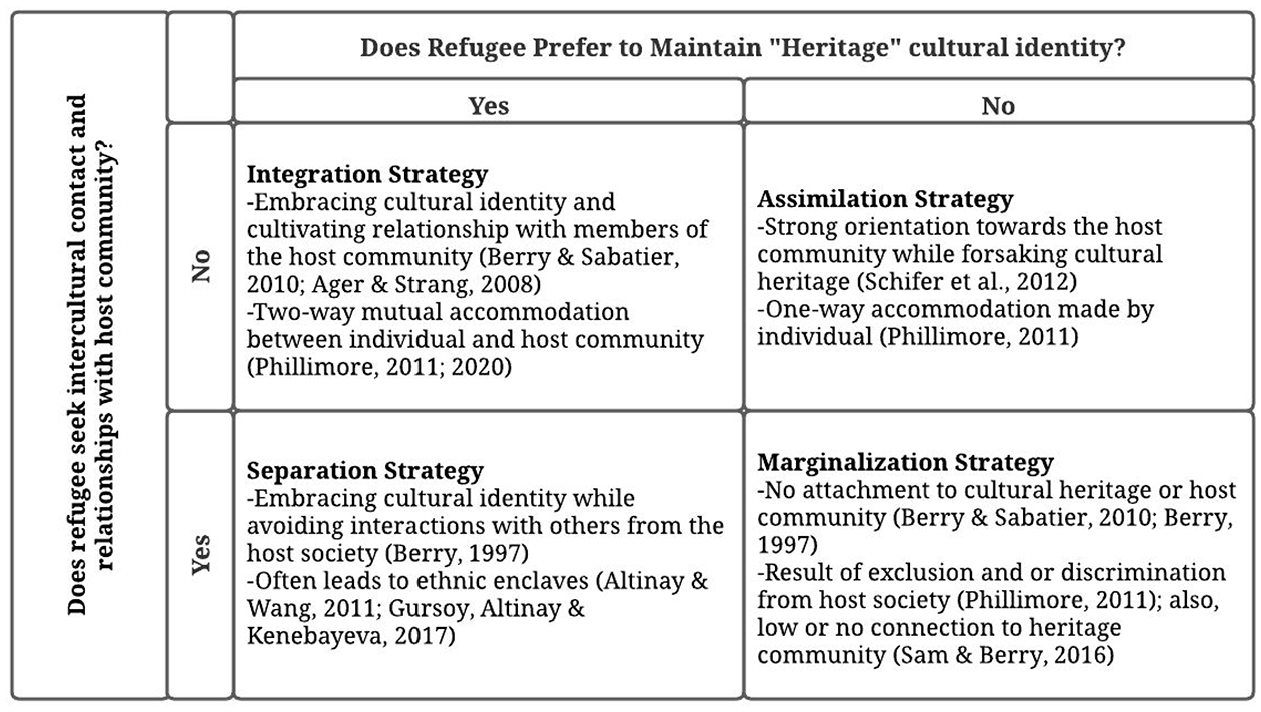
Acculturation Psychology Framework Summarizing [Refugee] Identity and Engagement Preferences.
Refugee Responses to Forced Relocation: Identity (Re)Construction
The acculturation framework summarized in Figure 1 stems from a foundational and psychologically based argument that, upon arrival, newcomers consider how to optimize two independent concerns: how to connect to the culture of origin and how to connect to the society of settlement (Berry et al., 2006: 305). Overlapping both results in four sectors where people can express how they want to acculturate; the answers reveal refugee preferences about identity expression in the new culture (Berry, 1997, 2007). Scholars who study the psychological acculturation of migrants, historically and in the present, consistently describe the identity-related consequences of two cultures colliding (Opute et al., 2021; Phillimore, 2011, 2020; Şafak-AyvazoĞlu et al., 2021; Zehra & Usmani, 2021). Specifically, they argue that the newcomer, the refugee in this case, makes an early decision about how she wants to prioritize her heritage cultural identity while in the new host community (Berry, 1997, 2007, 2019; Berry et al., 1987; Berry & Sabatier, 2010; Phillimore, 2011; Ward & Kus, 2012). Forced relocation inherent in the refugee experience represents a “jolt” or discontinuous transition that can trigger more identity questions the more the home and host cultures differ (Lee et al., 2018). Such “jolts” encourage identity construction in service of creating new “possible selves” (Yost et al., 1992) as the refugee (re)prioritizes identities to resolve identity “jolts” and guide identity-consistent behaviors (Shepherd & Patzelt, 2018: pp. 176).
After determining to what degree the individual wishes to maintain their home cultural identity, they likely also consider to what degree they seek involvement with the larger society (Berry et al., 2006: pp. 306). Theoretical and empirical work reveals that refugees respond to this question in terms of an attitudinal range about staying close or creating distance, rather than in terms of a simplistic yes/no or positive/negative (Berry, 2007; Berry et al., 2006; Ryder et al., 2000). The answers directly relate to subsequent behavior because identity mediates the relationship between the self, others, and the environment (Dutton et al., 2010; Gecas, 1982; Maitlis, 2009). This process, with these two essential questions, is summarized in Figure 2 below.
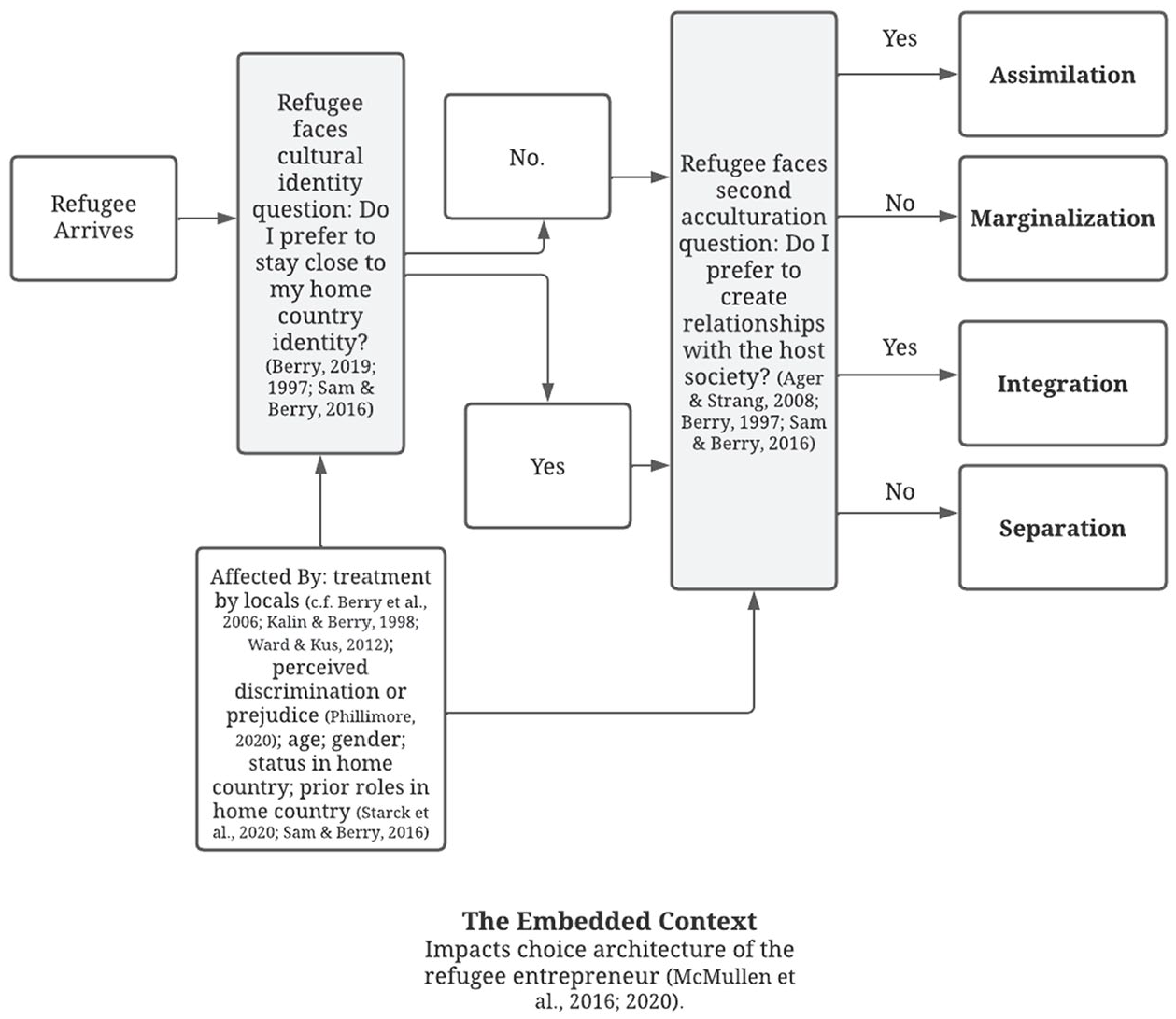
Key Acculturation Questions and Outcomes Applied to Refugee Context. (cf. Berry, 1997, 2019; Sam & Berry, 2016).
Identity, at its most basic, refers to the socially constructed self and the meanings that individuals attach to themselves to define who they are (Powell & Baker, 2014; Burke & Stets, 2009). Self-identity clarifies who an individual is and answers such questions as, “who am I, who do I desire to become, and how should I act?” (A. D. Brown, 2021; Cerulo, 1997). Cultural identity refers to the question of, “where do I fit within my ethnic group and the place where I now reside?” (Meca et al., 2017). These identity processes are subject to, and embedded within, a range of external factors, as identities are influenced by culture and structure (Berry, 2019; Colic-Peisker & Walker, 2003; Losoncz & Marlowe, 2020). In the case of refugees, external considerations include heterogeneity in what precipitated displacement, length of time lived or waiting in transitional spaces, and other real and symbolic constraints in the socio-political and institutional environment (Hynie, 2018; Phillimore, 2020). For refugees facing these influences, identities can be severed, and refugees can lose (or choose to separate from) what formerly represented and anchored their self and cultural identity (Berry, 2019; Colic-Peisker & Walker, 2003; Losoncz & Marlowe, 2020).
In sum, research on transitions in migration suggests that a refugee experiencing the discontinuity of relocation is in a state of identity construction/reconstruction. An entire body of acculturation scholarship theorizes about, and documents how, a migrant newcomer faces the question of her interest in centralizing her heritage home country identity or reinventing herself vis-a-vis the new location. This body of work builds from a foundational assumption about refugee identity work, restated and made explicit here and depicted in Figure 2 (Berry, 2019; Berry et al., 1987; Berry & Sabatier, 2010; Sam & Berry, 2016): A majority of newly-arrived refugees face an identity-related decision early in their tenure in the new location: they decide whether they prefer to emphasize the home country cultural identity or to de-emphasize that identity (typically in favor of an identity related to the new host country).
The above foundational assumption focuses on one internal experience of refugees post-relocation. Next, we discuss how many refugees face external pressures to move toward self-employment/entrepreneurship at this same juncture.
Global Responses to Refugees Upon Relocation: Encourage Entrepreneurship
When refugees arrive in a host community, existing governments, regulations, policies, and/or refugee survival exigencies often encourage or push refugees to quickly become economically self-sufficient—an outcome frequently defined in terms of working and earning wages (Desai et al., 2021; Fong et al., 2007; Jones Christensen et al., 2020; Wauters & Lambrecht, 2008). Many stakeholders use entrepreneurship-as-self-employment as the intervention of choice to drive employment and livelihood creation (Desai et al., 2021; Fong et al., 2007; Rashid, 2018; Shneikat & Alrawadieh, 2019). For example, a central part of the Refugee Act in the United States involves helping refugees become economically “self-sufficient” within the first year of arrival (A. D. Brown & Scribner, 2014). Similar logics exist in Australia and the United Kingdom (Colic-Peisker & Walker, 2003; Losoncz & Marlowe, 2020). The United Nations endorses a push for refugee entrepreneurship, declaring that entrepreneurship “offers an effective approach to overcoming the various challenges of economic and social inclusion for migrants worldwide” (United Nations Conference on Trade and Development [UNCTAD], 2018). 2
Some of these stakeholders argue that entrepreneurship, whether opportunity-driven (Dencker et al., 2021) or simply defined as “self-employment in commercial business” (Light & Dana, 2013: 603) has the potential for the entrepreneur to control, or feel more in control, of a range of financial and identity goals (Adeeko & Treanor, 2022; Newbery et al., 2018). Work from entrepreneurship scholars on founder identity also suggests that identity construction is central to the act of entrepreneurship (Baker & Powell, 2020; Powell & Baker, 2014, 2017; Clarke & Holt, 2017; Crosina, 2018; Ireland & Webb, 2007; Johannisson, 2011). Accordingly, the rest of this document draws from literature on acculturation and founder identity theory to argue for theory-driven connections between refugee identity questions, refugee entrepreneurship, and acculturation outcomes.
Theory Building: Connecting Refugees, Entrepreneurship, and Acculturation Outcomes
Refugee Identity Preferences, Founder Identity, and Refugee Entrepreneurship
. . .when facing adversity . . . entrepreneurial action may provide a vehicle for identity change. (Shepherd et al., 2020: pp. 2)
In connecting identity preferences and entrepreneurship, scholars argue that entrepreneurship itself represents an act of identity construction (Clarke & Holt, 2017; Crosina, 2018; Ireland & Webb, 2007; Johannisson, 2011; Shepherd et al., 2020). Indeed, Ireland and Webb (2007, pp. 916, italics ours) state “entrepreneurship is a process of identity construction. Entrepreneurs establish ventures. . .driven by self-identities.” Entrepreneurship thus becomes a tool to navigate identity construction as an entrepreneur engages with the community (or does not) (Conroy & O’Leary-Kelly, 2014; Shepherd et al., 2020). 3
This idea is central to founder identity theory (Baker & Powell, 2020; Powell & Baker, 2014), which suggests that before engaging in entrepreneurial activities, individuals consider (a) identity or self-concept needs derived from membership in social groups and (b) the social structures and constraints around them (Powell & Baker, 2014; Mathias & Williams, 2017; Wry & York, 2019). Founders leverage the role identity of “entrepreneur” to express their social identities (Powell & Baker, 2014: pp. 1406). This perspective blends entrepreneurial agency in defining the self, with a consideration of the possibilities (or lack thereof) provided in the social system (McMullen et al., 2016, 2021) to argue that entrepreneurs enact identity preferences through entrepreneurship (Ashforth et al., 2008; Leavitt et al., 2012; Wry & York, 2017). Related empirical work supports the idea that individuals make decisions about how they might “use” entrepreneurship to enact identity goals (Alkhaled & Sasaki, 2021; Beech, 2011; Shepherd et al., 2020). For example, in the refugee context, research shows that Palestinian refugees in Lebanon who configured their identity “choices” as: “Palestinian,” “refugee,” and/or “entrepreneurs” behaved differently in describing their businesses and themselves depending on which they prioritized and “valued” most (Shepherd et al., 2020). Data from Syrian refugees in the United Kingdom and in camps in Jordan found that female entrepreneurs engaged in identity work through celebrating their cultural heritage in handicraft work and did so to maintain cognitive control of a sense of self (Alkhaled & Sasaki, 2021). Such findings validate the idea that even in constrained environments, entrepreneurial refugees knowingly “use” entrepreneurship to further identity preferences.
Below, we build on this body of work and the “embedded entrepreneurial agency” (McMullen et al., 2016, 2021) which it reflects, to argue that refugees use entrepreneurship differently as they enact identity preferences regarding who they wish to be in the new location. Specifically, we know that refugees, upon arrival in a host country, have a significant identity choice to make regarding the salience and centrality of their heritage country identity as they ask: who do I want to be now that I am here? The answer, we argue below, impacts their founder identity work and their subsequent entrepreneurial actions. We propose that the entrepreneurial process unfolds in at least two different identity strategies: reinvention (a purposeful desire for distance from “refugee” or home country identity), or reinforcement (reflecting a desire for a close connection to home country identity) as the refugee simultaneously determines to what extent they wish to engage with and build connection to the host community. These two possible strategies, and their related acculturation outcomes, are summarized in Figure 3 and explored in subsequent sections.
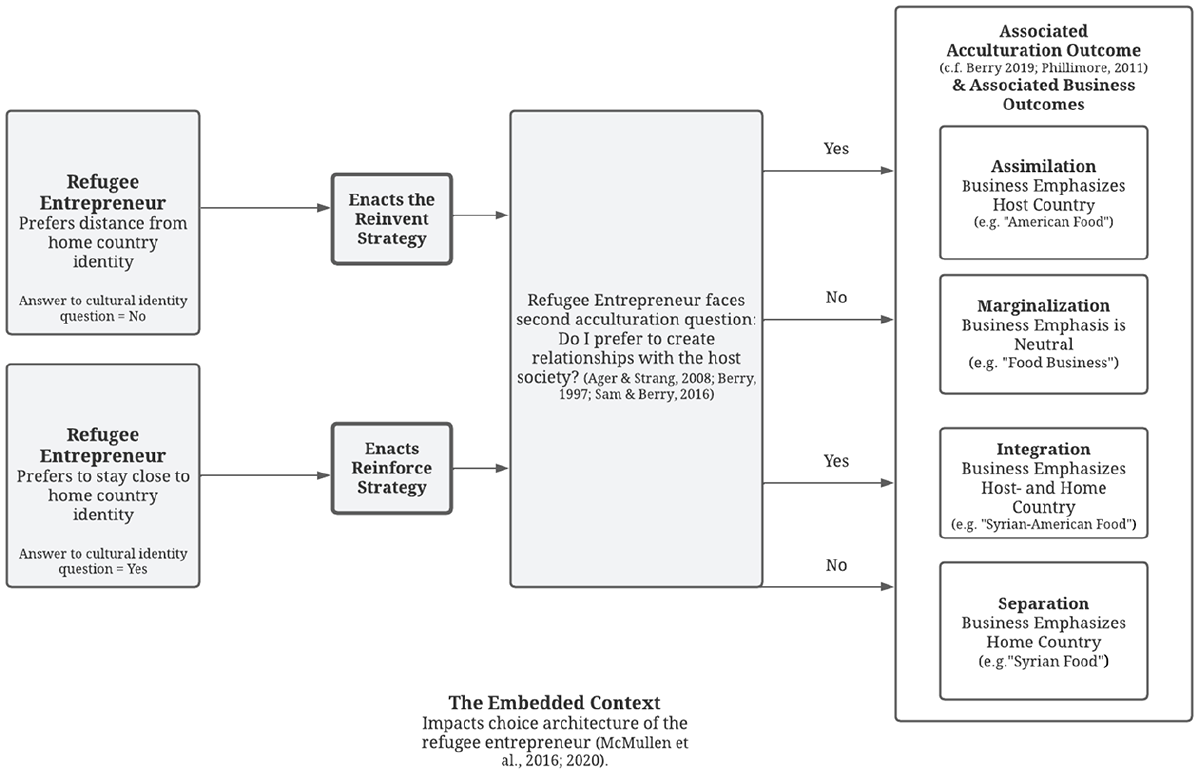
Framework Connecting Refugee Identity and Socialization Preferences to Entrepreneurial Strategies and Acculturation.
Strategy 1: Refugee Entrepreneurship as Tool for Reinvention
When refugee entrepreneurs face the first identity question and respond with a preference to de-identify with past selves, specifically with the refugee identity or the identity associated with their former home country (e.g., identity as a Syrian), we argue such preferences align with the goal of identity reinvention through entrepreneurship. 4 This choice describes refugees who consciously engage in entrepreneurial action to escape a previous role, mind-set, identity, or reality (c.f. Shepherd et al., 2020). Reinvention can require an individual to separate from previous identities, while cultivating new ones (Toubiana, 2020). This de-identification process requires the individual to sever prior cognitive and emotional ties to switch to the new targeted identity (Petriglieri, 2015). Literature on de-identification processes finds that when the individual actively wants to distance from the previous identity, the process of de-identification can be successful (Fiol, 2002; Grohsjean et al., 2016; Petriglieri, 2015; Rao et al., 2003). This new state is more attainable when the individual has strong social support for de-identification (Petriglieri, 2015). A refugee entrepreneur engaging in reinvention would purposefully use the entrepreneurial process to create new business opportunities to assist her in de-identifying with her cultural heritage. In this way, the refugee entrepreneur may pursue entrepreneurial opportunities unrelated to her past cultural heritage or roles from the home country to successfully de-identify with her past self.
However, scholars studying refugee and non-refugee populations note that when former aspects of identity from the past and any associated meanings remain desirable, such as in the case of focusing on a lost role or a loss of a favored identity, the process of de-identification is often unsuccessful (Shepherd & Haynie, 2011; Shepherd & Patzelt, 2018; Toubiana, 2020). When an individual loses (versus purposefully sheds) a coveted identity, she experiences ambiguity in conceptions of the self (Maitlis, 2009, 2022). Such individuals need to manage intense emotions of loss to then engage in identity construction to craft new definitions and understandings of the “self” (Conroy & O’Leary-Kelly, 2014; Shepherd & Haynie, 2011). Therefore, to be successful at reinvention via entrepreneurship, the refugee must desire the associated de-identification—it cannot be a forced de-identification.
By using the entrepreneurial process and a new business venture to de-identify with the past self, the refugee entrepreneur essentially denies the “refugee” portion of herself and leans into the founder identity or other possible identities in the host community. This de-identification with her past likely leads to assimilation or marginalization outcomes for the refugee in the host country—outcomes in opposition to the more idealized outcome of integration. As previously outlined, assimilation refers to the near total sublimation of an ethnic or cultural identity; it occurs when the person “blends in” or becomes indistinguishable from the dominant culture. Put simply, assimilation is cutting oneself off from the heritage home country identity (Berry, 1997; Schiefer et al., 2012). For refugees, assimilation results from leaving a home culture behind in favor of adapting the “American [or dominant culture] way of life” (c.f. Hirschman, 1983; Knight et al., 2016).
This acculturation outcome may be voluntary on the part of the refugee, meaning she no longer values her heritage cultural identity, or it could be enforced by a more hostile society that pressures the refugee to no longer value her heritage cultural identity (Harrell-Bond, 1999). In either situation, the refugee chooses not to give primacy to her cultural heritage identity, while strongly valuing relationships with the host society. 5 For example, consider a prototypical Syrian refugee resettling in the United States. If this refugee chose reinvention, preferring to distance herself from her cultural heritage, she may describe herself as a “American entrepreneur” rather than a “Syrian” or “Syrian-American entrepreneur.”
Marginalization, on the other hand, can occur when the individual prioritizes neither the heritage home cultural identity nor relationships with the host society (Berry, 1997; Phillimore, 2011). It leads to a no-man’s-land result of losing attachment to both the heritage and host cultural groups (Schifer et al., 2012). Oftentimes, this inability or lack of interest in cultural maintenance is largely due to enforced cultural loss from pressures within the host community (Berry & Sabatier, 2010). With marginalization, the refugee does not experience social support and instead of becoming a new citizen, instead, she is left without belonging in the host community—while having already essentially discarded cultural identities from home.
With these outcomes explained, we offer propositions about their antecedents. From acculturation psychology, we accept that a newly arrived refugee essentially asks: who do I want to be now that I am here? Do I want to release my old identity and reinvent myself or do I want to reinforce what I was? We argue that her answer can drive how she uses entrepreneurship as an identity tool, and that her use of entrepreneurship helps achieve her acculturation outcomes. If the refugee entrepreneur prefers distance from her home country identity, we posit the following:
Proposition 1a: A newly arrived refugee planning to reinvent himself or herself via entrepreneurship uses business to de-identify with aspects of the “refugee” identity; he or she is more likely to prioritize the entrepreneurial identity of “business founder” over identities related to the past self.
Proposition 1b: Newly arrived refugee entrepreneurs using a reinvention strategy are more likely to assimilate into the host community rather than to integrate into the host community when they value relationships with the host community.
Proposition 1c: Newly arrived refugee entrepreneurs using such a reinvention strategy are more likely to be marginalized than to integrate into the host community when they do not value relationships with the host community.
In practical terms, refugees who desire reinvention would create businesses quite independent from any experiences or knowledge they associate with their past or the “refugee” identity. If a refugee wanted to produce art, for example, she would not reveal, reference, or otherwise openly relate to her former country or her refugee past; she might downplay skills, knowledge, or experience from the home country (Shepherd et al., 2020). If she did not have such desires regarding her past identities, she might take a far less distancing approach to her roots and refugee history, as in the second strategy described below.
Strategy 2: Refugee Entrepreneurship as a Tool for Reinforcing Identity
In contrast to using entrepreneurship for reinvention, refugees may engage in entrepreneurial activities to allow for the reinforcement of a prior identity related to the heritage country. In this strategy, rather than de-identifying with previous sources of identity, the refugee “leans into” her identity preferences associated with her heritage culture. This reinforcement allows for the celebration and maintenance of one’s heritage (Alkhaled & Sasaki, 2021). This strategy could lead to refugees working in entrepreneurial ventures that create safe places and consistent opportunities to support behavioral expectations associated with heritage social roles. For example, if there is no place to participate in a cultural sport or activity, an entrepreneurial refugee could create a venue for such events to take place.
Likewise, the refugee entrepreneur using a reinforce strategy would likely create ventures tied to one or more aspects of their heritage skills and identity—such as making and selling products or services informed by the heritage culture (Alkhaled & Sasaki, 2021; Badger Newman & Jones Christensen, 2021; Wauters & Lambrecht, 2006). Examples of executing this strategy include launching restaurants and food-based businesses built on ethnic foods from home, offering tutoring, and opening artisanal shops with traditional crafts and/or fashions from the home country—all of which can also create physical spaces for the celebration of cultural heritage (c.f. Alkhaled & Sasaki, 2021; Badger Newman & Jones Christensen, 2021). Furthermore, more skilled examples of refugee entrepreneurs using reinforcement strategies include: utilizing past roles, past skills, past education in new ways to create an endeavor that to some extent references the refugee’s cultural heritage and past self. The crucial point here is that the spectrum of possible entrepreneurial opportunities the refugee configures is likely to incorporate aspects of the home culture and past identities, unlike what occurs with the reinvention approach.
As stated earlier (and depicted in Figure 2), previous work in acculturation psychology suggests that, after arrival, the refugee entrepreneur faces another key decision in addition to the decision about distance from her heritage identity—this second decision relates to the extent to which the refugee prefers to engage and create relationships with the host community (Berry, 2019; Phillimore, 2011). The answer drives the refugee toward acculturation outcomes closer to separation or integration (see Figures 1, 2). As noted (and in Figure 1), social and cultural separation occurs when a subgroup of the population, such as refugees, live and work outside of the dominant culture in any given community (Andersson, 2020). This outcome can result when the refugee embraces her cultural identity and characteristics while avoiding interaction with members of the host community (Berry, 1997). Separation from the host community can be chosen by the individual refugee to avoid changing or accommodating the cultural differences in the host society. 6 In summation, whether individuals self-segregate or live in segregated communities because of legal or other situations, the outcome is the same—the person does not consistently circulate, socialize, or transact with members of the wider host community (Berry, 2019).
However, if refugees lean further into creating culturally focused businesses (i.e., they take separation further), it may result in them isolating in an ethnic enclave, wherein the entrepreneur works only with culturally similar others but does not “share everyday lives” with the larger environment (Portes, 1987). An enclave offers a protected market wherein cultural needs for ethnic products and/or being served by those of the same ethnic background can foster successful ethnic entrepreneurship (Achidi Ndofor & Priem, 2011; Aguilera, 2009; Masurel et al., 2002). Yet, ethnic enclaves decrease the ability of the refugee to integrate and decrease the chance for businesses to grow and scale beyond the bounded ethnic community (c.f. Altinay & Wang, 2011; Gursoy et al., 2017). While this strategy may benefit the entrepreneur initially, by creating a space to preserve culture and heritage and “lean into” her recent past, it could lead to separation and even segregation from the mainstream community.
Considering our prototypical Syrian refugee resettled in the United States, if she chose to reinforce her cultural identity and if she chose less interaction with the host community, she would most likely identify herself as a “Syrian entrepreneur inside the U.S.” rather than a “New American” (assimilation) or “Syrian-American (integration) entrepreneur.” For example, Cuban refugees created a vibrant entrepreneurial sector within their ethnic enclave in Miami, Florida (c.f. Peterson & Roquebert, 1993; Portes, 1987), and they emphasized their Cuban identities in so doing. While the enclave and separation from mainstream Miami initially created a solid internal market that buffered ethnic entrepreneurs from instability in the external marketplace, the markets faced barriers to growth (Peterson & Roquebert, 1993, c.f. Jiobu, 1988).
The above is not the only possible acculturation outcome for refugees who engage in a reinforce strategy. We suggest that those refugee entrepreneurs who choose this strategy and who simultaneous make the choice to engage with the host community (and develop relationships therein), are more likely to achieve the outcome of community and cultural integration. Integration represents the oft-idealized balance between the refugee maintaining connections to the cultural heritage and the refugee valuing relationships with the larger host society; it frequently represents a mutual adaptation of the refugee and the host society toward one another (Phillimore, 2011). This outcome represents joint inclusion and participation in the host society (Castles et al., 2002; Hynie, 2018). In acculturation psychology, integration is optimal because it balances maintaining cultural identity and creating relationships with the host country (Ager & Strang, 2008). Studies show that low integration rates associate with increased unemployment, decreased incomes, increased dependence on social assistance programs, and increased stress-related violence (Baran et al., 2018).
If a refugee entrepreneur is embedded in an environment where integration seems possible and she also prefers integration in the host country, then her venture would more likely construct a social bridge with the local population, connecting stakeholders and enabling relationship building (Simsek, 2018). Such bridges require refugees to build community with locals in the host society. When refugees desire such a balance, they likely pursue ventures that use extant and heritage-related skills, qualifications, experience, knowledge, and abilities while also including and integrating aspects of the new host country culture (Alrawadieh et al., 2018; Krahn et al., 2000; Levie, 2007; Mestheneos & Ioannidi, 2002). 7 Referring to the previous archetype of the Syrian refugee in the U.S. interested in an artistic venture, if she had preferences for integration, she would be more likely to create work she broadcasts as related to her past refugee identity and she would create art embracing (and adapted to) local tastes. In addition, she might become a “hyphenate” and blend the two: identifying as a “Syrian-American entrepreneur,” incorporating both heritage culture and the host culture into her identity. Such a strategy validates a “new” while continuing part of the “old” identity; it is one way to allow for prior refugee entrepreneurial experiences and knowledge to fit into the new host community context. These observations lead to our final propositions:
Proposition 2a: Newly arrived refugees who prioritize their home-country identity and who prefer a reinforce strategy use entrepreneurship to connect with their home culture identities; they prioritize aspects of the “home country refugee” identity.
Proposition 2b: Newly arrived refugee entrepreneurs who de-prioritize creating relationships with the host community but prefer a reinforce strategy are more likely to segregate themselves from the host country and to build or join ethnic enclaves.
Proposition 2c: Newly arrived refugee entrepreneurs who prefer a reinforce strategy and to prioritize relationships with the host community are more likely to integrate into the host community.
To summarize: sociologists and psychologists affirm that refugees, post arrival in a new country, negotiate identity crises and make identity-based decisions about who to be, what to do within, and how to social relate to the new host location. Our framework introduces these findings and connects them to entrepreneurship-as-identity construction. The value of this framework is that it prioritizes the identity construction associated with refugee behaviors, and calls attention to it as a possible driver of the heterogeneity in refugee entrepreneur outcomes. This framework helps explain non-financial antecedents to refugee entrepreneurial behavior and helps clarify non-financial outcomes of refugee entrepreneurship. Few management scholars have reason to be aware of findings from the last 40 years in acculturation studies and acculturation psychology, which can lead to erroneous thinking about refugee preferences, post-arrival entrepreneurial behaviors, and belonging outcomes.
With our theoretical model established, we close with a discussion on scholarly and practical implications of the theoretical arguments.
Discussion
The article makes several contributions to scholarly conversations about the refugee crisis and how it intersects with business-focused interventions. First, we introduce management scholars to at least four possible acculturation outcomes for refugees and other migrants—few of which are currently discussed in management conversations about the effects of migration. This import of acculturation psychology moves management conversations about refugee belonging from a somewhat dichotomous discussion of “integrate/fail to integrate” to a more nuanced and multidimensional discussion. It also moves from intense focus on economic outcomes to being more focused on non-financial outcomes. Essentially, the import expands the number and type of dependent variables associated with refugee entrepreneurship. The same importing of acculturation psychology to management focuses conversations about antecedents to refugee entrepreneurship on non-financial antecedents. Finally, we contribute to the study of entrepreneurship-as-identity construction by providing a theoretical bridge between the known identity construction behaviors of refugees and subsequent entrepreneurial behaviors. We make these contributions but do so noting that the topics of timing and cultural embeddedness play a role that has not been discussed thus far. Below, we address both these topics before we expand further upon the implications and contributions of our work.
Acculturation Outcomes and the Role of Timing
One possible question regarding the framework in Figure 3 relates to whether the framework generalizes to other migrants who face identity-related questions and use entrepreneurship to enact them in various contexts—including both developed and developing countries, refugees awaiting future status in camps versus resettled among other potential contexts. We respond by noting that this theoretical framework was built from an empirical reality associated with refugee status—the reality that forced relocation also forces a juncture where a person must make identity-related choices vis-a-vis the previous identity and how to progress from there. Our theoretical arguments focus on newly arrived refugees and early identity-based questions. With time, however, it is possible that the achieved acculturation outcome affects how a refugee perceives herself and her venture. With time, she may revisit her identity priorities and desire to use entrepreneurship differently to trace a new path toward a different acculturation outcome. If this occurs as described, it is not related to an identity jolt or discontinuity, and other frameworks of identity construction and entrepreneurial identity construction may apply.
Our framework purposefully focuses on the identity work that occurs close to arrival (and its accompanying discontinuities) and when entrepreneurship is in nascent stages—this is the stage where business and policy responses start (Badger Newman & Jones Christensen, 2021; R. Brown & Mawson, 2016; Desai et al., 2021; Harper-Anderson & Lewis, 2018) and the stage where acculturation psychology findings strengthen theories about entrepreneurial identity work. After more time in the host country and/or in business, the refugee likely moves outside the scope of this framework.
Again, for any other group of migrants, and even for refugees who have been in the host country for a prolonged period of time, these decisions are less likely to be forced and less likely to occur so close together. Because of this specificity, the framework may not generalize to groups who are not forced or jolted into choosing an answer and moving forward. Extant frameworks of identity construction and entrepreneurship are likely more applicable to other migrants, or to refugees who have already lived through the implications of making such a choice. The same specificity of the framework that it applies to a culture-based identity jolt at a certain point in time, has the potential to guide how managers of entrepreneurship incubators, policymakers, and other pro-entrepreneurship stakeholders craft responses to newly arrived refugees.
Refugee Identity Construction and Entrepreneurship in Context: Considering Embeddedness
. . . Refugees do not just passively take on roles and identity categories assigned by the host society and the externalities of the resettlement country. Rather, they strategically shape their identity by interacting with the environment, and with their own hopes, dreams, fears, and threats, to make their new narratives. (Losoncz & Marlowe, 2020: 121)
Embeddedness logics argue that belonging requires both the individual refugee and the host community to mutually adapt to one another. Refugees face known barriers to integration within host communities, such as: ethnocentrism, racism, discrimination, and levels of xenophobia (Guo et al., 2020). Because of the heterogeneity of host country policies and social dynamics, the opportunities the refugee entrepreneur creates via entrepreneurship and the identity negotiations that result are strongly influenced by the institutional context within which they are embedded. An interdependency certainly exists wherein reactions and responses from the host community moderate refugee choices and affect the results of how and whether the refugee integrates (Levitt & Schiller, 2004; Losoncz & Marlowe, 2020; Phillimore, 2020; Portes & Zhou, 1993; Sam & Berry, 2010; Weinreich, 2009). Yet, even in the migration context—a context which recognizes the strong cultural and institutional exigencies that affect refugees—scholars argue for room to consider the psychological processes of identity at the individual level (Berry, 2019; Losoncz & Marlowe, 2020).
Certainly, in the migration context and outside of it, identity construction is “influenced by intra-group dynamics, and the socio-political context in which groups are embedded, such as real and symbolic constraints and opportunities created by the sociopolitical environment and institutional structures” (Scuzzarello & Carlson, 2018, cited in Losoncz & Marlowe, 2020: 120). Yet, these individuals maintain agency in crafting individual preferences (McMullen et al., 2016, 2021). Individuals seek to make the best decisions possible to minimize costs and maximize benefits, but within the choice architecture in which they find themselves embedded (McMullen et al., 2016, 2021). Therefore, while the individual entrepreneur retains her agency, it is strongly impacted by the embedded context.
The above discussion about time and context add nuance and highlight some possible boundary conditions to our framework. Still, the framework we outline invites business-focused conversations about refugees and argues that they must include and address more than economic drivers and more than dualistic belonging outcomes. To bridge to such conversations, the next section outlines implications of this work for academics and practitioners.
Implications
Implications for Scholars
One implication of this work highlights that the individual refugee engaging in identity construction via entrepreneurship has some agency over who he or she wishes to become, and over the salience and centrality of competing identities. Depending on how the refugee prioritizes identities, particularly the degree to which she embraces her cultural identity, she may choose behaviors consistent with either reinvent or reinforce strategies. These choices can, ceteris paribus, impact her acculturation outcome. These choices belong to the individual refugee, who may or may not hold integration as her personal ideal. The process of acculturation is stressful and is associated with both social and psychological problems (Berry, 1997; Phillimore, 2011). Specifically, the inability of a refugee to follow her preferred acculturation strategy can lead to psychosocial stress (Berry, 1997; Phillimore, 2011). Without understanding and acknowledging various acculturation preferences, those seeking to help refugee entrepreneurs “integrate” could be doing more harm to their overall well-being, even if they assist in achieving economic self-reliance for the refugee entrepreneur (Badger Newman & Jones Christensen, 2021 for a discussion on this topic).
The propositions herein extend identity theory to the new and growing domain of refugee entrepreneurship (Heilbrunn et al., 2019; Jones Christensen et al., 2020). The propositions suggest psychological antecedents and individual identity work as directly associated with different refugee acculturation outcomes. This article also introduces entrepreneurship as a tool to assist refugees in determining their identity and belonging in a new host community. Such ideas open up a new range of possible dependent variables in the study of refugee entrepreneurs and allow scholars to explore definitions of “success” aside from simply profit or the survival of a venture. In this article, a refugee interested in reinvention can downplay various past identities and literally “use” entrepreneurship to accomplish this change. According to our claims, if she sees some aspect of her “refugee” identity as a constraint she can use identity claims associated with “entrepreneur” as one tool to separate herself from those constraints. She may define her work as “successful” if she lives within her chosen identity, separate from whether her venture survives. On the other hand, if she chooses to reinforce her original cultural identity, she may define her work “successful” if she creates a way to continue those cultural aspects she values.
This work also has linkages or extension to the study of entrepreneurship and well-being (Newbery et al., 2018; Wiklund et al., 2019). Given that our framework incorporates the psychological preferences and crises that refugees face, and that it acknowledges that these “crises” differ from, and exist alongside, economic crises, the work brings a focus to mental health. Much of prior entrepreneurship research focuses on the health of the firm, rather than the health of the founding entrepreneur (Wiklund et al., 2019).
Given that higher levels of well-being link to increased optimism, boosted self-esteem, and the ability to persevere through the challenging tasks associated with creating an entrepreneurial venture (Foo et al., 2009), it is vital to focus on the well-being of individual entrepreneurs. Identity congruence can be one part of well-being (Newbery et al., 2018). In addition, the acculturation outcome of integration is considered to be the most mentally balanced and mentally healthy state for people who have relocated (Berry, 1997; Phillimore, 2011). Our work suggests that future research can adjust research questions to the following: for refugee entrepreneurs, how do identity construction and acculturation strategies impact well-being? The theoretical linkages we offer herein suggest the answer will stem from attending to refugee psychological preferences, not simply to refugee economic status.
Implications for Practice
Organizations that help refugees to become economically self-reliant may be able to increase uptake and service quality when they incorporate our theory-based arguments. Such organizations may want to change marketing and service delivery tactics once they understand that the refugee himself or herself is essentially asking questions such as: do I want to join a refugee incubator or just a business incubator? For example, a study of Bosnian refugees in Perth saw that these refugees preferred to stay within ethnic communities (reinforcement and separation) and were more inclined to look for resources and opportunities through ethnic community networks rather than to use professional mainstream services (Colic-Peisker & Walker, 2003). Such knowledge could help interested stakeholders experiment to best serve the needs of a population choosing separation. Once service providers consider that a person with a refugee background is implicitly or explicitly asking “who do I want to be now that I am here?” such organizations may accept a diversity of possible responses and customize offerings accordingly. In some ways, this article problematizes the idea of “helping” by turning attention to individual preferences rather than treating refugees as an undifferentiated category. We echo McMullen and colleagues (2016) in that “individual differences can systematically influence the efficacy of public policy and therefore deserve greater scholarly attention.” The framework in this article offers a new route for management scholars and practitioners as they seek to explain the heterogeneity associated with refugee entrepreneurial outcomes.
Specifically, these implications could apply to refugee entrepreneurship incubators, a common framework that government and private organizations use to achieve refugee integration (R. Brown & Mawson, 2016). This work relates to the work on positive identity construction via entrepreneurship, but without the presumption that every entrepreneur will respond the same upon arrival and upon finding local support for entrepreneurship. It also does not presume that refugees will definitely experience social integration if the venture succeeds. As stakeholders attempt to support people with a refugee background, specifically with interventions such as entrepreneurship incubators, they may benefit from attending to identity concerns and psychological (versus economic) drivers of entrepreneurial behavior. However, many incubators actively encourage culturally dependent refugee businesses, due to the low-cost barriers to entry, low requirements for formal education and training, and overall ease of entry (Badger Newman & Jones Christensen, 2021). These culturally dependent incubators may address ease of entry concerns and capital constraints, but efforts could lead to (unintended) separation for the refugee entrepreneur if support is not balanced with a focus on connecting to new possible identities associated with life in the new community. Stakeholders interested in refugee integration may need to design programs to create social bridges (or cultivate a desire for such bridges) between the refugees and mainstream society to avoid the outcome of separation.
On the other hand, refugees who seek reinvention may need specialized social support from incubator programs. Throughout the de-identification process intrinsic in the reinvention strategy, the individual needs sustained, reaffirming social support to be successful. Organizations can be cognizant of these choices and seek to offer the necessary support for the process. Assisting the creation of low-skill, culturally dependent ventures (more typical with the reinforcement strategy) may be easier from a programmatic stance, as funneling all participants into a single industry using replicative strategies is easiest to implement. In contrast, this reinvention strategy may require more complex support structures and services but may avoid negative outcomes for the refugee’s overall well-being. Such a focus moves invested business stakeholders from defining refugee entrepreneur “success” in terms of profits, funding, or long-term survival and toward other definitions (i.e., refugee moves closer to her acculturation goals; refugee makes entrepreneurial choices for identity or mental-health reasons).
Conclusion
Many stakeholders see refugee entrepreneurship as helpful—even possibly deterministic—in achieving refugee integration goals (UNHCR, 2020). Yet, this push for entrepreneurship is based on assumptions built from research on non-refugee entrepreneurs that largely ignores the agency, psychology, and relocation realities of newly relocated refugees. The work herein builds from decades of scholarship on migrant realities to offer theoretical arguments about how refugee identity preferences can affect how refugees use entrepreneurship for: 1) reinvention (distance from home country identity) or 2) reinforcement (close connection to home country identity). We also argue that as refugees utilize these identity strategies through entrepreneurship, each strategy has linkages to different and diverse acculturation outcomes.
One benefit of this work is the introduction, particularly to management scholars, of four possible acculturation outcomes for refugee entrepreneurs. A related contribution is the argument that acculturation consequences of refugee entrepreneurship are multidimensional and far from deterministic. The tragedy we hope to avoid is anyone to believe that when a refugee entrepreneur runs a successful business, it equates to her achieving cultural integration in the new community. The framework herein reveals multiple other possible outcomes and that a refugee can build such a business but still live and function quite separately from others in the host community. The framework also invites discussion about whether or not this is what the refugee wants.
The theory herein describes ways a refugee can “use” entrepreneurship as a vehicle for different types of belonging and explains heterogeneous refugee entrepreneurial behaviors. It also helps explain mixed results associated with refugee entrepreneurship globally (Badger Newman & Jones Christensen, 2021; Meister & Mauer, 2019). Thus, it can inform how scholars reconsider refugee entrepreneur agency and how scholars and practitioners define “success” in serving refugees via entrepreneurship. It is our hope that management scholars will attend to psychological, identity-related preferences, as well as economic and contextual exigencies, when considering whether and how to support refugee entrepreneurs. Such refocused attention, coupled with knowledge of acculturation outcomes, may help management scholars reconfigure and/or more accurately create different pro-entrepreneurship offerings for refugees.
Footnotes
Declaration of Conflicting Interests
The authors declared no potential conflicts of interest with respect to the research, authorship, and/or publication of this article.
Funding
The authors received no financial support for the research, authorship, and/or publication of this article.
