



Abstract
This article explores how agency is enabled in highly constrained contexts as at-risk individuals engage in restorative entrepreneuring. Focusing on the entrepreneurial journeys of 10 former prisoners after their release, the research reveals a complex process of reintegration, in which agency is both hindered and enabled as individuals move from the structured environment of prison to the challenges of the external business world. Through life-story research and process-tracing analysis, we show that successful rehabilitation requires individuals to navigate a delicate balance: enabling their agency through entrepreneurship while also relinquishing control to replicate the supportive structures they had in prison. Our findings highlight the iterative nature of this process and emphasise the critical role of societal and systemic support in facilitating both reintegration and positive entrepreneurial outcomes. This research highlights the challenges former prisoners face in rebuilding their lives and careers, illustrating the intricate balance required to regain agency and achieve long-term stability.
Introduction
Entrepreneurship is often seen as a pathway to social mobility and inclusion for vulnerable individuals, who are at risk of marginalisation or exclusion from society. These at-risk groups typically include individuals who face exclusion due to their social, cultural or economic status, which may conflict with the dominant norms, values and beliefs of their society (Webb et al., 2009). These groups frequently encounter a range of overlapping challenges – such as limited access to resources, poor employment prospects, and health issues – that increase their vulnerability to social exclusion, discrimination and both physical and psychological harm. The factors that contribute to an individual’s vulnerability include personal limitations, disadvantaged social status, lack of support networks and deteriorating environments, as well as the complex interplay of these factors over time (Mechanic and Tanner, 2007).
Restorative entrepreneuring has emerged as a concept and framework to understand and study how entrepreneurship can address these challenges. This approach focuses on entrepreneurial practices and support systems designed to help at-risk individuals – especially those in the process of rehabilitation or reintegration – rebuild their identities, sense of agency and self-worth (Awad, 2023; Awad et al., 2022; Wainwright and Muñoz, 2020). Restorative entrepreneuring adopts a holistic approach, nurturing entrepreneurial skills while also addressing the psychological, social and structural barriers faced by these individuals. A key element of this process is the concept of agency, which refers to an individual’s capacity to act independently and influence their social context (McMullen et al., 2021). McMullen et al. (2020) argue that entrepreneurial agency depends on several factors: ability, motivation, opportunity, supportive institutions and process skills. However, for at-risk individuals, these conditions are often severely constrained by social structures that limit access to resources and opportunities (Bullock and Bunce, 2020; Elkafrawi et al., 2022; Refai et al., 2024).
Despite these constraints, at-risk groups often demonstrate a capacity to influence their circumstances and achieve desired outcomes, even within highly restrictive contexts. McMullen et al. (2021) call this ‘transformative capacity’, which is particularly relevant to restorative entrepreneuring. While social structures can limit action, they can also create a context in which individuals can exercise agency (Sarason et al., 2006). Restorative entrepreneuring can enable agency, allowing individuals at risk to engage in a process of ‘self-reconstruction’. This is the intentional process by which individuals rebuild their identities and reframe how they perceive their own value, capabilities and place in the world as well as their sense of agency when facing structural challenges. While promising, restorative entrepreneuring does not fully explain the process through which agency is enabled in constrained environments or hindered for that matter. Given the structural limitations, scarce resources and lack of external support, entrepreneurship alone may not be a panacea for the myriad barriers and challenges at-risk individuals face in the pursuit of reintegration, agency and the reconstruction of the ‘self’ back into society. In this article, we ask: How is agency enabled in highly constrained contexts as at-risk individuals engage in restorative entrepreneuring? Answering this question is crucial for understanding what contributes to successful rehabilitation and reintegration, and for improving support systems, which are often inadequate in their current form.
To address the question, we examined the prison context in the United Kingdom. Specifically, we focused on the transition from incarceration to societal reintegration of ten former prisoners who engaged in entrepreneurial activities inside prison and continue to do so upon release, attempting to regain their status and independence. The transition process is fraught with hurdles such as enduring stigma, limited job opportunities and the psychological aftermath of incarceration (Baur et al., 2018; Brehmer et al., 2024; Kolbeck et al., 2024; Sheppard and Ricciardelli, 2020). Research suggests that engaging in entrepreneurship while in prison can help inmates enact a stronger sense of agency, fostering attitudinal and behavioural changes that enhance their economic and social conditions (Ciptono et al., 2023; Grosholz et al., 2020; Keena and Simmons, 2015). This suggests that entrepreneurship may play a key role in enabling transformative capacity and agency post-release, making prison an ideal context for our investigation.
We conducted life-story interviews over six months, where we captured through verbal accounts and graphical timelines the key events of this process shortly after being released from prison. We used multi-stage process-tracing (Collier, 2011; Muñoz et al., 2018) to sort, structure and analyse our life story and timeline data. Unlike traditional case study research, process-tracing focuses on identifying empirical regularities over time and causal mechanisms, which allows us to trace how these individuals regain agency in the face of structural constraints. Our findings suggest that successful rehabilitation requires individuals to navigate a delicate balance: enabling their agency through entrepreneurship while also relinquishing control to replicate the supportive structures they had in prison. We identified four markers in the process of enabling agency after prison (resetting imperative, recursive reconstruction of constraints, accumulation of resources, timing of entrepreneurial tasks), upon which we offer a causal structure that explains the journey of enabling agency after prison. Our findings challenge the assumption that constraints are purely hindrances to agency. We found that certain constraints can provide opportunities for action, supporting agency development in ways that are largely overlooked in existing literature (Garcia-Lorenzo et al., 2018; Wainwright and Muñoz, 2020).
This article makes several contributions to the entrepreneurship literature. First, it advances our understanding of agency in restrictive contexts, highlighting the complex interaction between individuals and constraints as they attempt to act independently and influence their social context post-incarceration. To do so, at-risk individuals reconstruct previous constraints which offer a safe place and allow them to acquire resources to move forward. Second, it contributes to the concept of restorative entrepreneuring by shedding light on the process of rehabilitation and reintegration once constraints are lifted. Reintegration is more than just adapting to life after prison; it is about fundamentally transforming one’s self-concept to transcend the limitations imposed by past experiences and societal stigma. It entails a conscious effort to increase their agency – the capacity to make choices and impose those choices on the world – which is often stripped away during incarceration due to the restrictive and controlling nature of the prison environment (Goffman, 2017). Finally, this study introduces methodological innovations by integrating life-story research with process tracing, offering a more nuanced approach to studying causal mechanisms in entrepreneurship. This methodology provides a robust framework for future research on entrepreneurship in constrained environments and sets a precedent for analysing complex social and psychological phenomena through structured causal analysis.
Restorative entrepreneuring and the centrality of agency
Restorative entrepreneurship highlights the transformative potential of entrepreneurship in the face of structural constraints. It refers to ‘a set of entrepreneurial practices and a system of support that enable individuals at-risk to reconstruct their identity, sense of ownership and self-worth and engage in a progressively autonomous rehabilitative life project, away from deviant behaviour and out of detrimental and stigmatizing circumstances’ (Wainwright and Muñoz, 2020, p.5). More than merely fostering economic activity, restorative entrepreneurship plays a crucial role in personal restoration. It connects individuals’ mindsets, skills, decisions and actions with supportive entities such as family, local organisations and broader societal structures (Wainwright and Muñoz, 2020). Within the entrepreneurship literature, Awad et al. (2022) demonstrate that when support organisations deeply embed local community values, the effectiveness, sustainability and impact of ‘restorative ventures’ are enhanced. These ventures are entrepreneurial initiatives designed to rehabilitate and reintegrate at-risk individuals into society by addressing systemic social inequities, fostering autonomy and building supportive networks through value-driven and inclusive practices. Robinson and Fernhaber (2024) question how restorative entrepreneuring, enriched by intersectionality, can enhance agency for former prisoners by managing and potentially reducing stigma. Such an integrated approach could potentially not only support the reintegration of at-risk groups into society but also empower them to regain control over their lives and futures. In the context of homelessness, for example, Awad’s (2023) study extends the concept of restorative entrepreneurship to include the development of housing solutions for the homeless and supportive community frameworks that address not just economic activity but also critical social dimensions such as inclusion, dignity and self-worth. This application highlights the broader potential of restorative entrepreneurship to tackle complex social issues by addressing the interrelated challenges of criminalisation, lack of healthcare, social exclusion and economic disempowerment.
The centrality of agency
Agency is a central concept in the theoretical apparatus of restorative entrepreneuring, given the latter’s dual emphasis on individual rehabilitation and the systems of support. In Giddens’ (1979, 1984) view, structure and agency are mutually dependent and recursive. Structures – comprising the rules and resources embedded within a social system – both enable and constrain human actions, serving as both the medium and outcome of social practices (Giddens, 1979; Sarason et al., 2006). In this perspective, structures are not static entities but are instantiated and made real through the everyday activities of human agents. These agents utilise the rules and resources provided by structures in their interactions, and through this utilisation, they reaffirm and reproduce the structures themselves (Giddens, 1984). In the context of restorative entrepreneuring, this means that at-risk individuals, like former prisoners, can actively engage with and alter the structural constraints they face by leveraging their agency in entrepreneurial endeavours. By understanding and exercising their agency, these individuals are not merely passive recipients of structural influences but are active participants in shaping their social reality.
Building on this foundation, McMullen et al. (2021) introduce the concept of transformative capacity, which refers to the ability of individuals to intervene in events to produce desired outcomes, effectively reshaping circumstances and influencing others to align with one’s objectives. Transformative capacity is particularly relevant in contexts characterised by structural constraints, as it emphasises the proactive role of agents in not just operating within the confines of existing structures but actively modifying those structures to facilitate new possibilities for action. Such structural transformation via entrepreneurial action requires five conditions, ability, motivation, opportunity, institutions and process skill. In restorative entrepreneuring, entrepreneurs with transformative capacity do not passively accept structural constraints. Instead, they can leverage these five conditions to enact change and utilise their abilities and process skills to develop innovative solutions to the challenges they face. Their motivation propels them to persist in the face of adversity, and they actively seek out or create opportunities within their environment. By engaging with supportive institutions, they gain access to resources and networks that can amplify their impact.For example, entrepreneurs in constrained environments utilise transformative capacity to overcome barriers such as limited access to capital or rigid regulatory frameworks. Through creative problem-solving and strategic action, they can modify or circumvent these obstacles, thereby expanding the range of possible actions for themselves and others in similar contexts (Giazitzoglu et al., 2024; Refai and McElwee, 2023).
In such constrained contexts, entrepreneurs are compelled to engage in specific forms of agency to overcome barriers and compensate for resource deficiencies (Refai et al., 2024). However, only a limited number of empirical studies have explored these dynamics. McKeever et al. (2015) found that entrepreneurs in socio-economically depleted regions leveraged strong social bonds and community ties to facilitate entrepreneurship despite limited opportunities. By relying on familial and communal networks, these entrepreneurs accessed resources, information and support that were otherwise unavailable, illustrating the importance of social capital in constrained settings (Kimmitt et al., 2020; Muñoz and Kimmitt, 2019). Similarly, Korsgaard et al. (2021) observed that entrepreneurs in peripheral areas employed storytelling, local sourcing and community engagement to overcome resource constraints. These studies highlight the cooperative nature of entrepreneurial agency and its role in introducing novelty and disrupting the status quo within ecosystems (McMullen et al., 2021). Despite their relevance, the qualitative dimensions of how entrepreneurial agency manifests in these settings are not thoroughly understood (Giazitzoglu et al., 2024). While entrepreneurship inherently involves creative agency, there is a lack of a unified understanding of the mechanisms that enable or hinder entrepreneurial action in the face of external challenges (Dutta, 2017; Elkafrawi et al., 2022; Garcia-Lorenzo et al., 2018; Villares-Varela et al., 2018). This gap becomes even more pronounced in extreme environments where structural constraints severely limit individual agency. Extreme environments refer to contexts characterised by profound and multifaceted challenges that go beyond typical obstacles faced in entrepreneurial settings (Chikweche and Fletcher, 2017; Hoxha and Capelleras, 2010; Jiang et al., 2021). These can include areas afflicted by chronic poverty, political instability, conflict zones, natural disasters or severe social exclusion. For instance, entrepreneurs operating in war-torn regions may face constant threats to personal safety, lack of infrastructure and disrupted markets (Castellanza, 2022). Such environments are extreme because the usual support systems and institutional frameworks that facilitate entrepreneurship are either weakened or absent, making the pursuit of entrepreneurial activities exceptionally arduous. In this vein, while much attention has been given to how structures limit entrepreneurial action, less focus has been placed on how entrepreneurs actively respond to and reshape their environments (Refai et al., 2024). Understanding this interplay is crucial, as it sheds light on the motivations behind agentic actions and the processes through which entrepreneurs navigate and potentially transform constraining and extreme contexts.
Restorative entrepreneuring has certainly opened a path forward, yet unfortunately, it falls short when it comes to explaining the process and mechanics that enable agency. We thus ask: How is agency enabled in highly constrained contexts as at-risk individuals engage in restorative entrepreneuring?
Prison, entrepreneurship and the study of agency
One such highly constrained context is the prison system, characterised by severe institutional restrictions imposed on individuals. The prison context serves as a unique backdrop for examining how people navigate and potentially overcome significant restrictions during and after incarceration. A central facet of the incarceration experience is the systematic restriction of personal autonomy and decision-making power. Prisons are quintessential examples of what Goffman (2017) describes as total institutions. In such environments, individuals are isolated from broader society and subjected to an all-encompassing institutional regime that dictates every aspect of their daily lives. Inmates are subject to the authority of prison staff, who possess the power to enforce rules, impose sanctions and make decisions on behalf of prisoners (Crewe, 2021). This power imbalance can lead to feelings of helplessness and dependency among inmates for basic needs such as food, clothing and healthcare (Liebling, 2011). Additionally, the use of disciplinary measures, such as solitary confinement or loss of privileges, reinforces the message that inmates have limited control over their lives (Haney, 2003). Security measures and the pervasive use of force create environments where personal autonomy is heavily restricted, and individual identities are often subsumed under institutional or gang-related identities (Schultz, 2023; Wooldredge, 2020). The stringent rules, constant surveillance and lack of privacy suppress self-expression and reinforce a culture of dependency. The prison environment’s architecture, management practices and complex social dynamics contribute to the erosion of personal identity and self-worth (Rubin, 2017; Wooldredge, 2020). Experienced altogether, the prison system severely restricts personal autonomy and agency, enforcing strict conformity to institutional rules and routines. From an institutional perspective, inmates are embedded within a singular, pervasive institutional framework that leaves little room for alternative perspectives or practices (Meyer et al., 2011).
The impact of these profound constraints and institutional embeddedness does not cease upon release. Instead, they continue to affect individuals as they attempt to rebuild their lives outside the prison walls, often leading to post-traumatic stress disorder (Facer-Irwin et al., 2021; Goff et al., 2007). As such, former prisoners face significant challenges in reintegrating into society. Enduring stigma, limited job opportunities and the psychological aftermath of incarceration compound the difficulties of rebuilding their lives (Baur et al., 2018; Brehmer et al., 2024; Kolbeck et al., 2024). The transition from the highly structured prison environment to the complexities of the outside world requires navigating new social structures and overcoming barriers to employment and social acceptance.
Against this backdrop, entrepreneurship programmes in prison have emerged to support the rehabilitation and reintegration of offenders (Cooney, 2012). By fostering self-efficacy, innovation and strategic thinking (Patzelt et al., 2014), it offers a powerful countermeasure that can help inmates in preparation for release and reintegration back into society (Brophy et al., 2024; Ciptono et al., 2023). Johnson and Raphael (2012) show that entrepreneurship prison programmes not only decrease recidivism rates when compared to other rehabilitation efforts but also yield a positive return on investment. Entrepreneurial attitudes, intentions and competencies also increase (Walter and Block, 2016), comparable to, or even exceeding those found in the general population (Sonfield and Barbato, 1994; Sonfield et al., 2001). Furthermore, prison entrepreneurship can foster the development of an entrepreneurial mindset, which is particularly beneficial for managing challenging personal and psychological situations (Haynie and Shepherd, 2011). This mindset allows inmates to reflect on their lives, potentially transforming their attitudes and behaviours, thereby encouraging lawful living post-release (Patzelt et al., 2014). By providing inmates with viable self-employment opportunities, these programmes seem to offer a constructive pathway for reintegration, significantly decreasing the likelihood of reoffending (Cooney, 2012). These initiatives not only equip ex-offenders with skills and knowledge essential for self-employment, which is an important factor for those facing difficulties in securing salaried employment post-release (Case and Fasenfest, 2004; Cooney, 2012), but also empower them to regain a sense of control in an environment where the agency is often diminished.
If agency hindrance upon incarceration is unique in the prison context, the way agency is enabled through entrepreneurship is equally heavily context-dependent, making it important to understand what underlies successful reintegration. Interestingly, research in this area is scarce. Current literature is overly focused on the in-prison experience, highlighting the transformative impact of formal entrepreneurship educational programmes within prisons. Yet, the process by which inmates transfer and apply their acquired entrepreneurial skills after release remains critically underexplored.
This oversight is particularly significant when considering the role of agency in the reintegration process. Agency is often conveyed as the capacity to act independently and make free choices, yet is not uniform but is highly contextual and shaped by the specific environments and challenges individuals face (Elkafrawi et al., 2022; Melin and Gaddefors, 2023). In the context of former prisoners, this shaping can be affected by stigma (Baur et al., 2018), limited employment opportunities (Kolbeck et al., 2024) and the persistent detrimental psychological impact of incarceration (Brehmer et al., 2024). Once released into society, stereotyping tends to take hold of the former prisoner, increasing the risk of dehumanisation, potentially evolving into the ‘folk devil’ ‘people whose very existence is socially constructed as posing a negative challenge and a grave threat to morality and who, as a result, provoke feelings of fear’ (Brisman et al., 2017, p.177). Such exposure impacts the individual’s ability to maintain control over the privacy of one’s personal space in both the physical and emotional sense (Young, 1997). Thus, research stresses the importance of considering context when examining agency. Just as other at-risk groups (e.g. refugees and individuals in poverty) must navigate specific constraints, former prisoners face particular barriers during their transition from incarceration to freedom. Traditional theories of agency, which often overlook these contextual factors, may fail to fully capture the complexities of this process.
Methods and data
Research context and participants
To understand how agency is enabled in highly restrictive contexts, we focused on the experiences of former prisoners in the United Kingdom. These individuals have been released into disempowering social structures and through entrepreneuring have attempted to re-enable agency within their context. This context is important for two reasons. First, the UK prison system is a predominately punitive context (Prison Reform Trust, 2019) which enforces restriction, explicitly restricting agency and attempts to disempower the individual (Bullock and Bunce, 2020; Maruna, 2001). As such all participants have experienced the restricting of agency whilst imprisoned, to then be expected to act with a sense of agency upon release. This presents an apposite opportunity to explore ‘self-reconstruction’ as individuals attempt to regain their status and independence. Second, the marginalisation of former prisoners by society is well researched (Aresti et al., 2010; Kirkwood and McNeill, 2015; Rade et al., 2018; Wesely, 2018). Upon release, former prisoners enter a disempowering social structure where constraint continues to dynamically exert itself through stigmatisation and stereotyping, requiring self-reconstruction to be undertaken differently for individuals to affect a positive life change.
All participants were located in the northwest of England. Sentencing time for our participants varied in terms of the type of offence, with a majority resulting from drug dealing and assault. The average sentencing time for our sample is 5.3 years, and the average time between release from prison and interview was 4.9 years. One of our participants had prior entrepreneurial experience before turning to criminal activity (drug dealing) leading to their arrest and imprisonment. Two further participants had criminal lifestyles for drug dealing before imprisonment, the remaining eight participants were all imprisoned upon their first offence and came from employed occupations. All former prisoners have engaged in entrepreneuring whilst inside prison, they had all developed latent and active entrepreneurial skill sets, providing a sense of parity when comparing across cases in identifying entrepreneurial actions. Of those who began to develop business ventures whilst imprisoned, these included a prison fitness magazine, an apprentice training organisation, two former prisoner recruitment agencies, a DIY book publishing company, a television production company, and a skills training centre for young people out of education, employment or training.
To access this population, we initially worked with gatekeepers from two organisations in the northwest of the United Kingdom that support entrepreneurial former prisoners. From there, we employed a snowball sampling method to reach additional participants. This method was particularly appropriate given the sensitive nature of the data being explored, as it often required participants to recall potentially traumatic periods in their lives. Establishing a level of trust and rapport within the sample population was essential to ensure they felt comfortable sharing their stories. All participants were required to have undertaken entrepreneuring whilst inside prison. This allowed for relevant entrepreneurial skill sets to have already been developed upon release for a comparable experience. To ensure accuracy of recall, all participants had to have been released for no more than five years at the time of the interviews; thus, we were able to capture the experiences of individuals who not only engaged in entrepreneurial activity but also began to experience positive change through so doing.
Data collection: approach and techniques
This research focuses on the reintegration period after a sense of autonomy has been gained and before the individuals engage in broader processes of change. Life story research (Kevill et al., 2015; Leung, 2010) is particularly suitable to tackle our research question. As described by Atkinson (2006) ‘the life-story interview provides a practical and holistic methodological approach for the sensitive collection of personal narratives that reveal how a specific human life is constructed and reconstructed in representing that life as a story’ (p.224). Rather than gathering data across the whole life course, we focused on narrative chapters (Kevill et al., 2015) by asking participants to identify the key high and low events from the time of release from prison to the date of the interview. Life story interviews hold many benefits for collecting such life story data. First, this approach encourages the participant to describe the process in their own words. This enables a richer understanding of a former prisoner’s experience, and in turn a deeper understanding of the saliency of key events and their relationship to each other which occurred during this time. Life stories facilitate the ordering of key events, or chapters, capable of being sketched out non-chronologically initially, and then revised with accuracy as dormant memories are triggered adding specificity. Chronologically key events and their subsidiaries can be contextualised to offer discussion of the broader issues impacting upon events, giving a more robust and authentic picture of the wider process (Kevill et al., 2015). Finally, the life-story method provides a ‘rich and colourful understanding of how individual entrepreneurs are motivated and how to explore the diversity of motivations’ (Johansson, 2004, p.285), highlighting the usefulness of life-story interviews in discovering motivations to continue entrepreneur, highly pertinent for our study.
We arranged interviews directly with participants via email. Before conducting the first interview, we carried out two pilot interviews in person at local coffee shops. This process helped us refine the structure of the narrative interview process and develop an approach for collecting sensitive personal data from a marginalised population. 1 Data collection took place between December 2020 and January 2022. Over six months, we conducted interviews via video calls, with up to three sessions per participant. We audio-recorded all sessions, transcribed them and emailed the transcripts to the participants for confirmation and clarification after each interview. In Tables 1 and 2, we offer a detailed description of the three interview sessions.
Participants.

Stages of data collection.

Data analysis
We analysed the data using a multi-stage process-tracing design (Collier, 2011), providing ‘an analytic tool for drawing descriptive and causal inferences from diagnostic pieces of evidence – understood as part of a temporal sequence of events or phenomena’ (p.824). Process-tracing analysis focuses on causal mechanisms, observed over time, based upon a series of connected components deemed necessary to explain an outcome – agency in our case (Befani and Mayne, 2014). Components are presented as a temporal sequence of linked intermediary effects, which when observed together, provide diagnostic evidence and confidence of a causal mechanism’s existence (Collier, 2011). As described by Beach (2017) when making a mechanism-based claim, process tracing changes the ‘analytical focus from causes and outcomes to the hypothesized causal process in between them’ (p.2). This is because mechanisms are not by themselves causes, but rather are causal processes triggered by causes, linking them with outcomes in a relationship. By contrast, traditional qualitative analysis often involves thematic or content analysis across multiple cases without a systematic focus on the sequence and interaction of events over time, with themes or categories typically generated by coding data across various cases to identify common patterns or themes. We divided the data analysis into four iterative stages, which allowed us to develop descriptive inferences by examining the sequence of events and their spatial and temporal positioning. This approach also helped us identify critical junctures, focal points, and empirical patterns both within and across the timelines (Muñoz et al., 2018).
Stage 1. Construction of narratives and timelines
This stage began with early interviews where participants shared key events in their entrepreneurial and personal journeys post-release. We assigned chapter titles during interviews and later revised them upon reviewing the transcripts to ensure they accurately reflected the content. These revised chapter titles were then shared with participants for clarification. We created timelines (Figures 1–3) to represent each journey after prison, with their lengths varying based on the pace of change and the time since release. To better identify patterns, we followed Chen et al.’s (2023) procedure and proportionally expanded the timelines.
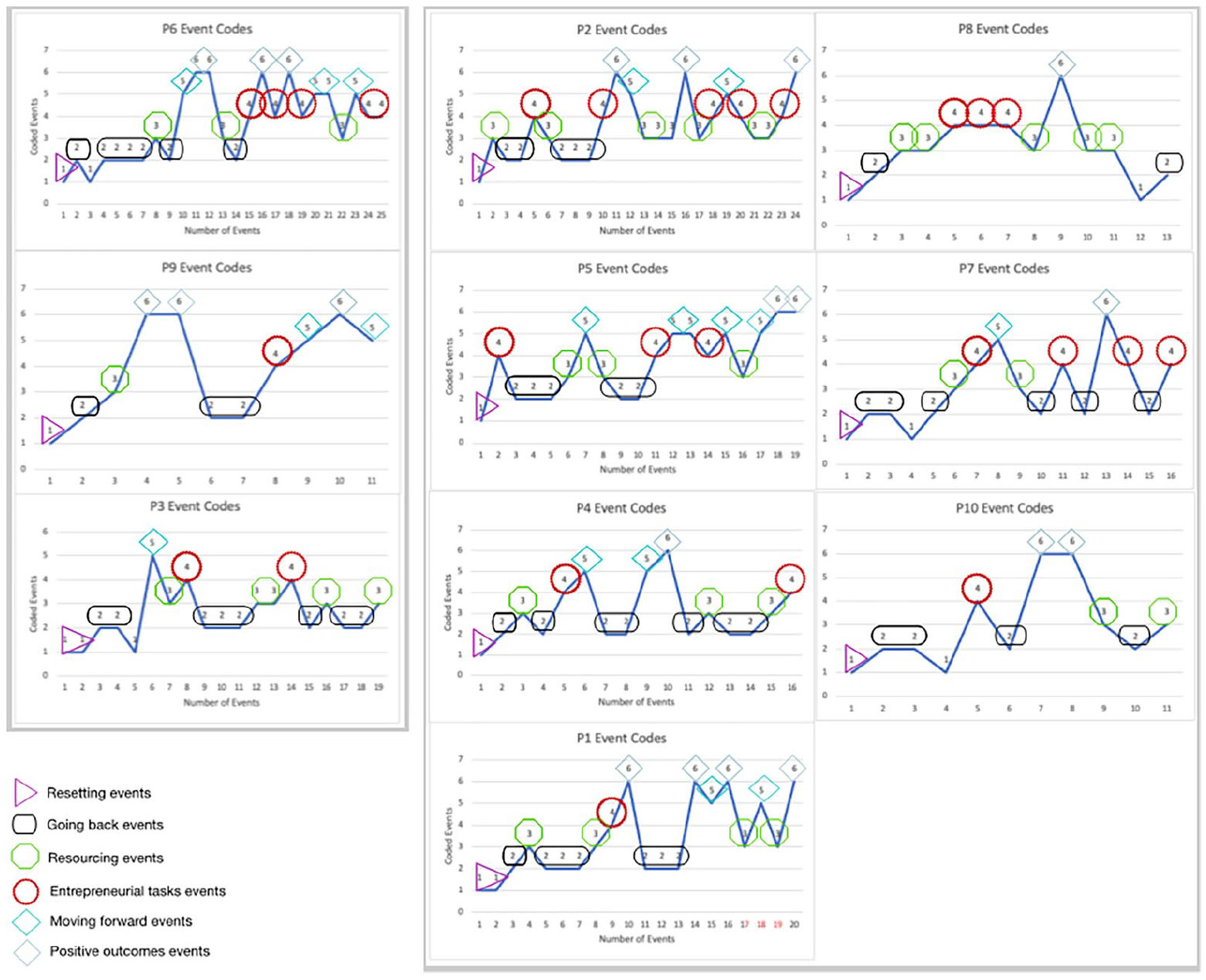
Coding of events.
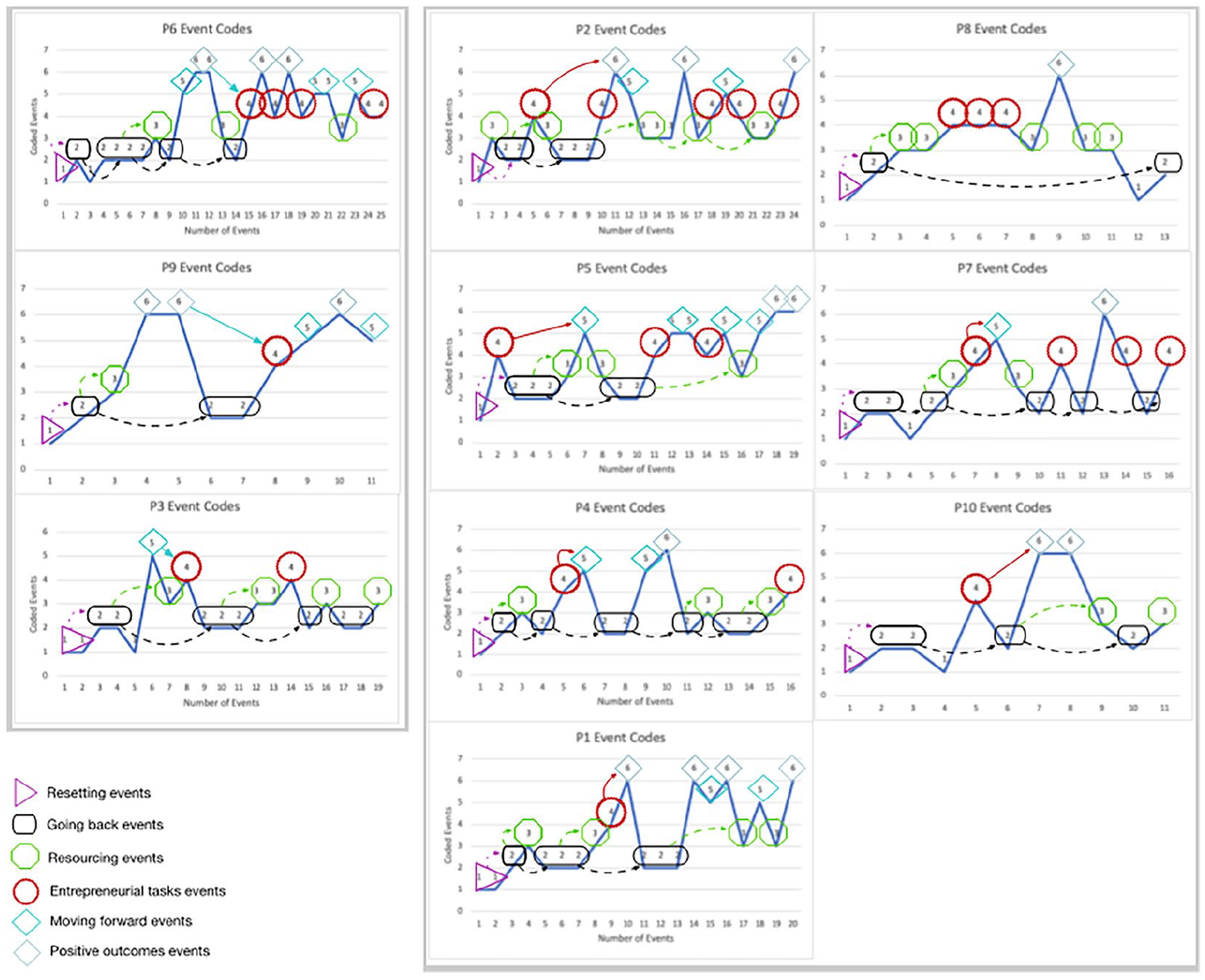
Empirical regularities within timelines.
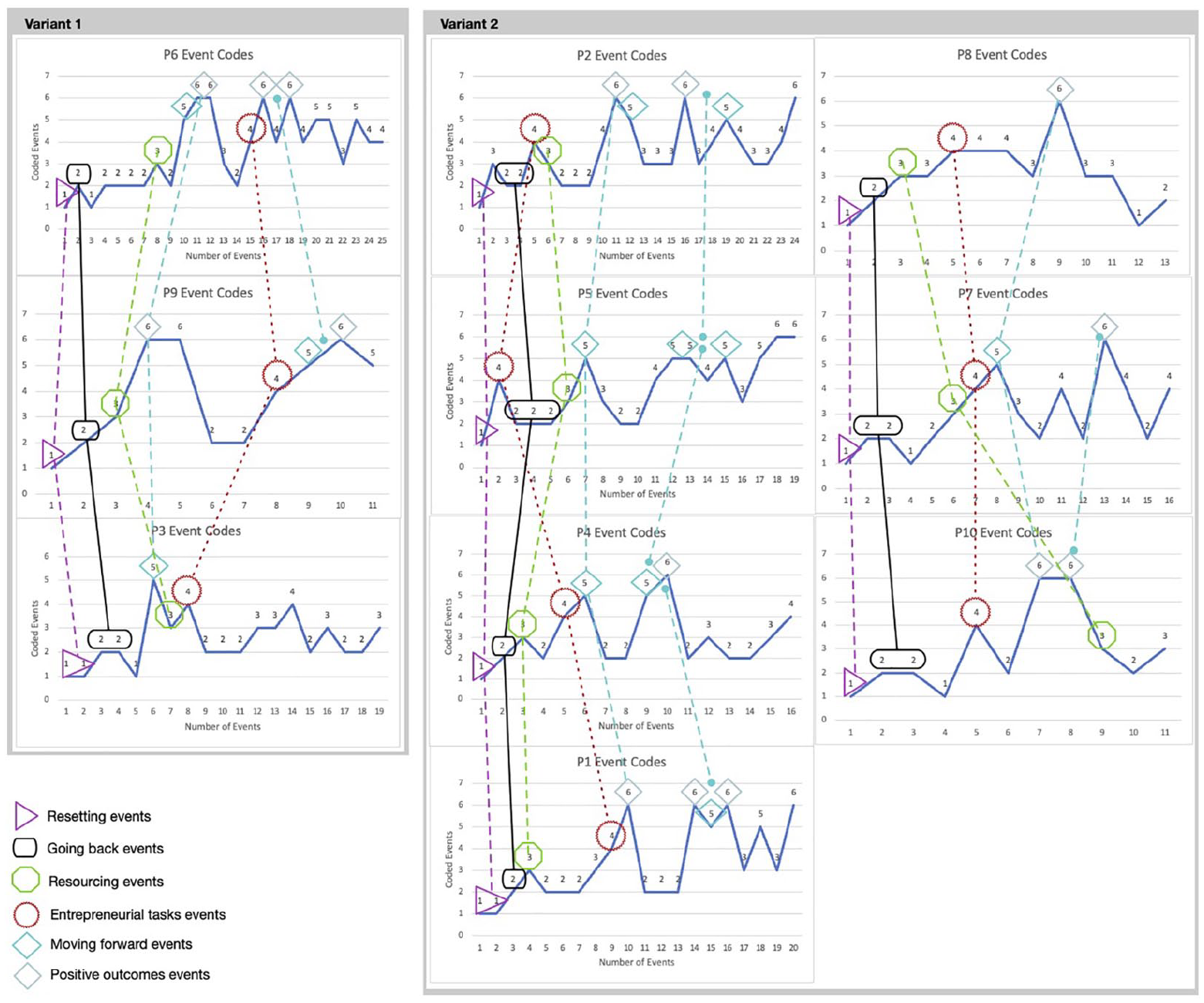
Empirical regularities across timeliness.
Stage 2. Within-case coding of timelines
During this stage, we used process tracing methods to code events within timelines (Figure 1). Working in an iterative recursive manner allowed for reviewing codes within one narrative, noting these down and comparing them to codes in other narratives. From here, we discovered five main event types. First, resetting events allow individuals to stabilise their lives after release, ranging from taking unsatisfactory jobs to moving in with elderly parents. The second set of events was coded as Going back events, whereby they recreate the restrictions and safe space granted by prison. For example, participant 8 hid their last name from their business network for fear of past criminality being discovered. Third, resourcing events allow them to create and accumulate resources over time. For example, participant 1 remained in a service-level role they were overqualified for to build up both financial resources through salary saving, as well as social resources through networking sporadically with senior management. We noticed that as resourcing events unfold, they contribute to increased stability in an individual’s life, gradually reducing the need to continuously reconstruct or navigate restrictions. Fourth, entrepreneurial task events, involving activities like business planning, market exploration, and company registration. The fifth and sixth sets of events involve the pursuit and achievement of positive outcomes. Despite the overlaps, we differentiate two types of events; moving forward events whereby they can achieve positive goals, and positive outcomes events, whereby they realise that goals are being achieved. Figure 1 shows the coding applied to the timelines.
Stage 3. Identification of empirical regularities
In this stage, we looked for empirical regularities within (Figure 2) and across (Figure 3) cases. Here, we made several discoveries. In our observation of within-case regularities, we discovered four markers in the enabling of agency, regarding (1) the role of resetting events, (2) the frequent and recursive reconstruction of constraints to move forward, (3) the accumulation of resources and (4) the timing of entrepreneurial tasks. From here, we were able to identify patterns across cases (Figure 3), beginning to configure a pathway that explains how agency is enabled after prison and the role entrepreneurship plays in the process.
Stage 4. Causal inferences and theorisation of causal mechanisms
In this final stage, we drew on empirical regularities previously identified to move from descriptive to causal inferences, which allows us to theorise the enabling of agency through a structure of interlocking parts. These parts connect the initial condition of freedom from restriction to the final outcome of achieving positive results. Each part is necessary for the next, and together they form a sufficient causal mechanism. In this stage, we leveraged empirical regularities to move from descriptive to causal inference, and then further abstract our findings to explain how agency is enabled. In process-tracing research, each part of the mechanism is presented as a statement of regularity (Chen et al., 2023).
This causal structure, shown in Table 3, theorises the enabling of agency as interlocking parts connecting an initial condition (i.e. entrepreneurs are granted freedom from restriction) and a final outcome (i.e. achievement of positive outcomes). These parts constitute a causal mechanism, where each part is necessary for the next to occur and the combination of parts is deemed sufficient to produce the final outcome. As Chen et al. (2023) explain: ‘The focus of causality here is on the dynamic and interactive influence of changes in problem formulation on the solution and, in particular, how causal forces are conveyed through the series of interlocking parts, which are marked by the four change dimensions identified in the development of descriptive inferences’ (p.241).
Conceptualisations of causal mechanisms and their parts.

In the findings, we first introduce the four markers in the process of enabling agency after prison, alongside the pathway explaining how at-risk individuals use entrepreneurship for rehabilitation and reintegration into society, illustrated with key quotes to underscore their journey of enabling agency.
Findings
Four markers in the process of enabling agency after prison
The resetting imperative
First, all journeys initiate with resetting events, followed by going back events (see purple triangles leading to black ovals; Purple line in Figure 2). Despite their entrepreneurial experience within prison and narrated expectations to venture upon release, an immediate move into entrepreneurial endeavours is notably absent among the individuals observed. Instead, there is a deliberate shift towards engaging in various resetting activities aimed at establishing a sense of stability in their lives. This redirection is primarily a response to the stark realisation that their agency, within the ambit of a free society, has been either drastically reduced or transformed. This period of introspection and adjustment underscores the process of establishing a stable foundation for existence beyond the prison’s perimeter and is critical as it involves laying down the foundational blocks for a stable life. This is interesting, as one would assume that entrepreneurial action would provide the sense of stability required. The below quote from Participant 6 illustrates how the release process is not necessarily one of happiness and freedom, showing instead a struggle to adjust to accepting freedom and needing time to process the change of leaving one context and entering another: I felt like I lost control when I came out. I felt like I was back in control in prison and then all of a sudden when I was back in the outside world that control had gone. You have to build it again, so back down, it was overwhelming all the stuff you have to do – P6
Recursive reconstruction of constraints to move forward
Second, the process is recursive and requires a frequent reconstruction of constraints to move forward. Even when positive outcomes are achieved, they regularly engage in going back events (see black ovals in Figure 2; Black line in Figure 2), whereby they recreate and reinforce the restrictions and the safe spaces granted by prison, which enabled entrepreneurial activity in the first place. This tells us that the regaining of agency is not linear and instead needs counterintuitive safeguarding to lead to positive outcomes. In the following quote, Participant 4 returns to a prison mindset after being previously offended by the same potentially lucrative partner who now returns after witnessing Participant 4’s success: You had your chance, you made me do a lot of work a lot of paperwork and then you just didn’t want to work with me so I said ‘What makes you want to work with me now? Because you know I’ve been on another year and a half and you know I’m going to smash it?’ A lot of these people are just greedy bastards – P4
While this might be seen as normal business behaviour, offering a contract despite an earlier prior rejection, Participant 4 takes it as an insult and reacts as if they are still in prison with their sense of self being insulted, a response to which they can control. It offers a feeling of protection when facing challenging circumstances in a constrained context.
The accumulation of resources
Third, the process is marked by the resources needed to move forward through entrepreneurship, which can only accumulate by going back to restrictive spaces (see links between green octagons in Figure 2; Green line in Figure 2). It becomes apparent that entrepreneurship, in isolation, is insufficient in equipping at-risk groups with the holistic set of tools required for substantial progress and positive outcomes. As seen in the sequences of black ovals to green octagons to blue diamonds, positive outcomes can only be achieved after a protective space is reconstructed. In the below example from Participant 1, we observe how after leaving prison they took on a limiting job opportunity, but one that recreated a similar experience of confinement to their prison experience: It was just like a box within [supermarket] in [city] by the rugby ground, and you look out the window, at the car park and it’s just grey, I just remember feeling really kind of ‘boxed in’ ironically, and just thinking what the fuck have I done in my life, and that was weirdly like a big realisation the fact that I was there in an [Employer]s uniform working in the branch . . . And I was kind of stuck there for the time being, and it wasn’t all doom and gloom because I was still earning but . . . that was when I was reading all sorts of business books and doing all the research on the internet getting sorted and trying to get motivated – P1
By placing themselves within this recreated prison (restrictive) space, both physically and mentally, Participant 1 began to accumulate both tangible and intangible resources in preparation for their first entrepreneurial task, and for moving forward.
The timing of entrepreneurial tasks
The initiation of entrepreneurial actions is not the sole mechanism for regaining agency or achieving positive outcomes within the rehabilitation process (Cyan and red lines in Figure 2). Our data unveils that entrepreneurial tasks may also emerge as outcomes, rather than precursors, of events that facilitate the pursuit and achievement of positive goals. Specifically, in certain narratives (highlighted on the left-hand side timelines for cases P6, P9, and P3), entrepreneurial tasks materialise as effects, not causes, of moving forward events. This revelation injects a layer of complexity into the conventional understanding of entrepreneurship’s role in rehabilitation and self-reconstruction, emphasising the critical timing and sequence of such engagements. We find this exampled by Participant 9, who after securing employment in a franchised retail unit adopted adaptive strategies seemingly without intent which worked in prison to play the role of the ‘grey man’, not drawing attention to themselves for neither good nor bad reasons: But I just, I don’t know, it just happened, you know, sometimes, I suppose when you sit down now and look back at it, it is a positive, but you just get on with it . . . But I used to do a lot of. . . I’d also do loads of things in the shop, so I’d do loads of cleaning or, just whilst I was waiting . . . and then when the shop was closed, things that I didn’t have to do got me quite noticed as well – P9
Participant 9 experienced a moving forward event by being noticed positively by management, drawing positive psychological resources from this such as increased self-esteem and confidence. The result of this was feeling sufficiently resilient to enact entrepreneurial behaviours as displayed here . . .so I was very hungry for money I don’t know whether that goes back to criminality where I was involved with different things, so I would always offer the customer the second [product] half price, or if they would come in to get the heels on their shoes I would offer them the heels and it would work out a bit cheaper, if they came in to get a [product] I’d offer them a second tag half price so I took that shop from doing about £800 to about £1,200 to £1,500, so although it’s still not really big money in the grand scheme of things with the bigger shops we had, it was noticed very well – P9
Through these engagements, it becomes evident that entrepreneurship emerges as a result of moving forward events, rather than being the initial catalyst; it materialises only after individuals achieve stability and begin to enable a sense of agency through key life adjustments, allowing them to engage in entrepreneurial activities from a place of renewed confidence and control.
The journey of enabling agency
The enablement of agency in highly restrictive contexts consists of six parts, following an initial condition (release from prison) and leading to a final positive outcome. Table 3 offers an overview of the causal process, with the conceptualisation of causal mechanisms and their parts. In the following, we explain this process in detail.
Agency restriction upon release (IC)
Our research findings illuminate a general experience among participants upon their re-entry into society, characterised by profound feelings of uncertainty and disempowerment. Interestingly, while the prison environment is inherently punitive and restrictive, it also serves as a nurturing ground for the development of entrepreneurial ideas. This constraining context provided a structured routine and a set of limitations that curtailed choice, honed focus, and alleviated the burdens associated with the complexities of societal integration. Within the prison walls, individuals were recognised by peers and staff alike for their entrepreneurial spirit and celebrated as figures of intent and action. For instance, Participant 3 shared their unique experience of entrepreneurial recognition while incarcerated: I was first, you’ll get to learn, I ended up getting a . . . I applied for a small loan business loan through one of the companies that we were talking about and worked with in prison. I’m the only prisoner that got selected or even considered for the loan. And I’m the only one that got it. – P3
This highlights the support and acknowledgement they received for their entrepreneurial efforts within the prison setting. However, this entrepreneurial spirit undergoes a drastic transformation upon release, as these individuals are perceived primarily through the lens of their ‘former prisoner’ status, stripping them of their entrepreneurial identities recognised in prison. This transition reveals a harsh reality: not only is the life participants knew before incarceration irretrievably lost, but the ‘entrepreneurial self’ they had painstakingly constructed behind bars also proves unviable in the external society. Participant 2 reflected on this challenging shift: So, when I came out reality set in now because I’d generally thought, I’d given up on the whole thing with the magazine [start-up]. . . so I was just down, cos I’d decided beforehand that somewhere in the third sector was where I wanted to be working. – P2
This insight is important. While the knowledge and skills related to entrepreneurship acquired in prison persist beyond release, the transition into a new social context does not automatically facilitate the embedding of this entrepreneurial agency. Despite possessing substantial entrepreneurial knowledge resources, the participants encountered significant challenges in translating this agency into their new surprisingly restrictive social environments. Participant 2 further elaborated on the disillusionment faced when attempting to actualise entrepreneurial goals post-release: Then you start realising well, actually you better go on working in Tesco or Selco or something, because. . . people aren’t actually lining up to do this with you to give you money! – P2
This disjunction highlights the intricate dynamics between individual agency and societal integration, revealing that the development of an entrepreneurial identity within the confines of prison does not seamlessly extend into broader societal acceptance or recognition. The participants’ experiences emphasise the need for supportive structures that bridge the gap between the entrepreneurial potential fostered in prison and the realities of societal reintegration.
Resetting (P1)
In confronting the disjunction in their sense of agency upon release, the entrepreneurs gravitate towards establishing structures that promise stability, routine and ease of access to counteract the societal barriers they face. Such decisions and actions are typically made swiftly following their release from prison. This rapid response, while understandable, tends to be myopic, fraught with risk, and primarily aimed at regaining a semblance of control and stability in their lives. Participant 2 exemplifies this immediate pursuit of stability: So roughly around about three months ago, maybe I ended up working in a builders’ merchant, which is something that I had done when I was 16/17, so it felt like a complete reset then. So I wasn’t like depressed, but I was probably level [neutral]. Probably just like, ‘this ain’t great’. – P2
By returning to a familiar job from his teenage years, Participant 2 sought to re-establish a sense of normalcy, even if it did not align with his entrepreneurial aspirations. This initial step, despite its potential pitfalls, provided a temporary platform of stability. Similarly, Participant 10 shared feelings of being caught between the need for familial support and the necessity of maintaining employment: At this point, I did feel a little bit trapped and that I needed to be with my mum and stuff, but then I had the priority of work as well and trying to maintain that job because it was the only opportunity I had. – P10
This underscores how the urgency to secure immediate employment can lead to feelings of entrapment. However, these initial positions are crucial as they offer a newfound sense of control, allowing individuals to pause, reflect and contemplate future directions. These experiences enable participants to reassess and adjust their initial entrepreneurial plans, considering the necessary adaptations prompted by their experiences of societal reintegration challenges. The temporary stability gained provides the space needed to navigate the complexities of re-entering society and to plan more sustainable paths towards their entrepreneurial goals.
Reconstructing constraints to move forward (P2)
Following the resetting part, instead of progressing directly to the core activities of entrepreneurial ventures such as refining business plans, conducting market research or expanding networks, all participants embark on recursive going-back events. This counterintuitive step is undertaken in pursuit of a broad spectrum of resources, encompassing psychological, emotional and structural dimensions. This finding challenges the conventional expectation that, upon achieving a degree of stability post-release, individuals would naturally gravitate towards entrepreneurial endeavours to further solidify their independence and cultivate their entrepreneurial identity.
The behaviour reveals contextual and socially embedded nature of entrepreneurship. The psychological fortitude and resources that our participants developed were intricately tied to the prison environment; a context replete with its norms, values and routines. The abrupt transition from this total institution to societal freedom leaves a void where the supportive framework once stood, compelling individuals to seek or recreate a context that can offer similar psychological scaffolding. This need for contextual re-creation is poignantly illustrated by Participant 1’s experience. Despite owning a house, they chose to move back in with their parents post-release, trading a six-bedroom house for a childhood bedroom adorned with Spiderman wallpaper. This decision reflects not just a physical regression but a profound psychological adjustment: It’s just this kind of, it’s just as much of a headfuck when you get released out of prison as it is going in. . . I went from having a six-bedroom detached house in [city] with me ex [former girlfriend], to being in the box bedroom at me mum’s with Spiderman wallpaper aged 30 odd. – P1
This quote captures the tumultuous journey of enabling a sense of agency through the lens of loss and the subsequent search for psychological stability within the familiarity of family routine. Participant 1’s story highlights the nuanced and complex process of reintegration, where the initial search for stability often requires making decisions that provide immediate benefits towards reconstructing a sense of self and purpose in the wake of institutional detachment. The need for experiencing the continuation of routine is highlighted by Participant 10, who after release attempted to maintain a similar highly structured lifestyle to the one he experienced in prison: I kind of just took every day as it came . . . so like I was working nine till five. . . So I was just hitting the gym at night and then by the time I got up I was just flat out and then I’d just do the same the day after and I kind of just done that for a while. . . P10
Participants continue to display going back events across their process and in doing so we observe participants recursively reconstructing the restrictive context in response to continued dynamic constraints they encounter within their lived experience towards their developing entrepreneurial self, their enabling of agency. We interpret this finding as a form of counterintuitive safeguarding, by not just providing the space needed to facilitate entrepreneurial development, akin to the prison context, but also safeguarding the development of agency. From this stage, we then observe a variation in processes between those participants in variant one (P3, P6, P9) and those in variant two (P1, P2, P4, P5, P7, P8, P10).
Moving Towards Positive Outcomes (P3/4)
Here we find a variation delineating two distinct pathways in our participants’ journeys – variant 3/4a and variant 3/4b – as outlined in the ‘path divergence’ presented in Table 3. In variant 3/4a, participants engaged in entrepreneurial tasks after achieving positive outcomes in other areas, suggesting that entrepreneurship emerged as a result of regaining stability. In variant 3/4b, participants initiated entrepreneurial tasks directly after the resource accumulation phase, indicating a more immediate pursuit of entrepreneurship to enable agency. This divergence highlights the different strategies individuals employ in reconstructing their selves after prison. For variant 3/4a, we observe that positive outcome events follow the stage of going back and resourcing events. Moving forward and positive outcome events represent a wide variety of activities reflecting the unique aims and ambitions of each participant in the development of their entrepreneurial objectives and yet do not necessarily constitute entrepreneurial activity. We find this with Participant 6 who after spending time in a stabilising job selling DVDs, took an opportunity that would set the scene for the commencing of entrepreneurial activity: Basically, what happened with [firm 1] was. . . this [firm 2] option came up and I thought, you know what, I'll do [firm 2], because I kind of like, one: it was better money, it was more sales targets. It was beer [sector]. Wasn’t like kid’s DVDs – P.6
After twelve months of exceeding targets, participant 6 was then offered a Regional Account Executive position constituting a positive outcome: Smashed all my targets and then they said to me ‘Do you want to be a Regional Account Executive?’ – P.6
Despite these positive outcomes and moving forward events, we observed participants engaging in further recursive going-back events, which are then followed by entrepreneurial task events. This pattern indicates that the accumulation of resources necessary for advancing through entrepreneurship often requires a psychological return to restrictive conditions. It suggests that entrepreneurship, by itself, may not furnish marginalised individuals with all the tools needed for advancement and the realisation of positive outcomes. Progress and positive achievements are contingent upon the availability of a supportive and protective space, underscoring the complexity of transitioning from restrictive institutional contexts to the broader societal landscape.
Here we find a variation delineating variant 3/4b from variant 3/4a. For those participants in variant 3/4b (P1, P2, P4, P5, P7, P8, P10) following the resetting phase, these participants also engage in recursive going back and resourcing events. Unlike variant 3/4a however, where the engagement in entrepreneurial tasks is preceded by moving forward and positive outcome events, variant 3/4b sees participants diving directly into entrepreneurial tasks right after this phase of reflection and resource accumulation. The engagement in entrepreneurial tasks at this stage is pivotal, marking a proactive step towards business creation and development. This early initiation into entrepreneurial activities highlights an interesting variation within the journey of enabling agency, where immediate action towards entrepreneurship is prioritised to catalyse change and foster agency. Subsequently, the moving forward and positive outcome events unfold as participants begin to see the fruits of their entrepreneurial efforts.
Engaging in Entrepreneurial Tasks (P5)
After progressing through the moving forward and positive outcome stages, participants embark on entrepreneurial tasks that resonate with their individual goals and ambitions. These tasks showcase the adaptability and resourcefulness of the participants, each tailoring their entrepreneurial journey to fit their unique circumstances and leveraging their networks and experiences. For instance, Participant 3 demonstrates his ingenuity by securing a deal with a merchandise printing company owned by an acquaintance’s brother, a connection made during his time in prison. This strategic partnership allowed him to mitigate the risks associated with inventory surplus, ensuring his business operations were more closely aligned with market demands: So, you know if I’ve got 25 large t-shirts and everyone wants a small one, they’re going to get dumped with them so I sort of struck a deal with someone I know who was inside, I’d done a bit of time with him and his brother’s got a printing company – P.3
Similarly, Participant 9’s journey illustrates his entrepreneurial acumen through his role as a franchisee manager, where he not only managed but also strategically developed branches to enhance sales and secure substantial bonuses. His efforts significantly improved the business’s performance: Once I got in charge, I was pushing sales and going home with £50, £70 week bonuses. I was going home because I was the manager with between £100 - £150 just in bonus, I took the shop from £3500 to between £4,500 and £5000 in sales. – P.9
This quote illustrates how Participant 9 seamlessly transitioned into a business-oriented mindset, embodying the entrepreneurial spirit by translating his leadership into measurable success. It underscores a broader theme where participants, through entrepreneurial tasks, not only navigate the complexities of societal reintegration but also assert their agency and entrepreneurial identity. This phase marks a crucial pivot in their journey, from re-establishing stability and re-engaging with societal norms to actively shaping their entrepreneurial trajectory. It showcases the resilience and creativity of individuals in leveraging their past experiences, networks, and newfound opportunities to carve out a path that aligns with their entrepreneurial vision and aspirations.
Continued Movement Towards Positive Outcomes (P6) and the Enabling of Agency (Outcome)
In the unfolding narrative of both pathways, the journey towards positive outcomes and the enabling of agency is marked by a series of strategic engagements and entrepreneurial tasks. This journey, reflective of a deeper, more profound process of transformation, showcases the resilience and adaptability of the participants as they navigate the complexities of societal reintegration and entrepreneurial endeavour. The progression towards positive outcomes is not a linear path of achievements but a dynamic process of continuous adaptation, learning, and manoeuvring. As the participants engage in entrepreneurial tasks, they not only confront the challenges posed by their external environment but also harness opportunities to assert their agency and redefine their identities. This stage of the process is characterised by a deliberate and conscious effort to leverage personal networks, utilise acquired skills and capitalise on new opportunities, thereby facilitating a transition from a state of disempowerment to one of empowerment and autonomy.
An illustrative example of this transformative process is Participant 6, who, upon leaving the security of employment, ventured into establishing their own marketing consultancy. This bold move paved the way for a significant opportunity: I got introduced to the CEO at [local] zoo and they want, they’re looking for me to do a sales feasibility plan for them. And then that led into, I've now got a full-time contract with them because they’re a client who I would say are in it for 12 months now. – P.6
This example not only illustrates Participant 6’s adeptness at networking but also highlights their capacity to capture new business opportunities, culminating in a stable and substantial contract. Like other participants, Participant 6’s journey did not stop at the successful execution of entrepreneurial tasks; it continued to evolve with ‘moving forward’ events as new opportunities were identified and seized. The enabling of agency, in this context, emerges as a multifaceted achievement, demonstrating the participant’s ability to navigate and reshape their socio-economic landscapes. It involves the reclamation of control over their lives and futures, manifested through the successful execution of entrepreneurial tasks and the realisation of positive outcomes. This enabled agency is not merely a return to a pre-incarceration state but a reconfiguration of the self that incorporates the lessons, experiences and resilience developed through the journey of reintegration. We see this enabling of agency summarised by Participant 3 who reflects on their experiences of being in prison to how they see themselves now.
For me, personally, mentally, I think I look back and I go “Yeah, that was tough. So if you can get through that you should be able to get through anything. And you should grab. . .” and this part of the reason why I’m still passionate about [the business] because of that situation where you go “You, you are going to achieve this” it doesn’t matter all your haters, all your hangers on, you are going to achieve something and that’s part of the drive. So, yeah, I’m grateful for it. I regret it, don’t get me wrong. But I’m grateful for it at the same time because I wouldn’t be doing what I’m doing now. And having, you know people like yourself, taking time out to actually learn about it . . . you think, sorry about the French but you think “Fuck me I must have done, I had some sort of impact” . . . You are on the right path, you’re doing the right thing. – P3
Participant 3’s narrative reveals the journey of enabling agency post-incarceration, emphasising resilience, goal-oriented determination and a transformative outlook. It reflects on overcoming past hardships, viewing them not as permanent setbacks but as lessons that foster resilience and purpose. This mindset, combined with a drive to succeed and gratitude for difficult experiences, illustrates a profound internal transformation. This story highlights the resilience and entrepreneurial spirit essential for navigating societal reintegration, underscoring the complex yet rewarding path to reclaiming one’s identity and agency.
Discussion
Restorative entrepreneuring has emerged as a concept and framework to address the challenges faced by at-risk individuals. It aims to help individuals rebuild their identities, sense of agency and self-worth, especially during rehabilitation or reintegration processes. Agency is a central component of this framework as it increases the capacity of an individual to act independently and influence their social environment, facing structural constraints. Restorative entrepreneuring facilitates this process of self-reconstruction, where individuals rebuild their identity and sense of agency. However, restorative entrepreneuring alone does not fully explain how agency is enabled or hindered in constrained contexts, where structural barriers and resource limitations prevail. This article investigates how agency is enabled in such environments, asking How is agency enabled in highly constrained contexts as at-risk individuals engage in restorative entrepreneuring?
By examining the entrepreneurial activities of 10 former prisoners through a process-tracing lens, we discovered four key markers in enabling agency (resetting priorities, adapting to constraints, building resources and timing entrepreneurial tasks) and developed a causal process that explains the journey of enabling agency after prison. Our findings provide empirical insights into the complex interplay between individual agency and structural constraints. In doing so, we contribute to a deeper understanding of restorative entrepreneuring (Wainwright and Muñoz, 2020) whilst extending the theoretical foundations of entrepreneurial agency.
Contributions to entrepreneurial agency
Through our findings, we advance our understanding of agency in restrictive contexts, highlighting the complex interaction between individuals and constraints as they attempt to act independently and influence their social context post-incarceration. Our research suggests that, counterintuitively, enabling agency requires reconstructing constraints, which challenges our current view of agency as a forward-looking transformative capacity. McMullen et al. (2021) argue that entrepreneurial agency depends on several factors: ability, motivation, opportunity, supportive institutions and process skills. We extend this by showing an iterative process that requires moving back (to prison) to move forward, thereby adding depth to the notion that constraints can serve as a platform for enabling agency. At-risk individuals are required to reconstruct previous constraints as they offer a safe place and allow them to acquire resources to move forward. By reconstructing safe places, they can not only acquire resources but also enact, use and benefit from ability, motivation, opportunity, supportive institutions and process skills.
The concept of transformative capacity – the ability of entrepreneurs to intervene in their environment and produce desired outcomes – has been highlighted as an important lens through which to understand how agency can emerge within constrained circumstances (McMullen et al., 2021). Prior research has shown that various forms of constraint, such as socioeconomic deprivation, institutional voids, or pervasive stigma, can paradoxically spark new entrepreneurial strategies and resource mobilisation (Anderson and Miller, 2003; Korsgaard et al., 2021; Muñoz and Kimmitt, 2019). Indeed, scholarship on entrepreneurship in extreme and under-resourced contexts has highlighted how entrepreneurs adapt to and even leverage adverse conditions, often relying on supportive institutions, community ties, and innovative processes that align with their limited operational spheres (Elkafrawi et al., 2022; McKeever et al., 2015; Refai et al., 2024).
We build upon these insights by showing how transformative capacity is not merely an adaptive response to constraints but can also involve actively reconstructing them. Extant studies, for example, note how entrepreneurs employ storytelling, local sourcing, and community engagement to overcome resource scarcity and social marginalisation (Korsgaard et al., 2021; McKeever et al., 2015), or how entrepreneurship fosters attitudinal and behavioural changes in prison contexts (Ciptono et al., 2023; Patzelt et al., 2014). Yet, the actions of the participants move beyond simply coping with limiting conditions into an iterative process where constraints reminiscent of incarceration are deliberately reconstituted. This approach transforms previously debilitating conditions into familiar psychological and structural frameworks that allow for incremental progress and calculated risk-taking. In constrained environments, individuals exercise their agency by developing institutional resilience and creating adaptable spaces to navigate and reduce external limitations (Refai and McElwee, 2023). Building on this perspective, we demonstrate how at-risk individuals transform challenging conditions into familiar psychological and structural frameworks. These frameworks support incremental progress and informed risk-taking. By doing so, we highlight how reinterpreting and restructuring prior constraints provides these individuals with a secure foundation to activate and sustain their agency.
By reenacting certain bounded environments, participants gained the stability and psychological safety needed to orchestrate resource accumulation and entrepreneurial experimentation. This process speaks to the nuanced interplay of structure and agency, wherein returning to constraint can facilitate forward movement by safeguarding fragile entrepreneurial identities before introducing more freedom (Giddens, 1984; Sarason et al., 2006). In other words, just as previous research has shown that constraints can induce greater entrepreneurial creativity and local embeddedness (Garcia-Lorenzo et al., 2018; Muñoz and Kimmitt, 2019; Villares-Varela et al., 2018; Wainwright and Muñoz, 2020), our findings demonstrate that transformative capacity can involve a conscious decision to recreate, rather than merely navigate, restrictive conditions.
This perspective extends current understandings of entrepreneurial action in extreme contexts (Dutta, 2017; Giazitzoglu et al., 2024; Jiang et al., 2021; Refai and McElwee, 2023), revealing that enabling agency may require a strategic oscillation between constraint and freedom. Rather than viewing constraints solely as triggers for creative adaptation, we show how formerly incarcerated entrepreneurs employ constraints as tools to rebuild and reinforce their nascent entrepreneurial selves. In doing so, we shed new light on the iterative and dialectical nature of transformative capacity, illuminating the sophisticated agentic practices that emerge in conditions where conventional pathways to entrepreneurial empowerment are blocked or absent.
Contributions to restorative entrepreneuring
Restorative entrepreneuring, as conceptualised by Wainwright and Muñoz (2020), focuses on entrepreneurial practices that enable at-risk individuals to rebuild their identities and sense of self-worth. Our study advances this concept by emphasising the centrality of agency in this process and revealing the mechanisms through which agency is enabled in highly constrained contexts. We found that entrepreneurship serves not just as an economic activity but as a means of reconstructing agency. The participants engaged in entrepreneurship to regain control over their lives, but this required them to navigate a delicate balance between seeking autonomy and recreating constraints that provided psychological safety. This adds depth to the concept of restorative entrepreneuring by highlighting the importance of considering how individuals strategically interact with constraints to facilitate their rehabilitation and reintegration.
Our findings align with Awad et al. (2022), who emphasise the role of supportive community frameworks in enhancing the effectiveness of restorative ventures. By reconstructing constraints, former prisoners create environments that support their entrepreneurial activities and personal growth, which is essential for successful reintegration. The evidence also resonates with critiques that question the romanticisation of entrepreneurship as a universal solution for marginalised groups (Smith et al., 2019; Trehan et al., 2020). For example, our study supports the argument that entrepreneurship can sometimes lead to precarious economic situations if individuals are pushed into self-employment out of necessity rather than choice (Refai et al., 2024). This is particularly relevant for former prisoners, who often face significant barriers such as stigma, limited job opportunities, and the psychological aftermath of incarceration (Baur et al., 2018; Brehmer et al., 2024). These barriers suggest that entrepreneurship should not be viewed as a panacea but as part of a broader, more nuanced strategy for rehabilitation and societal integration.
Methodological contributions
Our study also offers a specific methodological contribution. By employing a life-story research approach combined with an inductive multi-stage process-tracing design, we innovatively apply these methodologies to track and understand the dynamic process of agency reconstruction among former prisoners engaging in entrepreneurial activities post-release. This methodological approach allows us to capture a detailed and nuanced view of the transition from structured prison environments to the challenges of the external business world. The use of life-story interviews provides deep insights into the personal narratives and key events shaping the entrepreneurial journeys of the participants. This approach not only captures the complexity of their experiences but also allows for the exploration of the cyclical nature of gaining and losing agency, a critical aspect often missed in traditional qualitative analyses. Furthermore, the application of process tracing in this context is particularly novel as it enables the identification of causal mechanisms within these life stories. By mapping out these sequences and understanding their causal impacts, the study sets the ground for future research that can further explore and test these mechanisms in other contexts or populations.
Expanding the frontiers of prison entrepreneurship
Our exploration of how former prisoners regain agency places this study at the cutting edge, interfacing closely with criminology. The intersections between entrepreneurship and criminology provide fertile ground for innovative research approaches. This alignment prompts us to encourage entrepreneurship scholars to actively engage with the principles of positive criminology. Such interdisciplinary engagement enhances our understanding of Restorative Entrepreneuring within prison contexts, showcasing the close relationship between these fields. Given the contextual depth of our findings within the prison system, it is pertinent to discuss their contribution to criminological literature. By focusing on the role entrepreneurship plays in the reconstruction of the self, we add to the literature on recidivism through the lens of Positive Criminology and the concept of Personal Recovery Capital (PRC; Ohayon and Ronel, 2023). Positive criminology diverges from traditional approaches by emphasising rehabilitation and growth through personal, social and spiritual integration. It emphasises the importance of positive means and effects, such as acceptance, altruism, hope, supportive social atmospheres, self-efficacy and spirituality in facilitating rehabilitation and crime desistance. PRC highlights the internal resources individuals accumulate, propelling them towards life improvements, including self-capability, self-value and self-responsibility. This focus aligns with our findings that entrepreneurship and stabilising actions post-release can play a crucial role in the reintegration process by offering avenues for self-improvement and societal contribution, beyond the mere establishment of social bonds.
Our research suggests that interventions promoting PRC not only mitigate negative emotions but also encourage behavioural change, offering a nuanced understanding of desistance from crime. It highlights the significance of recognising and utilising one’s worth and capabilities, fostered by tangible successes, as a means to overcome the disempowering nature of the social system re-entered upon release. This article, therefore, makes a vital theoretical contribution to desistance theory, emphasising the need to explore the pathways former prisoners undertake in pursuit of agency, control and empowerment. Through the lens of agency and the utilisation of entrepreneurial actions, we show that achieving these outcomes can be facilitated in various ways, employing entrepreneuring not just as a narrative but as a practical tool for self-reconstruction and societal reintegration.
Practical implications
From a practical perspective, this study has relevance for probationary research which utilises self-employment as a necessary means for income and as a workaround to societal stigma preventing access to the employment sector. Prominent in rehabilitation research and practice is the Good Life Model which promotes undertaking activities that pull the participant towards life goals (primary goods) (Fortune, 2018). This perspective has been criticised however as potentially being insufficient to tackle a mindset change from antisocial to prosocial (Wainwright and Muñoz, 2020). This research sheds light on the importance of former prisoners taking ownership of their actions to effect positive change, and how this can be done via both meaningful self-employed and employed occupations.
Finally, the sample population presents an opportunity to offer a practical impact upon the population. For many ex-offenders, entrepreneurship can serve as a viable and necessary means for sustaining an income to provide for themselves and their family (The Centre for Entrepreneurs, 2016). McDaniel et al. (2021) explain how entrepreneurial training delivered either in prison or immediately upon release ‘has been shown to effectively promote start-up activity and reduce recidivism’ (p.2). As such the results from this research will be able to directly inform the organisations which support entrepreneurial training with former prisoners and marginalised groups.
Limitations and future research
Our study covered six months commencing shortly after release from prison. However, the process of overcoming restriction persists beyond the scope of this study, suggesting the possibility for further processes which may divert and reconnect similarly to that we have discovered, or may branch into alternative strategies as entrepreneuring develops. Future research can explore the mid to later stages of re-entry into society potentially discovering pathways which, if implemented earlier, with hindsight could produce positive impacts upon recidivism. This study focused on the enablement of agency in restrictive contexts, yet where freedom has been already granted, bounding the rehabilitation process to such a stage post-incarceration. However, other contexts where agency has been previously restricted also exist (under tyranny, slavery) and offer potential future contexts to explore the application of entrepreneuring as a pathway-producing empowerment tool. Through observing entrepreneuring within these contexts, we can discover the generalisability of such a pathway theory as has been developed here, including the relationship dynamics between restrictive contexts and the individual.
Conclusions
This study highlights how restorative entrepreneuring provides a critical pathway for post-incarceration reintegration by enabling agency through an iterative process of constraint reconstruction. Our findings emphasise that former prisoners undertaking entrepreneurship do not simply thrive once liberated. Rather, they strategically recreate certain elements of their previous restrictive environments to safeguard and strengthen their emerging entrepreneurial identities, gradually amassing the psychological, social and economic resources necessary for positive outcomes. By drawing upon life-story narratives and employing a multi-stage process-tracing approach, we reveal that reconstituted constraints serve as vital scaffolds, allowing individuals to balance the simultaneous need for autonomy and structure in their journeys towards sustainable entrepreneurship. This insight refines our understanding of entrepreneurial action in constrained contexts, demonstrating that freedom alone is insufficient for reintegration and, instead, must be combined with deliberate and recursive going-back events that foster resilience, self-efficacy and eventual self-determination. However, it is also important to acknowledge that not all formerly incarcerated individuals experience constraints and opportunities in a uniform manner. The population of former prisoners is highly diverse, including, for instance, variations in race, age, origin and gender, all of which can intensify or alter the effects of stigmatisation and structural limitations. By directing attention to these intersectional layers, future research may refine our understanding of how restorative entrepreneuring unfolds across diverse demographic categories, opening the door to more targeted support interventions and policy measures.
Footnotes
Funding
The author(s) disclosed receipt of the following financial support for the research, authorship, and/or publication of this article: This research was supported by funding from the Economic and Social Research Council (ESRC). The views expressed in this paper are those of the authors and do not necessarily reflect those of the ESRC.
