



Abstract
Root metaphors shape and reflect thinking in a field of research. This article analyzes how root metaphors from management studies are used in mainstream entrepreneurship research. We show how some root metaphors have been adapted, particularly those with negative connotations. We use the adapted metaphors to identify blind spots, suggest areas of research largely overlooked, and provide alternative perspectives on familiar phenomena in mainstream entrepreneurship research. We identify a positive root metaphor—organizations as instruments of emancipation—and discuss how it contributes to the canon of root metaphors for organizations, hitherto characterized as neutral or negative.
Keywords
Introduction
With the institutionalization of the entrepreneurship field (Aldrich, 2012; Fayolle et al., 2016), leading entrepreneurship journals have a growing obligation to be reflexive about the research the field produces (Anderson et al., 2019) and the theoretical assumptions that underpin it (Alvesson et al. 2008; Cornelissen, 2006b). In this vein of reflexivity, scholars have noted that mainstream entrepreneurship research has largely focused on “the good in entrepreneurship” (Shepherd, 2019, p. 2) and that a few central tropes permeate its theorizing. For example, Kibler and Laine (2024) identified the “messiah narrative” of entrepreneurship, and Brattström and Wennberg (2022) identified two dominant stories, entrepreneurship as “a road to salvation,” and “a means of emancipation.” Beyond the commonality of identifying a positive bias in entrepreneurship research, these studies also have in common that they build on what is represented in the literature to challenge us to imagine “the flipside of mainstream entrepreneurship research” (Shepherd, 2019, p. 4 emphasis added), the counternarratives (Kibler & Laine, 2024), or the alternative stories (Brattström & Wennberg, 2022).
Joining these efforts, we adopt a complementary, yet distinct approach. Rather than identifying what is in the mainstream of our field and imagining counterpoints, we are interested in what tropes have been readily available to entrepreneurship scholars and how those tropes have been represented (or not) in the mainstream of the field. Given that entrepreneurship is an interdisciplinary field, it has benefited from borrowing from adjacent fields, particularly management studies (Cornelius et al., 2006; Landström et al., 2012). However, such borrowing often entails repackaging concepts to fit the dominant stories of the adopting field, which can lead to adaptation of the borrowed concepts (Oswick et al., 2011). In this study, we focus on a particular type of trope, so-called root metaphors. Root metaphors are generative cognitive mappings through which one domain is understood in terms of another, and that permeates theorizing within a field of research—for example, understanding entrepreneurship as if it were a mindset, networking, parenthood, or mutagen (Lakoff & Johnson, 1980; Schön, 1979; Morgan, 1980, 2006, 2016a; Lundmark et al., 2019). Root metaphors are important because they influence not only what scholars pay attention to, but also how they make sense of their observations (Boxenbaum & Rouleau, 2011; Lundmark et al., 2019; Morgan, 1980, 1986).
Research on root metaphors is established in the entrepreneurship field but, like recent reflexive research on stories and narratives (Brattström & Wennberg, 2022; Kibler & Laine, 2024), has focused on identifying what is represented in the entrepreneurship literature to imagine alternatives (Lundmark et al., 2019; Lundmark & Westelius, 2014). Consequently, our understanding of how metaphors from other fields are used (or not) in entrepreneurship research remains limited (Lundmark et al., 2019). Such research is important because different research communities tend to use metaphors in different ways (Andriessen & Gubbins, 2009; Cornelissen, 2006b), and these differences can reveal underlying assumptions and blind spots that facilitate field-level reflexivity (Alvesson et al., 2008). Thus, in this study, we analyze how root metaphors for organizations from management studies are adopted and/or adapted in mainstream entrepreneurship research. Given that organization is a central construct both in management and entrepreneurship studies, such an analysis can help us better understand the different discursive practices in each of these neighboring fields (Lundmark et al., 2022). The article makes three contributions.
First, by showing how root metaphors for organization from management studies are used, and how some of them have been adapted (Oswick et al., 2011), we identify blind spots in mainstream entrepreneurship research and show how they manifest in the most central articles in the field. This is important not only because it provides systematic empirical support for the intuited positive bias in mainstream entrepreneurship research (Brattström & Wennberg, 2022; Kibler & Laine, 2024; Shepherd, 2019), but also because it shows the discursive practices by which positive narratives are generated and told (Lundmark et al., 2022). Moreover, our analyses reveal blind spots in mainstream entrepreneurship research that are not easily classified as either positive or negative. Thus, we demonstrate how studying the adaptation of root metaphors from other research communities can enhance reflexivity (Andriessen & Gubbins, 2009; Alvesson et al., 2008; Cornelissen, 2006b) in mainstream entrepreneurship research.
Second, we show how the root metaphors that have been adapted in mainstream entrepreneurship research can be used to generate alternative areas of research largely overlooked in mainstream entrepreneurship research and to provide alternative perspectives on familiar phenomena. This is important because it provides further research foci that contrast with the dominant stories (Brattström & Wennberg, 2022), positive biases (Shepherd, 2019) and dominant assumptions (Kibler & Laine, 2024), and it sensitizes researchers to what has been left out by the adaptation of some of these metaphors. If discourse is more defined by what is not represented than by what is (Ahl, 2004; Calás & Smircich, 1999), our approach offers a way to explore these absences and challenge entrenched assumptions in mainstream entrepreneurship research.
Third, we use our analyses to contribute to the study of root metaphors in management studies. Management scholars have sought to extend their repertoire of metaphors for organizations by suggesting new ones (Örtenblad, 2024; Örtenblad, Putnam, & Trehan, 2016). Yet, to qualify as a root metaphor, a metaphor needs to be embedded in the literature. Therefore, root metaphors can only be identified “through retrospective analysis”—such metaphors can “never be new” (Morgan, 2016a, p. 1035). Thus, despite much research effort, the established set of root metaphors for organizations has remained unchanged for decades and it is unclear whether any suggested metaphor could serve “as a true complement, in its own right” to the established canon of root metaphors for an organization (Örtenblad, 2024, p. 453). Through our retrospective analyses, we show that mainstream entrepreneurship research includes a root metaphor for organizations not included in the canon from management studies. We discuss how this root metaphor contributes to and extends the canon. By juxtaposing the two fields, we can explore and address biases in each of them.
Theoretical Background
We are interested in metaphors at the level of thought, not as mere linguistic expressions. From this perspective, “metaphor is understanding and experiencing one kind of thing in terms of another” (Lakoff & Johnson, 1980, p. 5). Metaphor involves projecting meaning from a source domain to a target domain. The source domain is the conceptual domain from which we draw familiar characteristics, and the target domain is the conceptual domain that we are trying to understand. For example, expressions such as “they attacked every weak point in my argument” and “I defended my position” suggest an underlying understanding of the target domain (i.e., argumentation) in terms of the source domain (i.e., war).
It has long been recognized that various strands of theorizing tend to cluster around distinct central metaphors (Morgan, 1980). Thus, what we refer to as root metaphors are central metaphors that are intertwined with the theorizing in a field of research and influence what we pay attention to and how we make sense of our observations (Lundmark & Westelius, 2014; Lundmark et al., 2019; Morgan, 2006). To qualify as a root metaphor, a metaphor must be (1) conceptual (Lakoff & Johnson, 1980), (2) generative (Schön, 1979), and (3) embedded in a field of research (Lundmark et al., 2019; Morgan, 2006, 2016a). For example, the metaphor of organizations as organisms is established as a root metaphor in management studies (Morgan, 2006). This metaphor is conceptual as it shapes thought, not just language (Lakoff & Johnson, 1980), generating meaning such as that organizations have needs that vary by life stage, compete for resources, and depend on environmental conditions (Morgan, 2006).
Second, generative metaphors are those that tend to generate a range of meanings through evoking derivative metaphors that help us better understand the target domain (Schön, 1979). While all metaphors involve a creative mapping between the involved domains (Cornelissen, 2005), influenced by the interpreter’s cultural background (Dell et al. 2024), many metaphors tend to direct interpreters to a limited set of meanings and close down further meaning seeking. For example, many commonly used metaphors, such as “breaking the ice” or “grasping an idea,” tend to habitually create a narrow sense of meaning and do not facilitate creative reinterpretation of the relationships between the involved domains. In contrast, the Organism root metaphor is generative (Schön, 1979); it has generated derivative metaphors such as organizational ecology, which posits that organizational birth and death rates influence the composition of organizations in society over time based on environmental selection (Hannan & Freeman, 1977). The Organism root metaphor can also evoke derivative metaphors for entrepreneurs, such as that entrepreneurs are mutagenic agents who change the DNA of organizations (Lundmark & Westelius, 2014), or that entrepreneurs are parents who conceive and give birth to organizations, nurture them in the early stages of life, perhaps even putting them in an incubator (Cardon et al., 2005).
Lastly, to qualify as root metaphors, conceptual and generative metaphors need to be embedded in a field of research by having been recurrently expressed in the discourse of central academic sources (Lundmark et al., 2019; Morgan, 2006). For example, consistent with the view of entrepreneurship as a mutagen, Lundmark et al. (2019) identified in mainstream entrepreneurship research repeated instances of portraying organizations as if they had genes that could mutate, and that entrepreneurship increases the rate of such mutations. Because root metaphors are embedded in the literature, one can identify root metaphors only by retrospectively analyzing the literature—such metaphors cannot be “new” (Morgan, 2016a); if they were new, they could not be embedded in a stream of research. While one may suggest any new metaphor, such as that organizations are cats or chocolate bars (Cornelissen, 2002), only some of them are sufficiently generative (Schön, 1979), and only once generative metaphors have become embedded in a field of research is it possible to identify them as root metaphors (Lundmark et al., 2019).
Borrowing Root Metaphors From Management Studies
Previous entrepreneurship research has used metaphors as tools for theorizing (Clarke et al., 2014; Fernhaber & Stark, 2019; Pattinson et al., 2020) and identified root metaphors that underpin mainstream entrepreneurship research (Lundmark et al., 2019). Yet, we should not assume that all root metaphors in mainstream entrepreneurship research have their origins within the field. Rather, it is likely that some are borrowed from neighboring fields, particularly management studies. Two factors facilitate the borrowing of root metaphors from management studies.
First, strong institutional links exist between management and entrepreneurship studies. These links stem in part from the strong influence management scholars exerted on entrepreneurship studies during the field’s formation (Landström et al., 2012); for example, management was the dominant discipline in the early entrepreneurship research handbooks (Carlsson et al., 2013). This early influence was so strong that Cornelius et al. (2006, p. 375) suggested the entrepreneurship field “developed from a subdiscipline of management studies.” These links have endured (Landström et al., 2012); entrepreneurship students often pursue a PhD in management departments; entrepreneurship scholars often publish in management journals (McMullen, 2019), and management journals are the most important external influence on the mainstream of entrepreneurship research (Lundmark et al., 2019).
Second, entrepreneurship and management studies share central constructs. Like management (Engwall et al., 2016; Morgan, 2006), entrepreneurship is inherently linked to the concept of organization. While the entrepreneurship research community employs a diverse array of definitions of entrepreneurship (Aldrich & Ruef, 2006; Carlsson et al., 2013; Gartner, 1990; Shane & Venkataraman, 2000), they all conceptually link entrepreneurship to organization, either as its focal activity (e.g., “entrepreneurs create organizations, while non-entrepreneurs do not”Gartner, 1989, p. 47), or more abstractly as a function of economic reorganization (Carlsson et al., 2013; Schumpeter, 1934/2008). As soon as someone starts thinking about an entrepreneurial idea or opportunity, organization in some form has a bearing on the entrepreneurial process; it is impossible to conceptualize entrepreneurial action in the absence of organization(s). Therefore, one would expect entrepreneurship studies to have adopted root metaphors for organization from management studies, but potentially also adapted them for usage in the entrepreneurship field.
Adaptation of metaphors happens because borrowing from other fields often “involves a process of repackaging, refining, and repositioning a discourse (or text) that circulates in a particular community for consumption within another community” (Oswick et al., 2011, p. 323). Such repackaging can involve extending the root metaphor to central concepts in the borrowing field. For example, as outlined above, the root metaphor “organizations are organisms” can generate conceptualizations of entrepreneurs, such as that entrepreneurs are parents who give birth to and nurture organizations, or that they are agents who change the DNA of organizations. Metaphors from management studies may also be repackaged for usage in entrepreneurship studies to better fit the dominant narratives of the entrepreneurship field (Brattström & Wennberg, 2022; Kibler & Laine, 2024). Because metaphors and narratives are closely intertwined (McCloskey, 1983), for a metaphor to make sense to a community, such as an organization or a field of research (Ahl, 2004), the metaphor must be reconciled with the dominant narratives within that community (Näslund & Pemer, 2012). While individuals may use metaphors that do not fit these dominant narratives (Brown, 2006), the community will struggle to make sense of them and thus will either ignore them or reshape them to fit the dominant narratives (Näslund & Pemer, 2012). Such reshaping often results in simplifications, loss of nuance, or deradicalization (Oswick et al., 2011).
A Canon of Root Metaphors for Organization From Management Studies
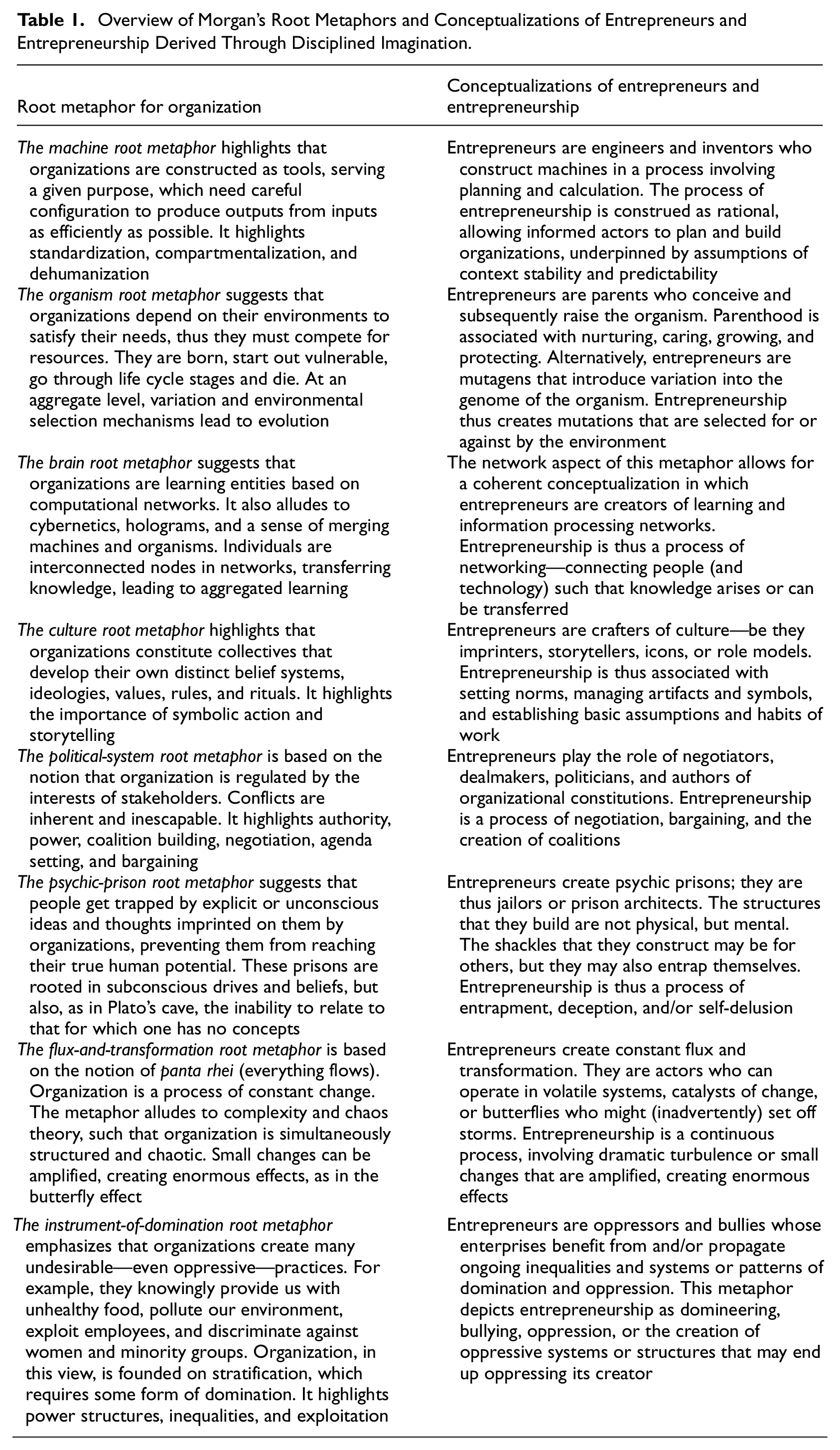
Scholars have explored a plethora of metaphors for organization, including garbage can (Cohen et al., 1972), theater, organism, psychic-prison (Morgan, 1980), jazz band, missionaries (Akin & Schultheiss, 1990), soap bubbles (Tsoukas, 1993), spheres of conviviality (Jermier & Forbes, 2016) and a wonderland (McCabe, 2016), but only a few metaphors have been established as root metaphors for organization. Morgan (1986, 2006) outlined a set of eight established and thoroughly documented root metaphors for organization used in management studies (Kemp, 2016; Pinto, 2016; Putnam et al., 1999)—machine, organism, brain, culture, political system, psychic-prison, flux and transformation, and instrument of domination (for a summary of these metaphors, see Table 1). While researchers often refer to these metaphors as “Morgan’s metaphors” (and we do too), it is important to recognize that they represent aggregate thought patterns that Morgan (1986) identified in the literature rather than his own ideas about how we ought to think about organizations (Morgan, 2016a). 1 For each root metaphor, Morgan (2006) provided ample explanations and evidence of existing literature that draws on it.
Overview of Morgan’s Root Metaphors and Conceptualizations of Entrepreneurs and Entrepreneurship Derived Through Disciplined Imagination.
Morgan’s (2006) set has been characterized as “canonical” (Schoeneborn et al., 2016, p. 916), a “landmark” (Dell et al., 2024; Inns, 2002), and “the seminal work” on metaphors for organizations (Kemp, 2016, p. 976, emphasis in original). It has been used extensively in university teaching and has had an immense impact on research (Inns, 2002). Notwithstanding much change in the academic literature and in society since the set was first published, it is still representative of the management literature (see e.g., Morgan, 2016b; Örtenblad, Putnam, & Trehan, 2016; Örtenblad, Trehan, & Putnam, 2016), including literature that has emerged after it was first published (Örtenblad, 2024), and continues to attract research attention (Glaser et al., 2024).
Research that has proposed metaphors for organization beyond Morgan’s set has offered them either as ways of capturing how practitioners interpret organization (Akin & Schultheiss, 1990; Brotheridge & Lee, 2006) or as insightful, novel and/or “cool” ways of conceptualizing organization (Gabriel, 2005; Glaser et al., 2024; Jermier & Forbes 2016; Kemp, 2016; McCabe, 2016; Pinto, 2016; Tsoukas, 1993). This search for novelty is understandable and has many benefits, but novel metaphors do not qualify as root metaphors in the sense of being embedded in the literature (Morgan, 2016a). 2 To date, Morgan’s (2006) root metaphors are the only ones widely accepted as such, and it is not clear that any metaphor developed since would qualify as an addition to the set (Örtenblad, 2024).
For the purposes of our study, Morgan’s (2006) root metaphors have the benefit of being a coherent and comprehensive set that has been widely available for borrowing since the emerging institutionalization of the entrepreneurship field (Örtenblad, Putnam, & Trehan, 2016; Örtenblad, Trehan, & Putnam, 2016; Schoeneborn et al., 2016). This set is particularly useful because it functions when applied both to individual organizations and to the process of organizing in a more abstract sense, which makes it relevant to notions of entrepreneurship, whether conceptualized as the act of creating new organizations (Gartner, 1989), the act of changing existing organizations (Sharma & Chrisman, 1999), or in the more abstract sense of instigating new economic activity in the pursuit of entrepreneurial opportunities (Carlsson et al., 2013; Shane & Venkataraman, 2000; Wiklund et al., 2011). Given that the management field is, by far, the most influential external field in mainstream entrepreneurship research (Lundmark et al., 2019), it makes sense to start investigations into how root metaphors from neighboring fields are expressed in our field by studying how Morgan’s (2006) set is used in mainstream entrepreneurship research.
Methodology
Collecting a Corpus of Entrepreneurship Articles
To collect a corpus of mainstream entrepreneurship articles, we followed Lundmark et al. (2019) and selected the entrepreneurship articles that had received the highest number of citations from articles published in the seven most well-regarded core entrepreneurship journals in the 10-year period between 2013 and 2022. 3 The selected articles could be published in any journal as long as they were highly cited in these seven entrepreneurship journals in the studied 10-year period. For example, the most cited entrepreneurship article in our corpus is by Shane and Venkataraman (2000), which is published in the Academy of Management Review. We sorted the resulting list of articles from high to low citations. We moved down the list until we reached 100 articles. Some articles in our list had the same citation count, so we ultimately included 102 articles in our corpus, each cited between 84 and 511 times in the 7 journals in the last 10-year period (N.B., the articles in our corpus had considerably more Google Scholar citations, ranging between roughly 700 and 22,000). Appendix A presents an overview of the journals represented, and Appendix B presents a list of all the articles in our corpus. As Appendix A demonstrates, entrepreneurship journals, primarily Entrepreneurship Theory and Practice and Journal of Business Venturing, dominate our corpus, accounting for 47% of the articles within it, followed by management journals (40%), and economics (5%). Other fields, such as finance, psychology, and sociology, are only marginally represented.
Deriving Entrepreneurs and Entrepreneurship From Root Metaphors for Organization
Our aim was to identify if and how Morgan’s (2006) metaphors are used in the mainstream of the entrepreneurship field. Morgan’s (2006) metaphors could be expressed in the corpus in two ways: directly and indirectly. First, the corpus could contain text that directly indicates a conceptualization of organization as per one or more of these metaphors. Second, the corpus could contain text that indirectly indicates the usage of one or more of Morgan’s (2006) metaphors through a conceptualization of entrepreneurs or entrepreneurship that could be derived from these metaphors. Therefore, we sought to map out a guide for our coding of indirect usage. To establish a set of such derivative conceptualizations of entrepreneurs and entrepreneurship we engaged in disciplined imagination, an approach for investigating useful analogies between two domains based on a problem statement, thought trials, and selection criteria set by the researcher (as detailed by Weick, 1989 and Cornelissen, 2006a). Our problem statement was what kinds of actors create (an) organization, as framed by each of Morgan’s (2006) root metaphors, and how this in turn depicts entrepreneurship as a process. For example, if organizations were machines, entrepreneurs (as creators of organizations) would be engineers or inventors who build machines, and the process of entrepreneurship would be one of mechanical engineering using a blueprint based on calculative thinking. A summary of these thought trials is presented in Table 1.
Table 1 is based on the authors’ interpretations and, as such, is influenced by our own scholarly and cultural backgrounds. We have, however, presented our work to entrepreneurship and management scholars through conferences, seminars, and direct interactions to get a sense of potential alternative interpretations from our target community (see acknowledgments). While different interpreters occasionally used different terminology, they tended toward similar overarching conceptualizations. For example, when asked if organizations were machines what would entrepreneurs be, some have said “inventors,” others suggested “engineers,”“machine builders,” or “designers.” Asked about the organism metaphor, some have suggested “parents,” others mentioned “gardeners,” but a common theme was giving life to and nurturing organisms; some have said mutagens (i.e., those who induce mutations in organisms), others genetic scientists. In the latter case, we chose not to include it because it overlaps with the machine metaphor. 4 Table 1 is not (and cannot be) an exhaustive list of every conceivable imagined extension. Rather, it constitutes a reasonable guide for our empirical investigation into the representation of Morgan’s (2006) metaphors in mainstream entrepreneurship. We have selected a range of conceptualizations of entrepreneurs and entrepreneurship that were (1) plausible to the academic community, (2) consistent with entrepreneurs as instigators of organizations or founders of organizations, and with entrepreneurship as the process of creating organization(s) as per each root metaphor. 5
Text Analysis
Step 1: Coding of Metaphors in the Corpus of Mainstream Research
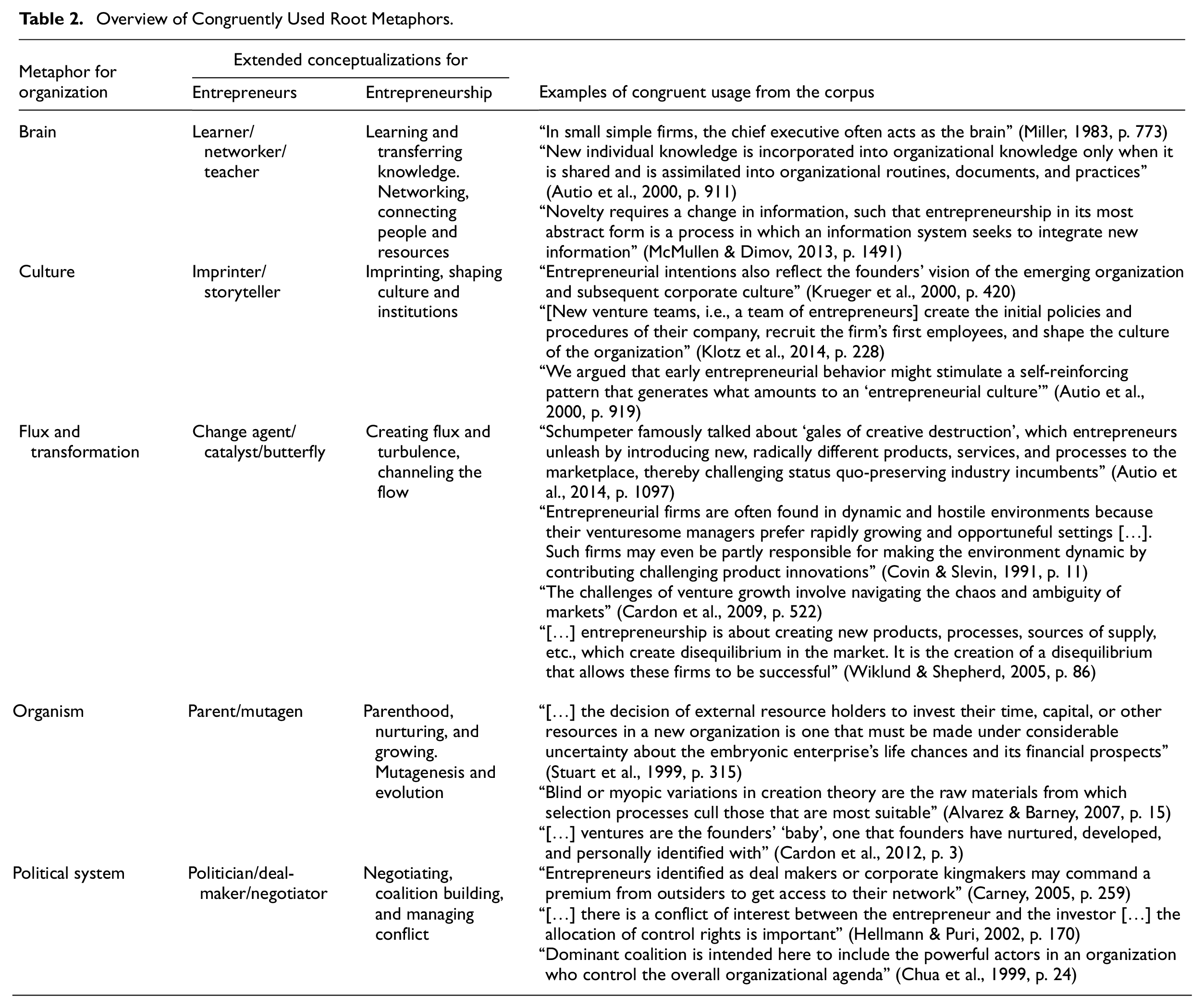
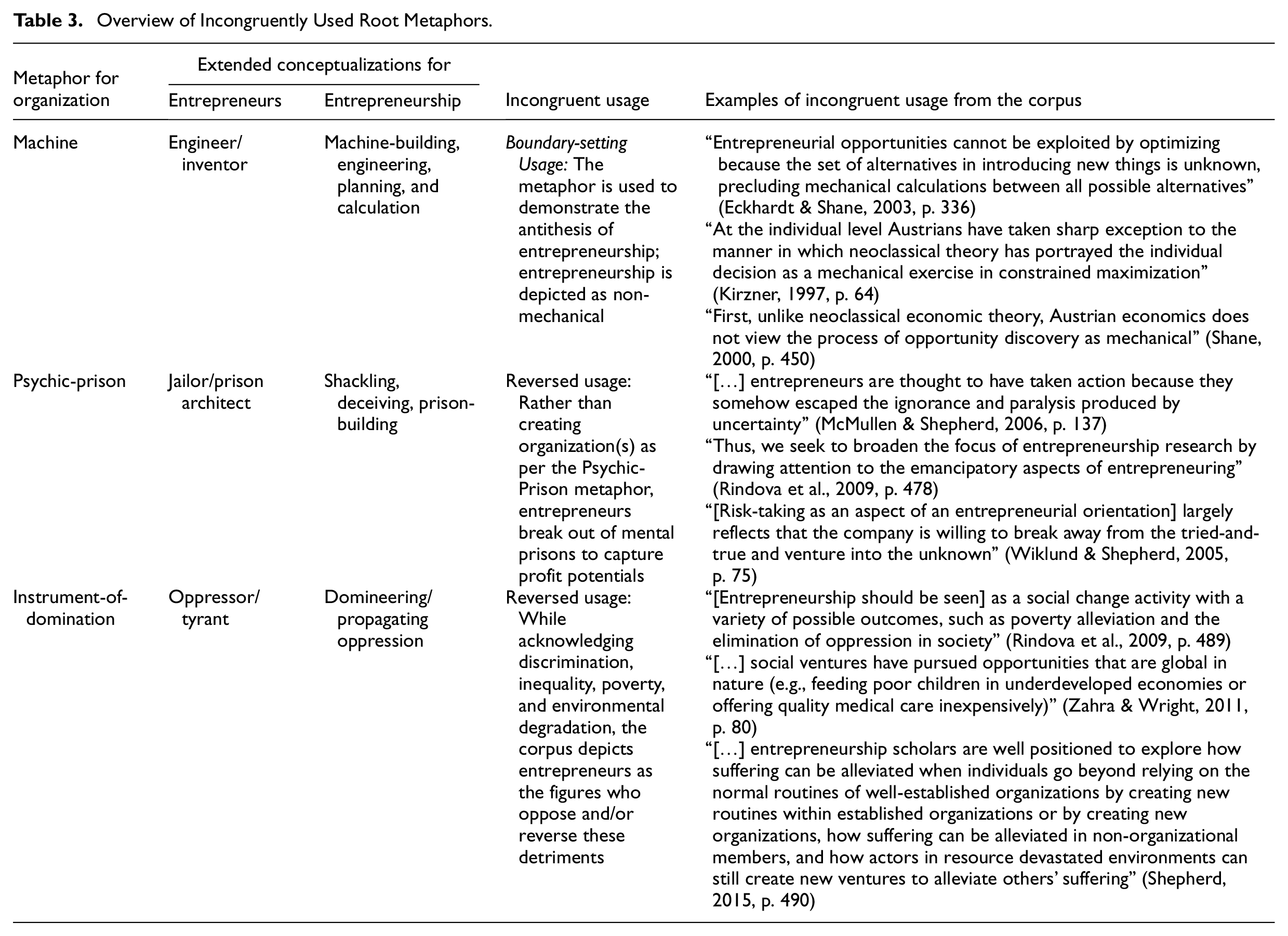
Following the deductive process of disciplined imagination, we read the articles in our corpus and identified language usage indicative of the deduced conceptualizations and Morgan’s (2006) root metaphors. For example, if a text directly referred to organizations as political objects (Fauchart & Gruber, 2011), we coded that under the Political-System root metaphor, if it referred to populations of organizations that evolve through variation and selection (Baum & Silverman, 2004), we coded that as the organism root metaphor. We also coded indirect usage of metaphors by looking at the language depicting entrepreneurs and entrepreneurship according to the conceptualizations we derived through disciplined imagination. For example, if a text referred to entrepreneurs as storytellers (Delmar & Shane, 2004; Lounsbury & Glynn, 2001), skilled cultural managers (Zott & Huy, 2007), or shapers of culture (Klotz et al., 2014), we coded that language under the Culture root metaphor. Similarly, if a text discussed inherent conflicts of interest (Hellmann & Puri, 2002), referred to the importance of political skills (Chen et al., 2009), or the importance of a dominant coalition (Chrisman et al., 2012), we coded that under the Political-System root metaphor (See Tables 2 and 3 for additional examples). 6 Like Lundmark et al. (2019), we included allusions from authors quoting or paraphrasing other sources, as this still propagates thought patterns.
Overview of Congruently Used Root Metaphors.
Overview of Incongruently Used Root Metaphors.
Like previous research (Lundmark et al., 2019), we found that many articles exhibited expressions related to several metaphors. There were also specific expressions that could be seen as reflections of more than one root metaphor. For example, texts referring to how entrepreneurs imprint organizations could be seen as expressions of the Culture metaphor or the Organism metaphor (via the derivative metaphor of entrepreneurs as parents). In some cases, such ambiguity could be resolved by the context in which it was expressed. In cases where it could not, we coded texts as relating to each of the metaphors. We evaluated root metaphors’ presence at the community level of analysis (Cameron, 2008) and therefore considered a root metaphor as present in the corpus when there were several sources containing language reflexive of the root metaphor. Consequently, any ambiguity in whether a specific text referred to a particular metaphor was never influential in determining whether a metaphor was identified in the corpus.
Step 2: Analysis of Congruent and Incongruent Usage of Metaphors
Next, we inductively analyzed how the coded texts related to underlying root metaphors. We looked for patterns in the corpus to identify congruent or incongruent usage of the metaphors. Congruent usage of the metaphor means that the thought patterns expressed were similar to those in management and organization studies as documented by Morgan (2006) and to the extensions derived by disciplined imagination. For example, depicting organizations as organisms that are exposed to evolutionary selection forces would be congruent usage of the organism metaphor (because that is how the metaphor is depicted by Morgan, 2006); depicting entrepreneurs as parents that protect or nurture their young organizations would also be congruent usage (because this is similar to the depictions we derived through disciplined imagination). Incongruent usage of the metaphor means that the thought patterns expressed indicated usage of the metaphor but in a way that deviates from the patterns in management studies as documented by Morgan (2006) or the extensions of these derived from disciplined imagination. For example, depicting entrepreneurship as the antidote to domination (Rindova et al., 2009) is an incongruent usage of the instrument-of-domination root metaphor. We also coded depicting entrepreneurs as those who oppose domination as an incongruent usage of this metaphor because this is contrary to the conceptualization of entrepreneurs as those who create instruments of domination. Incongruent usage was also noted when the metaphor was drawn upon in a congruent way, but the text expressed disapproval of the metaphor, such as stressing that entrepreneurship is not mechanical.
We focused our analyses on incongruent usages of the root metaphors as these carried the largest potential for new insights and alternative stories. We investigated the arguments articulated by the incongruent usages of a root metaphor, what sentiments were expressed about it, and the level of coherence in these thought patterns between different texts demonstrating similar usages. We also assessed the references drawn upon in association with incongruent usage. We investigated the extent to which incongruent usage related to sentiments expressed by the field’s most influential scholars’ foundational works written before the institutionalization of the entrepreneurship field (Landström et al., 2012), including Knight (1921/2002), Schumpeter (1934/2008, 1942/2008), Baumol (1968), and Kirzner (1973). The incongruent usage of the root metaphors is summarized in Table 3.
Morgan’s Canon of Root Metaphors in Mainstream Entrepreneurship Research
In this section, we show how the root metaphors in the canon outlined by Morgan (2006) are used in the studied corpus. We first outline how mainstream entrepreneurship research has congruently used the Brain, Culture, Flux-and-Transformation, Organism, and Political-System root metaphors. This is followed by a subsection each outlining how the Machine, Psychic-Prison, and Instrument-of-Domination root metaphors have been incongruently used.
Congruently Used Root Metaphors
The texts in our corpus invoke the Brain metaphor by portraying organizations as learning entities (Autio, et al., 2000; McGrath, 1999; Yli-Renko et al., 2001; Zahra et al., 2000). Invocations of this root metaphor are also consistent with the notion that entrepreneurs build networks (Davidsson & Honig 2003; Hoang & Antoncic 2003) that transfer knowledge and information (Baum et al., 2000; Sirmon & Hitt, 2003; Yli-Renko et al., 2001). Entrepreneurship thus creates new connections and combinations that lead to aggregated learning (Acs et al. 2009; McMullen & Dimov, 2013).
The texts in our corpus invoke Culture at the national (Bruton et al., 2010; Hayton et al., 2002), regional (Spigel, 2017), and organizational levels (Autio et al., 2014; Covin & Slevin, 1991; Ireland et al., 2003; Zott & Huy, 2007). Entrepreneurs’ values and behaviors influence the imprinting of culture on organizations (Fauchart et al., 2011; Klotz et al., 2014), and entrepreneurs engage in storytelling and symbolic action to harness culture (Delmar & Shane, 2004; Lounsbury & Glynn, 2001; Zott & Huy, 2007). The literature examines how to foster entrepreneurial cultures across levels of analysis (Ireland et al., 2003).
Although our study examines the Flux-and-Transformation root metaphor as an exogenous root metaphor, elements of it are endogenous to the entrepreneurship field, as entrepreneurship research has contributed to the development of the root metaphor. Notably, Morgan (2006) highlights Joseph A. Schumpeter’s texts as central contributions to the development of the Flux-and-Transformation root metaphor. In particular, Schumpeter’s rejection of equilibrium and focus on creative destruction are central to the conceptualization of organization as being in constant flux. Researchers frequently invoke this conceptualization in our corpus (Delmar & Shane, 2004; Eckhardt & Shane 2003; Shane & Venkataraman, 2000) and conceptualize entrepreneurs as those creating the dynamism associated with disequilibrium (Autio et al., 2014; Wiklund & Shepherd, 2005). However, the texts in our corpus also contain many allusions to other aspects of the Flux-and-Transformation root metaphor, such as chaos and complexity (Cardon et al., 2009; Sarasvathy, 2001), turbulence (Miller, 1983), and change and transformation (Bird 1988). They thus conceptualize entrepreneurs as both creators of flux and those who direct its flow.
The texts in our corpus make many allusions to the Organism root metaphor through the two derived conceptualizations: parenthood and mutagens. For example, they reference the viability of embryonic enterprises (Stuart et al., 1999), and the DNA of organizations, as shaped and altered by entrepreneurs (Alvarez & Busenitz, 2001) through a blind process (Alvarez & Barney, 2007) in which the organizational environment selects for or against resulting mutations (Baum & Silverman, 2004; Arenius & Minniti, 2005). The corpus also refers to organizations, after their birth, going into incubators, then progressing through life cycles (Autio et al., 2014; Cooper et al., 1994; Klotz et al., 2014; McMullen & Dimov, 2013). Entrepreneurs, in these conceptualizations, play formative roles as nurturers of their organizations (Cardon et al., 2009, 2012; Cooper et al., 1994; Klotz et al., 2014), and become attached to organizations such as a parent to a child (Cardon et al., 2012; Shepherd, 2003).
Finally, the texts in our corpus frequently allude to the Political-System root metaphor. They depict organizations as political entities, made up of different coalitions (Chrisman et al., 2012; Fauchart & Gruber, 2011), and entrepreneurs as actors who rely on political contacts (Carney, 2005), face inherent conflicts of interest (Hellmann & Puri, 2002), lobby stakeholders (Bruton et al., 2010; Zimmerman & Zeitz, 2002), and rely on political skills (Chen et al., 2009) to create dominant coalitions (Chua et al., 1999).
The Machine Root Metaphor: Boundary-Setting Usage
Management studies often allude to the Machine root metaphor (Cornelissen et al., 2005). It appears repeatedly in our corpus as well. However, the texts in our corpus often invoke this root metaphor to demonstrate what entrepreneurship is not, casting Machine-related concepts as the antithesis to all things entrepreneurial. Several articles associate entrepreneurial firms with organic characteristics and non-entrepreneurial firms with mechanistic characteristics (e.g., Covin & Slevin 1989, 1991; Miller, 1983; Lumpkin & Dess, 1996; Zahra et al., 2000). For example, Miller (1983, p. 774) claimed that “The Planner’s natural compulsion to pursue efficient and mechanical operation will then thwart entrepreneurship.”
Furthermore, the texts in our corpus contrast entrepreneurial bricolage and effectuation with engineering and causation based on prediction (Baker & Nelson, 2005; Sarasvathy, 2001). They cast planning and calculation as unlikely or impossible for entrepreneurs and their organizations because of the nature of entrepreneurial opportunities. For example, Eckhardt and Shane (2003, p. 336) stated: “Entrepreneurial opportunities cannot be exploited by optimizing because the set of alternatives in introducing new things is unknown, precluding mechanical calculations between all possible alternatives.”Acs et al. (2009, p. 15) quoted G. L. S. Shackle to a similar effect: “The entrepreneur is a maker of history, but his [sic] guide in making it is his [sic] judgment of possibilities and not a calculation of certainties.”
In one notable exception to the trend of boundary-setting usage of the Machine root metaphor, several texts in our corpus refer to entrepreneurship as “the engine” (e.g., Austin et al., 2006; Ireland et al., 2003; Shane & Venkataraman, 2000; Wiklund & Shepherd, 2005). However, these metaphors do not emphasize the mechanical aspects of entrepreneurship but instead, serve to emphasize the relationship between entrepreneurship and economic growth. This usage of the engine metaphor seems to stem from Schumpeter (1934/2008), as the texts in our corpus frequently reference this work next to instances of this conceptualization. 7 This is striking, as subsequent scholars have characterized Schumpeter as a scholar who rejected mechanical notions of entrepreneurship (Baumol, 1968; Coşgel, 1996). Like Schumpeter, several scholars in our corpus who alluded to the engine metaphor also contrasted the entrepreneurial with the mechanistic. For example, Shane and Venkataraman (2000, p. 222) portrayed the Schumpeterian entrepreneur as an engine of change, yet contended that “the discovery of entrepreneurial opportunities is not an optimization process by which people make mechanical calculations in response to a given a set of alternatives imposed upon them.” Usages of the engine metaphor in our corpus are thus mostly superficial, failing to evoke further mechanistic elements or even rejecting such elements. Rather, these allusions tend to be code for the idea that entrepreneurship leads to growth.
Beyond the works of Schumpeter, the texts in our corpus allude to other foundational works on entrepreneurship that similarly use the Machine root metaphor in boundary-setting ways. For example, Knight (1921/2002, p. 268) claimed that with “uncertainty absent […] all organic readjustments would become mechanical, all organisms automata.”Baumol (1968, p. 68) similarly distinguished entrepreneurship from management, with the manager portrayed as “a calculating robot, a programmed mechanical component in the automatic system that constitutes the firm.” Likewise, Kirzner (1973, p. 35) claimed that “It is this entrepreneurial element that is responsible for our understanding of human action as active, creative, and human rather than as passive, automatic, and mechanical.” Thus, the boundary-setting usage of the Machine root metaphor is rooted in the foundational entrepreneurship literature.
The Psychic-Prison Root Metaphor: Reversing the Metaphor
The Psychic-Prison root metaphor (Morgan, 2006) hinges on the idea that we can only access the world through imperfect representations. This notion is well represented in our corpus as well. For example, Shepherd (2015, p. 491) claimed that “individuals (i.e., entrepreneurs, scholars, and all others) can only access the real world through the mental world […] people strive for truth but never achieve it.” Therefore, entrepreneurs operate under mental constraints based on what they believe about the world. Yet while the Psychic-Prison root metaphor would suggest that entrepreneurs construct these mental constraints for the organizations they create, the texts in our corpus portray entrepreneurs as individuals who break out of existing mental prisons and thus see what others cannot. This reversal differs from the boundary-setting usage of the Machine root metaphor, as the metaphor is still used in our corpus to describe what entrepreneurship is (i.e., the act of breaking out of mental prisons) as opposed to what entrepreneurship is not (i.e., mechanical).
The texts in our corpus often depict entrepreneurs as unique figures by dint of their perceptiveness, knowledge, or other characteristics that help them break free from the constraints of ingrained ways of thinking (e.g., Ardichvili et al., 2003; Eckhardt & Shane 2003; Shane, 2000). Such views imply that “people who have acted entrepreneurially are seen to possess a more accurate picture of reality than those individuals who have not” (McMullen & Shepherd, 2006, p. 137). The texts in our corpus also frequently allude to entrepreneurship as a process of breaking out of the mental prisons of mundane practices that shape other organizations and offering innovative ideas that break with the past. For example, Rindova et al. (2009, p. 481) stated that entrepreneurship “involves creating and amplifying cracks in otherwise stable (and potentially rigidified) social and economic relationships that impose constraints on certain types of activities that the entrepreneur him/herself and other members of their social world may value.”Ireland et al. (2003, p. 968) associated entrepreneurship with “flashes of superior insight,” and claimed that entrepreneurial leaders challenge dominant logics. The idea of the Psychic-Prison root metaphor also resonates with the idea that entrepreneurs, through bricolage, break past mental limitations imposed by others. Thus entrepreneurs “create something out of nothing” by refusing “to enact limitations imposed by dominant definitions of resource environments” (Baker & Nelson, 2005, pp. 329–330). The idea that entrepreneurs break out of mental prisons through alertness stems, judging by the reference trail, from the work of Kirzner (1973).
The Instrument-of-Domination Root Metaphor: Reversing the Metaphor
A few articles in our corpus acknowledge that entrepreneurship can, under certain circumstances, have negative consequences (e.g., Baumol, 1996; Mair & Marti, 2009; Shepherd, 2015; Zahra et al., 2009). However, none built on the notion, conveyed in Morgan’s (2006) Instrument-of-Domination root metaphor, that organizing involves domination and subordination. Some texts in our corpus acknowledge oppression in the forms addressed in the Instrument-of-Domination root metaphor by Morgan (2006), such as discrimination, inequality, poverty, and environmental degradation (Austin et al., 2006; Mair & Marti, 2006, 2009; Shepherd, 2015; Zahra et al., 2009). However, they do not depict such oppression as an outcome of entrepreneurship. Texts that allude to oppression portray entrepreneurship as non-oppressive; for example, McMullen and Dimov (2013, p. 1494–1495) stated, “entrepreneurship is a two-sided transaction as opposed to a one-sided action and therefore entrepreneurship is better classified as a voluntary act of choice as opposed to a coercive act of force.” Predominantly, the corpus portrays social or compassionate entrepreneurship as solutions to oppression (Austin et al., 2006; Mair & Marti, 2006, 2009; Shepherd, 2015; Zahra et al., 2009).
Interestingly, the same articles that discuss the liberating potential of social and compassionate entrepreneurship are also the ones that hint at potential negative consequences of entrepreneurship. However, these acknowledgments are typically afterthoughts to the texts’ central thrust toward portraying entrepreneurship as resistance, emancipation, and the solution to oppression. For example, Rindova et al. (2009) acknowledged that entrepreneurs who seek independence may end up recreating the same oppressive structures they tried to escape. Zahra et al. (2009) warned that social entrepreneurs may face fewer checks and balances than “business entrepreneurs,” and that predispositions among some social entrepreneurs may drive them to act unethically. Shepherd (2015, p. 503) proposed that scholars “look to the ‘flipside’ of dominant streams of research,” for example, asking why “some use entrepreneurial action to destroy value, exploit the vulnerable, and/or harm nature?”
Articles that do not focus on social entrepreneurship tend to portray entrepreneurship as a driver of economic growth and/or innovation without acknowledging potential downsides, especially possible oppression, discrimination, and environmental degradation. Baumol (1996) is the exception to this trend, acknowledging that entrepreneurship can be unproductive and even destructive—but even he argued that this can be avoided, provided the right incentives are in place. Baumol (1996) notably also claimed that entrepreneurs are “persons who are ingenious and creative in finding ways that add to their own wealth, power, and prestige.” Yet he expressed little concern for how such persons manage their subordinates, or how their actions influence the natural environment. Rather, he suggested that entrepreneurs will turn criminal if taxes are too high, and that a legal system can help to avoid unproductive entrepreneurship by minimizing incentives for unproductive litigation.
Overall, our analysis identified some recognition of the existence of discrimination, inequality, poverty, and environmental degradation, but entrepreneurs were predominantly portrayed as remedies to these ills. Thus, similarly to the Psychic-Prison root metaphor, we observed a reversal of the Instrument-of-Domination root metaphor, casting entrepreneurs as actors who destroy instruments of oppression rather than create them. This is striking given that the exceptionally influential works of Schumpeter repeatedly engage with critical theory and allude to oppressive aspects of entrepreneurship. Specifically, Schumpeter (1942/2008) actively engaged with Marxist ideas and investigated how different systems of organization lead to different forms of domination and control, including the creative destruction inherent in entrepreneurial capitalism. Schumpeter (1934/2008, p. 93) highlighted that entrepreneurship is driven by factors such as the “will to conquer […] to prove oneself superior to others” and to create the closest thing to “medieval lordship possible to modern man.” Thus, the absence of critical analysis of the inherent domineering aspects of entrepreneurial organizing cannot be attributed to the absence of such analysis in the foundational entrepreneurship literature.
Discussion
This study has empirically investigated how root metaphors for organizations from management studies have been used in mainstream entrepreneurship research. We have shown that each of the established root metaphors for organization evokes conceptualizations of entrepreneurs and entrepreneurship and that most—but not all—of those conceptualizations congruently appear in a corpus of the most central entrepreneurship articles. In the next section, we show how the root metaphors that have been used incongruently in mainstream entrepreneurship research can generate alternative areas of research largely overlooked in the mainstream and provide alternative perspectives on familiar phenomena. Thereafter, we focus on how mainstream entrepreneurship research has reversed the two metaphors that are generally considered to cast organizations in a negative light by scholars—the Psychic-Prison and Instrument-of-Domination metaphors (Örtenblad, 2016a). We show how the reversal of the negatively charged metaphors has embedded a positive root metaphor—organizations as instruments of emancipation—into the literature and discuss how it can contribute to the established canon of metaphors for organization(s). We then reflect on the limitations of our study and the future of reflexive entrepreneurship research before summing up our contributions in the conclusion.
The Odd Ones Out: Using the Incongruently Used Root Metaphors Congruently
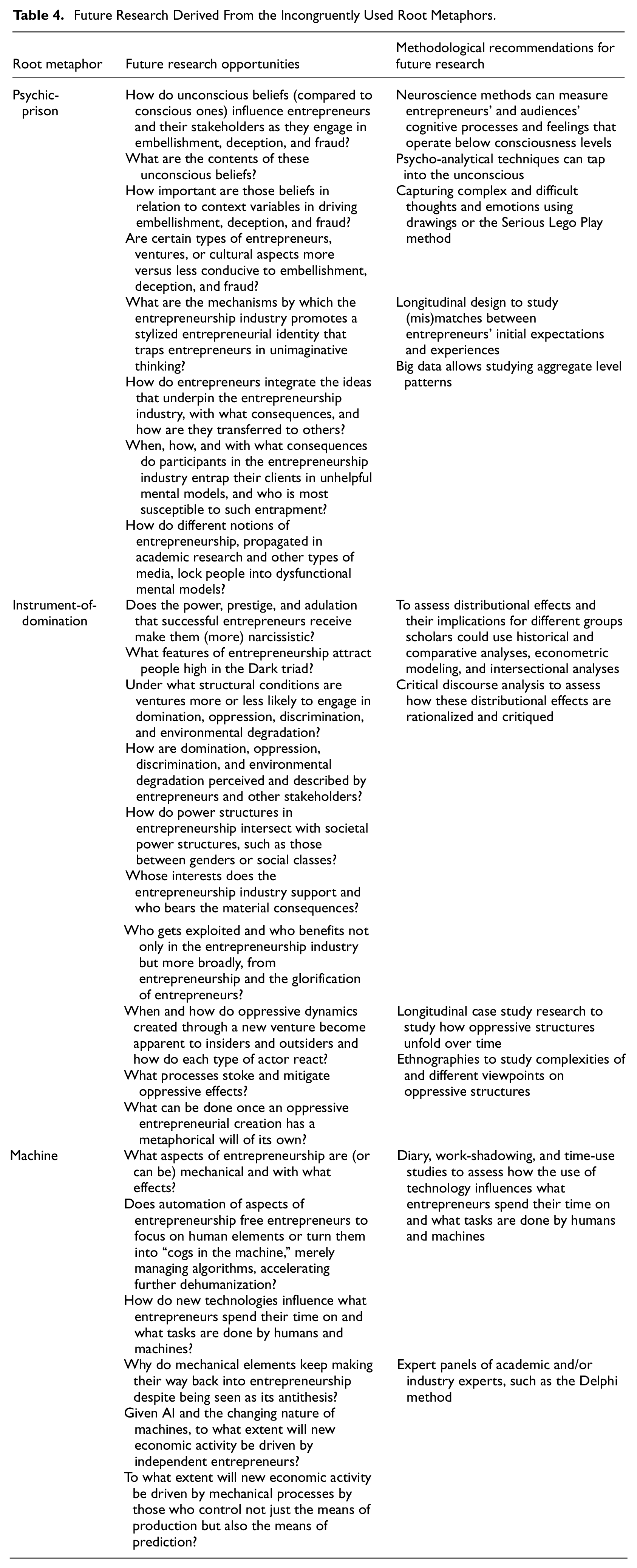
In this section, we explore each of the incongruently used root metaphors and discuss what their congruent usage would entail for mainstream entrepreneurship research. This can manifest in two ways. First, it can help us explore areas commonly overlooked in mainstream entrepreneurship research (Brattström & Wennberg, 2022). Second, it can help us reframe familiar areas of research. While we agree that “a more empirically grounded research agenda” (Brattström & Wennberg, 2022, p. 1444) is important for the field, the true power of root metaphors is in facilitating reflexivity about how we approach our empirical contexts and make sense of our findings. Root metaphors are intertwined with our basic assumptions and therefore they influence not only what we pay attention to but also how we make sense of our observations (Boxenbaum & Rouleau, 2011; Lakoff & Johnson, 1980; Morgan, 1980; Schumpeter, 1949; Weick, 1989). Thus, by congruently employing the incongruently used metaphors, we not only generate alternative research foci but also highlight how they provide different, if sometimes uncomfortable, perspectives when applied to familiar phenomena. Rather than providing an exhaustive list of foci and alternative perspectives, which is beyond the scope of this article, we provide examples to show the generative power of these root metaphors (Schön, 1979). That is, we offer these root metaphors as metaphorical fishing rods and show how to use them rather than filling the field’s buckets with fish. An overview of the derived research foci is presented in Table 4.
Future Research Derived From the Incongruently Used Root Metaphors.
Exploring the Psychic-Prison Root Metaphor
The reversal of the Psychic-Prison root metaphor indicates that the focus on how entrepreneurs break out of mental prisons may have blinded the mainstream to practices whereby entrepreneurs create mental structures that entrap themselves and/or their stakeholders. Yet, such practices can easily occur when entrepreneurs start out with little more than an idea and need to instill beliefs in their prospects among stakeholders, which may involve embellishments and conscious or unconscious falsehoods (Janeway, 2021). While entrepreneurial framing is a central practice in entrepreneurship (Snihur et al., 2022), it can lead to deception (Garud et al., 2025), including fraud (Carreyrou, 2018; Liubertė & Dimov, 2021; Morse, 2019). Research on such topics is emerging (e.g., Garud et al., 2025; Gehman & Wry, 2022; Palmer & Weiss, 2022; Shepherd et al., 2022) but remains largely conceptual and is mostly published outside entrepreneurship journals (Scheaf & Wood, 2022, p. 625).
Existing research implicitly assumes that entrepreneurial embellishment, deception, and fraud are conscious behaviors. Future research could benefit by drawing on the Psychic-Prison root metaphor’s ideas about the power of unconscious beliefs and the relational dynamics maintaining them. Unpacking the unconscious is methodologically challenging, but there are ways of studying it. For example, neuroscience methods can enable scholars to measure cognitive processes and feelings that operate below consciousness levels (Massaro et al., 2020; Lahti et al., 2019). Alternatively, scholars can borrow from psycho-analytical techniques to tap into the unconscious (Board, 2014; Rustin, 2019) or engage respondents to share difficult thoughts and emotions using drawings (Clarke & Holt, 2017) or the Serious Lego Play method (Casteleijn-Osorno, 2024).
The metaphor can also help us understand entrepreneurship differently by exploring aggregate and culturally shared psychic prisons. Specifically, the hype around successful entrepreneurs may have created an institutional psychic-prison of its own, rooted in a higher-level ideology of what entrepreneurship is and what behaviors lead to entrepreneurial success. For example, Pedersen et al. (2022, p. 1) suggested that aspiring entrepreneurs can be trapped by this ideology and “struggle to break out of the illusions” it creates. Indeed, there is a critique that the entrepreneurship industry—“the goods and services explicitly intended for opportunity discovery and development by current and prospective entrepreneurs” (Hunt and Kiefer (2017, p. 233)—traps entrepreneurs in unimaginative thought patterns (Hartmann et al., 2022).
Applying the Psychic-Prison root metaphor to the entrepreneurship industry prompts us to ask when, how, and with what consequences participants in the entrepreneurship industry, such as influencers and coaches (many of them entrepreneurs themselves), deliberately or unwittingly, entrap their audience in unhelpful mental models. It also prompts us to examine the mechanisms by which the entrepreneurship industry blinds entrepreneurs to their own “unproductiveness” (Hartmann et al., 2022, p. 32). While research has found that following influencers can create feelings of increased self-efficacy, optimism, and persistence in the face of adversity among entrepreneurs (e.g., D’Oria et al., 2025), the Psychic-Prison root metaphor prompts us to ask when those feelings are illusory or detrimental. A strong belief in one’s own agency could legitimize sleep deprivation and 24-7 hustle, ultimately resulting in possible burnout or depression (Cubbon et al., 2021). To study such questions, scholars could employ longitudinal designs to study entrepreneurs’ mental models and how they affect mental health and self-worth over time (e.g., Muñoz et al., 2023). Another avenue is big data (Schwab & Zhang, 2019) to study aggregate level patterns. For example, connecting different dominant entrepreneurship narratives in media with generational, regional, and religious characteristics and how these relate to the mental models of entrepreneurs and their effects.
Exploring the Instrument-of-Domination Root Metaphor
Recent research suggests depicting entrepreneurs as villains to counteract the positive bias in entrepreneurship research (Kibler & Laine, 2024; Shepherd, 2019). This idea aligns with the Instrument-of-Domination root metaphor and with empirical findings that those high in Dark Triad traits—Machiavellianism, narcissism, and psychopathy—are more inclined toward entrepreneurship (Brownell et al., 2021). Yet, this root metaphor prompts us to look beyond individual villains toward systemic factors. For example, do the power, prestige, and adulation that successful entrepreneurs receive make them (more) narcissistic (Cragun et al., 2020), and what features of entrepreneurship attract people high in the Dark triad?
The root metaphor directs our attention to structural, rather than individual, factors that enable domination, oppression, discrimination, and environmental degradation. To illustrate, if workers are overworked and underpaid in an industry, it may be difficult for any single entrepreneur to change employment conditions as that could make the venture uncompetitive (Fontaine, 2018). Likewise, without coordinated collective efforts, individual ventures may not be able to reduce greenhouse gas emissions (Lundmark & Audretsch, 2024). Thus, future research could study what structures enable and inhibit domination, oppression, discrimination, and environmental degradation in entrepreneurship and how such practices are perceived and described by entrepreneurs and other stakeholders. How do power structures in entrepreneurship intersect with societal power structures, such as those between genders or social classes? How does the power balance between entrepreneurs and investors, or between entrepreneurs and employees, influence the prevalence and nature of oppression? For example, entrepreneurs may be incentivized to act like villains through investor pressures, such as rapidly employing many people to “Blitz scale,” only to fire them shortly afterward when they are no longer needed. 8
This root metaphor can also help nuance the assumption that entrepreneurship is a guaranteed net positive (Corbett, 2016). As Kibler and Laine (2024) pointed out, Schumpeterian creative destruction, by definition, has a destructive side—as experienced by those entrepreneurs, employees, or other stakeholders who are made redundant by better, more efficient, or simply more alluring products and services. More broadly, inequality is seen as a driver of entrepreneurship, and entrepreneurship is a driver of inequality (Lippmann et al., 2005). Thus, any claim about the net effect of entrepreneurship must consider the distributional effects—the Instrument-of-Domination root metaphor puts these effects into focus. Entrepreneurship scholars could use historical and comparative analyses, econometric modeling, and intersectional analyses to assess distributional effects and their implications (Kibler & Laine, 2024; Piketty, 2014; Romero & Valdez, 2016), and critical discourse analysis to assess how distributional effects are rationalized and critiqued (Essers et al., 2017).
Furthermore, this root metaphor provides a different perspective on the entrepreneurship industry than the Psychic-Prison root metaphor, by asking what power structures are at play, whose interests the industry supports, and who bears the material consequences. For example, Hartmann et al. (2022) suggested that the entrepreneurship industry may lock failing entrepreneurs in cycles of iterative attempts, often at high personal, social, or financial costs, by offering them more products to keep consuming (and keep failing). The Instrument-of-Domination root metaphor prompts us to consider who gets exploited and who benefits materially from entrepreneurship and the glorification of entrepreneurs.
Finally, while entrepreneurs may well be the victims of inherent power structures, entrepreneurs may also be those who create those structures. For example, as Zuboff (2019) has thoroughly documented, the logic of Google’s business model developed a momentum of its own, effectively creating widespread imperatives to gather ever more data about people to increase the possibilities of manipulating their thoughts and actions. These imperatives now underpin much of our social media landscape, where users do not pay and therefore their interests are trumped by those of advertisers, who do pay (Bakshy et al., 2015; Zuboff, 2019). Using the Instrument-of-Domination root metaphor, future research could ask questions about when and how oppressive dynamics become apparent, how stakeholders react, and what can be done once an entrepreneurial creation has a metaphorical will of its own. Entrepreneurship scholars could use methodologies, such as longitudinal case study research (e.g., Jack, et al., 2008) to study how oppressive practices develop over time, and ethnographies (e.g., Reveley et al., 2004) to study the complexities of such practices.
Exploring the Machine Root Metaphor
The narratives of entrepreneurship as the antithesis of anything mechanical reject ideas related to the machine metaphor, even when there is evidence in their favor. For example, business planning has given way to alternatives, such as the lean-startup movement, which originally positioned itself as an “anti-machine” approach refuting the applicability of traditional (planning) paradigms in entrepreneurship (Blank et al, 2024). 9 Ironically, the lean-startup movement has become one of the most popular tools in entrepreneurship because of its systematic, templated, step-by-step processes (Shepherd & Gruber, 2021; Zott & Amit, 2024).
Why do mechanical elements keep making their way back into entrepreneurship despite being seen as its antithesis? While one can argue, on theoretical grounds, that there is no blueprint or playbook for venturing where no one has gone before (Lundmark & Westelius, 2014), perhaps mechanical aspects reappear because some aspects of venturing are, or can be, mechanical. For example, even disruptive ventures, which are often depicted as anything but mechanical, frequently need to scale (Coviello et al., 2024). Scaling is defined as the rapid replication of a business model (Tippmann et al., 2023)—inherently a mechanical process. Engaging with the Machine root metaphor prompts us to ask: what aspects of entrepreneurship are (or can be) mechanical and with what effects? 10 The root metaphor focuses our attention on aspects of entrepreneurship that can be compartmentalized, standardized, or even dehumanized.
The advent of large language models (LLMs) has changed the dynamics of the source domain, that is, how we understand machines. LLMs are increasingly used to automate entrepreneurial processes such as administrative tasks, gathering/analyzing data, or prototyping. Does such automation free entrepreneurs to focus on human elements or turn them into “cogs in the machine,” merely managing algorithms, accelerating further dehumanization? Going a step further, it is increasingly conceivable that machines could soon generate, explore, and test venture ideas (Davidsson & Sufyan, 2023; Mollick, 2023) or mechanistically replicate celebrity entrepreneurs, such that aspiring entrepreneurs can imitate aspects of their ventures (Short & Short, 2023). Scholars could employ work-shadowing, time-use, and diary studies to assess how technologies influence what entrepreneurs spend their time on and what tasks are done by humans and machines (Lévesque & Stephan, 2020).
Taken to its extreme, the machine metaphor could be used to expunge the hero from the entrepreneurial story (Baumol, 1968). Embracing the machine metaphor might thus compel us to reconsider the conceptualization of entrepreneurs as individuals and even as humans (Townsend et al., 2025). For instance, if machine-learning-driven tools can predict market trends or optimize operations better than humans, might we see the rise of an institutionalized function of the entrepreneur? If we take Kibler and Laine’s (2024) call for focusing on entrepreneurship as the process of change in capitalist economies (rather than the starting of ventures) seriously, the machine metaphor can help us reframe the process. As Kibler and Laine (2024) rightly pointed out, Schumpeter did much to establish the idea of the independent and heroic entrepreneur. However, by the end of his life, Schumpeter had changed his thinking and stressed the importance of research and development (R&D) within large corporations that could “routinize” innovation (Nelson & Winter, 2002; Schumpeter, 1942/2008). The advent of artificial intelligence (AI) ignites the prospect of routinized innovation at a grander scale. Thus, to what extent will new economic activity be driven by independent entrepreneurs and to what extent by mechanical processes by those who control not just the means of production but also the means of prediction? Mainstream entrepreneurship research may be unwise to reject the Machine root metaphor out of hand at a time when machines are taking on previously unconceivable roles. Scholars could employ, for example, expert panels of academic and/or industry experts, such as Delphi methods, to study these developments (Etemad et al., 2021).
Organizations as Instruments of Emancipation: Extending Morgan’s Canon
We have shown how mainstream entrepreneurship research reversed the negative metaphors and portrays entrepreneurship as a process of breaking out of mental constraints and counteracting oppression and domination (see pp. 19–22 and Table 3), in essence, depicting entrepreneurship as emancipation (Rindova et al., 2009). This resonates with an emerging strand of entrepreneurship research that suggests that entrepreneurship can be fruitfully understood as emancipation (Chandra, 2017; Jennings et al., 2016; Laine & Kibler, 2022; Muhammad et al., 2024; Williams et al., 2020). Some have gone so far as to say that the conceptualization of entrepreneurship as emancipation has become so dominant in mainstream entrepreneurship that we need to challenge it (Brattström & Wennberg, 2022), others have argued that there is resistance to this perspective (Jennings et al., 2016) and that it needs further attention (Muhammad et al., 2024). Our analysis suggests that the thought patterns underpinning the metaphor of entrepreneurship as emancipation are embedded in mainstream entrepreneurship research. 11 Entrepreneurship as emancipation thus constitutes an addition to the root metaphors identified in mainstream entrepreneurship research (in an older corpus) by Lundmark et al. (2019), indicating that this root metaphor has made it into the mainstream rather recently. Given the close links between the two fields, what are the implications of the Entrepreneurship-as-Emancipation root metaphor for management studies?
While we started this study by evoking images of entrepreneurs and entrepreneurship from root metaphors for organization, this process can be reversed. If entrepreneurship is emancipation, then organization would be an instrument of emancipation. In fact, this is also how ventures are depicted by studies that depict entrepreneurship as emancipation. For example, new ventures can help women gain autonomy to resist misogyny (Welter et al., 2017) and generally have an “emancipatory potential,” (Rindova et al., 2009, p. 484). Others noted that new and established ventures can alleviate the suffering of those in need (Shepherd, 2015; Zahra & Wright, 2011). These positive views contrast with how the established root metaphors depict organizations as either neutral or negative (Örtenblad, Putnam, & Trehan, 2016).
While our analyses have focused on mainstream entrepreneurship research (although such research is frequently published in management journals), we see no reason to limit the usage of the Instrument-of-Emancipation root metaphor to entrepreneurship studies. To organize is an important mechanism for emancipation in a range of situations. This can take varied forms, for example: the loose organization of movements such as MeToo (Ozkazanc-Pan, 2019); the formalized organization of workers’ rights entities, such as labor unions (Clawson & Clawson, 1999); or organized efforts to generate positive societal change (Ginwright & James, 2002). Like the inherent domineering or ensnaring aspects of organization, there are also inherent emancipatory aspects of organization, yet these aspects are not well covered by the established canon of root metaphors for organization (Morgan, 2006).
Overall, there are repeated allusions to entrepreneurship as emancipation and to ventures as their instruments both in the studied corpus and, more broadly, in leading entrepreneurship and management journals. The Instrument-of-Emancipation root metaphor suggests that organizations are means to overcome economic, social, institutional, or cultural constraints, achieving personal fulfillment, challenging and resisting oppression and injustice, and reaching higher levels of insight, mindfulness, and social connectedness (Chandra, 2017; Jennings et al., 2016; Laine & Kibler, 2022; Muhammad et al., 2024; Rindova et al., 2009; Williams et al., 2020). The metaphor generates derivative metaphors of entrepreneurs (e.g., revolutionary instigators and dissidents), employees (e.g., freedom fighters and rebels), and organizational processes (e.g., emancipation and resistance). It covers a positive conceptual space not covered by Morgan’s (2006) canon, it operates at the same level of abstraction as the original eight root metaphors (Örtenblad, Putnam, & Trehan, 2016), and represents thought patterns ingrained in research and fruitful in making sense of empirical observations. Taken together, there is sufficient support for the Instrument-of-Emancipation root metaphor as a useful complement (Örtenblad, 2024) to Morgan’s (2006) canon.
Emancipation in Relation to Other Root Metaphors
The Instrument-of-Emancipation root metaphor might be seen as the opposite of the Instrument-of-Domination and Psychic-Prison root metaphors in the same way as the Machine root metaphor can be seen as the opposite of the Organism (e.g., organic vs. mechanic) or the Flux-and-Transformation (e.g., orderly and predictable vs. chaotic and unpredictable) root metaphors. Yet, Morgan (2006) does not claim that some organizations are machines, others are organisms, and others still are instruments of domination. Rather, each root metaphor in Morgan’s (2006) set captures a particular perspective on organization that complements that of the others. As instruments of emancipation, organizations are not necessarily free of domination (nor culture, mechanical elements, psychic prisons, or any of the other root metaphors). Emancipation and domination are both integral aspects of organization, and thus, organizations can simultaneously function as both instruments of emancipation and domination. Rindova et al.’s (2009) exemplar of emancipation provides a concrete example of this tendency. They described how Google broke out of norms and ingrained practices. But, as discussed above, Google played a prominent role in creating the imperatives to gather ever more data about people to manipulate them. Rindova et al. (2009) noted that the etymology of the word emancipate stems from the idea of taking ownership of oneself—transitioning from someone traded to someone who trades. As the saying goes, “if you’re not paying for it; you are the product.” If that is true, Google has specifically turned most of us into something traded, in effect reversing emancipation. Whether we see Google as an instrument of emancipation or domination depends as much on our own mental models as on what Google does.
Limitations, Final Reflections, and the Future of Reflexive Entrepreneurship Research
We have studied a select corpus of the most frequently cited entrepreneurship articles where the cites come from the most well-regarded entrepreneurship journals. They represent what the mainstream of the research community frequently retells (Lundmark et al., 2019). When we note that there are areas that are not represented in this corpus, there may still be entrepreneurship studies in such areas. Sometimes, such research has been conducted but is too new to have attracted enough citations in the most well-regarded entrepreneurship journals. Lack of representation may also reflect that the most well-regarded journals resist such research, or that those who publish in those journals are not aware of or have for other reasons refrained from referencing this research. We have aimed to provide examples of such emerging or ignored research.
It is also important to note that what we have referred to as biases and blind spots represent areas that one field covers, whereas the other does not. Our findings suggest that mainstream entrepreneurship research has a positive bias when seen from the perspective of management studies, but the opposite is also true. From the perspective of mainstream entrepreneurship research, management studies have a negative bias. Because the root metaphors influence what we “see,” there is no neutral ground from which to “objectively” assess these biases (Lundmark et al., 2022). The merit of our research is that it provides a systematic analysis of mainstream entrepreneurship research and points of comparison from management studies. The ambition is not to determine which field is more or less biased. Rather, we aim to facilitate field-level reflexivity about what gets the most attention and what we have downplayed or ignored in mainstream entrepreneurship research based on the comparison points. We also provide metaphorical tools to reflect on and explore those areas. The identified reversal of the negative root metaphors into a positive one is aligned with quantitative analyses that show that leading entrepreneurship journals are characterized by a notably more positive tone than leading management journals (Lundmark et al., 2022). Thus, the observed reversal may be an example of how such a positive tone is maintained. This difference in tone seems, if anything, to become larger with time (Lundmark et al., 2022).
We started this article by underlining the importance of reflexive research as our field becomes more institutionalized. We see many openings for future research in this tradition. For example, some scholars may want to replicate this work, either directly or focusing on different corpora. Over time, what constitutes the most well-regarded journals changes and the journals that we used to draw citations from may need to be extended (e.g., Journal of Business Venturing Insights was not founded at the start of our sample but has since become both well established and well regarded). Another approach could be to deliberately study other corpora that do not represent the mainstream as conceptualized in this article or specifically focus on niche, fringe, or critical entrepreneurship studies (Dey et al., 2023). Alternatively, scholars may want to look at a broader set of metaphors than the root metaphors included in this study. Such research may study metaphors for other entities than organizations and metaphors from other fields of research. While our findings are based on the interpretations of the authors, AI technology is rapidly becoming more adept at interpretative work and it may soon be suitable for similar tasks, which can then span much larger corpora. Note, however, that interpretation is always a matter of what is out there and what the interpreter brings to the process. Therefore, we must acknowledge the creative act involved in interpretation (Alvesson, 2010; Cornelissen, 2005; McCabe, 2016) whether the interpreter is a human or a machine. Lastly, we believe that the general approach outlined in this article can be used also in other fields of research.
Conclusion
Our work contributes to the recent reflexive movement in entrepreneurship research (Brattström & Wennberg, 2022; Kibler & Laine, 2024; Lundmark et al., 2019; Shepherd, 2019). What sets our approach apart from other reflexive critiques is our usage of externally sourced metaphors and a systematic analysis of the most central articles in our field. Like previous reflexive entrepreneurship research, we hold up a mirror to the field. But unlike previous research, we also offer images from an adjacent field for comparison. By doing so, our approach demonstrates the value of studying the use of metaphors from other fields in our field and how such analyses can facilitate reflexivity in mainstream entrepreneurship research. We hope that our study encourages entrepreneurship and management scholars to rethink the phenomena they care about and promotes further borrowing of ideas between these fields.
Supplemental Material
sj-docx-1-etp-10.1177_10422587251347055 – Supplemental material for “The Odd Ones Out”: How Root Metaphors From Management Studies are Used in Mainstream Entrepreneurship Research
Supplemental material, sj-docx-1-etp-10.1177_10422587251347055 for “The Odd Ones Out”: How Root Metaphors From Management Studies are Used in Mainstream Entrepreneurship Research by Erik Lundmark, Anna Krzeminska and Hana Milanov in Entrepreneurship Theory and Practice
Footnotes
Acknowledgements
We would like to thank the Editor, Richard Hunt, and three anonymous reviewers for insightful and constructive feedback during the review process. Previous versions of this article have been presented at the ACERE conference twice and in seminars at Queensland University of Technology, Macquarie University, and Linköping University. We are also grateful for feedback from Rene Bakker, Marco Berti, Per Davidsson, Evan Douglas, Peter Fleming, Daniel Nyberg, Mustafa Özbilgin, Carl Rhodes, and Dean Shepherd. The usual disclaimers apply.
Declaration of Conflicting Interests
The author(s) declared no potential conflicts of interest with respect to the research, authorship, and/or publication of this article.
Funding
The author(s) received no financial support for the research, authorship, and/or publication of this article.

Supplemental Material
Supplemental material for this article is available online.
Notes
Author Biographies
References
Supplementary Material
Please find the following supplemental material available below.
For Open Access articles published under a Creative Commons License, all supplemental material carries the same license as the article it is associated with.
For non-Open Access articles published, all supplemental material carries a non-exclusive license, and permission requests for re-use of supplemental material or any part of supplemental material shall be sent directly to the copyright owner as specified in the copyright notice associated with the article.
