




Abstract
Institutional reforms have resulted in deep transformations of the global economy. Yet, the theoretical development and accumulating insights about the effects of institutional reforms on entrepreneurial outcomes have been inconclusive. Our study applies categorisation theory to argue that flexibility- and stability-enhancing reforms may affect entrepreneurial growth ambitions in distinct ways, depending on whether more innovative versus less innovative entrepreneurs perceive specific reforms as an opportunity or a threat. Our study employs a multi-source, repeated cross-sectional dataset of approximately 150,000 entrepreneurs from 65 countries, covering the period from 2002 to 2016. Our findings indicate that flexibility-enhancing reforms lead to higher growth ambitions. They are particularly favoured by less innovative entrepreneurs. On the contrary, stability-enhancing reforms do not affect growth ambitions of entrepreneurs in general but rather increase growth ambitions of more innovative entrepreneurs. Our study provides important theoretical and practical implications about the consequences of institutional reforms on growth ambitions of entrepreneurs with different levels of innovation.
Keywords
Introduction
Institutional reforms play a pivotal role in shaping entrepreneurial ecosystems and serve as a catalyst for economic development, innovation, and job creation (Cuervo-Cazurra et al., 2019; Mukherjee et al., 2023). This overarching impact has been a focal point in academic research, which has explored various dimensions of how reforms can either foster or hinder entrepreneurial activities (Acs and Mueller, 2007; Eesley et al., 2016; Weng et al., 2021). While the importance of pro-market institutional reforms, that is, those regulatory changes that facilitate market transactions with a more limited role of the government, is well acknowledged in practice, the academic literature paints a mixed picture about their impact and effectiveness. Some studies emphasise the positive effects of reforms for creating a more conducive environment for entrepreneurial ventures, such as risk mitigation and enhanced market transparency (Eberhart et al., 2017; Eesley et al., 2016). Other scholars however. have argued that reforms may lead to heightened competition or new market entrance, which may adversely affect entrepreneurial initiatives among established firms (Dau et al., 2020; Muuka, 1997; Salim, 2003). This divergence highlights a critical gap in our understanding about the nuanced ways in which different types of institutional reforms shape the growth ambitions of entrepreneurs with different levels of innovation. By bringing together recent research on institutional and categorisation theories, we develop a contingency model explaining why and under what circumstances institutional reforms affect growth ambitions of more versus less innovative entrepreneurs. In so doing, we extend the literature in two important ways.
First, our study responds to recent calls and uncovers the mechanisms linking institutional dynamics to entrepreneurial cognition and ambition (Caselli and Gennaioli, 2008; Cuervo-Cazurra et al., 2019; Economidou et al., 2018). We apply categorisation theory (Bansal, 2003; Elfenbein, 2007; Jackson and Dutton, 1988) to argue that the extent to which entrepreneurs categorise specific institutional reforms as threats or opportunities shape their subsequent growth ambitions in distinct ways (Banalieva et al., 2018; Wiklund et al., 2009). We distinguish between flexibility-enhancing reforms, or those facilitating the ability of entrepreneurs to modify decisions, and stability-enhancing institutional reforms, which enhance market efficiency through transparency (Boudreaux, 2021; Young et al., 2018). Consistent with the fundamental premise of categorisation theory, we then suggest that flexibility- and stability-enhancing reforms are not considered to be positive or negative in nature but are subjectively categorised by entrepreneurs as either opportunities or threats (Dutton, 1993; Weng et al., 2021). By so doing, we contribute to a better understanding of the varied consequences of institutional reforms and delineate underlying mechanisms explaining the relationship between reforms and growth ambitions.
Second, earlier research on individual-level consequences of institutional reforms has mainly considered the impact on entrepreneurs in general (Dau et al., 2020; Eesley et al., 2016; Elert and Henrekson, 2021). However, we argue that intrinsic differences among entrepreneurs may affect the way they perceive institutional reforms and adapt their growth ambitions. For instance, scholars have suggested that entrepreneurs may deal more effectively with institutional reforms when having access to knowledge and resources (Cuervo-Cazurra and Dau, 2009; Haveman et al., 2017; Ma et al., 2016). Moreover, a competitive position may provide certain (dis)advantages that may turn out to be critical during institutional fluctuations (Kumar and Aggarwal, 2005; Santangelo and Symeou, forthcoming), and as such, entrepreneurs occupying different positions may vary in perceiving institutional reforms as a threat or opportunity. To explain why entrepreneurial growth ambitions may increase or decrease because of institutional reforms, we examine how the relationship between institutional reforms and growth ambitions is contingent upon whether entrepreneurs are more or less innovative. More innovative entrepreneurs tend to enact first-mover advantages when pursuing novel opportunities; yet because of inherent risks involved and entrepreneur’s noncontractible efforts, more innovative entrepreneurs may perceive certain institutional reforms to be threatening their position compared to less innovative entrepreneurs (Kaul, 2013; McMullen and Shepherd, 2006). Because of these differences, institutional reforms may have varied consequences for the growth ambitions.
To investigate the role of flexibility-enhancing and stability-enhancing reforms in shaping growth ambitions of entrepreneurs with different levels of innovation, we rely on a repeated cross-sectional multi-level dataset comprising about 150,000 entrepreneurs located in 65 countries between 2002 and 2016. While the dataset spans multiple years, it is not used as a longitudinal dataset but rather as a multi-source dataset capturing the cross-sectional variation and trends across different countries and time periods. Even though flexibility-enhancing reforms lead to higher entrepreneurial growth ambitions in general, our findings reveal clear differences about how such reforms are perceived as opportunities or threats across varying levels of innovation among entrepreneurs, and hence, impact their growth ambitions. Similar differences can be found for stability-enhancing reforms. Overall, stability-enhancing reforms seem not to influence the growth ambitions of entrepreneurs. Yet, the effect for more innovative entrepreneurs is positive.
Theoretical background
Institutional reforms and entrepreneurial growth ambitions
Entrepreneurial growth ambitions are considered to be cognitive beliefs held by entrepreneurs about the future growth potential of their ventures (Delmar, 1996; Wiklund et al., 2009). Research linking institutional theory and growth ambitions proposes that entrepreneurs do not operate in isolation but are embedded within a wider institutional context (Bowen and De Clercq, 2008; Henrekson et al., 2010; McMullen et al., 2008; Smallbone et al., 2014). Constituting the ‘rules of the game’ governing market exchange (Boudreaux et al., 2019; North, 1990), pro-market institutions have been designed and implemented to reduce transaction costs and to enhance the ability to assess risks (Bennett, 2016; Boudreaux et al., 2019; Henrekson et al., 2010). Even though country-level research has outlined that pro-market institutions are beneficial for countries as a whole (Campos and Horvath, 2012; Sahay and Goyal, 2006), firm-level research has generated inconsistent insights about the effect of pro-market institutions on strategy choices and firm outcomes (Cuervo-Cazurra et al., 2019; Scalera et al., 2018). Institutions may not equally support all entrepreneurs operating within the same institutional context (Bhaumik and Dimova, 2014; Bradley et al., 2021; Smallbone et al., 2014). In addition, scholars have pointed at the static nature of earlier research and criticised it for focusing on the role of institutions rather than institutional change (Boudreaux et al., 2019; Dau and Cuervo-Cazurra, 2014). Many countries have implemented various regulatory changes, known as institutional reforms, to enhance the functionality and competitiveness of their markets (Dau et al., 2020; Rodrik, 2006). These reforms are aimed at modifying institutions to facilitate entrepreneurial activities and market efficiency (Weng et al., 2021). While primarily focusing on the positive progression of reforms, we acknowledge the existence of institutional reversals – where changes might retract or diminish the quality or extent of existing institutions (Banalieva et al., 2018). Our study concentrates on institutional reforms due to their role as deliberate steps taken by governments to improve conditions for businesses and individuals, and because they represent significant policy instruments that can directly influence economic development and entrepreneurial activity. Even though a country may have developed high-quality institutions (Boudreaux and Nikolaev, 2019), the magnitude of institutional reforms may have important implications for understanding how entrepreneurial growth ambitions may evolve over time. To provide a comprehensive understanding of the existing research on the impact of institutional reforms on entrepreneurship, we have included a detailed review of prior research in Appendix A1, presenting a synoptic table that summarises the focus of a number of seminal studies, variables of interest, direction and magnitude of effects.
To further examine how institutional reforms influence growth ambitions, we introduce categorisation theory (Jackson and Dutton, 1988; Reuber et al., 2017) and explain how and why different perceptions among entrepreneurs about institutional reforms explain their responses. Categorisation theory has been widely used by management scholars to explain how decision makers form cognitive categories when considering features or attributes of objects or issues (Chattopadhyay et al., 2001; Dutton and Jackson, 1987; McMullen and Shepherd, 2006; Reuber et al., 2017). Importantly, two prominent categories have been identified (König et al., 2021; McMullen and Shepherd, 2006; Milliken, 1987). The ‘opportunity’ category infers a positive state through which one perceives to have a fair amount of control and in which gains are expected. In contrast, the ‘threat’ category infers a negative state through which one perceives to have relatively little control and in which loss is expected. In this respect, prior studies argued that perceptions of threat can deepen concerns (König et al., 2021; Staw et al., 1981) and focus attention on internal problem solving, such as cost cutting and budget tightening (Thomas et al., 1993). Moreover, since events perceived as threats make the riskiness of a situation more prominent, managers and entrepreneurs tend to respond to them with risk-averse behaviour (Hodgkinson and Healey, 2014; Sitkin and Pablo, 1992). Conversely, when events are perceived as an opportunity, entrepreneurs are more likely to emphasise gains rather than the risks involved (March and Shapira, 1987) so that they may initiate R&D investment and international expansion (Chattopadhyay et al., 2001; Dutton and Jackson, 1987).
Varied perceptions of institutional reforms as opportunities or threats
Because institutional reforms may be implemented to accomplish specific goals (Baumol, 1990; Manolova and Yan, 2002; North, 1990), scholars have distinguished between the effect of flexibility- and stability-enhancing reforms on entrepreneurial growth ambitions (Young et al., 2018). Flexibility-enhancing reforms are institutional reforms that modify institutions (i.e. labour market institutions, business regulations, credit market regulations) to facilitate the ability of entrepreneurs to alter operations and improve performance. While they can lead to lower transaction costs, they may also introduce environmental uncertainty and turbulence (Dau et al., 2020). Flexibility-enhancing reforms empower entrepreneurs to swiftly adapt to market changes fostering innovation and competitive advantage (Teece, 2007), but they also necessitate a higher level of strategic agility to navigate the increased volatility (Sull, 2009). 1 Stability-enhancing reforms aim to create a more predictable and transparent business environment. These reforms in terms of property rights protection, monetary policies, and taxation policies allow entrepreneurs to better assess risks by improving the transparency of information transmission. Moreover, stability-enhancing reforms contribute to reducing information asymmetries supporting a fostering a more stable and less risky investment climate for entrepreneurs (Williamson, 2000). 2 In our study, flexibility- and stability-enhancing reforms are treated as orthogonal, based on distinct institutional dimensions, a distinction supported by our principal component analysis (PCA) (Darnihamedani et al., 2018; Young et al., 2018). However, we acknowledge that in many policy contexts, the interaction between these types of reforms can be complex, with potentially overlapping effects (Cuervo-Cazurra et al., 2019; Rodrik, 2006). While their definition and our PCA support their distinctiveness, we recognise the nuanced interplay of policy reforms as highlighted in policy intervention studies. This approach reflects both our statistical findings and an awareness of the complexities in policy reform implementation and impact. Building on this understanding, we turn to categorisation theory, a psychological framework that explains how individuals classify information into distinct categories to simplify and process complex environments (Murphy, 2016; Rosch, 1978). This theory suggests that individuals, including entrepreneurs, efficiently process vast amounts of information by organising it into manageable and recognisable groups, thereby facilitating quicker decision-making and problem-solving in complex situations like interpreting institutional reforms (Goldstone and Kersten, 2013; Nosofsky, 2011).
The relevance of categorisation theory for our study lies in its ability to elucidate how entrepreneurs perceive and respond to the nuanced aspects of flexibility- and stability-enhancing reforms, categorising them into meaningful groups that influence their decision-making (Smith and Medin, 2014). Building on categorisation theory, we posit that an entrepreneur’s perceptions of flexibility- and stability-enhancing reforms as either opportunities or threats are deeply influenced by the inherent characteristics of their firms (McMullen and Shepherd, 2006; Milliken, 1987). Specifically, factors such as a firm’s location, governance structure, access to resources, and competitive position serve as cognitive cues that shape how entrepreneurs categorise particular reforms (Cuervo-Cazurra and Dau, 2009; Kumar and Aggarwal, 2005; Manolova and Yan, 2002). This categorisation, in turn, influences their growth ambitions, by either amplifying or mitigating the impact of institutional reforms on their entrepreneurial aspirations. To understand such contingencies shaping the relationship between institutional reforms and entrepreneurial growth ambitions, we distinguish between more versus less innovative entrepreneurs. More innovative entrepreneurs are those offering new and unfamiliar products or services within markets that have no, or very fewothers, offering similar products (Darnihamedani et al., 2018; Reynolds et al., 2005; Schumpeter, 1934). This conceptualisation is supported by empirical studies such as those by Reynolds et al. (2005) and Darnihamedani et al. (2018), which emphasise the role of market novelty and the absence of direct competitors as key indicators of high entrepreneurial innovation. The definition also resonates with the entrepreneurship literature that emphasises the importance of first-mover advantages - where entrepreneurs that are first to enter new or existing markets with novel products or services often gain competitive advantages (Lieberman and Montgomery, 1988). Conversely, less innovative entrepreneurs are those offering known and familiar products or services within markets where similar products are on offer. Such entrepreneurs often enter markets with established demand and contribute little in terms of novelty or differentiation (Barringer and Ireland, 2010).
We chose categorisation theory for its ability to explain cognitive processes in decision-making, especially in contexts marked by uncertainty and complexity, typical of entrepreneurial environments (Barsalou, 1983; Lupyan and Mirman, 2013). This theory offers a particular lens to examine how entrepreneurs perceive and react to institutional reforms, distinguishing it from other theories that might not capture the nuanced cognitive categorisation involved in entrepreneurial decision-making (Murphy, 2016; Ocasio, 1997; Reuber et al., 2017). In the following section, we not only examine the consequences of institutional reforms but also argue how characteristics of entrepreneurs explicate circumstances under which their growth ambitions vary due to institutional reforms in a country.
Hypotheses development
Institutional reforms and entrepreneurial growth ambitions
Flexibility-enhancing reforms and entrepreneurial growth ambitions
We argue that flexibility-enhancing reforms elicit positive cognitive responses among entrepreneurs as such reforms are not just perceived as being beneficial for capitalising on emergent opportunities, but also as instrumental in altering the entrepreneurial landscape in a way that facilitates business growth. For instance, flexibility-enhancing reforms may ease restrictions on labour negotiations, wage setting, and employee termination, which provide entrepreneurs with greater flexibility to adapt to fluctuating demands and needs of growth-oriented ventures (Alvarez et al., 2015). In addition, flexibility-enhancing reforms may result into financial deregulations and liberalisations (McMullen et al., 2008; Miller and Kim, 2016), which make it easier for entrepreneurs to access capital from banks or other financial institutions (Katz and Green, 2014). Moreover, flexibility-enhancing reforms may also reduce the interference of government agencies in growth planning, for example, by offsetting production limits and quotas (Haan and Sturm, 2000; McMullen et al., 2008). Given that these reforms can enhance confidence and a sense of greater control over their ventures (Chattopadhyay et al., 2001; Milliken, 1987), we argue that entrepreneurs perceive these institutional reforms, the extent of the flexibility-enhancing reforms, as an opportunity to accelerate and to grow the business (Alvarez and Barney, 2007; Samuelsson and Davidsson, 2009), which may, in turn, result into higher entrepreneurial growth ambitions.
Hypothesis 1: There is a positive relationship between the magnitude of flexibility-enhancing institutional reforms and entrepreneurial growth ambitions.
Stability-enhancing reforms and entrepreneurial growth ambitions
We argue that the extent of changes in stability-enhancing institutions are likely to be perceived as a threat by entrepreneurs (McMullen and Shepherd, 2006; Milliken, 1987). These reforms often lead to increased transparency and rigidity in rules and regulations (Miller and Kim, 2016). While increased transparency may ostensibly appear beneficial, it can actually diminish the ambiguity that some entrepreneurs leverage for sustaining their competitive advantage (Autio and Acs, 2010). In a more transparent and stable regulatory environment, entrepreneurs may find it more challenging to identify unique market opportunities or to operate in areas that are less regulated (Bowman and Hurry, 1993; Kirzner, 1997). Importantly, however, environmental uncertainty is generally favoured by entrepreneurs because it increases not only the value of entrepreneurial judgement ex ante (Foss et al., 2019; Kaul, 2013), but it also stresses the importance of causal ambiguity ex post, as the development process of an opportunity may be causally ambiguous (Alvarez and Barney, 2007; McKelvie et al., 2011). Therefore, we posit that entrepreneurs are likely to perceive stability-enhancing reforms as a threat that may constrain their ability to capitalise on emergent growth opportunities (Dean and McMullen, 2007; Kirzner, 1997). As such, we suggest that these reforms negatively affect the growth ambitions of entrepreneurs.
Hypothesis 2: There is a negative relationship between the magnitude of stability-enhancing institutional reforms and entrepreneurial growth ambitions.
Flexibility-enhancing reforms, entrepreneurial growth ambitions, and the moderating role of innovative entrepreneurship
In addition to the direct effects of institutional reforms, we argue that pertinent differences among entrepreneurs shape the way in which they perceive the usefulness of institutional reforms and adjust their growth ambitions accordingly. One of the main differences is related to the innovativeness of their business. We argue that more innovative entrepreneurs are more likely to perceive flexibility-enhancing reforms as a threat rather than an opportunity to grow. The rationale is that while these reforms make it easier for them to innovate, they also lower barriers for competitors, potentially enabling them to adapt and compete more rapidly and aggressively (Darnihamedani et al., 2018; Sá and de Pinho, 2019). Less innovative entrepreneurs, on the contrary, may perceive such reforms as an opportunity to lower operational costs, diversify funding sources and ease market entry (Branstetter et al., 2014; Bruhn, 2013; Sá and de Pinho, 2019), and may become more willing to progress by developing new ideas and scaling operations (Audretsch et al., 2020; Grilli et al., 2023). Flexibility-enhancing reforms often simplify regulatory procedures and reduce transaction costs, making market entry and operational changes more accessible and less costly for new and existing competitors alike (Audretsch et al., 2020; Branstetter et al., 2014). Labour market reforms aim to alleviate labour market constraints and make hiring and firing easier and less costly (Rocha and Grilli, 2024; Sobel et al., 2007). While such reforms offer more innovative entrepreneurs more flexibility in adapting their workforce, they may also perceive such reforms as threatening their position as it makes it easier for others to attract talent from innovative ventures. Furthermore, reforms on financial regulations enable financial institutions to augment the funding accessible to entrepreneurs, particularly by diversifying the range of financing alternatives (Katz and Green, 2014). This, in turn, allows less innovative entrepreneurs to swiftly gather the necessary resources from diverse funding avenues, diminishing further the first-mover advantage of more innovative entrepreneurs and their ability to grow through innovation (Henrekson et al., 2010; Lieberman and Montgomery, 1998). In essence, the flexibility-enhancing reforms may dilute the first-mover advantage that more innovative entrepreneurs have been able to develop and leverage over time. Aligned with the categorisation theory predictions, these entrepreneurs may become more cautious to grow as they may foresee challenges in maintaining their unique market position in a more fluid and competitive environment, leading them to scale back their growth expectations (McMullen and Shepherd, 2006).
Hypothesis 3: The positive relationship between the magnitude of flexibility-enhancing reforms and entrepreneurial growth ambitions is weaker (stronger) for more (less) innovative entrepreneurs.
Stability-enhancing reforms, entrepreneurial growth ambitions, and the moderating role of innovative entrepreneurship
We argue that more innovative entrepreneurs perceive stability-enhancing reforms as an opportunity to grow their business. This is mainly because expectation of value appropriation is among the most important drivers of innovation (Autio and Acs, 2010; Ceccagnoli, 2009; Schumpeter, 1934). On the contrary, less innovative entrepreneurs may believe that such shifts disrupt their existing market position as they often rely on routines and competencies that are only marginally different from existing ventures (Samuelsson and Davidsson, 2009; Shankar et al., 1998). Because stability-enhancing reforms strengthen property protection, they may however, reassure more innovative entrepreneurs that institutions will protect their investments and intellectual property (Miller and Kim, 2016; North, 1990). Furthermore, reforms in monetary policy (another dimension of stability-enhancing reforms) lead not only to more small business loans, angel investing and venture capital but also facilitate a reduction in inflation levels (McMullen et al., 2008). Such institutional modifications subsequently amplify the anticipated growth that may be associated with entrepreneurial endeavours, particularly for more innovative entrepreneurs, considering inflation can be perceived as a concealed fiscal levy (Miller and Kim, 2016). Additionally, reforms in the taxation policy (a dimension of stability-enhancing reforms) may mean lower corporate and personal income tax rates, which similarly provides a higher ‘prize’ for innovation and a better prospect of re-investing the returns on the venture growth (Darnihamedani et al., 2018). Such a prospect may trigger more innovative entrepreneurs to invest more heavily in pursuing novel opportunities for growth (Fuentelsaz et al., 2018; Kaul, 2013). In this sense, more innovative entrepreneurs are likely to view stability-enhancing reforms as an opportunity, a category linked with higher control and expected gains (McMullen and Shepherd, 2006; Milliken, 1987). As a result, more innovative entrepreneurs are more likely to emphasise the gains associated with such reforms rather than the risks (Venâncio et al., 2022).
Hypothesis 4: The negative relationship between the magnitude of stability-enhancing reforms and entrepreneurial growth ambitions is weaker (stronger) for more (less) innovative entrepreneurs.
Figure 1 above presents the conceptual model of this study including the main predictors, moderators and their hypothesised effects on entrepreneurial growth ambitions.
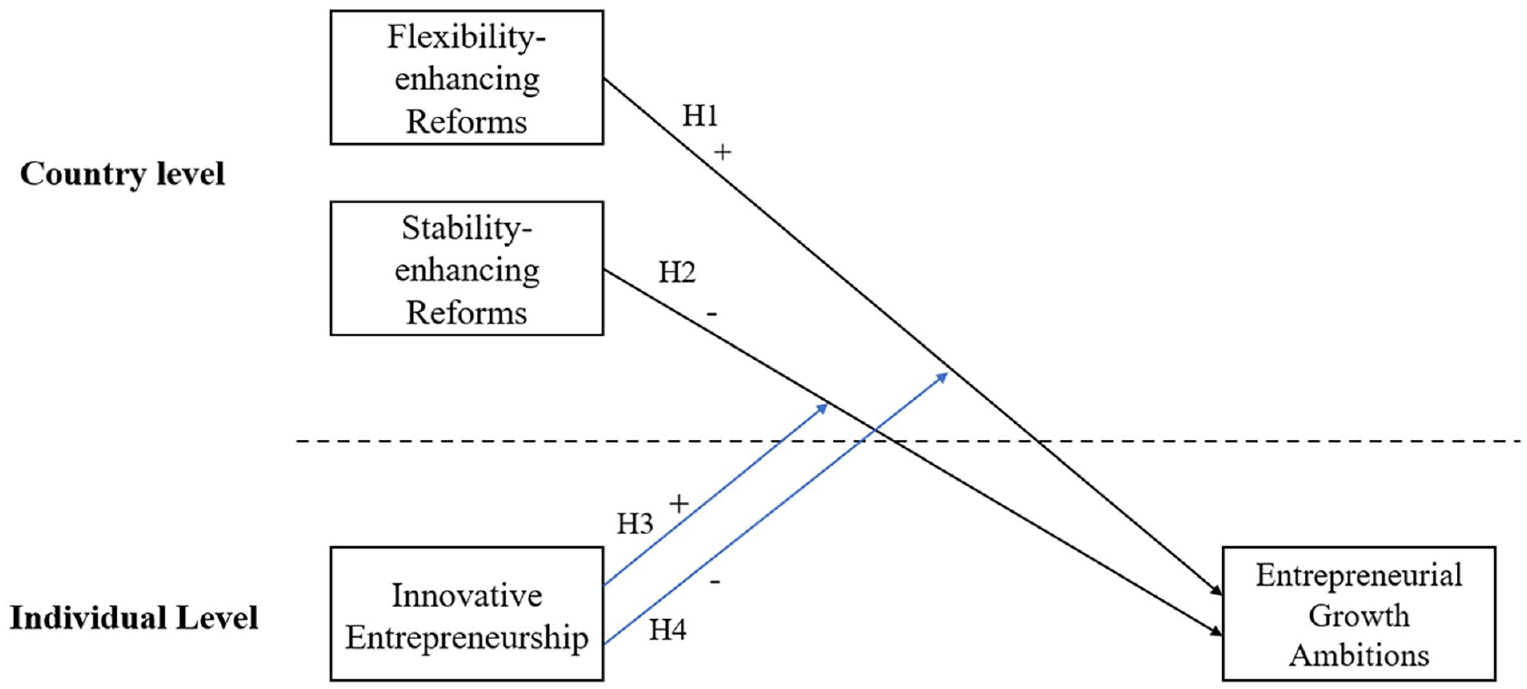
Conceptual model.
Data and method
Data sources and datasets
To investigate the relationship between institutional reforms and entrepreneurial growth ambitions, we combined an individual-level dataset with a country-level dataset. At the individual level, we use data from the Global Entrepreneurship Monitor (GEM); at the country level, we use data from the Heritage foundation. We describe both datasets in the following and provide a brief state of the art how they have been used in prior research.
GEM data and its use in prior research
At the individual level, the GEM annual adult population survey is used, which is a repeated cross-sectional multi-country survey. The GEM is a leading worldwide survey that is used to collect, among others, data about personality traits, human capital, entrepreneurial behaviour and growth ambitions (Darnihamedani and Terjesen, 2022; Reynolds et al., 2005). The GEM is representative for the population of entrepreneurs in a country and has been used to examine entrepreneurial growth ambitions (Autio et al., 2013; Estrin et al., 2013; Levie and Autio, 2011). The GEM covers a wide range of different countries over many years, enabling us to examine the consequences of institutional reforms over time. To date, numerous scholarly articles have been published using GEM data, investigating the influence of institutional dimensions on entrepreneurial behaviour and decisions across countries (Acs et al., 2014; Boudreaux et al., 2019; Urbano and Alvarez, 2014). However, these studies predominantly adopt a static conceptualisation of institutions, often neglecting the dynamic nature of institutional changes over time – a gap that our research aims to fill by explicitly examining the temporal variations in institutional factors and their influence on entrepreneurial activities. Our specific part of the GEM dataset includes data from 1,535,594 individuals – of which 149,010 are entrepreneurs – from 65 countries covering the period from 2002 to 2016. The cross-sectional nature of the data means that every year a (new) random sample of individuals is drawn from the whole population of the respective country. Therefore, it is not possible to link the observations across years and build a longitudinal dataset at the individual level. Still, given the retrospective nature of some questions, the survey responses provide insights into prior activities and experiences, for example, entrepreneurial, educational and investment experiences. The exact countries in the sample and the sample size per country can be found in the Appendix (Table A2).
Heritage foundation data and its use in prior research
In addition to the GEM dataset, we collected insights about institutional reforms using the Heritage Foundation Economic Freedom dataset. For a duration of 29 years, the Index has consistently contributed to the academic discourse through its meticulous analysis presented in a clear and unambiguous format (Nyström, 2008). 3 The Index quantitatively evaluates countries based on ten determinants of economic freedom, which are further classified into four categories (rule of law, limited government, regulatory efficiency and open markets). These determinants are assessed using data sourced from reputable international organisations such as the World Bank, the International Monetary Fund, the Economist Intelligence Unit and Transparency International. Each determinant is scored on a scale from 0 to 100, where 0 represents the lowest level of economic freedom and 100 represents the highest level of economic freedom. A score of 100 indicates an economic environment or policy framework that optimally supports economic freedom (Hall and Lawson, 2014). This country-level dataset has been used in earlier research about the consequences of various types of institutions (Bradley and Klein, 2016; Darnihamedani and Terjesen, 2022; McMullen et al., 2008; Young et al., 2018) and includes detailed information about a country’s institutional environment.
Measurement of study variables
Dependent variable
Our dependent variable entrepreneurial growth ambitions was measured as the entrepreneur’s expected number of created jobs within the next five years (Efendic et al., 2015; Hessels et al., 2008; Levie and Autio, 2011). Given the skewness of this variable and the number of zeros, we used the logarithm of the variable calculated as the logarithm of (1+ expected number of created jobs) (Autio et al., 2013; Darnihamedani and Terjesen, 2022; Estrin et al., 2013).
Independent and moderating variables
We used a two-step approach to measure flexibility- and stability-enhancing reforms. First, we calculated the extent to which a country possessed flexibility- and stability-enhancing institutions in a particular year using the Heritage Foundation dataset (See Table A3 in the Appendix for further details). We use six main components of the Economic Freedom Index to calculate the flexibility- and stability-enhancing institutions (Belitski et al., 2016; Bjørnskov and Foss, 2008): business freedom (i.e. a country’s freedom from burden of regulations on starting, running and closing a business), labour freedom (i.e. a country’s freedom from legal regulations on the labour market), financial freedom (i.e. an indicator of banking efficiency as well as government control over the financial sector), property rights protection (i.e. the extent to which individuals are allowed to acquire, hold, and utilise private property), monetary freedom (i.e. a country’s freedom from price controls and a measure of price stability) and taxation policy (i.e. an indicator of marginal tax rates on both personal and corporate income). Reflecting our theoretical framework, we conducted a PCA using a Varimax rotation to facilitate interpretability of the components. This rotation method maximises the variance of the loadings within each factor, aiding in the clear identification of each component’s contribution to the respective factor. The PCA empirically confirmed the existence and orthogonality of two distinct factors as theorised: flexibility-enhancing institutions comprising business, labour, and financial freedom, and stability-enhancing institutions comprising property rights protection, monetary freedom, and tax burden. This empirical validation justifies our use of these two sets of three components as separate and orthogonal constructs in our study. To ensure transparency and replicability, a table detailing the loadings of the principal components has been included in the Appendix (Appendix A4). Second, we followed earlier research (Banalieva et al., 2018) and calculated flexibility- and stability-enhancing reforms for each year t by
At the individual level, we used three GEM APS survey questions asked to founders to measure innovative entrepreneurship. The first question ‘Do all, some, or none of your potential customers consider this product or service as new and unfamiliar?’ is a demand-side indicator of innovation showing to what extent customers may perceive the entrepreneur’s product or service to be new in the market. The responses were originally coded as all = 1, some = 2, and none = 3. The second question ‘Right now, are there many, few, or no other businesses offering the same products or services to your potential customers?’ mainly measures the absence or presence of competitors in the product market with responses originally coded as many = 1, few = 2, and no = 3. Finally, the question ‘Have the technologies or procedures required for this product or service been available for less than a year, or between 1–5 years, or longer than 5 years?’ measures the newness of technologies and procedures with responses originally coded as less than a year = 1, 1–5 years = 2, and longer than 5 years = 3. Both the second and third questions are supply-side indicators of innovation showing whether and to what extent similar products or technologies are offered in the market by incumbents. To build a composite measure of innovation, we re-centred answers to each of these questions to range from 0 to 2 (including reverse coding answers to the second question) and summed them up, applying equal weighting to each component as per the methodology used in Young et al. (2018). This approach was chosen because it treats each dimension of innovation as equally important in contributing to the overall innovation score, reflecting a balanced view of the different aspects of innovation. Additionally, we acknowledge the temporal sensitivity of this innovation measure. Innovation is dynamic and can evolve over time; therefore, our approach includes year dummies in the regression model to control for temporal variations and trends in innovation. This allows for a more nuanced understanding of innovation over different time periods. The summed scores were then reverse coded to create a single overall proxy of innovative entrepreneurship scaled from 0 (not innovative at all) to 6 (very innovative) (Darnihamedani et al., 2018; Young et al., 2018).
Control variables
Several control variables were included at various levels. For instance, we accounted for venture size in terms of the number of employees (Daunfeldt and Halvarsson, 2015), university education, which takes the value of 1 if the individual had a university degree or 0 otherwise (Davidsson and Honig, 2003), and fear of failure was coded as 1 if fear of failure prevented the respondent to start a business or 0 otherwise (Darnihamedani and Terjesen, 2022). Additionally, we added the variable venture age which is a dummy variable coded as 1 if the venture was established more than 42 months ago or 0 otherwise (Reynolds et al., 2005). We also added entrepreneurial networks taking the value of 1 if the respondent had an entrepreneur in his/her social network or 0 otherwise (Parker, 2009). Moreover, we added social status of entrepreneurs by including a dummy variable coded as 1 if, according to the respondent, in his/her country those who start a business successfully have a high social status (and coded as 0 otherwise), and entrepreneurial skills, which was coded as 1 (or 0 otherwise) if, according to the respondent, s/he has the skill and experience required to start a business (Koellinger et al., 2007).
Furthermore, we have added a control variable for serial entrepreneurship, coded as 1 when the respondent recently shut down or exited a venture in the past 12 months and coded as 0 otherwise (Darnihamedani et al., 2018). We also added a dummy variable called abundance of opportunities which was measured as 1 (or 0 otherwise) when the individual perceived that there exist good opportunities for starting a business in his/her environment in the six months after completing the survey (Boudreaux et al., 2019). Serving as a crucial control variable, abundance of opportunities accounts for the varying (perceived) availability of opportunities across different regional environments, indicating a regional environment where a larger amount of opportunities exist compared to other regional environments. Next, we included sex (coded as 1 for male and 0 for female), an individual’s age in years (and age-squared), year and industry dummies (Boudreaux et al., 2019; Darnihamedani et al., 2018). At the country level, we controlled for (log transformed) Growth Domestic Product (GDP) per capita to account for the level of economic development and welfare (Boudreaux et al., 2019). Finally, we also added GDP growth rate as an indicator for economic growth and the number of entrepreneurial opportunities at the country level (Wong et al., 2005).
Common method bias
Since the data on dependent and independent variables are collected differently and from different data sources (i.e. GEM and Heritage Foundation), common method bias is unlikely to be an issue in the relationship between the dependent and independent variables. That said and acknowledging the potential for common method bias between our moderating and dependent variables, we argue it is not significant due to methodological separation, logarithmic transformation, factor analysis validation, and alternative transformations for robustness checks. Supporting this, Evans (1985) and Siemsen et al. (2010) highlight that common method variance tends to deflate, not fabricate, interaction effects, further reinforcing the reliability of our findings despite the common source of data. Additionally, we conducted Harman’s single factor test, which indicated that the percentage variance (24%) is well below the commonly accepted threshold of 50%, further pointing towards minimal impact of common method bias in our study.
Statistical analysis
In alignment with previous scholarly investigations, we make use of multi-level linear regressions with random intercepts at two distinct levels: the individual and the country level (Boudreaux et al., 2019; Peterson et al., 2012; Stephan et al., 2015). Given the nested nature of entrepreneurs within countries, these multi-level regressions are specifically designed to amalgamate variables from multiple aggregation levels, thereby mitigating the propensity for type 1 and type 2 errors through the consideration of potential intra-class correlations (Hofmann et al., 2000). These multi-level models calculate the variances of the random effects and utilise this data to assign varying weights to observations. Consequently, multi-level models not only correct the standard errors but also yield more accurate estimations of the regression coefficients. Furthermore, intra-class correlations (ICCs) ascertain that observations at level 1 exhibit significant divergence from groups at level 2 (Peterson et al., 2012). The extant body of literature employs a range of ICC threshold values, spanning from 15% (Stephan et al., 2015) to 9.3% (Boudreaux et al., 2019). Heck et al. (2010, p. 74) contend that ‘. . . if the ICC is relatively minuscule (i.e. a rough ‘cut-off’ point of 0.05 is frequently utilised by researchers), then the benefits of executing a multi-level analysis would be negligible’. In the context of our dependent variable, which is the anticipated job creation by entrepreneurs, the ICC at the country level approximates 8.2%, thereby fulfilling the condition for the implementation of multi-level regressions.
Results
Descriptive statistics
Table 1 shows descriptive statistics of our study variables. The mean score for innovation is 1.71 in the sample (between 0 and 6) showing the tendency of founders to start a business with low levels of innovation. For 22% of entrepreneurs in our sample, fear of failure is a preventive factor for starting a business. 41% of our sample of entrepreneurs have obtained a university degree; 52% of the entrepreneurs in our sample are women; the mean age is 41 years. The mean (lagged) values of flexibility- and stability-enhancing reforms are 0.62 and 0.55, respectively. Since there are no strong correlations between independent and control variables and the Variance Inflation Factors (VIFs) are low (Table 1), multi-collinearity seems not to be a major issue.
Descriptive statistics and correlation matrix of the variables (Sample size: 148,755).
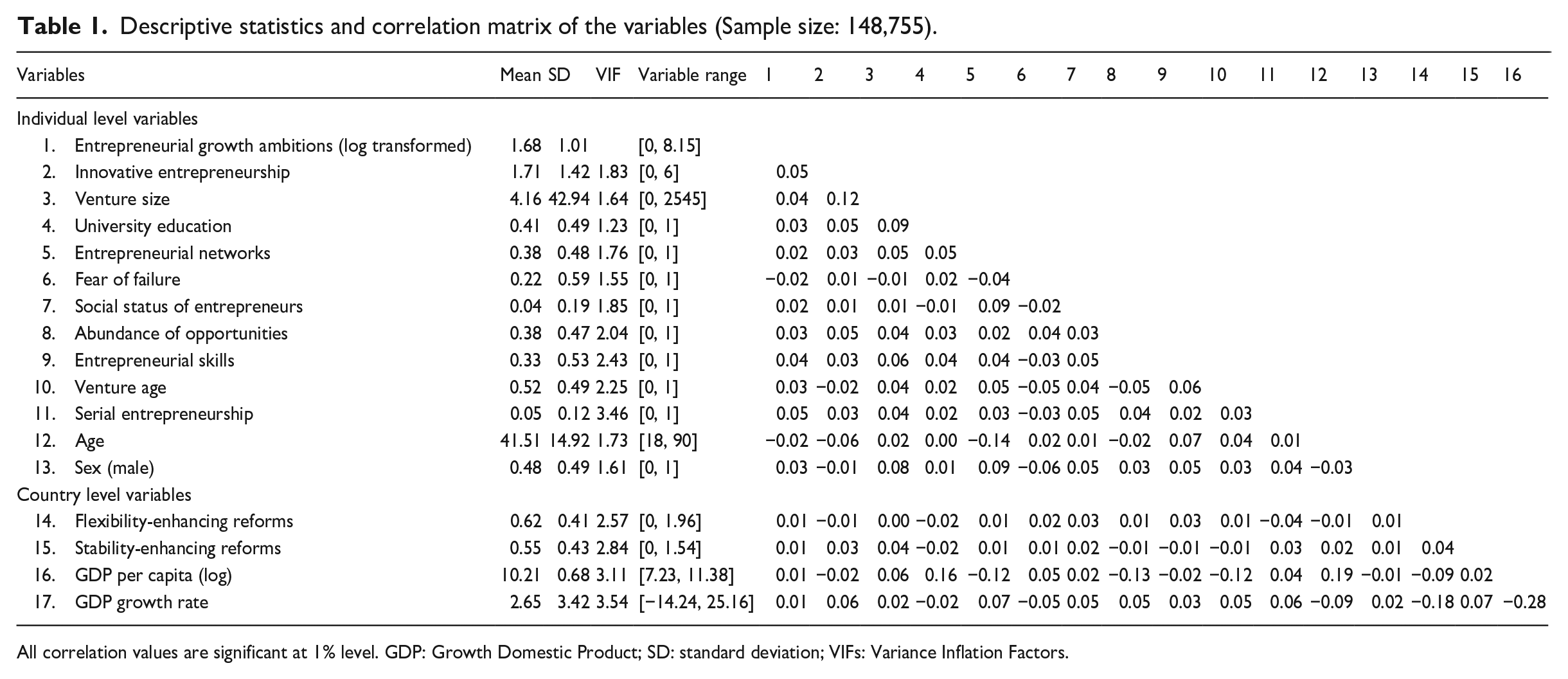
All correlation values are significant at 1% level. GDP: Growth Domestic Product; SD: standard deviation; VIFs: Variance Inflation Factors.
Main regression results
The results of the multi-level regressions are reported in Table 2. Models II, III and IV provide the main findings. We included only control variables in Model I and results indicate that venture size, education level, entrepreneurship experience, perceived entrepreneurial skills, male entrepreneurship, knowing another entrepreneur in the network, abundance of opportunities, social status of entrepreneurs and GDP growth rate show a significant positive relationship with entrepreneurial growth ambitions. By contrast, fear of failure shows a significant negative relationship and an entrepreneur’s age has an inverted U-shape relationship with entrepreneurial growth ambitions. In model II, we added our main independent variables. Our findings indicate that flexibility-enhancing reforms have a significant positive relationship with entrepreneurial growth ambitions (B = 0.034, p < 0.05). Hypothesis 1 is supported. The average marginal effect equals 0.034, and hence a one unit increase in flexibility-enhancing reforms leads to an approximately 3.4% increase in the dependent variable, ceteris paribus. Regarding Hypothesis 2, our empirical results show no significant effect of stability-enhancing reforms on entrepreneurial growth ambitions (B = −0.298, p = n.s.). Hypothesis 2 is not supported.
Results of the multi-level regression analysis with random intercepts (dependent variable: entrepreneurial growth ambitions).
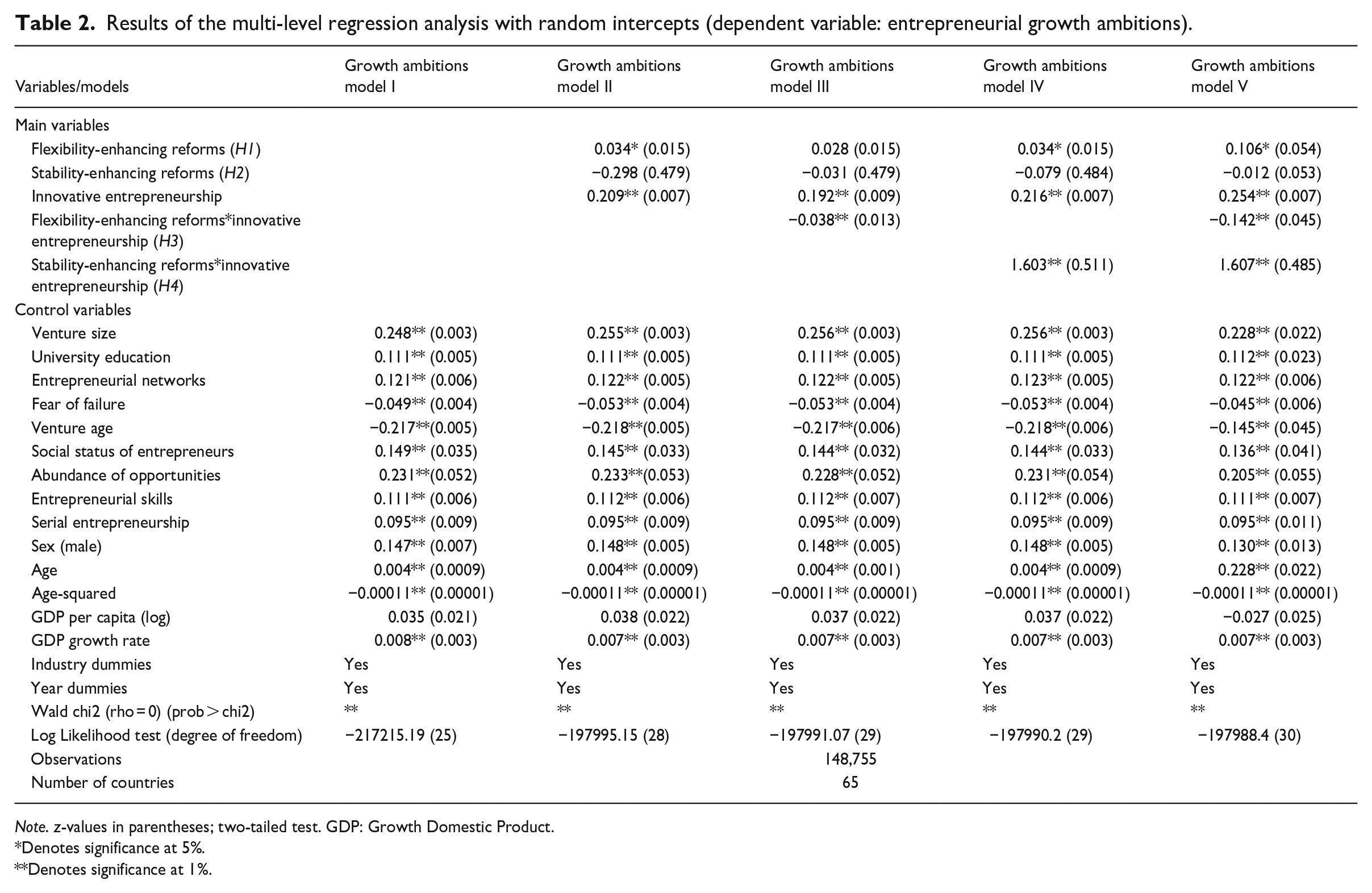
Note. z-values in parentheses; two-tailed test. GDP: Growth Domestic Product.
Denotes significance at 5%.
Denotes significance at 1%.
Models III and IV include the interaction terms and reveal strong variations in the effects of institutional reforms on entrepreneurial growth ambitions for more versus less innovative entrepreneurship. Hypothesis 3, which predicted varied perceptions and subsequent responses to flexibility-enhancing reforms, is supported. The positive effect of flexibility-enhancing reforms on entrepreneurial growth ambitions is weaker for more versus less innovative entrepreneurship (B = −0.038, p < 0.01). To analyse the impact of different types of entrepreneur interactions with varying levels of flexibility-enhancing reforms, the interaction plots were drawn (see Figure A1 in the Appendix) at one standard deviation above and below the mean of reforms for ease of interpretation. As shown in Figure A1, growth ambitions of non-innovative entrepreneurship (those with the value of innovation equal or below 3) move up higher than before when flexibility-enhancing reforms go from ‘low’ to ‘high’ as compared to those of innovative entrepreneurship (with innovation values above 3), respectively. Finally, the findings regarding the interaction between stability-enhancing reforms and less versus more innovative entrepreneurship reveal a significant negative relationship with entrepreneurial growth ambitions (B = 1.603, p < 0.01). Hypothesis 4 is supported. Further investigations (see the post hoc analyses below) show that the effect of stability-enhancing reforms on entrepreneurial growth ambitions is even positive for innovative entrepreneurship. We also drew the margins plot for this interaction term and observe that entrepreneurial growth ambitions for more innovative entrepreneurship move up when stability-enhancing reforms go from low to high while entrepreneurial growth ambitions for less innovative entrepreneurship (slightly) move down when stability-enhancing reforms go from low to high. The margin plot is included as Figure A1 in the Appendix.
Post hoc analyses and robustness checks
Joint significance tests and Chow test
We ran additional tests to further validate the interaction effects. First, for all interactions, we pursued joint significance tests with the main effects (e.g. flexibility-enhancing reforms) and interaction terms (e.g. flexibility-enhancing reforms*innovative entrepreneurship) using post-estimation commands, measured by the F distribution (Brambor et al., 2006). 4 Our findings showed that for all joint significance tests, F-values are statistically significant, and hence the main effects and the interactions are jointly significant (more details provided in Table A5). Second, we used the Chow test to analyse whether the estimated effects of institutional reforms associated with the two levels of innovative entrepreneurship are statistically different from each other. To do so, we ran a split sample analysis for the following subsets of our data: (1) only including innovative entrepreneurs, (2) only including non-innovative entrepreneurs (as defined above in the interaction plots). Then, we compared (1) the coefficients associated with flexibility-enhancing reforms of the sample of innovative with those from the sample of non-innovative entrepreneurs and (2) the coefficients associated with stability-enhancing reforms of the sample of innovative with those from the sample of non-innovative entrepreneurs. The Chow test showed significant differences between the respective coefficients in the two samples (at 5% levels), indicating the existence of contingencies and supporting Hypotheses 3 and 4 (details provided in Table A6).
Inclusion of additional control variables
To reduce the likelihood of omitted variable bias (Boudreaux et al., 2019), we added several country-level controls (Appendix, Table A7). These country-level control variables cannot be added to the main regression analyses because our main sample covers only 65 countries due to potential multi-collinearity. Hence, we added and replaced country-level control variables one-by-one in the regression. The newly inserted variables comprise four formal institutional (i.e. government spending, investment freedom, trade freedom and social security contributions), two cultural (i.e. uncertainty avoidance and collectivism), and one informal institutional factor (i.e. control of corruption). We also added variables relating to socio-economic conditions (i.e. population growth, economy size (proxied by GDP), labour with tertiary education and GDP per capita squared) (Efendic et al., 2015; Williams and Vorley, 2015). Overall, the inclusion of these control variables did not change substantially our main findings. Additionally, we have added country fixed effect dummies to the regression (we used linear regression this time due to multi-level regression setup) and found that the results would support our main findings regarding Hypotheses 1–4. For the exact results, see Table A7 in the Appendix.
Alternative measures for entrepreneurial growth ambitions
Scholars have used also slightly different operationalisations of our dependent variable. We assessed whether our main findings are robust and consistent when using these alternative measurements. First, we used the inverse hyperbolic sine transformation of entrepreneurial growth ambitions (see also Astebro and Tag, 2015) to take into account non-trivial numbers of zeros of our dependent variable. When using this alternative measurement, we found similar findings (Table A8). Second, we adopted a dummy variable for those entrepreneurs having a high-growth aspiration which was coded as 1 when entrepreneurs expected their business to create at least 20 new jobs in the next five years (Bowen and De Clercq, 2008). The overall pattern of findings using this dummy variable corroborated with our earlier results (Table A8). Third, to address potential concerns with having dissimilar baseline starting points among different levels of innovative entrepreneurship (McKelvie et al., 2017), we ran a robustness check using a relative growth measure and used a dummy for expected job growth valued as 1 when expected job growth equals or is above 50% of the current level and 0 otherwise. Again, our results supported our earlier findings regarding the direct and moderating effects of the variables of interests (Table A8).
Heckman regression analysis
So far, we considered the multi-level regression model to be superior given the hierarchical structure of our data (Autio et al., 2013; Stephan et al., 2015). Yet, given a potential sample selection bias, we ran also Heckman regressions as a further robustness check (Caner et al., 2018; Fang et al., 2021; Heckman, 1979). The selection variable is whether an individual is an entrepreneur or not. We selected ‘entrepreneurial networks’ – the presence of another entrepreneur in an individual’s network – as our exclusionary restriction variable, grounded in its theoretical and empirical significance for predicting entrepreneurial entry without directly affecting growth ambitions, aligning with the Heckman model’s requirements (Darnihamedani et al., 2018; De Carolis and Saparito, 2006). The Heckman regression results confirm the main findings of the multi-level regressions (see Table A9 in the Appendix).
Discussion
Market-based institutional reforms across countries have transformed the global economy leading to unprecedented economic growth (Cuervo-Cazzura, et al., 2019). Our study has developed a contingency model to examine the implications of institutional reforms on entrepreneurial growth ambitions. Based upon categorisation theory (Chattopadhyay et al., 2001; Dutton and Jackson, 1987), we argued that institutional reforms can be perceived either as an opportunity or a threat, and therefore, may affect the growth ambitions of entrepreneurs in different ways. In addition to examining direct effects of flexibility- and stability-enhancing reforms, we also suggested that more innovative entrepreneurs perceive flexibility-enhancing reforms less as an opportunity compared to less innovative entrepreneurs. Our results largely confirm our predictions and show that while flexibility-enhancing reforms generally have a positive effect on entrepreneurial growth ambitions, the effect is lower for more innovative entrepreneurs. The opposite is true for stability-enhancing reforms. While – on overage – they seem not to have an effect on entrepreneurial growth ambitions, they seem to have a positive effect on the growth ambitions of innovative entrepreneurs.
By using categorisation theory as a theoretical lens, our study significantly extends the existing literature on the impacts of institutional reforms on entrepreneurial strategies and behaviour (Cuervo-Cazurra et al., 2019; Dau et al., 2020; Rodrik, 2006). Categorisation theory serves as a pivotal mechanism that elucidates how entrepreneurs interpret and respond to institutional reforms at a micro-level (Bansal, 2003; Elfenbein, 2007; Jackson and Dutton, 1988). This theory allows us to understand that the same reform can be perceived as either a threat or an opportunity, depending on the individual characteristics of the entrepreneur and his or her venture (Fisher et al., 2016; Vanacker et al., 2017). By adopting this cognitive perspective, we address the ‘why’ and ‘how’ questions that have often been overlooked in prior research, thereby providing a more nuanced understanding of the relationship between institutional reforms and entrepreneurial growth ambitions (Banalieva et al., 2018; Wiklund et al., 2009). In so doing, we contribute to a richer theoretical underpinning of the varied consequences of institutional reforms on entrepreneurship. Additionally, our study contributes to the broader entrepreneurship and small business growth literatures by investigating the cognitive antecedents of entrepreneurial growth ambitions. We introduce an opportunity-threat perception framework, which we argue is not only applicable to the context of institutional reforms but also to other dynamic external factors like technological changes (Greening and Gray, 1994; McMullen and Shepherd, 2006). This adds a new layer of understanding to the cognitive determinants influencing entrepreneurial growth ambitions. Second, our study offers a more nuanced understanding of the relationship between institutional reforms and entrepreneurial growth ambitions, particularly focusing on the differential effects on more versus less innovative entrepreneurs. While existing research has underscored the role of innovative entrepreneurs in driving economic growth and job creation (Dahl and Klepper, 2015; Haltiwanger et al., 2013; Stam et al., 2009), it has largely overlooked how these entrepreneurs interact with and are influenced by institutional reforms. This is a significant gap given that institutional settings and reforms are central elements in entrepreneurship policy (Baumol et al., 2007; Dau and Cuervo-Cazzura, 2014). Our findings reveal an intriguing paradox: flexibility-enhancing reforms, which are generally seen as beneficial for entrepreneurial growth, appear to have a less pronounced impact on the growth ambitions of innovative ventures. These are the very ventures that are often the focal point of entrepreneurship policy and are expected to contribute most significantly to high-quality job creation (Estrin et al., 2013; Stam and Wennberg, 2009). We elucidate this paradox by applying categorisation theory, which allows us to understand how entrepreneurs subjectively interpret institutional reforms as either opportunities or threats. This theoretical approach not only fills a notable gap in the existing literature on the impacts of entrepreneurship policy and its institutional mechanisms (Bjørnskov and Foss, 2016; Bradley and Klein, 2016; Young et al., 2018), but also offers actionable insights for policymakers aiming to more effectively target innovative ventures.
Finally, our study introduces a dynamic perspective on institutions, contrasting it with the more static approaches commonly found in existing literature, such as the work by Young et al. (2018). While static perspectives, rooted in institutional economics, often posit that flexibility-enhancing institutions are beneficial for (more) innovative entrepreneurship (Bowen and De Clercq, 2008; Young et al., 2018), our dynamic approach yields different conclusions. By focusing on the nature of institutional reforms – specifically, flexibility-enhancing versus stability-enhancing reforms – we offer a fresh lens through which to understand their impact on entrepreneurial growth ambitions (Dau et al., 2020; Bjørnskov and Foss, 2016). Our empirical findings support this dynamic perspective, revealing that the effects of institutional reforms on entrepreneurship are not merely extensions of their static conditions (Cuervo-Cazurra et al., 2019; Rodrik, 2006). Rather, these reforms introduce new ‘rules of the game’ (Dau et al., 2020; Prasad, 1966) that can shift entrepreneurial perceptions and actions in unexpected ways (Boudreaux et al., 2019; Bradley and Klein, 2016). This dynamic view is a novel contribution to the entrepreneurship literature, urging scholars to consider not just the status quo of institutions but also the implications of institutional reforms and transformations (Bjørnskov and Foss, 2016; Dau et al., 2020).
Implications for policy-makers
The findings of our study have implications for policy-makers. Reflecting with prior studies, we find that more innovative entrepreneurs have the highest growth ambitions and consequently are also expected to create more jobs than other entrepreneurs (Haltiwanger et al., 2013; Stam et al., 2009). Supporting the results of prior research (Banalieva et al., 2018; Eberhart et al., 2017; Eesley et al., 2016), we also find that flexibility-enhancing reforms have positive effects on entrepreneurial growth ambitions. What is new, however, is that the impact of flexibility-enhancing reforms is contingent on entrepreneurship level of innovation and that the (positive) effect is larger for less innovative entrepreneurs. This result is contrary to policy suggestions of important multinational institutions such as the World Bank or the Organization for Economic Cooperation and Development (OECD) suggesting institutional reforms as a way to leverage the full potential of entrepreneurship for economic growth (Carree and Thurik, 2008; Henrekson et al., 2010; Wong et al., 2005). Our results suggest that policy-makers need to distinguish between a static and a dynamic perspective on reforms and that contingency factors exists, which force them to evaluate which types of entrepreneurs benefit from which reform.
Limitations and directions for future research
Our study has a number of limitations. Although the GEM is the largest cross-country dataset existing on entrepreneurial activity, the number of developing countries, is still somewhat restricted particularly in a longer time horizon (Estrin et al., 2013). Thus, the variation in institutions is limited to some extent. This limitation can be certainly addressed in future studies, when the GEM includes more low- and middle-income countries in a longer time horizon, to learn about institutional development and its influence on entrepreneurial ambitions. Moreover, due to the cross-sectional nature of the GEM dataset (Reynolds et al., 2005), it is not possible to observe the same entrepreneurs over time. Future studies can address this point and study the effects of institutional reforms on (changes in) entrepreneur perceptions and decisions over time. Additionally, while our study treats flexibility- and stability-enhancing reforms as orthogonal based on PCA results, we acknowledge a limitation in capturing the full complexity of policy reforms as they occur in real-world settings. Recent studies in policy interventions suggest that reforms can have interrelated and overlapping effects (Cuervo-Cazurra et al., 2019; Rodrik, 2006), a nuance that our statistical approach may not fully encompass. Future research could further explore the intricate dynamics between different types of reforms and their combined impact on entrepreneurial activities. Another limitation and opportunity for further research is that we only regard one dimension (i.e. level of innovation) how more and less innovative entrepreneurs perceive institutional reforms. Other important sub-groups of entrepreneurs exist such as new versus established entrepreneurs and those that have received Venture Capital (VC) financing. One can argue that VC-financed entrepreneurs not only differ in their growth (ambitions) (Bertoni et al., 2011) but also in their perception of flexibility- and stability-enhancing institutional reforms as an opportunity or threat. Through their VC-financing they have good access to resources and networks which puts them in a good position to benefit from an increased flexibility.
Another direction would be to investigate how the way an institutional reform is introduced influences its perception and how this differs by entrepreneurship type. Entrepreneurs may not have the time and resources to fully understand the functioning and consequences of an institutional reform. Depending on the perceived complexity and speed of a reform entrepreneurs may be slow and cautious with their response to a newly introduced reform. Prior research shows that perceived complexity of formal institutions can be a barrier to entrepreneurial activity (Braunerhjelm and Eklund, 2014) and that such a barrier is perceived differently depending on human capital and entrepreneurial engagement (Schulz et al., 2016). Finally, institutional reforms and their influence on entrepreneurs can be studied at the regional level. Many reforms are introduced and implemented at the regional level (Dau et al., 2020). Future studies, in a quasi-experimental setting, can analyse and compare entrepreneurial behaviour and performance across regions when reforms occur in some regions, but not others.
Conclusion
In conclusion, this article offers a multi-faceted contribution to the understanding of how institutional reforms affect entrepreneurial growth ambitions. Leveraging categorisation theory, we provide a nuanced cognitive framework that explains how entrepreneurs interpret these reforms as either opportunities or threats, thereby filling a significant gap in the existing literature. Our findings particularly highlight the differential effects of flexibility- and stability-enhancing reforms on entrepreneurs with varying levels of innovativeness. This not only extends the theoretical discourse but also offers actionable insights for policymakers. Furthermore, we introduce a dynamic perspective on institutions, contrasting it with the more static views commonly found in the literature. This dynamic approach reveals that the effects of evolving institutional reforms are not mere extensions of their static conditions but introduce new ‘rules of the game’ that can significantly shift entrepreneurial perceptions and actions. Our study thus, serves as a call to scholars and policymakers alike to consider the dynamic nature of institutional reforms and their complex implications for entrepreneurial growth ambitions.
Footnotes
Appendix
Results of the Heckman regression (dependent variable: entrepreneurial growth ambitions; selection variable: being an entrepreneur or not).
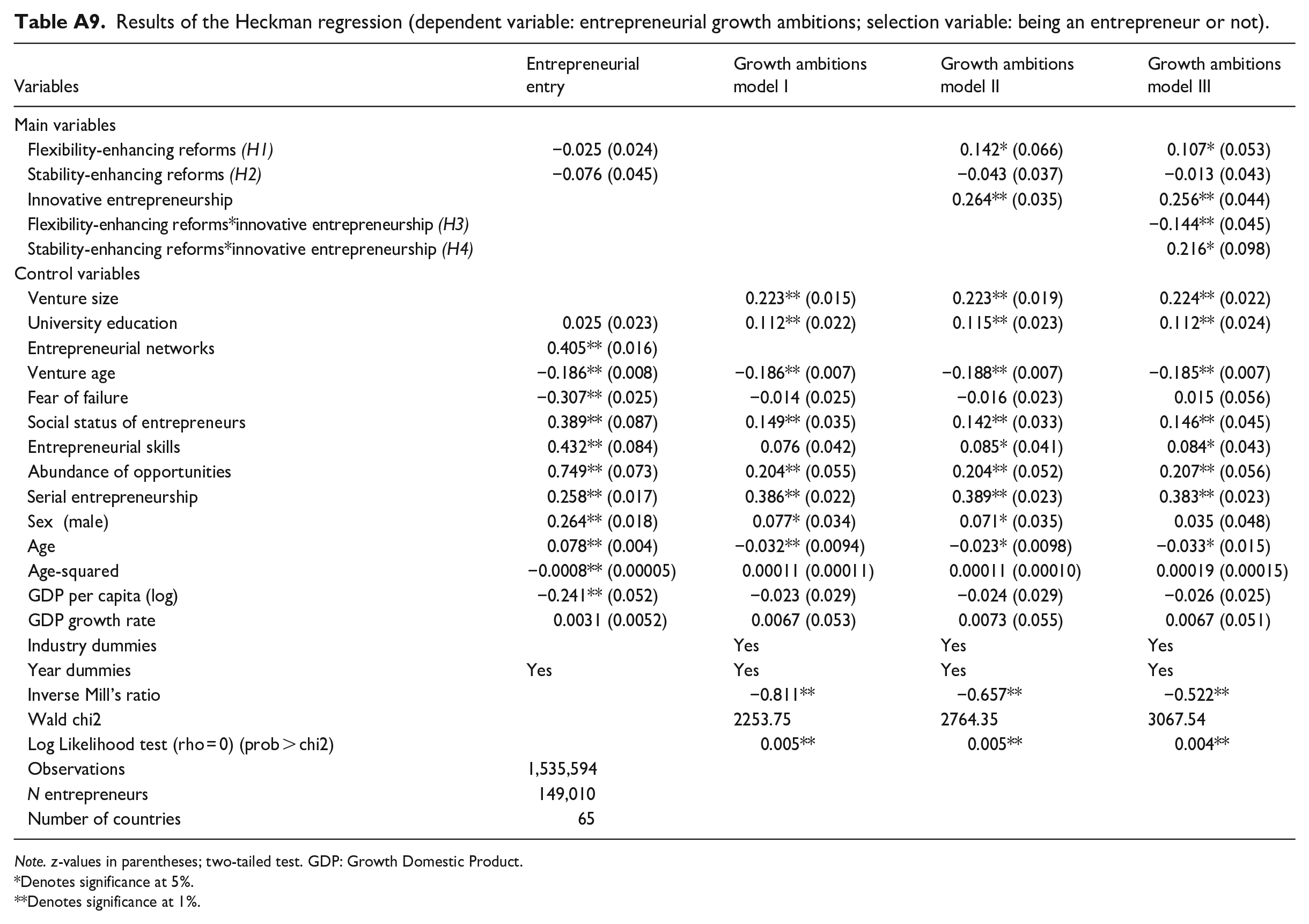
| Variables | Entrepreneurial entry | Growth ambitions model I | Growth ambitions model II | Growth ambitions model III |
|---|---|---|---|---|
| Main variables | ||||
| Flexibility-enhancing reforms (H1) | −0.025 (0.024) | 0.142* (0.066) | 0.107* (0.053) | |
| Stability-enhancing reforms (H2) | −0.076 (0.045) | −0.043 (0.037) | −0.013 (0.043) | |
| Innovative entrepreneurship | 0.264** (0.035) | 0.256** (0.044) | ||
| Flexibility-enhancing reforms*innovative entrepreneurship (H3) | −0.144** (0.045) | |||
| Stability-enhancing reforms*innovative entrepreneurship (H4) | 0.216* (0.098) | |||
| Control variables | ||||
| Venture size | 0.223** (0.015) | 0.223** (0.019) | 0.224** (0.022) | |
| University education | 0.025 (0.023) | 0.112** (0.022) | 0.115** (0.023) | 0.112** (0.024) |
| Entrepreneurial networks | 0.405** (0.016) | |||
| Venture age | −0.186** (0.008) | −0.186** (0.007) | −0.188** (0.007) | −0.185** (0.007) |
| Fear of failure | −0.307** (0.025) | −0.014 (0.025) | −0.016 (0.023) | 0.015 (0.056) |
| Social status of entrepreneurs | 0.389** (0.087) | 0.149** (0.035) | 0.142** (0.033) | 0.146** (0.045) |
| Entrepreneurial skills | 0.432** (0.084) | 0.076 (0.042) | 0.085* (0.041) | 0.084* (0.043) |
| Abundance of opportunities | 0.749** (0.073) | 0.204** (0.055) | 0.204** (0.052) | 0.207** (0.056) |
| Serial entrepreneurship | 0.258** (0.017) | 0.386** (0.022) | 0.389** (0.023) | 0.383** (0.023) |
| Sex (male) | 0.264** (0.018) | 0.077* (0.034) | 0.071* (0.035) | 0.035 (0.048) |
| Age | 0.078** (0.004) | −0.032** (0.0094) | −0.023* (0.0098) | −0.033* (0.015) |
| Age-squared | −0.0008** (0.00005) | 0.00011 (0.00011) | 0.00011 (0.00010) | 0.00019 (0.00015) |
| GDP per capita (log) | −0.241** (0.052) | −0.023 (0.029) | −0.024 (0.029) | −0.026 (0.025) |
| GDP growth rate | 0.0031 (0.0052) | 0.0067 (0.053) | 0.0073 (0.055) | 0.0067 (0.051) |
| Industry dummies | Yes | Yes | Yes | |
| Year dummies | Yes | Yes | Yes | Yes |
| Inverse Mill’s ratio | −0.811** | −0.657** | −0.522** | |
| Wald chi2 | 2253.75 | 2764.35 | 3067.54 | |
| Log Likelihood test (rho = 0) (prob > chi2) | 0.005** | 0.005** | 0.004** | |
| Observations | 1,535,594 | |||
| N entrepreneurs | 149,010 | |||
| Number of countries | 65 | |||
Note. z-values in parentheses; two-tailed test. GDP: Growth Domestic Product.
Denotes significance at 5%.
Denotes significance at 1%.
Funding
The author(s) received no financial support for the research, authorship, and/or publication of this article.
