




Abstract
There is growing recognition of the important role that collective enterprises for social impact can play in resolving grand challenges. New forms of collective organisation are appearing on a global basis, yet we still know little about the process by which they are created. Paradoxically, the literature tends to rely on the concept of individual agency to explain the emergence of collective organisations. Based on inductive research of two French cases, our analysis unpacks the key role of collective agency in collective enterprises created for social impact. By revealing three dynamics – collective entrepreneurship, collective animatorship and collective organising – and their interrelations, this study provides conceptual clarification of the understudied notion of collective agency in entrepreneurship. The study also takes a fresh look at the creation of collective enterprises for social impact beyond the vision of a ‘heroic’ entrepreneur.
Introduction
‘Alone we go faster, but together we go further’, don’t we? If the alternative seems reductive, several factors point to a shift from an individual to a more collective view of entrepreneurship. For decades, following a general tradition in entrepreneurship that studies the traits and personality of the entrepreneur (Gartner, 1988), the literature on entrepreneurship for social impact has focused on the individual entrepreneur (Dees, 2007; Shaw and de Bruin, 2013). In the American tradition of entrepreneurship for social impact, with which international associations such as Ashoka identify, social entrepreneurs are seen as exceptional individuals with the capacity to change the world. However, it is now becoming clear that lone entrepreneurs lack the knowledge, skills, authority and resources necessary to resolve grand challenges (Markman et al., 2019). The complexity of contemporary economic, ecological and social grand challenges invites collective action from diverse actors (Sarasvathy and Ramesh, 2019) and partly explains the development of collective entrepreneurship (Doh et al., 2019). And so, the subject of collective entrepreneurship is attracting renewed interest evident in the development of new forms of collective enterprises (e.g. ‘collective interest cooperative company’ (SCIC) in France, ‘solidarity cooperatives’ in Canada or ‘community interest companies’ in the United Kingdom). These organisations are structured for multi-stakeholder entrepreneurship and can serve the collective interests of their members (i.e. the employees and the users) and the local community.
Research on collective entrepreneurship has shown how ‘the many’ (inclusive of and beyond the initial entrepreneurs) may ‘shape the norms, roles, and structures that enable entrepreneurial action’ (Branzei et al., 2018: 2). There is growing recognition of the potential for research of the collective (Shepherd and Patzelt, 2017) to enrich entrepreneurship, be it entrepreneurial teams (Ben-Hafaïedh and Cooney, 2017; Schjoedt and Kraus, 2009), ‘ad hoc organizing’ (Ho and Teo, 2022), social entrepreneurship (Montgomery et al., 2012) or community entrepreneurship (Bacq et al., 2022). Yet, despite this renewed interest in collective organisations, we still need to identify the antecedents and outcomes of collective entrepreneurial dynamics that involve multiple actors throughout the process (Dufays and Huybrechts, 2016). Generally, collective enterprises have been analysed only once they are established (Cucchi et al., 2022), so how they emerge and take shape initially remains unclear (Hertel et al., 2019). While much of the literature on social and community entrepreneurship distinguishes the collective as a feature (Markman et al., 2019), little is known about the creation of collective enterprise for social impact.
We explore the role of agency to better understand the process through which collective enterprises for social impact are created. ‘Agency’ is a popular topic of discussion in the entrepreneurship literature (Michaelis et al., 2022), and it makes it possible to propose a unified theory of entrepreneurial action (McMullen et al., 2021). We aim to understand the creation of collective enterprises for social impact beyond the ‘traditional’ prism of personal agency where the agent of change is an individual entrepreneur (Dacin et al., 2011; Gupta et al., 2020). This informs our research question: What form of agency develops and sustains the emergence of collective enterprises for social impact?
We build on a longitudinal empirical study of two cases in France. Our inductive research reveals that the process of creating collective enterprises for social impact requires a specific form of collective agency that combines three dimensions: collective entrepreneurship (led mainly by an entrepreneurial team and a group of actors involved in the firm’s development); ‘collective animatorship’ (supported by actors keen to contribute to local development) and ‘collective organising’ (structuring a collective enterprise), the result of a prior process of mobilising multiple stakeholders. We also propose a model to better identify the key practices of creating collective organisations and examine the understudied notion of collective agency.
Literature review
Entrepreneurship as collective action covers diverse and independent realities in the management literature. We focus on academic research on the creation of collective forms of organisations and on the question of agency in collective entrepreneurship for social impact.
Creation of collective enterprises for social impact
Two streams of research address the creation of collective enterprises for social impact: the social enterprise and the community enterprise. Historically, research into collective enterprise has analysed cooperatives, associations and mutual companies (Stott et al., 2019), concluding that the collective dimension stems from the structure of the social enterprise (Defourny and Nyssens, 2017). Doherty et al. (2014: 431) argue that ‘most social enterprises tend to be a coalition of multi-stakeholder groups’. Unlike joint-stock companies, social enterprises are organised around the principle of ‘one person, one vote’ and must therefore, invent appropriate modes of decision-making for their collective functioning (Shaw and Carter, 2007). Moreover, social enterprises may have democratic structures that allow different stakeholders, including those they serve, to participate in management (Tracey et al., 2005). Adopting a broader perspective of social enterprise than the cooperative or mutual organisation, Dufays and Huybrechts (2016) explain that the collective dimension need not reflect the status of the organisation. The collective dimension in social enterprises is ‘the result of a dynamic involving people belonging to a community or to a group that shares a well-defined need or aim’ (Defourny and Nyssen, 2008: 228). Indeed, the collective dynamic is often the result of a collective process undertaken by a coalition of individuals forming a team with the ambition to create social value together (Slitine and Vuotto, 2023). Similarly, bottom-up, grassroots approaches to social enterprises have argued that the close involvement of beneficiaries is essential to meet the enterprise’s needs (Moulaert et al., 2013). Several publications have theorised about how governance of collective social enterprises is important in maintaining the collective dimension of the organisation, avoiding mission drift (Ebrahim et al., 2014) and aligning potentially conflicting objectives, namely social logic and commercial logic ways of thinking (Battilana et al., 2022).
Another stream of research has examined how communities can act collectively in response to economic, sociocultural and environmental grand challenges (Daskalaki et al., 2015), developing ‘collective forms of enterprises that have distinctive organizational features for the provision of goods and services’ (Meyer, 2020: 3). Work on community(-based) enterprise (Bacq et al., 2022; Peredo and Chrisman, 2006) is also important in coping with contemporary challenges, likewise focuses on the role of the community in the construction of collective organisations. Community entrepreneurship involves creating a business venture in which ownership and control are vested in a community of some kind (Somerville and McElwee, 2011). Community enterprises are established, owned and controlled collectively by the community in which they are embedded and for which they aim to generate economic, social and/or ecological benefits (Hertel et al., 2019). In such organisations, entrepreneurial engagement is socially situated, in the sense that opportunities are identified and exploited collectively, and that key entrepreneurs attached to their territories build ventures into the local social fabric (McKeever et al., 2014; Meyer, 2020). Marquis and Battilana (2009) also highlight the close association with the territory, defining a community as ‘a local level of analysis corresponding to the populations, organisations and markets located in a geographic territory and sharing, as a result of their common location, elements of local culture, norms, identity, and laws’ (p. 286).
While the work of the social enterprise and community enterprise streams of research has often developed in parallel, recent work has suggested a convergence around the notion of ‘collective social enterprise’ or ‘collective enterprise for social impact’ (Buratti et al., 2022; Lumpkin and Bacq, 2019; Spear, 2019). Collective social enterprises can be understood as a product of ‘collective action, involving groups of citizens (often with a cast of supporting stakeholders), or organisations, or networks and social movements’ (Spear, 2019: 82). However, few studies have examined the initial entrepreneurial phase to understand how collective dynamics are structured into a social enterprise (Spear, 2019). Much research on collective enterprises for social impact has focused on established organisations, analysing their particular model (Doherty et al., 2014). Apart from Akemu et al.’s (2016) study of the transformation of a social movement into a social enterprise, few studies have analysed the emergence of the collective dynamic in the first stages of a social enterprise. Similarly, there is little research on the creation phase of community enterprises. However, Haugh (2007) examines the early stages of a collective (community-led) venture. She focuses on stage theories (from opportunity identification and stakeholder mobilisation to opportunity exploitation) to understand the creation of collective ventures. Spear (2019) highlights that the institutional environment – intermediaries, organisations and regulatory regimes – is key to facilitating collective social entrepreneurial activities. McElwee et al. (2018) introduce the notion of ‘animatorship’ in the context of rural communities to illustrate how actors who are not necessarily entrepreneurs themselves can be entrepreneurial and crucial to the success of the entrepreneurial project. Animatorship involves not only educating, stimulating and encouraging others to be ‘more’ active in their communities, but also building, orchestrating and managing networks, relationships, situations and environments to the same end: ‘consequently, animation can be understood as enabling, facilitating and stimulating the creation of value by others – individuals, groups and communities’ (McElwee et al., 2018: 175).
Agency in collective enterprise creation for social impact
In the literature on collective entrepreneurship, the ‘collective’ is presented as a team (Ben-Hafaïdeh, 2006), as a community (Peredo and Chrisman, 2006) or as a context (Meyer, 2020), which can be confusing. Who is acting, how and when are they doing so, and what practices are they using? We address the question of ‘agency’ in entrepreneurship, given its key role in many studies seeking to explain the dynamic of creation of new enterprises: ‘entrepreneurial agency [. . .] is highly consistent with scholarly conceptions of human agency in general’ (McMullen et al., 2021: 1220). Direct personal agency, with which we are all familiar, describes acts performed solely with individual intentionality, forethought, self-regulation and self-reflection. In social psychology, Bandura’s (1997) social cognition theory emphasises the role of ‘personal efficacy’ in achieving the desired results from our actions. Fundamentally, being an agent is to intentionally make things happen by one’s actions (Bandura, 2001).
Yet, paradoxically, the literature examining collective entrepreneurship relies on the concept of individual agency (Emirbayer and Mische, 1998). Here, agency is a person’s ability to act in pursuit of goals in accordance with their values. Sen (1985) defines an agent as someone who acts and brings about change, hence agency is key ‘in asserting what a person can do in line with his or her conception of the good’ (p. 206). The social entrepreneurship literature emphasises values and motivation as the primary differentiators between social entrepreneurs and mainstream entrepreneurs. For example, McMullen et al. (2021) view social entrepreneurs as more interested in nonfinancial motives and incentives. More generally, social entrepreneurs are depicted as visionary individuals who drive social change by innovatively combining resources (Dacin et al., 2011; Gupta et al., 2020).
The inconsistency of mobilising individual agency to study collective entrepreneurship is also found in work on community entrepreneurship (e.g. see Buratti et al., 2022). To overcome this paradox and start to understand the notion of agency in collective entrepreneurship, the notion of distributed agency (Enfield and Kockelman, 2017) can be helpful. Indeed, Garud and Karnøe (2003) and Hargrave and Van de Ven (2006) have emphasised that agency does not rest with a single individual but is distributed amongst diverse actors pursuing their particular interests: ‘skills and resources required to take an idea from its inception to commercial use have to be mobilized by drawing upon the generative impulses of actors from multiple domains’ (Garud and Karnøe, 2003: 277). Some studies have emphasised the involvement of individual citizens – usually as volunteers without a controlling interest – in collective entrepreneurial projects (Haugh, 2007). For instance, Lumpkin and Bacq (2019) explain the role of local inhabitants as both beneficiaries and essential participants in problem-solving and enterprise development.
If collective agency is distributed amongst actors, the challenge is to coordinate and mobilise distributed agency (Bradley et al., 2012; McMullen, 2011). Montgomery et al. (2012: 385) focus on ‘the multitude of external actors that often collaborate to form and support entrepreneurial ventures, as well as to illuminate the mechanisms which aid in the success of such collaboration’. As the number of involved agents increases, so does the difficulty of communicating with and successfully coordinating them (McMullen et al., 2021). Similarly, Welch and Yates (2018) introduce the notion of ‘dispersed collective activity’, referring to the ways in which ‘the socially, spatially and temporally patterned character of practices and arrangements gives rise to aggregate effects’ (p. 11). However, the extent to which this aggregate effect leads to the creation of collective enterprises needs clarification. To better understand the coordination and chain of actors participating in the creation of a new collective organisation, social cognitive theory’s notion of ‘collective agency’ is helpful (McMullen et al., 2021). Bandura (1997) extends the concept of human (individual) agency to collective agency to describe the social coordination and interdependence of efforts in individuals and groups to produce outcomes. Other scholars associate collective agency with a set of actors linked to the entrepreneur, with differentiated roles and degrees of involvement; their adherence to the entrepreneurial project is essential to its success (Ho and Teo, 2022). Yet, there is only limited research on collective agency, despite its potential for understanding a growing proportion of collective entrepreneurship as a whole (Ho and Teo, 2022). For example, it remains unclear how a collective of localised actors engages in agency for societal impact: ‘the literature is still theoretically underdeveloped on the question of how and why these collective entrepreneurial processes are initiated’ (Gaddefors et al., 2020: 2).
Methodology
We address the notion of collective agency and our research question through a study of two cases in which collective enterprises were created. Drawing on our exploratory work on the dynamics of collective entrepreneurship processes, we used a case study approach to investigate a real-life phenomenon, an approach recognised as useful when the phenomenon is unclear. Initially, our choice of sampling came from an ‘unexpected opportunity’ (Aguinis and Solarino, 2019) when the two researchers met at a conference and discovered they were studying the same object – the Startup de Territoire (SUT) initiative – and decided to work together. They adopted a purposive sampling approach, meaning they selected certain cases ‘based on a specific purpose rather than randomly’ (Teddlie and Yu, 2007: 80). The two researchers reshaped their research around two collective enterprises designed for social impact – Ma Bouteille s’Appelle Reviens (MBAR) in Romans-Valence, and Reverrecible (RE) in Grenoble – because they represented ‘revealing cases’ (Yin, 2014) in studying the phenomenon of collective entrepreneurship for social impact.
Research context
Both enterprises are located in Auvergne-Rhône-Alpes, but with 100 km between them they have different local contexts. Both enterprises collect, wash and reuse glass drink bottles and aim to reduce waste, promote local business and create local jobs. Both enterprises were established with the support of the SUT initiative. Initiated in 2016, SUT is a French initiative created to ‘set in motion and inspire the actors of a territory and support them in the concretisation of entrepreneurial projects that carry solutions and have a strong impact in the sectors of the future: energy, transport, agriculture, circular economy, etc’ (SUT’s website). SUT’s main activities are to foster events designed to make citizens think of activities that could create jobs through business projects that serve the local area, and to support and sometimes finance such projects. SUT is driven by people who have a high level of legitimacy in their geographical area: in Valence-Romans, the Archer group (a social enterprise that employs more than 1000 people) and the FAB-T (an organisation created by the Archer group and the Valence-Romans agglomeration community 1 ); and in Grenoble, Grenoble Alpes Initiative Active (GAIA, one of the main financiers of the social and solidarity economy and of local businesses in the area). SUT now operates in 12 areas in France.
Ma Bouteille s’Appelle Reviens
Previously, the manager of a recycling centre, Solen started thinking about relaunching the glass deposit scheme a few months before talking with Christophe, the CEO of Archer and the founder of SUT. Christophe convinced Solen to submit her project idea at the SUT ideation event in February 2016. Solen said this event ‘acted as a trigger’ for the project by building the confidence and local networks necessary to advance it. In particular, it engaged different actors and thus expanded the initial circle of interested people: residents and working groups comprising different stakeholders (inhabitants, brewers and financers) met once a month to start working on the project. In 2017, Solen became MBAR’s first employee to dedicate more time to managing the structure. She formed around her an entrepreneurial team comprising Somaya, Clémence (who would replace Solen after a few months) and Karine (who subsequently became president of the project).
During its first few months, for example, MBAR relied on the Archer group for strategic advice and logistical and administrative skills. MBAR also benefited from SUT’s evening meetings – notably one in March 2018 (1492 attendees) and one in September 2020 (more than 2000 attendees) – during which attendees offered their expertise and insights on specific issues for the project, including how to increase the number of bottles collected and how to bring new people on board.
In 2018, MBAR attracted national attention: it was selected by citizens in a competition organised by the French Ministry of the Environment and received initial funding of EUR 90,000. In 2019, the organisation decided to invest in a special unit to wash 1.5 million bottles and reach break-even point. Nearly 400 people participated in a crowdfunding campaign to raise some of the finance, and this initiative also promoted the project throughout the area. In 2021, MBAR adopted the status of a SCIC to bring its various stakeholders (employees, customers, suppliers and local partners) on board and involve them in the organisation’s major strategic decisions. In 2023, MBAR employed eight people, five of whom were former long-term unemployed. The aim is, through short-term (two-year) contracts and socio-professional support, to offer them a chance to relaunch their careers. Figure 1 shows MBAR’s timeline.
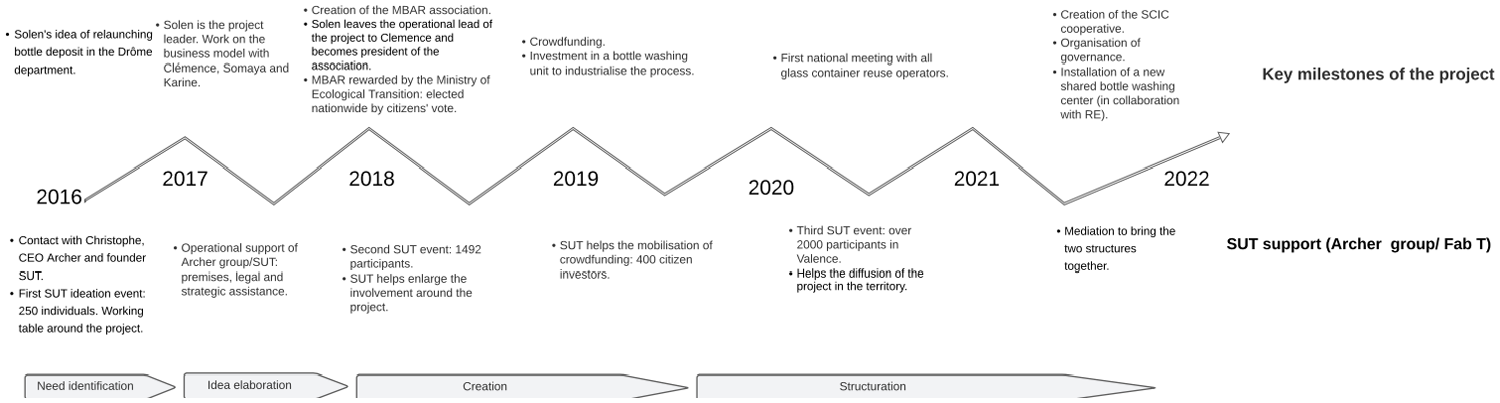
MBAR’s timeline.
Reverrecible
Naïm and Stéphanie met in 2018. They discovered that they both wanted to work on a project focusing on the environment and that they shared the same entrepreneurial focus. They decided to form an association in 2018 to launch their glass recycling project. The project gathered momentum at the SUT ideation evening (more than 500 attendees) organised by GAIA in Grenoble in October 2018, in which citizens expressed their support for the project. Initially, Ivan was the SUT animator for RE. Later, he became a volunteer, linking the project leaders with the citizens and allowing the entrepreneurial team to step back from the project strategy. For example, Volunteers met once a month in the year after the SUT event and helped the project leaders think about the business model, elaborate the collection site map and reflect on the logistics. Interest in the project grew as strong business relationships were made with brewers and juice producers. In December 2019, the volunteer group suggested the project leaders trial the whole process with the population: buying the drink, consuming it, returning the bottle to the shop, collecting and washing bottles and returning them to the local producers. Six volunteers, including one of the authors, organised the trial.
In autumn 2019, Naïm left the project to earn a stable income, and Stéphanie left because she no longer wanted to run the project alone. Augustin took over in March 2020 and formed a new team with Manon and Cécile. The three new project leaders expanded the business. They found new suppliers and new customers and studied the impact of having their own bottle washing machine. The coronavirus disease 2019 pandemic gave them some time to think about strategy and to structure the business more formally. In December 2021, RE adopted the cooperative status SCIC. SUT supported the legal change, mostly by promoting it to local political actors. In early 2022, Augustin decided to quit to move on to other professional challenges. By 2023, there were 121 collection sites and the cooperative had recycled 89,500 bottles, secured substantial financing – including EUR 600,000 from the Auvergne-Rhône-Alpes regional council – and created three jobs. Figure 2 shows RE’s timeline.
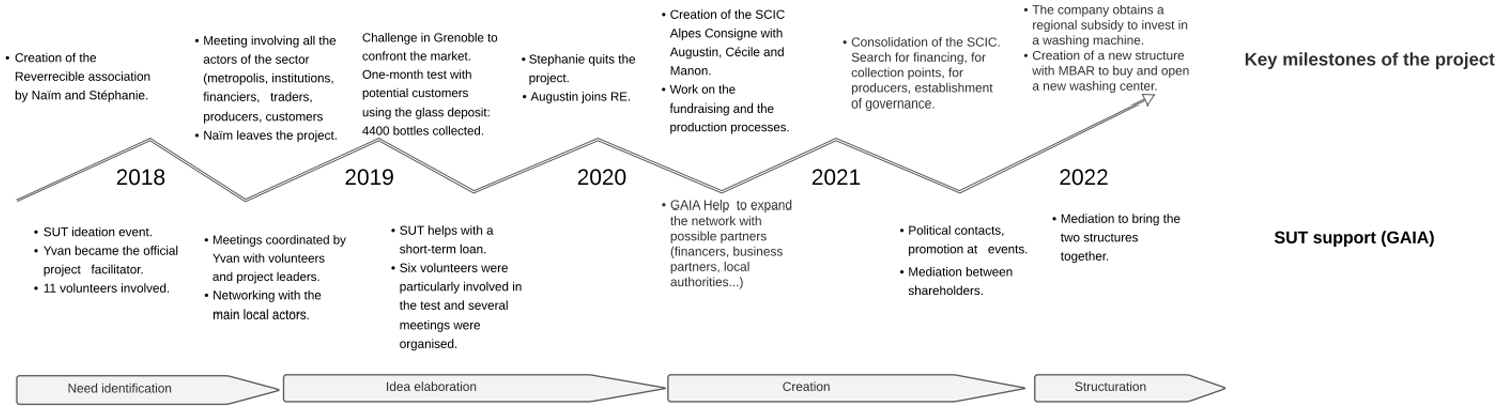
RE’s timeline.
Towards the convergence of the projects
The two enterprises’ business models, based on a delimited geographical area, were inadequate. In October 2022, they joined forces in Rebooteille (a SCIC with the same activity in the Lyon area) to share a new bottle washing centre. Located within the premises of MBAR, the pooling of a washing facility enables the three fims to ‘acquire washing facilities that meet the quality standards required by manufacturers, to increase production capacity and to secure long-term projects (letter to MBAR shareholders, November 2022). The merger also makes it possible to develop advocacy to standardise bottle collection at the national level. SUT mediated between the three partners to help them define a common strategy, including defining each company’s scope.
Data collection
We conducted a longitudinal study to observe how collective processes unfold over time. We adopted a mixed-methods approach (Langley et al., 2013) that combined various sources of data to generate holistic and contextual knowledge over seven years. From 2015, one of the authors observed how SUT was established to create social enterprises by involving the inhabitants of Romans-Valence (in the Drôme region of France). SUT’s participation in the evening sessions in 2016, 2018, 2020 and 2022 made it possible to understand the dynamics of supporting citizen entrepreneurship in the area. The same author observed the creation of MBAR. Interviews, which were recorded and transcribed, were conducted with the founding team and the various stakeholders in MBAR and SUT/Archer between 2016 and 2022. Simultaneously, follow-up conversations with the current leader (Clémence) made it possible to follow the key stages of MBAR’s evolution up to 2023. Numerous documents were collected, including internal and sometimes confidential material (e.g. emails and strategic documents). Finally, one of the authors made two visits to the organisation to observe the production processes and constraints of this type of industry. At RE, based on a personal interest in reuse and a commitment to volunteer in the organisation being created, one of the authors began fieldwork in 2018. This provided access to internal and external documents and regular progress reports, which helped to keep abreast of the key developments. The author also helped to organise a ‘life-size’ feasibility test for the project and to study its development potential in the area. Between 2020 and 2022, interviews were conducted, recorded and transcribed with the different stakeholders in RE, including successive entrepreneurial teams, volunteers and other actors in the area, such as SUT and GAIA.
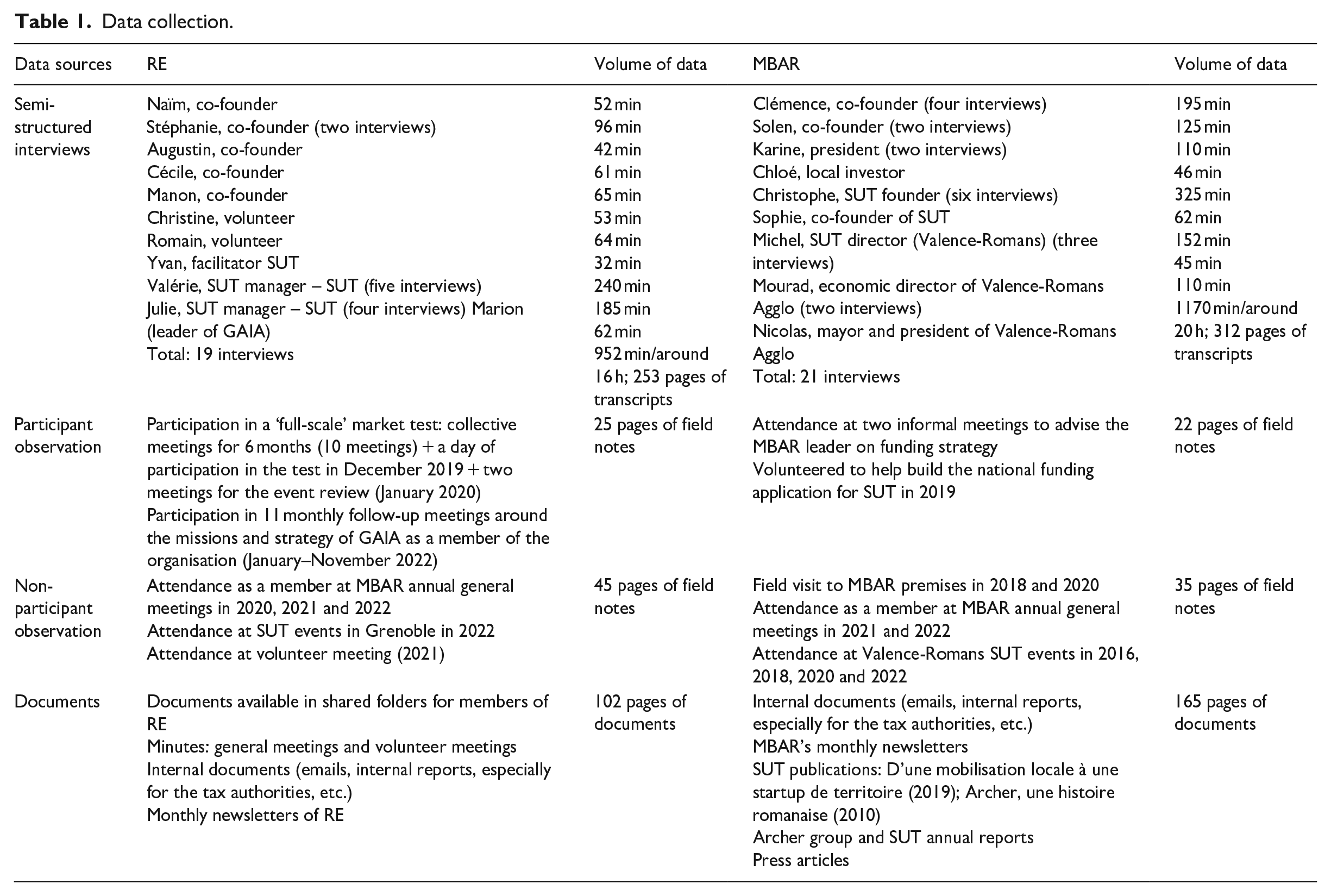
The two authors see themselves as ‘situated actors’ (Fletcher, 2011), given their proximity to the empirical field, which helped them to gain the confidence of the actors whose practices they were observing. They engaged in ‘enactive research’ (Johannisson, 2011), which provides ‘a means of understanding entrepreneurship as a mixture of the interrelated experiences, senses, feelings, emotions and actions of the various actors’ (Fletcher, 2011: 70). In 2021, both authors became shareholders in RE and MBAR. In doing so, they had regular access to legal information and internal documents (e.g. newsletters and strategic documents) up to 2023. Attending annual meetings with shareholders offered an advantage in terms of accessing and understanding the culture (Labaree, 2002). It also helped to keep the authors informed, to follow the evolution of the case studies and to understand reality from the perspective of the multiple actors involved (Johannisson, 2011). However, to ensure credibility and trustworthiness (Gioia et al., 2013), both authors regularly questioned their assumptions throughout data collection and analysis. For example, they were careful to identify any bias arising from their close relation to their field and from working as a team, where they were both simultaneously an ‘insider’ researcher for one of the cases and an ‘outsider’ researcher for the other (Griffith, 1998). This dual researcher status (Labaree, 2002) allowed them to combine intimacy with local settings with the potential for distancing. In total, data from 40 semi-structured interviews were gathered (416 pages of transcripts in A4 format), along with 1240 pages of documents and 96 pages of field notes (see Table 1).
Data collection.
Data analysis
To analyse collective agency, it is necessary to move away from the individualistic approaches that have dominated entrepreneurship research (Champenois et al., 2020; Watson, 2013). Adopting a practice-based approach helps challenge assumptions based on ontological individualism that equate entrepreneurial activity with the behaviour of a single type of practitioner (Thompson et al., 2020). Practice can be defined as a bundle of ‘doings and sayings which are hierarchically organized to comprise increasingly complex wholes called tasks and projects’ (Schatzki, 2005: 471). According to Teague et al. (2021: 570), a practice is a ‘type’ of behaving and understanding that ‘appears at different locales and at different points of time and is carried out by different body/minds’. Indeed, a practice-based approach offers a new perspective on organisational matters and makes it possible to study ‘doings and sayings’ of ‘multiple entrepreneurial practitioners’ (Thompson et al., 2020). In line with the literature on social practice theory (Nicolini, 2012), we consider practice as the fundamental unit of analysis when studying collective agency phenomena. Therefore, in our analysis, we focused on practices conceived as the ‘everyday activity of organizing in both its routine and improvised form’ (Feldman and Orlikowski, 2011: 1). We adopt an empirical approach to practice (Feldman and Orlikowski, 2011) that ‘recognizes the centrality of people’s actions to organizational outcomes and reflects an increasing recognition of the importance of practices in the ongoing operations of organizations’ (p. 1240). In accordance with the guidelines on practice analysis (Teague et al., 2021) and on grounded theory building in management research (Gioia et al., 2013), we moved between the data, specific analyses and the literature to generate novel theoretical insights.
Following Cucchi et al. (2022), we first ‘zoomed in’ on practices and coded the transcribed texts using the method detailed by Saldaña (2016) with the help of the Atlas.ti software. (Scientific Software GmbH) Our first open coding cycle was based as closely as possible on the texts and transcripts. Here, we looked for trends or recurring practices emerging from our interviews and observations. After an inter-coding phase in which we aimed to compare our coding perspectives, identify possible groupings and define the main codes, in the second coding cycle we merged, renamed or deleted irrelevant codes. We looked for similarities and differences between categories, adopting a similar process to Corbin and Strauss’s (1990) notion of axial coding. This reduces initial categories to a more manageable number (from 72 codes at the beginning to 32 codes after the second cycle of coding).
Then, to ‘zoom out’ from practices, we used Gioia et al.’s (2013) approach to move from our empirical understanding of practices to greater generalisation. This allows for a systematic presentation of both a first-order analysis (using informant-centric terms and codes) and a second-order analysis (using researcher-centric concepts, themes and dimensions) (see Figure 3). It is important to note that, traditionally, the Gioia approach advocates a purely inductive method in which researchers are led by the data and by informant-centric labels and terms before they make any conceptual abstractions. More recent versions of grounded theory advocate moving on more quickly to theoretical concepts to inform and adapt data collection (Murphy et al., 2020). We followed the more abductive approach, as suggested by Van Burg et al. (2022), and we returned to the literature to identify possible theoretical perspectives early in our analysis. In particular, the difference between animatorship and entrepreneurship (McElwee et al., 2018) inspired us to formulate key concepts and identify three major dimensions of collective agency. Concurrently, we reflected on how these connections could be explained theoretically (Gioia et al., 2013). Throughout the analytical process, we actively compared our observations with the entrepreneurship literature to identify overall patterns in the creation of collective enterprises.
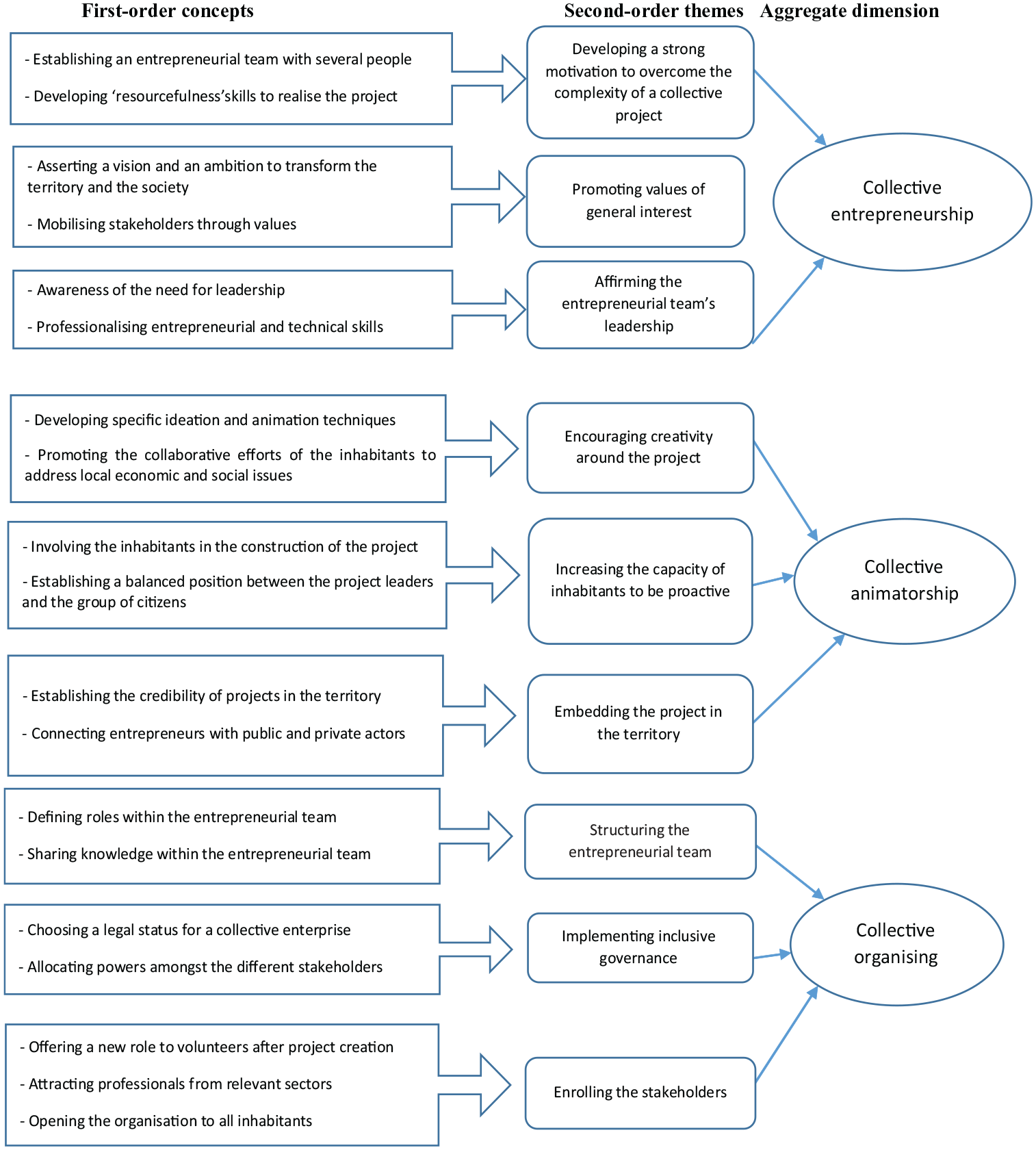
Data structure.
Results
Our analysis identified collective agency as one form of agency in the creation of collective enterprises with three dimensions – collective entrepreneurship, collective animatorship and collective organising – the main characteristics and interrelations of which are presented below.
Collective entrepreneurship
This dimension describes a set of practices associated with those who initiate entrepreneurial action at the inception of a collective enterprise for social impact. Collective entrepreneurship encompasses three main practices.
Developing a strong motivation to overcome the complexity inherent in a collective project
Collective initiatives for social impact take time to emerge because of the many stakeholders involved and the need for a stable economic model to reconcile objectives with a general interest purpose. Together, these requirements can limit the capacity of the initiatives to finance the entrepreneurs initially, which can make it difficult for project leaders to remain committed. As Valérie from SUT Grenoble, who followed the evolution of RE and many collective projects, explained: ‘It doesn’t surprise me that there are departures, because what they do is extremely hard’. In our study, to remain personally engaged in this type of entrepreneurial venture in the medium or long term, the founders felt that it was important to establish an entrepreneurial team from the outset. For instance, Stéphanie (RE) quickly realised that she ‘would not be able to carry out the project alone; it is necessary to be more numerous. I started to try to find people around me who might be willing to do such a project’. At MBAR, the original idea came from four people who already knew one another. The collective dimension of this type of entrepreneurship is an important source of motivation based on the pleasure of working together. In addition, to maintain their personal commitment to the project, leaders had to develop ‘resourcefulness’ skills to deal with the material constraints they faced. All project leaders became involved while making a professional transition. Often, they used their unemployment benefits to give themselves sufficient time and income for a few months to launch the concern before, in Clémence’s case, becoming a salaried manager. At the same time, the project leaders often accepted professional compromises (e.g. not looking for a permanent job) or even a lower income (source: observation minutes, RE).
Promoting values of general interest
First, project leaders asserted a vision and an ambition to transform the territory and the society. For example, Clémence (MBAR) stated that she embarked on the project ‘with a perspective of territorial resilience’. This ambition for transformation was also reflected in a desire to make an impact at a national level. Solen (MBAR) recalled that ‘every time there are laws, we meet the creators of the laws, our members of parliament, etc. We are part of the various co-construction bodies on reuse’. Moreover, shared values helped the founders mobilise stakeholders. Thus, volunteers got involved because they felt they were contributing to a meaningful project, and they believed they could be useful. Their shared values that represented their motivational impetus to get involved, as Solen (MBAR) explained: ‘the bottle deposit is something that really speaks to people of all generations; there is a kind of obvious side with a kind of adhesion that really appeals to everyone’. Therefore, the challenge was sufficient to get them involved voluntarily.
Affirming the entrepreneurial team’s leadership
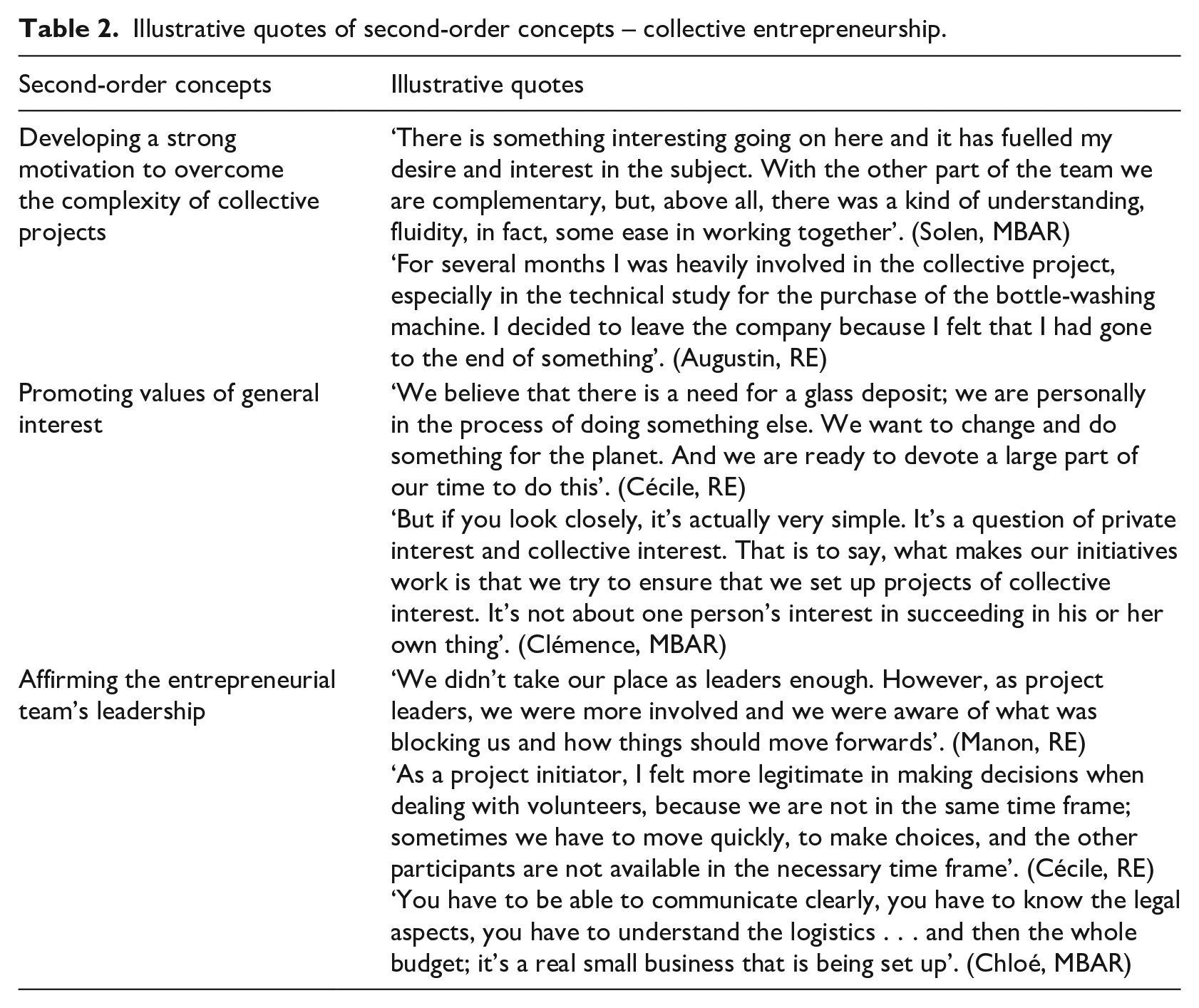
The collective dimension of projects meant that it was some months before a clear awareness of the need for leadership emerged and the collective nature of the entrepreneurial dynamic resembled the formation of a leadership team. As Manon (RE) pointed out, ‘our challenge was to affirm our positions more strongly towards the volunteers and other stakeholders’. This awareness of the importance of leadership is coupled with practices of professionalisation of the entrepreneurial team. In both cases, the team leader developed managerial skills (e.g. conducting a thorough economic feasibility study) and technical skills (e.g. understanding how a bottle washing unit works). Development of the project leaders’ skills helped establish their legitimacy, especially in the eyes of volunteers and public-sector partners in the local area (source: observation of RE’s annual general meetings). Table 2 contains quotes illustrating collective entrepreneurship.
Illustrative quotes of second-order concepts – collective entrepreneurship.
Collective animatorship
The primary objective of the second dimension of agency – ‘collective animatorship’ (McElwee et al., 2018) – is to enable others to engage in entrepreneurship collectively. We identified several prerequisites for this.
Encouraging creativity around the project
One of the primary roles of SUT was to encourage creativity. One focus involved developing specific ideation and animation techniques. As Christophe (SUT) put it: ‘When there are 15 people, volunteers and citizens, who want a project, it gives an incredible power to generate new ideas’. For example, MBAR’s presence at SUT evenings enabled it to obtain insights from citizens on specific project issues, such as how to increase the number of bottles returned to collection points. Another focus involved promoting the collaborative efforts of the inhabitants to address local economic and social issues. This implied finding ways to involve the entire local area. To encourage the flow of ideas around the projects, citizens, elected representatives and business leaders participated on an equal footing with local residents. To this end, everybody presented themselves ‘with their first name only to break the weight of the institutions, whether they are a doctor, a magistrate or a shopkeeper’ (Christophe, SUT) and to remove any social barriers between them (source: SUT event observation notes). For Ivan (RE), ‘SUT is also an event to explore issues and to say that we are more intelligent together and we don’t need to be an engineer on the subject to be knowledgeable’ (source: SUT event observation).
Increasing the capacity of inhabitants to be proactive in the collective projects
Through the ideation events, SUT brought a large and enthusiastic audience to collective projects. According to Valérie (SUT), after the SUT event: ‘The main question was: How to carry on? Many citizens wanted to understand how they could continue to be involved in the projects’. Actively involving the inhabitants in the construction of the project in the long term was one of SUT’s objectives. At RE, Ivan represented SUT Grenoble (GAIA) in animating the collective of local citizens around the project. After the ideation evening, Ivan (RE) facilitated ‘a small working group whose composition was very variable, with some people leaving in the middle, others arriving in the middle’ at least once a month. To achieve this objective, SUT had to establish a balanced position between the project leaders and the group of citizens. This would support the commitment of the inhabitants without assuming an overly central role in advancing the projects (source: meetings between volunteers, RE minutes). In this respect, Ivan (RE) noted that animators had to find their place alongside the entrepreneurial teams: ‘We are here to help others to be entrepreneurial, to do things. Our job is not to do the work and do things on behalf of the project leaders’.
Facilitating the territorial embeddedness of the project with private and public institutions
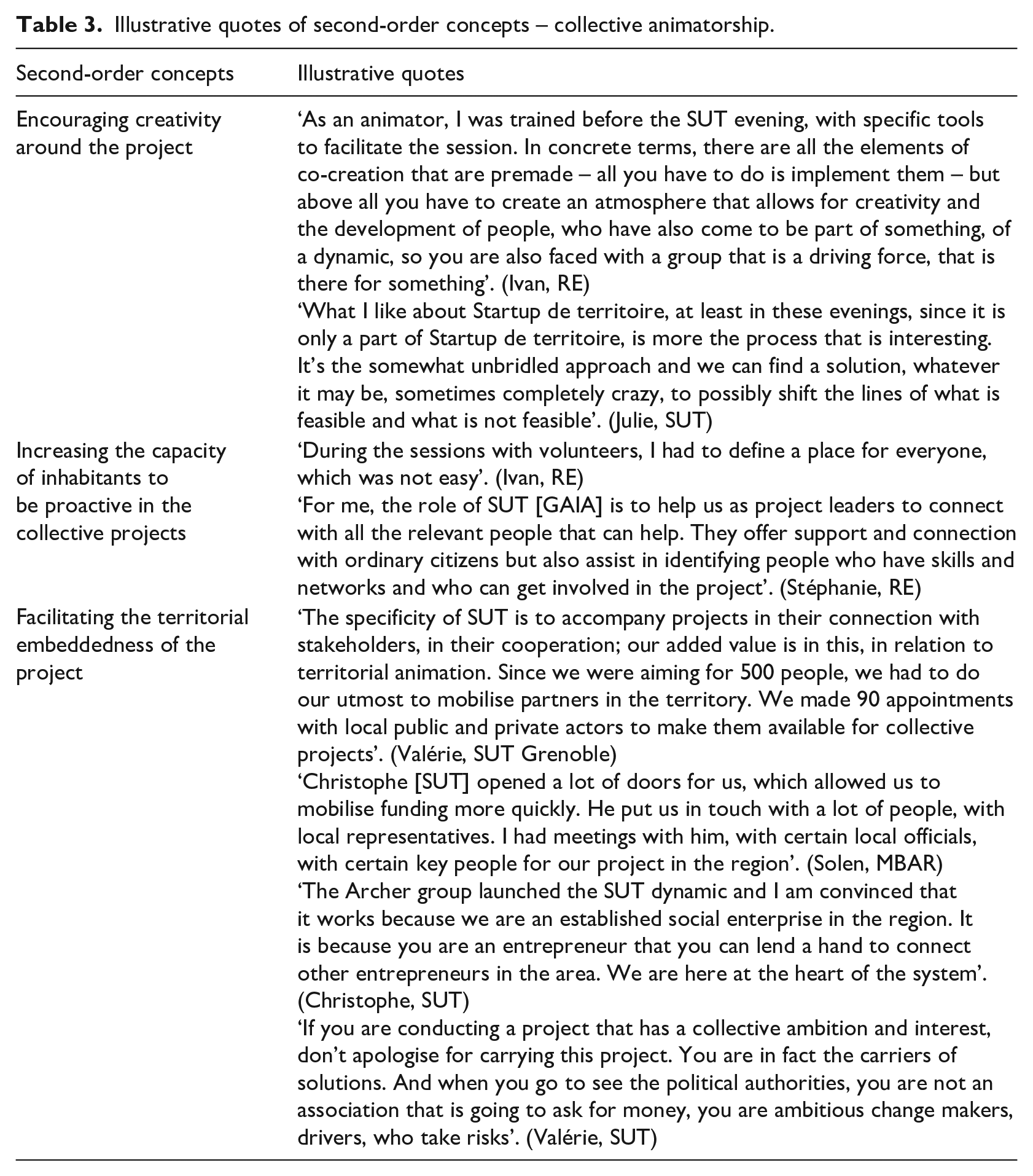
First, SUT aimed to help the collective projects establish their credibility in the area and convince all stakeholders, including local decision-makers, of the contribution made to the local area. SUT also developed tools to support the collective dimension of the projects, such as guides containing economic, ecological, social and territorial questions, to help the project leaders to take into account all these dimensions. According to Michel (SUT), it ‘allows us to identify the dimensions on which we can support them. This also increases the credibility of the project on the territory’. Second, SUT helped collective projects develop by connecting entrepreneurs with public actors (elected officials and senior civil servants of local authorities) and private-sector entities (e.g. financers and small- and medium-sized enterprise (SME) managers). In the Valence-Romans area, Christophe (SUT) defined his role as that of a ‘broker’ in the area. At MBAR, this was done by accompanying the project leaders to help them convince the local public authorities, including the mayor of Valence, of the positive contribution these collective organisations would make to local development. Indeed, as Nicolas, the mayor of Valence explained: ‘As these are the needs of the local area, we are certain that these are companies that will stay here, create jobs here, create wealth here. And they will respect the environment’. Table 3 contains quotes illustrating collective animatorship.
Illustrative quotes of second-order concepts – collective animatorship.
Collective organising
Weick’s (1993) concept of ‘organising’ is useful to understand the third dimension of collective agency. Weick captures the idea of organisational structuring through ‘activities that are repetitive, reciprocal, contingent behaviours that develop and are maintained between two or more actors’ (p. 91). In our study, organising the continuity of the collective enterprises for social impact involved three practices.
Structuring the entrepreneurial team
We noted instability in the composition of the entrepreneurial teams, with various project leaders leaving in the first three years. At RE, the entrepreneurial teams were renewed almost every year, mainly because of the difficulty of finding an economic model at the outset. The project leaders left for financial reasons (Naïm, Stéphanie, Clémence), out of exhaustion (Stéphanie) or for professional reasons (Augustin, Solen). The practices are different between the two projects in terms of defining the role of the entrepreneurial team over time. When Solen left MBAR after about a year, it was Clémence, who had been involved from the start, who took over, facilitated by her deep knowledge of the issues at stake. Clémence’s role changed from volunteer to employee. At RE, successive project leaders did not always know one another at the outset, so it was challenging to share knowledge within the entrepreneurial team. Hence, some tutelage is necessary from one project leader to the next, the former perhaps remaining as a volunteer or member of the board or performing functional tasks such as communication (e.g. Naïm, who is a graphic designer).
Implementing inclusive governance
For Solen, one obstacle to collective projects is that ‘there are many people who at some point no longer know what their role is, what their place is and what the decision-making methods are’. The organisational mode and the search for ways to make shared decisions quickly became key issues. At both projects, leaders initially adopted the legal status of an association as the simplest form of organisation to get started. As the enterprises developed, it became necessary to restructure while maintaining a collective dynamic. Both projects subsequently decided to adopt a legal status of collective enterprise. The associations later became SCICs, implying the establishment of a multi-stakeholder board of directors around the entrepreneurial team. According to Clémence (MBAR), ‘the objective is really to ensure that production and the mode of governance are tools that serve the territory’. To achieve a balanced distribution of power within the organisation, it is essential that all actors with a long-term interest in the project (employees of the company, beverage producers, stores and volunteers) can participate in organisational decision-making. However, the question of how much to open up governance has been the subject of much debate (source: 2020 annual SCIC general assembly minutes for RE and MBAR). At MBAR, for example, it was a question of deciding whether employees or workers in social integration – who were not expected to stay for more than two years – could become board members.
Enrolling the stakeholders
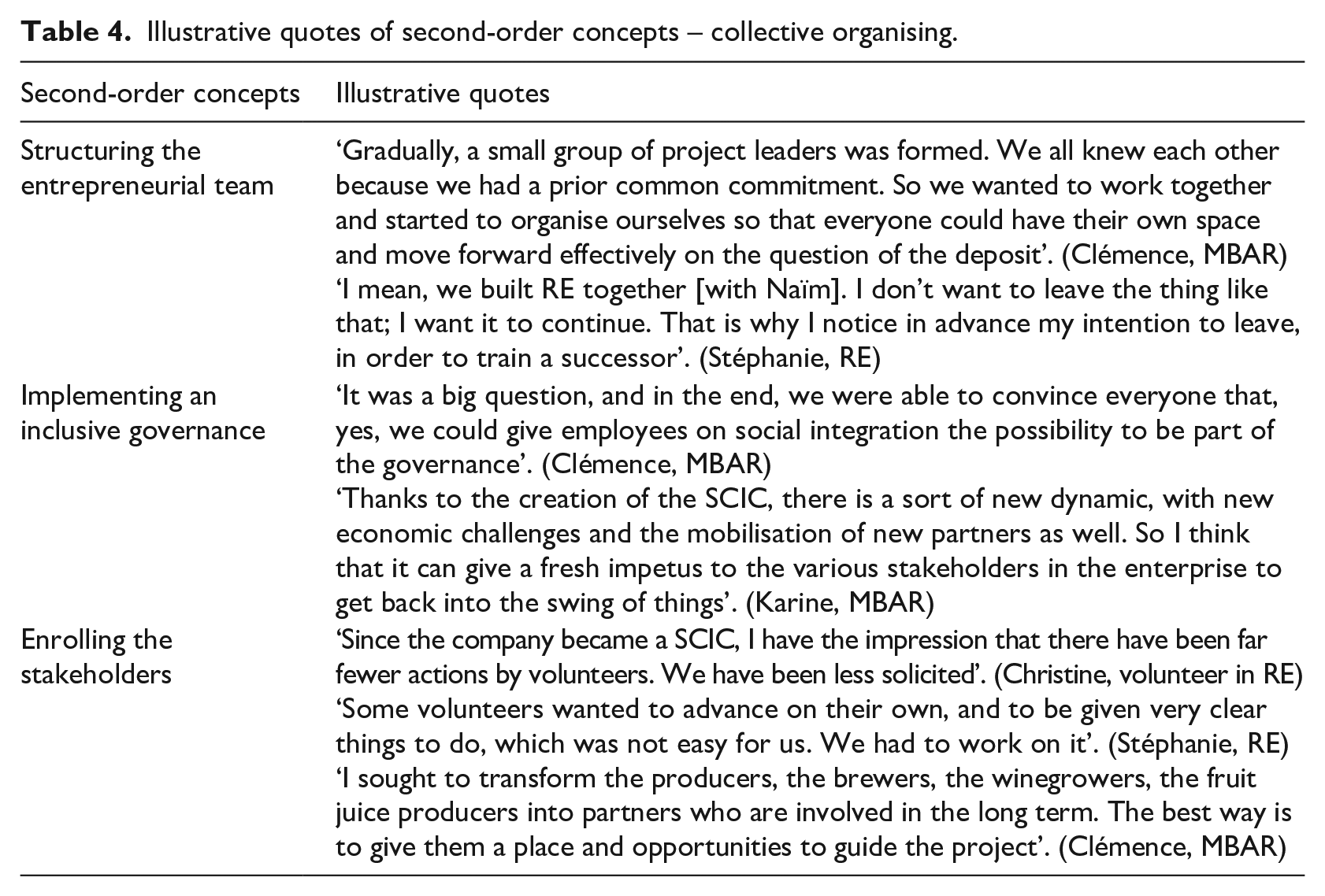
During the evolution and structuring of the project, one of the major challenges was maintaining the collective dynamic of the stakeholders. After the creation of the SCIC, a key question was whether to offer the volunteers a new role to encourage them to continue investing their energy in the organisation. To meet this challenge, Valérie (SUT) observed that ‘controlling the energy of volunteers’ was a key factor for success. For her, it was necessary to ‘manage this group of volunteers as a team’. Therefore, both projects tried to maintain a link with their volunteers through regular newsletters and inviting as many people as possible to meetings. In most cases, volunteers were assigned tasks based on immediate needs (running the bar at the opening, helping with washing and removing labels) or their skills (legal knowledge or graphic design experience). The projects sought to attract professionals in the sector into the collective and looked for actors with experience of the bottle deposit scheme. Solen (MBAR) explained that she was willing to work with them: ‘I approached very quickly brewers who were interested in the subject, on a technical level’. The challenge with the structuring of the project was to keep this professional engagement within the company. There was a need to give them a place and opportunities to guide the project. Thus, Clémence sought to ‘transform the producers, the brewers, the winegrowers, the fruit juice producers, into partners who are involved in the long term’. Finally, to engage the whole area, the projects offered all inhabitants the opportunity to become shareholders in the cooperative. At MBAR, this was done by organising a crowdfunding campaign that enlarged the circle of people willing to get involved. Table 4 contains quotes illustrating collective organising.
Illustrative quotes of second-order concepts – collective organising.
Collective agency in the creation of collective enterprises for social impact: a theoretical model
Our model improves understanding of the role of agency in the creation of collective enterprises for social impact over time (see Figure 4). Our results suggest that the creation of a collective enterprise for social impact requires a collective form of agency. Collective agency can be disaggregated into three components (interrelated empirically). First, collective entrepreneurship (practices associated with those who initiate entrepreneurial action) represents the foundation of collective action. This component is driven by a desire to engage in collective action and a shared project. Moreover, collective entrepreneurship is based upon a strong set of values shared amongst the project leaders, including a motivation to change the world. These values also attract an audience to the project at the start of the venture. Second, collective animatorship describes support and reinforcement of the collective approach in the process of creating an enterprise for social impact. It also fosters creativity and helps to get inhabitants involved. Thereafter, it embeds the project in the local area and gathers various public and private actors around the venture. Third, collective organising encompasses practices to maintain continuity of the collective approach: enrolling the stakeholders, implementing inclusive governance and structuring the entrepreneurial team. Here, progressive assertion of the team leadership allows collective entrepreneurship to evolve into collective organising. Thus, the initial collective can evolve and gradually stabilise to develop the venture.
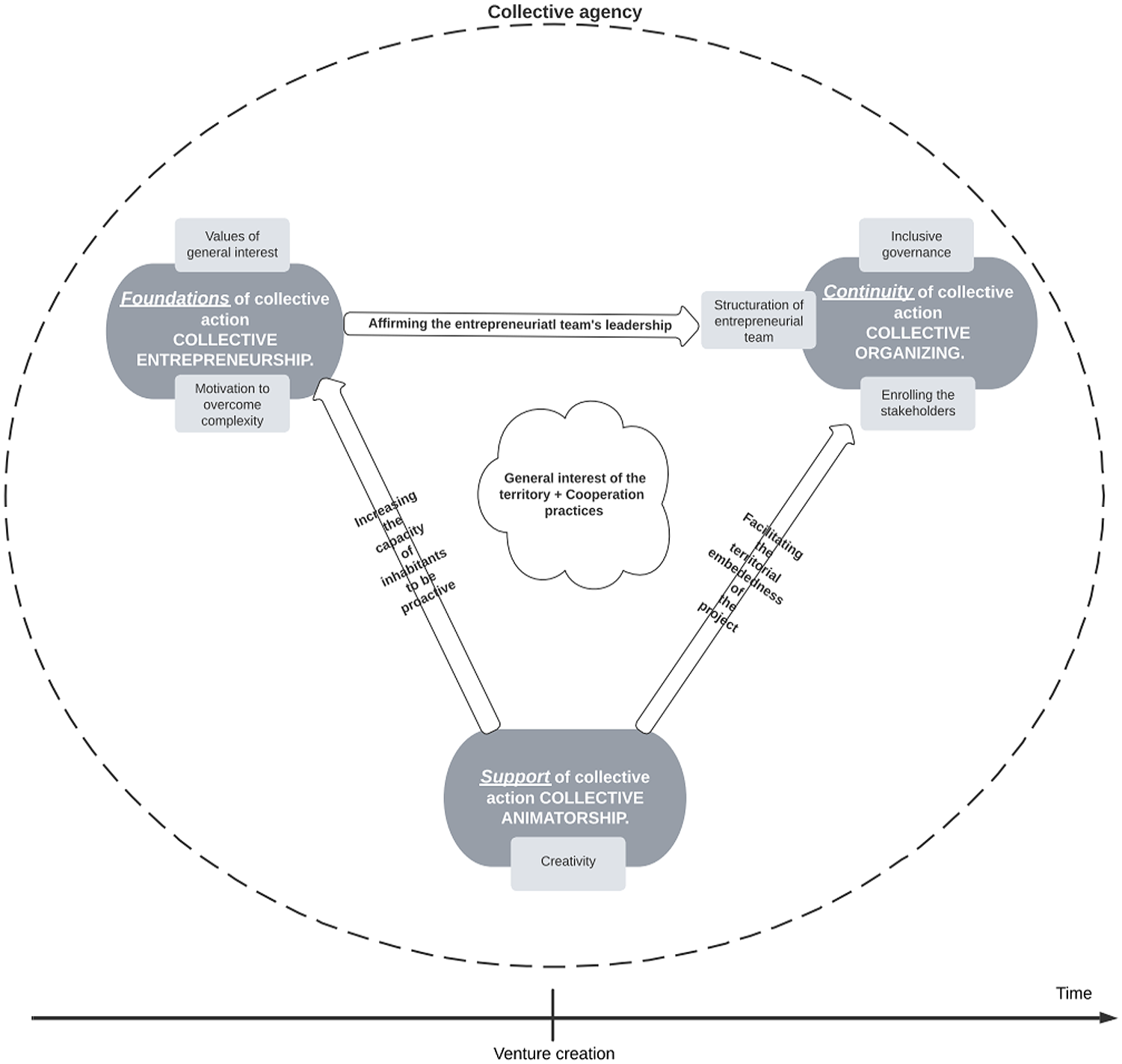
Collective agency in the creation of a collective enterprise for social impact.
If collective agency is effectively distributed amongst these three components, our model suggests two additional dynamics that consolidate it in the creation of collective enterprises. First, collective agency is driven by a common vision of social impact. This common vision, in our case general interest in the local area and its development, is essential for thinking about collective agency coherently. Second, collective agency requires cooperation between all the actors in the area interested in maintaining the collective dynamics of an enterprise with local social impact. This confirms that, in collective agency, people must collaborate to achieve what they cannot achieve alone.
Discussion
Agency, which is central to the field of entrepreneurship (McMullen et al., 2021), has to date been understudied in its collective dimension (with one exception: see Ho and Teo, 2022). Our analysis of collective agency highlights the functions, roles and practices of the actors involved in the creation of collective enterprises for social impact.
Diving into collective agency
By better delineating collective agency, our analysis contributes to the literature on entrepreneurial agency, which remains central to the field of entrepreneurship (McMullen et al., 2021). Traditionally, the literature (Bandura, 2001) compares an individual’s desire to engage in direct agency and personally control their actions with collective agency where people relinquish some personal control for the collective. Our approach, which considers collective agency as a sum of practices (Caldwell, 2005), allows us to go beyond this comparison and improve our understanding of collective agency in the context of creating collective enterprises for social impact. This disrupts the idea that agency or actors take precedence over the environments of ‘incentives’ and ‘constraints’ in which they operate. By studying collective agency as a sum of practices, our study also extends Champenois et al.’s (2020) call to explore the issue of entrepreneurship from a collective perspective. This extension of the ‘entrepreneurship-as-practice perspective’ to a ‘multiple-practitioner perspective’ encourages considering practitioners around entrepreneurs, who are engaged in the entrepreneurial venture and ‘who hold such collectively shared knowledge’ (Champenois et al., 2020: 22). This prevents us from limiting our attention to the individual, as is often the case in the literature on entrepreneurship (Shepherd et al., 2021).
Some commentators have highlighted that the locus of entrepreneurial agency is less predefined and more ‘distributed’ (Nambisan, 2017) when a collective of actors engages in an entrepreneurial initiative. Our conceptualisation reveals that collective agency, although indeed dispersed, has a reality of its own. Our study provides conceptual clarification of collective agency by identifying the dimensions of collective entrepreneurship, collective animatorship and collective organising. More specifically, we substantiate McElwee et al.’s (2018) concept of animatorship by specifying associated practices. Identifying animatorship as a distinct concept provides much-needed analytical clarity to research on collective entrepreneurship. In our recognition of collective animatorship’s key role in the creation of collective enterprises for social impact, we corroborate Smith and Besharov’s (2019) insight that other actors can help entrepreneurs foresee and tackle apparently insurmountable obstacles. This is important given that studies of collective action and social movements often highlight the problem of declining participation over time despite initially successful mobilisation efforts (Buechler, 2016).
We show that entrepreneurial agency can be both individual and altruistic. The concept of collective agency accommodates the goals of others; this encourages people to make a commitment to others and behave pro-socially. This is in line with Evans (2002), who argues that acts of collective agency are determined mainly by prevailing communal values and social structures. Similarly, Pelenc et al. (2015) explain that agency can infer the capacity to achieve objectives beyond improving individual well-being and involve sympathy, generosity and commitment to others, including participating in community development, poverty reduction and local sustainable development. In our cases, general interest in the local area is a key ingredient of collective agency. We show that the process of creating a collective business for social impact involves various actors – citizens, public actors, SMEs, business support, business partners and mentor entrepreneurs – who converge around a common territorial objective that goes beyond the individual enterprise’s goal.
Reconsidering the creation of collective enterprises for social impact
Our findings also challenge some classical assumptions in the literature on social entrepreneurship more generally. This study departs from the concept of individual agency in the creation of collective enterprise for social impact (Dees, 1998) to highlight collective agency in the local area. It shows that the traditional heroic tale of overcoming does not apply to all kinds of entrepreneurship. In this sense we agree with Gaddefors et al. (2020), who stress that a collective of localised actors engages in agency for, and with, the community. Our analysis also resonates with Bacq et al. (2022), who propose a continuum of community roles – from passive beneficiaries to proactive entrepreneurial agents of social change – through which societal impact is created by entrepreneurship for, in, with, enabled by and driven by communities. We also show that how ‘agency’ is conceived has implications for understanding the possibilities and limitations of the creation and sustainability of collective enterprises for social impact.
By contrast, the findings show that, while the legal status of a collective form of enterprise offers at least some guarantee of its collective – and even democratic – functioning (Ebrahim et al., 2014), it is not an end in itself. It seems clear that the other two dimensions of collective agency (collective entrepreneurship and collective animatorship) are necessary to sustain the collective dynamics of an organisation in the long term (i.e. collective organising). This echoes Haugh (2007), who points out that effective realisation of a collective enterprise requires multiple forms of capital and resources invested by different actors in the local area at different times. Therefore, these organisations can only emerge if enough people are willing to invest their private resources in a common goal (Hertel et al., 2019).
Empirical contributions
For years, high-growth entrepreneurship backed by venture capital has been promoted as an effective means to achieve local development in impoverished places. Yet there is growing evidence that, despite its successes in resource-rich regions, this approach has limited impact in economically challenged areas. Kim and Kim (2022) underline the importance of local development of enterprises that are not classic business start-ups: collective ventures strongly rooted in their local area may actively contribute to local development. Complementary, bottom-up, grassroots approaches to social enterprises and social innovation (Shaw and de Bruin, 2013) indicates that the direct involvement of beneficiaries is central to addressing their own needs. These forms of organisations represent a more resilient way for entrepreneurship to rebuild local economies (Korsgaard et al., 2020). As such, creating collective initiatives appears to be a credible way to generate ambitious and transformative entrepreneurial projects. Considering the impact of these ventures on the local area, our research may encourage local public authorities to look more closely at how to trigger collective ventures for social impact.
Finally, our study provides useful insights for public policies in regional development by underlining the importance of a particular form of agency in the creation of collective enterprises for social impact. Historically, research into entrepreneurship and regional development has explained success through entrepreneurial ecosystems (Chabaud et al., 2010). But emerging theories are reconsidering the role of individual and collective behaviour in determining regional development outcomes (Korsgaard et al., 2020). This position concerns ‘the means by which such behaviour drives innovation and subsequently economic development’ (Huggins and Thompson, 2020). This increasing emphasis on the role of collective agency through networks of individual agents and actors (Bristow and Healy, 2014; Cumbers et al., 2016) can help public policies better take into account and support local development dynamics. In sum, we argue that each component of collective agency has a distinct role to play in the creation and structuring of collective enterprise for social impact. Without these three components, collective agency will struggle to emerge.
Limitations and future research
Our research proposes a theoretical model that illustrates the dynamics of creating collective enterprises for social impact, but our study has limitations. Although we collected rich data thanks to our proximity to the field, our analyses are based on two case studies in the same region and are rooted in entrepreneurship for social impact. Some authors have emphasised the importance of context in the creation of collective social enterprises (Akemu et al., 2016). Spear (2019) highlights that the institutional environment – intermediaries, organisations and regulatory regimes – is key to facilitating collective social entrepreneurial activities. Future studies could examine the creation of collective entrepreneurship in other contexts (e.g. rural areas). Moreover, we recognise that our study was carried out in two areas with a strong culture of collective entrepreneurship. It would be interesting to analyse different forms of animatorship in other locations.
Collective entrepreneurship is particularly relevant today. While it is widely recognised that entrepreneurship makes a useful contribution to addressing grand challenges (Berrone et al., 2016), citizens are increasingly willing to participate in the creation of local enterprises that bring about change in their area. Faced with the ‘double unsustainability’ (Eynaud and Carvalho de França Filho, 2019) of ecological and social issues, more citizens want to be actors of economic change in a meaningful entrepreneurial initiative. Such civic engagement (Lumpkin and Bacq, 2019) represents an opportunity to fuel the momentum of creating collective enterprises for social impact (Wry and Haugh, 2018). Such common projects with social impact distance the actors from the ‘orthodox social imaginary’ and allow them to develop ‘collective imagination as a genuine entrepreneurial accomplishment’ (Dey and Mason, 2018). This allows them to create ‘possible worlds’ that prefigure ways of doing business that are consistent with broader societal interests (Dey and Mason, 2018).
Footnotes
Funding
The author(s) received no financial support for the research, authorship, and/or publication of this article.
Notes
Author biographies
 ). She was editor-in-chief of the Revue de l’Entrepreneuriat/Review of Entrepreneurship for one term. For the past 20 years, her research has focused on business transfers, in particular external business takeovers, sibling succession, support for the successor, and gender issues in business takeovers. In 2022, she coordinated BusinessTransfers, Entrepreneurship and Family Firms, published by Routledge.