




Abstract
Social enterprises (SEs) combine economic and social goals and are essential pillars to contribute to a better world. SEs often manage limited resources; wasting some could mean minimizing their social contributions. This study, supported by the theoretical lens of the business model (BM), analyses the modes of uncaptured value in SEs. This qualitative study examines micro and small SEs from the sustainable fashion industry based on ethnographic views and semi-structured interviews. This study contributes to the literature and the managerial field by examining the modes of uncaptured value and their consequences while organizing them in two groups according to the set of decisions and actions of the SEs; presenting a framework that represents stages of the development of SEs according to their relationship with modes of uncaptured value; and, providing a set of valuable knowledge to support the qualification of SEs in better structuring their BMs and practices. Understanding the modes of uncaptured value in the BMs of SEs leverages the value that could be delivered but is not, especially in a context of resource scarcity and social demands.
Keywords
Introduction
Currently, society faces severe sustainability challenges, and focusing only on maximizing the value for shareholders or customers is not enough (Bal et al., 2023). In this context, hybrid organizations such as social enterprises (SEs) combine economic and social goals, becoming essential societal pillars. For SEs, social responsibility become the raison d’être of the business. To do so, SEs adopt a hybrid business model (BM) approach of pursuing a social mission while targeting economic sustainability (Imperatori & Ruta, 2015).
A BM presents a set of themes and constituent elements that have a function designed to contribute to the generation of value (Teece, 2010). The critical starting point of building a BM is understanding the value to the enterprise and stakeholders. In a more reduced perspective, value is generally defined by benefits against sacrifices (Grönroos, 2017) or gains against costs. Firms prioritizing economic results aim to receive more value from a stakeholder than the firm spent to create it.
However, a perspective centred primarily on profit is insufficient for surplus challenges related to climate change and social and income inequalities (Sugai & Mahajan, 2023). Value, in a broader connotation, depends on the principles and purposes. In this sense, creating value can be understood as the execution of habitual, conscious, inspired and even imaginative actions that increase the overall good and well-being. Thus, the value cycle of and for ideas, goods, services, people or institutions is fed back, including society and all other stakeholders (Mahajan, 2022).
In this context, SEs consider other stakeholders, including the beneficiaries of the delivered social value (Dobson et al., 2018). For an SE, the value definition goes beyond a product’s worth and is aligned to a broader meaning: value is created when the firm does something good for itself and its stakeholders, including customers, employees, beneficiaries and the environment (Sugai & Mahajan, 2023). This hybridity is reflected in the BMs and revenue streams on which SEs depend. Although BMs have often been discussed and analysed in the research literature reinforcing the relevance of generating superior value for the customers (Kumar & Srivastava, 2022), BM frameworks for SEs are scarce, indicating that research in this area is still early (Sparviero, 2019).
If an SE has inefficiencies and losses in its BM’s processes, the final value to the enterprise, its stakeholders and beneficiaries could be reduced or even contribute to bankrupting the enterprise. Such inefficiencies and losses can be understood under the ‘uncaptured value’ concept. The term ‘uncaptured value’ was coined by Yang et al. (2017) to refer to a set of benefits that could be, but have not yet been, captured by an enterprise (Yang et al., 2017). To these authors, the traditional perspectives of BM studies only explain how, what and with whom the value is exchanged. They do not fully explain how much, or to what extent, the value is exchanged. However, little is known about what, how and why uncaptured value occurs in SEs.
Interestingly, the literature on BMs for SEs does not explicitly discuss uncaptured value in BMs or their modes of occurrence. Some studies have indirectly presented the value that could be captured by analysing challenges for the design of BMs in SEs (Imperatori & Ruta, 2015). Others present challenges for measuring the social impact (Satar & John, 2016) or the value missed through under-utilized resources (Bocken et al., 2013). As far as we have researched, consequences from uncaptured value modes are fragmented or not explicitly discussed in the SE literature. This study is supported by the idea that understanding the causes and consequences of uncaptured value in a BM is relevant to SEs to improve their delivered value performance. So, inspired by Yang et al. (2017) concerning uncaptured value definition and using the term ‘failure mode’ (Aguiar et al., 2015), we consider if the function linked to the BM’s component is not correctly fulfilled, there is a mode of uncaptured value.
Thus, this study aims to answer: ‘What are the modes of value not captured in their entirety, as proposed in the business models of SEs, and their consequences?’. The aim is to analyse the modes of uncaptured value in SEs and their consequences under the lens of the BM. SEs face limited resources, which increases the chance of mission drift and difficulty scaling the SE while casting a shadow on the potential social and environmental impact of SEs (Diaz Gonzalez & Dentchev, 2021). Enterprises, in general, may have uncaptured value in their BMs. Understanding the modes of uncaptured value in the BM of SEs can guide research and managerial actions to increase the socio-environmental value delivered to all stakeholders while guaranteeing economic sustainability.
We use a qualitative approach with micro and small sustainable fashion SEs in southern Brazil. Brazil is one of the four major world producers of textiles (Libânio & Amaral, 2017). The concept of sustainable fashion encompasses a variety of terms, such as organic, green, fair trade, sustainable, slow, eco, etc. It highlights various perceived defects in the fashion industry, including animal cruelty, environmental damage and worker exploitation (Mukendi et al., 2020). In addition, since there is still much uncertainty about how innovative and sustainable fashion BMs should be structured (Todeschini et al., 2017), this particular sector provides an opportunity to investigate uncaptured business value issues.
First, we contribute to the literature by proposing two groups of modes of uncaptured value according to the set of decisions and actions of the SEs. Also, we present the possible consequences of such modes. Second, we present a framework that represents the stages of the development of an SE according to its relationship with the modes of uncaptured values. Third, this study provides a set of practical knowledge to support the qualification of an SE in better structuring its BMs and practices, which could maximize its socio-environmental and economic results.
Literature Review
Business Model for Social Enterprises
Most definitions connect SE with a social mission involving a market orientation that mitigates a social problem or a market failure (Imperatori & Ruta, 2015). There is usually an effort to generate social value while operating within the financial discipline. Economic profitability was previously seen as a sine qua non to entrepreneurial action, but for SEs, it is seen as necessary but not sufficient (Murphy et al., 2021). An SE presents dual social and economic missions; the challenge is avoiding mission drift (Diaz Gonzalez & Dentchev, 2021). Mission drift arises when SEs prioritize creating value for their customers to the detriment of their beneficiaries.
The literature presents diverse configurations for SEs. The scope of this study aligns with the concept of for-profit SE, which means that the businesses are market-oriented. Typically, such SEs are more likely to be established in sectors where commercial organizations traditionally dominate (Davies et al., 2019) and face fierce competition. Different configurations may demand different BMs based on whether the beneficiaries are in the value chain.
Most of the definitions of BMs seem to converge on a company’s core logic for proposing, creating, delivering and capturing value by various methods. An SE applies multidimensional notions of value and considers the creation of social worth (Sparviero, 2019), which is reflected in the BM (Searing et al., 2021). The creation of a BM requires that the SE understands the environmental dynamics concerning the social value to be captured by its beneficiaries, pays attention to all stakeholders (Dobson et al., 2018), provides the necessary product or service value to satisfy its customers (Davies et al., 2019), communicates to the market the needs to be met and the targeted social changes (Rispal, 2016), and generates enough revenue to sustain a competitive advantage. Customer brand engagement with the enterprise reinforces the value proposition perspective of a business focused on something more than profit (Hollebeek et al., 2023; Sugai & Mahajan, 2023). In addition, a BM is dynamic and needs constant innovation to respond to changes in the surrounding business environment. The growing awareness of the negative impact of the cloting industry on the environment and human life should encourage producers and retailers to innovate their BM (Lichy et al., 2023). Such dynamism introduces challenges to the textile industry and retailers. For example, it is necessary to rethink the customers’ experience of using new omni-channels and consider it in the BM (Do Vale et al., 2021).
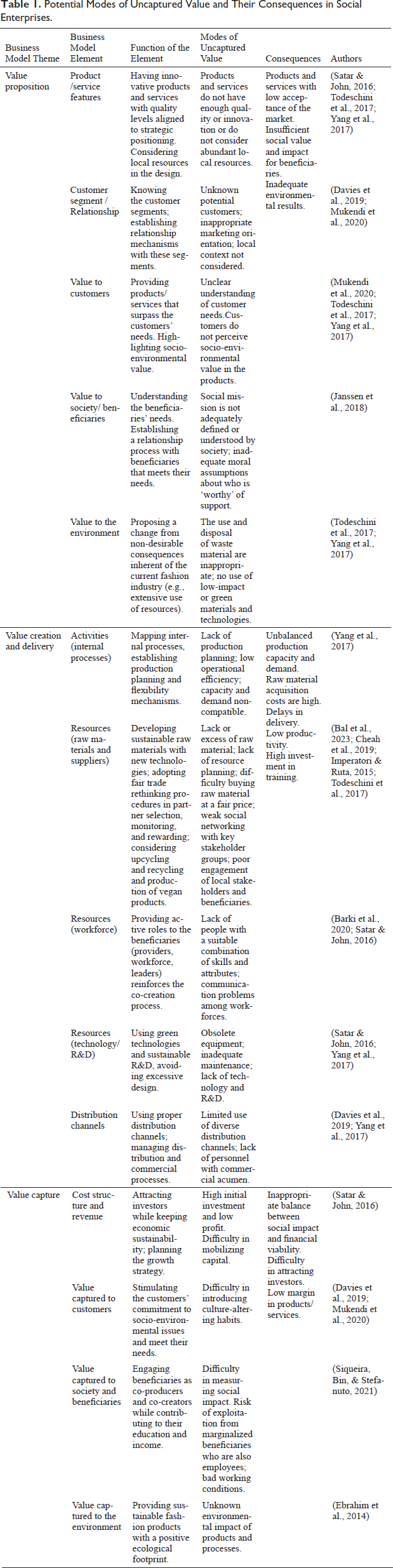
To the scope of this study, the three constituent themes prevalent in the literature have been considered: value proposition, value creation and delivery, and value capture (Bocken & Short, 2016). Table 1, presented in the next topic, displays each theme in its elements and presents the primary function of each one.
Potential Modes of Uncaptured Value and Their Consequences in Social Enterprises.
Uncaptured Value in a Business Model for Social Enterprise
A BM may allow for capturing or losing value through inconsistency (Jabłoński, 2019), which is related to uncaptured value. For SEs, uncaptured value can be associated with social and environmental values that could be delivered to their various stakeholders (beneficiaries, suppliers, communities) and to the economic value that can be delivered to the enterprise to sustain and expand its business. Due to different factors, they do not occur. The uncaptured values are related to failures in the planning or execution of the BM (Yang et al., 2017). The notion of uncaptured value can be understood from diverse perspectives, such as for the enterprise, for a broader range of stakeholders, for the customers, etc. This study focuses on the perspective of the enterprise.
This study considers that the failure to reach the potential value in each element that composes the themes of a BM results from the different modes of uncaptured value. These modes can have one or more distinct causes and can generate one or more consequences. It is not the purpose of this study to detail the causes of failure modes, as they relate to specific aspects of each operation and each company. The possible uncaptured value modes for each BM’s theme and its elements are presented in Table 1. Each business model theme was deployed into business model elements. To establish such structure, the triple-layered focus on the economic perspective, the environmental aspects and the societal stakeholders (Joyce & Paquin, 2016) was considered.
Method
This study is exploratory and aims to unveil empirical insights to support the development of a deep understanding of a phenomenon (Eisenhardt, 1989). An inductive approach is used to study phenomena such as SE. This study relies on qualitative data collection from semi-structured interviews preceded by ethnographic observation.
A literature review was carried out in the work method’s first step. The understanding of the uncaptured value related to each BM element was organized. Based on this, the potential modes of uncaptured value and their consequences were presented (Table 1), being the basis for data collection and discussion.
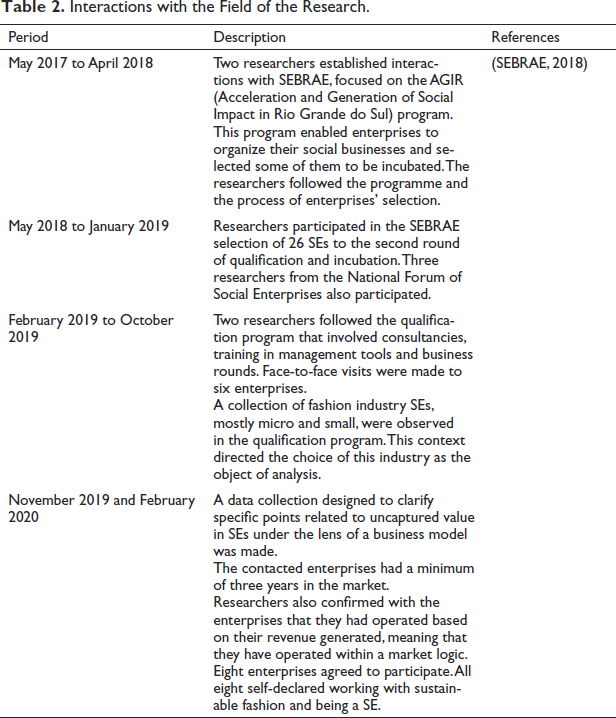
The second stage ran parallel to the first and the ethnographic vision was carried out. The ethnographic view made it possible to identify 26 SEs from the micro and small fashion industry participating in a SEBRAE (Brazilian Service of Support to Micro and Small Enterprises) qualification program. Several interactions occurred between researchers, SEBRAE, universities and SEs over two years. Such interactions were documented and provided an ethnographic view of the search. During the qualification program, in which two co-authors of this study participated as observers, six enterprises were visited in person for a broad understanding of the day-to-day of the SEs.
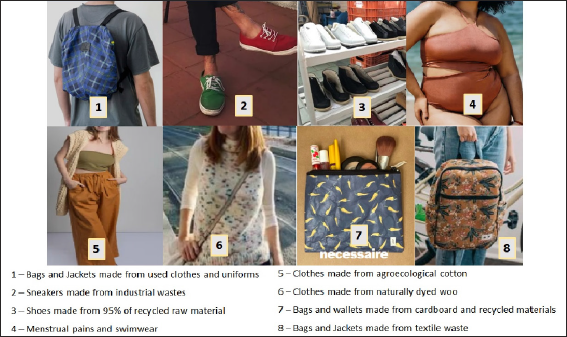
The third stage, data collection, consisted of in-depth interviews with the eight companies that confirmed their participation in the study. Table 2 presents the main characteristics of the studied enterprises and Figure 1 illustrates the respective products of each enterprise. The SEs work on creating, producing and selling sustainable clothing and accessories from the recycling of textile waste and in partnership with artisans from poor local communities.
Interactions with the Field of the Research.
Examples of Products of Each Studied Enterprise.
The entrepreneur of each enterprise was interviewed for being the enterprise’s leader and mentor and being the agent of change and innovation within the business. Each interview lasted between 54 minutes and 2 hours 54 minutes. The interview protocol included semi-structured questions for each business model element presented in Table 1. The protocol also had questions related to different modes of uncaptured value that could be present and their consequences. The interviews were conducted personally by two researchers. All interviews were recorded and later transcribed.
The fourth step was data analysis. For data analysis purposes, the data from each case were allocated to each corresponding block of the interview protocol. This made it possible to observe each case individually, associating the findings with each key business model element (Table 1). Then, a cross-case analysis was performed by comparing the cases and the research framework. This analysis provided internal validity and reliability (Yin, 2009).
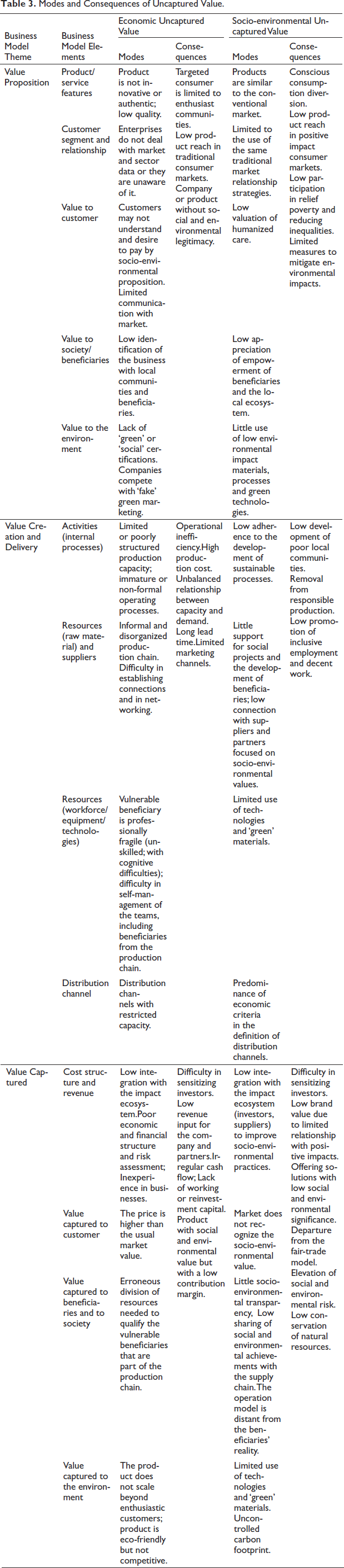
The last step was to prepare and present the discussions and conclusions of the study. These analyses identified detailed findings providing the set of uncaptured value modes and their consequences (Table 3). These results allowed us to discuss the findings under the lens of research literature. Thus, academic and managerial contributions were made.
Modes and Consequences of Uncaptured Value.
Findings
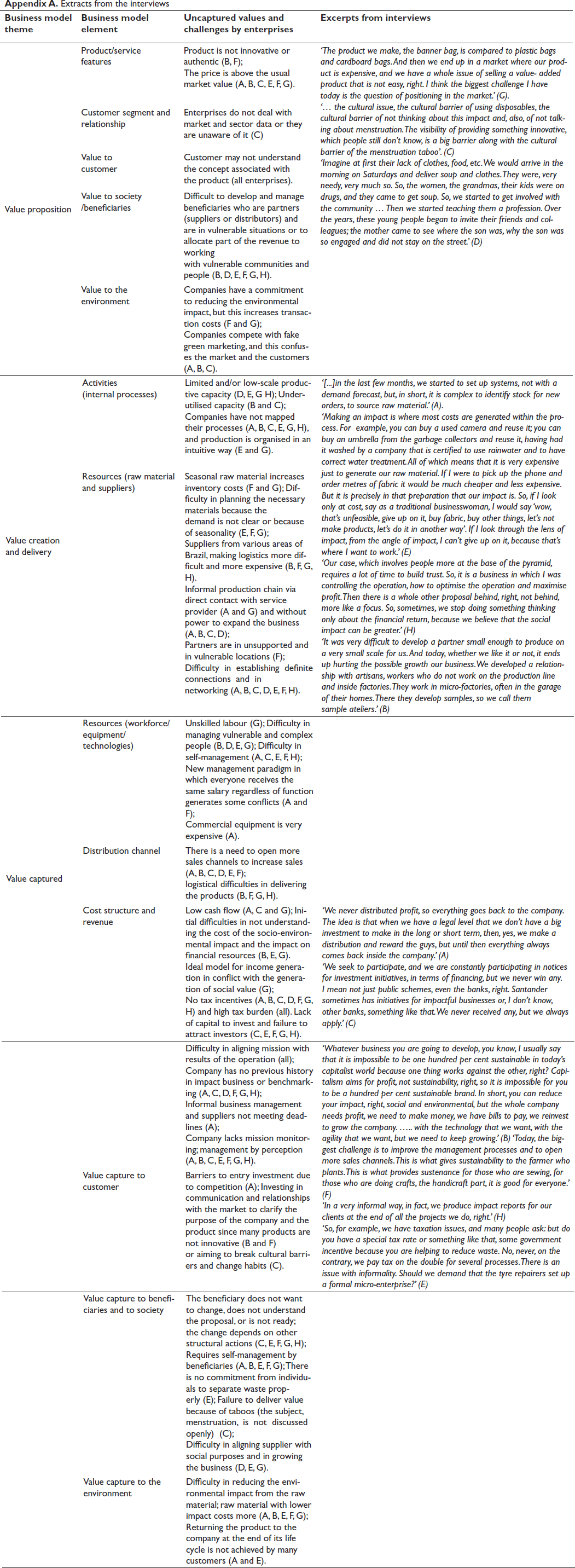
Initially, the findings were organized considering the perspective of each respondent related to each BM theme and element. Appendix A presents some quotations extracted from the interviews. For all the interviewed entrepreneurs, the social purpose is the basis of their mission, and it is consistent with their personal values. However, the market and socio-environmental uncertainties lead entrepreneurs to decisions and actions linked to the elements of the BM about how to perform their professional activities in which market to operate and how to show the socio-environmental contribution of the business to the market.
These decisions and actions reflect the generation of economic value, often to the detriment of socio-environmental value or the prioritization of the generation of socio-environmental value to the detriment of economic sustainability. In the first case, the enterprises guarantee the business’s survival and adjust the social and environmental contribution. In the second case, they continue to prioritize the social and environmental impact despite the high risk of the non-survival of the business. In this last group of companies, some entrepreneurs are highly engaged with the beneficiary communities served.
This tendency towards more emphasis on economic results, which the literature calls mission drift (Ebrahim et al., 2014), or socio-environmental results, is also reflected in the modes of uncaptured value. The analysis of uncaptured value modes can be didactically organized into two groups: those that predominantly affect the economic uncaptured value and those that affect the socio-environmental uncaptured value (Table 3). However, uncaptured value modes are not isolated. A loss of economic value will affect the delivery of the socio-environmental value and vice versa. The proposed classification indicates the most common results from the set of decisions and actions. The results also indicate the consequences of the uncaptured value modes for each business model theme.
The analysis of the results presented points to the idea that the company’s decisions and actions influence the prevailing uncaptured mode and momentarily divert the enterprise from the full achievement of its mission. Figure 2 schematically illustrates this process. Value modes that are not captured in socio-environmental terms reinforce what the literature calls ‘mission drift’ (Ebrahim et al., 2014), that is the managerial challenge of maintaining the SE’s focus on combining generated socio-environmental value with economic self-sustainability. Modes of value not captured in economic terms can drive the company to act as a non-governmental organizations (NGOs).
Uncaptured Value in Social Enterprise.
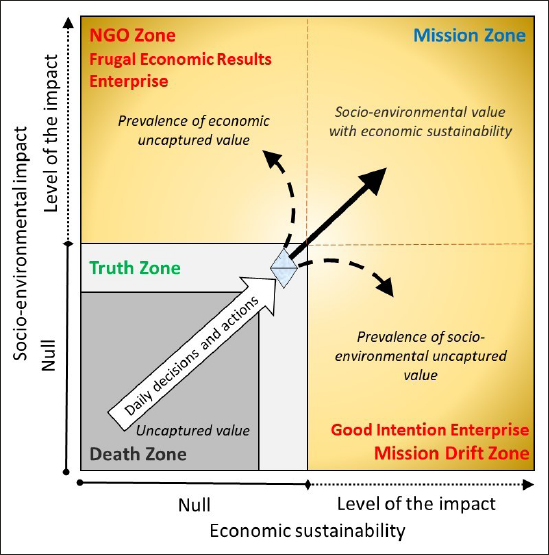
There is dynamism and movement in companies, called in this work the Zone of Truth (Figure 2), in search of a position with a minimum of uncaptured value towards fulfilling the social mission. Enterprises do not deliberately choose to take decisions and actions directed towards the NGO Zone or Mission Drift Zone. It is the situation in which they find themselves because of routine decisions and actions taken in different scenarios and contexts that present themselves. In this study, the results allow us to propose that if they are not assertive in their decisions and practices, they will remain in the Death Zone until they succumb. If economic uncaptured value modes are prevalent in enterprises that have already surpassed the Death Zone, socio-environmental value delivery will predominate. However, the SE’s survival will be fatally shortened over time without guaranteed economic sustainability. Conversely, suppose socio-environmental uncaptured value modes are prevalent. In that case, the socio-environmental contribution of the enterprise is reduced, which compromises the achievement of the SE’s mission and may trigger a mission drift process.
The findings reveal that SEs with a prevalence of economic uncaptured value cannot define how they will be able to innovate their products and processes and generate economic gains. Even so, when they realize economic gains, they do not successfully develop efficient business and operational processes capable of providing visibility that exceeds the level of enthusiastic customers of socio-environmental impact. In some cases, cash flow tends to be irregular, leading to deficient financial planning and, at times, compromising the business’s long-term vision. In the search for market opportunities, an insufficient entrepreneurial posture is observed. In the eagerness for economic support, the entrepreneur will likely seek income from other activities and even give up on the business. We call SEs stuck in economic uncaptured value modes ‘Frugal Economic Results Enterprises’ regarding non-expressive economic results.
For the SEs with an abundance of social and environmental uncaptured value modes in their business structure, it was observed that the SEs are hesitant when making decisions to increase positive social and environmental impact. They also recognize that they cannot assess the risks related to social and environmental actions correctly. They present inconsistency of socio-environmental purposes without determining the objectives to be achieved. In many cases, SEs with a predominance of these characteristics adopt a more passive entrepreneurial posture towards the beneficiary, waiting for the beneficiary to come to the company as a candidate for a potential benefit. These initiatives end up giving greater attention to operational issues. We call the SEs with a prevalence of socio-environmental uncaptured value mode ‘Good Intention Enterprises’.
Discussion and Further Research Avenues
This study identified, under the lens of a BM, the uncaptured value modes of SEs in the sustainable fashion industry and their consequences. Understanding these modes is an opportunity to minimize them and provide more socio-environmental value while contributing to the economic sustainability of the enterprises. Our findings outline a heterogeneous view of how uncaptured value occurred in the BM and its consequences, revealing (a) the prevalence of uncaptured economic value in SEs that concentrate results on positive social and environmental impact and the prevalence of social and environmental uncaptured value in SEs that concentrate results on economic sustainability; (b) the uncaptured value modes for SEs and their consequences for each BM theme (Table 3); and (c) a framework that represents the stages of the development of SEs according to their states of coping with uncaptured value modes (Figure 2).
First, we contribute to the SE literature by exploring the modes of uncaptured value and its consequences through the lens of the BM. We expand the studies that present the barriers and challenges in the development (Imperatori & Ruta, 2015) or implementation (Michelini & Fiorentino, 2012) (Table 1) of the BM. The triple-layered BM (Joyce & Paquin, 2016) was considered as initial structure for the BM themes and elements. Then, this study contributes illustrating a practical application of such approach, including the perspective of uncaptured value. Also, it was considered that value from and for an SE is made from a broader perspective behind the profit (Sugai & Mahajan, 2023). In line with the SE and BM literature, such assumptions include beneficiaries, environment, suppliers, customers and other stakeholders as value givers and receivers. By adding empirical evidence, we propose a set of modes of uncaptured value (Table 3). We further identify that the uncaptured value for SEs that focus on delivering high socio-environmental value is concentrated on causes that negatively affect the economic results (‘Frugal Results Enterprises’). For this situation, the results indicate that the modes of uncaptured value are predominantly centred on lack of product innovation, weak product design, deficient financial planning, lack of attention to the market and relationship with customers, and lack of production planning and technologies. Intriguingly, the literature studied on the difficulties faced by SEs in delivering value presents challenges and difficulties related to funding, human resources, professional management and underdeveloped networking (Diaz Gonzalez & Dentchev, 2021) but does not present the issues related to the production system and scarcely discusses technologies and the research and development (R&D) role (Satar & John, 2016). For SEs where economic issues are appropriately resolved and socio-environmental uncaptured value is predominant, the findings indicate that these enterprises have difficulty evaluating the risks associated with socio-environmental purposes and are not very proactive concerning their beneficiaries’ concerns. These ‘Good Intention Enterprises’ have adopted a more passive posture related to beneficiaries and have inconstant socio-environmental purposes. Understanding modes of uncaptured value can support further research on how to eliminate or decrease them, which could potentially amplify the potential social value to be delivered by SEs.
Second, the literature suggests that a SE has a double mission: economic sustainability and social issues (Davies et al., 2019). Also, the literature indicates a lack of understanding of how an SE prioritizes financial goals due to its mission drift (Searing et al., 2021) or socio-environmental issues or even due to balancing both (Ebrahim et al., 2014). We contribute by proposing a framework (Figure 2) that indicates the primary position of SEs concerning the present decisions: socio-environmental or economic. This implies that various phases of the business maturation with economic and socio-environmental challenges could differ from those established in the enterprise’s early stage. Based on such findings, this study contributes to the BM literature by evidencing how dynamic and innovative an BM (Lichy et al., 2023) must be to balance economic issues with social and environmental ones. The entrepreneurs’ characteristics directly influence the decisions in zones with high economic uncaptured value modes or high socio-environmental uncaptured value modes. Also, there is a dynamic movement along the edge of the zones due to challenges and uncertainties from the market, economic context, entrepreneurial orientations and social issues. When such movement reduces the uncaptured value, there is a shift towards the Mission Zone. The results suggest that if the uncaptured value modes are not reduced, there is the risk of bankruptcy or a drift to a traditional for-profit or non-profit type enterprise. Both represent the abandonment of the development of an SE. Understanding the maturity stage of an SE as a function of the position in one of the zones and its characteristics and the factors that induce a shift among zones can be further researched to more deeply understand the challenges and dynamics of SEs.
Third, the findings provide practical value for social entrepreneurs, managers and institutions that support SEs. Our study shows that by understanding the prevalent modes of uncaptured value according to the positioning of the enterprise as ‘Frugal Results’ or ‘Good Intention’ along the entrepreneurial journey, it will be possible to direct managerial support to the SEs. Still, such support is essential for the social entrepreneur to overcome the conflicts of interest inherent in an SE to cross the Truth Zone towards its socio-environmental mission and to avoid keeping the enterprise parked in the Death Zone. In practice, the entrepreneur is focused on the routine of the business, trying to survive, occasionally navigating from one quadrant to another without planning.
Conclusion and Limitations
This study aimed to analyse the modes of uncaptured value in SEs and their consequences under the lens of BM. The research gaps in the literature do not discuss uncaptured value in BM or its modes of occurrence. Also, the consequences of uncaptured value to the enterprise, the environment and the society were not mapped. So, this study is supported by the premise that understanding the causes and consequences of uncaptured value in the BM could be relevant to SE improving its business and could be a topical issue barely explored in the literature.
Initially, the modes of uncaptured value and their consequences in for-profit SEs of the sustainable fashion industry were identified. Afterwards, the literature review provided the basis for understanding the potential modes of uncaptured value under the BM lens (Table 1). The results (Table 3) were discussed based on the findings, providing academic and managerial contributions. The company’s decisions and actions related to each BM theme can influence the prevailing uncaptured mode and prevent the enterprise from fully fulfilling its mission (Figure 2).
Although this study researched for-profit SEs from the sustainable fashion industry in Brazil, it is relevant to the entire entrepreneurial and managerial fields to become alert to such uncaptured value modes. Uncaptured value is possibly present in the SEs from other industries in emerging economies and SEs with different social and commercial structures than the ones we examined. This study sheds light on this topical theme while suggesting further studies in different industries and contexts.
This study has certain limitations. A qualitative methodology was used and data were collected through semi-structured interviews with entrepreneurs. The findings are based on the perception and experience of them. In addition, all the studied enterprises are geographically located in southern Brazil. Thus, the modes of uncaptured value and their consequences under the lens of the BMs were based on these limitations. Still, the modes of uncaptured value and its consequences could inspire other enterprises from other contexts to shed light on such modes and improve their processes and results.
Extracts from the interviews
Footnotes
Declaration of Conflicting Interests
The authors declared no potential conflicts of interest with respect to the research, authorship and/or publication of this article.
Funding
The authors received no financial support for the research, authorship and/or publication of this article.
