




Abstract
This article analyses the relationship between the experience of a crisis and advice seeking in small firms. Although the benefits of business advice and support to smaller firms are well documented, smaller firms are often reluctant to seek external advice, relying instead on informal routines and a focus on daily operations. Conceptualising crisis as a trigger for advice seeking, and using survey data from 2089 small firms, we find a strong and significant relationship between experiencing a crisis and seeking external business advice up to five years after the crisis. This sustained effect on advice seeking is particularly strong for firms who also sought advice at the time of the crisis. Additionally, we find that the effect of a business crisis on sustained advice seeking is stronger for firms subject to a crisis with external origins.
Introduction
The effects of external advice on Small and Medium Enterprise (SME) performance have provided the focus for a considerable body of research. While some studies question the link between advice seeking and positive business outcomes (Coad et al., 2016; Mole and Capelleras, 2017), others point to a range of benefits for SMEs who seek external advice and support (Cole and Fernando, 2021; McKenzie, 2021). Advisory services can contribute to a firm’s knowledge, reduce business risks and improve strategy decisions (Mole et al., 2009, 2011) and can offer support and reassurance for business leaders dealing with complex and multi-dimensional issues (Bonner et al., 2018). In SMEs, where external support is particularly relevant given their limited internal knowledge and resources (Johnson et al., 2007), the use of external business advice has been associated with higher sales growth, innovation, finance and alliance participation (Cumming and Fischer, 2012). External advice has also been linked to greater resilience and growth and enhanced business performance (Carey, 2015), as well as an increased likelihood of internationalisation (Chang and Webster, 2019; Cumming et al., 2015; Idris and Saridakis, 2018). External support can also bring additional psychological capital (Mole, 2016) and provide valuable emotional support for SME owners, something that may be particularly important in times of crisis (Kuhn et al., 2017). Despite these benefits, SMEs are often reluctant to seek external advice (Blackburn, 2012; Scott and Irwin, 2009). 1 This may be because they prefer to rely on their own internal resources or because they do not perceive a gap between their own resources and those required to help them achieve their objectives (Mole et al., 2017). This in turn can drive a reliance on informal routines and a focus on day-to-day operations (Ates and Bititci, 2011) which can drive ‘short-termism and firefighting’ (Pal et al., 2014: 414). In this article, we explore the role of business crises as triggers of sustained external advice seeking among small firms located in four European countries – the United Kingdom, France, Germany and Spain.
The reluctance of SMEs to seek external support has been attributed to a range of factors. SMEs may be unwilling to disclose information about their business to third parties (Bennett and Robson, 1999), they may believe they do not require external input for their businesses (Blackburn, 2012) or they may doubt the trustworthiness or competence of external providers (Scott and Irwin, 2009; Cherry et al., 2018). Research has pointed to the importance of effective communication in relationships between advisers and businesses in ensuring positive engagement (Redien-Collot and Lefebvre, 2015). Firms may also be unwilling or unable to pay for external input and seeking external advice can be a complex process for small firms, with managers often struggling to navigate the market for advice and to identify appropriate sources of advice for their particular challenges (Mole, 2021). Perhaps because of this, small firms tend to consult informal sources of advice such as friends and family (Johnson et al., 2007). Such informal sources may suit an SME’s desire for confidentiality and control but may also limit the expertise that they can access (Bennett and Robson, 1999). Given the positive outcomes associated with taking external advice, understanding the factors which provoke a small firm to look to external sources for help can contribute much to our understanding of the ways in which these firms learn.
This article explores the role of one potential trigger for external advice seeking – a small firm’s experience of an existential crisis (i.e., a threat to its survival) – in inducing sustained external advice seeking by small firms. Exploring this link in small firms has the potential to elucidate the foundations of a potential source of sustained advantage. If seeking advice in response to an existential crisis contributes to a firm’s ability to survive the crisis, then advice seeking on an ongoing basis may provide the foundations of the future resilience of the firm.
We contribute to the business advice literature with our focus on the triggers for small firms to seek external advice, an under-researched area (Reddrop and Mapunda, 2015). Building on the resource-based view of the firm, notions of absorptive capacity and theories of organisational learning, we conceptualise a crisis as a trigger point for a small firm’s initial advice seeking. We argue that advice seeking triggered by a resource gap during a crisis, and which may be perceived to have helped resolve the crisis, is likely to become an embedded practice in a firm through organisational learning processes. This may be an important route to future resilience by giving firms ongoing access to resources and expertise that they would otherwise not have had. Empirically, we demonstrate that initial advice seeking in the context of a crisis is positively associated with sustained advice seeking in the future. To date, advice seeking has mostly been studied in the strategic management literature and has been seen as an input to strategic decision-making (Lim et al., 2019). Here, we regard it as an organisational practice triggered by a resource gap and sustained through organisational learning processes.
The article proceeds as follows. First, we outline the theoretical background and articulate our hypotheses. We then present our data and methods followed by the empirical results and a discussion of implications for theory, practice and policy. Finally, we summarise our main contribution and draw conclusions.
Theoretical background
Crisis as a force for change
The factors that enable external advice seeking have received considerable attention, including the individual characteristics of SME owner-managers (Scott and Irwin, 2009) and firm-level characteristics (Bennett and Robson, 1999; Johnson et al., 2007; Vivas and Barge-Gil, 2015; Mole et al., 2017). Studies also suggest that the experience of business challenges can be a catalyst for external advice seeking. For instance, Johnson et al. (2007) argue that SMEs are more likely to seek advice if they face challenges where their internal expertise or resources prove insufficient to respond effectively, or when there are recent or anticipated changes to the business. Empirically, Mole (2016) finds that SMEs often require a trigger event to push them to seek external advice.
Experiencing a crisis can arguably be a powerful motivator for a firm to seek external business advice. A dynamic environment, such as that experienced during a crisis, is characterised by uncertainty, complexity and discontinuous change and has been positively associated with external advice seeking in business leaders as they engage with the non-routine decision-making required (Heyden et al., 2013; Bonner et al., 2018). Uncertainty may also provoke external advice seeking because it obstructs the attainment of goals (Lim et al., 2019). A dynamic environment may also increase the information processing load on leaders, driving them to seek external advice to reduce pressure (Alexiev et al., 2019).
The resource-based view of the firm (Wernerfelt, 1984) sees unique internal resources as key to a firm’s superior performance. On this view, firms may derive competitive advantage from increasing their access to strategic information and knowledge. This suggests that firms may be driven to seek external advice and input if they perceive a gap between their internal resources and those they require to achieve their objectives (Johnson et al., 2007; Mole, 2021). This resource gap may be particularly wide for firms going through a crisis outside their own experience and that of their leader, making them more likely to seek external business advice (Mole, 2016). However, the potential for external advice to deliver unique competitive advantage will depend on the absorptive capacity of the firm – its ability to choose and utilise relevant external knowledge (Zahra and George, 2002). Successful advice seeking therefore requires that the firm is able to ‘value, assimilate, and apply new knowledge successfully’ (Van Doorn et al., 2017: 135) in a way that delivers a competitive advantage.
More generally, extant literature on organisational learning, notably that focused on absorptive capacity in organisations (Cohen and Levinthal, 1990), provides a useful framework for understanding crisis as a force for change. In challenging existing beliefs about the ability of the organisation to survive an unplanned episode, a crisis can lead to changed procedures or provoke organisational learning to prevent recurrence (Seeger et al., 2005). Internal or external crisis can trigger a firm to seek external assistance, intensifying their efforts to learn skills and develop knowledge (Zahra and George, 2002). The intensity of the trigger influences how actively a firm invests in developing or seeking new knowledge resources. Discontinuous events such as venture failure can provoke entrepreneurs to learn about themselves, their networks and the processes of firm management (Cope, 2011). Learning in these circumstances is characterised as powerful and future-oriented and likely to influence future ventures. An organisation also learns from adverse events through its networks and relationships (Zahra and George, 2002); these promote knowledge transfer, lowering barriers to the adoption of new ideas. Acquiring and assimilating knowledge can help an organisation to avoid the competence traps that limit their cognitive range, thus conferring strategic flexibility and competitive advantage.
In this article, we conceptualise a business crisis as a ‘trigger point’ or an event that can provoke instability, influencing a firm’s future prospects. Brown and Mawson’s (2013) conceptualisation of a trigger point as ‘…a systemic change to their firm’s structure and workings, which in turn provides a critical opportunity to alter their growth trajectories’ (p. 291) focuses on growth. We argue that it also resonates with episodes of adversity, which can significantly affect the structure and workings of a firm, provoking change. This notion of a change-provoking event experienced by a firm resonates with other studies focused on organisational learning and absorptive capacity. Bessant et al. (2005) conceptualise a ‘tipping point’ as a binary occasion faced by a firm that challenges their strategic orientation. Rare events have also been conceptualised as ‘opportunities for unique sensemaking’ (Lampel et al., 2009: 835) which can provoke organisational learning through a desire to respond by drawing lessons and making adjustments. This is consistent with the notion that firms may seek advice when faced with a crisis that may already have affected them, in order to buffer against further resource loss (Lim et al., 2019). Rare events have been shown to elicit learning related to gaps in the firm’s capabilities, as well as purposive learning, which may include the introduction of new practices (Lampel et al., 2009). This suggests that external events can provoke organisational learning leading to the implementation of new practices to address gaps in the organisation’s resources.
A crisis may be a trigger point from which organisational learning ensues, driving firms to transform their operations in a way that facilitates advice seeking. The notion of a trigger point captures the way that the external event provokes systemic firm-level change. From the resource-based view of the firm, a crisis can also intensify the perceived gap between the firm’s internal resources and the resources it needs to survive, increasing the likelihood that the firm will act to address the gap by seeking external advice. This suggests our first hypothesis:
Firms that have experienced a crisis are more likely to seek external advice. Arguably, the origin of a crisis can influence the firm’s response, requiring different external inputs to mitigate it (Bessant et al., 2005). These origins may be internal (e.g., loss of key staff) or external (e.g., competitive pressures) (Hipp et al., 2019). Following Brown and Mawson’s (2013) typology, we consider three types of crises: endogenous (resulting from factors wholly under the firm’s direct control); exogenous (resulting from factors wholly outside the firm’s direct control) and co-determined (resulting from factors that are both internal and external, often involving the firm and another party). In line with the resource-based view of the firm, we argue that the effect of each type of crisis on the propensity of a firm to seek external advice will depend on the firm’s existing perceived ability to solve it (Johnson et al., 2007). A firm will be more likely to seek external advice if it experiences a crisis that stems from factors that are, at least partly, outside its control and less likely to do so if the crisis results from internal factors. This leads us to our second hypothesis:
Firms that have experienced an exogenous or co-determined crisis are more likely to seek external advice than firms that experience an endogenous crisis.
From initial advice seeking to sustained advice seeking
Although the determinants of advice seeking have received considerable attention in the literature, little is known about the determinants of sustained advice seeking in small firms. The potential for experiential learning about how to capitalise on external advice, and development in the firm’s understanding of the potential benefits of advice, may generate dynamic complementarities which link initial advice seeking to more sustained external engagement (Cooper and Johri, 1997).
Prior research has examined the organisational learning effects that are involved in, and derived from, managing external relationships. Firms can develop the ability to interact with external organisations and can learn to do this better over time. This experiential learning has been empirically demonstrated in collaborative innovation processes, for example, where experience in external collaboration has been found to lead to more collaboration, and greater diversity of collaboration, in firms (Love et al., 2014). Firms become better at recognising and choosing appropriate external relationships through the experience of doing so, and they learn to manage these relationships better over time. This experiential learning can happen in two ways. In the first, firms may develop new organisational routines for managing relationships with external parties, and over time they may become more capable of, and efficient at, dealing with these parties. In the second, managerial cognition develops over time and through experience, and managers learn to devote more of their limited attention to productive relationships. Managers learn from the process of selecting and managing an external relationship in one period and are able to apply that learning subsequently, in future relationship seeking and managing processes. We argue that these processes apply to the management of external relationships with business advisers.
Concerns about navigating the market in order to identify appropriate sources of advice have been found to be a barrier to initial firm advice seeking (North et al., 2011). Business leaders with no prior experience of using external sources of advice can be uncertain about the benefits of external advice, leading them to undervalue it and to therefore be reluctant to invest in it (Mole et al., 2017). External business advice can therefore be seen as an experience good – a product or service which needs to be used to be fully understood and appreciated. Signalling theory (Spence, 1973) suggests that a firm may invest resources in external sources of advice despite being initially unaware of the eventual outcome of the advice seeking. This makes it an investment decision under uncertainty. The SME does, however, observe the characteristics of the external adviser, such as their credentials, structures and competencies (Zucker, 1987) which serve as ‘signals’ to encourage engagement. Engaging informs the firm about the adviser’s capabilities. This experiential learning means that in the future the firm may be more likely to engage with such advisers again. On this account, and in line with organisational learning theory, choices that have proved successful in the past are more likely to be repeated in the future (Minniti and Bygrave, 2001) and to become routinised (Breslin, 2019). We argue that accessing external support to help overcome a business crisis is a powerful way of gaining experience in the seeking of advice and its potential value, and of building trust with external advisers.
Prior studies have drawn on the concept of dynamic complementarities – the notion that the benefit to a firm of adding a new activity depends not only on what the firm currently does, but on what it did in the past – to explain how firms can shift towards different strategies over time (Love et al., 2014). The concept of dynamic complementarities captures learning-by-doing effects, where previous engagement in an activity is propagated over time (Cooper and Johri, 1997). In particular, engaging in an activity can build human and organisational capital by enabling individuals to learn how to undertake the task and by creating external links, in our case with advisers, which can serve to reduce barriers and transaction costs in the future (Zhang and Wu, 2017; Crescenzi and Gagliardi, 2018). In the context of innovation performance, for example, Roper and Hewitt-Dundas (2015) find that, once firms have used external knowledge and resources to complement their own internal resources in the pursuit of their objectives, they may be increasingly likely to use them again over time, as they build their capacity to identify and use such external resources. This suggests that having initially sought external advice, it is likely that a firm has built up some experience of the process of identifying and using such advice. This organisational experience and learning means that in the future, they will have a greater capacity to seek and use such advice. In this way, sustained advice seeking may be linked to a firm’s prior experience of advice seeking, through which it has built its capacity to seek advice again. Of course, the path to sustained advice seeking may be strengthened if prior advice has proved beneficial, in which case firms not only learn from the process of advice seeking but also learn of the value of advice. Arguably, firms that sought advice during an existential crisis, and which succeeded in overcoming the crisis, likely benefitted from that advice. However, irrespective of the value of prior advice, merely engaging in the process of advice seeking enables firms to become better at identifying appropriate sources of advice, navigating the advice market and leveraging dynamic complementarities in their advice seeking behaviour; these firms are then more likely to seek advice in the future.
Overall, therefore, we argue that the context of a crisis, when a firm’s leaders may be experiencing a gap between their knowledge and the knowledge required to deal with an unfamiliar situation, may provoke crisis-specific advice seeking. This initial experience of advice seeking is then likely to have developed the capacity of the firm to effectively seek advice, working through channels of organisational learning related to the identification and management of external relationships, the experience of the market for advice and dynamic complementarities which enable learning-by-doing. Through these channels, the initial process of seeking external advice in the context of a crisis may therefore lead to further advice seeking in the future.
Firms that have experienced a crisis and sought crisis-specific advice are more likely to seek future external advice.
Data and methods
Data
We use data on a sample of small firms, with between 3 and 99 employees, in London, Paris, Frankfurt and Madrid. In each city, around 600 firms were surveyed based on a structured sampling approach and using a computer assisted telephone survey. A filter question in the survey script ensured that the respondent was the most senior person in the organisation. The data set was generated during late 2018 and early 2019. To ensure a standard questionnaire structure and coding across the cities, researchers from all four countries collaborated to develop the survey instrument. Following a pilot in London in September 2018, the questionnaire was translated into French, German and Spanish. Fieldwork took place in London in October to December 2018 and in Paris, Frankfurt and Madrid between January and May 2019. The samples were stratified in order to be representative of the spread of businesses, by size and sector, in each city.
Part of the focus of the survey was understanding the experience of crisis and resilience among disadvantaged or under-represented business leaders, so businesses led or owned by females, ethnic minorities and those located in deprived areas were oversampled using a series of initial filter questions in the survey instrument. This also motivated the focus on large capital cities where female and ethnic minority businesses are more likely to be located. We aimed to achieve a sample of 300 firms in low-income (deprived) boroughs and 300 firms in middle-income (average) boroughs in each city, with around half being female-led and a quarter being ethnic minority-led. In London, the sample was drawn from three middle-income boroughs and three deprived boroughs, which were selected on the basis of the ranking of all London boroughs using the Index of Multiple Deprivation (IMD), a widely used measure of relative deprivation in the UK. In Paris, the sample was drawn from one middle-income borough and one deprived borough, both in Eastern Paris. The FiLoSoFi database from the French National Institute of Statistics (INSEE), which provides average yearly revenue for each city of Paris metropolitan areas, was used to identify these boroughs. In Frankfurt, the sample was drawn from three middle-income boroughs and six deprived boroughs, identified using the combined measures of unemployment rate, disposable income and purchasing power per person employed. Finally, in Madrid, the sample was drawn from seven middle-income boroughs and seven deprived boroughs, identified based on the vulnerability index used by the city of Madrid. 2 These sampling choices were made to ensure that underrepresented groups, for whom building a resilient business may be especially challenging, were adequately represented. Sampling frames in each city were provided by commercial partners with the intention of providing coverage that was as representative as possible of firms by sector and size band for low-income and middle-income areas in each city. Quotas were then applied during survey fieldwork to ensure a balance between response numbers by area, sector, size-band and whether firms were run by female or ethnic minority leaders. Details of quotas and of the actual sample achieved and used for analysis are given in Supplemental Table A. Sampling weights 3 were applied to obtain results that are representative of the size and sector profile of the population of firms within each administrative area in each city.
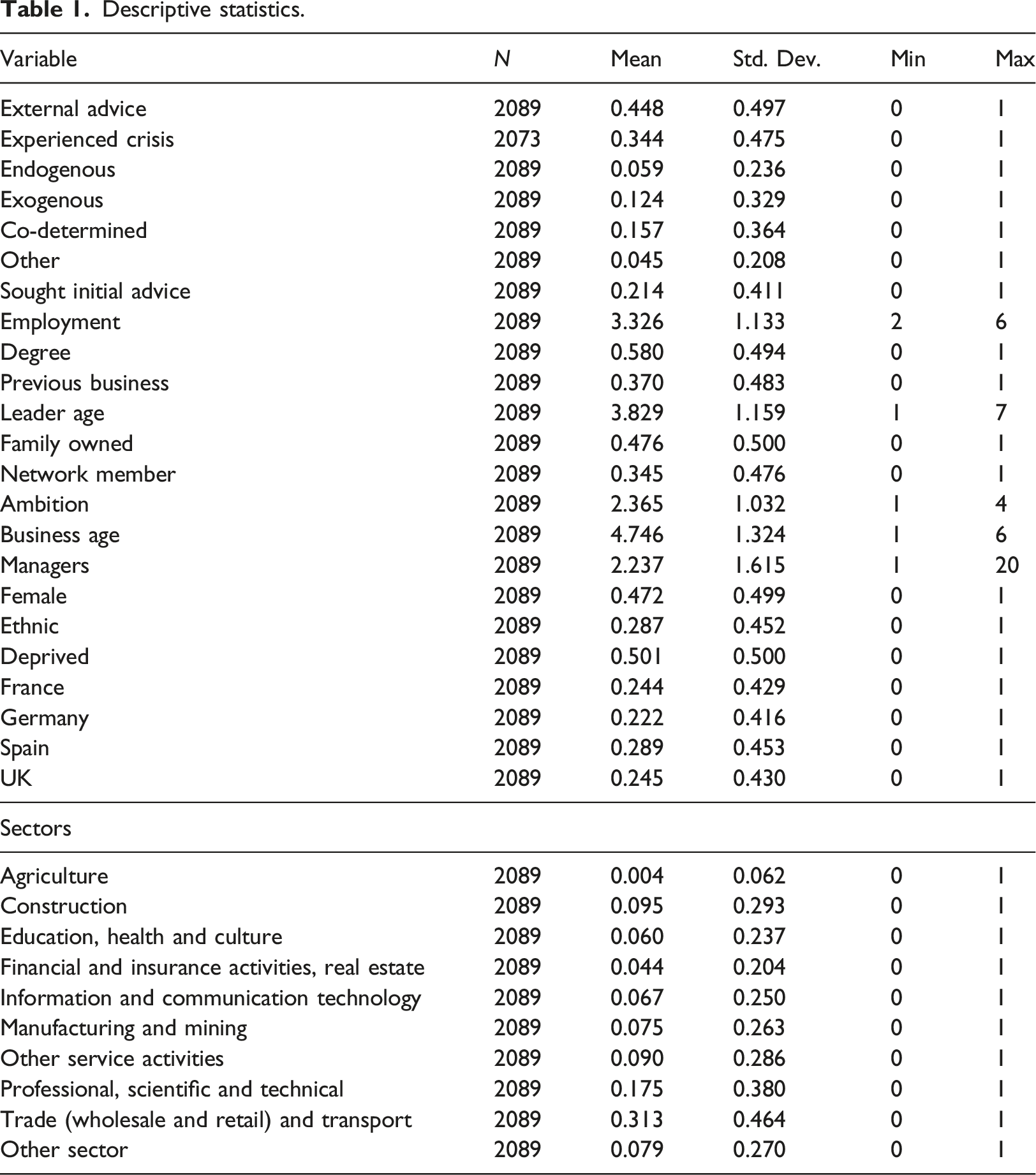
Our final estimation sample covers 2089 small firms – 512 in London, 464 in Frankfurt, 509 in Paris and 604 in Madrid. The survey includes 10 NACE level 1 manufacturing and services sectors and excludes public sector organisations, charities and subsidiaries of larger firms. The survey covered the firm’s background, activities, ambitions, networks and market position. It asked whether firms had experienced an existential threat over the preceding 5 years, the nature of the crisis and the steps taken to overcome it. Respondents were also asked about their use of external business support over the year prior to the survey. The data is therefore suitable for analysing the relationship between a firm’s experiences of adversity and its external advice-seeking.
Dependent variable
Our dependent variable, external advice seeking, is a binary variable equal to one if the firm has sought external business advice over the previous year and zero otherwise. We derive this variable from a survey question that asks: ‘In the last 12 months, have you sought external advice or information on any matters affecting your business?’ We categorise firms as having sought external advice if they answer ‘yes’ to this question. Since we later examine the influence of seeking initial crisis-specific advice, we refer to this dependent variable as ‘subsequent advice seeking’.
Independent variables
Our main independent variable is a binary variable equal to 1 if a business reported experiencing a crisis in the preceding 5 years and 0 otherwise. We derive this variable from a survey question that asked business leaders the following: ‘Now thinking about the last five years, have any situations arisen which have threatened the survival of your business?’ We categorise firms as having experienced a crisis if they answered ‘yes’ to this question.
To examine the effects of different types of crisis on the likelihood of seeking advice, we use information on the cause of the crisis as identified by the respondents. Firms that experienced a crisis were asked the cause of the crisis. Sixteen potential causes of crisis were consistently probed for respondents in all four countries, and separate country-specific potential causes of crises were also probed. Overall, the survey probed a total of 28 potential causes across all countries. We categorise these crises as endogenous, exogenous or co-determined (Brown and Mawson, 2013). Endogenous crises occur as a direct consequence of the actions of the firm (e.g., production or technical failures, difficulty recruiting personnel or issues with the business premises). Exogenous crises are determined by factors outside the company’s direct control (e.g., natural disasters, strikes or industrial action or changes in regulation or legislation). Co-determined crises are determined by both internal and external factors, often involving the firm and another party (e.g., the loss or failure of a major customer or supplier, or general decrease in sales or loss of business). The list of all probed causes of crises, along with our categorisation of these into the three types of crisis, is shown in Supplemental Table B. We include an ‘other crisis’ category for those crises which were unrelated to any of the probed causes.
To investigate the role of experiential learning from seeking external advice in the context of a crisis, we use a survey question which asks firms that have experienced a crisis over the previous 5 years: ‘which, if any, of the following steps did you take to address this crisis? (i) Developed a plan in response to the crisis, (ii) implemented a pre-written contingency plan, iii) sought advice from colleagues or informal support networks, (iv) sought specialist advice or help, (v) employed additional staff, (vi) invested in technical systems or backup, (vii) used financial reserves or other financial provision such as bank loans, (viii) claimed on an insurance policy and (ix) any other steps to address this crisis?’. Our measure of seeking this initial crisis-specific advice is a binary variable equal to one if the firm answered ‘yes’ to either (iii) or (iv) and zero otherwise. We refer to this variable as ‘initial advice seeking’ since it relates to advice sought during a crisis which occurred in the preceding 5 years. This separates it from our dependent variable (above), which relates to general business advice sought over the previous year, that is, ‘subsequent advice seeking’.
Control variables
Using insights from the business advice literature, we control for variables that may influence the likelihood that a firm seeks external business advice, and which may also influence whether a firm experiences a crisis. These include individual characteristics of the business leader and firm-level characteristics.
At the individual level, we control for the education level of the business leaders (Scott and Irwin, 2009) using a binary variable equal to one if they have a degree or equivalent qualification. We control for the leader’s business experience since inexperienced leaders are more likely to seek advice (Mole, 2016); here we use a binary variable equal to 1 if they have prior experience of managing a business or are currently managing another business. We control for the leader’s age in years, their gender and whether they have an ethnic minority background (Ram and Smallbone, 2002; Scott and Irwin, 2009).
At the firm level, we control for the size of the firm (Bennett and Robson, 1999), the number of business objectives expressed by the firm (Mole et al., 2017), the age of the business (Bennett and Robson, 1999) and its number of managers (Blackburn, 2012). We also include binary variables equal to one if the business is family owned or if it is a member of an external network, since these can provide advice and business intelligence. We include a variable that indicates whether the firm is located in a low-income or middle-income area since this can influence attitude towards external advice seeking and has been associated with experiencing a crisis (ERC, 2020). Finally, we include a full set of sector and country dummy variables to account for differences in the propensity to seek advice by sector and country.
Descriptive statistics
Descriptive statistics.
Empirical strategy
We estimate the effect of previous experience of adversity on the probability that a firm seeks external advice. The decision of a firm to seek external advice is a latent response variable that lies on a spectrum which is continuous but unobserved. If we denote this variable 
Our observed binary response variable
As such, when the probability of seeking external advice 
If the errors are independent and normally distributed, this yields the probit model
4


Our data is cross-sectional, so it provides little indication of causality. However, we argue that there is a strong argument for uni-directional causality from crisis to advice seeking. It is plausible that experiencing a crisis will encourage firms to seek business advice, but it is unlikely that seeking business advice will lead firms to experience a crisis. In addition, the design of the survey questionnaire introduces a temporal dimension that reduces the likelihood of reverse causality in the data: the survey asked firms whether they experienced a crisis over the previous 5 years, but asks whether they sought external advice over the previous 12 months. This suggests that, for most firms, the experience of crisis precedes the seeking of advice. Of course, there remains the possibility of an overlap for firms that experienced a crisis within the previous 12 months. However, this will be the case for a minority of firms, since the time period over which a crisis may have occurred extends over five years.
Next, to test H2, we examine the differential impacts of endogenous, exogenous and co-determined crises, as detailed in Table 1

To test H3, we estimate the potential impact of initial crisis-specific advice, sought at the time of crisis, on the probability of seeking external advice over the past 12 months. We divide firms that experienced a crisis into two groups: those that sought the initial crisis-related advice and those that did not seek such advice. We examine the differences in their propensity to seek external advice, thus
For completeness, we also examine how crisis-specific advice mediates the impact of each type of crisis, thus
5

In estimating the impacts of initial crisis-specific advice seeking,
Results
Marginal effects of crisis on the probability that firms seek external advice.
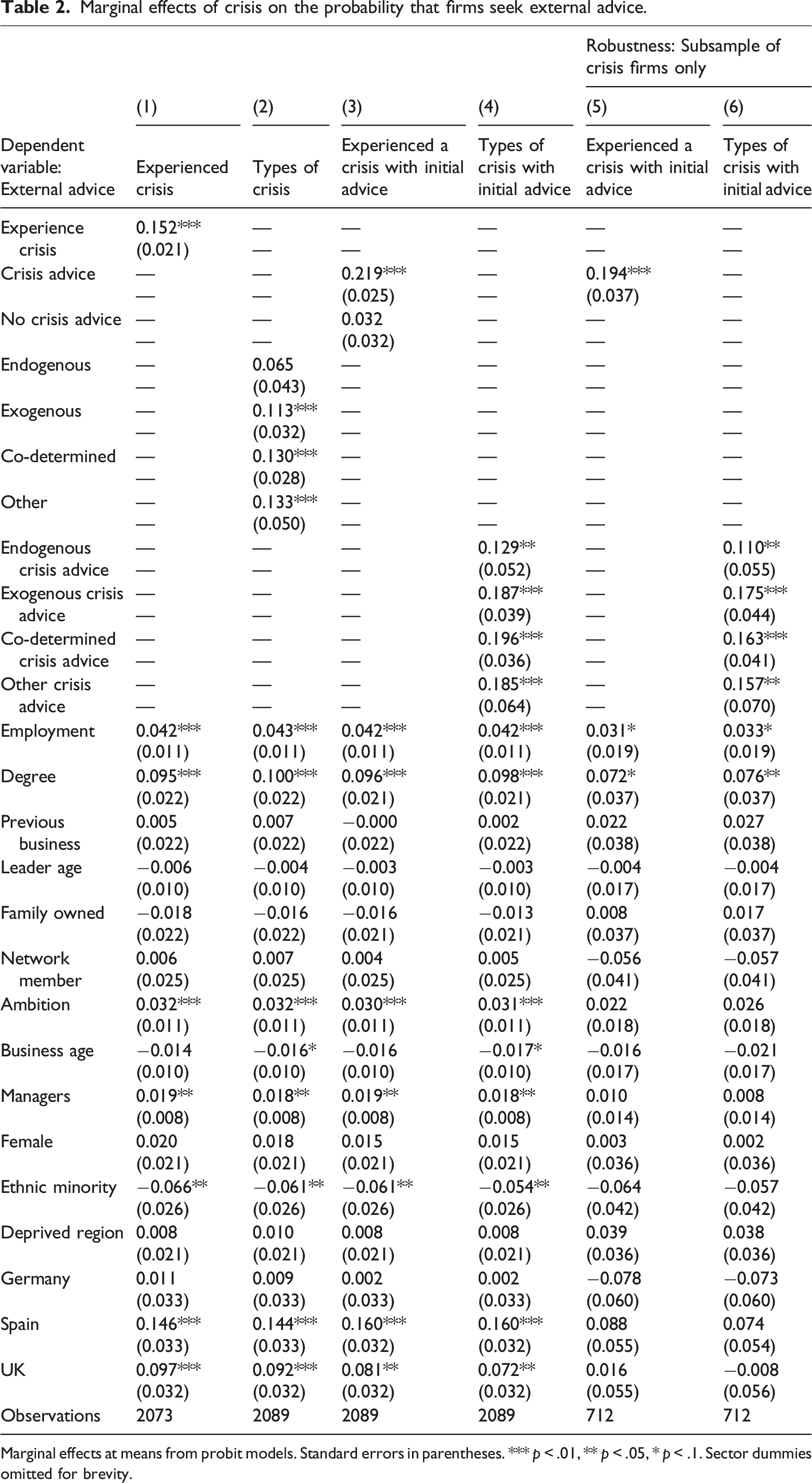
Marginal effects at means from probit models. Standard errors in parentheses. *** p < .01, ** p < .05, * p < .1. Sector dummies omitted for brevity.
In the first column of Table 2, we look at the main effect of experiencing a crisis in the preceding 5 years on the probability that a firm seeks external business advice in the preceding 12 months, that is, model (5). Experiencing a crisis is associated with a strong positive impact on the probability of seeking advice, and this effect is significant at the 1% level. In particular, firms that experienced a crisis over the previous five years are 15.2% points more likely to have sought external advice over the previous 12 months. This finding provides strong support for H1.
Column 2 of Table 2 shows the effects of different types of crises on the probability of seeking external advice, that is, model (6). Relative to firms that experienced no crisis, the probability of seeking subsequent external advice is 11.3% points higher for firms that experienced an exogenous crisis and 13% points higher for firms that experienced a co-determined crisis. Interestingly, firms that experienced an endogenous crisis are no more likely to seek subsequent advice than those that experienced no crisis. This finding suggests that a crisis resulting from factors over which the firm has direct control is less likely to elicit subsequent advice seeking. This is plausible since, from a resource-based view of the firm, one can expect the firm to be well equipped, internally, to deal with crises arising from potentially known issues. On the other hand, a crisis resulting even partly from external factors is more likely to drive sustained advice seeking because it intensifies the firm’s resource gap since solutions may lie outside the firm’s experience (Johnson et al., 2007).
Column 3 of Table 2 shows the results from model (7) where we make a distinction, among firms that experienced a crisis, between those that sought crisis-related external advice and those that did not. Relative to firms that experienced no crisis, firms that experienced a crisis and sought crisis-related advice are 21.9% points more likely to seek subsequent external advice, while firms that experienced a crisis, but did not seek crisis-related advice, are no more likely to seek subsequent external advice than firms that did not experience a crisis. This result provides strong support for H3. It implies that facing a crisis is not a sufficient condition for sustained advice seeking; rather, it is the seeking of advice in the context of a crisis that enables firms to become consistent seekers of external advice even after the crisis.
Column 4 of Table 2 shows how crisis-related advice influences the effects of the three types of crisis, that is, model (8). We find that firms that experienced an endogenous crisis, for whom the effect was previously insignificant, are now 12.9% points more likely to seek subsequent external advice if they sought crisis-related advice. These results suggest that, for endogenous crises, seeking initial crisis-related advice is a precondition for sustained advice seeking: even when the perceived resource gap is low, firms that seek external advice to resolve the crisis continue to seek subsequent external advice. In addition, the effects of exogenous crisis (18.7% points) and co-determined crisis (19.6% points) are stronger where firms initially sought crisis-related advice. These results indicate that experiential learning effects from crisis-related advice are important in driving firms to continue to seek external advice.
Columns 5 and 6 of Table 2 show the robustness of the results from Columns 3 and 4 to the exclusion of firms that did not experience a crisis. Column 5 shows that, relative to firms that did not seek crisis-related advice, firms that sought crisis-related advice are 19.4 percentage points more likely to seek subsequent advice. Column 6 shows that, for all types of crises, the probability of seeking external advice continues to be higher for firms that sought crisis-related advice. The effect is 11 percentage points for endogenous crisis, 17.5 percentage points for exogenous crisis and 16.3 percentage points for co-determined crisis. These marginal effects in Columns 5 and 6 are only slightly lower than those in Columns 3 and 4, indicating that our results are robust to the potential bias resulting from the omission of previous advice seeking by non-crisis firms. These results underscore the importance of experiential leaning effects resulting from the combination of experiencing adversity and seeking advice to help overcome it.
Discussion
We set out to explore the role of crisis in the advice seeking behaviour of small firms, hypothesising that a crisis would act as a trigger to external advice seeking, that exogenous and co-determined crises would be more likely to provoke such advice seeking, and that initial advice seeking following a crisis would lead to sustained advice seeking. Our findings contribute to the literature on business advice in several ways. First, we found a strong and significant association between the experience of a crisis that threatened the future of the firm and the likelihood of that firm to seek external advice. This supports our conceptualisation of crisis as a trigger for external advice seeking in these firms and contributes to the literature by demonstrating that a business crisis can be seen as an external event which provokes organisational advice seeking practices. In particular, this finding demonstrates an ability on the part of small firm leaders to engage in advice seeking behaviour in the face of adversity, indicating that they are able to identify a knowledge gap and willing to draw on external resources to address it. Previous research has identified the importance of the behaviour of small business leaders in developing resilience in their business, notably by being flexible (Smallbone et al., 2012), by being able to select and implement a range of strategies depending upon their circumstances (Conz et al., 2015) and by utilising their social capital to develop external networks (Baron and Markman, 2000). Arguably, seeking external advice demonstrates flexibility, strategic diversity and networking abilities in these leaders. It also suggests that small business leaders are resourceful enough to seek external help when they feel it is necessary, offering insight into the ways in which small firms experience and deal with unforeseen circumstances. This is highly topical in the context of the recent (and ongoing) crisis provoked by the Covid-19 pandemic. We point to extant literature which is clear on the link between external advice seeking and positive firm-level outcomes (e.g. Cumming and Fischer, 2012; Mole, 2016) to argue that seeking specialist advice in a crisis situation improves the ability of the firm to survive the crisis and thus increases its resilience.
We contribute to the business advice literature with our finding that firms faced with exogenous and co-determined crises are more likely than those experiencing an endogenous crisis to seek external advice. As noted above, this is intuitive because a crisis with external origins is more likely to be beyond the direct experience and expertise of the firm, which may provoke them to seek external advice to address the perceived gap in their own knowledge and resources. It is also likely that exogenous and co-determined crises will be less easy to predict and therefore to plan for (Brown and Mawson, 2013). This could make them potentially more powerful events to deal with and may explain why firms are more likely to seek external advice when they hit. Prior research has found that small firms are less likely to engage in crisis planning and that they struggle to identify the most potent threats facing their firms. They worry more about internal than external threats when external factors have been found to be more likely to provoke an existential crisis (ERC, 2020). Empirically demonstrating that firms are more likely to seek external advice in the face of an exogenous or co-determined crisis contributes to our understanding of small firm behaviour and has implications for small firm support agencies and policymakers as they develop and hone their programmes.
Our finding that seeking crisis-related advice is significantly associated with ongoing advice seeking suggests that, as we hypothesised, an initial decision to seek external advice provoked by a resource gap during a crisis can give rise to organisational learning, which can be translated into embedded organisational practices. This finding contributes to the business advice literature by identifying a key antecedent of sustained advice seeking. Prior studies suggest that seeking advice tends to lead to more advice seeking, since firms learn the value of the external advice (Mole et al., 2017). Here, we also argue that experiential learning from the process of advice seeking develops the capability of the firm to identify and interact with external advice providers, with implications for organisational routines that support sustained advice seeking. Our study empirically demonstrates that a crisis can act as the trigger for these processes. This underlines the importance of experiential learning from the combined effect of experiencing crisis and seeking external advice to help overcome it and offers insight into why some small firms routinely seek external advice while others do not. It also suggests that the circumstances in which the initial decision to seek external advice was taken are key to the likelihood of sustained advice seeking. Of course, it is important to acknowledge that our data only covers firms that survived a crisis, since those that did not survive were not available to take part in the survey. So, while we assert that surviving firms have potentially learned the value of external advice and have, as a result, adopted advice seeking as an ongoing organisational practice, we acknowledge the possibility that seeking external advice in response to a crisis was not necessarily a helpful experience for all firms, notably those that did not survive. Nevertheless, in the context of the ongoing Covid-19 pandemic, this finding suggests that external advice seeking during this crisis may educate small firms in the processes and value of seeking external advice, thus embedding it as an organisational practice beyond the crisis.
Our study has limitations which indicate possible future research avenues. First, while there are important logical and empirical reasons to suggest that we identify a causal relationship between crisis and external advice seeking, the cross-sectional nature of our data and the absence of suitable instrumental variables mean we cannot be completely confident in this regard. Analysis using longitudinal data to more clearly separate the experience of adversity and that of advice seeking will help overcome this limitation. Second, we are able to capture firm’s advice seeking behaviour but not how the advice is used and whether it was beneficial. While the implication of advice seeking is that advice is both sought and used, it is possible that some SMEs may seek advice but may not use it or that the advice may be of little value. It would be interesting in future research on the link between crisis and advice to distinguish between seeking and using advice and to identify the extent to which firms benefit from external advice. Third, our empirical analysis suggests some potentially interesting findings in terms of ethnic minority-owned businesses: these firms seem less likely to experience a crisis and less likely to seek related advice (Table 2). Future analysis could usefully explore this result in more detail given the potential policy implications.
Conclusions
Our findings advance understanding of the foundations of resilient practices in small firms. We contribute to the literature on external business advice by shedding light on the way that crisis can work to trigger initial advice seeking and on how this can be translated into embedded and sustained advice seeking.
In policy terms our results suggest that if small firms receive advice following the trigger event of a crisis, this is more likely to lead to sustained advice seeking, which may help them to be more resilient in the face of future adversity. This is highly relevant in the context of the Covid-19 pandemic. But it also suggests that interventions focused on small firm resilience should focus on encouraging them to seek external business advice when facing a crisis and on making advice more widely available. In England, for example, the publicly funded advisory and business support landscape has often been criticised as being fragmented, with firms often unsure where to seek business advice. Addressing these issues will help firms to navigate the immediate crisis and to assimilate the skills and knowledge necessary to address future adversity. Ensuring firms are able to easily identify and access potential sources of external advice during a crisis is critical to capitalising on any adversity-to-advice effect.
Tipping-points or trigger points, and the increased openness to external advice which they might create, also provide an opportunity for public agencies to develop new and supportive relationships with firms. For example, Brown and Mawson (2013), provide a review of the Companies of Scale programme run by Scottish Enterprise which sought to activate more intensive support for growing firms in response to either endogenous, exogenous or co-determined growth trigger points. These might relate to changes in ownership (endogenous), product failure (exogenous) or acquisition (co-determined). Our analysis suggests that crisis trigger points can also provide an opportunity for support agencies to build new advisory and support relationships with firms and contribute to subsequent resilience. Ensuring that support agencies also follow-up with small firms they have advised in the aftermath of a crisis also seems important, placing the emphasis on longer-term relationships with external business advisers rather than one-off crisis interventions. The increased likelihood of advice seeking following exogenous and co-determined crises suggests that interventions that encourage small firms to routinely evaluate their own skills and resources, and to undertake risk analysis and crisis planning activities, may help them to identify potential risks that are beyond their immediate focus. Helping firms to anticipate adversity may in turn encourage them to address internal resource gaps in advance of a crisis rather than in response to it, boosting resilience and sustainability.
Supplemental Material
Supplemental Material - From adversity to advice: Survival threats as a trigger for sustained engagement with external business support in small firms
Supplemental Material for From adversity to advice: Survival threats as a trigger for sustained engagement with external business support in small firms by Halima Jibril, Maria Wishart, and Stephen Roper in International Small Business Journal
Footnotes
Acknowledgements
We would like to acknowledge the support of the JP Morgan Chase Foundation, funders of the project ‘Building better business resilience’ through which we generated the data set used in this paper.
Declaration of conflicting interests
The author(s) declared no potential conflicts of interest with respect to the research, authorship, and/or publication of this article.
Funding
The author(s) received no financial support for the research, authorship, and/or publication of this article.

Supplemental Material
Supplemental material for this article is available online.
Notes
Author Biographies
References
Supplementary Material
Please find the following supplemental material available below.
For Open Access articles published under a Creative Commons License, all supplemental material carries the same license as the article it is associated with.
For non-Open Access articles published, all supplemental material carries a non-exclusive license, and permission requests for re-use of supplemental material or any part of supplemental material shall be sent directly to the copyright owner as specified in the copyright notice associated with the article.
