



Abstract
Despite a growing literature on entrepreneurial intentions, there remain gaps in the understanding of how these are affected by the age of later working-life social entrepreneurs. This research examined the ‘over-50s’ social entrepreneur understandings of age as an antecedent of their social entrepreneurial intentions. In-depth interviews were conducted with 28 UK-based social entrepreneurs. Our findings demonstrate that social entrepreneurial intentions in later working-life are influenced by an interplay of necessity, fulfilment and experienced later life, age being perceived as a positive construct rather than as a barrier. Our research contributes to the social entrepreneurship and small business literature by enhancing and advancing current knowledge and theorisation of the social entrepreneurial intentions of the over-50s. We reveal first, how social entrepreneurs make sense of their older age and the influence of their social entrepreneurial intentions; and second, how these social entrepreneurial intentions are formed by the intertwining of necessity, fulfilment and experienced later life.
Introduction
Starting a business venture is increasingly perceived as an appropriate career move for later working-life (LWL) entrepreneurs (Kautonen et al., 2011, 2014, 2015; Wadhwa, 2012; Weber and Schaper, 2003). In the literature, there are calls to give more attention to such entrepreneurs to understand how age as a key antecedent affects their entrepreneurial intentions (EIs) (Kautonen, 2008; Kautonen et al., 2010; Kibler et al., 2015). As well as chronological age, age-based self-image is antecedent to EIs, an under-researched but increasingly important area for research into entrepreneurship in ageing societies (Kautonen et al., 2015). Key gaps exist in our current knowledge and understanding of LWL social entrepreneurial intentions (SEIs). Informed by research on EIs in LWL (Kautonen et al., 2011), and on SEIs (Di Domenico et al., 2010; Hockerts, 2015), our research focuses explicitly on the over-50s who create social entrepreneurial ventures. Therefore, our research question is: How do later working-life social entrepreneurs understand age as an antecedent of their social entrepreneurial intentions (SEIs)?
In EI literature, LWL is defined as ‘aged over-50’ (Kautonen et al., 2011,, 2014; Kibler et al., 2015). LWL entrepreneurs are described as having professional, technical and industry experience, and desiring flexibility, fulfilment and achievement (Singh and DeNoble, 2003; Wadhwa, 2012; Weber and Schaper, 2003); but with experiences also of job dissatisfaction, poor employment opportunities, low retirement income and ageism (Kautonen, 2008; Walker and Webster, 2007); these offer insight into EIs in LWL. Yet, their SEIs require further understanding, this being limited by lack of research with this focus (Stumbitz et al., 2012). Age can be linked to declining physical and cognitive functions (Algilani et al., 2014), although social views tend to present ageing as more subjectively experienced (Barnhart and Peňaloza, 2013; Powell and Hendricks, 2009). In the social entrepreneurship literature, the generally adopted statistical and predictive approaches reflect interest in antecedent influences on SEIs, such as risk-taking, self-efficacy, social values, exposure to social problems, moral judgements and empathy (Chipeta and Surujlal, 2017; Hockerts, 2015, 2017; Mair and Noboa, 2006). Yet, lack of empirical studies means little is known of age as antecedent to LWL social entrepreneur intentions, nor their subjective understanding of age and ageing as key influences on SEIs. In keeping with prior research (Chipeta and Surujlal, 2017; Dickel and Eckardt, 2021; Mair and Noboa, 2006), we define social entrepreneurship as the process by which the social entrepreneur starts a social venture to create social value. Drawing on in-depth interviews with 28 UK-based social entrepreneurs aged over-50, we adopted a qualitative, interpretive approach to examine the participant’s subjective perspectives and identify influences on their SEIs, including their age (Kimmitt and Muñoz, 2018).
Our contributions are threefold. We first extend knowledge, contributing to SEI, LWL and EI literature, by revealing empirically how participant SEIs are affected by an interplay of necessity, fulfilment and experienced later life, intertwined with LWL social entrepreneur constructions of age. Second, LWL SEIs appear to be both more dynamic and more positive than was previously reported (Weber and Schaper, 2003), despite effects from experiences and perception of ageism, few employment opportunities and job dissatisfaction. We enhance understanding of how positive constructions of age, especially the intention to give back to the community, result in participants not only feeling good, but a positive feedback spiral regarding their self-images and views about their age and social entrepreneurship activities. Participants re-appraised their social roles, not based on economic necessity nor goals of commercial success alone, but on seeking a deeper meaning that was meshed with generally positive views of their life-stage and age. Their prior experience, skills, knowledge, social networks and positive views of resilience, maturity and confidence gave them advantages over their younger counterparts. Third, on a more general level, we explore how SEI formation in LWL is both complex and nuanced. For the LWL social entrepreneur, age is a key antecedent as a catalyst to self-reflection and re-appraisal of their roles, contributions and intentions, regarding continuing economic participation and social involvement. Age is not seen as preventing entrepreneurship, but as an opportunity to innovate, create social value and engender social change to improve the community (Di Domenico et al., 2010).
We commence with a review of the extant literature on entrepreneurial intentions (EIs) in later working-life (LWL), then the literature on SEIs, leading us to highlight the need for research focusing on SEIs in LWL. We then outline our methodology, before presenting and discussing our findings; showing how SEIs in LWL are multifaceted, age intertwining with necessity, fulfilment and experienced later life; and how LWL social entrepreneurs re-negotiate the meanings of their age and the ageing process. We conclude with our contributions and the future research implications.
Literature review
Entrepreneurial intentions in later working-life
Entrepreneurial intention literature tends to focus on the individual, together with socioeconomic factors that spur individuals to act on entrepreneurial opportunities (Hindle et al., 2009; Kourosh et al., 2019; Linan, 2008; Quan, 2012). It includes research highlighting how age influences EIs (Hatak et al., 2015; Kautonen et al., 2010; Tornikoski and Kautonen, 2009), and how age-related experiences are affected by individuals’ interpretations (Barnhart and Peňaloza, 2013; Bengtson et al., 1997; Schafer and Shippee, 2009; Shmerlina, 2015), as influenced also by their interactions with their environment (Annear et al., 2012; Luborsky and Sankar, 1993; Wood et al., 2008). Ageism, alongside disadvantages linked to gender, race, poverty, poor social network supports and ill health, all impact upon how ageing is experienced (Barrett and McGoldrick, 2013; Burr, 2003); affect how age is experienced (Pierce and Timonen, 2010; Powell and Hendricks, 2009; Putney et al., 2005; Wood et al., 2008). Nevertheless, chronologically older people often express ‘not-old’ identities (Barnhart and Peňaloza, 2013), encouraged by their younger felt identities to actively pursue high vitality work, new knowledge and refreshed abilities (Shmerlina, 2015).
Age is considered a key antecedent influencing EIs (Kautonen et al., 2010, 2011). Alongside shifting age identities and associated perceptions of age and retirement is the desire to leave something for posterity (Barnhart and Peňaloza, 2013; Beehr and Bennett, 2015; Schafer and Shippee, 2009), which may psychologically impact on older people developing EIs (Maalaoui et al., 2020). Chronological age is less of a barrier to socioeconomic participation and embracing opportunities to bridge back into employment, volunteering or entrepreneurship (Gray, 2009; Onyx and Warburton, 2003). Research reveals twice as many over-50s as under-25s act on entrepreneurial opportunities (Baucus and Human, 1994; Wadhwa, 2012; Wadhwa et al., 2010). Industry knowledge, professional experience, social capital and networks influence EIs (Carter et al., 2013; Kautonen, 2008; Kautonen et al., 2010; Kautonen and Palmroos, 2010); supporting flexible socioeconomic activities (Curran and Blackburn, 2001a; Walker and Webster, 2007). Yet, low income, uncertainty, fear of failure, risk adversity, insufficient business knowledge and education present barriers to LWL entrepreneurship (Akola, 2008; Gimmon et al., 2018; Hatak et al., 2015) as do ageist attitudes, lower energy levels and poorer health (Ainsworth and Hardy, 2007, 2008, 2009; Weber and Schaper, 2003).
In late-career entrepreneurship research, EIs have previously been examined through a lens that dichotomised ‘pull’ and ‘push’ factors (Hatak et al., 2015; Kautonen, 2008; Kautonen and Palmroos, 2010; Singh and DeNoble, 2003; Weber and Schaper, 2003); or as determined intentionally by antecedents such as perceptions of desirability, feasibility, behavioural control, personal attitudes, social support and norms (Kautonen et al., 2011). Kautonen et al. (2010) find positive entrepreneurial social norms shape EIs in LWL, mediated through personal attitudes and perceived ability to start and run a business venture. Further studies highlight how factors relating to intrinsic motives, like self-fulfilment, independence, need for achievement, increased earning capability, flexibility, work-life balance, social networks, personal interest, wellbeing and quality of life, influence EIs in LWL (Gimmon et al., 2018; Kautonen et al., 2017; Kautonen and Palmroos, 2010; Walker and Webster, 2007). Other studies find EIs may be encouraged further by hybrid factors, or negative experiences and perceptions of necessity due to redundancy, ageism, low retirement income, job dissatisfaction and lack of alternative career opportunities (Beehr and Bennett, 2015; Kautonen and Palmroos, 2010; Singh and DeNoble, 2003; Weber and Schaper, 2003). EIs may decline with age (Sahut et al., 2015), uncertain immediate monetary gains, perceived risks and postponed gratification (Lévesque and Minniti, 2006). Low incomes, ill health and family responsibilities also negatively influence LWL EIs (Ainsworth and Hardy, 2008; Curran and Blackburn, 2001a). EI studies find pursuit of non-monetary rewards by LWL entrepreneurs after unemployment are motivated by self-realisation, autonomy and a desire to feel useful, of value and active (Soto-Simeone and Kautonen, 2021). Yet, despite recent research studies on ageing and entrepreneurship examining the EI of over-50s (Backman et al., 2019), they tend to focus on antecedents relating more to commercially-oriented entrepreneurs. This ignores the possibility of the primary motivation of LWL social entrepreneurs being to create social value (Bacq and Alt, 2018; Santos et al., 2021).
Social entrepreneurial intentions
Despite growing interest (Hemingway, 2005), social entrepreneurship is noted for a lack of definitions and misconceptualisations (Dacin and Dacin 2011; Tiwari et al., 2020; Zahra et al., 2009). Social entrepreneurs address ‘social, educational, environmental… needs rather than satisfying demands for greater personal and family financial wealth’ (Shaw and De Bruin, 2013: 741). Social entrepreneurship relates to enterprise activities mainly for social purposes (Luke and Chu, 2013). Evidence suggests ‘nascent entrepreneurs seeking to create for-profit social ventures have higher levels of entrepreneurial self-efficacy and more ambitious goals than their commercial counterparts’ (Clark et al., 2018: 236). Combining ‘social’ with ‘entrepreneurship’ blurs boundaries between public, not-for-profit and private sector organisations (Austin et al., 2006; Cornforth, 2014; Dees and Elias, 1998; Mair and Martí, 2006; Spear et al., 2009). Nevertheless, two relevant research strands can be identified: One of social innovation, suggesting SEIs are spurred by creating social value and using innovative approaches to social problems (Dees, 2001; Mair and Martí, 2006; Martin and Osberg, 2007; Peredo and McLean, 2006); the other stressing a hybrid intention to balance for-profit and social motives, creating sustainable social problem solutions (Boschee, 2007; Zaremohzzabieh et al., 2019). Most of the existing definitions identify SEIs as driven by addressing social problems, so distinguishing them from their commercial counterparts (Austin et al., 2006; Berglund, 2018; Clark et al., 2018; Dickel and Eckardt, 2021; Estrin et al., 2016). Some describe social entrepreneurs as compelled by visions to meet social needs unaddressed by public or private sectors (Boschee, 2007; Di Domenico et al., 2010; Ip et al., 2021; Nga and Shamuganathan, 2010; Tan et al., 2020). Others consider them innovative risk-takers, unconstrained by limited resources, exploiting entrepreneurial opportunities to create social value (Martin and Osberg, 2007; Peredo and McLean, 2006).
A growing number of studies focus on the antecedents influencing the formation of SEIs (Ahuja et al., 2019; Dickel and Eckardt, 2021; Douglas et al., 2021; Douglas and Prentice, 2019; Ip et al., 2021; Santos et al., 2021; Tan et al., 2020; Tiwari et al., 2020; To et al., 2020; Tucker et al., 2019; Wach et al., 2021). Mair and Noboa (2006) argue entrepreneurial behaviour is intentionally starting business ventures; and that understanding social entrepreneurial processes is dependent on examining antecedents influencing SEIs. Here desirability is perceived as affected by emotional and cognitive constructs, mainly empathy and moral responsibility, to help those in need; from perceptions of feasibility, initiated by enabling factors, like self-efficacy and perceived social support. Hockerts (2017) further extends Mair and Noboa’s (2006) conceptual model, considering prior experience with social problems to be an antecedent of empathy, moral obligations, self-efficacy, perceived social support and social responsibility. For Bacq and Alt (2018), empathy, mediated through self-efficacy and social worth, shapes SEIs. Further findings show how attitudes, perceived behavioural controls and social norms and values shape SEIs (Bacq et al., 2014; Cavazos-Arroyo et al., 2016; Ernst, 2011).
Several studies indicate the role of personality traits and contextual factors in the formation of SEIs. These suggest social and commercial entrepreneurs can share similar characteristics like innovativeness, creativity, proactivity, internal locus of control and self-efficacy (Austin et al., 2006; Santos et al., 2021; Tiwari et al., 2020; To et al., 2020). Compared to their commercial counterparts, social entrepreneurs have unique ‘prosocial’ characteristics, comprising mainly empathy, altruism, social responsibility, compassion, sympathy and moral obligations/judgement, influencing their SEIs (Bacq and Alt, 2018; Douglas et al., 2021; Douglas and Prentice, 2019; Ernst, 2011; Hockerts, 2015; Ip et al., 2021; Mair and Noboa, 2006; Tiwari et al., 2020). Research reveals interplay between high degrees of openness, extraversion, conscientiousness and lower levels of neuroticism and agreeableness shaping SEIs (Tran et al., 2016). Perceived desirability and feasibility (Dickel and Eckardt, 2021; Douglas et al., 2021; Zaremohzzabieh et al., 2019), human and social capital (Ernst, 2011; Hsu and Wang, 2019; Zaremohzzabieh et al., 2019), perceived social support, extrinsic rewards (Ip et al., 2021) or self-orientated motives like personal satisfaction, fame, recognition and status (Tucker et al., 2019) can influence SEIs. Contextual factors, like regulatory environment (Urban and Kujinga, 2017), culture, role models, education, prior experience (Ernst, 2011; Hayek et al., 2014; Hockerts, 2018; Tiwari et al., 2020; Tran et al., 2016) and gender (Dickel and Eckardt, 2021; Santos et al., 2021) influence SEIs. Age is seen to affect SEIs, but older people are said to be less likely than their younger counterparts to form SEIs (Douglas and Prentice, 2019).
Whilst these findings offer invaluable insights into the antecedents shaping SEIs, they often use statistical methods, experimental designs or focus on university students’ social intentions; thereby neglecting more nuanced understandings of professional, technical, industry and life experiences of LWL social entrepreneurs (Singh and DeNoble, 2003; Wadhwa et al., 2010; Wadhwa, 2012; Weber and Schaper, 2003). In contrast, Stirzaker et al.’s (2021) study of social entrepreneurs indicates a complex process, involving agency and context; support of altruism, human, social and financial capital and social enterprise skills and experiences.
The need for research on social entrepreneurial intentions in later working-life
To address such shortcomings in both traditional EI literature on LWL and SEI literature, which tend to use traditional models of entrepreneurialism, we examine antecedents focussing on LWL social entrepreneur intentions. Prior studies have found, although contextual factors play a key role in shaping EIs, entrepreneurs respond directly to entrepreneurial opportunities, indicating primacy must be given to understanding how they view their actions towards business venture activities (Chell, 2010; Sarason et al., 2006, 2010). Recent SEI studies call for new theory building, thereby allowing a more thorough understanding of the complex processes involved in SEI formation (Bacq and Alt, 2018; Douglas et al., 2021; Wach et al., 2021). Douglas et al. (2021: 20) argue that inductive approaches to studying SEIs can draw ‘attention to constructs or variables not previously considered’. Thus, while we recognise the wealth of current SEI studies that empirically predicted/tested antecedents influencing SEIs, our study adopts a micro-level perspective delving deep into how participants, as LWL social entrepreneurs, understand age as an antecedent to their SEIs. Through the multiple voices emerging from their accounts (Andrews, 2012; Burrell and Morgan, 1979; Cunliffe, 2008), we gain insights regarding their social entrepreneurship perspectives, how they negotiate the meanings of their age and the extent these play a role in their SEIs formation. We contribute by revealing how these over-50s understand age as an antecedent to their SEIs, thereby extending scarce knowledge of LWL SEIs, and further advancing this stream of research.
Method
Research design
To date research on SEIs and LWL entrepreneurs has adopted mainly a positivistic stance principally using surveys to reveal observable and measurable facts. While use of extant quantitative measures has enabled law-like generalisations about an external truth, including the chronological age of LWL entrepreneurs, such approaches are less suited for richer understandings of complexities and multiple meanings (Saunders et al., 2019). This study adopted a social constructionist ontology (Crotty, 1998), considering the socially constructed understandings of LWL social entrepreneurs from their own perspectives (Guba and Lincoln, 1994). By adopting this ontology we consider individual LWL social entrepreneur’s subjective understandings of influences of their age and meanings attached to it (Gergen, 1985; Korsgaard, 2007; Meyer, 2006; Nightingale and Cromby, 2002). This allowed an in-depth focus on SEI meanings (Prasad and Prasad, 2002; Schwandt, 2003) from these LWL social entrepreneurs’ own perspectives. Using qualitative in-depth interviews, we gained insights into what they considered important (Denzin and Lincoln, 2003), in influencing their SEIs and sense of their ‘felt’ perceived age.
Research participants – social entrepreneurs.
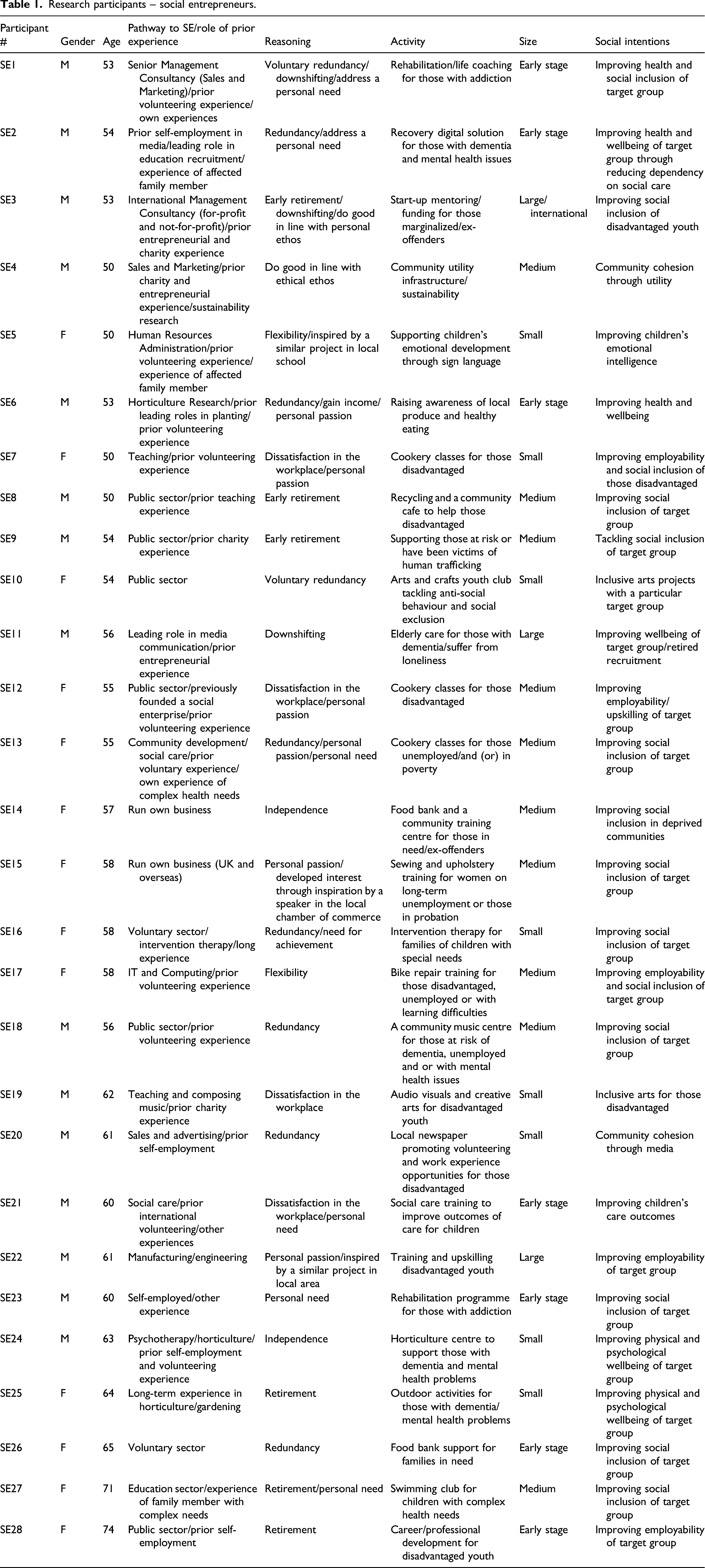
Notwithstanding definitional debates (Thompson, 2002), social entrepreneurs are often characterised by their compelling desire to address intractable social problems and create social value (Austin et al., 2006; Mair and Martí, 2006). Participants provided heterogeneous perspectives and experiences across gender, age, professional background, current activity and social venture size (Table 1). In-depth interviews allowed detailed exploration, focusing particularly on the prior experiences of participants, their understandings of their age and to what extent it influenced the formation of their SEIs. Interviews lasted from 45 minutes to one hour and were audio-recorded and transcribed. Participants were given numerical identifiers for anonymity. Each interview began with open invitation to describe ‘their background and prior experiences before starting their social venture’. This encouraged them to describe influences behind their social intentions and elaborate on topics meaningful to them. Participants were then asked how they made sense of their age and how it influenced their SEIs. Questions enabled clarity of research focus, whilst ensuring we ‘gave voice’ (Easterby-Smith et al., 2021) to participant’s subjective views.
Data analysis
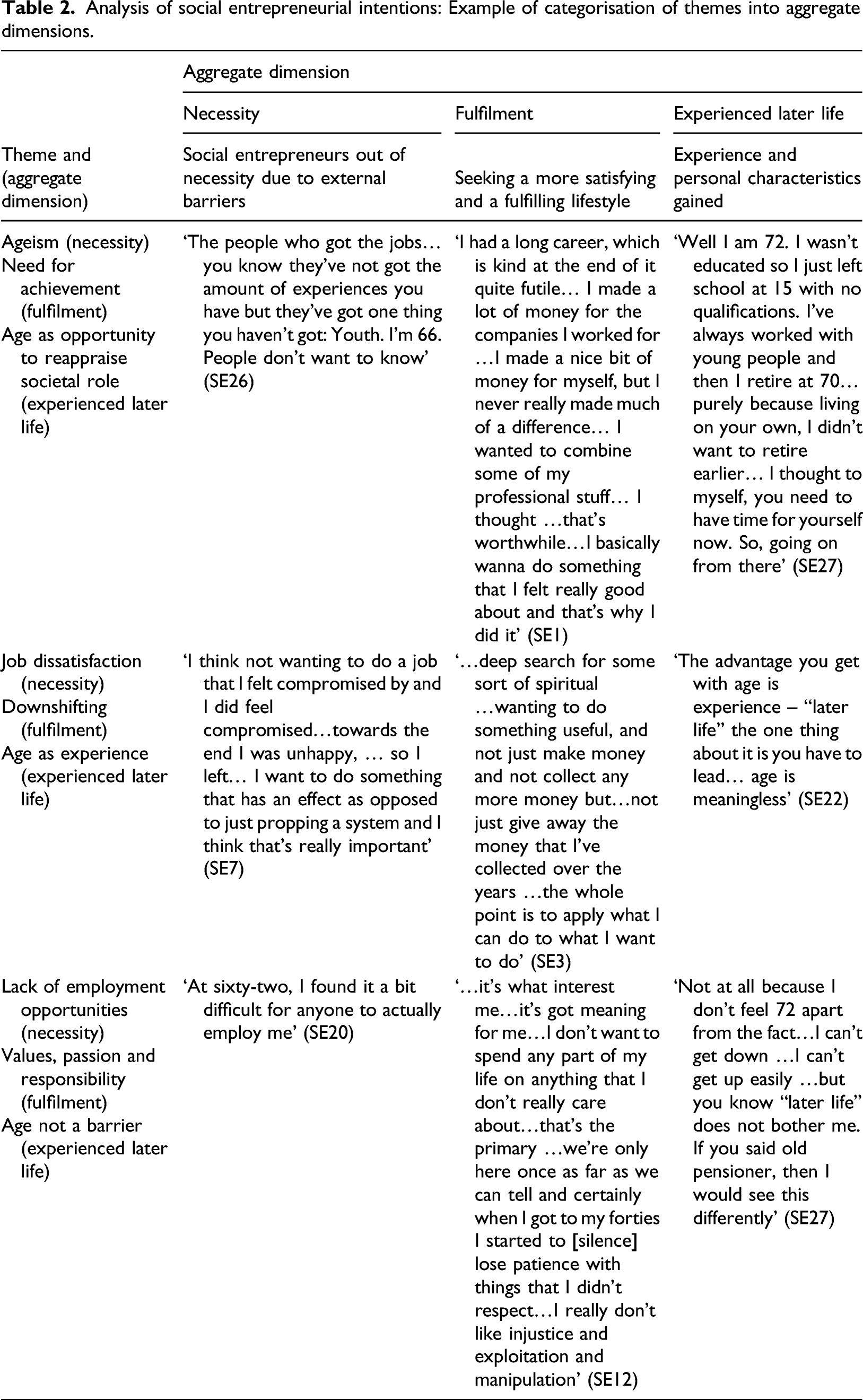
We adopted Gioia et al.’s (2013) inductive approach in the data analysis, which fits with our study’s social constructionist nature (Crotty, 1998). Supported by N-Vivo, analysis began with the close reading and re-reading of all transcripts, searching for meanings/patterns to explain how participants made sense of their social intentions. Our coding identified data-driven first-order concepts, informed by our research question and cognisant of the extant SEIs literature (Figure 1). These enabled us to unfold multiple meanings related to participants’ understandings of their social intentions. Next, while looking for commonalities and differences across transcripts, first-order concepts were categorised into second-order themes. This allowed identification of how participants made sense of their age and the extent this influenced SEIs. For example, for the second-order theme ‘lack of employment opportunities’ we noted those who spoke about external barriers like ‘redundancy’, ‘no other choices’ and ‘need income to support self’, associated their age with the formation of their SEIs. Following the abstraction process suggested by Gioia et al. (2013), second-order themes were grouped into aggregate theoretical dimensions, such as ‘necessity’. Looking for consistency between transcripts and identified dimensions and re-reviewing data analyses (Figure 1; Table 2), we considered the interplay between age and SEIs. We noticed that despite interplaying factors influencing social intentions like necessity, fulfilment and experienced later life, each revealed aspects of chronological and ‘felt’ age as focal antecedents shaping SEIs. The next section presents our findings. Data structure. Analysis of social entrepreneurial intentions: Example of categorisation of themes into aggregate dimensions.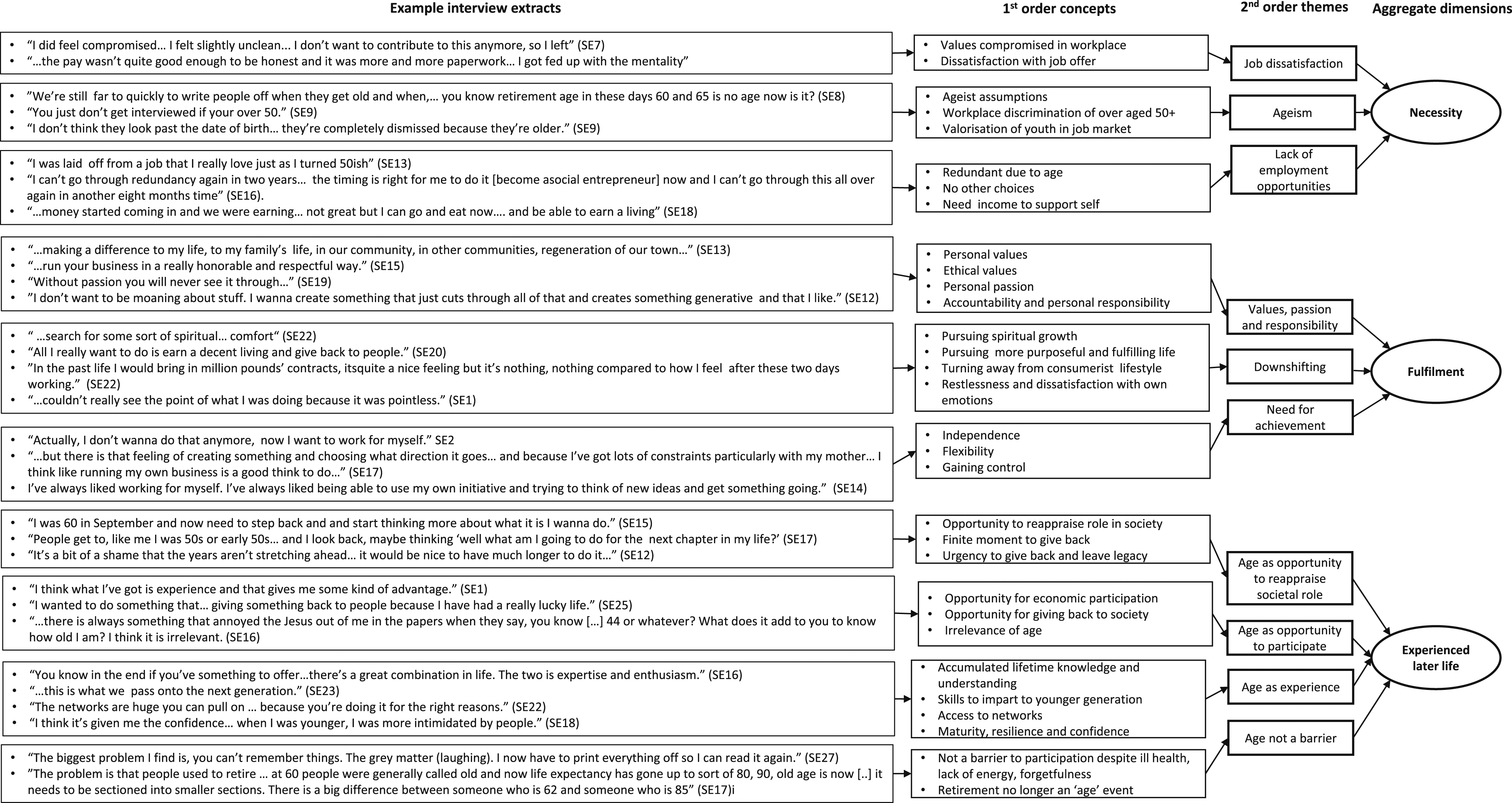
Findings
Necessity
In common with other studies on EIs in LWL (Walker and Webster, 2007; Weber and Schaper, 2003), our analysis revealed that nearly a third of participants became social entrepreneurs at least partly through having limited or ‘no alternatives’ due to what they experienced and/or perceived as ageism and lack of employment opportunities. However, where our findings depart from earlier research is that participants in our study provided more nuanced views. They explicitly stressed how their SEIs were inspired not just by necessity due to workplace age-barriers, but by their own positive constructions of age that gave them a crucial impetus to form their SEIs. SE26 and SE20 reflected that, although they decided to embrace social entrepreneurship when they lost their jobs, age played a key role in forming their SEIs along with the wish to feel useful through helping the disadvantaged in their communities and creating social value (Santos et al., 2021). …I have applied for jobs I know I’m well qualified to do and I’ve not even got an interview…I wanted to raise some money…social conscience, when you get to 50…taking the food to people…you don’t necessarily feel any older in yourself …you’ve got skills…but you’re overlooked…not seen as being useful (SE26). …it’s through necessity…I lost my job…because of my age…I never think of myself as being old…people of my age are probably better experienced being entrepreneurs than anyone of a younger generation…not interested in becoming a multi-millionaire…I just want to earn a living…people I serve…wanna give them back something…all for the benefit of the community (SE20).
Here, we see how SE26 and SE20 viewed SE as an option for gainful employment. Age provided them with experience and skills, thereby catalysing their SEIs (To et al., 2020). SE26 emphasised her 20 years’ experience in the voluntary sector giving her an advantage over younger counterparts. SE20 recounted frustration with the lack of employment opportunities for people of his age who were ‘ending on the scrappy’ once they were made redundant. However, reflecting the nuance and complexity of his SEIs, SE20 revealed how being over-50, with experiences to ‘impart to the younger generation’, made him ‘feel like a celebrity’. SE26 and SE20 disassociated themselves actively from being seen as social entrepreneurs solely through necessity, asserting their positive perceptions of their age in helping shape their SEIs. In doing so, they accentuated the role of age as a key antecedent to their SEIs, and not the stereotypical view of age as a barrier to social entrepreneurial activity. SE12 argued similarly that, while her motives were primarily to earn an income due to ‘no wealth or retirement savings’, age gave her an understanding of what ‘matters’ and ‘has meanings’. These influenced her SEIs to do ‘something creative…constructive’, as ‘this is what I have chosen to do…I have chosen to live…I have no aspirations to retire’. This is consistent with research highlighting that, although ‘older’ people can be perceived as economically and socially challenged, they often associate themselves with their ‘younger age’ identities, pursuing work, new knowledge and abilities (Balcombe and Sinclair, 2001; Barnhart and Peňaloza, 2013; Mayhew, 2005; Provencher et al., 2014; Razanova, 2010; Shmerlina, 2015).
Although participants did not consider themselves as social entrepreneurs entirely from necessity, they expressed dissatisfaction with the valorisation of youth over age in the job market (Tinsley, 2012) and perceived workplace resentment of over-50s. SE23 was unable to use his skills and experiences due to how the ‘whole ethics of society seems to be focused on youth and resenting the old generation…over-30, you’re past it….35 you had it…Not a life to be 40’. Nevertheless, he considered ‘having wider experience’ and ‘being over-50’ made him learn ‘how to achieve goals the hard way…’. In doing this, SE23 emphasised the antecedental role of age in shaping his SEIs while illustrating ‘goal striving’ (To et al., 2020) as a motivational outcome of social enterprise activity.
Highlighting the job market’s valorisation of youth, SE6 drew on his experience of being made redundant, despite his university-level education, arguing that social entrepreneurship was his only way to earn an income. He reflected how being over-50 meant he was ‘more confident’ and able to ‘synthesise ideas’, as ‘it’s been difficult…affected by the recession and then we got re-employed on a zero-hours contract’. He described himself as ‘experienced…an innovator…I understand the economic ways of continuing…ways you can do it and still be a socially responsible organisation’. SE6 believed his decision to become a social entrepreneur was not just out of necessity, but that age gave him the confidence to act on his SEIs. He depicted himself as an ‘innovator’, drawing on his hybrid purpose, combining social and economic missions (Zaremohzzabieh et al., 2019). This supports research on interplays between for-profit motives, innovation and social impact as among the antecedents of SEIs (Douglas and Prentice, 2019; Douglas et al., 2021).
Four participants said job dissatisfaction shaped their SEIs (Singh and DeNoble, 2003; Weber and Schaper, 2003). This was enmeshed with their discontent regarding welfare provision, social entrepreneurship being seen as addressing needs ignored by government agencies and private sector organisations (Dees, 2001; Di Domenico et al., 2010; Leadbeater, 1997). SE7 and SE9 asserted their discontent with existing welfare provisions influenced their decisions to become social entrepreneurs. They confirmed prior research findings that job dissatisfaction with lack of organisational incentives and innovative working environments compared to perceived future satisfaction in enterprise, greatly influences LWL EIs (Hatak et al., 2015; Singh and Onahring, 2019). Our findings show how social entrepreneurs perceive this was influenced by age in shaping their SEIs: ‘Funding not often spent on kids…I decided to leave…life is short…middle age…thinking what’s my job here?…What am I supposed to be doing?…nothing you can do that replaces the sense of saying this is good’ (SE7). ‘…I worked in an organisation…hit the ceiling of normalcy…they don’t like being constantly innovative…it got suffocating…for me we’ve got to do the best for the public…get relevant to stop this problem…to make it work which kind of forced me into social entrepreneurship…my age gave me a healthy disregard for trivia…without experience and expertise I probably wouldn’t be as successful and relevant to the solution…’ (SE9).
Both SE7 and SE9 demonstrated their multiple social intentions, with age playing a primary role in shaping these intentions rather than seeing themselves as ‘necessity’ social entrepreneurs. SE9 explained ‘being forced into entrepreneurship’ meant that, although dissatisfaction with existing provision influenced his intentions, age and the expertise gained throughout his career allowed him to see the need and relevance of his solution. Although SE7 explained how for her social entrepreneurship was the only option available to her when she had to change careers, her drive to engage in an activity to make a difference to her community came with her personal passion aligned with age (Cavazos-Arroyo et al., 2016; Chipeta et al., 2016; Chipeta and Surujlal, 2017; Ernst, 2011).
Social entrepreneurial intention literature, underscoring ‘older’ age as an antecedent to shaping SEIs, sees those in LWL as less likely to develop SEIs (Douglas and Prentice, 2019). Our findings reveal, despite negative impact from external barriers experienced due to ageism, lack of employment opportunities and job dissatisfaction, participants disassociated themselves from being seen as social entrepreneurs solely through necessity. Rather they demonstrated the role of age in shaping their SEIs and catalysing their social intentions.
Fulfilment
Research on EIs is characterised by understanding key factors influencing them in LWL. Findings suggest intrinsic factors like fulfilment, need for achievement and independence may positively shape these intentions (Gimmon et al., 2018; Kautonen et al., 2017; Kautonen and Palmroos, 2010; Walker and Webster, 2007). While previous research offers insights into how commercial LWL entrepreneurs form EIs, less attention is paid to how social entrepreneurs of the same age understand age as an antecedent to SEIs (Bacq and Alt, 2018; Santos et al., 2021). For our participants, fulfilment, viewed as ‘feeling good’, was a common theme, with fulfilment intertwined with re-appraising their societal roles.
SE1 spoke of leaving a successful career, seeking to address a social need which personally affected him (Hockerts, 2017). He emphasised how being over-50 had given him a sense of understanding that ‘spiritual growth’ was key to fulfilment. SE11 described an interplay between his age and wish for fulfilment; emphasising how his previous ‘busy lifestyle’ implied a ‘rat race where money is driving you’, with no ‘sense of community belonging’, leaving him emotionally restless. He recalled going through a questioning period, considering social entrepreneurship an option, downshifting on turning 50: …my wife had been travelling and had found an inflight magazine…‘why should I? You know salesman, businessman...She said ‘you…talked about doing something good for a long time’. That lived on my desk for quite a while till I picked up the phone…something hit my heart, wonderfully warm, lovely…I was shaking red and my wife said, ‘what’s the matter?’ and I said, ’I know what I wanna do now….
Being over-50 provided SE1 and SE11 with opportunities to re-appraise their societal roles. In being social entrepreneurs, both acknowledged that fulfilment had a higher value than money (Douglas et al., 2021; Douglas and Prentice, 2019), something they felt was reinforced by age. This was further emphasised by SE7 citing: ‘once you get to kind of 50…you have a sense of time is finite that I didn't have at 20…you’re getting old, and you have a limited number of really good productive years left at 50’.
Interplay between fulfilment and ageing/approaching retirement (Balcombe and Sinclair, 2001) emerged in participants accounts, and how by ‘retiring’ they were able to reconnect with their personal values and passions, and/or career change, leading to more fulfilment (Beehr and Bennett, 2015; Mayhew, 2005; Zissimopoulos and Karoly, 2003). SE8 established a link between his age, early retirement and the opportunities it provided for trying ‘different things’ like training as a coach, teaching and selling old books. This led to a career change into social entrepreneurship. Early retirement and being over-50 shaped his SEIs where he could create social value through his recycling social venture: …opportunities for people through apprenticeship, work experience, placements and volunteering opportunities…I’m not motivated by money. My satisfaction is actually seeing people having opportunities…getting bits of furniture…at the price they want…otherwise would have gone to landfill…Just being able to think about life from an independent point of view…I’m a lot happier…I have completely a clear conscience…I can sleep at night….
This response emphasised an interplay between age and sense of fulfilment through adding value to his local community by addressing social and environmental problems (Dees, 2001; Dees and Elias, 1998; Di Domenico et al., 2010; Leadbeater, 1997). Our study demonstrated the interplay between personal values and ageing in their multifaceted understandings, emphasising ‘accountability’, ‘personal responsibility’, ‘welfare’ and ‘ethical values’ (Bacq and Alt, 2018; Ip et al., 2021; Santos et al., 2021). Thus, for SE4, being over-50 had helped him to re-connect with his deep belief in ‘egalitarian sharing’, with his SEIs driven by ‘ethical values’ and ‘delivering productive change’ within his local community: …I got to a point where I might as well do something I want to do, whether it makes money or not because you only live once, rather than doing all these other things where you’ve a lot of fun, you’ve got money…so I kind of began to get quite firm ideas not so much what I wanted to do but how I wanted to do it…
Personal responsibility (Ip et al., 2021) to do good was linked to fulfilment by SE3. He took early retirement to become a social entrepreneur to help disadvantaged youth: ‘I’m not interested in making money for myself’ but in creating a ‘body of businesses that have choices about what they do with the money they make, and this is personal responsibility’. By doing this, SE3 did not deny that others in LWL could be influenced by different intentions. However, for him, age and ‘doing good’ reinforced his wish for fulfilment: I feel so much better in my life. I feel much much more…content than I ever had. I’m much happier now at 54 than I was at 24, 34, much happier, but that’s not unusual is it? There is a thing about people getting more content as they get older ...doing these things is fundamental to me. Working for me is fundamental...as I’m healthy I just keep doing these sorts of things until I can’t do it anymore…
Both SE4 and SE3 emphasised their age’s role in driving their SEIs. Being over-50 presented opportunity to re-appraise their social roles, to identify social entrepreneurship as aligning with their ethical/social values to achieve fulfilment. SEI studies have found antecedents like moral judgement, social values, responsibility and accountability shape SEIs (Bacq and Alt., 2018; Santos et al., 2021; Tiwari et al., 2020). Our data revealed over a third of participants identified need for independence, flexibility and control over their lives as factors influencing them to become social entrepreneurs. These intertwined with age shaping their SEIs. SE16 and SE17 reflected that, although gaining ‘flexibility’ and ‘control over their lives’ influenced them, age was a key enabler to acting on their SEIs: …I was the right age…mortgage has been paid…I wasn’t ready to retire…I can’t believe I’m 60 next year…I feel I’m 40…I knew exactly how I wanted it to be…I knew what sort of an employer I wanted to be…it was the right stage because I was financially secure…I’ve waited till I retire…feeling really alive…. (SE16) ‘I started because of my age, early-fifties time when you have few commitments and probably most well-off in your life…it’s a good opportunity…’ (SE17)
Age helped SE16 and SE17 to realise their SEIs, allowing them to act on identified needs for flexibility and control. SE16 saw her age as giving her financial stability to retire and ‘pay her mortgage’. She recounted her resentment towards her previous employer for not enabling her to ‘prove herself’, deciding to ‘claim back control’ with her social venture. SE17 recounted her experience of leaving a successful career in IT to care for her mother, gaining flexibility through her social venture, age giving her an urgent sense to do what she had always wanted to do by being creative and able to develop her ideas. Age was key for SE16 and SE17, shaping their SEIs to enable them to address a need for fulfilment.
Despite participants having multifaceted understandings of what fulfilment meant for them, their accounts revealed an ongoing and dynamic interplay between their positive construction of age and their SEIs. While other studies found ‘older’ people less likely to form SEIs (Douglas and Prentice, 2019), our data revealed how participants accentuated their age’s role as an antecedent shaping their SEIs, by linking their age with fulfilment.
Experienced later life
The literature shows antecedents influencing SEIs, such as experience, knowledge and social capital (Ernst, 2011; To et al., 2020; Zaremohzzabieh et al., 2019). Yet, less attention has been paid to exploring how LWL social entrepreneurs understand the interplay between their age and life experiences. In our study, all participants emphasised their ‘experienced later life’, revealing how skills, knowledge and expertise were gained over their lifetime careers (Hulmes, 2012; Kautonen, 2008; Kautonen et al., 2010; Singh and DeNoble, 2003; Weber and Schaper, 2003), and shaped their SEIs, even despite health limitations. Participants provided insights, linking age to attributes like maturity, resilience and confidence, as advantages over younger counterparts (Ong et al., 2006).
Acknowledging the benefits of prior experience, SE3 pointed to ‘twenty-five years of running companies of all sorts…I definitely bring basic management skills, financial management, very strong commercial skills’. With ‘prior experience’, he argued age gave over-50s freedom to act on SEIs. Compared to younger entrepreneurs who may ‘need an income….for a mortgage or family’; it was ‘not typically a big driver’ for over-50s, who were more free to engage in social enterprise activities and make a difference ‘in terms of one’s sense of wellbeing doing it…the comfort of doing it, and …the skills, knowledge, and experience of being able to do it’. SE3 commented: ‘younger entrepreneurs wouldn’t have enough experience to be able to handle this…they haven’t been around long enough…my life experience meant I knew how to deal with people who are mentally ill and that it is possible to recover…’ Age was seen as intertwined with life experience.
All participants articulated benefits of their age for social enterprise activity. They suggested ‘experienced later life’ was revealed through personal attributes like ‘resilience’ (SE2; SE12; SE13), ‘maturity’ (SE5; SE9; SE11) and ‘confidence’ (SE6; SE7; SE13). For SE8, while over 30 years of public sector experience gave him access to social networks, his age provided him with attributes like determination, innovation, risk-taking and a different perspective, all of which shaped his SEIs: …the perspective and the experience you’ve got as an older person certainly helps and any other skills from having done something previously stood me in very good stead and it teaches you determination…I just grit my teeth and say, ‘right I’m gonna make this one work’. You constantly appraise and reappraise…experience allows you to sit back and think…what you can take a risk with and how far you can allow…it gives you a different perspective on things…
SE8 emphasised skills gained through his prior experience (Akola, 2008; Kautonen et al., 2010, 2011, 2014; Say and Patrickson, 2012; Singh and DeNoble, 2003), while drawing on the attributes of his age and how these shaped his SEIs. SE22 described the financial ‘burden’ experienced during the social entrepreneurial process, making him ‘physically sick’, and how ‘resilience’ which came with age helped shape his SEIs: …I didn’t think I had resilience because life has been easy…had a good job, made very good money but I assure people now that I’m resilient. People ask how are you going to replicate [me]?…you probably won’t find …someone who is resilient…
Such positive constructions of age were common across all participants. For SE18: ‘…my age gave me a good background for what I’m doing now…ran a business in the past…made enough mistakes to learn. So, I had quite a lot of experience…years working for the local authority and a lot of the work I do now is in connection with the local authority. So, I had thirty-five years’ training for this role’.
In aligning age with positive attributes, participants paradoxically highlighted feelings relating to combining ‘later life experiences’ and feeling a ‘younger age’, as the dominant discourse on ageing. They distanced chronological ageing from perceptions of a younger identity (Schafer and Shippee, 2009; Shmerlina, 2015; Yang and Lee, 2010). When asked about age, most used words like ‘meaningless’, ‘don’t feel any different’ and ‘getting really started’. SE12, picked a hair strand to illustrate frustration: ‘I don’t dye my hair…I’m not later life…no intentions of retiring…more capable now than I have ever been’. SE22 recounted experiences of transporting himself to his younger self, feeling both child and adult, advantages of age, characterised by ‘wisdom’ and ‘social networks’: …I am a child…on a big adventure…I want to take a lot of young people on board…I have experience…wisdom I can share…I don’t get upset by being called old…what age brings…experience and a wealth of knowledge you can share…the networks are huge…you’re doing it for the right reasons…to make a difference.
Our findings demonstrate how, for participants, chronological age was not a barrier, as they identified more with ‘felt’ age. This was even the case for those who spoke of potential health limitations (Curran and Blackburn, 2001a); still perceiving age as a positive construct shaping their SEIs. SE27 stated although: ‘I can’t kneel on the floor easily…I don’t feel any different since you’ve got something to occupy your mind and you really enjoy doing it’. SE27 stressed the difference between chronological ageing, her physical limitations and her ‘felt perception’ of her age (Shmerlina, 2015). She reflected the participants’ overall positive ‘can do’ descriptions of their age and SEIs.
Discussion and contributions
We began this research with the important, but under-explored question, of how age is understood as an antecedent of SEIs in LWL. Our study demonstrates the interplay of age and necessity, fulfilment and experienced later life in influencing the SEI of over-50s, emphasising age’s key role in forming the social intentions of those in LWL. We thereby diverge from existing social entrepreneurship research that tends more to predict or test the antecedents shaping SEIs (Douglas et al., 2021; Douglas and Prentice, 2019; To et al., 2020). We suggest that understanding the decision to become a social entrepreneur in LWL entails more nuanced engagement with the complexities of how the over-50s view the role of age in shaping their SEIs. The social entrepreneurial intentions of those in LWL cannot be fully understood without considering their own perceptions of what chronological and felt age means for them, and how their intentions are formed.
Our research reveals the interplay between necessity and fulfilment and how both simultaneously shape the SEIs of the over-50s. Despite a multiplicity of factors spurring participant decisions to become social entrepreneurs, like ageism, dissatisfaction in the workplace and lack of employment opportunities (Kautonen, 2008; Singh and DeNoble, 2003; Walker and Webster, 2007), all highlighted how age played a key role in shaping their SEIs. As such, the dynamic interactions between necessity and fulfilment depict the extent to which participants re-negotiated the role of their age in forming their SEIs, whereby they simultaneously recognised that, although age is often perceived in society as a barrier to economic participation (Balcombe and Sinclair, 2001; Coupland et al., 2008; Razanova, 2010), they do not feel old (Barnhart and Penãloza, 2013; Schafer and Shippee, 2009; Shmerlina, 2015). Rather they perceive age as an opportunity to engage in social entrepreneurial activities (Beehr and Bennett, 2015; Ruhm, 1990; Say and Patrickson, 2012). Our participants disassociated themselves from being ‘necessity social entrepreneurs’ since their positive constructions of age intertwined with their need for fulfilment. Through this interplay, they recognised age’s meaning for them, and what they needed to do to actualise their SEIs by ‘doing good’ within their communities thus, achieving fulfilment. Age, therefore, can be viewed as having catalysed their SEIs, allowing them to create social value, reflecting existing literature that social entrepreneurs are often motivated by addressing intractable social problems and engendering social change (Austin et al., 2006; Mair and Martí, 2006).
The ‘fulfilment’ dimension provides a more nuanced understanding of what this meant for the LWL social entrepreneurs and its interplay with their own positive constructions of age. Participant understanding of ‘fulfilment’ varied; with some pursuing social entrepreneurial activities in line with their personal values and passions (Bacq and Alt, 2018; Santos et al., 2021); and others as an opportunity to ‘downshift’ (Hamilton, 2003; Juniu, 2000) and fulfil their felt ‘need for achievement’ and ‘gaining control’ (Singh and DeNoble, 2003). Yet, older age was seen by all as an opportunity to re-appraise their societal roles, giving them a sense of urgency to realise their SEIs. Participants combined age and fulfilment as factors shaping their SEIs. This interplay adds more insight to research findings that intrinsic factors like fulfilment, need for achievement and independence shape EIs in LWL (Gimmon et al., 2018; Kautonen et al., 2017; Walker and Webster, 2007). Our study demonstrates how, for LWL social entrepreneurs, age is a focal antecedent shaping their SEIs. Other social entrepreneurial studies reveal how pro-social motivations such as empathy, moral obligations, social responsibility, self-actualisation and goal striving (Hockerts, 2015; Ip et al., 2021; Santos et al., 2021; To et al., 2020) influence SEIs. While ‘older’ people have been found less likely to form SEIs (Douglas and Prentice, 2019), our study reveals the interplay between age and fulfilment when considering the over-50s’ SEIs formation, bringing to the fore the dimension of age as a key enabling antecedent shaping the over-50s’ SEIs. ‘Felt’ perception of age encouraged our participants to engage in social entrepreneurial activities in order to gain fulfilment through making a difference to their communities.
Finally, ‘experienced later life’ represents participant perceptions of the benefits of their age to social entrepreneurial activity. Mainstream entrepreneurship research shows prior experience, management and leadership skills all influence EIs in LWL (Akola, 2008; Kautonen et al., 2011; Say and Patrickson, 2012; Singh and DeNoble, 2003); while social entrepreneurial intent studies show social and human capital to be antecedents influencing SEIs (Ernst, 2011; Hockerts, 2015). We add to existing research, demonstrating interplay between age and experienced late life and how this plays a key role in shaping SEIs in LWL. ‘Experienced later life’ offers more nuanced understanding of how the participants perceived their age as giving them added benefits compared to their younger counterparts, enabling access to resources and social networks built over their lifetime. Participants associated age with positive attributes like resilience, maturity and confidence, accentuating its role in shaping SEIs. Age can be considered a subjective construct dependent on how older people perceive their own chronological age and experience the ageing process (Barnhart and Peňaloza, 2013; Schafer and Shippee, 2009; Shmerlina, 2015). Our study demonstrates how identifying with their younger selves, even when experiencing health limitations, increased the participant’s wish to pursue social entrepreneurial activities. Age and health were considered positively, contrasting with extant research findings that ill health and lack of energy may negatively influence EIs in LWL (Curran and Blackburn, 2001a; Weber and Schaper 2003).
Our study offers important contributions. First, we contribute to SEI, LWL and EI literature, revealing how the interplay between necessity, fulfilment and experienced later life intertwine with LWL social entrepreneurs’ positive constructions of age. This is a key step in understanding the extent to which age shapes social intentions in LWL. While studies already bring significant insights into the antecedents shaping SEIs, their point of departure is to view these antecedents as separate variables to be predicted or tested (Bacq and Alt, 2018; Dickel and Eckardt, 2021; Douglas et al., 2021; Douglas and Prentice, 2019; Ip et al., 2021; Santos et al., 2021; Tiwari et al., 2020; To et al., 2020; Tucker et al., 2019; Wach et al., 2021). Prior studies quantitatively examined antecedents of SEIs (Ip et al., 2021; Santos et al., 2021); our qualitative approach gives nuanced understanding of how LWL social entrepreneurs construct their age’s meaning, and how this affects their SEIs.
Second, we also contribute to EI literature by revealing the dynamic and positive nature of their intentions, and those factors that intertwine to form the SEIs of those in LWL. Research findings tend to highlight how age relates to commercially-oriented decisions influencing EIs, highlighting experiences and perceptions of ageism and economic necessity (Hatak et al., 2015; Kautonen, 2008; Kautonen and Palmroos, 2010; Singh and DeNoble, 2003; Weber and Schaper, 2003). Our study focuses on the paradoxical interplay of those more nuanced factors influencing social entrepreneurs’ EIs, particularly in LWL. We believe this interplay is important as it shows the decision to set up a business venture when aged over-50 cannot be understood solely through the lenses of economic necessity and/or fulfilment of mainly commercial goals. Rather, it is more nuanced and dependent on perceiving the advantages of age in relation to their participation in the social entrepreneurial process in LWL and their role in society.
Third, this study emphasises the importance of age and the complexity of its influences in forming SEIs. By focusing on over-50s social entrepreneurs, we reveal the formation of SEIs as complex and nuanced. Our participants distanced themselves from being seen solely as necessity entrepreneurs and, even recognising some of the health limitations that often come with age, they were able to act on their social intentions, prioritising their need for fulfilment, supported by their prior experiences that gave them benefits over and above their younger counterparts. For the over-50s social entrepreneurs in this study, age is a key antecedent enabling them to re-appraise their role in society; their perceptions acting as antecedents that help form their social intentions. There is increasing recognition that age positively influences EIs (Akola, 2008; Kautonen, et al., 2010, 2011; Say and Patrickson, 2012; Singh and DeNoble, 2003). These studies highlight the emphasis those over-50 place on continuing their economic participation and social involvement, with age not perceived as a barrier to entrepreneurial and volunteering activities (Gray, 2009; Onyx and Warburton, 2003). Research has found that shifting perceptions of retirement and ageing processes (Barnhart and Peňaloza, 2013; Beehr and Bennett, 2015; Schafer and Shippee, 2009) mean that ‘older people’ often identify with their younger age selves, pursuing new knowledge and work (Schafer and Shippee, 2009; Shmerlina, 2015; Yang and Lee, 2010). Yet to date little research has focused on the over-50s and the ways in which they understand the role of age in forming their SEIs. Our study, therefore, brings to the fore how these LWL social entrepreneurs negotiate the role of their age in terms of their SEIs. As our data reveals, participants were engaged in making a difference to their communities, and within the context of social entrepreneurship the over-50s play a key role in creating social value and engendering social change (Di Domenico et al., 2010).
Limitations
Our study seeks to broaden understanding of over-50s social entrepreneurs’ perceptions of age as an antecedent forming their SEIs. Our findings show the interplay of necessity, fulfilment and experienced later life, age playing a significant role in shaping their SEIs. This is important, given the increased evidence that those within this age cohort often act within their younger age identity, seeking socioeconomic participation (Barnhart and Peňaloza, 2013; Shmerlina, 2015). Although a rigorous methodology was adopted for unpacking how participants understand the influence of age in shaping their SEIs, we acknowledge its limitations. First, our study does not focus on contextual or institutional influences that may encourage or discourage social entrepreneurial activities for those in LWL. Second, we focus on social entrepreneurs aged over-50, which does not account for the heterogeneity of younger and older social entrepreneurs, and the diversity of their SEIs. We discuss these further below, as well as future research directions that can further advance this stream of research.
Future research directions
Building on social intent research in the social entrepreneurship literature, we examined age as an antecedent that shapes the SEI of over-50s. While a growing number of studies focus on the antecedents influencing the formation of SEIs (Bacq and Alt, 2018; Dickel and Eckardt, 2021; Douglas et al., 2021; Ernst, 2011; Hockerts, 2018; Ip et al., 2021; Mair and Noboa, 2006; Tiwari et al., 2020; Tran et al., 2016), our findings provide rich insights into how necessity, fulfilment and experienced later life intertwined with age as an antecedent shaping the SEIs of over-50s. In our attempt to understand the subjective perceptions of our participants within a distinct UK context, our study does not account for all the diverse contextual or institutional influences that may facilitate or discourage engagement in social entrepreneurial activities for those in LWL (Ernst, 2011; Hockerts, 2018; Tiwari et al., 2020; Tran et al., 2016). Future research directions in other contexts not only in terms of geographical settings but also institutional ecosystems could offer further understanding of how they can positively or negatively foster social entrepreneurialism for the over-50s. Second, our study focuses on the over-50s social entrepreneurs, and given the critical role of age in explaining their SEIs, it would be valuable for future qualitative research to extend this work by comparing ‘older’ and ‘younger’ cohorts’ understandings of the role of age in forming their SEIs. We believe this can lead to new theory and empirical developments in the field of social entrepreneurship by unpacking similarities and differences among both age categories. Third, the robustness of our findings could be tested through quantitative survey methods to establish their statistical generalisability. Our qualitative approach yielded rich insights into how decisions to engage in social entrepreneurial activities could be indicative of the need to create social value (Austin et al., 2006; Mair and Martí, 2006), or use their prior experience, skills and social networks (Hulmes, 2012; Kautonen, 2008; Kautonen et al., 2010; Singh and DeNoble, 2003; Weber and Schaper, 2003). Thus, our approach offers two significant benefits. First, it enabled us to examine, at the micro-level, how over-50s social entrepreneurs understand age as an antecedent shaping their SEIs. It further extends SEI literature, by adding the dimension of age as a focal antecedent forming SEIs in LWL. Our study thus brings new insights regarding how age intertwines with LWL social entrepreneurs SEIs. Second, in capturing the depth and breadth of participant understandings of what their age meant when presented with opportunities to engage in social entrepreneurship activities, we highlight the fact that LWL social entrepreneurs cannot be considered a homogenous group, emphasising how they vary in their SEIs and understandings of the factors that led to their decisions in becoming social entrepreneurs.
Conclusion
The focus of our study was examining how LWL social entrepreneurs understand age as an antecedent shaping their SEIs. We adopted a qualitative approach that enabled us to unpack how participants understood the role of age in shaping their SEIs. In common with extant research on EIs, our findings highlight how the over-50s may consider entrepreneurship as a career choice due to external barriers like ageism and lack of employment of opportunities, together with more intrinsic motives such as the need for fulfilment (Gimmon et al., 2018; Kautonen and Palmroos, 2010; Kautonen et al., 2017; Singh and DeNoble, 2003; Walker and Webster, 2007; Weber and Schaper, 2003). However, these intentions are more nuanced in terms of the paradoxical interplay of factors that influence social entrepreneurs’ EIs in LWL. Those who become social entrepreneurs through necessity usually dissociate themselves with being seen solely in this way, emphasising age intertwines with their need for fulfilment through making a difference to their communities. Their positive constructions of age highlight perceived benefits compared to their younger counterparts and intertwine with their need for fulfilment, when enacting their SEIs. Our findings therefore highlight that the decision to set up a business venture in LWL cannot be understood solely through the lenses of economic necessity and/or fulfilment of mainly commercial goals.
The social entrepreneurship literature argues that among the antecedents shaping SEIs are prosocial motives, like empathy, social responsibility, moral obligations and judgements (Bacq and Alt, 2018; Hockerts, 2015; Mair and Noboa, 2006), human and social capital (Ernst, 2011; Zaremohzzabieh et al., 2019), perceived social support, extrinsic rewards (Ip et al., 2021) and personal satisfaction (Tucker et al., 2019). This was reflected in our research study, the need to make a difference and ‘do good’ in society being common across all our participants. However, the findings generated by our study captures the unique interrelated influences driving the over-50s’ SEIs. This provides rich insights into what catalysed their decisions in becoming social entrepreneurs, with age playing a key role in forming their SEIs. Our findings, therefore, depart from earlier studies on SEIs that tested or predicted antecedents shaping SEIs as separate variables, by demonstrating the heterogeneity of LWL social entrepreneurs and the intertwining process through which their SEIs are formed. In particular, the focal role of age on SEIs provides novel insights regarding LWL social entrepreneurs’ constant negotiation and re-negotiation of the meanings of their age and their role in society, giving them a sense of urgency to act on their SEIs. This contributes to the social entrepreneurship literature by illustrating the need to reconsider age’s role and importance in SEIs formation.
Footnotes
Funding
The author(s) disclosed receipt of the following financial support for the research, authorship, and/or publication of this article: This work was supported by the Economic and Social Research Council (DTC), the University of Surrey and a third sector organisation.
